

Your wife used to complain that you were not present enough; now she has stopped asking for your attention, built more of a life without you, and may even be talking about divorce.
Take This 2 Minutes Quiz
That reversal can mess with your head.
There was a time when she wanted you to listen more. She wanted more conversation, affection, attention, involvement, or emotional presence.
You may have been confused because you believed you were already there.
worked, provided.
…You handled responsibilities.
Your life revolved around keeping the family together.
From your perspective, that was presence.
But physical presence and experienced connection are not automatically the same thing.
What Would Help You Most Right Now?
Choose the option that best matches where you are with your marriage.
My Marriage Is in Serious Trouble
If you're dealing with separation, divorce, loss of attraction, infidelity, intimacy problems, or a spouse who's pulling away, get help looking at what's happening in your specific situation.
Get Personalized Help →
Start With Get My Marriage Back
Get the book and start learning the principles for moving your marriage in a better direction.
Get the Free Book →Then something changed.
She stopped complaining.
At first, that may have felt like progress. The arguments decreased. She stopped asking you to talk. She no longer complained that you were always busy.
Until you noticed something uncomfortable:
She did not necessarily stop complaining because the problem was solved.
She may have stopped expecting you to solve it.
Now she has friendships, activities, events, work, lunches, interests, or an entire social world that does not revolve around you.
Suddenly, you are the one feeling disconnected.
And when your wife is pulling away and wants divorce, that reversal can trigger exactly the behavior that makes attraction even harder to rebuild.
When Your Wife Stops Needing Your Attention, Rejection Can Become Obsession
Attention has an interesting way of becoming more valuable when nobody is asking you for it anymore.
Yesterday, she wanted your attention and you were busy.
Today, she seems perfectly capable of enjoying herself without it, and suddenly you are watching everything.
Where is she going?
Who is going?
Why is she dressed like that?
Who is that guy?
Why did they have lunch together?
Did she mention him again?
Why does she seem happier around everybody else?
Those questions do not automatically make you controlling.
Feeling insecure is not a crime.
Insecurity is information.
You can feel threatened, rejected, excluded, jealous, confused, or frightened by a changing marriage without turning those feelings into your identity.
The danger begins when a feeling becomes a prosecution.
Now your wife has to prove her innocence every time she lives her life.
You question.
She becomes defensive.
You interpret her defensiveness as additional evidence.
She withdraws.
Her withdrawal increases your suspicion.
Then you question harder.
Before long, you are no longer responding to what you actually know. You are responding to a case being built inside your head.
That cycle is especially dangerous when your wife already wants separation or divorce.

Attraction Shift #1: Separate What You Know From What You Fear
Suppose your wife has developed an active social life.
She attends events. Maybe she volunteers, networks, works outside the home, goes to brunch, attends community functions, or spends time with friends.
Some of those environments naturally include men.
That fact alone does not prove infidelity.
At the same time, emotional intelligence does not require becoming naive.
If you have concrete evidence of deception, inappropriate boundaries, an affair, or cheating, deal with the facts in front of you.
But facts and fear are not interchangeable.
A grounded question sounds like:
“What do I actually know?”
An insecure prosecution sounds like:
“What can I find that proves what I already fear?”
Those mindsets produce completely different behavior.
When you manufacture certainty because uncertainty hurts, you can end up punishing your spouse for conclusions you have not established.
That is not confidence.
And it is rarely seductive.
Attraction Shift #2: Stop Making Her Responsible for Regulating Your Fear
Your wife goes out Saturday.
You spend Saturday monitoring the clock.
She comes home.
You want details.
Who was there?
Who did you talk to?
Where did you go afterward?
Why didn’t you answer immediately?
Did that guy show up?
One reasonable question can quickly become an interrogation when its real purpose is not understanding—it is emotional regulation.
You need her answers to make your anxiety disappear.
That is a tremendous amount of pressure to put on someone who may already be pulling away.
Seduction requires voluntary movement.
Attraction needs enough emotional oxygen for two people to remain individuals while choosing each other.
When every interaction contains the invisible demand, “Make me feel secure about us right now,” your spouse can begin experiencing your presence as emotional work.
You can desire your wife deeply without making her responsible for stabilizing you.
That distinction is powerful.
Attraction Shift #3: Understand Why “I’m Here” May Not Have Felt Like Connection
One of the most useful questions you can ask yourself is not:
“Was I a good spouse?”
Ask instead:
“What was it like to experience me?”
Those are not the same question.
You can be responsible, faithful, hardworking, committed, and dependable while still being emotionally difficult to reach.
Maybe you were physically home but mentally elsewhere.
Perhaps every conversation competed with your phone, work, business, television, stress, or exhaustion.
She may have repeatedly felt unheard while you repeatedly felt unfairly accused.
This is where attraction becomes more sophisticated than simply being a “good husband” or “good wife.”
Moral value matters.
But attraction is experienced value.
Your spouse experiences your presence, emotional intelligence, confidence, curiosity, warmth, sexuality, humor, boundaries, decisiveness, responsiveness, social intelligence, purpose, and ability to listen without immediately defending yourself.
Relationship research supports an important piece of this. Studies have found that perceived partner responsiveness—experiencing a partner as understanding, validating, and caring—is associated with intimacy and sexual desire. In one series of studies, the responsiveness-desire association was particularly strong among women. You can review the research on partner responsiveness and sexual desire.
That does not mean becoming endlessly agreeable.
Responsiveness is not submission.
Listening does not mean surrendering your judgment.
Understanding her experience does not require agreeing with every interpretation she makes.
It means becoming capable of receiving another person’s experience without immediately making the conversation about proving yourself innocent.
Attraction Shift #4: Do Not Confuse Being Needed With Being Desired
You may have heard that people—especially men—need to feel needed.
Be careful with that idea.
There is an enormous difference between being valuable to your spouse and needing your spouse to depend on you so you can feel valuable.
Imagine that your wife has become more independent.
She has friends.
She can entertain herself.
Her career or business is growing.
She has interests outside the marriage.
If your security depends on her dependence, her growth can feel like your rejection.
You may start trying to regain importance by becoming more controlling, more involved, more critical of her outside relationships, or more demanding of her time.
That is not intimacy.
Dependency is not the same thing as attraction.
A seductive marriage contains choice.
“I can live a meaningful life, and I still choose you” carries a different emotional energy from “I need you to need me so I know I matter.”
One creates room for desire.
The other can turn marriage into an emotional hostage situation.
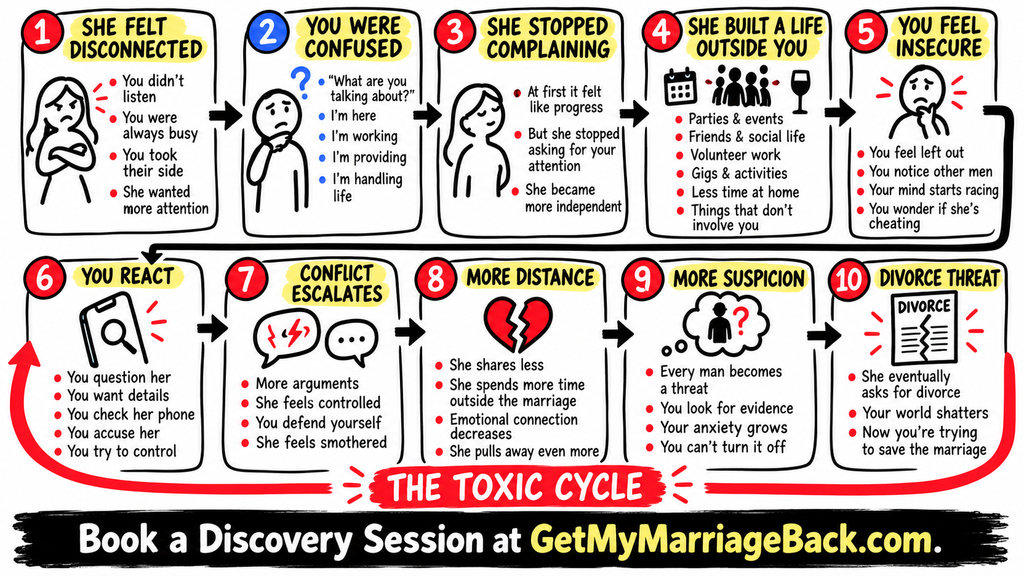
Attraction Shift #5: Interrupt the Rejection → Suspicion → Pressure Cycle
Here is the toxic cycle to watch:
Disconnection → Independence → Insecurity → Suspicion → Accusation → Conflict → More Distance → More Suspicion
The problem is not merely that your wife has become distant.
The problem is what the two of you repeatedly create after the distance appears.
You feel rejected.
Fear wants reassurance.
Reassurance does not last, so you monitor.
Monitoring produces questions.
Questions become accusations.
Accusations produce defensiveness.
Defensiveness feels suspicious.
Now the cycle has evidence to feed itself.
This can continue for months or years.
Eventually, you may become terrified that your wife wants divorce while behaving in ways that make being married to you increasingly exhausting.
That is the contradiction.
Your fear says, “Hold tighter.”
Attraction often needs you to become emotionally strong enough to stop squeezing.
Attraction Shift #6: Rebuild Yourself Around Grounding, Purpose and Self-Discovery
When your wife is pulling away and wants divorce, your world can become painfully small.
Everything becomes about her.
Her mood.
…phone.
Her schedule.
…affection.
Her texts.
…social life.
Her decision about the marriage.
That is too much power to hand another human being.
Start with Grounding.
Ground yourself in something true that exists beyond whether your wife chooses you today.
Your emotional stability cannot rise and fall entirely according to whether she smiled at breakfast.
Then reclaim Purpose.
Purpose is mission, contribution, impact, and legacy beyond the immediate marriage crisis.
That does not mean abandoning your spouse.
It means refusing to make saving your marriage your only identity.
Return to meaningful work.
Take care of your body.
Reconnect with healthy friendships.
Become socially alive again.
Create.
Lead.
Learn.
Contribute.
Handle neglected responsibilities.
Develop parts of yourself that disappeared while you were obsessing over the relationship.
Then practice Self-Discovery.
Do not merely ask, “How do I get my wife back?”
Ask:
“Who have I become?”
“What is it like to experience me?”
“Where did confidence become reassurance-seeking?”
“Did love become fear?”
“Where did pursuit become chasing?”
“Did leadership become control?”
“What have I stopped developing in myself?”
That is a much more attractive project than spending another six months investigating brunch.
Attraction Shift #7: Create Experiential Value Instead of Performing for Approval
There is a trap here.
Once you understand that your experience matters, you may start performing.
You become extra helpful.
Extra romantic.
Extra agreeable.
Suddenly you are at the gym every morning, buying flowers every Friday, cleaning everything, planning dates, changing your wardrobe, and becoming Husband of the Year.
But underneath the transformation is an invisible question:
“Do you want me now?”
That is still reassurance-seeking.
Your wife can often feel the transaction even when you never say it.
Experiential Value is different.
It asks:
What does my presence consistently create?
Do I bring emotional stability or volatility?
Curiosity or predictability?
Warmth or pressure?
Purpose or obsession?
Playfulness or constant seriousness?
Desire or desperation?
Healthy boundaries or control?
Listening or prosecution?
Growth or performance?
You are not building value to force your spouse to reward you.
You are developing into someone whose experience is naturally more attractive.
That is where curiosity can begin returning.
Value can create Curiosity.
Curiosity gives Attraction room to breathe.
Attraction expands Influence.
Influence can eventually create Leverage for building a different marriage.
Value → Curiosity → Attraction → Influence → Leverage
Notice what is absent from that sequence.
Begging.
“But What If She Really Is Cheating?”
Then the facts matter.
Emotional intelligence is not pretending betrayal cannot happen.
The objective is to become capable of addressing reality without inventing additional reality.
If evidence establishes an affair, the marriage now has an infidelity problem requiring boundaries, decisions, accountability, and a different conversation.
If you do not have evidence, repeatedly treating your spouse like a cheating spouse can create damage without giving you greater clarity.
You do not need paranoia to have standards.
Strong boundaries and emotional stability can exist together.
Stop Arguing About Whether You Are “Controlling”
Your wife says:
“You’re controlling.”
Your instinct may be immediate:
“No, I’m not.”
Then you spend twenty minutes debating the definition of control.
You explain that asking where your wife went is normal.
She explains how your questions feel.
Next, you defend your intentions.
She describes your behavior.
Eventually, you are fighting semantics while your marriage is bleeding.
Try a more emotionally intelligent approach.
Become curious about the experience underneath the accusation.
“What am I doing that feels controlling to you?”
That question is not an admission of guilt.
It is information gathering.
You can understand why something feels controlling to her and still decide that a particular boundary or concern is reasonable.
The objective is clarity—not surrender.
When Your Wife Wants Divorce, Stop Trying to Win the Immediate Moment
Divorce language creates urgency.
Your nervous system screams:
Fix this now.
Convince her now.
Get reassurance now.
Make her remember the good times.
Prove you’ve changed.
Promise everything.
But panic is rarely seductive.
Your spouse did not arrive at emotional withdrawal five minutes ago simply because she used the word “divorce” five minutes ago.
There is usually a history.
Listen to that history.
Look for patterns.
Take responsibility for what is actually yours.
Stop accepting responsibility for what is not.
Most importantly, resist the urge to turn every interaction into a referendum on whether she is staying.
A marriage crisis requires deliberate behavior.
Not frantic behavior.
Attraction Is Not Something You Extract From Your Wife
You cannot force curiosity.
…negotiate desire.
You cannot guilt somebody into genuine affection.
And you cannot interrogate another person into feeling safe enough to move toward you.
What you can do is change the experience you contribute to the marriage.
Become grounded enough to tolerate uncertainty.
Develop enough purpose that your entire identity is not trapped inside your spouse’s approval.
Learn enough about yourself to recognize when fear is driving you.
Build relational skills that allow you to express concern without prosecution.
Become responsive without becoming submissive.
Create boundaries without becoming controlling.
Desire your spouse without smothering her.
That combination is emotionally intelligent.
It is also far more seductive than desperation.
Prepare for the Moment Your Fear Comes Back
Reading this calmly is one thing.
Saturday night is another.
Your wife goes out.
Someone’s name comes up again.
She mentions lunch.
Your stomach tightens.
Suddenly every intelligent idea you understood today collides with:
“You’re losing her.”
That is where skill matters.
Some research has suggested that stress can favor previously learned responses over deliberate goal-directed behavior, although subsequent replication research has found the overall stress-to-habit effect is not universal.
The practical lesson for marriage is simple:
Do not assume understanding automatically becomes execution.
Your old reaction may still arrive first.
Prepare for it.
Know what you do when fear rises.
Know who you speak to instead of dumping every thought onto your spouse.
Recognize the difference between information you need and reassurance you crave.
Have a system for slowing yourself down before insecurity becomes accusation.
Emotional intelligence becomes valuable when the emotion is actually happening.
Can You Save Your Marriage When Your Wife Is Pulling Away?
One person cannot manufacture a healthy two-person marriage alone.
But one person can stop feeding a destructive cycle.
You can stop turning insecurity into prosecution.
…stop confusing pressure with pursuit.
You can stop treating your wife’s independence as automatic betrayal.
…become more present without becoming clingy.
You can listen without abandoning your standards.
And you can desire her without requiring her attention to regulate your emotional state.
And you can rebuild the qualities that make your presence feel grounded, interesting, emotionally intelligent, warm, purposeful, confident, and alive.
That is where marriage reconciliation becomes a more intelligent objective.
You are no longer asking:
“How do I make her choose me?”
You are asking:
“What can I change about the experience I am creating, and what does her response to that reality tell me?”
That question returns you to your power.
Not power over your wife.
Power over yourself.
And that is where attraction has room to become voluntary again.
Wife or Husband Denying You Sex? DO THIS!
Frequently Asked Questions
Stop escalating the crisis through begging, interrogation, repeated reassurance-seeking, or pressure, and examine the relational cycle plus what you can actually control. Listen carefully to her concerns while rebuilding your emotional stability, purpose, communication skills, and experiential value.
No; emotional distance, new friendships, events, lunches, or a larger social life do not by themselves establish infidelity. Respond to concrete evidence rather than allowing insecurity to turn ambiguous behavior into a prosecution.
Attraction can change over time, and research has associated intimacy, responsiveness, autonomy support, and feeling valued with stronger sexual and relationship experiences. You cannot force attraction back, but you can stop behaviors that create pressure and develop conditions more compatible with voluntary curiosity and connection.
You can change your contribution to destructive patterns even before your spouse participates, but sustainable marriage reconciliation ultimately involves choices from both people. Start by replacing fear-driven pursuit with grounded, emotionally intelligent behavior and observe the relationship from that stronger position.