
What Would Help You Most Right Now?

Choose the option that best matches where you are with your marriage.

I Need Personalized Help

My Marriage Is in Serious Trouble

If you're dealing with separation, divorce, loss of attraction, infidelity, intimacy problems, or a spouse who's pulling away, get help looking at what's happening in your specific situation.

Get Personalized Help →
Get My Marriage Back book cover
I'd Rather Learn What to Do First

Start With Get My Marriage Back

Get the book and start learning the principles for moving your marriage in a better direction.

Get the Free Book →

Wife Threatens Divorce During Arguments? 3 Traps to Avoid

Your wife threatens divorce during arguments, and now every serious conversation feels like one wrong sentence could end your marriage.

Take This 2 Minutes Quiz

That changes you.

You notice something that needs to be addressed, but instead of simply expressing your perspective, you calculate the consequences first.

Will she get angry?

Will she shut down?

Will this become another two days of cold silence?

Will she say she wants a divorce again?

Is this finally the argument where she files?

Eventually, you can become so focused on preventing your wife from leaving that you stop showing up as yourself inside your own marriage.

And that is where a divorce threat becomes much more than something said during an argument.

It starts changing the entire emotional structure of the relationship.

When Your Wife Keeps Threatening Divorce, Silence Starts Feeling Safe

One of the first changes is subtle.

You start letting things go.

Then you let another thing go.

Soon, you are no longer choosing your battles from a place of emotional intelligence. You are avoiding battles because you are afraid of what disagreement will trigger.

There is a major difference.

You don’t suddenly agree with everything your wife says. You simply decide that silence feels safer than another explosive argument, another shutdown, or another threat to leave the marriage.

That may reduce conflict tonight.

It can also destroy attraction over time.

Attraction needs room for two adults to exist as two adults. Your wife does not need a frightened version of you whose opinions change according to her emotional temperature.

Neither does she need somebody constantly correcting her.

The skill is learning to stand in your perspective without making her agreement necessary for your emotional stability.

Why “Just Communicate More” Can Make the Problem Worse

Generic marriage advice often tells distressed couples to communicate more.

More is not automatically better.

Research on what psychologists call the demand-withdraw pattern helps explain why. One partner pushes for discussion, resolution, or change while the other withdraws, avoids, or attempts to end the interaction. Research involving everyday marital conflicts found these patterns were associated with more negative emotion and lower conflict resolution.

So imagine that your wife withdraws after an argument.

You explain harder.

She still doesn’t respond the way you expected.

Now you explain again.

She becomes increasingly defensive or distant, so you produce an even better argument.

You think clarity is the missing ingredient.

It may not be.

Your repeated explanation can become pressure.

Her withdrawal then increases your anxiety, which makes you explain even more.

Before long, you are not solving the original problem anymore. You are trapped inside a cycle.

The Fine Line Between Correction and Criticism

I learned this distinction during my own marriage crisis with Lola.

There was a period when I wanted things to operate a certain way. When something wasn’t working according to what I believed was right, I corrected it.

I explained what was wrong.

I explained what wasn’t working.

Then I showed her what I believed needed to change.

For a long time, there wasn’t enough obvious pushback for me to understand the cumulative impact.

Years later, during our crisis, I discovered that Lola had been carrying resentment connected to some of the things I had said.

Suddenly, I swung toward the opposite extreme.

Instead of being completely comfortable correcting, I became scared to say certain things.

I would see something differently and hesitate.

Would saying it make everything worse?

That is no way to live inside a marriage either.

The answer wasn’t becoming silent.

It was developing the emotional intelligence to understand where correction crossed the line.

The Line Is Repetition

You have a perspective?

State it.

You believe a behavior is hurting the marriage?

State it clearly.

You believe something needs to change?

Say what you believe.

Then watch what happens inside you when your wife doesn’t agree.

That’s the moment that exposes the difference.

When you say it again because she didn’t accept it, then again because she didn’t respond correctly, and again because you need her to acknowledge that your interpretation is the right interpretation, you are moving beyond expressing your perspective.

You are trying to force acceptance of it.

That’s where correction can become criticism.

The more available your correction becomes, the less weight your words can carry.

You don’t need fourteen speeches.

You don’t need another three-hour conversation.

And you certainly don’t need to keep explaining until your wife finally gives you the facial expression that makes you feel understood.

State your position.

Then give an adult room to be an adult.

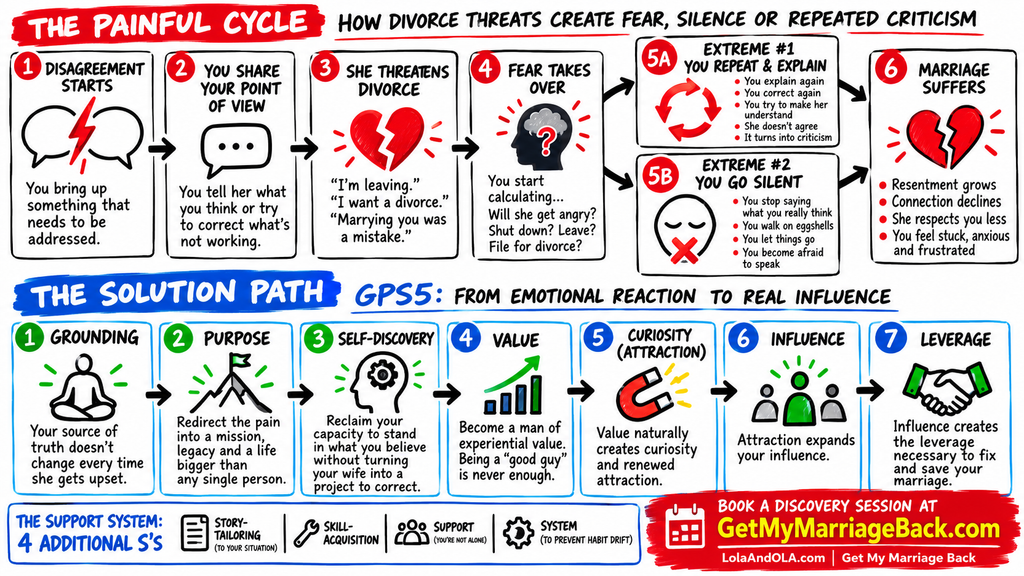
Trap #1: Over-Explaining Because You Are Afraid She Will Leave

When your wife threatens divorce during arguments, fear can disguise itself as communication.

You tell yourself that you simply need to explain this one more time.

Maybe she misunderstood.

So you send the longer text.

You initiate another conversation.

Soon, your emotional objective is no longer expression. It is obtaining the response that will make you feel safe again.

That dependency drains attraction because your emotional center is now sitting in somebody else’s hands.

Your position is only allowed to feel valid when she validates it.

That’s not confidence.

Trap #2: Becoming Afraid to Tell the Truth

The opposite reaction isn’t better.

You decide you won’t say anything.

Your wife appears calmer, so silence seems to be working.

But what exactly have you created?

Peace—or fear with good manners?

You can save a marriage without turning yourself into a person who walks on eggshells.

In fact, developing the capacity to express yourself without needing to dominate, convince, correct, or retreat is part of becoming more experientially attractive.

That distinction matters.

Value in attraction is not the same thing as moral worth.

Being a good person does not automatically make somebody feel curiosity, attraction, or emotional engagement toward you.

Experiential value is about what interacting with you actually feels like.

Can you remain grounded during disagreement?

Can you hold a perspective without turning it into a courtroom argument?

Can you tolerate her disappointment without collapsing?

Can you remain emotionally present without trying to control her?

Those qualities change the experience of being around you.

Trap #3: Making Your Wife’s Reaction Your Emotional Compass

This is the deeper trap.

She is happy with you, so you’re okay.

She becomes cold, so you panic.

She mentions separation, and your entire identity collapses into saving the marriage before bedtime.

She threatens divorce, so every principle you held yesterday suddenly becomes negotiable.

Now her emotional state controls yours.

That makes genuine attraction difficult because attraction requires differentiation: the ability to remain emotionally connected without losing your own center.

Your goal isn’t to become cold.

It isn’t to punish her with silence.

And it isn’t to manufacture indifference so she’ll chase you.

The goal is self-leadership.

What To Do When Your Wife Threatens Divorce During Arguments

Start with Grounding.

Your absolute source of truth cannot change every time your wife gets upset.

Grounding means returning to something higher than the immediate symptom—the argument, the cold shoulder, the divorce threat—and reconnecting with your source of truth and gratitude.

Next comes Purpose.

Pain wants to shrink your entire world down to your marriage crisis.

Don’t allow it.

Redirect that energy toward a mission, contribution, impact, legacy, and reason to wake up that is bigger than any single human being—including you and your wife.

Then comes Self-Discovery.

Instead of obsessively discovering what is wrong with her, discover what you are capable of becoming under pressure.

That is GPS: Grounding, Purpose, Self-Discovery.

From there, you build experiential Value.

Value naturally creates Curiosity.

Curiosity opens the possibility for Attraction.

Attraction expands Influence.

Influence creates Leverage.

That leverage gives you a stronger position from which to create the conditions for marriage reconciliation instead of desperately protecting the broken version of the marriage you already have.

Attraction Is Not About Manipulating Her Back

This distinction is critical.

You are not improving yourself as a trick to produce a specific reaction from your wife.

That’s still control.

Building attraction skillfully means becoming somebody whose presence feels different because you are different.

Your words become less frantic.

Your emotional state becomes less dependent on immediate reassurance.

Your purpose becomes bigger than the crisis.

You stop treating your wife like a project requiring constant correction.

That creates space.

Space creates room for curiosity.

Curiosity matters because somebody who believes they completely understand your pattern has very little reason to look again.

When your pattern changes authentically, the experience changes.

Why You May Fall Back Into the Same Pattern Tonight

Understanding all of this intellectually is not enough.

Conflict creates pressure, and pressure has a way of resurrecting old behaviors.

In a controlled experiment, researchers found that stress shifted participants away from goal-directed behavior and toward habitual responding. You can read the NIH-indexed research on stress and habitual behavior.

That helps explain a frustrating experience many people have during a marriage crisis.

You know you shouldn’t deliver another lecture.

Then she gets upset.

You panic.

Suddenly you’re explaining again.

Or you retreat into silence because that is the habit your nervous system has learned feels safest.

This is Habit Drift.

Breaking it requires more than information. Your strategy has to fit your actual story, you need the skill to execute under emotional pressure, and you need enough structure to stop improvising according to whether your wife looks happy with you that day.

Your Marriage Cannot Be Built Around Fear of the Next Divorce Threat

You cannot control whether your wife gets upset.

You cannot force her to understand your perspective.

And you cannot guarantee that the perfect sentence will make a spouse who wants out suddenly want back in.

What you can control is far more powerful.

You can stop over-explaining.

You can stop disappearing.

You can tell the truth without demanding acceptance.

You can build the emotional capacity to withstand disagreement without turning your wife into either your enemy or your emotional life-support system.

That’s where personal power begins.

A marriage crisis naturally makes you want to grab harder at the marriage you are terrified of losing.

The more powerful move is to become capable of building something better.

Not through begging.

Not through fear.

Not through fourteen speeches.

Through Grounding, Purpose, Self-Discovery, Value, Curiosity, Attraction, Influence, and ultimately the Leverage necessary to create a different experience of you—and different conditions for saving your marriage.

Average Length of Separation Before Reconciliation: Data Reveals!

Frequently Asked Questions

Why does my wife threaten divorce during every argument?

Repeated divorce language can serve different functions in different marriages, including expressing genuine intent to leave, escalating conflict, or attempting to end an overwhelming argument. Treat the pattern seriously without assuming you already know exactly what each threat means.

What should I do when my wife threatens divorce during an argument?

Don’t panic into another marathon explanation or surrender your position simply to restore temporary peace. Regulate yourself, state what needs to be stated clearly, and avoid turning the moment into a contest over who can force the other person to concede.

Can a marriage be saved when your wife wants a divorce?

Some marriages do reconcile after one spouse has expressed a desire to leave, but the immediate task is not forcing that spouse to reverse the decision. Focus first on changing the destructive patterns you control and creating healthier conditions for future interaction.

Should I stop talking when my wife threatens divorce?

No—silence driven by fear is different from intentionally refusing to escalate an unproductive argument. Research on marital conflict has linked demand-withdraw patterns with negative emotions and poorer conflict resolution, so the objective is not permanent withdrawal but more emotionally intelligent engagement.

My Wife Wants to Move Out? Do This Without Pushing Her Away

Your wife wants to move out, and every instinct in your body is screaming at you to stop her before physical separation turns into divorce.

Take This 2 Minutes Quiz

Question 1 of 15

You want to explain why leaving is a mistake.

You want to remind her about everything you built together, the family, the memories, the promises, the sacrifices and the future you planned.

Maybe you want to tell her you finally understand what went wrong. Maybe you are ready to promise that everything will change. You may even feel willing to pay almost any price to keep her from walking through that door.

I understand that instinct because I lived it.

Months before my wife moved out, she told me she did not want to be in our marriage anymore. I flew off the handle.

There were arguments, defensiveness and begging. I was trying to fight the reality in front of me because I desperately did not want that reality.

Later, while I was away on business, my wife and I spoke on the phone and things seemed relatively normal.

I came home to crickets.

The closets were clean.

When I called her, it became obvious that this wasn’t a weekend away. My wife was making a move completely away from our marriage.

Something had changed in me by then.

I still wanted my marriage. Secretly, I hoped we would find our way back to each other.

But I finally started learning one of the hardest skills you will ever need when your wife wants separation:

Letting go without giving up.

Those are not the same thing.

When Your Wife Wants to Move Out, Don’t Fight the Suitcase

The suitcase is a symptom.

The apartment is a symptom.

The physical separation is the visible manifestation of something that probably started much earlier.

That matters because when you concentrate exclusively on stopping your wife from moving out, you can miss the actual marriage crisis.

You are trying to prevent the physical distance while ignoring the emotional distance that preceded it.

Imagine she has felt unheard, disconnected, chronically frustrated or emotionally exhausted for months. Perhaps conflict became constant. Maybe attraction deteriorated until you felt more like roommates than lovers.

Then she finally says:

“I need to leave.”

From your perspective, everything suddenly changed.

From hers, leaving may feel like the culmination of a much longer process.

That does not make her decision fair.

It does not mean you agree with it.

And understanding why somebody reached a decision is not the same as endorsing that decision.

This distinction gives you Personal Power.

my wife wants to move out

Why Begging Your Wife to Stay Can Push Her Further Away

Your intention and her experience are two different things.

You intend to communicate love.

She can experience pressure.

You intend to demonstrate commitment.

She can experience desperation.

You intend to prove that you are finally serious about saving your marriage.

She can experience another demand to manage your fear.

That’s why the popular advice to “fight for your marriage” can become dangerous when nobody defines what fighting actually means.

Does fighting mean begging?

Does it mean sending a 1,500-word text at midnight?

Does it mean following her around the house while she packs?

Does it mean repeatedly explaining why she is wrong?

Does it mean using your children, vows or history as reasons she should reconsider?

That’s not the kind of pursuit that builds attraction.

That’s fear trying to regain control.

You can want your wife.

You can pursue reconciliation.

You can make it clear that you remain interested in saving the marriage.

But pursuit based on dignity is radically different from chasing based on fear.

My Wife Wants to Separate: What Should I Actually Say?

Keep it simple.

Tell her you understand.

Your emotions may immediately object:

“How can I tell her I understand when I don’t want her to leave?”

Because understanding is not agreement.

You understand that this did not start overnight.

You understand that something in the marriage brought the relationship to this point.

You understand that she currently believes distance is necessary.

None of those statements require you to declare the marriage dead.

Then let her know that if she changes her mind, she can let you know.

Stop there.

That statement does not mean:

“I’ll wait forever.”

It does not mean:

“You can do anything you want and I’ll always be here.”

And it certainly does not mean putting your life on layaway until your wife decides what happens next.

Now the real work begins.

Saving Your Marriage Alone Does Not Mean Controlling Her

There is a popular statement that “it takes two to save a marriage.”

Ultimately, two people choose whether they participate in a marriage.

But that does not mean two people must simultaneously become motivated before anything can change.

You control your contribution to the emotional system.

You control whether disagreement turns into combat.

You control whether rejection sends you into begging.

You control whether uncertainty turns you into an investigator.

You control whether your entire identity collapses because your wife wants separation.

Most importantly, you control what it feels like to experience you from this point forward.

That is where attraction starts becoming relevant again.

Attraction Is an Experience, Not an Argument

You cannot logically persuade your wife into attraction.

Think about how strange that proposition really is.

“Here are twelve excellent reasons you should desire me again.”

Attraction doesn’t work like that.

You create an experience.

When your wife experiences you as chronically anxious, argumentative, controlling, needy or emotionally dependent on her responses, the experience matters regardless of your good intentions.

The opposite is also true.

When you become grounded, emotionally intelligent, purposeful, interesting, responsive and capable of tolerating discomfort without dumping it onto her, interacting with you begins to feel different.

That does not mean performing confidence.

Fake indifference is still fixation.

Posting pictures to make her jealous is still fixation.

Ignoring her because some internet advisers told you “no contact makes women chase” is still allowing her behavior to control yours.

Real grounding is different.

You care without collapsing.

You remain interested without begging.

You can feel tremendous pain without making your wife responsible for regulating it.

That is attractive because it is sustainable.

Rebuild Value Before Demanding Reconciliation

Your wife has probably already heard promises.

“I’ll change.”

“I’ll do anything.”

“I finally get it.”

“Just give me another chance.”

Words have limited power when the existing experience contradicts them.

Experiential Value means she encounters something different rather than receiving another presentation about how different you are going to become.

If anger damaged the marriage, learn to experience frustration without turning the environment hostile.

If you became emotionally absent, develop your capacity to be present without demanding immediate credit for it.

When your life lost direction, rebuild purpose that exists beyond getting your wife back.

If every interaction became serious and heavy, stop turning every decent conversation into a marriage summit.

Changed behavior creates evidence.

Repeated promises create expectations.

The first can generate Curiosity.

Why Curiosity Matters When Your Wife Wants Separation

Attraction needs room.

Suppose your wife believes she already knows exactly how you will respond.

She pulls away.

You panic.

She becomes colder.

You explain.

She asks for space.

You chase.

She gives you a little warmth.

You immediately ask whether that means she wants to come home.

There is no mystery in that cycle.

Your emotional state is entirely predictable because she controls it without even trying.

Now imagine something genuinely changes.

She expects an argument, but you remain grounded.

She anticipates another desperate relationship conversation, but you don’t initiate one.

Your wife expects you to spend the entire separation monitoring her, yet she discovers you are becoming more engaged with your health, children, career, friendships, mission and emotional development.

You aren’t trying to make her curious.

You have become worth becoming curious about.

That’s different.

Curiosity can create room for attraction.

Attraction can create Influence.

Influence can create Leverage.

None of it requires manipulating your wife.

Ground Yourself Before You Try to Get Your Wife Back

The first part of our GPS framework is Grounding.

Grounding means returning to your higher self, source of truth and gratitude instead of allowing the symptom—your wife moving out—to become the source of your identity.

The pain remains real.

You simply stop allowing pain to issue commands.

Ask yourself:

What do I know to be true regardless of what she decides today?

What am I grateful for even in this painful season?

Which reactions have repeatedly made this marriage worse?

What would my highest self do with the next 24 hours?

These questions move you away from panic and toward intention.

Build a Purpose Bigger Than Your Marriage

This sounds counterintuitive when you desperately want to save your marriage.

It isn’t.

Your wife cannot sustainably function as your entire purpose.

Neither can reconciliation.

Purpose redirects pain toward the impact, legacy and mission your life is supposed to create beyond any single person.

That does not diminish marriage.

It makes you stronger inside it.

A person with meaningful direction carries a different emotional presence from somebody waiting beside the phone for one text to determine whether the day is worth living.

Purpose restores movement.

And movement creates aliveness.

Use Self-Discovery Without Turning It Into Self-Blame

Self-Discovery asks:

“What capacity do I need to develop?”

It does not ask:

“How do I prove everything was my fault?”

Those are radically different questions.

You may have made serious mistakes.

Own them.

Your wife may have made serious mistakes too.

Her mistakes do not eliminate your opportunity to grow.

You are looking for capacity: emotional regulation, communication, boundaries, conflict skills, presence, playfulness, purpose, confidence and the ability to remain grounded when another person disappoints you.

That development has value regardless of what she does next.

Ironically, that is exactly why it can become attractive.

Don’t Let Acute Stress Put Your Old Marriage Back in Charge

Here is where execution gets difficult.

Tonight, your wife may send a cold text.

Tomorrow, she may pack another box.

Next week, she may tell you she still needs space.

Your intellectual understanding can disappear quickly when fear gets activated.

Research has found circumstances in which acute stress can shift behavior away from deliberate, goal-directed responding toward established habitual responses, although later replication research suggests that this effect has important boundary conditions rather than occurring universally. You can review the underlying research on stress and habitual behavior directly.

That is particularly useful to understand during a marriage crisis.

Your old reaction is waiting.

Beg.

Argue.

Explain.

Check her phone.

Demand certainty.

Send another text.

Promise more.

Call again.

Your work is to recognize that reaction before you obey it.

Letting Go Is Not Giving Up on Marriage Reconciliation

Letting go means releasing your attempt to control an outcome that another human being participates in creating.

Giving up means abandoning what matters to you.

You can release control without abandoning your desire to save your marriage.

In fact, your desperation to control the outcome can prevent you from developing the very qualities that make reconciliation more attractive.

Let her experience your interest without your panic.

Let her experience your growth without your sales pitch.

Allow a pleasant interaction to remain pleasant without immediately asking, “So what does this mean for us?”

Let change accumulate.

Your objective is not to restore the exact marriage she wanted to leave.

Why would either of you want that?

The objective is to become capable of participating in a marriage that feels fundamentally different.

That means more emotional intelligence.

More Personal Power.

More Value.

More Curiosity.

More Attraction.

More Influence.

And eventually, enough Leverage to create the conditions in which rebuilding the marriage becomes a compelling possibility rather than another obligation.

What If She Has Already Moved Out?

The front door closing does not change the principles.

Do not transform separation into surveillance.

Don’t count every day apart as evidence that divorce is inevitable.

Avoid treating every friendly interaction as proof that reconciliation is imminent.

And stop trying to manufacture missing you through manipulative silence.

Build a life worth returning to—and more importantly, a self worth bringing into any future marriage.

Take responsibility for practical matters.

Remain dignified in necessary communication.

Respect legitimate boundaries.

Become more emotionally skilled.

Develop your purpose.

Create experiences that feel different when natural opportunities for interaction arise.

Your wife does not need another speech about the new you.

She needs the opportunity to encounter you.

The Real Goal When Your Wife Wants to Move Out

The goal is not to trick her into staying.

It is not to become emotionally cold enough that you stop caring.

And it is not to beg so convincingly that she postpones leaving.

Your goal is to stop making fear the leader of your marriage.

Understand what she is telling you.

Let go of your attempt to overpower her decision.

Then engage in the serious self-work required to rebuild Grounding, Purpose, Self-Discovery and experiential Value.

Value creates the possibility of Curiosity.

Curiosity gives Attraction room to breathe.

Attraction creates the conditions for Influence.

Influence creates Leverage.

That is a far more powerful position than sitting beside an unpacked suitcase begging your wife to choose you.

You still want your marriage.

Now you’re learning how to want it without losing yourself.

5 Physical Signs She Just Slept With Someone Else: The Truth

Frequently Asked Questions

What should I do when my wife wants to move out?

Stay grounded, understand that her decision probably developed before the physical move, and avoid turning fear into begging, arguing or repeated pressure. Make your interest in reconciliation clear without trying to overpower her freedom to decide.

Should I let my wife leave if she wants separation?

Understanding her desire to leave is not the same as agreeing that the marriage should end. Focus on what you control: your reactions, development, responsibilities, boundaries and the emotional experience you create.

Can I save my marriage after my wife moves out?

Physical separation does not by itself answer whether marriage reconciliation will occur. Use the separation to interrupt destructive patterns and build genuine, observable change instead of trying to force certainty.

How do I rebuild attraction while separated from my wife?

Reduce fear-driven chasing and strengthen Grounding, Purpose, emotional intelligence, self-respect and experiential Value. Give genuine change enough room to create Curiosity and Attraction instead of repeatedly asking your wife whether your efforts are working.

Wife Wants Divorce But Still Affectionate? 3 Signs That Matter

Your wife says she wants a divorce, but she is still affectionate with you… still doing the sex thing with you.


Take This 2 Minutes Quiz

Question 1 of 15

She hugs you. She touches you. She laughs with you. Some nights she still sleeps beside you, and physical intimacy may even continue.

Then something changes.

She becomes distant again.

The divorce conversation returns.

Suddenly, you are trying to understand how the same woman who showed you warmth last night can talk about ending the marriage today.

That contradiction can make you believe you have only two choices.

Either the affection means she does not really want the divorce, or the divorce means the affection is meaningless.

Both conclusions can get you into trouble.

Your wife can question the marriage and still experience affection, attachment, comfort, attraction, familiarity and sexual desire with you. The skill is learning how to receive what is genuinely happening without forcing one moment to tell you the future.

That is where emotional intelligence and attraction meet.

Wife Wants Divorce But Still Affectionate: What Does It Really Mean?

Start with the most important distinction:

Affection is information. It is not automatically a decision.

When your wife reaches for you, something real is happening.

The hug is real.

Her laughter is real.

Sexual attraction, when present, is real.

Comfort is real.

Yet none of those experiences automatically cancels everything that caused her to question the marriage.

This is why trying to force her behavior into a right-or-wrong answer creates so much unnecessary confusion.

You start thinking that if she wants divorce, she should not want you physically.

Then when she does want you physically, you conclude that she must not really want the divorce.

Human emotions do not operate like a courtroom.

A person can feel attraction and disappointment simultaneously. Your wife can enjoy being close to you while still wondering whether the marriage itself can become healthy enough for her to trust again.

Understanding that complexity gives you a much stronger position than trying to prove which version of her is the real one.

Both experiences can be real.

wife wants divorce but still affectionate

Sign #1: There Is Still Warmth, But Warmth Is Not Commitment

Suppose your wife reaches for your hand tonight.

You feel the relief immediately.

After weeks of rejection, that little bit of warmth feels enormous.

The danger begins when you turn the experience into proof.

Now you’re not simply enjoying your wife holding your hand. You’re thinking about what the hand-holding means for the divorce.

A kiss becomes evidence.

Sex becomes evidence.

Her sitting beside you becomes evidence.

A good conversation becomes evidence.

Before long, you’re no longer experiencing your marriage. You’re investigating it.

I call this Snapshot Blindness.

You’re taking one snapshot from the marriage and treating it like the entire movie.

That becomes especially dangerous after physical intimacy. You can wake up the next morning believing something has fundamentally changed because last night felt like the marriage you remember.

Then she becomes distant.

Your hope crashes.

Nothing necessarily changed overnight. You simply assigned the affectionate moment a promise it never made.

Attraction Requires You to Stop Demanding Proof

Your goal is not to dismiss positive experiences.

Quite the opposite.

Enjoy them.

Receive warmth warmly.

Be present when your wife is present.

What you don’t need to do is immediately convert affection into a reconciliation conversation.

That distinction matters because responsiveness itself appears relevant to desire. Research examining romantic relationships found that perceived partner responsiveness was associated with increased sexual desire, with stronger effects among women in those studies; feeling valued and experiencing the other person as a desirable mate helped explain that association.

Notice what that does not mean.

It does not mean becoming excessively agreeable.

Responsiveness is not servitude.

You’re not performing kindness so your wife owes you attraction afterward.

The attractive skill is being capable of receiving another person warmly without immediately turning the experience into a transaction.

Sign #2: Her Affection Changes From Day to Day

Your wife can be warm Friday and distant Saturday.

Sunday she initiates conversation.

Monday she mentions divorce.

Tuesday she seems almost normal.

By Wednesday, you’re wondering whether she even likes you.

This is where Threat Reactivity takes over.

Instead of observing the changing situation, you start emotionally moving with every change in her.

When she’s warm, you’re confident.

When she’s cold, you panic.

She mentions divorce and you collapse.

Then affection returns and suddenly you’re euphoric again.

Her emotional temperature has become your thermostat.

That is exhausting for you, but it also changes the experience of being around you.

Don’t Put Her Feelings on Trial

Rigid logic becomes especially tempting here.

You notice the contradiction and want her to explain it.

She’s affectionate, so why is she still talking about divorce?

She wanted space, so why did she come close?

She said she was done, so why did she initiate intimacy?

Soon, you’re pointing out every inconsistency.

That’s fault finding disguised as clarity.

You’re trying to win an argument against her emotional experience.

Even if your observations are factually correct, proving that your wife has conflicting emotions does not resolve those emotions.

It can make her feel that every affectionate gesture will eventually be used as evidence against her.

Now warmth has a price.

Every hug creates a conversation.

Every intimate experience creates an interrogation.

Every good evening becomes an opportunity to ask where the marriage stands.

Eventually, she can start protecting herself from the pressure by offering less.

You don’t want that.

Sign #3: Affection May Be an Open Door—Don’t Waste It

This is where people often overcorrect.

You hear that affection does not equal reconciliation, so you decide the affection means nothing.

Now you become cold.

You protect yourself by becoming detached.

She reaches toward you, but you don’t want to get your hopes up.

Physical intimacy happens, yet the next morning you act business-like because you don’t want to look needy.

That’s the opposite extreme.

I call it Dismissing the Spark.

Your wife is still willing to share some level of warmth or vulnerability with you during a marriage crisis. You don’t need to worship that moment, but throwing it away makes no sense either.

Don’t interrogate it. Don’t worship it. Don’t dismiss it.

Experience it.

Be warmly present.

Allow affection to be affection without immediately demanding a marriage decision on top of it.

Building Attraction Means Understanding Experiential Value - wife wants divorce but still affectionate

Building Attraction Means Understanding Experiential Value

When I talk about value in marriage, I am not talking about your worth as a human being.

Your wife does not determine your worth.

I mean experiential value: what is it actually like to experience you?

Can your wife laugh around you without wondering whether you’re going to turn the laughter into a serious marriage conversation?

Can she show affection without being asked what it means?

Can disagreement happen without you exploding or collapsing?

Does your presence bring constant anxiety into the room, or are you increasingly capable of holding difficult emotions without dumping them onto everyone else?

Are you still interesting?

Do you have purpose?

Is there playfulness?

Can you be warm without clinging?

That’s attraction-building at a deeper level.

You aren’t announcing your value.

You’re becoming someone whose value can be experienced.

The Three Anti-Seducers That Appear During Divorce Threats

When rejection scares you, fear can turn you into a version of yourself that works against the attraction you’re trying to rebuild.

The Suffocator

The Suffocator crowds the remaining space because he is terrified of losing the marriage.

More texts.

More questions.

More relationship talks.

More reassurance seeking.

More attempts to make sure yesterday’s affection still exists today.

You call it fighting for your marriage.

Your wife can experience it as pressure.

The Bumbler

The Bumbler doesn’t understand the signals, so he desperately assigns meaning to them.

Your wife kisses you and your mind jumps three months into the future.

She has sex with you and you start thinking the divorce threat is disappearing.

Then she becomes distant again and you feel deceived.

The problem wasn’t necessarily the affectionate moment.

You asked the moment to predict the future.

The Reactor

The Reactor is controlled by emotional whiplash.

One rejection ruins his day.

One affectionate interaction restores all his hope.

A divorce conversation destroys him again.

This makes your emotional stability dependent on your wife’s latest behavior.

Attraction has a difficult time breathing when another person feels responsible for continually regulating your emotional condition.

wife wants divorce but still affectionate - How to Handle Affection When Your Wife Wants Divorce

How to Handle Affection When Your Wife Wants Divorce

You need a different cycle.

I teach it this way:

Uncertainty → Grounding → Purpose → Self-Discovery → Value → Curiosity & Attraction → Uncertainty

Notice where the cycle ends.

Uncertainty.

You are not learning a trick that eliminates uncertainty.

You’re developing the capacity to navigate it differently.

1. Ground Yourself Before You Interpret Her

Grounding means returning from the symptom to your higher self and source of truth.

Your wife hugs you.

Enjoy the hug before deciding what it means.

She becomes distant tomorrow.

Notice what happens inside you before reacting.

You don’t have to pretend that rejection feels good. Emotional intelligence means feeling what is happening without automatically making that emotion responsible for your next move.

Fear can exist without becoming your leader.

Hope can exist without becoming fantasy.

2. Return to a Purpose Bigger Than This Crisis

A marriage crisis can swallow your identity.

Suddenly, every morning begins with your wife.

What mood is she in?

Did she sleep well?

Is she warmer today?

Did she text?

Does she miss you?

Has she changed her mind?

That’s not sustainable.

Your marriage can matter enormously without becoming your entire purpose.

Your health matters.

Fatherhood matters when applicable.

Your faith, work, creativity, friendships, contribution, mission and legacy still matter.

Purpose doesn’t mean distracting yourself from your marriage.

It means refusing to reduce your entire existence to whether another human being feels warm toward you today.

That creates a very different presence.

3. Use Rejection for Self-Discovery, Not Self-Blame

Look inward without turning yourself into the villain.

What happens to you when your wife withdraws?

Do you become needy?

Do you become angry?

Does rejection make you interrogate her?

Are you trying to control uncertainty?

Have you become boring because your entire life revolves around the marriage crisis?

Do you become cold to protect your ego?

Self-blame says something is wrong with you.

Self-discovery asks what capacity you need to develop.

That difference matters.

One produces shame.

The other gives you something useful to work on.

4. Build Value That Can Be Experienced

Experiential value is not a speech about how much you’ve changed.

Your wife needs to experience the difference.

Maybe you’re calmer under pressure.

Perhaps conversations no longer turn into arguments as quickly.

Your purpose returns.

You become socially alive again.

There is more humor in you.

You’re physically taking care of yourself.

You can listen without immediately defending yourself.

Affection doesn’t automatically produce an interrogation afterward.

That doesn’t mean you’re performing a new personality to get your wife back.

You’re developing skills and capacities that improve your life regardless of what happens tomorrow.

Research with married couples supports looking beyond any single behavior. Studies have linked communication, emotional intimacy and sexual satisfaction with relationship satisfaction, while other longitudinal work has found multiple relational skills—including emotional closeness, sexual intimacy, support and conflict management—to be relevant to marital satisfaction trajectories.

Marriage is an experience.

Build accordingly.

5. Let Curiosity and Attraction Be Outcomes

This is where people get impatient.

You start changing and immediately want to know whether your wife notices.

Don’t turn personal development into another scoreboard.

Curiosity belongs to her.

Your work is value.

When your experience becomes consistently different, your wife has an opportunity to encounter something different.

She might notice your steadiness.

Your confidence feels less needy.

There’s more life in you.

The old predictable reactions don’t happen as often.

You stop selling the transformation and start living it.

Curiosity now has room to emerge naturally.

Attraction can follow curiosity because there is something to experience rather than another promise to evaluate.

How to Use Intimacy Without Turning It Into Pressure

Physical intimacy deserves particular care during a marriage crisis.

First, don’t treat sex as a contract.

Having sex does not obligate your wife to withdraw the divorce conversation.

Second, don’t punish her afterward by becoming cold because you fear disappointment.

There is a middle path.

Be present.

Be responsive.

Enjoy genuine connection.

Let the relaxed warmth carry naturally into ordinary life.

A peaceful morning can remain a peaceful morning.

Simple affection doesn’t need an agenda.

Making coffee doesn’t need to become evidence of your transformation.

A warm smile doesn’t require a relationship-status conversation afterward.

The point isn’t to strategically manufacture an afterglow.

It’s to stop contaminating every good experience with pressure.

Research on married couples has found meaningful links among sexual satisfaction, perceived responsiveness and marital satisfaction, reinforcing that sexual and nonsexual relational experiences do not exist in completely separate worlds.

Seduction in Marriage Is Not Manipulation

The word seduction is often misunderstood.

Healthy seduction isn’t tricking your wife into wanting you.

It isn’t provoking jealousy.

You’re not trying to manipulate her fear of losing you.

Seduction is the cultivation of attraction through presence, emotional intelligence, confidence, warmth, curiosity, responsiveness and a life that has energy.

There is still freedom.

That’s essential.

Your wife gets to decide what she wants.

You get to decide what kind of person she experiences when she interacts with you.

That’s where dignity-based pursuit differs from chasing.

Chasing says you need a particular response in order to remain emotionally okay.

Pursuit expresses genuine interest without surrendering your center.

What to Do When Your Wife Is Affectionate Today and Cold Tomorrow

Don’t decide the entire marriage every 24 hours.

Watch the larger pattern.

Take her divorce concerns seriously without making every sentence an irreversible prophecy.

Receive affection without forcing it to guarantee reconciliation.

When distance returns, ground yourself before reacting.

Then continue the constructive cycle:

Grounding → Purpose → Self-Discovery → Value → Curiosity & Attraction.

You will eventually encounter uncertainty again.

That’s not proof that your work failed.

It’s another opportunity to demonstrate the capacity you’re building.

Over time, emotional steadiness changes the experience of interacting with you.

You are no longer The Reactor.

Warmth doesn’t immediately turn you into The Suffocator.

Affection doesn’t turn you into The Bumbler searching desperately for a prediction.

You can finally experience what is actually happening.

Don’t Give Affection Too Much Meaning—or Too Little Value

When your wife wants divorce but is still affectionate, there is something worth understanding.

Not predicting.

Understanding.

The affection does not automatically mean your marriage is saved.

Her divorce language does not automatically make every affectionate moment fake.

Both can exist.

Your opportunity is to become emotionally intelligent enough to hold that tension without forcing an immediate answer.

Receive warmth warmly.

Take rejection seriously without becoming reactive.

Keep developing your purpose.

Discover the capacities this crisis exposes.

Build experiential value.

Allow curiosity and attraction to remain outcomes instead of demands.

That is a far stronger position than spending every day asking whether the latest hug means your wife is coming back.

The question eventually changes.

Instead of constantly asking what her affection means, you begin asking:

What does experiencing me feel like now?

That’s a question you can actually do something about.

5 Physical Signs She Just Slept With Someone Else: The Truth

Frequently Asked Question

Why is my wife affectionate if she wants a divorce?

Affection can reflect attachment, attraction, comfort, familiarity, care or uncertainty without automatically meaning she has decided to reconcile. Treat the warmth as genuine information, not as proof that the divorce conversation is over.

Does affection mean my wife is changing her mind about divorce?

It can show that emotional or physical connection still exists, but affection alone cannot tell you whether her divorce decision has changed. Look at the broader direction of the marriage rather than making one affectionate moment carry the entire meaning.

Should I give my wife space if she is still affectionate?

Respecting space does not require becoming cold or rejecting genuine warmth. Respond naturally to healthy affection while avoiding pressure, repeated reassurance-seeking and attempts to make every interaction define the relationship.

Can attraction come back when my wife wants a divorce?

Attraction can change because desire is influenced by relational experiences, including responsiveness and feeling valued, but you cannot command another person’s desire. Focus on grounding, purpose, self-discovery and becoming more emotionally and experientially valuable rather than monitoring her reactions.

How to Save Marriage When Wife Wants Divorce: 3 Attraction Traps

Your wife says she wants a divorce. Maybe she still lives with you. She may still talk to you, laugh occasionally, coordinate the children, pay bills with you, or behave almost normally on certain days.


Take This 2 Minutes Quiz

Question 1 of 15

Then one disagreement happens and suddenly you hear it again:

“I’m done.”

“I don’t want this marriage anymore.”

“I want a divorce.”

That uncertainty can drive a man wild.

One minute you see evidence that there is still something between you. The next minute, you feel rejected by the woman you married. Naturally, your mind wants an answer.

Is my marriage over, or can I still save it?

I understand why that question becomes an obsession. But when your wife wants divorce, the most important question may not be what she is going to do next.

A more useful question is:

What is her uncertainty, rejection, or withdrawal turning you into?

Because you can love your wife deeply and still react to the fear of losing her in ways that make you less attractive to her.

That is where many husbands accidentally make an already fragile marriage worse.

When Your Wife Wants Divorce, Fear Can Disguise Itself as Love

Fear is seductive because it rarely announces itself as fear.

Instead, it sounds responsible:

  • Fight for your marriage.
  • Tell her how much you love her.
  • Remind her what you built together.
  • Get answers.
  • Show her how much you have changed.
  • Convince her to try marriage counseling.
  • Make her understand what divorce will do to the family.

Every one of those impulses can feel like love.

The problem is not necessarily your intention. The problem is the emotional experience you create on the other side.

Your intention may be connection while your wife experiences pressure. You may intend reassurance while she experiences neediness. What feels to you like “fighting for my marriage” can eventually feel to her like “he will not let me breathe.”

That distinction matters enormously when you are trying to figure out how to save marriage when wife wants divorce.

Attraction does not respond to your intentions alone.

It responds to experience.

how to save marriage when wife wants divorce

Attraction Cannot Be Negotiated Back Into Your Marriage

Suppose your wife tells you she is no longer happy.

You immediately start assembling evidence:

“But I’ve been a good husband.”

“I provide for this family.”

“I’m a good father.”

“We’ve been married for 15 years.”

“Look at everything we built.”

“I know I made mistakes, but I’ve changed.”

“Just give me another chance.”

Some of those statements may be completely true.

That is not the point.

Romantic attraction is not a courtroom, and your wife’s feelings are not a jury that can be persuaded by presenting enough evidence.

This is one of the hardest realities to accept when you desperately want to save your marriage. You can win the argument about why your marriage deserves another chance while simultaneously creating an emotional experience that makes your wife want more distance.

As a matter of fact, relationship research gives us a useful clue about what attraction responds to instead. Studies on perceived partner responsiveness have found associations between feeling understood, valued, and cared for by a romantic partner and greater sexual desire; the effect was particularly strong among women in one series of studies. research on partner responsiveness and sexual desire

Notice the distinction.

That research is not saying, “Be nicer until your wife stays.”

Responsiveness is not desperation, appeasement, or surrendering your standards. It is the ability to understand another person’s emotional experience without requiring that person to immediately change it so that you can feel safe.

That requires emotional intelligence.

And emotional intelligence is attractive precisely because it reduces the feeling that your wife must manage your emotional state for you.

how to save marriage when wife wants divorce - Blaming Your Wife for the Entire Marriage Crisis

Attraction Trap #1: Blaming Your Wife for the Entire Marriage Crisis

When your wife is the person talking about divorce, blaming her feels almost automatic.

“She’s destroying our family.”

“She changed.”

“Her friends are influencing her.”

“Her mother is in her ear.”

“She’s being selfish.”

“She’s confused.”

Maybe some of those observations contain truth.

Your wife is an adult. She can make bad decisions. She can behave selfishly, become confused, receive terrible advice, communicate poorly, or contribute substantially to the condition of your marriage.

Holding her accountable, however, is different from becoming psychologically consumed with proving whose fault everything is.

Blame becomes dangerous when you need your wife to accept your interpretation before you can regain your emotional stability.

Now your peace depends on her confession.

You need her to say:

“You were right.”

“I handled this badly.”

“My friends influenced me.”

“I caused this.”

But suppose she never says it?

Does that mean you remain angry, reactive, obsessive, and emotionally trapped?

That gives away far too much personal power.

You do not need to pretend your wife has done nothing wrong. You need enough emotional intelligence to separate her responsibility from your emotional regulation.

That distinction changes the energy you bring into every interaction.

Attraction Trap #2: Proving You Deserve Another Chance

Proving often follows blame.

Once you realize arguing about fault is getting you nowhere, you may switch strategies and begin demonstrating your value.

Suddenly you are more helpful.

You become extraordinarily attentive. You start doing everything around the house, sending thoughtful messages, announcing personal improvements, buying gifts, planning dates, and making sure your wife notices every positive change.

Growth is good.

Performance is different.

Ask yourself a difficult question:

Would I still make these changes if my wife gave me no immediate validation for them?

When the answer is no, your transformation may actually be an audition.

Your wife becomes the judge, and every interaction becomes your attempt to receive a passing grade.

“Did she notice?”

“Was she warmer today?”

“She smiled at me. Does that mean it’s working?”

“She didn’t text me back. Did I mess everything up?”

“She hugged me yesterday but seems cold today. What does that mean?”

Now your emotional state rises and falls according to her latest reaction.

That is exhausting for you, but it can also change how she experiences you.

Real self-development does not constantly look over its shoulder to see who noticed.

Attraction Trap #3: Pressing Your Wife for Certainty

Uncertainty hurts.

When you believe you might lose your marriage, your nervous system wants certainty immediately.

So you ask questions.

“Do you still love me?”

“Is there somebody else?”

“When did your feelings change?”

“Are you really going to file?”

“Do you want me to move out?”

“Can we try for another six months?”

“Do you see any hope for us?”

One honest conversation can be useful. Repeated questioning is different.

The diagnostic question is simple:

Am I asking because the answer will help me make a grounded decision—or because I need her answer to calm my fear?

Those motivations can produce completely different energy.

When reassurance becomes your emotional oxygen, your wife is effectively regulating your emotional state.

If she is warm, you breathe.

When she withdraws, you panic.

Then you press harder.

She feels more pressure and withdraws further.

You experience the withdrawal as greater rejection, which increases your need for reassurance.

That is how a destructive marriage cycle feeds itself.

how to save marriage when wife wants divorce - Why Pressure and Withdrawal Can Become a Self-Reinforcing Cycle

Why Pressure and Withdrawal Can Become a Self-Reinforcing Cycle

Marriage researchers have studied what is commonly called the demand-withdraw pattern: one person pushes for discussion, resolution, or change while the other avoids, shuts down, or withdraws.

The roles are not inherently male or female. In a divorce crisis, a husband who desperately wants certainty can easily become the person demanding discussion while his wife becomes the one trying to escape it.

The more she withdraws, the more urgent you feel.

Your urgency then gives her another reason to withdraw.

Now both people interpret the other person’s reaction as proof.

You think:

“See? She doesn’t care.”

She may think:

“See? He still doesn’t understand why I need space.”

Neither person necessarily intends to create the cycle.

Nevertheless, the cycle becomes the relationship experience.

And attraction cannot be skillfully rebuilt while every interaction feels like an emergency negotiation.

How to Save Your Marriage Alone Without Becoming Passive

This is where people often misunderstand the message.

Reducing pressure does not mean becoming passive.

It does not mean tolerating disrespect, abandoning standards, pretending divorce is not serious, or sitting around hoping your wife magically changes her mind.

There is an enormous difference between powerlessness and self-control.

Powerlessness says:

“There is nothing I can do.”

Control says:

“I cannot dictate her decision, but I can become extraordinarily intentional about what I bring into this situation.”

That is where attraction-building begins.

You stop trying to control her emotional experience and start taking responsibility for yours.

Instead of asking, “How do I get her to act right?” ask:

“Who am I becoming while my marriage is under pressure?”

That question puts your power back where it belongs.

Step 1: Ground Yourself Before You Try to Rebuild Attraction

Your wife saying she wants divorce is serious information.

Treat it seriously.

But serious does not mean you must turn every statement she makes today into an irreversible prophecy about tomorrow.

Grounding means learning to distinguish between what has actually happened and what fear predicts will happen.

“She said she wants divorce” is information.

“My life is over” is interpretation.

“She is emotionally withdrawn” is information.

“I will never be loved again” is interpretation.

“She did not respond to my text” is information.

“She must be talking to another man” is interpretation unless you actually have evidence.

This is emotional intelligence in practice.

Grounded people do not deny painful reality. They simply refuse to add unnecessary catastrophe to it.

That stability changes your presence.

Step 2: Stop Making Your Wife Your Source of Emotional Security

Your wife should matter to you.

Your marriage should matter.

The mistake is allowing her current emotional state to determine your identity.

You cannot build genuine attraction from:

“Please choose me so I can feel valuable.”

That emotional transaction is too expensive.

Instead, begin rebuilding a life that contains meaning independent of today’s marital temperature.

Reconnect with your purpose.

Invest emotionally in your children without using them as leverage in the marriage.

Take care of your body.

Deepen your faith if faith matters to you.

Strengthen meaningful friendships.

Return to interests that make you feel alive.

Advance your life’s work.

Develop yourself intellectually, socially, emotionally, financially, and physically.

None of this should be performed for your wife.

That is crucial.

The moment your growth becomes a campaign designed to make her jealous or force attraction, you have simply disguised the same dependency in more sophisticated clothing.

Become valuable because that is who you choose to be.

Step 3: Create Experiential Value Instead of Announcing Your Value

Do not repeatedly tell your wife that you have changed.

Let her experience something different.

Perhaps previous conversations became defensive. Now you can listen without instantly preparing your rebuttal.

Maybe every disagreement used to become a three-hour discussion. Today you can recognize when a conversation is deteriorating and stop escalating it.

Perhaps you previously needed reassurance every time she became quiet. Now you can tolerate uncertainty without interrogating her.

Maybe your energy around her used to communicate:

“Please tell me we’re okay.”

Over time, it can communicate:

“I care about this marriage deeply, and I am capable of standing emotionally whether today is warm or difficult.”

That difference is experiential.

Attraction is much more responsive to experience than advertising.

Step 4: Understand the Seductive Power of Curiosity

Long-term marriage creates familiarity.

Familiarity can create safety, which is valuable. Yet extreme predictability can also contribute to a roommate dynamic where two people know each other’s routines but stop discovering each other.

Research on self-expansion adds something fascinating here. Studies of established couples have found that engaging in novel, self-expanding activities together is associated with greater sexual desire and relationship satisfaction.

That does not mean dragging your wife on a surprise vacation while she is threatening divorce.

Timing matters.

During acute rejection, manufactured romance can feel like another attempt to influence her.

Instead, start by becoming a person who is still expanding.

Learn.

Grow.

Develop.

Create.

Have meaningful experiences.

Become curious about life again.

Then, when mutual openness exists, shared novelty can emerge organically rather than as an emergency marriage-saving technique.

Seduction in a long-term marriage is not merely candles, compliments, sex, or expensive dates.

At its most mature level, seduction contains curiosity.

There is still something about you to discover.

Step 5: Become Responsive Without Becoming Needy

A seductive, emotionally intelligent husband does not become cold.

Detachment is not the goal.

Neither is playing games, intentionally ignoring your wife, manufacturing jealousy, or pretending you do not care.

Those tactics merely replace anxious manipulation with avoidant manipulation.

Responsive strength sounds different.

You can hear that your wife is unhappy without immediately defending yourself.

You can acknowledge her experience without agreeing with every interpretation.

A difficult statement can be taken seriously without demanding immediate reassurance.

You can express that you value the marriage without making her responsible for calming your anxiety.

That balance—warmth without desperation, interest without pressure, strength without emotional coldness—is where mature attraction has room to breathe.

Stop Trying to “Make Your Wife Fall in Love With You Again”

I understand why people search for how to make your wife fall in love with you again after separation.

But notice the problem with the word make.

You cannot manufacture another adult’s feelings.

What you can influence is the relational environment she experiences when she encounters you.

Is it pressure?

Fear?

Interrogation?

Resentment?

A performance designed to win approval?

Or does she encounter emotional steadiness, growth, warmth, standards, self-respect, purpose, responsiveness, and a man who is increasingly interesting because he is actually living?

The second environment creates far more room for curiosity.

Curiosity creates the possibility of rediscovery.

Rediscovery can create conditions where attraction has somewhere to grow.

The Real Meaning of “Save Your Marriage Alone”

Saving your marriage alone does not mean one person can single-handedly create a healthy two-person marriage.

It means one person can stop waiting for the other person to change before taking ownership of their side of the dynamic.

That is powerful.

Perhaps your wife continues making mistakes.

You can still stop proving.

Maybe she remains uncertain.

You can stop pressing for constant reassurance.

She might be emotionally cold today.

You can refuse to let that determine whether you respect yourself tomorrow.

Your transformation does not require her permission.

Ironically, that is when change becomes more attractive—when it stops begging to be rewarded.

What Happens When Your Wife Still Wants Divorce?

This is where emotional maturity gets tested.

You may do substantial work on yourself and your wife may still say she wants divorce.

Do not convert personal development into a transaction:

“I changed, therefore you owe me reconciliation.”

That would put you right back into proving.

Growth is not a down payment on your wife’s decision.

The deeper objective is becoming emotionally capable of creating healthier love while remaining grounded enough to face reality.

That strength matters whether your marriage is beginning to reconnect or remains uncertain.

It also makes your interactions cleaner.

You can desire reconciliation without demanding it.

You can pursue your wife without chasing validation.

You can demonstrate warmth without begging.

You can respect her freedom without surrendering your own dignity.

And you can build attraction without attempting to manipulate attraction.

Your Wife Wants Divorce: What Should You Do First?

Do not begin by asking how to change her mind.

Start by identifying your cycle.

When she withdraws, what happens inside you?

Do you blame?

Prove?

Press?

Panic?

Over-text?

Over-explain?

Become excessively agreeable?

Monitor her mood?

Search her words for signs of reconciliation?

Treat every good day as evidence that the marriage is fixed and every bad day as evidence that divorce is inevitable?

Find the pattern first.

Then interrupt it.

Your immediate objective is not to create one magical conversation that saves your marriage.

It is to stop repeatedly creating the emotional conditions that deepen rejection.

From there, rebuild your grounding, purpose, self-respect, responsiveness, curiosity, emotional stability, and experiential value.

That is a much stronger foundation for attraction than convincing, begging, proving, or panic.

Your wife may be uncertain about the marriage right now.

You do not have to become uncertain about yourself.

My Wife Loves Me But Doesn’t Desire Me | 5 Signs | 5 Tips

Frequently Asked Questions

How do I save my marriage when my wife wants a divorce?

Start by reducing fear-driven behaviors such as arguing, proving, repeatedly seeking reassurance, and pressuring her for certainty. Focus on emotional stability, responsiveness, personal growth, and changing the relationship experience rather than trying to force her decision.

Can a marriage be saved if only one person wants it?

One person cannot control reconciliation, but one person can significantly change their own contribution to a destructive relationship pattern. That can create healthier conditions for communication, attraction, and possible reconnection.

How do I make my wife fall in love with me again?

You cannot force romantic feelings, but you can influence what it feels like to interact with you by replacing neediness and pressure with warmth, emotional intelligence, growth, curiosity, and self-respect. Research on romantic relationships has also associated responsiveness and shared self-expanding experiences with desire.

Should I give my wife space when she wants a divorce?

Respecting a genuine request for space can reduce unnecessary pressure, but space should not become a manipulative tactic designed to make her miss you. Use the space to regulate yourself, clarify boundaries, and develop rather than monitoring whether the strategy is “working.”

My Wife Is Not Attracted to Me: What Attraction Loss Really Means

When a man tells me that his wife is not attracted to him anymore, the pain usually goes deeper than sex.


Take This 2 Minutes Quiz

Question 1 of 15

You may still share a home. She may still care about you, laugh with you, raise children with you, or even tell you that she loves you.

Yet something feels unmistakably different.

The warmth is gone. Affection feels forced or nonexistent. Sex has slowed down or disappeared. Conversations sound more logistical than romantic.

Eventually, you start wondering whether your marriage has become a friendship with bills.

That realization can trigger fear quickly, and fear is where many otherwise intelligent husbands begin making their worst decisions.

You start proving.

Then you start pressuring.

Soon, you are analyzing every look, text, touch, mood, and conversation for evidence that attraction is returning—or disappearing completely.

That cycle rarely creates the emotional environment attraction needs.

The better question is not simply:

“How do I make my wife attracted to me again?”

Ask instead:

“What is she experiencing when she experiences me?”

That question changes everything.

Attraction Is Not the Same as Love

Your wife can love you deeply and still experience low romantic attraction.

That sounds contradictory until you separate attachment from attraction.

Love may include loyalty, history, family, friendship, concern, responsibility, shared memories, and emotional attachment.

Attraction involves something different.

There is energy.

Curiosity.

Emotional movement.

Presence.

Desire.

A sense that there is still something alive between two people rather than merely something established.

This is why “I love you, but I’m not in love with you” can feel so confusing.

She may not be saying that the entire relationship was fake.

She may be describing her current experience of the relationship.

That distinction matters because you cannot logically argue somebody into a romantic experience.

wife is not attracted to me

7 Signs Attraction Has Been Replaced by Roommate Energy

1. Your Conversations Have Become Almost Entirely Functional

Most conversations revolve around children, money, errands, appointments, work, meals, or household responsibilities.

Nothing is inherently wrong with those subjects.

The problem appears when administration becomes the entire relationship.

A marriage can run efficiently while feeling emotionally dead.

You become two competent people managing a small corporation called The Family.

Everything gets handled.

Very little feels alive.

2. She Still Loves You, But Romantic Energy Is Missing

Your wife may sincerely care about your well-being.

She might call you a great father or say that you are a good person.

Yet the romantic energy that once accompanied that affection may have faded.

That is why proving that you are a “good husband” can miss the point.

Being good matters.

Being good is not identical to being experientially attractive.

3. Affection Feels Obligatory Instead of Spontaneous

You notice that hugs are shorter.

Kissing becomes ceremonial.

Sex feels scheduled, avoided, negotiated, or nonexistent.

Even casual physical contact may become less common.

Rather than immediately turning every missing touch into evidence that the marriage is doomed, recognize what it tells you:

The experience between you needs attention.

4. You Feel Compelled to Keep Asking Whether She Still Loves You

Once attraction feels uncertain, reassurance becomes addictive.

You want to know:

“Are we okay?”

“Do you still love me?”

“Are you attracted to me?”

“Is there somebody else?”

“Do you think this can work?”

Some questions may genuinely need answers.

The important distinction is why you are asking them.

Are you gathering information so you can make a grounded decision?

Or are you asking your wife to regulate your fear?

Those are two completely different conversations.

5. You Keep Trying to Prove Your Value

This is one of the most common responses to rejection.

You remind her of your history.

You talk about the children.

Maybe you emphasize everything you provide.

You promise change.

Perhaps you explain how unreasonable divorce would be.

Underneath all those arguments can be an unspoken message:

“Please see my value again so I can feel safe.”

Your intentions may be loving.

Her experience can still be pressure.

6. Predictability Has Replaced Curiosity

Predictability has an important place in marriage.

Reliability matters.

Trust matters.

Consistency matters.

But romantic relationships also need vitality.

When every conversation, reaction, weekend, disagreement, and emotional response becomes completely predictable, there may be very little left to discover.

That does not mean you need to manufacture mystery or play childish games.

It means remaining a growing, evolving, engaged human being rather than becoming a fixed role called “husband.”

7. You Are Watching Her Like a Relationship Stock Market

She smiled at you.

Things are improving.

She did not text back quickly.

The marriage is over.

She initiated a conversation.

Attraction is coming back.

She slept facing the other direction.

Disaster.

You have turned your wife into a scoreboard.

I sometimes think of this as watching the Wife Index.

Up Monday.

Market crash Wednesday.

That is not emotional stability.

It is panic disguised as analysis.

The underlying destructive cycle is simple: fear produces proving, proving creates pressure, pressure fuels panic, and panic generates more fear.

wife is not attracted to me - Why More Effort Can Sometimes Create Less Attraction

Why More Effort Can Sometimes Create Less Attraction

One of the hardest truths to accept is that effort and effectiveness are not the same thing.

You can try extremely hard and still create the opposite result.

Suppose your wife feels emotionally crowded.

You respond by communicating more.

She retreats.

Now you explain more intensely.

She retreats further.

You interpret her withdrawal as proof that you need to try harder.

The cycle accelerates.

This dynamic resembles what relationship researchers call demand-withdraw patterns: one person increases pressure around a relational issue while the other retreats.

The lesson is not “never communicate.”

It is that pressure changes the experience of communication.

Even a reasonable question can feel unreasonable when the emotional subtext is:

“Give me the answer I need so I can calm down.”

Stop Trying to Win Her Feelings in Court - wife is not attracted to me

Stop Trying to Win Her Feelings in Court

A common reaction to attraction loss is becoming the attorney for your marriage.

You present exhibits.

Exhibit A: Your wedding.

B: The chilldren

C: Everything you have sacrificed.

Exhibit D: Your improved behavior over the last seventeen days.

Then you wait for the verdict.

Romantic attraction does not work like litigation.

You cannot win it by presenting sufficient evidence.

Attraction responds much more powerfully to experience.

That means your focus must shift from:

“How do I convince her of my value?”

to:

“What kind of experience am I creating?”

Ground Yourself Before You Try to Rebuild Attraction

A marriage crisis can make your entire identity feel threatened.

Your wife is not simply another woman.

She may represent your family, your home, your history, your future, your children, and a huge portion of how you imagined your life.

Of course fear shows up.

Grounding does not require pretending you are unaffected.

It means refusing to allow fear to run your behavior.

You can feel rejection without becoming rejection.

You can hear uncertainty without immediately trying to erase it.

Pain is real.

Panic is optional.

Return to a Purpose Bigger Than Her Response

When attraction disappears, many husbands accidentally make their wife the center of their entire psychological universe.

You monitor her.

Study her.

Analyze her.

Read articles about her.

Watch videos about her.

Think about what she said yesterday.

Then you imagine what she might say tomorrow.

Your own life slowly disappears.

That is not attractive, but more importantly, it is not healthy self-leadership.

Return energy to the parts of your life that create meaning.

Health.

Fatherhood.

Faith.

Work.

Mission.

Friendships.

Creativity.

Contribution.

Legacy.

Purpose should not be used as bait.

Do not suddenly become productive so your wife notices.

That is still performing for her.

Your purpose reminds you that your life has meaning even during relational uncertainty.

Use Rejection for Self-Discovery, Not Self-Blame

There is a major difference between responsibility and blame.

Blame asks:

“Whose fault is this?”

Self-discovery asks:

“What does this reveal about my capacity?”

Can you tolerate uncertainty?

Do you become defensive when criticized?

Have you become emotionally predictable?

Did you stop listening years ago?

Are you overly dependent on approval?

Have you become passive?

Did your life lose vitality?

Do you use logic to avoid emotional vulnerability?

Maybe you became complacent.

Perhaps the relationship became too functional.

There could also be issues on your wife’s side that have nothing to do with your behavior.

You do not need to accept responsibility for everything.

Your power comes from becoming extraordinarily responsible for what actually belongs to you.

Experiential Value: The Missing Piece in Attraction

People often misunderstand the word value.

I am not talking about your worth as a human being.

You do not become more worthy because somebody desires you.

Experiential value asks something else:

What does it feel like to interact with you?

Does your presence feel heavy?

Defensive?

Anxious?

Controlling?

Predictable?

Or does it feel grounded?

Interesting?

Emotionally intelligent?

Present?

Playful?

Purposeful?

Alive?

Romantic attraction is experiential.

That is why credentials do not guarantee desire.

Neither does money.

Providing matters, but provision alone cannot manufacture chemistry.

Being dependable matters, yet dependability without vitality can slowly become familiarity without romantic movement.

The goal is not to become a character.

Become more fully engaged with your own life.

Seduction Is Not Manipulation

Healthy seduction is often misunderstood.

Seduction does not mean tricks.

It is not withholding affection to punish somebody.

You are not trying to create jealousy, manipulate scarcity, or manufacture insecurity.

Skillful seduction is the ability to create an experience that contains warmth, confidence, individuality, curiosity, emotional intelligence, presence, playfulness, and tension without demanding an outcome.

That distinction is crucial.

Manipulation says:

“I am doing this so you will respond the way I want.”

Attractive self-leadership says:

“This is how I choose to show up.”

One depends on control.

The other creates space.

Curiosity Creates Room for Attraction

Curiosity matters because attraction struggles in an environment where everything feels emotionally predetermined.

Your wife already knows exactly how you will react.

She knows which argument you will make.

…knows when you will become defensive.

She can predict your complaints.

Maybe she even knows the speech you are about to give before you begin.

There is nowhere for curiosity to breathe.

This does not mean becoming intentionally inconsistent.

Instead, grow.

Learn.

Develop.

Become less reactive.

Introduce new dimensions into your life.

Be willing to surprise yourself before worrying about surprising her.

This principle has empirical support. A three-study research program on self-expansion and sexual desire in established relationships found that engaging in novel, broadening activities with a romantic partner was associated with higher sexual desire and greater relationship satisfaction; the researchers used daily-experience, longitudinal, and experimental methods.

The deeper insight is bigger than “go on exciting dates.”

Novelty without emotional capacity becomes entertainment.

Growth without connection can become distance.

The strongest attraction environment combines individual vitality with relational responsiveness.

Do Not Turn Curiosity Into Another Scoreboard

This is where people sabotage themselves.

You begin improving your life.

Then you check whether she noticed.

You dress better.

Did she notice?

You work out.

Did she notice?

You become calmer.

Did she notice?

You take your work more seriously.

Did she notice?

Stop.

You are back in the same cycle.

Curiosity is an outcome.

Attraction is an outcome.

Your assignment is not to inspect the seed every morning.

Build the conditions.

Let her experience them.

Attraction Needs Emotional Safety Too

Some people hear “attraction” and imagine excitement alone.

That is incomplete.

A sustainable marriage needs emotional safety.

Trust.

Consistency.

Freedom from constant interrogation.

The ability to speak without every conversation becoming a referendum on the future of the marriage.

You want emotional tension without emotional chaos.

That combination is powerful.

Novelty creates movement.

Grounding creates stability.

Curiosity creates openness.

Trust gives the relationship somewhere safe to land.

What to Do When Your Wife Is Not Attracted to You

Start with these seven shifts.

1. Stop proving.

Your marriage history does not need a courtroom defense every night.

2. Reduce reassurance-seeking.

Ask important questions when they are genuinely useful, not whenever anxiety spikes.

3. Stop tracking her emotional weather.

One cold evening does not define the marriage.

4. Rebuild your own vitality.

Become engaged with your body, work, purpose, friendships, interests, and growth.

5. Become easier to experience.

Practice presence instead of defensiveness and emotional pressure.

6. Create room for novelty.

Growth, new experiences, humor, playfulness, and exploration interrupt dead predictability.

7. Let attraction breathe.

Do not demand immediate evidence that your changes are “working.”

The Real Goal Is Not to Make Her Want You

That may sound strange in an article about attraction.

But it matters.

The moment your entire self-development project becomes a strategy for controlling your wife’s feelings, fear has taken over again.

A stronger goal is becoming a man capable of creating attraction without begging for it.

You become grounded enough to handle uncertainty.

Purposeful enough not to disappear into the marriage crisis.

Self-aware enough to recognize your destructive patterns.

Valuable enough that interaction with you feels different.

Emotionally intelligent enough to understand that your intentions and her experience are not always the same thing.

From there, curiosity has room to appear.

Attraction has room to breathe.

And marriage stops feeling like a desperate negotiation for affection.

My Wife Loves Me But Doesn’t Desire Me | 5 Signs | 5 Tips

Frequently Asked Questions

Why is my wife not attracted to me anymore?

Attraction can fade through emotional disconnection, unresolved resentment, excessive predictability, pressure, loss of vitality, conflict patterns, or changes in the relationship experience. The important question is not only what changed in her, but what changed in the dynamic between you.

Can my wife become attracted to me again?

Yes, attraction can change because it is an experience rather than a permanent identity label. Research on novelty and self-expansion suggests that growth, responsiveness, and fresh experiences can support desire in established relationships.

How do I make my wife attracted to me again?

Stop trying to force the feeling and focus on what you control: grounding, purpose, self-awareness, experiential value, emotional intelligence, and vitality. Attraction is more likely to grow when your presence creates curiosity rather than pressure.

Does my wife not being attracted to me mean my marriage is over?

No. Low attraction is serious information about the current condition of the marriage, but it does not automatically tell you what the future will be.


What Would Help You Most Right Now?

Choose the option that best matches where you are with your marriage.

I Need Personalized Help

My Marriage Is in Serious Trouble

If you're dealing with separation, divorce, loss of attraction, infidelity, intimacy problems, or a spouse who's pulling away, get help looking at what's happening in your specific situation.

Get Personalized Help →
Get My Marriage Back book cover
I'd Rather Learn What to Do First

Start With Get My Marriage Back

Get the book and start learning the principles for moving your marriage in a better direction.

Get the Free Book →