
What Would Help You Most Right Now?

Choose the option that best matches where you are with your marriage.

I Need Personalized Help

My Marriage Is in Serious Trouble

If you're dealing with separation, divorce, loss of attraction, infidelity, intimacy problems, or a spouse who's pulling away, get help looking at what's happening in your specific situation.

Get Personalized Help →
Get My Marriage Back book cover
I'd Rather Learn What to Do First

Start With Get My Marriage Back

Get the book and start learning the principles for moving your marriage in a better direction.

Get the Free Book →

Your Wife Is Not Sexually Attracted to You? 5 Mistakes Making It Worse

You reach for your wife, and she brushes you off. You try to be affectionate, and she acts like you’re bothering her.

Take This 2 Minutes Quiz

Question 1 of 15

Your wife hasn’t asked for a divorce. She’s still living in the house, raising children with you, paying bills, and participating in family responsibilities.

Everything looks like a marriage.

Except you’re living like roommates.

The affection that once came naturally now feels forced. Your wife rarely initiates intimacy, and even simple gestures of affection seem to irritate her.

You remember when she couldn’t wait to spend time with you. Now, you’re wondering whether she even finds you attractive anymore.

And the more you try to reconnect, the further away she seems to move.

Here’s something I want you to understand immediately:

Your wife’s lack of sexual attraction is not necessarily the biggest obstacle to rebuilding your marriage. Your reaction to that rejection can become an even bigger obstacle.

Because rejection breeds obsession.

And when obsession takes over, you begin doing things that make emotional safety, curiosity, and attraction increasingly difficult to experience.

Let’s examine five mistakes that can keep you trapped in that cycle—and what it takes to change the experience you’re creating in your marriage.

https://www.youtube.com/watch?v=QhBbHoFG5aE

1. Mistaking a Marriage Dry Spell for Permanent Rejection

My wife, Lola, and I recently celebrated nineteen years of marriage.

And over those years, we’ve experienced our share of dry spells.

Sometimes life simply gets in the way.

Children, work, bills, family responsibilities, financial pressure, and the ordinary demands of building a life together can gradually push romance into the background.

There have been periods when Lola felt I was too consumed by work.

We’ve also experienced moments when I felt like we were living as roommates rather than romantic partners.

Those experiences taught me something important.

Not every season of reduced affection represents a marriage crisis.

But there’s a significant difference between a temporary dry spell and a deeper emotional disconnection.

A temporary dry spell often develops because life becomes demanding.

A deeper disconnection involves something more.

Resentment accumulates. Arguments remain unresolved. Emotional distance becomes habitual, and physical affection starts disappearing.

Sometimes extended family conflicts contribute to the tension.

Other times, years of disappointment gradually change the emotional experience of being around each other.

When your wife stops showing affection, you naturally notice the physical symptoms first.

She doesn’t initiate sex.

Her kisses become less enthusiastic.

She avoids your touch.

But those behaviors don’t automatically reveal the underlying cause.

Sexual attraction is often influenced by the emotional experience surrounding the relationship—not simply physical appearance or sexual performance.

Before concluding that your wife has permanently lost interest, examine the environment in which that attraction has been disappearing.

my wife is not sexually attracted to me

2. Allowing Rejection to Become Obsession

Here’s where the situation becomes dangerous.

Your wife rejects your affection.

Immediately, your emotions begin interpreting that rejection.

After everything you’ve sacrificed?

And After everything you’ve built together?

After nineteen years of marriage, how can someone suddenly act like they don’t want you?

And yes, sometimes the situation is genuinely unfair.

But being right about the unfairness doesn’t automatically make your next reaction intelligent.

Rejection creates uncertainty. And uncertainty creates an obsession with restoring certainty.

You want reassurance that your wife still loves you.

Naturally, you want confirmation that she still finds you attractive.

When she refuses to provide that reassurance, your anxiety increases.

You start paying closer attention to her behavior.

Every facial expression becomes significant.

Her tone of voice becomes evidence.

A rejected hug can ruin your entire evening.

Before long, your emotional stability becomes dependent on whether she responds positively to your next attempt at affection.

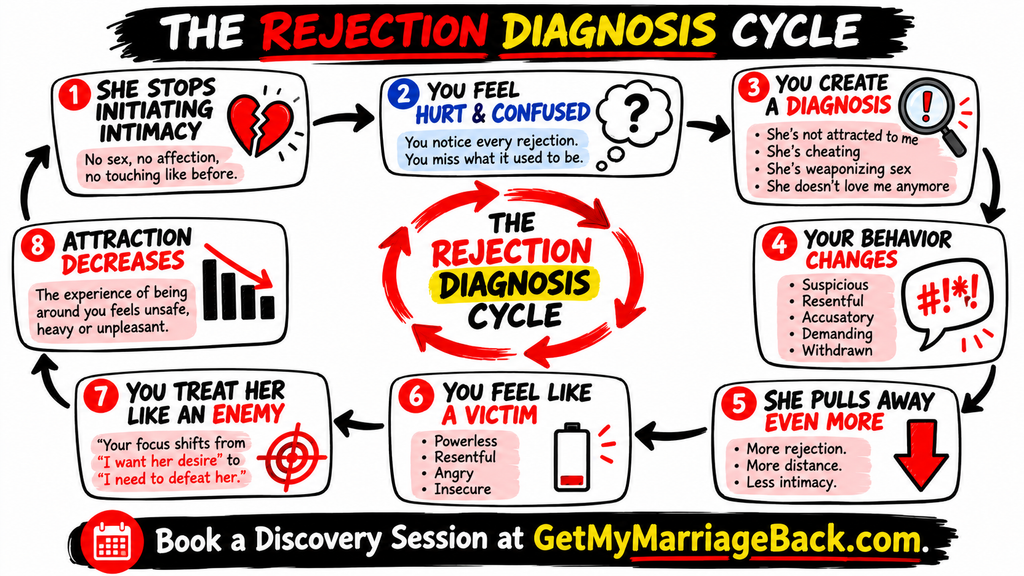
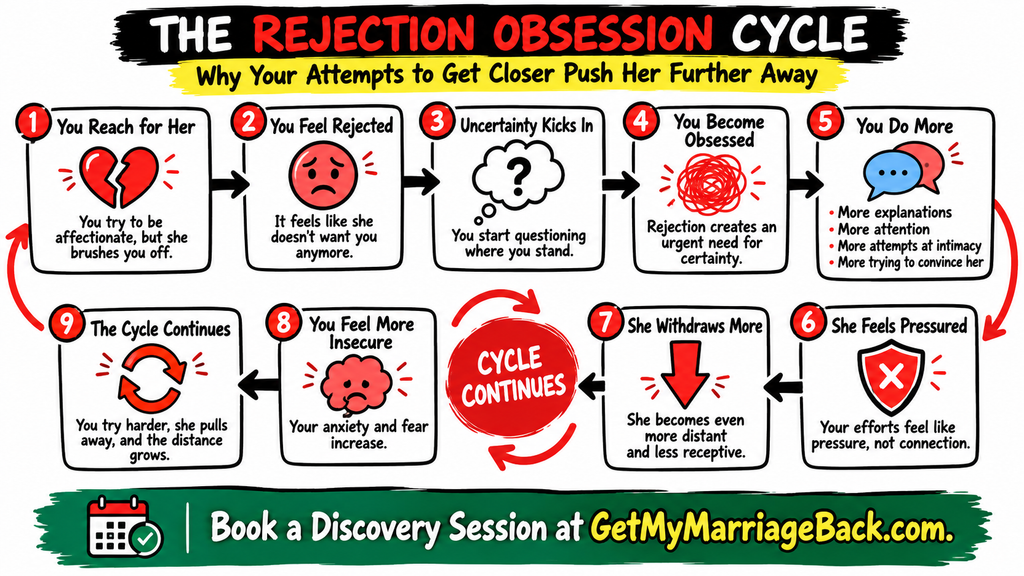
That’s the rejection-obsession cycle.

The more rejected you feel, the harder you pursue reassurance.

Unfortunately, the harder you pursue reassurance, the more pressure your wife experiences.

She withdraws further.

And her withdrawal produces even more obsession.

The problem is no longer just the absence of affection. It’s the emotional pressure surrounding every attempt to restore it.
my wife is not sexually attracted to me - recreate attraction

3. Trying to Recreate Attraction Through More Pursuit

Think about how your relationship began.

You probably demonstrated romantic interest.

And You pursued your wife.

You made an effort to spend time together, express affection, and create experiences she enjoyed.

Those behaviors helped establish your romantic connection.

So when that connection disappears, your instincts tell you to do more of what worked before.

More attention.

And More compliments.

More romantic gestures.

And More conversations about your feelings.

More attempts to initiate intimacy.

But there’s a fundamental difference between pursuing someone who welcomes your romantic interest and repeatedly approaching someone who is emotionally withdrawing.

What feels like romantic effort to you can feel like emotional pressure to her.

This doesn’t mean affection is wrong.

It means attraction depends partly on how affection is experienced.

A romantic gesture that once communicated love can begin communicating expectation.

A conversation intended to restore closeness can become another demand for reassurance.

Even an expensive gift can create discomfort when your wife senses that something is expected in return.

What Research Reveals About Attraction

A 2016 study published in the Journal of Personality and Social Psychology examined the relationship between perceived partner responsiveness and sexual desire.

Across three studies, researchers found that feeling understood, valued, and cared for was associated with greater sexual desire, particularly among women.

The researchers also identified feeling special and perceiving one’s partner as desirable as important mechanisms.

You can examine the research on partner responsiveness and sexual desire for the underlying findings.

This supports an important distinction.

Attraction is influenced by the experience you create, not simply the amount of effort you demonstrate.

Additional relationship research has found positive associations between perceived partner responsiveness, affectionate touch, and intimacy.

That doesn’t mean emotional responsiveness automatically produces sexual desire.

It means the quality of the relational experience deserves attention before you assume that more romantic pursuit is the answer.

4. Believing Personal Improvement Entitles You to Intimacy

I once worked with a man whose marriage had experienced an extraordinary level of betrayal.

He had committed serial infidelity.

His behavior had caused tremendous damage, including circumstances in which his wife required treatment for an infection.

Eventually, she emotionally withdrew from the marriage.

She wasn’t asking for divorce.

According to him, she was remaining in the household primarily because of the children.

But she had made one thing clear.

She never wanted him to touch her again.

Now, here’s where most people become distracted.

They immediately start looking for a way to change her mind.

But her determination to never touch him again was irrelevant to the work he needed to do on himself.

Not because her decision didn’t matter.

Her boundaries absolutely mattered.

The point is that his responsibility wasn’t to negotiate her decision or pressure her into reconsidering it.

His responsibility was to address the behavior that had destroyed emotional safety.

When Personal Transformation Becomes Entitlement

This man experienced what he described as a spiritual transformation.

He found God.

He believed he had become a different person.

And he genuinely wanted to repair his marriage.

But for approximately two years, he repeatedly tried to convince his wife that his transformation should change how she treated him.

He wanted recognition for becoming a better man.

He expected renewed affection.

His belief was that because they had committed to a lifetime together, she should give him another opportunity.

Unfortunately, his attempts to prove that he had changed became another source of pressure.

His declaration of change was not the same thing as her experience of safety.

That’s the distinction I want you to understand.

You can become more religious.

And You can work harder.

You can become more responsible.

And You can provide more financially.

But none of those improvements automatically changes the emotional experience your wife associates with you.

And when you demand affection as evidence that your personal improvement is working, you turn your growth into an invoice she is expected to pay.

This is particularly damaging when the marriage has experienced betrayal, cheating, or prolonged resentment.

Your wife needs the freedom to evaluate your behavior without being pressured to reward it.

Real transformation becomes influential when it can be experienced consistently—not when it is repeatedly announced.

5. Trying to Control Her Feelings Instead of Developing Your Influence

When your wife emotionally withdraws, your instincts naturally focus on the external situation.

You want to fix her mood.

And You want to change her response.

You want to convince her that you’re still desirable.

And you want her to understand why she should reconnect.

But this is where you begin surrendering your personal power.

Because you’re attempting to control something that belongs to another human being.

Influence begins where the need to control ends.

That distinction changes how you approach marriage reconciliation.

Control attempts to produce a particular response.

Influence develops through the quality, consistency, and emotional intelligence of your behavior.

When you become less defensive, more emotionally grounded, and more intentional about the experiences you create, your presence begins communicating something different.

Your wife no longer has to experience every interaction as an attempt to extract affection.

She can observe your behavior without being required to immediately validate your improvement.

And that creates room for a different kind of relational experience.

Emotional Safety Comes Before Romantic Reconnection

Consider what happens when your wife rejects a simple gesture of affection.

Your old response involves questioning her, becoming visibly frustrated, or withdrawing into resentment.

She learns that rejecting affection produces an uncomfortable emotional consequence.

Eventually, even innocent gestures can become associated with pressure.

Now consider a different response.

You recognize the rejection without making it the center of your identity.

Instead of interrogating her, you respect the boundary and continue conducting yourself with dignity.

Your emotional stability remains intact.

Over time, your consistent behavior communicates that she can interact with you without being responsible for regulating your emotions.

That’s emotional intelligence in action.

Emotional safety isn’t something you demand. It’s something your behavior helps establish.

And emotional safety creates better conditions for curiosity, warmth, and attraction to develop.

How to Rebuild Attraction Without Begging for Affection

Here’s what I want you to do.

Stop treating your wife’s immediate response as the ultimate measurement of your personal value.

Your responsibility is to develop the emotional capacity and behavioral consistency necessary to create a different experience.

I teach this through three foundational principles: Grounding, Purpose, and Self-Discovery.

Grounding: Stop Allowing Rejection to Define You

Grounding means returning to a source of truth greater than your wife’s immediate emotional response.

Her rejection is real.

The pain matters.

But that moment doesn’t determine your identity, dignity, or capacity for personal growth.

When you become grounded, you stop treating every interaction as an emergency requiring immediate resolution.

You can experience disappointment without becoming reactive.

And you can respect your wife’s boundaries without interpreting them as a personal catastrophe.

Purpose: Become Bigger Than the Marriage Crisis

Your marriage matters.

But your purpose must extend beyond the approval of any individual person.

Reconnect with your mission.

Examine the impact you want to create.

Consider your contribution to your family, community, career, and the legacy you intend to build.

Purpose redirects emotional energy away from obsessive monitoring of your wife’s behavior.

It also makes your life more engaging.

A person who is meaningfully engaged with life creates a different experience from someone whose entire emotional existence revolves around receiving reassurance.

Attraction is not built by abandoning your identity to obtain someone else’s approval.

Self-Discovery: Reclaim Your Capacity for Influence

Self-Discovery means examining your emotional patterns without collapsing into self-blame.

Notice what rejection triggers in you.

Do you become defensive?

And Do you overexplain?

Do you initiate arguments?

Do you attempt to purchase affection through gifts or favors?

Perhaps you withdraw emotionally to punish your wife for not responding.

These patterns deserve examination because they influence the experience you create.

The objective is not to become emotionally indifferent.

It’s to develop the capacity to express interest without desperation and experience rejection without losing self-control.

The Attraction Chain: Value, Curiosity, Influence, and Leverage

There’s another distinction that matters when you’re trying to save your marriage.

Being a morally good person and creating an attractive relational experience are not identical.

You can be hardworking, loyal, responsible, and generous while still creating interactions dominated by anxiety, resentment, or emotional pressure.

Experiential value concerns what another person experiences in your presence.

Do your interactions create unnecessary tension?

Can you remain warm without demanding affection?

Are you capable of humor, confidence, emotional regulation, and genuine interest without attaching hidden expectations?

Those qualities influence the relational environment.

And when your wife begins experiencing something different from the patterns she has come to expect, curiosity becomes possible.

Curiosity is closely connected to attraction because it creates renewed interest.

That interest can support influence.

Influence becomes leverage when your consistent behavior creates value without demanding an immediate return.

Leverage isn’t permission to manipulate your wife.

It is the personal capacity to contribute meaningfully to the relationship while remaining grounded in your own dignity.

That’s how you pursue reconciliation without turning your wife into a project you must control.

Why Knowing What to Do Isn’t Enough

Now imagine tonight.

You approach your wife affectionately.

She pulls away.

Immediately, your chest tightens.

The familiar thoughts return.

You want an explanation.

And You want reassurance.

You want to remind her of everything you’ve done.

And suddenly, the emotional understanding you’ve developed becomes difficult to apply.

That’s habit drift.

Research on habitual behavior shows that familiar environmental cues can activate automatic responses, particularly when established routines are strong.

Your reaction to rejection can become one of those routines.

The solution requires more than understanding the problem intellectually.

It requires repeated behavioral practice.

You need to recognize the emotional trigger, interrupt your established reaction, and consistently choose behavior aligned with the person you’re becoming.

That’s how emotional intelligence becomes a skill rather than an idea.

Can You Save Your Marriage When Your Wife Has Lost Attraction?

Yes, attraction can change throughout a long-term marriage.

But the path forward begins with understanding the difference between restoring affection and creating the conditions that make affection desirable.

Your wife isn’t a problem to solve.

Her emotional response isn’t something you can manufacture.

And her physical boundaries aren’t obstacles to overcome through persistence.

The meaningful work begins with your own behavior.

Stop attempting to extract intimacy through persuasion.

Develop emotional stability that doesn’t depend on constant reassurance.

Address the patterns that have contributed to resentment, insecurity, or disconnection.

Build a life characterized by purpose, confidence, and emotional intelligence.

Most importantly, understand that becoming more attractive is not simply about becoming a better person on paper.

It’s about becoming someone whose presence creates a better experience.

That’s where emotional safety develops.

That’s where curiosity becomes possible.

And that’s where attraction has room to grow.

Wife or Husband Denying You Sex? DO THIS!!!

Frequently Asked Questions

Why is my wife not sexually attracted to me anymore?

Sexual attraction can decline because of accumulated resentment, emotional disconnection, chronic stress, health changes, relationship dissatisfaction, or pressure surrounding intimacy. Understanding the underlying pattern is more useful than assuming her rejection has one simple explanation.

Can my wife love me but not be sexually attracted to me?

Yes, emotional attachment, commitment, and sexual attraction are related but distinct experiences. Your wife can care deeply about you while experiencing little romantic or sexual desire.

What should I do when my wife rejects my affection?

Respect her boundaries, avoid demanding reassurance, and examine whether your response to rejection creates additional emotional pressure. Focus on emotional regulation, personal purpose, and consistent behavior that supports trust and emotional safety.

Can sexual attraction return after years of marriage?

Yes, sexual desire can change over time, and research associates intimacy and perceived partner responsiveness with greater desire. Rebuilding attraction begins with improving the relational experience rather than pressuring your wife to demonstrate affection.


Wife Never Initiates Intimacy? 7 Things It May Really Mean

Your wife used to initiate intimacy, and now she doesn’t—and after enough rejection, it can stop feeling like a change in your sex life and start feeling like evidence about your marriage.

Take This 2 Minutes Quiz

Question 1 of 15

Maybe she used to touch you first. She kissed you without prompting, flirted with you, initiated sex, reached across the bed, or made it obvious that she wanted you.

Now you are usually the one making the first move.

Sometimes she responds. Other times she rejects you. Eventually, you may stop trying because another rejection feels worse than going without sex.

Then your mind starts filling in the blanks.

“She isn’t attracted to me anymore.”

“She must be interested in somebody else.”

“She’s withholding sex because she knows I want it.”

“She doesn’t love me.”

“She’s checked out of the marriage.”

Any one of those explanations could conceivably be true. The mistake is deciding that one of them must be true before you actually understand what changed.

When your wife never initiates intimacy, the withdrawal is information.

Your interpretation of the withdrawal is something different.

That distinction can determine whether you skillfully rebuild attraction—or accidentally create even more distance.

Why It Hurts When Your Wife Never Initiates Intimacy

This problem is deeper than frequency.

Most distressed spouses aren’t simply saying, “I want more sex.”

What they really mean is:

“I want to feel wanted by my wife.”

There is a massive emotional difference between having sex with somebody who reluctantly agrees and experiencing genuine desire from somebody who actively comes toward you.

You want the look.

The touch.

The spontaneity.

The feeling that she chose you rather than merely accommodated you.

When that disappears, the loss can hit your confidence, masculinity, identity, and sense of security inside the marriage.

Research supports the idea that differences between desired and actual sexual frequency can matter relationally. A study of 1,054 married couples found that greater sexual desire discrepancy was generally associated with lower relationship satisfaction and stability and greater conflict; the researchers also found particularly strong negative communication associations when husbands reported larger discrepancies between desired and actual sexual frequency. You can review the published study on sexual desire discrepancy among married couples.

So yes, the problem matters.

But that does not mean your first explanation for it is correct.

wife never initiates intimacy

1. Her Sexual Desire May Have Changed

Sometimes the simplest explanation deserves consideration first.

Desire can change.

Pregnancy, childbirth, exhaustion, physical discomfort, hormonal changes, medication, stress, aging, parenting demands, sleep deprivation, illness, emotional overload, and other circumstances can influence somebody’s sexual experience.

I learned this personally in my own marriage.

After our second baby, my wife experienced a drop in libido. Instead of leaving me to invent an explanation, she communicated what she was experiencing and took the initiative to seek medical insight.

We investigated it together.

Interestingly, figuring out the loss of intimacy became an intimate experience itself.

That taught me something I want you to remember:

A change in sexual behavior is real.

Your interpretation of that change is not automatically reality.

When your wife doesn’t want sex anymore, jumping immediately from “her libido changed” to “she no longer desires me as a man” can transform a problem the two of you might navigate together into a personal indictment.

2. Attraction May Have Declined

We also shouldn’t hide from the possibility you probably fear most.

Yes, attraction can decline in marriage.

Nobody experiences exactly the same emotional and sexual intensity every day for decades.

Conflict can affect attraction. Resentment can affect it. Familiarity without curiosity can affect it. The experience of being around each other can change.

Sometimes a spouse has become emotionally predictable in ways that reduce intrigue.

Other times pressure has slowly replaced playfulness.

Perhaps every affectionate touch now carries an expectation of sex, so ordinary physical affection no longer feels emotionally free.

The critical distinction is this:

Reduced attraction does not automatically mean attraction is permanently gone.

Attraction is responsive to experience.

That means your question should eventually move beyond:

“Why won’t my wife initiate sex?”

A more useful question is:

“What does it currently feel like to experience me?”

That question can sting.

It can also give you somewhere productive to go.

3. Unresolved Conflict May Be Showing Up in the Bedroom

A bedroom problem isn’t always born in the bedroom.

Imagine months of criticism, defensiveness, tension, arguments, unresolved disappointment, pressure, resentment, or emotional disconnection.

Then bedtime arrives.

You suddenly want tenderness, openness, vulnerability, affection, and sexual energy.

Those two experiences don’t always coexist easily.

Your wife may love you while simultaneously experiencing unresolved negative emotions around you.

Likewise, a husband can love his wife while feeling rejected, resentful, lonely, and unwanted.

When the emotional climate changes, sexual behavior can change with it.

That doesn’t make sex a reward for perfect behavior.

It means intimacy exists inside a larger relational experience.

4. She Could Be Withholding Sex—But Don’t Diagnose Motive From Symptoms

Can people weaponize sex?

Of course.

Human beings have used money, attention, affection, access, status, children, silence, approval, and sexuality manipulatively.

Pretending manipulation never happens would be naive.

The dangerous leap happens here:

Symptom: My wife stopped initiating.

Diagnosis: Therefore, she is manipulating me.

Or:

Symptom: She rejected me.

Diagnosis: Therefore, she is cheating.

Or:

Symptom: She doesn’t touch me anymore.

Diagnosis: Therefore, she doesn’t love me.

You’ve moved from observing behavior to claiming certainty about motive.

That certainty feels powerful because uncertainty hurts.

Unfortunately, false certainty can make you confidently destroy what you are trying to rebuild.

5. Your Fear of a Cheating Spouse Can Become Part of the Problem

When intimacy disappears, another person is one of the first possibilities many distressed spouses consider.

That possibility becomes even louder when friends, relatives, social media, and online commentary repeatedly tell you:

“She must be getting it somewhere else.”

Perhaps an affair exists.

Perhaps it doesn’t.

Unless you have evidence, suspicion is still suspicion.

More importantly, notice what believing the accusation prematurely does to you.

You become watchful.

Your questions become interrogations.

Normal behavior starts looking suspicious.

Resentment enters your tone.

Coldness becomes self-protection.

Suddenly, you’re no longer interacting with your wife as the woman whose desire you want to experience.

You’re interacting with an enemy.

Think about that contradiction.

You want her to desire you while experiencing her as somebody you need to defeat.

That’s a terrible environment for attraction.

6. Sexual Rejection Can Turn Your Marriage Into Villain Versus Victim

Repeated rejection hurts.

Pain naturally wants an explanation.

Once you decide your wife is deliberately depriving, betraying, manipulating, or humiliating you, something psychologically convenient happens:

You become the victim.

Now somebody else has to become the villain.

From there, almost anything can feel justified.

Sulking feels justified.

Pressure feels justified.

Interrogation feels justified.

Punishment feels justified.

Constantly demanding an explanation feels justified.

Begging for reassurance may even feel justified.

Yet none of those behaviors necessarily creates what you actually want.

Remember, the objective isn’t simply to secure sexual compliance.

You want genuine desire.

Pressure might produce capitulation.

It cannot manufacture authentic attraction.

7. She May Not Even Fully Understand Why Her Desire Changed

This is one of the most overlooked possibilities.

You may be demanding an answer from somebody who doesn’t completely understand the answer herself.

“Why don’t you want me?”

“Are you still attracted to me?”

“What’s wrong?”

“Is there somebody else?”

“Why did you change?”

Those questions can sound reasonable from inside your pain.

But imagine being repeatedly required to provide a definitive explanation for a feeling you haven’t fully processed yourself.

She may know that something feels different without yet understanding why.

This is another reason emotional intelligence matters.

You need enough internal stability to investigate reality without forcing your preferred explanation onto it.

wife never initiates intimacy - the rejection diagnosis cycle

Stop Making Her Desire the Measurement of Your Identity

Here’s where attraction work becomes personal.

Your wife’s desire matters to you.

It should not become the measurement of your identity.

Those are different statements.

When your identity depends on her sexual response, every rejection becomes an emergency.

You initiate.

She says no.

Now you’re not simply disappointed.

You’re destabilized.

You need reassurance.

And you need an explanation.

You need her to prove that you’re still desirable.

The pressure intensifies precisely when pressure is least seductive.

Ground yourself first.

Her rejection is information.

It is not your source of truth about your worth.

Redirect the Energy You’re Burning on Her

How much mental energy are you spending analyzing your wife?

Her facial expression.

How she hugged you.

Whether she kissed you properly.

Why she rolled over.

How long she spent on her phone.

Whether she seemed excited to see you.

Why she rejected you Tuesday but seemed cheerful Wednesday.

That constant monitoring can turn your marriage into a laboratory and your spouse into a specimen.

Redirect some of that energy toward purpose.

Build.

Create.

Contribute.

Strengthen your body, work, mission, friendships, parenting, character, interests, competence, and impact.

This is not about pretending you don’t care about your marriage.

Quite the opposite.

You’re refusing to make the marriage carry the entire weight of your identity.

A grounded spouse brings a different energy into a room than somebody silently begging to be validated.

Use Rejection for Self-Discovery, Not Self-Blame

Now look inward without turning the exercise into shame.

Ask:

What is this rejection exposing in me?

Fear of abandonment?

Jealousy?

A desperate need for validation?

Anger?

Entitlement?

An inability to tolerate uncertainty?

A habit of catastrophizing?

The discovery isn’t an admission that her behavior is your fault.

You are identifying the part of your response that belongs to you.

That gives you leverage.

You cannot directly control another adult’s libido.

You can become far more skillful at controlling what you bring into the relationship.

Attraction Is About Experiential Value, Not Moral Invoices

This is where many good spouses become confused.

“I’ve been loyal.”

“I work hard.”

“I provide.”

“I’m a good parent.”

“I’ve done everything for this family.”

Those things matter.

But being a good husband does not create an invoice your wife is required to pay with sexual desire.

Neither does being a good wife entitle someone to her husband’s desire.

Attraction doesn’t operate like accounts receivable.

Instead, think about experiential value.

What does it feel like to experience you?

Do you bring suspicion?

Pressure?

Neediness?

Sulking?

Interrogation?

Passive aggression?

Or can your spouse experience somebody grounded enough to want intimacy without collapsing when the answer is no?

Can you flirt without demanding?

And can you create warmth without immediately converting warmth into a sexual transaction?

Can you be playful again?

Also, can you remain emotionally present without monitoring every response?

Can you express desire confidently while respecting another person’s autonomy?

That is a far more sophisticated approach to rebuilding attraction.

Seduction Isn’t Pressure—It’s Creating an Experience

The word “seduction” is often misunderstood.

Healthy seduction isn’t trickery.

It isn’t coercion.

It’s certainly not wearing somebody down until they surrender.

Seduction is partly the art of creating an experience where curiosity, emotional energy, individuality, playfulness, tension, safety, confidence, and desire have room to emerge.

Notice the phrase have room to emerge.

You cannot command curiosity.

And you can become more interesting to experience.

Can’t negotiate somebody into authentic attraction.

You can stop behaving in ways that unnecessarily suffocate it.

And you cannot demand genuine desire.

You can develop the emotional intelligence required to stop turning every intimate moment into a referendum on your worth.

Watch for Habit Drift After the Next Rejection

Reading this while calm is easy.

Tonight might be different.

You initiate.

She rejects you again.

Now you’re lying there staring at the ceiling.

Suddenly the old diagnosis returns.

“She doesn’t want me.”

“She’s doing this deliberately.”

“There must be somebody else.”

Nothing you intellectually understood twenty minutes earlier feels emotionally available anymore.

That’s habit drift.

Under stress, people tend to fall back toward familiar responses.

For you, that could mean interrogation.

Maybe it’s an attitude.

Perhaps you withdraw affection.

You might become cold, accusatory, sarcastic, or desperate.

Some spouses start begging for sex or reassurance.

Recognize the drift before it takes control.

One rejection does not require an immediate investigation.

Why “My Wife Doesn’t Want Sex” Is Not a Complete Diagnosis

Sexual withdrawal is a symptom with multiple possible pathways.

It can involve attraction.

There may be unresolved conflict.

Physical or hormonal changes may matter.

Stress could matter.

Parenthood may matter.

An affair is possible.

Medication or health issues can matter.

The sexual dynamic itself may have become pressured or predictable.

Several factors may be operating simultaneously.

That’s why generic marriage advice becomes dangerous when it turns one symptom into one universal diagnosis.

Your marriage has a history.

Your wife has a history.

You have a history.

The dynamic between you has a history.

Understanding that story matters.

Can You Save Your Marriage When Attraction Has Dropped?

Yes, a marriage experiencing attraction loss is not automatically a marriage destined for divorce.

But saving your marriage is not the same thing as desperately trying to preserve the current dynamic.

Sometimes the current dynamic is precisely what must change.

You may need to stop chasing.

You may need to stop prosecuting.

Perhaps you need to rebuild emotional stability.

You may need better communication skills.

The relationship may require honest conversations about resentment, sex, health, conflict, or desire.

Your job isn’t to force your wife back into the version of herself you remember.

Your job is to become capable of responding intelligently to the marriage that exists today.

That shift matters whether you’re trying to save marriage from divorce, prevent separation, pursue marriage reconciliation, or simply rebuild attraction before the crisis becomes that severe.

What You Actually Control When Your Wife Stops Initiating

You control your interpretation.

You control whether you turn suspicion into fact.

Your emotional regulation belongs to you.

You control whether rejection becomes resentment.

Your behavior after rejection is yours.

You control whether you create pressure or space.

You can examine the experience you’re creating.

Your growth remains available to you even when your spouse isn’t currently cooperating.

This is how you begin to save your marriage without trying to control another human being.

The paradox is important:

The less desperately you attempt to control desire, the more capable you become of creating conditions where genuine desire can breathe again.

That’s emotional intelligence.

That’s attraction work.

And that’s far more seductive than begging somebody to prove that you are still desirable.

19 Signs Your Wife Is Not Sexually Attracted To You

Frequently Asked Questions

Why does my wife never initiate intimacy?

There isn’t one universal cause; attraction changes, unresolved conflict, stress, health factors, parenthood, desire discrepancy, relationship dynamics, or several factors together can influence initiation. Treat the change as information to investigate rather than automatic proof that she no longer loves you.

Does my wife not initiating sex mean she isn’t attracted to me?

Not necessarily, although reduced attraction is one possibility. Sexual desire and initiation can change for relational, physical, emotional, hormonal, and situational reasons, so the pattern needs context before you diagnose its meaning.

Is my wife cheating if she suddenly stops wanting sex?

A change in sexual behavior alone does not establish an affair. Look at evidence rather than allowing the fear of a cheating spouse to turn uncertainty into an accusation.

Can a sexless marriage regain attraction and intimacy?

A sexless marriage can change, but rebuilding intimacy requires understanding what is maintaining the distance rather than merely increasing pressure for sex. Greater sexual desire discrepancy has been associated with poorer relationship outcomes in married couples, which is one reason the couple’s broader interaction pattern deserves attention rather than treating one partner as the entire problem.

Your Wife Is Pulling Away and Wants Divorce? 7 Attraction Shifts

Your wife used to complain that you were not present enough; now she has stopped asking for your attention, built more of a life without you, and may even be talking about divorce.

Take This 2 Minutes Quiz

Question 1 of 15

That reversal can mess with your head.

There was a time when she wanted you to listen more. She wanted more conversation, affection, attention, involvement, or emotional presence.

You may have been confused because you believed you were already there.

worked, provided.

…You handled responsibilities.

Your life revolved around keeping the family together.

From your perspective, that was presence.

But physical presence and experienced connection are not automatically the same thing.

Then something changed.

She stopped complaining.

At first, that may have felt like progress. The arguments decreased. She stopped asking you to talk. She no longer complained that you were always busy.

Until you noticed something uncomfortable:

She did not necessarily stop complaining because the problem was solved.

She may have stopped expecting you to solve it.

Now she has friendships, activities, events, work, lunches, interests, or an entire social world that does not revolve around you.

Suddenly, you are the one feeling disconnected.

And when your wife is pulling away and wants divorce, that reversal can trigger exactly the behavior that makes attraction even harder to rebuild.

When Your Wife Stops Needing Your Attention, Rejection Can Become Obsession

Attention has an interesting way of becoming more valuable when nobody is asking you for it anymore.

Yesterday, she wanted your attention and you were busy.

Today, she seems perfectly capable of enjoying herself without it, and suddenly you are watching everything.

Where is she going?

Who is going?

Why is she dressed like that?

Who is that guy?

Why did they have lunch together?

Did she mention him again?

Why does she seem happier around everybody else?

Those questions do not automatically make you controlling.

Feeling insecure is not a crime.

Insecurity is information.

You can feel threatened, rejected, excluded, jealous, confused, or frightened by a changing marriage without turning those feelings into your identity.

The danger begins when a feeling becomes a prosecution.

Now your wife has to prove her innocence every time she lives her life.

You question.

She becomes defensive.

You interpret her defensiveness as additional evidence.

She withdraws.

Her withdrawal increases your suspicion.

Then you question harder.

Before long, you are no longer responding to what you actually know. You are responding to a case being built inside your head.

That cycle is especially dangerous when your wife already wants separation or divorce.

wife is pulling away and wants divorce

Attraction Shift #1: Separate What You Know From What You Fear

Suppose your wife has developed an active social life.

She attends events. Maybe she volunteers, networks, works outside the home, goes to brunch, attends community functions, or spends time with friends.

Some of those environments naturally include men.

That fact alone does not prove infidelity.

At the same time, emotional intelligence does not require becoming naive.

If you have concrete evidence of deception, inappropriate boundaries, an affair, or cheating, deal with the facts in front of you.

But facts and fear are not interchangeable.

A grounded question sounds like:

“What do I actually know?”

An insecure prosecution sounds like:

“What can I find that proves what I already fear?”

Those mindsets produce completely different behavior.

When you manufacture certainty because uncertainty hurts, you can end up punishing your spouse for conclusions you have not established.

That is not confidence.

And it is rarely seductive.

Attraction Shift #2: Stop Making Her Responsible for Regulating Your Fear

Your wife goes out Saturday.

You spend Saturday monitoring the clock.

She comes home.

You want details.

Who was there?

Who did you talk to?

Where did you go afterward?

Why didn’t you answer immediately?

Did that guy show up?

One reasonable question can quickly become an interrogation when its real purpose is not understanding—it is emotional regulation.

You need her answers to make your anxiety disappear.

That is a tremendous amount of pressure to put on someone who may already be pulling away.

Seduction requires voluntary movement.

Attraction needs enough emotional oxygen for two people to remain individuals while choosing each other.

When every interaction contains the invisible demand, “Make me feel secure about us right now,” your spouse can begin experiencing your presence as emotional work.

You can desire your wife deeply without making her responsible for stabilizing you.

That distinction is powerful.

Attraction Shift #3: Understand Why “I’m Here” May Not Have Felt Like Connection

One of the most useful questions you can ask yourself is not:

“Was I a good spouse?”

Ask instead:

“What was it like to experience me?”

Those are not the same question.

You can be responsible, faithful, hardworking, committed, and dependable while still being emotionally difficult to reach.

Maybe you were physically home but mentally elsewhere.

Perhaps every conversation competed with your phone, work, business, television, stress, or exhaustion.

She may have repeatedly felt unheard while you repeatedly felt unfairly accused.

This is where attraction becomes more sophisticated than simply being a “good husband” or “good wife.”

Moral value matters.

But attraction is experienced value.

Your spouse experiences your presence, emotional intelligence, confidence, curiosity, warmth, sexuality, humor, boundaries, decisiveness, responsiveness, social intelligence, purpose, and ability to listen without immediately defending yourself.

Relationship research supports an important piece of this. Studies have found that perceived partner responsiveness—experiencing a partner as understanding, validating, and caring—is associated with intimacy and sexual desire. In one series of studies, the responsiveness-desire association was particularly strong among women. You can review the research on partner responsiveness and sexual desire.

That does not mean becoming endlessly agreeable.

Responsiveness is not submission.

Listening does not mean surrendering your judgment.

Understanding her experience does not require agreeing with every interpretation she makes.

It means becoming capable of receiving another person’s experience without immediately making the conversation about proving yourself innocent.

Attraction Shift #4: Do Not Confuse Being Needed With Being Desired

You may have heard that people—especially men—need to feel needed.

Be careful with that idea.

There is an enormous difference between being valuable to your spouse and needing your spouse to depend on you so you can feel valuable.

Imagine that your wife has become more independent.

She has friends.

She can entertain herself.

Her career or business is growing.

She has interests outside the marriage.

If your security depends on her dependence, her growth can feel like your rejection.

You may start trying to regain importance by becoming more controlling, more involved, more critical of her outside relationships, or more demanding of her time.

That is not intimacy.

Dependency is not the same thing as attraction.

A seductive marriage contains choice.

“I can live a meaningful life, and I still choose you” carries a different emotional energy from “I need you to need me so I know I matter.”

One creates room for desire.

The other can turn marriage into an emotional hostage situation.

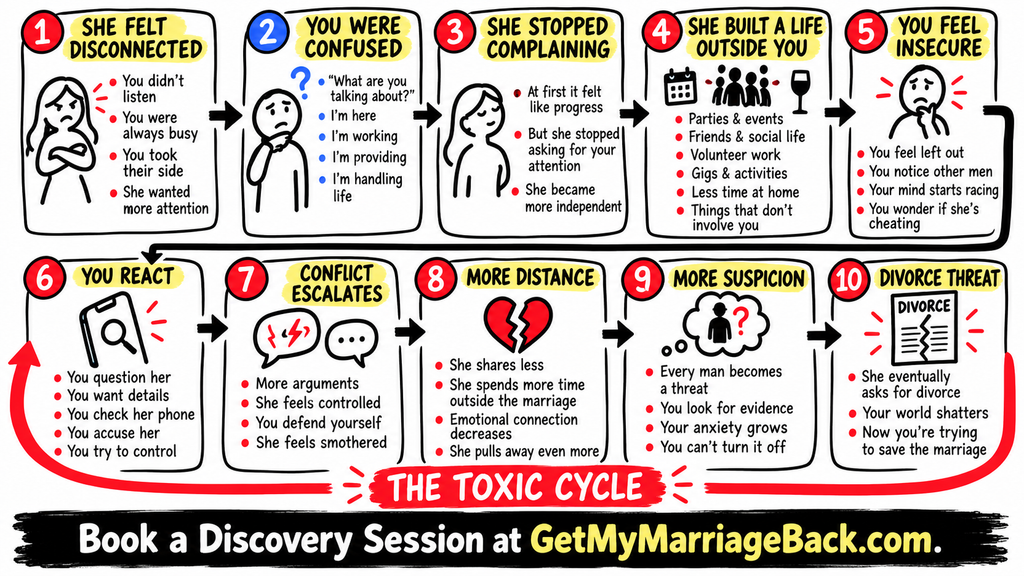
Attraction Shift #5: Interrupt the Rejection → Suspicion → Pressure Cycle

Here is the toxic cycle to watch:

Disconnection → Independence → Insecurity → Suspicion → Accusation → Conflict → More Distance → More Suspicion

The problem is not merely that your wife has become distant.

The problem is what the two of you repeatedly create after the distance appears.

You feel rejected.

Fear wants reassurance.

Reassurance does not last, so you monitor.

Monitoring produces questions.

Questions become accusations.

Accusations produce defensiveness.

Defensiveness feels suspicious.

Now the cycle has evidence to feed itself.

This can continue for months or years.

Eventually, you may become terrified that your wife wants divorce while behaving in ways that make being married to you increasingly exhausting.

That is the contradiction.

Your fear says, “Hold tighter.”

Attraction often needs you to become emotionally strong enough to stop squeezing.

Attraction Shift #6: Rebuild Yourself Around Grounding, Purpose and Self-Discovery

When your wife is pulling away and wants divorce, your world can become painfully small.

Everything becomes about her.

Her mood.

…phone.

Her schedule.

…affection.

Her texts.

…social life.

Her decision about the marriage.

That is too much power to hand another human being.

Start with Grounding.

Ground yourself in something true that exists beyond whether your wife chooses you today.

Your emotional stability cannot rise and fall entirely according to whether she smiled at breakfast.

Then reclaim Purpose.

Purpose is mission, contribution, impact, and legacy beyond the immediate marriage crisis.

That does not mean abandoning your spouse.

It means refusing to make saving your marriage your only identity.

Return to meaningful work.

Take care of your body.

Reconnect with healthy friendships.

Become socially alive again.

Create.

Lead.

Learn.

Contribute.

Handle neglected responsibilities.

Develop parts of yourself that disappeared while you were obsessing over the relationship.

Then practice Self-Discovery.

Do not merely ask, “How do I get my wife back?”

Ask:

“Who have I become?”

“What is it like to experience me?”

“Where did confidence become reassurance-seeking?”

“Did love become fear?”

“Where did pursuit become chasing?”

“Did leadership become control?”

“What have I stopped developing in myself?”

That is a much more attractive project than spending another six months investigating brunch.

Attraction Shift #7: Create Experiential Value Instead of Performing for Approval

There is a trap here.

Once you understand that your experience matters, you may start performing.

You become extra helpful.

Extra romantic.

Extra agreeable.

Suddenly you are at the gym every morning, buying flowers every Friday, cleaning everything, planning dates, changing your wardrobe, and becoming Husband of the Year.

But underneath the transformation is an invisible question:

“Do you want me now?”

That is still reassurance-seeking.

Your wife can often feel the transaction even when you never say it.

Experiential Value is different.

It asks:

What does my presence consistently create?

Do I bring emotional stability or volatility?

Curiosity or predictability?

Warmth or pressure?

Purpose or obsession?

Playfulness or constant seriousness?

Desire or desperation?

Healthy boundaries or control?

Listening or prosecution?

Growth or performance?

You are not building value to force your spouse to reward you.

You are developing into someone whose experience is naturally more attractive.

That is where curiosity can begin returning.

Value can create Curiosity.

Curiosity gives Attraction room to breathe.

Attraction expands Influence.

Influence can eventually create Leverage for building a different marriage.

Value → Curiosity → Attraction → Influence → Leverage

Notice what is absent from that sequence.

Begging.

wife is pulling away and wants divorce - “But What If She Really Is Cheating?”

“But What If She Really Is Cheating?”

Then the facts matter.

Emotional intelligence is not pretending betrayal cannot happen.

The objective is to become capable of addressing reality without inventing additional reality.

If evidence establishes an affair, the marriage now has an infidelity problem requiring boundaries, decisions, accountability, and a different conversation.

If you do not have evidence, repeatedly treating your spouse like a cheating spouse can create damage without giving you greater clarity.

You do not need paranoia to have standards.

Strong boundaries and emotional stability can exist together.

Stop Arguing About Whether You Are “Controlling”

Your wife says:

“You’re controlling.”

Your instinct may be immediate:

“No, I’m not.”

Then you spend twenty minutes debating the definition of control.

You explain that asking where your wife went is normal.

She explains how your questions feel.

Next, you defend your intentions.

She describes your behavior.

Eventually, you are fighting semantics while your marriage is bleeding.

Try a more emotionally intelligent approach.

Become curious about the experience underneath the accusation.

“What am I doing that feels controlling to you?”

That question is not an admission of guilt.

It is information gathering.

You can understand why something feels controlling to her and still decide that a particular boundary or concern is reasonable.

The objective is clarity—not surrender.

When Your Wife Wants Divorce, Stop Trying to Win the Immediate Moment

Divorce language creates urgency.

Your nervous system screams:

Fix this now.

Convince her now.

Get reassurance now.

Make her remember the good times.

Prove you’ve changed.

Promise everything.

But panic is rarely seductive.

Your spouse did not arrive at emotional withdrawal five minutes ago simply because she used the word “divorce” five minutes ago.

There is usually a history.

Listen to that history.

Look for patterns.

Take responsibility for what is actually yours.

Stop accepting responsibility for what is not.

Most importantly, resist the urge to turn every interaction into a referendum on whether she is staying.

A marriage crisis requires deliberate behavior.

Not frantic behavior.

Attraction Is Not Something You Extract From Your Wife

You cannot force curiosity.

…negotiate desire.

You cannot guilt somebody into genuine affection.

And you cannot interrogate another person into feeling safe enough to move toward you.

What you can do is change the experience you contribute to the marriage.

Become grounded enough to tolerate uncertainty.

Develop enough purpose that your entire identity is not trapped inside your spouse’s approval.

Learn enough about yourself to recognize when fear is driving you.

Build relational skills that allow you to express concern without prosecution.

Become responsive without becoming submissive.

Create boundaries without becoming controlling.

Desire your spouse without smothering her.

That combination is emotionally intelligent.

It is also far more seductive than desperation.

Prepare for the Moment Your Fear Comes Back

Reading this calmly is one thing.

Saturday night is another.

Your wife goes out.

Someone’s name comes up again.

She mentions lunch.

Your stomach tightens.

Suddenly every intelligent idea you understood today collides with:

“You’re losing her.”

That is where skill matters.

Some research has suggested that stress can favor previously learned responses over deliberate goal-directed behavior, although subsequent replication research has found the overall stress-to-habit effect is not universal.

The practical lesson for marriage is simple:

Do not assume understanding automatically becomes execution.

Your old reaction may still arrive first.

Prepare for it.

Know what you do when fear rises.

Know who you speak to instead of dumping every thought onto your spouse.

Recognize the difference between information you need and reassurance you crave.

Have a system for slowing yourself down before insecurity becomes accusation.

Emotional intelligence becomes valuable when the emotion is actually happening.

Can You Save Your Marriage When Your Wife Is Pulling Away?

One person cannot manufacture a healthy two-person marriage alone.

But one person can stop feeding a destructive cycle.

You can stop turning insecurity into prosecution.

…stop confusing pressure with pursuit.

You can stop treating your wife’s independence as automatic betrayal.

…become more present without becoming clingy.

You can listen without abandoning your standards.

And you can desire her without requiring her attention to regulate your emotional state.

And you can rebuild the qualities that make your presence feel grounded, interesting, emotionally intelligent, warm, purposeful, confident, and alive.

That is where marriage reconciliation becomes a more intelligent objective.

You are no longer asking:

“How do I make her choose me?”

You are asking:

“What can I change about the experience I am creating, and what does her response to that reality tell me?”

That question returns you to your power.

Not power over your wife.

Power over yourself.

And that is where attraction has room to become voluntary again.

Wife or Husband Denying You Sex? DO THIS!

Frequently Asked Questions

What should I do if my wife is pulling away and wants divorce?

Stop escalating the crisis through begging, interrogation, repeated reassurance-seeking, or pressure, and examine the relational cycle plus what you can actually control. Listen carefully to her concerns while rebuilding your emotional stability, purpose, communication skills, and experiential value.

Does my wife becoming distant mean she is cheating?

No; emotional distance, new friendships, events, lunches, or a larger social life do not by themselves establish infidelity. Respond to concrete evidence rather than allowing insecurity to turn ambiguous behavior into a prosecution.

Can attraction come back when my wife wants divorce?

Attraction can change over time, and research has associated intimacy, responsiveness, autonomy support, and feeling valued with stronger sexual and relationship experiences. You cannot force attraction back, but you can stop behaviors that create pressure and develop conditions more compatible with voluntary curiosity and connection.

Can I save my marriage if my wife has emotionally checked out?

You can change your contribution to destructive patterns even before your spouse participates, but sustainable marriage reconciliation ultimately involves choices from both people. Start by replacing fear-driven pursuit with grounded, emotionally intelligent behavior and observe the relationship from that stronger position.

Signs Your Wife Is Cheating? 7 Clues Fear Can Misread

Your wife becomes cold, her energy changes, conversations get shorter, and one suspicious text suddenly seems to explain everything: there must be another man.

Take This 2 Minutes Quiz

Question 1 of 15

That conclusion may eventually prove true. Infidelity happens, and pretending otherwise will not help you save your marriage.

But emotional distance is information—not a conviction.

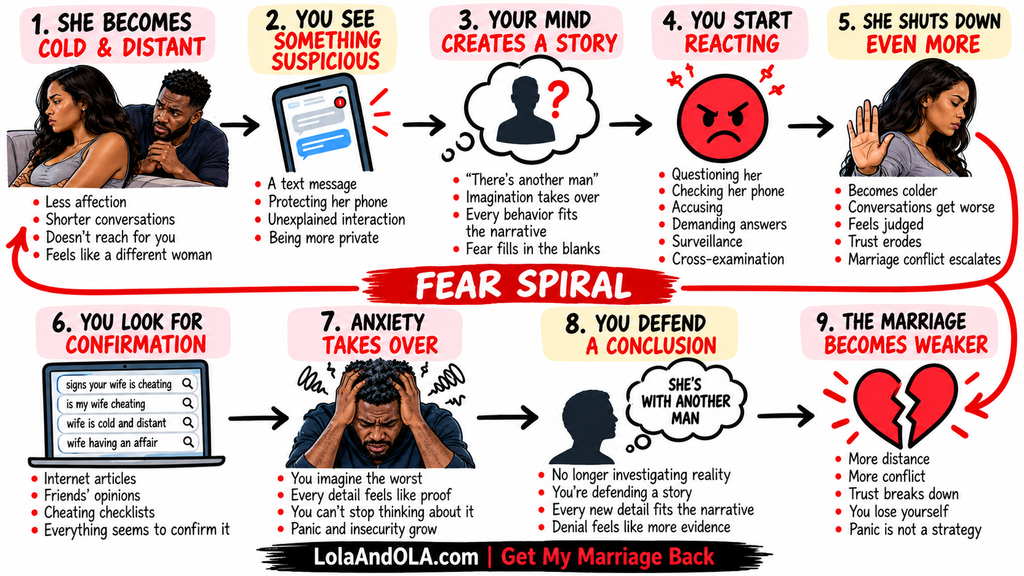
That distinction matters because when you’re scared of losing your wife, your mind naturally wants to turn uncertainty into certainty. Suddenly, you’re not simply noticing changes in her behavior. You’re interpreting everything through the same frightening explanation.

She’s late? Another man.

She’s quiet? Another man.

She turns her phone over? Another man.

She’s irritated because you keep asking questions? Now even her irritation becomes evidence.

Before long, you’re no longer trying to understand reality. You’re defending a conclusion.

And that can become extraordinarily destructive when your deeper objective is not merely discovering whether your wife is cheating, but rebuilding a marriage in which attraction, curiosity, respect, trust and emotional connection can exist again.

Signs Your Wife Is Cheating—or Signs Something Is Wrong?

When people look for signs your wife is cheating, they’re usually not beginning from a place of emotional neutrality.

Something has already changed.

Maybe affection disappeared. Sex became infrequent or stopped. She no longer reaches for you. Her phone habits changed. Conversations became functional rather than intimate.

Perhaps she suddenly seems more emotionally alive around everybody except you.

Those changes deserve your attention.

They do not all have the same explanation.

Research on infidelity reflects this complexity. Researchers have examined individual, relationship and contextual variables associated with infidelity rather than identifying one behavioral sign that reliably proves an affair.

That means you need to resist one of the most seductive mistakes in a marriage crisis:

Taking several ambiguous facts and using fear to manufacture the missing pieces.

signs your wife is cheating

7 Signs That Can Feel Like Proof of Cheating

1. Your Wife Suddenly Becomes Cold

This is often the change that destabilizes a spouse first.

You knew how your wife used to look at you. You remember how she responded when you touched her, how she spoke to you and how naturally conversation once flowed.

Now something feels different.

That shift is real even when you cannot yet explain it.

The mistake is turning:

“My wife has become emotionally distant.”

into:

“My wife is emotionally distant because she’s sleeping with someone else.”

The first statement describes your experience.

The second assigns a cause you may not have established.

That gap is where emotional intelligence becomes critical.

2. She Starts Protecting Her Phone

A wife suddenly hiding her phone understandably gets your attention.

Maybe she turns the screen downward. Perhaps she carries it everywhere. Password behavior changes. She appears uncomfortable when messages arrive.

Those behaviors can accompany secrecy.

Still, secrecy and adultery are not interchangeable concepts.

She could be concealing an affair. She could also be discussing your marriage with someone, dealing with something personal, protecting information she doesn’t want you to see, or reacting to a relationship dynamic that has already become distrustful.

Your objective isn’t to become naive.

It’s to become accurate.

3. You Find an Ambiguous Text Message

This is where many people emotionally lose control.

You see a message.

It bothers you.

Nothing in the message independently proves she’s cheating, but once you combine it with months of emotional distance, your brain creates a compelling narrative.

Now the message doesn’t feel ambiguous anymore.

It feels like confirmation.

But confirmation and confirmation bias are not the same thing.

When you’ve already decided what the story means, every new detail starts getting recruited to support it.

That’s dangerous.

4. She Stops Reaching for You

Loss of affection can be devastating because it feels deeply personal.

When your wife once initiated affection, intimacy or sex and suddenly stops, it’s easy to conclude that her desire must be going somewhere else.

Sometimes another relationship is involved.

Other times attraction has deteriorated inside the marriage itself.

Resentment may have accumulated. Emotional exhaustion may have taken over. Repeated conflict could have made closeness feel unsafe or undesirable.

Sometimes the consequences seem sudden because you didn’t experience the buildup the same way she did.

5. She Seems Irritated by Your Questions

Here’s where the situation becomes circular.

You suspect something.

So you ask.

She becomes irritated.

Now her irritation makes you more suspicious.

You ask again, except this time you’re less curious and more prosecutorial.

She becomes even more defensive.

Soon every conversation feels like cross-examination:

“Who’s that?”

“Why did you turn your phone over?”

“Where were you?”

“Why are you acting differently?”

“Just tell me the truth.”

The more she resists the interrogation, the more convinced you become.

You’ve now created a theory that can become almost impossible to disprove.

If she admits it, she’s guilty.

If she denies it, she’s hiding it.

If she’s angry about the accusation, her anger becomes evidence.

At that point, fear is running the investigation.

6. Your Wife’s Withdrawal Seems to Come Out of Nowhere

One of the most important questions isn’t merely, “Is my wife cheating?”

Ask:

“What happened before she became this version of herself with me?”

Consider a marriage where one spouse carries a secret.

Eventually, information about that secret reaches the other spouse, but there’s no immediate confrontation.

Instead, the betrayed spouse withdraws.

She becomes cold.

Distant.

Quiet.

Her husband doesn’t know that she knows what he did, so he experiences her behavioral change without access to its cause.

Ironically, he can start wondering whether she has found somebody else.

Now both spouses occupy the same marriage while living inside radically different versions of reality.

That’s why emotional distance should make you curious before it makes you certain.

Your wife knows things you don’t know.

You know things she doesn’t know.

There may also be things neither of you has properly articulated.

Marriage reconciliation requires learning to distinguish those categories.

7. Everything Starts Looking Like Evidence

This may be the most dangerous sign—not necessarily a sign your wife is cheating, but a sign that fear has taken control of your interpretation.

She’s late.

Evidence.

She’s quiet.

Evidence.

She dresses differently.

Evidence.

She’s angry.

Evidence.

She’s unusually happy.

Somehow that’s evidence too.

Eventually, almost nothing can happen without being incorporated into the affair narrative.

That’s when you need to interrupt yourself.

Ask one brutally simple question:

What do I actually know?

Not what your friend thinks.

Not what an article about cheating spouses told you.

Not what you constructed at 2:00 AM while staring at the ceiling.

What can you independently establish as true?

That is the beginning of Grounding.

signs your wife is cheating - infographic

Why Panic Makes Marriage Problems Worse

Marriage crises activate old patterns quickly.

One reason is that intense stress can affect how deliberately people respond. Experimental research has found circumstances in which stress shifts behavior toward previously learned habitual responses, although later replication work suggests that this effect is not universal and depends on important conditions.

That nuance matters.

Your stomach dropping when your wife’s phone lights up doesn’t force you to interrogate her.

But your trigger can make familiar behavior feel almost automatic.

The old pattern says:

Check. Ask. Accuse. Pursue. Demand. Monitor.

That’s why intellectual understanding isn’t enough.

You can read ten articles about how to save your marriage and still lose your composure when she turns her phone over tonight.

The skill is learning to create space between what activates you and what you do next.

The research behind this stress-and-habit distinction is worth understanding; this review of stress and habitual versus goal-directed behavior explains how stress has been studied in relation to these competing systems of action.

Your goal is not emotional numbness.

It’s emotional leadership.

Stop Making Your Wife Responsible for Eliminating Your Uncertainty

This is one of the hardest shifts.

You desperately want your wife to make you feel safe.

Tell me there’s nobody else.

Show me your phone.

Promise me you still love me.

Tell me we’re going to be okay.

Answer this one question and I’ll stop asking.

But reassurance obtained under pressure rarely satisfies fear for long.

Your brain simply creates the next question.

Now your wife isn’t experiencing curiosity from you. She’s experiencing your demand that she regulate your emotional state.

That’s rarely attractive.

Attraction is not built by pretending you don’t care. Nor is it built by becoming cold, manipulative or artificially mysterious.

Attraction grows more naturally when your presence stops communicating:

“You must behave correctly so I can be okay.”

How to Build Attraction While Your Wife Is Distant

Your first job is Grounding.

Return to truth that exists independently of tonight’s suspicion.

Next comes Purpose.

Your identity cannot collapse into monitoring another human being, even when that person is your wife and your marriage means everything to you.

Redirect some of that emotional energy toward mission, contribution, impact and legacy.

That doesn’t mean distracting yourself from your marriage.

It means refusing to make your wife’s current emotional temperature the sole measurement of your value.

Then comes Self-Discovery.

Can you experience uncertainty without immediately converting it into accusation, surveillance, begging, revenge, panic or defensiveness?

That’s a serious attraction skill.

Because the person capable of experiencing uncomfortable emotions without dumping responsibility for those emotions onto everyone else creates a fundamentally different relationship experience.

Attraction Isn’t About Becoming Morally Superior

This distinction matters.

You’re not trying to become “better than your wife.”

You’re developing Experiential Value.

Ask yourself:

What does it feel like to be married to me right now?

Does your presence feel like pressure?

Does every conversation eventually become about the relationship?

Are you constantly measuring affection?

Does sex function as proof that everything is okay?

Does a bad mood trigger an investigation?

Or can your spouse experience curiosity, emotional space, groundedness, humor, competence, direction and strength around you?

Experiential Value can create Curiosity.

Curiosity can reopen space for Attraction.

Attraction expands Influence.

Influence creates Leverage—not leverage for controlling your spouse, but leverage in the sense that the relationship is no longer entirely organized around resistance, pursuit and fear.

That’s a much more seductive position than desperation.

“But Why Should I Change if She’s the One Cheating?”

You don’t know that yet unless you actually know it.

And if you do have verified evidence of infidelity, your self-development still matters.

Your growth isn’t payment for her behavior.

It’s not an admission of guilt.

You’re focusing on yourself because you’re the only person in this marriage whose thoughts, actions, habits and emotional leadership are directly under your control.

That’s power.

Even confirmed infidelity doesn’t make panic strategic.

It makes clarity even more important.

Research involving couples who entered marital therapy with infidelity histories has found that affair-affected couples can improve, although circumstances surrounding disclosure and the relationship obviously matter.

So “Can marriage be saved after infidelity?” is not answered by one universal yes or no.

The more useful question becomes:

What does this particular marriage require now?

Don’t Confuse Attraction With Ignoring Betrayal

Building attraction does not mean overlooking evidence.

You don’t need to become naive.

You don’t have to tolerate deception.

And emotional intelligence does not require smiling peacefully while somebody violates your boundaries.

If there is real infidelity, deal with real infidelity.

If there isn’t, deal with that reality instead.

What you don’t want to do is convict your wife inside your head and then punish her for a case you haven’t established.

Because whether the affair exists or not, reality matters.

Panic isn’t strategy.

Hope isn’t strategy.

Constantly worrying about another man isn’t strategy either.

The More You Monitor the Rival, the Smaller You Become

Another man—real or imagined—can slowly become the center of your marriage.

You think about him.

Compare yourself to him.

Wonder what he has that you don’t.

Monitor your wife’s behavior for evidence of him.

Eventually, you’re organizing your identity around a person who may not even exist.

That’s the opposite of attraction.

The stronger move is not pretending you don’t care.

It’s refusing to surrender your entire emotional center to competition.

Your mission is bigger than another man.

Your identity is bigger than your wife’s current mood.

Your value is bigger than whether she validates you tonight.

Paradoxically, that’s also the version of you most capable of creating a desirable relational experience again.

Your Wife’s Distance Is Information—Use It Wisely

Something may genuinely be wrong.

Take that seriously.

But don’t confuse seriousness with panic.

Observe what is actually happening. Examine the history of your marriage. Become honest about your own contribution without taking responsibility for another adult’s choices.

If there’s betrayal, face it.

If attraction has collapsed, understand why.

When resentment has accumulated, address the pattern that created it.

And when fear has turned you into a detective, recognize that pattern too.

You don’t save a marriage by becoming better at monitoring your spouse.

You give yourself a better chance by becoming increasingly capable of handling reality—especially when reality isn’t giving you immediate answers.

That is where emotional intelligence becomes attractive.

That is where personal power begins returning.

And that is how you stop allowing the fear of another person to become the most influential person in your marriage.

Wife or Husband Denying You Sex? DO THIS!!!

Frequently Asked Questions

What are the biggest signs your wife is cheating?

Sudden secrecy, unexplained changes in availability, emotional withdrawal and changed phone behavior can raise legitimate questions, but no single behavior independently proves infidelity. Look for verifiable facts and meaningful patterns rather than treating ambiguous behavior as a conviction.

Why is my wife suddenly cold and distant?

Emotional distance can accompany an affair, but it can also emerge from resentment, attraction loss, exhaustion, unresolved conflict or information your spouse has not disclosed. The timing and history surrounding the behavioral change matter.

Should I confront my wife if I think she’s cheating?

A legitimate conversation is different from an interrogation based on a conclusion you’ve already reached. Ground yourself in what you actually know so your questions seek information rather than demanding a confession.

Can a marriage be saved after infidelity?

Some couples do reconcile after infidelity, and research on couples receiving marital therapy has documented improvement among affair-affected couples under some circumstances. Recovery depends heavily on the specific couple, disclosure, accountability, relationship dynamics and what both spouses do afterward.


What Would Help You Most Right Now?

Choose the option that best matches where you are with your marriage.

I Need Personalized Help

My Marriage Is in Serious Trouble

If you're dealing with separation, divorce, loss of attraction, infidelity, intimacy problems, or a spouse who's pulling away, get help looking at what's happening in your specific situation.

Get Personalized Help →
Get My Marriage Back book cover
I'd Rather Learn What to Do First

Start With Get My Marriage Back

Get the book and start learning the principles for moving your marriage in a better direction.

Get the Free Book →