
Broken Marriage?
Fix it
Here FREE

Get My Marriage Back


My Wife Loves Me but Is Not Sexually Attracted to Me: What Now?

If you are wondering why your wife loves you but is not sexually attracted to you, you are dealing with one of the most confusing forms of marriage crisis.

She may still care about you. She may still call you her husband, raise children with you, laugh with you, sleep next to you, and say that she loves you.

But something romantic is missing.


Take This 2 Minutes Quiz

Question 1 of 15

She rarely initiates intimacy. Your touch receives less enthusiasm. Sex becomes infrequent, mechanical, negotiated, or nonexistent. Dates feel friendly instead of seductive. The marriage starts feeling like a partnership between roommates rather than two people who still experience each other as lovers.

The first distinction I want you to understand is simple:

Love and sexual attraction are not the same experience.

The presence of love does not automatically produce desire, and the loss of desire does not automatically mean divorce. That distinction matters because panic will tempt you to treat every kiss, sexual encounter, rejection, and affectionate moment as a verdict on your entire marriage.

That is where men often make the attraction problem worse.

my wife loves me but is not sexually attracted to me

Why Your Wife Can Love You but Not Feel Sexually Attracted to You

Long-term love contains history, loyalty, attachment, family, companionship, shared responsibility, and emotional bonds.

Sexual attraction operates differently.

Attraction is more sensitive to experience: how you feel around each other, how much pressure exists, how emotionally alive the relationship feels, whether curiosity remains, whether interactions carry resentment, whether you feel like separate adults with interesting lives, and whether intimacy feels freely chosen.

Research backs up parts of this distinction. Studies of long-term couples have found that greater perceived partner responsivenessโ€”feeling understood, cared for, and valuedโ€”is associated with higher sexual desire, with some research finding an especially strong association for women.

Daily-life research has likewise found that higher intimacy is associated with higher sexual desire in long-term relationships, and that desire in turn is associated with a greater likelihood of partnered sexual activity.

None of this means you should become obsessed with โ€œmakingโ€ your wife feel something.

It means attraction is not simply a logical conclusion she reaches because you are a responsible husband.

my wife loves me but is not sexually attracted to me - Desire Is Not a Performance Review

Desire Is Not a Performance Review

One of the biggest mistakes you can make after your wife loses attraction is treating desire like a performance review.

You start going to the gym and immediately wonder whether she noticed.

You become extra helpful and watch for signs that she appreciates you differently.

Perhaps you buy gifts, become more agreeable, plan dates, improve your clothes, work harder, or start another serious marriage conversation.

Improvement itself is not the problem.

The problem appears when every improvement secretly asks:

โ€œDo you want me now?โ€

That turns growth into performance.

You are no longer exercising because you value strength, health, discipline, confidence, and your own body. You are exercising with your wife standing invisibly beside the treadmill as the judge.

You are no longer planning an enjoyable evening because you want to create an interesting experience. You are waiting to see whether the evening earns affection later.

Eventually, love begins to feel transactional: โ€œI did this, so why am I still being rejected?โ€

That is why I say desire is not a performance review. The original teaching behind this framework describes the same trap: becoming extra nice, improving yourself, checking whether your wife noticed, and repeatedly initiating relationship conversations can turn self-improvement into a bid for validation.

Attraction responds much more powerfully to the ongoing experience of you than to an explanation of how hard you have worked.

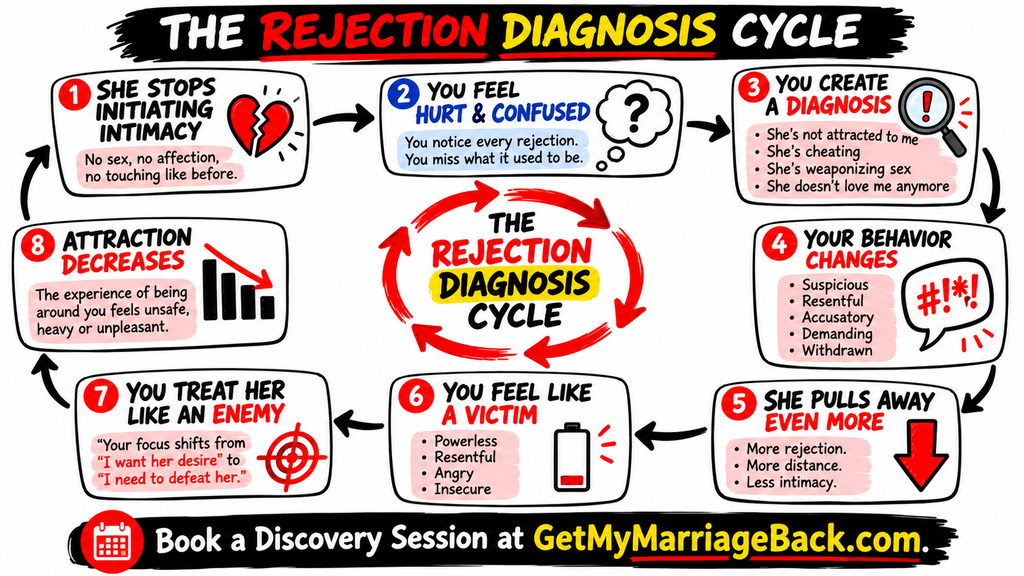
The Rejection-Proving Cycle - my wife loves me but is not sexually attracted to me

The Rejection-Proving Cycle

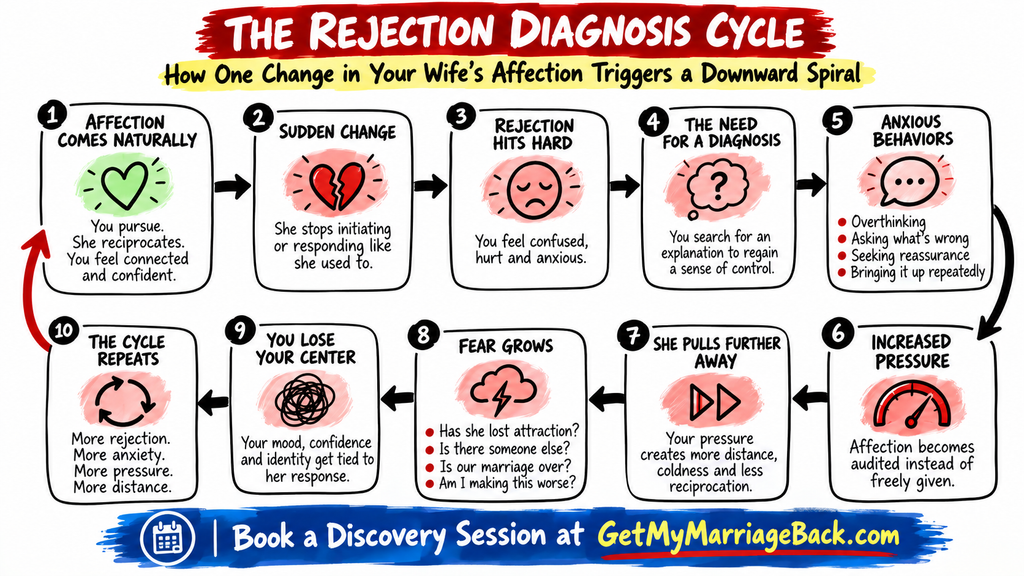
When your wife is no longer attracted to you sexually, the obvious pain is rejection.

The less obvious danger is what you do because you feel rejected.

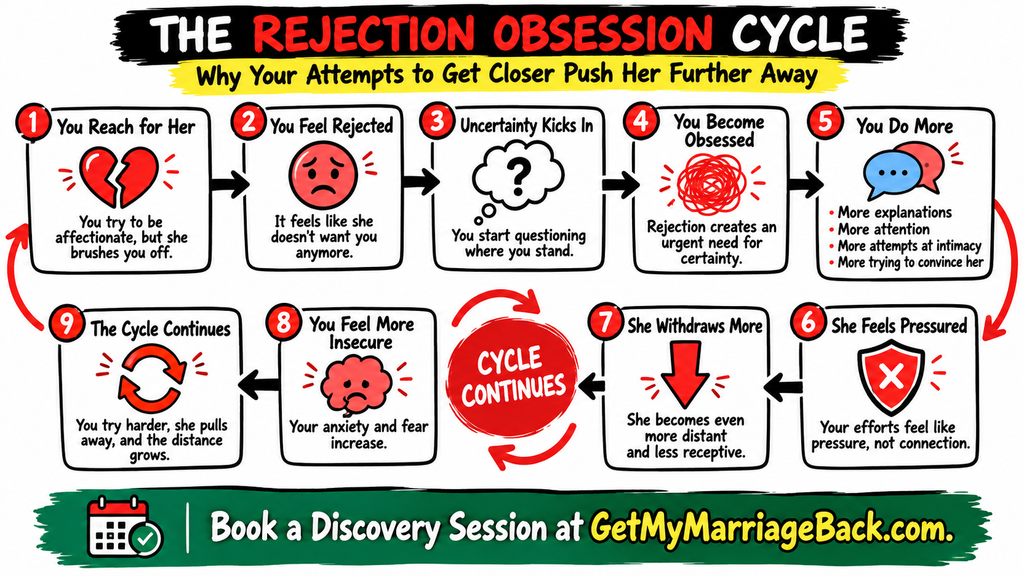
I describe the destructive pattern like this:

Rejection โ†’ Proving โ†’ Pressure โ†’ Predictability โ†’ Withdrawal โ†’ Rejection

Rejection creates fear.

Fear makes you prove yourself.

Proving creates pressure.

Pressure makes your interactions increasingly predictable.

Predictability and emotional pressure encourage withdrawal.

Her withdrawal then feels like even more rejection.

Now you try harder.

That is how a husband who genuinely wants to save his marriage can accidentally keep recreating the environment that makes desire harder to experience. The cycle was explicitly developed around the idea that proving leads into pressure, predictability, withdrawal, and renewed rejection.

1. Rejection Makes You Over-Focus on Her

You begin scanning everything.

Was she warmer today?

Why did she turn away in bed?

Why didn’t she kiss you the same way?

Is she attracted to somebody else?

Does she still love you?

Can this marriage be saved?

Your attention moves away from your own center and toward constant interpretation of her.

That obsession changes the energy you bring into the marriage.

Stop Using Intimacy to Calm Rejection

Sex can become dangerous psychologically when you stop experiencing it simply as intimacy and start using it as proof that you are okay.

Your wife finally initiates sex.

Suddenly you feel relieved.

โ€œShe still wants me.โ€

You have a good evening and receive a passionate kiss.

โ€œMaybe the marriage is finally recovering.โ€

Three days later she turns you down.

Panic returns.

โ€œShe doesn’t want me anymore.โ€

The problem is not wanting sex with your wife. The problem is allowing sex, affection, or reassurance to regulate your sense of security.

In the teaching framework, this is where intimacy becomes โ€œemotional evidenceโ€: every positive encounter produces hope while rejection becomes a sweeping verdict on the marriage.

Once that happens, your wife can feel the invisible weight behind ordinary affection.

A kiss is no longer merely a kiss.

A date needs to prove progress.

Sex needs to reassure you.

Physical touch starts carrying expectations.

That pressure works against the freedom healthy sexuality requires. The World Health Organization describes sexual well-being in terms that include safety, respect, and freedom from coercion, while research on sexual responsiveness shows that healthy responsiveness is associated with desire maintenance, sexual satisfaction, and relationship quality.

โ€œMy Wife Never Initiates Intimacyโ€ Is a Symptom, Not the Whole Diagnosis

When you start wondering why your wife never initiates intimacy or makes no effort for intimacy, you naturally focus on the visible behavior.

But initiation is only the symptom you can see.

The more useful questions are:

What has the romantic experience of this marriage become?

Is there unresolved resentment?

Has every sexual conversation become emotionally loaded?

Are most interactions about chores, children, bills, problems, and the marriage itself?

Have you become so focused on keeping her that you stopped being engaged with your own life?

Does your interest feel invitingโ€”or desperate?

Has she come to expect exactly the same emotional interaction every day?

You are not asking these questions so you can blame yourself.

You are asking because self-discovery gives you leverage over the only adult you fully control: you.

Roommate Marriage Is Usually an Experience Before It Is a Label

A marriage that feels like roommates does not suddenly appear one morning.

Romantic energy gets buried underneath repetition.

Everything becomes functional.

Who is picking up the children?

What time is dinner?

Did you pay the bill?

What needs fixing?

What are we doing Saturday?

There is nothing wrong with stability. Marriage requires stability.

The problem is when certainty becomes the entire relationship and novelty, playfulness, autonomy, curiosity, and adventure disappear.

Research on self-expansion in relationships helps explain why this matters. Studies have found that engaging in exciting or novel shared activities can support closeness and relationship quality, with researchers describing useful ingredients such as novelty, spontaneity, playfulness, challenge, interest, and adventure.

Research on long-term romantic love has also connected continued self-expansion and rewarding novel experiences with mechanisms that may help sustain romantic love over time.

Notice what I am not saying.

You do not need to manufacture excitement every night.

You do need a life and personality that have not been reduced to predictable marital administration.

How to Rebuild Attraction Without Turning Your Wife Into a Project

The constructive path begins with the exact same trigger:

Rejection.

The difference is what you do next.

I teach the progression this way:

Rejection โ†’ Grounding โ†’ Purpose โ†’ Self-Discovery โ†’ Value โ†’ Curiosity & Attraction

Grounding: Stop Letting Rejection Define You

Your wife can say, โ€œI’m not attracted to you anymore.โ€

That sentence hurts.

It still does not get to become the definition of your masculinity, worth, identity, future, or entire marriage.

Grounding means returning from panic to yourself.

You recognize what is happening emotionally without letting rejection make your next decision.

Instead of immediately asking for reassurance, forcing another conversation, demanding clarity, withdrawing dramatically, or retaliating, you regain possession of your emotional center.

The framework defines grounding in precisely this way: returning from panic, focusing on what you control, and refusing to let another person’s statement become the verdict on your worth.

That is emotional intelligence in action.

Purpose: Get Your Life Out of the Waiting Room

When your wife loses attraction, there is a temptation to make saving your marriage your full-time identity.

Do not.

Your marriage matters deeply, but it cannot carry the entire weight of your existence.

Your physical health matters.

Your career matters.

Your children matter.

Your friendships matter.

Your faith matters.

Your creativity matters.

Your mission matters.

Purpose redirects emotional energy that would otherwise become obsession.

This is not a seduction trick.

You are not becoming busy so she notices you.

You are rebuilding a life that remains alive whether she notices today or not.

Ironically, this is also part of what makes somebody more compelling to experience.

Self-Discovery: Ask Better Questions

Fear asks:

โ€œWhy doesn’t she want me?โ€

Self-discovery asks:

โ€œWhat happens inside me when I feel rejected?โ€

Fear asks:

โ€œWhat can I do to make her change?โ€

Self-discovery asks:

โ€œWhere do I become needy, predictable, resentful, controlling, passive, or approval-seeking?โ€

Fear keeps your attention locked onto her behavior.

Self-discovery returns attention to your capacity.

This distinction is crucial because attraction does not require you to become somebody fake. It asks you to rediscover dimensions of yourself that disappeared underneath fear, routine, pressure, work, parenting, and the slow erosion of personal identity.

Value: Become More Interesting to Experience

When I use the word value, I am not talking about human worth.

Your worth is not up for negotiation.

Value here refers to the experience another person has around you.

Are you grounded?

Do you bring emotional stability?

Are you playful?

Can you carry a conversation without turning everything into a marriage summit?

Do you have interests?

Are you physically taking care of yourself?

Can you express desire without demanding reciprocation?

Do you bring warmth without collapsing into people-pleasing?

Can you handle disappointment without punishing somebody?

That is experiential value.

Research on perceived partner responsiveness repeatedly shows that feeling understood, cared for, and valued is connected with sexual and relationship well-being.

A large meta-analysis of sexual communication also found positive associations between sexual communication and both relationship and sexual satisfaction, with quality of communication showing stronger associations than simply talking more often.

That last distinction matters tremendously.

More marriage conversations are not automatically better.

Better experiences matter.

Curiosity Comes Before Attraction

When your marriage has become painfully predictable, curiosity is valuable.

Curiosity means there is something to discover.

You have stopped broadcasting every emotional reaction.

Your life has movement again.

Your identity is expanding.

Your wife no longer knows that every date will end with a relationship discussion.

Every improvement is not announced.

Every good interaction does not trigger a request for reassurance.

You are not withholding yourself to manipulate her.

You are simply no longer performing your entire life for an audience of one.

Novelty research gives this idea useful support. Shared activities that feel exciting, engaging, spontaneous, or self-expanding are associated with greater closeness and relationship quality.

Seduction in a long marriage therefore is not about cheesy tricks.

It is about becoming emotionally alive again.

Pursue Your Wife Without Pressuring Her

There is an important difference between pursuit and chasing.

Pursuit communicates:

โ€œI desire you, and you are free.โ€

Fear-driven chasing communicates:

โ€œI need you to respond so I can feel secure.โ€

You can invite your wife to dinner.

You can flirt.

You can tell her she looks beautiful.

You can express sexual interest.

You can create an enjoyable experience.

What you stop doing is attaching your stability to the result.

If she says no, you do not sulk.

If she is receptive, you do not immediately conclude the marriage is fixed.

When warmth appears, enjoy warmth.

When rejection appears, ground yourself again.

That ability keeps desire from becoming another battleground.

Better Sexual Communication Is Not Constant Sexual Communication

You may need to talk about sex.

Avoiding every difficult conversation is not emotional intelligence.

Yet there is a major difference between one honest, grounded conversation and repeatedly demanding explanations.

Research suggests that quality sexual communication is positively associated with both sexual satisfaction and relationship satisfaction.

Other research on desire discrepancy indicates that how couples respond to differing levels of desire can influence sexual and relationship satisfaction.

So speak clearly when a real conversation is needed.

Listen without cross-examining.

Do not require your wife to produce a perfectly logical explanation for desire.

Avoid using the conversation as an indirect attempt to secure sex that night.

Communication should increase understandingโ€”not pressure.

Can Marriage Be Saved When Attraction Is Gone?

Yes, attraction loss and a marriage ending are not synonymous.

Long-term desire fluctuates.

Sexual desire discrepancy is common enough that researchers have described it as a recurring feature of long-term relationships rather than an unusual defect.

The more important issue is whether you respond to the crisis by making the marriage increasingly pressured and fear-driven or by developing your own capacity.

Your strongest posture is neither begging nor pretending not to care.

You care deeply.

You simply stop demanding that your wife regulate the fear created by that care.

That is how you begin building and nurturing attraction with more skill, seduction, dignity, and emotional intelligence.

The work is not to convince her that she should desire you.

Your work is to become grounded enough to stop destroying desire with pressure, purposeful enough to reclaim your life, curious enough to discover yourself again, and valuable enough to create a richer experience when you show up.

Attraction then has room to breathe.

5 Undeniable Disrespectful Wife Signs (& How to Reset the Frame)

Frequently Asked Questions [FAQ]

Why is my wife not sexually attracted to me anymore?

Attraction can decline because of pressure, resentment, routine, unresolved conflict, loss of intimacy, personal stress, health factors, or changes in how the relationship feels. The useful starting point is understanding the current experience of the marriage rather than assuming one single cause.

Can my wife become sexually attracted to me again?

Sexual desire can change over time, and research links intimacy, responsiveness, novelty, and relationship quality with desire. Focus on what you control instead of trying to force a particular response.

What should I do if my wife never initiates intimacy?

Stop using initiation as a daily scorecard for the marriage and examine the larger pattern of pressure, resentment, connection, routine, and attraction. Have honest conversations when needed, while rebuilding your own Grounding, Purpose, Self-Discovery, and experiential Value.

Does a sexless marriage mean divorce is inevitable?

No. Desire discrepancies occur in long-term relationships and do not automatically determine whether a marriage ends. The way the crisis is handled matters more than treating the current sexual frequency as a final verdict.

Wife Not in Love With Me? How to Rebuild Attraction in Your Marriage

โ€œMy wife is not in love with me.โ€

Few thoughts hit a husband harder.

Sometimes she says it directly: โ€œI love you, but Iโ€™m not in love with you anymore.โ€

Other times, you recognize it through the symptoms. Sex has disappeared. Affection feels obligatory. She avoids your touch. Conversations have become logistical. You share a home, bills, responsibilities and possibly childrenโ€”but the marriage increasingly feels like a friendship or roommate arrangement.


Take This 2 Minutes Quiz

Question 1 of 15

Your instinct is to fix the problem immediately.

That instinct is where many husbands accidentally make attraction loss worse.

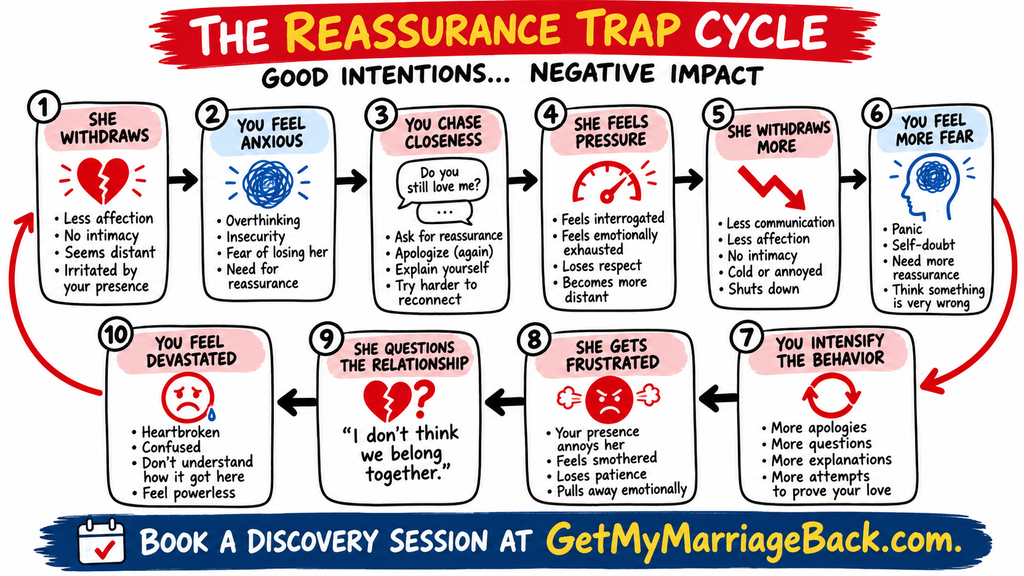
When rejection triggers fear, you naturally want reassurance. You talk more about the marriage, explain how much you care, become unusually helpful, initiate more affection or try to prove that you have changed.

The problem is simple: attraction cannot be negotiated into existence.

If your wife is not attracted to you anymore, rebuilding your marriage requires something more emotionally intelligent than trying harder to get a reaction from her. You need to understand the conditions under which attraction deterioratesโ€”and become skillful at changing the part of that experience you actually control.

wife not in love with me

When Your Wife Is Not in Love With You, Don’t Treat Attraction Like an Emergency

The first mistake is treating attraction loss like an emergency that must be solved tonight.

Imagine lying in bed at 1:00 a.m. You reach for your wife. She pulls away.

Your mind immediately starts writing the rest of the story:

She doesn’t want me.

She’s not attracted to me.

She’s going to leave.

My marriage is over.

Now your nervous system wants relief.

You ask what’s wrong. She says she’s tired, but you don’t believe that’s the whole story. Another question follows. Then another.

Soon you are no longer responding to what actually happened. You are responding to what you fear the rejection means.

That distinction matters.

In our livestream, we described this as the beginning of an Attraction-Panic Cycle:

Fear โ†’ Chasing โ†’ Proving โ†’ Pleasing โ†’ Predictability โ†’ Pressure โ†’ Withdrawal โ†’ Fear

The painful irony is that fear of losing attraction can produce behaviors that make romantic connection feel increasingly pressured.

Why Trying Harder Can Make Your Marriage Feel Worse

When your wife says she isn’t in love with you, trying harder feels responsible.

You love your marriage. Why wouldn’t you fight for it?

Because there is an important difference between pursuit and chasing.

Healthy pursuit expresses interest while preserving dignity and freedom. Fear-driven chasing needs your wife’s reaction to regulate your emotional state.

That difference changes the experience completely.

A loving invitation says, โ€œI’d enjoy spending time with you.โ€

Fear-driven pursuit carries an invisible second sentence:

โ€œโ€ฆand I need you to say yes so I know our marriage is okay.โ€

Your wife feels that weight even when you never say those words.

This is why the question isn’t simply, โ€œAm I doing nice things?โ€

Ask instead:

What emotional energy is driving what I’m doing?

Stop Trying to Prove You Deserve Your Wife’s Attraction

When pursuing harder doesn’t work, proving often comes next.

You start mentally building a case:

โ€œI’ve always been faithful.โ€

โ€œI provide for this family.โ€

โ€œI’ve changed.โ€

โ€œI help around the house.โ€

โ€œI love you more than anyone ever will.โ€

Those qualities matter.

They still don’t create romantic debt.

Being a responsible husband doesn’t obligate your wife to experience sexual attraction toward you. Likewise, years invested in a marriage don’t create an emotional contract requiring someone to feel desire on command.

This distinction is painful because commitment and attraction operate differently.

Commitment involves decisions, values and behavior.

Attraction involves experience.

You can influence the experience you create around another person. You cannot force their emotional response to it.

That is why proving yourself becomes especially dangerous when it carries an unspoken expectation:

โ€œAfter everything I’ve done, you should want me.โ€

Desire suffocates under obligation.

People-Pleasing Is Not Value

This is one of the most counterintuitive lessons when a wife is not attracted to her husband:

Becoming endlessly agreeable does not automatically make you more attractive.

Fear can turn kindness into people-pleasing.

You wash more dishes. Take over extra responsibilities. Agree with everything. Avoid difficult opinions. Stop challenging anything. Offer favors constantly.

None of those actions is inherently unattractive.

The motive changes their meaning.

If you’re being generous because generosity reflects who you are, that’s authentic behavior. If you’re performing generosity while desperately waiting for affection in return, the behavior becomes transactional.

The internal question becomes:

โ€œDo you want me now?โ€

Research adds an important distinction here. Studies on responsiveness find that feeling understood, cared for and valued by a romantic partner is associated with sexual desire and intimacy. In a three-study investigation, perceived partner responsiveness was associated with greater desire, particularly among women.

So the lesson is not โ€œstop being nice.โ€

It’s more sophisticated:

Become responsive without becoming self-erasing.

A 2023 research review makes almost exactly this distinction. Sexual responsiveness is associated with desire, sexual satisfaction and relationship quality, but those benefits deteriorate when responsiveness requires neglecting your own needs.

That aligns with a central principle from Get My Marriage Back:

Value is not people-pleasing.

If Your Marriage Feels Like Roommates, Predictability Matters -wife not in love with me

If Your Marriage Feels Like Roommates, Predictability Matters

Many people searching โ€œwife not in love with meโ€ are really describing a roommate marriage.

Nothing catastrophic necessarily happened.

Life simply became extraordinarily predictable.

Wake up.

Work.

Children.

Dinner.

Television.

Phones.

Bed.

Repeat.

Familiarity is necessary for a secure marriage, but familiarity alone doesn’t create erotic energy.

This is where attraction requires a more nuanced understanding.

Your goal isn’t to manufacture jealousy, disappear mysteriously or play psychological games. Those strategies replace genuine attraction with manipulation.

Instead, become a person who is still developing.

Research on self-expansion is particularly relevant. Across three studies, researchers found that engaging in novel, growth-oriented activities with a long-term romantic partner was associated with greater sexual desire and relationship satisfaction. (PubMed)

Other research has examined personal self-expansionโ€”the growth and positive change you experience independentlyโ€”and its relationship to romantic passion. (PubMed)

That supports an important principle:

Your marriage should contain two developing human beings, not two people whose identities have collapsed into maintaining a household.

Attraction Needs Some Room to Breathe

When your marriage feels threatened, you naturally focus more attention on it.

Eventually, everything becomes about the relationship.

Breakfast becomes an opportunity to evaluate her mood.

A text becomes evidence.

Sex becomes a referendum on the marriage.

A quiet evening becomes proof that you’ve become roommates.

One affectionate moment produces hope. One rejection destroys it.

That hyper-focus creates pressure.

Every interaction becomes emotionally expensive because your wife isn’t simply having dinner with you anymore. Somewhere underneath the interaction is a question she is expected to answer:

โ€œAre we okay yet?โ€

Stop making every moment carry that burden.

You don’t need to pretend the marriage crisis doesn’t exist. You need enough emotional grounding that every interaction isn’t required to resolve it.

Ground Yourself Before Trying to Rebuild Attraction

When your wife rejects you, your first job isn’t seduction.

It’s Grounding.

Grounding means fear no longer gets automatic control over your next action.

You can experience rejection without immediately initiating another marriage conversation.

You can hear something painful without constructing an argument.

A cold evening doesn’t require you to chase reassurance.

This is Personal Power in practical form.

You return to your higher self, gratitude, emotional stability and what is actually within your control.

Notice the distinction:

Grounding does not mean becoming emotionally detached.

It means becoming emotionally responsible.

You still want your marriage. You simply stop requiring your wife’s immediate behavior to determine your emotional center.

Rebuild a Life That Generates Purpose

When marriage becomes your only source of emotional meaning, rejection becomes overwhelming.

Your world shrinks.

Every thought becomes about her.

Every improvement becomes secretly designed for her approval.

Even โ€œworking on yourselfโ€ turns into another attraction tactic.

Purpose interrupts that pattern.

Return meaningful energy to your health, career, business, fatherhood, friendships, creativity, spirituality, interests and mission.

This isn’t a trick for making your wife curious.

Purpose pursued as manipulation isn’t purpose.

The deeper objective is becoming a fuller human being regardless of what emotional weather exists inside your marriage today.

Ironically, this also addresses one of the central problems in roommate status: sameness.

A growing person continually brings something new back into their relationshipsโ€”new experiences, perspectives, stories, energy, competence and confidence.

Research on self-expansion offers a useful parallel. Novel and broadening experiences have repeatedly been associated with desire, including research involving couples dealing with clinically low sexual desire. (Sage Journals)

Use Rejection for Self-Discovery, Not Self-Blame - wife not in love with me

Use Rejection for Self-Discovery, Not Self-Blame

If your wife is not attracted to you, self-discovery requires uncomfortable questions.

Not:

โ€œWhat’s wrong with her?โ€

And not:

โ€œWhat’s wrong with me?โ€

Instead ask:

โ€œWhat has this crisis revealed about me?โ€

Have you become needy?

Did you stop developing?

Are you afraid to disagree?

Did you abandon friendships and interests?

Has your personality become consumed by work?

Do you use sex as proof that you’re loved?

Does rejection make you obsessive?

Are you trying to earn affection through service?

Can you express desire without demanding reciprocation?

Those questions produce information.

Self-discovery isn’t a confession of guilt. Your wife’s feelings belong to her.

The exercise reveals your capacity.

When you discover how fear changes your behavior, you gain the ability to choose differently.

Build Value Instead of Performing for Attraction

โ€œValueโ€ in this framework doesn’t mean human worth.

Your worth isn’t determined by whether your wife wants sex tonight.

Value describes the experience of interacting with you.

Are you grounded or chronically reactive?

Curious or predictable?

Purposeful or consumed by the marriage?

Playful or heavy?

Warm or transactional?

Confident or approval-seeking?

Emotionally intelligent or constantly demanding reassurance?

Interesting or stagnant?

That is where building attraction becomes skillful.

You don’t announce your value.

You experience life differently, and other people experience you differently as a consequence.

Seduction Is an Experience, Not a Negotiation

Seduction in a marriage crisis should never mean manipulating your wife into sex.

Real seduction creates an experience in which desire has room to emerge voluntarily.

That requires freedom.

It also requires emotional responsiveness.

Research has consistently connected perceived responsivenessโ€”feeling understood, validated and cared forโ€”with intimacy and sexual desire. (Frontiers) More recent work also found an association between partner responsiveness, greater sexual communication and positive intimacy or sexual outcomes. (Taylor & Francis Online)

So emotional intelligence and seduction are not opposites.

They belong together.

Listen without turning every disclosure into a defense.

Express interest without demanding a response.

Be playful without testing whether she responds correctly.

Flirt without making every flirt an invitation to sex.

Have opinions without becoming combative.

Maintain boundaries without punishing her.

Create experiences without secretly scoring her reaction.

Respect rejection without collapsing into resentment.

That combination is powerful because it removes coercion without removing masculinity, personality, desire or intention.

Stop Measuring Whether Attraction Is โ€œWorkingโ€

This part is critical.

Once you start rebuilding yourself, don’t turn your wife into a dashboard.

โ€œShe touched me twice today.โ€

โ€œ…laughed at my joke.โ€

โ€œShe didn’t text back for three hours.โ€

โ€œ…kissed me differently.โ€

โ€œWe had sex, so it’s working.โ€

โ€œShe rejected sex, so nothing is working.โ€

That mindset puts you straight back into the Attraction-Panic Cycle.

Curiosity and attraction are outcomes, not measurements you assign to your wife.

Research on desire itself reinforces why simplistic scorekeeping makes little sense. A systematic review notes that sexual desire naturally ebbs and flows both within people and between people over time. (PubMed)

One cold night doesn’t define your marriage.

Neither does one passionate weekend.

Build capacity rather than constantly collecting evidence.

What Happens When Your Wife Rejects You Again?

She will have another distant day.

That’s the real test.

Your old pattern was:

Fear โ†’ Chasing โ†’ Proving โ†’ Pleasing โ†’ Predictability โ†’ Pressure โ†’ Withdrawal โ†’ Fear

The constructive roadmap becomes:

Fear โ†’ Grounding โ†’ Purpose โ†’ Self-Discovery โ†’ Value โ†’ Curiosity & Attraction โ†’ Fear

Notice something important.

It ends with fear again.

That’s intentional.

Progress doesn’t mean you never experience rejection, uncertainty or fear. Progress means those feelings stop automatically controlling your behavior.

When rejection returns, you return to Grounding.

Then Purpose.

…Self-Discovery.

Then Value.

Over time, you’re no longer desperately trying to make your wife attracted to you.

You’re becoming capable of creating a marriage experience in which attraction, warmth, curiosity, intimacy and reconciliation have room to develop naturally.

That is a much stronger position from which to save your marriage, navigate a wife who is not in love with you, address a sexless marriage, or respond when your marriage feels like roommates.

You cannot negotiate desire.

You can become more emotionally grounded, purposeful, interesting, responsive, self-aware and experientially attractive.

And that changes what you bring into the marriage.

My Wife Loves Me But Doesnโ€™t Desire Me

Frequently Asked Questions

Why is my wife not in love with me anymore?

Romantic feelings can decline through accumulated conflict, pressure, resentment, excessive predictability, loss of intimacy and changes in how two people experience each other. Instead of demanding an explanation that restores certainty, examine the relational experience and the patterns within your control.

Can my marriage be saved if my wife is not in love with me?

A loss of romantic feelings does not automatically mean the marriage has reached an irreversible endpoint. Start by stopping fear-driven chasing and rebuilding Grounding, Purpose, Self-Discovery and Value so your actions no longer add pressure to the crisis.

How do I make my wife attracted to me again?

You cannot make another adult experience attraction, but you can influence the experience of being married to you. Build emotional stability, authentic confidence, responsiveness, purpose, novelty and value without turning those behaviors into techniques for extracting affection.

Should I give my wife space if she says she is not in love with me?

Respecting her freedom is different from becoming cold, disappearing or using space as a manipulation tactic. Stay grounded and dignified, reduce pressure, and let warmth or pursuit come from genuine interest rather than fear of rejection.

9 Signs Your Marriage Can Still Be Savedโ€”and What to Do Next

Looking for the signs your marriage can still be saved is often the last thing you do before giving up.

You may be exhausted from arguing, confused by your spouseโ€™s emotional distance, or terrified that one bad season has permanently destroyed the relationship. Perhaps trust has been damaged, affection has disappeared, or every conversation seems to become another fight.

You want an honest answer: Is there still hope, or are you fighting for something that is already gone?

The truth is that hope does not come from one romantic gesture, a temporary mood change, or your spouse saying the perfect words. A marriage becomes salvageable when emotional connection still exists, the underlying foundation remains intact, and at least one person is willing to stop feeding the destructive cycle.

That does not mean one spouse can single-handedly create a healthy marriage. Mutual participation is ultimately necessary. But one grounded person can often interrupt the patterns that keep both partners defensive, resentful, and disconnected.

Before you decide the marriage is over, look for these nine meaningful signsโ€”and be prepared to respond to them with emotional intelligence rather than panic.

Beyond Hope: Saving a Marriage Requires More Than Positive Signs

Beyond Hope: Saving a Marriage Requires More Than Positive Signs

Searching for signs can provide perspective, but signs alone do not repair a relationship.

You can have shared values, children, history, and lingering feelings while still repeating the same behaviors that are destroying attraction. Begging for affection, monitoring your spouseโ€™s moods, forcing heavy conversations, keeping score, and trying to police their behavior may feel like fighting for the marriage, but these actions often create more emotional pressure.

The question is not only whether your marriage contains hope.

The deeper question is whether you are willing to become emotionally steady enough to use that hope wisely.

Saving a marriage often begins when you stop:

  • Reacting to every emotional shift
  • Chasing reassurance
  • Trying to force closeness
  • Shaming your spouse into changing
  • Treating every disagreement as proof that you are unloved
  • Sacrificing your dignity to keep the peace
  • Confusing control with leadership

Real leadership in marriage is not domination. It is the ability to regulate yourself, communicate clearly, protect healthy boundaries, and create conditions in which friendship, respect, desire, and trust can grow again.

1. You Still Have Emotional Reactions to Each Other

One of the clearest signs your marriage can still be saved is that emotional energy still exists between you.

That energy may not currently look romantic. It may appear as anger, frustration, jealousy, disappointment, or passionate disagreement. Although chronic fighting is unhealthy, conflict can indicate that both spouses still care about being understood.

Indifference is often more concerning than anger.

When someone has emotionally detached, they may stop arguing, stop asking questions, and stop responding to issues that once mattered. They are no longer fighting for understanding because they no longer expect connection.

This does not mean you should celebrate explosive conflict. It means the emotion underneath the conflict may still be redirected.

Anger often hides a more vulnerable message:

  • โ€œI do not feel important to you.โ€
  • โ€œI miss how close we used to be.โ€
  • โ€œI do not trust that you will hear me.โ€
  • โ€œI feel rejected.โ€
  • โ€œI am afraid I no longer matter.โ€

The goal is to stop fighting over the surface complaint long enough to recognize the unmet emotional need beneath it.

2. You Both Still Care About the Outcome

Your marriage may still be repairable if both of you remain emotionally affected by what happens to the relationship.

Your spouse may sound frustrated, skeptical, or guarded. They may say they do not know whether things can improve. But uncertainty is different from complete emotional departure.

Pay attention to whether your spouse still:

  • Talks about the relationship
  • Expresses disappointment about what has been lost
  • Reacts emotionally to the possibility of separation
  • Asks whether change is possible
  • Participates in difficult conversations
  • Shows concern about the impact on the family
  • Leaves the door open to counseling or another form of support

Pain is not proof that the marriage is doomed. Sometimes pain exists because the relationship still matters.

However, do not use your spouseโ€™s emotions to pressure them. An emotional reaction to divorce does not automatically mean they are ready to reconcile. Treat it as evidence of unresolved attachment, not as permission to chase, manipulate, or demand immediate commitment.

3. You Still Share Important Core Values

Marriages can survive major disagreements when the spouses remain aligned on the fundamentals.

You may have different communication styles, personalities, spending habits, or approaches to household responsibilities. Those differences can create conflict, but they are not always fatal.

A shared core foundation may include agreement about:

  • Loyalty and commitment
  • Faith or spiritual values
  • Parenting priorities
  • Family and legacy
  • Personal responsibility
  • Honesty
  • Growth
  • The kind of life you want to build

Shared values give you something solid to rebuild upon.

By contrast, the relationship becomes harder to repair when one person wants honesty and the other repeatedly chooses deception, or when one wants mutual commitment while the other insists on living without relational accountability.

You do not need to agree about everything. You do need enough alignment to create a future that neither person must betray themselves to accept.

4. Moments of Vulnerability Still Break Through

A marriage may look cold on the surface while still containing brief moments of emotional openness.

Perhaps your spouse becomes soft when discussing the children, admits that they are overwhelmed, shares a personal fear, or allows you to comfort them during a difficult moment. You may occasionally laugh together, remember a meaningful experience, or acknowledge that the relationship was once deeply loving.

Do not dismiss these moments because they are brief.

They may show that emotional safety is buried beneath resentment rather than completely gone.

At the same time, do not seize every vulnerable moment as an opportunity to demand a relationship conversation. That can make your spouse regret opening up.

Allow vulnerability to breathe.

Listen without immediately correcting, defending, diagnosing, or converting the moment into proof that the marriage is saved. Emotional safety grows when people learn that openness will not be used against them.


Take This 2 Minutes Quiz

Question 1 of 15

5. Friendship Has Not Completely Disappeared

Romantic attraction often struggles when friendship has been neglected.

You may no longer feel like passionate partners, but signs of friendship can reveal that the relational bridge is still standing. Perhaps you still cooperate, share inside jokes, enjoy certain routines, ask about each otherโ€™s day, or instinctively support one another during a crisis.

Friendship matters because it creates a low-pressure path back to connection.

Trying to force romance before restoring basic goodwill can feel artificial. Instead, begin by rebuilding positive emotional experiences:

  • Speak with warmth instead of suspicion
  • Show genuine curiosity
  • Notice what your spouse is doing well
  • Create moments that are not about solving the marriage
  • Be playful when the moment allows
  • Reduce criticism and unnecessary correction
  • Follow through on small promises

Friendship does not mean becoming a passive roommate. It means rebuilding enough emotional ease for attraction and intimacy to have somewhere to return.

6. Attraction Is Dormant, Not Completely Dead

A lack of sex does not always mean a lack of love, and a lack of current attraction does not always mean attraction can never return.

Desire often disappears beneath resentment, pressure, predictability, poor self-care, unresolved conflict, and emotional exhaustion. It can also fade when one partner becomes overly needy, controlling, reactive, or self-abandoning.

Attraction is rarely rebuilt by demanding more affection.

It is more likely to return when both partners experience greater emotional freedom, respect, curiosity, and vitality.

Ask yourself honestly:

  • Have I become consumed by the relationship?
  • Do I expect my spouse to regulate my self-worth?
  • Have I neglected my body, purpose, friendships, or confidence?
  • Do I create emotional safety, or do I create pressure?
  • Have I confused constant availability with intimacy?
  • Do my conversations feel inviting or interrogative?
  • Have criticism and resentment replaced appreciation?

Rebuilding attraction is not about playing games or making your spouse jealous. It is about becoming grounded, purposeful, emotionally disciplined, and genuinely alive again.

Seduction within marriage is not manipulation. It is the art of creating anticipation, emotional contrast, playfulness, presence, and space for desire to emerge voluntarily.

7. At Least One of You Is Willing to Take Accountability

A relationship stays stuck when both spouses build a case against each other.

The argument becomes:

โ€œI would change if you changed first.โ€

That mindset protects the ego but poisons the marriage.

One of the strongest signs your marriage can still be saved is the presence of accountability. This means someone is willing to ask, โ€œWhat am I contributing to this dynamic?โ€

Accountability does not require you to accept responsibility for your spouseโ€™s choices. It requires you to own your reactions, communication patterns, boundaries, and behavior.

For example:

  • You can acknowledge that you became critical without excusing dishonesty.
  • You can admit that you became emotionally unavailable without accepting verbal abuse.
  • You can recognize your neediness without pretending your spouseโ€™s neglect was healthy.
  • You can apologize for disrespect without surrendering your standards.
  • You can change your behavior without begging your spouse to reward you immediately.

Accountability is attractive because it communicates strength. Blame demands that someone else become different before you can become emotionally stable.

8. The Main Problems Are Patterns, Not Permanent Incompatibility

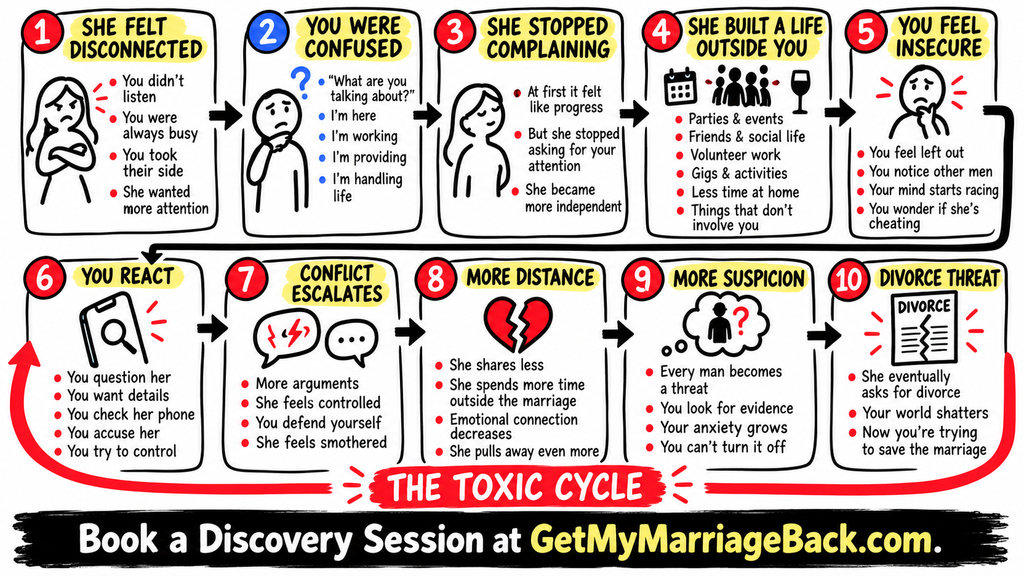
Many marriages feel hopeless because the same painful cycle keeps repeating.

One partner pursues. The other withdraws.

The pursuer becomes more anxious, demanding, and emotionally intense. The withdrawing partner feels controlled and becomes colder. The increased distance causes even more pursuit.

Eventually, both spouses believe the other person is the problem.

But often, the real enemy is the cycle.

Other common cycles include:

  • Criticism followed by defensiveness
  • Disrespect followed by emotional shutdown
  • Broken promises followed by surveillance
  • Sexual rejection followed by resentment
  • Stress followed by irritability and avoidance
  • Shame followed by secrecy
  • Control followed by rebellion
  • Pride followed by emotional punishment

Patterns can be changed when they are identified honestly.

It becomes more difficult when a spouse repeatedly refuses accountability, rejects all boundaries, or remains committed to behavior that makes emotional or physical safety impossible. But when both people are caught in a pattern they dislike, there may be significant room for recovery.

9. There Is Still a Willingness to Try Something Different

You do not need perfect confidence that the marriage will survive.

You need enough willingness to stop repeating what has already failed.

That willingness may include:

  • Trying marriage counseling
  • Receiving individual support
  • Changing communication habits
  • Setting clearer boundaries
  • Addressing untreated mental health concerns
  • Creating transparency after betrayal
  • Rebuilding physical and emotional intimacy gradually
  • Changing financial or household systems
  • Making time for friendship
  • Allowing the rebuilding process to unfold without forcing it

A marriage cannot be restored through promises alone. Look for behavior.

Real willingness sounds like, โ€œI do not know whether this will work, but I am prepared to participate honestly.โ€

Can You Save a Marriage When Only One Person Is Trying?

Can You Save a Marriage When Only One Person Is Trying?

One spouse can begin the change, but one spouse cannot complete the entire repair.

Your self-leadership can interrupt destructive patterns. When you become calmer, stop chasing, communicate more clearly, and refuse disrespect without hostility, the relationshipโ€™s emotional system changes.

Your spouse must now respond to a different version of you.

That shift may reduce defensiveness, increase curiosity, and make reconnection more possible. But it cannot force honesty, faithfulness, affection, or accountability from another adult.

Your job is not to control the outcome. Your job is to become the healthiest, most grounded version of yourself while evaluating your spouseโ€™s response over time.

You can open the door.

You cannot make another person walk through it.

How to Stop the Reactive Cycle and Lead From Emotional Stability

When you are afraid of losing your marriage, your instincts may tell you to do more: talk more, explain more, text more, pursue more, and demand answers more urgently.

But panic rarely produces attraction or trust.

Use the following steps to regain stability.

Stop Treating Every Mood as an Emergency

Your spouse is allowed to have emotions you do not like.

Do not interpret every quiet evening, delayed response, or bad mood as proof that divorce is coming. Emotional monitoring makes you anxious and makes your spouse feel watched.

Respond to patterns, not every passing emotion.

Remove Shame, Sarcasm, and Condescension

Shaming language may produce short-term compliance, but it destroys emotional safety.

Avoid insults, character attacks, moral superiority, guilt tactics, sarcastic jabs, and public humiliation. Address the behavior directly without degrading the person.

Instead of saying, โ€œYou are a selfish narcissist,โ€ say, โ€œWhen you make this decision without discussing it with me, I feel disregarded. I need us to agree on a better process.โ€

Establish Boundaries Without Performing Anger

A boundary is not a threat designed to control another person.

It is a clear statement of what you will participate in, what you will not tolerate, and what action you will take to protect your well-being.

For example:

โ€œI want to discuss this, but I will not continue while we are insulting each other. I am going to step away, and we can try again when we are calmer.โ€

A mature boundary does not require shouting. Its strength comes from consistency.

Rebuild Your Physical and Mental Health

Your marriage should matter, but it should not consume your identity.

Return attention to your sleep, physical health, work, purpose, spiritual grounding, friendships, and emotional development. This is not a trick to make your spouse miss you.

It is how you stop asking the relationship to provide every form of certainty, significance, connection, growth, and fulfillment.

A healthier you makes better decisionsโ€”whether the marriage recovers or not.

Bring Back Variety and Positive Energy

Relationships suffocate when every interaction becomes a discussion about problems.

Create moments of novelty and lightness without pretending the issues do not exist. Try a new activity, change the environment, bring humor into the home, or have a conversation that is not about the marriage.

Attraction needs some freedom from constant analysis.

Replace Expectations With Clear Requests

Unspoken expectations often become silent contracts:

โ€œIf you loved me, you would know what I need.โ€

When your spouse fails the test they did not know they were taking, resentment grows.

State what you want directly and allow your spouse to respond honestly. A clear request creates an opportunity for cooperation; an expectation creates a setup for disappointment.

Let the Process Reveal the Truth

Do not demand certainty before enough evidence exists.

Marriage repair is a process. Your spouseโ€™s consistency, accountability, and willingness will reveal more than emotional promises made during a crisis.

Practice patience without becoming passive. Pray about what you cannot control, act wisely on what you can control, and observe the pattern over time.

Signs Your Marriage Needs More Than Self-Help

Some problems require trained professional support.

Consider working with a qualified marriage therapist, individual therapist, faith leader, or other appropriate professional when you are dealing with:

  • An affair or repeated betrayal
  • Addiction
  • Severe communication breakdown
  • Persistent contempt
  • Untreated depression or another mental health concern
  • Sexual trauma or major intimacy problems
  • Threats of divorce used as manipulation
  • Escalating conflict
  • Long-term emotional withdrawal

Professional support is not proof that the marriage has failed. It can provide structure when both spouses are too emotionally flooded to repair the relationship alone.

When Hope Should Not Become Self-Abandonment

Not every marriage should be preserved at any cost.

Physical violence, sexual coercion, stalking, threats, intimidation, severe financial control, and patterns of abuse are not ordinary communication problems. Prioritize safety and seek appropriate professional or local support rather than attempting to become more attractive, patient, or accommodating.

You should also be cautious when your spouse consistently:

  • Refuses all responsibility
  • Repeatedly violates important boundaries
  • Uses counseling to manipulate or retaliate
  • Continues an affair without remorse or transparency
  • Shows contempt for your well-being
  • Makes promises but never changes behavior
  • Punishes you for expressing basic needs
  • Expects you to carry the relationship indefinitely

Self-leadership does not mean tolerating mistreatment.

It means having enough emotional clarity to distinguish between a wounded marriage that needs repair and a destructive situation that requires protection, distance, or a different decision.

What to Do When You See Signs Your Marriage Can Still Be Saved

Do not use these signs as an excuse to relax and return to the same patterns.

Use them as an invitation to act differently.

Begin with three commitments:

1. Become Grounded

Stop making permanent decisions in the middle of emotional flooding. Regulate your body, slow your reactions, and reconnect with your values before initiating major conversations.

2. Become Purposeful

Do not let the crisis become your entire identity. Use the pain as information and motivation to develop greater confidence, discipline, awareness, and emotional maturity.

3. Become Self-Aware

Notice the role you play without blaming yourself for everything. Identify your triggers, expectations, pride, communication habits, and attempts to control the outcome.

Your spouse may or may not follow your lead.

But regardless of what happens, you will stop abandoning yourself in the process.

signs your marriage can still be saved - the bottom line

The Bottom Line

The most meaningful signs your marriage can still be saved are not superficial.

Living in the same house, sharing finances, or having children may provide more opportunities to reconnect, but those circumstances alone do not prove that a healthy relationship remains.

Look instead for emotional engagement, shared values, moments of vulnerability, friendship, accountability, and a willingness to try a different approach.

Then stop waiting passively for your spouse to become the person who saves the marriage.

Lead yourself first.

Become calmer without becoming cold. Set boundaries without becoming cruel. Restore your purpose without using distance as punishment. Create attraction without manipulation. Speak honestly without shaming. Allow your behavior to communicate dignity, stability, confidence, and emotional strength.

You cannot control whether your spouse chooses to rebuild with you.

But you can stop feeding the cycle that has been pushing both of you further apartโ€”and that may be the first real sign that your marriage has a chance.

If you missed part 1 of the series, click here to check it out.

Frequently Asked Questions [FAQ]

How do you know when a marriage cannot be saved?

A marriage may be beyond repair when there is ongoing abuse, persistent contempt, repeated betrayal without accountability, or a complete refusal to participate in change. A qualified professional can help you evaluate the situation safely and objectively.

What are the signs a marriage will end in divorce?

Common warning signs include chronic contempt, emotional detachment, repeated unresolved conflict, secrecy, and one or both spouses refusing responsibility. These signs indicate serious risk, but they do not guarantee divorce if both partners are willing to change.

How do I know if God wants me to end my marriage?

Prayer, spiritual counsel, personal safety, wise boundaries, and an honest examination of the relationship can help guide your decision. Avoid assuming that enduring abuse or serious mistreatment is automatically a spiritual obligation.

What are the first signs a marriage is ending?

Early signs may include reduced affection, avoidance, constant criticism, loss of friendship, emotional withdrawal, and conversations that feel purely transactional. Addressing these patterns early gives the relationship a better chance of recovery.

Sexless Marriage Effects on Husbands: The Hidden Emotional Cost of Living Without Intimacy

A sexless marriage doesn’t just affect the bedroom. For many husbands, it slowly reshapes how they see themselves, how they relate to their wives, and even how they show up in every other area of life.


Take This 2 Minutes Quiz

Question 1 of 15

What are the sexless marriage effects on husbands, they often assume it’s simply about physical frustration. But that assumption misses the deeper reality. For many men, physical intimacy is one of the primary ways they experience emotional connection, acceptance, and romantic partnership. When that disappears, the emotional consequences often run much deeper than anyone realizes.

The danger is that many husbands respond in ways that unintentionally make the situation worse. …withdrawal. They become resentful. Also… repeatedly argue about sex. They seek validation through work, pornography, emotional affairs, or endless distractions. Others quietly surrender, convincing themselves that this is simply what marriage becomes.

None of those responses restore attraction.

The good news is that while the psychological effects of a sexless marriage are real, they don’t have to define your future. Understanding what’s happeningโ€”and responding with emotional intelligence, strength, and self-respectโ€”creates the best opportunity for lasting change.

sexless marriage effects on husbands - what is a sexless marriage

What Is a Sexless Marriage?

A sexless marriage is commonly defined as a marriage where sexual intimacy happens very rarely or not at all, often for six months or longer.

However, frequency alone doesn’t tell the whole story.

Some couples have infrequent sex but feel emotionally connected and mutually satisfied. Others may have regular sex while feeling emotionally miles apart.

In many marriages, the lack of physical intimacy is less the core problem and more the visible symptom of deeper issues such as:

  • Emotional disconnection
  • Chronic conflict
  • Unresolved resentment
  • Stress and exhaustion
  • Medical or hormonal challenges
  • Loss of attraction
  • Communication breakdown

For husbands, the absence of intimacy often feels like far more than the absence of sex. It can feel like losing the place where they once felt most accepted, admired, and emotionally connected.


The Real Sexless Marriage Effects on Husbands

The psychological effects of a sexless marriage on a man often develop slowly rather than all at once.

1. Confidence Begins to Erode

Repeated rejection is difficult not to personalize.

Even when a wife is withdrawing because of her own stress, emotional pain, or physical challenges, many husbands naturally begin asking themselves:

  • Am I unattractive?
  • Am I failing as a husband?
  • What’s wrong with me?

Eventually, those questions become beliefs.

That loss of confidence doesn’t stay confined to marriage. It often affects leadership at work, friendships, decision-making, and overall emotional resilience.


2. Emotional Loneliness Becomes the New Normal

One of the cruelest parts of a sexless marriage is feeling lonely while sleeping beside the person you love.

Many husbands describe feeling more like roommates than romantic partners.

Daily conversations become centered around:

  • Bills
  • Parenting
  • Schedules
  • Household responsibilities

Romance quietly disappears.

Without emotional and physical connection, the marriage begins functioning like a business partnership instead of an intimate relationship.


3. Resentment Slowly Replaces Affection

Resentment rarely explodes overnight.

Instead, it accumulates through hundreds of small disappointments.

A husband who repeatedly feels rejected may eventually stop initiating altogether. Not because he no longer desires his wife, but because protecting himself from rejection feels safer.

Unfortunately, emotional withdrawal creates even greater distance.


4. Stress and Mental Health Can Suffer

The effects of no physical intimacy on a husband often extend beyond emotions.

Many men experience:

  • Increased anxiety
  • Lower motivation
  • Difficulty concentrating
  • Sleep disturbances
  • Elevated stress
  • Symptoms of depression

Intimacy isn’t simply about pleasure. Healthy physical affection helps many couples regulate stress, strengthen emotional bonding, and reinforce feelings of safety and connection.


5. Identity Starts to Shift

One of the least discussed psychological effects of a sexless marriage on a man is identity loss.

A husband may begin feeling less like a husband and more like:

  • A provider
  • A co-parent
  • A roommate
  • A problem-solver

The romantic part of his identity quietly disappears.

That internal shift often hurts more than the lack of sex itself.

Why Begging for Intimacy Usually Backfires - sexless marriage effects on husbands

Why Begging for Intimacy Usually Backfires

When husbands feel desperate, many instinctively try to fix the problem by talking about it repeatedly.

Ironically, this often creates more pressure instead of more desire.

Common reactions include:

  • Constantly bringing up the lack of sex
  • Keeping score
  • Guilt-tripping
  • Sulking
  • Seeking reassurance
  • Negotiating for affection

These behaviors usually communicate emotional neediness rather than confident leadership.

Desire cannot be guilted into existence.

Attraction grows in an atmosphere of emotional safety, respect, curiosity, and personal strengthโ€”not pressure, resentment, or constant negotiation.


How a Sexless Marriage Changes a Man

Many men don’t realize they’re changing until monthsโ€”or yearsโ€”have passed.

He may become:

  • Less playful
  • More emotionally guarded
  • Less affectionate
  • More irritable
  • Hyper-focused on work
  • Addicted to distractions
  • Spiritually disconnected
  • Less optimistic

The tragedy is that these coping mechanisms often reduce attraction even further.

Instead of becoming more emotionally magnetic, he unintentionally becomes more withdrawn, reactive, or emotionally unavailable.


Don’t Build Your Identity Around Your Wife’s Validation

One of the biggest mistakes a husband can make is allowing his sense of manhood to depend entirely on his wife’s level of desire.

Your wife’s attraction matters.

But it should never become the foundation of your identity.

A man who constantly waits for validation gradually gives away his emotional stability.

Healthy confidence is built internally through:

  • Physical health
  • Purpose
  • Emotional discipline
  • Spiritual grounding
  • Personal integrity
  • Meaningful friendships
  • Continuous growth

Ironically, these same qualities often make someone more attractive inside marriage as well.


Attraction Is Difficult to Sustain Without Emotional Leadership

Many couples assume fixing a sexless marriage means improving sexual techniques.

Usually, that’s not where the real work begins.

Long-term attraction is influenced by daily emotional dynamics.

Ask yourself honestly:

  • Have I become emotionally reactive?
  • Do I complain more than I inspire?
  • Have I stopped growing?
  • Am I leading my own life well?
  • Do I bring calm or chaos into our home?

Leadership isn’t domination.

It’s becoming emotionally steady enough that your presence brings security rather than emotional exhaustion.

That kind of strength tends to build attraction far more effectively than arguments about frequency ever will.


What Husbands Can Control

You cannot force desire.

…Cannot demand attraction.

You cannot negotiate chemistry.

…Can control how you lead yourself.

Focus on areas within your influence:

Prioritize Your Physical Well-Being

Exercise consistently.

Eat well.

Sleep properly.

Manage stress.

Your health influences both confidence and emotional resilience.


Rebuild Emotional Connection

Stop making every conversation about sex.

Instead:

  • Become genuinely curious.
  • Listen without immediately defending yourself.
  • Create moments of laughter.
  • Spend quality time together.
  • Reintroduce affection without expectation.

Many marriages rediscover intimacy long before sex returns.


Address Difficult Conversations With Respect

Avoid:

  • Blame
  • Shame
  • Sarcasm
  • Condemnation
  • Keeping score

Instead, communicate your experience honestly.

For example:

“I miss feeling close to you. This isn’t just about sex for me. I miss feeling like we’re truly connected.”

That creates far more room for meaningful dialogue than accusations ever will.


Continue Growing as a Man

A fulfilling life should never shrink down to one relationship.

Continue investing in:

  • Your purpose
  • Your faith or spiritual life
  • Friendships
  • Hobbies
  • Learning
  • Career
  • Service to others

Growth doesn’t replace intimacy.

But it prevents your entire emotional identity from depending upon it.


When Professional Help Makes Sense

Sometimes a sexless marriage reflects issues too complex to solve alone.

Professional support may help when there are:

  • Repeated unresolved conflicts
  • Trauma
  • Infidelity recovery
  • Medical concerns
  • Pornography addiction
  • Long-term emotional disconnection
  • Communication breakdown

Seeking help isn’t weakness.

It’s often the strongest decision a couple can make when both genuinely want to rebuild the relationship.

Hope Without Denial - Why Begging for Intimacy Usually Backfires

Hope Without Denial

If you’re experiencing the painful reality of a sexless marriage, your pain deserves to be acknowledged.

Feeling rejected doesn’t make you weak.

Wanting intimacy doesn’t make you needy.

At the same time, living in resentment, self-pity, or emotional dependence won’t restore the connection you’re longing for.

The strongest path forward combines honesty with responsibility.

Protect your dignity. Strengthen your character. Continue becoming the kind of man who leads himself with confidence, emotional intelligence, and purpose.

Whether your marriage ultimately heals or not, those investments will never be wasted.

Because real masculine strength isn’t measured by how desired you feel on any given dayโ€”it’s measured by who you continue becoming when life doesn’t unfold the way you hoped.


Frequently Asked Questions (FAQs)

How to handle a marriage without intimacy?

Start by approaching the issue with empathy and honest communication rather than blame or pressure. At the same time, invest in your own physical health, emotional well-being, and personal growth while working together to uncover the deeper causes behind the loss of intimacy.

Can men survive a sexless marriage?

Yes, many men survive a sexless marriage, but merely enduring it without addressing the underlying issues often leads to resentment, loneliness, and emotional detachment. The healthier goal is not just survival but rebuilding connection, strengthening self-respect, and deciding together whether the relationship can move toward greater intimacy.

What does lack of intimacy do to a husband?

A lack of intimacy can gradually affect a husband’s confidence, emotional security, stress levels, and sense of connection within the marriage. Over time, he may begin to feel more like a roommate than a romantic partner, making emotional withdrawal and resentment increasingly likely if the issue remains unresolved.

What happens to men with no intimacy?

Men who experience prolonged emotional and physical intimacy deprivation may struggle with loneliness, lowered self-esteem, increased stress, and a reduced sense of purpose within the relationship. Some withdraw into work or distractions, while others use the experience as a catalyst to develop greater emotional resilience, healthier boundaries, and personal growth.

YOU WILL LIKE THIS TOO…


How to Stop Thinking About Divorce After Betrayal

Is A Sexless Marriage Biblical Grounds For Divorce?

Disrespectful Wife Signs: Hereโ€™s Whatโ€™s Really Going On (And What You Can Do About It)

Feeling disrespected by your wife is one of the deepest, most isolating pains a husband can experience.

It cuts straight through your sense of self, your identity as a provider, and your daily emotional well-being.

But marital disrespect is not always loud, aggressive, or obviousโ€”no shouting matches or slammed doors are required to cause profound damage to a relationship.

disrespectful wife signs

Instead, it is a slow, freezing erosion driven by subtle, daily patterns: the silent eye-rolls, the sharp sarcasm, the way she talks at you instead of to you, and a heavy undercurrent of criticism telling you that no matter what you do, it is never enough.

If you have found yourself trying to help around the house only to be told youโ€™re doing it wrong, trying to lead your family only to be labeled controlling, or retreating into silence only to be accused of being cold and distant, you are stuck in a painful behavioral loop.

Understanding the root causes of these disrespectful wife signs, and learning how to respond rather than emotionally react, is the only way to break the pattern and reclaim your household’s peace.

5 Core Indicators: Recognizing Disrespectful Wife Signs

Relational friction is normal, but systemic disrespect is a structural threat to your marriage.

To change the dynamic, you must first accurately identify the exact behaviors currently undermining your relationship.

1. Public and Private Emasculation

This occurs when your spouse systematically corrects, minimizes, or belittles your input in front of your children, friends, or extended family.

When private disagreements are weaponized into public performances, it signals a collapse of the marital team dynamic and destroys a husband’s authority in the home.

2. Chronic Dismissal of Your Personal Boundaries

A healthy marriage requires a mutual exchange of safety and consideration.

If your personal limits, your work schedule, or your explicit requests for calm, respectful communication are treated as non-existent, irrelevant, or laughable, your relational boundaries are actively being breached.

3. The Rejection of Household Leadership

If your financial plans, parenting boundaries, or long-term household decisions are instantly overridden or dismissed without a discussion, it forces you out of your natural frame.

You are left feeling less like an equal partner and more like an inconvenience.

4. Continuous Contempt, Sarcasm, and Passive-Aggressiveness

Contempt is the single greatest predictor of marital failure.

If your daily interactions are laced with mocking commentary, heavy sighing, sharp tones, or defensive stonewalling, the emotional bedrock of your connection is actively decaying.

5. Total Emotional and Physical Withdrawal

When respect exits a marriage, physical intimacy is almost always the next line of defense to fall.

This often triggers a devastating cascade where the relationship transitions into a completely platonic roommate arrangement, leading directly to the breakdown of the romantic covenant.

disrespectful wife signs - psychology

The Psychological Reality: Disrespect is a Dynamic

To change how your wife treats you, you must fundamentally change how you interpret and interact with her behavior.

Beneath the surface of a hostile marriage, three core relational truths are constantly at play:

Secret #1: Disrespect is a Feeling โ€” Not a Fact

The first thing to understand is that disrespect is not always about an objective truth.

Instead, it is about how an action lands on your nervous systemโ€”it is a feeling based on perception.

For example, a husband sees an eye-roll or a sharp comment about budgeting as direct, malicious disrespect.

However, if you look beneath the surface, that tone is often an unmanaged expression of her own internal frustration, exhaustion, or fear.

Check this out: Behaviors That Cause Divorces: 10 Marriage Killers to Avoid

She may see her tone not as disrespectful, but as desperate venting because she feels unsupported.

When you tie your entire sense of self-worth to your wife’s emotional state, you give away complete control over your peace of mind.

The moment you realize her attitude is a reflection of her internal worldโ€”not a factual verdict on your value as a manโ€”you stop reacting defensively and start leading with clarity.

Secret #2: Her Hostility is a Test โ€” Not the Final Grade

Many husbands dealing with a cold, critical spouse try everything to keep the peace.

They beg, they try to over-explain themselves, they try to buy gifts, or they retreat into total silence.

Nothing changes.

What they fail to realize is that her behavioral pushback is often an unconscious test of your emotional frame.

She is silently assessing your baseline stability.

She is asking:

Can I trust this man’s leadership, strength, and calm when a storm hits, or will he crumble into anger, match my hostility, or run away?

Reacting to disrespect with more disrespect simply fuels the cycle of dysfunction.

True leadership requires you to remain emotionally unshakeable, grounded in self-possession, while holding a firm, quiet line on your personal boundaries.

Sexless Marriage Quiz: Find Out Whatโ€™s Really Happening

Secret #3: Her Behavioral Defenses are an Opportunity

A wife’s disrespectful behavior is almost always an erratic defense mechanism designed to prevent her from feeling dismissed, unseen, or rejected.

This creates a heartbreaking, vicious cycle: she pushes you away to protect herself from being hurt, and you respond by completely checking out or shutting down.

Breaking this cycle means leaning in with calm authority and deep empathy, not backing away in anger or trying to aggressively force her to change.

Listening for the underlying anxiety or pain driving the disrespect, while maintaining firm emotional boundaries, softens the conflict.

This approach transforms her defense mechanism back into mutual trust.

disrespectful wife signs - marital

The Broader Marital Picture

A systemic breakdown of respect rarely happens in a vacuum.

If you are noticing these severe behavioral shifts, it is highly likely your relationship is showing other structural warning signs.

Do thisiIf you are trying to evaluate whether this toxic dynamic has pushed your relationship to the point of no return.

Review our comprehensive diagnostic guide on the primary signs a marriage is ending.

Furthermore, if this emotional distance has already translated into a complete bedroom freeze, do this.

You must learn when to walk away from a sexless marriage before the underlying resentment permanently solidifies.

YOU WILL LIKE THIS TOO…

Sexless Marriage Effects on Husbands

Disrespectful Wife? FINALLY What To Doโ€ฆ (5 Tips)

Signs of a Fake Apology After Infidelity: 9 Red Flags to Watch

FAQ

How to tell if your wife is disrespecting you?

You can tell your wife is disrespecting you when minor disagreements consistently transition into contempt, sarcastic put-downs, or public emasculation.

What is the behavior of a toxic wife?

The behavior of a toxic wife is characterized by chronic manipulation, emotional stonewalling, continuous invalidation of her partner’s efforts, and the weaponization of affection or intimacy.

How to deal with a wife that doesn’t respect you?

To deal with a wife who doesn’t respect you, you must stop matching her emotional volume or retreating into silent compliance.

What does the Bible say about a husband that disrespects his wife?

The Bible explicitly commands husbands to love their wives selflessly, just as Christ loved the church (Ephesians 5:25). Scripture warns men that treating their wives with harshness, disrespect, or emotional neglect will fundamentally compromise their own spiritual well-being and directly hinder their prayers (1 Peter 3:7).


Broken Marriage?
Fix it
Here FREE

Get My Marriage Back