
Broken Marriage?
Fix it
Here FREE

Get My Marriage Back


Can You Regain Attraction to Your Spouse? 9 Ways to Reignite It

There are few questions more unsettling in a marriage than this:

Can you regain attraction to your spouse?

If you’re asking that question, you’re likely experiencing a disconnect that feels confusing, frustrating, and maybe even a little frightening.

You may still love your spouse deeply, yet the spark, desire, excitement, or emotional pull you once felt seems distant.

The good news is this:

Yes, you can regain attraction to your spouse.

In fact, attraction in long-term relationships is rarely a fixed trait.

It rises and falls based on emotional connection, respect, novelty, personal growth, unresolved resentment, stress levels, and the dynamic both partners create together.

The very fact that you’re searching for answers is encouraging.

It means you still care.

It means you’re attracted to the possibility of rebuilding what has been lost.

And that desire to reconnect is often the first sign that attraction isn’t deadโ€”it’s simply buried beneath layers of emotional debris.

The real question isn’t whether attraction can come back.

The question is: Are you willing to create the conditions that allow it to return?

can you regain attraction to your spouse

Why Attraction Fades in Marriage

Most people assume attraction disappears because physical appearance changes.

While physical attraction can be affected by lifestyle habits, appearance is rarely the primary reason attraction collapses in marriage.

More often, attraction fades because emotional dynamics change.

Over time, couples can become trapped in predictable routines that satisfy certainty but starve variety.

They become effective co-parents, business partners, and household managers, yet slowly stop being romantic partners.

Attraction often declines when:

  • Unresolved resentment builds up.
  • Respect begins to erode.
  • Communication becomes transactional.
  • Emotional intimacy disappears.
  • One or both partners stop growing.
  • The relationship becomes overly predictable.
  • Pride and unrealistic expectations take over.

Many marriages don’t suffer from a lack of love.

They suffer from a lack of emotional and romantic energy.

The Biggest Mistake People Make When Trying to Feel Attraction Again

Many people attempt to force attraction.

They pressure themselves to feel desire.

They ask:

  • “Why don’t I feel what I used to?”
  • “What’s wrong with me?”
  • “Shouldn’t I want them more?”

This approach usually backfires.

Attraction is not something you force.

It’s something you cultivate.

Trying to manufacture desire without addressing the emotional environment underneath it is like trying to grow flowers in poisoned soil.

Instead of obsessing over attraction itself, focus on rebuilding the conditions that naturally create attraction.

can you regain attraction to your spouse - The Biggest Mistake People Make When Trying to Feel Attraction Again

1. Stop Viewing Your Marriage Through Today’s Emotions

Temporary feelings often convince people that permanent conclusions are true.

You may feel detached today.

May be you’r feel numb this month.

You may even feel disconnected for a season.

But emotions are not facts.

Long-term couples who stay together successfully understand that attraction fluctuates. They don’t panic every time the emotional temperature changes.

Instead, they focus on the process of reconnection.

Remember:

If attraction existed before, it can often be rebuilt again.

2. Address Resentment Before Pursuing Romance

Nothing kills attraction faster than unresolved resentment.

When emotional wounds go unaddressed, the mind naturally protects itself from vulnerability.

You cannot consistently desire someone you secretly resent.

Ask yourself:

  • What disappointments am I still carrying?
  • What conversations have we avoided?
  • Where do I feel unseen, unsupported, or unheard?

Many people mistakenly believe attraction disappeared first.

In reality, attraction often disappears after resentment has been quietly accumulating for years.

Clear the emotional clutter and attraction often has room to breathe again.

3. Rebuild Friendship First

One of the strongest predictors of long-term attraction is friendship.

Many couples focus on fixing sex while neglecting friendship.

That’s backwards.

Attraction thrives when partners genuinely enjoy one another’s company.

Start with simple questions:

  • Do we still laugh together?
  • Do we still enjoy conversations?
  • Do we still share experiences?
  • Do we still know what’s happening in each other’s inner world?

Friendship creates emotional safety.

Emotional safety creates openness.

Openness creates attraction.

4. Become Attractive Again to Yourself

One uncomfortable truth about attraction is this:

Sometimes the issue isn’t your spouse.

Sometimes it’s you.

Many people lose connection with themselves long before they lose connection with their partner.

Have you:

  • Stopped pursuing goals?
  • Lost confidence?
  • Abandoned hobbies?
  • Neglected your health?
  • Given up personal growth?

Attraction often increases when individuals reconnect with purpose.

People are naturally drawn toward energy, confidence, direction, and self-respect.

You don’t become attractive by chasing attraction.

You become attractive by building a life that energizes you.

5. Introduce Variety Back Into the Relationship

Humans need both certainty and variety.

Marriage naturally provides certainty.

Unfortunately, many couples unintentionally eliminate variety.

When every day feels identical, emotional excitement fades.

Create novelty by:

  • Taking weekend trips.
  • Trying new activities together.
  • Exploring shared interests.
  • Learning new skills.
  • Breaking routines.

Novelty activates curiosity.

Curiosity is often the doorway back to attraction.

6. Eliminate Attraction-Killing Behaviors

Many marriages unknowingly adopt habits that quietly poison attraction.

Some of the biggest attraction killers include:

  • Neediness
  • Constant criticism
  • Emotional reactivity
  • Controlling behavior
  • Chronic negativity
  • Condescension
  • Shaming
  • Blaming
  • Sarcasm
  • Self-righteousness

These behaviors create emotional exhaustion.

Attraction struggles to survive where emotional safety is constantly under attack.

Focus on emotional self-control, patience, and respect.

The more emotionally intelligent you become, the more attractive you often become.

7. Rebuild Physical Connection Without Pressure

One mistake couples make is assuming physical attraction can only return through sex.

Often, it returns through non-sexual connection first.

Start small:

  • Hold hands.
  • Sit closer.
  • Hug longer.
  • Make eye contact.
  • Touch affectionately without expectations.

Pressure creates resistance.

Safety creates openness.

When physical connection becomes associated with warmth rather than obligation, desire often begins returning naturally.

8. Manage Pride and Expectations

Two of the most common causes of marital breakdown are mismanaged pride and unrealistic expectations.

Pride says:

“I shouldn’t have to go first.”

Attraction says:

“Someone needs to lead.”

Healthy relationships require leadership at difficult moments.

Waiting for your spouse to change first often keeps both people stuck.

Instead, ask:

“What can I control today?”

When both partners focus more on contribution than scorekeeping, attraction often finds fertile ground to grow again.

9. Embrace the Process Instead of Chasing Immediate Results

Many people give up too soon.

They want attraction restored in a week.

They want one conversation to fix years of emotional distance.

That’s rarely how lasting transformation works.

Healthy marriages are built through what we call the Three P’s:

Prayer

Focus on what is beyond your control.

Patience

Accept that meaningful change takes time.

Process

Commit to consistent action instead of emotional urgency.

Attraction often returns graduallyโ€”not suddenly.

The couples who succeed are usually the ones who stay committed long enough to experience the breakthrough.

Attraction Is More Fluid Than You Think

If you’ve ever been attracted to your spouse before, there is a strong possibility that attraction can return.

The loss of attraction is usually not the root problem.

It’s the symptom.

The real work involves rebuilding friendship, managing resentment, creating emotional safety, pursuing personal growth, introducing novelty, and learning how to connect again from a place of maturity rather than expectation.

Your marriage doesn’t need perfection.

It needs leadership, patience, and intentional effort.

And perhaps most importantly, it needs two people willing to stop asking, “Why don’t I feel attraction?”

And start asking:

“What kind of relationship would naturally create attraction again?”

The answer to that question is where the real transformation begins.

Check this out: 5 Signs Your Wife Never Really Loved You

"What kind of relationship would naturally create attraction again?" - can you regain attraction to your spouse

Frequently Asked Questions [FAQ]

What to do when no longer attracted to your spouse?

Start by identifying whether the issue is emotional, physical, relational, or personal rather than assuming the marriage is the problem. Focus on rebuilding friendship, resolving resentment, and creating new positive experiences together before making major decisions.

What causes loss of attraction?

Loss of attraction is often caused by emotional disconnection, unresolved conflict, loss of respect, routine, stress, and a lack of personal growth. In many cases, attraction fades because the relationship dynamic has changed, not because love has disappeared.

Is it possible to get your attraction back for your husband?

Yes, many people regain attraction after addressing the emotional and relational issues that created distance in the first place. Attraction is often a byproduct of renewed connection, respect, confidence, and shared positive experiences.

How to tell your partner you’re not sexually attracted to them?

Approach the conversation with empathy and focus on the relationship rather than criticizing their appearance or worth. Frame the discussion around wanting to improve connection and intimacy together rather than assigning blame or making them feel rejected.

โ€œDoes My Wife MISS ME During SEPARATION?โ€

Living apart from your spouse is an agonizing experience, leading many hurting husbands to constantly ask: does my wife miss me during separation?

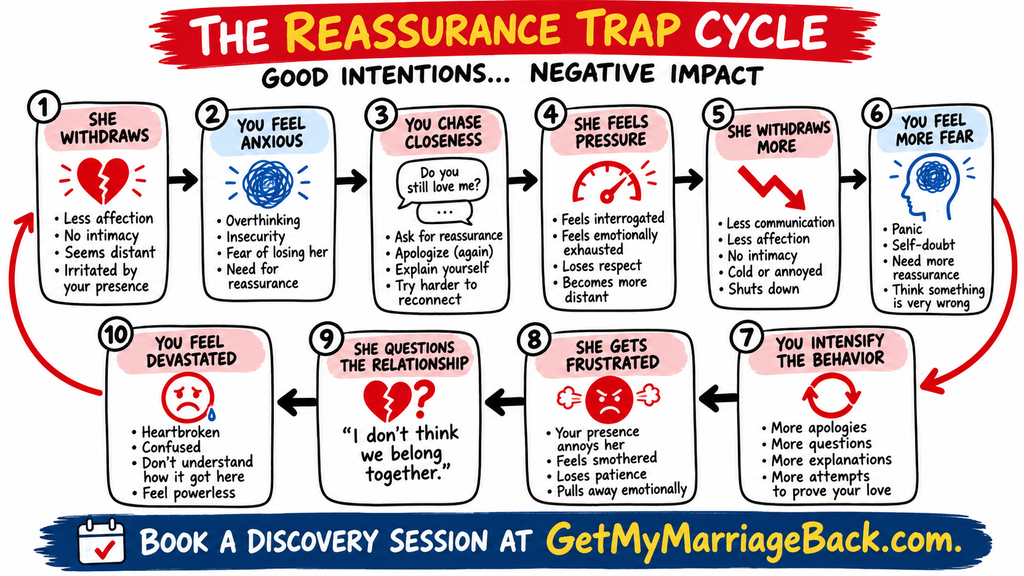
When communication drops, it is incredibly easy to spiral into panic, over-analyze her silence, or look for hidden clues in her text messages.

However, chasing her for validation will only backfire.

True attraction requires emotional breathing room.

This guide outlines the psychological reality of marital distance, how to identify genuine positive signs during separation, and how to use this season to build your own self-respect so she naturally wonders about you again.

does my wife miss me during separation

Does My Wife Miss Me During Separation?

The short answer is: probably yes, at least sometimesโ€”but that doesn’t automatically mean she is ready to reconcile.

Human beings become emotionally attached to routines, shared experiences, companionship, and familiarity.

Even when a marriage is struggling, the absence of a spouse often creates emotional gaps that are impossible to ignore.

However, whether your wife misses youโ€”and how intensely she misses youโ€”depends on several factors:

  • Who initiated the separation
  • The level of emotional damage in the marriage
  • Whether trust was broken
  • How long the separation has lasted
  • Whether she feels relief or loss
  • The quality of your interactions before separation

Many husbands assume that if their wife isn’t reaching out, she doesn’t care anymore.

That assumption is often wrong.

People process emotional pain differently. Some become more expressive. Others become quieter.

A wife can miss you and still choose distance because she believes space is necessary.

The Law of Attraction: Why Chasing Her Kills Her Desire to Wonder

When you are separated, hyper-fixing on whether your wife misses you is the fastest way to ensure that she doesn’t.

If you are constantly seeking signs of her attraction, it consumes your thoughts, causing you to completely neglect your personal growth and life goals.

Your relationship shouldn’t define you; it should complement your authentic self.

In life, people often attract what they fear most because fear changes behavior.

The husband who fears losing his wife becomes needy, reactive, impatient, and emotionally dependent.

Ironically, these are the exact traits that reduce attraction.

If a man hasn’t given his wife space, she cannot experience the psychological vacuum required to actually miss him.

Start paying attention to:

  • Your physical fitness
  • Your emotional intelligence
  • Your purpose and mission
  • Your friendships
  • Your faith and gratitude
  • Your personal growth

Allow your wife room to wonder what you are doing.

Allow her room to experience your absence.

Taking your attention off her and investing it back into your life’s purpose is often the fastest way to rebuild attraction during separation.

Why Separation Isn't Always a Bad Thing - does my wife miss me during separation

Why Separation Isn’t Always a Bad Thing

Most men hear the word “separation” and immediately think the marriage is over.

Not necessarily.

In many cases, separation is simply a symptom of emotional overwhelm.

Think about the alternative.

Would you rather continue living in a toxic environment filled with:

  • Constant conflict
  • Emotional disconnection
  • Resentment
  • Criticism
  • Contempt
  • Exhaustion

Sometimes separation creates the emotional breathing room necessary for clarity.

Distance often reveals things that proximity hides.

When two people stop reacting to each other daily, they gain perspective.

That perspective can either confirm the desire to leaveโ€”or reignite appreciation for what was taken for granted.

5 Positive Signs During Separation

If you’re wondering whether your wife misses you, look for behaviors rather than assumptions.

Sign #1 – She Reaches Out Without Necessity

When communication is no longer required but she still finds reasons to contact you, it can indicate emotional attachment remains.

Examples include:

  • Asking how you’re doing
  • Sending funny videos
  • Sharing life updates
  • Checking in casually

These interactions suggest she still values connection.

Sign #2 – She Brings Up Positive Memories

Nostalgia is powerful.

When your wife references vacations, family moments, inside jokes, or good times together, she’s mentally revisiting emotional experiences associated with you.

That is usually a positive sign.

Sign #3 – She Delays Permanent Decisions

A wife who is absolutely certain she wants out typically moves forward decisively.

If she continues postponing divorce discussions, asking for more time, or expressing uncertainty, she may still be processing her feelings.

Sign #4 – She Shows Curiosity About Your Life

People don’t become curious about things they no longer care about.

If she’s asking mutual friends about you, monitoring your progress, or asking questions about what you’ve been doing, there is likely still emotional interest.

Sign #5 – She Becomes More Comfortable Around You

Watch her energy rather than her words.

If interactions become warmer, more relaxed, and less defensive over time, attraction and trust may slowly be rebuilding.

3 Bad Signs During Separation From Husband

While maintaining hope is healthy, it’s equally important to stay grounded in reality.

Bad Sign #1 – She Shows Complete Indifference

Anger still contains emotional energy.

Indifference often signals emotional detachment.

If she consistently appears uninterested in your life, your well-being, or the future of the marriage, that’s a concern.

Bad Sign #2 – She Actively Avoids Contact

If she repeatedly refuses communication, avoids all interaction, and demonstrates no desire to maintain connection, she may be creating emotional distance intentionally.

Bad Sign #3 – She Is Focused Entirely on a Future Without You

Pay attention to actions rather than promises.

If she is making long-term plans that exclude you entirely and shows no interest in discussing reconciliation, that’s a sign the separation may be moving toward permanence.

Check this out: How To Rebuild Trust After An Affair

3 Ways To Make Your Wife Miss You During Separation

Many husbands ask, “How do I make my wife miss me during separation?”

The answer is not manipulation.

You cannot force somebody to miss you.

You can only create conditions where missing you becomes possible.

#1 – Stop Being Available Every Minute

Constant texting, calling, checking in, and seeking reassurance destroys mystery.

Attraction requires space.

Space creates curiosity.

Curiosity creates emotional movement.

#2 – Rebuild Your Identity

One of the biggest mistakes separated spouses make is allowing the marriage to become their entire identity.

Become the man she originally admired:

  • Purpose-driven
  • Confident
  • Emotionally grounded
  • Self-respecting
  • Growth-oriented

Your relationship should complement your life, not become your life.

#3 – Master Emotional Intelligence

Most marital breakdowns are not caused by evil intentions.

They’re caused by poor emotional management.

Learn to eliminate behaviors that poison relationships:

  • Blame
  • Shaming
  • Condemnation
  • Sarcasm
  • Constant criticism
  • Defensiveness

A calm and emotionally intelligent man naturally becomes more attractive.

Focus on the Three P’s

When navigating separation, remember:

Prayer

For things beyond your control.

Patience

Because emotional healing takes time.

Process

Because sustainable reconciliation is a journey, not an event.

does my wife miss me during separation - Make Your Wife Miss You During Separation by Becoming More Attractive

Make Your Wife Miss You During Separation by Becoming More Attractive

Attraction isn’t built through pressure.

It’s built through contrast.

If your wife remembers a stressed, reactive, needy version of you, then your mission is not convincing her to return.

Your mission is becoming a healthier version of yourself.

Work on:

  • Physical health
  • Emotional stability
  • Leadership
  • Self-awareness
  • Gratitude
  • Purpose

The more grounded you become, the more likely she is to notice the difference.

Whether reconciliation happens or not, you win because you become stronger.

Keeping Hope During Separation Without Becoming Desperate

Hope is healthy.

Desperation is not.

The difference is subtle.

Hope says:

“I want this marriage to work, but I’ll be okay regardless.”

Desperation says:

“My happiness depends entirely on her decision.”

The first mindset creates attraction.

The second creates pressure.

Remember that respect, trust, and attraction are rebuilt gradually.

Trying to force outcomes usually delays them.

So… Does My Wife Miss Me During Separation?

In most cases, yes, your wife likely misses aspects of you during separation.

She may miss your companionship, your presence, your support, your humor, your family routines, or the life you built together.

But the better question isn’t whether she misses you.

The better question is:

Are you becoming the kind of man she can miss even more tomorrow than she does today?

Give her space.

Focus on growth.

Stay emotionally grounded.

Let attraction rebuild naturally rather than trying to force it.

Sometimes the strongest move during separation is not chasing harderโ€”it’s becoming better.

Check this out: The signs that your wife is ready to reconcile

Frequently Asked Questions [FAQ]

What to expect during separation?

Expect a mixture of emotions including sadness, relief, confusion, hope, and uncertainty. Separation often creates emotional distance initially, but it can also provide clarity and perspective for both spouses over time.

What percentage of marriages last after a separation?

Research varies, but many separated couples never formally divorce, and a meaningful percentage eventually reconcile. Success depends heavily on the reasons for separation, willingness to change, and both partners’ commitment to rebuilding trust.

How long do divorced couples still sleep together?

There is no standard timeline because every situation is unique. Some couples maintain physical intimacy during separation or after divorce due to emotional attachment, while others stop immediately once the relationship ends.

What should a wife not do during separation?

A wife should avoid using separation solely as a tool for punishment, manipulation, or emotional leverage. Clear boundaries, honest communication, and respect for the agreed purpose of the separation create the best environment for healing and clarity.

Can a Marriage Survive Without Physical Attraction? The Truth Most Couples Avoid

Physical attraction is one of those topics people often tiptoe around because it feels shallow to admit it matters.

Yet countless husbands and wives quietly wrestle with the same question:

Can a marriage survive without physical attraction?

The honest answer is yes.

But surviving and thriving are not the same thing.

A marriage can survive without physical attraction in the same way a business partnership can survive without friendship.

The structure remains intact, the responsibilities continue, and life moves forward.

However, for most people, something essential is missing.

Human beings are not designed to live on practicality alone.

We crave connection, desire, affection, admiration, novelty, and emotional intimacy.

While physical attraction is not the only ingredient of a successful marriage, it remains one of the major forces that separates a romantic partnership from a platonic friendship.

The more important question isn’t whether a marriage can survive without attraction.

The better question is:

Can attraction be rebuilt when it fades?

In many cases, the answer is yes.

can a marriage survive without physical attraction -

The Difference Between Possibility and Probability

Anything is possible.

There are marriages that survive decades with little or no physical attraction.

Some couples remain together because of shared values, children, faith, financial stability, companionship, or a deep emotional bond developed over years.

But possibility is not the same as probability.

Most people do not enter marriage hoping for a relationship that resembles a roommate arrangement.

They want romance, companionship, friendship, intimacy, family, growth, and shared experiences.

When physical attraction disappears entirely, most marriages face significant pressure because one of the fundamental purposes of marriage has been weakened.

That doesn’t automatically mean divorce.

It does mean the issue deserves attention rather than avoidance.


Why Physical Attraction Matters More Than People Admit

Many people try to separate physical attraction from emotional connection.

In reality, the two are often intertwined.

Physical attraction isn’t just about looks.

It is influenced by:

  • Emotional safety
  • Respect
  • Admiration
  • Confidence
  • Energy
  • Mystery
  • Playfulness
  • Personal growth
  • Sexual polarity
  • Lifestyle habits

This explains why someone can look nearly identical to how they looked years ago yet feel dramatically less attractive to their spouse.

The attraction problem is often deeper than appearance.

It’s frequently a reflection of emotional disconnection.

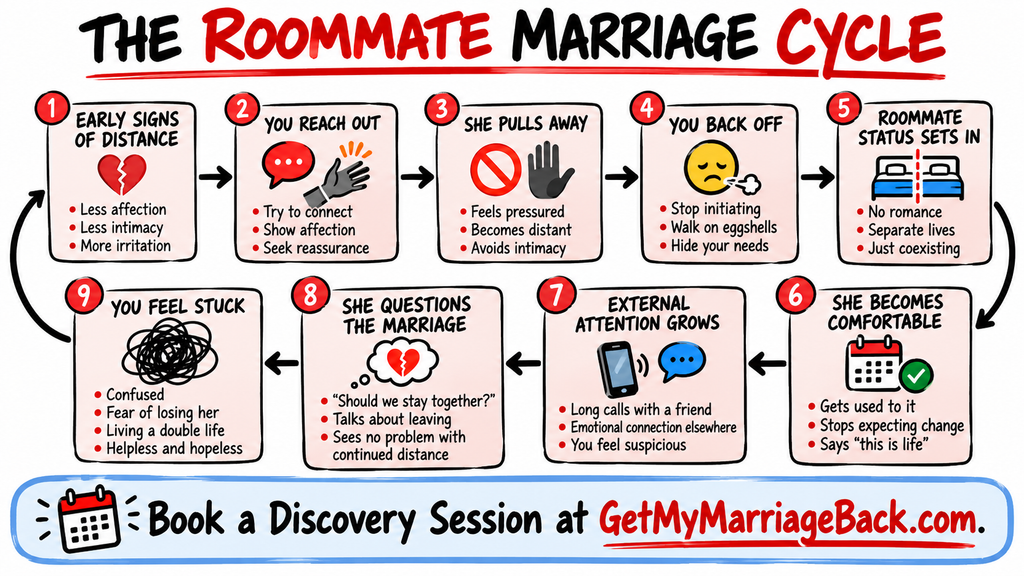
The Real Danger: The Roommate Dynamic

Most marriages don’t collapse overnight.

They drift.

A couple gets busy.

Children arrive.

Careers demand attention.

Stress accumulates.

Date nights disappear.

Conversations become transactional.

Intimacy becomes scheduledโ€”or nonexistent.

Eventually, the marriage starts operating like a household management system rather than a romantic relationship.

At that point, attraction often fades as a symptom rather than the root problem.

The spouses still function as teammates.

But they no longer feel like lovers.

This is what many people describe as the “roommate phase.”

Left unaddressed, it can quietly erode both emotional and physical intimacy.

 - can a marriage survive without physical attraction

What Happens When You’re No Longer Attracted to Your Spouse?

If you’ve lost attraction to your spouse, don’t panic.

Loss of attraction is often temporary.

The bigger issue is understanding why it happened.

Ask yourself:

  • Has respect diminished?
  • Did resentment accumulate?
  • Have unresolved conflicts gone unaddressed?
  • Did either partner stop investing in personal growth?
  • And have you become overly familiar and predictable?
  • Has intimacy been neglected for years?

Many people assume attraction is either there or it isn’t.

That’s a mistake.

Attraction is often responsive.

It grows or shrinks based on how two people show up in the relationship.


The Two Biggest Marriage Killers: Pride and Expectations

Many couples believe attraction dies because feelings change.

More often, attraction dies because pride and expectations are mismanaged.

Killer #1 – Mismanaged Expectations

People frequently enter marriage believing:

  • Their spouse should automatically understand them.
  • Romance should happen naturally forever.
  • Passion should sustain itself.
  • Their partner should meet every emotional need.

Reality eventually collides with fantasy.

When expectations become unrealistic, disappointment follows.

Disappointment becomes resentment.

Resentment kills attraction.

Killer #2 – Mismanaged Pride

Pride prevents accountability.

Instead of asking:

“What can I improve?”

People ask:

“Why aren’t they changing?”

The marriage becomes a scoreboard.

Both partners wait for the other person to move first.

Nobody leads.

Nothing improves.

Attraction continues to decline.


Attraction Is Often Earned, Not Owed

One of the hardest truths about attraction is that nobody is entitled to it.

Respect, trust, admiration, and desire are continuously influenced by behavior.

This doesn’t mean you must become someone else.

It means attraction requires maintenance.

Many couples unknowingly become anti-seducers inside their marriage.

They become:

  • Needier
  • More reactive
  • Controlling
  • More critical
  • Less playful
  • Almost no patience
  • Less emotionally regulated

The very behaviors that attracted their spouse initially slowly disappear.

Then they wonder why the spark faded.

5 Ways To Rebuild Attraction in Marriage

The good news?

Attraction can often be rebuilt.

Not through manipulation.

And ot through guilt.

Not through pressure.

But through intentional action.

1. Rebuild Friendship First

Friendship is one of the strongest foundations of lasting attraction.

When couples stop enjoying each other outside the bedroom, intimacy usually suffers inside the bedroom too.

Start by reconnecting through:

  • Shared experiences
  • Meaningful conversations
  • Laughter
  • Curiosity
  • Adventure

Attraction frequently follows connection.


2. Focus on Personal Growth

One of the most attractive qualities in any person is growth.

People are naturally drawn to individuals who are improving their lives.

Develop:

  • Better health
  • And fitness
  • Better emotional intelligence
  • Improving communication skills
  • Greater purpose & Overall GAME

Your spouse may not respond immediately.

Do it anyway.

Growth benefits you regardless of the outcome.


3. Reduce the Behaviors That Poison Relationships

Attraction struggles often exist alongside toxic communication patterns.

Watch for:

  • Shaming
  • Blaming
  • Insults
  • Condescension
  • Judgment
  • Constant criticism
  • Sarcasm used as a weapon

You cannot consistently attack someone and expect them to feel emotionally or physically drawn to you.


4. Bring Seduction Back Into Marriage

Many married couples stop flirting because they assume commitment eliminates the need for courtship.

It doesn’t.

Seduction isn’t manipulation.

It’s intentional attraction-building.

Compliments.

Playfulness.

Mystery.

Attention.

Presence.

These are often more powerful than grand gestures.

Your spouse still wants to feel chosen.


5. Address Resentment Directly

Unspoken resentment is one of the biggest attraction killers.

You cannot heal what you refuse to discuss.

Healthy conversations require:

  • Emotional honesty
  • Accountability
  • Listening
  • Patience

Avoid turning every discussion into a courtroom trial.

The goal is understanding, not winning.


When Physical Attraction Fades Because of Life Circumstances

Life happens.

People age.

Bodies change.

Illness occurs.

Stress accumulates.

In long-term marriages, physical attraction inevitably evolves.

The strongest marriages survive these seasons because they have built multiple layers of attraction.

They develop:

  • Emotional attraction
  • Intellectual attraction
  • Spiritual attraction
  • Lifestyle compatibility
  • Shared purpose
  • Mutual respect

Physical beauty changes.

Character becomes increasingly important.


Can a Marriage Thrive Without Physical Attraction?

For a small minority of couples, yes.

Some marriages become deeply fulfilling companionate partnerships built on friendship, loyalty, shared values, and mutual support.

But for most people, complete absence of physical attraction creates challenges that eventually surface.

That’s why the healthier goal is not learning how to live without attraction.

The healthier goal is learning how to cultivate it.

Because attraction is often less about finding the right person and more about continuously becoming the kind of person who inspires attraction.


So, Can a Marriage Survive Without Physical Attraction?

Yes.

But survival should not be the standard.

Most people don’t dream of merely surviving their marriage.

They want connection.

Passion.

Friendship.

Romance.

Growth.

The encouraging news is that attraction is rarely a fixed trait.

In many marriages, it is a skill that can be nurtured, rebuilt, and strengthened through emotional intelligence, personal growth, respect, and intentional effort.

The couples who succeed are rarely the couples who never lose attraction.

They are the couples who learn how to rebuild it when life inevitably tests their connection.

Check this out: 35 Warning Signs Your Wife Is Cheating (Is It Insecurity?)

Frequently Asked Questions

Can a marriage work without attraction?

Yes, a marriage can work without strong physical attraction if both partners are fulfilled by emotional connection, shared values, companionship, and mutual respect. However, for most people, the absence of attraction makes it harder to sustain romantic intimacy and long-term relationship satisfaction.

How does a sexless marriage affect men?

A sexless marriage can leave some men feeling rejected, undesirable, disconnected, and emotionally lonely, especially if physical intimacy is one of their primary ways of experiencing love and connection. Over time, unresolved sexual frustration can contribute to resentment, lower self-esteem, and emotional withdrawal from the relationship.

How long can a marriage last without physical attraction?

A marriage can last for many years or even a lifetime without physical attraction if both partners are genuinely content with the arrangement and have strong bonds in other areas. The bigger factor is not time itself, but whether unmet needs create ongoing dissatisfaction, resentment, or emotional distance.

What happens when you are no longer attracted to your spouse?

When attraction fades, couples often experience less intimacy, reduced affection, increased emotional distance, and a growing sense of living as roommates rather than romantic partners. The good news is that loss of attraction is not always permanent and can often be rebuilt by addressing underlying issues such as resentment, neglect, poor communication, or loss of emotional connection.

Signs of a Fake Apology After Infidelity: 9 Red Flags to Watch

Rebuilding trust after a betrayal is a delicate process, leaving many betrayed spouses constantly wondering: what are the true signs of a fake apology after infidelity?

When a partner says โ€œIโ€™m sorryโ€ after an affair, it is easy to mistake a shallow, fear-driven script for genuine repentance.

However, accepting an insincere apology without checking for true remorse only sets your marriage up for further emotional damage.

This guide outlines the psychological differences between empty remorse and a real path to healing.

Below, we break down how to spot a fake apology, how to handle emotional distance, and how to safely rebuild your relationship foundation.

Why Learning the Signs of a Fake Apology After Infidelity Matters - signs of a fake apology after infidelity

Why Learning the Signs of a Fake Apology After Infidelity Matters

After an affair, most people focus on one question:

โ€œAre they really sorry?โ€

Unfortunately, many betrayed spouses evaluate apologies based on words instead of behavior.

That mistake can cost monthsโ€”or yearsโ€”of additional pain.

A convincing apology can temporarily soothe your emotions.

But lasting healing requires something deeper than words.

It requires accountability, consistency, transparency, and emotional maturity.

If your goal is rebuilding attraction, trust, and emotional safety in marriage, you must learn to distinguish genuine remorse from performance.

Because attraction cannot thrive where trust remains broken.

Remorse vs. Repentance: The Difference Most Couples Miss

One of the biggest mistakes people make is confusing remorse with repentance.

Regret Is About Them

A spouse may regret:

  • Getting caught
  • Facing consequences
  • Losing respect
  • Damaging their reputation
  • Risking divorce

Regret focuses on their discomfort.

Genuine Remorse Is About You

A truly remorseful spouse focuses on:

  • The pain they caused
  • And The trust they destroyed
  • The confusion they created
  • Also The emotional safety they violated

They are not primarily concerned with escaping consequences.

They are concerned with helping you heal.

Repentance Goes Even Further

Repentance is remorse in action.

It is not simply saying, โ€œIโ€™m sorry.โ€

It is saying:

โ€œI understand what I did. I accept responsibility. And I will change the behaviors, boundaries, and patterns that created this outcome.โ€

This distinction is critical when evaluating the signs of genuine remorse after infidelity vs fake remorse.

9 Signs of a Fake Apology After Infidelity - signs of a fake apology after infidelity

9 Signs of a Fake Apology After Infidelity

1. They Say โ€œIโ€™m Sorry, Butโ€ฆโ€

This is perhaps the most obvious red flag.

Examples include:

  • โ€œIโ€™m sorry, but you were emotionally distant.โ€
  • Here is another one โ€œIโ€™m sorry, but we hadn’t been connecting.โ€
  • Or. โ€œIโ€™m sorry, but you weren’t meeting my needs.โ€

The moment โ€œbutโ€ enters the apology, responsibility begins leaving it.

Healthy explanations may eventually be part of marriage recovery.

But explanations are not apologies.

An apology accepts responsibility before discussing context.

2. They Minimize the Betrayal

Another common sign of fake remorse after cheating is minimizing what happened.

They may describe the affair as:

  • A mistake
  • Or A lapse in judgment
  • A bad decision
  • OR worse… An accident

But affairs are rarely one decision.

They are usually a series of decisions.

Minimization prevents accountability because it reduces the seriousness of the betrayal.

3. They Want Instant Forgiveness

A fake apology often comes with an invisible deadline.

You may hear:

  • โ€œHow long are we going to keep talking about this?โ€
  • โ€œI already apologized.โ€
  • โ€œYou need to move on.โ€
  • โ€œYou can’t keep punishing me forever.โ€

A sincere apology understands that trust and forgiveness operate on different timelines.

Respect, trust, and emotional safety are earned in the mid-to-long term.

Not demanded.

4. They Become Defensive When You Ask Questions

The betrayed spouse naturally seeks understanding.

A remorseful partner understands this.

A defensive partner often responds with:

  • Anger
  • Irritation
  • Stonewalling
  • Accusations

If they become frustrated every time you seek clarity, they are prioritizing their comfort over your healing.

5. They Want Credit for Bare-Minimum Effort

One apology.

An emotional conversation.

One good week.

Then they expect recognition.

Real trust rebuilding requires consistency.

Not occasional bursts of effort.

The strongest indicator of sincerity isn’t intensity.

It’s sustainability.

6. Their Actions Never Change

Words create hope.

Actions create trust.

If their behaviors remain unchanged, their apology remains incomplete.

Examples include:

  • Keeping inappropriate friendships
  • Maintaining secrecy
  • Refusing transparency
  • Ignoring relationship issues
  • Avoiding counseling or growth

The clearest answer to how to tell if an apology is fake after an affair is simple:

Watch what they do after they apologize.

7. They Turn Themselves Into the Victim

This often sounds like:

  • โ€œI guess I’m just a terrible person.โ€
  • โ€œNothing I do is ever enough.โ€
  • โ€œEveryone hates me now.โ€

Notice what happens.

The conversation shifts from your pain to their feelings.

Now you are comforting the person who hurt you.

That is not accountability.

That is emotional deflection.

8. They Apologize Repeatedly Without Progress

Surprisingly, endless apologies can become a warning sign.

If you’ve heard:

  • โ€œI’m sorry.โ€
  • And โ€œI’m sorry.โ€
  • Than โ€œI’m sorry.โ€

Dozens of times without meaningful behavioral change, the apology may be functioning as emotional management rather than relationship repair.

Real remorse produces movement.

Not repetition.

9. They Focus More on Saving the Marriage Than Becoming Trustworthy

This is subtle but important.

Some spouses become obsessed with saving the relationship while ignoring the personal growth required to deserve trust again.

Their focus becomes:

  • Keeping the marriage
  • Avoiding divorce
  • Restoring normalcy

Instead of:

  • Developing integrity
  • Building transparency
  • Improving emotional intelligence
  • Becoming emotionally safe

Saving the marriage is not the same thing as becoming trustworthy.

12 Signs of Genuine Remorse After Infidelity vs Fake Remorse

Let’s simplify the comparison.

Fake Remorse

  • Focuses on consequences
  • Deflects responsibility
  • Wants quick forgiveness
  • Resists difficult conversations
  • Uses words as the primary tool
  • Prioritizes comfort

Genuine Remorse

  • Focuses on your pain
  • Accepts full responsibility
  • Allows healing to take time
  • Welcomes difficult conversations
  • Demonstrates change through actions
  • Prioritizes repair

This distinction alone can save you from months of confusion.

The Danger of Forced Forgiveness

Many people rush forgiveness because uncertainty feels unbearable.

But forcing forgiveness does not create healing.

It creates suppression.

Your desire for certainty may tempt you to:

  • Ignore red flags
  • Accept weak apologies
  • Rush trust
  • Avoid conflict

Don’t.

One of the greatest emotional intelligence skills in marriage is learning to tolerate uncertainty long enough to observe reality.

Trust actions.

Not promises.

Trust consistency.

Not emotional speeches.

Trust patterns.

Not isolated moments.

signs of a fake apology after infidelity - Reclaiming Your Peace Instead of Becoming a Detective

Reclaiming Your Peace Instead of Becoming a Detective

After betrayal, many people become trapped in hyper-vigilance.

Checking phones.

Reading messages.

Analyzing every word.

Looking for hidden clues.

This response is understandable.

But eventually, healing requires a shift.

The goal is not becoming a better detective.

The goal is becoming a better observer.

Observe actions and consistency.

Observe effort and integrity.

The healthiest position is not obsessive monitoring.

It is calm evaluation.

When your life becomes grounded in purpose, self-awareness, gratitude, and emotional leadership, you stop chasing certainty and start recognizing truth.

Building Attraction While Rebuilding Trust

This may sound surprising, but attraction and accountability are deeply connected.

Attraction grows when people display:

  • Integrity
  • Confidence
  • Leadership
  • Emotional maturity
  • Consistency

Trust rebuilding isn’t just about avoiding another affair.

It’s about becoming a more attractive spouse emotionally, mentally, and relationally.

Many marriages collapse because of mismanaged pride and unrealistic expectations.

Recovery begins when both spouses become willing to lead themselves before trying to lead each other.

The spouse who cheated must develop accountability.

The betrayed spouse must develop discernment.

Both must cultivate emotional intelligence.

That is where sustainable attraction begins.

Check this out: My Wife Loves Me But Doesnโ€™t Desire Me | 5 Signs | 5 Tips

The Bottom Line

The biggest signs of a fake apology after infidelity are blame-shifting, minimizing the betrayal, demanding quick forgiveness, avoiding accountability, and refusing meaningful change.

A real apology does not simply say the right words.

It demonstrates the right behaviors repeatedly over time.

If you’re evaluating whether your spouse is truly remorseful, stop focusing exclusively on what they say.

Watch what they consistently do.

Because trust is not rebuilt through promises.

It is rebuilt through proof.

And when proof becomes consistent, healing becomes possible.

Frequently Asked Questions

How can you tell if someone is faking an apology?

A fake apology usually includes excuses, blame-shifting, minimizing the harm, or pressure for you to “move on” quickly. The clearest sign is when their behavior never changes, even though they keep saying they’re sorry.

What are the stages of emotions after being cheated on?

Most people experience a cycle of shock, denial, anger, sadness, confusion, and eventually either acceptance or reconciliation. These emotions rarely occur in a straight line and often resurface in waves as trust and reality are processed.

How does an innocent person act when accused of cheating?

An innocent person is typically more focused on clearing up the misunderstanding than attacking or manipulating the accuser. While they may feel hurt, frustrated, or defensive, they usually remain willing to answer questions and provide reasonable reassurance.

What does a manipulative apology look like?

A manipulative apology sounds like, “I’m sorry you feel that way,” or “I’m sorry, but you made me do it,” because it avoids full responsibility. It often shifts attention to the apologizer’s feelings, seeks sympathy, or pressures the other person to forgive without genuine accountability or change.

What are the biggest signs of a fake apology after infidelity?

The most common signs include blame-shifting, minimizing the affair, demanding quick forgiveness, becoming defensive, and failing to change behavior after apologizing.

How can you tell if remorse is genuine after cheating?

Genuine remorse focuses on the pain caused to the betrayed spouse, accepts full responsibility, welcomes questions, demonstrates transparency, and shows long-term behavioral change.

Why do people give fake apologies after an affair?

Many fake apologies are driven by fear of consequences, shame, discomfort, or a desire to quickly restore normalcy rather than a genuine commitment to repair the damage caused.

Check out this videos…

5 Signs of An Emotional Affair + 5 RECOVERY TIPS

Is Physical Attraction Overrated in Marriage? Hereโ€™s the Real Truth

Husband Doesn’t Find Me Attractive? Here’s What You Need to Understand First

Few thoughts cut deeper than believing your husband doesn’t find you attractive anymore.

It can make you question your appearance, your value, your desirability, and even the future of your marriage.

Every declined advance, every lack of affection, every distracted glance can feel like evidence that the attraction is gone.

But before you accept that conclusion, pause and ask a critical question:

How did you arrive there?

Did your husband explicitly tell you he no longer finds you attractive?

Or are you interpreting his behavior?

Is he avoiding intimacy? Spending less time with you? Constantly criticizing you? Acting more like a roommate than a romantic partner?

The answers matter because many women arrive at the painful conclusion that “my husband doesn’t find me attractive” without ever verifying whether attraction is actually the problem.

And even when attraction has declined, it’s rarely as simple as physical appearance.

In long-term relationships, attraction is often a reflection of emotional connection, friendship, respect, polarity, stress levels, unresolved resentment, and the overall health of the marriage.

The good news?

Attraction is far more dynamic than most people realize. In many marriages, it can be rebuilt.

Before Anything Else: Separate Facts From Assumptions

One of the biggest mistakes people make is treating assumptions as facts.

Maybe your husband hasn’t initiated sex in months.

Does he seem emotionally distant?

Maybe he appears uninterested.

Those experiences are real.

But they don’t automatically prove he no longer finds you attractive.

Many men withdraw physically because of:

  • Work stress
  • Financial pressure
  • Depression or anxiety
  • Low testosterone
  • Health issues
  • Pornography habits
  • Emotional resentment
  • Relationship burnout
  • Feeling unappreciated
  • Personal insecurities

Attraction problems and intimacy problems are not always the same thing.

Before trying to solve the issue, make sure you’re diagnosing the right problem.

The Hard Question: Why Does This Possibility Feel So Believable? husband doesn't find me attractive

The Hard Question: Why Does This Possibility Feel So Believable?

Let’s assume for a moment that your husband’s behavior genuinely suggests a loss of attraction.

There’s still another question worth exploring:

Why are you able to believe it so easily?

This isn’t about blaming yourself.

It’s about identifying where your confidence may have quietly eroded.

Because confidence has always been attractive.

A woman with healthy self-esteem doesn’t automatically collapse when someone questions her value.

She may feel hurt.

She may feel disappointed.

But she doesn’t instantly conclude she is undesirable.

Instead, she becomes curious.

She asks:

  • What’s actually happening here?
  • Is this about me?
  • Is this about him?
  • Is this about us?

The more dependent your self-worth becomes on your husband’s validation, the more devastating every sign of withdrawal becomes.

That’s why rebuilding attraction often starts by rebuilding something even more important:

Your relationship with yourself.

Attraction Is More Than Physical Appearance - husband doesn't find me attractive

Attraction Is More Than Physical Appearance

Most people think attraction is about looks.

That’s only part of the story.

In marriage, attraction is deeply connected to emotional experiences.

People become attractive when they create feelings of:

  • Connection
  • Safety
  • Respect
  • Excitement
  • Appreciation
  • Admiration
  • Mystery
  • Growth

When these elements disappear, attraction often fades regardless of physical appearance.

This explains why some couples remain passionately connected for decades while others struggle despite being physically attractive.

The issue is rarely just what someone sees.

It’s often what they feel when they’re with you.

3 Signs the Real Problem May Be Emotional Disconnection - husband doesn't find me attractive

3 Signs the Real Problem May Be Emotional Disconnection

If your husband seems less attracted to you, look beyond the bedroom.

Ask yourself:

Sign #1 – Has Friendship Declined?

One of the strongest predictors of attraction is friendship.

Many couples stop dating each other after marriage.

Conversations become logistical.

Fun disappears.

Playfulness dies.

The relationship becomes about responsibilities instead of connection.

When friendship weakens, attraction often follows.

Sign #2 – Has Resentment Been Building?

Unspoken resentment is one of the biggest attraction killers in marriage.

Resentment creates emotional distance.

Emotional distance creates physical distance.

Physical distance gets interpreted as a lack of attraction.

But the root problem is often unresolved emotional wounds.

Sign #3 – Have You Become Teammates But Not Lovers?

Many couples become excellent co-parents and household managers.

But they stop being romantic partners.

They discuss bills.

And coordinate schedules…

They solve problems.

Yet they rarely flirt, tease, touch, or create romantic tension.

Attraction cannot thrive in an environment where romance has been completely replaced by routine.

The Hidden Attraction Killers Most Couples Ignore

Many marriages slowly drift into patterns that unintentionally destroy attraction.

These behaviors often matter more than appearance.

Neediness and Emotional Suffocation

Constant reassurance-seeking creates pressure.

When every interaction becomes a search for validation, attraction often decreases.

Confidence attracts.

Neediness repels.

Constant Criticism

Few things destroy desire faster than feeling judged.

If interactions are filled with criticism, blame, or fault-finding, emotional safety disappears.

And attraction rarely survives where emotional safety is absent.

Losing Individual Identity

One of the paradoxes of attraction is that healthy relationships require two complete individuals.

When someone completely loses their hobbies, passions, friendships, goals, and personal growth, they often become less interesting to their partner.

Growth creates energy.

Stagnation creates boredom.

Rebuild Yourself Before Trying to Rebuild Attraction

This may sound counterintuitive.

But chasing your husband’s attraction is usually the fastest way to lose more of it.

Instead, focus on becoming someone you genuinely admire.

Ask yourself:

  • Am I physically taking care of myself?
  • Am I emotionally healthy?
  • Am I growing?
  • Am I pursuing meaningful goals?
  • Am I living with purpose?
  • Am I proud of the woman I see in the mirror?

These questions aren’t about becoming attractive for him.

They’re about becoming attractive to yourself first.

Ironically, that often creates the very shift you’re hoping for.

How to Talk to Your Husband Without Creating Defensiveness

Many attraction conversations fail because they begin with accusations.

Avoid statements like:

  • “You don’t find me attractive anymore.”
  • “You never want me.”
  • “What’s wrong with you?”

Instead, focus on your experience.

Try:

“I’ve been feeling disconnected from you lately, and it’s been hurting me. I’d love to understand what’s been going on from your perspective.”

This creates curiosity instead of conflict.

The goal is not to win an argument.

The goal is to uncover the truth.

Focus on the Four Areas That Most Influence Attraction

When attraction fades, examine these four leverage points:

1. Friendship

Do you still enjoy each other?

Can you laugh together?

Can you spend time together without discussing responsibilities?

2. Sex and Physical Intimacy

Not just intercourse.

Touch.

Affection.

Flirting.

Playfulness.

Physical closeness.

3. Expectations

Many marriages collapse under unrealistic expectations.

People silently expect their spouse to meet every emotional need.

When reality fails to match expectations, resentment grows.

4. Pride and Ego

Pride prevents honest conversations.

Mismanaged pride prevents apologies.

Pride prevents vulnerability.

Many marriages don’t fail because of a lack of love.

They fail because neither person wants to lower their guard.

Can Attraction Come Back?

Absolutely.

In fact, attraction often returns when couples stop obsessing over attraction itself.

The strongest marriages focus on:

  • Emotional connection
  • Friendship
  • Respect
  • Personal growth
  • Shared experiences
  • Playfulness
  • Healthy communication

Attraction becomes the natural byproduct.

Think of attraction like a fire.

Most people try to force the flames.

The wiser approach is rebuilding the conditions that allow the fire to burn.

Final Thoughts: Don’t Make Your Husband the Judge of Your Worth

If you truly believe your husband doesn’t find you attractive, take the concern seriously.

But don’t make the mistake of turning his opinion into the final verdict on your value.

Your worth existed before your marriage.

It exists during your marriage.

And it will exist regardless of anyone’s approval.

The healthiest path forward is not obsessing over whether your husband finds you attractive.

It’s becoming the strongest, most confident, emotionally intelligent version of yourself.

Because when self-respect grows, everything becomes easier to see clearly.

You’ll communicate better.

And set healthier boundaries.

You’ll stop chasing validation.

And you’ll create the conditions where attraction has the greatest chance of returning naturally.

Check this out: How to make your husband want you all the time

Frequently Asked Questions

Can a marriage survive a lack of attraction?

Yes, a marriage can survive periods of reduced attraction, especially when friendship, respect, trust, and commitment remain intact. In many cases, attraction returns when couples address the underlying issues causing emotional disconnection, resentment, stress, or complacency.

Why does my partner find me unattractive?

Attraction is rarely just about physical appearance; it is often influenced by emotional distance, unresolved conflict, stress, resentment, unhealthy relationship dynamics, or personal struggles your partner may be experiencing. Before assuming they find you unattractive, it’s important to have an honest conversation and understand what is actually driving the disconnect.

What are signs of a sexless marriage?

Common signs include little to no sexual intimacy for extended periods, avoidance of physical affection, reduced flirting, emotional distance, and a growing roommate-like dynamic. While definitions vary, many experts consider a marriage “sexless” when a couple has sex fewer than 10 times per year.

How long does the average sexless marriage last?

There is no reliable average because some sexless marriages end quickly while others continue for decades, depending on the couple’s level of satisfaction and commitment. The more important factor is not the duration itself, but whether both partners are willing to address the causes of the lack of intimacy before resentment becomes deeply rooted.


Broken Marriage?
Fix it
Here FREE

Get My Marriage Back