
Broken Marriage?
Fix it
Here FREE

Get My Marriage Back


Your Wife Is Not Attracted to You? Here Are 5 Mistakes Making It Worse

Your wife still talks to you. You handle responsibilities, raise children, pay bills, solve problems, and keep life moving.


Take This 2 Minutes Quiz

Question 1 of 15

But something feels painfully different.

Affection is rare. Sex feels mechanical, awkward, dutiful, or completely absent. When you touch her, you sense hesitation instead of excitement. You may even sleep in the same bed while feeling like two people sharing a house rather than husband and wife.

Eventually, one thought becomes hard to escape:

“wife is not attracted to me anymore.”

That realization creates more than sexual frustration. It creates a specific kind of emotional starvation—the experience of loving someone, wanting romantic connection with her, yet no longer feeling wanted in return.

The danger begins when emotional starvation starts choosing your behavior.

You try harder. more helpful. Initiate more carefully. You ask questions about sex. You pull away to see whether she notices. Eventually, even your best intentions begin carrying pressure.

That is how a marriage can move deeper into roommate status even while you are desperately trying to save it.

The answer is not to become cold, manipulate your wife, perform tricks to make her jealous, or turn marriage into a negotiation over who owes whom affection.

The skill is learning how to build attraction from self-leadership, emotional intelligence, experiential value, healthy pursuit, curiosity, and personal power.

What Does It Really Mean When Your Wife Is Not Attracted to You?

Loss of attraction is serious, but it does not automatically mean your marriage is finished.

Attraction is an experience, not a moral judgment.

Your wife can believe you are a responsible father, good provider, decent person, and loyal friend while experiencing very little romantic or sexual energy toward you.

That distinction is difficult because most high-functioning husbands naturally think in terms of solutions.

You may reason:

  • “I provide for this family.”
  • “I help around the house.”
  • “I’m working on myself.”
  • “I’m more patient now.”
  • “I’ve apologized.”
  • “Why doesn’t she want me?”

All of those statements can be factually true while missing the central question:

What does being romantically connected to you currently feel like?

Research offers useful support for this distinction. In three studies, Gurit Birnbaum and colleagues found that perceived partner responsiveness—feeling understood, valued, and cared for—was associated with greater sexual desire, with the link especially pronounced among women. Attraction was connected to relational experience, not simply household functionality. (PubMed)

That does not mean “be nicer and she will desire you.”

It means attraction responds to an entire experience.

my wife is not attracted to me - The Roommate Marriage Usually Has a Cycle

The Roommate Marriage Usually Has a Cycle

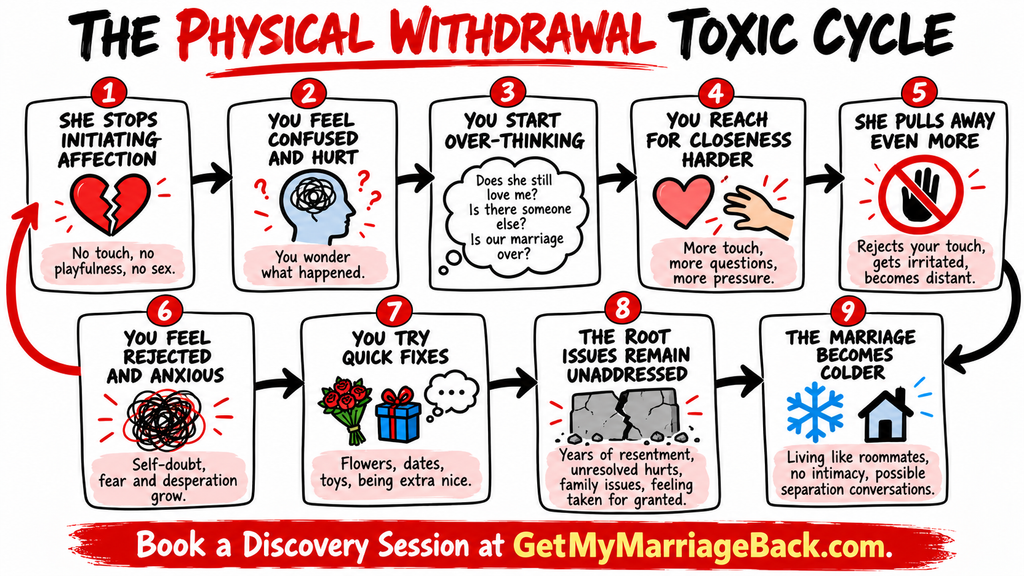
When your marriage feels like roommates, the external symptom is obvious: romance has faded.

Underneath it, however, a destructive cycle can develop:

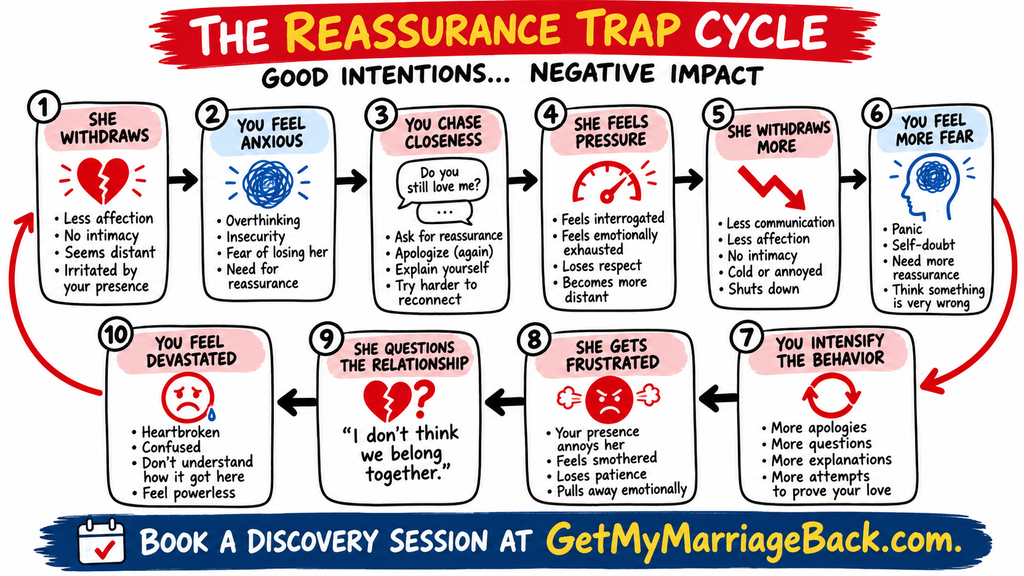
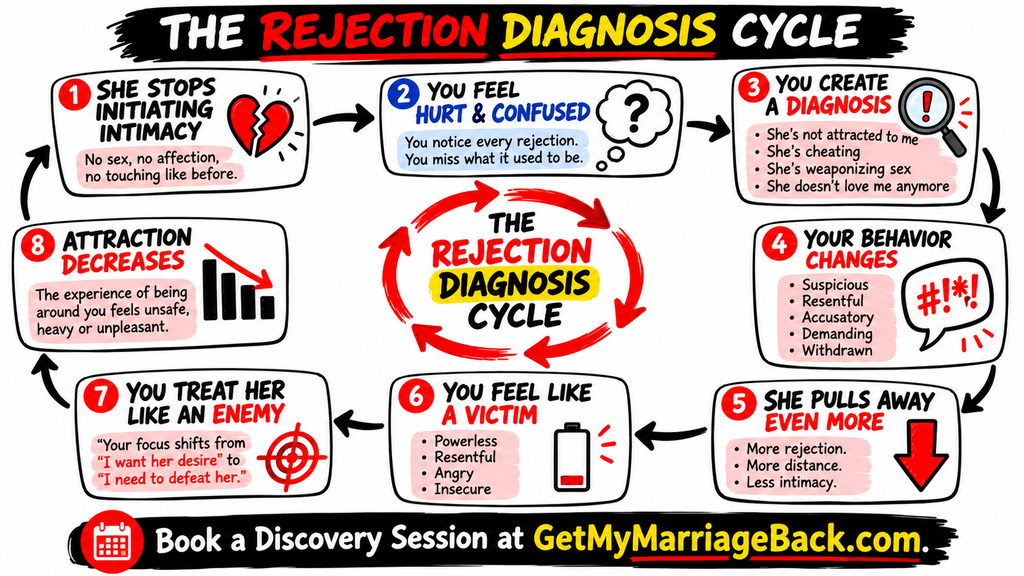
Roommate Status → Emotional Starvation → Connection Testing → Transaction Pressure → Romantic Shutdown → Deeper Roommate Status

Understanding this cycle matters because a man can unknowingly intensify the very rejection he is trying to escape.

1. Emotional Starvation

You want to feel desired.

That is normal.

Men do not stop needing affection, sexuality, admiration, playfulness, touch, warmth, and romantic connection simply because they got married.

Once those experiences disappear, however, hunger can become fear.

Now every interaction starts carrying extra meaning.

One rejected advance becomes:

“She’s not attracted to me.”

A week without sex becomes:

“Our marriage is dying.”

A cold response becomes:

“She doesn’t love me anymore.”

Soon, intimacy is no longer simply intimacy. It has become evidence.

That emotional weight sets up the next mistake.

my wife is not attracted to me

Mistake #1: You Start Testing Whether Your Wife Still Wants You

I call this connection testing.

Instead of expressing interest because you genuinely feel it, you begin expressing interest partly to measure her reaction.

You touch her to see if she leans in.

Sex becomes a test of whether attraction still exists.

You ask why she never initiates.

Sometimes you stop initiating completely because you want to see whether she comes looking for you.

Different behaviors can carry the same hidden question:

“Do I still matter to you romantically?”

That is a heavy question to attach to an ordinary hug.

Healthy pursuit has a different energy.

A man can desire his wife, initiate affection, flirt, express sexuality, and pursue without needing every interaction to reassure him that the marriage is safe.

Fear-driven chasing says, “I need your reaction to stabilize me.”

Dignity-based pursuit says, “I can express interest without losing myself inside your response.”

That difference is emotional intelligence.

Mistake #2: You Turn “Choreplay” Into Attraction Currency

Helping at home is not the problem.

Responsibility is attractive when it reflects your standards, leadership, maturity, generosity, and investment in the life you chose.

The problem appears when your behavior quietly becomes an exchange.

You clean.

…handle more errands.

You take care of the kids.

Then somewhere underneath the effort is an expectation:

“After everything I’ve done, why doesn’t she want sex?”

Now your contribution carries an invisible invoice.

Your wife does not have to hear you say the words to feel the transaction developing.

This does not mean domestic workload is irrelevant to desire. Stress, exhaustion, parenting demands, health changes, and unequal responsibilities can absolutely affect sexual interest.

The important distinction is motive.

Research on sexual motivation shows that responsiveness tends to work best when it comes from autonomous desire and genuine care rather than pressure or obligation. Across dyadic studies, people higher in what researchers call sexual communal strength—a willingness to care about a partner’s sexual needs without erasing their own—reported greater satisfaction and desire. By contrast, sex motivated more strongly by pressure and obligation was associated with poorer outcomes. (PubMed)

In plain English:

Care creates a different experience than payment.

Do your part because it represents your character.

Do not convert your character into a bill your wife must pay with attraction.

my wife is not attracted to me - You Keep Having “The Talk” About Why She Doesn't Want Sex

Mistake #3: You Keep Having “The Talk” About Why She Doesn’t Want Sex

Communication is valuable.

Interrogation disguised as communication is not.

Once attraction has already deteriorated, repeated conversations such as these can become emotionally exhausting:

“Why don’t you ever initiate?”

“Do you still find me attractive?”

“Why don’t we have sex anymore?”

“Are you still in love with me?”

“What do I need to change?”

Those questions make sense intellectually.

Emotionally, however, they can turn desire into a performance review.

Now your wife has to explain an experience she may not fully understand herself.

Worse, she starts associating affection with the possibility that another heavy conversation is coming.

A hug carries expectations.

A kiss becomes a signal.

Going to bed becomes tense.

Sex feels like proof that progress is happening.

Research on 1,054 married couples found that greater gaps between desired and actual sexual frequency were generally associated with poorer relationship outcomes, including lower satisfaction and stability and more conflict. The discrepancy itself matters, but turning that discrepancy into constant relational pressure does not solve it. (PubMed)

The better question is not:

“Why won’t she give me what I need?”

Ask:

“What has intimacy started to feel like inside this marriage?”

That question gives you something useful to work with.

Mistake #4: You Quietly Withdraw So She Will Miss You

After enough rejection, many husbands stop pursuing altogether.

You tell yourself:

“Fine. I’m done trying.”

You become polite but distant.

Warmth disappears.

You focus on work.

Sometimes you secretly hope your wife will finally notice the difference and begin chasing you.

That is still connection testing.

It simply wears a colder outfit.

Grounded detachment is different from quiet punishment.

You can stop over-pursuing without becoming emotionally dead.

And you can regain your independence without manufacturing scarcity.

You can respect her distance without turning silence into a manipulation strategy.

The purpose of reclaiming yourself is not to make your wife panic.

It is to stop allowing her current attraction level to control your identity, behavior, mood, and purpose.

Mistake #5: You Confuse Being a Good Husband With Being Experientially Attractive

This is one of the hardest ideas to accept.

Being a good person matters.

So does integrity.

Responsibility matters.

Faithfulness matters.

Providing matters.

None of those automatically creates romantic attraction.

Attraction has an experiential dimension.

Ask yourself:

What does my presence feel like?

Are you alive or chronically tense?

Curious or predictable?

Purposeful or emotionally dependent?

Playful or constantly serious?

Warm or defensive?

Present or mentally elsewhere?

Capable of hearing something painful without turning it into an argument?

Romantic attraction is not a reward for moral performance.

Your moral character establishes who you choose to be.

Experiential value affects what it feels like to interact with you.

That is why the goal is not merely “be a better husband.”

Become a fuller human being.

How to Rebuild Attraction Without Turning Your Wife Into a Project

Once you understand the destructive cycle, the constructive work becomes clearer.

The roadmap is:

Emotional Starvation → Grounding → Purpose → Self-Discovery → Value → Curiosity & Attraction

Notice where the work happens.

It starts with you.

Ground Yourself Before You Try to Fix the Marriage

Your wife’s attraction level is information about the present condition of the relationship.

It is not your source of truth.

Grounding means returning to your higher self before fear decides your next move.

You can acknowledge:

“My wife is not attracted to me sexually right now.”

without turning that sentence into:

“I am unattractive.”

Those are completely different statements.

Gratitude also matters here.

Not fake positivity.

Real gratitude widens your field of vision when fear has narrowed your entire life down to whether one person desires you today.

That is personal power.

Rebuild a Purpose Bigger Than Your Marriage

A marriage crisis can consume every available mental resource.

You wake up thinking about her.

You analyze her tone.

Work becomes harder.

Your phone becomes a source of anxiety.

Every quiet moment becomes another opportunity to think about the relationship.

Purpose interrupts that collapse.

Your life needs a mission greater than your wife and greater than your marriage.

Think about your children, health, faith, business, career, creativity, contribution, service, friendships, community, legacy, and the man you are becoming.

Purpose is not avoidance.

It is emotional structure.

When your entire identity depends on your wife’s current feelings, neediness naturally rises.

A purposeful life gives attraction room to breathe because you are no longer asking the marriage to carry the full weight of your identity.

Use the Crisis for Self-Discovery, Not Self-Blame

Now become curious about your own capacity.

Ask difficult questions without attacking yourself.

Where did you become complacent?

When did playfulness disappear?

Have resentment and defensiveness changed your energy?

Did work swallow your personality?

Have you become emotionally predictable?

Are you treating sex as reassurance rather than connection?

Do you listen to understand, or listen long enough to prepare your defense?

Self-discovery does not mean accepting blame for your wife’s feelings.

Her emotions remain hers.

Your behavior remains yours.

That boundary allows you to grow without surrendering your dignity.

Build Experiential Value

This is where attraction work becomes skillful and seductive in the healthiest sense of the word.

Seduction is not trickery.

It is the art of creating an experience that feels engaging enough to invite curiosity.

Experiential value includes presence, confidence, humor, emotional steadiness, competence, style, vitality, purpose, curiosity, warmth, sensuality, boundaries, social intelligence, and a genuine life of your own.

You are not assembling these qualities as bait.

Develop them because they expand you.

One useful body of research comes from Arthur Aron and colleagues. Their studies found that couples who participated in novel and arousing activities experienced increases in relationship quality compared with couples assigned more mundane activities. (DOI)

A 2026 review of self-expansion research likewise highlights evidence that novel, challenging, growth-oriented shared experiences can strengthen relationship quality and well-being.

The lesson is bigger than “plan a date.”

Routine can turn two interesting people into efficient coworkers.

Value requires aliveness.

Create Novelty Without Performing for Approval

Many husbands hear “bring excitement back” and immediately create another assignment.

Date night.

Vacation.

Flowers.

Fancy dinner.

Then comes the hidden scorecard:

“Did she appreciate it?”

“Was she affectionate afterward?”

“Did we have sex?”

Now novelty has become another transaction.

Instead, approach shared experiences with curiosity.

Try something different because life should be interesting.

Introduce more personality into your own life.

Become less predictable in healthy ways.

Explore.

Learn.

Create.

Invite rather than pressure.

Your wife can participate or decline.

The value of your growth does not disappear because her response was not what you hoped for.

That mindset is far more seductive than performing for approval.

Pursue Without Begging

A husband does not need to pretend he has stopped wanting his wife.

That performance usually feels fake anyway.

You can pursue.

Flirt.

Express attraction.

Initiate.

Compliment.

Create openings for connection.

The skill is removing emotional debt from the invitation.

A genuine invitation allows another person to say yes or no without having to manage your self-esteem afterward.

That is confidence.

When your wife says no, you do not have to sulk, interrogate, punish, or immediately diagnose the entire marriage.

You continue being a man whose emotional state belongs to him.

Over time, that difference changes the experience of you.

Stop Monitoring Whether Attraction Is “Working”

One of the fastest ways to turn personal growth back into pressure is to begin measuring your wife.

“She touched me twice this week.”

AND “She texted first.”

“She smiled at me.”

“We had sex, so this must be working.”

“She was cold tonight, so nothing is changing.”

Stop.

Curiosity, warmth, reciprocity, and attraction belong on her side of the equation.

Your job is value.

Her response is information—not your identity.

Attraction also fluctuates naturally. Stress, sleep, parenting, health, hormonal changes, medication, emotional history, and relational dynamics all influence sexual desire.

Research on desire discrepancy repeatedly shows that mismatched desire is common and connected with relationship and sexual satisfaction, but the meaning of the discrepancy varies across couples.

Do not convert every fluctuation into a marriage verdict.

What Attraction Recovery Actually Looks Like

Attraction recovery rarely begins with one dramatic romantic moment.

Often, the first changes are experiential.

Interactions become lighter.

Defensiveness decreases.

You stop forcing certainty.

Your identity expands beyond the marriage crisis.

Conversation stops feeling like crisis management every day.

Your energy becomes less predictable because your life is growing again.

Warmth can exist without demand.

Sexual interest can be expressed without making sex compulsory.

Curiosity has room to return.

That final word matters: room.

You cannot force curiosity.

You create an experience where curiosity has somewhere to live.

Your Wife’s Rejection Is Not a Command to Become Cold

Some men respond to rejection by deciding vulnerability itself is the problem.

It is not.

Emotional dependence and emotional openness are different things.

A strong man can say:

“I want my wife.”

“miss our connection.”

“I care about this marriage.”

“want romance in my life.”

None of those statements makes you weak.

The issue is what happens next.

Can you still stand when she does not immediately give you what you want?

Can you continue creating a meaningful life?

OR Can you learn from the crisis?

Can you pursue with dignity?

AND Can you remain warm without begging?

That is the kind of emotional capacity that makes reconciliation possible without turning it into an obsession.

The Goal Is Not to Restore the Old Marriage

When your marriage has reached deep roommate status, trying to recover exactly what you had before is often the wrong objective.

That version of the relationship produced the current result.

Build something more mature.

More emotionally intelligent.

alive.

More honest.

….purposeful.

More seductive.

…spacious.

Romantic attraction thrives when two people remain capable of experiencing each other as individuals—not merely roles performing household functions.

You are not only “husband.”

She is not only “wife.”

Marriage becomes far more compelling when the people inside it continue growing.

That is how you stop treating attraction like something you either have or lose forever.

It becomes a capacity you learn to nurture.

5 Physical Signs She Just Slept With Someone Else

Frequently Asked Questions

Why is my wife not attracted to me anymore?

Loss of attraction can grow from emotional disconnection, accumulated pressure, resentment, excessive routine, sexual obligation, stress, health changes, or a relational experience that has become more functional than romantic. The useful question is what attraction and intimacy currently feel like inside your marriage, not simply who is to blame.

Can a wife become attracted to her husband again?

Yes, attraction can change because it is responsive to relational experience, emotional connection, novelty, individual growth, sexual dynamics, and many other factors. Your strongest position is to improve what you control without trying to force her feelings.

How do I know if my wife is not sexually attracted to me?

Common signs include consistently avoiding sexual initiation, pulling away from affectionate touch, describing the marriage as friendship or roommate-like, and experiencing intimacy as obligation rather than desire. One isolated rejection does not establish the overall condition of your marriage.

What should I do when my wife rejects intimacy?

Do not interrogate, punish, sulk, or turn the rejection into proof that your marriage is over. Ground yourself, examine the larger relational pattern, express interest without pressure, and focus on building experiential value rather than demanding reassurance.

5 Signs Your Husband Doesn’t Find You Attractive: What It Really Means and How to Rebuild Attraction

Few marriage problems cut as deeply as the realization that your husband doesn’t find you attractive.


Take This 2 Minutes Quiz

Question 1 of 15

Sexual rejection has a way of becoming personal very quickly. A declined advance stops feeling like one moment and starts feeling like a verdict. Less touching becomes evidence. A lack of compliments starts sounding like confirmation. Before long, you are no longer asking why intimacy has changed. You are asking whether something is wrong with you.

That is where the real danger begins.

Your husband’s current level of attraction matters, but it should not become the source of your identity. Attraction in a long-term marriage is dynamic. It rises, falls, responds to stress, emotional patterns, familiarity, resentment, novelty, health, personal development, and the experience each person has inside the relationship.

Research supports that distinction. In a study of 1,054 married couples, larger gaps between desired and actual sexual frequency were generally associated with lower relationship satisfaction, lower stability, and more conflict. (PubMed)

So sexual rejection is not “just sex.”

At the same time, the answer is not to panic, interrogate your husband, compete with younger women, obsess over your body, or turn yourself into a project designed to earn his approval.

Your strongest position is learning how attraction works and becoming skillful at creating value, emotional stability, curiosity, and seduction from the inside out.

5 Signs Your Husband May Have Lost Attraction

Not every tired evening or declined sexual advance means attraction is gone. Look for patterns rather than isolated moments.

1. He Regularly Rejects Sexual Intimacy

A husband who occasionally says no to sex is human. Stress, exhaustion, health issues, medication, work pressure, and emotional strain all affect desire.

The concern becomes more serious when sexual rejection becomes the established pattern and there is little evidence of desire coming from his side.

Research on sexual desire discrepancy consistently shows that differences in desire can affect sexual and relationship satisfaction. Importantly, desire mismatch is not automatically a “female low-libido problem”; men can absolutely be the lower-desire person in a marriage. (PubMed)

2. Physical Affection Has Disappeared Too

Sex is only one signal.

You may notice fewer kisses, hugs, playful touches, lingering looks, flirtation, or spontaneous physical closeness. Your husband may recoil from affection, seem irritated by it, or simply stop initiating.

That broader pattern matters because attraction is experiential. Desire does not live only in the bedroom. It is influenced by the entire emotional and relational environment surrounding the bedroom.

3. He Seems Emotionally Detached

Sometimes the sexual problem sits on top of a larger emotional shift.

Your husband may seem less curious about you, less engaged in conversation, more absorbed in work or screens, or emotionally unavailable when you try to connect.

That does not automatically mean he has stopped loving you.

Love and attraction are not identical.

A husband can care deeply about his wife, value the family, remain committed to responsibilities, and still experience diminished attraction. Treating those realities as identical makes the problem harder to diagnose.

4. He Says He “Doesn’t Feel the Same Anymore”

Sometimes you do not have to interpret anything.

He tells you.

Statements such as “I love you, but I’m not in love with you,” “I don’t feel the same,” or “I’m not attracted to you like I used to be” are painful, but they are useful information.

Do not waste your power arguing with his current feeling.

Attraction is not something you debate another person into experiencing.

The more productive question becomes: What conditions created this experience, and what part of those conditions can you influence?

5. Your Marriage Feels Like Roommates

This is one of the clearest descriptions women use.

You manage a home. You discuss bills. You coordinate children. You handle schedules.

Yet romance is gone.

You may feel friend-zoned in your own marriage—technically married, functionally cooperative, but no longer experiencing the polarity, curiosity, playfulness, or sexual energy that once distinguished the marriage from ordinary friendship. That exact progression—from sexual rejection and emotional detachment into roommate status—was a central pattern identified in the teaching behind this framework.

signs my husband is not attracted to me

The Biggest Mistake: Turning His Rejection Into Your Identity

Once your husband’s attraction starts feeling uncertain, your mind naturally wants certainty.

That desire for certainty creates a dangerous loop.

You ask:

“Do you still think I’m attractive?”

“Why don’t you touch me?”

“Is there another woman?”

“Do you still love me?”

“What’s wrong with me?”

The question itself is not the problem. The problem is when repeated questioning becomes testing.

You are no longer simply communicating. You are using his answer to regulate your emotional state.

If he reassures you, you feel better for several hours.

When he is cold tomorrow, you crash again.

Then you ask another question.

Eventually, reassurance stops working altogether.

That is when rejection can become fixation. In the original framework, repeated testing was followed by fixation and eventually defensive coldness—the exact reactions meant to protect you can feed the experience of being unwanted.

signs my husband is not attracted to me - Why Fixating on Your Body Usually Makes Attraction Harder

Why Fixating on Your Body Usually Makes Attraction Harder

When a wife feels sexually rejected, her attention often narrows.

You start looking at your stomach.

Your weight.

And Your age.

May Be Your hair.

Your clothes.

Women your husband might find attractive.

You may begin comparing yourself with photographs from ten years ago or wondering whether every attractive woman who walks past represents a threat.

That mental state is not seductive.

It is fear-driven.

There is nothing wrong with improving your health, fitness, grooming, wardrobe, sensuality, or physical presentation. As a matter of fact, those are legitimate parts of self-care.

The distinction is why you are doing it.

Improving your body because you value your vitality is personal power.

Trying to redesign yourself so your husband will finally validate you puts him in charge of your self-perception.

Attraction grows more effectively when your external improvement reflects an internal expansion rather than desperation.

Do Not Go Cold Just Because You Feel Rejected - signs my husband is not attracted to me

Do Not Go Cold Just Because You Feel Rejected

Eventually, many women get tired of feeling vulnerable.

You decide:

“Fine. I won’t touch him either.”

“I’m done trying.”

“He can come to me.”

You become emotionally colder so he cannot reject you again.

That response makes sense as self-protection, but it often preserves the very environment you want to change. The transcript describes going cold as a short-term coping mechanism that protects you from immediate rejection while potentially creating more relational damage over time.

There is a major difference between dignity and coldness.

Dignity means you stop begging.

Coldness means you punish.

Dignity allows warmth without demand.

Coldness weaponizes withdrawal.

For a woman, seduction does not require pursuit. You can remain warm, feminine, expressive, socially alive, emotionally intelligent, and receptive without trying to force intimacy from a man who is currently withdrawing.

Rebuilding Attraction Starts With Grounding

The first skill is not seduction.

It is emotional grounding.

You need the capacity to experience the symptom—rejection—without automatically allowing it to dictate your behavior.

His mood cannot become your mood.

Distance cannot decide your value.

His rejection cannot automatically become evidence that you are undesirable.

Grounding means returning to your source of truth, gratitude, higher self, faith, and emotional center before deciding what to do next.

This is especially important because attraction requires freedom.

Pressure communicates the opposite.

When every interaction carries the emotional message, “Please prove that I still matter,” your husband does not simply experience your affection. He experiences the weight attached to it.

Build a Purpose Bigger Than Your Husband

One of the most seductive things about a person is aliveness.

A compelling woman has a life.

She has interests.

Has purpose.

She has direction that is not completely dependent on the emotional weather inside her marriage.

Purpose does not mean neglecting your marriage. It means refusing to make your husband the center of your identity.

Your mission might involve your children, career, business, art, faith, health, learning, community, service, creativity, or legacy.

The point is larger than staying busy.

Purpose changes your emotional posture.

Instead of waking up asking, “Does he want me today?” you begin waking up with something meaningful to become, build, serve, or contribute.

That shift matters because desire is connected with novelty and expansion. Research across multiple studies found that self-expanding experiences—activities that create growth, novelty, and a broader sense of self—were associated with greater sexual desire and greater relationship satisfaction in established relationships.

Subsequent research also found that self-expansion can help people see a long-term romantic partner “in a new light,” which was associated with sexual desire. (Sage Journals)

That is a research-backed version of an important attraction principle:

Familiarity without growth can become predictability. Growth creates new information. New information creates curiosity.

Self-Discovery Is Not Self-Blame

When your husband is not attracted to you, self-reflection can easily become self-attack.

Do not confuse the two.

Self-blame asks:

“What is wrong with me?”

Self-discovery asks:

“What is this crisis showing me that I have not developed yet?”

Perhaps you abandoned interests that once made you vibrant.

Maybe resentment has made your energy chronically harsh.

You might have become emotionally dependent on reassurance.

Possibly you stopped taking care of yourself because marriage felt secure.

There may be unresolved conflict, years of criticism, predictable routines, or sexual interactions that became heavy with expectation.

Looking at those possibilities does not mean accepting responsibility for everything happening in your husband.

You are searching for leverage inside your own life.

That is personal power.

Attraction Is About Experiential Value, Not Moral Worth

One of the biggest mistakes in marriage is confusing being a good person with being an engaging experience.

You can be loyal.

Responsible.

Hardworking.

An excellent mother.

Morally decent.

None of those qualities automatically create erotic attraction.

They matter enormously, but attraction asks another question:

What does it feel like to experience you?

Are you emotionally grounded?

Playful?

Interesting?

Warm?

Sensual?

Curious?

Purposeful?

Socially alive?

Capable of handling tension without collapsing?

Able to express desire without demanding validation?

Experiential value is not moral superiority. It is the quality of the emotional, intellectual, social, and sensual experience created around your presence.

Research on sexual communal strength offers an important parallel. Across four studies involving 1,532 participants, unmet sexual ideals were linked with poorer sexual satisfaction and relationship quality; perceived responsiveness to sexual needs helped buffer some of those negative associations.

Notice what that does not mean.

It does not mean sacrificing yourself sexually to keep somebody happy.

Another body of research distinguishes healthy responsiveness from unmitigated sexual communion—prioritizing another person’s needs while excluding your own. The latter has been associated with poorer sexual outcomes.

Seduction requires self-respect.

Curiosity Is the Bridge Back to Attraction

You cannot demand curiosity.

You create the conditions for it.

When you begin changing from the inside out, your husband has new information to experience.

Your emotional reactions change.

Then Your presence changes.

Your priorities become clearer.

And Your confidence grows less dependent on him.

Your life expands.

That does not mean acting mysterious as a manipulation tactic.

Real curiosity happens when the person he thought he completely understood starts growing again.

The transcript describes this constructive progression as developing value that becomes visible and can create curiosity and attraction.

Research on self-expansion provides a useful scientific parallel: novelty and growth in established relationships are associated with increased desire partly because a familiar person can be experienced with fresh attention.

That is why becoming more attractive is bigger than changing your body.

You are becoming less predictable in the healthiest possible way: through continued growth.

You Can Express Desire Without Testing Him

A common question is whether you should stop initiating affection completely.

No universal rule serves every marriage.

What matters is the emotional source of your behavior.

There is a difference between:

“I want to touch you because I feel warm and affectionate.”

and:

“I need to touch you so I can find out whether you still want me.”

One is expression.

The other is testing.

Healthy seduction offers an experience without demanding a predetermined response.

You can flirt because flirting is part of who you are.

Dress beautifully because you enjoy your femininity.

Create sensual energy because you value sensuality.

Bring warmth because warmth reflects your character.

Then allow his response to belong to him.

That emotional separation is difficult when you are desperate to save your marriage, but it is one of the foundations of attractive self-leadership.

Do Not Try to Talk Your Way Into Desire

Communication matters enormously in marriage.

However, conversation cannot directly manufacture attraction.

You cannot logically prove that your husband ought to desire you because you have been married for 15 years.

Explaining that sex is important does not automatically produce sexual energy.

Arguing that a good husband should show affection does not create authentic affection.

Words can clarify problems, establish boundaries, identify health issues, and expose unresolved resentment.

Use them for those purposes.

Do not expect words to perform the job of attraction.

Your husband experiences far more than your sentences: your demeanor, emotional regulation, energy, body language, confidence, lifestyle, resentment, warmth, playfulness, and the emotional meaning attached to interactions all communicate alongside your words.

What If He Truly Does Not Find You Attractive?

Accept reality before trying to influence it.

If he has directly told you that attraction has fallen, do not force him to retract the statement just to make you feel better.

His current feeling is real because it is his current feeling.

It is also not necessarily permanent.

Attraction can fluctuate. The transcript explicitly frames diminished attraction as a condition that can move rather than a permanent identity judgment.

The useful question becomes:

What created the drop?

Physical changes may play a role.

So can resentment.

Stress.

Predictability.

Parenthood.

Depression.

Medication.

Hormonal changes.

Pornography.

Unresolved betrayal.

Lifestyle differences.

Emotional pressure.

Chronic conflict.

Loss of admiration.

A marriage that gradually became all responsibility and no polarity.

Diagnose before reacting.

Your Husband’s Rejection Is a Capacity Test

Attraction recovery is rarely linear.

You may feel grounded for two weeks and then experience another rejection.

Old fear comes back.

That return does not mean you failed.

It shows you where your capacity still needs development.

Can you experience rejection without interrogating?

Will you feel disappointed without becoming cold?

Can you care about your marriage without turning your husband into your emotional oxygen supply?

And can you improve yourself without making every improvement an attempt to earn his reaction?

That is the deeper work.

The goal is not to stop wanting your husband.

The goal is to want him without abandoning yourself.

From that position, you become more capable of offering warmth without pressure, sexuality without desperation, curiosity without games, and love without making another person responsible for your emotional stability.

That is where attraction has room to breathe again.

Sexless Marriage Quiz [2 Minutes Detective]

Frequently Asked Questions

Why doesn’t my husband find me attractive anymore?

Attraction can decline because of emotional disconnection, resentment, stress, routine, health changes, sexual patterns, physical changes, or accumulated relationship dynamics. Do not assume appearance is the only explanation.

Can a husband love his wife but not be sexually attracted to her?

Yes. Love, commitment, attachment, friendship, and sexual attraction overlap but are not identical, so a husband can care deeply while experiencing reduced desire.

Can attraction come back in a marriage?

Yes, attraction is dynamic rather than permanently fixed, and research links novelty, self-expansion, responsiveness, and relationship quality with sexual desire and satisfaction.

What should I do when my husband rejects me sexually?

Do not turn each rejection into a test of your worth; first regulate your emotions, assess the larger pattern, and focus on the areas of your life and relational experience you can actually influence.

How to Get Your Husband Back After Separation Without Destroying Attraction

When your husband pulls away during separation, your mind naturally wants answers.


Take This 2 Minutes Quiz

Question 1 of 15

Does he still love you? Is he thinking about divorce? Is there someone else? Does he miss you? Is the separation temporary? Should you call him, text him, give him space, ask for counseling, or explain how much you have changed?

The deeper problem is not simply that your husband is distant.

The problem is what uncertainty starts making you do.

When you do not know where your marriage stands, fear can turn into checking, explaining, interrogating, over-contacting, apologizing, defending yourself, and trying to create another conversation. Those actions often feel like love because you are trying to save your marriage. In practice, they can produce more pressure at the exact moment your husband is already pulling away.

That is why learning how to get your husband back after separation is not primarily about finding the perfect message.

It is about becoming emotionally intelligent enough to navigate uncertainty without letting fear control your behavior.

Why Your Husband Pulling Away Feels So Urgent

Separation creates a painful loss of certainty.

You no longer have the same access to your husband, the same daily routines, or the same sense of where the marriage is going. Even a small change in tone can feel loaded with meaning.

A delayed text can feel like rejection.

A short conversation can feel like proof that divorce is coming.

A warm interaction can make you believe reconciliation is finally happening.

Then he becomes distant again, and the emotional cycle starts over.

Research helps explain why this pattern becomes so powerful. A 2020 study involving 328 participants found that intolerance of uncertainty was connected with worry and reassurance-seeking behavior. In other words, when uncertainty becomes emotionally difficult to tolerate, people become more likely to seek information or reassurance that temporarily reduces anxiety. (Wiley Online Library)

That temporary relief is the trap.

You get an answer, but then you need another answer.

You get reassurance, but then you need reassurance again.

The marriage slowly becomes less about attraction, friendship, emotional connection, and shared experience—and more about trying to determine whether you are safe.

how to get your husband back after separation

The First Attraction Shift: Stop Treating Certainty as the Goal

Your instinct may be to think:

“I just need to know where we stand.”

That sounds reasonable, but during an active separation you may not be able to get a stable answer.

Your husband can sincerely feel one way today and differently several weeks from now. He can care about you while still feeling overwhelmed by the marriage. He can enjoy a conversation with you and still want space afterward.

Trying to force a final answer out of an unstable emotional situation creates pressure.

A better objective is learning to function well while uncertainty still exists.

That does not mean becoming passive.

It means becoming grounded.

Grounding is your ability to return to your higher self, your faith or source of truth, gratitude, perspective, and emotional stability before deciding what to do next.

When your husband pulls away, your nervous system wants to act first and think later.

Grounding reverses that order.

The Second Attraction Shift: Stop Turning Contact Into an Investigation

One of the most damaging changes during separation happens when normal communication becomes information gathering.

You start listening for clues.

You reread text messages.

You notice when he was online.

You look closely at unfamiliar phone numbers.

You wonder who he is talking to.

In more extreme cases, you start checking passwords, email accounts, WhatsApp messages, social media activity, or screenshots because you believe more evidence will finally make you feel secure.

The problem is not merely the act of looking.

The greater problem is interpretation.

When you are already afraid of rejection, neutral information can become evidence for your worst fear.

A simple message such as “See you later” can suddenly feel suspicious.

An unfamiliar number can turn into an imagined affair.

A few hours without communication can become proof that he no longer cares.

Once panic controls interpretation, the next conversation rarely feels light, warm, or attractive.

It feels like an interrogation.

Understand the Demand-Withdrawal Trap - how to get your husband back after separation

The Third Attraction Shift: Understand the Demand-Withdrawal Trap

There is a well-established relationship pattern called demand-withdraw.

One person seeks discussion, answers, change, connection, or resolution. The other person attempts to reduce the intensity by withdrawing, becoming quiet, ending the discussion, or limiting closeness.

A 2024 study of 63 heterosexual couples found that demand behavior from one person was associated with withdrawal from the other. When the conflict centered on an issue raised by the woman, men were more likely to withdraw. (DOI)

This matters when your husband wants separation.

You feel the marriage slipping away, so you demand more clarity.

He experiences more emotional pressure, so he withdraws.

His withdrawal creates more uncertainty.

Your uncertainty makes you demand more clarity.

Now you are both inside a self-reinforcing pattern.

This is why simply “communicating more” is not automatically good marriage advice.

Communication quality matters more than communication quantity.

The Fourth Attraction Shift: Stop Over-Explaining Yourself

One of the most common mistakes during separation is trying to prove your intentions.

You explain why you called.

You explain why you were upset.

You explain why the marriage deserves another chance.

You explain why your husband has misunderstood you.

You explain the changes you are making.

You explain how much you love him.

Eventually, the explanation itself becomes pressure.

The hidden message is:

“Please understand this so that you will respond differently.”

That puts your husband in the position of needing to validate your interpretation before the conversation can feel successful.

Attraction does not thrive under that kind of emotional obligation.

You want your communication to become lighter, clearer, warmer, and less dependent on a specific response.

That does not mean pretending everything is fine.

It means speaking without demanding a particular emotional result.

Separate Moral Value From Experiential Value - how to get your husband back after separation

The Fifth Attraction Shift: Separate Moral Value From Experiential Value

Many people in marriage crisis become focused on proving that they are right.

Maybe you are right.

Your husband may have behaved badly.

He may have broken promises.

He may have withdrawn unfairly.

He may have become cold, defensive, secretive, or dismissive.

Being morally correct does not automatically create attraction.

That distinction matters.

Moral value answers the question:

“Am I doing what I believe is right?”

Experiential value answers a different question:

“What does it feel like to experience me?”

That second question is much more relevant when you are trying to rebuild attraction.

A person can be morally correct and emotionally exhausting.

Another person can have strong standards while still being calm, engaging, interesting, playful, emotionally intelligent, self-respecting, and grounded.

Experiential value is not about becoming fake.

It is about developing the skills that make your presence feel different.

The Sixth Attraction Shift: Build a Life That Is Bigger Than His Decision

One of the least seductive positions you can occupy is making another person’s decision the center of your life.

Your husband becomes the source of your mood.

His text determines whether you have a good day.

His warmth makes you hopeful.

His silence makes you panic.

His uncertainty becomes your uncertainty.

Purpose breaks that dependency.

Purpose means redirecting your pain into something meaningful that extends beyond the marriage.

Your children may be part of that.

Your work may be part of it.

Your faith, contribution, creativity, health, education, business, community, or legacy may also belong there.

Purpose is not a distraction technique.

It is the process of becoming a whole person again.

When your life develops direction beyond obtaining a particular response from your husband, your energy changes.

You become less emotionally demanding because every interaction no longer carries the weight of your entire future.

That is naturally more attractive.

The Seventh Attraction Shift: Let Curiosity and Attraction Become Outcomes

This is where many people sabotage progress.

They learn a better way to communicate, then immediately start measuring whether it is working.

“Did he text more?”

“Did he seem happier?”

“Did he miss me?”

“Did he ask about me?”

“Was he jealous?”

“Does this mean he is coming back?”

Now the new strategy becomes another form of checking.

Curiosity and attraction should remain outcomes.

Your responsibility is to become increasingly grounded, purposeful, emotionally intelligent, self-aware, skillful, and experientially valuable.

His response belongs to him.

That distinction protects your dignity.

It also prevents every interaction from turning into a test.

Why Reassurance Does Not Always Make You Feel More Secure

Reassurance sounds like the obvious solution when you feel uncertain.

Research suggests it is more complicated.

A daily diary study of 110 heterosexual couples found that lower relationship trust was associated with greater excessive reassurance seeking. Among women higher in attachment anxiety, reassurance seeking was also associated with lower next-day trust.

That finding explains why reassurance can become addictive without actually solving the underlying problem.

Your husband can tell you:

“I’m not seeing anyone.”

You feel better for several hours.

Then another unanswered text creates doubt again.

You ask another question.

He reassures you again.

Eventually, the problem is no longer lack of information.

The problem is that your emotional stability depends on repeated external confirmation.

Attraction requires a different source of stability.

What Healthy Pursuit Looks Like During Separation

You do not need to become cold.

You do not need to pretend you have stopped caring.

You also do not need to disappear in order to manufacture scarcity.

Healthy interest has dignity.

For a woman trying to rebuild attraction with her husband, that means allowing your warmth and feminine seduction to exist without pursuing a man who is actively pulling away.

Seduction is not manipulation.

It is creating an experience that naturally invites curiosity.

Your tone can be lighter.

Your presence can become more peaceful.

Your life can become more interesting.

Your emotional responses can become more mature.

Your boundaries can become clearer.

Your need to force the relationship conversation can become smaller.

The objective is not to convince your husband that you have changed.

Let him experience the difference.

Do Not Use the Children to Reopen the Marriage Conversation

This deserves special attention.

During separation, children create legitimate reasons for communication.

That does not mean every parenting conversation should become a doorway into the marriage.

Statements such as:

“Don’t you want to be here for your children?”

or

“The kids need us together.”

may contain truth, but they can also become emotional leverage.

When you use a valid responsibility to force a reconciliation conversation, your husband experiences the hidden pressure underneath it.

Handle parenting directly.

Handle logistics clearly.

Keep marriage persuasion separate.

Your children deserve mature leadership, not a role inside the negotiation.

What About Accountability?

Accountability matters.

However, trying to force another adult to feel accountable often becomes blame, guilt, criticism, or repeated confrontation.

Those behaviors rarely create attraction.

You can decide what you accept.

You can set boundaries.

You can communicate standards.

You can make decisions based on his behavior.

What you cannot do is control whether your husband interprets his behavior the way you want him to.

Self-accountability is much more powerful.

Ask:

“What am I contributing to the experience?”

“What happens inside me when I feel rejected?”

“Do I become critical?”

“Do I interrogate?”

“Do I over-explain?”

“Do I collapse?”

“Do I retaliate?”

That is self-discovery, not self-blame.

You are identifying your leverage.

How Attraction Begins to Rebuild

Attraction often begins to return when pressure begins to disappear.

Your husband starts experiencing you differently.

Instead of anxiety, he experiences more stability.

Instead of interrogation, he experiences conversation.

Instead of repeated persuasion, he experiences space.

Instead of emotional dependence, he experiences purpose.

Instead of moral superiority, he experiences emotional maturity.

Instead of predictably reactive behavior, he experiences curiosity.

That is why experiential value matters.

You are not trying to become “good enough” to be chosen.

You are becoming more skillful at creating a relationship experience worth participating in.

There is a major difference.

Your Husband Pulling Away Can Become a Capacity Test

One of the biggest mistakes is treating every setback as proof that nothing is working.

Your husband may become warm and then distant again.

He may have a great conversation with you and later ask for more space.

He may show curiosity without discussing reconciliation.

Uncertainty returning is not automatically failure.

It is a capacity test.

Can you experience uncertainty without immediately checking?

Can you hear something painful without defending yourself?

Can you feel rejection without trying to force reassurance?

Can you remain warm without pursuing?

Can you continue building value without turning his reactions into a scoreboard?

That is emotional intelligence in real time.

The Real Goal of Marriage Reconciliation

Marriage reconciliation is not simply getting your husband back into the house.

You can reunite physically and still recreate the exact same emotional environment that produced separation.

The more valuable objective is building the capacity to create trust, safety, attraction, friendship, respect, curiosity, and emotional stability consistently.

That requires skills.

It requires habits.

It requires self-discovery.

It requires purpose.

Most importantly, it requires learning how to stop making your husband’s behavior the orchestrator of your own behavior.

When that changes, your marriage has a fundamentally different foundation.

Average Length of Separation Before Reconciliation: Data Reveals!

Frequently Asked Questions

How do I get my husband back after separation?

Focus less on persuading him and more on reducing fear-driven pressure while strengthening grounding, purpose, self-discovery, communication, and experiential value. Attraction grows more naturally when contact stops feeling like a demand for certainty.

Should I give my husband space during separation?

Respecting requested space is different from using rigid no-contact rules to manipulate a reaction. Use the separation to stabilize yourself and improve how you show up rather than counting silent days.

How do I know if my husband misses me during separation?

Warmth, contact, or curiosity can occur during separation, but constantly measuring those behaviors recreates uncertainty and reassurance seeking. Focus on what you control instead of turning his behavior into a reconciliation scoreboard.

Can a marriage be saved after separation?

Yes, separation does not automatically mean divorce, and many marriages move through periods of distance before reconciliation. The stronger question is whether you are building the emotional capacity and relationship skills necessary to create a healthier marriage rather than simply restoring the old one.

Wife Says Marriage Is Over? 7 Ways to Rebuild Attraction

When your wife says the marriage is over, your first instinct is usually to fix the marriage as quickly as possible.


Take This 2 Minutes Quiz

Question 1 of 15

You want another conversation. You want to explain yourself better. You want her to understand your intentions, remember the good years, recognize your changes, and reconsider divorce.

That instinct makes emotional sense.

It can also make the situation worse.

The deeper problem is not simply that your wife wants divorce or says she is no longer in love. The deeper problem is what rejection starts turning you into.

Fear can make you plead.

Anxiety can make you prove.

Powerlessness can make you pressure.

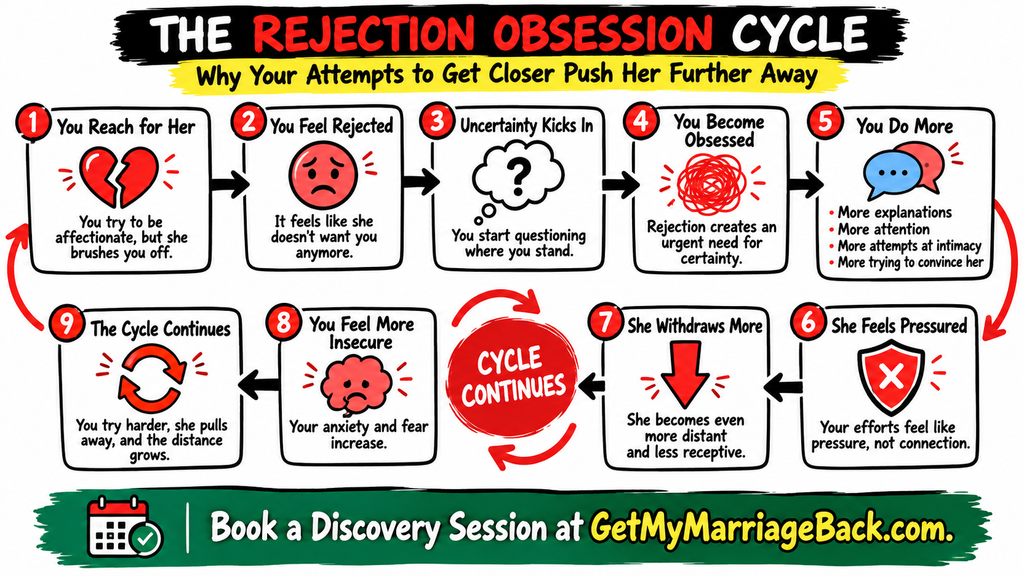
Then the pressure creates more withdrawal, which leaves you feeling even more rejected.

Research on married couples has documented this demand-withdraw pattern. In a study of 116 married couples reporting conflicts at home, demand-withdraw dynamics were associated with more negative emotions and lower conflict resolution. (PubMed Central (PMC))

That is why saving your marriage is not primarily about finding stronger arguments.

It is about becoming emotionally intelligent enough to stop feeding the cycle that destroys attraction.

Your Wife Wants Divorce, But More Effort Is Not Always More Attractive

A marriage crisis creates urgency.

That urgency tells you:

  • Talk more.
  • Explain more.
  • Apologize more.
  • Prove more.
  • Ask where you stand.
  • Show her everything she will lose.
  • Convince her that divorce is a mistake.

The problem is that attraction does not respond well to force.

Your wife is still another human being with autonomy, emotions, preferences, fears, desires, and choices of her own. Commitment matters, but commitment does not magically eliminate the human need to want the relationship.

This distinction is critical.

Marriage has responsibilities.

Marriage also has romance.

You can appeal to responsibility long after the romantic experience has deteriorated, but responsibility by itself does not recreate desire.

As a matter of fact, when every interaction carries the hidden question, “Have you changed your mind about me yet?” your wife can experience even ordinary conversations as pressure.

Your intentions may be loving.

Her experience of those intentions can still feel needy.

That gap between intention and impact is where emotional intelligence becomes essential.

wife says marriage is over

1. Stop Trying to Win the Divorce Argument

One of the fastest ways to deepen rejection is to turn your marriage into a courtroom.

You start collecting evidence.

You remind your wife about the vows.

You explain why divorce will hurt the children.

You point out everything you have done correctly.

You challenge inconsistencies in her reasoning.

Perhaps you even prove that she is technically wrong about certain things.

And you still lose attraction.

Why?

Because romantic connection is not decided by winning an argument.

When you operate from “I am right and you are wrong,” the conversation becomes a contest for moral superiority instead of an opportunity for connection.

Arguments can also reinforce the same demand-withdraw pattern that already damages conflict resolution. (PubMed Central (PMC))

Your strongest move is not to become less intelligent.

It is to become more emotionally intelligent.

You need the capacity to hear a painful statement without automatically treating it as a debate invitation.

2. Separate Accountability From Begging

Accountability is attractive when it comes from strength.

Begging is fear asking another person to regulate your emotional state.

Those are not the same thing.

You can recognize what you did wrong without repeatedly apologizing until your wife reassures you.

You can acknowledge complacency without performing self-hatred.

You can admit that your communication became defensive without demanding instant forgiveness.

Real accountability sounds internally like:

“I see it now. I own my part. I am going to become better because this is who I choose to become.”

Fear-driven accountability sounds more like:

“I admitted everything. Why won’t you give me another chance?”

The first builds capacity.

The second puts pressure back on your wife.

Your goal is not to become perfect enough that she has no logical choice except reconciliation.

Perfection is another performance.

She needs to experience something real.

Ground Yourself Before You Try to Rebuild Attraction - wife says marriage is over

3. Ground Yourself Before You Try to Rebuild Attraction

When your wife says she wants divorce, powerlessness becomes the symptom underneath almost everything.

You cannot control what she feels.

You cannot control what she says tomorrow.

You cannot force reconciliation.

You cannot guarantee that one good conversation produces another.

Grounding means returning to your source of truth before fear decides what you do next.

That can include gratitude, faith, perspective, emotional regulation, and remembering that the marriage crisis is one part of your life rather than the entire definition of your life.

Grounding is not pretending that divorce does not hurt.

You are developing enough emotional capacity to feel the hurt without letting the hurt run your behavior.

That distinction changes how you show up.

Instead of reacting immediately, you can observe.

Instead of defending reflexively, you can listen.

Rather than demanding certainty, you can tolerate uncertainty long enough to choose a skillful response.

That calm creates a different experience of you.

4. Build a Purpose Bigger Than Your Wife’s Current Decision

A marriage crisis can shrink your entire world down to one question:

“Does she still want me?”

That question becomes dangerous when it starts determining your identity, mood, productivity, confidence, sleep, and sense of purpose.

Your life needs a mission greater than any one individual, including the person you deeply love.

Purpose does not mean distracting yourself so your wife becomes jealous.

It does not mean pretending you no longer care.

Purpose means redirecting pain into meaningful growth, contribution, leadership, creation, service, family legacy, faith, business, fitness, learning, or whatever represents the highest expression of who you are becoming.

This matters to attraction because neediness decreases when your emotional center of gravity no longer sits entirely inside someone else’s approval.

Your marriage can matter tremendously without becoming the only source of meaning in your life.

That is personal power.

5. Let the Crisis Teach You Something About Yourself

Self-discovery is not self-blame.

You are not examining yourself so you can conclude that everything is your fault.

Instead, you are discovering the capacities this crisis exposed.

Can you handle rejection without attacking?

Can you hear criticism without immediately defending?

Can you express desire without begging?

Can you remain warm without demanding reciprocity?

Are you able to pursue with dignity without pressuring for a result?

Can you take responsibility without collapsing into shame?

Those questions move you out of obsession with your wife’s every reaction and back toward what you actually control.

That shift is especially important when you are trying to save your marriage alone.

Your wife does not have to participate in your self-discovery.

You can improve emotional intelligence regardless of whether she joins you in the process.

6. Create Experiential Value, Not Moral Value

This is one of the biggest misunderstandings in marriage.

You can be a good person and still become difficult to experience romantically.

You can be responsible, hardworking, faithful, generous, and committed while also becoming defensive, predictable, controlling, withdrawn, anxious, boring, sarcastic, or emotionally exhausting.

Moral value answers:

“Am I a decent person?”

Experiential value answers:

“What does it feel like to interact with me?”

That second question matters enormously in attraction.

Research on perceived partner responsiveness consistently links feeling understood, cared for, and appreciated with intimacy and relationship satisfaction. (PubMed Central (PMC))

That does not mean becoming endlessly agreeable.

Emotional intelligence involves learning how to express standards, opinions, boundaries, humor, confidence, vulnerability, curiosity, and warmth without turning every interaction into a fight for control.

Value is felt.

You do not need to announce it.

7. Give Curiosity and Attraction Room to Return

Many marriages become painfully predictable.

Your wife knows what you are going to say.

She knows what will trigger you.

She knows how every difficult conversation ends.

She already knows that you want her back.

There is nothing left to wonder about because your emotional world has become completely exposed through anxiety.

Curiosity requires space.

That does not mean playing games, disappearing, or deliberately withholding affection.

It means becoming a growing human being again.

Research on self-expansion offers an important clue here. Studies have found that novel and engaging experiences are associated with greater relationship quality, and experiments have shown improvements in experienced relationship quality after couples participated in novel, arousing activities compared with mundane activities. (PubMed)

A 2026 review of the self-expansion literature likewise concluded that shared novel and challenging activities can help reinvigorate long-term relationships and improve relationship quality. (PubMed Central (PMC))

The larger lesson goes beyond date-night ideas.

Attraction suffers when you become static.

Developing new skills, perspectives, interests, emotional capacities, goals, and experiences makes your life less psychologically flat.

You become more interesting because you are actually growing.

wife says marriage is over - Attraction Cannot Be Negotiated Back Into Your Marriage

Attraction Cannot Be Negotiated Back Into Your Marriage

This is where many people get trapped.

They treat attraction like a contractual obligation.

“I married you, therefore you should desire me.”

That is not how romantic attraction works.

Desire involves autonomy.

Recent research involving 786 participants found that perceived sexual autonomy support was associated with greater sexual need fulfillment as well as sexual and relationship satisfaction. (PubMed Central (PMC))

That matters even when your immediate issue is not sex.

Pressure generally says:

“You need to feel differently.”

Emotional intelligence says:

“I respect that I cannot control your internal experience, and I am still responsible for the experience I create.”

This is the difference between manipulating attraction and nurturing attraction.

You cannot order desire.

You can become more attractive.

Stop Monitoring Whether Your Wife Is Responding Yet

Once you begin changing, another temptation appears.

You start scoring the results.

She smiled today.

She texted first.

She stayed on the phone longer.

She seemed jealous.

She asked where you were going.

Suddenly your entire growth process becomes another strategy for extracting reassurance.

That puts you right back into powerlessness.

Curiosity, warmth, reciprocity, and attraction belong on your wife’s side of the equation.

Your responsibility is your grounding, purpose, self-discovery, value, standards, emotional intelligence, and behavior.

Let her experience you without constantly testing whether the experience “worked.”

Ironically, genuine growth becomes most credible when it stops demanding immediate applause.

When Your Wife Says the Marriage Is Over, Treat Rejection as a Capacity Test

You can do meaningful work and still hear something painful tomorrow.

She can be warm today and cold next week.

Divorce can remain on the table.

That does not mean you failed.

The symptom returning is a capacity test.

Can you face the same rejection without returning to the same behavior?

Old pattern:

Rejection → Pleading → Proving → Pressure → Withdrawal → More Rejection

Constructive pattern:

Rejection → Grounding → Purpose → Self-Discovery → Value → Curiosity & Attraction → Rejection

Notice that rejection still appears at the end.

That is intentional.

Personal power is not the elimination of painful circumstances.

It is your increasing capacity to navigate those circumstances skillfully.

Saving Your Marriage Alone Does Not Mean Doing Two People’s Work

You can influence a marriage from your side.

You cannot operate another adult.

Saving your marriage alone means taking full responsibility for the part of the relationship you actually control.

That includes your communication.

Your emotional regulation.

Your purpose.

Your behavior.

Your attraction habits.

Your reactions to rejection.

Your ability to learn.

Your standards.

Your willingness to create value rather than demand validation.

Once you understand that distinction, you stop making your wife into a project.

You start becoming a person whose presence feels different.

What Rebuilding Attraction Actually Looks Like

Rebuilding attraction is not a single dramatic gesture.

It is a pattern of experiences.

You become calmer without becoming passive.

You become accountable without begging.

You communicate directly without turning everything into an argument.

Your purpose gives your life momentum.

Self-discovery creates depth.

Personal growth gives your wife something new to experience rather than another promise about who you will become.

Emotional intelligence makes difficult interactions less exhausting.

Confidence replaces panic.

Warmth becomes an expression rather than a transaction.

There is no need to force curiosity.

Value naturally gives curiosity somewhere to emerge.

That is how you build and nurture attraction skillfully.

Not through control.

Not through manipulation.

Not by proving that divorce is logically wrong.

You become more capable of creating the emotional and relational experience that attraction can actually live inside.

My Wife Loves Me But Doesn’t Desire Me | 5 Signs | 5 Tips

Frequently Asked Questions

Can a marriage be saved when your wife says it is over?

Yes, a statement that the marriage feels over describes her present emotional position, not something you can reverse through argument. Focus on reducing pressure, developing emotional intelligence, and changing the relational experience you actually control.

How do I make my wife fall in love with me again?

You cannot force love, but you can rebuild the conditions that support attraction through grounding, purpose, emotional responsiveness, personal growth, and experiential value. Attraction grows more naturally when your wife is not being pressured to validate your progress.

Should I give my wife space if she wants divorce?

Respecting space can reduce pressure, but do not use distance as a manipulation tactic designed to trigger fear or jealousy. Use the space to become more grounded, purposeful, emotionally skilled, and clear about what you control.

Can you save your marriage alone?

You can change your contribution to the marriage and interrupt destructive patterns from your side, even before your wife participates. Reconciliation itself eventually requires her voluntary participation, but your self-leadership does not.

How to Save Your Marriage During Separation: 4 Signals You Misread

Separation creates one of the strangest emotional environments you can experience in a marriage.


Take This 2 Minutes Quiz

Question 1 of 15

Your husband or wife can sound completely finished with the relationship on Monday, call you comfortably on Wednesday, laugh with you on Friday, and become distant again by Sunday. A good conversation feels like reconciliation is starting. Then one cold text can make divorce feel inevitable all over again.

That emotional whiplash creates a dangerous question:

“What does this mean?”

Trying to answer that question from every individual interaction is where many people make saving their marriage during separation much harder than it needs to be.

The biggest challenge is often not the mixed signals themselves. It is what uncertainty starts making you do.

You begin assigning meaning to temporary moments. Then you look for evidence that your interpretation is correct. Fear turns ordinary uncertainty into worst-case scenarios, and before long, your search for reassurance becomes pressure.

That pressure can change the experience of interacting with you.

And when someone is already questioning whether they want to remain married, the experience of you matters enormously.

This is where rebuilding attraction during separation becomes less about convincing and more about emotional intelligence, Personal Power, self-discovery and experiential value.

Can a Marriage Be Saved After Separation?

Yes, separation does not automatically mean a marriage is permanently over.

A 2025 Journal of Marriage and Family study followed adults who separated after age 50 and found that some did eventually reconcile with their spouses. The study found reconciliation in roughly 7% of women and 11% of men during the observation period, although the authors noted that their method probably missed shorter separations that began and ended between interview waves.

Those statistics should not become a prediction about your marriage. Their importance is much simpler:

Separation is a relationship state, not a supernatural verdict about what happens next.

People search for the average length of separation before reconciliation because uncertainty is painful. They want a calendar that says, “At week six this means one thing; at month four it means another.”

Relationships do not work that neatly.

The history of the marriage, accumulated resentment, attraction, betrayal, emotional safety, individual personalities, children, outside influences, financial realities and the behaviors occurring during separation all matter.

That is why your real job is not predicting the outcome from a stopwatch.

It is understanding the relational environment that exists right now.

how to save your marriage during separation

Why Mixed Signals During Separation Feel So Powerful

Human beings crave certainty, especially when something valuable feels threatened.

When the future of your marriage becomes uncertain, your mind naturally starts scanning for information. A phone call becomes evidence. Silence becomes evidence too.

The problem becomes worse when your emotional stability depends on interpreting those clues correctly.

Recent longitudinal research involving 325 adults found that greater intolerance of uncertainty predicted increased mistake-rumination over time, with those processes negatively affecting family communication.

That matters because marriage separation creates an almost perfect environment for rumination.

You replay the conversation.

Was your husband warmer than yesterday?

Why did your wife send that photo?

Why did they stay on the phone for forty minutes if they really want divorce?

Was that hug meaningful?

Why did they suddenly become cold afterward?

Eventually you stop experiencing interactions and start testing them.

That distinction is critical.

A Warm Moment Is Not a Reconciliation Verdict - how to save your marriage during separation

Signal #1: A Warm Moment Is Not a Reconciliation Verdict

Warmth is good.

Friendship is good.

Comfort, laughter and positive interactions can all matter.

But none of them should carry the burden of proving that your marriage has already been saved.

Imagine that your wife has moved out but still enjoys talking to you. She calls, laughs, tells you about her day and sounds almost like the woman you remember.

It would be tempting to think:

“She clearly wants to come back.”

That conclusion may outrun the actual state of the marriage.

Warm behavior during separation can reflect affection, friendship, familiarity, shared history, attachment, comfort, uncertainty or genuine openness toward rebuilding. Several of those things can exist at the same time.

Your mistake is not appreciating a good experience.

The mistake is demanding that one experience tell you the entire future.

This matters for attraction because once you declare a warm moment “proof,” you become emotionally attached to getting more proof.

Now the interaction is no longer light.

It has a hidden job.

Signal #2: A Cold Moment Is Not Automatically a Divorce Verdict Either

The opposite mistake happens just as quickly.

Your husband is quiet.

Your wife takes longer to respond.

Yesterday felt close; today feels distant.

Fear immediately supplies the interpretation:

“It’s over.”

Then panic takes over strategy.

You may suddenly send a long message, demand clarification, ask what changed, revisit the marriage conversation or search for some hidden explanation.

None of this means you should ignore serious information. A divorce filing is real information. An affair is real information. Statements about wanting out deserve to be taken seriously.

But taking information seriously is different from emotionally turning every fluctuation into a final judgment.

Attraction becomes difficult when each interaction carries that much emotional weight.

The person on the other side starts experiencing not only the marriage crisis, but also your reaction to the marriage crisis.

That distinction brings us to one of the most important patterns in saving a marriage while separated.

The Uncertainty-Chasing Cycle

The destructive cycle often looks like this:

Uncertainty → Meaning → Testing → Pressure → More Uncertainty

You do not usually enter this cycle because you want to pressure your husband or wife.

Fear starts it.

The marriage feels unstable, so your mind creates a meaning for whatever just happened. Because that interpretation does not create lasting certainty, you begin looking for proof.

Testing follows naturally.

“Do you still love me?”

“Do you miss me?”

“Are you talking to someone else?”

“Are we getting back together?”

“Why were you so nice yesterday if you still want separation?”

“Are you really done?”

Each question can sound completely reasonable by itself.

Collectively, however, they can transform ordinary interactions into repeated relationship examinations.

Research on marital conflict has documented a related demand-withdraw dynamic. In a diary study involving 116 married couples, demand-withdraw patterns were associated with more negative emotions and tactics and with lower conflict resolution; the researchers found the pattern when either husbands or wives occupied the demanding role.

In other words, this is not simply “what men do” or “what women do.”

Research involving heterosexual and same-sex couples has also found that demand-withdraw behavior can be better explained by differences in who wants change during the conflict than by gender alone.

When you desperately need the marriage to move in a particular direction, it becomes very easy to become the person pushing for resolution.

The more the other person withdraws, the more frightened you become.

Then you push harder.

That is how the cycle recreates itself.

how to save your marriage during separation - Why Trying Harder Can Make Saving Your Marriage Harder

Why Trying Harder Can Make Saving Your Marriage Harder

Effort sounds virtuous.

More effort is rewarded almost everywhere else in life.

When your business struggles, you work harder. If your body is out of shape, you train more consistently. When a professional skill is weak, additional practice generally helps.

Marriage crisis is different because your effort is being experienced by another human being with their own emotions and autonomy.

Intensity is therefore not the same thing as effectiveness.

Trying harder from fear can mean explaining harder, apologizing harder, texting harder, proving harder, convincing harder and demanding clarity harder.

Your intention says:

“I’m fighting for my marriage.”

Their experience can become:

“Every interaction with you comes with pressure.”

Attraction lives in experience, not intention.

That is why I define Value here very carefully. I am not talking about your worth as a human being or whether you are morally superior to your husband or wife.

Value means the experience of interacting with you.

Does being around you repeatedly feel anxious, heavy and outcome-dependent?

Or are you gradually becoming a person capable of emotional stability, depth, curiosity, purpose, warmth, dignity and self-possession even while the marriage remains uncertain?

That difference matters.

How to Save Your Marriage During Separation Without Turning It Into a Performance

This is where people commonly misunderstand self-improvement.

They hear, “Work on yourself,” and secretly translate it into:

“Become impressive enough so my husband or wife comes back.”

Now self-development is another form of chasing.

You go to the gym but keep checking whether they noticed.

A new hobby becomes useful only if it makes them jealous.

Your confidence exists mainly to provoke a reaction.

Even giving space becomes a tactic designed to produce pursuit.

That is still outcome-dependence wearing better clothes.

The healthier direction begins somewhere else.

Grounding Comes Before Attraction

Before you can build attraction skillfully, you need enough emotional Grounding that panic is no longer controlling every interpretation.

Grounding does not mean suppressing pain.

Separation hurts.

Divorce threats hurt.

Rejection hurts.

Instead, Grounding means remembering that an emotion can be real without becoming the executive decision-maker of your life.

When fear stops running every interaction, you gain access to emotional intelligence again.

You notice instead of immediately reacting.

Curiosity becomes possible because you no longer need an instant verdict.

That creates the beginning of Personal Power.

Purpose Changes the Emotional Gravity of the Marriage

A marriage becomes dangerously heavy when it is carrying your entire sense of meaning.

During separation, everything can shrink until there is only one subject left:

the marriage.

Work becomes a distraction from the marriage.

Friends become people you talk to about the marriage.

Sleep becomes something interrupted by thoughts about the marriage.

Your phone becomes a marriage-monitoring device.

Purpose reverses that collapse.

Your career, faith, health, parenting, creativity, friendships, contribution, learning, business and larger mission begin occupying meaningful space again.

This is not detachment theater.

Purpose makes you more emotionally substantial because your life once again contains dimensions beyond whether another adult chooses you today.

That is naturally more attractive than desperation.

Self-Discovery Builds Capacity Without Self-Blame

Once you become grounded enough to look inward, the most powerful questions change.

Instead of asking only:

“Why is my husband doing this?”

or

“Why is my wife acting this way?”

you become interested in what the crisis is revealing about you.

What does rejection activate inside you?

Where does uncertainty become control?

What happens when you cannot get reassurance?

Which reactions belong to this marriage, and which patterns existed long before it?

Where have you become complacent?

What emotional skills are missing?

That investigation is not about taking responsibility for everything your husband or wife has done.

It is about discovering where your power actually lives.

You cannot control their choices.

Your capacity, however, belongs to you.

Attraction During Separation Is an Outcome, Not an Assignment

This distinction protects you from another common mistake.

Do not turn attraction into a scoreboard.

You do not need to count texts, monitor response speed, interpret hugs, measure flirtation or keep a spreadsheet of “positive signs during separation.”

Those behaviors put you right back into testing.

Curiosity and attraction work better as natural outcomes of value.

Research on long-term married couples offers an interesting parallel. One study found that “positivity resonance”—shared positive emotion combined with mutual care and behavioral synchrony—was associated with marital satisfaction even after accounting for other positive affect measures.

That does not mean you can manufacture attraction by acting cheerful.

It means relationships are experiential.

People respond to how interactions feel.

Building attraction in marriage therefore requires more than being logically correct or proving that divorce would be a mistake.

Safety, curiosity, emotional depth, respect, playfulness, individuality and genuine value shape the experience.

Seduction in a marriage crisis is not manipulation.

It is becoming less predictably fear-driven and more experientially engaging.

Positive Signs During Separation: Look at Direction, Not Isolated Events

People naturally want to know the positive signs during separation.

A healthier way to think about signs is direction rather than individual incidents.

An isolated affectionate interaction says little by itself. A broader reduction in hostility, greater ease around communication, renewed willingness to spend voluntary time together, increased openness and a progressively safer relational atmosphere can matter more.

Even then, do not convert progress into entitlement.

Warmth does not mean you are owed reconciliation.

Attraction does not mean the unresolved problems disappeared.

Friendship does not automatically equal restored marriage.

Direction gives you information.

It does not give you ownership over another person’s decision.

Bad Signs During Separation: Pressure Can Hide Behind “Fighting for the Marriage”

One of the clearest bad signs during separation is not simply that your husband or wife is distant.

Look at what the crisis is turning you into.

Are you constantly interrogating?

Do conversations keep becoming negotiations about reconciliation?

Has your identity collapsed around saving the marriage?

Are you trying to generate jealousy?

Do you repeatedly demand reassurance?

Is every positive interaction followed by a conversation about “us”?

Those patterns often reveal that uncertainty is still driving your behavior.

Ironically, they can happen precisely because you care deeply.

Care without emotional regulation can still feel like pressure.

Saving Your Marriage Alone Does Not Mean Controlling It Alone

The phrase save your marriage alone is easy to misunderstand.

You cannot single-handedly command another adult into a healthy marriage.

What you can do is radically improve the part of the relational system that belongs to you.

That is substantial power.

Research on people contemplating divorce shows that individuals use very different approaches to relationship repair, ranging from intensive professional help-seeking to private, self-directed efforts. In one national longitudinal sample of 745 married adults thinking about divorce, researchers found several distinct patterns of repair behavior rather than one universal pathway. (PubMed)

That supports a reality I see repeatedly:

There is no single script for marriage reconciliation.

More communication is not always the answer.

More distance is not always the answer either.

A separation created primarily by accumulated pressure is different from one following an affair. A husband who has lost attraction presents a different pattern from a wife who feels chronically unsafe during conflict.

The map can be universal.

The marriage is specific.

What to Do When Your Husband Wants to Separate

When your husband wants separation, your strongest position is not to become a female pursuer trying to drag him emotionally toward reconciliation.

Women do not need to chase.

Attraction grows more naturally when you retain dignity, emotional presence, femininity, value and openness while refusing to convert anxiety into pursuit.

That does not mean pretending you do not care.

It means your interest in the marriage does not require you to run after a man who is currently moving away.

Seduction creates room for curiosity.

Chasing destroys it.

What to Do When Your Wife Wants Separation

When your wife wants space or separation, pursuit itself is not automatically wrong.

Men pursue.

The distinction is between dignity-based pursuit and fear-driven chasing.

A grounded man can express interest without begging for reassurance. He can care deeply without turning every encounter into a referendum on whether she is returning.

Your wife needs enough emotional room to experience who you are becoming rather than repeatedly hearing arguments about why she should believe you have changed.

Attraction is experiential.

The PowerPoint presentation about your transformation is not the transformation.

Marriage Reconciliation Requires a New Experience, Not Just a Return to the Old One

Saving the marriage should not mean restoring the exact relationship that produced the crisis.

That marriage already generated separation.

Reconciliation becomes meaningful when the experience begins changing.

Grounding alters reactivity.

Purpose restores individuality.

Self-Discovery increases emotional capacity.

Value changes what it feels like to interact with you.

Curiosity and attraction then have space to develop naturally.

From there, trust and emotional safety have a better environment in which to grow.

The objective is not to become perfect.

It is to stop asking fear to lead your marriage.

Once you understand that, mixed signals become less powerful because they no longer dictate your identity, mood and next move.

You can care deeply about saving your marriage without surrendering your Personal Power to uncertainty.

That is where genuine attraction has room to breathe.

Average Length of Separation Before Reconciliation: Data Reveals

Frequently Asked Questions

Can you save your marriage during separation?

Yes, some separated couples do reconcile, and separation itself does not automatically determine the final outcome of the marriage. The more useful question is what patterns created the separation and whether the relationship experience is genuinely changing.

How long does marriage separation last before reconciliation?

There is no reliable universal timeline for reconciliation because separation circumstances and marriage histories vary significantly. Using an arbitrary number of weeks or months as a prediction can increase anxiety and encourage you to misread normal fluctuations.

What are positive signs during separation?

Reduced hostility, easier voluntary communication, renewed curiosity, warmth and a progressively safer relational atmosphere can indicate healthier movement. No single text, date, affectionate moment or conversation should be treated as proof of reconciliation.

What are bad signs during separation?

Escalating pressure, repeated relationship interrogations, hostility, manipulation, contempt and increasingly rigid demand-withdraw patterns point toward a worsening relational environment. The most actionable warning signs are often the patterns you can recognize and change on your own side.


Broken Marriage?
Fix it
Here FREE

Get My Marriage Back