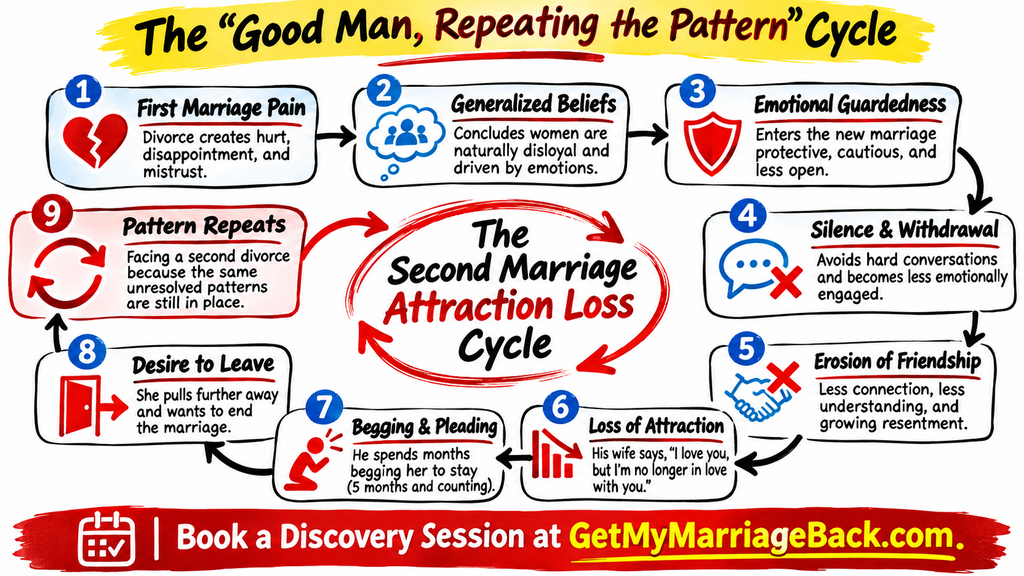


Your wife has been saying she wants a divorce for months—maybe even 18 months—but she still hasn’t filed, and you’re caught between hoping she wants to stay and fearing she’s already emotionally gone.
Take This 2 Minutes Quiz
The uncertainty can become more exhausting than the arguments themselves.
One day, you’re wondering whether she’s serious about divorce. The next, you’re analyzing her tone, checking whether she still wears her wedding ring, or wondering why she hasn’t contacted an attorney.
Meanwhile, affection has disappeared. Conversations feel forced. Your attempts to reconnect seem to push her further away.
You want to save your marriage, but you’re not sure whether you’re fighting for a relationship that still has a future or holding on to someone who has already made up her mind.
Here’s what I want you to understand: Your wife not filing for divorce doesn’t automatically mean she wants to stay. But her emotional withdrawal doesn’t tell you everything about her intentions either.
The distinction matters because the way you interpret her behavior influences how you respond. And your response can either create opportunities for emotional reconnection or contribute to the distance already developing between you.
Let’s examine five signs that deserve your attention and what they mean for rebuilding attraction in your marriage.
1. Your Wife Keeps Threatening Divorce but Never Files
When your wife repeatedly says she wants a divorce but takes no legal action, it’s tempting to assume she doesn’t mean it.
You might tell yourself she’s bluffing, trying to get your attention, or using divorce to win arguments.
But those assumptions can become dangerous.
A person can genuinely want to leave a marriage while feeling uncertain about the consequences of ending it.
Children, financial responsibilities, housing, family expectations, emotional attachment, and fear of starting over can all influence the timing of a divorce.
Sometimes a spouse is still emotionally conflicted. Other times, the practical complications of leaving are greater than the emotional discomfort of staying.
The absence of divorce paperwork is not the same as the presence of commitment.
What should you pay attention to?
Look beyond the words and examine the pattern.
Does your wife only mention divorce during heated arguments, or does she discuss it calmly when there is no immediate conflict?
Has she started making independent financial arrangements, researching housing, or discussing custody and separation?
Does she still participate in meaningful conversations about your future together?
These details provide more useful information than simply counting the months since she first mentioned divorce.
If she has been threatening divorce for 18 months, the important question is not merely why she hasn’t filed.
It’s what has been happening emotionally between you during those 18 months.
A marriage can remain legally intact while the emotional connection continues deteriorating.
That’s why waiting for paperwork is not a marriage-saving strategy.
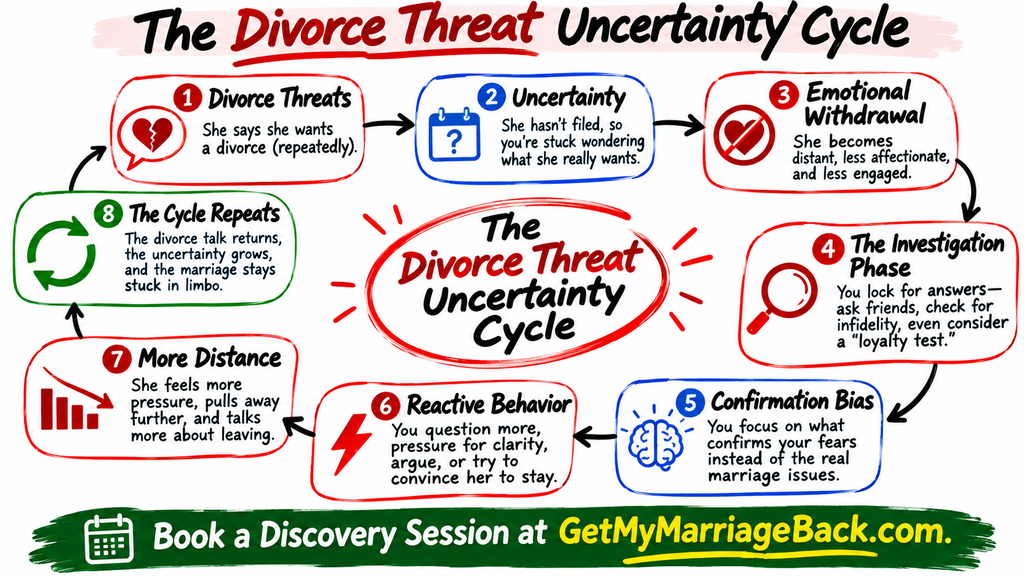
2. Your Wife Has Emotionally Withdrawn From the Marriage
One of the most painful experiences in marriage is watching someone who once adored you become emotionally unavailable.
You remember when she wanted to talk to you, laugh with you, touch you, and share the smallest details of her day.
Now she barely responds.
You try to start a conversation, and she gives you short answers. When you reach for affection, she pulls away.
Even sitting together can feel lonely.
This is often when the distressed spouse begins asking, “Is my wife cheating?” or “Does she still love me?”
Those questions are understandable, but emotional withdrawal is not a complete diagnosis.
Emotional distance is a symptom, not an explanation
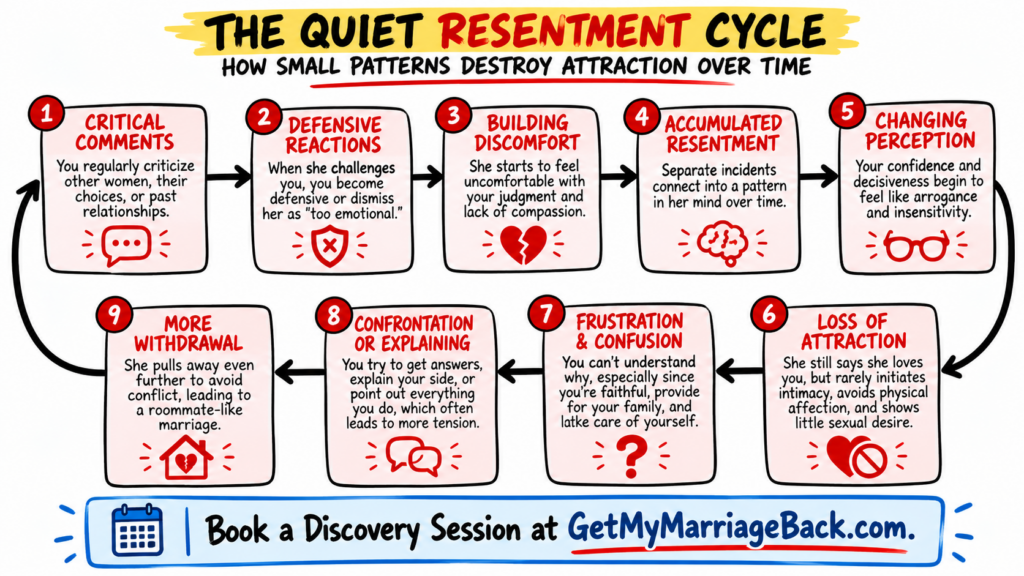
Withdrawal can reflect accumulated resentment, unresolved conflict, emotional exhaustion, declining attraction, or a growing desire for independence.
In some marriages, infidelity is involved. In others, the spouse has simply stopped expecting the relationship to feel emotionally rewarding.
The observable behavior is real, but the explanation still requires careful examination.
Research on relationship intimacy helps explain why this distinction matters.
Psychologists Harry Reis, Margaret Clark, and John Holmes identified perceived partner responsiveness as an important part of emotional intimacy. People experience greater closeness when they believe their partners understand, value, and respond meaningfully to their needs.
In practical terms, attraction is influenced by how people experience each other, not merely by what they promise.
When someone repeatedly feels misunderstood, dismissed, criticized, or emotionally disconnected, their willingness to engage can diminish.
This doesn’t mean every withdrawn spouse has experienced those conditions. It means you need to investigate the relationship pattern rather than automatically assume the presence of another person.
What does emotional withdrawal reveal about attraction?
Attraction is more than physical appearance or sexual chemistry.
It includes emotional safety, admiration, curiosity, respect, playfulness, and the experience of feeling valued.
When those qualities weaken, the marriage can begin to feel like an obligation instead of a relationship both people enjoy.
You cannot rebuild attraction simply by demanding affection.
Instead, examine what your wife has come to associate with interacting with you.
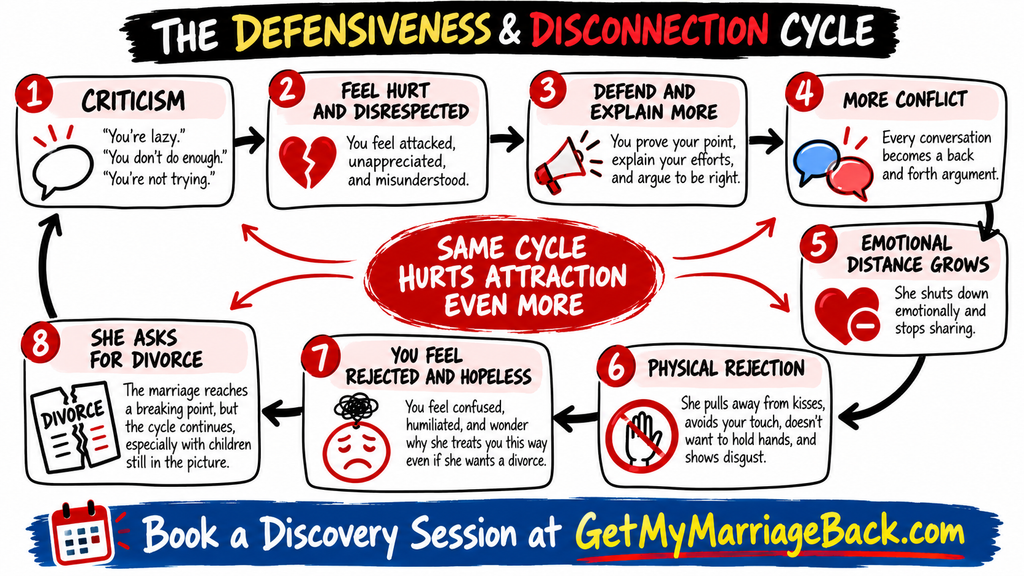
Does she anticipate another argument? Does she expect you to defend yourself before understanding her perspective? Has every conversation become a negotiation about whether she will stay?
These patterns matter because attraction struggles to grow when ordinary interactions consistently feel emotionally exhausting.
3. You’re Looking for Proof That She’s Cheating Instead of Understanding the Marriage
Imagine a husband whose wife has talked about divorce for more than a year without filing.
She’s emotionally distant, and he desperately wants to know whether there’s another man.
Friends begin offering explanations.
One person suggests she’s already cheating. Another insists she’s keeping him around until she finds someone better.
Eventually, he considers participating in a social-media loyalty test where a stranger would contact his wife and attempt to expose her intentions.
Think about what has happened.
He started with the desire to save his marriage, but his attention has shifted toward investigating his wife.
Even if a loyalty test produces something suspicious, it doesn’t automatically explain the history of the relationship or identify what reconciliation would require.
Why confirmation bias can keep you stuck
Confirmation bias is the tendency to notice, interpret, and prioritize information that supports beliefs you already hold.
When you’re afraid your wife is cheating, ordinary behavior can begin looking suspicious.
She spends more time on her phone, and you assume she’s communicating with someone else.
Her affection declines, and you interpret it as evidence that she’s attracted to another person.
She doesn’t file for divorce, and you conclude she’s keeping her options open.
Any of those interpretations could be correct in a particular situation. None is established by the behavior alone.
If credible evidence of infidelity exists, address it seriously and establish appropriate boundaries.
But don’t manufacture certainty from suspicion.
Confirmation is not reconciliation
You can spend months collecting opinions, studying her behavior, and looking for someone to validate your fears without making meaningful progress toward saving your marriage.
Meanwhile, your emotional energy becomes consumed by circumstances outside your control.
That creates another problem.
The more desperate you become for reassurance, the more likely you are to approach your wife from anxiety rather than emotional stability.
You may repeatedly question her, demand explanations, or turn every interaction into an investigation.
Even when your concerns are legitimate, this pattern can make emotional reconnection increasingly difficult.
A marriage cannot become attractive again when every conversation feels like an interrogation.
4. Your Wife Still Has Individual Choices You Cannot Control
Marriage creates a partnership, but it does not eliminate individuality.
The person you married remains a separate human being with personal desires, emotional experiences, fears, and decisions.
After 19 years of marriage with my wife, Lola, I understand that people continue revealing different aspects of themselves throughout their lives.
Our own marriage went through a major crisis roughly a decade ago, and that experience changed how I understood relationships.
One of the most important lessons was learning the difference between influencing a relationship and trying to control another person.
You cannot force your wife to choose you
You can explain how much you love her.
You can communicate your desire to preserve the marriage, acknowledge mistakes, and demonstrate meaningful changes.
But you cannot make her feel attracted to you on command.
Neither can you force her to reconsider divorce.
Trying to control another person’s emotional decisions usually creates more pressure, and pressure is not the same as attraction.
Genuine attraction involves freedom.
A spouse needs room to experience the relationship differently and make authentic choices about participation.
That doesn’t require you to tolerate mistreatment, ignore your needs, or abandon healthy boundaries.
It means recognizing that your responsibility is to manage your behavior, communicate honestly, and become someone who contributes positively to the relationship.
Her responsibility remains her own.
Emotional safety creates opportunities for reconnection
Emotional safety doesn’t mean agreeing with everything your spouse says.
It means being able to communicate difficult feelings without expecting intimidation, humiliation, manipulation, or unnecessary escalation.
Research from the Gottman Institute illustrates the importance of everyday emotional responsiveness.
In a longitudinal study of newlywed couples, those who remained married six years later responded positively to approximately 86% of their partners’ bids for connection during laboratory observations. Couples who later divorced responded positively about 33% of the time.
These bids are often small: a question, a smile, a request for attention, or an invitation to share an experience.
You can explore the underlying findings in the Gottman Institute’s research on emotional bids and trust.
The practical lesson is that emotional connection develops through repeated experiences, not occasional grand gestures.
When your wife has withdrawn, those everyday experiences deserve serious attention.
5. You’re So Focused on Saving Your Marriage That You’ve Lost Your Own Emotional Stability
This is where many distressed spouses become trapped.
You want to save your marriage so badly that your entire emotional world begins revolving around your wife’s reactions.
When she’s friendly, you feel hopeful.
When she’s distant, you feel rejected.
If she mentions divorce again, your confidence collapses.
You start measuring your personal worth against her willingness to stay.
Over time, the relationship crisis begins consuming your identity.
I understand this pattern because I had to confront aspects of it during my own marriage crisis.
Eventually, I recognized that constantly seeking validation from outside myself was weakening my ability to lead my own behavior.
I needed to develop greater personal capacity.
Why emotional stability matters when rebuilding attraction
Attraction is influenced by the emotional experience two people create together.
When your spouse experiences you as consistently anxious, demanding, reactive, or dependent on reassurance, ordinary interactions can become burdened with emotional pressure.
On the other hand, emotional steadiness can make difficult conversations more constructive.
A person who can listen without immediately becoming defensive, communicate without begging, and maintain self-respect during uncertainty brings a different quality of energy into the relationship.
This is not about pretending you don’t care.
It’s about caring deeply without allowing fear to control your behavior.
Emotional intelligence allows you to recognize your feelings, understand their influence, and respond intentionally.
That ability becomes especially important when your spouse is considering divorce.
How to Rebuild Attraction When Your Wife Wants a Divorce
When your wife wants divorce but you don’t, your instinct may be to persuade her to reconsider immediately.
You might promise dramatic changes, increase romantic gestures, or repeatedly remind her of your history together.
But rebuilding attraction requires more than convincing someone that your marriage deserves another chance.
It requires changing the emotional experiences associated with the relationship.
Begin with grounding
Before responding to another divorce threat, recognize what you’re feeling.
Fear, rejection, anger, grief, and uncertainty can all influence your reactions.
Grounding means learning to experience those emotions without automatically acting on them.
You don’t need to suppress your feelings. You need enough emotional stability to choose your response rather than surrendering that choice to panic.
Reconnect with your purpose
Your marriage is an important part of your life, but it cannot become the only source of your identity.
Reconnect with your health, responsibilities, meaningful work, friendships, personal values, and long-term goals.
This is not a strategy for making your wife jealous.
It’s an expression of self-respect and personal direction.
A person with purpose is better positioned to participate in a relationship from genuine desire rather than desperation.
Practice self-discovery
Examine the relationship patterns that may have contributed to disconnection.
Consider how you respond to criticism, disappointment, disagreement, and unmet expectations.
Do you become defensive? Do you withdraw emotionally? Are you constantly seeking reassurance?
Self-discovery is not an exercise in accepting responsibility for every marital problem.
It’s an opportunity to identify the behaviors you can meaningfully change.
Together, grounding, purpose, and self-discovery form the foundation of GPS5.
The Connection Between Value, Curiosity, and Attraction
One of the biggest misunderstandings about saving a marriage is believing that attraction returns when you explain your love convincingly enough.
Love declarations have their place, but attraction is experienced through interactions.
Your spouse notices how you handle pressure, whether you respect boundaries, how you communicate, and whether your actions align with your words.
These experiences influence how the relationship feels.
Value comes before persuasion
Value is not about money, status, or trying to prove you’re better than another potential partner.
It includes emotional maturity, integrity, self-respect, accountability, and the ability to contribute positively to shared experiences.
When you develop these qualities authentically, your behavior becomes less dependent on your spouse’s immediate approval.
That changes how you show up in the marriage.
Curiosity can reopen emotional possibilities
When two people have been arguing for months, they may begin assuming they already know everything about each other.
Every conversation becomes predictable.
Your wife expects you to react defensively, while you expect her to reject your attempts at connection.
Curiosity interrupts that pattern.
Instead of approaching every interaction with an agenda, you become more interested in understanding the person in front of you.
You listen for what she means rather than preparing your next argument.
You recognize changes in her emotional experience without automatically making them about yourself.
Curiosity also works in the other direction.
When your behavior becomes consistently different from the patterns she expects, she may begin noticing qualities that have been absent from the relationship.
That possibility cannot be forced, but it can be supported by genuine personal growth.
Attraction requires a different emotional experience
A seductive marriage is not built through manipulation, jealousy, or manufactured scarcity.
It’s built through genuine confidence, emotional presence, warmth, playfulness, mutual desire, and respect for personal choice.
Sometimes the most attractive response is not another romantic speech.
It’s demonstrating that you can remain composed during a difficult conversation.
Other times, attraction grows through humor, thoughtful attention, or the simple experience of enjoying each other’s company without discussing the marriage crisis.
Physical affection matters too, but it must remain welcome and mutually desired.
When your wife has withdrawn, the goal is not to pressure her into intimacy.
It’s to understand what has made connection difficult and whether a healthier emotional dynamic can develop.
Can You Save Your Marriage Alone When Your Wife Wants Out?
You can begin changing your contribution to the marriage even when your wife isn’t ready to participate.
That distinction is important.
Saving your marriage alone does not mean controlling the outcome by yourself.
It means refusing to postpone your personal growth until your spouse changes first.
You can improve emotional regulation, communicate more respectfully, recognize unhealthy patterns, and establish boundaries.
Those changes may create opportunities for reconciliation, especially when the relationship has been dominated by predictable conflict.
However, rebuilding a mutually satisfying marriage ultimately requires two people willing to participate.
Your growth is your responsibility. Her choices remain hers.
What to Do When Your Wife Says She Wants Divorce but Won’t Leave
Stop treating her continued presence as the answer to your marriage crisis.
Instead, evaluate the quality of the relationship that currently exists.
Consider whether communication is improving or deteriorating, whether emotional responsiveness is increasing, and whether both partners can discuss difficult subjects respectfully.
If separation is being discussed, address practical arrangements clearly rather than using uncertainty as a reason to avoid necessary decisions.
At the same time, avoid making every interaction a referendum on the marriage.
Not every conversation needs to determine whether your wife still loves you.
You can respect the seriousness of her statements while remaining intentional about your behavior.
The most important shift is moving from monitoring her every reaction to developing your own emotional capacity.
When you stop organizing your entire life around the next divorce threat, you become better equipped to see the relationship clearly.
And clarity is essential for making decisions about reconciliation.
The Truth About a Wife Who Wants Divorce but Hasn’t Filed
Your wife may be conflicted.
She may be emotionally exhausted, financially unprepared, uncertain about leaving, or still attached to aspects of your marriage.
It’s also possible that she’s made an emotional decision but hasn’t taken the legal steps to follow through.
You cannot determine her intentions from the missing paperwork alone.
What you can examine is the relationship dynamic developing between you.
The emotional withdrawal, repeated conflict, reduced affection, and loss of attraction deserve more attention than speculation about why an attorney hasn’t filed a petition.
Your greatest opportunity is not discovering how to make your wife stay. It’s becoming more emotionally capable while creating the conditions in which genuine connection can be considered again.
That begins with self-leadership, emotional intelligence, personal value, and a willingness to understand your marriage beyond the immediate fear of divorce.
Because the marriage crisis is already happening, whether or not the paperwork has been filed.
And the way you respond to that crisis matters.
“I Feel Disgusted When My Husband Touches Me” – [5 Solutions]
Frequently Asked Questions
She may be uncertain, emotionally conflicted, concerned about finances or children, or unprepared for the practical consequences of divorce. Her delay alone doesn’t establish whether she intends to stay or leave.
Not necessarily, because remaining legally married doesn’t automatically indicate romantic attachment or a desire for reconciliation. Examine her communication, emotional engagement, and willingness to participate in repairing the relationship.
You can begin improving your emotional stability, communication, and relationship behaviors without waiting for your wife to change. A lasting reconciliation, however, requires both partners to choose participation.
Take her statements seriously, avoid pressuring her for reassurance, and examine the relationship patterns contributing to emotional distance. Focus on constructive communication, healthy boundaries, and consistent personal growth rather than trying to control her decision.