
What Would Help You Most Right Now?

Choose the option that best matches where you are with your marriage.

I Need Personalized Help

My Marriage Is in Serious Trouble

If you're dealing with separation, divorce, loss of attraction, infidelity, intimacy problems, or a spouse who's pulling away, get help looking at what's happening in your specific situation.

Get Personalized Help โ†’
Get My Marriage Back book cover
I'd Rather Learn What to Do First

Start With Get My Marriage Back

Get the book and start learning the principles for moving your marriage in a better direction.

Get the Free Book โ†’

Wife Wants Divorce? 7 Attraction Mistakes That Push Her Away

Your wife says she’s no longer attracted to you, wants space, or is thinking about divorceโ€”and the harder you try to save your marriage, the further away she seems to move.

Take This 2 Minutes Quiz

Question 1 of 15

I want you to understand something that took me years to appreciate: being committed to your marriage and knowing how to create attraction within that marriage are not necessarily the same skill.

You can work hard, pay the bills, remain faithful, raise your children, and genuinely love your wife. Yet none of those things automatically determines how she experiences you emotionally, romantically, or sexually.

At 30, I believed that enough effort, provision, and commitment would naturally produce a successful marriage. Now, at 47, I understand that marriage also requires emotional intelligence, self-leadership, relational awareness, and the ability to remain attractive through the way you live.

If your wife wants a divorce, the immediate temptation is to do more of whatever you believe should make her appreciate you.

More explanations. More apologies. More conversations. More attempts to convince her that leaving would be a mistake.

Unfortunately, more effort does not always create more attraction. Sometimes it creates more pressure.

Here are seven mistakes worth examining if you want to understand how to save your marriage when your wife wants divorceโ€”and how to develop the emotional and romantic skills that make connection possible.

Why Your Wife May Lose Attraction Even When You Love Her

Before we examine the seven mistakes, I want to distinguish three things: commitment, connection, and attraction.

Commitment is your decision to remain invested in the relationship.

Connection is the experience of being emotionally understood, valued, and engaged with each other.

Attraction is the romantic, emotional, and sometimes sexual pull that makes closeness desirable.

These experiences can influence one another, but they are not interchangeable.

You may be committed while your wife feels emotionally disconnected. She may appreciate your financial contributions without experiencing much romantic desire.

Likewise, a temporary reduction in sexual interest does not necessarily mean the marriage is ending.

Stress, unresolved conflict, resentment, exhaustion, health concerns, and years of negative interaction can all affect intimacy.

The question is not simply whether you are doing enough.

It is whether your presence, habits, communication, and emotional responses are creating an experience that supports closeness.

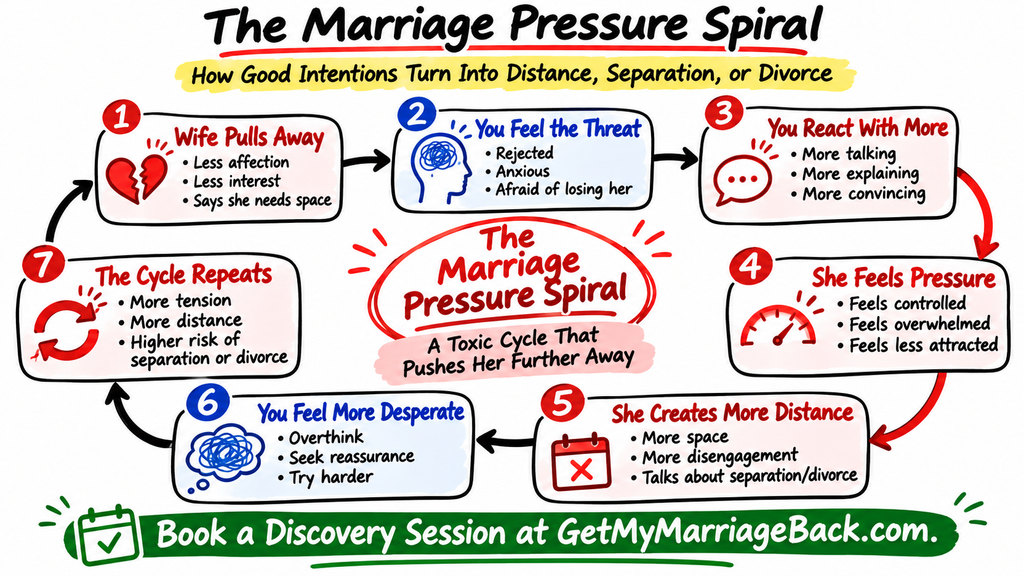
The Marriage Pressure Spiral

Consider a familiar pattern:

Your wife pulls away โ†’ You feel threatened โ†’ You pursue harder โ†’ She experiences pressure โ†’ She creates more distance โ†’ You become increasingly desperate.

Eventually, both spouses begin reacting to each other’s reactions instead of addressing the original disconnection.

She may experience your pursuit as another demand. Meanwhile, you interpret her distance as proof that you must try even harder.

The pattern reinforces itself.

Breaking that cycle requires more than good intentions. It requires recognizing how your own responses affect the emotional atmosphere of the marriage.

wife wants divorce

Mistake 1: Trying to Negotiate Attraction Instead of Becoming More Attractive

When your wife says she is no longer attracted to you, your instinct may be to ask what you must change to make her want you again.

You might remind her of your sacrifices, question her fairness, or explain why you deserve another chance.

But attraction is not a debt your spouse owes you.

You cannot negotiate desire by presenting evidence of how much you have contributed.

That does not mean you should change your core identity to please another person. It means developing the qualities that influence how you show up in difficult situations.

Ask yourself:

  • Can I manage disappointment without becoming desperate?
  • Can I handle disagreement without losing emotional self-control?
  • Can I remain purposeful when my wife is not reassuring me?
  • Can I communicate confidently without demanding an immediate response?
  • Am I still curious, playful, and engaged with life outside this crisis?

These are questions about emotional capacity, not performance.

Attraction grows more naturally around genuine confidence than around a constant need for reassurance.

Confidence is not loudness, dominance, or pretending not to care.

It is the ability to remain grounded when circumstances are uncomfortable.

There is also a seductive quality to someone who is comfortable in their own skin. Their warmth is freely offered rather than used as a bargaining tool.

That distinction matters.

A playful smile, an appropriate compliment, or a moment of affectionate attention feels different when it comes without the expectation that your spouse must respond romantically.

If your wife is uncomfortable with flirting or physical contact, respect that boundary. Emotional intelligence includes knowing when affection is welcome and when space is necessary.

The goal is to become someone whose presence feels more emotionally secure, interesting, and enjoyableโ€”not someone who has mastered techniques for extracting a reaction.
wife wants divorce attraction mistakes attraction loss

Mistake 2: Refusing to Let Go When Your Wife Wants Space

Your wife asks for space.

Suddenly, you feel compelled to explain everything.

You send another message, then a longer message, then a clarification of the previous message.

Perhaps you try to prove that separation would be a mistake.

I understand that impulse. When the marriage feels threatened, uncertainty can become almost unbearable.

However, there is a difference between fighting for your marriage and fighting to control your wife’s decision.

Letting go does not mean giving up on your marriage. It means releasing the desperation that is making your behavior less effective.

You can release the need for immediate approval without abandoning your values.

You can stop demanding that every disagreement end with your wife acknowledging your perspective.

Most importantly, you can recognize that commitment does not give you ownership of another person’s emotions.

How to Give Space Without Becoming Cold

Giving space is not the silent treatment.

The silent treatment uses withdrawal as punishment. Healthy space creates breathing room while preserving respect.

Suppose your wife says she does not want to discuss the relationship tonight.

An emotionally grounded response might be:

“I understand. We don’t need to force this conversation tonight. I’m willing to talk when we’re both ready.”

Then follow through.

Do not spend the evening sending additional explanations or monitoring whether she has changed her mind.

Continue your responsibilities. Get some rest, take care of your health, and allow the situation to settle.

You can remain warm without being intrusive.

There is quiet strength in communicating that you care about the marriage without requiring your spouse to regulate your emotions every hour.

Mistake 3: Believing Financial Provision Automatically Creates Emotional Connection

At 30, it is easy to believe that if you make enough money and build enough security, everything else will fall into place.

You work harder. Your income increases, and your family enjoys a better lifestyle.

Yet your wife may still say she feels alone.

Why?

Because your wife does not experience your intentions. She experiences your presence.

She experiences your habits, your attention, and the emotional atmosphere around you.

You can provide an incredible lifestyle while becoming emotionally unavailable.

Marriage is not something waiting at home after you finish building your career or accumulating money.

Marriage is part of the life you are building.

Presence Is More Than Being in the Same Room

Imagine coming home after a long workday.

Your spouse wants to share something that happened, but you are mentally occupied with tomorrow’s responsibilities.

You nod without really listening.

Later, you wonder why she says you never connect.

From your perspective, you have been working for the family. From hers, she may have experienced another evening of emotional absence.

Both experiences deserve examination.

Research supports the importance of feeling understood and cared for in romantic relationships. A 2024 study published in Scientific Reports, involving 825 participants, found that perceived partner responsiveness helped explain the association between gratitude and relationship satisfaction.

In practical terms, being appreciated matters, but feeling genuinely understood and emotionally responded to matters too.

Build Attraction Through Intentional Presence

Start paying attention to the experience you create during ordinary interactions.

Put your phone down when a meaningful conversation begins. Notice your spouse’s emotional state without immediately trying to fix it.

Ask thoughtful questions, listen to the answers, and remember details that matter to her.

When the relationship allows it, introduce warmth and lightheartedness into moments that have become overly serious.

Not every interaction needs to become a discussion about the marriage.

Sometimes a relaxed conversation, shared laughter, or sincere appreciation does more for emotional connection than another hour of relationship analysis.

The point is not to manufacture romance.

It is to stop allowing the marriage to receive whatever attention remains after everything else has been served.

Mistake 4: Doing More When Less Would Create More Connection

When your marriage starts falling apart, your instincts may tell you to increase your activity.

More conversations. More gifts. More apologies.

Perhaps you become more assertive, speak louder, or repeatedly defend your intentions.

But more activity does not automatically create more connection.

Sometimes the most productive action is ending an argument before it becomes destructive.

At other times, it is keeping your word without announcing that you kept it.

You may also need to give your wife space without turning that space into a punishment.

Apply the 80/20 Principle to Marriage

The 80/20 principle is a useful way to examine how a small number of repeated behaviors may disproportionately affect your relationship.

Consider whether a few habits are responsible for much of the tension:

  • Turning every disagreement into a debate.
  • Interrupting your spouse to defend your intentions.
  • Asking repeatedly whether she still loves you.
  • Making promises without consistent follow-through.
  • Bringing relationship anxiety into otherwise peaceful moments.

You do not necessarily need 20 new marriage strategies.

You may need to identify two or three behaviors that repeatedly make the situation worse.

For example, if conversations regularly escalate when you feel criticized, your immediate priority is learning to respond without defensiveness.

That one improvement can influence many different interactions.

Why Emotional Regulation Matters

When people become overwhelmed during conflict, they often lose the ability to listen carefully and respond thoughtfully.

Relationship research has long examined this experience of emotional flooding.

A practical response is to recognize when a conversation has become unproductive, pause respectfully, and return when both people are calmer.

That is different from walking away to punish your spouse.

Emotional control is not the absence of emotion. It is the ability to choose your behavior while experiencing emotion.

Progress will not always be linear.

One good conversation does not erase months of resentment. Likewise, one difficult evening does not invalidate every improvement.

Stop measuring progress by how many arguments you won or how many apologies you received.

Instead, examine whether your behavior is improving the emotional experience of the relationship.

Mistake 5: Neglecting Yourself While Trying to Save Your Marriage

You can become so obsessed with preserving the institution of marriage that you neglect the people the marriage was supposed to support.

That includes you.

Your health suffers, friendships disappear, and your children may begin feeling the tension.

Eventually, your sense of purpose becomes dependent on whether your wife responds positively.

That is not sustainable self-leadership.

Protect Yourself Without Becoming Selfish

Protecting yourself means maintaining the personal foundation that allows you to participate in a healthy relationship.

Continue exercising, sleeping, and eating properly.

Stay engaged with meaningful work, supportive friendships, and your responsibilities as a parent.

Preserve your dignity during disagreements.

You do not need to make your wife the villain to acknowledge your own needs.

Neither should you confuse self-respect with constantly demanding respect from someone else.

Self-respect begins with the standard you maintain in your own conduct.

It is visible when you communicate without humiliating yourself or your spouse.

You can acknowledge mistakes without turning every conversation into self-condemnation.

You can express a need without issuing an ultimatum.

And you can recognize when repeated conflict requires boundaries, outside support, or a more structured conversation.

Why Self-Respect Can Support Attraction

There is a meaningful difference between someone who wants connection and someone who needs constant approval to feel emotionally stable.

The first can express affection with confidence. The second may experience every delayed response as rejection.

When your life retains purpose, your romantic interest becomes an invitation rather than an emotional demand.

That makes room for genuine desire.

It also allows you to remain emotionally available without becoming consumed by your spouse’s every reaction.

Mistake 6: Treating Your Wife as the Enemy Instead of Recognizing Distraction

When your marriage is struggling, it becomes easy to focus entirely on what your wife is doing wrong.

You may analyze her tone, her phone habits, her social interactions, and every moment of withdrawal.

Meanwhile, distractions continue to erode meaningful presence.

Your work, entertainment, social media, and outside attention may consume the emotional energy that your relationship needs.

But not every distraction is destructive.

Sometimes exercising, enjoying a hobby, or stepping away from a heated conversation helps restore emotional balance.

The important question is whether the activity helps you return stronger or helps you avoid reality.

Healthy Space Versus Emotional Avoidance

Consider two people who spend an evening exercising after a difficult conversation.

One uses that time to regulate emotions and returns home more relaxed and willing to connect.

The other uses exercise to avoid discussing a serious relationship problem indefinitely.

The activity is identical. The intention and pattern are different.

That is why self-awareness matters more than simply labeling an activity good or bad.

If your wife feels emotionally distant, disappearing into work will not automatically repair the connection.

Obsessively monitoring her behavior will not repair it either.

You need to develop the judgment to recognize when to engage, when to listen, and when to create breathing room.

Restore the Conditions for Romantic Interest

Romantic attraction benefits from experiences that are not dominated by conflict management.

When appropriate and mutually welcome, introduce moments of playfulness, curiosity, novelty, and genuine appreciation.

A thoughtful compliment can communicate desire without becoming a request for reassurance.

An enjoyable shared activity can remind both spouses that the relationship contains more than unresolved problems.

Affectionate touch can also support closeness when both people welcome it. Research on perceived partner responsiveness has found associations with affectionate touch, while other studies connect responsiveness with more comfortable sexual communication and intimacy.

The lesson is simple: emotional connection and romantic attraction are influenced by how people experience one another, not merely by how often they discuss their problems.

Seduction within marriage is not manipulation.

It is the art of creating genuine, mutual romantic possibility through confidence, attentiveness, emotional awareness, and respect.

Mistake 7: Confusing Emotional Noise With Serious Marriage Signals

Your wife has a bad day.

She does not smile, and her response feels colder than usual.

Suddenly, you interpret that moment as proof that the marriage is over.

This is where emotional intelligence becomes essential.

One emotional fluctuation is not necessarily a permanent decision.

However, repeated withdrawal, explicit separation plans, and consistent refusal of connection deserve serious attention.

You must learn to distinguish between an isolated moment and an established pattern.

Signal Versus Noise in a Marriage Crisis

Emotional noise includes temporary irritation, tiredness, occasional disagreement, and an isolated request for solitude.

More significant signals include repeated statements about wanting divorce, sustained emotional disconnection, concrete separation arrangements, and unresolved patterns that continue despite attempts to address them.

The distinction is not whether a particular interaction hurts.

It is what the broader pattern actually tells you.

If your wife says she feels disconnected, take that information seriously.

But do not automatically conclude that every year of your marriage was a failure.

Look at patterns, context, and consistency before deciding what you are dealing with.

What to Do When Your Wife Becomes Cold or Distant

Suppose your wife seems emotionally withdrawn tonight.

Your first impulse may be to ask whether she still loves you.

You have already asked that question several times this week.

Another interrogation is unlikely to produce the clarity you want.

Instead, relax your shoulders, regulate your breathing, and speak calmly.

If a practical matter needs attention, address it directly and respectfully.

Avoid repeating the same emotional demand when it is clearly not producing a productive conversation.

Give the situation room without using silence as a weapon.

Later, when there is an appropriate opportunity, discuss the underlying pattern rather than treating one evening as the entire marriage.

That is how you begin replacing reactive communication with deliberate emotional leadership.

How to Rebuild Attraction When Your Wife Wants a Divorce

Understanding these mistakes is useful, but the real question is how you apply the lessons.

I would begin by separating what you can influence from what you cannot control.

You cannot dictate your wife’s attraction, feelings, or decisions.

However, you can improve the emotional experience you create through your behavior.

Become Emotionally Grounded Before Pursuing More Intimacy

When your marriage feels threatened, your nervous system may treat every interaction as urgent.

That urgency can lead to excessive reassurance-seeking, repeated conversations, and emotional overreaction.

Start by developing your ability to remain composed.

Take care of your body, maintain your responsibilities, and learn to tolerate uncertainty without immediately acting on it.

This is not about pretending you are unaffected.

It is about refusing to let fear dictate every interaction.

Replace Pressure With Responsive Attention

Being emotionally responsive means noticing what your spouse communicates and responding with care rather than defensiveness.

For example, if your wife says she feels unheard, immediately listing everything you have done for her misses the point.

A more constructive response begins with curiosity.

Ask what she means, listen carefully, and reflect on whether your behavior has contributed to that experience.

Responsiveness does not require agreement with every accusation.

It requires the ability to understand another person’s perspective without losing your own.

Reintroduce Attraction Without Demanding It

As the emotional atmosphere becomes less pressured, look for appropriate opportunities to restore warmth.

Be genuinely interested in your spouse as a person.

Maintain your appearance, health, personal interests, and confidence.

Allow humor and lightness to exist without forcing romantic outcomes.

When affection is mutually welcome, let it be affectionate rather than transactional.

You are not trying to trade a compliment for a kiss or a date for sexual intimacy.

The goal is to create the conditions in which two people can experience each other positively again.

Evaluate Progress Through Patterns, Not Daily Reactions

A spouse may respond warmly one day and remain distant the next.

That fluctuation does not necessarily mean your efforts are failing.

Look instead at whether communication is becoming more respectful, arguments are less destructive, and both people are increasingly willing to engage.

Notice whether you are developing greater emotional stability regardless of the immediate response.

Attraction is not something you can force on a deadline.

You can, however, become more skillful in the way you participate in your marriage.

What If Your Wife Has Already Asked for Separation?

A request for separation changes the practical situation.

You should take it seriously rather than assuming it is simply an emotional test.

Ask for clarity about immediate responsibilities, living arrangements, children, finances, and the communication that remains appropriate.

Avoid treating the separation as an invitation to intensify romantic pursuit.

Repeated persuasion can reinforce the very pressure your spouse is trying to escape.

At the same time, you do not have to become cold, hostile, or emotionally unavailable.

You can remain respectful, dependable, and clear about your desire to repair the relationship.

If both spouses are willing, structured marriage counseling or another mutually agreed process can help address the patterns behind the disconnection.

Where one spouse is unwilling to participate, your work begins with your own conduct, emotional regulation, and decisions.

That is still meaningful work.

The Real Difference Between Chasing Attraction and Building It

At 30, I thought marriage would naturally reflect the effort I invested in it.

At 47, I understand that effort must be accompanied by awareness.

You can work harder without becoming more emotionally available.

You can communicate more without becoming easier to understand.

And you can pursue your spouse more intensely while making closeness feel increasingly difficult.

The better question is not, “How do I make my wife want me again?”

It is, “What kind of emotional and relational experience am I consistently creating?”

That question changes your focus.

Instead of obsessing over every response, you begin developing the qualities that make you a stronger partner: confidence, emotional stability, attentiveness, integrity, warmth, and self-respect.

Instead of trying to win every argument, you learn to recognize what actually improves connection.

Rather than treating romance as a reward for sacrifice, you begin understanding attraction as part of a living relationship that requires attention and skill.

You can love your wife deeply and still have important things to learn about attraction.

That realization is not a defeat.

It is the beginning of a more mature way to approach marriage.

11 Physical Attraction Signs That Reveal Real Desire

Frequently Asked Questions

How can I save my marriage when my wife wants a divorce?

Take her concerns seriously, reduce pressure, and identify the recurring behaviors contributing to disconnection. Focus on emotionally responsible communication and practical changes while respecting her right to make her own decisions.

Can my wife become attracted to me again after losing feelings?

Attraction can change as emotional connection, responsiveness, and relationship experiences change. Rebuilding it involves addressing the underlying disconnection rather than demanding reassurance or immediate intimacy.

Should I give my wife space if she says she wants a divorce?

Respect her request for space while maintaining necessary communication about children, finances, and shared responsibilities. Space should reduce emotional pressure, not become punishment or a strategy for provoking a reaction.

What should I avoid doing when my wife wants to leave?

Avoid repeated pleading, emotional interrogation, defensiveness, and attempts to control her decisions. Pay attention to consistent patterns, regulate your reactions, and communicate with clarity and self-respect.


Wife Wants to Separate? 5 Mistakes That Push Her Further Away

Your wife says she needs space, and suddenly the person you love most feels like the one person you cannot reach.

Take This 2 Minutes Quiz

Question 1 of 15

The temptation is immediate: call her, send another text, explain yourself, remind her of your history, and convince her that the marriage deserves another chance.

I understand that urgency. When the woman who once wanted your attention starts asking for distance, rejection can awaken an obsession you didn’t even know you had.

But here’s the contradiction you need to recognize: the harder you try to close the emotional distance, the more you may contribute to it.

A wife who wants to separate is not necessarily announcing that the marriage is over. She may be overwhelmed, emotionally exhausted, resentful, disconnected, or questioning whether she can experience love and attraction in the relationship again.

Those are different situations requiring different responses.

Your first responsibility is not to force an answer out of her. It is to understand what has changed, what your reactions are communicating, and whether your behavior is making you someone she wants to move towardโ€”or further away from.

What Does It Mean When Your Wife Wants to Separate?

When your wife says she wants to separate, the words matter. The circumstances behind those words matter even more.

Perhaps she wants a few days without another argument. Maybe she has stopped initiating affection, avoids spending time together, or has begun discussing separate living arrangements.

In a more serious situation, she may have already moved out.

You cannot treat all these circumstances as the same marriage problem.

A request for space can indicate emotional overload after repeated conflict. It can also reveal resentment that has been building for years, a loss of romantic attraction, or uncertainty about remaining married.

Her request for distance is a symptom. It is not the complete diagnosis.

I want you to separate what you know from what you fear.

You know she has asked for space. You may not yet know whether she wants temporary relief, a trial separation, or a permanent ending.

Assuming divorce is inevitable can send you into a panic. Pretending nothing serious is happening can be equally destructive.

The intelligent response begins with observing the pattern behind her withdrawal.

wife wants to separate

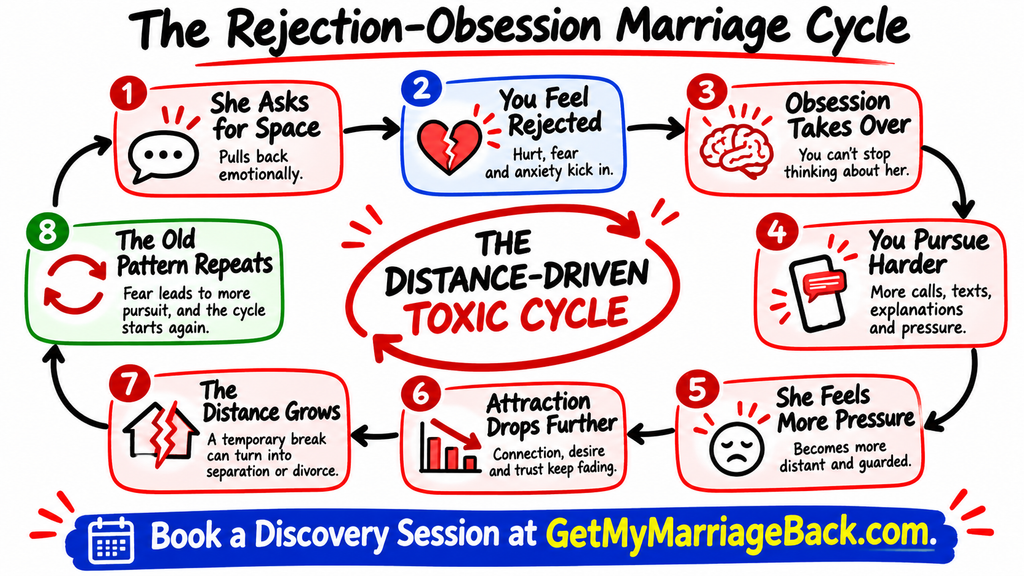
Why Rejection Makes You Want to Chase Her

Before your wife started pulling away, you probably weren’t thinking about her every minute.

Now you monitor your phone.

A delayed response feels threatening. A short message becomes something to analyze, and silence makes you want to send another explanation.

This is how rejection can turn your attention into obsession.

Your mind begins treating reconnection as an emergency. Instead of asking whether a conversation would be useful, you ask how quickly you can get her to respond.

The difference is enormous.

A genuine desire to repair the marriage considers both people’s emotional experience. Fear-driven pursuit focuses on relieving your own discomfort.

That is why repeated attempts to reassure, explain, apologize, or argue can feel so intrusive to a spouse who has requested distance.

She asks for breathing room, but every interaction brings another demand for emotional engagement.

Over time, the pressure itself becomes part of what she wants to escape.

wife wants to separate - the rejection-obsession marriage cycle

Mistake 1: Making Your Anxiety Her Responsibility

There is nothing unusual about feeling frightened when your marriage becomes uncertain.

The mistake is expecting your wife to regulate that fear for you.

You may want her to promise she still loves you, explain exactly how long she needs, or reassure you that she isn’t considering divorce.

But reassurance extracted under pressure rarely creates the romantic connection you’re seeking.

You cannot skillfully rebuild attraction while making another person responsible for calming every uncomfortable feeling you experience.

Emotional intelligence begins when you can feel rejection without automatically acting on it.

That doesn’t mean pretending you aren’t hurt. It means choosing a response based on the marriage you want to build rather than the anxiety you want to escape.

Mistake 2: Treating Her Request for Space as the Entire Problem

Many people become obsessed with the question, “How much space should I give my wife?”

It’s understandable, but the question is incomplete.

The more important question is what created the distance in the first place.

Consider these possibilities:

  • Repeated arguments have made conversations emotionally exhausting.
  • Unresolved resentment has weakened trust and affection.
  • Your spouse no longer feels understood or valued.
  • Romantic attraction has deteriorated through predictable negative interactions.
  • Separation has become an option because earlier attempts to resolve problems went nowhere.

Each situation calls for a different level of repair.

If the problem is one emotionally charged disagreement, a brief pause may allow both people to settle down.

When the marriage has endured years of resentment, a day without arguing doesn’t erase the underlying damage.

Researchers studying relationship conflict have documented the importance of physiological calming during arguments. The Gottman approach, for example, emphasizes taking a break when partners become emotionally flooded, then returning to the conversation when they can engage more constructively.

That research supports a practical distinction: taking space can help interrupt escalation, but space alone does not repair a damaged relationship.

Mistake 3: Turning Separation Into a Countdown

Some people respond to a request for space by creating an imaginary deadline.

They decide that 24 hours should be enough. If their spouse doesn’t reconnect, they extend it to 48 hours or three days.

Then the ultimatum appears.

“I’ve given you enough space. We need to talk now.”

This approach treats separation like a negotiation in which the person who controls the calendar controls the outcome.

It doesn’t work that way.

A boundary isn’t automatically unreasonable because it makes you uncomfortable. Likewise, respecting a request for distance doesn’t require abandoning your own legitimate needs or accepting indefinite uncertainty.

You can discuss practical matters, household responsibilities, parenting arrangements, and reasonable opportunities to revisit the relationship.

What you cannot do is manufacture emotional readiness by declaring that the waiting period has expired.

The Client Whose Wife Moved to Her Mother’s House

One of my clients experienced an especially painful version of this situation.

His wife had moved to her mother’s house.

He was confused, frightened, and determined to repair the marriage. So he kept sending long text messagesโ€”paragraph after paragraph.

Sometimes he apologized. Other times he defended himself, criticized her, or tried to explain why her interpretation of the marriage was wrong.

At certain moments, he even declared that he didn’t care.

Yet his actions communicated something very different.

Those messages were not addressing the deeper problems behind the separation. They were expressing his panic.

We worked to understand his particular circumstances and change his approach.

It was difficult because familiar reactions don’t disappear simply because someone understands that they are unhelpful.

Over time, he began making meaningful changes without waiting for his wife to participate directly in every part of the process.

The important distinction was how he measured progress.

He stopped treating the number of messages he sent as evidence that he was fighting for the marriage.

Instead, he began paying attention to whether he was interrupting the behaviors contributing to the crisis.

That is a far more useful measure of personal growth.

Mistake 4: Losing Yourself While Trying to Save the Marriage

Here’s something I want you to examine carefully.

Have you become so consumed with saving your marriage that you’ve abandoned the person you were before the crisis?

Your confidence now depends on whether she responds.

A good day requires her affection. Your peace disappears whenever her mood changes.

You may still be going to work, paying bills, and handling responsibilities, but emotionally your entire identity has become attached to the marriage’s immediate condition.

That is emotional dependency, not personal power.

And dependency can quietly undermine attraction.

Romantic connection becomes difficult when every interaction carries the unspoken demand, “Please make me feel secure again.”

Rebuild the Person Your Spouse Can Experience Differently

I teach a progression that begins with grounding, purpose, and self-discovery.

Grounding means learning to experience difficult emotions without allowing them to dictate your next move.

When you feel the urge to send an angry or desperate message, notice the feeling before acting. Let the emotional intensity settle, then decide whether communication is necessary and appropriate.

Purpose means reconnecting with responsibilities and meaningful pursuits beyond your immediate marriage crisis.

Your health, work, relationships, personal growth, and contribution to the world still matter.

Self-discovery requires examining the patterns you would rather avoid.

Where have you been arguing instead of listening? When have you begged for reassurance, reacted defensively, or repeated behavior that clearly wasn’t working?

This isn’t about accepting blame for everything that has gone wrong.

It’s about taking ownership of what you can actually change.

You don’t need your spouse’s permission to become more grounded, confident, thoughtful, and emotionally disciplined.

Mistake 5: Trying to Explain Your Way Back Into Attraction

One of the biggest misunderstandings about marriage reconciliation is the belief that the right explanation will restore romantic attraction.

You imagine that if you could finally make your wife understand your intentions, she would see you differently.

But attraction isn’t simply an intellectual conclusion.

It is influenced by what someone repeatedly experiences in your presence.

Does interacting with you feel exhausting or enjoyable? Does a disagreement become a contest, or can you remain curious and composed?

Are your words consistent with your actions?

These experiences matter more than another carefully written promise.

Emotional Safety Creates Room for Romantic Curiosity

Research on intimate relationships helps explain why.

Studies of perceived partner responsiveness have found that feeling understood, validated, and cared for is closely associated with intimacy. Research published in the journal Psychological Science also examined how perceived partner responsiveness relates to affectionate touch, finding evidence that responsiveness and affectionate behavior are connected in romantic relationships.

The lesson is not that being agreeable automatically creates desire.

It is that closeness develops through experiences of connection, not through explanations alone.

Your spouse needs opportunities to experience meaningful differences in how you listen, communicate, handle conflict, and carry yourself.

That is where emotional intelligence becomes attractive.

Stop Using Text Messages to Force Emotional Resolution

When your wife wants space, texting can become one of your most destructive habits.

A simple logistical message may be necessary. Respectful communication about children, finances, or shared responsibilities can remain appropriate.

A seven-paragraph essay demanding that she understand your feelings is something else entirely.

Avoid using texts to litigate the marriage, extract reassurance, or force a conversation she has declined.

Also avoid the opposite manipulation: deliberately ignoring her to provoke jealousy or manufacture mystery.

Both behaviors are attempts to control her response.

The goal is not to become mysteriously unavailable.

The goal is to become genuinely different in the way that matters: you stop repeating destructive reactions.

How to Rebuild Attraction When Your Wife Wants Space

Attraction grows through a different experience of you.

That means your strategy should focus less on persuading your wife to feel something and more on becoming capable of creating healthier interactions.

1. Become Emotionally Steady

You can be concerned about your marriage without allowing every uncomfortable emotion to turn into an action.

Practice slowing your reactions, especially during disagreements or periods of silence.

Calmness is not indifference. It is the ability to remain responsible for yourself under pressure.

2. Respect Distance Without Becoming Cold

If your wife has requested space, take the request seriously.

You don’t have to punish her with silence, act detached, or pretend that the relationship means nothing.

When communication is appropriate, let it be warm, clear, and free from hidden demands.

Respect can be quietly attractive because it changes the emotional experience of interacting with you.

3. Replace Defensiveness With Curiosity

When your spouse expresses frustration, resist the urge to immediately prove that her interpretation is inaccurate.

Listen for the experience beneath the complaint.

You can acknowledge that she feels hurt without agreeing with every conclusion she draws.

That distinction allows you to remain confident while becoming easier to communicate with.

4. Create Experiential Value

I use the phrase experiential value to describe the positive experience someone has through interacting with you.

This is different from merely claiming to have good moral values.

You might consider yourself loyal, hardworking, and committed. Those qualities matter, but they don’t automatically tell you how your spouse experiences a conversation, an evening together, or a disagreement.

Experiential value comes from the way you live, communicate, listen, respond, and carry yourself.

Romantic curiosity has more room to develop when the familiar pattern of pressure and conflict begins to change.

5. Let Consistency Speak Louder Than Promises

A dramatic apology may capture attention.

Consistent behavior is what allows someone to notice that an old pattern is no longer dominating the relationship.

If you have promised to listen better, demonstrate it when a difficult conversation arises.

When you say you’re working on emotional control, practice it when you’re disappointed.

Attraction cannot be negotiated into existence. It develops in the context of lived experiences, including trust, emotional connection, individuality, and mutual desire.

What to Do When Your Wife Wants to Separate but You Don’t

Start by recognizing the seriousness of her request without assuming you already know the ending.

Ask for clarity when an appropriate conversation is possible. Respect the distance she has requested, and handle necessary responsibilities without turning every interaction into a discussion about reconciliation.

Meanwhile, examine the behaviors you control.

If you tend to pursue harder when you feel rejected, learn to interrupt that reaction. Should resentment and conflict have become normal, focus on communicating with greater awareness and less defensiveness.

Rebuild your personal stability instead of waiting for your spouse to supply it.

You also need to distinguish between doing your part and trying to do both people’s parts.

A marriage involves two individuals with independent choices. You can improve your own behavior and create conditions more supportive of connection, but you cannot decide for another person whether they will participate in rebuilding the relationship.

That is why personal power matters.

It allows you to act deliberately rather than desperately.

How Long Should You Give Your Wife Space?

There is no universal number of days that resolves every marriage crisis.

A short cooling-off period after an argument is fundamentally different from a separation involving a move out of the marital home.

Consider the severity and duration of the conflict, the specific boundary your wife has expressed, and the practical responsibilities you share.

A request for a quiet evening should not automatically become a month of silence.

Similarly, years of emotional disconnection will not necessarily disappear after 48 hours apart.

The better question is whether the space is helping interrupt destructive interactions while allowing both people to make thoughtful decisions.

Your role is to remain respectful, clear about practical needs, and focused on meaningful change.

The Real Shift: From Chasing Reassurance to Building Attraction

When your wife wants to separate, your instinct may be to fight harder for immediate closeness.

But a marriage crisis often exposes the limitations of that approach.

Repeated pursuit can become pressure. Explanations can become arguments, and attempts to save the relationship can turn into behaviors that make connection feel less appealing.

You need a different foundation.

Grounding helps you respond instead of react. Purpose restores a meaningful life beyond the crisis, while self-discovery reveals the habits you need to change.

From there, you can build experiential value through how you communicate, handle disagreements, and show up consistently.

This is the deeper distinction between trying to convince someone to love you and becoming someone who contributes to a more attractive relationship experience.

Your wife has asked for space.

The question is whether you will use that space to repeat the same cycleโ€”or become capable of breaking it.

“I Feel Disgusted When My Husband Touches Me” – [5 Solutions]

Frequently Asked Questions

Does my wife wanting space mean she wants a divorce?

Not necessarily; a request for space can reflect emotional overwhelm, unresolved resentment, lost attraction, or uncertainty about the marriage. Pay attention to her specific words, actions, and circumstances rather than assuming divorce is inevitable.

How long should I give my wife space when she wants to separate?

There is no fixed timeline because a brief conflict break and a serious marital separation involve different levels of damage. Respect her stated boundaries while addressing necessary practical matters and discussing future communication when appropriate.

Should I text my wife when she asks for space?

Keep necessary communication respectful, brief, and consistent with the boundaries she has expressed. Avoid repeated emotional essays, demands for reassurance, or messages designed to force an immediate resolution.

Can I save my marriage if my wife wants to separate?

You can begin improving your communication, emotional stability, and relationship patterns without waiting for your wife to participate in every step. Reconciliation also requires her independent willingness to rebuild the relationship.

Your Wife Is Pulling Away and Wants Divorce? 7 Attraction Shifts

Your wife used to complain that you were not present enough; now she has stopped asking for your attention, built more of a life without you, and may even be talking about divorce.

Take This 2 Minutes Quiz

Question 1 of 15

That reversal can mess with your head.

There was a time when she wanted you to listen more. She wanted more conversation, affection, attention, involvement, or emotional presence.

You may have been confused because you believed you were already there.

worked, provided.

…You handled responsibilities.

Your life revolved around keeping the family together.

From your perspective, that was presence.

But physical presence and experienced connection are not automatically the same thing.

Then something changed.

She stopped complaining.

At first, that may have felt like progress. The arguments decreased. She stopped asking you to talk. She no longer complained that you were always busy.

Until you noticed something uncomfortable:

She did not necessarily stop complaining because the problem was solved.

She may have stopped expecting you to solve it.

Now she has friendships, activities, events, work, lunches, interests, or an entire social world that does not revolve around you.

Suddenly, you are the one feeling disconnected.

And when your wife is pulling away and wants divorce, that reversal can trigger exactly the behavior that makes attraction even harder to rebuild.

When Your Wife Stops Needing Your Attention, Rejection Can Become Obsession

Attention has an interesting way of becoming more valuable when nobody is asking you for it anymore.

Yesterday, she wanted your attention and you were busy.

Today, she seems perfectly capable of enjoying herself without it, and suddenly you are watching everything.

Where is she going?

Who is going?

Why is she dressed like that?

Who is that guy?

Why did they have lunch together?

Did she mention him again?

Why does she seem happier around everybody else?

Those questions do not automatically make you controlling.

Feeling insecure is not a crime.

Insecurity is information.

You can feel threatened, rejected, excluded, jealous, confused, or frightened by a changing marriage without turning those feelings into your identity.

The danger begins when a feeling becomes a prosecution.

Now your wife has to prove her innocence every time she lives her life.

You question.

She becomes defensive.

You interpret her defensiveness as additional evidence.

She withdraws.

Her withdrawal increases your suspicion.

Then you question harder.

Before long, you are no longer responding to what you actually know. You are responding to a case being built inside your head.

That cycle is especially dangerous when your wife already wants separation or divorce.

wife is pulling away and wants divorce

Attraction Shift #1: Separate What You Know From What You Fear

Suppose your wife has developed an active social life.

She attends events. Maybe she volunteers, networks, works outside the home, goes to brunch, attends community functions, or spends time with friends.

Some of those environments naturally include men.

That fact alone does not prove infidelity.

At the same time, emotional intelligence does not require becoming naive.

If you have concrete evidence of deception, inappropriate boundaries, an affair, or cheating, deal with the facts in front of you.

But facts and fear are not interchangeable.

A grounded question sounds like:

โ€œWhat do I actually know?โ€

An insecure prosecution sounds like:

โ€œWhat can I find that proves what I already fear?โ€

Those mindsets produce completely different behavior.

When you manufacture certainty because uncertainty hurts, you can end up punishing your spouse for conclusions you have not established.

That is not confidence.

And it is rarely seductive.

Attraction Shift #2: Stop Making Her Responsible for Regulating Your Fear

Your wife goes out Saturday.

You spend Saturday monitoring the clock.

She comes home.

You want details.

Who was there?

Who did you talk to?

Where did you go afterward?

Why didn’t you answer immediately?

Did that guy show up?

One reasonable question can quickly become an interrogation when its real purpose is not understandingโ€”it is emotional regulation.

You need her answers to make your anxiety disappear.

That is a tremendous amount of pressure to put on someone who may already be pulling away.

Seduction requires voluntary movement.

Attraction needs enough emotional oxygen for two people to remain individuals while choosing each other.

When every interaction contains the invisible demand, โ€œMake me feel secure about us right now,โ€ your spouse can begin experiencing your presence as emotional work.

You can desire your wife deeply without making her responsible for stabilizing you.

That distinction is powerful.

Attraction Shift #3: Understand Why โ€œIโ€™m Hereโ€ May Not Have Felt Like Connection

One of the most useful questions you can ask yourself is not:

โ€œWas I a good spouse?โ€

Ask instead:

โ€œWhat was it like to experience me?โ€

Those are not the same question.

You can be responsible, faithful, hardworking, committed, and dependable while still being emotionally difficult to reach.

Maybe you were physically home but mentally elsewhere.

Perhaps every conversation competed with your phone, work, business, television, stress, or exhaustion.

She may have repeatedly felt unheard while you repeatedly felt unfairly accused.

This is where attraction becomes more sophisticated than simply being a โ€œgood husbandโ€ or โ€œgood wife.โ€

Moral value matters.

But attraction is experienced value.

Your spouse experiences your presence, emotional intelligence, confidence, curiosity, warmth, sexuality, humor, boundaries, decisiveness, responsiveness, social intelligence, purpose, and ability to listen without immediately defending yourself.

Relationship research supports an important piece of this. Studies have found that perceived partner responsivenessโ€”experiencing a partner as understanding, validating, and caringโ€”is associated with intimacy and sexual desire. In one series of studies, the responsiveness-desire association was particularly strong among women. You can review the research on partner responsiveness and sexual desire.

That does not mean becoming endlessly agreeable.

Responsiveness is not submission.

Listening does not mean surrendering your judgment.

Understanding her experience does not require agreeing with every interpretation she makes.

It means becoming capable of receiving another person’s experience without immediately making the conversation about proving yourself innocent.

Attraction Shift #4: Do Not Confuse Being Needed With Being Desired

You may have heard that peopleโ€”especially menโ€”need to feel needed.

Be careful with that idea.

There is an enormous difference between being valuable to your spouse and needing your spouse to depend on you so you can feel valuable.

Imagine that your wife has become more independent.

She has friends.

She can entertain herself.

Her career or business is growing.

She has interests outside the marriage.

If your security depends on her dependence, her growth can feel like your rejection.

You may start trying to regain importance by becoming more controlling, more involved, more critical of her outside relationships, or more demanding of her time.

That is not intimacy.

Dependency is not the same thing as attraction.

A seductive marriage contains choice.

โ€œI can live a meaningful life, and I still choose youโ€ carries a different emotional energy from โ€œI need you to need me so I know I matter.โ€

One creates room for desire.

The other can turn marriage into an emotional hostage situation.

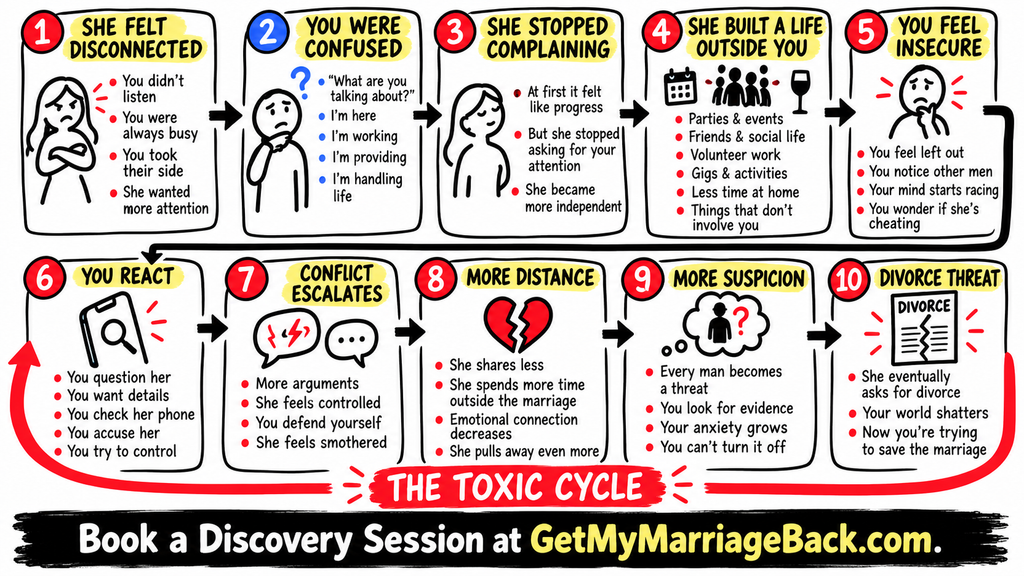
Attraction Shift #5: Interrupt the Rejection โ†’ Suspicion โ†’ Pressure Cycle

Here is the toxic cycle to watch:

Disconnection โ†’ Independence โ†’ Insecurity โ†’ Suspicion โ†’ Accusation โ†’ Conflict โ†’ More Distance โ†’ More Suspicion

The problem is not merely that your wife has become distant.

The problem is what the two of you repeatedly create after the distance appears.

You feel rejected.

Fear wants reassurance.

Reassurance does not last, so you monitor.

Monitoring produces questions.

Questions become accusations.

Accusations produce defensiveness.

Defensiveness feels suspicious.

Now the cycle has evidence to feed itself.

This can continue for months or years.

Eventually, you may become terrified that your wife wants divorce while behaving in ways that make being married to you increasingly exhausting.

That is the contradiction.

Your fear says, โ€œHold tighter.โ€

Attraction often needs you to become emotionally strong enough to stop squeezing.

Attraction Shift #6: Rebuild Yourself Around Grounding, Purpose and Self-Discovery

When your wife is pulling away and wants divorce, your world can become painfully small.

Everything becomes about her.

Her mood.

…phone.

Her schedule.

…affection.

Her texts.

…social life.

Her decision about the marriage.

That is too much power to hand another human being.

Start with Grounding.

Ground yourself in something true that exists beyond whether your wife chooses you today.

Your emotional stability cannot rise and fall entirely according to whether she smiled at breakfast.

Then reclaim Purpose.

Purpose is mission, contribution, impact, and legacy beyond the immediate marriage crisis.

That does not mean abandoning your spouse.

It means refusing to make saving your marriage your only identity.

Return to meaningful work.

Take care of your body.

Reconnect with healthy friendships.

Become socially alive again.

Create.

Lead.

Learn.

Contribute.

Handle neglected responsibilities.

Develop parts of yourself that disappeared while you were obsessing over the relationship.

Then practice Self-Discovery.

Do not merely ask, โ€œHow do I get my wife back?โ€

Ask:

โ€œWho have I become?โ€

โ€œWhat is it like to experience me?โ€

โ€œWhere did confidence become reassurance-seeking?โ€

โ€œDid love become fear?โ€

โ€œWhere did pursuit become chasing?โ€

โ€œDid leadership become control?โ€

โ€œWhat have I stopped developing in myself?โ€

That is a much more attractive project than spending another six months investigating brunch.

Attraction Shift #7: Create Experiential Value Instead of Performing for Approval

There is a trap here.

Once you understand that your experience matters, you may start performing.

You become extra helpful.

Extra romantic.

Extra agreeable.

Suddenly you are at the gym every morning, buying flowers every Friday, cleaning everything, planning dates, changing your wardrobe, and becoming Husband of the Year.

But underneath the transformation is an invisible question:

โ€œDo you want me now?โ€

That is still reassurance-seeking.

Your wife can often feel the transaction even when you never say it.

Experiential Value is different.

It asks:

What does my presence consistently create?

Do I bring emotional stability or volatility?

Curiosity or predictability?

Warmth or pressure?

Purpose or obsession?

Playfulness or constant seriousness?

Desire or desperation?

Healthy boundaries or control?

Listening or prosecution?

Growth or performance?

You are not building value to force your spouse to reward you.

You are developing into someone whose experience is naturally more attractive.

That is where curiosity can begin returning.

Value can create Curiosity.

Curiosity gives Attraction room to breathe.

Attraction expands Influence.

Influence can eventually create Leverage for building a different marriage.

Value โ†’ Curiosity โ†’ Attraction โ†’ Influence โ†’ Leverage

Notice what is absent from that sequence.

Begging.

wife is pulling away and wants divorce - โ€œBut What If She Really Is Cheating?โ€

โ€œBut What If She Really Is Cheating?โ€

Then the facts matter.

Emotional intelligence is not pretending betrayal cannot happen.

The objective is to become capable of addressing reality without inventing additional reality.

If evidence establishes an affair, the marriage now has an infidelity problem requiring boundaries, decisions, accountability, and a different conversation.

If you do not have evidence, repeatedly treating your spouse like a cheating spouse can create damage without giving you greater clarity.

You do not need paranoia to have standards.

Strong boundaries and emotional stability can exist together.

Stop Arguing About Whether You Are โ€œControllingโ€

Your wife says:

โ€œYou’re controlling.โ€

Your instinct may be immediate:

โ€œNo, I’m not.โ€

Then you spend twenty minutes debating the definition of control.

You explain that asking where your wife went is normal.

She explains how your questions feel.

Next, you defend your intentions.

She describes your behavior.

Eventually, you are fighting semantics while your marriage is bleeding.

Try a more emotionally intelligent approach.

Become curious about the experience underneath the accusation.

โ€œWhat am I doing that feels controlling to you?โ€

That question is not an admission of guilt.

It is information gathering.

You can understand why something feels controlling to her and still decide that a particular boundary or concern is reasonable.

The objective is clarityโ€”not surrender.

When Your Wife Wants Divorce, Stop Trying to Win the Immediate Moment

Divorce language creates urgency.

Your nervous system screams:

Fix this now.

Convince her now.

Get reassurance now.

Make her remember the good times.

Prove you’ve changed.

Promise everything.

But panic is rarely seductive.

Your spouse did not arrive at emotional withdrawal five minutes ago simply because she used the word โ€œdivorceโ€ five minutes ago.

There is usually a history.

Listen to that history.

Look for patterns.

Take responsibility for what is actually yours.

Stop accepting responsibility for what is not.

Most importantly, resist the urge to turn every interaction into a referendum on whether she is staying.

A marriage crisis requires deliberate behavior.

Not frantic behavior.

Attraction Is Not Something You Extract From Your Wife

You cannot force curiosity.

…negotiate desire.

You cannot guilt somebody into genuine affection.

And you cannot interrogate another person into feeling safe enough to move toward you.

What you can do is change the experience you contribute to the marriage.

Become grounded enough to tolerate uncertainty.

Develop enough purpose that your entire identity is not trapped inside your spouse’s approval.

Learn enough about yourself to recognize when fear is driving you.

Build relational skills that allow you to express concern without prosecution.

Become responsive without becoming submissive.

Create boundaries without becoming controlling.

Desire your spouse without smothering her.

That combination is emotionally intelligent.

It is also far more seductive than desperation.

Prepare for the Moment Your Fear Comes Back

Reading this calmly is one thing.

Saturday night is another.

Your wife goes out.

Someone’s name comes up again.

She mentions lunch.

Your stomach tightens.

Suddenly every intelligent idea you understood today collides with:

โ€œYou’re losing her.โ€

That is where skill matters.

Some research has suggested that stress can favor previously learned responses over deliberate goal-directed behavior, although subsequent replication research has found the overall stress-to-habit effect is not universal.

The practical lesson for marriage is simple:

Do not assume understanding automatically becomes execution.

Your old reaction may still arrive first.

Prepare for it.

Know what you do when fear rises.

Know who you speak to instead of dumping every thought onto your spouse.

Recognize the difference between information you need and reassurance you crave.

Have a system for slowing yourself down before insecurity becomes accusation.

Emotional intelligence becomes valuable when the emotion is actually happening.

Can You Save Your Marriage When Your Wife Is Pulling Away?

One person cannot manufacture a healthy two-person marriage alone.

But one person can stop feeding a destructive cycle.

You can stop turning insecurity into prosecution.

…stop confusing pressure with pursuit.

You can stop treating your wife’s independence as automatic betrayal.

…become more present without becoming clingy.

You can listen without abandoning your standards.

And you can desire her without requiring her attention to regulate your emotional state.

And you can rebuild the qualities that make your presence feel grounded, interesting, emotionally intelligent, warm, purposeful, confident, and alive.

That is where marriage reconciliation becomes a more intelligent objective.

You are no longer asking:

โ€œHow do I make her choose me?โ€

You are asking:

โ€œWhat can I change about the experience I am creating, and what does her response to that reality tell me?โ€

That question returns you to your power.

Not power over your wife.

Power over yourself.

And that is where attraction has room to become voluntary again.

Wife or Husband Denying You Sex? DO THIS!

Frequently Asked Questions

What should I do if my wife is pulling away and wants divorce?

Stop escalating the crisis through begging, interrogation, repeated reassurance-seeking, or pressure, and examine the relational cycle plus what you can actually control. Listen carefully to her concerns while rebuilding your emotional stability, purpose, communication skills, and experiential value.

Does my wife becoming distant mean she is cheating?

No; emotional distance, new friendships, events, lunches, or a larger social life do not by themselves establish infidelity. Respond to concrete evidence rather than allowing insecurity to turn ambiguous behavior into a prosecution.

Can attraction come back when my wife wants divorce?

Attraction can change over time, and research has associated intimacy, responsiveness, autonomy support, and feeling valued with stronger sexual and relationship experiences. You cannot force attraction back, but you can stop behaviors that create pressure and develop conditions more compatible with voluntary curiosity and connection.

Can I save my marriage if my wife has emotionally checked out?

You can change your contribution to destructive patterns even before your spouse participates, but sustainable marriage reconciliation ultimately involves choices from both people. Start by replacing fear-driven pursuit with grounded, emotionally intelligent behavior and observe the relationship from that stronger position.

Signs Your Wife Is Cheating? 7 Clues Fear Can Misread

Your wife becomes cold, her energy changes, conversations get shorter, and one suspicious text suddenly seems to explain everything: there must be another man.

Take This 2 Minutes Quiz

Question 1 of 15

That conclusion may eventually prove true. Infidelity happens, and pretending otherwise will not help you save your marriage.

But emotional distance is informationโ€”not a conviction.

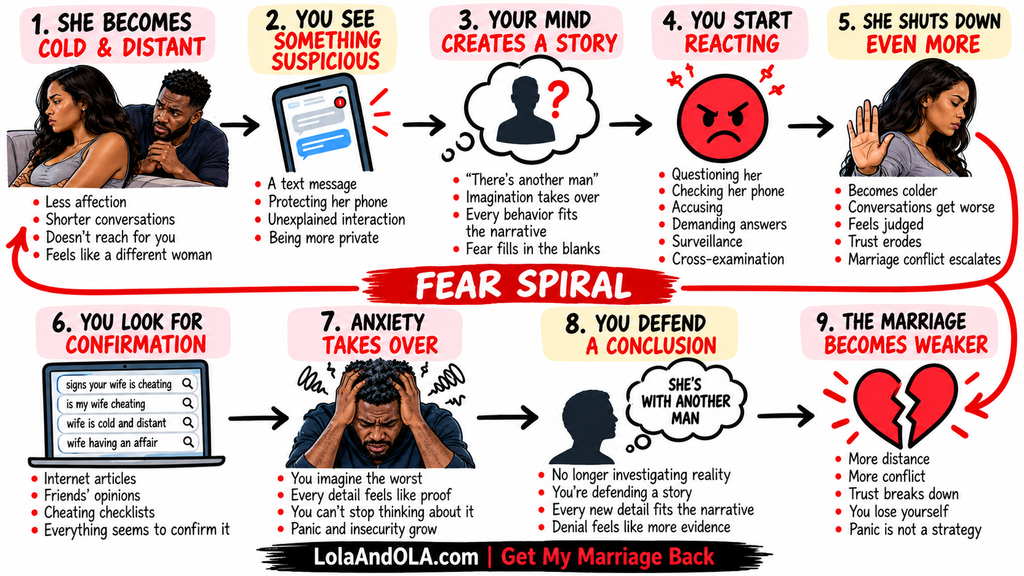
That distinction matters because when you’re scared of losing your wife, your mind naturally wants to turn uncertainty into certainty. Suddenly, you’re not simply noticing changes in her behavior. You’re interpreting everything through the same frightening explanation.

She’s late? Another man.

She’s quiet? Another man.

She turns her phone over? Another man.

She’s irritated because you keep asking questions? Now even her irritation becomes evidence.

Before long, you’re no longer trying to understand reality. You’re defending a conclusion.

And that can become extraordinarily destructive when your deeper objective is not merely discovering whether your wife is cheating, but rebuilding a marriage in which attraction, curiosity, respect, trust and emotional connection can exist again.

Signs Your Wife Is Cheatingโ€”or Signs Something Is Wrong?

When people look for signs your wife is cheating, they’re usually not beginning from a place of emotional neutrality.

Something has already changed.

Maybe affection disappeared. Sex became infrequent or stopped. She no longer reaches for you. Her phone habits changed. Conversations became functional rather than intimate.

Perhaps she suddenly seems more emotionally alive around everybody except you.

Those changes deserve your attention.

They do not all have the same explanation.

Research on infidelity reflects this complexity. Researchers have examined individual, relationship and contextual variables associated with infidelity rather than identifying one behavioral sign that reliably proves an affair.

That means you need to resist one of the most seductive mistakes in a marriage crisis:

Taking several ambiguous facts and using fear to manufacture the missing pieces.

signs your wife is cheating

7 Signs That Can Feel Like Proof of Cheating

1. Your Wife Suddenly Becomes Cold

This is often the change that destabilizes a spouse first.

You knew how your wife used to look at you. You remember how she responded when you touched her, how she spoke to you and how naturally conversation once flowed.

Now something feels different.

That shift is real even when you cannot yet explain it.

The mistake is turning:

โ€œMy wife has become emotionally distant.โ€

into:

โ€œMy wife is emotionally distant because she’s sleeping with someone else.โ€

The first statement describes your experience.

The second assigns a cause you may not have established.

That gap is where emotional intelligence becomes critical.

2. She Starts Protecting Her Phone

A wife suddenly hiding her phone understandably gets your attention.

Maybe she turns the screen downward. Perhaps she carries it everywhere. Password behavior changes. She appears uncomfortable when messages arrive.

Those behaviors can accompany secrecy.

Still, secrecy and adultery are not interchangeable concepts.

She could be concealing an affair. She could also be discussing your marriage with someone, dealing with something personal, protecting information she doesn’t want you to see, or reacting to a relationship dynamic that has already become distrustful.

Your objective isn’t to become naive.

It’s to become accurate.

3. You Find an Ambiguous Text Message

This is where many people emotionally lose control.

You see a message.

It bothers you.

Nothing in the message independently proves she’s cheating, but once you combine it with months of emotional distance, your brain creates a compelling narrative.

Now the message doesn’t feel ambiguous anymore.

It feels like confirmation.

But confirmation and confirmation bias are not the same thing.

When you’ve already decided what the story means, every new detail starts getting recruited to support it.

That’s dangerous.

4. She Stops Reaching for You

Loss of affection can be devastating because it feels deeply personal.

When your wife once initiated affection, intimacy or sex and suddenly stops, it’s easy to conclude that her desire must be going somewhere else.

Sometimes another relationship is involved.

Other times attraction has deteriorated inside the marriage itself.

Resentment may have accumulated. Emotional exhaustion may have taken over. Repeated conflict could have made closeness feel unsafe or undesirable.

Sometimes the consequences seem sudden because you didn’t experience the buildup the same way she did.

5. She Seems Irritated by Your Questions

Here’s where the situation becomes circular.

You suspect something.

So you ask.

She becomes irritated.

Now her irritation makes you more suspicious.

You ask again, except this time you’re less curious and more prosecutorial.

She becomes even more defensive.

Soon every conversation feels like cross-examination:

โ€œWho’s that?โ€

โ€œWhy did you turn your phone over?โ€

โ€œWhere were you?โ€

โ€œWhy are you acting differently?โ€

โ€œJust tell me the truth.โ€

The more she resists the interrogation, the more convinced you become.

You’ve now created a theory that can become almost impossible to disprove.

If she admits it, she’s guilty.

If she denies it, she’s hiding it.

If she’s angry about the accusation, her anger becomes evidence.

At that point, fear is running the investigation.

6. Your Wife’s Withdrawal Seems to Come Out of Nowhere

One of the most important questions isn’t merely, โ€œIs my wife cheating?โ€

Ask:

โ€œWhat happened before she became this version of herself with me?โ€

Consider a marriage where one spouse carries a secret.

Eventually, information about that secret reaches the other spouse, but there’s no immediate confrontation.

Instead, the betrayed spouse withdraws.

She becomes cold.

Distant.

Quiet.

Her husband doesn’t know that she knows what he did, so he experiences her behavioral change without access to its cause.

Ironically, he can start wondering whether she has found somebody else.

Now both spouses occupy the same marriage while living inside radically different versions of reality.

That’s why emotional distance should make you curious before it makes you certain.

Your wife knows things you don’t know.

You know things she doesn’t know.

There may also be things neither of you has properly articulated.

Marriage reconciliation requires learning to distinguish those categories.

7. Everything Starts Looking Like Evidence

This may be the most dangerous signโ€”not necessarily a sign your wife is cheating, but a sign that fear has taken control of your interpretation.

She’s late.

Evidence.

She’s quiet.

Evidence.

She dresses differently.

Evidence.

She’s angry.

Evidence.

She’s unusually happy.

Somehow that’s evidence too.

Eventually, almost nothing can happen without being incorporated into the affair narrative.

That’s when you need to interrupt yourself.

Ask one brutally simple question:

What do I actually know?

Not what your friend thinks.

Not what an article about cheating spouses told you.

Not what you constructed at 2:00 AM while staring at the ceiling.

What can you independently establish as true?

That is the beginning of Grounding.

signs your wife is cheating - infographic

Why Panic Makes Marriage Problems Worse

Marriage crises activate old patterns quickly.

One reason is that intense stress can affect how deliberately people respond. Experimental research has found circumstances in which stress shifts behavior toward previously learned habitual responses, although later replication work suggests that this effect is not universal and depends on important conditions.

That nuance matters.

Your stomach dropping when your wife’s phone lights up doesn’t force you to interrogate her.

But your trigger can make familiar behavior feel almost automatic.

The old pattern says:

Check. Ask. Accuse. Pursue. Demand. Monitor.

That’s why intellectual understanding isn’t enough.

You can read ten articles about how to save your marriage and still lose your composure when she turns her phone over tonight.

The skill is learning to create space between what activates you and what you do next.

The research behind this stress-and-habit distinction is worth understanding; this review of stress and habitual versus goal-directed behavior explains how stress has been studied in relation to these competing systems of action.

Your goal is not emotional numbness.

It’s emotional leadership.

Stop Making Your Wife Responsible for Eliminating Your Uncertainty

This is one of the hardest shifts.

You desperately want your wife to make you feel safe.

Tell me there’s nobody else.

Show me your phone.

Promise me you still love me.

Tell me we’re going to be okay.

Answer this one question and I’ll stop asking.

But reassurance obtained under pressure rarely satisfies fear for long.

Your brain simply creates the next question.

Now your wife isn’t experiencing curiosity from you. She’s experiencing your demand that she regulate your emotional state.

That’s rarely attractive.

Attraction is not built by pretending you don’t care. Nor is it built by becoming cold, manipulative or artificially mysterious.

Attraction grows more naturally when your presence stops communicating:

โ€œYou must behave correctly so I can be okay.โ€

How to Build Attraction While Your Wife Is Distant

Your first job is Grounding.

Return to truth that exists independently of tonight’s suspicion.

Next comes Purpose.

Your identity cannot collapse into monitoring another human being, even when that person is your wife and your marriage means everything to you.

Redirect some of that emotional energy toward mission, contribution, impact and legacy.

That doesn’t mean distracting yourself from your marriage.

It means refusing to make your wife’s current emotional temperature the sole measurement of your value.

Then comes Self-Discovery.

Can you experience uncertainty without immediately converting it into accusation, surveillance, begging, revenge, panic or defensiveness?

That’s a serious attraction skill.

Because the person capable of experiencing uncomfortable emotions without dumping responsibility for those emotions onto everyone else creates a fundamentally different relationship experience.

Attraction Isn’t About Becoming Morally Superior

This distinction matters.

You’re not trying to become โ€œbetter than your wife.โ€

You’re developing Experiential Value.

Ask yourself:

What does it feel like to be married to me right now?

Does your presence feel like pressure?

Does every conversation eventually become about the relationship?

Are you constantly measuring affection?

Does sex function as proof that everything is okay?

Does a bad mood trigger an investigation?

Or can your spouse experience curiosity, emotional space, groundedness, humor, competence, direction and strength around you?

Experiential Value can create Curiosity.

Curiosity can reopen space for Attraction.

Attraction expands Influence.

Influence creates Leverageโ€”not leverage for controlling your spouse, but leverage in the sense that the relationship is no longer entirely organized around resistance, pursuit and fear.

That’s a much more seductive position than desperation.

โ€œBut Why Should I Change if She’s the One Cheating?โ€

You don’t know that yet unless you actually know it.

And if you do have verified evidence of infidelity, your self-development still matters.

Your growth isn’t payment for her behavior.

It’s not an admission of guilt.

You’re focusing on yourself because you’re the only person in this marriage whose thoughts, actions, habits and emotional leadership are directly under your control.

That’s power.

Even confirmed infidelity doesn’t make panic strategic.

It makes clarity even more important.

Research involving couples who entered marital therapy with infidelity histories has found that affair-affected couples can improve, although circumstances surrounding disclosure and the relationship obviously matter.

So โ€œCan marriage be saved after infidelity?โ€ is not answered by one universal yes or no.

The more useful question becomes:

What does this particular marriage require now?

Don’t Confuse Attraction With Ignoring Betrayal

Building attraction does not mean overlooking evidence.

You don’t need to become naive.

You don’t have to tolerate deception.

And emotional intelligence does not require smiling peacefully while somebody violates your boundaries.

If there is real infidelity, deal with real infidelity.

If there isn’t, deal with that reality instead.

What you don’t want to do is convict your wife inside your head and then punish her for a case you haven’t established.

Because whether the affair exists or not, reality matters.

Panic isn’t strategy.

Hope isn’t strategy.

Constantly worrying about another man isn’t strategy either.

The More You Monitor the Rival, the Smaller You Become

Another manโ€”real or imaginedโ€”can slowly become the center of your marriage.

You think about him.

Compare yourself to him.

Wonder what he has that you don’t.

Monitor your wife’s behavior for evidence of him.

Eventually, you’re organizing your identity around a person who may not even exist.

That’s the opposite of attraction.

The stronger move is not pretending you don’t care.

It’s refusing to surrender your entire emotional center to competition.

Your mission is bigger than another man.

Your identity is bigger than your wife’s current mood.

Your value is bigger than whether she validates you tonight.

Paradoxically, that’s also the version of you most capable of creating a desirable relational experience again.

Your Wife’s Distance Is Informationโ€”Use It Wisely

Something may genuinely be wrong.

Take that seriously.

But don’t confuse seriousness with panic.

Observe what is actually happening. Examine the history of your marriage. Become honest about your own contribution without taking responsibility for another adult’s choices.

If there’s betrayal, face it.

If attraction has collapsed, understand why.

When resentment has accumulated, address the pattern that created it.

And when fear has turned you into a detective, recognize that pattern too.

You don’t save a marriage by becoming better at monitoring your spouse.

You give yourself a better chance by becoming increasingly capable of handling realityโ€”especially when reality isn’t giving you immediate answers.

That is where emotional intelligence becomes attractive.

That is where personal power begins returning.

And that is how you stop allowing the fear of another person to become the most influential person in your marriage.

Wife or Husband Denying You Sex? DO THIS!!!

Frequently Asked Questions

What are the biggest signs your wife is cheating?

Sudden secrecy, unexplained changes in availability, emotional withdrawal and changed phone behavior can raise legitimate questions, but no single behavior independently proves infidelity. Look for verifiable facts and meaningful patterns rather than treating ambiguous behavior as a conviction.

Why is my wife suddenly cold and distant?

Emotional distance can accompany an affair, but it can also emerge from resentment, attraction loss, exhaustion, unresolved conflict or information your spouse has not disclosed. The timing and history surrounding the behavioral change matter.

Should I confront my wife if I think she’s cheating?

A legitimate conversation is different from an interrogation based on a conclusion you’ve already reached. Ground yourself in what you actually know so your questions seek information rather than demanding a confession.

Can a marriage be saved after infidelity?

Some couples do reconcile after infidelity, and research on couples receiving marital therapy has documented improvement among affair-affected couples under some circumstances. Recovery depends heavily on the specific couple, disclosure, accountability, relationship dynamics and what both spouses do afterward.

Your Wife Wants Space? How to Rebuild Attraction in Your Marriage

When your wife wants space, the instinct to move closer can become almost irresistible.


Take This 2 Minutes Quiz

Question 1 of 15

You want clarity. You want reassurance. You want to know whether your marriage is going to survive. You may want to talk until both of you finally understand what went wrong, remind her of everything you have built together, demonstrate that you have changed, or get some indication that divorce is no longer on the table.

Yet this is precisely where a marriage crisis can become more destructive.

You are creating a pattern in which uncertainty leads to counting, counting creates interpretation, interpretation produces urgency, and urgency creates pressure. Eventually, pressure generates more withdrawal and rejectionโ€”which feeds the uncertainty that started the cycle.

If your wife wants separation or says she needs space, attraction is rarely rebuilt by winning an argument about why the marriage deserves another chance.

Attraction is an experience.

And the person you desperately want to experience you differently needs enough emotional room to actually experience something different.

That changes the question from:

โ€œHow do I get my wife to come back?โ€

to:

โ€œWhat does interacting with me feel like right now?โ€

That second question is where emotional intelligence, attraction, intimacy and reconciliation begin to intersect.

wife wants space

When Your Wife Wants Space, Stop Turning Time Into Evidence

One of the most psychologically expensive things you can do during marriage separation is turn the calendar into a scoreboard.

Three weeks becomes evidence.

Six weeks becomes stronger evidence.

Another quiet weekend becomes evidence.

A delayed text becomes evidence.

We call this turning time into proof. Every passing week can begin to feel like confirmation that she cares less, the separation is becoming permanent, or divorce is getting closer.

Once you interpret time that way, your behavior changes.

You may become more watchful, reactive and emotionally hungry. Suddenly, a simple interaction carries enormous weight because you are not merely talking to your wifeโ€”you are unconsciously trying to determine the future of your marriage.

She can feel that weight.

The Calendar Cannot Tell You How Your Wife Feels

A marriage separation is real. Divorce may also become real, and practical decisions still have to be made.

However, we need to make an important distinction: your power is not found in discovering the perfect number of weeks before reconciliation. It is found in what you become and how you show up while the outcome remains uncertain.

That distinction matters for attraction.

A man who needs every interaction to answer, โ€œDo you still want me?โ€ creates a very different emotional experience from a man capable of being warm, grounded and present without demanding an immediate verdict.

The second experience leaves room for curiosity.

And curiosity matters.

wife wants space - Why Chasing Your Wife Can Create More Withdrawal

Why Chasing Your Wife Can Create More Withdrawal

There is a well-established relationship pattern known as demand-withdraw.

One person pursues discussion, resolution or change while the other retreats or avoids engagement. Research examining married couples found greater demand-withdraw behavior was associated with lower marital satisfaction.

That does not mean every conversation is pressure.

It means your emotional agenda matters.

Consider the difference between:

โ€œCan we talk tonight? I really need to understand where we stand.โ€

and:

โ€œI understand you need some room. We can talk when there’s actually something useful for us to talk about.โ€

The first interaction may sound reasonable. But if your wife has repeatedly said she wants space, she may experience it as another request to manage your anxiety.

The second communicates something different:

I hear you. I can regulate myself. You don’t have to take care of my emotional stability.

That is not indifference.

It is emotional self-possession.


Attraction Cannot Thrive Under Constant Emotional Pressure

This is where many husbands misunderstand the objective.

If your wife wants space, the goal is not to manipulate her by withdrawing affection or pretending not to care.

Nor is the objective to manufacture scarcity through arbitrary โ€œ30-day no contactโ€ formulas. I want to warn you against using rigid no-contact deadlines as a substitute for genuine confidence and grounding.

The more sophisticated objective is to remove unnecessary emotional pressure.

Your wife should not have to continuously defend her desire for space.

She should not have to reassure you that there isn’t somebody else every few days.

Every conversation should not become an unofficial marriage counseling session.

Most importantly, she should not have to experience your presence as an obligation.

Attraction Needs Psychological Breathing Room

Attraction contains an element that distressed marriages often lose:

discovery.

When every thought, feeling, fear and intention is constantly explained, there is little left to discover.

This is not an argument for secrecy or emotional games.

It is an argument for having a life.

You need to move away from sitting around waiting for a wife to determine your emotional schedule and instead paying attention to purpose, health, children, career and self-development.

That shift is powerful because your wife is no longer interacting exclusively with the husband trying to save the marriage.

She gets an opportunity to encounter the fuller man again.

wife wants space - If Your Wife Is Distant, Become Responsive Without Becoming Needy

If Your Wife Is Distant, Become Responsive Without Becoming Needy

Emotional intelligence during marriage separation requires an unusual combination:

Warmth without pursuit.

Interest without interrogation.

Availability without hovering.

Confidence without coldness.

Research on romantic relationships gives us an important concept here: perceived partner responsiveness.

Responsiveness broadly involves feeling that another person understands, validates and cares about you. Research involving romantic couples found that perceiving one’s partner as responsive was positively associated with affectionate touch, and prospective studies found responsiveness predicted subsequent affectionate touching behavior.

Notice what that suggests.

You do not create intimacy merely by demanding more intimate behavior.

You improve the relational conditions under which intimacy can emerge.

That distinction is enormous.


Listen for the Experience Beneath Your Wife’s Words

Suppose your wife says:

โ€œEvery time I tell you I need space, you keep trying to fix everything.โ€

A defensive husband hears:

โ€œEverything you’ve done is worthless.โ€

An emotionally intelligent husband hears:

โ€œMy experience of you right now is pressure.โ€

That does not automatically make every accusation accurate.

It means you become interested in her experience before trying to correct her interpretation.

You might say:

โ€œI can see how my trying to solve this every time we talk has made it harder for you to breathe.โ€

Then stop.

No twenty-minute explanation.

No immediate request for credit.

No โ€œbut you alsoโ€ฆโ€

Understanding loses much of its seductive power when it immediately sends an invoice.


Stop Trying to Convince Your Wife That You’ve Changed

One of the weakest ways to communicate transformation is repeatedly announcing transformation.

โ€œI’ve changed.โ€

โ€œI finally understand.โ€

โ€œI’m working on myself.โ€

โ€œYou’ll see a different husband.โ€

Perhaps.

But let her discover it.

If you previously became defensive, let her encounter composure.

If you were chronically unavailable, let her experience attentiveness.

If every disagreement became a courtroom, let her discover that disagreement no longer automatically produces combat.

If you abandoned yourself trying to keep the marriage together, let her encounter a husband with a meaningful life.

Real change creates evidence without constantly narrating itself.

That is where attraction becomes more organic.


Your Wife Wants Separationโ€”But She Shouldn’t Become Your Entire Purpose

You need to make one of your strongest shifts around this point.

Instead of creating deadlines around somebody else’s timetable, uncertainty can become an opportunity to build yourself. Once purpose becomes active, separation stops functioning exclusively as waiting time and becomes processing time.

That is a dramatically healthier position from which to interact with your wife.

Purpose gives your emotional energy somewhere productive to go.

Without it, every spare ounce of attention can become surveillance:

Has she texted?

Where did she go?

Why didn’t she respond?

Why was that message shorter?

Is she happier without me?

Does she miss me?

Purpose interrupts obsession without requiring emotional numbness.

You can deeply desire reconciliation without making reconciliation your only source of vitality.


Become More Interesting to Yourself First

Attraction is not merely about looking more attractive.

It is partly about aliveness.

A person engaged with life carries different energy than somebody emotionally stationed outside another person’s door waiting for permission to live again.

Return to interests you neglected.

Develop competence.

Take your health seriously.

Deepen friendships that support responsible growth rather than resentment.

Become more present with your children.

Improve your environment.

Pursue meaningful professional or creative goals.

Not because completing a checklist magically makes your wife return.

Do it because self-abandonment is not seductive.


Novelty Can Matter in a Long-Term Marriage

There is also relationship science behind the importance of becoming more than predictable marital machinery.

A classic series of studies by Arthur Aron and colleagues found that couples participating together in novel and arousing activities experienced greater increases in relationship quality than couples completing mundane activities. The research connected shared excitement with relationship satisfaction and reduced boredom.

More recent experimental research continues to investigate this self-expansion principle, with findings linking aspects of novel shared experiences to reduced boredom and greater closeness.

This doesn’t mean booking skydiving tickets while your wife is asking you to leave her alone.

Timing matters.

Instead, understand the broader principle:

A marriage becomes vulnerable when every interaction is reduced to logistics, problems, responsibilities and relationship analysis.

Attraction needs some room for play, novelty, discovery, humor and emotional freshness.

When appropriate contact begins happening naturally again, resist turning every pleasant moment into an opportunity to discuss reconciliation.

Allow a good moment to simply be good.


Escape the Roommate Marriage Without Demanding Sex

For many people searching wife wants space, the deeper pain is not physical separation.

The separation began emotionally much earlier.

You became parents.

Administrators.

Bill payers.

Problem solvers.

Household coworkers.

Eventually, husband and wife started feeling more like roommates.

This is painful: โ€œno sex, just duty and responsibility.โ€

Sexual disconnection matters.

But demanding sex as proof that the marriage is recovering puts even more psychological weight on intimacy.

Instead, rebuild the environment from which attraction can emerge.


Emotional Safety and Sexual Attraction Are Not Enemies

Some people talk about emotional safety as though it inevitably produces friendship rather than desire.

That is an oversimplification.

Responsiveness research suggests that feeling understood, validated and cared for is deeply connected to intimacy, while perceived responsiveness has also been associated with affectionate physical contact.

Safety does not require becoming boring.

You can be emotionally safe and playful.

Grounded and flirtatious.

Reliable and mysterious enough to remain interesting.

Caring without becoming dependent.

Marriage attraction becomes especially compelling when security and vitality coexist.


Use Gratitude Without Turning It Into a Strategy

Gratitude is at the beginning of its constructive cycle, a return to grounding and gratitude rather than attempting to manufacture fake confidence.

Relationship research makes this especially interesting.

Studies of romantic couples have found links between perceived gratitude and relationship satisfaction. One dyadic investigation found people often underestimated their partner’s gratitude, while greater underestimation was associated with lower satisfaction.

Research involving 163 couples also found that gratitude played an important mediating role between supportive dyadic coping and relationship satisfaction. Both felt and expressed gratitude were relevant.

Yet gratitude becomes unattractive when weaponized.

โ€œAfter everything I’ve done for youโ€ฆโ€

is not gratitude.

It is an invoice.

Real appreciation recognizes something desirable without demanding repayment.

โ€œI appreciate how you handled that with the kids.โ€

โ€œThanks for telling me directly.โ€

โ€œYou looked great today.โ€

Then continue with your day.

Do not stare at her waiting for the emotional dividend.


Your Wife’s Curiosity Is More Valuable Than Forced Reassurance

An important transformation is necessary.

As a person develops genuine value through self-discovery rather than merely declaring โ€œI know my worth,โ€ other people can begin seeing that change. The person who was running away may eventually become curious about what is different.

Curiosity cannot be demanded.

That’s precisely why it is valuable.

You want your wife to occasionally wonder:

โ€œWhat changed?โ€

โ€œWhy didn’t that upset him like it normally would?โ€

โ€œHe seems different lately.โ€

โ€œWhat’s he been doing?โ€

Those questions are more useful than forcing her to answer:

โ€œDo you miss me?โ€

Because the first set of questions happens inside her.

Attraction is much more powerful when discovery belongs to the person experiencing it.


Don’t Confuse Mystery With Manipulation

Healthy mystery means your wife cannot predict every detail of your emotional state because your entire existence no longer revolves around monitoring hers.

Manipulative mystery looks different.

Deliberately making her jealous.

Posting photographs to provoke her.

Ignoring legitimate messages.

Pretending another woman is interested.

Withholding affection to punish her.

Creating artificial scarcity.

Those behaviors may generate emotional activation, but emotional activation is not necessarily attraction.

Your objective is not:

โ€œHow can I make my wife anxious enough to want me?โ€

It is:

โ€œHow can I become emotionally grounded enough that being around me feels different?โ€

That’s a far more sustainable form of seduction.


Stop Putting Your Life on Hold During Marriage Separation

This may be the most consequential lesson.

You cannot control exactly how long reconciliation takes.

You need to distinguish processing time from waiting time. ..waiting for another human being before allowing yourself to live.

Waiting says:

โ€œMy life resumes when my wife chooses me.โ€

Processing says:

โ€œThis marriage matters enormously to me, and my life is happening today.โ€

Those positions produce radically different behavior.

One breeds hypervigilance.

The other builds groundedness.

One constantly asks the wife for certainty.

The other becomes increasingly capable of tolerating uncertainty.

One tries to extract attraction.

The other develops the conditions under which attraction can breathe again.


What to Do When Your Wife Wants Space

When your wife wants space, think in terms of reducing destructive pressure while increasing genuine relational value.

First, respect clearly communicated boundaries. Space stops being space if you’re constantly testing whether she still needs it.

Next, stop using each interaction to measure reconciliation. A warm text is not proof you’re getting back together, and a quiet day isn’t proof you’re getting divorced.

Build emotional regulation so your wife isn’t responsible for stabilizing you.

Create a meaningful daily life involving health, purpose, family, work, friendship and development.

When communication occurs, practice responsiveness. Listen for the experience underneath the words instead of preparing your defense.

Allow positive interactions to remain positive without converting them into marriage negotiations.

Express sincere appreciation without requiring reciprocation.

When circumstances permit, gradually create experiences containing freshness, lightness, play and novelty rather than discussing problems every time you’re together.

Most importantly, allow change to become observable.

You don’t need to continuously explain who you’re becoming.

Let her experience him.


The Constructive Cycle of Marriage Attraction

The destructive cycle essentially feeds itself:

Uncertainty โ†’ Counting โ†’ Interpretation โ†’ Urgency โ†’ Pressure โ†’ Withdrawal/Rejection โ†’ More Uncertainty

The constructive direction starts differently.

It accepts that uncertainty exists.

Then it moves toward grounding, gratitude, purpose and self-discovery rather than deadlines and pressure.

From there, something significant becomes possible.

You become less obsessed with extracting certainty from your wife and more capable of creating a life and presence that have intrinsic value.

That affects how you communicate.

It affects how you handle rejection.

It affects your confidence.

It changes what your wife encounters when she interacts with you.

Eventually, it can even change what she becomes curious about.

This is the emotional intelligence of attraction in a marriage crisis:

You don’t try to control another person’s desire.

You become responsible for the experience you bring into the relationship.

When your wife wants space, that may be one of the most attractive changes she can possibly discover.

11 Signs Your Wife Doesn’t Respect You (And How to Rebuild It)


Frequently Asked Questions [FAQ]

What should I do when my wife says she wants space?

Respect the space while staying grounded, responsive and responsible for legitimate marital or family obligations. Avoid repeatedly asking for reassurance or turning every interaction into a conversation about whether the marriage will survive.

Does giving my wife space mean she wants a divorce?

Wanting space can occur for many reasons and does not, by itself, tell you the final outcome of your marriage. Treat what your wife actually communicates and does as more meaningful than assumptions created by counting days apart.

How long should I give my wife space?

There is no universal number of days or weeks that determines when marriage reconciliation should happen. Focus on respecting communicated boundaries and improving how you show up rather than turning the separation into a countdown.

How do I make my wife attracted to me again during separation?

Reduce pressure, strengthen emotional responsiveness, develop your own purpose and allow genuine changes to become observable rather than constantly announcing them. Attraction is more likely to breathe when interactions contain emotional safety, curiosity and vitality instead of repeated demands for reassurance.


What Would Help You Most Right Now?

Choose the option that best matches where you are with your marriage.

I Need Personalized Help

My Marriage Is in Serious Trouble

If you're dealing with separation, divorce, loss of attraction, infidelity, intimacy problems, or a spouse who's pulling away, get help looking at what's happening in your specific situation.

Get Personalized Help โ†’
Get My Marriage Back book cover
I'd Rather Learn What to Do First

Start With Get My Marriage Back

Get the book and start learning the principles for moving your marriage in a better direction.

Get the Free Book โ†’