

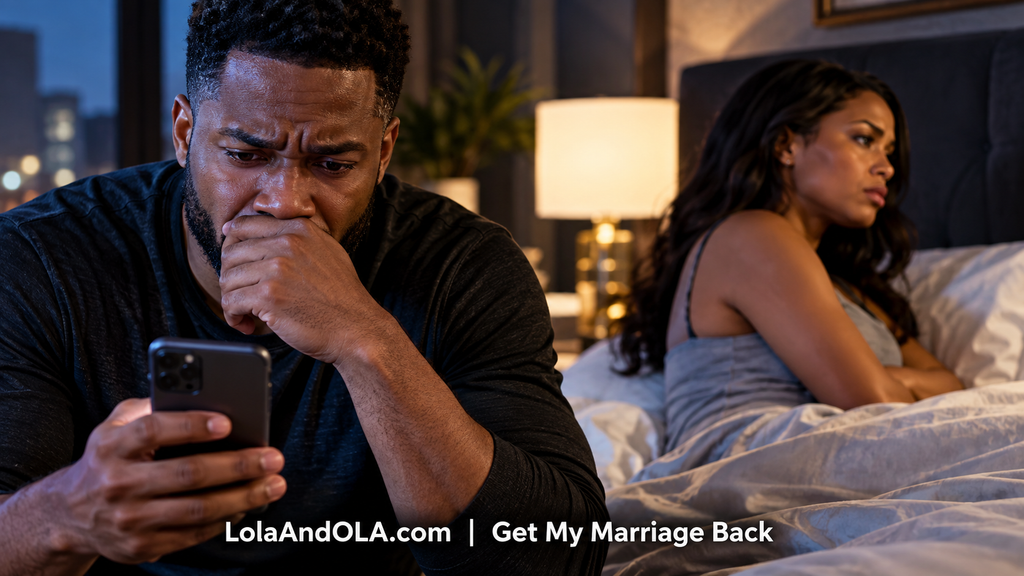
Your wife becomes cold, her energy changes, conversations get shorter, and one suspicious text suddenly seems to explain everything: there must be another man.
Take This 2 Minutes Quiz
That conclusion may eventually prove true. Infidelity happens, and pretending otherwise will not help you save your marriage.
But emotional distance is information—not a conviction.
That distinction matters because when you’re scared of losing your wife, your mind naturally wants to turn uncertainty into certainty. Suddenly, you’re not simply noticing changes in her behavior. You’re interpreting everything through the same frightening explanation.
She’s late? Another man.
She’s quiet? Another man.
She turns her phone over? Another man.
She’s irritated because you keep asking questions? Now even her irritation becomes evidence.
Before long, you’re no longer trying to understand reality. You’re defending a conclusion.
What Would Help You Most Right Now?
Choose the option that best matches where you are with your marriage.
My Marriage Is in Serious Trouble
If you're dealing with separation, divorce, loss of attraction, infidelity, intimacy problems, or a spouse who's pulling away, get help looking at what's happening in your specific situation.
Get Personalized Help →
Start With Get My Marriage Back
Get the book and start learning the principles for moving your marriage in a better direction.
Get the Free Book →And that can become extraordinarily destructive when your deeper objective is not merely discovering whether your wife is cheating, but rebuilding a marriage in which attraction, curiosity, respect, trust and emotional connection can exist again.
Signs Your Wife Is Cheating—or Signs Something Is Wrong?
When people look for signs your wife is cheating, they’re usually not beginning from a place of emotional neutrality.
Something has already changed.
Maybe affection disappeared. Sex became infrequent or stopped. She no longer reaches for you. Her phone habits changed. Conversations became functional rather than intimate.
Perhaps she suddenly seems more emotionally alive around everybody except you.
Those changes deserve your attention.
They do not all have the same explanation.
Research on infidelity reflects this complexity. Researchers have examined individual, relationship and contextual variables associated with infidelity rather than identifying one behavioral sign that reliably proves an affair.
That means you need to resist one of the most seductive mistakes in a marriage crisis:
Taking several ambiguous facts and using fear to manufacture the missing pieces.
7 Signs That Can Feel Like Proof of Cheating
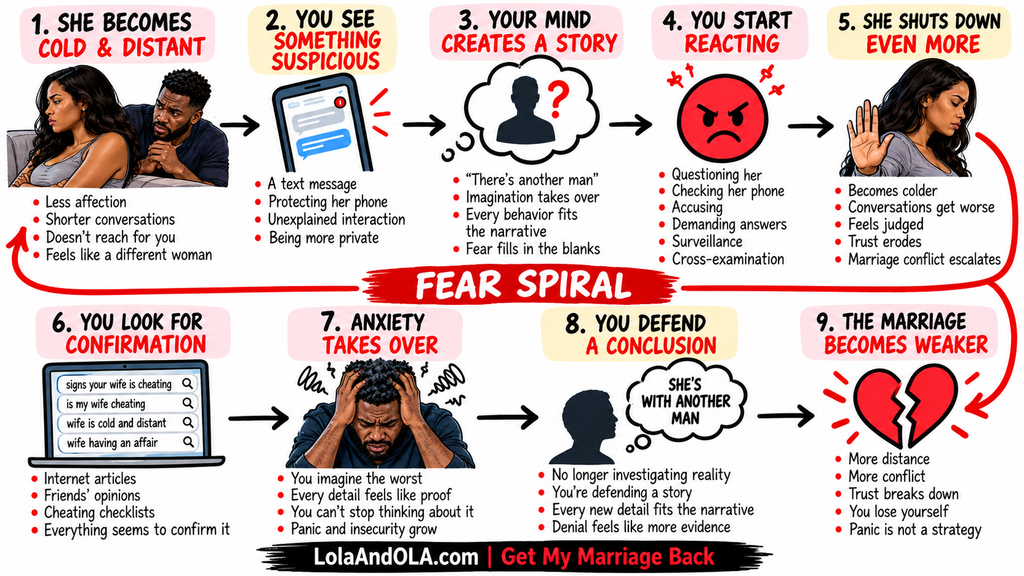
1. Your Wife Suddenly Becomes Cold
This is often the change that destabilizes a spouse first.
You knew how your wife used to look at you. You remember how she responded when you touched her, how she spoke to you and how naturally conversation once flowed.
Now something feels different.
That shift is real even when you cannot yet explain it.
The mistake is turning:
“My wife has become emotionally distant.”
into:
“My wife is emotionally distant because she’s sleeping with someone else.”
The first statement describes your experience.
The second assigns a cause you may not have established.
That gap is where emotional intelligence becomes critical.
2. She Starts Protecting Her Phone
A wife suddenly hiding her phone understandably gets your attention.
Maybe she turns the screen downward. Perhaps she carries it everywhere. Password behavior changes. She appears uncomfortable when messages arrive.
Those behaviors can accompany secrecy.
Still, secrecy and adultery are not interchangeable concepts.
She could be concealing an affair. She could also be discussing your marriage with someone, dealing with something personal, protecting information she doesn’t want you to see, or reacting to a relationship dynamic that has already become distrustful.
Your objective isn’t to become naive.
It’s to become accurate.
3. You Find an Ambiguous Text Message
This is where many people emotionally lose control.
You see a message.
It bothers you.
Nothing in the message independently proves she’s cheating, but once you combine it with months of emotional distance, your brain creates a compelling narrative.
Now the message doesn’t feel ambiguous anymore.
It feels like confirmation.
But confirmation and confirmation bias are not the same thing.
When you’ve already decided what the story means, every new detail starts getting recruited to support it.
That’s dangerous.
4. She Stops Reaching for You
Loss of affection can be devastating because it feels deeply personal.
When your wife once initiated affection, intimacy or sex and suddenly stops, it’s easy to conclude that her desire must be going somewhere else.
Sometimes another relationship is involved.
Other times attraction has deteriorated inside the marriage itself.
Resentment may have accumulated. Emotional exhaustion may have taken over. Repeated conflict could have made closeness feel unsafe or undesirable.
Sometimes the consequences seem sudden because you didn’t experience the buildup the same way she did.
5. She Seems Irritated by Your Questions
Here’s where the situation becomes circular.
You suspect something.
So you ask.
She becomes irritated.
Now her irritation makes you more suspicious.
You ask again, except this time you’re less curious and more prosecutorial.
She becomes even more defensive.
Soon every conversation feels like cross-examination:
“Who’s that?”
“Why did you turn your phone over?”
“Where were you?”
“Why are you acting differently?”
“Just tell me the truth.”
The more she resists the interrogation, the more convinced you become.
You’ve now created a theory that can become almost impossible to disprove.
If she admits it, she’s guilty.
If she denies it, she’s hiding it.
If she’s angry about the accusation, her anger becomes evidence.
At that point, fear is running the investigation.
6. Your Wife’s Withdrawal Seems to Come Out of Nowhere
One of the most important questions isn’t merely, “Is my wife cheating?”
Ask:
“What happened before she became this version of herself with me?”
Consider a marriage where one spouse carries a secret.
Eventually, information about that secret reaches the other spouse, but there’s no immediate confrontation.
Instead, the betrayed spouse withdraws.
She becomes cold.
Distant.
Quiet.
Her husband doesn’t know that she knows what he did, so he experiences her behavioral change without access to its cause.
Ironically, he can start wondering whether she has found somebody else.
Now both spouses occupy the same marriage while living inside radically different versions of reality.
That’s why emotional distance should make you curious before it makes you certain.
Your wife knows things you don’t know.
You know things she doesn’t know.
There may also be things neither of you has properly articulated.
Marriage reconciliation requires learning to distinguish those categories.
7. Everything Starts Looking Like Evidence
This may be the most dangerous sign—not necessarily a sign your wife is cheating, but a sign that fear has taken control of your interpretation.
She’s late.
Evidence.
She’s quiet.
Evidence.
She dresses differently.
Evidence.
She’s angry.
Evidence.
She’s unusually happy.
Somehow that’s evidence too.
Eventually, almost nothing can happen without being incorporated into the affair narrative.
That’s when you need to interrupt yourself.
Ask one brutally simple question:
What do I actually know?
Not what your friend thinks.
Not what an article about cheating spouses told you.
Not what you constructed at 2:00 AM while staring at the ceiling.
What can you independently establish as true?
That is the beginning of Grounding.
Why Panic Makes Marriage Problems Worse
Marriage crises activate old patterns quickly.
One reason is that intense stress can affect how deliberately people respond. Experimental research has found circumstances in which stress shifts behavior toward previously learned habitual responses, although later replication work suggests that this effect is not universal and depends on important conditions.
That nuance matters.
Your stomach dropping when your wife’s phone lights up doesn’t force you to interrogate her.
But your trigger can make familiar behavior feel almost automatic.
The old pattern says:
Check. Ask. Accuse. Pursue. Demand. Monitor.
That’s why intellectual understanding isn’t enough.
You can read ten articles about how to save your marriage and still lose your composure when she turns her phone over tonight.
The skill is learning to create space between what activates you and what you do next.
The research behind this stress-and-habit distinction is worth understanding; this review of stress and habitual versus goal-directed behavior explains how stress has been studied in relation to these competing systems of action.
Your goal is not emotional numbness.
It’s emotional leadership.
Stop Making Your Wife Responsible for Eliminating Your Uncertainty
This is one of the hardest shifts.
You desperately want your wife to make you feel safe.
Tell me there’s nobody else.
Show me your phone.
Promise me you still love me.
Tell me we’re going to be okay.
Answer this one question and I’ll stop asking.
But reassurance obtained under pressure rarely satisfies fear for long.
Your brain simply creates the next question.
Now your wife isn’t experiencing curiosity from you. She’s experiencing your demand that she regulate your emotional state.
That’s rarely attractive.
Attraction is not built by pretending you don’t care. Nor is it built by becoming cold, manipulative or artificially mysterious.
Attraction grows more naturally when your presence stops communicating:
“You must behave correctly so I can be okay.”
How to Build Attraction While Your Wife Is Distant
Your first job is Grounding.
Return to truth that exists independently of tonight’s suspicion.
Next comes Purpose.
Your identity cannot collapse into monitoring another human being, even when that person is your wife and your marriage means everything to you.
Redirect some of that emotional energy toward mission, contribution, impact and legacy.
That doesn’t mean distracting yourself from your marriage.
It means refusing to make your wife’s current emotional temperature the sole measurement of your value.
Then comes Self-Discovery.
Can you experience uncertainty without immediately converting it into accusation, surveillance, begging, revenge, panic or defensiveness?
That’s a serious attraction skill.
Because the person capable of experiencing uncomfortable emotions without dumping responsibility for those emotions onto everyone else creates a fundamentally different relationship experience.
Attraction Isn’t About Becoming Morally Superior
This distinction matters.
You’re not trying to become “better than your wife.”
You’re developing Experiential Value.
Ask yourself:
What does it feel like to be married to me right now?
Does your presence feel like pressure?
Does every conversation eventually become about the relationship?
Are you constantly measuring affection?
Does sex function as proof that everything is okay?
Does a bad mood trigger an investigation?
Or can your spouse experience curiosity, emotional space, groundedness, humor, competence, direction and strength around you?
Experiential Value can create Curiosity.
Curiosity can reopen space for Attraction.
Attraction expands Influence.
Influence creates Leverage—not leverage for controlling your spouse, but leverage in the sense that the relationship is no longer entirely organized around resistance, pursuit and fear.
That’s a much more seductive position than desperation.
“But Why Should I Change if She’s the One Cheating?”
You don’t know that yet unless you actually know it.
And if you do have verified evidence of infidelity, your self-development still matters.
Your growth isn’t payment for her behavior.
It’s not an admission of guilt.
You’re focusing on yourself because you’re the only person in this marriage whose thoughts, actions, habits and emotional leadership are directly under your control.
That’s power.
Even confirmed infidelity doesn’t make panic strategic.
It makes clarity even more important.
Research involving couples who entered marital therapy with infidelity histories has found that affair-affected couples can improve, although circumstances surrounding disclosure and the relationship obviously matter.
So “Can marriage be saved after infidelity?” is not answered by one universal yes or no.
The more useful question becomes:
What does this particular marriage require now?
Don’t Confuse Attraction With Ignoring Betrayal
Building attraction does not mean overlooking evidence.
You don’t need to become naive.
You don’t have to tolerate deception.
And emotional intelligence does not require smiling peacefully while somebody violates your boundaries.
If there is real infidelity, deal with real infidelity.
If there isn’t, deal with that reality instead.
What you don’t want to do is convict your wife inside your head and then punish her for a case you haven’t established.
Because whether the affair exists or not, reality matters.
Panic isn’t strategy.
Hope isn’t strategy.
Constantly worrying about another man isn’t strategy either.
The More You Monitor the Rival, the Smaller You Become
Another man—real or imagined—can slowly become the center of your marriage.
You think about him.
Compare yourself to him.
Wonder what he has that you don’t.
Monitor your wife’s behavior for evidence of him.
Eventually, you’re organizing your identity around a person who may not even exist.
That’s the opposite of attraction.
The stronger move is not pretending you don’t care.
It’s refusing to surrender your entire emotional center to competition.
Your mission is bigger than another man.
Your identity is bigger than your wife’s current mood.
Your value is bigger than whether she validates you tonight.
Paradoxically, that’s also the version of you most capable of creating a desirable relational experience again.
Your Wife’s Distance Is Information—Use It Wisely
Something may genuinely be wrong.
Take that seriously.
But don’t confuse seriousness with panic.
Observe what is actually happening. Examine the history of your marriage. Become honest about your own contribution without taking responsibility for another adult’s choices.
If there’s betrayal, face it.
If attraction has collapsed, understand why.
When resentment has accumulated, address the pattern that created it.
And when fear has turned you into a detective, recognize that pattern too.
You don’t save a marriage by becoming better at monitoring your spouse.
You give yourself a better chance by becoming increasingly capable of handling reality—especially when reality isn’t giving you immediate answers.
That is where emotional intelligence becomes attractive.
That is where personal power begins returning.
And that is how you stop allowing the fear of another person to become the most influential person in your marriage.
Wife or Husband Denying You Sex? DO THIS!!!
Frequently Asked Questions
Sudden secrecy, unexplained changes in availability, emotional withdrawal and changed phone behavior can raise legitimate questions, but no single behavior independently proves infidelity. Look for verifiable facts and meaningful patterns rather than treating ambiguous behavior as a conviction.
Emotional distance can accompany an affair, but it can also emerge from resentment, attraction loss, exhaustion, unresolved conflict or information your spouse has not disclosed. The timing and history surrounding the behavioral change matter.
A legitimate conversation is different from an interrogation based on a conclusion you’ve already reached. Ground yourself in what you actually know so your questions seek information rather than demanding a confession.
Some couples do reconcile after infidelity, and research on couples receiving marital therapy has documented improvement among affair-affected couples under some circumstances. Recovery depends heavily on the specific couple, disclosure, accountability, relationship dynamics and what both spouses do afterward.