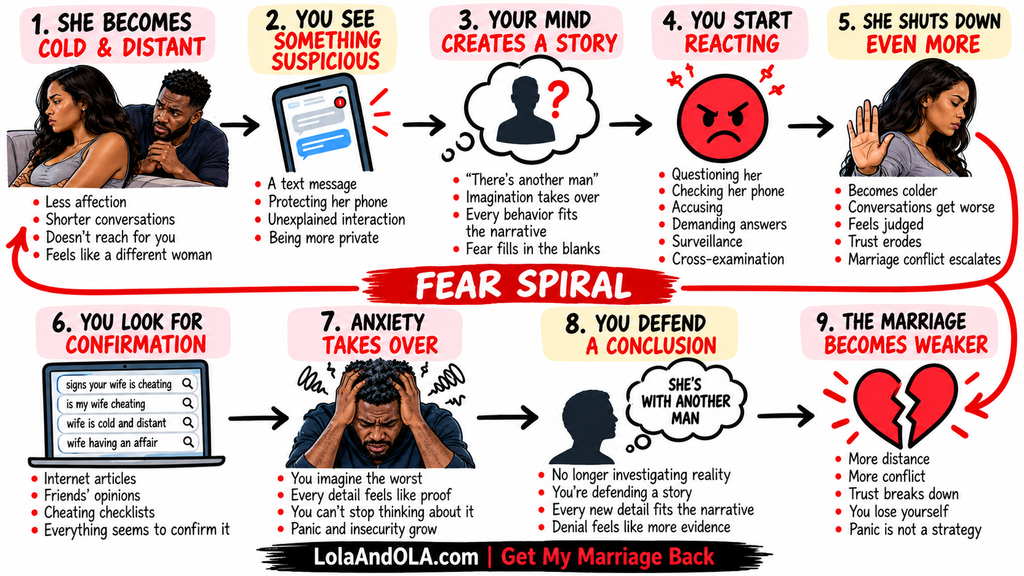


Your wife wants a divorce, and the more desperately you try to defend yourself, prove your point, or save your marriage, the more emotionally distant she becomes.
Take This 2 Minutes Quiz
You may believe the biggest problem is that she no longer trusts you, refuses to communicate, or won’t acknowledge your side of the story.
But I want you to consider something more uncomfortable.
What if your attempts to regain control are making you less attractive to the person you desperately want to keep?
Attraction in marriage is not just about physical appearance, romance, or sexual chemistry. It is also influenced by how someone experiences you emotionally.
Do they feel understood or interrogated? Do they experience steadiness or constant anxiety? Can they disagree with you without being punished for having a different perspective?
When your wife says she wants a divorce, these questions become especially important.
I’m going to show you five mistakes that can damage trust, intensify emotional withdrawal, and weaken attraction. More importantly, you’ll learn how to replace those habits with the emotional intelligence, self-respect, and personal leadership that make genuine reconnection possible.
Why Your Wife Wants a Divorce Even Though You Still Love Her
One of the most painful marriage crises happens when you genuinely love your wife but she experiences your behavior as emotionally exhausting.
You may be trying to get answers, resolve a disagreement, or reassure yourself that your marriage is secure.
Meanwhile, she may experience those same efforts as criticism, surveillance, pressure, or control.
This is where couples begin living in two different emotional realities.
You believe you’re fighting for the marriage. She believes she’s fighting for breathing room.
Neither person’s feelings automatically establish the facts. However, the emotional impact of your conduct matters even when your underlying concern is legitimate.
Consider a husband who becomes suspicious because his wife starts protecting her phone more carefully.
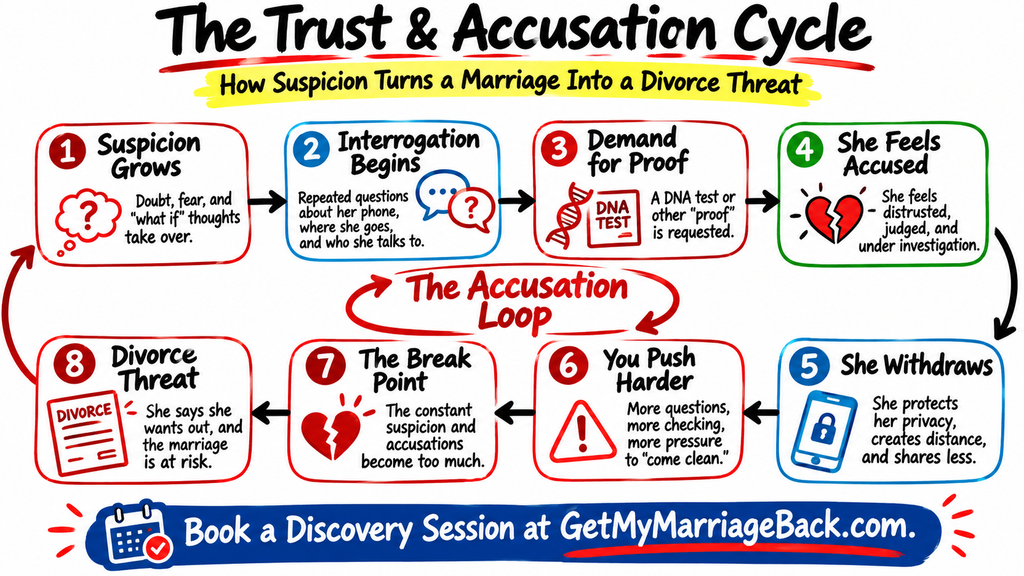
He notices a changed password, a turned screen, and occasional late arrivals. Eventually, he demands a DNA test because he fears their child might not be biologically his.
From his perspective, he’s asking for certainty.
From hers, he’s questioning her fidelity, her integrity, and the identity of their family.
When she threatens divorce, he becomes even more convinced that something must be wrong.
Now the marriage has two separate problems: an unresolved question about trust and an escalating pattern of accusation.
The first problem requires facts. The second requires emotional intelligence.
Confusing those two problems is how many people turn a difficult conversation into a relationship crisis.

Mistake #1: Treating Your Fear Like It’s Already a Fact
When your wife wants a divorce, your mind may become obsessed with explanations.
Perhaps she’s having an affair. Maybe she never loved you. You might even convince yourself that every ordinary change in her behavior confirms your worst fear.
But fear is not evidence.
A locked phone is an observation. Concluding that she’s hiding another relationship is an interpretation.
A late arrival is an event. Deciding that it proves infidelity is a separate judgment.
You must learn to distinguish what happened from what you believe it means.
How to separate facts from fears
Create three categories:
- What I know: Specific, observable events or verified information.
- What I suspect: Interpretations that have not been established.
- What I still need to understand: Legitimate questions requiring a proportionate response.
This simple distinction changes how you communicate.
Instead of saying, “You’re obviously hiding something,” you can identify the actual concern without presenting suspicion as a conviction.
That doesn’t require you to abandon your judgment or ignore genuine inconsistencies.
It requires intellectual discipline.
Why emotional discipline builds attraction
Someone who can tolerate uncertainty without becoming aggressive communicates inner stability.
That stability matters because attraction is difficult to nurture when every interaction feels like an emergency.
Your spouse should not have to manage your anxiety before discussing the actual issue.
I want you to develop the capacity to experience a difficult emotion without immediately converting it into a demand.
That is a practical form of confidence.
And confidence rooted in self-control is far more compelling than confidence performed through intimidation.
Mistake #2: Confusing Privacy With Proof of Cheating
A marriage requires honesty, but honesty does not mean surrendering every personal boundary.
Privacy and secrecy are different.
Privacy protects reasonable personal space. Secrecy involves intentionally concealing something material to the relationship.
The distinction depends on behavior, agreements, and context—not simply whether you can access someone’s phone.
Imagine your wife changes her password.
You ask why. She says she needs privacy.
You interpret that response as evidence of an affair.
When she becomes angry, you decide her anger proves guilt. If she explains herself calmly, you assume she rehearsed an excuse.
Notice the trap.
Every possible response now supports your accusation.
She cannot answer her way out of a conclusion you’ve already reached.
The question that exposes the problem
Ask yourself:
“Is there any answer my wife could give that I would genuinely consider?”
If the answer is no, you’re no longer investigating a concern with an open mind.
You’re seeking confirmation for a belief.
That behavior can destroy emotional safety because your spouse begins to experience conversation as a trial rather than a connection.
What makes you more attractive instead?
Develop discernment.
You can have standards without becoming controlling. You can expect honesty without demanding unrestricted access to every private interaction.
When you have concrete evidence of deception, address it specifically and respectfully.
If you don’t have evidence, stop treating discomfort with surveillance as a confession.
An emotionally intelligent person knows the difference between having boundaries and trying to dominate another person’s boundaries.
That distinction preserves both dignity and the possibility of intimacy.
Mistake #3: Defending Your Intentions While Dismissing Her Experience
This is one of the biggest mistakes people make when trying to save a marriage from divorce.
You explain what you meant.
Your wife explains how it affected her.
Instead of acknowledging her experience, you repeat your intentions more forcefully.
You might say:
“I was only asking a question.”
“I have a right to know.”
“If you’re innocent, why are you so upset?”
These statements may express genuine concerns, but they can also communicate that her emotional experience is irrelevant.
Here’s the distinction I want you to understand:
You can have a legitimate question and still handle that question badly.
A DNA test can establish biological paternity. It cannot establish whether your spouse feels respected, understood, or emotionally secure in the marriage.
Those are separate matters.
Acknowledgment is not surrender
Suppose you tell your wife:
“I understand why that question felt like an accusation. I can see that the way I approached you was hurtful. I still need to understand my concern, but I don’t want to keep treating you like you’re already guilty.”
That is different from either attacking her or pretending you no longer have questions.
You’re acknowledging two emotional realities at the same time.
Your feelings matter. Hers do too.
This ability to recognize another person’s experience without erasing your own is a cornerstone of emotional maturity.
Why responsiveness matters to attraction
Research on romantic relationships offers an important insight here.
A series of three studies published in the Journal of Personality and Social Psychology found that perceived partner responsiveness was associated with greater sexual desire, particularly among women.
The researchers examined how feeling understood, valued, and cared for relates to attraction and desire. Their findings support the importance of partner responsiveness in romantic desire.
This doesn’t mean you should manufacture empathy as a technique for getting affection.
Quite the opposite.
Your responsiveness must become part of your character rather than a performance designed to produce an immediate reward.
People notice the difference between genuine understanding and strategic agreement.
The seductive quality of emotional intelligence is that your spouse can feel seen without feeling managed.
Mistake #4: Turning Your Marriage Into an Investigation
One question becomes five.
Your wife withdraws.
You feel rejected, so you ask again.
She becomes frustrated and mentions divorce.
Now you panic, send a long message, demand another conversation, or follow her around trying to settle everything immediately.
The cycle becomes predictable.
Suspicion → Interrogation → Withdrawal → Panic → More Interrogation.
Eventually, the marriage starts feeling like a courtroom.
You become the investigator, your spouse becomes the suspect, and ordinary affection disappears beneath the pressure to defend or prosecute.
Why pursuing harder can push her away
When someone feels emotionally overwhelmed, more questions may increase the urge to withdraw.
That withdrawal can then intensify the other partner’s fear of abandonment.
Relationship research has examined this demand-withdraw pattern for decades, finding associations between demanding or withdrawing behaviors and lower relationship satisfaction.
The practical lesson is straightforward: escalating pursuit does not necessarily create understanding.
Sometimes it creates the very distance you’re trying to eliminate.
Interrupt the cycle without abandoning the relationship
The next time a conversation becomes heated, notice what is happening inside you.
Are you trying to establish a fact, or are you trying to eliminate anxiety through your spouse’s immediate compliance?
Those are different objectives.
If you need a specific answer about an important issue, pursue it through an appropriate, lawful, respectful process.
Don’t grab her phone, demand passwords through intimidation, involve relatives to pressure her, or turn social media into a jury.
When children or paternity concerns are involved, their privacy and well-being also matter.
You can say:
“I don’t want this conversation to become another interrogation. I need some time to collect my thoughts, and I’d rather discuss the actual issue when we can both think clearly.”
Then follow through.
Avoid using the pause as a punishment or as a way to make her chase you.
The attraction shift: Become emotionally steady
There is something deeply appealing about a person who can remain grounded during an uncomfortable moment.
They don’t need to win every argument.
Their self-worth doesn’t collapse because someone disagrees with them.
They can listen, reflect, and make decisions without turning every disagreement into a test of loyalty.
This is the kind of steadiness I want you to cultivate.
Not coldness. Not indifference. Not emotional suppression.
Calm strength with genuine emotional availability.
That combination makes room for curiosity, respect, and renewed connection.
Mistake #5: Demanding Forgiveness Before Demonstrating Change
When your wife wants a divorce, you may become desperate for a sign that things are improving.
You apologize and immediately ask whether she’s forgiven you.
After one peaceful evening, you want to know whether she’s reconsidered the divorce.
When she remains distant, you feel that your effort has been rejected.
But rebuilding trust is not a transaction.
You cannot deposit one apology and demand affection as the withdrawal.
Attraction responds to lived experience
Imagine the husband who demanded a DNA test begins changing his behavior.
He stops monitoring every movement. He no longer disguises repeated accusations as innocent questions.
Instead of obsessing over every unanswered concern, he becomes more deliberate about how he responds to uncertainty.
He keeps his commitments, maintains his daily responsibilities, and develops a life that is not organized around checking his wife’s emotional temperature.
These actions matter because they change what living with him feels like.
His wife no longer has to anticipate an interrogation every time she puts down her phone.
Conversations can gradually become less defensive.
That creates an opportunity for warmth to return.
How to rebuild attraction without chasing
I teach this through five interconnected shifts.
Ground yourself. Learn to regulate your reactions before trying to influence someone else’s behavior.
Reconnect with purpose. Maintain meaningful responsibilities, friendships, health, and personal direction beyond the current marriage conflict.
Discover your patterns. Examine the insecurity, assumptions, and emotional habits that repeatedly turn disagreement into confrontation.
Build value through consistency. Become someone whose conduct communicates reliability, respect, and emotional maturity.
Allow curiosity to emerge. Give your spouse room to notice real change without demanding immediate recognition.
The final point is especially important.
You cannot force someone to feel attracted to you.
But you can stop behaving in ways that repeatedly extinguish attraction.
And you can build the qualities that make closeness more inviting.
How to Be Seductive Again When Your Wife Is Emotionally Distant
Seduction in a troubled marriage is often misunderstood.
People imagine grand romantic gestures, carefully timed compliments, gifts, or sexual advances.
Those gestures may have their place in a healthy relationship.
During a divorce crisis, however, they can feel like another form of pressure when the underlying conflict remains unresolved.
I want you to think about seduction differently.
Seduction begins with becoming someone your spouse can approach freely.
That means you create emotional room rather than demanding access.
You show interest without interrogating. You express warmth without requiring reciprocation.
When your wife needs space, you respect it without turning the moment into a dramatic rejection.
If she shares something vulnerable, listen without immediately correcting her.
And when a disagreement arises, let your self-control speak louder than your frustration.
Emotional intelligence creates a different atmosphere
Attraction is influenced by the emotional atmosphere of a relationship.
A spouse who expects criticism may become guarded.
Someone who anticipates pressure may avoid intimacy because affection feels like the beginning of another obligation.
By contrast, feeling understood and respected can make emotional closeness more appealing.
Studies of couples have associated perceived responsiveness with intimacy and affectionate touch, while research on conflict-day interactions has linked greater responsiveness with higher daily sexual satisfaction and desire.
These findings reinforce a principle worth remembering: the way you treat your spouse outside romantic moments influences the emotional meaning of those moments.
You cannot separate everyday conduct from intimacy.
Keep your dignity while becoming more inviting
Don’t beg for attraction.
Avoid performing confidence through jealousy, emotional withdrawal, or threats.
You don’t need to become mysterious by refusing to communicate.
Instead, become less reactive, more purposeful, and more comfortable with yourself.
Take care of your appearance because you respect yourself.
Pursue meaningful goals because your life has direction.
Express affection when it’s welcome, and respect a lack of interest without retaliating.
A spouse who feels free to say no is in a better position to offer a genuine yes.
That freedom is essential to mature attraction.
What to Do Tonight When Your Wife Goes Quiet Again
Imagine your wife is sitting nearby.
She places her phone face down.
You feel the familiar tension rising.
Your mind begins creating explanations, and you feel tempted to ask another question.
This is where your real work begins.
Relax your shoulders.
Notice the fear without treating it as an instruction.
Remember that you do not need to resolve every uncertainty in the next thirty seconds.
If there’s an unresolved concern, choose an appropriate time to discuss it directly.
For now, allow an ordinary moment to remain ordinary.
Don’t follow her into another room to continue an argument.
Avoid saying, “If you have nothing to hide, prove it.”
Give her space without making a spectacle of how much space you’re giving.
That single choice will not repair months of conflict, but it interrupts the behavior that keeps reinforcing the same emotional distance.
Every time you respond with steadiness instead of panic, you practice becoming a different partner.
And repeated experiences are what allow someone to evaluate whether change is real.
Can You Save Your Marriage When Your Wife Wants a Divorce?
A divorce threat can represent many things.
Sometimes it reflects accumulated resentment. Other times, it follows a specific betrayal, ongoing incompatibility, or years of unresolved conflict.
You cannot determine its meaning by panic or speculation alone.
Start by understanding the actual reasons your wife gives.
Listen carefully enough to distinguish the immediate argument from the longer relationship pattern.
If she says she no longer feels emotionally connected, examine the daily interactions that may have contributed to that distance.
When she describes feeling controlled, look honestly at your behavior instead of debating whether she has the right to feel that way.
If the relationship contains deception or broken agreements, address those facts without confusing accountability with coercion.
And remember that repairing a marriage ultimately requires two people’s voluntary participation.
Your responsibility is to lead your own behavior intelligently.
Stop trying to control the outcome
The more obsessed you become with making your wife change her mind, the easier it is to neglect the personal growth that could improve the relationship.
You may spend hours analyzing her words while ignoring your own conduct.
You might search for reassurance while failing to create experiences that feel reassuring.
Or you could focus on winning an argument while losing the ability to connect.
That is why I want you to redirect your attention.
Stop asking only, “How do I make her stay?”
Begin asking, “What does my behavior make it feel like to be married to me?”
The second question puts your attention where you have genuine influence.
The Real Secret to Rebuilding Trust and Attraction
When your wife wants a divorce, your instinct may be to increase your effort.
More explanations. More promises. More emotional conversations.
But greater effort applied through the same unhealthy patterns often creates more of the same conflict.
What you need is a different quality of behavior.
You need the emotional intelligence to distinguish facts from fears, the discipline to respect boundaries, and the confidence to acknowledge someone else’s pain without abandoning your own legitimate concerns.
You also need patience.
Trust develops through consistent experiences, not a single dramatic speech.
Attraction grows more naturally when a relationship has room for individuality, warmth, mutual respect, and emotional freedom.
So the next time you feel compelled to chase an answer, demand reassurance, or defend yourself at any cost, remember this:
You don’t become more attractive by winning control over your spouse. You become more attractive by developing control over yourself.
That is where your influence begins.
And that is how you create the conditions for a different kind of marriage.
“Wife Makes NO EFFORT In BED” (5 Tips For INSTANT Solution)
Frequently Asked Questions
Listen to her reasons without immediately arguing, threatening, or demanding reassurance. Identify the specific relationship problems she describes and begin addressing the behaviors within your control.
You can improve your conduct, address unresolved problems, and invite constructive conversations, but reconciliation requires your wife’s willingness too. Focus on consistent change rather than pressuring her to reverse her decision.
Rebuild emotional steadiness, respect her boundaries, and demonstrate reliability through daily behavior rather than trying to force romantic feelings. Genuine responsiveness, confidence, and personal purpose can help create an atmosphere where attraction becomes more possible.
Respecting a request for space can reduce pressure and interrupt repeated conflict. Space should not become silent punishment or an excuse to avoid necessary conversations about children, responsibilities, or important decisions.