

You reach for your wife, and she brushes you off. You try to be affectionate, and she acts like you’re bothering her.
Take This 2 Minutes Quiz
Your wife hasn’t asked for a divorce. She’s still living in the house, raising children with you, paying bills, and participating in family responsibilities.
Everything looks like a marriage.
Except you’re living like roommates.
The affection that once came naturally now feels forced. Your wife rarely initiates intimacy, and even simple gestures of affection seem to irritate her.
You remember when she couldn’t wait to spend time with you. Now, you’re wondering whether she even finds you attractive anymore.
And the more you try to reconnect, the further away she seems to move.
Here’s something I want you to understand immediately:
Your wife’s lack of sexual attraction is not necessarily the biggest obstacle to rebuilding your marriage. Your reaction to that rejection can become an even bigger obstacle.
Because rejection breeds obsession.
And when obsession takes over, you begin doing things that make emotional safety, curiosity, and attraction increasingly difficult to experience.
Let’s examine five mistakes that can keep you trapped in that cycle—and what it takes to change the experience you’re creating in your marriage.
1. Mistaking a Marriage Dry Spell for Permanent Rejection
My wife, Lola, and I recently celebrated nineteen years of marriage.
And over those years, we’ve experienced our share of dry spells.
Sometimes life simply gets in the way.
Children, work, bills, family responsibilities, financial pressure, and the ordinary demands of building a life together can gradually push romance into the background.
There have been periods when Lola felt I was too consumed by work.
We’ve also experienced moments when I felt like we were living as roommates rather than romantic partners.
Those experiences taught me something important.
Not every season of reduced affection represents a marriage crisis.
But there’s a significant difference between a temporary dry spell and a deeper emotional disconnection.
A temporary dry spell often develops because life becomes demanding.
A deeper disconnection involves something more.
Resentment accumulates. Arguments remain unresolved. Emotional distance becomes habitual, and physical affection starts disappearing.
Sometimes extended family conflicts contribute to the tension.
Other times, years of disappointment gradually change the emotional experience of being around each other.
When your wife stops showing affection, you naturally notice the physical symptoms first.
She doesn’t initiate sex.
Her kisses become less enthusiastic.
She avoids your touch.
But those behaviors don’t automatically reveal the underlying cause.
Sexual attraction is often influenced by the emotional experience surrounding the relationship—not simply physical appearance or sexual performance.
Before concluding that your wife has permanently lost interest, examine the environment in which that attraction has been disappearing.

2. Allowing Rejection to Become Obsession
Here’s where the situation becomes dangerous.
Your wife rejects your affection.
Immediately, your emotions begin interpreting that rejection.
After everything you’ve sacrificed?
And After everything you’ve built together?
After nineteen years of marriage, how can someone suddenly act like they don’t want you?
And yes, sometimes the situation is genuinely unfair.
But being right about the unfairness doesn’t automatically make your next reaction intelligent.
Rejection creates uncertainty. And uncertainty creates an obsession with restoring certainty.
You want reassurance that your wife still loves you.
Naturally, you want confirmation that she still finds you attractive.
When she refuses to provide that reassurance, your anxiety increases.
You start paying closer attention to her behavior.
Every facial expression becomes significant.
Her tone of voice becomes evidence.
A rejected hug can ruin your entire evening.
Before long, your emotional stability becomes dependent on whether she responds positively to your next attempt at affection.
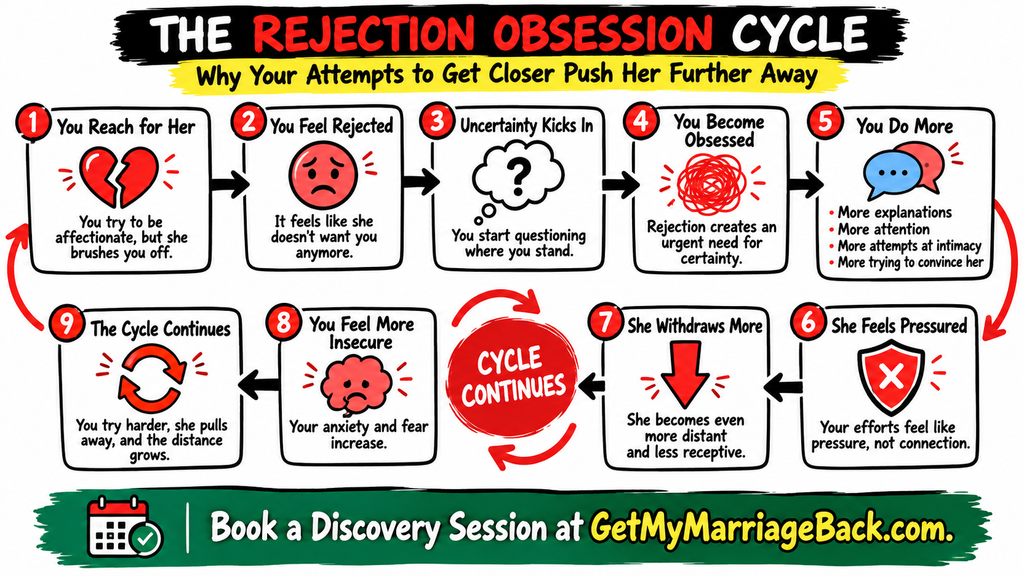
That’s the rejection-obsession cycle.
The more rejected you feel, the harder you pursue reassurance.
Unfortunately, the harder you pursue reassurance, the more pressure your wife experiences.
She withdraws further.
And her withdrawal produces even more obsession.
The problem is no longer just the absence of affection. It’s the emotional pressure surrounding every attempt to restore it.
3. Trying to Recreate Attraction Through More Pursuit
Think about how your relationship began.
You probably demonstrated romantic interest.
And You pursued your wife.
You made an effort to spend time together, express affection, and create experiences she enjoyed.
Those behaviors helped establish your romantic connection.
So when that connection disappears, your instincts tell you to do more of what worked before.
More attention.
And More compliments.
More romantic gestures.
And More conversations about your feelings.
More attempts to initiate intimacy.
But there’s a fundamental difference between pursuing someone who welcomes your romantic interest and repeatedly approaching someone who is emotionally withdrawing.
What feels like romantic effort to you can feel like emotional pressure to her.
This doesn’t mean affection is wrong.
It means attraction depends partly on how affection is experienced.
A romantic gesture that once communicated love can begin communicating expectation.
A conversation intended to restore closeness can become another demand for reassurance.
Even an expensive gift can create discomfort when your wife senses that something is expected in return.
What Research Reveals About Attraction
A 2016 study published in the Journal of Personality and Social Psychology examined the relationship between perceived partner responsiveness and sexual desire.
Across three studies, researchers found that feeling understood, valued, and cared for was associated with greater sexual desire, particularly among women.
The researchers also identified feeling special and perceiving one’s partner as desirable as important mechanisms.
You can examine the research on partner responsiveness and sexual desire for the underlying findings.
This supports an important distinction.
Attraction is influenced by the experience you create, not simply the amount of effort you demonstrate.
Additional relationship research has found positive associations between perceived partner responsiveness, affectionate touch, and intimacy.
That doesn’t mean emotional responsiveness automatically produces sexual desire.
It means the quality of the relational experience deserves attention before you assume that more romantic pursuit is the answer.
4. Believing Personal Improvement Entitles You to Intimacy
I once worked with a man whose marriage had experienced an extraordinary level of betrayal.
He had committed serial infidelity.
His behavior had caused tremendous damage, including circumstances in which his wife required treatment for an infection.
Eventually, she emotionally withdrew from the marriage.
She wasn’t asking for divorce.
According to him, she was remaining in the household primarily because of the children.
But she had made one thing clear.
She never wanted him to touch her again.
Now, here’s where most people become distracted.
They immediately start looking for a way to change her mind.
But her determination to never touch him again was irrelevant to the work he needed to do on himself.
Not because her decision didn’t matter.
Her boundaries absolutely mattered.
The point is that his responsibility wasn’t to negotiate her decision or pressure her into reconsidering it.
His responsibility was to address the behavior that had destroyed emotional safety.
When Personal Transformation Becomes Entitlement
This man experienced what he described as a spiritual transformation.
He found God.
He believed he had become a different person.
And he genuinely wanted to repair his marriage.
But for approximately two years, he repeatedly tried to convince his wife that his transformation should change how she treated him.
He wanted recognition for becoming a better man.
He expected renewed affection.
His belief was that because they had committed to a lifetime together, she should give him another opportunity.
Unfortunately, his attempts to prove that he had changed became another source of pressure.
His declaration of change was not the same thing as her experience of safety.
That’s the distinction I want you to understand.
You can become more religious.
And You can work harder.
You can become more responsible.
And You can provide more financially.
But none of those improvements automatically changes the emotional experience your wife associates with you.
And when you demand affection as evidence that your personal improvement is working, you turn your growth into an invoice she is expected to pay.
This is particularly damaging when the marriage has experienced betrayal, cheating, or prolonged resentment.
Your wife needs the freedom to evaluate your behavior without being pressured to reward it.
Real transformation becomes influential when it can be experienced consistently—not when it is repeatedly announced.
5. Trying to Control Her Feelings Instead of Developing Your Influence
When your wife emotionally withdraws, your instincts naturally focus on the external situation.
You want to fix her mood.
And You want to change her response.
You want to convince her that you’re still desirable.
And you want her to understand why she should reconnect.
But this is where you begin surrendering your personal power.
Because you’re attempting to control something that belongs to another human being.
Influence begins where the need to control ends.
That distinction changes how you approach marriage reconciliation.
Control attempts to produce a particular response.
Influence develops through the quality, consistency, and emotional intelligence of your behavior.
When you become less defensive, more emotionally grounded, and more intentional about the experiences you create, your presence begins communicating something different.
Your wife no longer has to experience every interaction as an attempt to extract affection.
She can observe your behavior without being required to immediately validate your improvement.
And that creates room for a different kind of relational experience.
Emotional Safety Comes Before Romantic Reconnection
Consider what happens when your wife rejects a simple gesture of affection.
Your old response involves questioning her, becoming visibly frustrated, or withdrawing into resentment.
She learns that rejecting affection produces an uncomfortable emotional consequence.
Eventually, even innocent gestures can become associated with pressure.
Now consider a different response.
You recognize the rejection without making it the center of your identity.
Instead of interrogating her, you respect the boundary and continue conducting yourself with dignity.
Your emotional stability remains intact.
Over time, your consistent behavior communicates that she can interact with you without being responsible for regulating your emotions.
That’s emotional intelligence in action.
Emotional safety isn’t something you demand. It’s something your behavior helps establish.
And emotional safety creates better conditions for curiosity, warmth, and attraction to develop.
How to Rebuild Attraction Without Begging for Affection
Here’s what I want you to do.
Stop treating your wife’s immediate response as the ultimate measurement of your personal value.
Your responsibility is to develop the emotional capacity and behavioral consistency necessary to create a different experience.
I teach this through three foundational principles: Grounding, Purpose, and Self-Discovery.
Grounding: Stop Allowing Rejection to Define You
Grounding means returning to a source of truth greater than your wife’s immediate emotional response.
Her rejection is real.
The pain matters.
But that moment doesn’t determine your identity, dignity, or capacity for personal growth.
When you become grounded, you stop treating every interaction as an emergency requiring immediate resolution.
You can experience disappointment without becoming reactive.
And you can respect your wife’s boundaries without interpreting them as a personal catastrophe.
Purpose: Become Bigger Than the Marriage Crisis
Your marriage matters.
But your purpose must extend beyond the approval of any individual person.
Reconnect with your mission.
Examine the impact you want to create.
Consider your contribution to your family, community, career, and the legacy you intend to build.
Purpose redirects emotional energy away from obsessive monitoring of your wife’s behavior.
It also makes your life more engaging.
A person who is meaningfully engaged with life creates a different experience from someone whose entire emotional existence revolves around receiving reassurance.
Attraction is not built by abandoning your identity to obtain someone else’s approval.
Self-Discovery: Reclaim Your Capacity for Influence
Self-Discovery means examining your emotional patterns without collapsing into self-blame.
Notice what rejection triggers in you.
Do you become defensive?
And Do you overexplain?
Do you initiate arguments?
Do you attempt to purchase affection through gifts or favors?
Perhaps you withdraw emotionally to punish your wife for not responding.
These patterns deserve examination because they influence the experience you create.
The objective is not to become emotionally indifferent.
It’s to develop the capacity to express interest without desperation and experience rejection without losing self-control.
The Attraction Chain: Value, Curiosity, Influence, and Leverage
There’s another distinction that matters when you’re trying to save your marriage.
Being a morally good person and creating an attractive relational experience are not identical.
You can be hardworking, loyal, responsible, and generous while still creating interactions dominated by anxiety, resentment, or emotional pressure.
Experiential value concerns what another person experiences in your presence.
Do your interactions create unnecessary tension?
Can you remain warm without demanding affection?
Are you capable of humor, confidence, emotional regulation, and genuine interest without attaching hidden expectations?
Those qualities influence the relational environment.
And when your wife begins experiencing something different from the patterns she has come to expect, curiosity becomes possible.
Curiosity is closely connected to attraction because it creates renewed interest.
That interest can support influence.
Influence becomes leverage when your consistent behavior creates value without demanding an immediate return.
Leverage isn’t permission to manipulate your wife.
It is the personal capacity to contribute meaningfully to the relationship while remaining grounded in your own dignity.
That’s how you pursue reconciliation without turning your wife into a project you must control.
Why Knowing What to Do Isn’t Enough
Now imagine tonight.
You approach your wife affectionately.
She pulls away.
Immediately, your chest tightens.
The familiar thoughts return.
You want an explanation.
And You want reassurance.
You want to remind her of everything you’ve done.
And suddenly, the emotional understanding you’ve developed becomes difficult to apply.
That’s habit drift.
Research on habitual behavior shows that familiar environmental cues can activate automatic responses, particularly when established routines are strong.
Your reaction to rejection can become one of those routines.
The solution requires more than understanding the problem intellectually.
It requires repeated behavioral practice.
You need to recognize the emotional trigger, interrupt your established reaction, and consistently choose behavior aligned with the person you’re becoming.
That’s how emotional intelligence becomes a skill rather than an idea.
Can You Save Your Marriage When Your Wife Has Lost Attraction?
Yes, attraction can change throughout a long-term marriage.
But the path forward begins with understanding the difference between restoring affection and creating the conditions that make affection desirable.
Your wife isn’t a problem to solve.
Her emotional response isn’t something you can manufacture.
And her physical boundaries aren’t obstacles to overcome through persistence.
The meaningful work begins with your own behavior.
Stop attempting to extract intimacy through persuasion.
Develop emotional stability that doesn’t depend on constant reassurance.
Address the patterns that have contributed to resentment, insecurity, or disconnection.
Build a life characterized by purpose, confidence, and emotional intelligence.
Most importantly, understand that becoming more attractive is not simply about becoming a better person on paper.
It’s about becoming someone whose presence creates a better experience.
That’s where emotional safety develops.
That’s where curiosity becomes possible.
And that’s where attraction has room to grow.
Wife or Husband Denying You Sex? DO THIS!!!
Frequently Asked Questions
Sexual attraction can decline because of accumulated resentment, emotional disconnection, chronic stress, health changes, relationship dissatisfaction, or pressure surrounding intimacy. Understanding the underlying pattern is more useful than assuming her rejection has one simple explanation.
Yes, emotional attachment, commitment, and sexual attraction are related but distinct experiences. Your wife can care deeply about you while experiencing little romantic or sexual desire.
Respect her boundaries, avoid demanding reassurance, and examine whether your response to rejection creates additional emotional pressure. Focus on emotional regulation, personal purpose, and consistent behavior that supports trust and emotional safety.
Yes, sexual desire can change over time, and research associates intimacy and perceived partner responsiveness with greater desire. Rebuilding attraction begins with improving the relational experience rather than pressuring your wife to demonstrate affection.