

Your wife used to initiate intimacy, and now she doesn’t—and after enough rejection, it can stop feeling like a change in your sex life and start feeling like evidence about your marriage.
Take This 2 Minutes Quiz
Maybe she used to touch you first. She kissed you without prompting, flirted with you, initiated sex, reached across the bed, or made it obvious that she wanted you.
Now you are usually the one making the first move.
Sometimes she responds. Other times she rejects you. Eventually, you may stop trying because another rejection feels worse than going without sex.
Then your mind starts filling in the blanks.
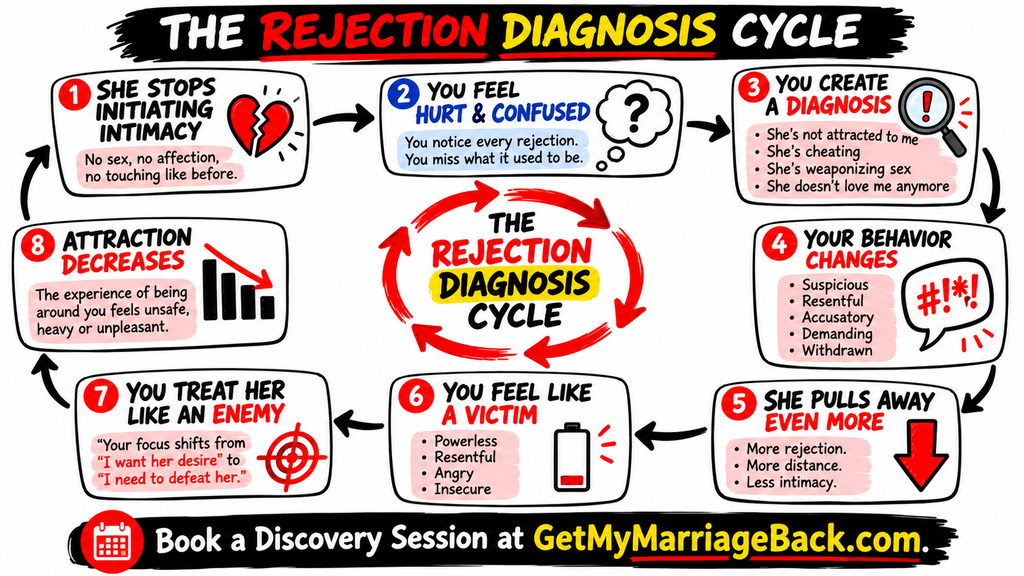
“She isn’t attracted to me anymore.”
“She must be interested in somebody else.”
“She’s withholding sex because she knows I want it.”
“She doesn’t love me.”
What Would Help You Most Right Now?
Choose the option that best matches where you are with your marriage.
My Marriage Is in Serious Trouble
If you're dealing with separation, divorce, loss of attraction, infidelity, intimacy problems, or a spouse who's pulling away, get help looking at what's happening in your specific situation.
Get Personalized Help →
Start With Get My Marriage Back
Get the book and start learning the principles for moving your marriage in a better direction.
Get the Free Book →“She’s checked out of the marriage.”
Any one of those explanations could conceivably be true. The mistake is deciding that one of them must be true before you actually understand what changed.
When your wife never initiates intimacy, the withdrawal is information.
Your interpretation of the withdrawal is something different.
That distinction can determine whether you skillfully rebuild attraction—or accidentally create even more distance.
Why It Hurts When Your Wife Never Initiates Intimacy
This problem is deeper than frequency.
Most distressed spouses aren’t simply saying, “I want more sex.”
What they really mean is:
“I want to feel wanted by my wife.”
There is a massive emotional difference between having sex with somebody who reluctantly agrees and experiencing genuine desire from somebody who actively comes toward you.
You want the look.
The touch.
The spontaneity.
The feeling that she chose you rather than merely accommodated you.
When that disappears, the loss can hit your confidence, masculinity, identity, and sense of security inside the marriage.
Research supports the idea that differences between desired and actual sexual frequency can matter relationally. A study of 1,054 married couples found that greater sexual desire discrepancy was generally associated with lower relationship satisfaction and stability and greater conflict; the researchers also found particularly strong negative communication associations when husbands reported larger discrepancies between desired and actual sexual frequency. You can review the published study on sexual desire discrepancy among married couples.
So yes, the problem matters.
But that does not mean your first explanation for it is correct.

1. Her Sexual Desire May Have Changed
Sometimes the simplest explanation deserves consideration first.
Desire can change.
Pregnancy, childbirth, exhaustion, physical discomfort, hormonal changes, medication, stress, aging, parenting demands, sleep deprivation, illness, emotional overload, and other circumstances can influence somebody’s sexual experience.
I learned this personally in my own marriage.
After our second baby, my wife experienced a drop in libido. Instead of leaving me to invent an explanation, she communicated what she was experiencing and took the initiative to seek medical insight.
We investigated it together.
Interestingly, figuring out the loss of intimacy became an intimate experience itself.
That taught me something I want you to remember:
A change in sexual behavior is real.
Your interpretation of that change is not automatically reality.
When your wife doesn’t want sex anymore, jumping immediately from “her libido changed” to “she no longer desires me as a man” can transform a problem the two of you might navigate together into a personal indictment.
2. Attraction May Have Declined
We also shouldn’t hide from the possibility you probably fear most.
Yes, attraction can decline in marriage.
Nobody experiences exactly the same emotional and sexual intensity every day for decades.
Conflict can affect attraction. Resentment can affect it. Familiarity without curiosity can affect it. The experience of being around each other can change.
Sometimes a spouse has become emotionally predictable in ways that reduce intrigue.
Other times pressure has slowly replaced playfulness.
Perhaps every affectionate touch now carries an expectation of sex, so ordinary physical affection no longer feels emotionally free.
The critical distinction is this:
Reduced attraction does not automatically mean attraction is permanently gone.
Attraction is responsive to experience.
That means your question should eventually move beyond:
“Why won’t my wife initiate sex?”
A more useful question is:
“What does it currently feel like to experience me?”
That question can sting.
It can also give you somewhere productive to go.
3. Unresolved Conflict May Be Showing Up in the Bedroom
A bedroom problem isn’t always born in the bedroom.
Imagine months of criticism, defensiveness, tension, arguments, unresolved disappointment, pressure, resentment, or emotional disconnection.
Then bedtime arrives.
You suddenly want tenderness, openness, vulnerability, affection, and sexual energy.
Those two experiences don’t always coexist easily.
Your wife may love you while simultaneously experiencing unresolved negative emotions around you.
Likewise, a husband can love his wife while feeling rejected, resentful, lonely, and unwanted.
When the emotional climate changes, sexual behavior can change with it.
That doesn’t make sex a reward for perfect behavior.
It means intimacy exists inside a larger relational experience.
4. She Could Be Withholding Sex—But Don’t Diagnose Motive From Symptoms
Can people weaponize sex?
Of course.
Human beings have used money, attention, affection, access, status, children, silence, approval, and sexuality manipulatively.
Pretending manipulation never happens would be naive.
The dangerous leap happens here:
Symptom: My wife stopped initiating.
Diagnosis: Therefore, she is manipulating me.
Or:
Symptom: She rejected me.
Diagnosis: Therefore, she is cheating.
Or:
Symptom: She doesn’t touch me anymore.
Diagnosis: Therefore, she doesn’t love me.
You’ve moved from observing behavior to claiming certainty about motive.
That certainty feels powerful because uncertainty hurts.
Unfortunately, false certainty can make you confidently destroy what you are trying to rebuild.
5. Your Fear of a Cheating Spouse Can Become Part of the Problem
When intimacy disappears, another person is one of the first possibilities many distressed spouses consider.
That possibility becomes even louder when friends, relatives, social media, and online commentary repeatedly tell you:
“She must be getting it somewhere else.”
Perhaps an affair exists.
Perhaps it doesn’t.
Unless you have evidence, suspicion is still suspicion.
More importantly, notice what believing the accusation prematurely does to you.
You become watchful.
Your questions become interrogations.
Normal behavior starts looking suspicious.
Resentment enters your tone.
Coldness becomes self-protection.
Suddenly, you’re no longer interacting with your wife as the woman whose desire you want to experience.
You’re interacting with an enemy.
Think about that contradiction.
You want her to desire you while experiencing her as somebody you need to defeat.
That’s a terrible environment for attraction.
6. Sexual Rejection Can Turn Your Marriage Into Villain Versus Victim
Repeated rejection hurts.
Pain naturally wants an explanation.
Once you decide your wife is deliberately depriving, betraying, manipulating, or humiliating you, something psychologically convenient happens:
You become the victim.
Now somebody else has to become the villain.
From there, almost anything can feel justified.
Sulking feels justified.
Pressure feels justified.
Interrogation feels justified.
Punishment feels justified.
Constantly demanding an explanation feels justified.
Begging for reassurance may even feel justified.
Yet none of those behaviors necessarily creates what you actually want.
Remember, the objective isn’t simply to secure sexual compliance.
You want genuine desire.
Pressure might produce capitulation.
It cannot manufacture authentic attraction.
7. She May Not Even Fully Understand Why Her Desire Changed
This is one of the most overlooked possibilities.
You may be demanding an answer from somebody who doesn’t completely understand the answer herself.
“Why don’t you want me?”
“Are you still attracted to me?”
“What’s wrong?”
“Is there somebody else?”
“Why did you change?”
Those questions can sound reasonable from inside your pain.
But imagine being repeatedly required to provide a definitive explanation for a feeling you haven’t fully processed yourself.
She may know that something feels different without yet understanding why.
This is another reason emotional intelligence matters.
You need enough internal stability to investigate reality without forcing your preferred explanation onto it.
Stop Making Her Desire the Measurement of Your Identity
Here’s where attraction work becomes personal.
Your wife’s desire matters to you.
It should not become the measurement of your identity.
Those are different statements.
When your identity depends on her sexual response, every rejection becomes an emergency.
You initiate.
She says no.
Now you’re not simply disappointed.
You’re destabilized.
You need reassurance.
And you need an explanation.
You need her to prove that you’re still desirable.
The pressure intensifies precisely when pressure is least seductive.
Ground yourself first.
Her rejection is information.
It is not your source of truth about your worth.
Redirect the Energy You’re Burning on Her
How much mental energy are you spending analyzing your wife?
Her facial expression.
How she hugged you.
Whether she kissed you properly.
Why she rolled over.
How long she spent on her phone.
Whether she seemed excited to see you.
Why she rejected you Tuesday but seemed cheerful Wednesday.
That constant monitoring can turn your marriage into a laboratory and your spouse into a specimen.
Redirect some of that energy toward purpose.
Build.
Create.
Contribute.
Strengthen your body, work, mission, friendships, parenting, character, interests, competence, and impact.
This is not about pretending you don’t care about your marriage.
Quite the opposite.
You’re refusing to make the marriage carry the entire weight of your identity.
A grounded spouse brings a different energy into a room than somebody silently begging to be validated.
Use Rejection for Self-Discovery, Not Self-Blame
Now look inward without turning the exercise into shame.
Ask:
What is this rejection exposing in me?
Fear of abandonment?
Jealousy?
A desperate need for validation?
Anger?
Entitlement?
An inability to tolerate uncertainty?
A habit of catastrophizing?
The discovery isn’t an admission that her behavior is your fault.
You are identifying the part of your response that belongs to you.
That gives you leverage.
You cannot directly control another adult’s libido.
You can become far more skillful at controlling what you bring into the relationship.
Attraction Is About Experiential Value, Not Moral Invoices
This is where many good spouses become confused.
“I’ve been loyal.”
“I work hard.”
“I provide.”
“I’m a good parent.”
“I’ve done everything for this family.”
Those things matter.
But being a good husband does not create an invoice your wife is required to pay with sexual desire.
Neither does being a good wife entitle someone to her husband’s desire.
Attraction doesn’t operate like accounts receivable.
Instead, think about experiential value.
What does it feel like to experience you?
Do you bring suspicion?
Pressure?
Neediness?
Sulking?
Interrogation?
Passive aggression?
Or can your spouse experience somebody grounded enough to want intimacy without collapsing when the answer is no?
Can you flirt without demanding?
And can you create warmth without immediately converting warmth into a sexual transaction?
Can you be playful again?
Also, can you remain emotionally present without monitoring every response?
Can you express desire confidently while respecting another person’s autonomy?
That is a far more sophisticated approach to rebuilding attraction.
Seduction Isn’t Pressure—It’s Creating an Experience
The word “seduction” is often misunderstood.
Healthy seduction isn’t trickery.
It isn’t coercion.
It’s certainly not wearing somebody down until they surrender.
Seduction is partly the art of creating an experience where curiosity, emotional energy, individuality, playfulness, tension, safety, confidence, and desire have room to emerge.
Notice the phrase have room to emerge.
You cannot command curiosity.
And you can become more interesting to experience.
Can’t negotiate somebody into authentic attraction.
You can stop behaving in ways that unnecessarily suffocate it.
And you cannot demand genuine desire.
You can develop the emotional intelligence required to stop turning every intimate moment into a referendum on your worth.
Watch for Habit Drift After the Next Rejection
Reading this while calm is easy.
Tonight might be different.
You initiate.
She rejects you again.
Now you’re lying there staring at the ceiling.
Suddenly the old diagnosis returns.
“She doesn’t want me.”
“She’s doing this deliberately.”
“There must be somebody else.”
Nothing you intellectually understood twenty minutes earlier feels emotionally available anymore.
That’s habit drift.
Under stress, people tend to fall back toward familiar responses.
For you, that could mean interrogation.
Maybe it’s an attitude.
Perhaps you withdraw affection.
You might become cold, accusatory, sarcastic, or desperate.
Some spouses start begging for sex or reassurance.
Recognize the drift before it takes control.
One rejection does not require an immediate investigation.
Why “My Wife Doesn’t Want Sex” Is Not a Complete Diagnosis
Sexual withdrawal is a symptom with multiple possible pathways.
It can involve attraction.
There may be unresolved conflict.
Physical or hormonal changes may matter.
Stress could matter.
Parenthood may matter.
An affair is possible.
Medication or health issues can matter.
The sexual dynamic itself may have become pressured or predictable.
Several factors may be operating simultaneously.
That’s why generic marriage advice becomes dangerous when it turns one symptom into one universal diagnosis.
Your marriage has a history.
Your wife has a history.
You have a history.
The dynamic between you has a history.
Understanding that story matters.
Can You Save Your Marriage When Attraction Has Dropped?
Yes, a marriage experiencing attraction loss is not automatically a marriage destined for divorce.
But saving your marriage is not the same thing as desperately trying to preserve the current dynamic.
Sometimes the current dynamic is precisely what must change.
You may need to stop chasing.
You may need to stop prosecuting.
Perhaps you need to rebuild emotional stability.
You may need better communication skills.
The relationship may require honest conversations about resentment, sex, health, conflict, or desire.
Your job isn’t to force your wife back into the version of herself you remember.
Your job is to become capable of responding intelligently to the marriage that exists today.
That shift matters whether you’re trying to save marriage from divorce, prevent separation, pursue marriage reconciliation, or simply rebuild attraction before the crisis becomes that severe.
What You Actually Control When Your Wife Stops Initiating
You control your interpretation.
You control whether you turn suspicion into fact.
Your emotional regulation belongs to you.
You control whether rejection becomes resentment.
Your behavior after rejection is yours.
You control whether you create pressure or space.
You can examine the experience you’re creating.
Your growth remains available to you even when your spouse isn’t currently cooperating.
This is how you begin to save your marriage without trying to control another human being.
The paradox is important:
The less desperately you attempt to control desire, the more capable you become of creating conditions where genuine desire can breathe again.
That’s emotional intelligence.
That’s attraction work.
And that’s far more seductive than begging somebody to prove that you are still desirable.
19 Signs Your Wife Is Not Sexually Attracted To You
Frequently Asked Questions
There isn’t one universal cause; attraction changes, unresolved conflict, stress, health factors, parenthood, desire discrepancy, relationship dynamics, or several factors together can influence initiation. Treat the change as information to investigate rather than automatic proof that she no longer loves you.
Not necessarily, although reduced attraction is one possibility. Sexual desire and initiation can change for relational, physical, emotional, hormonal, and situational reasons, so the pattern needs context before you diagnose its meaning.
A change in sexual behavior alone does not establish an affair. Look at evidence rather than allowing the fear of a cheating spouse to turn uncertainty into an accusation.
A sexless marriage can change, but rebuilding intimacy requires understanding what is maintaining the distance rather than merely increasing pressure for sex. Greater sexual desire discrepancy has been associated with poorer relationship outcomes in married couples, which is one reason the couple’s broader interaction pattern deserves attention rather than treating one partner as the entire problem.