
What Would Help You Most Right Now?

Choose the option that best matches where you are with your marriage.

I Need Personalized Help

My Marriage Is in Serious Trouble

If you're dealing with separation, divorce, loss of attraction, infidelity, intimacy problems, or a spouse who's pulling away, get help looking at what's happening in your specific situation.

Get Personalized Help →
Get My Marriage Back book cover
I'd Rather Learn What to Do First

Start With Get My Marriage Back

Get the book and start learning the principles for moving your marriage in a better direction.

Get the Free Book →

Your Wife Never Initiates Sex? 4 Signs & How to Reconnect

Your wife still kisses you goodbye, asks about your day, and shares a home with you—but she never initiates intimacy anymore, leaving you wondering whether you’re still her husband emotionally or simply the man she lives with.

Take This 2 Minutes Quiz

Question 1 of 15

There is a particular kind of loneliness that comes from sleeping beside someone you love while feeling completely unwanted.

You might still laugh together occasionally. The bills get paid, family responsibilities continue, and your marriage looks normal to everyone outside your home.

But something has changed.

She no longer reaches for you in bed. The spontaneous kisses have disappeared. When you initiate affection, you sometimes feel as though you’re interrupting her rather than inviting her into something enjoyable.

Eventually, you start asking yourself questions you never imagined asking about your marriage.

Is my wife still sexually attracted to me? Does she love me but no longer desire me? Is there somebody else? Can my marriage be saved?

I want you to understand something important: The absence of sexual initiation is a symptom, not a complete diagnosis of your marriage.

Before you conclude that your wife has stopped loving you, you need to understand what might be happening beneath the surface—and how your reactions may be affecting the attraction you desperately want to rebuild.

Why Does My Wife Never Initiate Intimacy Anymore?

One of the biggest mistakes I see in struggling marriages is assuming that sexual withdrawal has only one explanation.

Your wife might be experiencing declining sexual attraction. She may be carrying unresolved resentment, struggling with emotional exhaustion, or dealing with physical or psychological changes affecting her desire.

Sometimes several of these issues overlap.

And sometimes she genuinely wants to remain married while feeling disconnected from the sexual side of the relationship.

Consider a husband who spent three and a half years in a marriage where his wife stopped initiating physical intimacy.

She wasn’t threatening divorce. There were no packed suitcases, and she continued participating in their family life.

From the outside, they looked married.

Behind closed doors, however, he was constantly trying to understand why she no longer seemed to want him.

His uncertainty became anxiety. That anxiety turned into monitoring, pleading, and pursuing affection.

The more he chased intimacy, the more emotionally exhausted he became.

The central problem wasn’t simply that his wife stopped initiating.

He had begun organizing his emotional life around whether she desired him.

That distinction matters because attraction is difficult to nurture when every interaction becomes a referendum on whether you’re wanted.

my wife never initiates sex

Sign #1: She Still Acts Married, But the Sexual Attraction Is Missing

Your wife can be a responsible partner without feeling the same level of sexual desire she once experienced.

She might prepare meals with you, coordinate schedules, remember important dates, and genuinely care about your wellbeing.

Those behaviors demonstrate participation in the marriage.

They do not automatically demonstrate sexual attraction.

This is where many husbands become confused.

You assume that because she still performs the responsibilities associated with marriage, physical intimacy should naturally follow.

When it doesn’t, you interpret the contradiction as rejection.

But companionship, commitment, emotional closeness, and sexual attraction are related experiences—not identical ones.
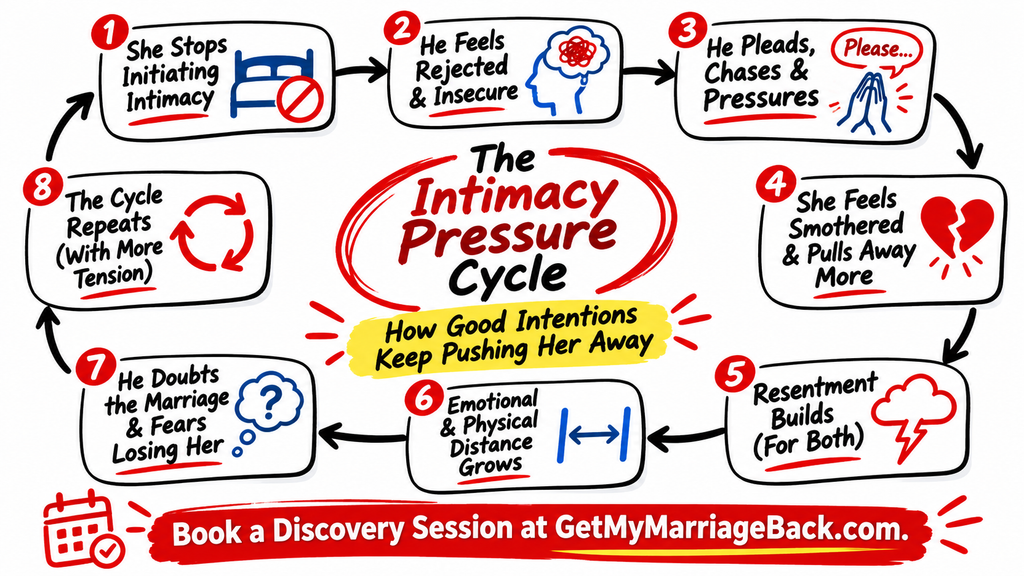
my wife never initiates sex - the intimacy pressure cycle

What to examine

Pay attention to the difference between affectionate behavior and sexual initiation.

Does she enjoy sitting close to you but withdraw when touching becomes sexual?

Does she initiate casual affection while avoiding anything that might lead to intercourse?

Has her interest in all forms of physical closeness declined, or only sexual activity?

These distinctions reveal more than simply counting how many times you’ve had sex.

A woman who welcomes nonsexual affection but rarely initiates intercourse may be experiencing something different from a woman who avoids nearly every form of physical contact.

Neither pattern tells the entire story.

Your objective is to understand the relationship dynamic rather than force a conclusion from one behavior.

Sign #2: Emotional Withdrawal Has Become Part of Your Marriage

Sexual attraction and emotional connection influence each other.

When unresolved emotional tension accumulates, physical closeness can become difficult.

Likewise, a prolonged absence of intimacy can create sadness, insecurity, and emotional withdrawal for the spouse who feels rejected.

Now both people are reacting to the same problem from different emotional positions.

You feel unwanted.

She may feel pressured, misunderstood, exhausted, or disconnected.

Instead of experiencing each other as romantic partners, you begin experiencing each other through the tension surrounding intimacy.

The difference between emotional withdrawal and lost attraction

Emotional withdrawal often becomes visible outside the bedroom.

Your wife may stop sharing personal thoughts, become less interested in spending time together, or respond to ordinary conversations with impatience.

Lost sexual attraction can exist even when friendship and companionship remain relatively strong.

The distinction is important because rebuilding emotional connection and addressing sexual desire are related but not interchangeable tasks.

Research published in the Journal of Marital and Family Therapy in 2024 examined how adults manage differences in sexual and affectionate desire. Participants described several approaches, including communication, alternative forms of connection, and changes in relationship behavior.

The research reinforces an important principle: couples experience differences in desire, and how they respond to those differences matters.

I encourage you to stop asking only, “Why won’t my wife initiate sex?”

Start examining a broader question:

“What happens emotionally between us before intimacy even becomes a possibility?”

That question directs your attention toward the quality of your interactions rather than merely their sexual outcome.

Sign #3: Unresolved Resentment Has Replaced Emotional Safety

Marriage creates friction.

You combine two personalities, two histories, different expectations, financial responsibilities, family obligations, and competing emotional needs.

Eventually, disagreements happen.

Being a good person doesn’t automatically make you skilled at navigating those disagreements.

You can genuinely love your wife and still have habits that create unnecessary tension.

Perhaps you become defensive whenever she expresses frustration.

Maybe she avoids difficult conversations until resentment builds.

Over time, the marriage develops an emotional history neither person knows how to resolve.

The result can be a relationship where both partners feel misunderstood.

Why resentment affects physical intimacy

Imagine trying to feel playful, affectionate, or sexually open with someone when you anticipate criticism or another argument.

Your body may be physically present, but your attention remains occupied by emotional tension.

That tension can interfere with the relaxed connection that often supports desire.

It is also important to recognize that resentment doesn’t always originate in one spouse’s behavior.

Personal history, childhood experiences, chronic stress, health difficulties, and outside responsibilities can influence how someone experiences closeness.

You cannot assume that everything your wife feels is your responsibility.

However, you can take responsibility for understanding your contribution to the relationship dynamic.

Stop confusing good intentions with relationship skills

You may have worked hard, remained faithful, supported your family, and believed those qualities should protect your marriage.

They matter tremendously.

But commitment and good intentions don’t replace the skills required to handle emotional friction.

Learning to listen without becoming defensive, express frustration without attacking, and address disagreements without punishment changes the emotional environment of a marriage.

Attraction has more room to develop when ordinary interactions stop feeling like battles.

Sign #4: Your Attempts to Restore Intimacy Are Creating More Pressure

This is where I want you to pay particular attention.

When your wife stops initiating intimacy, your natural instinct may be to pursue her more aggressively.

You become unusually attentive.

You offer compliments, perform favors, plan romantic evenings, and initiate physical contact more frequently.

None of those behaviors is automatically unhealthy.

The problem begins when your actions carry an unspoken expectation.

You do something nice and wait for affection.

When she doesn’t respond as you hoped, disappointment becomes resentment.

Soon, your kindness begins to feel like an investment that should produce a particular return.

This is what I call a covert contract.

The invisible contract destroying your confidence

A covert contract sounds something like this:

“If I do enough for my wife, she should want me.”

Or:

“If I become more romantic, she should initiate sex.”

Perhaps your internal agreement is even simpler:

“If she loves me, she should prove it physically.”

The difficulty is that your wife never necessarily agreed to those conditions.

Your gestures may look generous, but your emotional reaction reveals that you were expecting something in exchange.

Over time, ordinary affection becomes loaded with pressure.

She may begin wondering whether every hug is supposed to lead to sex.

Meanwhile, you interpret every hesitation as further evidence that you’re unwanted.

Now both people become increasingly guarded.

The pressure-and-withdrawal cycle

The pattern often develops like this:

You notice less intimacy → You feel rejected → You pursue reassurance → She experiences pressure → She withdraws → You feel even more rejected.

The cycle repeats until intimacy becomes associated with anxiety rather than connection.

This doesn’t mean your desire for physical intimacy is unreasonable.

Sexual connection can be an important part of marriage.

It means that the method you’re using to pursue connection may be working against the outcome you want.

You cannot pressure someone into authentic desire.

How to Rebuild Attraction Without Begging or Chasing

I want to shift your attention away from controlling your wife’s reactions and toward developing the qualities that make you a more grounded, emotionally intelligent partner.

That is where self-leadership becomes important.

Self-leadership doesn’t mean pretending you don’t care about intimacy.

It means your emotional stability is no longer determined entirely by whether your wife initiates affection tonight.

You remain capable of warmth, confidence, and constructive communication even when you’re disappointed.

1. Stop turning every interaction into a test

When your wife enters the room, notice whether you’re immediately evaluating her mood.

Are you searching for evidence that she finds you attractive?

Do you interpret a smile as progress and a distracted response as rejection?

This constant monitoring makes it difficult to enjoy ordinary companionship.

Practice being present without requiring every interaction to reassure you.

Offer affection because you genuinely want to express affection, while allowing her the freedom to welcome or decline it.

A peaceful evening together can be valuable even when it doesn’t end in sex.

2. Rebuild your personal grounding

Attraction is difficult to cultivate when desperation dominates your behavior.

Reconnect with the parts of your identity that exist beyond your wife’s approval.

Maintain meaningful friendships, pursue worthwhile goals, care for your physical wellbeing, and participate actively in your family life.

These activities shouldn’t become performances designed to make her jealous or afraid of losing you.

Their purpose is to restore balance to your emotional life.

When your confidence comes from your values and actions rather than constant reassurance, you become less reactive.

That steadiness changes how you participate in the marriage.

3. Create emotional connection without an immediate sexual agenda

Emotional intimacy grows through repeated experiences of being understood, respected, and genuinely enjoyed.

Ask questions because you’re interested in your wife’s perspective.

Listen without immediately defending yourself.

Share humor, appreciation, and experiences that remind both of you that marriage involves more than responsibilities.

Make room for playfulness.

A thoughtful compliment, a shared private joke, or a spontaneous invitation can help restore the feeling of being romantic partners rather than household administrators.

The seductive quality of these interactions comes from mutual enjoyment, not hidden pressure.

You are creating opportunities for attraction to emerge naturally.

4. Communicate about intimacy without demanding it

Avoiding pressure doesn’t mean avoiding the subject.

If physical intimacy has disappeared for months or years, the problem deserves a thoughtful conversation.

Choose a calm moment outside the bedroom.

You might say:

“I’ve noticed that physical intimacy has become difficult for us, and I miss feeling close to you. I don’t want you to feel pressured, but I do want to understand what this experience has been like for you.”

Then listen.

Your wife may describe experiences you haven’t considered.

She might identify emotional concerns, physical discomfort, exhaustion, or uncertainty about her own desire.

If medical symptoms, pain, medication effects, or hormonal changes are involved, appropriate healthcare support can be part of addressing the problem.

The objective is understanding, not winning an argument about how often sex should happen.

5. Restore flirtation without making affection transactional

A marriage needs more than efficient teamwork.

It also benefits from novelty, curiosity, anticipation, and playful attention.

Flirtation is an invitation to enjoy each other, not a demand for sexual performance.

You can communicate attraction through your presence, warmth, humor, and sincere appreciation.

Notice what your wife enjoys.

Create opportunities for shared experiences outside your usual routines.

Allow affectionate moments to remain affectionate without automatically escalating them.

When physical closeness is freely chosen, it becomes easier for both partners to experience it as enjoyable rather than obligatory.

The goal is not to make your wife comply with your desire. It is to rebuild a relationship where mutual desire has room to develop.

Can You Save Your Marriage Alone When Your Wife Has Lost Attraction?

You can begin changing your contribution to the marriage even when your wife isn’t ready to participate in a formal reconciliation process.

That doesn’t mean you can create mutual intimacy entirely by yourself.

A marriage involves two people with independent feelings, choices, and responsibilities.

Your opportunity is to stop reinforcing the patterns that make connection more difficult.

This requires learning three essential elements: Skills, Support, and System.

Skills help you navigate conflict, communicate effectively, and manage emotional reactions.

Support gives you perspective when anxiety makes it difficult to interpret what’s happening.

A system helps you practice those skills consistently instead of reverting to old habits whenever disappointment returns.

Research involving 1,054 married couples found that larger differences between desired and actual sexual frequency were generally associated with lower relationship satisfaction and stability, along with more conflict.

That finding helps explain why unresolved intimacy problems deserve attention even when divorce isn’t being discussed.

The important question is not simply whether your wife has initiated sex recently.

It’s whether the two of you are developing a healthier way to experience emotional and physical connection.

The GPS5 Approach to Rebuilding Attraction in Marriage

I teach self-leadership through a framework called GPS5.

It begins with three foundational areas:

Grounding: Learning to regulate your reactions instead of allowing fear and rejection to control your behavior.

Purpose: Building a meaningful life and personal direction that don’t depend entirely on your spouse’s validation.

Self-Discovery: Recognizing the emotional habits, assumptions, and relationship patterns that influence your decisions.

These foundations support a progression involving Value, Curiosity, Attraction, Influence, and Leverage.

Value begins with becoming a more emotionally steady, responsible, and engaging partner.

Curiosity grows when familiar negative patterns change and both people have opportunities to see each other differently.

Attraction becomes possible when interactions are more enjoyable, emotionally connected, and mutually inviting.

Influence comes from trust, credibility, and constructive communication rather than pressure.

Leverage, in this context, means developing the personal stability and relationship skills needed to make thoughtful choices without resorting to desperation.

You are not using these principles to manipulate your wife’s emotions.

You’re developing the capacity to participate in marriage with greater confidence, maturity, and emotional intelligence.

What If Your Wife Hasn’t Initiated Intimacy for Years?

A long period without intimacy deserves more than a quick romantic gesture.

Three and a half years of sexual withdrawal can produce deeply established expectations.

You may anticipate rejection before initiating anything.

Your wife may anticipate pressure whenever you become affectionate.

Both partners can become trapped in habits that reinforce the very distance they dislike.

Changing that pattern requires patience and an honest examination of its causes.

Start by identifying what you actually know.

Separate observable behavior from assumptions.

For example:

Observation: Your wife rarely initiates physical contact.

Assumption: She doesn’t love you anymore.

Those are not equivalent statements.

Similarly, continuing to share a home doesn’t establish that emotional attraction is healthy.

The more accurately you understand your marriage, the less likely you are to make fear-driven decisions.

That clarity matters whether you’re dealing with attraction loss, emotional withdrawal, a sexless marriage, or concerns about eventual separation.

The Truth About Rebuilding Sexual Attraction

Attraction is not simply a reward for being nice.

Neither is it something you can demand because you’re married.

It develops within a relationship influenced by emotional experiences, physical wellbeing, personal identity, communication, and the quality of everyday interactions.

You cannot eliminate every disagreement or guarantee that your spouse will always feel desire.

But you can stop making intimacy a constant emotional test.

You can become more intentional about how you handle frustration, express affection, and create opportunities for connection.

Most importantly, you can recognize the difference between pursuing your wife romantically and pursuing her desperately.

Romantic pursuit leaves room for curiosity, freedom, and mutual enjoyment.

Desperate pursuit demands reassurance and interprets hesitation as personal failure.

One creates space for connection.

The other often increases the pressure surrounding it.

If your wife never initiates intimacy, don’t reduce your entire marriage to that one painful symptom.

Examine the emotional environment, the history of unresolved friction, the quality of your interactions, and the habits you bring into the relationship.

Your first responsibility isn’t to convince your wife to want you. It’s to become someone who can participate in intimacy without fear, pressure, or emotional dependence controlling the experience.

That’s where skillful, emotionally intelligent marriage restoration begins.

5 Physical Signs She Just Slept With Someone Else: The Truth

Frequently Asked Questions

Why does my wife never initiate intimacy?

Your wife may be experiencing lower sexual desire, unresolved resentment, emotional disconnection, stress, or physical health changes. Understanding the cause requires examining her experience and the broader relationship rather than assuming she has stopped loving you.

Does my wife still love me if she never initiates sex?

Yes, your wife can love you while experiencing little sexual desire or rarely initiating intimacy. Emotional commitment and sexual attraction are related but distinct aspects of marriage.

How do I get my wife to initiate intimacy again?

Focus on improving emotional connection, communicating openly about desire, reducing pressure, and creating mutually enjoyable opportunities for affection. Sexual initiation must remain her choice rather than something produced through obligation.

Can a sexless marriage recover after years without intimacy?

Yes, couples can rebuild emotional and physical closeness after prolonged periods of sexual disconnection. Progress depends on understanding the underlying causes, addressing persistent relationship patterns, and developing a mutually satisfying approach to intimacy.

Your Wife Loves You but Isn’t Attracted to You? 4 Hidden Reasons

Your wife still says she loves you, but she rarely touches you, avoids intimacy, and no longer looks at you with the desire you remember.

Take This 2 Minutes Quiz

Question 1 of 15

You have been faithful. You provide for your family, take care of yourself, and genuinely love your wife. Yet your marriage increasingly feels like a roommate arrangement.

Perhaps you’ve caught yourself thinking, “My wife loves me but is not sexually attracted to me. How is that even possible?”

I want you to understand something important: Love and sexual attraction are connected, but they are not identical.

Your wife can appreciate your commitment, respect your responsibilities, and care about your well-being while experiencing very little romantic or sexual desire.

The mistake is assuming that because you’ve fulfilled your responsibilities, attraction should automatically follow.

Sometimes, the real explanation is buried in years of interactions you never considered significant.

And understanding those interactions can change how you approach rebuilding attraction in your marriage.

Why Your Wife Can Love You but Not Desire You

A marriage operates on several levels simultaneously.

There is commitment: the decision to remain faithful and honor your responsibilities.

There is companionship: the familiarity, friendship, and shared history that develop over years together.

Then there is romantic and sexual attraction: the desire to experience your spouse as an intimate partner rather than simply someone who shares your household.

These dimensions influence one another, but they don’t always move together.

You can have commitment without much passion. A couple can maintain a functional household while losing emotional closeness. Two people may genuinely love each other yet struggle to experience the intimacy they once enjoyed.

When your wife never initiates intimacy, the problem may appear purely sexual.

But the bedroom can reveal tensions that developed elsewhere in the marriage.

my wife loves me but is not sexually attracted to me

The 14-Year Marriage That Became a Roommate Relationship

I worked with a husband who had been married for 14 years.

He was faithful, responsible, physically well-maintained, and genuinely committed to his family.

From his perspective, he had done what a good husband was supposed to do.

Yet his wife had become emotionally distant.

She rarely initiated physical affection. Sexual intimacy had declined, and their relationship felt increasingly like two roommates sharing responsibilities.

He couldn’t understand why.

Initially, we examined his frustration, his wife’s withdrawal, and the criticism and defensiveness developing between them.

But the deeper issue didn’t emerge during our initial Discovery Session.

It surfaced much later, when we began engaging his wife directly.

What we discovered illustrates four important reasons attraction can deteriorate even when a husband believes he has done everything right.

my wife loves me but is not sexually attracted to me - quiet resentment

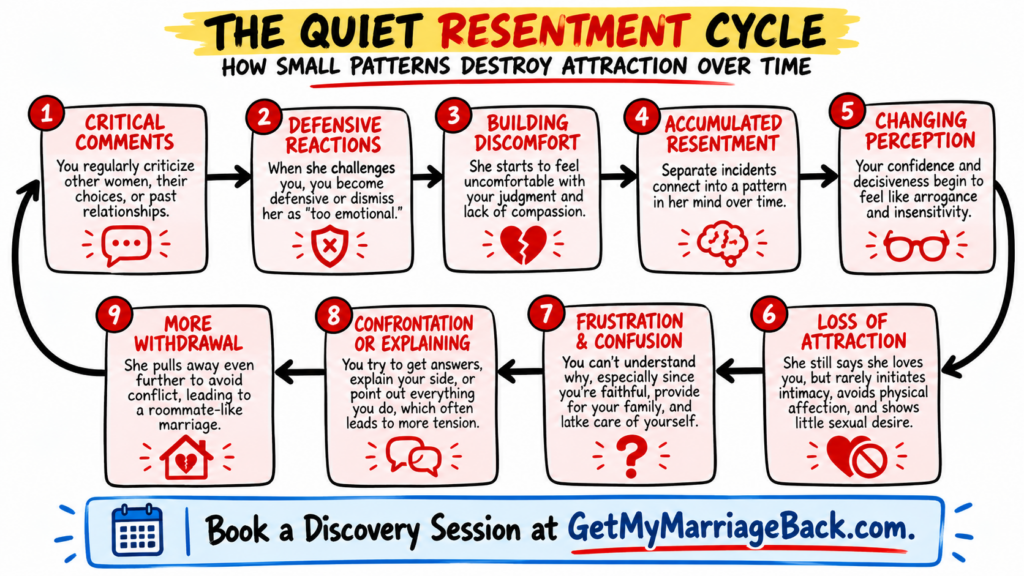
1. Your Wife May Be Connecting Experiences You’ve Kept Separate

One of the most revealing discoveries involved the husband’s longstanding habit of harshly criticizing other women.

He frequently expressed contempt toward single mothers, divorced women, and women whose relationship decisions he disapproved of.

His wife had sometimes agreed with his opinions.

But gradually, she became uncomfortable with the judgment behind his words.

Whenever she challenged him, he became defensive and accused her of being overly emotional.

To him, these were isolated disagreements.

To her, they were pieces of a much larger pattern.

This distinction matters.

You may remember individual conversations. Your wife may remember the emotional pattern connecting them.

You remember what the disagreement was about. She remembers how you responded when someone challenged your opinion.

Eventually, when she experienced personal difficulties, she recognized that same lack of compassion directed toward her.

The emotional meaning of earlier conversations changed.

What had once appeared to be confidence began to feel like judgment.

The man she once admired for his decisiveness increasingly seemed difficult to approach emotionally.

Why Emotional Patterns Matter More Than Individual Arguments

Imagine criticizing someone’s mistakes during a conversation.

You believe you’re discussing accountability.

Your wife hears contempt.

Later, she shares something vulnerable, and you respond by explaining why her interpretation is wrong.

In your mind, you’re correcting a misunderstanding.

From her perspective, you’re repeating the same behavior she has observed for years.

Neither spouse necessarily understands the full pattern while it is developing.

But repeated experiences can influence whether your partner anticipates understanding or judgment when approaching you.

If your wife avoids difficult conversations, examine how those conversations typically unfold.

Does she feel heard before you explain your position?

Can she disagree without being labeled emotional or unreasonable?

Are you more interested in proving your point than understanding her experience?

These questions may reveal more about the loss of connection than another argument about how often you have sex.

2. Confidence Can Become Unattractive When It Feels Like Contempt

Confidence is attractive when it communicates stability, competence, and self-respect.

But confidence and contempt are fundamentally different.

A confident person can disagree without humiliating someone.

A decisive spouse can maintain strong convictions while remaining compassionate.

Someone with healthy self-respect doesn’t need to make another person feel small to establish authority.

In the marriage I described, the husband’s confidence had originally contributed to his wife’s attraction.

Over time, however, she began experiencing his decisiveness as arrogance.

The qualities themselves weren’t necessarily the problem.

It was how those qualities appeared in their interactions.

The Difference Between Strength and Emotional Insensitivity

Consider two responses to a disagreement.

One husband says:

“I see why that upset you. I don’t completely agree with your interpretation, but I want to understand what happened.”

Another responds:

“You’re being too emotional. That’s not what I meant, and you know it.”

Both men may believe they are defending a reasonable position.

But the emotional experience they create is very different.

The first response preserves room for connection.

The second can make vulnerability feel unsafe.

When emotional insensitivity becomes habitual, a spouse may begin protecting herself through distance.

That distance can eventually affect affection, flirtation, and sexual desire.

Relationship research supports the importance of this distinction. In a large community study, researchers found that perceived intimacy and partner responsiveness were positively associated with sexual desire among partnered adults across the groups examined.

The findings are discussed in this study on intimacy, partner responsiveness, and sexual desire.

The practical implication is significant: how your spouse experiences you emotionally can matter to the romantic and sexual relationship.

Attraction is not simply a reward for providing financially, remaining faithful, or maintaining your appearance.

3. Accumulated Resentment Can Turn Marriage Into a Roommate Arrangement

Resentment rarely announces itself dramatically.

Sometimes it develops through repeated experiences that never receive meaningful attention.

A disagreement ends without resolution.

Someone feels dismissed but stops arguing.

Physical affection becomes less spontaneous.

Eventually, the couple maintains the household while avoiding deeper emotional engagement.

The marriage still functions, but the romantic relationship becomes increasingly disconnected.

Signs Your Wife’s Emotional Withdrawal May Be Connected to Resentment

Pay attention to patterns such as:

  • She avoids discussing personal struggles with you.
  • Affection has become less frequent or feels obligatory.
  • Conversations about intimacy quickly become arguments.
  • She repeatedly brings up experiences you believe were resolved.
  • She seems more comfortable discussing practical responsibilities than emotional concerns.
  • Your attempts to explain yourself frequently make her withdraw further.

None of these signs establishes resentment as the only explanation.

Stress, exhaustion, health concerns, hormonal changes, medication, unresolved sexual difficulties, and broader relationship dissatisfaction can also influence desire.

However, when emotional withdrawal follows years of criticism and defensiveness, the relationship dynamic deserves serious attention.

Why Being Faithful Isn’t Always Enough

Faithfulness is essential to the commitments many married couples make.

Providing for your family matters.

Taking care of yourself is valuable.

But these contributions don’t eliminate the need for emotional connection.

Think about it.

Would you feel naturally drawn toward someone who consistently dismissed your concerns, even if that person fulfilled every practical responsibility?

Probably not.

Your wife may recognize your sacrifices while struggling with how she feels during interactions with you.

That is why reminding her of everything you’ve done can miss the underlying issue.

You’re presenting evidence of responsibility when the relationship may be suffering from a lack of emotional understanding.

4. Defending Yourself Can Deepen the Attraction Problem

When your wife no longer initiates intimacy, frustration is understandable.

You miss being wanted.

Perhaps you’ve begun questioning your attractiveness, masculinity, or value as a husband.

Naturally, you want an explanation.

But how you pursue that explanation matters.

In the 14-year marriage, the husband’s attempts to defend himself and confront the lack of intimacy intensified his wife’s withdrawal.

He wanted her to recognize his intentions.

She wanted him to understand her experience.

Both were addressing different parts of the relationship.

Stop Trying to Win the Argument About Attraction

Imagine saying:

“I’ve never cheated on you. I pay the bills. I take care of myself. What more do you want?”

Those statements may be factually correct.

But they don’t necessarily address why your wife feels emotionally disconnected.

Instead, they can turn intimacy into another argument about who has fulfilled their obligations.

Sexual desire doesn’t operate like a debt someone owes because their spouse has behaved responsibly.

And pressure can make an already difficult sexual relationship feel even more complicated.

A better starting point is understanding what changed in the emotional relationship.

Ask yourself whether your conversations create curiosity or defensiveness.

Notice whether affection is freely exchanged or followed by expectations.

Most importantly, examine whether your response to rejection reinforces the very emotional distance you’re trying to overcome.

How to Rebuild Attraction Without Begging for Intimacy

Now we come to the part you can influence.

You cannot command your wife’s feelings.

But you can change how you participate in the relationship.

I teach this through the GPS5 framework, beginning with Grounding, Purpose, and Self-Discovery.

These principles help you move away from reactive behavior and toward emotionally intelligent self-leadership.

Grounding: Stop Letting Rejection Control Your Behavior

When your wife pulls away, the temptation is to chase reassurance.

You may repeatedly ask whether she loves you, question why she doesn’t initiate sex, or become visibly frustrated whenever affection is absent.

Grounding means learning to regulate those reactions.

It doesn’t mean pretending you aren’t hurt.

Rather, you acknowledge the pain without allowing it to dictate your next conversation.

A grounded spouse can express disappointment without creating pressure.

That emotional steadiness helps make honest conversations more possible.

Purpose: Become More Than Someone Waiting to Be Desired

If your entire sense of worth depends on whether your wife wants intimacy tonight, every interaction becomes emotionally loaded.

You start measuring her tone, her touch, and her attention.

Ordinary moments become tests of attraction.

Purpose restores a healthier balance.

Continue investing in your physical health, meaningful work, friendships, personal development, and responsibilities.

Build a life that reflects your values rather than organizing your identity around obtaining your spouse’s approval.

This isn’t a tactic to make her jealous.

It is an expression of healthy self-respect.

Self-Discovery: Identify the Patterns You Don’t Notice

This is where many people encounter their greatest challenge.

You know your intentions.

But you may not recognize how your habits affect someone else.

Examine your communication during disagreements.

Do you interrupt?

Does criticism come naturally when someone makes a mistake?

Are you quick to explain why your spouse shouldn’t feel the way she feels?

Can you acknowledge an emotional impact without immediately defending your character?

Self-discovery requires more than deciding you’re a good person.

It requires observing how you behave when challenged.

For the husband in our story, understanding this distinction was essential because the deeper issue had remained hidden behind his complaints about intimacy.

Building Attraction Through Emotional Intelligence

Romantic attraction involves more than being agreeable.

Healthy attraction can include playfulness, anticipation, admiration, individuality, emotional intimacy, and mutual desire.

But these qualities flourish more naturally when the relationship is not dominated by resentment or pressure.

Here are several ways to develop that environment.

Replace Judgment With Curiosity

When your spouse expresses an opinion you disagree with, resist the urge to immediately correct it.

Try understanding the experience behind the opinion.

You don’t have to surrender your convictions.

The goal is to demonstrate that disagreement doesn’t threaten your ability to remain emotionally present.

Practice Affection Without Demanding Escalation

A hug doesn’t have to become an invitation to sex.

A compliment doesn’t need to produce immediate romantic attention.

Small gestures become more meaningful when your spouse can receive them freely.

Respect her comfort, boundaries, and willingness to participate.

Affection should create connection, not obligation.

Bring Back Playfulness and Individuality

A roommate marriage often becomes dominated by schedules, bills, parenting, and household responsibilities.

Those responsibilities matter, but they shouldn’t consume every interaction.

Make room for humor, interesting conversations, shared experiences, and enjoyable time together.

Stay curious about who your spouse is becoming.

Continue developing yourself as someone with interests, energy, and a meaningful life beyond household logistics.

Romance benefits when partners can experience one another as individuals rather than merely coworkers managing a family.

Let Changed Behavior Become Consistent

A single apology cannot erase years of accumulated experiences.

Neither can one romantic dinner.

If defensiveness has been a recurring problem, the meaningful change is learning to remain receptive during repeated disagreements.

When criticism has damaged connection, practice communicating your standards without contempt.

Consistency matters because trust develops through experience.

Your spouse needs room to observe who you are becoming without being pressured to immediately reward your efforts.

Can You Save Your Marriage When Your Wife Has Lost Attraction?

The answer depends on what is happening beneath the loss of desire.

Some marriages struggle primarily with exhaustion, competing responsibilities, or sexual desire differences.

Others are affected by accumulated resentment, unresolved conflict, emotional withdrawal, or significant breaches of trust.

The first task is distinguishing among those possibilities.

If you’re trying to save your marriage from divorce, don’t assume that fixing your appearance or increasing romantic gestures will resolve a longstanding emotional pattern.

Similarly, don’t conclude that every lack of sexual desire means your spouse is preparing to leave.

Look at the entire relationship.

How do you communicate?

What happens when one person feels misunderstood?

Has affection disappeared gradually or suddenly?

What concerns has your spouse repeated over time?

These questions can help clarify whether the relationship needs renewed emotional responsiveness, changes in conflict behavior, attention to sexual concerns, or a combination of approaches.

Marriage reconciliation becomes more realistic when you stop treating the visible symptom as the whole problem.

The Real Meaning Behind “My Wife Loves Me but Is Not Sexually Attracted to Me”

Your wife may genuinely love you while experiencing a different emotional relationship than the one you believe you’re maintaining.

That difference can be difficult to accept.

You may remember your faithfulness, sacrifices, and good intentions.

She may remember moments when she felt judged, dismissed, or unable to approach you vulnerably.

Neither perspective should be ignored.

But you cannot understand the marriage by examining only your intentions.

The husband who had been married for 14 years initially believed his problem was primarily sexual attraction.

Much later, a deeper relational pattern became visible.

His wife’s withdrawal had not developed in isolation.

It was connected, in significant part, to experiences that gradually changed how she perceived him.

The most important shift is moving from “Why doesn’t my wife want me?” to “What has our relationship become emotionally, and what can I change about how I participate in it?”

That question moves you away from begging, defensiveness, and blame.

It also creates room for something more valuable: genuine self-respect, emotional understanding, and the possibility of rebuilding romantic connection through consistent behavior.

Attraction is not something you extract from your spouse.

It is something two people can experience when the relationship gives them reasons to feel emotionally connected, respected, and romantically engaged.

19 Signs Your Wife Is Not Sexually Attracted To You

Frequently Asked Questions

Why does my wife love me but not feel sexually attracted to me?

Love and sexual desire are different experiences, and attraction can be affected by resentment, emotional distance, stress, health changes, and relationship dynamics. Understanding what has changed between you is more useful than assuming one explanation.

Can my wife’s sexual attraction to me come back?

Yes, sexual attraction can return as emotional connection, relationship satisfaction, and intimacy improve. The important step is identifying what contributed to its decline rather than trying to force physical affection.

What should I do when my wife never initiates intimacy?

Stop treating initiation as the only measure of love and examine the broader emotional and sexual relationship. Discuss your needs respectfully, listen to her experience, and avoid turning affection into an obligation.

Does a sexless marriage mean my wife wants a divorce?

No, a sexless marriage does not automatically mean your wife wants a divorce. However, persistent emotional withdrawal, unresolved resentment, and deteriorating communication deserve attention before the relationship becomes increasingly disconnected.

Wife Never Initiates Affection? 5 Signs You’re Missing

Your wife used to reach for your hand, lean into your touch, and make you feel wanted—but now you’re wondering why she barely initiates affection at all.

Take This 2 Minutes Quiz

Question 1 of 15

When your wife stops initiating affection, the silence can feel louder than an argument.

You remember when she would touch your shoulder while walking past, kiss you without being asked, or curl up beside you without thinking twice. Now you find yourself wondering whether she’s still attracted to you, whether she’s carrying resentment, or whether your marriage has quietly become a roommate arrangement.

And when you ask what’s wrong?

“Nothing.”

That’s often the answer that makes the situation even more confusing.

Because the affection has changed. You can feel the difference. Yet the person you love doesn’t seem willing—or able—to explain what happened.

I want you to understand something important: Your wife’s lack of affection is a symptom. It is not, by itself, a complete diagnosis of your marriage.

There is a meaningful difference between lost attraction, unresolved resentment, emotional exhaustion, and a relationship where physical closeness has gradually become associated with pressure.

Those experiences can overlap. They can also require different responses.

If your goal is to rebuild attraction in your marriage, you need more than an explanation for why she stopped touching you.

You need to understand the emotional conditions surrounding her withdrawal—and the ways your own responses may be influencing those conditions.

Why Your Wife Never Initiates Affection Anymore

Physical affection is often one of the first places where emotional distance becomes visible.

A spouse may stop initiating hugs, kisses, cuddling, hand-holding, or sexual intimacy. Sometimes the change happens suddenly after a major conflict. Other times, it develops gradually until one partner realizes they have become the only person reaching out.

That difference matters.

A wife who still enjoys conversations, laughs with you, spends time with you, and occasionally welcomes affection may be experiencing something different from a wife who has withdrawn from nearly every form of connection.

Neither pattern tells you everything.

But each provides useful information.

When you conclude, “My wife isn’t attracted to me anymore,” you’re making an interpretation of her behavior.

It may be accurate. It may be incomplete.

The first skill in rebuilding attraction is learning to separate what you can observe from what you fear it means.

You can observe that she no longer initiates physical contact.

You cannot determine her entire emotional experience from that observation alone.

That distinction keeps you from turning every rejected touch into a verdict on your marriage.

wife never initiates affection

5 Signs That Reveal What May Be Happening Beneath Her Withdrawal

1. She Still Enjoys Your Company but Rarely Initiates Touch

This is one of the most overlooked patterns when a wife stops initiating affection.

She may still talk with you comfortably, share jokes, discuss everyday life, and spend time around you. Yet the moment physical intimacy enters the picture, something changes.

Perhaps she becomes hesitant. Maybe she pulls away, redirects the conversation, or seems uncomfortable when a casual touch begins to feel like an invitation for more.

That pattern doesn’t automatically mean she has stopped loving you.

It may indicate that physical affection has acquired an emotional meaning that ordinary companionship does not carry.

For example, if every hug seems to lead toward an expectation of sex, she may begin avoiding the hug itself.

This doesn’t make your desire for affection unreasonable. Wanting to feel wanted by your spouse is a legitimate relational need.

However, the way that need is expressed can either invite connection or create pressure.

Attraction grows more naturally when affection can exist without becoming an immediate obligation.

Pay attention to whether your wife seems comfortable with closeness that has no hidden demand attached.

A gentle conversation, shared laughter, or relaxed time together may reveal more about the state of your connection than repeatedly asking why she won’t initiate intimacy.

wife never initiates affection - the affection and resentment cycle

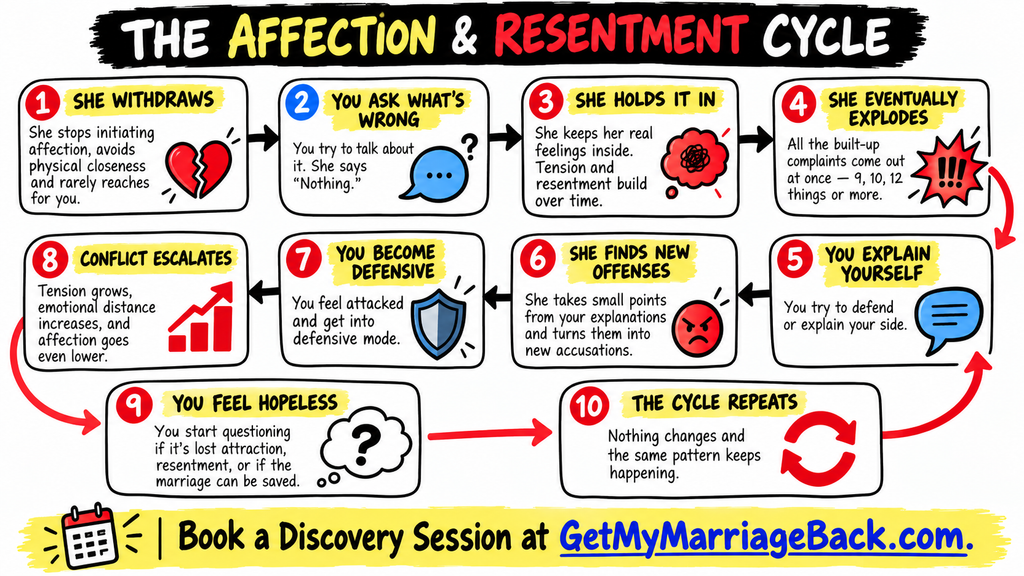
2. She Says “Nothing” Is Wrong—Then Unloads Old Complaints

One of the most confusing marriage dynamics happens when emotional withdrawal and accumulated complaints exist side by side.

I’ve worked with a husband who experienced a chronic version of this situation.

His wife had stopped initiating affection.

Whenever he asked what was wrong, she repeatedly told him, “Nothing.”

Then, eventually, the frustration would erupt.

Instead of one clear issue, he would hear nine, ten, or sometimes twelve complaints in the same conversation.

Some concerned recent events. Others involved problems he believed they had already addressed.

He couldn’t understand why something that seemed settled to him was still emotionally active for her.

Naturally, he wondered whether she had lost attraction.

But another possibility deserved attention: Unresolved resentment may have been interfering with her willingness to feel close.

Lost attraction concerns desire and connection.

Resentment concerns negative experiences and the meaning someone continues to attach to them.

A spouse can still recognize qualities she values in you while feeling too upset to welcome physical intimacy.

That doesn’t mean every complaint is justified or that resentment explains every instance of withdrawal.

It means the emotional history deserves examination.

Ask yourself when the affection began changing.

Was there a major argument? A repeated disappointment? A stressful period? A gradual accumulation of disconnection?

Sometimes the timeline reveals a pattern that the latest argument cannot explain.

3. Your Attempts to Explain Yourself Create More Conflict

Here is where many well-intentioned spouses unknowingly deepen the distance they’re trying to repair.

Your wife raises a complaint.

You explain what actually happened from your perspective.

She identifies something in your explanation that upsets her further.

Now you’re defending the original issue and a new accusation inside the same conversation.

Before long, neither of you is discussing the concern that started the argument.

You’re discussing how the argument itself has become another problem.

I call this the explanation trap.

You believe you’re clarifying the facts. Your wife experiences your explanation as another reason to feel unheard.

Both experiences can exist simultaneously.

Her emotional reaction is real as an experience, but that doesn’t make every accusation factually accurate.

Likewise, your good intentions don’t automatically erase legitimate concerns.

Emotional intelligence requires you to distinguish those things without treating every disagreement as an emergency.

Research supports the importance of this distinction. A longitudinal study examining defensive denial in romantic relationships found that conflict-escalating behaviors helped explain the association between defensive denial and later relationship instability.

The point isn’t that you should accept every criticism.

It’s that defending yourself immediately is not always the most effective way to protect your relationship.

Instead, listen for the specific concern underneath emotionally charged language.

When she says, “You never listen,” don’t automatically turn the conversation into a historical debate about every occasion when you did listen.

Identify the behavior she’s referring to.

You can acknowledge a legitimate disappointment without agreeing that you have failed in every situation.

That is a much stronger position than either surrendering your judgment or fighting to win every detail.

4. Affection Disappears Most Often After Conflict or Pressure

The timing of withdrawal is especially revealing.

Does your wife become physically distant after disagreements?

Does she seem comfortable around you until you begin asking for reassurance?

Have conversations about intimacy become emotionally loaded because both of you already know how they usually end?

When physical closeness becomes associated with interrogation, disappointment, or conflict, a spouse may begin protecting herself from the interaction before it even starts.

That protection can look like indifference.

It can feel like rejection.

But the emotional process underneath may be more complicated than a simple absence of desire.

Research on romantic relationships has repeatedly examined the importance of perceived partner responsiveness—the experience of feeling understood, cared for, and valued by a partner.

In a 2016 series of three studies, researchers found that responsiveness was associated with greater sexual desire, particularly among women. Feeling special and perceiving one’s partner as desirable helped explain that relationship.

This matters because attraction is not simply about performing impressive behaviors.

It’s also about how someone experiences being with you.

A person can provide financially, fulfill responsibilities, and make substantial sacrifices while still struggling to create an emotionally comfortable atmosphere.

The ability to remain composed, attentive, and respectful during difficult moments is part of what you contribute to that atmosphere.

That doesn’t require accepting mistreatment.

It requires recognizing that emotional stability and personal boundaries can coexist.

You can listen without surrendering your judgment.

You can acknowledge a mistake without destroying your self-respect.

And you can maintain a boundary without turning every disagreement into a threat against the marriage.

5. You Have Started Measuring Every Good Deed Against Her Affection

This is one of the most subtle ways attraction becomes pressured.

You make a thoughtful gesture.

You help around the house.

You have a good conversation.

Then you watch to see whether your wife reaches for you that evening.

When she doesn’t, disappointment sets in.

You may begin thinking, “What else am I supposed to do?”

I understand the frustration.

But three good behaviors today do not create an obligation for your wife to initiate affection tonight.

When kindness becomes a transaction, the other person may begin experiencing even thoughtful gestures as part of an unspoken demand.

Reciprocity matters in marriage. Both partners need to contribute to the relationship.

Yet reciprocity is not the same as controlling the timing, form, or intensity of someone else’s response.

Think about preparing soil before planting a seed.

You don’t make the seed grow faster by digging it up every morning to inspect it.

You create better conditions and allow the natural process to unfold.

Marriage attraction requires similar patience.

Your consistency matters. So does your ability to bring warmth, confidence, attentiveness, and emotional steadiness into interactions without constantly checking whether you’ve earned a reward.

How to Rebuild Attraction Without Begging, Chasing, or Pressure

When your wife avoids intimacy, the instinct to pursue harder can become overwhelming.

You may want another conversation, another explanation, another promise, or another opportunity to prove that you’re changing.

But attraction isn’t something you can argue another person into feeling.

It is influenced by the emotional experience of being in the relationship.

That means the most productive place to begin is often your own self-leadership.

Stop Making Her Response the Measure of Your Worth

Your spouse’s affection matters, but it should not become the only source of your emotional stability.

If every interaction determines whether you feel confident or defeated, your relationship becomes dominated by anxious monitoring.

You start looking for evidence of love in every glance, every touch, and every change in tone.

That makes it harder to be genuinely present.

A grounded person can recognize a painful situation without allowing every uncertain moment to dictate their behavior.

You can care deeply about your marriage and still retain your dignity.

Become Emotionally Safe Without Becoming Passive

Emotional safety doesn’t mean never disagreeing.

It means your spouse can express a concern without every conversation immediately turning into a contest.

You remain capable of hearing uncomfortable information, considering what is valid, and responding thoughtfully.

At the same time, you don’t have to tolerate contempt, intimidation, or repeated disrespect.

Confidence and kindness are not opposites.

Neither are boundaries and affection.

One of the most attractive forms of maturity is the ability to remain steady without becoming cold, controlling, or desperate.

Restore the Qualities That Made Connection Enjoyable

Long-term conflict can cause spouses to focus so intensely on what is wrong that they forget what once made the relationship enjoyable.

You may begin resenting qualities you previously appreciated.

Ordinary conversations become problem-solving sessions.

Shared time becomes another opportunity to evaluate whether the marriage is improving.

That atmosphere leaves little room for curiosity, playfulness, or romantic tension.

Seduction in a long-term marriage is not about tricks or manufactured jealousy.

It’s about restoring an experience of connection that feels voluntary, alive, and emotionally engaging.

Bring back your sense of humor.

Take care of your appearance and personal energy because those things reflect how you carry yourself.

Remain interested in your spouse as an individual, not merely as the person who can relieve your anxiety about the marriage.

Allow warmth to exist without immediately turning it into a request for more.

The goal is to become someone whose presence feels valuable, not someone who must constantly negotiate for affection.

The GPS5 Approach to Rebuilding Marital Attraction

I teach a progression called GPS5 because rebuilding attraction starts long before a spouse initiates physical intimacy again.

It begins with grounding, purpose, and self-discovery.

Grounding: Separate Facts From Fear

Start with what you know.

Your wife has stopped initiating affection. That is an observable fact.

The belief that she will never love you again is a prediction.

Grounding helps you respond to the actual situation rather than every frightening interpretation your mind creates.

Purpose: Become Bigger Than the Immediate Crisis

A marriage crisis can consume your identity.

Every decision starts revolving around your spouse’s mood, availability, or willingness to connect.

Purpose restores perspective.

Your marriage matters, but your ability to lead yourself, fulfill responsibilities, maintain relationships, and live according to your values matters too.

That stability changes how you show up.

Self-Discovery: Recognize Your Contribution to the Cycle

Examine your habits without assuming responsibility for everything.

Do you interrogate your spouse when you feel uncertain?

Do you become defensive before understanding a complaint?

Does your desire for affection sometimes turn into pressure?

Self-discovery allows you to identify what is within your influence.

It also helps you stop attempting to control what belongs to another person.

Value, Curiosity, Attraction, Influence, and Leverage

As your grounding and self-awareness improve, you become better positioned to offer genuine value in your interactions.

Value creates opportunities for curiosity.

Curiosity can reopen the possibility of attraction.

Attraction can create opportunities for positive influence.

And influence gives you greater leverage to pursue reconciliation with dignity.

This is a progression of relational possibilities, not a strategy for controlling another person’s feelings.

The distinction is essential.

You cannot force desire.

You can become more skillful at creating the conditions in which connection is easier to welcome.

When Your Wife Isn’t Attracted to You Anymore, What Should You Focus On First?

Focus on the pattern before you focus on the outcome.

The absence of affection may be the most painful part of your experience, but it is not necessarily the first part of the problem that needs attention.

Look at the emotional history.

Notice when withdrawal happens.

Pay attention to the difference between ordinary companionship and physical closeness.

Recognize whether your explanations are helping conversations become clearer or making them increasingly defensive.

Most importantly, examine whether your efforts to restore affection are creating warmth or pressure.

You don’t need to solve every disagreement before your marriage can experience a better interaction.

But you do need to stop allowing unresolved disagreements to define every interaction.

There is a difference between wanting your wife to initiate affection and becoming a person who understands how attraction, emotional safety, curiosity, and reciprocity interact.

The first is a desired outcome.

The second is a relationship skill.

And relationship skills are where your influence begins.

“Wife Makes NO EFFORT In BED” (5 Tips For INSTANT Solution)

Frequently Asked Questions

Why does my wife never initiate affection anymore?

She may be experiencing unresolved resentment, reduced attraction, emotional exhaustion, stress, or discomfort with the expectations attached to physical closeness. Look at when the withdrawal began and whether it affects only touch or your broader emotional connection.

Does it mean my wife isn’t attracted to me anymore?

Not necessarily, because reduced physical initiation can reflect several different emotional and relational patterns. Attraction and resentment can also overlap, so one symptom alone cannot explain the entire marriage.

How do I get my wife to initiate intimacy again?

Focus on rebuilding emotional responsiveness, reducing pressure, and making everyday interactions more enjoyable rather than demanding immediate physical reassurance. Respect her autonomy while developing the communication and self-leadership skills that support connection.

Can a marriage recover when one spouse avoids physical affection?

Yes, emotional and physical connection can improve when the underlying patterns are understood and the interactions sustaining distance begin to change. Progress often involves patience, emotional regulation, clear boundaries, and consistent relational effort.

Signs My Wife Is Not Sexually Attracted to Me: 5 Mistakes to Avoid

Your wife used to welcome your kisses, reach for your hand, and enjoy being close to you.

But now she pulls away from your touch, looks irritated when you approach, and acts like physical affection is something she has to endure.

Take This 2 Minutes Quiz

Question 1 of 15

When your wife stops showing physical affection, especially after years of marriage, the rejection cuts deeper than sex.

You’re not simply missing intimacy. You’re watching a woman who once wanted you become increasingly uncomfortable around you.

Sometimes the situation gets even worse.

Your wife says she’s no longer in love with you. She wants separation. Perhaps she’s already asked for divorce.

And now you’re trying to figure out how to save your marriage when your wife isn’t attracted to you anymore.

I want you to understand something important.

Your wife’s lack of attraction is a serious symptom, but your reaction to that symptom can become another problem entirely.

You cannot argue your way back into her desire.

You cannot explain your sacrifices until she finds you attractive again.

And you certainly cannot make someone want to kiss you by proving how unfairly they’re treating you.

However, you can change the emotional experience you bring into the marriage.

That’s where rebuilding attraction begins.

signs my wife is not sexually attracted to me

5 Signs Your Wife May Be Losing Sexual Attraction

Before examining the mistakes, let’s identify what you’re experiencing.

1. She Pulls Away When You Try to Kiss Her

A kiss that used to happen naturally now creates discomfort.

She turns her face, stiffens, or avoids the moment altogether.

One rejected kiss doesn’t establish a loss of attraction. But repeated withdrawal alongside emotional disconnection deserves attention.

2. She Never Initiates Physical Affection

You initiate every hug, kiss, and attempt at closeness.

When you stop initiating, physical affection practically disappears.

The imbalance leaves you wondering whether she still desires you.

3. She Looks Irritated When You Approach

Sometimes the rejection isn’t verbal.

Her facial expression changes when you enter the room. She looks annoyed before you’ve even said anything.

Visible disgust or contempt is especially concerning when it becomes a recurring feature of your interactions.

4. She Avoids Emotional Intimacy

Conversations become strictly practical.

You discuss bills, children, schedules, and responsibilities, but meaningful emotional connection disappears.

The marriage begins resembling a household arrangement rather than a romantic relationship.

5. She Talks About Separation or Divorce

This is where the situation becomes urgent.

Your wife isn’t simply declining intimacy. She’s questioning whether she wants to remain married.

At this stage, treating the problem as a lack of sex misses the larger crisis.

You need to address the relationship experience surrounding the physical rejection, not merely the absence of physical affection.

Why Your Wife’s Rejection Feels So Devastating

When you’ve invested years in a marriage, physical rejection carries enormous emotional weight.

You’ve worked, sacrificed, supported your family, and tried to build a future together.

Now the woman you married appears uncomfortable with your presence.

That is painful.

It’s also frightening when you have children, shared responsibilities, and a life that could be dismantled by divorce.

Your immediate instinct is to seek an explanation.

You want her to understand your intentions, recognize your contributions, and acknowledge everything you’ve done.

Unfortunately, that instinct can lead directly into the first major mistake.

signs my wife is not sexually attracted to me - the defensiveness

Mistake #1: Trying to Prove You’re Right

I worked with a gentleman whose wife had already asked for divorce.

They had three children, and their marriage had deteriorated to the point where she avoided kisses, refused to hold hands, and sometimes displayed visible disgust when he entered the room.

He couldn’t understand why she treated him so coldly.

Even if they eventually separated, he believed they should still be able to interact respectfully.

That concern was legitimate.

But another pattern became obvious as we worked through his situation.

He felt compelled to prove he was right about almost everything.

One recurring disagreement involved his employment.

He had worked as a consultant for years, but his income wasn’t consistently stable. His wife believed he wasn’t doing enough to secure dependable employment.

She accused him of being lazy.

He was actively looking for better opportunities, and her criticism felt deeply unfair.

So he defended himself.

He explained every application, every effort, every obstacle, and every reason she was misjudging him.

Yet the more he argued, the more emotionally exhausting their interactions became.

He was trying to demonstrate responsibility.

What she repeatedly experienced was another argument.

There’s a powerful distinction here.

Being right is not the same as being attractive.

Your wife doesn’t suddenly experience romantic desire because you’ve successfully defeated her argument.

You can be factually correct and still communicate in a way that intensifies conflict.

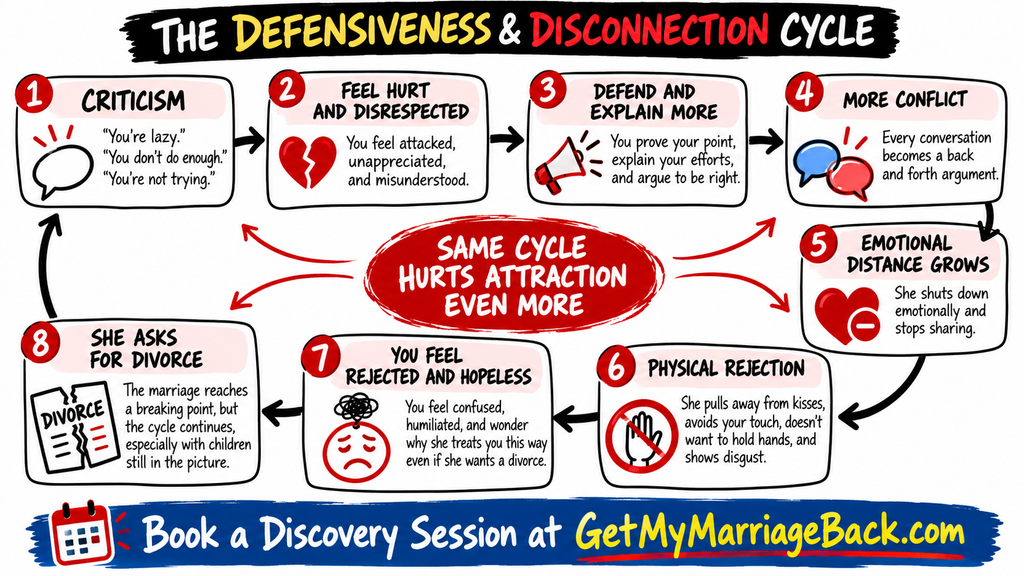
Mistake #2: Responding to Criticism With Defensiveness

When your wife criticizes your character, defending yourself feels natural.

She calls you lazy.

You explain why you’re hardworking.

She says you never do enough.

You produce evidence of everything you’ve done.

Before long, you’re both trapped in a repetitive argument.

Research from the Gottman Institute on destructive communication patterns identifies criticism, contempt, defensiveness, and stonewalling as particularly damaging patterns in distressed relationships.

Criticism attacks character rather than addressing a specific behavior.

Defensiveness attempts to protect the self from perceived accusations.

Contempt communicates disrespect or superiority.

Stonewalling involves withdrawing from an interaction.

These patterns can reinforce one another, creating an increasingly hostile emotional environment.

Importantly, refusing a kiss isn’t automatically stonewalling. Your wife has the right to decline physical affection.

The concern is the broader pattern of criticism, contempt, escalating arguments, and emotional disconnection.

What Defensiveness Does to Attraction

Defensiveness changes the emotional tone of an interaction.

Instead of communicating stability, you communicate that every criticism requires a counterargument.

Rather than demonstrating responsibility through consistent behavior, you demand immediate recognition.

Your intentions can be completely sincere while the experience becomes increasingly unpleasant.

Attraction involves more than appearance, income, or sexual technique.

The emotional experience of being around someone matters tremendously.

And constant conflict rarely creates an inviting romantic atmosphere.

Mistake #3: Confusing More Communication With Better Communication

Generic marriage advice frequently tells distressed spouses to communicate more.

Express your feelings.

Explain your intentions.

Make sure your wife understands.

But what happens when you’ve already explained yourself a hundred times?

Another explanation isn’t automatically progress.

When your wife has emotionally withdrawn, repeatedly demanding that she understand your perspective can feel like pressure.

Consider the gentleman whose wife criticized his employment situation.

He didn’t need to submit a verbal progress report every time she questioned his effort.

His stronger response was to continue taking meaningful action toward financial stability.

A calm reassurance could communicate his intentions without turning the conversation into a courtroom.

Then his consistent behavior would speak for itself.

The objective isn’t to become silent. It’s to stop making every disagreement a battle for validation.

You can communicate clearly without arguing endlessly.

You can disagree without becoming hostile.

And you can maintain your dignity without requiring your wife to declare you the winner.

Mistake #4: Trying to Restore Attraction Through Pressure

When your wife stops kissing you, the temptation is to pursue immediate reassurance.

You initiate more frequently.

You ask why she doesn’t touch you.

You remind her how long you’ve been married.

Sometimes you explain that withholding affection is unfair after everything you’ve sacrificed.

The pain behind those reactions is understandable.

But pressure is not seduction.

Romantic attraction requires space for voluntary interest.

Repeatedly seeking affection after clear rejection turns intimacy into another source of tension.

There’s also an important distinction between dignified pursuit and fear-driven chasing.

Pursuit expresses genuine interest while respecting the other person’s freedom.

Chasing attempts to eliminate your fear of rejection by obtaining an immediate response.

You don’t need to pretend you no longer desire your wife.

However, you must stop treating her physical response as a referendum on your worth.

A kiss freely given means something very different from a kiss obtained through pressure.

Mistake #5: Making Your Wife Responsible for Your Emotional Stability

This mistake is particularly dangerous during an active divorce threat.

Your wife withdraws, and your entire emotional state collapses.

She criticizes you, and you spend the evening proving yourself.

When she rejects affection, you immediately question your identity, attractiveness, and future.

Your emotional stability becomes dependent on her next reaction.

That dependence creates pressure even when you never intend to pressure her.

I understand this because my wife and I experienced a major marriage crisis ourselves.

We’ve celebrated 19 years of marriage, but almost ten years ago, our relationship nearly ended.

She asked for divorce during a period when physical attraction and emotional intimacy had seriously deteriorated.

The marriage we had before that crisis no longer exists in the same form.

We’re still married to each other, but rebuilding required a different approach.

One of the most important changes involved learning how to respond to rejection without allowing it to control my behavior.

That is the foundation of self-leadership.

How to Rebuild Attraction When Your Wife Isn’t Attracted to You

Here is what I want you to do.

Stop treating attraction as something you can demand, negotiate, or logically establish.

Begin changing what you can actually control.

Our framework starts with GPS: Grounding, Purpose, and Self-Discovery.

Grounding: Stop Letting Rejection Define You

When your wife pulls away, acknowledge what’s happening without allowing that moment to determine your identity.

Return to a source of truth beyond her immediate reaction.

Your values, responsibilities, gratitude, and personal integrity remain available regardless of whether she welcomes physical affection tonight.

Grounding doesn’t eliminate the pain.

It prevents the pain from controlling your next decision.

Purpose: Build a Life Bigger Than Her Approval

Your marriage matters.

Your family matters.

But your purpose must extend beyond obtaining your wife’s attention.

Redirect emotional energy toward meaningful responsibilities, personal growth, service, contribution, and the legacy you’re building.

When your wife criticizes your employment efforts, for example, keep pursuing meaningful professional progress.

Don’t turn every step into a campaign for recognition.

Become increasingly committed to the mission itself.

Self-Discovery: Examine Your Reactions Without Self-Blame

Pay attention to the moments when rejection triggers defensiveness.

Notice the urge to explain everything.

Recognize when you’re trying to force acknowledgment rather than demonstrate consistency.

This isn’t about blaming yourself for your wife’s choices.

It’s about discovering your capacity to respond with emotional intelligence instead of panic.

Attraction Is an Experience, Not an Argument

Here’s where the process becomes particularly important.

I teach a concept called experiential value.

Value in this context has very little to do with moral superiority, marrying the right person, or convincing your wife that you’re a good husband.

It’s about the experience you create through your presence, behavior, emotional intelligence, and interactions.

A person who constantly argues creates one kind of experience.

Someone who remains grounded, purposeful, warm, interesting, and emotionally steady creates another.

That distinction matters.

When your behavior changes consistently, your wife has the opportunity to experience you differently.

A different experience can create curiosity.

Curiosity can support attraction.

Attraction can open opportunities for influence and renewed connection.

None of that requires turning your wife into a project or manipulating her emotions.

Your responsibility is to become more intentional about the experience you contribute.

Use Emotional Intelligence Instead of Emotional Pressure

Another principle I teach is GAME:

Giving Authentically but Mindfully with Emotional intelligence.

Giving authentically means expressing genuine care without pretending.

Mindfulness means recognizing when your generosity is actually an attempt to obtain reassurance.

Emotional intelligence means understanding the circumstances before deciding how to respond.

For example, when your wife is visibly uncomfortable with physical affection, don’t intensify your attempts to kiss her.

Respect the boundary.

Remain composed.

Continue demonstrating warmth and responsibility through appropriate actions.

When criticism arises, address legitimate concerns without automatically turning the conversation into a defensive confrontation.

This is how you begin replacing destructive interactions with more constructive experiences.

Why Old Habits Return When Your Wife Rejects You

Understanding a strategy is different from executing it under pressure.

Research on habitual behavior by Wendy Wood and colleagues demonstrates how familiar environments and repeated cues can activate established behavioral patterns.

That helps explain why you can understand the dangers of defensiveness in the morning and still find yourself arguing with your wife that evening.

She makes another comment about your job.

Your body reacts.

You prepare your explanation.

Suddenly, you’re repeating the same argument.

This is why sustainable change requires more than collecting marriage advice.

You need practiced emotional-intelligence skills, a clear understanding of your particular circumstances, and a reliable way to interrupt destructive reactions.

Our broader implementation framework, GPS5, combines GPS with Story-Tailoring, Skill-Acquisition, Support, and System.

The objective is to turn understanding into consistent behavior.

Can Marriage Be Saved When Your Wife Has Lost Attraction?

A marriage crisis involving lost attraction, emotional withdrawal, and divorce threats requires serious attention.

But don’t confuse the current condition of your marriage with a complete description of everything that remains possible.

Your wife may be experiencing resentment, accumulated conflict, unresolved disappointment, or other reasons for withdrawing.

Those issues deserve to be taken seriously.

At the same time, you cannot personally manufacture her desire or decide whether she will remain married.

Your power lies in the experience you create, the choices you make, and the destructive patterns you stop repeating.

If you’ve been trying to save your marriage alone, begin by abandoning the belief that another argument will restore attraction.

Take responsibility for your behavior without accepting responsibility for every problem in the relationship.

Replace pressure with emotional steadiness.

Build meaningful value through consistent action.

And remember this distinction:

Winning an argument proves a point. Rebuilding attraction requires changing the experience.

That’s where your work begins.

19 Signs Your Wife Is Not Sexually Attracted To You

Frequently Asked Questions

How do I know if my wife is not sexually attracted to me?

Repeated avoidance of kissing, touching, sexual intimacy, and affectionate interaction can indicate declining attraction, especially when accompanied by emotional withdrawal. These behaviors can also reflect stress, resentment, health concerns, or unresolved conflict, so don’t assume a single explanation.

Can my wife become sexually attracted to me again?

Yes, sexual attraction can change as emotional experiences, circumstances, and relationship dynamics change. Focus on rebuilding your own emotional stability, personal growth, and the quality of your interactions rather than pressuring her to desire you.

Why does my wife pull away when I try to kiss her?

She may be experiencing emotional disconnection, resentment, discomfort, reduced attraction, or another concern affecting physical intimacy. Respect her withdrawal and examine the broader relationship dynamics instead of demanding an immediate explanation or affection.

How can I save my marriage when my wife wants a divorce?

Start by stopping fear-driven reactions such as begging, repeated arguments, defensiveness, and pressure for intimacy. Strengthen your self-leadership, address your responsibilities, and develop the emotional-intelligence skills necessary to respond constructively during the crisis.

My Wife Loves Me but Is Not Sexually Attracted: 5 Mistakes to Stop

Your wife says she loves you, but she no longer touches you, initiates intimacy, or looks at you with the desire she once had—and the harder you try to bring her closer, the further away she seems to get.

Take This 2 Minutes Quiz

Question 1 of 15

That contradiction is one of the most frightening experiences you can have in a marriage.

You remember when affection happened naturally. She reached for you, expressed love without being prompted, and enjoyed being close to you.

Now, even your presence seems to irritate her.

You ask whether she still loves you. She says yes, but the answer doesn’t match the emotional distance you experience every day.

And you’re beginning to wonder whether your marriage is slowly ending.

I want you to understand something important: Love and sexual attraction are not the same experience.

Your wife can care about you, appreciate your history, and value the life you’ve built while struggling to experience romantic or sexual desire.

That doesn’t automatically mean the marriage is finished.

But it does mean you need to understand what’s happening before your attempts to repair the relationship create even more distance.

Why Your Wife Says She Loves You but Isn’t Sexually Attracted to You

Attraction rarely disappears because of one ordinary disagreement.

In many struggling marriages, emotional disconnection develops through repeated interactions that gradually change how two people experience each other.

Conflict creates resentment. Resentment changes how affection is received. Emotional pressure makes ordinary interactions exhausting.

Eventually, what used to feel natural begins to feel like an obligation.

The problem becomes especially serious when you respond to her withdrawal by increasing your pursuit of reassurance.

You want to restore closeness.

She experiences pressure.

You become more anxious.

She withdraws further.

Your intention is connection. Your impact is pressure.

That’s the contradiction I want you to recognize.

It doesn’t mean affection is wrong. It means the way you express affection, the timing, and the emotional expectations attached to it matter.

And when you’re desperately trying to save your marriage, those distinctions become critical.

my wife loves me but is not sexually attracted to me

A Seven-Year Marriage That Almost Ended Over Emotional Withdrawal

I worked with a husband who had been married for approximately seven years.

When he described the beginning of their relationship, he remembered being the first to say, “I love you.”

There was nothing wrong with that.

Expressing affection first is not a weakness. Taking initiative in a relationship can be healthy and attractive.

But over time, something changed.

He became the person initiating almost every expression of affection.

Whenever conflict appeared, he apologized first.

When she seemed distant, he tried harder to reconnect.

And when he became uncertain about her feelings, he asked whether she still loved him.

During the final three years before he sought help, his wife rarely volunteered those words.

The familiar question became:

“Do you still love me?”

She would answer.

But her response never gave him lasting peace.

Before long, he needed reassurance again.

Meanwhile, his wife became increasingly frustrated by his presence.

Eventually, she told him:

“I don’t think we belong together.”

That’s when he came to us.

The disturbing part of this story is that he genuinely loved his wife.

He wasn’t indifferent to the marriage. He wasn’t refusing to make an effort.

In fact, he was making enormous efforts.

Unfortunately, he didn’t understand the difference between demonstrating commitment and creating an emotionally desirable experience.

That distinction brings us to five mistakes that can deepen attraction loss.

my wife loves me but is not sexually attracted to me - the reassurance trap

Mistake 1: Asking “Do You Still Love Me?” Until Reassurance Loses Its Meaning

When your wife stops expressing affection voluntarily, the silence becomes difficult to tolerate.

You begin looking for evidence that the marriage is still safe.

“Are we okay?”

“Do you still love me?”

“Are you still attracted to me?”

The questions themselves aren’t inherently unreasonable.

The problem begins when reassurance becomes something you repeatedly demand to calm your anxiety.

Now, your wife isn’t simply responding to a question.

She’s being placed in the position of managing your emotional state.

Even when she answers positively, you remain uncertain because the reassurance wasn’t spontaneous.

That creates a cycle.

Her withdrawal increases your anxiety. Your anxiety produces more questions. Those questions create pressure, and the pressure contributes to further withdrawal.

Researchers call a related interaction pattern demand-withdrawal.

In a 2025 study published in the Journal of Sex Research, researchers examined 151 couples discussing sexual conflict. Greater demand-withdrawal behavior was associated with lower sexual and relationship satisfaction and greater sexual distress; lower relationship satisfaction was also observed at a 12-month follow-up.

The research helps explain why repeated pressure around intimacy deserves serious attention.

You cannot interrogate your way into genuine desire.

Attraction must have room to exist without being demanded.

Mistake 2: Apologizing Repeatedly Without Changing the Experience

During a crisis in my own marriage, my first instinct whenever Lola was upset was to apologize.

Lola and I recently celebrated 19 years of marriage.

About ten years ago, we experienced a crisis that nearly ended our relationship.

It wasn’t the dramatic scandal people often imagine when they think about marriage breakdown.

Attraction was deteriorating, resentment was building, and our responses to conflict were making the situation worse.

I thought apologizing was the responsible thing to do.

And sometimes it absolutely was.

When you’ve genuinely hurt someone, accountability matters.

But I eventually had to confront an uncomfortable truth:

An apology is not a substitute for changing the experience you’re creating.

If you apologize repeatedly while continuing the same behaviors, your words lose their effectiveness.

Worse, you can begin apologizing for things you haven’t even identified simply because you want your wife to stop withdrawing.

Now the apology isn’t really about accountability.

It’s about obtaining emotional relief.

That’s an entirely different dynamic.

Take responsibility for actual mistakes, but stop using apologies as a tool for extracting affection.

A meaningful apology acknowledges specific harm and is followed by changed behavior.

Mistake 3: Confusing Constant Pursuit With Building Attraction

One of the biggest misconceptions in marriage advice is that more affection automatically produces more attraction.

More compliments.

More messages.

More explanations.

More declarations of love.

More attempts to initiate intimacy.

But attraction is not simply a reward for effort.

Think about the experience you’re creating.

When your wife has become emotionally distant, every additional attempt to secure affection can make her feel that another response is expected from her.

This doesn’t mean you should become cold, deliberately unavailable, or emotionally punishing.

That would simply replace one unhealthy pattern with another.

Instead, understand the difference between dignified pursuit and fear-driven chasing.

Dignified pursuit expresses genuine interest while respecting the other person’s autonomy.

Fear-driven chasing makes your emotional stability dependent on receiving the response you want.

The distinction is subtle, but its impact is enormous.

Attraction requires emotional freedom.

You can express love without insisting that your wife immediately return it.

You can show interest without making every interaction a test of whether she still desires you.

And you can remain warm without constantly trying to close every moment of emotional distance.

This is the art of emotional intelligence in attraction.

Mistake 4: Assuming Being a Good Husband Automatically Creates Sexual Desire

You work hard.

You provide for your family.

You remain committed to the marriage.

Perhaps you’ve sacrificed opportunities, invested years into building a home, and stayed loyal through difficult seasons.

Then your wife tells you she loves you but isn’t sexually attracted to you.

It’s painful because you believe your commitment should count for something.

And it does.

But being a good person and creating an attractive interpersonal experience are different things.

I call this distinction moral worth versus experiential value.

Your moral worth is not determined by your wife’s desire.

Experiential value concerns what it feels like to interact with you.

Does your presence create warmth, interest, emotional steadiness, and genuine enjoyment?

Or have your interactions become dominated by anxiety, resentment, defensiveness, and repeated attempts to obtain reassurance?

Research supports the importance of this distinction.

A 2016 study published in the Journal of Personality and Social Psychology found that perceived partner responsiveness was associated with greater sexual desire, particularly among women.

The researchers explored how feeling understood, valued, and special contributes to desire.

The lesson isn’t to become endlessly agreeable.

It’s to develop the emotional intelligence to create interactions where another person feels respected and genuinely engaged.

Experiential value creates room for curiosity. Curiosity can support attraction.

And attraction opens opportunities for deeper connection.

Mistake 5: Allowing Her Withdrawal to Control Your Identity

This is where many people lose themselves.

Your wife doesn’t touch you, so your confidence collapses.

She seems annoyed, so you become anxious.

She doesn’t initiate intimacy, so you begin questioning your entire identity.

Before long, your daily emotional condition depends on how she responds to you.

That is an exhausting way to live.

It also makes it harder to respond skillfully when conflict appears.

You need an internal foundation that doesn’t disappear whenever your spouse withdraws.

That’s where I teach GPS: Grounding, Purpose, and Self-Discovery.

Grounding: Return to Your Source of Truth

Stop treating your wife’s immediate response as the final authority over your identity.

Her attraction matters to your marriage, but it doesn’t determine your worth.

Ground yourself in your higher self, your values, gratitude, and the responsibilities within your control.

This is not pretending the crisis doesn’t hurt.

It’s refusing to let that pain dictate every decision.

Purpose: Build a Life Bigger Than the Crisis

When your marriage is struggling, it can consume every waking moment.

You monitor her expressions.

You analyze her messages.

You replay conversations and search for signs that attraction is returning.

That attention eventually becomes a prison.

Redirect some of that energy toward your mission, your work, your health, your contribution, and the legacy you want to build.

Your purpose must be bigger than obtaining another person’s approval.

That independent direction is part of becoming emotionally grounded and genuinely engaging.

Self-Discovery: Examine the Person You’re Becoming

Look honestly at your behavior without turning self-reflection into self-blame.

Are you expressing affection because you genuinely want to give?

Or because you desperately need reassurance?

Are you apologizing because you’ve identified a mistake?

Or because you want the discomfort to end?

These questions help you distinguish authentic love from fear-driven reactions.

Self-discovery gives you the capacity to choose your response instead of repeating the same behavior automatically.

How to Rebuild Attraction Without Begging for Intimacy

Now let’s make this practical.

Suppose your wife walks past you tonight without touching you.

Previously, you would immediately become anxious.

You might ask whether she’s upset, whether she still loves you, or whether the marriage is okay.

Then, if she responded coldly, you would apologize or try even harder.

That’s the old pattern.

Your new response begins with emotional composure.

Recognize the withdrawal without immediately interpreting it as proof that your marriage is over.

Allow the moment to exist without demanding reassurance.

Continue showing warmth, respect, and authentic interest without turning affection into a transaction.

If there is a genuine issue requiring accountability, address it directly.

Otherwise, stop treating every uncomfortable interaction as an emergency you must immediately resolve.

This is not about withholding affection to manipulate her.

It’s about developing the ability to express affection freely, with emotional intelligence and respect for boundaries.

A seductive relationship experience isn’t built through pressure.

It develops through authentic connection, confidence, responsiveness, playfulness, and the freedom for desire to be mutual.

That includes understanding that physical intimacy must remain freely chosen.

If pain, medication, hormonal changes, chronic stress, or other health concerns are contributing to reduced desire, those realities also deserve attention rather than being interpreted automatically as rejection.

Why Understanding Attraction Isn’t Enough: The GPS5 Principle

You can understand everything I’ve explained and still return to your old habits tonight.

Your wife responds coldly.

You become anxious.

Suddenly, you’re asking for reassurance again.

That’s why insight alone doesn’t create lasting behavioral change.

GPS establishes your internal foundation, but sustained execution requires additional skills.

I teach four supporting elements:

Story-Tailoring: Understand the specific history, behaviors, and emotional dynamics operating in your marriage.

Skill-Acquisition: Develop emotional intelligence through deliberate practice rather than relying on good intentions.

Support: Maintain perspective when rejection, anxiety, and fear distort your judgment.

System: Build a consistent way of responding when familiar emotional triggers appear.

Together, these principles form GPS5.

The objective is to move from reacting automatically to responding intentionally.

This is also where GAME becomes relevant: Giving Authentically but Mindfully with Emotional intelligence.

You express love because you choose to give, not because you’re trying to force an immediate return.

You remain attentive without becoming controlling.

And you develop a more attractive relationship experience without abandoning your dignity.

Can You Save Your Marriage When Your Wife Has Lost Attraction?

Yes, attraction can change within a marriage.

But the first question isn’t how to make your wife desire you again.

It’s whether you understand the behaviors, emotional dynamics, and patterns contributing to the current distance.

You can’t rebuild attraction effectively while repeatedly creating the pressure that undermines it.

Start by recognizing what has changed.

Perhaps your wife no longer initiates intimacy.

Maybe she says she loves you but doesn’t feel romantic attraction.

She may have become emotionally withdrawn, stopped expressing affection, or started questioning whether the marriage should continue.

These are serious signs of relationship distress.

They deserve more than generic advice to communicate more or apologize more.

You need the emotional intelligence to understand the experience you’re creating and the self-leadership to change what remains within your control.

My client didn’t need another speech convincing his wife that he loved her.

He needed to understand why his expressions of love were increasingly experienced as pressure.

That’s a very different problem.

And it requires a very different approach.

Your job is not to force your wife to say she loves you. Your job is to become capable of creating a healthier, more attractive relationship experience without losing yourself in the process.

19 Signs Your Wife Is Not Sexually Attracted To You

Frequently Asked Questions

Can my wife love me but not be sexually attracted to me?

Yes. Emotional attachment, commitment, and sexual desire are related but distinct experiences, so your wife can genuinely love you while experiencing reduced sexual attraction.

Why does my wife never initiate intimacy anymore?

Reduced initiation can reflect resentment, emotional disconnection, stress, health changes, differing desire levels, or pressure surrounding intimacy. Pay attention to the broader relationship pattern rather than treating one behavior as proof she no longer loves you.

Can sexual attraction come back in a marriage?

Yes, sexual desire can change as emotional connection, relationship experiences, and personal circumstances change. Rebuilding attraction begins with understanding the causes of disconnection and creating conditions where intimacy feels desirable rather than demanded.

How do I save my marriage when my wife isn’t attracted to me?

Start by reducing reassurance-seeking and pressure, taking responsibility for specific mistakes, respecting boundaries, and strengthening your emotional self-leadership. Focus on creating a better relationship experience instead of trying to force affection or immediate reconciliation.


What Would Help You Most Right Now?

Choose the option that best matches where you are with your marriage.

I Need Personalized Help

My Marriage Is in Serious Trouble

If you're dealing with separation, divorce, loss of attraction, infidelity, intimacy problems, or a spouse who's pulling away, get help looking at what's happening in your specific situation.

Get Personalized Help →
Get My Marriage Back book cover
I'd Rather Learn What to Do First

Start With Get My Marriage Back

Get the book and start learning the principles for moving your marriage in a better direction.

Get the Free Book →