

Your wife says she loves you, but she no longer touches you, initiates intimacy, or looks at you with the desire she once had—and the harder you try to bring her closer, the further away she seems to get.
Take This 2 Minutes Quiz
That contradiction is one of the most frightening experiences you can have in a marriage.
You remember when affection happened naturally. She reached for you, expressed love without being prompted, and enjoyed being close to you.
Now, even your presence seems to irritate her.
You ask whether she still loves you. She says yes, but the answer doesn’t match the emotional distance you experience every day.
And you’re beginning to wonder whether your marriage is slowly ending.
I want you to understand something important: Love and sexual attraction are not the same experience.
Your wife can care about you, appreciate your history, and value the life you’ve built while struggling to experience romantic or sexual desire.
That doesn’t automatically mean the marriage is finished.
What Would Help You Most Right Now?
Choose the option that best matches where you are with your marriage.
My Marriage Is in Serious Trouble
If you're dealing with separation, divorce, loss of attraction, infidelity, intimacy problems, or a spouse who's pulling away, get help looking at what's happening in your specific situation.
Get Personalized Help →
Start With Get My Marriage Back
Get the book and start learning the principles for moving your marriage in a better direction.
Get the Free Book →But it does mean you need to understand what’s happening before your attempts to repair the relationship create even more distance.
Why Your Wife Says She Loves You but Isn’t Sexually Attracted to You
Attraction rarely disappears because of one ordinary disagreement.
In many struggling marriages, emotional disconnection develops through repeated interactions that gradually change how two people experience each other.
Conflict creates resentment. Resentment changes how affection is received. Emotional pressure makes ordinary interactions exhausting.
Eventually, what used to feel natural begins to feel like an obligation.
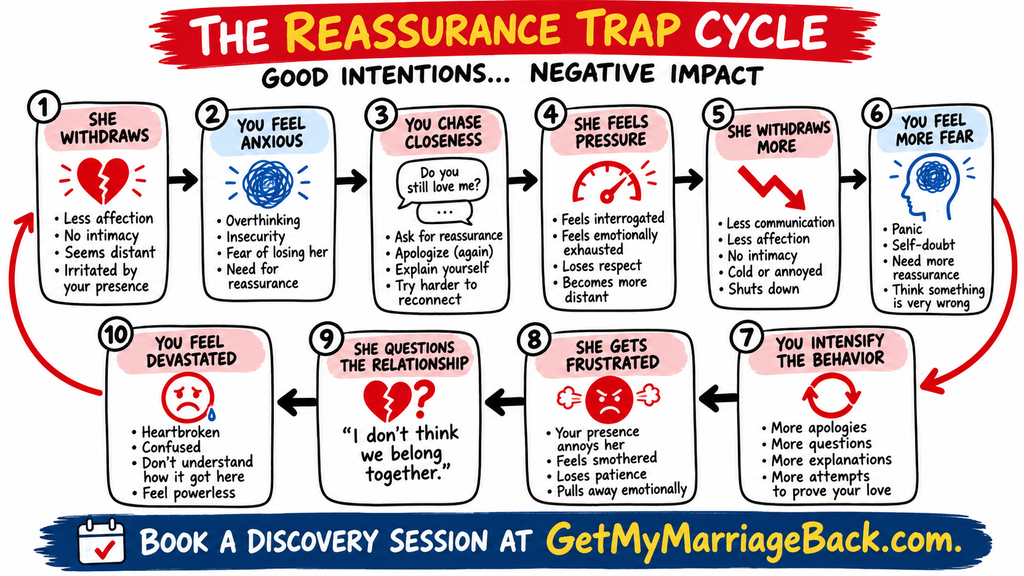
The problem becomes especially serious when you respond to her withdrawal by increasing your pursuit of reassurance.
You want to restore closeness.
She experiences pressure.
You become more anxious.
She withdraws further.
Your intention is connection. Your impact is pressure.
That’s the contradiction I want you to recognize.
It doesn’t mean affection is wrong. It means the way you express affection, the timing, and the emotional expectations attached to it matter.
And when you’re desperately trying to save your marriage, those distinctions become critical.
A Seven-Year Marriage That Almost Ended Over Emotional Withdrawal
I worked with a husband who had been married for approximately seven years.
When he described the beginning of their relationship, he remembered being the first to say, “I love you.”
There was nothing wrong with that.
Expressing affection first is not a weakness. Taking initiative in a relationship can be healthy and attractive.
But over time, something changed.
He became the person initiating almost every expression of affection.
Whenever conflict appeared, he apologized first.
When she seemed distant, he tried harder to reconnect.
And when he became uncertain about her feelings, he asked whether she still loved him.
During the final three years before he sought help, his wife rarely volunteered those words.
The familiar question became:
“Do you still love me?”
She would answer.
But her response never gave him lasting peace.
Before long, he needed reassurance again.
Meanwhile, his wife became increasingly frustrated by his presence.
Eventually, she told him:
“I don’t think we belong together.”
That’s when he came to us.
The disturbing part of this story is that he genuinely loved his wife.
He wasn’t indifferent to the marriage. He wasn’t refusing to make an effort.
In fact, he was making enormous efforts.
Unfortunately, he didn’t understand the difference between demonstrating commitment and creating an emotionally desirable experience.
That distinction brings us to five mistakes that can deepen attraction loss.
Mistake 1: Asking “Do You Still Love Me?” Until Reassurance Loses Its Meaning
When your wife stops expressing affection voluntarily, the silence becomes difficult to tolerate.
You begin looking for evidence that the marriage is still safe.
“Are we okay?”
“Do you still love me?”
“Are you still attracted to me?”
The questions themselves aren’t inherently unreasonable.
The problem begins when reassurance becomes something you repeatedly demand to calm your anxiety.
Now, your wife isn’t simply responding to a question.
She’s being placed in the position of managing your emotional state.
Even when she answers positively, you remain uncertain because the reassurance wasn’t spontaneous.
That creates a cycle.
Her withdrawal increases your anxiety. Your anxiety produces more questions. Those questions create pressure, and the pressure contributes to further withdrawal.
Researchers call a related interaction pattern demand-withdrawal.
In a 2025 study published in the Journal of Sex Research, researchers examined 151 couples discussing sexual conflict. Greater demand-withdrawal behavior was associated with lower sexual and relationship satisfaction and greater sexual distress; lower relationship satisfaction was also observed at a 12-month follow-up.
The research helps explain why repeated pressure around intimacy deserves serious attention.
You cannot interrogate your way into genuine desire.
Attraction must have room to exist without being demanded.
Mistake 2: Apologizing Repeatedly Without Changing the Experience
During a crisis in my own marriage, my first instinct whenever Lola was upset was to apologize.
Lola and I recently celebrated 19 years of marriage.
About ten years ago, we experienced a crisis that nearly ended our relationship.
It wasn’t the dramatic scandal people often imagine when they think about marriage breakdown.
Attraction was deteriorating, resentment was building, and our responses to conflict were making the situation worse.
I thought apologizing was the responsible thing to do.
And sometimes it absolutely was.
When you’ve genuinely hurt someone, accountability matters.
But I eventually had to confront an uncomfortable truth:
An apology is not a substitute for changing the experience you’re creating.
If you apologize repeatedly while continuing the same behaviors, your words lose their effectiveness.
Worse, you can begin apologizing for things you haven’t even identified simply because you want your wife to stop withdrawing.
Now the apology isn’t really about accountability.
It’s about obtaining emotional relief.
That’s an entirely different dynamic.
Take responsibility for actual mistakes, but stop using apologies as a tool for extracting affection.
A meaningful apology acknowledges specific harm and is followed by changed behavior.
Mistake 3: Confusing Constant Pursuit With Building Attraction
One of the biggest misconceptions in marriage advice is that more affection automatically produces more attraction.
More compliments.
More messages.
More explanations.
More declarations of love.
More attempts to initiate intimacy.
But attraction is not simply a reward for effort.
Think about the experience you’re creating.
When your wife has become emotionally distant, every additional attempt to secure affection can make her feel that another response is expected from her.
This doesn’t mean you should become cold, deliberately unavailable, or emotionally punishing.
That would simply replace one unhealthy pattern with another.
Instead, understand the difference between dignified pursuit and fear-driven chasing.
Dignified pursuit expresses genuine interest while respecting the other person’s autonomy.
Fear-driven chasing makes your emotional stability dependent on receiving the response you want.
The distinction is subtle, but its impact is enormous.
Attraction requires emotional freedom.
You can express love without insisting that your wife immediately return it.
You can show interest without making every interaction a test of whether she still desires you.
And you can remain warm without constantly trying to close every moment of emotional distance.
This is the art of emotional intelligence in attraction.
Mistake 4: Assuming Being a Good Husband Automatically Creates Sexual Desire
You work hard.
You provide for your family.
You remain committed to the marriage.
Perhaps you’ve sacrificed opportunities, invested years into building a home, and stayed loyal through difficult seasons.
Then your wife tells you she loves you but isn’t sexually attracted to you.
It’s painful because you believe your commitment should count for something.
And it does.
But being a good person and creating an attractive interpersonal experience are different things.
I call this distinction moral worth versus experiential value.
Your moral worth is not determined by your wife’s desire.
Experiential value concerns what it feels like to interact with you.
Does your presence create warmth, interest, emotional steadiness, and genuine enjoyment?
Or have your interactions become dominated by anxiety, resentment, defensiveness, and repeated attempts to obtain reassurance?
Research supports the importance of this distinction.
A 2016 study published in the Journal of Personality and Social Psychology found that perceived partner responsiveness was associated with greater sexual desire, particularly among women.
The researchers explored how feeling understood, valued, and special contributes to desire.
The lesson isn’t to become endlessly agreeable.
It’s to develop the emotional intelligence to create interactions where another person feels respected and genuinely engaged.
Experiential value creates room for curiosity. Curiosity can support attraction.
And attraction opens opportunities for deeper connection.
Mistake 5: Allowing Her Withdrawal to Control Your Identity
This is where many people lose themselves.
Your wife doesn’t touch you, so your confidence collapses.
She seems annoyed, so you become anxious.
She doesn’t initiate intimacy, so you begin questioning your entire identity.
Before long, your daily emotional condition depends on how she responds to you.
That is an exhausting way to live.
It also makes it harder to respond skillfully when conflict appears.
You need an internal foundation that doesn’t disappear whenever your spouse withdraws.
That’s where I teach GPS: Grounding, Purpose, and Self-Discovery.
Grounding: Return to Your Source of Truth
Stop treating your wife’s immediate response as the final authority over your identity.
Her attraction matters to your marriage, but it doesn’t determine your worth.
Ground yourself in your higher self, your values, gratitude, and the responsibilities within your control.
This is not pretending the crisis doesn’t hurt.
It’s refusing to let that pain dictate every decision.
Purpose: Build a Life Bigger Than the Crisis
When your marriage is struggling, it can consume every waking moment.
You monitor her expressions.
You analyze her messages.
You replay conversations and search for signs that attraction is returning.
That attention eventually becomes a prison.
Redirect some of that energy toward your mission, your work, your health, your contribution, and the legacy you want to build.
Your purpose must be bigger than obtaining another person’s approval.
That independent direction is part of becoming emotionally grounded and genuinely engaging.
Self-Discovery: Examine the Person You’re Becoming
Look honestly at your behavior without turning self-reflection into self-blame.
Are you expressing affection because you genuinely want to give?
Or because you desperately need reassurance?
Are you apologizing because you’ve identified a mistake?
Or because you want the discomfort to end?
These questions help you distinguish authentic love from fear-driven reactions.
Self-discovery gives you the capacity to choose your response instead of repeating the same behavior automatically.
How to Rebuild Attraction Without Begging for Intimacy
Now let’s make this practical.
Suppose your wife walks past you tonight without touching you.
Previously, you would immediately become anxious.
You might ask whether she’s upset, whether she still loves you, or whether the marriage is okay.
Then, if she responded coldly, you would apologize or try even harder.
That’s the old pattern.
Your new response begins with emotional composure.
Recognize the withdrawal without immediately interpreting it as proof that your marriage is over.
Allow the moment to exist without demanding reassurance.
Continue showing warmth, respect, and authentic interest without turning affection into a transaction.
If there is a genuine issue requiring accountability, address it directly.
Otherwise, stop treating every uncomfortable interaction as an emergency you must immediately resolve.
This is not about withholding affection to manipulate her.
It’s about developing the ability to express affection freely, with emotional intelligence and respect for boundaries.
A seductive relationship experience isn’t built through pressure.
It develops through authentic connection, confidence, responsiveness, playfulness, and the freedom for desire to be mutual.
That includes understanding that physical intimacy must remain freely chosen.
If pain, medication, hormonal changes, chronic stress, or other health concerns are contributing to reduced desire, those realities also deserve attention rather than being interpreted automatically as rejection.
Why Understanding Attraction Isn’t Enough: The GPS5 Principle
You can understand everything I’ve explained and still return to your old habits tonight.
Your wife responds coldly.
You become anxious.
Suddenly, you’re asking for reassurance again.
That’s why insight alone doesn’t create lasting behavioral change.
GPS establishes your internal foundation, but sustained execution requires additional skills.
I teach four supporting elements:
Story-Tailoring: Understand the specific history, behaviors, and emotional dynamics operating in your marriage.
Skill-Acquisition: Develop emotional intelligence through deliberate practice rather than relying on good intentions.
Support: Maintain perspective when rejection, anxiety, and fear distort your judgment.
System: Build a consistent way of responding when familiar emotional triggers appear.
Together, these principles form GPS5.
The objective is to move from reacting automatically to responding intentionally.
This is also where GAME becomes relevant: Giving Authentically but Mindfully with Emotional intelligence.
You express love because you choose to give, not because you’re trying to force an immediate return.
You remain attentive without becoming controlling.
And you develop a more attractive relationship experience without abandoning your dignity.
Can You Save Your Marriage When Your Wife Has Lost Attraction?
Yes, attraction can change within a marriage.
But the first question isn’t how to make your wife desire you again.
It’s whether you understand the behaviors, emotional dynamics, and patterns contributing to the current distance.
You can’t rebuild attraction effectively while repeatedly creating the pressure that undermines it.
Start by recognizing what has changed.
Perhaps your wife no longer initiates intimacy.
Maybe she says she loves you but doesn’t feel romantic attraction.
She may have become emotionally withdrawn, stopped expressing affection, or started questioning whether the marriage should continue.
These are serious signs of relationship distress.
They deserve more than generic advice to communicate more or apologize more.
You need the emotional intelligence to understand the experience you’re creating and the self-leadership to change what remains within your control.
My client didn’t need another speech convincing his wife that he loved her.
He needed to understand why his expressions of love were increasingly experienced as pressure.
That’s a very different problem.
And it requires a very different approach.
Your job is not to force your wife to say she loves you. Your job is to become capable of creating a healthier, more attractive relationship experience without losing yourself in the process.
19 Signs Your Wife Is Not Sexually Attracted To You
Frequently Asked Questions
Yes. Emotional attachment, commitment, and sexual desire are related but distinct experiences, so your wife can genuinely love you while experiencing reduced sexual attraction.
Reduced initiation can reflect resentment, emotional disconnection, stress, health changes, differing desire levels, or pressure surrounding intimacy. Pay attention to the broader relationship pattern rather than treating one behavior as proof she no longer loves you.
Yes, sexual desire can change as emotional connection, relationship experiences, and personal circumstances change. Rebuilding attraction begins with understanding the causes of disconnection and creating conditions where intimacy feels desirable rather than demanded.
Start by reducing reassurance-seeking and pressure, taking responsibility for specific mistakes, respecting boundaries, and strengthening your emotional self-leadership. Focus on creating a better relationship experience instead of trying to force affection or immediate reconciliation.