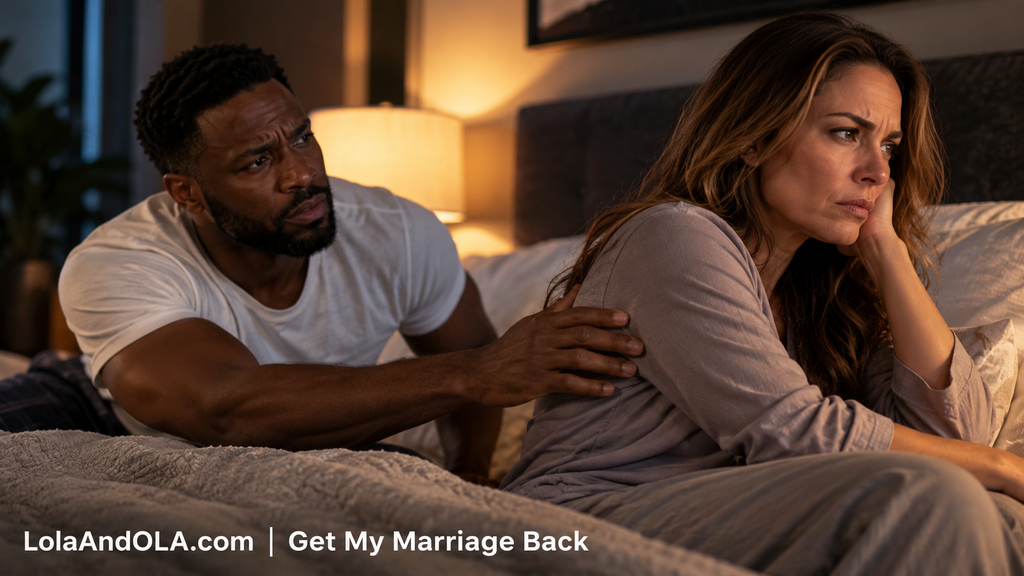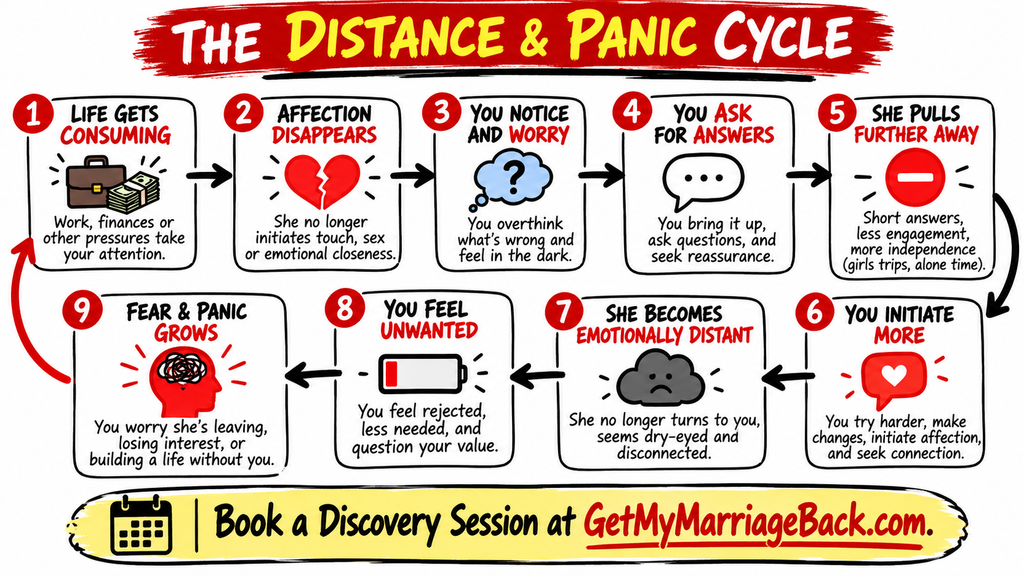


Your wife still says she loves you, but she rarely touches you, avoids intimacy, and no longer looks at you with the desire you remember.
Take This 2 Minutes Quiz
You have been faithful. You provide for your family, take care of yourself, and genuinely love your wife. Yet your marriage increasingly feels like a roommate arrangement.
Perhaps you’ve caught yourself thinking, “My wife loves me but is not sexually attracted to me. How is that even possible?”
I want you to understand something important: Love and sexual attraction are connected, but they are not identical.
Your wife can appreciate your commitment, respect your responsibilities, and care about your well-being while experiencing very little romantic or sexual desire.
The mistake is assuming that because you’ve fulfilled your responsibilities, attraction should automatically follow.
Sometimes, the real explanation is buried in years of interactions you never considered significant.
And understanding those interactions can change how you approach rebuilding attraction in your marriage.
Why Your Wife Can Love You but Not Desire You
A marriage operates on several levels simultaneously.
There is commitment: the decision to remain faithful and honor your responsibilities.
There is companionship: the familiarity, friendship, and shared history that develop over years together.
Then there is romantic and sexual attraction: the desire to experience your spouse as an intimate partner rather than simply someone who shares your household.
These dimensions influence one another, but they don’t always move together.
You can have commitment without much passion. A couple can maintain a functional household while losing emotional closeness. Two people may genuinely love each other yet struggle to experience the intimacy they once enjoyed.
When your wife never initiates intimacy, the problem may appear purely sexual.
But the bedroom can reveal tensions that developed elsewhere in the marriage.
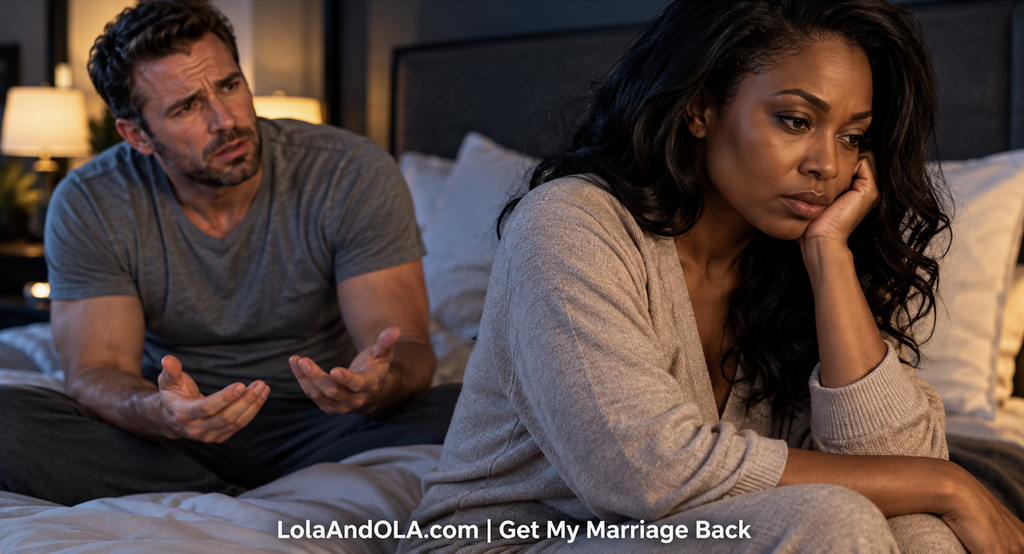
The 14-Year Marriage That Became a Roommate Relationship
I worked with a husband who had been married for 14 years.
He was faithful, responsible, physically well-maintained, and genuinely committed to his family.
From his perspective, he had done what a good husband was supposed to do.
Yet his wife had become emotionally distant.
She rarely initiated physical affection. Sexual intimacy had declined, and their relationship felt increasingly like two roommates sharing responsibilities.
He couldn’t understand why.
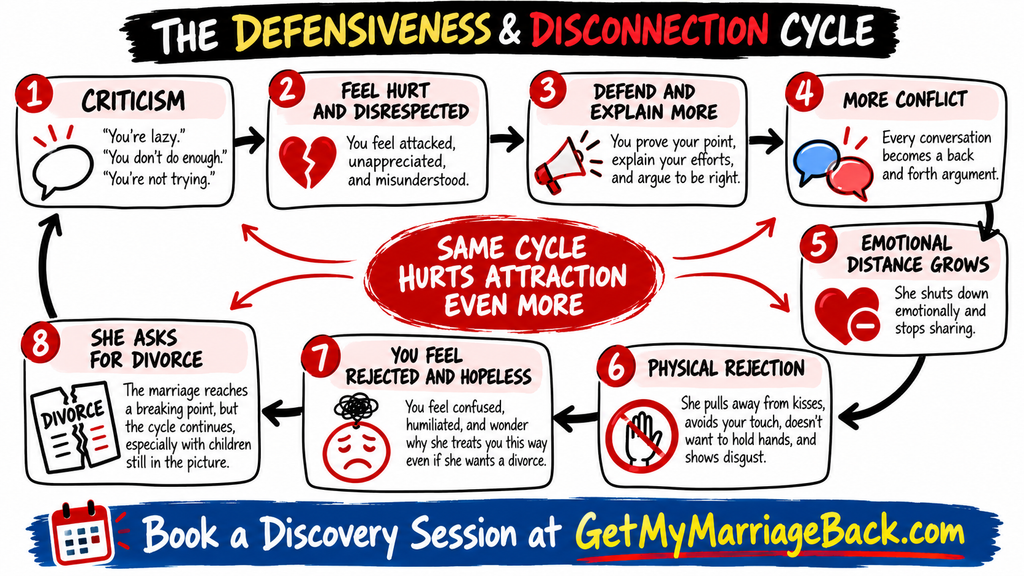
Initially, we examined his frustration, his wife’s withdrawal, and the criticism and defensiveness developing between them.
But the deeper issue didn’t emerge during our initial Discovery Session.
It surfaced much later, when we began engaging his wife directly.
What we discovered illustrates four important reasons attraction can deteriorate even when a husband believes he has done everything right.
1. Your Wife May Be Connecting Experiences You’ve Kept Separate
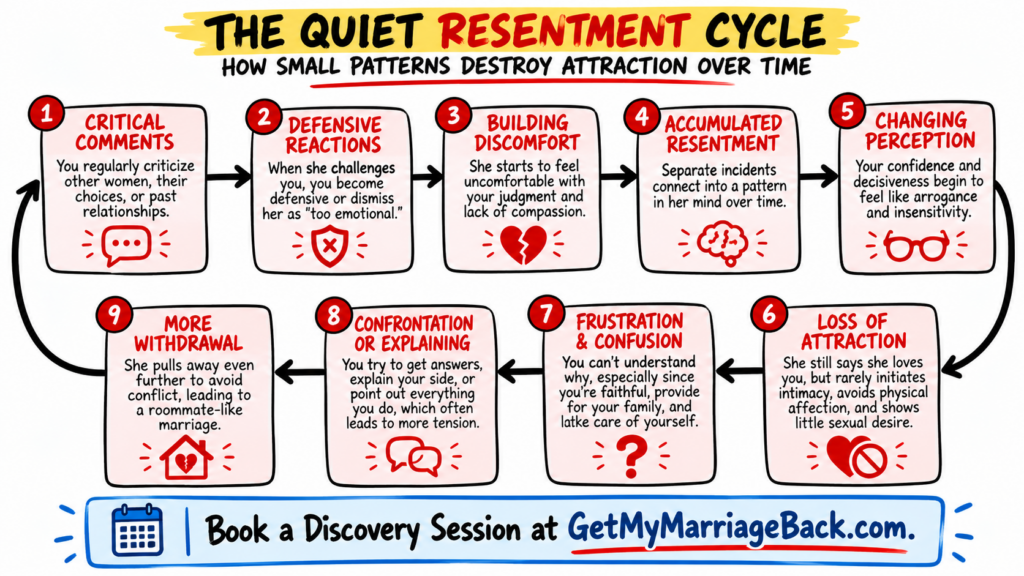
One of the most revealing discoveries involved the husband’s longstanding habit of harshly criticizing other women.
He frequently expressed contempt toward single mothers, divorced women, and women whose relationship decisions he disapproved of.
His wife had sometimes agreed with his opinions.
But gradually, she became uncomfortable with the judgment behind his words.
Whenever she challenged him, he became defensive and accused her of being overly emotional.
To him, these were isolated disagreements.
To her, they were pieces of a much larger pattern.
This distinction matters.
You may remember individual conversations. Your wife may remember the emotional pattern connecting them.
You remember what the disagreement was about. She remembers how you responded when someone challenged your opinion.
Eventually, when she experienced personal difficulties, she recognized that same lack of compassion directed toward her.
The emotional meaning of earlier conversations changed.
What had once appeared to be confidence began to feel like judgment.
The man she once admired for his decisiveness increasingly seemed difficult to approach emotionally.
Why Emotional Patterns Matter More Than Individual Arguments
Imagine criticizing someone’s mistakes during a conversation.
You believe you’re discussing accountability.
Your wife hears contempt.
Later, she shares something vulnerable, and you respond by explaining why her interpretation is wrong.
In your mind, you’re correcting a misunderstanding.
From her perspective, you’re repeating the same behavior she has observed for years.
Neither spouse necessarily understands the full pattern while it is developing.
But repeated experiences can influence whether your partner anticipates understanding or judgment when approaching you.
If your wife avoids difficult conversations, examine how those conversations typically unfold.
Does she feel heard before you explain your position?
Can she disagree without being labeled emotional or unreasonable?
Are you more interested in proving your point than understanding her experience?
These questions may reveal more about the loss of connection than another argument about how often you have sex.
2. Confidence Can Become Unattractive When It Feels Like Contempt
Confidence is attractive when it communicates stability, competence, and self-respect.
But confidence and contempt are fundamentally different.
A confident person can disagree without humiliating someone.
A decisive spouse can maintain strong convictions while remaining compassionate.
Someone with healthy self-respect doesn’t need to make another person feel small to establish authority.
In the marriage I described, the husband’s confidence had originally contributed to his wife’s attraction.
Over time, however, she began experiencing his decisiveness as arrogance.
The qualities themselves weren’t necessarily the problem.
It was how those qualities appeared in their interactions.
The Difference Between Strength and Emotional Insensitivity
Consider two responses to a disagreement.
One husband says:
“I see why that upset you. I don’t completely agree with your interpretation, but I want to understand what happened.”
Another responds:
“You’re being too emotional. That’s not what I meant, and you know it.”
Both men may believe they are defending a reasonable position.
But the emotional experience they create is very different.
The first response preserves room for connection.
The second can make vulnerability feel unsafe.
When emotional insensitivity becomes habitual, a spouse may begin protecting herself through distance.
That distance can eventually affect affection, flirtation, and sexual desire.
Relationship research supports the importance of this distinction. In a large community study, researchers found that perceived intimacy and partner responsiveness were positively associated with sexual desire among partnered adults across the groups examined.
The findings are discussed in this study on intimacy, partner responsiveness, and sexual desire.
The practical implication is significant: how your spouse experiences you emotionally can matter to the romantic and sexual relationship.
Attraction is not simply a reward for providing financially, remaining faithful, or maintaining your appearance.
3. Accumulated Resentment Can Turn Marriage Into a Roommate Arrangement
Resentment rarely announces itself dramatically.
Sometimes it develops through repeated experiences that never receive meaningful attention.
A disagreement ends without resolution.
Someone feels dismissed but stops arguing.
Physical affection becomes less spontaneous.
Eventually, the couple maintains the household while avoiding deeper emotional engagement.
The marriage still functions, but the romantic relationship becomes increasingly disconnected.
Signs Your Wife’s Emotional Withdrawal May Be Connected to Resentment
Pay attention to patterns such as:
- She avoids discussing personal struggles with you.
- Affection has become less frequent or feels obligatory.
- Conversations about intimacy quickly become arguments.
- She repeatedly brings up experiences you believe were resolved.
- She seems more comfortable discussing practical responsibilities than emotional concerns.
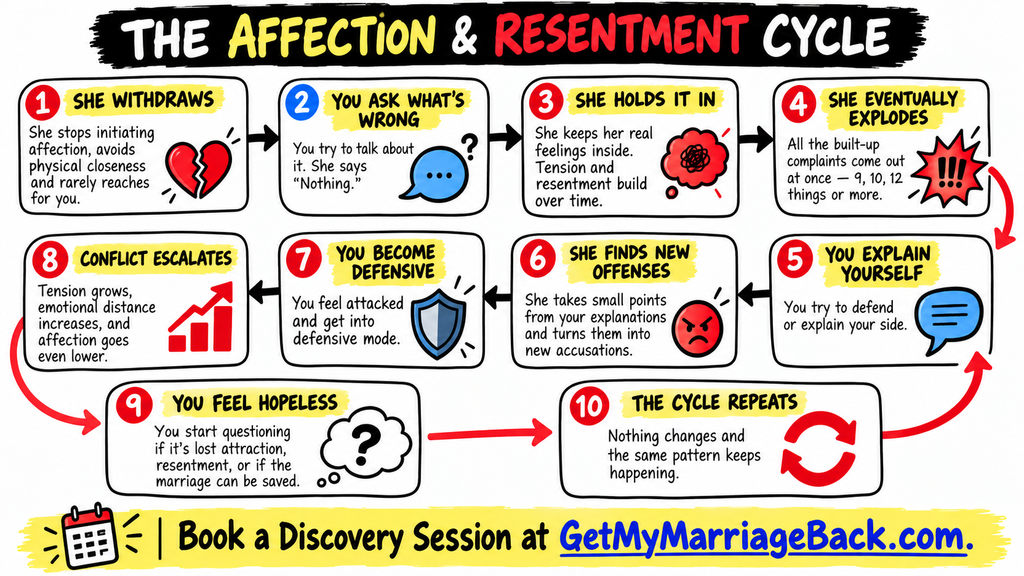
- Your attempts to explain yourself frequently make her withdraw further.
None of these signs establishes resentment as the only explanation.
Stress, exhaustion, health concerns, hormonal changes, medication, unresolved sexual difficulties, and broader relationship dissatisfaction can also influence desire.
However, when emotional withdrawal follows years of criticism and defensiveness, the relationship dynamic deserves serious attention.
Why Being Faithful Isn’t Always Enough
Faithfulness is essential to the commitments many married couples make.
Providing for your family matters.
Taking care of yourself is valuable.
But these contributions don’t eliminate the need for emotional connection.
Think about it.
Would you feel naturally drawn toward someone who consistently dismissed your concerns, even if that person fulfilled every practical responsibility?
Probably not.
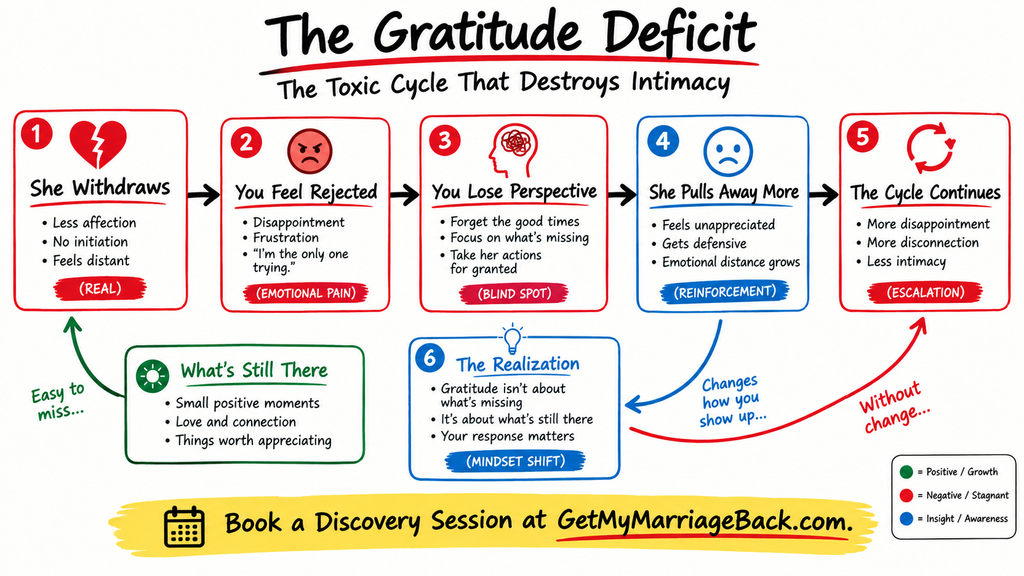
Your wife may recognize your sacrifices while struggling with how she feels during interactions with you.
That is why reminding her of everything you’ve done can miss the underlying issue.
You’re presenting evidence of responsibility when the relationship may be suffering from a lack of emotional understanding.
4. Defending Yourself Can Deepen the Attraction Problem
When your wife no longer initiates intimacy, frustration is understandable.
You miss being wanted.
Perhaps you’ve begun questioning your attractiveness, masculinity, or value as a husband.
Naturally, you want an explanation.
But how you pursue that explanation matters.
In the 14-year marriage, the husband’s attempts to defend himself and confront the lack of intimacy intensified his wife’s withdrawal.
He wanted her to recognize his intentions.
She wanted him to understand her experience.
Both were addressing different parts of the relationship.
Stop Trying to Win the Argument About Attraction
Imagine saying:
“I’ve never cheated on you. I pay the bills. I take care of myself. What more do you want?”
Those statements may be factually correct.
But they don’t necessarily address why your wife feels emotionally disconnected.
Instead, they can turn intimacy into another argument about who has fulfilled their obligations.
Sexual desire doesn’t operate like a debt someone owes because their spouse has behaved responsibly.
And pressure can make an already difficult sexual relationship feel even more complicated.
A better starting point is understanding what changed in the emotional relationship.
Ask yourself whether your conversations create curiosity or defensiveness.
Notice whether affection is freely exchanged or followed by expectations.
Most importantly, examine whether your response to rejection reinforces the very emotional distance you’re trying to overcome.
How to Rebuild Attraction Without Begging for Intimacy
Now we come to the part you can influence.
You cannot command your wife’s feelings.
But you can change how you participate in the relationship.
I teach this through the GPS5 framework, beginning with Grounding, Purpose, and Self-Discovery.
These principles help you move away from reactive behavior and toward emotionally intelligent self-leadership.
Grounding: Stop Letting Rejection Control Your Behavior
When your wife pulls away, the temptation is to chase reassurance.
You may repeatedly ask whether she loves you, question why she doesn’t initiate sex, or become visibly frustrated whenever affection is absent.
Grounding means learning to regulate those reactions.
It doesn’t mean pretending you aren’t hurt.
Rather, you acknowledge the pain without allowing it to dictate your next conversation.
A grounded spouse can express disappointment without creating pressure.
That emotional steadiness helps make honest conversations more possible.
Purpose: Become More Than Someone Waiting to Be Desired
If your entire sense of worth depends on whether your wife wants intimacy tonight, every interaction becomes emotionally loaded.
You start measuring her tone, her touch, and her attention.
Ordinary moments become tests of attraction.
Purpose restores a healthier balance.
Continue investing in your physical health, meaningful work, friendships, personal development, and responsibilities.
Build a life that reflects your values rather than organizing your identity around obtaining your spouse’s approval.
This isn’t a tactic to make her jealous.
It is an expression of healthy self-respect.
Self-Discovery: Identify the Patterns You Don’t Notice
This is where many people encounter their greatest challenge.
You know your intentions.
But you may not recognize how your habits affect someone else.
Examine your communication during disagreements.
Do you interrupt?
Does criticism come naturally when someone makes a mistake?
Are you quick to explain why your spouse shouldn’t feel the way she feels?
Can you acknowledge an emotional impact without immediately defending your character?
Self-discovery requires more than deciding you’re a good person.
It requires observing how you behave when challenged.
For the husband in our story, understanding this distinction was essential because the deeper issue had remained hidden behind his complaints about intimacy.
Building Attraction Through Emotional Intelligence
Romantic attraction involves more than being agreeable.
Healthy attraction can include playfulness, anticipation, admiration, individuality, emotional intimacy, and mutual desire.
But these qualities flourish more naturally when the relationship is not dominated by resentment or pressure.
Here are several ways to develop that environment.
Replace Judgment With Curiosity
When your spouse expresses an opinion you disagree with, resist the urge to immediately correct it.
Try understanding the experience behind the opinion.
You don’t have to surrender your convictions.
The goal is to demonstrate that disagreement doesn’t threaten your ability to remain emotionally present.
Practice Affection Without Demanding Escalation
A hug doesn’t have to become an invitation to sex.
A compliment doesn’t need to produce immediate romantic attention.
Small gestures become more meaningful when your spouse can receive them freely.
Respect her comfort, boundaries, and willingness to participate.
Affection should create connection, not obligation.
Bring Back Playfulness and Individuality
A roommate marriage often becomes dominated by schedules, bills, parenting, and household responsibilities.
Those responsibilities matter, but they shouldn’t consume every interaction.
Make room for humor, interesting conversations, shared experiences, and enjoyable time together.
Stay curious about who your spouse is becoming.
Continue developing yourself as someone with interests, energy, and a meaningful life beyond household logistics.
Romance benefits when partners can experience one another as individuals rather than merely coworkers managing a family.
Let Changed Behavior Become Consistent
A single apology cannot erase years of accumulated experiences.
Neither can one romantic dinner.
If defensiveness has been a recurring problem, the meaningful change is learning to remain receptive during repeated disagreements.
When criticism has damaged connection, practice communicating your standards without contempt.
Consistency matters because trust develops through experience.
Your spouse needs room to observe who you are becoming without being pressured to immediately reward your efforts.
Can You Save Your Marriage When Your Wife Has Lost Attraction?
The answer depends on what is happening beneath the loss of desire.
Some marriages struggle primarily with exhaustion, competing responsibilities, or sexual desire differences.
Others are affected by accumulated resentment, unresolved conflict, emotional withdrawal, or significant breaches of trust.
The first task is distinguishing among those possibilities.
If you’re trying to save your marriage from divorce, don’t assume that fixing your appearance or increasing romantic gestures will resolve a longstanding emotional pattern.
Similarly, don’t conclude that every lack of sexual desire means your spouse is preparing to leave.
Look at the entire relationship.
How do you communicate?
What happens when one person feels misunderstood?
Has affection disappeared gradually or suddenly?
What concerns has your spouse repeated over time?
These questions can help clarify whether the relationship needs renewed emotional responsiveness, changes in conflict behavior, attention to sexual concerns, or a combination of approaches.
Marriage reconciliation becomes more realistic when you stop treating the visible symptom as the whole problem.
The Real Meaning Behind “My Wife Loves Me but Is Not Sexually Attracted to Me”
Your wife may genuinely love you while experiencing a different emotional relationship than the one you believe you’re maintaining.
That difference can be difficult to accept.
You may remember your faithfulness, sacrifices, and good intentions.
She may remember moments when she felt judged, dismissed, or unable to approach you vulnerably.
Neither perspective should be ignored.
But you cannot understand the marriage by examining only your intentions.
The husband who had been married for 14 years initially believed his problem was primarily sexual attraction.
Much later, a deeper relational pattern became visible.
His wife’s withdrawal had not developed in isolation.
It was connected, in significant part, to experiences that gradually changed how she perceived him.
The most important shift is moving from “Why doesn’t my wife want me?” to “What has our relationship become emotionally, and what can I change about how I participate in it?”
That question moves you away from begging, defensiveness, and blame.
It also creates room for something more valuable: genuine self-respect, emotional understanding, and the possibility of rebuilding romantic connection through consistent behavior.
Attraction is not something you extract from your spouse.
It is something two people can experience when the relationship gives them reasons to feel emotionally connected, respected, and romantically engaged.
19 Signs Your Wife Is Not Sexually Attracted To You
Frequently Asked Questions
Love and sexual desire are different experiences, and attraction can be affected by resentment, emotional distance, stress, health changes, and relationship dynamics. Understanding what has changed between you is more useful than assuming one explanation.
Yes, sexual attraction can return as emotional connection, relationship satisfaction, and intimacy improve. The important step is identifying what contributed to its decline rather than trying to force physical affection.
Stop treating initiation as the only measure of love and examine the broader emotional and sexual relationship. Discuss your needs respectfully, listen to her experience, and avoid turning affection into an obligation.
No, a sexless marriage does not automatically mean your wife wants a divorce. However, persistent emotional withdrawal, unresolved resentment, and deteriorating communication deserve attention before the relationship becomes increasingly disconnected.