

Your wife still kisses you goodbye, asks about your day, and shares a home with you—but she never initiates intimacy anymore, leaving you wondering whether you’re still her husband emotionally or simply the man she lives with.
Take This 2 Minutes Quiz
There is a particular kind of loneliness that comes from sleeping beside someone you love while feeling completely unwanted.
You might still laugh together occasionally. The bills get paid, family responsibilities continue, and your marriage looks normal to everyone outside your home.
But something has changed.
She no longer reaches for you in bed. The spontaneous kisses have disappeared. When you initiate affection, you sometimes feel as though you’re interrupting her rather than inviting her into something enjoyable.
Eventually, you start asking yourself questions you never imagined asking about your marriage.
Is my wife still sexually attracted to me? Does she love me but no longer desire me? Is there somebody else? Can my marriage be saved?
I want you to understand something important: The absence of sexual initiation is a symptom, not a complete diagnosis of your marriage.
Before you conclude that your wife has stopped loving you, you need to understand what might be happening beneath the surface—and how your reactions may be affecting the attraction you desperately want to rebuild.
What Would Help You Most Right Now?
Choose the option that best matches where you are with your marriage.
My Marriage Is in Serious Trouble
If you're dealing with separation, divorce, loss of attraction, infidelity, intimacy problems, or a spouse who's pulling away, get help looking at what's happening in your specific situation.
Get Personalized Help →
Start With Get My Marriage Back
Get the book and start learning the principles for moving your marriage in a better direction.
Get the Free Book →Why Does My Wife Never Initiate Intimacy Anymore?
One of the biggest mistakes I see in struggling marriages is assuming that sexual withdrawal has only one explanation.
Your wife might be experiencing declining sexual attraction. She may be carrying unresolved resentment, struggling with emotional exhaustion, or dealing with physical or psychological changes affecting her desire.
Sometimes several of these issues overlap.
And sometimes she genuinely wants to remain married while feeling disconnected from the sexual side of the relationship.
Consider a husband who spent three and a half years in a marriage where his wife stopped initiating physical intimacy.
She wasn’t threatening divorce. There were no packed suitcases, and she continued participating in their family life.
From the outside, they looked married.
Behind closed doors, however, he was constantly trying to understand why she no longer seemed to want him.
His uncertainty became anxiety. That anxiety turned into monitoring, pleading, and pursuing affection.
The more he chased intimacy, the more emotionally exhausted he became.
The central problem wasn’t simply that his wife stopped initiating.
He had begun organizing his emotional life around whether she desired him.
That distinction matters because attraction is difficult to nurture when every interaction becomes a referendum on whether you’re wanted.

Sign #1: She Still Acts Married, But the Sexual Attraction Is Missing
Your wife can be a responsible partner without feeling the same level of sexual desire she once experienced.
She might prepare meals with you, coordinate schedules, remember important dates, and genuinely care about your wellbeing.
Those behaviors demonstrate participation in the marriage.
They do not automatically demonstrate sexual attraction.
This is where many husbands become confused.
You assume that because she still performs the responsibilities associated with marriage, physical intimacy should naturally follow.
When it doesn’t, you interpret the contradiction as rejection.
But companionship, commitment, emotional closeness, and sexual attraction are related experiences—not identical ones.
What to examine
Pay attention to the difference between affectionate behavior and sexual initiation.
Does she enjoy sitting close to you but withdraw when touching becomes sexual?
Does she initiate casual affection while avoiding anything that might lead to intercourse?
Has her interest in all forms of physical closeness declined, or only sexual activity?
These distinctions reveal more than simply counting how many times you’ve had sex.
A woman who welcomes nonsexual affection but rarely initiates intercourse may be experiencing something different from a woman who avoids nearly every form of physical contact.
Neither pattern tells the entire story.
Your objective is to understand the relationship dynamic rather than force a conclusion from one behavior.
Sign #2: Emotional Withdrawal Has Become Part of Your Marriage
Sexual attraction and emotional connection influence each other.
When unresolved emotional tension accumulates, physical closeness can become difficult.
Likewise, a prolonged absence of intimacy can create sadness, insecurity, and emotional withdrawal for the spouse who feels rejected.
Now both people are reacting to the same problem from different emotional positions.
You feel unwanted.
She may feel pressured, misunderstood, exhausted, or disconnected.
Instead of experiencing each other as romantic partners, you begin experiencing each other through the tension surrounding intimacy.
The difference between emotional withdrawal and lost attraction
Emotional withdrawal often becomes visible outside the bedroom.
Your wife may stop sharing personal thoughts, become less interested in spending time together, or respond to ordinary conversations with impatience.
Lost sexual attraction can exist even when friendship and companionship remain relatively strong.
The distinction is important because rebuilding emotional connection and addressing sexual desire are related but not interchangeable tasks.
Research published in the Journal of Marital and Family Therapy in 2024 examined how adults manage differences in sexual and affectionate desire. Participants described several approaches, including communication, alternative forms of connection, and changes in relationship behavior.
The research reinforces an important principle: couples experience differences in desire, and how they respond to those differences matters.
I encourage you to stop asking only, “Why won’t my wife initiate sex?”
Start examining a broader question:
“What happens emotionally between us before intimacy even becomes a possibility?”
That question directs your attention toward the quality of your interactions rather than merely their sexual outcome.
Sign #3: Unresolved Resentment Has Replaced Emotional Safety
Marriage creates friction.
You combine two personalities, two histories, different expectations, financial responsibilities, family obligations, and competing emotional needs.
Eventually, disagreements happen.
Being a good person doesn’t automatically make you skilled at navigating those disagreements.
You can genuinely love your wife and still have habits that create unnecessary tension.
Perhaps you become defensive whenever she expresses frustration.
Maybe she avoids difficult conversations until resentment builds.
Over time, the marriage develops an emotional history neither person knows how to resolve.
The result can be a relationship where both partners feel misunderstood.
Why resentment affects physical intimacy
Imagine trying to feel playful, affectionate, or sexually open with someone when you anticipate criticism or another argument.
Your body may be physically present, but your attention remains occupied by emotional tension.
That tension can interfere with the relaxed connection that often supports desire.
It is also important to recognize that resentment doesn’t always originate in one spouse’s behavior.
Personal history, childhood experiences, chronic stress, health difficulties, and outside responsibilities can influence how someone experiences closeness.
You cannot assume that everything your wife feels is your responsibility.
However, you can take responsibility for understanding your contribution to the relationship dynamic.
Stop confusing good intentions with relationship skills
You may have worked hard, remained faithful, supported your family, and believed those qualities should protect your marriage.
They matter tremendously.
But commitment and good intentions don’t replace the skills required to handle emotional friction.
Learning to listen without becoming defensive, express frustration without attacking, and address disagreements without punishment changes the emotional environment of a marriage.
Attraction has more room to develop when ordinary interactions stop feeling like battles.
Sign #4: Your Attempts to Restore Intimacy Are Creating More Pressure
This is where I want you to pay particular attention.
When your wife stops initiating intimacy, your natural instinct may be to pursue her more aggressively.
You become unusually attentive.
You offer compliments, perform favors, plan romantic evenings, and initiate physical contact more frequently.
None of those behaviors is automatically unhealthy.
The problem begins when your actions carry an unspoken expectation.
You do something nice and wait for affection.
When she doesn’t respond as you hoped, disappointment becomes resentment.
Soon, your kindness begins to feel like an investment that should produce a particular return.
This is what I call a covert contract.
The invisible contract destroying your confidence
A covert contract sounds something like this:
“If I do enough for my wife, she should want me.”
Or:
“If I become more romantic, she should initiate sex.”
Perhaps your internal agreement is even simpler:
“If she loves me, she should prove it physically.”
The difficulty is that your wife never necessarily agreed to those conditions.
Your gestures may look generous, but your emotional reaction reveals that you were expecting something in exchange.
Over time, ordinary affection becomes loaded with pressure.
She may begin wondering whether every hug is supposed to lead to sex.
Meanwhile, you interpret every hesitation as further evidence that you’re unwanted.
Now both people become increasingly guarded.
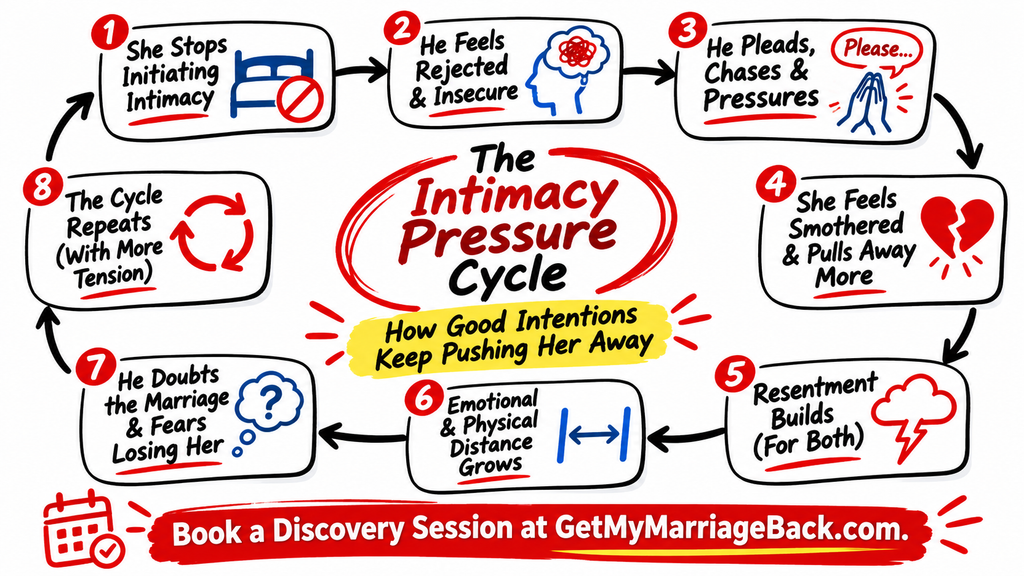
The pressure-and-withdrawal cycle
The pattern often develops like this:
You notice less intimacy → You feel rejected → You pursue reassurance → She experiences pressure → She withdraws → You feel even more rejected.
The cycle repeats until intimacy becomes associated with anxiety rather than connection.
This doesn’t mean your desire for physical intimacy is unreasonable.
Sexual connection can be an important part of marriage.
It means that the method you’re using to pursue connection may be working against the outcome you want.
You cannot pressure someone into authentic desire.
How to Rebuild Attraction Without Begging or Chasing
I want to shift your attention away from controlling your wife’s reactions and toward developing the qualities that make you a more grounded, emotionally intelligent partner.
That is where self-leadership becomes important.
Self-leadership doesn’t mean pretending you don’t care about intimacy.
It means your emotional stability is no longer determined entirely by whether your wife initiates affection tonight.
You remain capable of warmth, confidence, and constructive communication even when you’re disappointed.
1. Stop turning every interaction into a test
When your wife enters the room, notice whether you’re immediately evaluating her mood.
Are you searching for evidence that she finds you attractive?
Do you interpret a smile as progress and a distracted response as rejection?
This constant monitoring makes it difficult to enjoy ordinary companionship.
Practice being present without requiring every interaction to reassure you.
Offer affection because you genuinely want to express affection, while allowing her the freedom to welcome or decline it.
A peaceful evening together can be valuable even when it doesn’t end in sex.
2. Rebuild your personal grounding
Attraction is difficult to cultivate when desperation dominates your behavior.
Reconnect with the parts of your identity that exist beyond your wife’s approval.
Maintain meaningful friendships, pursue worthwhile goals, care for your physical wellbeing, and participate actively in your family life.
These activities shouldn’t become performances designed to make her jealous or afraid of losing you.
Their purpose is to restore balance to your emotional life.
When your confidence comes from your values and actions rather than constant reassurance, you become less reactive.
That steadiness changes how you participate in the marriage.
3. Create emotional connection without an immediate sexual agenda
Emotional intimacy grows through repeated experiences of being understood, respected, and genuinely enjoyed.
Ask questions because you’re interested in your wife’s perspective.
Listen without immediately defending yourself.
Share humor, appreciation, and experiences that remind both of you that marriage involves more than responsibilities.
Make room for playfulness.
A thoughtful compliment, a shared private joke, or a spontaneous invitation can help restore the feeling of being romantic partners rather than household administrators.
The seductive quality of these interactions comes from mutual enjoyment, not hidden pressure.
You are creating opportunities for attraction to emerge naturally.
4. Communicate about intimacy without demanding it
Avoiding pressure doesn’t mean avoiding the subject.
If physical intimacy has disappeared for months or years, the problem deserves a thoughtful conversation.
Choose a calm moment outside the bedroom.
You might say:
“I’ve noticed that physical intimacy has become difficult for us, and I miss feeling close to you. I don’t want you to feel pressured, but I do want to understand what this experience has been like for you.”
Then listen.
Your wife may describe experiences you haven’t considered.
She might identify emotional concerns, physical discomfort, exhaustion, or uncertainty about her own desire.
If medical symptoms, pain, medication effects, or hormonal changes are involved, appropriate healthcare support can be part of addressing the problem.
The objective is understanding, not winning an argument about how often sex should happen.
5. Restore flirtation without making affection transactional
A marriage needs more than efficient teamwork.
It also benefits from novelty, curiosity, anticipation, and playful attention.
Flirtation is an invitation to enjoy each other, not a demand for sexual performance.
You can communicate attraction through your presence, warmth, humor, and sincere appreciation.
Notice what your wife enjoys.
Create opportunities for shared experiences outside your usual routines.
Allow affectionate moments to remain affectionate without automatically escalating them.
When physical closeness is freely chosen, it becomes easier for both partners to experience it as enjoyable rather than obligatory.
The goal is not to make your wife comply with your desire. It is to rebuild a relationship where mutual desire has room to develop.
Can You Save Your Marriage Alone When Your Wife Has Lost Attraction?
You can begin changing your contribution to the marriage even when your wife isn’t ready to participate in a formal reconciliation process.
That doesn’t mean you can create mutual intimacy entirely by yourself.
A marriage involves two people with independent feelings, choices, and responsibilities.
Your opportunity is to stop reinforcing the patterns that make connection more difficult.
This requires learning three essential elements: Skills, Support, and System.
Skills help you navigate conflict, communicate effectively, and manage emotional reactions.
Support gives you perspective when anxiety makes it difficult to interpret what’s happening.
A system helps you practice those skills consistently instead of reverting to old habits whenever disappointment returns.
Research involving 1,054 married couples found that larger differences between desired and actual sexual frequency were generally associated with lower relationship satisfaction and stability, along with more conflict.
That finding helps explain why unresolved intimacy problems deserve attention even when divorce isn’t being discussed.
The important question is not simply whether your wife has initiated sex recently.
It’s whether the two of you are developing a healthier way to experience emotional and physical connection.
The GPS5 Approach to Rebuilding Attraction in Marriage
I teach self-leadership through a framework called GPS5.
It begins with three foundational areas:
Grounding: Learning to regulate your reactions instead of allowing fear and rejection to control your behavior.
Purpose: Building a meaningful life and personal direction that don’t depend entirely on your spouse’s validation.
Self-Discovery: Recognizing the emotional habits, assumptions, and relationship patterns that influence your decisions.
These foundations support a progression involving Value, Curiosity, Attraction, Influence, and Leverage.
Value begins with becoming a more emotionally steady, responsible, and engaging partner.
Curiosity grows when familiar negative patterns change and both people have opportunities to see each other differently.
Attraction becomes possible when interactions are more enjoyable, emotionally connected, and mutually inviting.
Influence comes from trust, credibility, and constructive communication rather than pressure.
Leverage, in this context, means developing the personal stability and relationship skills needed to make thoughtful choices without resorting to desperation.
You are not using these principles to manipulate your wife’s emotions.
You’re developing the capacity to participate in marriage with greater confidence, maturity, and emotional intelligence.
What If Your Wife Hasn’t Initiated Intimacy for Years?
A long period without intimacy deserves more than a quick romantic gesture.
Three and a half years of sexual withdrawal can produce deeply established expectations.
You may anticipate rejection before initiating anything.
Your wife may anticipate pressure whenever you become affectionate.
Both partners can become trapped in habits that reinforce the very distance they dislike.
Changing that pattern requires patience and an honest examination of its causes.
Start by identifying what you actually know.
Separate observable behavior from assumptions.
For example:
Observation: Your wife rarely initiates physical contact.
Assumption: She doesn’t love you anymore.
Those are not equivalent statements.
Similarly, continuing to share a home doesn’t establish that emotional attraction is healthy.
The more accurately you understand your marriage, the less likely you are to make fear-driven decisions.
That clarity matters whether you’re dealing with attraction loss, emotional withdrawal, a sexless marriage, or concerns about eventual separation.
The Truth About Rebuilding Sexual Attraction
Attraction is not simply a reward for being nice.
Neither is it something you can demand because you’re married.
It develops within a relationship influenced by emotional experiences, physical wellbeing, personal identity, communication, and the quality of everyday interactions.
You cannot eliminate every disagreement or guarantee that your spouse will always feel desire.
But you can stop making intimacy a constant emotional test.
You can become more intentional about how you handle frustration, express affection, and create opportunities for connection.
Most importantly, you can recognize the difference between pursuing your wife romantically and pursuing her desperately.
Romantic pursuit leaves room for curiosity, freedom, and mutual enjoyment.
Desperate pursuit demands reassurance and interprets hesitation as personal failure.
One creates space for connection.
The other often increases the pressure surrounding it.
If your wife never initiates intimacy, don’t reduce your entire marriage to that one painful symptom.
Examine the emotional environment, the history of unresolved friction, the quality of your interactions, and the habits you bring into the relationship.
Your first responsibility isn’t to convince your wife to want you. It’s to become someone who can participate in intimacy without fear, pressure, or emotional dependence controlling the experience.
That’s where skillful, emotionally intelligent marriage restoration begins.
5 Physical Signs She Just Slept With Someone Else: The Truth
Frequently Asked Questions
Your wife may be experiencing lower sexual desire, unresolved resentment, emotional disconnection, stress, or physical health changes. Understanding the cause requires examining her experience and the broader relationship rather than assuming she has stopped loving you.
Yes, your wife can love you while experiencing little sexual desire or rarely initiating intimacy. Emotional commitment and sexual attraction are related but distinct aspects of marriage.
Focus on improving emotional connection, communicating openly about desire, reducing pressure, and creating mutually enjoyable opportunities for affection. Sexual initiation must remain her choice rather than something produced through obligation.
Yes, couples can rebuild emotional and physical closeness after prolonged periods of sexual disconnection. Progress depends on understanding the underlying causes, addressing persistent relationship patterns, and developing a mutually satisfying approach to intimacy.