


Your wife never initiates affection anymore, and every night you spend waiting for her to reach for you makes you feel like you’re the only one trying to keep your marriage alive.
Take This 2 Minutes Quiz
You remember when your wife used to touch you without being asked. She would reach for your hand, kiss you spontaneously, lean against you on the couch, or initiate intimacy because she wanted to be close.
Now, you initiate almost everything.
When you stop making the first move, nothing happens. The silence becomes painful, and you start wondering whether your wife is still sexually attracted to you.
Perhaps you’ve already tried explaining how rejected you feel. You’ve reminded her that physical affection matters to you, worked harder to make her happy, or asked why she never initiates intimacy.
Yet the emotional distance keeps growing.
I want to show you something that changed my marriage.
Your wife’s withdrawal is a real problem. But the way you interpret that withdrawal can become a second problem that makes the first one worse.
Understanding this distinction is one of the most important steps toward rebuilding attraction when your marriage feels like it’s falling apart.
Why Your Wife Never Initiates Affection Anymore
When your wife stops initiating physical affection, your immediate instinct is to focus on what she’s no longer doing.
She doesn’t kiss you first. She doesn’t reach for your hand. She rarely initiates sex, and when you attempt physical intimacy, her response feels cold or mechanical.
Naturally, you begin connecting those experiences to a frightening conclusion: your wife doesn’t desire you anymore.
Sometimes, that conclusion reflects a genuine loss of attraction. In other situations, unresolved resentment, emotional disconnection, stress, or repeated negative interactions have changed how she experiences closeness.
The important distinction is that a lack of initiation is a symptom, not a complete explanation of what’s happening in your marriage.
And when you’re hurting, that symptom can become the lens through which you interpret everything else.
You stop noticing the ordinary moments when your wife is pleasant, thoughtful, cooperative, or emotionally available.
Instead, you become increasingly sensitive to every moment when she isn’t.
Before long, your entire marriage feels like one long experience of rejection.
That’s where the cycle begins.

The Hidden Cycle That Makes Emotional Distance Worse
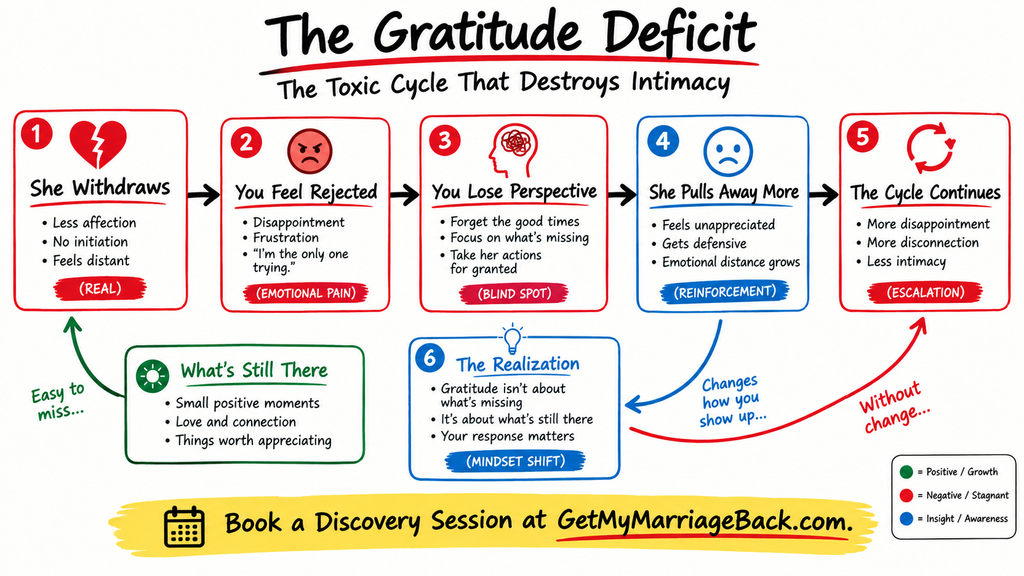
I call this the Disappointment Amplification Cycle.
It develops through a sequence of emotional reactions that can become almost automatic.
1. You Expect Affection and Feel Disappointed
You want your wife to initiate physical touch because you want to feel desired.
That’s a legitimate desire.
But when she doesn’t respond according to your expectations, disappointment enters the experience.
The problem begins when that disappointment becomes more important than everything else happening between you.
2. Your Attention Becomes Dominated by What’s Missing
One disappointing interaction begins overshadowing dozens of ordinary or positive experiences.
You remember the rejection but overlook the smile.
Her failure to initiate intimacy becomes more significant than the small gestures of care that still exist.
Your attention starts selecting evidence that supports the belief that your wife no longer cares.
3. Your Emotional Reaction Changes Your Behavior
Frustration begins affecting your tone, facial expressions, patience, and emotional availability.
You become more critical, defensive, or demanding.
Even when you’re trying to create intimacy, your wife experiences the emotional pressure surrounding your attempts.
Affection starts becoming associated with expectations and disappointment rather than enjoyment.
4. Your Wife Withdraws Further
As tension increases, she becomes less responsive.
Physical affection decreases, conversations feel strained, and spontaneous connection becomes increasingly rare.
You interpret this additional withdrawal as confirmation that you were right all along.
5. You Become Convinced You’re the Only One Trying
Now the marriage feels completely one-sided.
You begin measuring your effort against everything your wife isn’t doing.
The positive experiences become harder to remember, and the negative experiences grow more emotionally powerful.
Eventually, you return to the beginning of the cycle with even greater expectations, resentment, and fear.
The more you focus on the absence of affection, the more that absence can dominate the experience you’re creating.
What Almost Losing My Marriage Taught Me About Attraction
Lola and I recently celebrated 19 years of marriage.
About ten years ago, however, we experienced a marriage crisis that almost ended our relationship.
During our first eight or nine years together, there were several moments when things became serious enough to threaten everything we had built.
And one of the most important discoveries I made was about myself.
Whenever Lola did something that fell below my expectations, I had a tendency to allow that disappointment to overwhelm our entire experience.
Something would happen.
I wouldn’t like it.
Then I would carry the emotional weight of that experience into our next interaction.
Before long, Lola would withdraw.
And suddenly, I would become confused.
Why isn’t she initiating affection? Why is she responding that way? Why does she seem irritated? Why am I the only person trying?
Here’s the uncomfortable part.
Sometimes, she had already attempted to communicate what was happening.
But I wasn’t paying attention.
I had mentally disconnected from the earlier interaction while continuing to carry its emotional consequences.
I was surprised by her emotional disconnection without recognizing how my own reactions had contributed to the atmosphere between us.
Over the years, as Lola and I continued sharing our experiences, I discovered that there were moments when she had felt like the only person trying, too.
That realization changed how I understood marital dissatisfaction.
Two people can experience the same relationship and walk away with very different emotional accounts of what happened.
The Man Who Couldn’t Remember the Good Times
I once worked with a man who had spent years complaining about his wife.
According to him, she wasn’t doing enough.
She didn’t cook enough, clean enough, initiate affection, or understand his needs.
As I listened, I noticed that he could describe his disappointments with incredible detail.
But when I started asking about the good experiences in his marriage, something interesting happened.
It took considerable effort to get him to acknowledge them.
Those positive experiences existed.
He simply wasn’t giving them meaningful attention.
His disappointment had become so dominant that almost everything else disappeared from his emotional accounting.
Then we started talking about intimacy.
I asked him a question.
“What’s your love language?”
He struggled for a moment before answering.
“Sex.”
I stopped him.
“What do you mean by sex?”
Because sex fulfills something else.
What experience was he actually looking for?
Was it feeling desired? Was it reassurance that his wife still wanted him? Was it emotional closeness, acceptance, or the experience of being chosen?
He froze.
And I realized that there was much deeper work to do.
You can spend years telling your wife that she isn’t meeting your needs without understanding the experience you’re actually trying to create.
When that happens, you become dependent on her behavior for an emotional outcome you haven’t fully understood yourself.
Why Gratitude Matters When Your Wife Isn’t Affectionate
Gratitude is one of the most misunderstood principles in marriage.
People often interpret gratitude as pretending everything is wonderful or convincing themselves that their spouse is doing enough.
That’s not what I mean.
Gratitude is the ability to recognize the value of something real without requiring everything else to be perfect.
Imagine experiencing a thousand interactions in your marriage.
Some are wonderful. Others are ordinary. A few are deeply disappointing.
One painful experience can become so emotionally dominant that it changes how you remember everything else.
The purpose of gratitude isn’t to erase that pain.
It’s to stop the pain from erasing your awareness of everything valuable that still exists.
What Relationship Research Reveals About Appreciation
Relationship researchers have repeatedly examined the connection between gratitude, appreciation, and relationship quality.
A study by Sara Algoe, Shelly Gable, and Natalya Maisel found that gratitude following thoughtful interactions predicted increases in relationship connection and satisfaction the following day.
Other research by Amie Gordon and colleagues found that people who felt more appreciated tended to become more appreciative and responsive toward their partners.
Research involving 316 African American couples also found that feeling appreciated by a partner helped buffer some of the negative associations between relationship stress and relationship quality.
These findings support an important distinction: appreciation isn’t simply polite behavior. It is connected to the emotional experiences that help sustain intimate relationships.
You can explore the underlying findings in this peer-reviewed research on gratitude and relationship maintenance.
For your marriage, the practical lesson is straightforward.
When you consistently overlook positive experiences, you lose access to emotional resources that can help you respond more constructively to disappointment.
And when you become more intentional about recognizing genuine value, you begin changing the emotional experience you bring into your interactions.
Stop Confusing Being a Good Husband With Creating Attraction
One of the biggest mistakes I see when helping people save their marriages is confusing moral goodness with experiential attraction.
You can be responsible, loyal, hardworking, and deeply committed to your family.
Those qualities matter.
But they don’t automatically create romantic desire.
Attraction is also about the experience of being around you.
Does your presence create warmth or pressure?
When your wife interacts with you, does she encounter curiosity, emotional steadiness, playfulness, and genuine interest?
Or does every interaction carry the weight of another unmet expectation?
This is where emotional intelligence becomes essential.
You don’t build attraction by demanding proof that you’re attractive.
You build your capacity for attraction by developing the qualities and behaviors that make your presence engaging.
That includes emotional self-control, confidence, generosity without hidden expectations, personal direction, and the ability to create enjoyable experiences.
These qualities become especially important when you’re trying to save your marriage alone.
You cannot manufacture your wife’s desire.
But you can stop making your own fear and disappointment the dominant experience you bring into the relationship.
How to Rebuild Attraction Without Begging for Affection
Here’s what I want you to do.
Start by separating your wife’s behavior from your interpretation of your entire marriage.
If she doesn’t initiate affection tonight, acknowledge that reality.
Don’t automatically turn it into evidence that your marriage has no value or that you’re personally undesirable.
Then begin working through three essential areas.
Grounding: Stop Letting Her Response Define Your Worth
Your wife’s affection is something you desire.
It is not the ultimate source of your identity.
When rejection occurs, return to a source of truth beyond her immediate response.
Recognize the disappointment without allowing it to control your next interaction.
Practice gratitude by identifying something specific and genuine that deserves appreciation.
It can be a thoughtful gesture, a moment of cooperation, a shared laugh, or an ordinary act of consideration.
The objective isn’t to manufacture positivity.
It’s to develop a more accurate emotional perspective.
Purpose: Build a Life Bigger Than Her Approval
When your entire emotional world revolves around whether your wife desires you, every interaction becomes disproportionately important.
A missed kiss can ruin your evening.
One cold response can consume your attention for days.
Redirect that energy toward a meaningful mission.
Your work, contribution, health, personal development, and legacy deserve attention independent of your wife’s immediate behavior.
Purpose helps you become less reactive because your life no longer rises and falls with every romantic interaction.
That emotional independence is an important part of personal power.
Self-Discovery: Understand What Rejection Triggers Inside You
When your wife doesn’t initiate intimacy, examine your immediate reaction.
Do you become angry?
Do you withdraw affection to punish her?
Are you tempted to send a long message explaining everything you’ve sacrificed?
Or do you become desperate to prove that you’re still desirable?
Recognizing these patterns is not an exercise in blaming yourself for your wife’s withdrawal.
It’s an opportunity to understand your own emotional habits.
Once you recognize the pattern, you can choose a different response.
The Difference Between Pursuing Your Wife and Chasing Her
There’s nothing inherently wrong with wanting your wife.
Expressing romantic interest, initiating affection, and making your attraction known are normal parts of marriage.
The problem is the emotional position from which those behaviors emerge.
When you pursue from confidence, your interest is an authentic expression of desire.
When you chase from fear, your behavior becomes an attempt to escape rejection.
The distinction matters.
You can offer a warm touch without turning it into a demand for reassurance.
A compliment can be genuine appreciation rather than an attempt to secure affection in return.
You can create a thoughtful romantic moment while respecting your wife’s response.
Seduction loses its appeal when every gesture comes with an emotional invoice.
Attraction requires room for genuine choice.
Your responsibility is to become more skillful in how you express interest, manage disappointment, and create enjoyable experiences.
Her responsibility for her own choices remains hers.
Why Understanding This Once Isn’t Enough
You can read everything I’ve explained and understand it intellectually.
Then tonight, your wife walks past you without touching you.
Immediately, the old disappointment returns.
You remember the last time she rejected you, the conversation that went nowhere, and all the occasions when you initiated intimacy without receiving the response you wanted.
Your emotional habits take over.
This is why sustainable change requires more than a moment of inspiration.
Psychological research on habits and stress helps explain why familiar reactions can become more accessible when deliberate self-control is under pressure.
In your marriage, that means you need to practice responding differently before the next emotionally difficult moment arrives.
Build the skill of recognizing disappointment without escalating it.
Develop a reliable way to regain perspective.
Learn how to express desire without attaching your emotional stability to the outcome.
Over time, repeated practice makes these responses more familiar.
And that changes how you experience your marriage, even before you see significant changes in your wife’s behavior.
Can You Save Your Marriage When Your Wife Has Lost Attraction?
A marriage crisis involving attraction loss can become especially frightening because you cannot argue someone into desiring you.
You cannot present a list of sacrifices and expect romantic feelings to appear.
Nor can you demand that your wife initiate intimacy simply because you’ve been married for years.
What you can do is change the experience you bring into the relationship.
That starts with recognizing the difference between genuine rejection and the emotional story you build around it.
You can become more grounded, purposeful, appreciative, emotionally intelligent, and intentional.
These changes help you move away from a marriage experience dominated by complaints, fear, and unmet expectations.
And they create more room for curiosity and attraction than repeated pressure ever will.
Think Like Someone Planting a Seed
One principle helped me tremendously during my own marriage crisis.
You sow a seed.
Then comes a season of waiting.
During that season, you protect what you’ve planted.
You don’t dig it up every morning because you haven’t seen results yet.
The same principle applies when you’re rebuilding your own emotional habits.
You practice gratitude before receiving the affection you’re hoping for.
You become more intentional before your wife starts responding differently.
And you continue developing yourself without demanding immediate evidence that your effort is working.
That is not passivity.
It’s disciplined self-leadership.
Your wife’s withdrawal may have started the crisis you’re experiencing.
But it doesn’t have to dictate the person you become while navigating it.
The Real Shift When Your Wife Never Initiates Affection
When your wife never initiates affection, the pain can become so consuming that you lose sight of the marriage you’re actually experiencing.
You begin remembering only what’s missing.
Then your frustration changes your behavior, your interactions become more pressured, and the emotional distance grows.
Breaking that pattern begins with a different understanding of gratitude.
Gratitude doesn’t mean accepting an intimacy-free marriage as your ideal.
It means recognizing genuine value without allowing disappointment to destroy your perspective.
When I learned this during my marriage with Lola, it fundamentally changed how I approached difficult moments.
I stopped treating every unmet expectation as evidence that the entire relationship was failing.
Instead, I began paying more attention to the experience I was capable of creating.
And that’s where I want you to focus.
Your job isn’t to force your wife to initiate the next touch. Your job is to become someone who can express desire, create value, and maintain emotional power without being controlled by rejection.
That’s where rebuilding attraction begins.
19 Signs Your Wife Is Not Sexually Attracted To You
Frequently Asked Questions
Your wife may be experiencing reduced attraction, unresolved resentment, emotional disconnection, stress, or a pattern in which affection has become associated with pressure. Her lack of initiation is a symptom that needs context rather than proof of one particular explanation.
Not necessarily, because sexual initiation and attraction are related but not identical. Pay attention to the broader pattern of emotional closeness, responsiveness, and physical connection rather than relying on initiation alone.
Stop initiating from fear, resentment, or a need to force reassurance, but don’t confuse dignified romantic interest with begging. Express genuine affection without pressure and respect her response.
A marriage experiencing emotional and physical withdrawal can recover when the patterns sustaining disconnection change and both partners remain free to make their own choices. Begin by developing emotional steadiness, personal purpose, genuine appreciation, and more attractive ways of interacting.