

You can be completely right about what happened yesterday and still be destroying the attraction, emotional connection, and marriage you’re desperately trying to save today.
Take This 2 Minutes Quiz
When your wife argues with you about everything, it’s tempting to believe that the problem is simply her attitude. She criticizes, you explain. She questions your intentions, you defend yourself. Then she brings up something from three years ago, and suddenly you’re having another exhausting conversation about who was right.
You’re not necessarily lying, manipulating, or trying to hurt her. In fact, you may genuinely believe you’re protecting your dignity by refusing to let an unfair accusation go unanswered.
But I want you to consider something.
What if your constant need to explain yourself is helping destroy the very attraction you’re trying to rebuild?
This is one of the most painful contradictions in a marriage crisis. You want your wife to feel closer to you, but the way you’re interacting makes closeness increasingly difficult.
And the more she withdraws, the harder you fight to be understood.
Let’s examine five attraction killers that can hide inside this pattern—and what you can begin changing without begging, chasing, or abandoning your self-respect.
Why Does My Wife Argue With Me About Everything?
First, understand that not every disagreement is evidence of a failing marriage.
What Would Help You Most Right Now?
Choose the option that best matches where you are with your marriage.
My Marriage Is in Serious Trouble
If you're dealing with separation, divorce, loss of attraction, infidelity, intimacy problems, or a spouse who's pulling away, get help looking at what's happening in your specific situation.
Get Personalized Help →
Start With Get My Marriage Back
Get the book and start learning the principles for moving your marriage in a better direction.
Get the Free Book →Healthy couples disagree. They have different perspectives, misunderstand each other, and sometimes experience frustration.
The real problem begins when disagreement becomes the dominant emotional experience of the relationship.
Your wife may be carrying unresolved resentment. Perhaps she feels misunderstood, disappointed, emotionally disconnected, or unheard.
You may be experiencing those same feelings.
When criticism, defensiveness, and contempt become habitual, both spouses can begin anticipating conflict before anyone speaks.
Marriage researchers have extensively examined these patterns. A meta-analysis involving 74 studies and 14,255 participants found a meaningful association between demand-withdraw communication patterns and relationship difficulties.
This research on marital demand-withdraw communication helps explain why repeated cycles of pressure, criticism, defensiveness, and withdrawal are associated with relationship dissatisfaction.
Here’s the important distinction: the person who starts the argument isn’t necessarily the only person sustaining it.
Your wife is responsible for her actions.
You are responsible for yours.
And understanding that distinction is where emotional self-leadership begins.
Attraction Killer #1: Explaining Yourself Until Every Conversation Becomes an Argument
During my own marriage crisis with Lola, I wanted to explain everything.
My intentions.
My decisions.
My side of the story.
Whenever somebody said something I considered unfair, I felt compelled to correct it.
Eventually, my mother told me something simple:
“Don’t be talking all the time.”
My uncle reinforced that lesson.
They weren’t telling me to become weak, tolerate mistreatment, or pretend that every accusation was true.
They were challenging my belief that every accusation required an immediate response.
And that lesson changed the direction of how I approached my marriage.
The explanation trap
Imagine your wife says, “You never listen to me.”
You immediately respond, “That’s not true. I listened to you yesterday, and I remember exactly what you said.”
She brings up another example.
Now you produce evidence.
Before long, you’re discussing conversations from several years ago.
The original emotional concern has disappeared beneath competing versions of history.
What started as a complaint has become a courtroom.
Here’s what I want you to recognize:
Being able to explain your behavior doesn’t mean another explanation is helping your marriage.
Sometimes your spouse needs clarification. Other times, she needs to feel that you’ve understood the concern beneath her words.
The emotional intelligence is knowing the difference.
A grounded response might sound like:
“I understand that you’ve been feeling unheard. I don’t agree with everything you said, but I want to understand what happened.”
That response doesn’t require you to confess to something you didn’t do.
It simply refuses to turn every complaint into another battle.
Attraction Killer #2: Confusing Defensiveness With Self-Respect
One of the most dangerous beliefs in a distressed marriage is that refusing to defend yourself means accepting disrespect.
I worked with a gentleman who struggled tremendously with this.
He wanted to save his marriage, but whenever his wife said something hurtful, he felt compelled to respond.
His objective was to feel justified.
He wanted to demonstrate that his actions were reasonable and that her accusations were unfair.
People around him encouraged him to match her energy.
If she criticized him, criticize her.
If she disrespected him, return the disrespect.
It sounded fair.
But those advisers didn’t have to live with the consequences inside his marriage.
You can protect your dignity without winning every exchange
I remember coaching him through a particularly painful situation.
His wife had said something that deeply upset him. He wanted to respond immediately.
I encouraged him not to engage in that particular argument.
He tried, but sustaining that restraint became difficult.
He feared that if he didn’t correct the narrative, his wife’s version of events would become the accepted truth.
That’s where the real issue emerged.
He wasn’t simply protecting a boundary. He was struggling with the possibility that somebody might believe something negative about him.
Ask yourself:
Am I responding because something genuinely needs to be addressed, or because I cannot tolerate being misunderstood?
Your answer matters.
Self-respect doesn’t require universal agreement with your version of events.
A confident person can disagree without becoming consumed by the disagreement.
That kind of emotional steadiness is far more attractive than constantly demanding acknowledgment.
Attraction Killer #3: Matching Your Wife’s Negative Energy
There’s a popular relationship philosophy that sounds empowering:
Match people’s energy.
If they give you attitude, give them attitude.
If they withdraw, withdraw harder.
If they hurt you, make sure they understand how it feels.
But marriage isn’t a competition to determine who can deliver the most convincing retaliation.
Matching negative energy can turn a temporary disagreement into a permanent relationship atmosphere.
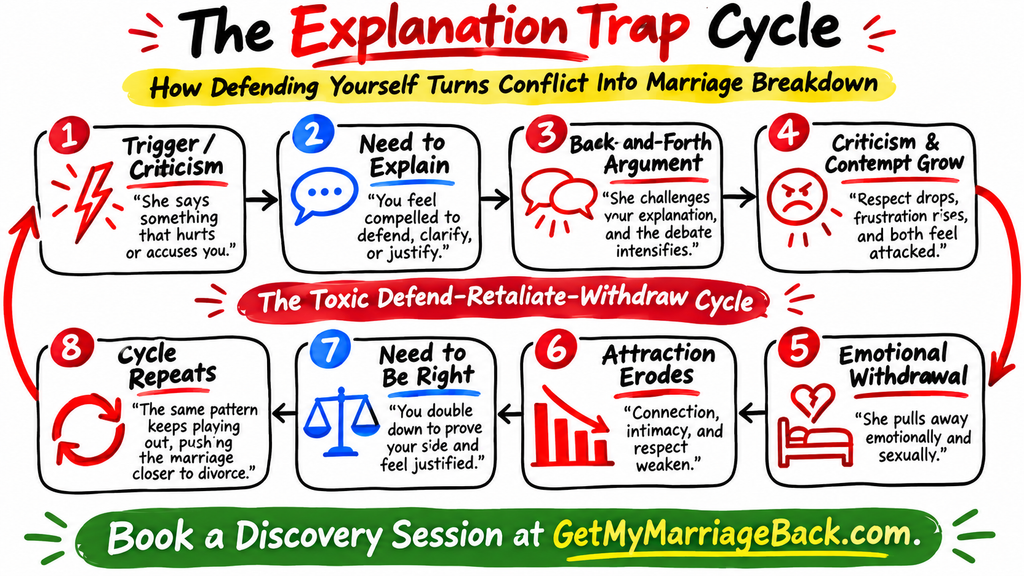
Consider how the cycle develops:
Your wife criticizes you.
You defend yourself.
She becomes more contemptuous.
You retaliate.
Now she uses your retaliation to justify her next reaction.
And you use her reaction to justify yours.
Both spouses have evidence. Both can point to something the other person did.
Nobody wants to interrupt the cycle because everyone believes their reaction was justified.
How far backward should we investigate?
Last night?
Last month?
Three years ago?
The beginning of the marriage?
At some point, the search for the original offender becomes less useful than recognizing the destructive interaction happening right now.
A reaction is still an action.
That doesn’t erase the original offense. It means your spouse’s behavior doesn’t automatically determine how you must behave.
This is especially important when you’re trying to save your marriage alone.
You cannot force your wife to participate in reconciliation. However, you can stop contributing your own criticism, contempt, and retaliation.
That isn’t passive.
It’s emotional independence.
Attraction Killer #4: Winning Arguments While Losing Romantic Attraction
This is where the consequences become especially painful.
The gentleman I mentioned earlier eventually experienced serious problems with physical intimacy.
He believed his wife was weaponizing sex.
But consider the emotional environment surrounding their relationship.
When he wasn’t withdrawing or sulking, he was criticizing.
When she criticized him, he defended himself.
Their conversations became opportunities to settle scores.
Neither person was enjoying the relationship.
Now, sexual withdrawal can have several explanations.
Resentment is one possibility. Loss of attraction is another. Stress, emotional exhaustion, health concerns, and unresolved relationship injuries can also influence desire.
You cannot determine somebody’s sexual motivation simply because intimacy has disappeared.
But here’s something worth understanding.
It’s difficult to cultivate romantic desire when your relationship has become emotionally exhausting.
Attraction needs a different emotional atmosphere
Think about the experiences that make romantic connection enjoyable.
Playfulness.
Warmth.
Curiosity.
Feeling appreciated.
Emotional safety.
The freedom to relax around your partner.
Now compare those experiences with constant criticism, defensiveness, and arguments about the past.
Which environment makes affection feel more inviting?
Which one makes somebody look forward to spending time together?
Romantic attraction is more complex than communication alone, but the emotional atmosphere matters.
Research examining couples’ communication during sexual conflict has also connected demand-withdraw patterns with sexual and relationship difficulties.
The lesson isn’t that you should become agreeable to obtain sex.
That’s simply another form of pressure.
Instead, recognize that building attraction requires becoming someone who can participate in emotionally enjoyable interactions without turning every disagreement into a struggle for control.
Seduction in a long-term marriage isn’t merely about sexual technique.
It’s also about emotional presence, confidence, anticipation, warmth, and the ability to create enjoyable experiences together.
Your spouse should be able to experience your personality without constantly encountering your defenses.
Attraction Killer #5: Taking the Higher Road Temporarily, Then Exploding
This is where many people undermine their own progress.
They recognize the destructive pattern and decide to change.
For two days, they’re calm.
They don’t argue.
They refuse to take the bait.
Then something especially painful happens on the third day.
They explode.
Every accusation they’ve been holding back suddenly comes pouring out.
Now the relationship returns to the same destructive cycle, sometimes with even greater intensity.
Consistency is more important than a temporary performance
Emotional self-leadership isn’t pretending you don’t feel anger.
It’s developing the ability to experience anger without allowing it to dictate your behavior.
And that requires sustained practice.
You can maintain boundaries.
Serious problems can still be addressed.
Disrespectful interactions can be interrupted.
But you don’t need to turn every disagreement into an emotional war.
The distinction is between suppressing your feelings and regulating your response.
Suppression builds pressure when you never address the underlying issue.
Regulation allows you to choose an appropriate time, tone, and approach.
For example:
“I want to discuss this, but I’m getting frustrated. Let’s return to it when we can both have a productive conversation.”
Then follow through.
Don’t use the pause as punishment, and don’t disappear indefinitely.
Your emotional steadiness becomes meaningful when it remains consistent under pressure.
How to Rebuild Attraction When Your Wife Keeps Arguing With You
The objective isn’t to become somebody your wife can control.
It’s to become somebody who can control himself.
That difference changes everything.
When you stop treating every accusation as a threat to your identity, you create space for a different kind of interaction.
You become less predictable in the destructive sense.
Instead of automatically defending yourself, you can listen.
Rather than retaliating, you can establish a boundary.
When an argument no longer serves a constructive purpose, you can disengage respectfully.
And when your wife is open to connection, you can participate without dragging yesterday’s conflict into today’s experience.
Make emotional connection enjoyable again
Attraction often deteriorates when spouses begin associating each other primarily with stress.
Changing that association requires more than avoiding arguments.
You also need positive experiences.
Be genuinely interested in your wife’s thoughts without turning every conversation into a relationship evaluation.
Bring humor into ordinary moments when it’s welcome.
Express appreciation without attaching a demand for reciprocation.
Create opportunities for shared enjoyment that aren’t disguised attempts to negotiate affection.
Flirt when the interaction is receptive, and respect her response when it isn’t.
Confidence becomes attractive when it is paired with emotional awareness rather than entitlement.
The objective is not to manufacture a reaction from your wife.
It’s to become more grounded, enjoyable, and emotionally available while respecting her freedom to choose how she responds.
The GPS-V Approach to Emotional Self-Leadership
I teach a framework called GPS-V because changing relationship behavior requires more than memorizing communication techniques.
It begins with how you relate to yourself.
Grounding
Return to your emotional center before responding.
An accusation may upset you, but it doesn’t have to control your next action.
Purpose
Remember the larger life you’re building.
Your marriage, family, character, and long-term direction deserve more consideration than winning today’s argument.
Self-Discovery
Examine why certain accusations trigger such intense reactions.
Sometimes the accusation hurts because you fear your spouse believes something negative about you.
Other times, it touches an insecurity you already carry.
Understanding the trigger gives you more freedom in how you respond.
Value
Develop the qualities that make your presence meaningful.
Emotional stability, discipline, reliability, warmth, and personal direction contribute to the experience of being in a relationship with you.
Curiosity and Attraction
Allow your spouse to encounter a version of you that isn’t constantly explaining, chasing, criticizing, or demanding reassurance.
Curiosity becomes possible when interactions stop following the same exhausting script.
Influence and Leverage
Influence grows through consistent behavior, not pressure.
Your most dependable leverage begins with your ability to choose your own actions and maintain your boundaries.
You don’t need to control your wife to become more emotionally powerful.
What If Your Wife Wants a Divorce or Separation?
When your wife wants a divorce, the instinct to explain yourself can become even stronger.
You may believe that one perfect conversation will make her understand your intentions and reconsider leaving.
So you send longer messages.
You revisit old disagreements.
Every interaction becomes another attempt to convince her that the marriage deserves a second chance.
But marriage reconciliation isn’t a courtroom appeal.
Your wife may have genuine grievances, just as you may have legitimate concerns about her behavior.
Those concerns deserve attention.
However, repeated persuasion can increase pressure when your spouse is already emotionally withdrawn.
If you’re trying to save marriage from divorce, begin by distinguishing practical conversations from emotional negotiations.
Discuss necessary decisions clearly.
Address important responsibilities.
Respect reasonable requests for space.
Avoid using every interaction to demand reassurance about the future.
You can communicate your desire to preserve the marriage without repeatedly arguing for it.
That distinction matters whether you’re living together, experiencing emotional separation, or already physically separated.
The Difference Between Being Right and Being Effective
I want to leave you with a question.
What exactly are you trying to win?
If your wife argues with you about everything, it’s understandable that you want your perspective acknowledged.
Nobody enjoys feeling falsely accused.
But being right about an individual disagreement doesn’t automatically mean your response is helping the relationship.
You can prove that something happened exactly as you remember it and still leave the conversation more disconnected than before.
You can win the last word and lose another opportunity for emotional closeness.
And you can demand fairness so aggressively that the relationship becomes a continuous competition over who has suffered more.
The goal isn’t to surrender your truth. It’s to stop sacrificing your emotional stability in the pursuit of agreement.
You don’t have to explain yourself every time somebody gives you the opportunity.
You don’t have to retaliate to establish dignity.
And you don’t have to beg for attraction.
The more effectively you lead yourself, the more room you create for warmth, respect, playfulness, and romantic connection.
That’s where rebuilding attraction begins.
Not with another closing argument.
With a different experience of being together.
“I Feel Disgusted When My Husband Touches Me” – [5 Solutions]
Frequently Asked Questions
Frequent arguments can reflect unresolved resentment, unmet emotional needs, communication habits, or deeper dissatisfaction. The pattern becomes especially destructive when both spouses repeatedly respond with criticism, defensiveness, or retaliation.
Stop treating every accusation as something that requires an immediate defense, and focus on understanding the concern before responding. Maintain clear boundaries while refusing to escalate conversations that have become unproductive.
Yes, persistent conflict can contribute to emotional exhaustion, resentment, and reduced romantic interest. Attraction is influenced by several factors, but repeated contempt and defensiveness can make closeness less enjoyable.
Marriage reconciliation remains possible in some relationships, but it requires respecting your spouse’s choices while changing the behaviors you control. Focus on sustained emotional maturity, constructive communication, and rebuilding a healthier relationship dynamic rather than trying to argue your spouse into staying.