
What Would Help You Most Right Now?

Choose the option that best matches where you are with your marriage.

I Need Personalized Help

My Marriage Is in Serious Trouble

If you're dealing with separation, divorce, loss of attraction, infidelity, intimacy problems, or a spouse who's pulling away, get help looking at what's happening in your specific situation.

Get Personalized Help →
Get My Marriage Back book cover
I'd Rather Learn What to Do First

Start With Get My Marriage Back

Get the book and start learning the principles for moving your marriage in a better direction.

Get the Free Book →

Wife Says Marriage Is Over? 7 Ways to Rebuild Attraction

When your wife says the marriage is over, your first instinct is usually to fix the marriage as quickly as possible.


Take This 2 Minutes Quiz

Question 1 of 15

You want another conversation. You want to explain yourself better. You want her to understand your intentions, remember the good years, recognize your changes, and reconsider divorce.

That instinct makes emotional sense.

It can also make the situation worse.

The deeper problem is not simply that your wife wants divorce or says she is no longer in love. The deeper problem is what rejection starts turning you into.

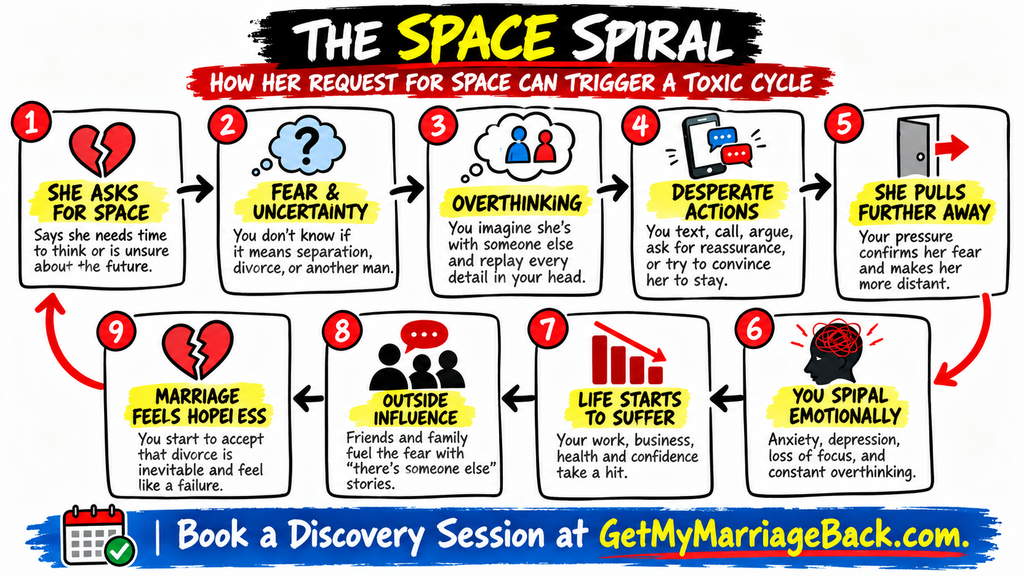
Fear can make you plead.

Anxiety can make you prove.

Powerlessness can make you pressure.

Then the pressure creates more withdrawal, which leaves you feeling even more rejected.

Research on married couples has documented this demand-withdraw pattern. In a study of 116 married couples reporting conflicts at home, demand-withdraw dynamics were associated with more negative emotions and lower conflict resolution. (PubMed Central (PMC))

That is why saving your marriage is not primarily about finding stronger arguments.

It is about becoming emotionally intelligent enough to stop feeding the cycle that destroys attraction.

Your Wife Wants Divorce, But More Effort Is Not Always More Attractive

A marriage crisis creates urgency.

That urgency tells you:

  • Talk more.
  • Explain more.
  • Apologize more.
  • Prove more.
  • Ask where you stand.
  • Show her everything she will lose.
  • Convince her that divorce is a mistake.

The problem is that attraction does not respond well to force.

Your wife is still another human being with autonomy, emotions, preferences, fears, desires, and choices of her own. Commitment matters, but commitment does not magically eliminate the human need to want the relationship.

This distinction is critical.

Marriage has responsibilities.

Marriage also has romance.

You can appeal to responsibility long after the romantic experience has deteriorated, but responsibility by itself does not recreate desire.

As a matter of fact, when every interaction carries the hidden question, “Have you changed your mind about me yet?” your wife can experience even ordinary conversations as pressure.

Your intentions may be loving.

Her experience of those intentions can still feel needy.

That gap between intention and impact is where emotional intelligence becomes essential.

wife says marriage is over

1. Stop Trying to Win the Divorce Argument

One of the fastest ways to deepen rejection is to turn your marriage into a courtroom.

You start collecting evidence.

You remind your wife about the vows.

You explain why divorce will hurt the children.

You point out everything you have done correctly.

You challenge inconsistencies in her reasoning.

Perhaps you even prove that she is technically wrong about certain things.

And you still lose attraction.

Why?

Because romantic connection is not decided by winning an argument.

When you operate from “I am right and you are wrong,” the conversation becomes a contest for moral superiority instead of an opportunity for connection.

Arguments can also reinforce the same demand-withdraw pattern that already damages conflict resolution. (PubMed Central (PMC))

Your strongest move is not to become less intelligent.

It is to become more emotionally intelligent.

You need the capacity to hear a painful statement without automatically treating it as a debate invitation.

2. Separate Accountability From Begging

Accountability is attractive when it comes from strength.

Begging is fear asking another person to regulate your emotional state.

Those are not the same thing.

You can recognize what you did wrong without repeatedly apologizing until your wife reassures you.

You can acknowledge complacency without performing self-hatred.

You can admit that your communication became defensive without demanding instant forgiveness.

Real accountability sounds internally like:

“I see it now. I own my part. I am going to become better because this is who I choose to become.”

Fear-driven accountability sounds more like:

“I admitted everything. Why won’t you give me another chance?”

The first builds capacity.

The second puts pressure back on your wife.

Your goal is not to become perfect enough that she has no logical choice except reconciliation.

Perfection is another performance.

She needs to experience something real.

Ground Yourself Before You Try to Rebuild Attraction - wife says marriage is over

3. Ground Yourself Before You Try to Rebuild Attraction

When your wife says she wants divorce, powerlessness becomes the symptom underneath almost everything.

You cannot control what she feels.

You cannot control what she says tomorrow.

You cannot force reconciliation.

You cannot guarantee that one good conversation produces another.

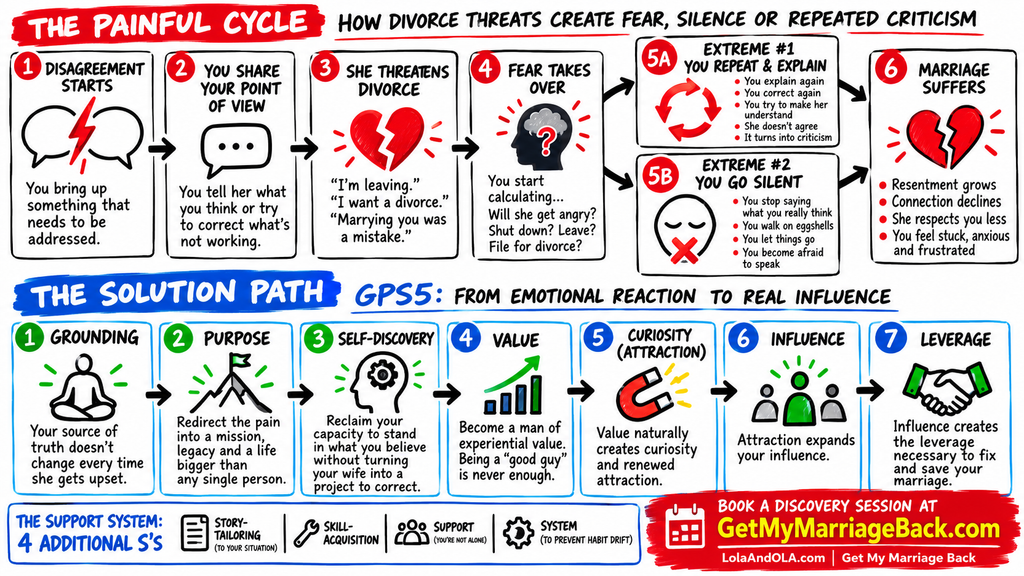
Grounding means returning to your source of truth before fear decides what you do next.

That can include gratitude, faith, perspective, emotional regulation, and remembering that the marriage crisis is one part of your life rather than the entire definition of your life.

Grounding is not pretending that divorce does not hurt.

You are developing enough emotional capacity to feel the hurt without letting the hurt run your behavior.

That distinction changes how you show up.

Instead of reacting immediately, you can observe.

Instead of defending reflexively, you can listen.

Rather than demanding certainty, you can tolerate uncertainty long enough to choose a skillful response.

That calm creates a different experience of you.

4. Build a Purpose Bigger Than Your Wife’s Current Decision

A marriage crisis can shrink your entire world down to one question:

“Does she still want me?”

That question becomes dangerous when it starts determining your identity, mood, productivity, confidence, sleep, and sense of purpose.

Your life needs a mission greater than any one individual, including the person you deeply love.

Purpose does not mean distracting yourself so your wife becomes jealous.

It does not mean pretending you no longer care.

Purpose means redirecting pain into meaningful growth, contribution, leadership, creation, service, family legacy, faith, business, fitness, learning, or whatever represents the highest expression of who you are becoming.

This matters to attraction because neediness decreases when your emotional center of gravity no longer sits entirely inside someone else’s approval.

Your marriage can matter tremendously without becoming the only source of meaning in your life.

That is personal power.

5. Let the Crisis Teach You Something About Yourself

Self-discovery is not self-blame.

You are not examining yourself so you can conclude that everything is your fault.

Instead, you are discovering the capacities this crisis exposed.

Can you handle rejection without attacking?

Can you hear criticism without immediately defending?

Can you express desire without begging?

Can you remain warm without demanding reciprocity?

Are you able to pursue with dignity without pressuring for a result?

Can you take responsibility without collapsing into shame?

Those questions move you out of obsession with your wife’s every reaction and back toward what you actually control.

That shift is especially important when you are trying to save your marriage alone.

Your wife does not have to participate in your self-discovery.

You can improve emotional intelligence regardless of whether she joins you in the process.

6. Create Experiential Value, Not Moral Value

This is one of the biggest misunderstandings in marriage.

You can be a good person and still become difficult to experience romantically.

You can be responsible, hardworking, faithful, generous, and committed while also becoming defensive, predictable, controlling, withdrawn, anxious, boring, sarcastic, or emotionally exhausting.

Moral value answers:

“Am I a decent person?”

Experiential value answers:

“What does it feel like to interact with me?”

That second question matters enormously in attraction.

Research on perceived partner responsiveness consistently links feeling understood, cared for, and appreciated with intimacy and relationship satisfaction. (PubMed Central (PMC))

That does not mean becoming endlessly agreeable.

Emotional intelligence involves learning how to express standards, opinions, boundaries, humor, confidence, vulnerability, curiosity, and warmth without turning every interaction into a fight for control.

Value is felt.

You do not need to announce it.

7. Give Curiosity and Attraction Room to Return

Many marriages become painfully predictable.

Your wife knows what you are going to say.

She knows what will trigger you.

She knows how every difficult conversation ends.

She already knows that you want her back.

There is nothing left to wonder about because your emotional world has become completely exposed through anxiety.

Curiosity requires space.

That does not mean playing games, disappearing, or deliberately withholding affection.

It means becoming a growing human being again.

Research on self-expansion offers an important clue here. Studies have found that novel and engaging experiences are associated with greater relationship quality, and experiments have shown improvements in experienced relationship quality after couples participated in novel, arousing activities compared with mundane activities. (PubMed)

A 2026 review of the self-expansion literature likewise concluded that shared novel and challenging activities can help reinvigorate long-term relationships and improve relationship quality. (PubMed Central (PMC))

The larger lesson goes beyond date-night ideas.

Attraction suffers when you become static.

Developing new skills, perspectives, interests, emotional capacities, goals, and experiences makes your life less psychologically flat.

You become more interesting because you are actually growing.

wife says marriage is over - Attraction Cannot Be Negotiated Back Into Your Marriage

Attraction Cannot Be Negotiated Back Into Your Marriage

This is where many people get trapped.

They treat attraction like a contractual obligation.

“I married you, therefore you should desire me.”

That is not how romantic attraction works.

Desire involves autonomy.

Recent research involving 786 participants found that perceived sexual autonomy support was associated with greater sexual need fulfillment as well as sexual and relationship satisfaction. (PubMed Central (PMC))

That matters even when your immediate issue is not sex.

Pressure generally says:

“You need to feel differently.”

Emotional intelligence says:

“I respect that I cannot control your internal experience, and I am still responsible for the experience I create.”

This is the difference between manipulating attraction and nurturing attraction.

You cannot order desire.

You can become more attractive.

Stop Monitoring Whether Your Wife Is Responding Yet

Once you begin changing, another temptation appears.

You start scoring the results.

She smiled today.

She texted first.

She stayed on the phone longer.

She seemed jealous.

She asked where you were going.

Suddenly your entire growth process becomes another strategy for extracting reassurance.

That puts you right back into powerlessness.

Curiosity, warmth, reciprocity, and attraction belong on your wife’s side of the equation.

Your responsibility is your grounding, purpose, self-discovery, value, standards, emotional intelligence, and behavior.

Let her experience you without constantly testing whether the experience “worked.”

Ironically, genuine growth becomes most credible when it stops demanding immediate applause.

When Your Wife Says the Marriage Is Over, Treat Rejection as a Capacity Test

You can do meaningful work and still hear something painful tomorrow.

She can be warm today and cold next week.

Divorce can remain on the table.

That does not mean you failed.

The symptom returning is a capacity test.

Can you face the same rejection without returning to the same behavior?

Old pattern:

Rejection → Pleading → Proving → Pressure → Withdrawal → More Rejection

Constructive pattern:

Rejection → Grounding → Purpose → Self-Discovery → Value → Curiosity & Attraction → Rejection

Notice that rejection still appears at the end.

That is intentional.

Personal power is not the elimination of painful circumstances.

It is your increasing capacity to navigate those circumstances skillfully.

Saving Your Marriage Alone Does Not Mean Doing Two People’s Work

You can influence a marriage from your side.

You cannot operate another adult.

Saving your marriage alone means taking full responsibility for the part of the relationship you actually control.

That includes your communication.

Your emotional regulation.

Your purpose.

Your behavior.

Your attraction habits.

Your reactions to rejection.

Your ability to learn.

Your standards.

Your willingness to create value rather than demand validation.

Once you understand that distinction, you stop making your wife into a project.

You start becoming a person whose presence feels different.

What Rebuilding Attraction Actually Looks Like

Rebuilding attraction is not a single dramatic gesture.

It is a pattern of experiences.

You become calmer without becoming passive.

You become accountable without begging.

You communicate directly without turning everything into an argument.

Your purpose gives your life momentum.

Self-discovery creates depth.

Personal growth gives your wife something new to experience rather than another promise about who you will become.

Emotional intelligence makes difficult interactions less exhausting.

Confidence replaces panic.

Warmth becomes an expression rather than a transaction.

There is no need to force curiosity.

Value naturally gives curiosity somewhere to emerge.

That is how you build and nurture attraction skillfully.

Not through control.

Not through manipulation.

Not by proving that divorce is logically wrong.

You become more capable of creating the emotional and relational experience that attraction can actually live inside.

My Wife Loves Me But Doesn’t Desire Me | 5 Signs | 5 Tips

Frequently Asked Questions

Can a marriage be saved when your wife says it is over?

Yes, a statement that the marriage feels over describes her present emotional position, not something you can reverse through argument. Focus on reducing pressure, developing emotional intelligence, and changing the relational experience you actually control.

How do I make my wife fall in love with me again?

You cannot force love, but you can rebuild the conditions that support attraction through grounding, purpose, emotional responsiveness, personal growth, and experiential value. Attraction grows more naturally when your wife is not being pressured to validate your progress.

Should I give my wife space if she wants divorce?

Respecting space can reduce pressure, but do not use distance as a manipulation tactic designed to trigger fear or jealousy. Use the space to become more grounded, purposeful, emotionally skilled, and clear about what you control.

Can you save your marriage alone?

You can change your contribution to the marriage and interrupt destructive patterns from your side, even before your wife participates. Reconciliation itself eventually requires her voluntary participation, but your self-leadership does not.

Wife Wants Divorce But Still Sleeps With Me: What It Means

Your wife says she wants a divorce, yet she still sleeps with you.


Take This 2 Minutes Quiz

Question 1 of 15

She may hug you, laugh with you, watch movies beside you, text you first, become jealous when your attention shifts elsewhere, or share moments that feel remarkably similar to the marriage you remember.

Then the temperature changes.

She becomes distant again. Divorce comes back into the conversation. Perhaps she says she still does not know what she wants.

That contradiction can make an intelligent, successful person obsess over every interaction because you are trying to answer one urgent question:

“Does this mean my wife wants the marriage back?”

Here is the distinction I want you to understand immediately:

Intimacy can return before the marriage returns.

Sex, affection, warmth, jealousy, laughter, comfort, and emotional closeness are real experiences. They are not automatically reconciliation decisions.

That distinction matters because the way you respond to these mixed signals can either create more pressure in an already fragile marriage or help you become a more grounded, emotionally intelligent, attractive presence.

Why Your Wife Can Want Divorce and Still Sleep With You

Human attachment does not disappear the moment somebody says the word “divorce.”

You have history together. Your bodies know each other. Familiarity exists. Attraction can still exist. Emotional attachment can remain even when confidence in the marriage has deteriorated.

Your wife may also be genuinely uncertain.

Research on 624 parents who had already filed for divorce found that roughly one-quarter were ambivalent about proceeding, while another group did not want the divorce at all. Divorce decision-making, in other words, is not always the perfectly straight line people imagine it to be.

Researchers studying what they call ambiguous marital separation found something similar from another angle. People can live in a separated state without knowing whether the ultimate outcome will be divorce or remaining married; ambiguity, loneliness, temporary benefits, and uncertainty can coexist during that period.

So when you think, “My wife wants divorce but still sleeps with me—how can both things be true?” the answer is simple:

Human beings can hold conflicting feelings at the same time.

The problem begins when you force those feelings to give you a prediction.

wife wants divorce but still sleeps with me

Mixed Signals Are Information, Not a Verdict

Suppose your wife sleeps with you tonight.

What does that tell you?

It can tell you that desire existed in that moment. Comfort may have been present. Familiarity, attraction, loneliness, affection, attachment, nostalgia, safety, or simple enjoyment may have played a role.

What it does not automatically tell you is:

  • the divorce is cancelled;
  • the marriage has been repaired;
  • resentment has disappeared;
  • trust has been restored;
  • she has recommitted;
  • reconciliation is complete.

The original teaching behind this distinction is that one intimate moment should not be assigned a promise it never made.

This is where emotional intelligence becomes more valuable than emotional excitement.

Enjoy what is real without demanding that the moment tell you the future.

wife wants divorce but still sleeps with me - Turning a Good Moment Into Evidence

Trap #1: Turning a Good Moment Into Evidence

A marriage crisis makes certainty incredibly seductive.

You have experienced rejection, so your mind searches for signs that the rejection is reversing.

She texts first.

“Maybe she misses me.”

She laughs with you.

“She must be reconsidering.”

She sleeps with you.

“This has to mean we are getting back together.”

Now you are not simply enjoying connection. You are collecting evidence.

The danger is subtle because it feels rational. You believe you are observing your marriage carefully, but your emotional stability has quietly become dependent on what happens next.

When tomorrow does not match today’s warmth, you crash.

That creates the first destructive pattern:

Uncertainty → Reading → Assuming → Pressure → Emotional Swinging → More Uncertainty.

Your real problem is no longer simply your wife’s mixed signals. Your emotional center is being controlled by them.

Trap #2: Confusing Intimacy With Commitment

Sexual desire and marital commitment overlap, but they are not identical psychological experiences.

Someone can desire you and still question the marriage.

Someone can love you and still feel exhausted by the relationship.

A person can enjoy closeness while remaining afraid that returning fully to the marriage will recreate old problems.

Research on sexuality in long-term relationships reinforces an important principle: desire is influenced by relational experiences such as responsiveness, feeling valued, autonomy, novelty, and emotional connection—not simply by formal commitment status.

That means intimacy during a divorce crisis deserves neither cynicism nor fantasy.

Don’t dismiss it as meaningless.

Don’t declare it proof of reconciliation either.

A stronger response is:

“That was a good experience. I can appreciate it without trying to own tomorrow.”

That mindset is attractive because it removes desperation from the moment.

Trap #3: Asking the Present to Guarantee the Future

Once you interpret intimacy as reconciliation, another impulse appears almost immediately:

You want confirmation.

“What does last night mean?”

“Are you still thinking about divorce?”

“Do you think we can work this out now?”

“Are we back together?”

“Do you still love me?”

Those questions can appear reasonable, but timing matters.

When the hidden purpose of a conversation is to force emotional certainty, your wife can experience something very different from what you intended.

You think you are communicating.

She feels pressure.

You think you are seeking clarity.

She experiences another demand to make a decision before she has internally reached one.

You think you are talking about love.

Fear is actually conducting the conversation.

This is why emotional intelligence is not simply “communicating more.” It is understanding the emotional function of your communication.

Sometimes the strongest move is allowing a good moment to remain a good moment.

Pressure Is Especially Dangerous Around Sex - wife wants divorce but still sleeps with me

Pressure Is Especially Dangerous Around Sex

Sexual autonomy matters.

Recent research across multiple studies found that when people perceived their romantic partners as supportive of their freedom and autonomy around sex, they reported greater sexual need fulfillment and higher sexual and relationship satisfaction.

Other research distinguishes between sexual responsiveness that respects both people’s needs and sexual behavior driven by pressure or obligation. Autonomous motivation is associated with healthier satisfaction and desire outcomes than sex driven by controlled reasons.

That provides an important lesson for rebuilding attraction.

You cannot pressure somebody into freely desiring you.

Seduction in a marriage crisis is not manipulation.

It is the art of becoming emotionally attractive while leaving room for freedom.

Trap #4: Letting Her Temperature Control Yours

Your wife is warm Friday.

You feel powerful.

She becomes distant Saturday.

You panic.

She initiates intimacy Sunday.

Hope explodes.

She mentions divorce Monday.

You cannot concentrate at work.

At that point, her emotional temperature has become your thermostat.

The delivered framework describes this as outsourcing your center: your emotional condition rises and falls according to every change in her behavior.

That pattern destroys attraction because desperation makes every interaction heavy.

It also makes you less capable of seeing what is actually happening.

The hug happened.

The cold text happened too.

You do not need to decide which version of her is “real.”

Both moments are real.

Your job is to develop enough emotional capacity to remain stable while reality unfolds.

Stop Trying to Read Your Wife and Start Building Capacity

When your wife wants divorce but still sleeps with you, the attractive path is not becoming colder than she is.

It is not pretending you do not care.

You also do not need to manufacture indifference, disappear dramatically, provoke jealousy, or play sexual games.

Your advantage comes from becoming harder to emotionally destabilize.

I teach this through a constructive progression:

Uncertainty → Grounding → Purpose → Self-Discovery → Value → Curiosity & Attraction → Uncertainty

Notice that uncertainty does not disappear.

Life is still allowed to happen.

Your wife is still allowed to feel what she feels.

The difference is that you develop a better way of responding.

Step 1: Ground Yourself Before You Interpret Anything

Grounding means returning from panic to your emotional source.

Take your attention away from:

“What does she mean?”

…and return it to:

“What is actually happening inside me?”

You may feel rejection.

Fear may be present.

Hope may be running wild.

None of those emotions needs to make the next decision for you.

Grounding gives you enough space between stimulus and response to stop turning every intimate interaction into another marriage summit.

It also lets you recognize something extremely powerful:

Your wife’s uncertainty does not require you to become uncertain about yourself.

Step 2: Rebuild a Life Bigger Than the Marriage Crisis

One of the least seductive states you can enter is making the threatened marriage your entire life.

You stop exercising.

Your mission disappears.

Friends hear nothing except marriage problems.

Work becomes difficult.

Every spare minute goes toward researching divorce, reconciliation, separation, signs your wife still loves you, signs your wife doesn’t want to reconcile, and whether marriages survive this exact situation.

I understand why.

You are trying to save something important.

But obsession shrinks you.

Purpose expands you.

Your work, creativity, fatherhood, physical health, spirituality, friendships, service, interests, ambitions, education, and personal mission matter precisely because your marriage matters.

You need a living, growing self to bring into any relationship.

Research on self-expansion is useful here. Studies have found that growth, novelty, new experiences, and expanded capacities can be associated with passion and relationship quality, including greater sexual desire under certain conditions.

Personal growth also has a nuanced relationship with passion: day-to-day personal self-expansion has been associated with greater passion through positive emotions, although growth that chronically creates less intimacy can work differently.

So the message is not “get busy so she wants you.”

The better message is:

Become alive again.

Step 3: Practice Self-Discovery Without Self-Blame

Once you stop obsessively investigating her, you can start examining yourself.

Ask stronger questions:

Why does her uncertainty make me abandon my own routines?

Why do I need one affectionate night to prove I am lovable?

Why does rejection immediately make me over-explain?

Why am I tempted to sell my improvements instead of simply living them?

Where did I become predictable, emotionally heavy, complacent, dependent, defensive, unavailable, controlling, or disconnected?

These are not accusations.

They are leverage.

Self-blame asks, “What is wrong with me?”

Self-discovery asks, “What capacity can I build from this?”

One question produces shame.

The other produces power.

Step 4: Understand What “Value” Means in Attraction

When I use the word value, I am not talking about your worth as a human being.

Your wife’s attraction does not determine your worth.

Value here means the experience of interacting with you.

Are you interesting?

Do you have emotional range?

Can you handle discomfort?

Is there playfulness in your personality?

Can you disagree without turning everything into warfare?

Do you know when to speak and when timing says otherwise?

Have you become consumed by anxiety?

Does every romantic moment come with emotional paperwork afterward?

That is where building attraction becomes a skill.

You are not convincing your wife that you are valuable.

You are creating a life and presence where value can be experienced.

Step 5: Build Attraction Through Responsiveness, Not Servitude

There is a difference between being responsive and becoming a servant who performs for approval.

Responsiveness means being emotionally present enough to understand another person without losing yourself.

Research involving perceived partner responsiveness found that feeling understood, valued, and cared for was associated with greater sexual desire, with particularly strong effects observed among women in those studies.

That does not mean agreeing with everything your wife says.

It certainly does not mean abandoning boundaries.

Emotional intelligence means you can understand her experience without making her feelings the authority over your identity.

You can listen without begging.

You can care without clinging.

You can show interest without demanding reciprocity on schedule.

That combination creates dignity-based pursuit rather than fear-driven chasing.

Step 6: Bring Novelty Back Into Who You Are

Long-term marriage creates familiarity.

Familiarity creates efficiency, comfort, and stability—valuable qualities for building a life.

Too much predictability, however, can quietly remove curiosity.

Research on established relationships has found that self-expanding, novel activities are associated with higher sexual desire and greater relationship satisfaction.

Do not reduce that finding to “take your wife skydiving.”

The deeper principle is expansion.

Learn.

Grow.

Develop.

Create.

Travel when appropriate.

Improve your physical vitality.

Reconnect with humor.

Build skills.

Develop social intelligence.

Return to interests that disappeared.

Try new experiences because your life should contain life.

When you genuinely expand, you become less predictable because you are no longer frozen in the same anxious identity your marriage crisis exposed.

Step 7: Stop Making Attraction a Performance

This is essential.

If every improvement secretly says:

“Look how much I’ve changed. Are you ready to love me now?”

…your improvement is still dependent on her reaction.

The gym becomes a negotiation.

Personal development becomes an audition.

Being helpful becomes a covert contract.

Even emotional intelligence becomes another technique designed to extract reassurance.

That is not self-leadership.

Real growth continues whether she applauds today or remains uncertain.

Ironically, that is when your transformation becomes easier to trust.

Curiosity Cannot Grow Under Constant Pressure

Attraction needs enough psychological space for another person to experience you rather than simply respond to your demands.

Constant questions remove that space.

Repeated reconciliation talks remove that space.

Monitoring her affection removes that space.

Trying to define every sexual encounter removes that space.

Your marriage does need meaningful conversations.

The principle is not silence.

The principle is timing, purpose, and emotional intelligence.

Ask whether a conversation serves the relationship or merely temporarily anesthetizes your anxiety.

That question alone can save you from a great deal of unnecessary pressure.

What Does Genuine Marriage Reconciliation Look Like?

Marriage reconciliation is larger than a night of sex.

It is larger than jealousy.

Reconciliation is bigger than your wife telling you she misses you.

A meaningful rebuilding process shows up through an evolving relational experience: greater safety, healthier interactions, increasing trust, reduced destructive patterns, renewed curiosity, greater honesty, improved emotional capacity, and eventually clearer willingness to build something together.

You do not need to monitor these outcomes obsessively.

Become responsible for your side of the experience.

When you keep looking for a scoreboard, you turn your marriage into a laboratory experiment.

Attraction works better as an experience than as a metric.

Can Marriage Be Saved When Your Wife Wants Divorce?

A divorce declaration tells you the marriage is in serious trouble.

Take it seriously.

Do not treat it as a bluff simply because intimacy continues.

At the same time, divorce language does not prove every emotional process has already reached a permanent endpoint.

The research on divorce ambivalence is important here. Even among people already engaged in divorce proceedings, researchers have documented meaningful differences in certainty, ambivalence, and interest in reconciliation.

That is why I prefer grounded action over prediction.

Instead of asking:

“Will she come back?”

Ask:

“How do I become capable of creating the healthiest, strongest, most attractive version of my life and relationships from here?”

That question gives you work you can actually do.

Saving Your Marriage Without Losing Yourself

Saving your marriage is not the same thing as preventing your wife from ever leaving.

You do not control her decision.

Your control lies in the quality of the man you become, the patterns you stop repeating, the emotional intelligence you develop, the value you create, and how skillfully you navigate moments of uncertainty.

Remember the core sequence:

Uncertainty → Grounding → Purpose → Self-Discovery → Value → Curiosity & Attraction

Then uncertainty arrives again.

That is not failure.

It is another opportunity to practice capacity.

Your wife may be warm.

Stay grounded.

She may become distant.

Stay grounded.

Intimacy may return.

Enjoy what is genuinely present without immediately trying to extract a guarantee.

A difficult conversation may follow.

Respond from your higher capacity instead of abandoning yourself.

This is how you become increasingly difficult to emotionally knock off-center.

It is also how you stop making your wife responsible for producing your confidence.

And confidence—when it is rooted in genuine self-leadership rather than performance—is a far more attractive experience than panic disguised as love.

11 Signs Your Wife Doesn’t Respect You (And How to Rebuild It)

FAQ – Frequently Asked Questions

Why does my wife want divorce but still sleep with me?

Sex can reflect desire, comfort, familiarity, attachment, loneliness, affection, or unresolved emotional connection without automatically meaning she has recommitted to the marriage. Treat the intimacy as real without turning it into proof that the divorce is cancelled.

Does sleeping together during separation mean reconciliation?

No single sexual encounter establishes marriage reconciliation; ambiguous separations can include continuing attachment and uncertainty about the marriage’s future. Reconciliation involves a broader change in the relationship, not one intimate moment.

How often do couples reconcile after filing for divorce?

There is no universal reconciliation percentage that predicts an individual marriage, but research on 624 parents who filed for divorce found roughly one-quarter expressed ambivalence about proceeding and about 8% did not want the divorce. Those findings show that divorce attitudes can remain complex even after filing.

What are signs your wife doesn’t want to reconcile?

Repeatedly stating a clear intention to leave, refusing meaningful engagement with rebuilding, and consistently moving toward a separate future deserve to be taken seriously. Do not reduce the answer to isolated warmth or rejection; judge the crisis by the broader relational direction rather than individual moments.


What Would Help You Most Right Now?

Choose the option that best matches where you are with your marriage.

I Need Personalized Help

My Marriage Is in Serious Trouble

If you're dealing with separation, divorce, loss of attraction, infidelity, intimacy problems, or a spouse who's pulling away, get help looking at what's happening in your specific situation.

Get Personalized Help →
Get My Marriage Back book cover
I'd Rather Learn What to Do First

Start With Get My Marriage Back

Get the book and start learning the principles for moving your marriage in a better direction.

Get the Free Book →