

What Would Help You Most Right Now?

Choose the option that best matches where you are with your marriage.

I Need Personalized Help

My Marriage Is in Serious Trouble

If you're dealing with separation, divorce, loss of attraction, infidelity, intimacy problems, or a spouse who's pulling away, get help looking at what's happening in your specific situation.

Get Personalized Help →
Get My Marriage Back book cover
I'd Rather Learn What to Do First

Start With Get My Marriage Back

Get the book and start learning the principles for moving your marriage in a better direction.

Get the Free Book →

Your Wife Asked You to Move Out? 5 Mistakes That Push Her Further Away

Your wife asked you to move out, and right now leaving your own home can feel exactly like agreeing that your marriage is over.

Take This 2 Minutes Quiz

Question 1 of 15

I understand why your first reaction can be, “Absolutely not.”

This is your house too. You may pay the mortgage or rent. Your children may live there. Your routines, memories, belongings and entire family life are wrapped up in that home.

Then the person you married tells you to leave.

It feels unfair.

And depending on the circumstances, it may genuinely be unfair.

But when your wife asks you to move out during a marriage crisis, the argument about who is right can quickly become less important than what happens next.

Your fear wants immediate action. Your anger wants justice. Your anxiety wants certainty.

None of those emotions should be driving the car.

I know this from more than coaching people through marriage crises. During the darkest period of my own marriage, I packed a small bag and left my house.

Our conflict eventually escalated further. During one argument, I became so frustrated that I picked up a bowl of water from the kitchen countertop and poured it onto the floor.

My logic at that moment was almost comical in hindsight: I was trying to demonstrate that anybody could fly off the handle.

Think about that.

I was demonstrating the problem of losing control by losing control.

Eventually, Lola called the police.

That is why I draw a hard line here. If anybody feels unsafe, safety comes first. If police or emergency assistance is necessary, call them. If there are legal questions about leaving the marital home, custody, property, a protective order or your rights, get qualified legal advice.

Marriage strategy does not override safety or the law.

Once those issues are separated from the reconciliation problem, however, you can ask a much more productive question:

What kind of man are you going to become while your marriage is under this pressure?

Wife Asked Me to Move Out: Does That Mean the Marriage Is Over?

No single request for physical distance can tell you the entire future of your marriage.

Your wife asking you to move out is serious information. Treat it seriously without turning it into a prophecy.

Separation and divorce are not identical.

Physical distance and emotional finality are not identical either.

The danger is that fear collapses all of those distinctions into one terrifying conclusion:

“If I leave, I lose her.”

Once you accept that conclusion as fact, almost anything can feel justified.

You argue.

You refuse.

You explain why she has no right to ask.

You remind her how much you pay.

You demand another conversation.

You send enormous text messages.

You insist that you’re “fighting for your marriage.”

But there is an uncomfortable question underneath all of this:

Are you fighting for your marriage—or is fear fighting through you?

That distinction changes everything.

wife asked me to move out

Mistake #1: Treating Retaliation Like Strength

One client I worked with had lived through years of increasingly heated marital conflict.

Arguments became normal. Doors were slammed. Emotions escalated.

His philosophy was straightforward:

If somebody brings war, retaliate with war. Otherwise, they’ll think you’re weak.

That philosophy felt powerful until his wife told him to move out.

Suddenly, everything he believed about strength was being tested.

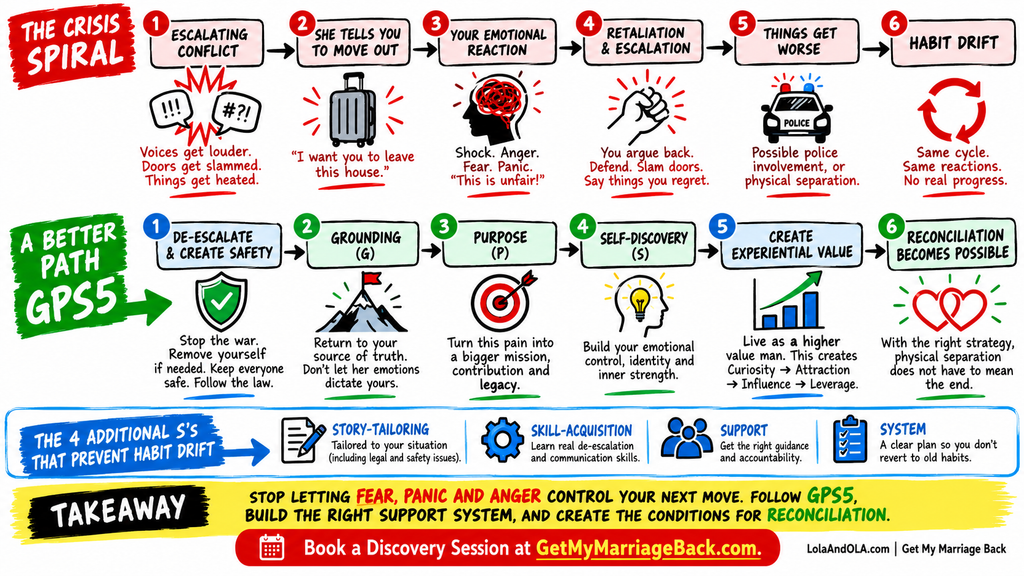
This is one of the most seductive mistakes in a marriage crisis because retaliation feels like Personal Power.

It isn’t.

If your wife can raise her voice and automatically make you raise yours, she is influencing your emotional state.

If one sentence about separation makes you lose control, separation is controlling you.

When fear, panic, anger and anxiety determine your next move, those emotions have power over you.

Self-control is not submission. De-escalation is not weakness.

You can be physically strong enough to slam every door in your house and still be emotionally controlled by fear.
wife asked me to move out, not what

Mistake #2: Believing You Must Choose Between Fighting and “Giving Her Space”

Generic marriage advice loves extremes.

“Never leave your house.”

“Fight for your marriage.”

“Don’t let her push you around.”

Then another corner of the internet tells you:

“Just give her space.”

“Do whatever she wants.”

“Don’t contact her.”

“If she loves you, she’ll come back.”

Neither collection of slogans knows your marriage.

There is an enormous difference between fear-driven chasing and dignity-based pursuit.

You can want your wife.

You can want your marriage.

You can make your interest clear.

None of that requires you to beg for reassurance, force conversations, repeatedly ask whether she still loves you, or use every interaction to measure your chances of reconciliation.

Likewise, respecting legitimate distance does not require becoming cold, passive or manipulative.

You are not disappearing to “make her miss you.”

Your objective is much bigger.

Become someone whose emotional center is no longer dependent on what mood your wife is in today.

Mistake #3: Trying to Talk Your Way Back Into Attraction

When your wife wants separation, words become extremely tempting.

You want to explain your intentions.

You want her to understand how much you love her.

Maybe you have finally recognized mistakes that she complained about for years, and now you desperately need her to believe you have changed.

So you talk.

And talk.

And talk.

But attraction is experiential.

Your wife does not experience your transformation because you gave her a PowerPoint presentation about it.

She experiences you.

How do you respond under pressure?

What happens when she disagrees with you?

Can you hear something painful without immediately defending yourself?

Does every warm interaction become an opportunity to ask about reconciliation?

Can you experience rejection without collapsing, exploding or retaliating?

Those experiences communicate far more than another promise.

Why Chasing and Withdrawal Can Make the Crisis Worse

There is useful research behind this dynamic.

A study involving 116 married couples examined what researchers call demand-withdraw communication—a pattern where one spouse pushes for discussion, change or resolution while the other avoids or withdraws.

Both husband-demand/wife-withdraw and wife-demand/husband-withdraw patterns were associated with more negative emotions and tactics and lower conflict resolution. The pattern was not simply a “husband problem” or a “wife problem”; either spouse could occupy either side of the cycle. You can read the research on demand-withdraw patterns in marital conflict.

Look at how easily this can appear after your wife asks you to move out:

Fear → Pursuit → Pressure → Withdrawal → More Fear → More Pursuit

You want reassurance, so you push for a conversation.

She experiences pressure and retreats.

Her retreat frightens you, so you push harder.

Now she wants even more distance.

You interpret that distance as proof that you need to fight harder for the marriage.

The cycle feeds itself.

Breaking that cycle creates emotional breathing room. And emotional breathing room matters when you are trying to rebuild attraction.

Mistake #4: Making Your Wife Responsible for Your Emotional Stability

This is where separation exposes things ordinary married life can hide.

When your wife is warm, you feel powerful.

When she becomes cold, you fall apart.

When she texts you, you see hope.

When she doesn’t, you start imagining divorce.

When she laughs with you, you think reconciliation has started.

Then she mentions separation again and your entire emotional world crashes.

That’s not Personal Power.

Your wife has effectively become the thermostat controlling your emotional temperature.

Attraction struggles under that burden because every interaction acquires a hidden job:

“Please make me feel safe about us.”

Your wife can feel that pressure even when you never say those exact words.

This is why your first job is not making her change her mind.

Your first job is recovering your ability to lead yourself.

Grounding: Stop Letting the Symptom Become Your Identity

The symptom is:

“My wife asked me to move out.”

Grounding does not mean pretending that symptom doesn’t exist.

It means returning to a source of truth higher than the symptom.

Your marriage crisis cannot become your identity.

Your wife’s current emotional state cannot become your definition of your worth.

Her rejection cannot become the authority determining whether today has meaning.

Grounding brings you back to truth and gratitude while allowing you to confront the crisis exactly as it is.

Now you can respond instead of react.

That difference is enormous.

Purpose: Become Bigger Than the Crisis

Pain has a nasty habit of shrinking your entire world.

Suddenly everything becomes about your wife.

What did she mean by that text?

Why didn’t she call?

Is she talking to somebody else?

Does she miss you?

Is she filing?

When is she coming back?

Your marriage matters tremendously, but your purpose must be bigger than any single living human being—including your wife and including you.

Redirect pain into mission.

Reconnect with contribution, impact and legacy.

Build something meaningful enough that your marriage crisis cannot consume every available piece of your identity.

This isn’t a trick for making your wife jealous.

Purpose is attractive because purpose creates life.

A person with direction generates a different experience from a person whose entire existence has become monitoring whether someone else still wants them.

Self-Discovery: Find Out Who You Are Under Pressure

A marriage crisis reveals capacity.

It exposes your beliefs about masculinity, love, conflict, rejection, control, fairness and strength.

Don’t turn that discovery into self-blame.

Use it.

You may discover that what you called “standing up for yourself” was sometimes emotional reactivity.

Perhaps what you called “fighting for the marriage” was occasionally panic.

What looked like communication may have become repeated demands for reassurance.

Self-Discovery means developing enough emotional capacity to see those patterns without needing to declare yourself either the hero or villain.

Then you can change what you actually control.

How Attraction Starts Rebuilding During Separation

Attraction isn’t something you demand from your wife.

It emerges from experience.

I describe the progression this way:

Value → Curiosity → Attraction → Influence → Leverage

Value here does not mean moral worth.

You already have human worth.

I’m talking about experiential value: what does interacting with you feel like?

Are you emotionally exhausting or emotionally engaging?

Predictable or interesting?

Desperate or grounded?

Reactive or responsive?

Consumed by the marriage or connected to a meaningful life?

When your experience changes consistently, curiosity can emerge.

Your wife begins encountering something different instead of hearing another sales pitch about how different you are.

Curiosity gives attraction room to breathe.

Attraction can expand influence.

Influence creates leverage—not leverage to control her, but a stronger relational position from which reconciliation becomes possible.

Mistake #5: Trying to Recreate the Old Marriage

You don’t need the broken marriage back.

Read that again.

The goal is a brand-new marriage with the same person.

Going back to exactly what existed before the separation simply restores the conditions that produced the crisis.

You need a different relational experience.

More emotional intelligence.

Better conflict skills.

Greater self-control.

More curiosity.

Stronger individuality.

More play.

More purpose.

Greater experiential value.

That is how reconciliation becomes something more meaningful than getting your wife physically back inside the same house.

What to Do After Your Wife Asks You to Move Out

Start with reality.

Determine whether there is an immediate safety issue.

Separate legal questions from emotional questions.

Do not make irreversible housing, financial, property or custody decisions based solely on marriage advice from the internet.

Then look directly at your emotional pattern.

What happens inside you when she says, “I want you to leave”?

Does fear become anger?

Do you retaliate?

Do you start proving?

Does panic make you send paragraphs of text?

Do you immediately demand certainty about divorce?

Identify the automatic reaction before trying to perfect your next speech.

From there, rebuild your foundation:

Grounding. Purpose. Self-Discovery.

Create experiential value through the way you live and interact.

Allow curiosity and attraction to emerge from experience rather than pressure.

Develop influence through consistency.

Build leverage through emotional intelligence, dignity and a life that does not collapse every time your wife has a difficult emotion.

This is not passivity.

This is strategic self-leadership.

Physical Separation Does Not Have to Mean Emotional Surrender

I packed a bag and left my house during my own marriage crisis.

I understand the fear attached to that moment.

Walking through a door with luggage can feel like you’re physically acting out the death of your marriage.

But distance itself does not write the ending.

What matters enormously is what happens inside that distance.

You can spend separation obsessing, retaliating, monitoring, begging and waiting.

Or you can use the crisis to become grounded, purposeful, emotionally intelligent and experientially attractive.

You cannot control whether your wife ultimately chooses reconciliation.

But you have tremendous influence over the experience of you that you bring into every interaction from this point forward.

That’s where your Personal Power lives.

Stop trying to win the argument about who has the right to be angry.

Stop allowing fear to masquerade as strength.

Don’t make your wife responsible for regulating your emotions.

Build the man who can experience this crisis without becoming the crisis.

That is where rebuilding your marriage begins.

Wife or Husband Denying You Sex? DO THIS!!!

Frequently Asked Questions

What should I do if my wife asks me to move out?

De-escalate first, address any immediate safety or legal issues appropriately, and avoid making panic-driven decisions. Then identify the fear-driven behaviors you control and begin changing the experience you create in the marriage.

Does moving out mean my marriage is over?

No; physical separation and divorce are different events, although a request to move out should be treated seriously. Focus less on predicting the ending and more on responding with emotional intelligence, dignity and deliberate action.

Should I give my wife space when she wants separation?

Respecting legitimate space can reduce pressure, but don’t use distance as a manipulation tactic to make her miss you. Research on demand-withdraw conflict suggests that cycles of pressure and withdrawal are associated with more negative interactions and poorer conflict resolution.

Can I save my marriage while separated?

You cannot single-handedly dictate reconciliation, but you can change your contribution to destructive patterns and rebuild grounding, purpose, experiential value and emotional intelligence. Those changes create healthier conditions in which curiosity, attraction and reconciliation can develop.


My Wife Wants to Move Out? Do This Without Pushing Her Away

Your wife wants to move out, and every instinct in your body is screaming at you to stop her before physical separation turns into divorce.

Take This 2 Minutes Quiz

Question 1 of 15

You want to explain why leaving is a mistake.

You want to remind her about everything you built together, the family, the memories, the promises, the sacrifices and the future you planned.

Maybe you want to tell her you finally understand what went wrong. Maybe you are ready to promise that everything will change. You may even feel willing to pay almost any price to keep her from walking through that door.

I understand that instinct because I lived it.

Months before my wife moved out, she told me she did not want to be in our marriage anymore. I flew off the handle.

There were arguments, defensiveness and begging. I was trying to fight the reality in front of me because I desperately did not want that reality.

Later, while I was away on business, my wife and I spoke on the phone and things seemed relatively normal.

I came home to crickets.

The closets were clean.

When I called her, it became obvious that this wasn’t a weekend away. My wife was making a move completely away from our marriage.

Something had changed in me by then.

I still wanted my marriage. Secretly, I hoped we would find our way back to each other.

But I finally started learning one of the hardest skills you will ever need when your wife wants separation:

Letting go without giving up.

Those are not the same thing.

When Your Wife Wants to Move Out, Don’t Fight the Suitcase

The suitcase is a symptom.

The apartment is a symptom.

The physical separation is the visible manifestation of something that probably started much earlier.

That matters because when you concentrate exclusively on stopping your wife from moving out, you can miss the actual marriage crisis.

You are trying to prevent the physical distance while ignoring the emotional distance that preceded it.

Imagine she has felt unheard, disconnected, chronically frustrated or emotionally exhausted for months. Perhaps conflict became constant. Maybe attraction deteriorated until you felt more like roommates than lovers.

Then she finally says:

“I need to leave.”

From your perspective, everything suddenly changed.

From hers, leaving may feel like the culmination of a much longer process.

That does not make her decision fair.

It does not mean you agree with it.

And understanding why somebody reached a decision is not the same as endorsing that decision.

This distinction gives you Personal Power.

my wife wants to move out

Why Begging Your Wife to Stay Can Push Her Further Away

Your intention and her experience are two different things.

You intend to communicate love.

She can experience pressure.

You intend to demonstrate commitment.

She can experience desperation.

You intend to prove that you are finally serious about saving your marriage.

She can experience another demand to manage your fear.

That’s why the popular advice to “fight for your marriage” can become dangerous when nobody defines what fighting actually means.

Does fighting mean begging?

Does it mean sending a 1,500-word text at midnight?

Does it mean following her around the house while she packs?

Does it mean repeatedly explaining why she is wrong?

Does it mean using your children, vows or history as reasons she should reconsider?

That’s not the kind of pursuit that builds attraction.

That’s fear trying to regain control.

You can want your wife.

You can pursue reconciliation.

You can make it clear that you remain interested in saving the marriage.

But pursuit based on dignity is radically different from chasing based on fear.

My Wife Wants to Separate: What Should I Actually Say?

Keep it simple.

Tell her you understand.

Your emotions may immediately object:

“How can I tell her I understand when I don’t want her to leave?”

Because understanding is not agreement.

You understand that this did not start overnight.

You understand that something in the marriage brought the relationship to this point.

You understand that she currently believes distance is necessary.

None of those statements require you to declare the marriage dead.

Then let her know that if she changes her mind, she can let you know.

Stop there.

That statement does not mean:

“I’ll wait forever.”

It does not mean:

“You can do anything you want and I’ll always be here.”

And it certainly does not mean putting your life on layaway until your wife decides what happens next.

Now the real work begins.

Saving Your Marriage Alone Does Not Mean Controlling Her

There is a popular statement that “it takes two to save a marriage.”

Ultimately, two people choose whether they participate in a marriage.

But that does not mean two people must simultaneously become motivated before anything can change.

You control your contribution to the emotional system.

You control whether disagreement turns into combat.

You control whether rejection sends you into begging.

You control whether uncertainty turns you into an investigator.

You control whether your entire identity collapses because your wife wants separation.

Most importantly, you control what it feels like to experience you from this point forward.

That is where attraction starts becoming relevant again.

Attraction Is an Experience, Not an Argument

You cannot logically persuade your wife into attraction.

Think about how strange that proposition really is.

“Here are twelve excellent reasons you should desire me again.”

Attraction doesn’t work like that.

You create an experience.

When your wife experiences you as chronically anxious, argumentative, controlling, needy or emotionally dependent on her responses, the experience matters regardless of your good intentions.

The opposite is also true.

When you become grounded, emotionally intelligent, purposeful, interesting, responsive and capable of tolerating discomfort without dumping it onto her, interacting with you begins to feel different.

That does not mean performing confidence.

Fake indifference is still fixation.

Posting pictures to make her jealous is still fixation.

Ignoring her because some internet advisers told you “no contact makes women chase” is still allowing her behavior to control yours.

Real grounding is different.

You care without collapsing.

You remain interested without begging.

You can feel tremendous pain without making your wife responsible for regulating it.

That is attractive because it is sustainable.

Rebuild Value Before Demanding Reconciliation

Your wife has probably already heard promises.

“I’ll change.”

“I’ll do anything.”

“I finally get it.”

“Just give me another chance.”

Words have limited power when the existing experience contradicts them.

Experiential Value means she encounters something different rather than receiving another presentation about how different you are going to become.

If anger damaged the marriage, learn to experience frustration without turning the environment hostile.

If you became emotionally absent, develop your capacity to be present without demanding immediate credit for it.

When your life lost direction, rebuild purpose that exists beyond getting your wife back.

If every interaction became serious and heavy, stop turning every decent conversation into a marriage summit.

Changed behavior creates evidence.

Repeated promises create expectations.

The first can generate Curiosity.

Why Curiosity Matters When Your Wife Wants Separation

Attraction needs room.

Suppose your wife believes she already knows exactly how you will respond.

She pulls away.

You panic.

She becomes colder.

You explain.

She asks for space.

You chase.

She gives you a little warmth.

You immediately ask whether that means she wants to come home.

There is no mystery in that cycle.

Your emotional state is entirely predictable because she controls it without even trying.

Now imagine something genuinely changes.

She expects an argument, but you remain grounded.

She anticipates another desperate relationship conversation, but you don’t initiate one.

Your wife expects you to spend the entire separation monitoring her, yet she discovers you are becoming more engaged with your health, children, career, friendships, mission and emotional development.

You aren’t trying to make her curious.

You have become worth becoming curious about.

That’s different.

Curiosity can create room for attraction.

Attraction can create Influence.

Influence can create Leverage.

None of it requires manipulating your wife.

Ground Yourself Before You Try to Get Your Wife Back

The first part of our GPS framework is Grounding.

Grounding means returning to your higher self, source of truth and gratitude instead of allowing the symptom—your wife moving out—to become the source of your identity.

The pain remains real.

You simply stop allowing pain to issue commands.

Ask yourself:

What do I know to be true regardless of what she decides today?

What am I grateful for even in this painful season?

Which reactions have repeatedly made this marriage worse?

What would my highest self do with the next 24 hours?

These questions move you away from panic and toward intention.

Build a Purpose Bigger Than Your Marriage

This sounds counterintuitive when you desperately want to save your marriage.

It isn’t.

Your wife cannot sustainably function as your entire purpose.

Neither can reconciliation.

Purpose redirects pain toward the impact, legacy and mission your life is supposed to create beyond any single person.

That does not diminish marriage.

It makes you stronger inside it.

A person with meaningful direction carries a different emotional presence from somebody waiting beside the phone for one text to determine whether the day is worth living.

Purpose restores movement.

And movement creates aliveness.

Use Self-Discovery Without Turning It Into Self-Blame

Self-Discovery asks:

“What capacity do I need to develop?”

It does not ask:

“How do I prove everything was my fault?”

Those are radically different questions.

You may have made serious mistakes.

Own them.

Your wife may have made serious mistakes too.

Her mistakes do not eliminate your opportunity to grow.

You are looking for capacity: emotional regulation, communication, boundaries, conflict skills, presence, playfulness, purpose, confidence and the ability to remain grounded when another person disappoints you.

That development has value regardless of what she does next.

Ironically, that is exactly why it can become attractive.

Don’t Let Acute Stress Put Your Old Marriage Back in Charge

Here is where execution gets difficult.

Tonight, your wife may send a cold text.

Tomorrow, she may pack another box.

Next week, she may tell you she still needs space.

Your intellectual understanding can disappear quickly when fear gets activated.

Research has found circumstances in which acute stress can shift behavior away from deliberate, goal-directed responding toward established habitual responses, although later replication research suggests that this effect has important boundary conditions rather than occurring universally. You can review the underlying research on stress and habitual behavior directly.

That is particularly useful to understand during a marriage crisis.

Your old reaction is waiting.

Beg.

Argue.

Explain.

Check her phone.

Demand certainty.

Send another text.

Promise more.

Call again.

Your work is to recognize that reaction before you obey it.

Letting Go Is Not Giving Up on Marriage Reconciliation

Letting go means releasing your attempt to control an outcome that another human being participates in creating.

Giving up means abandoning what matters to you.

You can release control without abandoning your desire to save your marriage.

In fact, your desperation to control the outcome can prevent you from developing the very qualities that make reconciliation more attractive.

Let her experience your interest without your panic.

Let her experience your growth without your sales pitch.

Allow a pleasant interaction to remain pleasant without immediately asking, “So what does this mean for us?”

Let change accumulate.

Your objective is not to restore the exact marriage she wanted to leave.

Why would either of you want that?

The objective is to become capable of participating in a marriage that feels fundamentally different.

That means more emotional intelligence.

More Personal Power.

More Value.

More Curiosity.

More Attraction.

More Influence.

And eventually, enough Leverage to create the conditions in which rebuilding the marriage becomes a compelling possibility rather than another obligation.

What If She Has Already Moved Out?

The front door closing does not change the principles.

Do not transform separation into surveillance.

Don’t count every day apart as evidence that divorce is inevitable.

Avoid treating every friendly interaction as proof that reconciliation is imminent.

And stop trying to manufacture missing you through manipulative silence.

Build a life worth returning to—and more importantly, a self worth bringing into any future marriage.

Take responsibility for practical matters.

Remain dignified in necessary communication.

Respect legitimate boundaries.

Become more emotionally skilled.

Develop your purpose.

Create experiences that feel different when natural opportunities for interaction arise.

Your wife does not need another speech about the new you.

She needs the opportunity to encounter you.

The Real Goal When Your Wife Wants to Move Out

The goal is not to trick her into staying.

It is not to become emotionally cold enough that you stop caring.

And it is not to beg so convincingly that she postpones leaving.

Your goal is to stop making fear the leader of your marriage.

Understand what she is telling you.

Let go of your attempt to overpower her decision.

Then engage in the serious self-work required to rebuild Grounding, Purpose, Self-Discovery and experiential Value.

Value creates the possibility of Curiosity.

Curiosity gives Attraction room to breathe.

Attraction creates the conditions for Influence.

Influence creates Leverage.

That is a far more powerful position than sitting beside an unpacked suitcase begging your wife to choose you.

You still want your marriage.

Now you’re learning how to want it without losing yourself.

5 Physical Signs She Just Slept With Someone Else: The Truth

Frequently Asked Questions

What should I do when my wife wants to move out?

Stay grounded, understand that her decision probably developed before the physical move, and avoid turning fear into begging, arguing or repeated pressure. Make your interest in reconciliation clear without trying to overpower her freedom to decide.

Should I let my wife leave if she wants separation?

Understanding her desire to leave is not the same as agreeing that the marriage should end. Focus on what you control: your reactions, development, responsibilities, boundaries and the emotional experience you create.

Can I save my marriage after my wife moves out?

Physical separation does not by itself answer whether marriage reconciliation will occur. Use the separation to interrupt destructive patterns and build genuine, observable change instead of trying to force certainty.

How do I rebuild attraction while separated from my wife?

Reduce fear-driven chasing and strengthen Grounding, Purpose, emotional intelligence, self-respect and experiential Value. Give genuine change enough room to create Curiosity and Attraction instead of repeatedly asking your wife whether your efforts are working.


What Would Help You Most Right Now?

Choose the option that best matches where you are with your marriage.

I Need Personalized Help

My Marriage Is in Serious Trouble

If you're dealing with separation, divorce, loss of attraction, infidelity, intimacy problems, or a spouse who's pulling away, get help looking at what's happening in your specific situation.

Get Personalized Help →
Get My Marriage Back book cover
I'd Rather Learn What to Do First

Start With Get My Marriage Back

Get the book and start learning the principles for moving your marriage in a better direction.

Get the Free Book →