

Your wife can appreciate everything you’ve sacrificed for your family and still feel so emotionally disconnected from you that she no longer wants your affection, your intimacy, or even your company.
Take This 2 Minutes Quiz
That’s one of the most painful realities you can face in a marriage.
You’ve worked hard. You’ve provided. You’ve raised children, handled responsibilities, and sacrificed years of your life to build something meaningful.
Now your wife barely speaks to you.
She doesn’t initiate affection. Physical intimacy has disappeared. Conversations feel forced, and your attempts to save your marriage seem to make her even colder.
You want to understand what happened.
More importantly, you want to know whether you can rebuild the emotional connection and attraction that once made your marriage feel alive.
Here’s where I want you to begin.
Your wife’s emotional withdrawal is a symptom. Understanding the relationship dynamic behind that symptom determines what you need to change.
What Would Help You Most Right Now?
Choose the option that best matches where you are with your marriage.
My Marriage Is in Serious Trouble
If you're dealing with separation, divorce, loss of attraction, infidelity, intimacy problems, or a spouse who's pulling away, get help looking at what's happening in your specific situation.
Get Personalized Help →
Start With Get My Marriage Back
Get the book and start learning the principles for moving your marriage in a better direction.
Get the Free Book →And sometimes, the biggest obstacle isn’t what you haven’t said.
It’s what happens when you finally start talking.
Why Is My Wife Cold and Emotionless Toward Me?
When your wife becomes emotionally distant, it’s tempting to interpret her behavior as proof that she doesn’t love you anymore.
But emotional withdrawal has different possible explanations.
She may carry unresolved resentment from years of disappointment. Repeated arguments may have made emotional conversations exhausting. Attraction may have declined as the relationship became dominated by responsibilities, conflict, and predictable routines.
Sometimes, your wife has already begun imagining a life outside the marriage.
These possibilities require different interpretations.
A wife who avoids intimacy because she feels chronically unheard is experiencing something different from a wife who has explicitly decided she wants a divorce.
You need to examine what changed, when it changed, and how your interactions have contributed to the current situation.
The Roommate Marriage Nobody Planned
I recently worked with a gentleman in his late fifties who had been married for more than 25 years.
His children were grown. He and his wife shared a three-bedroom house.
But their marriage had become almost entirely transactional.
They passed each other in the hallway, exchanged brief greetings, and continued with their separate routines.
No meaningful conversations.
No playful banter.
No romantic intimacy.
Two people sharing an address without experiencing much of a relationship.
His wife had accumulated years of resentment. She felt neglected and disregarded, including during painful experiences involving his extended family.
Meanwhile, he believed his decades of sacrifice deserved greater appreciation.
Both carried legitimate grievances.
The problem was that their conversations had become another source of emotional injury.
And now she wanted to move on because she believed she had never experienced the love she wanted from the marriage.
That is a serious attraction-loss crisis.
Not because romance disappeared overnight, but because emotional disconnection had become their normal way of living.
Sign 1: Your Wife Recognizes Your Sacrifices but Still Feels Unloved
This is where many husbands become confused.
You provided financially. You made sacrifices. You remained committed to your responsibilities.
Yet your wife tells you she felt alone throughout the marriage.
Naturally, you want to defend your record.
But consider the difference between two questions:
What did you contribute to the marriage?
And:
What did your wife experience emotionally while married to you?
Those are not the same question.
Your sacrifices can be real while her loneliness is also real.
When she describes feeling neglected, listing everything you’ve provided doesn’t necessarily address what she’s trying to communicate.
You are defending your contribution.
She’s describing her emotional experience.
And the conversation becomes a competition between two different realities.
What This Means for Attraction
Attraction in a long-term marriage involves more than physical appearance, sexual performance, or financial security.
It also involves how someone experiences your presence.
Do your interactions create warmth, curiosity, playfulness, and emotional engagement?
Or have they become predictable exchanges involving responsibilities, complaints, and unresolved grievances?
Being a responsible spouse matters.
But responsibility alone doesn’t automatically create romantic desire.
You need to become someone whose presence offers an emotionally different experience from the patterns that contributed to the disconnection.
That starts with understanding the experience you’re currently creating.
Sign 2: Every Apology Becomes Another Argument
One of the most revealing aspects of this gentleman’s situation emerged during our Discovery Session.
He genuinely wanted to save his marriage.
But whenever his wife described something painful, he struggled to resist defending himself.
He would acknowledge a mistake and immediately explain why he had behaved that way.
Some of those explanations were legitimate.
He felt unappreciated. His sacrifices had been overlooked. He had his own resentment to address.
But his timing was destroying the opportunity for understanding.
Imagine your wife explaining that she felt abandoned during a difficult family situation.
You respond:
“I’m sorry, but you have to understand how much pressure I was under.”
Now you’re discussing your pressure instead of exploring her experience.
Your pressure may have been completely real.
However, your explanation can make the apology sound conditional.
She hears the words without experiencing the understanding she was hoping to receive.
The Difference Between Explaining and Understanding
An apology isn’t automatically authentic because you say the correct words.
Its credibility depends partly on whether your subsequent behavior demonstrates understanding.
Ask yourself:
When your wife describes something painful, do you become curious about what happened from her perspective?
Or do you immediately search your memory for evidence that you’re not the person she’s describing?
That distinction reveals whether you’re listening to understand or listening to defend.
And defending your intentions doesn’t automatically address the consequences of your actions.
You don’t need to agree with every accusation.
You do need to distinguish legitimate factual concerns from emotionally charged interpretations.
If she says, “You never cared about me,” that statement describes her emotional conclusion, not necessarily an objective account of every moment in your marriage.
Explore the specific experiences behind it without getting trapped in proving that the word “never” is inaccurate.
Sign 3: Your Fear of Rejection Is Deepening the Roommate Marriage
Emotional withdrawal often extends into physical intimacy.
In this gentleman’s marriage, sexual connection had disappeared.
He was also experiencing erectile difficulties, reduced confidence, and increasing fear of rejection.
Initiating intimacy felt dangerous to his dignity.
Another rejection threatened what little confidence he believed he had left.
So he stopped initiating.
His wife wasn’t showing interest either.
The physical distance reinforced the emotional distance.
Why Sexual Pressure Won’t Repair Emotional Disconnection
When intimacy disappears, it’s tempting to focus entirely on restoring sexual activity.
But sexual withdrawal can reflect several overlapping factors, including relationship distress, health conditions, hormonal changes, medication effects, and psychological stress.
Erectile dysfunction deserves appropriate medical evaluation, especially when it persists.
More importantly, the absence of sex doesn’t tell you everything about the relationship.
Examine what happens outside the bedroom.
Does your wife avoid ordinary conversations?
Has playful interaction disappeared?
Does she become guarded whenever you approach a sensitive subject?
Has she explicitly said she wants to leave?
These observations help distinguish a primarily sexual difficulty from a broader emotional crisis.
Trying to force physical closeness while years of resentment remain unresolved creates additional pressure.
Attraction grows more naturally when emotional engagement, mutual interest, and freedom to choose are present.
You cannot demand desire.
But you can change how you show up in the relationship.
Sign 4: Your Wife Feels Unheard Even When You Keep Talking
Here’s the uncomfortable contradiction.
You may be talking more because you’re desperately trying to save your marriage.
Yet every conversation makes your wife feel more distant.
Why?
Because you’re approaching the conversation as an opportunity to establish your innocence.
She experiences it as another occasion when her pain gets pushed aside.
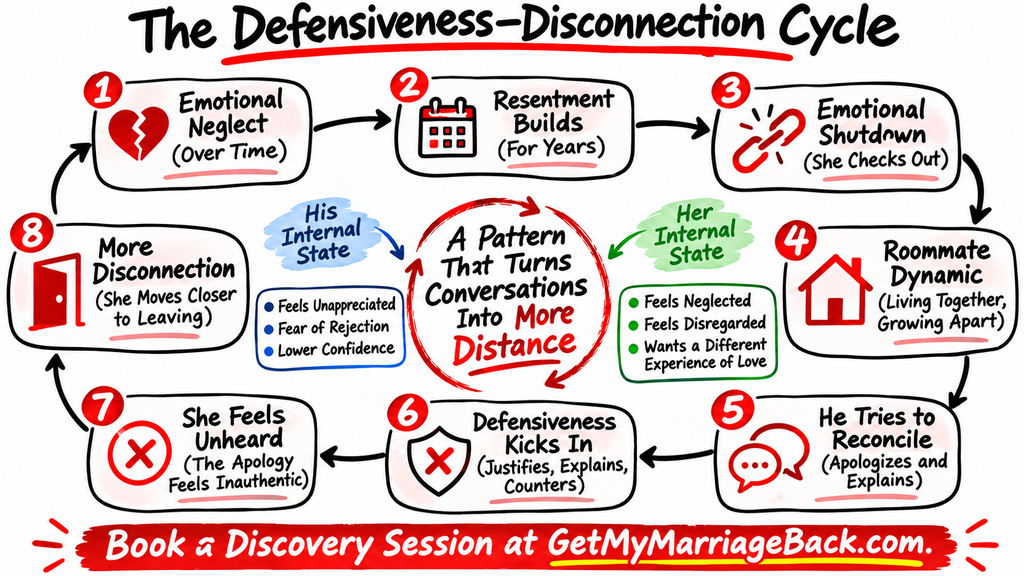
This creates what I call the Defensiveness–Disconnection Cycle.
Emotional neglect contributes to resentment.
Resentment contributes to withdrawal.
Withdrawal creates fear and desperation.
Fear triggers defensive explanations, repeated apologies, and arguments.
Those reactions leave your wife feeling unheard, reinforcing the withdrawal.
Eventually, even ordinary conversations become emotionally exhausting.
What Relationship Research Reveals
Relationship research supports the importance of responsiveness in emotional intimacy.
A study published in Psychological Science examined how feeling understood, validated, and cared for by a romantic partner relates to affectionate touch.
The researchers found that perceived partner responsiveness was positively associated with affectionate touch.
That matters because attraction isn’t simply something you manufacture through romantic gestures.
Your partner’s experience of your responsiveness can influence the emotional conditions surrounding closeness.
Other relationship research has also identified defensiveness and emotional withdrawal as important patterns in distressed marriages.
The practical distinction is clear: winning an argument and creating an experience of understanding are different achievements.
How to Rebuild Attraction Without Begging or Chasing
Here’s what I want you to do.
Stop treating every interaction with your wife as an emergency opportunity to convince her to stay.
Your immediate responsibility is to interrupt the behaviors that reinforce the emotional distance.
Listen to Identify Where You Can Add Value
When your wife expresses a grievance, allow her to finish.
Keep your posture relaxed. Maintain a calm, attentive presence without forcing eye contact or demanding an immediate response.
Don’t interrupt to correct details that aren’t essential to understanding her concern.
Instead, identify one specific experience you genuinely understand.
For example:
“I understand that when my family treated you that way, you felt I didn’t stand up for you.”
That statement doesn’t require you to accept every conclusion she has drawn.
It demonstrates that you’re capable of recognizing her experience without immediately centering your defense.
And that’s a different emotional experience.
Separate Your Grievances From Her Moment of Expression
Your concerns matter.
If you’ve spent decades feeling unappreciated, those experiences deserve attention.
But bringing them into every conversation about your wife’s pain prevents either issue from receiving meaningful consideration.
During the Discovery Session, I helped this gentleman distinguish between listening to understand where he could add value and listening while preparing his counterarguments.
He needed to identify which grievances required their own attention and which immediate reactions were poisoning the conversation.
That distinction changed the direction of our diagnostic work.
You don’t regain dignity by silencing yourself permanently.
You regain control by choosing when, why, and how to express your concerns.
Become Emotionally Attractive Through Self-Leadership
Attraction isn’t rebuilt through rehearsed apologies or calculated performances.
Your emotional presence needs to become genuinely different.
Start with grounding.
Return your attention to what you know is true, what you appreciate, and what you can control rather than allowing every interaction to determine your emotional stability.
Reconnect with purpose.
Your marriage matters, but your entire identity cannot depend on your wife’s next reaction.
Develop meaningful direction through your work, health, relationships, responsibilities, and personal mission.
Then practice self-discovery.
Notice when fear causes you to interrupt, justify, withdraw, or seek immediate reassurance.
Recognizing those reactions gives you an opportunity to choose differently.
This is where value becomes experiential.
Your wife encounters someone who can remain composed during disagreement, acknowledge a legitimate concern, and demonstrate curiosity without surrendering personal dignity.
That combination can create room for renewed respect and interest.
The goal isn’t to perform confidence so your wife reacts. It’s to develop the confidence that changes how you participate in the relationship.
The Art of Attraction After Years of Emotional Distance
Seduction in a distressed marriage isn’t about tricks, jealousy, or withholding affection to manufacture anxiety.
It’s about restoring the conditions in which romantic interest can emerge voluntarily.
That requires three important shifts.
Replace Emotional Pressure With Emotional Freedom
When every conversation carries the hidden demand that your wife reassure you, forgive you, or reconsider leaving, your presence can become associated with pressure.
Remove the demand for an immediate emotional payoff.
Let a respectful interaction remain a respectful interaction.
You don’t need to turn every pleasant exchange into a conversation about saving the marriage.
Replace Predictable Defensiveness With Curiosity
Your wife already knows how your arguments usually unfold.
She anticipates the explanation, the justification, and the competing grievance.
Interrupt that predictability through genuine understanding.
Ask a relevant question when appropriate. Listen to the answer. Resist the urge to turn the moment into another defense of your intentions.
Curiosity becomes meaningful when it leads to observable behavioral change.
Replace Desperation With Personal Direction
A marriage crisis can consume your attention until every decision revolves around your spouse.
That level of emotional dependence places enormous pressure on the relationship.
Rebuild your daily structure.
Take care of your health. Address sexual difficulties appropriately. Strengthen your emotional regulation and reconnect with meaningful responsibilities outside the crisis.
You become more engaging when your life contains genuine purpose rather than constant monitoring of your wife’s emotional temperature.
And when your wife chooses to engage, you have something more meaningful to bring into that interaction.
Can You Save Your Marriage When Your Wife Wants Out?
The answer depends on what has happened, what remains unresolved, and whether your wife is willing to participate in rebuilding the relationship.
But her withdrawal doesn’t eliminate your ability to change your contribution to the dynamic.
You can stop defending every mistake.
You can acknowledge real grievances without accepting exaggerated accusations as objective truth.
You can address your own fear of rejection.
Most importantly, you can learn to distinguish between actions that create value and reactions that reinforce emotional distance.
If you’re trying to save your marriage alone, this is where your work begins.
Not with begging.
Not with forcing intimacy.
And not with trying to talk your wife out of her emotional experience.
Start by understanding the patterns that brought your marriage here.
Then develop the emotional intelligence, personal direction, and relationship skills necessary to create a different experience moving forward.
Because the most important question isn’t simply why your wife has become cold and emotionless.
It’s whether your next interaction will reinforce the same painful pattern—or demonstrate that something meaningful has changed.
5 Physical Signs She Just Slept With Someone Else: The Truth
Frequently Asked Questions
Your wife may be carrying unresolved resentment, experiencing emotional exhaustion, losing romantic attraction, or withdrawing after repeated conflict. Examine when the distance began and which relationship patterns consistently accompany it.
Yes, marriages can recover from emotional disconnection when the underlying problems are addressed and both spouses become willing to rebuild trust and closeness. You can begin by changing your own defensive reactions, but reconciliation ultimately requires her voluntary participation.
You cannot force your wife to feel love, but you can rebuild your emotional stability, address past behavior, and create interactions characterized by understanding rather than pressure. Consistent change matters more than repeated promises or dramatic romantic gestures.
Respect her boundaries and avoid interpreting every refusal as proof that the marriage is over. Examine the broader emotional relationship, address any relevant medical or psychological concerns, and prioritize rebuilding connection without pressuring her for sex.