

What Would Help You Most Right Now?

Choose the option that best matches where you are with your marriage.

I Need Personalized Help

My Marriage Is in Serious Trouble

If you're dealing with separation, divorce, loss of attraction, infidelity, intimacy problems, or a spouse who's pulling away, get help looking at what's happening in your specific situation.

Get Personalized Help →
Get My Marriage Back book cover
I'd Rather Learn What to Do First

Start With Get My Marriage Back

Get the book and start learning the principles for moving your marriage in a better direction.

Get the Free Book →

Wife Wants Separation? 5 Mistakes That Push Her Further Away

Your wife wants separation, and suddenly the woman you built your life with is asking for a future that might not include you.

Take This 2 Minutes Quiz

Question 1 of 15

Yesterday, you were her husband. Today, you feel like you’re auditioning for a position you already had.

She says she needs space. Maybe she isn’t sure about the marriage anymore. Perhaps she’s already mentioned divorce, moving out, or living separately while she figures out what she wants.

Now every unanswered text feels suspicious. Every conversation seems like a test. Your friends are telling you there’s probably another man, and you’re wondering whether giving her space means giving up on your marriage.

I want you to understand something important: Your wife asking for separation is a serious marriage crisis, but separation and divorce are not the same decision.

What you do during this period matters. And some of the most natural reactions to losing your wife can create exactly the kind of pressure that makes reconciliation harder.

https://www.youtube.com/watch?v=FCpuxML4uRo

Why Your Wife Wants Separation When You Still Love Her

When your wife wants separation, the announcement can seem to come out of nowhere.

You remember the last argument. Maybe you said something you regret. Perhaps she got upset over something you considered minor.

Now you’re wondering how one disagreement became a threat to everything you’ve built.

But the argument that triggers a separation conversation isn’t necessarily the problem that created the crisis.

Sometimes resentment has been accumulating for years.

Your wife may have experienced repeated disappointment, emotional disconnection, unresolved conflict, or declining attraction long before she mentioned leaving.

That doesn’t make every accusation against you accurate. It means the announcement and the emotional process behind it are two different things.

The marriage crisis that changed my perspective

Years into my own marriage, my wife told me she didn’t want to be married anymore.

I initially thought she was joking.

We had two boys together. We had built a family, and I couldn’t understand how an argument could suddenly put our marriage in jeopardy.

Then she repeated herself.

The reality became impossible to ignore.

For months, our marriage was in crisis. Eventually, I began accepting that divorce might become part of my story.

Yet my wife and I recently celebrated nineteen years of marriage.

That experience changed how I understand saving a marriage when one spouse wants out.

The biggest mistake is believing your wife must first change her mind before you can change the direction of your own life.

wife wants separation

The 5 Mistakes That Push Your Wife Further Away During Separation

1. Begging Her to Reconsider Before She Has Space to Think

Your wife says she needs time, and you immediately want another conversation.

You explain how much you love her. You remind her about your wedding vows, the children, the sacrifices, and everything you’ve survived together.

When that doesn’t work, you try again.

Here’s the problem.

You cannot negotiate somebody into wanting you.

Your explanations may be sincere, but when every interaction becomes an attempt to reverse her decision, your wife starts associating contact with emotional pressure.

Relationship researchers call one version of this the demand-withdraw pattern: one spouse increasingly presses for discussion or change while the other retreats.

A study of 116 couples examining marital conflict at home found that these patterns were associated with more negative interactions and less conflict resolution. The findings help explain why pursuing another conversation isn’t always the same as making progress.

The research on demand-withdraw patterns in marital conflict reinforces an important distinction: pressure and productive engagement are not interchangeable.

Giving your wife space doesn’t require pretending you don’t care.

It means refusing to make every interaction another campaign to change her mind.

2. Assuming She Wants Separation Because There’s Another Man

When your wife becomes emotionally distant, your imagination starts filling in the missing information.

She’s protecting her phone.

She doesn’t respond as quickly.

Her tone has changed.

Now your friends are telling you she must be interested in somebody else.

I worked with a man whose wife wanted divorce and was threatening to take much of what he had built financially.

But money wasn’t his deepest fear.

His parents had experienced multiple divorces. He had promised himself that his family would be different.

When his wife began questioning their future, he felt as though he was becoming the very story he’d spent his life trying to escape.

People around him became convinced another man was involved.

That possibility started dominating his thinking.

But suspicion isn’t evidence.

When you turn uncertainty into a conclusion, your behavior starts responding to a story you haven’t established as fact.

You become defensive, accusatory, controlling, or desperate for reassurance.

If there is evidence of infidelity, address the reality and protect your boundaries. But don’t manufacture certainty simply because uncertainty is painful.

Your fear of being replaced must not become the force controlling your behavior.
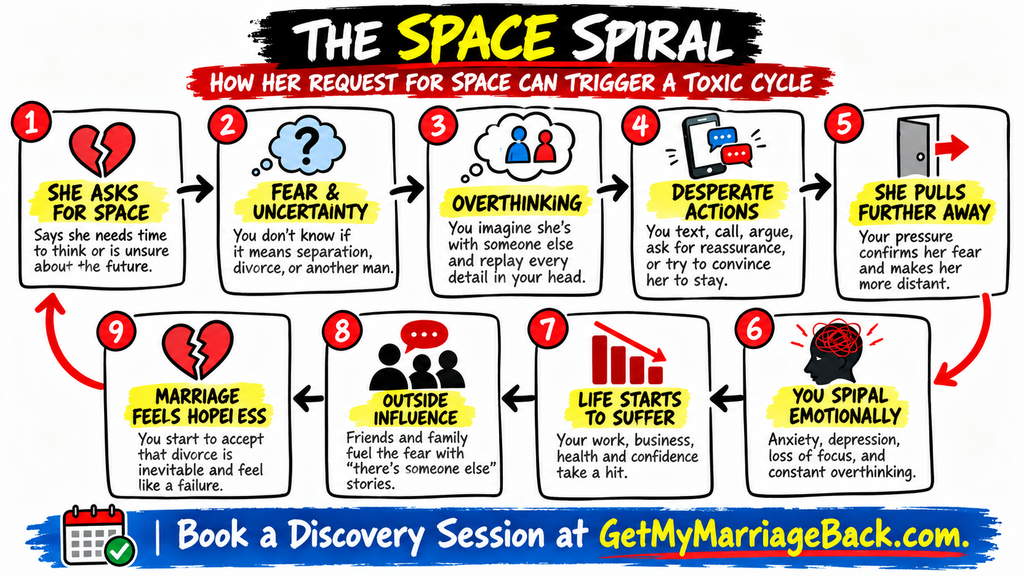
wife wants separation - the space spiral

3. Letting the Separation Destroy Your Identity

One of the most painful consequences of a marriage crisis is how quickly it can consume everything else.

Your business suffers.

You lose focus at work.

Sleep becomes difficult, and the activities that once gave your life meaning disappear.

I saw this happen with the client whose wife wanted divorce.

His emotional deterioration began affecting his business and everyday functioning.

Eventually, his wife pointed to those changes as additional reasons she no longer recognized the person she had married.

Think about that contradiction.

He was falling apart because he desperately wanted to save his family.

Yet the deterioration was making it harder for him to show up as the person he wanted to be.

This is where self-leadership becomes essential.

You don’t reclaim your identity by pretending the marriage doesn’t matter.

You reclaim it by refusing to make your wife’s immediate response the only measure of whether your life has value.

Your health, responsibilities, friendships, children, professional commitments, and personal mission still deserve your attention.

Those aren’t distractions from saving your marriage.

They’re part of rebuilding the stability that allows you to navigate the crisis intelligently.

4. Confusing Chasing With Genuine Pursuit

There’s a meaningful difference between pursuing your wife and chasing her.

Pursuit communicates interest with dignity.

Chasing demands reassurance because fear has taken control.

A thoughtful expression of love is different from sending six unanswered messages.

Respecting her request for space is different from disappearing to punish her.

Maintaining warmth when appropriate is different from manufacturing jealousy to make her react.

Attraction isn’t built by demonstrating how helpless you become when someone withdraws.

It’s influenced by the experience you create through your presence, emotional regulation, confidence, and behavior.

That is what I mean by experiential value.

I’m not talking about proving you’re morally superior or reminding your wife how good a husband you’ve been.

I’m talking about becoming someone whose presence creates a different emotional experience from the pressure and conflict she has come to expect.

You can be caring without being desperate.

You can remain interested without demanding access.

And you can respect distance without turning it into a manipulation tactic.

5. Treating Every Interaction as a Verdict on Your Marriage

Your wife responds warmly to a message.

You immediately think reconciliation is beginning.

The following day, she’s distant again.

Now you’re convinced divorce is inevitable.

That emotional roller coaster can turn every interaction into a test.

A short reply becomes rejection. A smile becomes proof of attraction. Silence becomes evidence of another man.

Eventually, your emotional stability depends on interpreting signals that may have several explanations.

One good conversation doesn’t mean your marriage is saved. One difficult conversation doesn’t mean it’s finished.

Instead of chasing individual signals, pay attention to patterns over time.

Is there less hostility?

Are your interactions becoming more respectful?

Are you responding differently when disappointment occurs?

Most importantly, are you becoming more capable of handling uncertainty without surrendering your judgment?

That is progress you can actually influence.

How to Save Your Marriage When Your Wife Wants Separation

Saving your marriage while separated begins with understanding the difference between control and influence.

You cannot control your wife’s feelings, attraction, or final decision.

But you can change the experience of interacting with you.

I teach a progression that begins with GPS: Grounding, Purpose, and Self-Discovery.

Grounding: Stop Letting Her Reactions Define Reality

Grounding means returning to a source of truth that remains stable even when your wife is uncertain about you.

Her emotional withdrawal is real.

Your marriage crisis is real.

But neither determines your entire identity or future.

When fear rises, acknowledge the situation without letting your imagination become your authority.

Purpose: Rebuild a Life Bigger Than This Crisis

Your marriage matters, but your purpose cannot depend entirely on another person’s decision.

Reconnect with your responsibilities, contribution, mission, and legacy.

This is particularly important when you’re trying to save your marriage alone.

You still have a life to lead while the future of your marriage remains unresolved.

Self-Discovery: Reclaim Your Capacity to Influence

Self-discovery isn’t an invitation to blame yourself for everything that went wrong.

It’s an opportunity to recognize the patterns you can change.

Perhaps you become defensive when criticized.

Maybe rejection triggers excessive reassurance-seeking.

You may have allowed years of disappointment to replace confidence with resentment.

Recognizing these behaviors gives you something practical to work on.

Rebuilding Attraction During Marriage Separation

The next progression is experiential value, curiosity, attraction, influence, and leverage.

Experiential value concerns what it is like to experience you.

When your behavior becomes more grounded, emotionally intelligent, and engaging, interactions can begin to feel different.

That difference creates room for curiosity.

Curiosity matters because attraction is difficult to nurture when every conversation feels predictable, pressured, or emotionally exhausting.

Your wife doesn’t need another performance designed to convince her you’ve changed.

She needs the freedom to observe whether your behavior actually changes.

That means demonstrating emotional intelligence in ordinary moments.

Respond without immediately defending yourself.

Respect reasonable boundaries without turning cold.

Maintain your responsibilities without demanding recognition.

Express interest without making every interaction a referendum on reconciliation.

This is how you begin changing your contribution to the relational dynamic.

Not by forcing attraction, but by becoming more capable of creating the conditions in which attraction can develop naturally.

Why Understanding Isn’t Enough: The Habit Drift Problem

You can understand everything I’ve explained and still repeat the same mistake tonight.

Your wife ignores your message.

Fear returns.

Suddenly, you’re writing another long paragraph explaining why she shouldn’t leave.

This is Habit Drift: returning to familiar reactions when emotional pressure rises.

Research into stress and decision-making has examined how stress can affect the balance between deliberate action and habitual responding, although findings are mixed and not every person responds the same way.

The practical lesson is straightforward.

Insight needs implementation.

In my GPS5 approach, the additional four S’s help turn understanding into sustained behavior:

  • Story-Tailoring: Understand the circumstances and history of your particular marriage.
  • Skill-Acquisition: Practice emotional intelligence until it becomes part of how you respond.
  • Support: Maintain perspective when fear and rejection distort your thinking.
  • System: Establish a consistent approach to difficult moments rather than improvising under emotional pressure.

The objective isn’t to become emotionally detached from your wife.

It’s to remain capable of making intelligent decisions even when your marriage is under threat.

Can Marriage Be Saved When Your Wife Wants Out?

A wife asking for separation is not automatically announcing an irreversible divorce.

Some marriages reconcile after significant emotional distance. Others move toward divorce despite sincere efforts to repair the relationship.

The distinction matters because you need to respond to the situation you’re actually facing, not the outcome you’re most afraid of.

When my own marriage reached a breaking point, I couldn’t see a path back.

Today, our history includes both that crisis and nineteen years of marriage.

What changed my perspective was recognizing that saving a marriage cannot require abandoning yourself.

Wanting your family is not weakness.

Loving your wife is not weakness.

Trying to save a broken marriage is not weakness.

But making your wife’s decision the sole source of your stability leaves you vulnerable to every change in her mood.

Your responsibility is to become grounded, emotionally intelligent, purposeful, and capable of creating a healthier relational experience.

Giving her space doesn’t have to mean giving up on your marriage. But saving your marriage cannot require losing yourself.

Wife or Husband Denying You Sex? DO THIS!!!

Frequently Asked Questions

What should I do if my wife wants separation?

Respect her request for reasonable space, avoid pressuring her for immediate reassurance, and focus on maintaining your emotional stability and responsibilities. Pay attention to the actual circumstances rather than assuming separation automatically means divorce.

Does separation mean my wife wants a divorce?

Not necessarily; separation can reflect uncertainty, emotional exhaustion, or a decision to move toward divorce. Her stated intentions and consistent actions provide more reliable information than speculation.

How can I save my marriage while separated?

Focus on the behaviors you control, including emotional regulation, respectful communication, personal stability, and addressing destructive relationship patterns. Sustainable reconciliation requires more than repeatedly convincing your wife to reconsider.

Should I contact my wife during separation?

Follow the boundaries and practical arrangements that apply to your separation, especially regarding children and shared responsibilities. Avoid using necessary contact as an excuse to pressure her into discussing reconciliation.


Wife Wants Divorce But Still Affectionate? 3 Signs That Matter

Your wife says she wants a divorce, but she is still affectionate with you… still doing the sex thing with you.


Take This 2 Minutes Quiz

Question 1 of 15

She hugs you. She touches you. She laughs with you. Some nights she still sleeps beside you, and physical intimacy may even continue.

Then something changes.

She becomes distant again.

The divorce conversation returns.

Suddenly, you are trying to understand how the same woman who showed you warmth last night can talk about ending the marriage today.

That contradiction can make you believe you have only two choices.

Either the affection means she does not really want the divorce, or the divorce means the affection is meaningless.

Both conclusions can get you into trouble.

Your wife can question the marriage and still experience affection, attachment, comfort, attraction, familiarity and sexual desire with you. The skill is learning how to receive what is genuinely happening without forcing one moment to tell you the future.

That is where emotional intelligence and attraction meet.

Wife Wants Divorce But Still Affectionate: What Does It Really Mean?

Start with the most important distinction:

Affection is information. It is not automatically a decision.

When your wife reaches for you, something real is happening.

The hug is real.

Her laughter is real.

Sexual attraction, when present, is real.

Comfort is real.

Yet none of those experiences automatically cancels everything that caused her to question the marriage.

This is why trying to force her behavior into a right-or-wrong answer creates so much unnecessary confusion.

You start thinking that if she wants divorce, she should not want you physically.

Then when she does want you physically, you conclude that she must not really want the divorce.

Human emotions do not operate like a courtroom.

A person can feel attraction and disappointment simultaneously. Your wife can enjoy being close to you while still wondering whether the marriage itself can become healthy enough for her to trust again.

Understanding that complexity gives you a much stronger position than trying to prove which version of her is the real one.

Both experiences can be real.

wife wants divorce but still affectionate

Sign #1: There Is Still Warmth, But Warmth Is Not Commitment

Suppose your wife reaches for your hand tonight.

You feel the relief immediately.

After weeks of rejection, that little bit of warmth feels enormous.

The danger begins when you turn the experience into proof.

Now you’re not simply enjoying your wife holding your hand. You’re thinking about what the hand-holding means for the divorce.

A kiss becomes evidence.

Sex becomes evidence.

Her sitting beside you becomes evidence.

A good conversation becomes evidence.

Before long, you’re no longer experiencing your marriage. You’re investigating it.

I call this Snapshot Blindness.

You’re taking one snapshot from the marriage and treating it like the entire movie.

That becomes especially dangerous after physical intimacy. You can wake up the next morning believing something has fundamentally changed because last night felt like the marriage you remember.

Then she becomes distant.

Your hope crashes.

Nothing necessarily changed overnight. You simply assigned the affectionate moment a promise it never made.

Attraction Requires You to Stop Demanding Proof

Your goal is not to dismiss positive experiences.

Quite the opposite.

Enjoy them.

Receive warmth warmly.

Be present when your wife is present.

What you don’t need to do is immediately convert affection into a reconciliation conversation.

That distinction matters because responsiveness itself appears relevant to desire. Research examining romantic relationships found that perceived partner responsiveness was associated with increased sexual desire, with stronger effects among women in those studies; feeling valued and experiencing the other person as a desirable mate helped explain that association.

Notice what that does not mean.

It does not mean becoming excessively agreeable.

Responsiveness is not servitude.

You’re not performing kindness so your wife owes you attraction afterward.

The attractive skill is being capable of receiving another person warmly without immediately turning the experience into a transaction.

Sign #2: Her Affection Changes From Day to Day

Your wife can be warm Friday and distant Saturday.

Sunday she initiates conversation.

Monday she mentions divorce.

Tuesday she seems almost normal.

By Wednesday, you’re wondering whether she even likes you.

This is where Threat Reactivity takes over.

Instead of observing the changing situation, you start emotionally moving with every change in her.

When she’s warm, you’re confident.

When she’s cold, you panic.

She mentions divorce and you collapse.

Then affection returns and suddenly you’re euphoric again.

Her emotional temperature has become your thermostat.

That is exhausting for you, but it also changes the experience of being around you.

Don’t Put Her Feelings on Trial

Rigid logic becomes especially tempting here.

You notice the contradiction and want her to explain it.

She’s affectionate, so why is she still talking about divorce?

She wanted space, so why did she come close?

She said she was done, so why did she initiate intimacy?

Soon, you’re pointing out every inconsistency.

That’s fault finding disguised as clarity.

You’re trying to win an argument against her emotional experience.

Even if your observations are factually correct, proving that your wife has conflicting emotions does not resolve those emotions.

It can make her feel that every affectionate gesture will eventually be used as evidence against her.

Now warmth has a price.

Every hug creates a conversation.

Every intimate experience creates an interrogation.

Every good evening becomes an opportunity to ask where the marriage stands.

Eventually, she can start protecting herself from the pressure by offering less.

You don’t want that.

Sign #3: Affection May Be an Open Door—Don’t Waste It

This is where people often overcorrect.

You hear that affection does not equal reconciliation, so you decide the affection means nothing.

Now you become cold.

You protect yourself by becoming detached.

She reaches toward you, but you don’t want to get your hopes up.

Physical intimacy happens, yet the next morning you act business-like because you don’t want to look needy.

That’s the opposite extreme.

I call it Dismissing the Spark.

Your wife is still willing to share some level of warmth or vulnerability with you during a marriage crisis. You don’t need to worship that moment, but throwing it away makes no sense either.

Don’t interrogate it. Don’t worship it. Don’t dismiss it.

Experience it.

Be warmly present.

Allow affection to be affection without immediately demanding a marriage decision on top of it.

Building Attraction Means Understanding Experiential Value - wife wants divorce but still affectionate

Building Attraction Means Understanding Experiential Value

When I talk about value in marriage, I am not talking about your worth as a human being.

Your wife does not determine your worth.

I mean experiential value: what is it actually like to experience you?

Can your wife laugh around you without wondering whether you’re going to turn the laughter into a serious marriage conversation?

Can she show affection without being asked what it means?

Can disagreement happen without you exploding or collapsing?

Does your presence bring constant anxiety into the room, or are you increasingly capable of holding difficult emotions without dumping them onto everyone else?

Are you still interesting?

Do you have purpose?

Is there playfulness?

Can you be warm without clinging?

That’s attraction-building at a deeper level.

You aren’t announcing your value.

You’re becoming someone whose value can be experienced.

The Three Anti-Seducers That Appear During Divorce Threats

When rejection scares you, fear can turn you into a version of yourself that works against the attraction you’re trying to rebuild.

The Suffocator

The Suffocator crowds the remaining space because he is terrified of losing the marriage.

More texts.

More questions.

More relationship talks.

More reassurance seeking.

More attempts to make sure yesterday’s affection still exists today.

You call it fighting for your marriage.

Your wife can experience it as pressure.

The Bumbler

The Bumbler doesn’t understand the signals, so he desperately assigns meaning to them.

Your wife kisses you and your mind jumps three months into the future.

She has sex with you and you start thinking the divorce threat is disappearing.

Then she becomes distant again and you feel deceived.

The problem wasn’t necessarily the affectionate moment.

You asked the moment to predict the future.

The Reactor

The Reactor is controlled by emotional whiplash.

One rejection ruins his day.

One affectionate interaction restores all his hope.

A divorce conversation destroys him again.

This makes your emotional stability dependent on your wife’s latest behavior.

Attraction has a difficult time breathing when another person feels responsible for continually regulating your emotional condition.

wife wants divorce but still affectionate - How to Handle Affection When Your Wife Wants Divorce

How to Handle Affection When Your Wife Wants Divorce

You need a different cycle.

I teach it this way:

Uncertainty → Grounding → Purpose → Self-Discovery → Value → Curiosity & Attraction → Uncertainty

Notice where the cycle ends.

Uncertainty.

You are not learning a trick that eliminates uncertainty.

You’re developing the capacity to navigate it differently.

1. Ground Yourself Before You Interpret Her

Grounding means returning from the symptom to your higher self and source of truth.

Your wife hugs you.

Enjoy the hug before deciding what it means.

She becomes distant tomorrow.

Notice what happens inside you before reacting.

You don’t have to pretend that rejection feels good. Emotional intelligence means feeling what is happening without automatically making that emotion responsible for your next move.

Fear can exist without becoming your leader.

Hope can exist without becoming fantasy.

2. Return to a Purpose Bigger Than This Crisis

A marriage crisis can swallow your identity.

Suddenly, every morning begins with your wife.

What mood is she in?

Did she sleep well?

Is she warmer today?

Did she text?

Does she miss you?

Has she changed her mind?

That’s not sustainable.

Your marriage can matter enormously without becoming your entire purpose.

Your health matters.

Fatherhood matters when applicable.

Your faith, work, creativity, friendships, contribution, mission and legacy still matter.

Purpose doesn’t mean distracting yourself from your marriage.

It means refusing to reduce your entire existence to whether another human being feels warm toward you today.

That creates a very different presence.

3. Use Rejection for Self-Discovery, Not Self-Blame

Look inward without turning yourself into the villain.

What happens to you when your wife withdraws?

Do you become needy?

Do you become angry?

Does rejection make you interrogate her?

Are you trying to control uncertainty?

Have you become boring because your entire life revolves around the marriage crisis?

Do you become cold to protect your ego?

Self-blame says something is wrong with you.

Self-discovery asks what capacity you need to develop.

That difference matters.

One produces shame.

The other gives you something useful to work on.

4. Build Value That Can Be Experienced

Experiential value is not a speech about how much you’ve changed.

Your wife needs to experience the difference.

Maybe you’re calmer under pressure.

Perhaps conversations no longer turn into arguments as quickly.

Your purpose returns.

You become socially alive again.

There is more humor in you.

You’re physically taking care of yourself.

You can listen without immediately defending yourself.

Affection doesn’t automatically produce an interrogation afterward.

That doesn’t mean you’re performing a new personality to get your wife back.

You’re developing skills and capacities that improve your life regardless of what happens tomorrow.

Research with married couples supports looking beyond any single behavior. Studies have linked communication, emotional intimacy and sexual satisfaction with relationship satisfaction, while other longitudinal work has found multiple relational skills—including emotional closeness, sexual intimacy, support and conflict management—to be relevant to marital satisfaction trajectories.

Marriage is an experience.

Build accordingly.

5. Let Curiosity and Attraction Be Outcomes

This is where people get impatient.

You start changing and immediately want to know whether your wife notices.

Don’t turn personal development into another scoreboard.

Curiosity belongs to her.

Your work is value.

When your experience becomes consistently different, your wife has an opportunity to encounter something different.

She might notice your steadiness.

Your confidence feels less needy.

There’s more life in you.

The old predictable reactions don’t happen as often.

You stop selling the transformation and start living it.

Curiosity now has room to emerge naturally.

Attraction can follow curiosity because there is something to experience rather than another promise to evaluate.

How to Use Intimacy Without Turning It Into Pressure

Physical intimacy deserves particular care during a marriage crisis.

First, don’t treat sex as a contract.

Having sex does not obligate your wife to withdraw the divorce conversation.

Second, don’t punish her afterward by becoming cold because you fear disappointment.

There is a middle path.

Be present.

Be responsive.

Enjoy genuine connection.

Let the relaxed warmth carry naturally into ordinary life.

A peaceful morning can remain a peaceful morning.

Simple affection doesn’t need an agenda.

Making coffee doesn’t need to become evidence of your transformation.

A warm smile doesn’t require a relationship-status conversation afterward.

The point isn’t to strategically manufacture an afterglow.

It’s to stop contaminating every good experience with pressure.

Research on married couples has found meaningful links among sexual satisfaction, perceived responsiveness and marital satisfaction, reinforcing that sexual and nonsexual relational experiences do not exist in completely separate worlds.

Seduction in Marriage Is Not Manipulation

The word seduction is often misunderstood.

Healthy seduction isn’t tricking your wife into wanting you.

It isn’t provoking jealousy.

You’re not trying to manipulate her fear of losing you.

Seduction is the cultivation of attraction through presence, emotional intelligence, confidence, warmth, curiosity, responsiveness and a life that has energy.

There is still freedom.

That’s essential.

Your wife gets to decide what she wants.

You get to decide what kind of person she experiences when she interacts with you.

That’s where dignity-based pursuit differs from chasing.

Chasing says you need a particular response in order to remain emotionally okay.

Pursuit expresses genuine interest without surrendering your center.

What to Do When Your Wife Is Affectionate Today and Cold Tomorrow

Don’t decide the entire marriage every 24 hours.

Watch the larger pattern.

Take her divorce concerns seriously without making every sentence an irreversible prophecy.

Receive affection without forcing it to guarantee reconciliation.

When distance returns, ground yourself before reacting.

Then continue the constructive cycle:

Grounding → Purpose → Self-Discovery → Value → Curiosity & Attraction.

You will eventually encounter uncertainty again.

That’s not proof that your work failed.

It’s another opportunity to demonstrate the capacity you’re building.

Over time, emotional steadiness changes the experience of interacting with you.

You are no longer The Reactor.

Warmth doesn’t immediately turn you into The Suffocator.

Affection doesn’t turn you into The Bumbler searching desperately for a prediction.

You can finally experience what is actually happening.

Don’t Give Affection Too Much Meaning—or Too Little Value

When your wife wants divorce but is still affectionate, there is something worth understanding.

Not predicting.

Understanding.

The affection does not automatically mean your marriage is saved.

Her divorce language does not automatically make every affectionate moment fake.

Both can exist.

Your opportunity is to become emotionally intelligent enough to hold that tension without forcing an immediate answer.

Receive warmth warmly.

Take rejection seriously without becoming reactive.

Keep developing your purpose.

Discover the capacities this crisis exposes.

Build experiential value.

Allow curiosity and attraction to remain outcomes instead of demands.

That is a far stronger position than spending every day asking whether the latest hug means your wife is coming back.

The question eventually changes.

Instead of constantly asking what her affection means, you begin asking:

What does experiencing me feel like now?

That’s a question you can actually do something about.

5 Physical Signs She Just Slept With Someone Else: The Truth

Frequently Asked Question

Why is my wife affectionate if she wants a divorce?

Affection can reflect attachment, attraction, comfort, familiarity, care or uncertainty without automatically meaning she has decided to reconcile. Treat the warmth as genuine information, not as proof that the divorce conversation is over.

Does affection mean my wife is changing her mind about divorce?

It can show that emotional or physical connection still exists, but affection alone cannot tell you whether her divorce decision has changed. Look at the broader direction of the marriage rather than making one affectionate moment carry the entire meaning.

Should I give my wife space if she is still affectionate?

Respecting space does not require becoming cold or rejecting genuine warmth. Respond naturally to healthy affection while avoiding pressure, repeated reassurance-seeking and attempts to make every interaction define the relationship.

Can attraction come back when my wife wants a divorce?

Attraction can change because desire is influenced by relational experiences, including responsiveness and feeling valued, but you cannot command another person’s desire. Focus on grounding, purpose, self-discovery and becoming more emotionally and experientially valuable rather than monitoring her reactions.

Your Wife Has Filed for Divorce: 3 Mistakes That Kill Attraction & The Possibility of a Possible Reconciliation

Your wife filed for divorce.


Take This 2 Minutes Quiz

Question 1 of 15

That sentence can make a successful, intelligent, normally composed person feel completely powerless.

Suddenly, you are thinking about attorneys, children, money, the house, your history together, and every mistake you have made. At the same time, another question keeps running through your mind:

Can I still save my marriage?

You may feel an overwhelming urge to move fast. Apologize again. Explain yourself better. Tell her you love her. Remind her of the family you built. Prove that you changed. Convince her that divorce is a terrible mistake.

Those reactions make emotional sense.

They can also deepen rejection.

When your wife has reached the point of filing for divorce, your biggest relationship challenge is no longer proving that the marriage deserves to survive. Your challenge is learning how to operate with enough emotional intelligence, personal power, and self-control that you stop adding pressure to a relationship already associated with pressure.

Attraction does not grow because you argue a better case.

It grows through experience.

That distinction changes everything.

Your Divorce Papers Are Real—But They Are Not the Whole Marriage

A divorce filing matters.

You need to take deadlines, finances, children, property, and legal responsibilities seriously. Protecting your legitimate interests is responsible behavior.

However, there is a crucial distinction between the legal marriage and the underlying relationship.

The petition did not create the emotional breakdown.

Something was happening before the filing.

Perhaps there was resentment. Emotional disconnection. Repeated conflict. Complacency. Lack of intimacy. Betrayal. Feeling unheard. Attraction loss. Pressure. Neediness. A roommate dynamic.

The paperwork is evidence that the crisis has escalated.

It is not necessarily the original cause.

That means making the divorce petition the center of your emotional strategy can send you in the wrong direction. You start fighting the symptom while ignoring the relational experience underneath it.

The better question becomes:

What made being married to you feel different from what you intended it to feel like?

That question is uncomfortable.

It is also powerful.

my wife filed for divorce

Mistake #1: Begging Your Wife to Stay

Rejection creates obsession surprisingly fast.

The more unavailable your wife feels, the more valuable the marriage suddenly feels. Your attention intensifies because your brain is responding to a perceived loss.

Then fear starts speaking.

“Please don’t do this.”

“Think about the children.”

“I’ll do anything.”

“Give me one more chance.”

“We can fix this.”

“I promise everything will change.”

You may call that fighting for your marriage.

She may experience it as pressure.

There is a difference between pursuit and pleading.

Pursuit has dignity. You can clearly want your marriage, express interest, and remain emotionally present without demanding that another adult remove your fear.

Pleading is different.

Pleading says, consciously or subconsciously:

I need you to change your decision so I can feel okay again.

That transfers responsibility for your emotional stability onto the very person who is trying to create distance.

Research helps explain why this can become destructive. In a study of 116 married couples, demand-withdraw interactions—where one person keeps pressing for discussion or change while the other pulls away—were associated with more negative emotions, more destructive conflict tactics, and poorer conflict resolution. The same paper summarizes a larger body of relationship research linking this pattern with distress and declining relationship satisfaction. You can read the research on demand-withdraw patterns in marriage.

That pattern matters enormously during a divorce crisis.

You press harder because she withdraws.

She withdraws because she feels more pressure.

Her withdrawal makes you more afraid.

Your fear makes you press even harder.

Now you are not rebuilding attraction.

You are accidentally rehearsing the exact emotional experience both of you need to escape.

Mistake #2: Trying to Prove You Have Changed

Once begging feels ineffective, proving often takes its place.

You start presenting evidence.

…went to therapy.

You started reading marriage books.

AND You stopped drinking.

You changed your schedule.

…became more attentive.

You finally understand what she complained about three years ago.

All of those changes can be valuable.

The problem begins when you repeatedly tell her about them because you need an immediate reaction.

Real change does not need a closing argument.

It becomes visible through experience.

There was a point in my own marriage crisis when I believed I was simply trying to communicate. From my perspective, I wanted to explain myself and make things right.

Yet what I meant and what Lola experienced were no longer the same thing. The more I expressed my confusion, the needier and more reactive I sounded.

That distinction is one of the most important skills in emotional intelligence:

Your intention does not automatically determine another person’s experience of you.

You can intend love and create pressure.

…can intend reassurance and create suffocation.

You can intend accountability and create another argument.

You can intend leadership and come across as control.

Once your wife has filed for divorce, explaining your intentions matters far less than changing the experience.

my wife filed for divorce - Stop Trying to Look Valuable—Become Experientially Valuable

Stop Trying to Look Valuable—Become Experientially Valuable

When I talk about value in marriage, I am not talking about moral worth.

You are not trying to prove that you are a “good enough husband.”

Experiential value answers a different question:

What does interacting with you feel like?

Does your presence create more tension?

Does every conversation secretly become a referendum on the marriage?

Can she speak without you immediately defending yourself?

Are you emotionally predictable only when she gives you what you want?

Does your confidence collapse whenever she mentions divorce?

Can you handle disappointment without punishing, begging, arguing, or emotionally unraveling?

Those experiences affect attraction.

A person can be hardworking, faithful, financially responsible, intelligent, generous, and still create an emotionally exhausting relationship experience.

Likewise, rebuilding value does not require performing perfection.

It requires capacity.

Attraction After a Divorce Filing Begins With Grounding

Your first job is not seduction in the theatrical sense.

It is Grounding.

You need a source of truth that exists outside your wife’s present emotional state.

She may be angry today.

She may sound friendly tomorrow.

An attorney may send something Thursday.

She may repeat that she wants divorce Friday.

None of those moments should be allowed to completely rewrite your identity.

Grounding brings you back to reality without making reality your master.

You acknowledge:

“My wife filed for divorce.”

That is different from:

“My life is over.”

You acknowledge:

“She does not want this marriage right now.”

That is different from:

“I have no value.”

You acknowledge:

“I cannot control her decision.”

That is different from:

“I have no power.”

That emotional separation is essential.

Purpose Makes You More Attractive Than Obsession Ever Will

Marriage should matter deeply.

It still cannot become your entire reason for existing.

When your purpose shrinks down to getting your wife back, every interaction carries hidden weight.

You become hyper-aware.

Every message matters too much.

…cold response feels catastrophic.

Every pleasant conversation creates unrealistic hope.

…legal development feels like a verdict on your identity.

Purpose redirects that emotional energy.

Your work matters.

… children matter.

Your health matters.

…faith matters.

Your contribution matters.

Your personal mission matters.

During our own marriage crisis, redirecting attention toward purpose and self-development became part of recovering personal stability rather than allowing the crisis to consume everything.

This is not pretending you do not care about your wife.

It is refusing to turn her into your emotional oxygen.

That distinction is attractive because emotional self-sufficiency changes what it feels like to interact with you.

Self-Discovery Is Not Self-Blame

A divorce filing can push you toward two equally unhelpful extremes.

One says:

“Everything is her fault.”

The other says:

“Everything is my fault.”

Neither creates useful self-discovery.

Instead, ask:

Where did fear start controlling my behavior?

…did I stop listening?

Where did defensiveness replace curiosity?

…did I become complacent?

When did our conversations start feeling heavy?

Where did my need to be right become more important than understanding?

Did I become emotionally unavailable?

Did I repeatedly ask for reassurance instead of building connection?

Have I been trying to repair perception instead of capacity?

Those questions keep your attention where your power actually lives.

You are not taking responsibility for her choices.

You are taking responsibility for your development.

Why Seduction During Marriage Crisis Is Mostly About Experience

The word seduction gets reduced to sex, flirting, clothes, mysterious behavior, or techniques.

That is too shallow for an active marriage crisis.

Skillful marital seduction means becoming someone whose presence creates a different emotional experience.

Not manipulation.

And Not jealousy.

Not fake scarcity.

AND Not disappearing so she becomes afraid of losing you.

Those behaviors still make your wife a project.

Real attraction develops when value becomes something she experiences rather than something you advertise.

You become calmer.

More interesting.

More purposeful.

Less emotionally demanding.

More capable of listening.

Less attached to winning every interaction.

More comfortable with reality.

Less desperate to control the outcome.

Now the emotional atmosphere changes.

You are no longer standing in front of her saying:

“Look how different I am.”

She gets the opportunity to experience something different.

Curiosity Must Be Her Experience, Not Your Assignment

Curiosity and attraction are outcomes.

They are not tasks.

One of the biggest mistakes people make after learning about attraction is immediately asking:

“Is it working?”

“She texted first. Is that curiosity?”

“She laughed with me. Does she still love me?”

“She called about the kids and stayed on the phone. Is that a sign?”

“She seemed jealous. Does she want me back?”

That turns personal development into another form of obsession.

Do not count texts.

AND Do not score phone calls.

Do not treat warmth as reconciliation.

AND Do not treat one cold interaction as final divorce.

Do not manufacture jealousy to produce a reaction.

Your assignment is value.

Her curiosity belongs to her.

In the delivered framework, attraction and curiosity emerge after experiential value rather than being something you force or constantly measure. When those conditions develop naturally, trust, safety, and security have room to reappear.

Trust, Safety, and Attraction Work Together

Attraction is difficult to nurture in an environment that constantly feels emotionally dangerous.

Safety does not mean becoming passive.

Trust does not mean accepting everything.

Emotional security does not mean promising that nothing uncomfortable will ever happen again.

It means you become increasingly reliable in how you handle yourself.

Your wife can disagree without immediately triggering a campaign to change her mind.

She can express frustration without you collapsing.

A conversation can end without you sending five follow-up messages.

You can hear an unpleasant truth without instantly defending your character.

You can acknowledge rejection without begging for relief.

That capacity creates a different relationship experience.

And experience is where attraction lives.

What to Do When Powerlessness Returns

Powerlessness will return.

A good week does not permanently cure fear.

Perhaps another legal document arrives.

Maybe your wife becomes colder.

She might repeat that the divorce is moving forward.

You may have a warm conversation followed by three days of silence.

That does not automatically mean your progress disappeared.

It is a capacity test.

Can you feel fear without turning it into pressure?

…disappointment exist without another argument?

Can you want your marriage while still respecting reality?

AND Can you pursue reconciliation without making your wife responsible for your identity?

That is the deeper skill.

The objective is not to become emotionless.

Your objective is to become emotionally intelligent enough that emotion stops blindly driving behavior.

Can You Save Your Marriage After Your Wife Files for Divorce?

A divorce filing means your marriage is in a serious crisis.

It does not erase your ability to change the way you show up in the underlying relationship.

You cannot manufacture your wife’s attraction.

…cannot force curiosity.

You cannot argue trust back into existence.

AND You cannot debate someone into wanting intimacy.

What you can do is develop the qualities that make healthy attraction more likely to emerge naturally:

Grounding.

Purpose.

Self-discovery.

Experiential value.

Emotional intelligence.

Dignified pursuit.

Patience.

The most seductive shift is rarely the clever thing you say.

It is becoming noticeably less controlled by fear.

That is where personal power returns.

And that is where the conditions for voluntary reconciliation become fundamentally different.

My Wife Loves Me But Doesn’t Desire Me | 5 Signs | 5 Tips

Frequently Asked Questions

My wife filed for divorce. Is it too late to save my marriage?

A filing means the crisis is serious, but the legal process and the underlying relationship are not identical. Focus on handling legal responsibilities responsibly while changing the relational patterns you still control.

Should I tell my wife I still love her after she files for divorce?

You do not need to hide genuine love, but repeatedly declaring it to change her decision can become emotional pressure. Let your behavior demonstrate maturity and change instead of constantly asking your words to produce reassurance.

Should I give my wife space if she wants a divorce?

Space can reduce unnecessary pressure when your wife has clearly asked for it, but do not turn distance into a manipulation tactic. Remain responsible, grounded, and appropriately available while resisting fear-driven contact.

Can attraction come back after my wife wants divorce?

Attraction can change because relationship experiences and perceptions can change, but you cannot force that process. Build emotional stability, purpose, self-awareness, and experiential value rather than monitoring your wife for signs that your efforts are working.


What Would Help You Most Right Now?

Choose the option that best matches where you are with your marriage.

I Need Personalized Help

My Marriage Is in Serious Trouble

If you're dealing with separation, divorce, loss of attraction, infidelity, intimacy problems, or a spouse who's pulling away, get help looking at what's happening in your specific situation.

Get Personalized Help →
Get My Marriage Back book cover
I'd Rather Learn What to Do First

Start With Get My Marriage Back

Get the book and start learning the principles for moving your marriage in a better direction.

Get the Free Book →