

Your wife wants a divorce, refuses to discuss your marriage, and every attempt to convince her to stay seems to push her further away.
Take This 2 Minutes Quiz
You still love your wife. You want your marriage back, and you’re watching the family you worked so hard to build move toward separation.
Perhaps you have children together. You want them growing up in a two-parent household, and you cannot understand why your wife seems unwilling to fight for that future.
So you explain yourself.
You remind her about the good years. You promise to change. You tell her how much you love her and why divorce would be a terrible mistake.
But instead of getting closer, she becomes colder.
She stops responding to your messages, avoids conversations about reconciliation, or tells you to stop talking about the marriage altogether.
Here’s what you need to understand: your desperation to save your marriage can communicate neediness, and that neediness can increase the very emotional distance you’re trying to eliminate.
The problem isn’t necessarily that you haven’t found the right words.
What Would Help You Most Right Now?
Choose the option that best matches where you are with your marriage.
My Marriage Is in Serious Trouble
If you're dealing with separation, divorce, loss of attraction, infidelity, intimacy problems, or a spouse who's pulling away, get help looking at what's happening in your specific situation.
Get Personalized Help →
Start With Get My Marriage Back
Get the book and start learning the principles for moving your marriage in a better direction.
Get the Free Book →It’s that your behavior may be communicating something completely different from what you’re saying.
And that distinction changes how you approach saving your marriage.
1. Your Wife Wants a Divorce, but the Divorce Isn’t the Whole Story
When your wife initiates divorce, you’re naturally focused on the immediate crisis.
You want to stop the divorce proceedings. You want her to reconsider. You want to understand what happened to the woman who once wanted to spend her life with you.
But divorce is often the tipping point of a much longer story.
Consider the sequence that may have preceded her decision:
- Small disappointments accumulated without resolution.
- Ordinary disagreements gradually became exhausting arguments.
- Affection and sexual attraction declined.
- Emotional conversations started feeling repetitive or pointless.
- Your wife began withdrawing from activities you previously enjoyed together.
- One or both of you stopped expecting meaningful change.
You may have been busy doing everything you believed a responsible husband should do.
Working. Paying bills. Raising children. Maintaining the household. Making sacrifices for your family’s future.
Those responsibilities matter.
But being a good person doesn’t automatically maintain romantic attraction.
Your moral character, financial contributions, and commitment to your children are important foundations. They are not substitutes for emotional connection, attraction, and the quality of everyday interactions.
Many husbands don’t recognize how serious the emotional deterioration has become until their marriage reaches rock bottom.
By then, they’re attempting to solve several years of accumulated problems in one conversation.
That’s why I want you to examine the history instead of obsessing exclusively over the divorce filing.
When did your wife stop initiating affection? When did she begin avoiding difficult conversations? What changed in the emotional atmosphere before she mentioned divorce?
The answers help you distinguish the crisis that finally became visible from the patterns that developed beforehand.

2. When Your Wife Refuses to Talk, Her Silence Is Already Communication
Your wife says, “I don’t want to talk about our marriage anymore.”
You interpret that as a communication failure.
So you try to communicate more.
You explain your intentions, defend your character, promise improvements, and remind her about the children.
But you’re overlooking an important distinction.
Communication is not always talking.
Her refusal to continue the conversation communicates that she does not want that particular interaction at that moment.
It doesn’t automatically prove she has stopped loving you. It doesn’t establish that reconciliation is impossible or that divorce is the correct decision.
Neither does it excuse her from the responsibilities associated with marriage and parenthood.
However, you’re the person actively trying to save the marriage.
Your immediate strategy cannot depend on forcing her to behave the way you believe a married adult should behave.
You must begin with the reality in front of you.
Is she avoiding all communication or only marriage conversations?
Pay attention to this distinction.
Your wife may communicate normally about the children, household responsibilities, schedules, and financial matters.
But the moment you mention reconciliation, affection, romance, or your relationship’s future, she becomes defensive or shuts down.
That tells you something useful.
The problem may not be communication in general.
The marriage conversation itself has become associated with emotional pressure.
Another possibility is that she feels overwhelmed, resentful, or convinced that previous discussions produced no meaningful change.
Research on relationship conflict identifies a phenomenon called emotional flooding, in which overwhelming emotional arousal interferes with a person’s ability to remain engaged in difficult conversations. A published study of emotional flooding and conflict behaviors examines how demanding and withdrawing during relationship conflict can become part of a destructive interaction pattern.
That research does not establish what your wife is experiencing.
It does reinforce an important distinction: increasing the intensity of a conversation is not necessarily the same as improving communication.
You need to observe the interaction before deciding what her silence means.
3. Your Desperation to Save Your Marriage Can Become Neediness
This is where many husbands unintentionally make their marriage crisis worse.
You desperately want your wife back.
There’s nothing inherently wrong with that desire.
Wanting reconciliation doesn’t make you weak, and caring about your family doesn’t make you needy.
Neediness begins when your emotional stability becomes dependent on your wife’s immediate reassurance, affection, or approval.
That dependence can appear in behaviors you believe demonstrate commitment.
For example:
- You repeatedly ask whether she still loves you.
- You monitor her facial expressions for signs of renewed attraction.
- You send long messages explaining your feelings.
- You constantly seek confirmation that reconciliation remains possible.
- You announce improvements and expect immediate recognition.
- You interpret every delayed response as another rejection.
- You reopen marriage conversations after she has clearly declined them.
The more anxious you become, the harder you try.
And the harder you try, the more pressure she may experience.
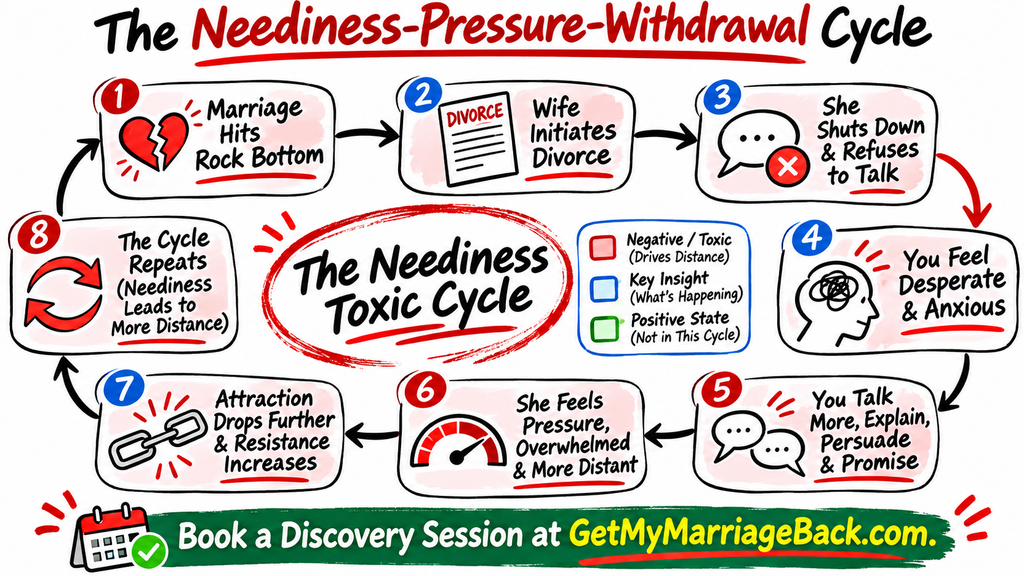
The neediness-pressure-withdrawal cycle
Imagine this sequence.
Your wife becomes emotionally distant.
You experience anxiety because you’re afraid of losing your marriage.
To relieve that anxiety, you initiate another conversation about reconciliation.
She withdraws because she doesn’t want another emotionally demanding discussion.
Her withdrawal intensifies your fear.
You respond with more explanations, promises, reassurance-seeking, or arguments.
Eventually, both of you become increasingly frustrated.
Your attempt to eliminate emotional distance has become part of the pattern maintaining it.
This doesn’t mean you’re responsible for every problem in the marriage.
It means you have identified a behavior within your control.
And changing that behavior gives you an opportunity to change the quality of your interactions.
4. Why Saying “I Don’t Need You” Still Communicates Neediness
Some husbands hear the word neediness and immediately swing to the opposite extreme.
They announce:
“I don’t need you.”
“I don’t care anymore.”
“You can leave if you want.”
They believe those declarations communicate strength.
But examine the motivation.
Are you genuinely comfortable with your independence, or are you hoping your wife becomes frightened of losing you?
Are you expressing a healthy boundary, or trying to provoke an emotional reaction?
If your behavior is designed primarily to make her chase you, you’re still depending on her reaction.
You’ve simply changed the presentation.
Real emotional independence doesn’t require an announcement.
It becomes visible through your decisions, emotional regulation, and consistency.
You can genuinely want your wife back without making her responsible for your emotional stability.
You can acknowledge the seriousness of divorce without begging her to reconsider.
And you can remain committed to reconciliation while recognizing that you cannot control another person’s decision.
That combination is a far stronger expression of personal capacity than pretending not to care.
5. Attraction Is Influenced by What Your Wife Experiences, Not Just What You Say
When attraction has declined, explanations about your goodness or intentions have limited power.
You can repeatedly tell your wife that you’re responsible, loyal, loving, and committed.
But those statements don’t automatically change the emotional experience she associates with interacting with you.
This is why I distinguish between moral worth and experiential value.
Your worth as a human being isn’t determined by whether your wife desires you.
Experiential value concerns what another person experiences in your presence.
Are your interactions consistently tense and demanding?
Does every conversation become an attempt to obtain reassurance?
Or are you becoming someone who can remain emotionally grounded, engaging, responsible, and genuinely interested without demanding an immediate reward?
These distinctions matter because attraction involves emotional experience, not merely intellectual agreement.
Seduction isn’t emotional manipulation
Building attraction skillfully doesn’t mean creating jealousy, withholding affection as punishment, or pretending to be unavailable.
Those behaviors keep your attention centered on controlling your wife’s reactions.
Genuine romantic appeal is expressed through emotional steadiness, confidence, self-respect, social awareness, and a life with meaningful direction.
You can communicate interest without turning that interest into pressure.
You can maintain warmth without begging for affection.
And you can respect someone’s autonomy without abandoning your own desires.
That’s the difference between dignity-based pursuit and fear-driven chasing.
Attraction cannot be commanded, but you can become more intentional about the experience your behavior creates.
6. What to Do When Your Wife Wants a Divorce: Start With Your Response
I helped a client whose wife had initiated divorce proceedings.
He wanted his marriage restored, and he deeply wanted their three daughters growing up in a two-parent household.
His wife had stopped engaging in conversations about saving the marriage.
Seven months after the divorce proceedings began, his marriage was saved.
That experience reinforces something I also learned while navigating my own marriage crisis.
Your response to the crisis matters.
You cannot force another person to feel attraction or choose reconciliation.
But you can influence the interactions in which you participate.
You can stop making fear the driving force behind your decisions.
And you can begin developing the emotional capacity to respond differently.
Grounding: Stop allowing fear to dictate your behavior
Grounding means reconnecting with your higher self, your values, and the reality of your situation.
It doesn’t mean pretending the divorce threat doesn’t hurt.
Instead, you acknowledge the pain without allowing it to control your next interaction.
Before sending another emotional message, recognize what you’re trying to accomplish.
Are you communicating something necessary?
Or are you trying to escape the discomfort of uncertainty?
That distinction alone can interrupt a destructive reaction.
Purpose: Build a life larger than the crisis
Your marriage matters.
Your wife matters.
Your children matter.
But your entire identity cannot depend on one relationship outcome.
Purpose means reconnecting with the responsibilities, aspirations, contributions, and legacy that give your life direction.
Continue showing up for your children. Maintain your commitments. Invest in your personal development, health, and meaningful work.
These aren’t performances designed to impress your wife.
They are expressions of the person you choose to become.
Self-Discovery: Recognize the capacity you already possess
A marriage crisis exposes emotional habits that everyday life can conceal.
You discover how you respond to rejection, uncertainty, conflict, and perceived abandonment.
Instead of condemning yourself for those reactions, examine them.
What consistently triggers your need for reassurance?
Which situations cause you to abandon your boundaries?
What behaviors have you repeated despite seeing that they increase tension?
Self-discovery allows you to recognize those patterns and develop stronger responses.
Together, Grounding, Purpose, and Self-Discovery form the foundation of the GPS5 approach I teach.
From that foundation, you can develop experiential value that creates opportunities for curiosity, attraction, influence, and meaningful relationship change.
7. Saving Your Marriage Alone Doesn’t Mean Controlling Your Wife
You may have heard that saving a marriage always takes two people.
That statement describes an important part of the desired outcome: a restored marriage ultimately requires two people willing to participate.
But it doesn’t mean you must wait for your wife to cooperate before improving your own behavior.
You can begin changing the way you communicate.
You can stop escalating arguments.
You can develop emotional independence.
You can become more attentive to the effect of your words, timing, and body language.
And you can take responsibility for your own contribution to the relationship’s difficulties without accepting responsibility for every decision your wife makes.
This is what saving your marriage alone means at the beginning of the process.
It is individual self-leadership, not unilateral control over reconciliation.
Your shared history, family responsibilities, and ongoing interactions create opportunities for influence.
They do not give you ownership over your wife’s feelings or choices.
What about the children?
Wanting your children raised in a two-parent household is a meaningful desire.
But repeatedly invoking the children to pressure your wife into reconciliation can turn a legitimate concern into another emotionally demanding interaction.
Your children deserve responsible parenting regardless of the state of the marriage.
Demonstrate that responsibility through your behavior rather than using their future as an argument your wife must accept.
That distinction protects your dignity and keeps the children from becoming instruments in an adult conflict.
8. The Next Time Your Wife Shuts Down, Let Your Behavior Speak
Imagine your wife refuses another conversation about reconciliation.
Your instinct is to explain why the marriage deserves another chance.
Instead, recognize what has just happened.
She has communicated a boundary around that conversation.
You don’t need another speech.
Maintain a calm voice, relax your posture, and respect the immediate boundary.
Then return to a meaningful responsibility without sulking, threatening, or performing indifference.
Don’t use silence as punishment.
Don’t pretend you no longer care.
And don’t spend the next several hours monitoring whether your wife noticed your restraint.
The goal is not to make her react. The goal is to stop making your emotional stability dependent on her reaction.
This is how you begin changing the message communicated through your behavior.
One calm response will not automatically repair years of resentment, emotional disconnection, or lost attraction.
But repeatedly replacing pressure with emotional steadiness changes the behavior you bring into the marriage.
And that is a meaningful starting point.
The Truth About Saving Your Marriage When Your Wife Wants Divorce
Your wife may have initiated divorce.
She may refuse to discuss reconciliation.
She may no longer respond to affection, promises, or explanations the way she once did.
Those realities are painful, particularly when you still want the marriage and family you’ve built.
But desperation is not the same as effective action.
Neediness can turn genuine love into pressure when you repeatedly seek reassurance from someone who is withdrawing.
Emotional independence allows you to communicate your desire for reconciliation without demanding that your wife immediately validate it.
Your wife is responsible for her choices.
You are responsible for yours.
And when you stop trying to control her response, you can finally direct your energy toward developing the emotional intelligence, personal capacity, and experiential value that have been missing from your approach.
You don’t have to stop wanting your wife back. You have to stop allowing the fear of losing her to determine how you behave.
5 Physical Signs She Just Slept With Someone Else: The Truth
Frequently Asked Questions
Stop repeatedly trying to convince her and examine the relationship patterns that preceded the divorce decision. Focus on your emotional regulation, responsibilities, and behaviors while respecting her autonomy and taking necessary practical steps.
You can begin changing your contribution to the relationship even when your wife refuses reconciliation conversations. Whether the marriage is ultimately restored also depends on her willingness to participate.
She may associate those conversations with pressure, unresolved conflict, emotional overwhelm, or a decision she doesn’t want to revisit. Observe whether she avoids all communication or specifically withdraws when reconciliation becomes the subject.
Begin by understanding what contributed to the breakdown rather than relying on promises, arguments, or emotional appeals. Develop consistent, emotionally intelligent behavior that reduces unnecessary pressure and allows any renewed connection to develop voluntarily.