
What Would Help You Most Right Now?

Choose the option that best matches where you are with your marriage.

I Need Personalized Help

My Marriage Is in Serious Trouble

If you're dealing with separation, divorce, loss of attraction, infidelity, intimacy problems, or a spouse who's pulling away, get help looking at what's happening in your specific situation.

Get Personalized Help โ†’
Get My Marriage Back book cover
I'd Rather Learn What to Do First

Start With Get My Marriage Back

Get the book and start learning the principles for moving your marriage in a better direction.

Get the Free Book โ†’

What to Do When Your Wife Wants a Divorce but Won’t Talk

Your wife wants a divorce, refuses to discuss your marriage, and every attempt to convince her to stay seems to push her further away.

Take This 2 Minutes Quiz

Question 1 of 15

You still love your wife. You want your marriage back, and you’re watching the family you worked so hard to build move toward separation.

Perhaps you have children together. You want them growing up in a two-parent household, and you cannot understand why your wife seems unwilling to fight for that future.

So you explain yourself.

You remind her about the good years. You promise to change. You tell her how much you love her and why divorce would be a terrible mistake.

But instead of getting closer, she becomes colder.

She stops responding to your messages, avoids conversations about reconciliation, or tells you to stop talking about the marriage altogether.

Here’s what you need to understand: your desperation to save your marriage can communicate neediness, and that neediness can increase the very emotional distance you’re trying to eliminate.

The problem isn’t necessarily that you haven’t found the right words.

It’s that your behavior may be communicating something completely different from what you’re saying.

And that distinction changes how you approach saving your marriage.

1. Your Wife Wants a Divorce, but the Divorce Isn’t the Whole Story

When your wife initiates divorce, you’re naturally focused on the immediate crisis.

You want to stop the divorce proceedings. You want her to reconsider. You want to understand what happened to the woman who once wanted to spend her life with you.

But divorce is often the tipping point of a much longer story.

Consider the sequence that may have preceded her decision:

  • Small disappointments accumulated without resolution.
  • Ordinary disagreements gradually became exhausting arguments.
  • Affection and sexual attraction declined.
  • Emotional conversations started feeling repetitive or pointless.
  • Your wife began withdrawing from activities you previously enjoyed together.
  • One or both of you stopped expecting meaningful change.

You may have been busy doing everything you believed a responsible husband should do.

Working. Paying bills. Raising children. Maintaining the household. Making sacrifices for your family’s future.

Those responsibilities matter.

But being a good person doesn’t automatically maintain romantic attraction.

Your moral character, financial contributions, and commitment to your children are important foundations. They are not substitutes for emotional connection, attraction, and the quality of everyday interactions.

Many husbands don’t recognize how serious the emotional deterioration has become until their marriage reaches rock bottom.

By then, they’re attempting to solve several years of accumulated problems in one conversation.

That’s why I want you to examine the history instead of obsessing exclusively over the divorce filing.

When did your wife stop initiating affection? When did she begin avoiding difficult conversations? What changed in the emotional atmosphere before she mentioned divorce?

The answers help you distinguish the crisis that finally became visible from the patterns that developed beforehand.

what to do when your wife wants a divorce

2. When Your Wife Refuses to Talk, Her Silence Is Already Communication

Your wife says, “I don’t want to talk about our marriage anymore.”

You interpret that as a communication failure.

So you try to communicate more.

You explain your intentions, defend your character, promise improvements, and remind her about the children.

But you’re overlooking an important distinction.

Communication is not always talking.

Her refusal to continue the conversation communicates that she does not want that particular interaction at that moment.

It doesn’t automatically prove she has stopped loving you. It doesn’t establish that reconciliation is impossible or that divorce is the correct decision.

Neither does it excuse her from the responsibilities associated with marriage and parenthood.

However, you’re the person actively trying to save the marriage.

Your immediate strategy cannot depend on forcing her to behave the way you believe a married adult should behave.

You must begin with the reality in front of you.

Is she avoiding all communication or only marriage conversations?

Pay attention to this distinction.

Your wife may communicate normally about the children, household responsibilities, schedules, and financial matters.

But the moment you mention reconciliation, affection, romance, or your relationship’s future, she becomes defensive or shuts down.

That tells you something useful.

The problem may not be communication in general.

The marriage conversation itself has become associated with emotional pressure.

Another possibility is that she feels overwhelmed, resentful, or convinced that previous discussions produced no meaningful change.

Research on relationship conflict identifies a phenomenon called emotional flooding, in which overwhelming emotional arousal interferes with a person’s ability to remain engaged in difficult conversations. A published study of emotional flooding and conflict behaviors examines how demanding and withdrawing during relationship conflict can become part of a destructive interaction pattern.

That research does not establish what your wife is experiencing.

It does reinforce an important distinction: increasing the intensity of a conversation is not necessarily the same as improving communication.

You need to observe the interaction before deciding what her silence means.
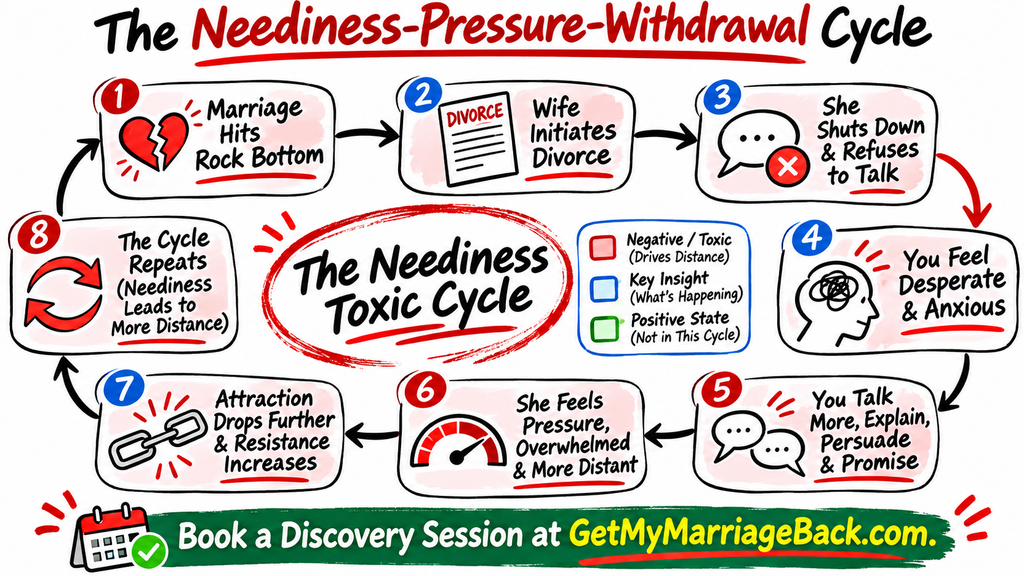
what to do when your wife wants a divorce - the neediness-pressure-withdrawal cycle

3. Your Desperation to Save Your Marriage Can Become Neediness

This is where many husbands unintentionally make their marriage crisis worse.

You desperately want your wife back.

There’s nothing inherently wrong with that desire.

Wanting reconciliation doesn’t make you weak, and caring about your family doesn’t make you needy.

Neediness begins when your emotional stability becomes dependent on your wife’s immediate reassurance, affection, or approval.

That dependence can appear in behaviors you believe demonstrate commitment.

For example:

  • You repeatedly ask whether she still loves you.
  • You monitor her facial expressions for signs of renewed attraction.
  • You send long messages explaining your feelings.
  • You constantly seek confirmation that reconciliation remains possible.
  • You announce improvements and expect immediate recognition.
  • You interpret every delayed response as another rejection.
  • You reopen marriage conversations after she has clearly declined them.

The more anxious you become, the harder you try.

And the harder you try, the more pressure she may experience.

The neediness-pressure-withdrawal cycle

Imagine this sequence.

Your wife becomes emotionally distant.

You experience anxiety because you’re afraid of losing your marriage.

To relieve that anxiety, you initiate another conversation about reconciliation.

She withdraws because she doesn’t want another emotionally demanding discussion.

Her withdrawal intensifies your fear.

You respond with more explanations, promises, reassurance-seeking, or arguments.

Eventually, both of you become increasingly frustrated.

Your attempt to eliminate emotional distance has become part of the pattern maintaining it.

This doesn’t mean you’re responsible for every problem in the marriage.

It means you have identified a behavior within your control.

And changing that behavior gives you an opportunity to change the quality of your interactions.

4. Why Saying “I Don’t Need You” Still Communicates Neediness

Some husbands hear the word neediness and immediately swing to the opposite extreme.

They announce:

“I don’t need you.”

“I don’t care anymore.”

“You can leave if you want.”

They believe those declarations communicate strength.

But examine the motivation.

Are you genuinely comfortable with your independence, or are you hoping your wife becomes frightened of losing you?

Are you expressing a healthy boundary, or trying to provoke an emotional reaction?

If your behavior is designed primarily to make her chase you, you’re still depending on her reaction.

You’ve simply changed the presentation.

Real emotional independence doesn’t require an announcement.

It becomes visible through your decisions, emotional regulation, and consistency.

You can genuinely want your wife back without making her responsible for your emotional stability.

You can acknowledge the seriousness of divorce without begging her to reconsider.

And you can remain committed to reconciliation while recognizing that you cannot control another person’s decision.

That combination is a far stronger expression of personal capacity than pretending not to care.

5. Attraction Is Influenced by What Your Wife Experiences, Not Just What You Say

When attraction has declined, explanations about your goodness or intentions have limited power.

You can repeatedly tell your wife that you’re responsible, loyal, loving, and committed.

But those statements don’t automatically change the emotional experience she associates with interacting with you.

This is why I distinguish between moral worth and experiential value.

Your worth as a human being isn’t determined by whether your wife desires you.

Experiential value concerns what another person experiences in your presence.

Are your interactions consistently tense and demanding?

Does every conversation become an attempt to obtain reassurance?

Or are you becoming someone who can remain emotionally grounded, engaging, responsible, and genuinely interested without demanding an immediate reward?

These distinctions matter because attraction involves emotional experience, not merely intellectual agreement.

Seduction isn’t emotional manipulation

Building attraction skillfully doesn’t mean creating jealousy, withholding affection as punishment, or pretending to be unavailable.

Those behaviors keep your attention centered on controlling your wife’s reactions.

Genuine romantic appeal is expressed through emotional steadiness, confidence, self-respect, social awareness, and a life with meaningful direction.

You can communicate interest without turning that interest into pressure.

You can maintain warmth without begging for affection.

And you can respect someone’s autonomy without abandoning your own desires.

That’s the difference between dignity-based pursuit and fear-driven chasing.

Attraction cannot be commanded, but you can become more intentional about the experience your behavior creates.

6. What to Do When Your Wife Wants a Divorce: Start With Your Response

I helped a client whose wife had initiated divorce proceedings.

He wanted his marriage restored, and he deeply wanted their three daughters growing up in a two-parent household.

His wife had stopped engaging in conversations about saving the marriage.

Seven months after the divorce proceedings began, his marriage was saved.

That experience reinforces something I also learned while navigating my own marriage crisis.

Your response to the crisis matters.

You cannot force another person to feel attraction or choose reconciliation.

But you can influence the interactions in which you participate.

You can stop making fear the driving force behind your decisions.

And you can begin developing the emotional capacity to respond differently.

Grounding: Stop allowing fear to dictate your behavior

Grounding means reconnecting with your higher self, your values, and the reality of your situation.

It doesn’t mean pretending the divorce threat doesn’t hurt.

Instead, you acknowledge the pain without allowing it to control your next interaction.

Before sending another emotional message, recognize what you’re trying to accomplish.

Are you communicating something necessary?

Or are you trying to escape the discomfort of uncertainty?

That distinction alone can interrupt a destructive reaction.

Purpose: Build a life larger than the crisis

Your marriage matters.

Your wife matters.

Your children matter.

But your entire identity cannot depend on one relationship outcome.

Purpose means reconnecting with the responsibilities, aspirations, contributions, and legacy that give your life direction.

Continue showing up for your children. Maintain your commitments. Invest in your personal development, health, and meaningful work.

These aren’t performances designed to impress your wife.

They are expressions of the person you choose to become.

Self-Discovery: Recognize the capacity you already possess

A marriage crisis exposes emotional habits that everyday life can conceal.

You discover how you respond to rejection, uncertainty, conflict, and perceived abandonment.

Instead of condemning yourself for those reactions, examine them.

What consistently triggers your need for reassurance?

Which situations cause you to abandon your boundaries?

What behaviors have you repeated despite seeing that they increase tension?

Self-discovery allows you to recognize those patterns and develop stronger responses.

Together, Grounding, Purpose, and Self-Discovery form the foundation of the GPS5 approach I teach.

From that foundation, you can develop experiential value that creates opportunities for curiosity, attraction, influence, and meaningful relationship change.

7. Saving Your Marriage Alone Doesn’t Mean Controlling Your Wife

You may have heard that saving a marriage always takes two people.

That statement describes an important part of the desired outcome: a restored marriage ultimately requires two people willing to participate.

But it doesn’t mean you must wait for your wife to cooperate before improving your own behavior.

You can begin changing the way you communicate.

You can stop escalating arguments.

You can develop emotional independence.

You can become more attentive to the effect of your words, timing, and body language.

And you can take responsibility for your own contribution to the relationship’s difficulties without accepting responsibility for every decision your wife makes.

This is what saving your marriage alone means at the beginning of the process.

It is individual self-leadership, not unilateral control over reconciliation.

Your shared history, family responsibilities, and ongoing interactions create opportunities for influence.

They do not give you ownership over your wife’s feelings or choices.

What about the children?

Wanting your children raised in a two-parent household is a meaningful desire.

But repeatedly invoking the children to pressure your wife into reconciliation can turn a legitimate concern into another emotionally demanding interaction.

Your children deserve responsible parenting regardless of the state of the marriage.

Demonstrate that responsibility through your behavior rather than using their future as an argument your wife must accept.

That distinction protects your dignity and keeps the children from becoming instruments in an adult conflict.

8. The Next Time Your Wife Shuts Down, Let Your Behavior Speak

Imagine your wife refuses another conversation about reconciliation.

Your instinct is to explain why the marriage deserves another chance.

Instead, recognize what has just happened.

She has communicated a boundary around that conversation.

You don’t need another speech.

Maintain a calm voice, relax your posture, and respect the immediate boundary.

Then return to a meaningful responsibility without sulking, threatening, or performing indifference.

Don’t use silence as punishment.

Don’t pretend you no longer care.

And don’t spend the next several hours monitoring whether your wife noticed your restraint.

The goal is not to make her react. The goal is to stop making your emotional stability dependent on her reaction.

This is how you begin changing the message communicated through your behavior.

One calm response will not automatically repair years of resentment, emotional disconnection, or lost attraction.

But repeatedly replacing pressure with emotional steadiness changes the behavior you bring into the marriage.

And that is a meaningful starting point.

The Truth About Saving Your Marriage When Your Wife Wants Divorce

Your wife may have initiated divorce.

She may refuse to discuss reconciliation.

She may no longer respond to affection, promises, or explanations the way she once did.

Those realities are painful, particularly when you still want the marriage and family you’ve built.

But desperation is not the same as effective action.

Neediness can turn genuine love into pressure when you repeatedly seek reassurance from someone who is withdrawing.

Emotional independence allows you to communicate your desire for reconciliation without demanding that your wife immediately validate it.

Your wife is responsible for her choices.

You are responsible for yours.

And when you stop trying to control her response, you can finally direct your energy toward developing the emotional intelligence, personal capacity, and experiential value that have been missing from your approach.

You don’t have to stop wanting your wife back. You have to stop allowing the fear of losing her to determine how you behave.

5 Physical Signs She Just Slept With Someone Else: The Truth

Frequently Asked Questions

What should I do when my wife wants a divorce but I don’t?

Stop repeatedly trying to convince her and examine the relationship patterns that preceded the divorce decision. Focus on your emotional regulation, responsibilities, and behaviors while respecting her autonomy and taking necessary practical steps.

Can I save my marriage if my wife refuses to talk to me?

You can begin changing your contribution to the relationship even when your wife refuses reconciliation conversations. Whether the marriage is ultimately restored also depends on her willingness to participate.

Why does my wife shut down when I try to talk about our marriage?

She may associate those conversations with pressure, unresolved conflict, emotional overwhelm, or a decision she doesn’t want to revisit. Observe whether she avoids all communication or specifically withdraws when reconciliation becomes the subject.

How do I get my wife back after she files for divorce?

Begin by understanding what contributed to the breakdown rather than relying on promises, arguments, or emotional appeals. Develop consistent, emotionally intelligent behavior that reduces unnecessary pressure and allows any renewed connection to develop voluntarily.


Wife Wants to Separate? 4 Signs Her Distance Could Become Divorce

Your wife wants to separate, and the most frightening part isn’t the word separationโ€”it’s watching her gradually build a life that seems to have less and less room for you.

Take This 2 Minutes Quiz

Question 1 of 15

Maybe she stopped initiating sex months ago. Affection became inconsistent, conversations grew tense, and now she wants more personal space.

Her career, finances, friendships, and future plans increasingly seem to operate independently of your marriage.

You still love your wife. You want to understand what’s happening, but every attempt to get reassurance seems to push her further away.

Here’s the distinction I want you to understand:

Your wife’s independence doesn’t automatically mean she’s leaving your marriage. But temporary emotional distance can become permanent when the patterns surrounding it continue.

Understanding those patterns is the beginning of responding with emotional intelligence rather than fear.

Why Does My Wife Want to Separate When We’re Still Married?

When a wife wants to separate, her husband often assumes she’s already made a final decision.

That’s understandable, especially when the separation request follows months of sexual rejection, reduced affection, and emotional withdrawal.

However, wanting independence and deciding to divorce are not identical.

Your wife might be experiencing several competing emotions:

  • She feels overwhelmed by the demands of marriage, work, or family.
  • She wants more control over her personal decisions.
  • She has unresolved resentment toward you.
  • She misses the independence she experienced before marriage.
  • She is uncertain whether she still feels romantic attraction.
  • She has begun imagining what life would look like without the relationship.

These possibilities can overlap.

A woman can feel overwhelmed and emotionally detached at the same time. She can want space without knowing whether she wants divorce.

The mistake is assuming that one explanation automatically eliminates every other possibility.

I want you to recognize the difference between what your wife has actually communicated and what your anxiety is telling you her behavior means.

That distinction matters because your interpretation influences your next move.

wife wants to separate

When Your Wife Starts Acting Single While Still Married

Consider a marriage where physical intimacy has gradually disappeared.

The husband notices that his wife rarely initiates affection. Sometimes she compares him to other husbands, mentioning what her friends’ spouses are doing differently.

He begins questioning whether she’s still attracted to him.

Meanwhile, she’s experiencing perimenopause, financial pressure, and uncertainty about her career.

Her stress is real. His frustration is also real.

Then the relationship changes again.

She wants more independence, spends less time with him, and becomes increasingly focused on her own plans.

Eventually, she mentions separation.

What began as a concern about sex has become a much bigger question:

Is she trying to rediscover herself, or is she discovering that she prefers a life without her husband?

This is where many distressed spouses make a costly mistake.

They begin interpreting every independent decision as evidence of rejection.

A career opportunity becomes proof that she’s planning to leave. Spending time with friends becomes suspicious, and her desire for privacy starts looking like a secret divorce strategy.

You cannot understand the direction of your marriage by investigating isolated behaviors.

Instead, examine the relationship patterns surrounding those behaviors.

wife wants to separate emotional distance signs

4 Signs Your Wife’s Emotional Distance Could Be Becoming Permanent

1. Her Independence Is Replacing Your Shared Future

Healthy independence and marital commitment can coexist.

Your wife can pursue career opportunities, develop friendships, manage finances, and maintain personal interests while remaining emotionally invested in the marriage.

The concern begins when independence consistently replaces partnership.

Perhaps she no longer includes you in important discussions. Shared plans become increasingly rare, and conversations about the future focus almost entirely on her individual life.

Notice the distinction.

Having separate interests isn’t emotional abandonment.

However, consistently excluding the marriage from major future decisions can indicate a deeper change in how she understands the relationship.

Ask yourself whether she still demonstrates interest in building anything together.

Does she occasionally initiate meaningful conversations? Is she willing to discuss shared responsibilities or consider your perspective when decisions affect both of you?

A spouse who needs breathing room may still preserve a sense of partnership.

Growing detachment becomes more concerning when that shared identity repeatedly disappears.

2. Physical Withdrawal Is Becoming Emotional Withdrawal

A wife who stops initiating sex isn’t automatically preparing for divorce.

Sexual desire is influenced by physical health, emotional stress, relationship satisfaction, and hormonal changes.

Perimenopause, for example, can affect sleep, mood, comfort during intimacy, and sexual desire.

That context matters.

Nevertheless, a marriage can experience more than a temporary reduction in sexual activity.

Perhaps your wife no longer initiates affection, avoids meaningful conversations, and shows little curiosity about your emotional experience.

Now the issue extends beyond sex.

You’re experiencing a broader loss of connection.

Sexual rejection and emotional detachment are related concerns, but they are not interchangeable.

A wife can have reduced sexual desire while still feeling deeply connected to her husband.

Conversely, physical intimacy can occasionally continue even when emotional investment has weakened.

Rather than treating sex as the only measurement of attraction, pay attention to warmth, openness, curiosity, affection, and the overall quality of your interactions.

These provide a more complete picture of your marriage.

3. She Seems Increasingly Comfortable Imagining Life Without You

One of the most unsettling experiences in marriage separation is watching your spouse become comfortable with the idea of living independently.

She might talk about where she would live, how she would manage her finances, or what her daily routine might look like.

Sometimes these conversations are practical preparations.

Other times, they are expressions of frustration, uncertainty, or a desire to escape emotional pressure.

The important distinction is between imagining an alternative and making a definite decision.

A fantasy about independence isn’t the same as filing for divorce.

However, repeatedly imagining a future without the marriage can gradually make that future feel more familiar.

You should take explicit separation plans seriously without treating every hypothetical statement as a final decision.

Pay attention to what she communicates consistently, what practical steps she takes, and whether she remains willing to discuss the relationship.

Your objective isn’t to police her imagination.

It’s to understand the actual direction of the marriage.

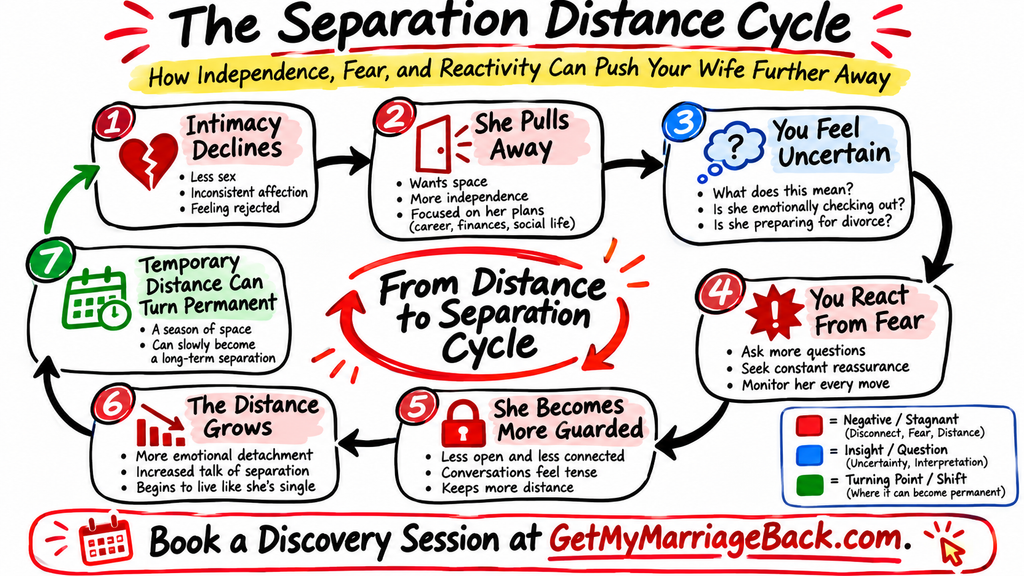
4. Your Conversations Are Becoming a Pursuit-and-Withdrawal Cycle

This is one of the most important signs because it involves something you can directly influence.

Your wife pulls away.

You feel anxious and begin asking questions.

Does she still love you? Is there another man? Does she want a divorce? Why doesn’t she want to spend time with you?

You’re looking for reassurance.

But she experiences the repeated questioning as pressure and becomes more guarded.

Her withdrawal increases your suspicion, so you ask even more questions.

Now both of you are contributing to an escalating cycle.

Relationship researchers call this a demand-withdraw pattern.

In a study involving 55 couples, researchers observed connections between one partner’s demanding behavior, the other’s withdrawal, and their emotional reactions during conflict.

The research on demand-withdraw behavior helps explain why repeated pursuit and emotional withdrawal can reinforce each other rather than resolve the underlying disagreement.

Here’s what I want you to recognize:

The more you pursue reassurance through pressure, the more threatening ordinary conversations can become.

This pattern isn’t limited to husbands pursuing wives. Either spouse can occupy either role.

When fear begins directing your communication, even reasonable questions can become part of an unhealthy interaction.

Breaking that pattern requires more than finding better words.

It requires developing a different emotional response.

Bad Signs During Separation: What Actually Deserves Your Attention?

When your wife wants to separate, it’s tempting to search for definitive signs that she’s never coming back.

But no single behavior can tell you everything about another person’s intentions.

Look for repeated patterns rather than isolated moments.

Some developments deserve particular attention:

  • She explicitly communicates that she no longer wants the marriage.
  • She consistently avoids discussions about shared responsibilities or the relationship’s future.
  • She begins making concrete plans for a separate household.
  • She shows sustained disinterest in repairing unresolved conflicts.
  • She establishes financial or legal arrangements for separation.
  • She repeatedly describes the relationship as something she no longer wants to participate in.

These are more consequential than whether she went out with friends or seemed emotionally distant after a difficult day.

At the same time, don’t confuse a calm separation with a successful reconciliation.

Reduced conflict can mean that emotional pressure has decreased.

It can also mean that one spouse has stopped engaging.

The meaning depends on the larger pattern.

Can You Save Your Marriage While Separated?

Marriage reconciliation begins with understanding the difference between influence and control.

You cannot force your wife to feel attraction.

Neither can you argue her into emotional intimacy or persuade her to experience desire through repeated explanations.

However, your behavior still influences the emotional environment of the relationship.

You can change how you communicate, manage anxiety, maintain boundaries, and show up in difficult conversations.

Those changes matter because attraction isn’t only about physical appearance.

Romantic attraction can also involve emotional safety, curiosity, confidence, warmth, respect, and the experience of being with someone who has a meaningful life.

When your entire identity becomes centered on whether your wife still wants you, your interactions can become dominated by insecurity.

You stop relating to her as a complete person and begin treating every conversation as a test of whether you’re still desirable.

That pressure rarely creates the emotional atmosphere you’re seeking.

Building attraction requires becoming someone who can offer connection without demanding constant validation in return.

This isn’t about pretending you don’t care.

It’s about caring without allowing desperation to determine your behavior.

How to Rebuild Attraction When Your Wife Wants Space

Stop Turning Every Interaction Into a Marriage Status Report

Your wife already knows you’re concerned about the relationship.

Repeating the same questions every evening doesn’t necessarily create more clarity.

Sometimes it creates emotional exhaustion.

There is a difference between having an intentional conversation about the marriage and repeatedly asking your spouse to regulate your anxiety.

You can express your desire to reconcile while respecting her need for space.

For example:

“I care about our marriage, and I’m interested in understanding what has changed between us. I also recognize that repeating the same conversation under pressure isn’t helping either of us.”

That statement communicates commitment without demanding an immediate declaration of love.

Then allow your behavior to support your words.

Replace Emotional Pursuit With Emotional Presence

Emotional presence is different from emotional pursuit.

Pursuit driven by fear seeks immediate relief.

Presence involves remaining grounded enough to listen, communicate, and tolerate uncertainty without escalating the situation.

You don’t need to disappear to demonstrate independence.

Instead, develop the ability to participate in interactions without constantly trying to control their outcome.

Listen without preparing a defensive argument.

Acknowledge what your wife says without automatically agreeing with every interpretation.

Express your own feelings without using guilt to secure affection.

These skills make difficult conversations less threatening.

They also allow your personality, warmth, and confidence to become visible again.

Rebuild Your Personal Identity

One of the most damaging consequences of marriage anxiety is losing your sense of self.

Your mood begins depending on your wife’s behavior.

When she’s affectionate, you feel hopeful. When she’s distant, you feel defeated.

Eventually, your entire day revolves around interpreting her reactions.

That’s not the emotional foundation from which healthy attraction develops.

Reconnect with meaningful responsibilities, friendships, physical well-being, interests, and personal ambitions.

Develop a life that remains purposeful even during uncertainty.

This doesn’t mean acting single to provoke jealousy.

It means becoming emotionally grounded enough to remain yourself while navigating a difficult marriage.

Confidence becomes more compelling when it’s supported by consistent behavior rather than performed for attention.

Create Room for Curiosity and Natural Attraction

Attraction grows through experiences, not interrogation.

When every interaction centers on separation, rejection, or divorce, the relationship can become emotionally predictable.

Your wife may begin anticipating another difficult conversation before you even speak.

Changing that atmosphere requires patience and discernment.

Not every moment needs to become an opportunity to discuss the marriage.

Appropriate humor, shared interests, respectful conversation, and genuine curiosity can create a different emotional experience.

Don’t use kindness as a transaction.

Affection offered with the expectation of immediate reciprocation can become another form of pressure.

Instead, practice warmth because it reflects the person you’re choosing to become.

Respect physical and emotional boundaries, particularly when your wife has clearly requested space.

Seduction within marriage is most meaningful when it involves mutual desire, emotional responsiveness, and the freedom to choose connection.

The goal is to become more engaging and emotionally availableโ€”not to manufacture attraction through manipulation.

The GPS5 Approach to Saving Your Marriage Alone

When your spouse wants out, your first responsibility is to regain emotional direction.

I begin with three elements of the GPS5 framework: Grounding, Purpose, and Self-Discovery.

Grounding: Separate Facts From Fear

Grounding means learning to recognize what you actually know.

Your wife asking for space is a fact.

Concluding that she’s secretly preparing to divorce you may be an interpretation.

Her reduced interest in sex is observable.

Assuming that another man must be responsible is speculation unless you have evidence.

This distinction protects you from reacting to imagined threats as though they’re established realities.

Purpose: Stop Making Your Marriage Crisis Your Entire Identity

Your marriage matters.

However, your value as a person cannot depend entirely on your spouse’s current feelings.

Reconnect with the responsibilities and aspirations that give your life direction.

A grounded sense of purpose allows you to remain emotionally available without becoming dependent on constant reassurance.

It also makes your presence more stable and engaging.

Self-Discovery: Identify the Patterns You’re Bringing Into the Marriage

Ask yourself difficult questions.

Do you become controlling when you feel rejected?

Are you repeatedly demanding affection because you’re afraid of abandonment?

Have you neglected your own development while focusing entirely on your spouse?

Perhaps you withdraw, criticize, or become defensive when conversations don’t go your way.

Self-discovery requires recognizing these behaviors without making your spouse responsible for changing them.

The purpose isn’t to blame yourself for the entire marriage crisis.

It’s to identify the patterns within your control.

What About the 3 S’s: Skills, Support, and System?

Understanding your marriage intellectually is different from behaving differently when emotions become intense.

You might recognize the pursuit-and-withdrawal cycle today, then repeat it tomorrow when your wife declines an invitation or avoids a conversation.

That’s why personal transformation requires more than motivation.

Skills help you communicate, regulate emotions, establish boundaries, and respond constructively.

Support helps you examine blind spots and maintain perspective when fear distorts your judgment.

System means developing consistent habits rather than relying on occasional moments of clarity.

Together, these elements help turn emotional intelligence into repeatable behavior.

The objective is not to become indifferent to your wife.

It’s to become someone capable of handling uncertainty, rejection, and difficult conversations without abandoning personal dignity.

When Temporary Separation Starts Feeling Permanent

The most dangerous assumption is that time alone will solve the problem.

Sometimes space allows both spouses to recover from emotional exhaustion.

In other situations, prolonged distance becomes the new normal because the underlying issues remain unresolved.

That’s why you need to pay attention to the direction of the relationship.

Are conversations becoming less defensive?

Is there more mutual understanding?

Does either spouse demonstrate interest in addressing the problems that contributed to separation?

Are shared responsibilities being handled respectfully?

These questions reveal more than simply counting how many days you’ve spent apart.

Reconciliation is not measured by whether your wife sends an affectionate text.

It’s reflected in the development of a healthier relationship pattern.

You can contribute to that pattern even before your spouse decides what she wants.

The Truth About Your Wife Wanting to Separate

Your wife may be overwhelmed.

She may be emotionally detached.

She may be imagining an independent future without you.

Several of these things can be true simultaneously.

The important question isn’t whether you can decode every thought in her mind.

It’s whether you can recognize the patterns unfolding in your marriage and respond with emotional intelligence.

Fear encourages interrogation, suspicion, and emotional pursuit.

Grounded confidence allows you to maintain boundaries, communicate clearly, and remain open to connection without surrendering your identity.

Your wife’s independence isn’t automatically the end of your marriage. But the emotional patterns you continue during this season can influence what happens next.

And that is where your personal development becomes essential.

“I Feel Disgusted When My Husband Touches Me” – [5 Solutions]

Frequently Asked Questions

Why does my wife want to separate but not divorce?

She may want relief from conflict, personal independence, or time to evaluate the relationship without making a final decision. Her willingness to discuss the marriage and her practical plans provide more context than the separation request alone.

What are the signs my wife is not coming back after separation?

Consistent rejection of reconciliation, concrete divorce preparations, and sustained unwillingness to discuss a shared future are more concerning than temporary emotional distance. Look at repeated behavior and explicit communication rather than isolated incidents.

How do I win my wife back during separation?

Focus on emotional regulation, respectful communication, personal development, and addressing the relationship patterns that contributed to separation. Attraction and reconciliation require voluntary participation rather than pressure or constant reassurance-seeking.

Can a marriage be saved when only one spouse is trying?

One spouse can improve personal behavior, reduce destructive interaction patterns, and create better conditions for communication. Rebuilding a mutually committed marriage ultimately requires both spouses to participate.

How to Make Your Wife Fall in Love With You Again After Separation

Marriage separation is one of the most emotionally painful experiences a husband can face. The silence becomes louder than the arguments ever were.


Take This 2 Minutes Quiz

Question 1 of 15

Every hour feels like an opportunity slipping away, making it tempting to send another text, make another promise, or desperately search for the perfect words that will change her mind.

More Video on our YouTube Channel

Unfortunately, that instinct usually pushes her further away.

If you’re searching for how to make your wife fall in love with you again after separation, you need a completely different strategy than the one your emotions are telling you to use. Attraction rarely returns because someone begged hard enough. It returns when emotional safety, respect, curiosity, and trust begin replacing disappointment, pressure, and predictability.

The good news is that separation doesn’t automatically mean your marriage is over. For many couples, it becomes the wake-up call that exposes years of unhealthy emotional patterns. If approached correctly, separation can become the beginning of rebuildingโ€”not just savingโ€”the relationship.

Let’s discuss what actually works.

how to make your wife fall in love with you again after separation

Stop Trying to Convince Her

One of the biggest mistakes separated husbands make is believing that if they can just explain themselves one more time, she’ll understand.

They send:

  • Long emotional text messages
  • Endless apologies
  • Love letters
  • Promises they’ll never make the same mistakes
  • Constant requests to “just talk”

Here’s the reality:

You cannot negotiate attraction.

If she’s emotionally detached, more words rarely create more feelings. In many cases, they create more pressure.

When a wife has asked for space, repeatedly trying to force emotional conversations often confirms the very reasons she needed distance in the first place.

Instead of making her miss you, it makes her feel responsible for managing your emotions.

That is not attractive.


Accept That Something Had Been Breaking for a Long Time

Most marriages don’t suddenly collapse.

They slowly accumulate disappointment.

Before asking how to get your wife to fall in love again, honestly ask yourself:

  • What had she been complaining about?
  • What conversations did you keep avoiding?
  • Where did she stop feeling emotionally safe?
  • What patterns kept repeating?

Forget who’s right for a moment.

Focus on what was happening.

Whether her complaints were perfectly fair isn’t the first issue.

What matters is that she experienced enough pain to choose separation.

Until you understand that experience, you’ll keep solving the wrong problem.


Do a Brutally Honest Personal Inventory

This is where real leadership begins.

Write everything down without defending yourself.

Consider areas like:

Emotional Habits

Were you:

  • Defensive?
  • Easily triggered?
  • Emotionally unavailable?
  • Overly jealous?
  • Needy?
  • Dismissive?

Marriage Leadership

Did you:

  • Neglect quality time?
  • Stop dating your wife?
  • Become complacent?
  • Lose direction?
  • Make her carry all the emotional labor?

Lifestyle

Sometimes attraction suffers because life itself becomes stagnant.

Ask yourself:

  • Have I stopped taking care of my health?
  • Have I become financially irresponsible?
  • Have I become negative?
  • Have I lost ambition?
  • Have I allowed stress to become my identity?

Personal growth starts with radical honesty.

how to make your wife fall in love with you again after separation

During Separation, Space Is Not Your Enemy

Many husbands panic when their wife asks for distance.

Ironically…

Space is often what gives attraction room to breathe again.

If every interaction feels emotionally heavy, she never gets the opportunity to experience your absence.

Respecting her space communicates something powerful:

“I respect your boundaries, and I’m emotionally strong enough to handle discomfort without trying to control you.”

That kind of emotional composure creates far more curiosity than constant pursuit.


Replace Desperation With Calm Confidence

Confidence isn’t something you announce.

It’s something people observe.

Your wife doesn’t need another speech about how you’ve changed.

She needs to experience someone different.

That means:

  • Staying calm during difficult conversations.
  • Handling disagreements without becoming reactive.
  • Respecting boundaries without resentment.
  • Living a productive life whether she notices immediately or not.

Real confidence never asks for validation.

It simply becomes visible over time.


Show Change Instead of Talking About It

One of the quickest ways to destroy credibility is repeatedly saying:

“I’ve changed.”

If she can’t see it consistently, those words lose value.

Instead, quietly demonstrate change.

Maybe you’ve:

  • Started exercising consistently.
  • Become more emotionally regulated.
  • Improved your financial discipline.
  • Developed healthier friendships.
  • Deepened your spiritual life.
  • Become a better father.

None of these should be performed to impress her.

They’re investments in becoming the kind of man who naturally attracts respect and trust.

People believe what they repeatedly observeโ€”not what they’re repeatedly told.

communication - how to make your wife fall in love with you again after separation

Keep Communication Calm, Brief, and Purposeful

If you’re co-parenting or handling shared responsibilities, communication is unavoidable.

Use that opportunity wisely.

Good communication during separation is:

  • Respectful
  • Friendly
  • Brief
  • Solution-focused
  • Emotionally steady

Avoid turning every logistical conversation into a relationship discussion.

For example:

Instead of:

“Can we talk about us?”

Focus on:

“I’ll pick up the kids at 5 PM. Let me know if anything changes.”

This lowers emotional pressure while rebuilding trust through consistency.


Stop Trying to Manage Her Feelings

Many husbands unknowingly become emotional managers.

They constantly ask:

  • “Are you okay?”
  • “Do you still love me?”
  • “Where is this going?”
  • “Have you made a decision?”

These questions usually come from anxietyโ€”not leadership.

When someone feels emotionally pressured, they often withdraw even further.

Allow her emotions to belong to her.

Your responsibility is managing yours.

That emotional independence is surprisingly attractive.

Wife Says Marriage Is Over? 7 Ways to Rebuild Attraction


Become Someone She Can Become Curious About Again

Attraction requires mystery.

Not manipulation.

Not games.

Just growth.

If every day looks exactly like the last five years, there’s nothing emotionally new to discover.

Curiosity grows when she begins noticing changes she wasn’t expecting.

Maybe you’re:

  • More emotionally grounded.
  • More patient.
  • Less reactive.
  • More disciplined.
  • More fulfilled.
  • More peaceful.

When someone changes from the inside out, other people naturally become curious.

Curiosity often opens doors that persuasion never could.


Build a Life Bigger Than the Marriage Crisis

This may sound counterintuitive.

One of the healthiest ways to save your marriage is to stop making your marriage your only purpose.

Develop a meaningful life that includes:

  • Faith and spiritual growth
  • Physical health
  • Professional excellence
  • Friendships
  • Personal goals
  • Serving others
  • Learning new skills

A purpose-driven man carries different emotional energy.

Instead of constantly needing reassurance, he becomes someone who contributes value wherever he goes.

Ironically, that makes reconnecting much more likely than making your entire identity dependent on reconciliation.

Your Wife Has Filed for Divorce: 3 Mistakes


Apologize Onceโ€”Then Let Your Actions Speak

Some husbands never apologize.

Others apologize every week.

Neither extreme is effective.

A sincere apology is simple.

Take responsibility for your contribution to the breakdown of the relationship without defending yourself or expecting immediate forgiveness.

For example:

“I recognize the ways I contributed to where we are today. I’m genuinely sorry for my part in that. I’m committed to becoming a better husband and a better man regardless of how long that takes.”

After that…

Stop trying to convince her.

Your daily actions become the apology.

5 Tips to Stop Divorce after Separation📍⁉️ ❤️


Patience Is Part of the Attraction Process

One of the hardest lessons during separation is understanding that emotional healing rarely follows your timeline.

If trust eroded over years, it usually isn’t rebuilt in weeks.

Patience isn’t passive.

It’s active self-development while allowing genuine change to accumulate over time.

The husbands who rebuild strong marriages aren’t usually the ones who chased hardest.

They’re the ones who became emotionally stronger while giving trust enough time to grow again.

You Wife Doesn’t Desire Me Anymore? CHECK THIS OUT


Avoid These Attraction Killers During Separation

If your goal is rebuilding attraction, avoid these common mistakes:

  • Constantly checking on her feelings.
  • Sending emotional novels through text.
  • Showing up uninvited.
  • Monitoring her social media.
  • Trying to make her jealous.
  • Using guilt to gain sympathy.
  • Arguing over who’s right.
  • Begging for another chance.
  • Becoming emotionally unpredictable.
  • Making promises you haven’t yet demonstrated.

Every one of these behaviors communicates insecurity instead of strength.

Save Your Marriage While Separated Without Destroying Attraction


Focus on Becoming the Man She Can Respect Again

Love and attraction often grow where respect exists.

Respect grows when your words and actions consistently align.

That means becoming:

  • Emotionally intelligent instead of emotionally reactive.
  • Purpose-driven instead of approval-driven.
  • Patient instead of impulsive.
  • Confident instead of controlling.
  • Self-aware instead of defensive.

Whether your marriage ultimately reconciles or not, these changes improve every area of your life.

Ironically, that’s exactly why they become attractive.

โ€œDoes My Wife MISS ME During SEPARATION?โ€


So how do you make your wife fall in love with you again after separation.

Stop trying to manufacture feelings and start becoming someone capable of sustaining a healthier marriage.

Respect her need for space. Take full ownership of your personal growth. Let your actions replace empty promises. Build emotional stability instead of emotional pressure.

You cannot force someone back into loveโ€”but you can remove the behaviors that pushed love away while becoming a man who naturally inspires trust, respect, and renewed attraction. If reconciliation happens, it will be because the relationship evolved into something healthier than what existed beforeโ€”not because you convinced her to return.

“I Feel Disgusted When My Husband Touches Me” – [5 Solutions]


Frequently Asked Questions [FAQ]

How can I get my wife to love me again?

You cannot force someone to love you again, but you can create the conditions where love has room to grow. Focus on becoming emotionally mature, respecting her boundaries, taking responsibility for your mistakes, and consistently demonstrating positive change over time.

What is the success rule for wife?

There is no universal “success rule,” but healthy marriages thrive when both spouses consistently invest in friendship, respect, trust, emotional safety, and mutual growth. Long-term attraction is sustained by daily actions rather than occasional grand gestures.

Why is my wife not in love with me anymore?

Love often fades after repeated disappointment, unresolved conflict, emotional disconnection, broken trust, or years of unmet expectations rather than a single event. Understanding the deeper emotional patterns that led to the separation is the first step toward rebuilding the relationship.

How to ask your wife if she still loves you?

Instead of repeatedly asking whether she still loves you, create space for honest conversation by asking how she’s feeling about the relationship and listening without becoming defensive. If you do ask directly, be prepared to hear her answer with emotional composure rather than trying to argue or persuade her in the moment.


What Would Help You Most Right Now?

Choose the option that best matches where you are with your marriage.

I Need Personalized Help

My Marriage Is in Serious Trouble

If you're dealing with separation, divorce, loss of attraction, infidelity, intimacy problems, or a spouse who's pulling away, get help looking at what's happening in your specific situation.

Get Personalized Help โ†’
Get My Marriage Back book cover
I'd Rather Learn What to Do First

Start With Get My Marriage Back

Get the book and start learning the principles for moving your marriage in a better direction.

Get the Free Book โ†’