
What Would Help You Most Right Now?

Choose the option that best matches where you are with your marriage.

I Need Personalized Help

My Marriage Is in Serious Trouble

If you're dealing with separation, divorce, loss of attraction, infidelity, intimacy problems, or a spouse who's pulling away, get help looking at what's happening in your specific situation.

Get Personalized Help →
Get My Marriage Back book cover
I'd Rather Learn What to Do First

Start With Get My Marriage Back

Get the book and start learning the principles for moving your marriage in a better direction.

Get the Free Book →

What to Do When Your Wife Wants a Divorce but Won’t Talk

Your wife wants a divorce, refuses to discuss your marriage, and every attempt to convince her to stay seems to push her further away.

Take This 2 Minutes Quiz

Question 1 of 15

You still love your wife. You want your marriage back, and you’re watching the family you worked so hard to build move toward separation.

Perhaps you have children together. You want them growing up in a two-parent household, and you cannot understand why your wife seems unwilling to fight for that future.

So you explain yourself.

You remind her about the good years. You promise to change. You tell her how much you love her and why divorce would be a terrible mistake.

But instead of getting closer, she becomes colder.

She stops responding to your messages, avoids conversations about reconciliation, or tells you to stop talking about the marriage altogether.

Here’s what you need to understand: your desperation to save your marriage can communicate neediness, and that neediness can increase the very emotional distance you’re trying to eliminate.

The problem isn’t necessarily that you haven’t found the right words.

It’s that your behavior may be communicating something completely different from what you’re saying.

And that distinction changes how you approach saving your marriage.

1. Your Wife Wants a Divorce, but the Divorce Isn’t the Whole Story

When your wife initiates divorce, you’re naturally focused on the immediate crisis.

You want to stop the divorce proceedings. You want her to reconsider. You want to understand what happened to the woman who once wanted to spend her life with you.

But divorce is often the tipping point of a much longer story.

Consider the sequence that may have preceded her decision:

  • Small disappointments accumulated without resolution.
  • Ordinary disagreements gradually became exhausting arguments.
  • Affection and sexual attraction declined.
  • Emotional conversations started feeling repetitive or pointless.
  • Your wife began withdrawing from activities you previously enjoyed together.
  • One or both of you stopped expecting meaningful change.

You may have been busy doing everything you believed a responsible husband should do.

Working. Paying bills. Raising children. Maintaining the household. Making sacrifices for your family’s future.

Those responsibilities matter.

But being a good person doesn’t automatically maintain romantic attraction.

Your moral character, financial contributions, and commitment to your children are important foundations. They are not substitutes for emotional connection, attraction, and the quality of everyday interactions.

Many husbands don’t recognize how serious the emotional deterioration has become until their marriage reaches rock bottom.

By then, they’re attempting to solve several years of accumulated problems in one conversation.

That’s why I want you to examine the history instead of obsessing exclusively over the divorce filing.

When did your wife stop initiating affection? When did she begin avoiding difficult conversations? What changed in the emotional atmosphere before she mentioned divorce?

The answers help you distinguish the crisis that finally became visible from the patterns that developed beforehand.

what to do when your wife wants a divorce

2. When Your Wife Refuses to Talk, Her Silence Is Already Communication

Your wife says, “I don’t want to talk about our marriage anymore.”

You interpret that as a communication failure.

So you try to communicate more.

You explain your intentions, defend your character, promise improvements, and remind her about the children.

But you’re overlooking an important distinction.

Communication is not always talking.

Her refusal to continue the conversation communicates that she does not want that particular interaction at that moment.

It doesn’t automatically prove she has stopped loving you. It doesn’t establish that reconciliation is impossible or that divorce is the correct decision.

Neither does it excuse her from the responsibilities associated with marriage and parenthood.

However, you’re the person actively trying to save the marriage.

Your immediate strategy cannot depend on forcing her to behave the way you believe a married adult should behave.

You must begin with the reality in front of you.

Is she avoiding all communication or only marriage conversations?

Pay attention to this distinction.

Your wife may communicate normally about the children, household responsibilities, schedules, and financial matters.

But the moment you mention reconciliation, affection, romance, or your relationship’s future, she becomes defensive or shuts down.

That tells you something useful.

The problem may not be communication in general.

The marriage conversation itself has become associated with emotional pressure.

Another possibility is that she feels overwhelmed, resentful, or convinced that previous discussions produced no meaningful change.

Research on relationship conflict identifies a phenomenon called emotional flooding, in which overwhelming emotional arousal interferes with a person’s ability to remain engaged in difficult conversations. A published study of emotional flooding and conflict behaviors examines how demanding and withdrawing during relationship conflict can become part of a destructive interaction pattern.

That research does not establish what your wife is experiencing.

It does reinforce an important distinction: increasing the intensity of a conversation is not necessarily the same as improving communication.

You need to observe the interaction before deciding what her silence means.
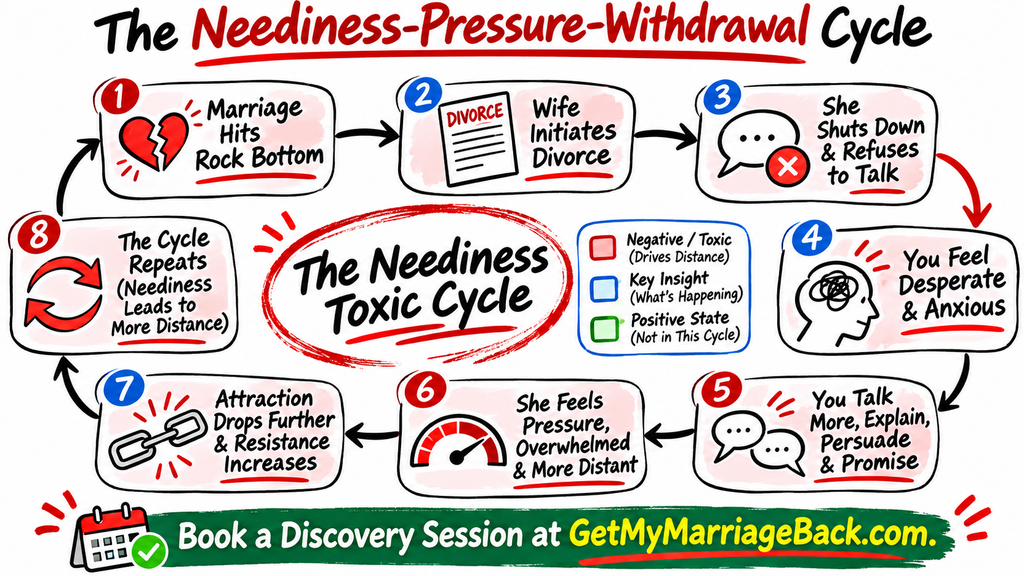
what to do when your wife wants a divorce - the neediness-pressure-withdrawal cycle

3. Your Desperation to Save Your Marriage Can Become Neediness

This is where many husbands unintentionally make their marriage crisis worse.

You desperately want your wife back.

There’s nothing inherently wrong with that desire.

Wanting reconciliation doesn’t make you weak, and caring about your family doesn’t make you needy.

Neediness begins when your emotional stability becomes dependent on your wife’s immediate reassurance, affection, or approval.

That dependence can appear in behaviors you believe demonstrate commitment.

For example:

  • You repeatedly ask whether she still loves you.
  • You monitor her facial expressions for signs of renewed attraction.
  • You send long messages explaining your feelings.
  • You constantly seek confirmation that reconciliation remains possible.
  • You announce improvements and expect immediate recognition.
  • You interpret every delayed response as another rejection.
  • You reopen marriage conversations after she has clearly declined them.

The more anxious you become, the harder you try.

And the harder you try, the more pressure she may experience.

The neediness-pressure-withdrawal cycle

Imagine this sequence.

Your wife becomes emotionally distant.

You experience anxiety because you’re afraid of losing your marriage.

To relieve that anxiety, you initiate another conversation about reconciliation.

She withdraws because she doesn’t want another emotionally demanding discussion.

Her withdrawal intensifies your fear.

You respond with more explanations, promises, reassurance-seeking, or arguments.

Eventually, both of you become increasingly frustrated.

Your attempt to eliminate emotional distance has become part of the pattern maintaining it.

This doesn’t mean you’re responsible for every problem in the marriage.

It means you have identified a behavior within your control.

And changing that behavior gives you an opportunity to change the quality of your interactions.

4. Why Saying “I Don’t Need You” Still Communicates Neediness

Some husbands hear the word neediness and immediately swing to the opposite extreme.

They announce:

“I don’t need you.”

“I don’t care anymore.”

“You can leave if you want.”

They believe those declarations communicate strength.

But examine the motivation.

Are you genuinely comfortable with your independence, or are you hoping your wife becomes frightened of losing you?

Are you expressing a healthy boundary, or trying to provoke an emotional reaction?

If your behavior is designed primarily to make her chase you, you’re still depending on her reaction.

You’ve simply changed the presentation.

Real emotional independence doesn’t require an announcement.

It becomes visible through your decisions, emotional regulation, and consistency.

You can genuinely want your wife back without making her responsible for your emotional stability.

You can acknowledge the seriousness of divorce without begging her to reconsider.

And you can remain committed to reconciliation while recognizing that you cannot control another person’s decision.

That combination is a far stronger expression of personal capacity than pretending not to care.

5. Attraction Is Influenced by What Your Wife Experiences, Not Just What You Say

When attraction has declined, explanations about your goodness or intentions have limited power.

You can repeatedly tell your wife that you’re responsible, loyal, loving, and committed.

But those statements don’t automatically change the emotional experience she associates with interacting with you.

This is why I distinguish between moral worth and experiential value.

Your worth as a human being isn’t determined by whether your wife desires you.

Experiential value concerns what another person experiences in your presence.

Are your interactions consistently tense and demanding?

Does every conversation become an attempt to obtain reassurance?

Or are you becoming someone who can remain emotionally grounded, engaging, responsible, and genuinely interested without demanding an immediate reward?

These distinctions matter because attraction involves emotional experience, not merely intellectual agreement.

Seduction isn’t emotional manipulation

Building attraction skillfully doesn’t mean creating jealousy, withholding affection as punishment, or pretending to be unavailable.

Those behaviors keep your attention centered on controlling your wife’s reactions.

Genuine romantic appeal is expressed through emotional steadiness, confidence, self-respect, social awareness, and a life with meaningful direction.

You can communicate interest without turning that interest into pressure.

You can maintain warmth without begging for affection.

And you can respect someone’s autonomy without abandoning your own desires.

That’s the difference between dignity-based pursuit and fear-driven chasing.

Attraction cannot be commanded, but you can become more intentional about the experience your behavior creates.

6. What to Do When Your Wife Wants a Divorce: Start With Your Response

I helped a client whose wife had initiated divorce proceedings.

He wanted his marriage restored, and he deeply wanted their three daughters growing up in a two-parent household.

His wife had stopped engaging in conversations about saving the marriage.

Seven months after the divorce proceedings began, his marriage was saved.

That experience reinforces something I also learned while navigating my own marriage crisis.

Your response to the crisis matters.

You cannot force another person to feel attraction or choose reconciliation.

But you can influence the interactions in which you participate.

You can stop making fear the driving force behind your decisions.

And you can begin developing the emotional capacity to respond differently.

Grounding: Stop allowing fear to dictate your behavior

Grounding means reconnecting with your higher self, your values, and the reality of your situation.

It doesn’t mean pretending the divorce threat doesn’t hurt.

Instead, you acknowledge the pain without allowing it to control your next interaction.

Before sending another emotional message, recognize what you’re trying to accomplish.

Are you communicating something necessary?

Or are you trying to escape the discomfort of uncertainty?

That distinction alone can interrupt a destructive reaction.

Purpose: Build a life larger than the crisis

Your marriage matters.

Your wife matters.

Your children matter.

But your entire identity cannot depend on one relationship outcome.

Purpose means reconnecting with the responsibilities, aspirations, contributions, and legacy that give your life direction.

Continue showing up for your children. Maintain your commitments. Invest in your personal development, health, and meaningful work.

These aren’t performances designed to impress your wife.

They are expressions of the person you choose to become.

Self-Discovery: Recognize the capacity you already possess

A marriage crisis exposes emotional habits that everyday life can conceal.

You discover how you respond to rejection, uncertainty, conflict, and perceived abandonment.

Instead of condemning yourself for those reactions, examine them.

What consistently triggers your need for reassurance?

Which situations cause you to abandon your boundaries?

What behaviors have you repeated despite seeing that they increase tension?

Self-discovery allows you to recognize those patterns and develop stronger responses.

Together, Grounding, Purpose, and Self-Discovery form the foundation of the GPS5 approach I teach.

From that foundation, you can develop experiential value that creates opportunities for curiosity, attraction, influence, and meaningful relationship change.

7. Saving Your Marriage Alone Doesn’t Mean Controlling Your Wife

You may have heard that saving a marriage always takes two people.

That statement describes an important part of the desired outcome: a restored marriage ultimately requires two people willing to participate.

But it doesn’t mean you must wait for your wife to cooperate before improving your own behavior.

You can begin changing the way you communicate.

You can stop escalating arguments.

You can develop emotional independence.

You can become more attentive to the effect of your words, timing, and body language.

And you can take responsibility for your own contribution to the relationship’s difficulties without accepting responsibility for every decision your wife makes.

This is what saving your marriage alone means at the beginning of the process.

It is individual self-leadership, not unilateral control over reconciliation.

Your shared history, family responsibilities, and ongoing interactions create opportunities for influence.

They do not give you ownership over your wife’s feelings or choices.

What about the children?

Wanting your children raised in a two-parent household is a meaningful desire.

But repeatedly invoking the children to pressure your wife into reconciliation can turn a legitimate concern into another emotionally demanding interaction.

Your children deserve responsible parenting regardless of the state of the marriage.

Demonstrate that responsibility through your behavior rather than using their future as an argument your wife must accept.

That distinction protects your dignity and keeps the children from becoming instruments in an adult conflict.

8. The Next Time Your Wife Shuts Down, Let Your Behavior Speak

Imagine your wife refuses another conversation about reconciliation.

Your instinct is to explain why the marriage deserves another chance.

Instead, recognize what has just happened.

She has communicated a boundary around that conversation.

You don’t need another speech.

Maintain a calm voice, relax your posture, and respect the immediate boundary.

Then return to a meaningful responsibility without sulking, threatening, or performing indifference.

Don’t use silence as punishment.

Don’t pretend you no longer care.

And don’t spend the next several hours monitoring whether your wife noticed your restraint.

The goal is not to make her react. The goal is to stop making your emotional stability dependent on her reaction.

This is how you begin changing the message communicated through your behavior.

One calm response will not automatically repair years of resentment, emotional disconnection, or lost attraction.

But repeatedly replacing pressure with emotional steadiness changes the behavior you bring into the marriage.

And that is a meaningful starting point.

The Truth About Saving Your Marriage When Your Wife Wants Divorce

Your wife may have initiated divorce.

She may refuse to discuss reconciliation.

She may no longer respond to affection, promises, or explanations the way she once did.

Those realities are painful, particularly when you still want the marriage and family you’ve built.

But desperation is not the same as effective action.

Neediness can turn genuine love into pressure when you repeatedly seek reassurance from someone who is withdrawing.

Emotional independence allows you to communicate your desire for reconciliation without demanding that your wife immediately validate it.

Your wife is responsible for her choices.

You are responsible for yours.

And when you stop trying to control her response, you can finally direct your energy toward developing the emotional intelligence, personal capacity, and experiential value that have been missing from your approach.

You don’t have to stop wanting your wife back. You have to stop allowing the fear of losing her to determine how you behave.

5 Physical Signs She Just Slept With Someone Else: The Truth

Frequently Asked Questions

What should I do when my wife wants a divorce but I don’t?

Stop repeatedly trying to convince her and examine the relationship patterns that preceded the divorce decision. Focus on your emotional regulation, responsibilities, and behaviors while respecting her autonomy and taking necessary practical steps.

Can I save my marriage if my wife refuses to talk to me?

You can begin changing your contribution to the relationship even when your wife refuses reconciliation conversations. Whether the marriage is ultimately restored also depends on her willingness to participate.

Why does my wife shut down when I try to talk about our marriage?

She may associate those conversations with pressure, unresolved conflict, emotional overwhelm, or a decision she doesn’t want to revisit. Observe whether she avoids all communication or specifically withdraws when reconciliation becomes the subject.

How do I get my wife back after she files for divorce?

Begin by understanding what contributed to the breakdown rather than relying on promises, arguments, or emotional appeals. Develop consistent, emotionally intelligent behavior that reduces unnecessary pressure and allows any renewed connection to develop voluntarily.

Your Wife Filed for Divorce? 3 Mistakes That Push Her Further Away

Your wife filed for divorce, but the most dangerous mistake you could make right now might have nothing to do with the divorce papers.

Take This 2 Minutes Quiz

Question 1 of 15

You may be studying divorce laws, worrying about custody, calculating what you could lose financially, and wondering whether marriage was ever designed to work in your favor.

Meanwhile, the woman you married is becoming emotionally distant, and every conversation feels like another opportunity to lose her.

I want you to consider something uncomfortable.

While you’re preparing to defend yourself in court, are you unintentionally destroying your remaining opportunity to reconnect with your wife?

I’m not suggesting you ignore the divorce filing, abandon your rights, or pretend everything is fine.

Your legal strategy and your marriage reconciliation strategy are two different things.

Understanding that distinction could completely change how you approach this crisis.

Because when your wife has already filed for divorce, the question isn’t simply whether you’re a good husband.

The more important question is whether you have the emotional intelligence, relationship skills, and consistency required to navigate a marriage that is falling apart.

Let me explain.

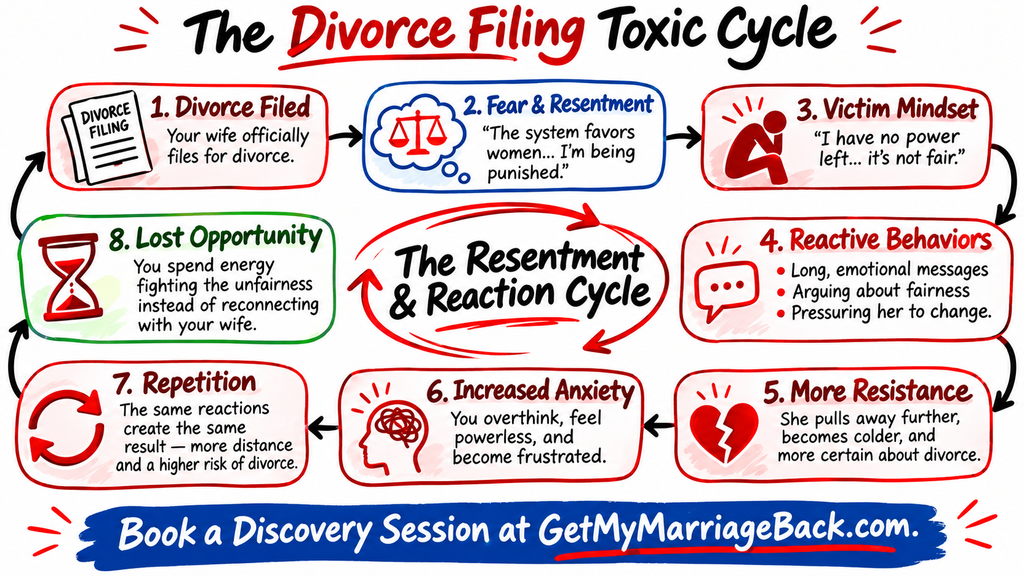
My Wife Filed for Divorce: Is It Too Late to Save My Marriage?

When a wife files for divorce, many husbands immediately assume that the marriage is over.

Others become convinced that the legal system favors women, that their wives have all the power, and that there’s nothing left they can do.

I understand why someone facing the possible loss of their marriage, family structure, home, or financial security might feel that way.

But there’s an important difference between what has happened and what you’ve concluded about what happened.

Your wife filing for divorce is a fact.

Your fear of losing everything is an emotional response to a serious situation.

The belief that you’ve lost every opportunity to influence your future is a conclusion.

And conclusions can become dangerous when you start treating them as established facts.

A divorce filing tells you what your wife has decided to pursue at this moment. It doesn’t tell you everything she will feel, think, or decide in the future.

People can reconsider decisions. They can also remain committed to them.

Your responsibility is to deal with the reality in front of you rather than trying to control an outcome that involves another person’s choices.

That’s where the three C’s of sustainable love become essential.

my wife filed for divorce

The 3 C’s of Sustainable Love: Character, Competence, and Consistency

Marriage is not sustained by good intentions alone.

You can be faithful, hardworking, financially responsible, and deeply committed to your spouse while still lacking the relationship skills necessary to navigate emotional disconnection.

Think about the corporate world.

A company might hire an honest employee, but honesty alone doesn’t make that employee competent.

The employee must also understand the job, develop the necessary skills, and perform consistently.

Marriage is no different in that respect.

Character is the foundation. Competence determines what you know how to do. Consistency determines whether you can continue doing it when life becomes difficult.

When your spouse wants out, these three qualities become especially important.

Let’s examine the three mistakes that reveal where they may be missing.

my wife filed for divorce - the 3 C's to sustainable love

Mistake #1: Blaming Your Wife Without Examining Your Own Judgment

I once worked with a man whose wife had already filed for divorce.

He wanted one last opportunity to save his marriage.

But our conversations kept returning to the same belief: marriage favors women.

He believed the divorce system was working against him, and he was increasingly focused on everything his wife had done wrong.

Eventually, he told me that his wife lacked character.

So I asked him a question.

If you believe your wife lacks character, and you chose to marry her, what does that tell you about your own judgment?

That question can make someone uncomfortable.

It isn’t about blaming a husband for his wife’s decisions or suggesting that choosing someone makes him responsible for everything that person does.

It’s about examining the judgment, assumptions, expectations, and relationship patterns that brought two people to their present circumstances.

You cannot develop better judgment while refusing to examine your previous decisions.

And you cannot become more emotionally intelligent if accountability is something you demand exclusively from other people.

Character Is More Than Being a Good Person

Most people define character through moral behavior.

They think about honesty, faithfulness, loyalty, and integrity.

Those qualities matter.

But sustainable love requires another dimension of character: the willingness to confront uncomfortable truths about yourself.

Can you acknowledge your emotional reactions without allowing them to control your decisions?

Are you capable of recognizing when resentment is distorting your interpretation of your wife’s behavior?

Can you accept responsibility for your contribution to unhealthy patterns without accepting blame for things you didn’t do?

These questions matter because resentment changes how you communicate.

When you’re convinced your wife is the villain, almost everything she does can become further evidence supporting that conclusion.

Even a neutral conversation can turn into another argument.

Attraction rarely grows in an environment where every interaction feels like a courtroom.

Mistake #2: Confusing Reconciliation With Convincing Your Wife

This is where competence becomes essential.

You might desperately want to save your marriage from divorce.

But wanting reconciliation and knowing how to pursue it are completely different things.

Suppose your wife tells you:

“I’m done. I’ve filed for divorce.”

What do you do next?

Some husbands immediately begin explaining why their wives are wrong.

They send long emotional messages, challenge the fairness of the divorce process, bring up everything they’ve sacrificed, or demand another opportunity to prove themselves.

Others apologize repeatedly, hoping that enough remorse will change their wives’ minds.

Unfortunately, these reactions often communicate emotional pressure rather than emotional maturity.

Your Wife Doesn’t Need Another Argument About Why She Should Stay

Imagine that your wife has spent months feeling emotionally disconnected.

Now she has filed for divorce, and every conversation becomes another attempt to persuade her that she’s making a mistake.

From your perspective, you’re fighting for your marriage.

From her perspective, she may experience those conversations as another reason to create distance.

This is why competence matters.

You need to understand the difference between expressing your desire for reconciliation and pressuring someone to reverse a decision.

A competent response acknowledges reality, respects boundaries, and demonstrates that you can handle difficult emotions without turning every encounter into a confrontation.

You can say that you still value the marriage without demanding an immediate answer.

It’s also possible to protect your legal interests while behaving respectfully toward your spouse.

Hiring a qualified divorce attorney is responsible when legal proceedings have begun.

Your attorney handles legal strategy.

You still have to handle yourself.

Emotional Attraction Begins With How Your Spouse Experiences You

Here’s something many people misunderstand about attraction in marriage.

They assume attraction is primarily about physical appearance, romance, sexual chemistry, or saying the right words.

Those things can matter, but emotional attraction also depends on how someone feels in your presence.

Does your wife feel understood?

Can she express disagreement without being interrogated?

Does she experience your attention as genuine interest or as another attempt to change her mind?

Relationship research supports the importance of these experiences.

A 2016 study by Gurit Birnbaum and colleagues, published in the Journal of Personality and Social Psychology, examined how perceived partner responsiveness relates to sexual desire.

Across three studies, responsiveness was associated with increased desire, particularly among women. Feeling special and valued helped explain that relationship.

You can explore the research on partner responsiveness and sexual desire.

Other relationship studies have connected perceived responsiveness with emotional expression and affectionate touch.

The underlying principle is important.

People are generally more receptive to intimacy when they experience understanding, consideration, and genuine emotional connection.

This doesn’t mean you should perform kindness to manufacture attraction.

In fact, that approach creates another problem.

When your behavior is designed exclusively to produce a reaction, your spouse may eventually recognize that the attention comes with expectations.

Genuine emotional competence means developing the ability to understand, listen, regulate yourself, and respond thoughtfully because those skills reflect who you are becoming.

Attraction becomes an invitation rather than a demand.

Mistake #3: Changing for One Week and Expecting Your Wife to Return

This is where consistency separates temporary improvement from sustainable transformation.

Imagine having one peaceful conversation with your wife.

You stay calm.

You listen without interrupting.

For the first time in weeks, the interaction doesn’t become an argument.

You feel encouraged.

Then another legal notice arrives.

Your wife doesn’t respond to your message.

Someone tells you she’s moving on.

Suddenly, you’re back to accusations, emotional messages, panic, begging, and demands.

What happened?

Your behavior improved temporarily, but your emotional habits remained largely unchanged.

Love Cannot Become a Transaction

One of the most damaging expectations in a struggling marriage is the belief that improved behavior should produce immediate rewards.

You tell yourself:

“I’ve been calm for seven days. Why hasn’t she come back?”

Or perhaps:

“I’ve apologized and given her space for two weeks. What else does she want?”

Notice what’s happening.

Your change has become a transaction.

You’re measuring your behavior against the response you expect from your spouse.

But trust doesn’t operate according to your preferred deadline.

A person who has experienced repeated disappointment may need time to evaluate whether something has genuinely changed.

Your spouse also has the freedom to decide what she wants.

Consistency means remaining committed to your principles even when you aren’t receiving the emotional response you hoped for.

This is especially important when you’re trying to save your marriage alone.

You cannot single-handedly create mutual reconciliation, but you can become more skillful in how you conduct yourself.

How to Rebuild Emotional Attraction When Your Wife Wants Divorce

Attraction is not something you can demand, negotiate, or extract from another person.

However, you can become someone whose presence is more emotionally grounded, respectful, engaging, and enjoyable.

That’s a meaningful distinction.

The objective isn’t to convince your wife that you’ve suddenly become a different person.

It’s to develop the qualities that make healthy connection possible.

Stop Making Every Interaction About the Marriage

When your wife wants divorce, it’s tempting to treat every conversation as an opportunity to discuss reconciliation.

You want answers.

Naturally, you want reassurance that your marriage still has a future.

But constantly returning to the relationship can make ordinary communication feel exhausting.

When appropriate communication is possible, allow conversations to serve their actual purpose.

If you’re discussing the children, discuss the children.

When you’re addressing household responsibilities, stay focused on those responsibilities.

If your wife has requested space, respect it.

Emotional intelligence includes recognizing when a conversation is welcome and when continued pursuit becomes pressure.

Become Emotionally Attractive Without Performing

Seduction in a long-term marriage is not simply about flirting or physical intimacy.

It also involves curiosity, confidence, emotional presence, and the experience of being with someone who doesn’t require constant reassurance.

A grounded person can be warm without being needy.

Confidence allows you to express affection without demanding that it be returned.

Emotional maturity helps you tolerate uncertainty without making your spouse responsible for calming every fear.

These qualities can make interactions feel lighter and more inviting.

But they must become part of your character rather than techniques you switch on whenever your wife appears receptive.

You don’t become respectful only when she’s affectionate.

Likewise, you don’t abandon your principles when she becomes distant.

That’s consistency.

What to Do When Your Wife Has Filed for Divorce

When you’re facing an active divorce proceeding, the immediate objective is not to manufacture a romantic breakthrough.

It’s to stop adding unnecessary pressure to an already difficult situation.

Start by separating your legal responsibilities from your emotional responses.

Understand the filing, meet deadlines, and obtain qualified legal representation.

Then examine your communication habits.

Are you sending messages because something genuinely needs to be discussed, or because you’re uncomfortable with uncertainty?

Do you repeatedly ask whether your wife still loves you?

Have you been using guilt, financial fears, or your shared history to pressure her into reconsidering?

These behaviors deserve honest examination.

If your wife has clearly stated that she doesn’t want to discuss reconciliation, respect that boundary.

When communication is legally restricted, follow those restrictions completely.

Practice Emotional Self-Regulation Before Responding

Emotional flooding occurs when intense feelings overwhelm your ability to respond thoughtfully.

Research involving 233 married or cohabiting couples found that greater emotional flooding was associated with anger and less effective problem-solving during conflict.

This helps explain why someone can genuinely intend to remain calm and still react impulsively when a stressful message arrives.

Before responding to something upsetting, create enough distance to recognize what you’re feeling.

You might need to step away from your phone, take a walk, or return to an ordinary responsibility.

Ask yourself whether your next action serves a meaningful purpose or merely relieves temporary anxiety.

The ability to experience intense emotion without immediately acting on it is an essential relationship skill.

Use Your GPS to Regain Personal Direction

When a marriage is collapsing, many people lose their sense of direction.

Their emotional state becomes completely dependent on what their spouse says or does.

One encouraging conversation produces hope.

A delayed text message produces panic.

This is where I encourage you to use your GPS.

Ground Yourself in Reality

Start with what is actually true today.

Your wife filed for divorce.

You have legal and personal responsibilities.

You may still desire reconciliation, but you don’t control her decision.

Grounding means dealing with those facts without adding catastrophic predictions.

Reconnect With a Larger Purpose

Your marriage matters, but your identity cannot depend entirely on whether your wife chooses to remain married.

Reconnect with your responsibilities, values, personal development, and the kind of person you want to become.

This creates a more stable emotional foundation.

You can care deeply about reconciliation without allowing uncertainty to consume every part of your life.

Discover the Skills You Need to Develop

Finally, examine the relationship skills you may be missing.

Perhaps you struggle with emotional regulation.

Maybe you become defensive whenever someone criticizes you.

You might have difficulty listening without immediately offering explanations or corrections.

These are competencies that can be developed.

The objective is not to become a flawless spouse.

It’s to become increasingly capable of navigating difficult relationships with character, competence, and consistency.

Can a Marriage Be Saved After Divorce Papers Are Filed?

The filing itself doesn’t determine every future interaction between two people.

Some couples reconsider separation and pursue reconciliation after legal proceedings have begun.

Others continue toward divorce.

The important distinction is that reconciliation requires two willing participants.

You can improve your conduct, develop emotional intelligence, and become more capable of creating healthy connection.

What you cannot do is make your spouse choose reconciliation.

This is why I encourage you to stop confusing influence with control.

Influence grows from how you consistently conduct yourself.

Control attempts to force another person’s response.

One creates the possibility of voluntary connection. The other often produces resistance.

If you want to rebuild attraction in marriage, your focus must shift from extracting reassurance to becoming genuinely more emotionally mature.

The Truth About Saving Your Marriage When Your Wife Wants Out

Here’s what I want you to remember.

Character matters, but character alone is not enough.

You can have good intentions and still communicate poorly.

It’s possible to love your wife deeply while lacking the skills to handle rejection, uncertainty, conflict, and emotional distance.

And you can improve temporarily without developing the consistency necessary for lasting change.

Sustainable love requires character, competence, and consistency working together.

If your wife has filed for divorce, protect your interests and take the situation seriously.

But don’t allow resentment, panic, or a belief that you’ve lost all personal power to dictate your next move.

Your wife has her choices.

You still have yours.

The question is whether those choices will be guided by fear and frustration—or by the kind of emotional intelligence that makes healthy love possible.

5 Physical Signs She Just Slept With Someone Else: The Truth

Frequently Asked Questions

Can I save my marriage if my wife has already filed for divorce?

Reconciliation remains possible after a divorce filing when both spouses become willing to reconsider the relationship. Focus on respectful communication, personal accountability, and understanding what contributed to the breakdown.

What should I do first when my wife files for divorce?

Consult a qualified divorce attorney, understand your legal responsibilities, and avoid impulsive emotional confrontations. Separate your desire for marriage reconciliation from the legal decisions that require immediate attention.

How do I get my wife back when she wants a divorce?

You cannot make your wife return, but you can improve how you communicate, respect her boundaries, and address the behaviors that contributed to emotional disconnection. Rebuilding trust requires consistent conduct rather than repeated persuasion.

Should I give my wife space after she files for divorce?

Respect her request for space while maintaining any necessary, appropriate communication about children, finances, or legal responsibilities. Space should not become a tactic to provoke a reaction; it should reflect genuine respect for her autonomy.


What Would Help You Most Right Now?

Choose the option that best matches where you are with your marriage.

I Need Personalized Help

My Marriage Is in Serious Trouble

If you're dealing with separation, divorce, loss of attraction, infidelity, intimacy problems, or a spouse who's pulling away, get help looking at what's happening in your specific situation.

Get Personalized Help →
Get My Marriage Back book cover
I'd Rather Learn What to Do First

Start With Get My Marriage Back

Get the book and start learning the principles for moving your marriage in a better direction.

Get the Free Book →