


Your wife filed for divorce, but the most dangerous mistake you could make right now might have nothing to do with the divorce papers.
Take This 2 Minutes Quiz
You may be studying divorce laws, worrying about custody, calculating what you could lose financially, and wondering whether marriage was ever designed to work in your favor.
Meanwhile, the woman you married is becoming emotionally distant, and every conversation feels like another opportunity to lose her.
I want you to consider something uncomfortable.
While you’re preparing to defend yourself in court, are you unintentionally destroying your remaining opportunity to reconnect with your wife?
I’m not suggesting you ignore the divorce filing, abandon your rights, or pretend everything is fine.
Your legal strategy and your marriage reconciliation strategy are two different things.
Understanding that distinction could completely change how you approach this crisis.
Because when your wife has already filed for divorce, the question isn’t simply whether you’re a good husband.
The more important question is whether you have the emotional intelligence, relationship skills, and consistency required to navigate a marriage that is falling apart.
Let me explain.
My Wife Filed for Divorce: Is It Too Late to Save My Marriage?
When a wife files for divorce, many husbands immediately assume that the marriage is over.
Others become convinced that the legal system favors women, that their wives have all the power, and that there’s nothing left they can do.
I understand why someone facing the possible loss of their marriage, family structure, home, or financial security might feel that way.
But there’s an important difference between what has happened and what you’ve concluded about what happened.
Your wife filing for divorce is a fact.
Your fear of losing everything is an emotional response to a serious situation.
The belief that you’ve lost every opportunity to influence your future is a conclusion.
And conclusions can become dangerous when you start treating them as established facts.
A divorce filing tells you what your wife has decided to pursue at this moment. It doesn’t tell you everything she will feel, think, or decide in the future.
People can reconsider decisions. They can also remain committed to them.
Your responsibility is to deal with the reality in front of you rather than trying to control an outcome that involves another person’s choices.
That’s where the three C’s of sustainable love become essential.
The 3 C’s of Sustainable Love: Character, Competence, and Consistency
Marriage is not sustained by good intentions alone.
You can be faithful, hardworking, financially responsible, and deeply committed to your spouse while still lacking the relationship skills necessary to navigate emotional disconnection.
Think about the corporate world.
A company might hire an honest employee, but honesty alone doesn’t make that employee competent.
The employee must also understand the job, develop the necessary skills, and perform consistently.
Marriage is no different in that respect.
Character is the foundation. Competence determines what you know how to do. Consistency determines whether you can continue doing it when life becomes difficult.
When your spouse wants out, these three qualities become especially important.
Let’s examine the three mistakes that reveal where they may be missing.
Mistake #1: Blaming Your Wife Without Examining Your Own Judgment
I once worked with a man whose wife had already filed for divorce.
He wanted one last opportunity to save his marriage.
But our conversations kept returning to the same belief: marriage favors women.
He believed the divorce system was working against him, and he was increasingly focused on everything his wife had done wrong.
Eventually, he told me that his wife lacked character.
So I asked him a question.
If you believe your wife lacks character, and you chose to marry her, what does that tell you about your own judgment?
That question can make someone uncomfortable.
It isn’t about blaming a husband for his wife’s decisions or suggesting that choosing someone makes him responsible for everything that person does.
It’s about examining the judgment, assumptions, expectations, and relationship patterns that brought two people to their present circumstances.
You cannot develop better judgment while refusing to examine your previous decisions.
And you cannot become more emotionally intelligent if accountability is something you demand exclusively from other people.
Character Is More Than Being a Good Person
Most people define character through moral behavior.
They think about honesty, faithfulness, loyalty, and integrity.
Those qualities matter.
But sustainable love requires another dimension of character: the willingness to confront uncomfortable truths about yourself.
Can you acknowledge your emotional reactions without allowing them to control your decisions?
Are you capable of recognizing when resentment is distorting your interpretation of your wife’s behavior?
Can you accept responsibility for your contribution to unhealthy patterns without accepting blame for things you didn’t do?
These questions matter because resentment changes how you communicate.
When you’re convinced your wife is the villain, almost everything she does can become further evidence supporting that conclusion.
Even a neutral conversation can turn into another argument.
Attraction rarely grows in an environment where every interaction feels like a courtroom.
Mistake #2: Confusing Reconciliation With Convincing Your Wife
This is where competence becomes essential.
You might desperately want to save your marriage from divorce.
But wanting reconciliation and knowing how to pursue it are completely different things.
Suppose your wife tells you:
“I’m done. I’ve filed for divorce.”
What do you do next?
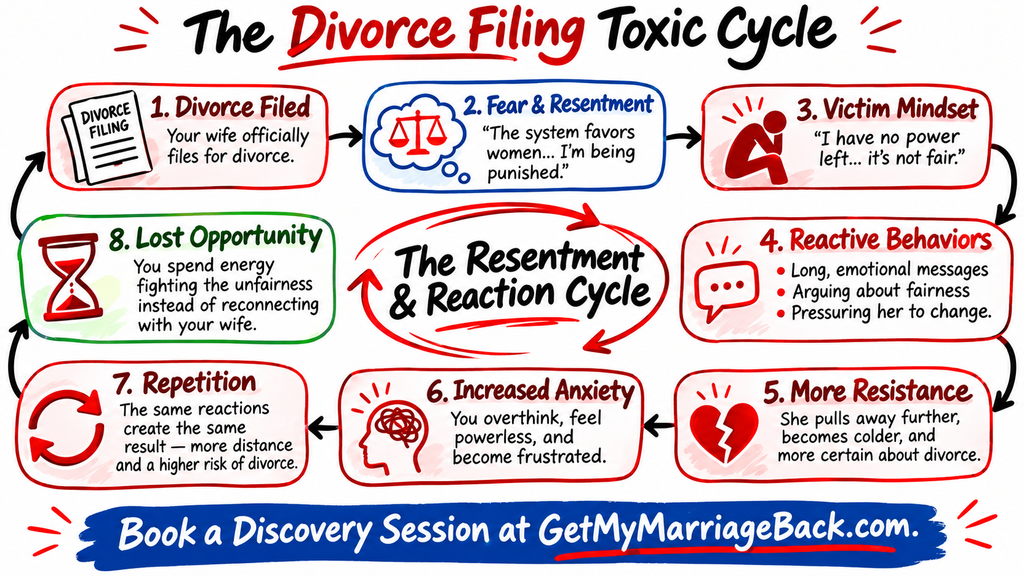
Some husbands immediately begin explaining why their wives are wrong.
They send long emotional messages, challenge the fairness of the divorce process, bring up everything they’ve sacrificed, or demand another opportunity to prove themselves.
Others apologize repeatedly, hoping that enough remorse will change their wives’ minds.
Unfortunately, these reactions often communicate emotional pressure rather than emotional maturity.
Your Wife Doesn’t Need Another Argument About Why She Should Stay
Imagine that your wife has spent months feeling emotionally disconnected.
Now she has filed for divorce, and every conversation becomes another attempt to persuade her that she’s making a mistake.
From your perspective, you’re fighting for your marriage.
From her perspective, she may experience those conversations as another reason to create distance.
This is why competence matters.
You need to understand the difference between expressing your desire for reconciliation and pressuring someone to reverse a decision.
A competent response acknowledges reality, respects boundaries, and demonstrates that you can handle difficult emotions without turning every encounter into a confrontation.
You can say that you still value the marriage without demanding an immediate answer.
It’s also possible to protect your legal interests while behaving respectfully toward your spouse.
Hiring a qualified divorce attorney is responsible when legal proceedings have begun.
Your attorney handles legal strategy.
You still have to handle yourself.
Emotional Attraction Begins With How Your Spouse Experiences You
Here’s something many people misunderstand about attraction in marriage.
They assume attraction is primarily about physical appearance, romance, sexual chemistry, or saying the right words.
Those things can matter, but emotional attraction also depends on how someone feels in your presence.
Does your wife feel understood?
Can she express disagreement without being interrogated?
Does she experience your attention as genuine interest or as another attempt to change her mind?
Relationship research supports the importance of these experiences.
A 2016 study by Gurit Birnbaum and colleagues, published in the Journal of Personality and Social Psychology, examined how perceived partner responsiveness relates to sexual desire.
Across three studies, responsiveness was associated with increased desire, particularly among women. Feeling special and valued helped explain that relationship.
You can explore the research on partner responsiveness and sexual desire.
Other relationship studies have connected perceived responsiveness with emotional expression and affectionate touch.
The underlying principle is important.
People are generally more receptive to intimacy when they experience understanding, consideration, and genuine emotional connection.
This doesn’t mean you should perform kindness to manufacture attraction.
In fact, that approach creates another problem.
When your behavior is designed exclusively to produce a reaction, your spouse may eventually recognize that the attention comes with expectations.
Genuine emotional competence means developing the ability to understand, listen, regulate yourself, and respond thoughtfully because those skills reflect who you are becoming.
Attraction becomes an invitation rather than a demand.
Mistake #3: Changing for One Week and Expecting Your Wife to Return
This is where consistency separates temporary improvement from sustainable transformation.
Imagine having one peaceful conversation with your wife.
You stay calm.
You listen without interrupting.
For the first time in weeks, the interaction doesn’t become an argument.
You feel encouraged.
Then another legal notice arrives.
Your wife doesn’t respond to your message.
Someone tells you she’s moving on.
Suddenly, you’re back to accusations, emotional messages, panic, begging, and demands.
What happened?
Your behavior improved temporarily, but your emotional habits remained largely unchanged.
Love Cannot Become a Transaction
One of the most damaging expectations in a struggling marriage is the belief that improved behavior should produce immediate rewards.
You tell yourself:
“I’ve been calm for seven days. Why hasn’t she come back?”
Or perhaps:
“I’ve apologized and given her space for two weeks. What else does she want?”
Notice what’s happening.
Your change has become a transaction.
You’re measuring your behavior against the response you expect from your spouse.
But trust doesn’t operate according to your preferred deadline.
A person who has experienced repeated disappointment may need time to evaluate whether something has genuinely changed.
Your spouse also has the freedom to decide what she wants.
Consistency means remaining committed to your principles even when you aren’t receiving the emotional response you hoped for.
This is especially important when you’re trying to save your marriage alone.
You cannot single-handedly create mutual reconciliation, but you can become more skillful in how you conduct yourself.
How to Rebuild Emotional Attraction When Your Wife Wants Divorce
Attraction is not something you can demand, negotiate, or extract from another person.
However, you can become someone whose presence is more emotionally grounded, respectful, engaging, and enjoyable.
That’s a meaningful distinction.
The objective isn’t to convince your wife that you’ve suddenly become a different person.
It’s to develop the qualities that make healthy connection possible.
Stop Making Every Interaction About the Marriage
When your wife wants divorce, it’s tempting to treat every conversation as an opportunity to discuss reconciliation.
You want answers.
Naturally, you want reassurance that your marriage still has a future.
But constantly returning to the relationship can make ordinary communication feel exhausting.
When appropriate communication is possible, allow conversations to serve their actual purpose.
If you’re discussing the children, discuss the children.
When you’re addressing household responsibilities, stay focused on those responsibilities.
If your wife has requested space, respect it.
Emotional intelligence includes recognizing when a conversation is welcome and when continued pursuit becomes pressure.
Become Emotionally Attractive Without Performing
Seduction in a long-term marriage is not simply about flirting or physical intimacy.
It also involves curiosity, confidence, emotional presence, and the experience of being with someone who doesn’t require constant reassurance.
A grounded person can be warm without being needy.
Confidence allows you to express affection without demanding that it be returned.
Emotional maturity helps you tolerate uncertainty without making your spouse responsible for calming every fear.
These qualities can make interactions feel lighter and more inviting.
But they must become part of your character rather than techniques you switch on whenever your wife appears receptive.
You don’t become respectful only when she’s affectionate.
Likewise, you don’t abandon your principles when she becomes distant.
That’s consistency.
What to Do When Your Wife Has Filed for Divorce
When you’re facing an active divorce proceeding, the immediate objective is not to manufacture a romantic breakthrough.
It’s to stop adding unnecessary pressure to an already difficult situation.
Start by separating your legal responsibilities from your emotional responses.
Understand the filing, meet deadlines, and obtain qualified legal representation.
Then examine your communication habits.
Are you sending messages because something genuinely needs to be discussed, or because you’re uncomfortable with uncertainty?
Do you repeatedly ask whether your wife still loves you?
Have you been using guilt, financial fears, or your shared history to pressure her into reconsidering?
These behaviors deserve honest examination.
If your wife has clearly stated that she doesn’t want to discuss reconciliation, respect that boundary.
When communication is legally restricted, follow those restrictions completely.
Practice Emotional Self-Regulation Before Responding
Emotional flooding occurs when intense feelings overwhelm your ability to respond thoughtfully.
Research involving 233 married or cohabiting couples found that greater emotional flooding was associated with anger and less effective problem-solving during conflict.
This helps explain why someone can genuinely intend to remain calm and still react impulsively when a stressful message arrives.
Before responding to something upsetting, create enough distance to recognize what you’re feeling.
You might need to step away from your phone, take a walk, or return to an ordinary responsibility.
Ask yourself whether your next action serves a meaningful purpose or merely relieves temporary anxiety.
The ability to experience intense emotion without immediately acting on it is an essential relationship skill.
Use Your GPS to Regain Personal Direction
When a marriage is collapsing, many people lose their sense of direction.
Their emotional state becomes completely dependent on what their spouse says or does.
One encouraging conversation produces hope.
A delayed text message produces panic.
This is where I encourage you to use your GPS.
Ground Yourself in Reality
Start with what is actually true today.
Your wife filed for divorce.
You have legal and personal responsibilities.
You may still desire reconciliation, but you don’t control her decision.
Grounding means dealing with those facts without adding catastrophic predictions.
Reconnect With a Larger Purpose
Your marriage matters, but your identity cannot depend entirely on whether your wife chooses to remain married.
Reconnect with your responsibilities, values, personal development, and the kind of person you want to become.
This creates a more stable emotional foundation.
You can care deeply about reconciliation without allowing uncertainty to consume every part of your life.
Discover the Skills You Need to Develop
Finally, examine the relationship skills you may be missing.
Perhaps you struggle with emotional regulation.
Maybe you become defensive whenever someone criticizes you.
You might have difficulty listening without immediately offering explanations or corrections.
These are competencies that can be developed.
The objective is not to become a flawless spouse.
It’s to become increasingly capable of navigating difficult relationships with character, competence, and consistency.
Can a Marriage Be Saved After Divorce Papers Are Filed?
The filing itself doesn’t determine every future interaction between two people.
Some couples reconsider separation and pursue reconciliation after legal proceedings have begun.
Others continue toward divorce.
The important distinction is that reconciliation requires two willing participants.
You can improve your conduct, develop emotional intelligence, and become more capable of creating healthy connection.
What you cannot do is make your spouse choose reconciliation.
This is why I encourage you to stop confusing influence with control.
Influence grows from how you consistently conduct yourself.
Control attempts to force another person’s response.
One creates the possibility of voluntary connection. The other often produces resistance.
If you want to rebuild attraction in marriage, your focus must shift from extracting reassurance to becoming genuinely more emotionally mature.
The Truth About Saving Your Marriage When Your Wife Wants Out
Here’s what I want you to remember.
Character matters, but character alone is not enough.
You can have good intentions and still communicate poorly.
It’s possible to love your wife deeply while lacking the skills to handle rejection, uncertainty, conflict, and emotional distance.
And you can improve temporarily without developing the consistency necessary for lasting change.
Sustainable love requires character, competence, and consistency working together.
If your wife has filed for divorce, protect your interests and take the situation seriously.
But don’t allow resentment, panic, or a belief that you’ve lost all personal power to dictate your next move.
Your wife has her choices.
You still have yours.
The question is whether those choices will be guided by fear and frustration—or by the kind of emotional intelligence that makes healthy love possible.
5 Physical Signs She Just Slept With Someone Else: The Truth
Frequently Asked Questions
Reconciliation remains possible after a divorce filing when both spouses become willing to reconsider the relationship. Focus on respectful communication, personal accountability, and understanding what contributed to the breakdown.
Consult a qualified divorce attorney, understand your legal responsibilities, and avoid impulsive emotional confrontations. Separate your desire for marriage reconciliation from the legal decisions that require immediate attention.
You cannot make your wife return, but you can improve how you communicate, respect her boundaries, and address the behaviors that contributed to emotional disconnection. Rebuilding trust requires consistent conduct rather than repeated persuasion.
Respect her request for space while maintaining any necessary, appropriate communication about children, finances, or legal responsibilities. Space should not become a tactic to provoke a reaction; it should reflect genuine respect for her autonomy.