

Your wife used to reach for your hand, lean into your touch, and make you feel wanted—but now you’re wondering why she barely initiates affection at all.
Take This 2 Minutes Quiz
When your wife stops initiating affection, the silence can feel louder than an argument.
You remember when she would touch your shoulder while walking past, kiss you without being asked, or curl up beside you without thinking twice. Now you find yourself wondering whether she’s still attracted to you, whether she’s carrying resentment, or whether your marriage has quietly become a roommate arrangement.
And when you ask what’s wrong?
“Nothing.”
That’s often the answer that makes the situation even more confusing.
Because the affection has changed. You can feel the difference. Yet the person you love doesn’t seem willing—or able—to explain what happened.
I want you to understand something important: Your wife’s lack of affection is a symptom. It is not, by itself, a complete diagnosis of your marriage.
There is a meaningful difference between lost attraction, unresolved resentment, emotional exhaustion, and a relationship where physical closeness has gradually become associated with pressure.
What Would Help You Most Right Now?
Choose the option that best matches where you are with your marriage.
My Marriage Is in Serious Trouble
If you're dealing with separation, divorce, loss of attraction, infidelity, intimacy problems, or a spouse who's pulling away, get help looking at what's happening in your specific situation.
Get Personalized Help →
Start With Get My Marriage Back
Get the book and start learning the principles for moving your marriage in a better direction.
Get the Free Book →Those experiences can overlap. They can also require different responses.
If your goal is to rebuild attraction in your marriage, you need more than an explanation for why she stopped touching you.
You need to understand the emotional conditions surrounding her withdrawal—and the ways your own responses may be influencing those conditions.
Why Your Wife Never Initiates Affection Anymore
Physical affection is often one of the first places where emotional distance becomes visible.
A spouse may stop initiating hugs, kisses, cuddling, hand-holding, or sexual intimacy. Sometimes the change happens suddenly after a major conflict. Other times, it develops gradually until one partner realizes they have become the only person reaching out.
That difference matters.
A wife who still enjoys conversations, laughs with you, spends time with you, and occasionally welcomes affection may be experiencing something different from a wife who has withdrawn from nearly every form of connection.
Neither pattern tells you everything.
But each provides useful information.
When you conclude, “My wife isn’t attracted to me anymore,” you’re making an interpretation of her behavior.
It may be accurate. It may be incomplete.
The first skill in rebuilding attraction is learning to separate what you can observe from what you fear it means.
You can observe that she no longer initiates physical contact.
You cannot determine her entire emotional experience from that observation alone.
That distinction keeps you from turning every rejected touch into a verdict on your marriage.

5 Signs That Reveal What May Be Happening Beneath Her Withdrawal
1. She Still Enjoys Your Company but Rarely Initiates Touch
This is one of the most overlooked patterns when a wife stops initiating affection.
She may still talk with you comfortably, share jokes, discuss everyday life, and spend time around you. Yet the moment physical intimacy enters the picture, something changes.
Perhaps she becomes hesitant. Maybe she pulls away, redirects the conversation, or seems uncomfortable when a casual touch begins to feel like an invitation for more.
That pattern doesn’t automatically mean she has stopped loving you.
It may indicate that physical affection has acquired an emotional meaning that ordinary companionship does not carry.
For example, if every hug seems to lead toward an expectation of sex, she may begin avoiding the hug itself.
This doesn’t make your desire for affection unreasonable. Wanting to feel wanted by your spouse is a legitimate relational need.
However, the way that need is expressed can either invite connection or create pressure.
Attraction grows more naturally when affection can exist without becoming an immediate obligation.
Pay attention to whether your wife seems comfortable with closeness that has no hidden demand attached.
A gentle conversation, shared laughter, or relaxed time together may reveal more about the state of your connection than repeatedly asking why she won’t initiate intimacy.
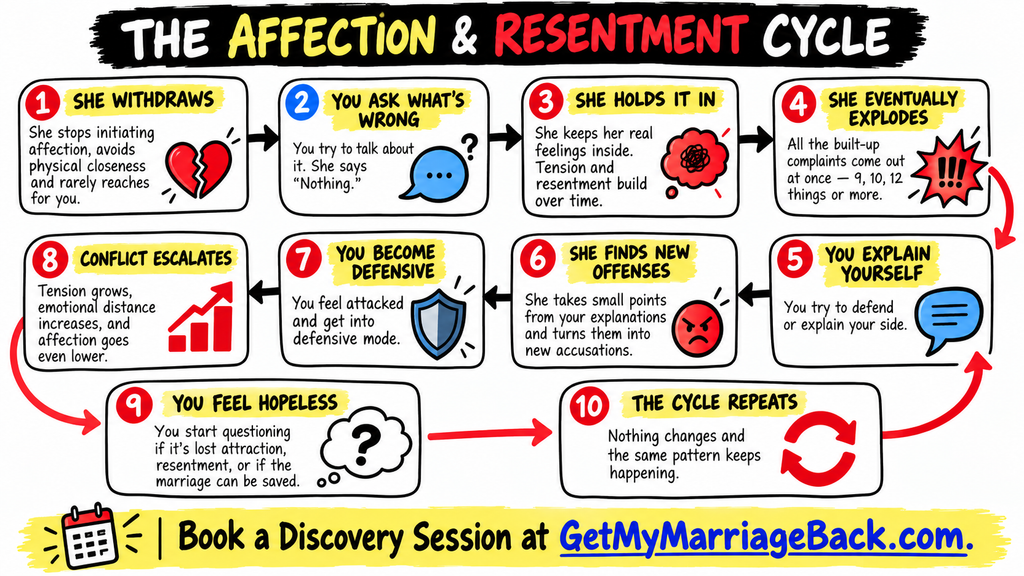
2. She Says “Nothing” Is Wrong—Then Unloads Old Complaints
One of the most confusing marriage dynamics happens when emotional withdrawal and accumulated complaints exist side by side.
I’ve worked with a husband who experienced a chronic version of this situation.
His wife had stopped initiating affection.
Whenever he asked what was wrong, she repeatedly told him, “Nothing.”
Then, eventually, the frustration would erupt.
Instead of one clear issue, he would hear nine, ten, or sometimes twelve complaints in the same conversation.
Some concerned recent events. Others involved problems he believed they had already addressed.
He couldn’t understand why something that seemed settled to him was still emotionally active for her.
Naturally, he wondered whether she had lost attraction.
But another possibility deserved attention: Unresolved resentment may have been interfering with her willingness to feel close.
Lost attraction concerns desire and connection.
Resentment concerns negative experiences and the meaning someone continues to attach to them.
A spouse can still recognize qualities she values in you while feeling too upset to welcome physical intimacy.
That doesn’t mean every complaint is justified or that resentment explains every instance of withdrawal.
It means the emotional history deserves examination.
Ask yourself when the affection began changing.
Was there a major argument? A repeated disappointment? A stressful period? A gradual accumulation of disconnection?
Sometimes the timeline reveals a pattern that the latest argument cannot explain.
3. Your Attempts to Explain Yourself Create More Conflict
Here is where many well-intentioned spouses unknowingly deepen the distance they’re trying to repair.
Your wife raises a complaint.
You explain what actually happened from your perspective.
She identifies something in your explanation that upsets her further.
Now you’re defending the original issue and a new accusation inside the same conversation.
Before long, neither of you is discussing the concern that started the argument.
You’re discussing how the argument itself has become another problem.
I call this the explanation trap.
You believe you’re clarifying the facts. Your wife experiences your explanation as another reason to feel unheard.
Both experiences can exist simultaneously.
Her emotional reaction is real as an experience, but that doesn’t make every accusation factually accurate.
Likewise, your good intentions don’t automatically erase legitimate concerns.
Emotional intelligence requires you to distinguish those things without treating every disagreement as an emergency.
Research supports the importance of this distinction. A longitudinal study examining defensive denial in romantic relationships found that conflict-escalating behaviors helped explain the association between defensive denial and later relationship instability.
The point isn’t that you should accept every criticism.
It’s that defending yourself immediately is not always the most effective way to protect your relationship.
Instead, listen for the specific concern underneath emotionally charged language.
When she says, “You never listen,” don’t automatically turn the conversation into a historical debate about every occasion when you did listen.
Identify the behavior she’s referring to.
You can acknowledge a legitimate disappointment without agreeing that you have failed in every situation.
That is a much stronger position than either surrendering your judgment or fighting to win every detail.
4. Affection Disappears Most Often After Conflict or Pressure
The timing of withdrawal is especially revealing.
Does your wife become physically distant after disagreements?
Does she seem comfortable around you until you begin asking for reassurance?
Have conversations about intimacy become emotionally loaded because both of you already know how they usually end?
When physical closeness becomes associated with interrogation, disappointment, or conflict, a spouse may begin protecting herself from the interaction before it even starts.
That protection can look like indifference.
It can feel like rejection.
But the emotional process underneath may be more complicated than a simple absence of desire.
Research on romantic relationships has repeatedly examined the importance of perceived partner responsiveness—the experience of feeling understood, cared for, and valued by a partner.
In a 2016 series of three studies, researchers found that responsiveness was associated with greater sexual desire, particularly among women. Feeling special and perceiving one’s partner as desirable helped explain that relationship.
This matters because attraction is not simply about performing impressive behaviors.
It’s also about how someone experiences being with you.
A person can provide financially, fulfill responsibilities, and make substantial sacrifices while still struggling to create an emotionally comfortable atmosphere.
The ability to remain composed, attentive, and respectful during difficult moments is part of what you contribute to that atmosphere.
That doesn’t require accepting mistreatment.
It requires recognizing that emotional stability and personal boundaries can coexist.
You can listen without surrendering your judgment.
You can acknowledge a mistake without destroying your self-respect.
And you can maintain a boundary without turning every disagreement into a threat against the marriage.
5. You Have Started Measuring Every Good Deed Against Her Affection
This is one of the most subtle ways attraction becomes pressured.
You make a thoughtful gesture.
You help around the house.
You have a good conversation.
Then you watch to see whether your wife reaches for you that evening.
When she doesn’t, disappointment sets in.
You may begin thinking, “What else am I supposed to do?”
I understand the frustration.
But three good behaviors today do not create an obligation for your wife to initiate affection tonight.
When kindness becomes a transaction, the other person may begin experiencing even thoughtful gestures as part of an unspoken demand.
Reciprocity matters in marriage. Both partners need to contribute to the relationship.
Yet reciprocity is not the same as controlling the timing, form, or intensity of someone else’s response.
Think about preparing soil before planting a seed.
You don’t make the seed grow faster by digging it up every morning to inspect it.
You create better conditions and allow the natural process to unfold.
Marriage attraction requires similar patience.
Your consistency matters. So does your ability to bring warmth, confidence, attentiveness, and emotional steadiness into interactions without constantly checking whether you’ve earned a reward.
How to Rebuild Attraction Without Begging, Chasing, or Pressure
When your wife avoids intimacy, the instinct to pursue harder can become overwhelming.
You may want another conversation, another explanation, another promise, or another opportunity to prove that you’re changing.
But attraction isn’t something you can argue another person into feeling.
It is influenced by the emotional experience of being in the relationship.
That means the most productive place to begin is often your own self-leadership.
Stop Making Her Response the Measure of Your Worth
Your spouse’s affection matters, but it should not become the only source of your emotional stability.
If every interaction determines whether you feel confident or defeated, your relationship becomes dominated by anxious monitoring.
You start looking for evidence of love in every glance, every touch, and every change in tone.
That makes it harder to be genuinely present.
A grounded person can recognize a painful situation without allowing every uncertain moment to dictate their behavior.
You can care deeply about your marriage and still retain your dignity.
Become Emotionally Safe Without Becoming Passive
Emotional safety doesn’t mean never disagreeing.
It means your spouse can express a concern without every conversation immediately turning into a contest.
You remain capable of hearing uncomfortable information, considering what is valid, and responding thoughtfully.
At the same time, you don’t have to tolerate contempt, intimidation, or repeated disrespect.
Confidence and kindness are not opposites.
Neither are boundaries and affection.
One of the most attractive forms of maturity is the ability to remain steady without becoming cold, controlling, or desperate.
Restore the Qualities That Made Connection Enjoyable
Long-term conflict can cause spouses to focus so intensely on what is wrong that they forget what once made the relationship enjoyable.
You may begin resenting qualities you previously appreciated.
Ordinary conversations become problem-solving sessions.
Shared time becomes another opportunity to evaluate whether the marriage is improving.
That atmosphere leaves little room for curiosity, playfulness, or romantic tension.
Seduction in a long-term marriage is not about tricks or manufactured jealousy.
It’s about restoring an experience of connection that feels voluntary, alive, and emotionally engaging.
Bring back your sense of humor.
Take care of your appearance and personal energy because those things reflect how you carry yourself.
Remain interested in your spouse as an individual, not merely as the person who can relieve your anxiety about the marriage.
Allow warmth to exist without immediately turning it into a request for more.
The goal is to become someone whose presence feels valuable, not someone who must constantly negotiate for affection.
The GPS5 Approach to Rebuilding Marital Attraction
I teach a progression called GPS5 because rebuilding attraction starts long before a spouse initiates physical intimacy again.
It begins with grounding, purpose, and self-discovery.
Grounding: Separate Facts From Fear
Start with what you know.
Your wife has stopped initiating affection. That is an observable fact.
The belief that she will never love you again is a prediction.
Grounding helps you respond to the actual situation rather than every frightening interpretation your mind creates.
Purpose: Become Bigger Than the Immediate Crisis
A marriage crisis can consume your identity.
Every decision starts revolving around your spouse’s mood, availability, or willingness to connect.
Purpose restores perspective.
Your marriage matters, but your ability to lead yourself, fulfill responsibilities, maintain relationships, and live according to your values matters too.
That stability changes how you show up.
Self-Discovery: Recognize Your Contribution to the Cycle
Examine your habits without assuming responsibility for everything.
Do you interrogate your spouse when you feel uncertain?
Do you become defensive before understanding a complaint?
Does your desire for affection sometimes turn into pressure?
Self-discovery allows you to identify what is within your influence.
It also helps you stop attempting to control what belongs to another person.
Value, Curiosity, Attraction, Influence, and Leverage
As your grounding and self-awareness improve, you become better positioned to offer genuine value in your interactions.
Value creates opportunities for curiosity.
Curiosity can reopen the possibility of attraction.
Attraction can create opportunities for positive influence.
And influence gives you greater leverage to pursue reconciliation with dignity.
This is a progression of relational possibilities, not a strategy for controlling another person’s feelings.
The distinction is essential.
You cannot force desire.
You can become more skillful at creating the conditions in which connection is easier to welcome.
When Your Wife Isn’t Attracted to You Anymore, What Should You Focus On First?
Focus on the pattern before you focus on the outcome.
The absence of affection may be the most painful part of your experience, but it is not necessarily the first part of the problem that needs attention.
Look at the emotional history.
Notice when withdrawal happens.
Pay attention to the difference between ordinary companionship and physical closeness.
Recognize whether your explanations are helping conversations become clearer or making them increasingly defensive.
Most importantly, examine whether your efforts to restore affection are creating warmth or pressure.
You don’t need to solve every disagreement before your marriage can experience a better interaction.
But you do need to stop allowing unresolved disagreements to define every interaction.
There is a difference between wanting your wife to initiate affection and becoming a person who understands how attraction, emotional safety, curiosity, and reciprocity interact.
The first is a desired outcome.
The second is a relationship skill.
And relationship skills are where your influence begins.
“Wife Makes NO EFFORT In BED” (5 Tips For INSTANT Solution)
Frequently Asked Questions
She may be experiencing unresolved resentment, reduced attraction, emotional exhaustion, stress, or discomfort with the expectations attached to physical closeness. Look at when the withdrawal began and whether it affects only touch or your broader emotional connection.
Not necessarily, because reduced physical initiation can reflect several different emotional and relational patterns. Attraction and resentment can also overlap, so one symptom alone cannot explain the entire marriage.
Focus on rebuilding emotional responsiveness, reducing pressure, and making everyday interactions more enjoyable rather than demanding immediate physical reassurance. Respect her autonomy while developing the communication and self-leadership skills that support connection.
Yes, emotional and physical connection can improve when the underlying patterns are understood and the interactions sustaining distance begin to change. Progress often involves patience, emotional regulation, clear boundaries, and consistent relational effort.