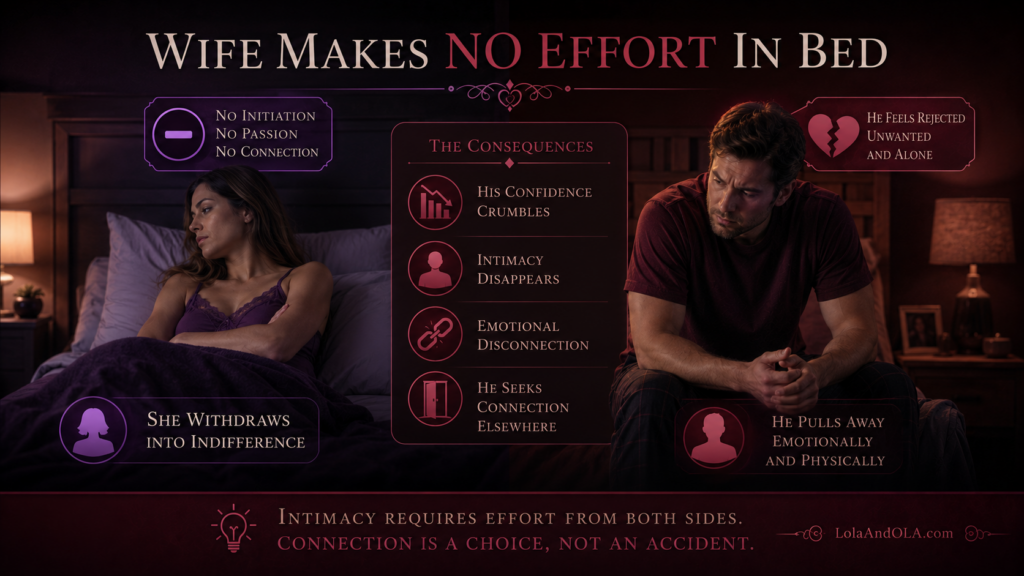


Feeling like your wife loves you but doesnt desire you is one of the most painful, isolating experiences a husband can endure in a marriage.
Take This 2 Minutes Marriage Assessment
When a relationship slips into a completely sexless routine, it’s easy to assume the romantic spark is dead permanently.
But there is a massive psychological difference between a woman losing her baseline love for you and her temporary lack of sexual desire.
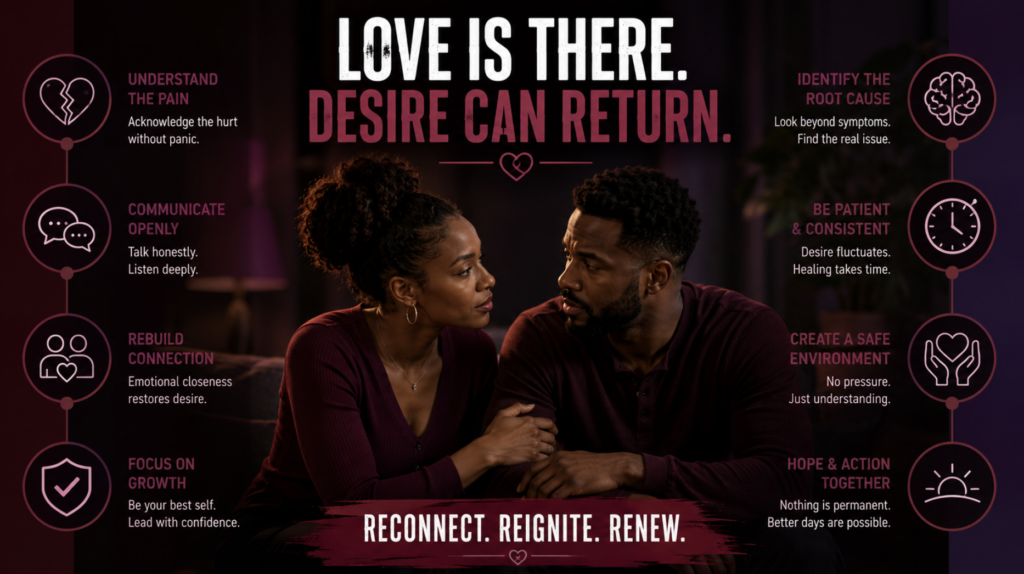
If you constantly feel like your wife loves you but is not sexually attracted to you, you must stop overreacting.
This comprehensive guide breaks down exactly why the physical intimacy has stopped, how to interpret her emotional distance, and the exact steps you can take today to revive her desire without losing yourself in the process.
Few relationship struggles cut as deeply as feeling loved but not desired.
For many men, especially husbands, this disconnect can be devastating. But before you assume the worst, it’s important to slow down, understand what’s really happening, and recognize that this situation may not be as permanent—or as hopeless—as it feels.
Where Did This Conclusion Come From?
Before anything else, ask yourself:
How did I arrive at the belief that my wife doesn’t desire me?
Was it something she said or did she tell you directly that she’s no longer attracted to you?
Has intimacy decreased or disappeared?
Does she seem emotionally distant?
Have there been repeated rejections that left you feeling unwanted?
Or have you simply noticed a pattern over time and drawn your own conclusions?
Understanding the source of your belief matters because sometimes our conclusions are based on clear evidence, while other times they’re based on assumptions, fears, or interpretations that may not tell the whole story.
The more specific you can be about what led you here, the better equipped you’ll be to address it.
Love and Desire Are Not the Same Thing
One of the hardest truths to accept is that love and desire, while connected, are not identical.
A person can genuinely love you and still struggle with desire.
That doesn’t necessarily mean they’re lying when they say they love you.
Love can exist in many forms:
- Commitment
- Loyalty
- Affection
- Respect
- Care
- Partnership
Desire, however, is often tied to attraction, emotional connection, excitement, energy, and physical intimacy.
While love tends to be stable, desire can fluctuate.
That’s why someone can sincerely say, “I love you,” while simultaneously feeling disconnected from the romantic or sexual aspects of the relationship.
Understanding this distinction doesn’t remove the pain, but it helps explain why these seemingly contradictory realities can exist at the same time.
Why This Hurts So Much
For many men, being desired by their wife isn’t simply about sex.
It’s about feeling chosen.
Also, it’s about feeling valued.
It’s about feeling attractive, important, and significant in the eyes of the woman they love.
When that desire seems absent, many men don’t just experience disappointment—they experience a blow to their identity.
Questions begin to surface:
- What’s wrong with me?
- Am I no longer attractive?
- Did I fail somehow?
- Is she interested in someone else?
- Is our marriage over?
The emotional impact can be severe because it touches on self-worth, masculinity, and the need for connection.
That’s why hearing something like:
“I love you, but I’m not in love with you.”
or
“I care about you, but I don’t feel that way anymore.”
often feels worse than people realize.
The statement may be intended to soften the blow, but for the person receiving it, it can feel like a rejection of the deepest kind.
Desire Is Often Temporary
Here’s an important truth:
A lack of desire today does not automatically mean a lack of desire forever.
Desire is dynamic.
It rises and falls.
Also, it responds to circumstances.
It can be affected by:
- Stress
- Exhaustion
- Resentment
- Health issues
- Hormonal changes
- Parenting responsibilities
- Emotional disconnection
- Depression
- Anxiety
- Unresolved conflicts
Many couples go through seasons where attraction feels weaker.
That doesn’t necessarily mean the marriage is doomed.
In fact, some couples rebuild desire and intimacy after years of disconnection.
The key is understanding that low desire is often a symptom of something deeper rather than the problem itself.
Don’t Let Panic Make Things Worse
One of the biggest mistakes people make when they feel undesired is reacting out of fear.
When fear takes over, it often leads to:
- Constant reassurance-seeking
- Neediness
- Anger
- Defensiveness
- Accusations
- Emotional pressure
- Desperation
Ironically, these reactions often push a spouse further away.
When you’re convinced that something is permanently broken, you tend to operate from panic.
When you recognize that the situation may be temporary, you create space for healthier responses.
Calmness doesn’t mean indifference.
It means approaching the issue with confidence instead of fear.
Seek Understanding Before Solutions
Instead of immediately trying to fix the problem, seek to understand it.
Ask questions.
Listen carefully.
Create a safe space for honest conversations.
You might discover that your wife’s lack of desire has little to do with your appearance or worth.
Perhaps she’s overwhelmed. Perhaps she’s emotionally exhausted.
And perhaps unresolved issues have built up over time.
Perhaps she’s struggling with something she hasn’t been able to communicate.
The goal isn’t to prove who’s right or wrong.
The goal is understanding.
Because once you understand the true cause, meaningful solutions become possible.
Remember Your Value
A temporary decline in your wife’s desire does not determine your worth as a man.
It’s easy to internalize rejection and begin believing that something is fundamentally wrong with you.
Don’t do that.
Your value isn’t measured solely by how desired you feel at any given moment.
Maintain your confidence.
Continue growing.
Check this article out: Saving A lonely Marriage
Take care of yourself physically, emotionally, and mentally.
The stronger and more grounded you remain, the better positioned you’ll be to navigate the challenges in your marriage.
Every Man Wants Both
Let’s be honest.
Most husbands don’t just want love.
They want love and desire.
Also, they want affection and attraction.
They want commitment and passion.
There’s nothing wrong with wanting that.
Desiring to be desired by your spouse is natural.
It’s healthy.
It’s human.
The goal isn’t to convince yourself that love alone is enough when your heart longs for more.
The goal is to approach the situation wisely, recognize that desire can be rebuilt, and avoid making permanent conclusions based on temporary circumstances.
If you’re currently thinking, “My wife loves me, but she doesn’t desire me,” remember this:
Don’t confuse today’s reality with tomorrow’s destiny.
Desire is not always permanent.
Attraction can be restored.
Connection can be rebuilt.
Marriages can recover.
The most important thing you can do right now is resist panic, seek understanding, communicate honestly, and approach the situation from a place of strength rather than fear.
Because sometimes what feels like the end of desire is actually the beginning of discovering what has been missing all along—and how to bring it back.
5 Subtle Signs Your Separated Wife Wants to Reconcile
It can be difficult if it seems like your wife loves you but doesn’t desire you, but there are a few things you can do.
We’ve had a few people send these questions in and maybe you can relate in one shape, form or the other. Here we go before I share 5 tips to help you through a difficult time in your marriage.
“Wife Has No Romantic Feelings For Me”
My wife and I have been married for several years, but I have come to realize that she has no romantic feelings for me. We still have a good relationship, but it is more of a friendship than a romantic partnership. I feel lonely and rejected, but I am trying to accept the situation and move forward.
Your Wife Hasn’t Slept With You In Months”
My marriage has been going through a difficult time lately. My wife and I have been growing apart and it has been months since we have shared a bed. This has been an incredibly hard time for both of us, and I am trying my best to make things better.
“My Wife Sees Me As A Friend Not A Lover”
My wife and I have a strong friendship, but it is not a romantic one. She sees me as a companion and confidant, but not as a lover. We have a mutual respect and admiration for one another, but it is not the same kind of connection that is usually associated with a romantic relationship. We are content with our relationship as it is, and we both appreciate the bond we share.
“My Wife Says She Loves Me But Doesn’t Show It”
My wife often tells me that she loves me, but I can’t help but feel like she doesn’t show it. She is often busy with work and other commitments, so it’s hard for her to find the time to express her love. I try to understand, but it’s still difficult for me to feel truly appreciated.
You Don’t Feel Desired By You Wife
I feel like my wife doesn’t desire me anymore. Also, i feel like she has lost interest in me and our relationship. I feel neglected and unimportant to her. It’s heartbreaking to feel like I’m not wanted or desired by the person I love the most.
“My Wife Doesn’t Want Me Sexually”
My wife and I have been having a difficult time in our relationship lately. She has expressed that she no longer feels the same way about me sexually, and that she does not want to be intimate with me. This has been a difficult situation for both of us, but I am trying to be understanding and supportive of her feelings. We are working together to try to find a way to reconnect and build a stronger relationship.
Here are the 5 tips…
Tip 1 – Honest & Open Conversation
Start by having an honest and open conversation with your wife and try to understand her perspective.
The best way to start having a meaningful conversation with your wife is to be honest and open within the confinement of emotional intelligence.
Listen to her perspective and try to understand where she is coming from. Ask her questions and be willing to compromise.
Show her that you care about her feelings and that you are willing to work together to find a resolution. Be patient and understanding, and don’t be afraid to express your own feelings.
Show her that you are willing to put in the effort to make things work. This will help to create an environment of trust and respect, which is essential for any healthy relationship.
Tip 2 – Active Listening
Make sure to actively listen to her and let her express her thoughts and feelings without judgment.
It is important to make sure that you actively listen to her and let her express her thoughts and feelings without judgment.
This means that you should be actively engaged in the conversation, focusing on what she is saying and not interrupting her.
You should also be open to hearing her thoughts and feelings without passing any kind of judgment.
This is important because it will allow her to feel comfortable expressing herself and will create a safe space for her to do so.
It is also important to be patient and understanding, as this will help create a positive environment for her to share her thoughts and feelings.

Tip 3 – Self Care
You can also take time to focus on yourself. This has nothing to do with the selfless ingredient necessary for a marriage’s sustainability.
Taking time to focus on yourself is a great way to make sure that you are taking care of your mental and physical health.
Self-care can include activities such as reading a book, going for a walk, or taking a nap.
It can also mean taking time to reflect on your thoughts and emotions, or doing something that brings you joy.
Taking time to focus on yourself can help you to reduce stress, improve your mood, and increase your overall well being.
It can also help you to gain clarity and perspective on your life and the decisions you make.
Taking time for yourself is an important part of self-care and should be an integral part of your life.
Make sure you’re taking care of yourself and your own needs by engaging in activities that bring you joy and make you feel good.
Self-care is an important part of maintaining a healthy and balanced lifestyle.
Taking care of yourself and your own needs is essential for your mental, physical, and emotional wellbeing.
Engaging in activities that bring you joy and make you feel good is a great way to practice self-care.
This can include anything from exercising, reading a book, spending time with friends, or simply taking a few moments to relax.
Taking the time to do something that you enjoy can help to reduce stress and improve your overall mood.
Practicing self-care is a great way to ensure that you are taking care of yourself and your own needs.
Tip 4 – Affection
Lastly, don’t forget to be affectionate with your wife.
It is important to remember to be affectionate with your wife.
Showing your wife affection is a great way to show her that you care and appreciate her.
This can be done through small gestures such as holding hands, giving hugs, or even just saying “I love you”.
It is also important to make time for your wife, whether it is going on a date night or just spending quality time together.
Showing your wife affection is a great way to strengthen your relationship and make her feel special.
Tip 5 – Love & Kindness
Show her love and kindness, and let her know that you appreciate her and are here for her.
Being in a relationship is hard work because it is highly rewarding, but it can also be immensely rewarding.
4 Signs Your Wife Is Not Sexually Attracted To You
There are a few signs that may indicate your wife is not sexually attracted to you.
- She may avoid physical contact, such as cuddling or holding hands.
- She may also not want to engage in any kind of sexual activity or intimacy.
- She may be less interested in spending time with you or may be distant in conversations.
- She may also not be as affectionate or show signs of physical attraction, such as compliments or flirting.
If these signs are present, it may be a sign that your wife is not sexually attracted to you.

In this rest of the article, you will discover what to do if all signals indicate that the wife you married doesn’t desire you anymore even though she claims she loves you.
It’s perfectly normal for a wife to love her husband, but sometimes not feel sexually attracted to him.
While desire cannot be negotiated, it can absolutely be influenced with some tips we will share in this article.
There could be any number of reasons for this, such as a lack of emotional connection, mismatched libido levels or unresolved anger or resentment.
If you’re in this situation, it’s important to talk to your spouse and figure out what’s causing the disconnect.
You may need to see a therapist to help address the underlying issues; you can start with a family therapist.
Here are some very important lessons that we will cover to give you a full understanding and tactful things you can do to rekindle things:
- The Meaning of “Desire” In A Marriage
- What is the Difference Between Love and Sexual Desire?
- “What Does it Mean When My Wife Loves Me But Doesn’t Desire Me?”
- How does this affect a marriage and relationship?
- Tips for creating sexual desire in your spouse again
- The Role of a Sex Therapist
… and more.
My Wife Never Touches Me Anymore
“She used to be so affectionate, but now she seems distant and removed. I don’t know what I did wrong, but I fear that she may be cheating on me or is no longer interested in me. I don’t know how much longer I can take this.”
This kind of problem always start with a wife losing interest.
Let’s dive right in…

3 Signs That Your Wife Is Losing Interest
It can be difficult to tell if your wife is losing interest in you.
However, there are 4 of many other signs you can look out for.
- Sign #3 – One common sign is if your wife starts to avoid sexual intimacy.
- Sign #2 – If she stops taking care of herself physically or stops dressing up for you, this can also be a sign that she’s losing interest.
- Sign #1 – Another sign is if she becomes critical or negative towards you.
If your wife shows any of these signs, it might be time to talk to her about your concerns and see if there’s anything wrong.

The Meaning of “Desire” In A Marriage
When we think of the word “desire,” we often think of our sex life in a marriage and sexual desire.
However, desire is much more than that.
Desire is a yearning or craving for something, someone or the presence of someone.
It can be a strong feeling or emotion that motivates us to take further desired action of course.
In a marriage, it is important for both spouses to feel desired by the other.
This can be accomplished in many ways, such as through words of affirmation, acts of service, and physical touch.
When both spouses feel desired, it builds intimacy and strengthens the bond between them.
Sexual desire is an important part of a marriage, but it is not the only type of desire that matters.
Spouses should strive to meet each other’s non-sexual desires as well, in order to create a fulfilling and lasting relationship.
That alone can help in boosting and/or sustaining sexual desires in the marriage.

What is the Difference Between Love and Sexual Desire?
When we think of love, we often think of feelings of warmth, happiness and affection.
Love is a deep, emotional connection that spouses have with each other.
It is a feeling of being drawn to someone, of wanting to be close to them and wanting to make them happy.
In marriage, however, love is not just a feeling of lust or passion.
It is much more than that because a long term relationship between 2 different human beings is involved.

Love is Action, Patient, Kind and Fifty Million Others Things.
Sexual desire, on the other hand, is a physical attraction that spouses feel for each other.
It is the desire to be intimate with someone, to touch them and to be touched by them.
Sexual desire can often be confused with love, but they are two separate things.
Sexual desire was traditionally not necessary in a marriage, but love was as a function of duty and responsibility.
However, things have changed and it will hurt your marriage if you dare attempt to discount the importance of feelings in modern day marriage.

There Is A Strong Relationship Between A Couple’s Sex Life, Love And Sexual Desire.
A couple’s sex life is often seen as the foundation of a healthy relationship, and is usually one of the first things to disappear when a relationship starts to deteriorate.
Love is often thought of as the emotional connection that couples share, and is what keeps them together over time.
Sexual desire, on the other hand, is what motivates people to have sex and is often seen as a physical manifestation of love.

“What Does it Mean When My Wife Loves Me But Doesn’t Desire Me?”
When a wife loves her husband but does not desire him, it can be a sign that there is something wrong in the underlying relationship.
It may be that the wife is no longer attracted to her husband, or that she is unhappy with the way things are going in the relationship.
If this is the case, then it is important for the husband to talk to his wife and find out what is wrong.
He should express his love for her and try to find a way to fix whatever is causing the problem.
By the way, she might not be able to explain this in words.

How Does Your Intimacy Affect a Marriage Relationship?
Your sex life is an important part of intimacy in your marriage and the underlying relationship.
It helps to keep the spark alive and allows couples to feel close to each other.
When there is not healthy level of intimacy (which is deeper than sex), everything else starts to feel wrong.

Your Sex Life Can Take Many Different Forms, Such As Talking And Touching.
If one partner feels that they are not being desired by the other, it can be a blow to their self-esteem.
It can make them feel like they are not good enough and that they are not wanted.
This can lead to a lot of emotional pain and conflict and even emotional and full blown infidelity.

There are many ways to improve your sex life in a marriage relationship.
Couples can talk about their needs and desires, spend time together, touch each other more often, and be open and honest with each other.
But that’s usually not enough because it would most likely take one person to lead the dance.
If you are struggling with this issue, please seek help from a therapist, coach or counselor.
They can assist you in working through these feelings and improving your relationship.

6 Tips for Creating A Fulfilling Sex Life With Your Spouse Again
There are many ways to rekindle your sex life in your relationship with your spouse.
Here are a few tips:
1. Talk openly and honestly about your feelings and desires but with respect to your partner’s feelings.
2. Make time for each other and carve out special moments just for the two of you.
3. Be affectionate and touch each other often.
4. Experiment and be playful in the bedroom.
5. Communicate during sex and let your partner know what you enjoy.
6. Connect emotionally as well as physically.

The Role of a Sex Therapist
A sex therapist’s role is to help couples or individuals overcome issues that are preventing them from enjoying a healthy and fulfilling sex life.
They can help with a range of issues, such as low libido, performance anxiety, erectile dysfunction, and more.
Sex therapists typically use a mix of therapies, such as cognitive behavioral therapy (CBT), couples therapy, and psycho-education.
My Husband Won’t Listen to My Feelings

How A Sex Therapist Uses CBT
A sex therapist uses cognitive behavioral therapy (CBT) which can be a great help for couples in this situation.
He or she can help the couple understand why the wife loves her husband but does not desire him.
They can also work to help the couple rebuild their intimacy and connection.
Every other advice would probably unintentionally position you to start feeling like your wife is weaponizing sex.
How can she weaponize sex if she doesn’t hate sex with you?

That’s The Easy Route Of Thought; Try Harder.
A sex therapist would help you do the hard work by digging deeper into the reasons behind the scenes and behind the obvious.
You can even take it further.
You will learn seduction skills from a sex therapist that will help you influence high level of desire, interest and attraction.
Check out American Association of Sexuality Educators, counselors and therapists to see if you can find an AASECT Certified Sex Therapist.
An AASECT Certified Sex Therapist is trained to provide in-depth psychotherapy and they are specialized in treating clients with sexual issues and concerns.

What To Do When Your Partner Doesn’t Want To Be Intimate
When your partner doesn’t want to be intimate, it can be a difficult and confusing experience.
You may feel like you’re not good enough or that you’re not attractive in your relationship anymore.

Here Are 5 Things You Can Do To Improve Intimacy:
1. Talk to your partner about why they don’t want to be intimate and try to understand their point of view.
2. Don’t take it personally (this is easier said than done) – remember that this has nothing to do with how much they love you.
3. Don’t pressure your partner into being intimate if they’re not comfortable doing so because desire cannot be negotiated; it can however be influenced if you have the skills.
4. Seek out support from friends or family members who can offer words of encouragement to you if need it; don’t count on them being able to correct your spouse into order.
5. Seek professional help if the situation is causing you significant distress.
Remember that you’re not alone and there are ways to deal with this situation.
Don’t hesitate to reach out for help if you need it.

“Can I Divorce My Wife For Not Sleeping With Me?”
Of course you can divorce your spouse these days for the dumbest reasons.
All you have to do is to claim “irreconcilable differences.”
But of course, I don’t just advice you to just run for the hills at the slightest sight of a slow down in intimacy.
While it may be frustrating if your wife doesn’t want to have sex with you, it’s important to remember that there are many reasons why someone may not be interested in sex.

It Could Be Due To Stress, Fatigue, or Health Issues.
If your wife is unwilling to discuss the issue, then you may want to consult with a therapist to help you understand why she is not interested in sex and work on ways to improve intimacy.
There are many bitter people on the internet that will advice you to just go ahead and kick her to the curb.
You and I know that if it was that easy, you would have done it already.
Don’t compare yourself to people who are so weak to the extent that they never had enough vested interest in a marriage they created in the first place.
Identify if you really want that marriage from a personal standpoint and then move intentionally and accordingly; with the help of good counsel and not random people on the internet.

How Health Issues Can Result in Lack of Physical Intimacy
Many couples struggle with physical intimacy at some point in their relationship.
This can be due to a variety of factors, such as fatigue, stress, or health issues.
When one partner is dealing with health issues leading to a lack of physical intimacy, it might not be as obvious.
Physical intimacy is an important part of a marriage, and when it’s lacking, it can be difficult for both partners.
There are issues that may be hormonal or psychological remnants of health crisis.
Start with a conversation as usual and a healthy does of empathy and that alone can instigate her wanting sex.

“I Just Want My Wife To Want Me But I’ve Heard Many Wives Like Her Hate Sex Eventually.”
Sexual pleasure is an important part of any relationship, and it’s no different for couples in which the wife loves her husband but doesn’t desire him.
This is a temporary issue normally and you next move can make it permanent or temporary; tread carefully.
Even though they’re not physically attracted to each other, these couples can still enjoy a healthy and fulfilling sexual relationship if they’re willing to put in the effort.
For men in this situation, it’s important to understand that sexual pleasure isn’t all about the physical act of sex.
Sexual pleasure actually starts long before the act of sex.
There is a lot more going on even though you may feel as though she hates sex; it’s highly unlikely.
One of the key things when you are going through this is to make sure you are prepared for the opportunity to be intimate when it presents itself again.
When that time comes…

Here Are Additional 5 Tips To Be More Sexually Intimate With Your Wife
Tip #5 – First, try to be more present when you’re together.
And Tip #4 – Pay attention to her body and her reactions when you’re touching her.
Tip #3 – Second, experiment with different types of touch. Try mixing up your routine to keep things fresh; don’t be predictable.
Tip #2 – Third, communicate with your wife about what she enjoys.
Let her know what turns you on, and ask her about her fantasies.
Tip #1 – Lastly, make time for sex.
Dedicate time specifically for intimacy, and make sure that both of you are available for it.
Here is a quick question for you to ponder.
How do you feel about entertaining sex toys in your sex life?
Your answer can make or break your sex life and intimacy; Hint: No answer is right and wrong.

Why Does My Wife Hate Initiating Sex?
There could be many reasons why your wife hates initiating sex.
It could be that she’s not attracted to you, she’s not in the mood, or she’s not feeling well.
If your wife doesn’t initiate sex very often, it might be because she’s not comfortable doing so.
Heck: It can be completely a traditional or cultural issue
Talk to her about how you feel and see if she has any concerns or suggestions.
This is one of those situations where you may want to identify the strengths and weaknesses of your relationship and both of you as individuals.
What I want you to do is to shed more energy and light on the strengths and avoid trying to force the weaknesses with respect to the result that you want.
I would hope that your desired result is simply more sex; more passionate sex.

“My Wife Makes Excuses To Refuse Sex.”
“My wife loves me and always tells me how much she cares for me, but she doesn’t desire me sexually. She makes excuses not to sleep with me, and it’s really starting to take a toll on our relationship. I’m not sure what to do, as I still want to be intimate with her.”

Most Women In Marriage React To Unhappiness In One Or More Ways:
Outside of health issues, she might not feel satisfied with her marriage due to the amount of time spent away from her spouse.
The most recent findings suggest that up to 50 percent of couples who have been married 10 years are dissatisfied with their marriage because they report feeling frustrated and unfulfilled.
This is a rather strong reason why most women in marriage do not want sex – it’s as if they’re trying to protect themselves from being hurt again by refusing sex.
To a large extent, this can be subconscious.
Most women refuse sex because they are afraid of getting too close, only for them to continue to feel unhappy in the marriage down the road anyway.
It’s like “why bother?”

The First Step Is Always To Talk To Your Spouse About The Issue.
If that doesn’t work, you may want to engage your seduction power as a woman; that starts with self-assessment.
- What turned him on to you in the first place?
- What turns him on to you right now?
- What turns you on?
Once you find out the answer to all 3 of these questions, then you will find everything else useful in rekindling things.
How To Deal With A Sexless Marriage As A Woman
Dealing with a sexless marriage as a woman can be difficult, but there are ways to cope.
First, it’s important to understand that there is no shame in having a sexless marriage.
It’s not your fault, and you’re not alone.
There are many couples who experience this problem and therefore there are many solutions and options.

In Conclusion
It’s normal for most women to lose interest in their husbands after some time and over time.
This doesn’t mean that the love is gone, just the desire may be absent.
There are many things you can do to help boost your wife’s desire and attraction towards you again.
By leveraging some of the simple tips we’ve covered, you can rekindle the flame and have a more fulfilling marriage.
Here is a last bonus tip for you.
If you are always engaged in arguments that you may have considered a harmless debate, that can sure create lower interest and desire from your spouse; It can get weird from time to time.
What a confusion right?
Are women crazy?
How do you love a husband you don’t desire?
I was on the receiving end of those resentments she mentioned earlier and it was not fun as you can probably imagine.
We got married and I flipped my legs on the table and just relaxed like most new husbands.
After all, we are now committed to each other for life.
PREVIOUS POST: 💔 5 Reasons Your Wife is NOT Affectionate Anymore
What else is there to worry about? So I thought or acted at least.
It’s called complacency and we all do it in one shape, form or the other.
The truth is that I truly loved my wife and my family even back then but that didn’t stop me from being complacent.
Here is the first thing you should know.
On the other end of being complacent is a person you love who may be feeling undesired by you even if you don’t mean to.
And you know what they say about hurt-people. They hurt people right?
That’s right. But I didn’t plan out how I was going to hurt you back.
It was more-so about two people who entered a whole marriage to wing things along.
I know what you are thinking.
Why didn’t we vet properly and go through premarital counseling?
Not only did we engage in some premarital counseling,
we actually dated and were in a committed relationship for 3 years before we went to the altar.
Here is what we know today after reviewing, consulting and coaching many people in modern marriages .
People that say “I do” don’t know what they are doing because they couldn’t possibly know.
When you haven’t experienced marriage,
you are in a completely different context and it is what it is.
So when I complained about a few things a few times only to get undesirable responses from my husband,
I continued to feel more unsafe to express myself.
The resentments started to build up naturally.
It is in fact true that unexpressed expectations turn to resentments.
It is paramount that you give your partner freedom to express their expectations and the key is to not take those expectations personally.
TRENDING: 5 Stages that Leads to a Sexless Marriage 💔
After our relationship deteriorated so badly, I was still pretty much oblivious.
To me it wasn’t that difficult. I just want my wife to want me and it was weird to me that she didn’t get it.
Before I knew it, I started creating room in my life for the idea of entertaining attention that was being deprived on the sidelines.
We never stopped proclaiming our love for each other verbally but I didn’t feel it.
As a man, I simply normalized it because I grew up with Uncles who had and exercised options when it comes to women; married or not.
Like most men…
I thought about sexual attraction.
And I wondered why you avoided intimacy and I couldn’t touch you anymore.
I resented the audacity of committing and not showing up to our marriage.
So of course over time, the disconnection reflected occasionally in my energy and at one point, my wife verbally gave up on us.
The Main Lesson
HAVE YOU SEEN THIS: More Video on our YouTube Channel
That rock bottom helped me discover the secret.
A certain type of love required for all marriages is a choice.
However, desire, affection, and attraction are symptoms of a certain consistent way of showing up in your marriage as a man.
A typical wife has a lot on her plate and simply doesn’t get to decide if they want to desire you or not.
Think about it.
In the beginning of your love affair, your wife desired you without knowing enough about you.
Although, it wasn’t controlled. It was an attraction.
So we can agree that desire in a marriage is not some logical decision.
At least, that’s not reality.
With proper support it’s absolutely possible because we are a testimony.
But you will have to engage your power and it’s impossible when you are playing the victim.
“Is My Wife Attracted To Me” Take The Quiz
Taking a quiz can be a great way to gauge the level of attraction between you and your wife. Try this…
It can help you to identify areas of your relationship that could use some work, or it can help you to recognize the positive aspects of your relationship.
The quiz typically consists of questions about your relationship, such as how often you and your wife spend time together, how often you show affection, and how often you communicate.
Additionally, it may also include questions about how you and your wife interact with each other in public, how often you have disagreements, and how often you share intimate moments.
We will be creating a quiz soon. Look out for it.
My Husband Is Not Attracted to Me [Seeing These 10 SIGNS?]
Frequently Asked Question
There are a variety of potential reasons why a wife may have no desire for her husband. It could be due to a lack of communication, a lack of emotional connection, or a lack of physical intimacy. And It could also be due to a change in circumstances, such as a job loss, a move, or a health issue.
When your wife doesn’t want you sexually, it can be difficult to handle and can create a lot of tension in the relationship. It is important to talk to your wife about her feelings.
I feel like my wife doesn’t want me sexually for a variety of reasons. We may not be communicating our needs and desires effectively, or we may have drifted apart over time. It could also be that she is feeling overwhelmed with other aspects of life, such as work, family, or other commitments.
A marriage without desire can be a difficult situation to navigate. While it is possible for a marriage to survive without desire, it is often an uphill battle. Without the passion that comes with desire, couples may find that they are unable to connect on an emotional level, leading to a lack of communication and understanding.
Dealing with a lack of intimacy as a man starts with resisting the urge to take it as a permanent judgment of your worth. Many men immediately internalize rejection and assume they’re no longer attractive, loved, or valued, but intimacy often reflects the overall health of the relationship rather than one person’s desirability.