

Your wife still lives under the same roof, but every time you reach for affection, you feel her pulling away—and now you’re afraid that trying to save your marriage is actually making her want you less.
Take This 2 Minutes Quiz
You remember when your wife wanted to touch you, kiss you, spend time with you, and enjoy your company. Today, you can sit beside her on the same couch and feel like you’re living with a stranger.
The affection is disappearing. Intimacy feels awkward. Even a simple hug can leave you wondering whether she’s tolerating you rather than enjoying you.
And the most painful part?
You still want your wife, but you’re no longer sure she wants you.
When you’re thinking, “My wife isn’t attracted to me anymore,” the natural instinct is to do something immediately. You want to prove your love, fix whatever went wrong, and convince her that the marriage is worth saving.
But the actions you take from that desperate position can create the very pressure that makes attraction more difficult.
I want to show you how that happens, why some marriages become trapped in roommate status for years, and what you can begin changing without begging your wife to love you.
When Your Wife Becomes Comfortable Living Like a Roommate
About eight or nine years into my marriage, I experienced something I didn’t fully understand while it was happening.
What Would Help You Most Right Now?
Choose the option that best matches where you are with your marriage.
My Marriage Is in Serious Trouble
If you're dealing with separation, divorce, loss of attraction, infidelity, intimacy problems, or a spouse who's pulling away, get help looking at what's happening in your specific situation.
Get Personalized Help →
Start With Get My Marriage Back
Get the book and start learning the principles for moving your marriage in a better direction.
Get the Free Book →My wife, Lola, and I had disagreements like many married couples. Sometimes we argued, but typically, within 24 hours, everything appeared to return to normal.
Or so I thought.
Looking back, one question stands out: Were we actually returning to normal, or was I simply assuming that because the argument had ended, the emotional damage had disappeared?
Over time, I realized that my wife had been carrying resentment that wasn’t being resolved.
Eventually, she told me she didn’t want to be in the marriage anymore.
You might imagine that somebody would immediately leave after making that declaration.
That wasn’t our reality.
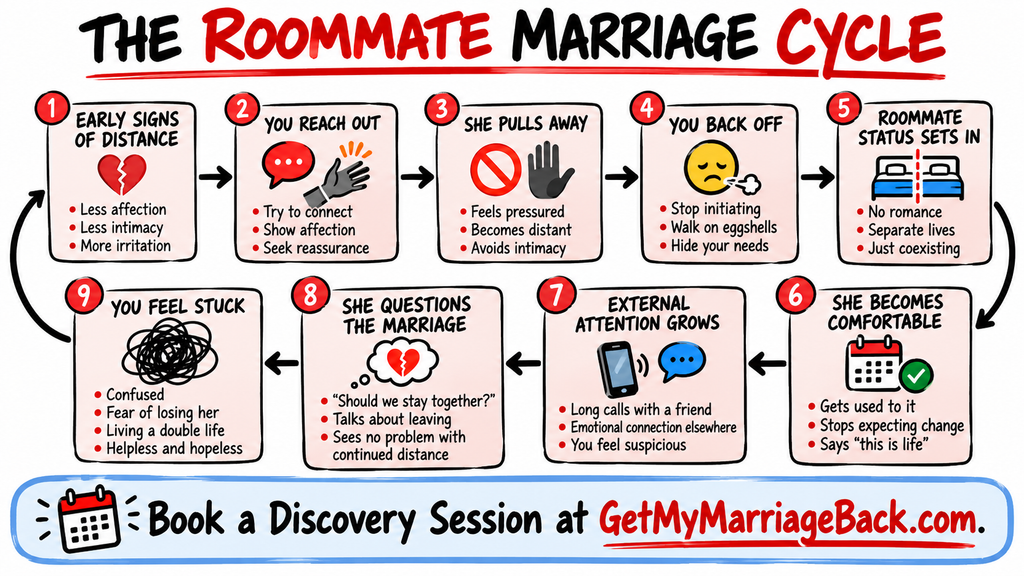
We continued living under the same roof for several months, moving back and forth through a relationship that increasingly resembled a roommate arrangement.
The house was still there. Our responsibilities hadn’t disappeared. Yet the emotional and romantic connection that made the marriage meaningful was under serious threat.
This is what makes attraction loss so dangerous.
A marriage can remain physically intact while the romantic relationship inside it deteriorates.
You can continue paying bills, raising children, attending family gatherings, and maintaining appearances while privately wondering whether your wife has emotionally checked out.
And when that arrangement becomes familiar, the urgency to change it can become painfully unequal.

The Roommate Marriage Trap: When Affection Becomes Pressure
I once worked with a gentleman who was a minister in church.
People respected him and looked up to his marriage. From the outside, he appeared to have the kind of family life others admired.
Behind closed doors, however, he was suffering.
For approximately three to five years, he and his wife had been living like roommates.
He wanted affection, physical intimacy, public displays of affection, and the ordinary romantic connection he remembered from their earlier years.
But every time he reached toward his wife, he sensed that she was uncomfortable.
He didn’t want to pressure her.
So he stopped initiating.
At first, that seemed like the respectful thing to do. He believed that avoiding uncomfortable situations would preserve peace until they could figure things out.
Instead, the arrangement continued for years.
What bothered him most was something his wife had said while they were dating.
Back then, she was afraid that marriage would eventually destroy their romance. She worried that affection, excitement, and intimacy would disappear after the wedding.
Now, she appeared comfortable with the exact situation she once feared.
Sometimes she would essentially tell him that this was simply what married life had become.
Imagine how painful that contradiction was.
He was desperately trying to preserve the romantic relationship, while she seemed increasingly willing to accept a marriage without romance.
Eventually, she began questioning whether they should continue staying together.
That is the roommate marriage trap.
You become so afraid of making your wife uncomfortable that you stop expressing your own needs, while the distance between you becomes the accepted arrangement.
Respecting her boundaries is essential. But living indefinitely in fear of her reactions is not a sustainable marriage strategy.
5 Mistakes That Push Your Wife Further Away When Attraction Is Gone
1. Trying to Convince Your Wife to Feel Attracted to You
When your wife says she isn’t attracted to you anymore, you naturally want an explanation.
You remind her of your history, your sacrifices, your responsibilities, and everything you’ve built together.
Perhaps you tell her how much you love her. You explain that marriage requires commitment and that she shouldn’t give up because her feelings have changed.
The problem is that these arguments address responsibility rather than attraction.
Your wife can recognize that you’re a good husband without experiencing romantic desire.
She can appreciate your sacrifices while feeling emotionally disconnected.
Being a responsible spouse and creating a desirable romantic experience are not the same thing.
Attraction is not something you can establish through a convincing argument.
When every conversation becomes another attempt to prove why she should love you, she starts associating your presence with emotional obligation.
That is the opposite of the experience you’re trying to create.
2. Treating Every Moment of Affection as a Test
Your wife sits beside you, and you reach for her hand.
She doesn’t respond the way you hoped.
Immediately, your mind starts interpreting what happened.
Does she still love you? Is she thinking about somebody else? Has she completely lost interest in physical intimacy?
Now every interaction carries emotional consequences.
A hug becomes a test. A kiss becomes evidence. Sex becomes a referendum on whether your marriage can survive.
Your wife begins sensing that ordinary affection comes with expectations.
Even when you don’t verbally demand anything, your disappointment can make the interaction feel emotionally expensive.
Here is the distinction I want you to understand:
Romantic pursuit expresses desire. Fear-driven chasing demands reassurance.
You can express genuine romantic interest without making your wife responsible for relieving your anxiety.
That requires emotional discipline.
When she declines affection, respect the boundary without punishing her through resentment, interrogation, or withdrawal.
Your ability to handle disappointment matters just as much as your willingness to initiate.
3. Assuming That Giving Her Space Will Automatically Rebuild Attraction
Generic marriage advice frequently tells you to give your wife space.
There are circumstances where space is necessary, especially when she feels overwhelmed or has explicitly requested distance.
But space alone doesn’t create attraction.
My client discovered this after years of avoiding situations that might make his wife uncomfortable.
He stopped initiating affection because he didn’t want to pressure her. Meanwhile, the roommate arrangement became increasingly established.
The mistake wasn’t respecting her boundaries.
The mistake was confusing the absence of pressure with the presence of romance.
A relationship can become peaceful without becoming passionate.
You can eliminate arguments while leaving the underlying disconnection untouched.
Rebuilding attraction requires more than simply staying out of her way. It requires changing the experience you bring into the relationship.
That begins with how you manage your emotions, express interest, maintain your identity, and engage with life.
4. Becoming Suspicious Instead of Emotionally Grounded
My client’s situation became even more complicated because of a family friend.
His wife regularly spent approximately 40 to 45 minutes talking with this person on the phone every other night.
Naturally, he became suspicious.
He was experiencing very little affection from his wife while watching her invest considerable time and attention in another relationship.
That combination was painful.
But suspicion is not proof of infidelity.
And allowing suspicion to control your behavior introduces another problem.
You start monitoring phone calls, questioning ordinary interactions, comparing yourself with another person, and interpreting every moment of distance as evidence of betrayal.
Before long, your behavior becomes organized around fear.
If there are legitimate concerns about an affair or inappropriate boundaries, address the facts directly and maintain your standards.
Don’t turn uncertainty into an excuse for accusations, surveillance, or emotional punishment.
You cannot rebuild attraction while allowing suspicion to become your personality.
Your wife needs to encounter somebody capable of exercising emotional intelligence, not somebody whose entire mood depends on her next phone call.
5. Making Your Wife the Center of Your Entire Identity
This is one of the most damaging mistakes because it often disguises itself as devotion.
You love your wife. You want to save your marriage. You believe your family is worth fighting for.
Those desires are understandable.
But somewhere along the way, your wife’s approval can become the measure of your entire existence.
When she smiles, you’re hopeful.
When she withdraws, you’re devastated.
If she mentions separation or divorce, everything else in your life suddenly loses meaning.
Your purpose, confidence, emotional stability, and daily decisions become dependent on her responses.
That creates a relationship in which you are constantly seeking something from her.
And when somebody experiences every interaction as another request for emotional reassurance, romantic connection can become burdensome.
Your wife can be deeply important to you without becoming the source of your identity.
That distinction is foundational to rebuilding attraction.
How to Rebuild Attraction in Marriage Without Begging or Pressure
The first thing I want you to understand is that attraction involves the experience somebody has in your presence.
I’m not talking about moral worth.
Being honest, faithful, hardworking, and responsible matters. But those qualities don’t automatically produce romantic excitement.
Experiential value is different.
It’s the emotional experience created by your confidence, attentiveness, energy, emotional intelligence, humor, boundaries, and genuine interest.
A person who is constantly afraid of rejection brings a different emotional atmosphere into the room than somebody who is grounded, engaged, and comfortable with himself.
This doesn’t mean pretending to be indifferent.
It means developing the ability to express love without demanding a particular response.
Start With Grounding, Purpose, and Self-Discovery
I teach a framework called GPS because rebuilding attraction begins with your own internal direction.
Grounding: Return to a source of truth greater than your wife’s immediate emotional response. Her attraction matters to the marriage, but it cannot determine your worth as a human being.
Purpose: Reconnect with your mission, contribution, growth, and legacy beyond the relationship. Your marriage deserves an engaged person with a meaningful life, not somebody who has abandoned everything else in pursuit of reassurance.
Self-Discovery: Examine how fear, insecurity, resentment, or emotional dependence have influenced your behavior. This is about discovering your capacity to respond differently, not blaming yourself for every problem in the marriage.
These three practices change the position from which you engage your wife.
Instead of approaching her as somebody desperately seeking emotional rescue, you begin approaching her as a person who has something meaningful to contribute.
That difference matters.
Make Your Presence Emotionally Attractive Again
Research provides an important insight into how attraction operates.
A 2016 study published in the Journal of Personality and Social Psychology examined how perceived partner responsiveness relates to sexual desire. Across three studies, researchers found that responsiveness was associated with greater desire, particularly among women, partly because feeling understood and valued made partners appear more desirable.
You can read the research on partner responsiveness and sexual desire.
The lesson isn’t that you should become endlessly accommodating.
Responsiveness means recognizing another person’s experience and responding thoughtfully without abandoning your own needs or boundaries.
For example, when your wife is upset, you don’t have to defend yourself against every statement.
When she disagrees with you, disagreement doesn’t have to become a battle for control.
If she declines intimacy, you can respect that decision without interpreting it as a verdict on your masculinity.
And when you express romantic interest, you can do so warmly and confidently without demanding reciprocation.
This is where emotional intelligence becomes attractive in practice.
You are no longer asking every interaction to prove that your marriage is safe.
You’re learning to create experiences that can be enjoyable on their own.
The Difference Between Seduction and Emotional Pressure
Seduction in marriage is not manipulation.
It is the art of creating an inviting romantic experience while preserving the other person’s freedom to participate.
That requires confidence, emotional awareness, and restraint.
Consider two different approaches.
In the first, you compliment your wife and immediately look for confirmation that she appreciates you.
When she doesn’t respond enthusiastically, you become disappointed.
In the second, you offer a sincere compliment because you genuinely appreciate something about her.
You remain comfortable whether she responds immediately or not.
The words may be identical, but the emotional experience is different.
One interaction carries a demand for reassurance. The other expresses authentic interest.
The same principle applies to flirting, humor, physical affection, and romantic pursuit.
Attraction grows in an atmosphere where interest is genuine and participation is freely chosen.
That doesn’t mean suppressing your desire or pretending you don’t care.
It means expressing desire with dignity.
A warm smile, playful conversation, attentive listening, and confident presence create opportunities for connection without turning every interaction into a negotiation.
Respect a lack of interest rather than escalating the pursuit.
Seduction loses its meaning when somebody feels obligated to respond.
Why Being Willing to Walk Away Changes Your Position
One principle I often teach is that the strongest position in a negotiation is being willing to walk away and genuinely meaning it.
This is frequently misunderstood.
I’m not suggesting that you threaten your wife with divorce to make her jealous or frightened.
I’m not suggesting that you pretend to stop caring.
And I’m certainly not suggesting that you abandon a marriage simply because attraction has declined.
I’m talking about the ability to recognize that your life has meaning beyond your wife’s decision to remain married.
When you’re terrified of losing her at any cost, you become vulnerable to accepting circumstances that violate your own needs and standards.
You stop expressing yourself honestly.
You tolerate indefinite uncertainty because you’re afraid that establishing boundaries will push her away.
Eventually, your fear begins shaping the entire relationship.
Being willing to walk away means you can sincerely pursue reconciliation while acknowledging that a romantic marriage requires willing participation.
You can love your wife without begging her to choose you.
The objective is not to make her afraid of losing you. It’s to stop being controlled by your fear of losing her.
That is personal power.
Can You Save Your Marriage When Your Wife Wants Out?
When attraction loss progresses into separation or divorce discussions, the stakes change.
Your wife may tell you she loves you but isn’t in love with you anymore.
She may stop initiating intimacy, move into another bedroom, or question whether remaining together makes sense.
Sometimes she continues sharing the house while emotionally preparing for a different future.
At this stage, trying harder in the same old ways often intensifies the problem.
Long emotional messages, repeated relationship discussions, desperate promises, and constant requests for reassurance can make every interaction revolve around your fear.
Instead, your behavior needs a different foundation.
Develop the ability to regulate your reactions. Maintain meaningful responsibilities and relationships outside the marriage. Express your intentions without attempting to control her decision.
Where affection is welcome, engage warmly. Where boundaries exist, respect them.
And where your own needs are consistently unmet, acknowledge that reality rather than pretending everything is fine.
Saving your marriage alone doesn’t mean you can manufacture your wife’s participation.
It means you can begin changing your contribution to the relationship without waiting for her to initiate every improvement.
From Experiential Value to Curiosity and Attraction
There is a progression worth understanding:
Grounding → Purpose → Self-Discovery → Experiential Value → Curiosity → Attraction → Influence → Leverage
This is not a technique for controlling your wife.
It’s a way of understanding how your own development changes the experiences available within the marriage.
When you’re grounded, you become less reactive.
With a meaningful purpose, your identity becomes broader than the relationship crisis.
Through self-discovery, you recognize behaviors that have been undermining your confidence and connection.
As your emotional presence improves, you become capable of creating more enjoyable interactions.
Those changes can introduce curiosity.
Your wife may begin encountering a version of you that is less defensive, less dependent, and more emotionally engaging.
Curiosity can open space for attraction.
But the important distinction is that you are not performing these changes to force a reaction.
You are becoming somebody whose presence has value regardless of whether your wife immediately recognizes it.
That is what makes the transformation sustainable.
Don’t Let the Roommate Marriage Become Your Permanent Reality
The most painful part of my client’s experience wasn’t simply the absence of sex.
It was the realization that years were passing while he continued living in a marriage that no longer reflected the relationship he wanted.
He had become afraid of making things worse.
So he stopped taking meaningful action.
His wife appeared increasingly comfortable with the arrangement, while he continued suffering privately.
That is why I want you to distinguish patience from paralysis.
Patience allows time for meaningful change.
Paralysis avoids necessary decisions because you’re afraid of the consequences.
You don’t have to threaten your wife, beg for affection, or pretend that living like roommates is acceptable to you.
Instead, reclaim your emotional stability, strengthen your personal direction, develop your relational skills, and become intentional about the experiences you create.
Attraction is not rebuilt through fear.
It is nurtured through authentic value, emotional intelligence, respectful romantic interest, and the freedom for genuine desire to emerge.
Your wife may have lost attraction to the relationship as she currently experiences it.
That doesn’t mean your next move should be to chase harder or disappear emotionally.
Your next move is to stop organizing your life around rejection and start becoming the person you can respect, whether your wife responds today or not.
That is where meaningful change begins.
19 Signs Your Wife Is Not Sexually Attracted To You
Frequently Asked Questions
Your wife’s attraction may have declined because of accumulated resentment, emotional disconnection, unresolved conflict, changing desire, or negative experiences within the relationship. Understanding the specific pattern matters more than assuming one universal explanation.
Yes, attraction can change over time, particularly when the emotional experience of the relationship changes. Rebuilding it requires genuine desire and participation rather than pressure, persuasion, or forced intimacy.
Stop treating every intimate interaction as a test of your worth, and respect her boundaries while maintaining your own needs and standards. Focus on emotional connection, confident romantic interest, and understanding the circumstances surrounding her withdrawal.
Begin by controlling your reactions, respecting her autonomy, and addressing the behaviors and relationship dynamics within your influence. Avoid begging, threats, and repeated persuasion while developing a clear, dignified approach to reconciliation.