

Your wife says she wants separation, and almost immediately it feels like she has given herself permission to start living like a single person while you are still carrying the responsibilities of a married spouse.
Take This 2 Minutes Quiz
She is going out without you.
She is making plans that do not include you.
Her social life is changing.
Maybe men you have never heard about are suddenly appearing around her socially. Her phone rings at an hour that makes you uncomfortable. Perhaps she is getting dressed to go somewhere that does not look appropriate to you for somebody who is still married.
Meanwhile, you are looking around thinking:
“We are still married.”
“We have children.”
“I am still paying bills.”
“I am still taking care of responsibilities.”
“You cannot simply announce that you want separation and behave as though the marriage disappeared overnight.”
I understand why that feels unfair.
But if you want to save your marriage during separation, there is a distinction you need to understand before frustration pushes you into a strategy that makes attraction, respect and reconciliation even harder to rebuild.
Your marriage certificate does not give you control over another adult.
And trying to exercise control when your spouse is already moving away from you can accidentally create more of the experience she is trying to escape.
The goal is not passivity.
It is Personal Power.
Those are two radically different things.
When Your Wife Starts Living Single During Separation
The first mistake is assuming that her announcement created the crisis.
It probably did not.
Her announcement may simply be when you discovered how serious the crisis had already become.
This is why I describe the announcement as a lagging indicator.
When your wife finally says:
“I don’t want this marriage anymore.”
“I want a separation.”
“I think I want a divorce.”
“Leave me alone.”
You are hearing those words today.
She may have been emotionally experiencing the decision for months.
In some marriages, resentment has accumulated for years.
That does not automatically mean divorce is inevitable. It means you need to stop confusing the moment you received the information with the moment the emotional process began.
This distinction matters because otherwise you will look at whatever happened yesterday and decide that it caused everything.
The argument.
The night out.
The new friends.
The phone call.
The cold text.
The disrespectful comment.
The man whose name appeared on her screen.
Those events may matter tremendously, but they may be symptoms occurring inside a much older emotional process.
When you misunderstand the timeline, you can easily attack the symptom while strengthening the underlying problem.

The Painful Contradiction: She Wants Freedom While You Still Have Responsibilities
This is where separation becomes emotionally complicated.
One spouse can emotionally declare independence while practical marriage responsibilities continue.
Children still need stability.
A mortgage still exists.
Bills still arrive.
Schedules still have to be coordinated.
Property may still be shared.
Parenting responsibilities do not disappear.
That contradiction can produce enormous resentment.
You may think:
“How can you tell me to leave you alone while I am still responsible for all of this?”
That is a legitimate emotional reaction.
Yet legitimacy does not automatically make every response strategically useful.
You can be completely justified in feeling disturbed and still choose a response that works against the marriage you secretly want back.
That is the trap.
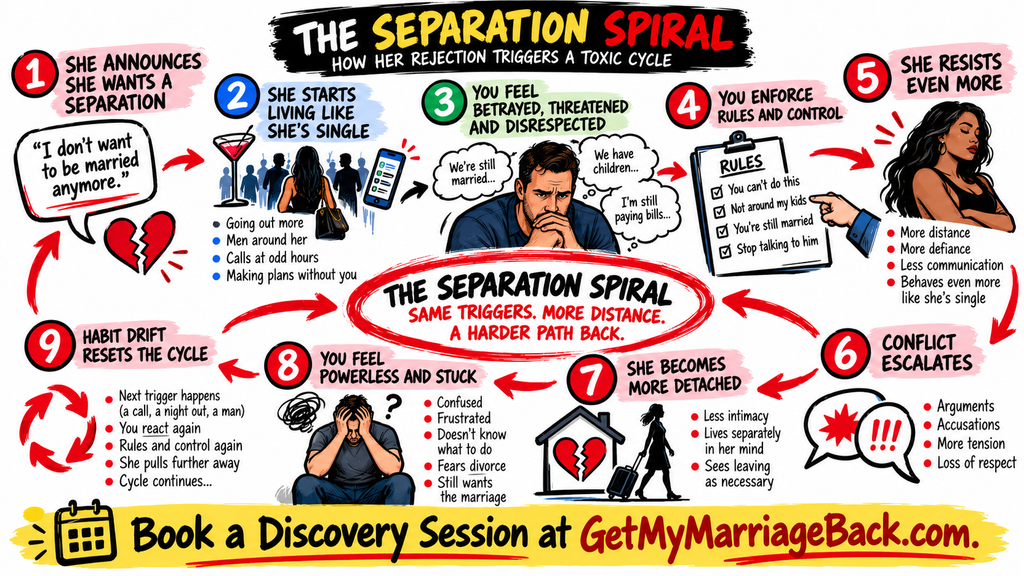
Why Enforcing More Marriage Rules Can Backfire
Imagine your wife starts living single during separation.
Your instinct may be to tighten the rules.
“You cannot do that while my children are here.”
“You cannot have those people around our kids.”
“You are still my wife.”
“You cannot go out at that hour.”
“We are still married.”
Some distinctions are important here.
You absolutely can make responsible decisions concerning your own property, money, time, presence and conduct. You should protect your relationship with your children, fulfill appropriate parental responsibilities and address legitimate matters involving their safety and welfare.
But another adult ultimately controls another adult’s behavior.
That is where many distressed spouses get stuck.
They are trying to save a marriage by enforcing the authority of a position the other spouse has already rejected emotionally.
And every attempt to assert that authority can become, in the departing spouse’s mind, another reason why leaving feels necessary.
It does not mean she is right.
It does not mean you are wrong for being upset.
You do not have to approve of everything she does.
It simply means control and influence are not the same thing.
The Separation Control Trap
The cycle often looks like this:
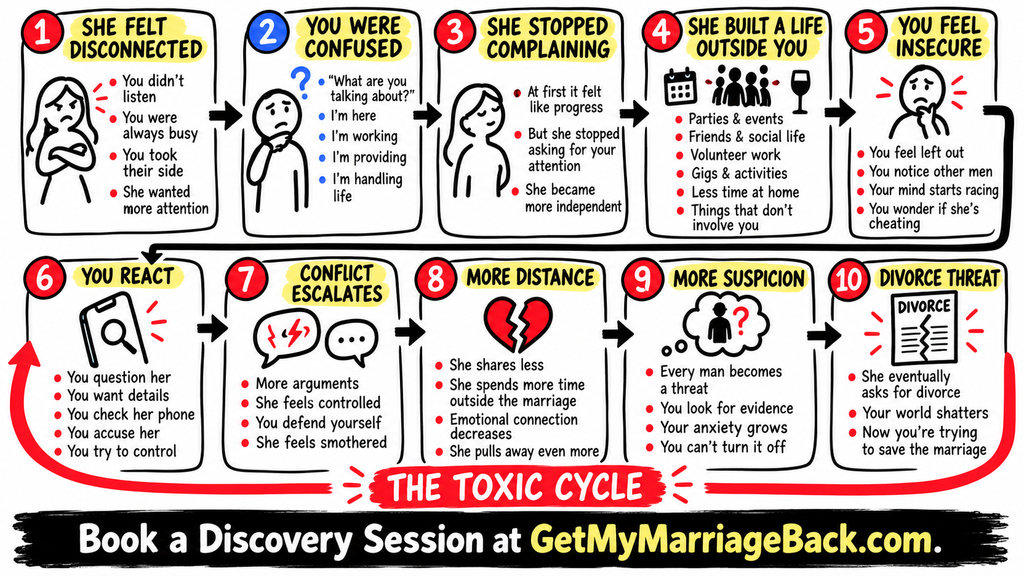
She pulls away → You feel rejected → You demand change → She resists → You enforce harder → She pulls away further → You feel even more powerless.
Now you intensify.
She intensifies her resistance.
Eventually, both people become increasingly convinced that the other’s behavior proves their interpretation of the marriage.
You think:
“She obviously doesn’t respect me, so I need to become firmer.”
She may think:
“He still doesn’t understand why I needed to get away, so I need even more distance.”
Relationship research has examined a related interaction known as the demand-withdraw pattern, where one partner increasingly seeks discussion or change while the other increasingly avoids or withdraws. Research has associated this pattern with relationship distress, although circumstances and context matter; importantly, the person wanting more change—not simply gender—can help determine who occupies which role in the cycle. You can review the underlying research on demand-withdraw patterns in couples for a deeper look at that dynamic.
The practical lesson is powerful.
The harder you chase control, the more resistance may become the response.
And resistance is not attraction.
Attraction During Separation Is an Experience
This is where I want you to stop thinking only about whether you are morally right.
You may be right.
Perhaps your spouse is behaving irresponsibly.
Maybe she is violating expectations you both previously shared.
You might have legitimate reasons to feel betrayed, rejected or disrespected.
But moral value and experiential value are different questions.
Experiential value asks:
What does it feel like to experience you right now?
Pressure?
Interrogation?
Correction?
Criticism?
Surveillance?
Neediness?
Anger?
Or does your presence increasingly communicate emotional stability, purpose, confidence, self-respect and groundedness?
That question matters because attraction is not an argument you win.
Attraction is experienced.
You cannot logically force your spouse to become curious about you.
You cannot lecture somebody into desire.
Nor can you enforce emotional closeness with a marriage certificate.
You can, however, become increasingly responsible for the experience you create.
That is where rebuilding attraction during separation gets interesting.
Shift #1: Stop Trying to Control What She Does Tonight
Suppose it is 11:30 tonight.
Her phone rings.
A man’s name appears.
Immediately, your nervous system lights up.
Or she is getting dressed to go somewhere and you are thinking:
“Where is she going?”
“Who is she meeting?”
“Why is she dressed like that?”
“What married woman behaves this way?”
Everything you intellectually understand about emotional intelligence can disappear within seconds.
You want to confront.
You want to demand.
Maybe you want to remind her that she is still married.
Stress pushes human beings toward familiar responses.
That is why insight alone is not enough.
Your power begins when you recognize that what she does tonight and what you become next are two separate things.
You cannot build attraction while requiring control to feel powerful.
Shift #2: Ground Yourself Before You Try to Influence Her
Your wife’s rejection cannot become the authority that determines who you are.
That is Grounding.
Her mood cannot decide whether you have value today.
A cold text cannot determine whether your life has meaning.
One pleasant interaction cannot make you emotionally euphoric while one distant interaction destroys your confidence again.
Otherwise, your spouse becomes the thermostat controlling your emotional temperature.
She warms up; you feel powerful.
She gets cold; you collapse.
She texts; you see hope.
She ignores you; you imagine divorce.
That emotional volatility creates pressure because every interaction secretly carries a job:
“Please make me feel safe about us.”
Grounding removes that burden.
You can still love your spouse deeply.
You can still want reconciliation.
The difference is that you stop requiring today’s interaction to determine your identity.
That is emotionally intelligent.
It is also more attractive.
Shift #3: Build a Purpose Bigger Than the Crisis
Pain produces energy.
So does rejection.
The question is where that energy goes.
When your wife wants separation, you can burn enormous amounts of emotional energy supervising her life.
Who called?
Where did she go?
Who liked the photo?
Why is she online?
Why didn’t she answer?
Who was that man?
What did she mean by that message?
What happens to attraction when your entire identity becomes private investigator, rejected spouse and marriage emergency manager?
Very little about that state creates curiosity.
Redirect the energy.
Your health matters.
Your children matter.
Your contribution matters.
Your work matters.
Your creativity matters.
Your faith may matter.
Your mission matters.
Your legacy matters.
Purpose does not mean pretending your marriage is unimportant.
It means refusing to make the marriage crisis bigger than your entire existence.
A person engaged with life creates a different experience from a person emotionally waiting outside somebody else’s door for permission to live.
That difference can be felt.
Shift #4: Use Self-Discovery to Recover Personal Power
Separation exposes things.
Let it.
Maybe what you previously called leadership occasionally became control.
Perhaps what you called communication sometimes became interrogation.
What felt like “fighting for my marriage” may occasionally have been panic wearing respectable clothing.
Maybe you abandoned important parts of yourself long before the separation began.
Self-Discovery is not self-condemnation.
It is capacity.
You ask:
“What do I actually control?”
“What patterns do I repeat when I feel rejected?”
“What happens to me when I become afraid?”
“What experience have I been creating?”
“What have I neglected in myself?”
“What kind of spouse am I capable of becoming?”
You are removing the fantasy that the perfect rule, argument, consequence or explanation can force another adult back into alignment.
That fantasy creates desperation.
Personal Power creates choice.
Shift #5: Replace Force With Influence
You never truly had control over your spouse.
You had influence.
There is an enormous difference.
Control says:
“You must behave this way because I am your spouse.”
Influence says:
“My presence, behavior, emotional intelligence and value affect the experience of being in relationship with me.”
Control requires compliance.
Influence leaves another adult with agency.
Control becomes obsessed with enforcement.
Influence becomes interested in experience.
And influence is much closer to attraction.
Think about the progression:
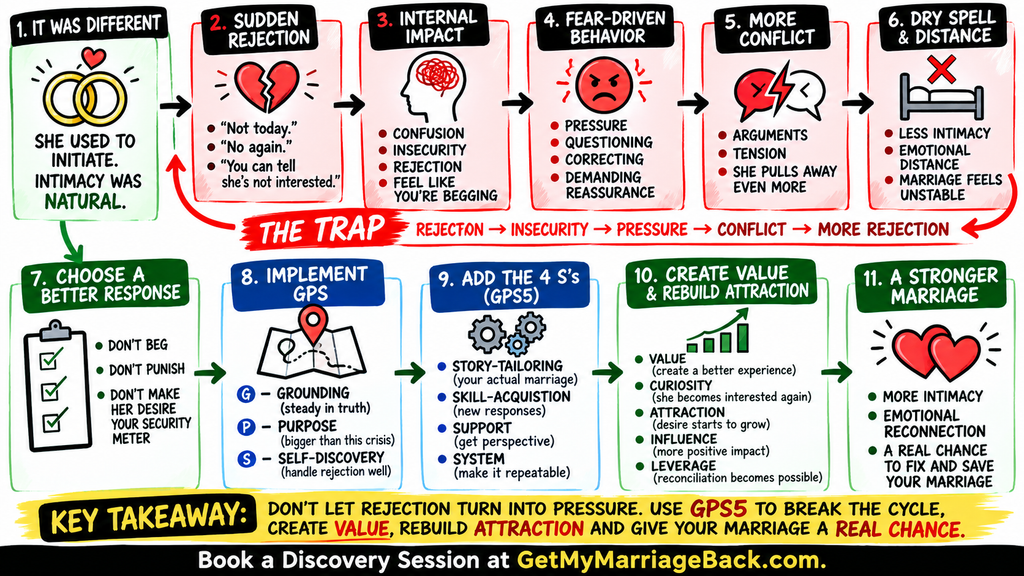
Grounding → Purpose → Self-Discovery → Value → Curiosity → Attraction → Influence → Leverage
Notice what is missing.
Force.
Attraction does not require you to become passive. It requires you to become sophisticated enough to distinguish personal power from controlling behavior.
What Experiential Value Looks Like During Separation
Experiential value does not mean becoming endlessly agreeable.
It does not mean accepting disrespect.
You are not required to pretend something doesn’t hurt when it does.
Experiential value means your spouse encounters somebody increasingly capable of handling emotional discomfort without automatically converting it into pressure.
You can disagree without prosecuting.
You can listen without immediately correcting.
A boundary can be expressed without turning it into an attempt to control another adult.
You can be warm without begging.
You can care without hovering.
You can remain interested without interrogating.
You can become more attractive without playing jealousy games.
This is seduction at a much more emotionally intelligent level.
You are not manufacturing anxiety so your spouse chases you.
You are rebuilding the conditions that make curiosity possible.
Curiosity Is the Bridge Back to Attraction
A spouse who believes she completely understands you has very little left to discover.
Especially when her current story about you is negative.
“He always reacts like this.”
“I already know what he’s going to say.”
“He will interrogate me.”
“He will get angry.”
“He will beg.”
“He will lecture me about the marriage.”
Predictability becomes dangerous when the predicted experience is unpleasant.
Genuine change interrupts that prediction.
You respond differently.
You become less reactive.
Your life becomes fuller.
Your purpose becomes visible.
Your emotional stability improves.
The interaction she expected does not happen.
Now something becomes possible:
Curiosity.
“What changed?”
“Why didn’t that trigger him?”
“Why does he seem different?”
“What has he been doing?”
“Why does talking to him feel different now?”
You cannot demand those questions.
That is precisely why they matter.
Curiosity belongs to the person experiencing it.
And curiosity is almost attraction.
Don’t Turn Attraction Into Another Manipulation Strategy
This part is crucial.
Once people understand the value of curiosity, they sometimes immediately start performing.
They deliberately ignore texts.
Post photographs to create jealousy.
Pretend somebody else is interested.
Disappear because an internet rule told them to.
Become cold so their spouse will chase.
That is not Personal Power.
It is still obsession.
The spouse remains at the center of every move.
You are still asking:
“Did she notice?”
“Did she react?”
“Is she jealous?”
“Does she miss me now?”
“Is this working?”
The costume changed.
The dependency did not.
Real growth continues even when nobody applauds.
You ground yourself because emotional stability serves your life.
Purpose matters because your existence has meaning.
Self-Discovery matters because you need capacity.
Experiential value matters because you want your presence to become richer, healthier and more engaging.
When those changes become authentic, curiosity has room to emerge naturally.
What About Men Calling Your Wife During Separation?
This is where theory becomes difficult.
You may be able to calmly discuss Grounding at 2:00 in the afternoon.
At 11:30 at night, when a man’s name appears on her phone, the emotional test becomes real.
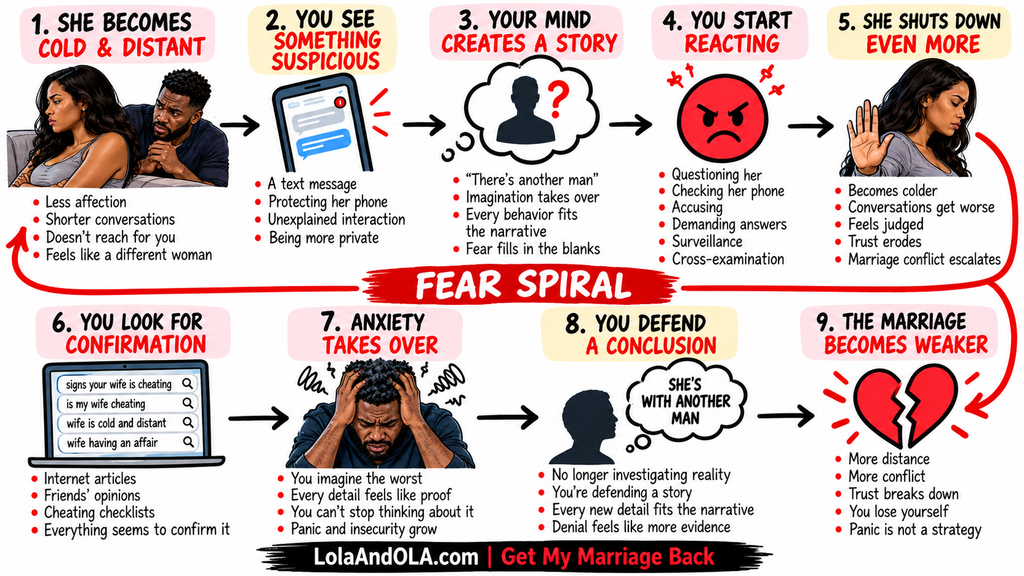
First, separate facts from interpretations.
A man’s name on a phone is a fact.
“He is replacing me” is an interpretation unless you know that.
“She has been cheating for months” is a conclusion that requires evidence.
Your feelings can still be intense.
Emotional intelligence does not require pretending otherwise.
But strong feelings should not automatically become instructions.
Before acting, ask:
What do I actually want?
If your answer is:
“I want to save my marriage.”
Then ask the more difficult question:
Is what I am about to do creating movement toward what I actually want?
That question does not excuse infidelity.
It does not erase boundaries.
You are simply refusing to let emotional activation choose your strategy.
What If Your Wife Is Actually Dating During Separation?
Then you need clarity about the facts and your own standards.
Separation can mean very different things to different couples. Some spouses understand separation as remaining romantically exclusive while living apart; others treat it as the beginning of the end of the relationship.
Do not assume both people are operating under the same definition.
Have necessary conversations about children, finances, property, sexual health, living arrangements and whatever agreements legitimately affect both parties.
But recognize the boundary between an agreement and control.
You can decide what you participate in.
You can decide what you accept in a relationship.
You can decide what conditions would need to exist for reconciliation.
What you cannot do is convert those decisions into remote control over another adult.
Personal Power says:
“I know what I stand for.”
Control says:
“Therefore you must obey.”
The difference matters.
Saving Your Marriage Alone Does Not Mean Doing Nothing
People hear “stop controlling” and sometimes translate it into:
“So I’m supposed to let my spouse do whatever she wants?”
No.
You are supposed to stop measuring your power by whether another adult complies with you.
That is different.
Saving your marriage alone means you take responsibility for the side of the relational system you can actually influence directly:
Your emotional regulation.
Your communication.
Your purpose.
Your behavior.
Your reactions.
Your standards.
Your parenting.
Your integrity.
Your personal development.
Your experiential value.
You cannot perform both sides of reconciliation.
But you can dramatically change the experience coming from your side.
That is not weakness.
It requires substantially more strength than yelling a rule at somebody who has already decided she doesn’t recognize your authority.
The Announcement Is a Lagging Indicator
Remember where we started.
Your wife says:
“I want separation.”
That announcement may be a lagging indicator.
The emotional decision may have been developing long before the announcement.
Now consider the other side.
Your behavior today is a leading indicator.
The way you handle rejection today matters.
How you respond to uncertainty matters.
What you build during separation matters.
Whether you become more grounded or more reactive matters.
The experiential value you create matters.
Your capacity to distinguish influence from control matters.
That is where your power lives.
Not in controlling what she does tonight.
In controlling what you become next.
How to Save Marriage During Separation Without Becoming Powerless
Start with the actual objective.
Do you want revenge?
Do you want to prove that you are right?
Do you want your spouse to feel guilty?
Do you want compliance?
Or do you want to create the strongest possible relational environment for marriage reconciliation?
Those objectives produce different behavior.
When your goal is reconciliation, attraction needs emotional breathing room.
Respect needs consistency.
Influence requires credibility.
Curiosity needs something new to discover.
Personal Power requires an identity that survives rejection.
That is why building and nurturing attraction during separation is not fundamentally about tricks.
It is about emotional capacity.
You become more skillful.
More grounded.
More purposeful.
More interesting to yourself.
Less easily controlled by temporary emotional weather.
More capable of warmth without pursuit.
More capable of strength without domination.
More capable of boundaries without attempting to parent your spouse.
More capable of desire without desperation.
That combination is powerful because your spouse is no longer interacting exclusively with the person desperately trying to save the marriage.
She gets the opportunity to experience you again.
The Real Attraction Shift When Your Wife Is Living Single During Separation
Your instinct says:
“Get her under control.”
Your fear says:
“Stop this before I lose her.”
Your ego says:
“She cannot disrespect me like this.”
Your pain says:
“Make her understand what she’s doing to me.”
But attraction asks a different question:
What is it like to experience you right now?
That is where the work becomes seductive rather than controlling.
Your goal is not to become somebody who tolerates everything.
It is to become somebody who does not require another adult’s obedience to possess Personal Power.
When that transformation becomes real, your presence changes.
Pressure can become composure.
Interrogation can become discernment.
Criticism can become clarity.
Desperation can become purpose.
Control can become influence.
Predictability can become curiosity.
And curiosity can create room for attraction that no argument, rule or marriage certificate could force into existence.
Your spouse’s announcement is a lagging indicator.
Who you become next is the leading indicator.
19 Signs Your Wife Is Not Sexually Attracted To You
Frequently Asked Questions
Yes, separation does not automatically mean divorce, and some separated couples do reconcile. What happens during the separation—including communication, unresolved problems, boundaries and each spouse’s behavior—matters.
Clarify necessary agreements involving children, finances, property and exclusivity while focusing on what you actually control: your conduct, emotional regulation and standards. Trying to supervise another adult usually creates a different relational experience from expressing a clear boundary.
Space can reduce unnecessary pressure when a spouse is already withdrawing, but it should not be confused with punishment, manipulation or ignoring legitimate responsibilities. The goal is emotional breathing room, not a tactic designed to force pursuit.
Build attraction through Grounding, Purpose, Self-Discovery and stronger experiential value rather than chasing reassurance or trying to enforce desire. Become more emotionally responsive, purposeful and self-directed so that your spouse has an opportunity to experience something genuinely different.