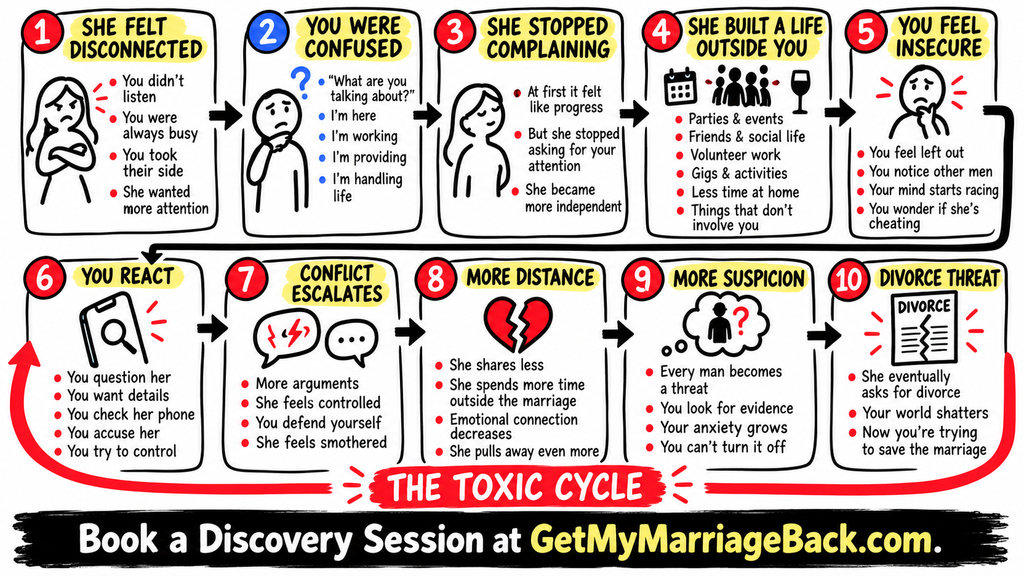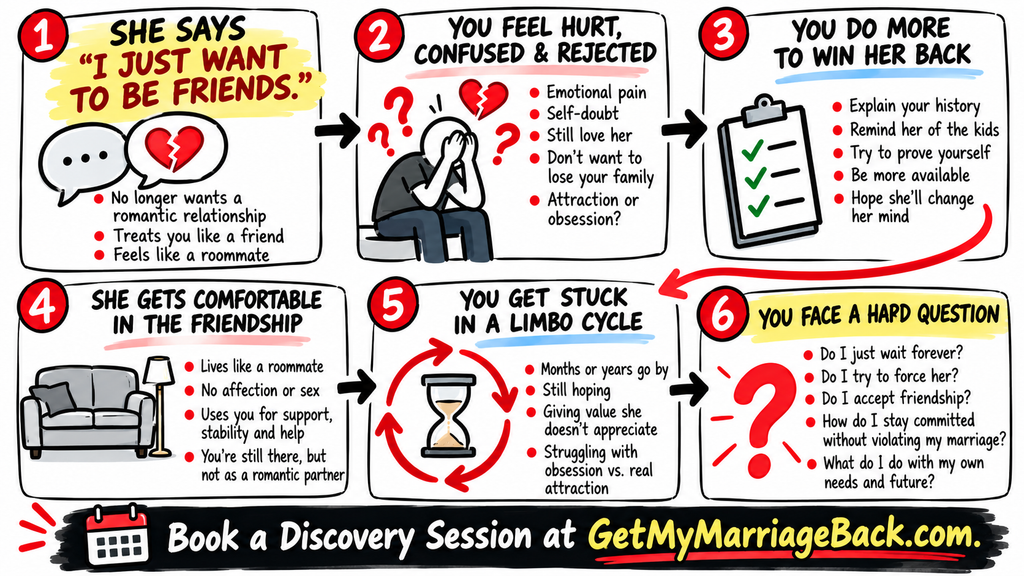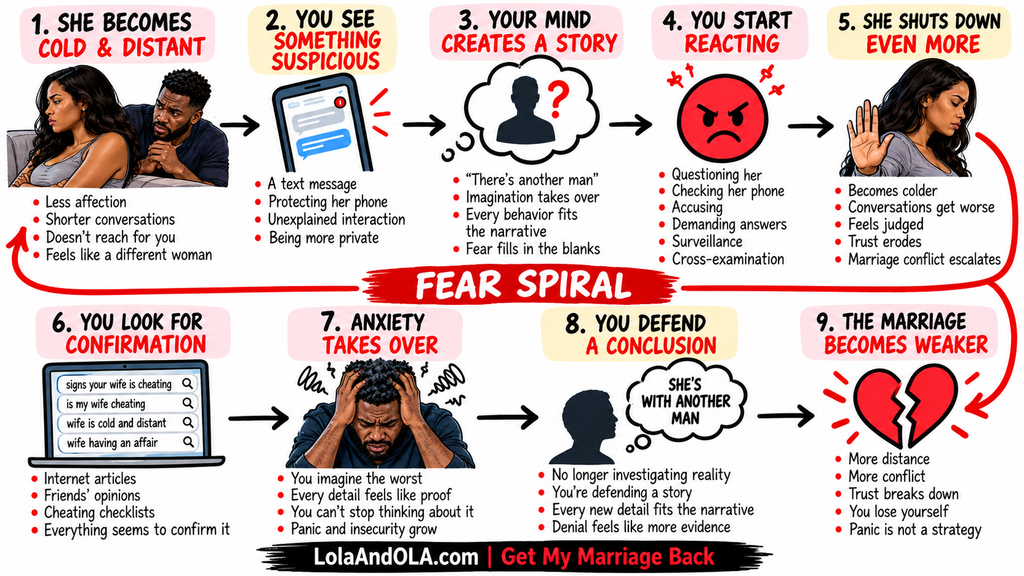

Broken Marriage?
Fix it
Here FREE

Get My Marriage Back


My Wife Loves Me but Is Not Sexually Attracted to Me: 7 Signs & Truths

Your wife says she loves you. She may still care about you, raise children with you, laugh with you, sleep next to you, and consider you an important part of her life.


Take This 2 Minutes Quiz

Question 1 of 15

But something feels painfully different.

She rarely initiates intimacy. Kissing has lost its energy. Sex feels mechanical, negotiated, infrequent, or completely absent. Affection may still exist, but you no longer feel wanted.

Eventually, one thought starts following you everywhere:

“My wife loves me but is not sexually attracted to me. What does that actually mean for my marriage?”

That question hurts because love and desire feel like they are supposed to travel together.

They don’t always.

The first distinction I want you to understand is this:

Love and sexual attraction are related, but they are not the same experience.

Your wife can genuinely love you and still experience a major loss of sexual attraction. That does not automatically mean your marriage is over, but it does mean something in the romantic experience of the marriage deserves your attention.

Research supports the broader point that sexual desire naturally changes over the course of long-term relationships. A systematic review of long-term desire research found that desire is dynamic rather than fixed and is influenced by multiple individual and relationship factors. (PubMed)

The danger begins when rejection convinces you that your job is to force attraction back as quickly as possible.

That instinct is understandable.

It is also where many people make the crisis worse.

Truth #1: Less Sex Does Not Automatically Mean Your Wife No Longer Loves You

When sexual intimacy disappears, your mind wants a clean explanation.

You may conclude:

“She doesn’t love me anymore.”

“She must be attracted to somebody else.”

“My marriage is dead.”

“I must not be good enough.”

“She’s only staying because of the children.”

Any of those possibilities can exist in a particular marriage, but sexual rejection alone does not prove them.

A lower level of desire can be connected to stress, accumulated resentment, relationship dissatisfaction, health issues, emotional disconnection, sexual pressure, predictable routines, exhaustion, changing life circumstances, or differences in how desire is experienced.

Research has also examined responsive desire, meaning desire that develops in response to sufficiently appealing sexual or relational cues rather than always appearing spontaneously beforehand. That matters because the absence of spontaneous initiation does not necessarily tell you everything about someone’s capacity for desire.

So when your wife never initiates intimacy, you want to take the symptom seriously without turning one symptom into a complete diagnosis.

The question is not simply:

“How do I get more sex?”

A better question is:

“What has changed in the experience of this marriage, and what am I creating on my side of that experience?”

That question gives you something useful to work with.

my wife loves me but is not sexually attracted to me

Truth #2: Sexual Rejection Becomes More Dangerous When You Turn Sex Into Proof

One of the easiest mistakes to make is using sexual intimacy as your marriage scoreboard.

Your wife touches you affectionately and your mind immediately says:

“Maybe tonight.”

She kisses you differently and you think:

“She wants me again.”

Two good nights happen and you conclude:

“We’re finally fixing this.”

Then she pulls away again.

Suddenly you feel devastated.

Now every interaction carries a hidden question:

Does she desire me yet?

That is what I mean by turning sex into proof.

You stop experiencing intimacy and start investigating it.

Instead of a kiss being a kiss, it becomes evidence.

Instead of sex being an experience between two people, it becomes confirmation that you still matter.

Instead of rejection being one disappointing moment, it becomes a verdict about your masculinity, desirability, and marriage.

That creates enormous emotional pressure.

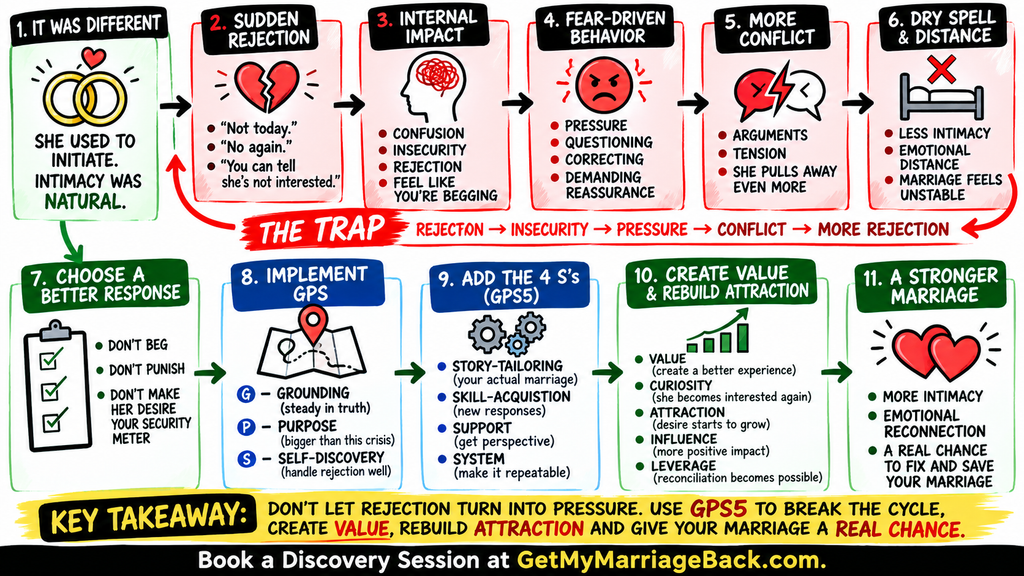
The pattern developed in this teaching begins with rejection and quickly progresses into testing, begging, proving, pressure, and then renewed rejection.

In other words:

Rejection → Testing → Begging → Proving → Pressure → More Rejection

Once you understand the cycle, the problem becomes easier to see.

You are no longer dealing only with your wife’s attraction.

You are also dealing with what rejection is turning you into.

Trying Harder Can Make You Less Attractive - my wife loves me but is not sexually attracted to me

Truth #3: Trying Harder Can Make You Less Attractive

This is the counter-intuitive part.

Your wife becomes less sexually responsive, so you become more attentive.

You initiate more.

You increase compliments.

You become unusually agreeable.

You start doing things around the house you never cared about before.

You organize dates.

You buy gifts.

You repeatedly ask how she feels.

None of those behaviors are inherently unattractive.

Your emotional motivation changes their meaning.

There is a major difference between expressing genuine interest and performing for reassurance.

When the hidden message underneath your behavior becomes:

“Please respond positively so I can feel okay again,”

you are no longer simply giving.

You are asking for emotional payment.

The delivered teaching makes the same distinction between dignity-based pursuit and fear-driven chasing: pursuit expresses genuine interest while maintaining your Personal Power; chasing is driven by panic and an urgent need to change the other person’s response.

People often feel that emotional difference even when nobody says it aloud.

Your intention may be love.

Her experience may still be pressure.

That distinction matters.

my wife loves me but is not sexually attracted to me - Pressure Is Especially Dangerous Around Sex

Truth #4: Pressure Is Especially Dangerous Around Sex

Sexual attraction does not respond well to obligation.

You cannot logically argue someone into desire.

You cannot demand enthusiasm.

You cannot negotiate genuine curiosity into existence.

Research gives this distinction real weight.

Across two dyadic studies involving 103 couples in one study and 147 couples in another, researchers found that sexual experiences driven more by autonomous reasons—pleasure, genuine value, and personal choice—were associated with greater satisfaction and desire. More controlled or pressured sexual motivation was associated with poorer outcomes. (PubMed)

That doesn’t mean you stop expressing sexual interest.

It means you stop making your interest a demand for immediate validation.

This becomes especially important when you’re thinking:

“My wife is not sexually attracted to me—what should I do?”

Start by removing the emotional assignment.

Your wife cannot be responsible for having sex with you so you can feel attractive.

She cannot be responsible for initiating enough times per month to keep your confidence stable.

Her body cannot become your Personal Power meter.

Once that happens, every “no” becomes a psychological emergency.

Pressure rises.

Attraction usually does not.

Truth #5: Your Wife’s Attraction Is an Experience, Not a Moral Judgment

When someone says, “My wife is not attracted to me,” the sentence often quietly becomes:

“Therefore, something is wrong with me.”

That’s where shame enters.

Then you compare yourself to other people.

Is another man more attractive?

Am I too old?

Did I gain weight?

Do I make enough money?

Am I boring?

Does she respect me?

Those questions can become obsessive because rejection attacks your sense of significance.

I want you to separate value from moral worth.

When I talk about becoming more valuable in attraction, I am not saying you are a more worthy human being than somebody else.

I am talking about the experience of being around you.

Are you grounded or constantly anxious?

Interesting or completely consumed by the marriage crisis?

Emotionally intelligent or reactive?

Purposeful or waiting for your wife’s next reaction?

Playful or permanently serious?

Present or constantly testing?

Confident enough to hear “no” without collapsing?

Capable of expressing desire without demanding reassurance?

That is experiential value.

The original framework puts the work back on your capacity rather than manipulating your wife. As the constructive side develops, Grounding leads into Purpose, Self-Discovery, Value, and ultimately the possibility of Curiosity & Attraction.

That gives you a much stronger place to operate from.

Truth #6: The Roommate Marriage Is Usually Bigger Than the Bedroom

When a wife treats you like a roommate, the obvious symptom is often sexual.

The deeper problem is usually experiential.

Your conversations may revolve around children, groceries, schedules, money, work, chores, and logistics.

You function well.

You cooperate.

You manage life.

But the romantic energy has disappeared.

Everything becomes predictable.

Attraction rarely thrives when two people experience each other primarily as household administrators.

That does not mean you need theatrical date nights or manipulative “seduction techniques.”

It means you need to understand what has disappeared from the experience of you.

Curiosity matters.

Play matters.

Autonomy matters.

Emotional responsiveness matters.

Purpose matters.

A sense that you remain a developing human being rather than a permanently available household fixture matters.

Research on partner responsiveness offers an important piece of this. Across three studies, researchers found that perceived partner responsiveness—feeling understood, validated, and cared for—was associated with greater sexual desire, particularly under certain relationship conditions. (PubMed)

Notice what that does not say.

It does not say:

“Become endlessly available.”

It does not say:

“Agree with everything.”

It does not say:

“Perform kindness until your wife owes you attraction.”

Emotional responsiveness is not servitude.

It is emotional intelligence.

You can understand someone’s experience without abandoning your own center.

Truth #7: Attraction Is Rebuilt Through Capacity, Not Control

So what do you actually do when your wife loves you but doesn’t desire you?

You build your attraction capacity.

I break the constructive process down this way:

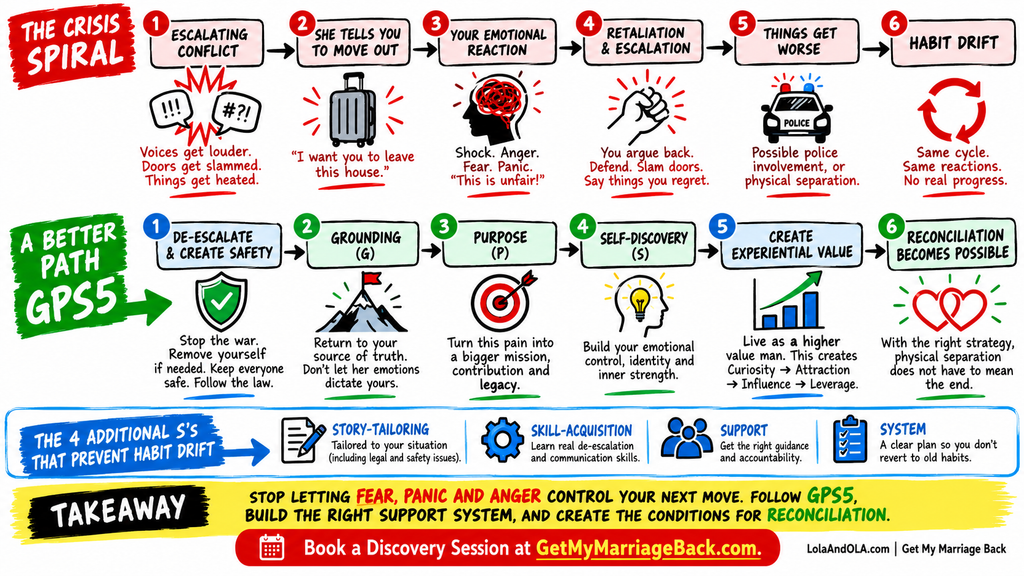
Rejection → Grounding → Purpose → Self-Discovery → Value → Curiosity & Attraction → Rejection

Yes, rejection appears at both ends.

That’s intentional.

Your goal is not to construct a life in which your wife never rejects you again.

Your goal is to develop the emotional capacity to experience rejection without returning to panic.

Grounding: Stop Letting Rejection Become Your Strategist

Rejection hurts.

Acknowledge that.

Then refuse to make pain your decision-maker.

Grounding means returning to a higher reference point before acting: gratitude, faith, perspective, emotional stability, health, responsibility, and the larger reality of your life.

Your marriage matters tremendously.

It is still not the only thing that makes your life meaningful.

The delivered framework describes grounding as returning to your higher self and source of truth rather than allowing the immediate emotional experience to control your interpretation of life.

This is where Personal Power starts returning.

Purpose: Stop Making Your Marriage Your Full-Time Occupation

A marriage crisis can consume every waking thought.

You wake up thinking about her.

You analyze breakfast.

You replay her tone.

You inspect text messages.

You think about sex.

You think about why you’re not having sex.

You search for signs.

You replay conversations.

You plan your next conversation.

Your entire psychological world becomes your marriage.

Purpose breaks that obsession.

Purpose means reinvesting pain into a mission larger than the immediate crisis.

Your health.

Your children.

Your work.

Your business.

Your spirituality.

Your creativity.

Your contribution.

Your friendships.

Your education.

Your legacy.

This isn’t a trick designed to make your wife miss you.

As a matter of fact, if you engage purpose solely to produce a reaction from her, you are still performing.

Purpose matters because your life should possess meaning even while your marriage is uncertain.

That change alone affects the experience of being around you.

Self-Discovery: Examine Yourself Without Turning It Into Self-Blame

Now you can ask better questions.

When did I become so afraid of rejection?

Where did my confidence become dependent on sexual approval?

Have I become predictable?

Do I communicate desire as interest or pressure?

What happens inside me when my wife says no?

Have resentment and frustration changed how I show up?

Did I stop developing?

Am I fun to be around?

Have I confused being a good husband with being an attractive human being?

Self-discovery requires curiosity rather than shame.

The original constructive teaching makes exactly that distinction: you examine yourself without self-blame so rejection becomes information rather than a determinant of your value.

This gives you room to grow instead of defend yourself.

Value: Become Experientially Attractive

Here’s where the word “seduction” gets misunderstood.

Seduction is not trickery.

It is not withholding affection to manipulate somebody.

It is not pretending you don’t care.

It is not manufacturing jealousy.

Healthy seduction is the art of becoming an increasingly engaging experience.

You develop emotional control.

You take care of your body.

You develop purpose.

You become socially alive.

You communicate clearly.

You listen without collapsing.

You express sexual interest without turning it into a negotiation.

You become less predictable because you are actually growing—not because you’re playing a game.

You regain confidence because you’re living from confidence-producing behaviors.

That is fundamentally different from announcing:

“Look how much I’ve changed.”

Real value does not need a press release.

Curiosity & Attraction: Stop Trying to Manufacture the Outcome

Attraction is not the assignment.

It is an outcome.

Curiosity is not something you demand from your wife.

It naturally has more room to emerge when you stop presenting the same fearful, overavailable, approval-seeking experience every day.

This is where many people make one final mistake.

They start improving themselves and immediately monitor the response.

“She touched me yesterday.”

“She laughed at my joke.”

“She seems warmer.”

“Did it work?”

Now they’re testing again.

That drops them right back into the destructive cycle.

Don’t turn personal growth into another attraction experiment.

Build because the capacity belongs to you.

What About Sex? Should You Stop Initiating Completely?

No universal rule says that you must stop initiating intimacy.

Rigid rules create new forms of fear.

The real question is what is driving your initiation.

Are you expressing genuine sexual interest?

Or are you asking for proof that you still matter?

Can you express desire and remain emotionally grounded if the answer is no?

Do you respect the response without sulking, withdrawing affection, arguing, or immediately asking what is wrong?

That’s the difference.

Research on sexual motivation repeatedly finds that autonomy matters. Sexual experiences driven by choice and genuine interest are associated with better sexual and relational outcomes than experiences dominated by pressure or obligation. (PubMed)

So yes, you can remain sexually expressive.

Just stop making sex responsible for stabilizing your identity.

“What If She’s Attracted to Someone Else?”

This possibility frightens people because sexual rejection at home often creates immediate suspicion.

An affair or outside attraction can absolutely affect a marriage.

But you do not gain Personal Power by inventing evidence.

Your job is to deal with reality as it becomes available.

If there is credible evidence of infidelity, secrecy, deception, or another relationship, that becomes a different marriage-crisis problem requiring its own strategy.

Until then, obsession is not investigation.

Fear will happily create an entire affair inside your imagination before facts exist.

Stay grounded enough to respond to what is real.

Can Sexual Attraction Return in a Marriage?

Yes, attraction is not necessarily fixed.

That statement does not mean you control another person’s feelings.

It means attraction itself can change.

Long-term desire research describes sexual desire as something that ebbs and flows rather than remaining at one permanent level. (PubMed) Partner responsiveness has also been linked with increased desire, while autonomous sexual motivation is associated with stronger desire and satisfaction than pressured motivation. (PubMed)

That gives you an important distinction:

You cannot command attraction, but you can influence the environment in which attraction either struggles or has room to grow.

Pressure hurts that environment.

Begging hurts it.

Constant testing hurts it.

Performing for approval hurts it.

Emotional instability hurts it.

A chronically roommate-like experience can hurt it.

Grounding changes the environment.

Purpose changes it.

Self-discovery changes it.

Experiential value changes it.

Emotional intelligence changes it.

Healthy sexual expression changes it.

Curiosity has more room to breathe when pressure leaves the room.

The Goal Is Not to “Make Your Wife Want You”

That phrase sounds attractive because it promises control.

It also puts you on the wrong side of the problem.

You cannot make another human being experience desire.

What you can do is become much more skillful at attraction.

Learn how pressure feels.

Understand the difference between pursuit and fear-driven chasing.

Develop emotional control.

Stop using intimacy as evidence.

Become less psychologically dependent on reassurance.

Build a meaningful life.

Rediscover yourself.

Increase the experiential value of being around you.

Express attraction without demanding reciprocity on your timetable.

That is seduction with dignity.

That is emotional intelligence applied to attraction.

Most importantly, that is Personal Power.

When your wife says she loves you but sexual attraction seems gone, the goal isn’t to pretend rejection does not hurt.

The goal is to become capable of carrying that pain without letting it turn you into someone who creates even more rejection.

Once you can do that, you’re no longer desperately asking:

“How do I make her desire me?”

You start asking a much stronger question:

“Who am I becoming in this marriage, and what experience of me am I creating?”

That question belongs to you.

And because it belongs to you, you can actually do something about it.

My Wife Loves Me But Doesn’t Desire Me | 5 Signs | 5 Tips

Frequently Asked Questions

Can my wife love me but not be sexually attracted to me?

Yes. Love, attachment, commitment, and sexual attraction overlap, but they are not identical experiences, and desire can fluctuate significantly throughout a long-term marriage.

Why is my wife no longer sexually attracted to me?

There is no single cause; stress, resentment, emotional disconnection, relationship dissatisfaction, health factors, predictability, sexual pressure, and changing desire can all play a role. Look at the overall marriage pattern rather than assuming one symptom provides the entire diagnosis.

Can a marriage survive without sexual attraction?

A period of low attraction does not automatically mean the marriage will end, particularly because desire can change over time. The more useful question is whether you can address the underlying relational experience without turning sex into pressure, proof, or obligation.

What should I do if my wife is not sexually attracted to me?

Stop treating her desire as the source of your confidence, reduce pressure, ground yourself, reinvest in purpose, examine your patterns without self-blame, and develop the experience of value you bring into the marriage. Attraction cannot be demanded, but you can become far more skillful about creating conditions that support curiosity, desire, and emotional connection.

If Someone Wants a Divorce and the Other Doesn’t: 4 Mistakes

When one person wants a divorce and the other doesn’t, the marriage suddenly feels like an emergency.


Take This 2 Minutes Quiz

Question 1 of 15

You want to save your marriage. Your husband or wife sounds increasingly certain that leaving is the answer. Every conversation feels loaded, every period of silence feels dangerous, and every cold interaction can make you wonder whether you are running out of time.

That fear makes immediate action feel intelligent.

It usually isn’t.

One of the most important lessons I learned during my own marriage crisis is this: fear cannot become your strategist.

Your desire to save your marriage is not the problem. The problem begins when fear turns that desire into begging, debating, proving, performing, checking, and demanding reassurance.

Those behaviors feel like fighting for your marriage from your side.

From the other side, they can feel like pressure.

That distinction matters because when your husband or wife already feels emotionally checked out, pressure rarely creates the experience that restores attraction. It often strengthens the exact emotional environment they are trying to escape.

The better question is not:

“How do I make my husband or wife change their mind about divorce?”

The better question is:

“What can I change about the experience I am creating while I still have control over myself?”

That is where emotional intelligence, attraction, dignity, and reconciliation strategy meet.

Why Your Panic Makes Perfect Sense—and Why You Still Cannot Follow It

Divorce threatens several things at once.

It threatens your marriage, family structure, identity, routines, financial expectations, future plans, sense of belonging, and sometimes your relationship with your children.

Naturally, your nervous system wants certainty.

You want to know:

  • Are you still filing for divorce?
  • Do you still love me?
  • Is there somebody else?
  • Can this marriage be saved?
  • Do you notice that I’ve changed?
  • Are we getting better?
  • Do you still want to separate?

Those questions are understandable.

Repeatedly demanding answers to them is another matter.

Research on what psychologists call demand-withdraw communication helps explain why. In a longitudinal study, demanding behavior—and to a lesser extent withdrawal—was associated with relationship satisfaction both initially and 2.5 years later. Other research has also associated demand-withdraw communication with greater distress and lower relationship satisfaction.

The pattern is easy to recognize in a marriage crisis.

You feel the marriage slipping away, so you push for another conversation.

Your husband or wife feels pressured, so they withdraw.

Their withdrawal scares you.

Now you push harder.

The increased pressure produces greater withdrawal.

Eventually, you interpret that withdrawal as proof that the divorce is becoming inevitable.

You have just recreated the fear that started the cycle.

if someone wants a divorce and the other doesn't

The Divorce Panic Cycle

The destructive pattern usually looks something like this:

FEAR → Begging → Arguing → Proving → Pressure → FEAR

The problem is not that you care too much.

The problem is that fear turns love into an attempt to control an outcome that belongs partly to another adult.

During my own crisis, it took me time to understand that my intentions were not enough. What I intended as fighting for my marriage could still be experienced as neediness and pressure.

That difference between intention and experience is one of the most important emotional-intelligence lessons you can learn.

Mistake #1: Begging Your Husband or Wife to Stay

Begging often sounds loving from inside your own head.

“Please don’t do this.”

“Think about the kids.”

“We’ve been together too long to throw this away.”

“Just give me one more chance.”

“I promise everything will be different.”

The emotion underneath those statements is usually fear.

Begging places your emotional stability inside your husband or wife’s decision. Now the person who is already questioning the marriage also feels responsible for reducing your panic.

That creates emotional weight.

Love is not supposed to feel like captivity.

Healthy pursuit has dignity. Fear-driven chasing says, in effect, “I cannot be okay unless you choose me right now.”

Those experiences feel completely different.

Attraction requires enough emotional freedom for another person to experience you rather than manage you.

Mistake #2: Trying to Win the Divorce Debate

After begging fails, many people switch strategies without realizing it.

They start arguing.

You tell your husband or wife:

“Every marriage has problems.”

“You’re giving up too quickly.”

“You haven’t really tried.”

“Divorce will hurt the children.”

“You’re only focusing on the negative.”

Some of these statements can contain truth.

Truth is not the same thing as timing, emotional intelligence, or influence.

When your husband or wife says the marriage no longer feels right to them, arguing against that experience can sound like you are telling them that their feelings are invalid.

Now you’re trying to win a logical debate against an emotional conclusion.

That tends to be a losing game.

Research on intimacy provides an important clue here. Studies of married couples have found that perceived responsiveness—feeling understood, validated, and cared for—plays an important role in experiences of intimacy.

That does not mean agreeing with a divorce.

It means understanding this distinction:

Listening to someone’s experience is not surrendering your position.

You can want your marriage while refusing to litigate another adult’s feelings.

That is strength.

Mistake #3: Performing Change to Get a Reaction

Eventually you realize arguing is not working.

So you start improving.

At first glance, this sounds ideal.

You become more helpful. You improve your appearance. You start reading marriage books. You become more agreeable. You go to the gym. You work on communication. You become unusually attentive.

Nothing is inherently wrong with those changes.

The hidden problem is the scoreboard.

You keep wondering:

Did they notice?

Now your improvement is still organized around your husband or wife’s reaction.

You wear something better and watch their face.

You clean the house and wait for appreciation.

You become calmer and wonder why they still haven’t changed their mind.

You initiate affection and use the response as evidence about the marriage.

That’s performance.

Authentic self-development does not require immediate applause.

When I finally redirected my own energy away from begging and proving, personal development became valuable because it belonged to me. I had to confront what the crisis exposed about my character, habits, assumptions, purpose, and emotional capacity.

That is very different from becoming “better” for three days so your wife or husband will cancel a divorce.

Mistake #4: Demanding Certainty Before Certainty Exists

This is where the pressure reaches its peak.

You have begged.

You have talked.

You have changed.

Now you want the verdict.

“Are we staying married?”

“Are you still leaving?”

“Do you believe I’ve changed?”

“Are we reconciling?”

Those questions feel reasonable because certainty is psychologically comforting.

Unfortunately, attraction, trust, curiosity, warmth, and reconciliation are experiential.

You cannot demand an experience into existence.

You cannot demand desire any more effectively than you can command someone to become genuinely curious about you.

Pressure tends to make these experiences less natural.

That is why the most powerful move during a marriage crisis is not emotional disappearance and not manipulation.

It is building capacity.

if someone wants a divorce and the other doesn't - How to Save Your Marriage When You're the Only One Trying

How to Save Your Marriage When You’re the Only One Trying

Saving your marriage alone does not mean doing two people’s work.

You cannot manufacture another person’s decision.

What you can do is stop adding unnecessary pressure while becoming a stronger, more emotionally intelligent version of yourself.

The constructive roadmap looks like this:

FEAR → Grounding → Purpose → Self-Discovery → Value → Curiosity & Attraction → FEAR

Notice something important.

Fear eventually comes back.

That is intentional.

Marriage reconciliation is not a straight line where you finally become enlightened and never feel rejected again.

Life will test your capacity.

Your husband may still seem cold.

Your wife may still mention separation.

A good conversation can be followed by silence.

Warmth can appear and disappear.

The question becomes whether every uncomfortable moment sends you back into panic.

Step 1: Ground Yourself Before Trying to Save the Marriage

Grounding does not mean eliminating fear.

It means refusing to give fear control of your behavior.

Return your attention to what remains true and stable:

your health, responsibilities, work, faith, children, friendships, gratitude, sleep, emotional regulation, and personal standards.

Your marriage is important.

It cannot become your entire identity.

When one interaction controls your mood for three days, your emotional center has moved outside yourself.

Bring it back.

This is attractive in the deepest sense of the word because grounded people create less emotional chaos around themselves.

They are easier to experience.

Step 2: Turn Marriage Pain Into Purpose

One of the fastest ways to become emotionally suffocating during a divorce threat is to make the marriage your full-time occupation.

You wake up thinking about your husband.

You check your phone.

You analyze your wife’s tone.

You search divorce questions during lunch.

You replay last night’s conversation.

Then you lie awake trying to interpret everything again.

Your life becomes smaller while your obsession grows larger.

Purpose reverses that contraction.

Take the pain and redirect some of that energy toward mission.

Work.

Create.

Exercise.

Learn.

Parent.

Build.

Serve.

Reconnect with ambitions you neglected.

Purpose is not a trick to make your husband jealous or your wife curious.

The value is that you become alive again.

Ironically, aliveness is far more attractive than desperation.

Research on self-expansion supports part of this principle. Studies have found associations between self-expanding experiences and greater passion, positive emotion, relationship satisfaction, and sexual desire.

Novelty and personal growth matter because attraction does not thrive only on familiarity.

A marriage needs life inside it.

Step 3: Use the Crisis for Self-Discovery, Not Self-Blame

Self-discovery is not:

“Everything is my fault.”

That is still an emotionally immature extreme.

Instead ask:

What did this crisis reveal about me?

Do I become controlling when I feel rejected?

Do I argue when I feel powerless?

Have I allowed my identity to disappear into the marriage?

Did complacency replace curiosity?

Have I confused being right with being effective?

Was I emotionally absent before the crisis?

Did I stop creating interesting experiences in my own life?

Do I demand reassurance instead of building internal security?

This type of reflection gives pain a purpose.

A crisis has an uncomfortable way of introducing you to parts of yourself that comfort kept hidden.

Use that information.

Step 4: Build Value Instead of Proving Your Worth

Value is not moral worth.

You already possess human worth.

When I talk about value in attraction, I mean experiential value.

What does interacting with you feel like?

Do conversations constantly return to divorce?

Does your husband expect every warm moment to become a relationship meeting?

Does your wife feel that every friendly interaction will trigger another attempt to define the marriage?

Are you bringing curiosity, energy, humor, intelligence, purpose, emotional stability, and self-respect into your life?

Or does every interaction carry fear?

Attraction responds to experience.

Research consistently points toward the importance of responsiveness and positive relational experiences. One series of studies found that perceived partner responsiveness predicted affectionate touch, while other relationship research connects responsiveness with intimacy.

The lesson is not to perform responsiveness.

Become more responsive because emotional intelligence makes you a better human being.

That distinction keeps growth authentic.

Attraction Is an Outcome—Not an Assignment - if someone wants a divorce and the other doesn't

Attraction Is an Outcome—Not an Assignment

This is where people become tempted to turn attraction into another manipulation project.

Don’t.

You are not supposed to create a spreadsheet measuring:

  • how quickly your wife responds to texts,
  • whether your husband hugged you longer,
  • how often they initiate conversations,
  • whether they seem jealous,
  • whether sex increased,
  • whether they compliment your appearance.

That is still fear wearing a lab coat.

Curiosity and attraction are outcomes of value.

You work on your side.

Your husband or wife gets to experience it freely.

That freedom is part of what makes genuine attraction possible.

Seduction in Marriage Is About Experience, Not Tricks

Seduction has been cheapened into techniques.

Real seduction is much deeper.

It is the art of creating an experience that contains enough emotional freedom, confidence, curiosity, novelty, warmth, playfulness, and value for desire to breathe.

Pressure suffocates that experience.

Predictability can flatten it.

Neediness burdens it.

Resentment poisons it.

Self-abandonment makes it difficult to sustain.

That is why building attraction during a marriage crisis begins with you becoming more grounded and interesting rather than trying to become more convincing.

Research on long-term desire points in a similar direction. A systematic review of sexual desire in established relationships emphasizes that desire is influenced by relational and individual factors rather than functioning like a permanent on/off switch. Research also suggests that self-expanding experiences can support passion and desire over time.

Attraction lives inside an experience.

Create better experiences because they reflect who you are becoming—not because you need your husband or wife to reward you by staying.

What Happens When Fear Comes Back?

Fear will return.

Your husband may repeat, “I still want a divorce.”

Your wife might say, “I don’t know.”

Divorce papers may still exist.

Separation might continue.

The old version of you treats each event as an emergency.

The stronger version recognizes a capacity test.

Can you hear something painful without collapsing?

Can you remain emotionally intelligent while disappointed?

Can you accept reality without approving of it?

Can you continue building a meaningful life without pretending the marriage does not matter?

Can you pursue what you want with dignity instead of begging for validation?

That capacity makes you more powerful regardless of today’s outcome.

It also creates a healthier environment for marriage reconciliation than panic ever could.

Can a Marriage Be Saved When Only One Person Wants It?

A marriage ultimately contains two autonomous people, so you cannot guarantee another person’s choice.

However, one person’s behavior can dramatically change the emotional environment surrounding the relationship.

That matters.

The mistake is assuming that because you cannot control everything, you control nothing.

You control your emotional regulation.

Your reactions.

Your purpose.

Your growth.

Your communication.

Your boundaries.

Your value.

Your capacity to become more interesting, alive, socially intelligent, emotionally stable, and attractive.

That is a tremendous amount of influence.

It just isn’t control.

Understanding the difference between influence and control is one of the most liberating lessons available to you during divorce or separation.

Control asks:

“How do I make them stay?”

Influence asks:

“What experience am I responsible for creating from my side?”

One produces panic.

The other produces Personal Power.

The Truth About Saving Your Marriage From Divorce

When someone wants a divorce and the other doesn’t, your instinct is to fight the divorce directly.

That makes sense.

Yet the divorce statement is often the visible crisis rather than the entire problem.

Years of resentment, disappointment, poor communication, complacency, lost attraction, distrust, emotional disconnection, affairs, repeated conflict, or a roommate-style marriage can exist underneath that one sentence.

You cannot fix years of experience with one perfect conversation.

Neither can you rebuild attraction by repeatedly demanding proof that the marriage is improving.

Stop treating every moment as a verdict.

Ground yourself.

Reconnect with purpose.

Discover what the crisis is teaching you.

Build real experiential value.

Allow curiosity and attraction to become natural outcomes rather than demands.

Then, when fear returns, ground yourself again.

That is how you stop allowing divorce panic to run your marriage strategy.

More importantly, that is how you become capable of creating a relationship worth being curious about again.

“Wife Makes NO EFFORT In BED” (5 Tips For INSTANT Solution)

Frequently Asked Questions

What do you do when one person wants a divorce and the other doesn’t?

Stop making persuasion your primary strategy and focus first on reducing fear-driven begging, arguing, proving, and pressure. Build emotional stability and assess what actually led to the divorce decision before deciding what meaningful change looks like.

Can you save a marriage if your husband or wife wants a divorce?

A marriage can move from crisis toward reconciliation, but you cannot force another adult to choose it. Your strongest position is improving what you control: your emotional regulation, behavior, purpose, communication, personal growth, and the experience you create.

Should you give your husband or wife space when they want a divorce?

Space can reduce pressure when repeated pursuit has created a demand-withdraw pattern, but space should not be used as punishment or a manipulation tactic. Stay responsible, respectful, and emotionally grounded rather than using distance to provoke a reaction.

Does begging your husband or wife to stay make divorce worse?

Repeated begging can increase pressure by making your husband or wife responsible for calming your fear while they are already questioning the marriage. Research on demand-withdraw communication suggests that cycles of pressure and withdrawal are associated with poorer relationship outcomes.

My Husband Doesn’t Find Me Attractive: 4 Traps That Make It Worse

So your husband doesn’t find you attractive anymore?

That thought can land like a verdict.

He does not initiate the way he used to. You notice less touch, less sexual energy, less flirting, or less curiosity about you. Even when the marriage appears functional on the surface, something feels missing underneath it.


Take This 2 Minutes Quiz

Question 1 of 15

Before long, you are no longer dealing only with sexual rejection. You are wondering whether he still loves you, whether there is another woman, whether your marriage has become a roommate situation, and whether divorce is quietly getting closer.

Here is the first distinction I want you to understand: your husband’s lack of desire is a symptom, not a definition of your value.

Attraction inside a long-term marriage is much more complex than physical beauty. Research on established relationships has found that perceived partner responsiveness—feeling understood, valued, and cared for—is associated with greater sexual desire, with particularly strong effects reported among women.

Other research has found that self-expanding experiences—activities that create novelty, growth, learning, and a broader sense of self—are associated with increased sexual desire and relationship satisfaction in established couples.

So when you say, “My husband doesn’t find me attractive,” the most useful question is not simply, “What is wrong with my appearance?”

A better question is:

What has happened to the experience of attraction inside this marriage—and what part of that experience can I skillfully influence?

That is where your power begins.

Signs Your Husband Doesn’t Find You Attractive—And What They Actually Tell You

There are obvious signs husband doesn’t want you sexually: he repeatedly avoids intimacy, rarely initiates, turns away from affectionate contact, seems uncomfortable when sex comes up, or treats physical closeness like an obligation.

Less obvious signs can look like emotional flatness.

You may still function well as parents. Bills still get paid. Dinner still happens. You may even laugh together occasionally.

Yet the romantic energy has disappeared.

That does not automatically prove that he is cheating, preparing for divorce, or incapable of ever feeling desire for you again. Loss of attraction can sit on top of resentment, routine, pressure, conflict, sexual disconnection, unresolved disappointment, complacency, identity loss, or years of becoming increasingly predictable to one another.

The mistake is turning one symptom into the entire diagnosis.

When your husband rejects you sexually, your nervous system wants certainty immediately. That urgency creates some of the very behaviors most likely to make an already-fragile attraction dynamic feel even heavier.

my husband doesn't find me attractive

The 4 Traps That Can Make Attraction Loss Worse

1. Turning Intimacy Into a Marriage Test

Sex stops being sex when you secretly use it to answer another question.

You initiate because you want connection, but underneath that desire is something heavier:

“Does he still want me?”

When he responds positively, you feel relief. When he turns away, the entire marriage suddenly feels unsafe.

Now intimacy is carrying a job it was never designed to carry.

A single sexual encounter becomes evidence about whether your marriage can be saved. One rejection becomes proof that he no longer loves you. A quiet evening becomes evidence of another woman.

This turns intimacy into testing.

Testing creates tension because you are no longer fully inside the experience. Part of you is observing him, interpreting him, and deciding what his response means about your future.

Attraction struggles under that kind of emotional surveillance.

Research on sexual motivation supports an important distinction here. Across several studies, sex motivated by approach goals—such as intimacy and connection—was associated with greater satisfaction, while sex motivated by avoidance goals—such as preventing disappointment or relational trouble—was associated with poorer satisfaction.

In other words, your motive changes the experience.

Wanting your husband is different from needing sex tonight to prove that your husband still wants you.

2. Trying to Prove That You Are Desirable

Once testing creates painful results, proving usually comes next.

You change your hair and immediately wonder whether he noticed.

You lose weight and wait for a reaction.

You buy new clothes, become unusually agreeable, initiate more sex, become more accommodating, or start behaving like the woman you think he is supposed to want.

There is nothing wrong with becoming healthier, more stylish, more sensual, more playful, or more emotionally intelligent.

The problem is the scoreboard.

When every improvement is measured by his reaction, your growth is no longer fully yours.

You are performing.

That distinction matters because seduction requires presence. Performance produces self-consciousness.

A seductive woman is connected to herself while relating to another person. A validation-seeking woman constantly watches the other person to determine whether she is succeeding.

Those two energies feel completely different.

Research on sexual communal motivation offers a useful parallel. Being responsive to a loved one’s sexual needs is associated with greater desire and satisfaction, but prioritizing another person’s needs while neglecting your own is associated with worse sexual outcomes and greater distress.

Healthy giving does not require disappearing.

3. Asking His Desire to Reassure You

Eventually, proving becomes exhausting.

You want answers.

“Do you still find me attractive?”

“Why don’t you ever touch me anymore?”

“Do you still love me?”

“Is there somebody else?”

“What am I doing wrong?”

Those questions are understandable. The danger begins when reassurance becomes something he must repeatedly produce so that you can regulate yourself.

Now his attraction has become responsible for your emotional stability.

That creates pressure.

The paradox is painful: the harder you demand certainty from someone whose desire is already low, the more emotionally expensive the relationship can begin to feel.

Pressure is not seduction.

Seduction creates room for another person to experience something. Pressure tells them what they are supposed to experience.

The same distinction appears in newer research on sexual autonomy. Greater perceived support for sexual autonomy—experiencing sexual choice rather than control or coercive pressure—has been associated with greater need fulfillment and relationship satisfaction.

You cannot argue somebody into desire.

You can become much more intelligent about the conditions in which desire either grows or suffocates.

4. Making His Desire Your Identity

This is the deepest trap.

At first, the thought is:

“My husband doesn’t find me attractive.”

Eventually it becomes:

“I am unattractive.”

Those are two completely different statements.

The first describes your interpretation of a relationship condition. The second turns somebody else’s current response into your identity.

Once that happens, every rejection becomes bigger.

A night when he does not initiate becomes proof that you are undesirable. Emotional distance becomes proof that you are not enough. His distraction becomes evidence that another woman must be more appealing.

Your entire emotional world starts revolving around his next response.

That is how attraction loss becomes identity loss.

The way out is not pretending you do not care.

You are married. Of course you care whether your husband desires you.

The shift is learning to care without surrendering your Personal Power to the outcome.

my husband doesn't find me attractive - What Does It Mean When Your Husband Rejects You Sexually?

What Does It Mean When Your Husband Rejects You Sexually?

It means something needs attention.

It does not tell you exactly what.

Sexual rejection can reflect fatigue, stress, unresolved resentment, low desire, medical issues, emotional disconnection, relationship pressure, conflict, pornography, another relationship, attraction loss, or an interaction between several factors.

Jumping immediately to the worst-case scenario usually makes you less perceptive, not more.

Fear looks for confirmation.

Emotional intelligence looks for context.

Instead of turning each rejection into a courtroom verdict, pay attention to the larger pattern of the marriage. Consider when the disconnection began, what changed around that period, how the emotional experience between you evolved, and whether the relationship gradually became functional but romantically lifeless.

This distinction becomes especially important when you are asking, “My husband loves me but not sexually—what does that mean?”

Love and desire overlap, but they are not identical.

A marriage can contain loyalty, history, affection, parenting, friendship, and responsibility while sexual polarity steadily weakens.

That is why some couples end up saying, “We feel more like roommates.”

Roommate Marriage Is Usually an Experience Problem Before It Is a Bedroom Problem

Bedroom problems often begin outside the bedroom.

Two people can become incredibly efficient at operating a household.

Wake up. Work. Children. Dinner. Phones. Television. Sleep. Repeat.

Nothing is dramatically wrong, but nothing feels particularly alive either.

Predictability replaces discovery.

Familiarity replaces curiosity.

Administration replaces romance.

That is the roommate trap.

Research on self-expansion helps explain why this matters. In a series of studies involving established couples, participation in self-expanding activities was associated with higher sexual desire and greater relationship satisfaction.

Novelty by itself is not magic.

The deeper principle is expansion.

People become more interesting when they are still becoming.

If your entire identity has collapsed into wife, mother, employee, problem-solver, and marriage-repair specialist, rebuilding attraction requires more than lingerie.

You need a life force again.

How to Rebuild Attraction Without Turning Your Husband Into a Project

The constructive path starts when you stop asking, “How do I get him to validate me?”

Instead ask:

“What kind of woman am I becoming inside this crisis?”

The progression is:

Rejection → Grounding → Purpose → Self-Discovery → Value → Curiosity & Attraction

The goal is not to manipulate your husband.

Your goal is to become increasingly skilled at creating an attractive relational experience while staying anchored in yourself.

Grounding: Stop Letting One Rejection Define Your Reality

Grounding means returning to your higher self instead of letting panic run the marriage.

Your husband turns away one night.

That hurts.

Feeling rejected is real. Turning that feeling into “My marriage is doomed” is interpretation.

Grounding creates enough emotional space for you to tell the difference.

Return to gratitude. Take care of your body. Sleep. Pray if faith is central to your life. Handle your responsibilities. Stay connected to people and practices that remind you that your life is larger than today’s emotional weather.

Grounding does not remove pain.

It increases your capacity to carry pain intelligently.

That is emotional intelligence in practice.

Purpose: Give Your Pain Somewhere Productive to Go

Marriage crisis creates enormous emotional energy.

Without direction, that energy becomes obsession.

You reread messages. Study his face. Check whether he touched you differently. Wonder who he is texting. Replay conversations. Search constantly for signs your husband doesn’t find you attractive.

Purpose interrupts this loop.

Put emotional energy back into your mission.

Build something.

Learn.

Create.

Train your body.

Advance professionally.

Deepen spiritually.

Reconnect with meaningful friendships.

Become a more interesting participant in your own life.

Purpose is not a strategy for making your husband jealous.

It is how you stop making your marriage the only source of meaning in your existence.

Ironically, that often makes you more experientially attractive because you stop showing up as someone waiting to be emotionally fed.

Self-Discovery: Find the Woman Rejection Introduced You To - my husband doesn't find me attractive

Self-Discovery: Find the Woman Rejection Introduced You To

A marriage crisis exposes parts of you that comfort never had to reveal.

Maybe you discovered that rejection makes you frantic.

Perhaps you become controlling.

You might shut down, overperform, seduce from desperation, interrogate, withdraw, obsess, or become passive-aggressive.

Do not waste that information.

Self-Discovery means learning what the crisis reveals about your capacity without turning the discovery into self-blame.

Ask what rejection activates in you.

Notice which parts of your identity disappeared over the years.

Remember what made you lively before every emotional decision became connected to the marriage.

The objective is not to return to some younger version of yourself.

You are becoming a deeper one.

Value: Attraction Is About the Experience of Being Around You

Your value is not your moral worth.

I am talking about experiential value.

What does it feel like to be around you?

Are you curious?

Warm?

Playful?

Purposeful?

Sensual?

Confident?

Interesting?

Emotionally stable enough to tolerate tension without immediately turning it into conflict?

Can you listen without preparing your defense?

Can you disagree without poisoning the atmosphere?

Can you enjoy a moment without needing it to prove something about tomorrow?

Responsiveness matters here. Research suggests that feeling understood and valued by a romantic partner can contribute to sexual desire because responsiveness can make a person feel special and increase the perceived desirability of the responsive partner.

That is not about becoming submissive or agreeable.

Listening is not surrender.

Emotional intelligence lets you understand another person without abandoning your own perspective.

Curiosity and Attraction: Stop Trying to Force the Outcome

Curiosity is one of the most underrated forces in a long-term marriage.

You cannot be curious about someone you believe you already completely understand.

Roommate dynamics thrive on predictability.

Attraction benefits from discovery.

Personal growth, new experiences, changing perspectives, humor, social expansion, meaningful projects, confidence, style, sexuality, competence, and emotional depth all create new information.

Your husband should not become the project.

You become the project.

Then you let attraction remain an outcome instead of turning it into a daily performance review.

Do not measure whether he looked at you longer today.

Avoid keeping score of hugs.

Stop turning every warmer interaction into evidence that your “strategy” is working.

That behavior simply recreates testing in a more sophisticated disguise.

Build value because value belongs to you.

Let curiosity emerge naturally.

Seduction Is Influence, Not Manipulation

Some people become uncomfortable with the word seduction because they confuse influence with control.

Human relationships are full of influence.

Your mood influences the room. Your confidence influences conversation. Your emotional stability changes how conflict feels. Your appearance creates an impression. Your warmth, humor, boundaries, purpose, sensuality, intelligence, presence, and communication all contribute to another person’s experience.

Manipulation attempts to control another person’s choices through distortion, pressure, guilt, deception, or coercion.

Skillful seduction does something different.

It creates an attractive experience while respecting freedom.

That freedom matters because desire requires choice.

You can influence the environment.

You cannot manufacture another adult’s internal state on command.

The emotionally intelligent woman understands both sides of that truth.

Stop Trying to Become the Woman You Think He Wants

There is a subtle danger in almost every article about how to get your husband to love you again.

It can accidentally teach you to become a character.

Cook more.

Dress differently.

Be quieter.

Be sexier.

Compliment him.

Stop arguing.

Smile more.

Every one of those behaviors can be useful in the right context. None of them can replace authenticity.

If you transform into a performance designed entirely around your husband’s approval, attraction becomes another form of labor.

Real growth expands you.

Performance shrinks you.

Make improvements that remain valuable whether he applauds today or not.

That is how confidence becomes sustainable.

Can Marriage Be Saved When Attraction Is Gone?

Yes, attraction loss does not automatically mean the marriage is finished.

However, you need to understand what created the loss instead of treating the bedroom as an isolated problem.

Relationship research repeatedly shows that desire is connected to relational variables such as responsiveness, sexual motivation, novelty, autonomy, and the quality of intimate exchanges.

Research on post-sex affection also found that the duration and quality of affectionate exchanges following sex were associated with sexual and relationship satisfaction, reinforcing that intimacy is embedded in a larger emotional experience.

That is good news because experiences are dynamic.

They can deteriorate.

They can also be rebuilt.

What to Do When Your Husband Doesn’t Love You Anymore—or Says He Doesn’t

Do not argue with his feelings.

A declaration like “I don’t love you anymore” creates enormous fear, especially when you are already dealing with sexual rejection.

Begging, proving, interrogating, or demanding reassurance will not create the emotional experience you want.

Listen for information.

Stabilize yourself.

Rebuild purpose.

Study the marriage honestly.

Increase your capacity.

Become more skillful at creating value without surrendering your identity.

Attraction is not built by convincing someone that they should want you.

It is built through the experience of wanting.

The Real Goal Is Bigger Than Getting His Attention Back

A woman who is desperate to feel desired can get temporary attention and still remain powerless.

A woman who rebuilds her grounding, purpose, identity, confidence, emotional intelligence, sensuality, and relational skill possesses something much more durable.

She can enjoy desire without needing it to define her.

That is the difference.

When your husband’s lack of desire stops controlling your identity, you become capable of relating to him rather than auditioning for him.

Sex becomes intimacy again instead of evidence.

Growth becomes yours instead of something performed for applause.

Seduction becomes an expression of value instead of an attempt to control an outcome.

Most importantly, rejection can happen again without destroying everything you have rebuilt.

That is capacity.

And capacity is what allows attraction, reconciliation, and a healthier marriage to become possible from your side without begging another adult to choose you.

My Wife Loves Me But Doesn’t Desire Me | 5 Signs | 5 Tips

Frequently Asked Questions

Why doesn’t my husband find me attractive anymore?

Attraction can decline because of resentment, routine, emotional disconnection, pressure, sexual issues, stress, or changing relationship dynamics—not simply appearance. Look at the broader marriage pattern rather than assuming your body is the entire problem.

What are the signs your husband doesn’t find you attractive?

Common signs include repeated sexual rejection, little initiation, reduced affection, lack of flirting, emotional flatness, and a roommate-like dynamic. These behaviors signal disconnection but do not reveal the exact cause by themselves.

Can a husband become attracted to his wife again?

Yes, attraction can change because desire is influenced by relational experience, responsiveness, novelty, emotional connection, autonomy, and personal growth. Rebuilding attraction works best when you improve what you control rather than pressuring him to feel differently.

What should I do when my husband rejects me sexually?

Do not use one rejection as proof that you are unattractive or that your marriage is doomed. Ground yourself, study the larger pattern, protect your dignity, and focus on building emotional stability, purpose, value, and a more attractive relational experience.

How to Make Your Husband Fall in Love Again After Separation

Your husband has pulled away, the marriage is separated, and you are left with one of the hardest emotional positions a wife can experience: you still love him, but you no longer have normal access to him.


Take This 2 Minutes Quiz

Question 1 of 15

You do not know what his silence means. A warm text can make you hopeful, while a cold reply can make you wonder whether divorce is inevitable. One decent conversation feels like reconciliation is beginning; a delayed response two days later can make you feel as though everything has collapsed again.

That emotional whiplash is exactly where many women lose their power.

The natural impulse is to do more. You want to explain yourself better, show him how much you have changed, ask what he is thinking, prove that the marriage can work, or find some sign that he still misses you.

But attraction rarely grows because you demand certainty from someone who is trying to create distance.

When your husband wants space, your strongest move is not to turn him into a project. Your work is to become grounded enough, purposeful enough, self-aware enough, and experientially valuable enough that your presence begins to feel different.

That is where attraction can start breathing again.

The central principle is simple:

You cannot force your husband to fall in love with you again. You can, however, stop feeding the behaviors that make attraction harder and become increasingly attractive from the part of the marriage you actually control.

That distinction changes everything.

Why Separation Creates So Much Anxiety

Separation creates uncertainty because your normal relationship feedback disappears.

Before the crisis, you had routines. You knew when he would come home, what his mood usually meant, when you would talk, and how your lives connected.

Now every interaction feels loaded.

A practical text about the children can become, “Does he miss me?”

A friendly phone call becomes, “Are we getting back together?”

Silence turns into, “Is he talking to someone else?”

A cold conversation becomes, “Is this marriage over?”

The problem is not simply that uncertainty exists. The problem is what fear trains you to do with uncertainty.

The destructive pattern often looks like this:

Uncertainty → Testing → Chasing → Performing → Pressuring → More Uncertainty

The transcript teaching behind this framework describes separation anxiety turning normal interactions into reconciliation tests and then into increasingly fear-driven behavior.

You are trying to get relief, but the strategy itself creates more emotional pressure.

how to make your husband fall in love with you again after separation

Mistake #1: Turning Every Interaction Into a Reconciliation Test

One of the fastest ways to make separation emotionally unbearable is to treat every interaction as evidence.

Your husband sends a message, and instead of simply responding to the message, you try to decode the marriage.

He sounds warm. You feel hopeful.

His next response is short. You crash.

He asks about something practical. You wonder whether he is using it as an excuse to talk to you.

Then he goes quiet for a day, and you assume the attraction disappeared again.

This keeps your nervous system dependent on his behavior.

More importantly, it changes the experience of interacting with you. Instead of simply being with you, your husband may begin to feel that every conversation carries an invisible question:

“So what does this mean about us?”

That is pressure, even when you never say the question out loud.

You do not need to pretend not to care. Emotional intelligence means allowing yourself to care without forcing every moment to answer a question it cannot answer yet.

Mistake #2: Using Contact With Your Husband to Reduce Fear

Wanting your husband is not the problem.

Fear-driven chasing is.

There is a massive difference between genuine interest and using contact as emotional medication.

You send a message and feel calmer when he replies.

Thirty minutes later, the anxiety returns.

Another reason to contact him appears.

You think of something you “forgot” to mention. A practical issue suddenly becomes urgent. Another conversation about the marriage feels necessary because yesterday’s answer did not give you enough reassurance.

At that point, contact is no longer primarily about communication.

It is being used to regulate fear.

That dynamic is visible in the delivered teaching: once contact becomes the thing that temporarily removes panic, you become increasingly dependent on the next response.

The emotional result is brutal because your peace now lives in another person’s phone.

Your husband replies, and you feel okay.

He does not reply, and your day falls apart.

That is not personal power.

Mistake #3: Trying to Prove That You Have Changed

This mistake is especially seductive because it looks healthy.

Your husband complained that you were critical, so now you are extremely pleasant.

He said the relationship felt boring, so suddenly you are trying to become exciting.

Perhaps he criticized your appearance, emotional reactions, finances, faith, parenting, ambition, or communication. Once separation happens, you begin working feverishly on every item.

Growth is good.

Performing growth for a reaction is not.

When separation becomes an audition, your husband remains the judge.

You are not simply becoming calmer; you are waiting for him to notice how calm you are.

Your appearance changes, but you secretly watch to see whether he reacts.

You become more patient, then feel resentful when he does not reward the patience.

A new hobby, spiritual practice, fitness routine, career goal, or personal-development effort becomes another way to say, “Look at me now.”

The original teaching makes this distinction sharply: performing growth for a reaction defeats the purpose because your emotional state still depends on whether your husband applauds the change.

Real transformation belongs to you before anyone notices it.

Mistake #4: Forcing the Future Conversation Before the Experience Changes

You want an answer.

That is understandable.

“How long are we going to be separated?”

“Are you coming back?”

“Do you still love me?”

“Are we trying to work this out?”

“Is there someone else?”

“Have you noticed that I’ve changed?”

Those questions can feel completely reasonable, especially when you are afraid of divorce.

But repeated demands for clarity can create pressure when your husband has not yet experienced enough change to feel differently.

There is a sequence problem.

You are asking for a new decision before there has been enough of a new experience.

Words cannot manufacture attraction.

Arguments cannot negotiate desire.

Repeated relationship talks cannot force emotional curiosity.

The more desperately you try to extract certainty, the more likely your interactions become associated with emotional weight.

Instead of making your husband decide faster, your pressure can reinforce why distance feels attractive to him.

Attraction Is an Experience, Not an Argument

This is where relationship advice often becomes too logical.

You cannot make someone desire you because your case is persuasive.

Attraction is experiential.

Research supports this idea from several directions.

A series of studies on perceived partner responsiveness found that responsiveness—feeling understood, valued, and cared for—was associated with greater sexual desire. The effect was particularly strong among women in that research, but the broader principle matters here: desire is influenced by the experience created inside an interaction, not simply by intellectual agreement about the relationship. (PubMed)

Separate research on established romantic relationships found that self-expanding experiences—activities involving novelty, growth, and a broader sense of self—were associated with higher sexual desire and greater relationship satisfaction.

Another three-study project found that self-expansion was connected to both closeness and seeing a romantic partner “in a new light,” which in turn related to sexual desire. (Sage Journals)

Notice the pattern.

Desire thrives around experiences such as responsiveness, discovery, novelty, individuality, emotional presence, and positive growth.

Fear-driven interrogation produces almost the opposite atmosphere.

That is why rebuilding attraction after separation starts with you—not because you caused everything, but because your side is the side you can actually lead.

how to make your husband fall in love with you again after separation - The 5 Shifts That Rebuild Attraction After Separation

The 5 Shifts That Rebuild Attraction After Separation

The constructive process looks like this:

Uncertainty → Grounding → Purpose → Self-Discovery → Value → Curiosity & Attraction

You still begin with uncertainty.

The difference is what you do next.

Shift #1: Ground Yourself Before You React

Grounding means returning to a stable source of identity before fear decides your next move.

Your husband does not reply.

Ground first.

A difficult conversation happens.

Return to yourself before sending another paragraph.

He says he still needs space.

Do not allow one statement to become your entire identity for the day.

Grounding does not mean pretending the separation feels good. It means refusing to let panic become your strategist.

The constructive framework teaches that the answer to uncertainty is not more certainty extracted from another adult; it is greater personal capacity.

Your emotional footing can come from faith, gratitude, health, family responsibility, meaningful work, spiritual practice, reflection, exercise, community, or other stable values.

The key is that your source of stability cannot be your husband’s latest mood.

You become far more attractive when your presence is not constantly asking another person to regulate you.

Shift #2: Build a Purpose Bigger Than the Marriage Crisis

Purpose is one of the most powerful antidotes to desperation.

A marriage crisis naturally wants to become your full-time identity.

You wake up thinking about your husband.

During work, you think about the separation.

At night, you replay conversations.

Your social media becomes relationship research.

Every quiet moment gets filled with questions about reconciliation.

Purpose interrupts that collapse.

Your mission might involve your career, children, education, faith, business, health, creativity, service, leadership, or a goal that existed before this crisis.

Pain can become fuel instead of becoming your entire personality.

The constructive teaching moves directly from grounding into purpose because a woman whose entire life has collapsed into “Does my husband want me?” has very little psychological room for attraction, mystery, or personal expansion.

Purpose does not mean becoming unavailable or cold.

It means becoming alive again.

Shift #3: Use Separation for Self-Discovery, Not Self-Blame

Self-discovery asks better questions.

Instead of:

“What is wrong with me?”

Ask:

“What does pressure reveal about how I handle uncertainty?”

Instead of:

“How do I make him come back?”

Ask:

“What version of me disappears whenever I fear rejection?”

Rather than obsessing over every flaw your husband mentioned, explore your own patterns with curiosity.

What happens when you feel abandoned?

Do you overexplain?

Do you become controlling?

Do you become excessively agreeable?

Are you afraid to disagree because you think disagreement will cost you love?

Have you stopped having your own opinions, interests, friendships, or goals?

Self-discovery is attractive because it creates depth.

It also protects you from becoming a manufactured version of whatever you think your husband currently wants.

Shift #4: Build Experiential Value

Value is not your moral worth.

You are not earning permission to be loved.

Experiential value means becoming someone whose presence has substance, emotional steadiness, warmth, individuality, energy, growth, and healthy unpredictability.

This is where building attraction becomes seductive without becoming manipulative.

Seduction is not tricking your husband.

It is allowing him to experience you without suffocating the experience with expectations.

Warmth feels better when it is freely given.

Confidence feels different from performance.

A woman connected to her purpose feels different from a woman whose entire emotional center is “Please choose me.”

Someone who has rediscovered her humor, curiosity, friendships, interests, physical vitality, ambition, and inner life is naturally more dimensional.

Research on personal self-expansion adds an important nuance here. Daily increases in personal growth were associated with greater passion through positive emotion, although very high chronic self-expansion disconnected from the relationship could also correspond with lower intimacy. (PubMed)

So the goal is not to build a new life as revenge.

Your goal is to become fuller without turning growth into another form of emotional withdrawal.

Shift #5: Let Curiosity and Attraction Become Outcomes

This may be the hardest part.

You stop trying to measure whether attraction is returning.

No counting how quickly he replies.

No analyzing how long he hugged you.

No asking friends whether a certain sentence means he still loves you.

You do not score whether he seems jealous.

His warmth does not become permission to abandon your grounding.

Curiosity and attraction must remain outcomes rather than assignments.

Once you become obsessed with measuring them, you return to testing.

The goal is not:

“How do I know he misses me?”

The better question is:

“Am I becoming increasingly grounded, purposeful, emotionally intelligent, interesting, warm, and self-respecting regardless of today’s evidence?”

That is work you can actually complete.

Will Your Husband Miss You During Separation - how to make your husband fall in love with you again after separation

Will Your Husband Miss You During Separation?

He may.

Distance often changes perception because the normal pattern has been interrupted.

But making him miss you cannot become your project.

The moment you use silence, social media, jealousy, another man, withdrawal, or calculated coldness specifically to trigger fear in him, you have replaced self-leadership with manipulation.

There is a healthier form of space.

You respect the separation without disappearing from your responsibilities.

You stop flooding him with relationship conversations.

Your attention goes back into your own life.

When interaction happens naturally, your presence is warm rather than desperate.

That creates an environment where your husband has room to experience what life feels like without the old pressure.

Whether he misses you is his experience.

Your assignment is to become someone worth experiencing again.

Signs Your Husband Misses You During Separation Are Not Your Scoreboard

Women often look for signs:

He contacts you more.

Conversations become longer.

His tone becomes softer.

He becomes curious about your life.

He initiates practical contact that gradually becomes personal.

He spends more time around you.

Those behaviors can reflect increasing openness.

They can also mean very little in isolation.

A single warm interaction does not mean reconciliation is complete, just as one cold interaction does not mean divorce is inevitable.

Treat interactions as experiences, not verdicts.

That mindset allows warmth to develop without immediately crushing it under the weight of expectation.

Bad Signs During Separation From Your Husband

Some situations deserve serious attention.

Your husband may be actively proceeding with divorce, refusing necessary communication, escalating hostility, becoming deeply involved with someone else, or withdrawing from major family responsibilities.

Those are meaningful circumstances.

Still, panic does not improve your decision-making.

Emotional intelligence becomes even more important when the situation is difficult.

You can acknowledge reality without begging.

You can protect your interests without making revenge your identity.

You can communicate clearly without trying to force affection.

Personal power is not pretending bad news is good news.

It is remaining capable when the news is not what you wanted.

How Long Should a Separation Last?

There is no universally correct number.

People often search for a timeline because a timeline feels like certainty.

The deeper question is what the separation is producing.

Are old patterns simply continuing from separate addresses?

Is communication becoming more hostile?

Are you using the time to grow?

Has your identity become stronger or more anxious?

Are interactions becoming healthier when they occur?

Time itself does not repair a marriage.

What happens during the time matters.

How Often Do Couples Reconcile After Separation?

Reconciliation does happen, but not every separation leads back to marriage.

That reality is exactly why your strategy cannot depend on forcing a particular outcome.

A strong approach gives you something valuable either way: greater emotional capacity, clarity, self-respect, purpose, and relationship skill.

Your husband returning before anything fundamentally changes is not necessarily success.

A reunion that simply recreates the old relationship will eventually recreate the old pain.

The goal is not to restore the exact marriage that broke.

You want the capacity to create a different relational experience.

Does Separation Help a Marriage?

Separation can create useful space, but space alone does not create attraction.

Distance without growth is just distance.

Silence used as punishment becomes another form of conflict.

A separation spent obsessively monitoring your husband’s behavior can actually deepen anxiety.

Useful separation creates room for emotional stabilization, personal growth, perspective, and a change in how you show up.

That is why the constructive path begins with grounding rather than trying to control your husband.

Building Attraction Is Not the Same as Begging for Love

There is nothing weak about wanting your marriage.

Love can involve courage, pursuit of growth, patience, and strategic effort.

Begging begins when your dignity becomes conditional on another person’s response.

For a woman, seduction is different from pursuit.

Seduction allows attraction to breathe.

Your warmth invites rather than demands.

Your femininity, confidence, intelligence, humor, standards, purpose, and emotional presence create an experience rather than a sales presentation.

You do not have to convince your husband that you are attractive.

Become increasingly attractive in how you live and relate.

Let him experience the difference when the opportunity naturally appears.

Stop Trying to Get the Old Marriage Back

This is one of the most important mental shifts.

The old marriage produced the current crisis.

Why would you want the exact same structure back?

You want your husband, but you need a different quality of connection.

A healthier marriage requires new emotional skills.

Attraction needs room.

Respect needs consistency.

Curiosity requires two human beings who have not reduced each other to predictable roles.

Your growth must become part of your identity rather than a temporary emergency response.

That takes repetition.

There will be days when fear returns.

A cold message may still hurt.

Silence may still trigger you.

The return of uncertainty does not mean you failed.

It means the cycle is asking you the same question again:

Will you test, chase, perform, and pressure—or will you ground yourself and continue building?

That is how emotional capacity develops.

The Truth About Making Your Husband Fall in Love Again After Separation

You do not rebuild love by forcing more relationship talk.

You do not rebuild attraction by proving your worth.

Constant reassurance will not eliminate uncertainty.

A woman becomes more powerful when she stops demanding that her husband constantly tell her who she is.

Ground yourself.

Build purpose.

Discover yourself again.

Become more experientially valuable.

Allow curiosity and attraction to arise naturally instead of trying to manufacture them.

That is how you build and nurture attraction skillfully, seductively, and with emotional intelligence.

You stop begging the relationship to make you feel alive.

You become alive again.

Then whatever interaction happens next comes from a completely different version of you.

Average Length of Separation Before Reconciliation: Data Reveals!

Frequently Asked Questions

Can my husband fall in love with me again after separation?

Yes, attraction and emotional connection can change over time, especially when the relational experience changes. Focus on reducing pressure and strengthening the qualities you control rather than trying to force his feelings.

Will my husband miss me during our separation?

He may miss you as distance changes the experience of the relationship, but trying to manufacture that feeling through games or calculated silence usually turns space into manipulation. Use the separation to rebuild your own emotional stability and value.

How long should I give my husband space during separation?

There is no universal number of days that guarantees reconciliation. Respect legitimate space while remaining responsible and judge your own progress by emotional stability and growth rather than a countdown.

Is it too late to save my marriage after separation?

Separation does not automatically mean the marriage is beyond repair, but rebuilding requires more than returning to the old dynamic. Your strongest position is to develop the emotional intelligence, attraction, and self-leadership needed to create a healthier experience from your side.

My Husband Rejects Me Sexually: 5 Traps + How to Rebuild Desire

When your husband rejects you sexually, the pain rarely stays in the bedroom.


Take This 2 Minutes Quiz

Question 1 of 15

It can quickly become a question about your attractiveness, your femininity, your marriage, and your future. One rejection becomes, “He doesn’t want me.” A few more become, “He must not be attracted to me anymore.” Before long, you are wondering whether you are living in a sexless marriage, whether you have become roommates, or whether divorce is closer than you think.

That emotional jump is understandable, but it is also where a dangerous pattern begins.

I want you to separate two things that often get fused together: the fact that your husband rejected a sexual advance and the meaning your mind assigns to that rejection.

Those are not automatically the same thing.

Sexual rejection matters. A persistent pattern of low desire matters. A marriage in which intimacy has disappeared for months deserves serious attention. But panic makes diagnosis harder, not easier.

Research backs up the importance of taking sexual differences seriously without turning every rejection into a final verdict. A study of 1,054 married couples found that larger gaps between desired and actual sexual frequency were associated with lower relationship satisfaction, lower stability, and more conflict.

At the same time, sexual desire does not exist in a vacuum. Research on long-term relationships has found that feeling understood, valued, and cared for is associated with greater sexual desire.

That means the right question is not simply:

“How do I get my husband to have sex with me?”

A stronger question is:

“What is happening in the experience of this marriage, and what can I change on my side without begging, pressuring, performing, or turning my husband into a project?”

That is where rebuilding attraction becomes skillful.

What Does It Mean When Your Husband Rejects You Sexually?

Sometimes rejection means exactly what it appears to mean in that moment: he does not want sex right now.

Other times, repeated sexual rejection is part of a larger pattern involving resentment, stress, emotional shutdown, attraction loss, unresolved conflict, sexual difficulties, depression, health issues, an affair, or a marriage that has slowly become more functional than romantic.

You should not ignore the pattern. You also should not diagnose the entire marriage from one symptom.

Research on sexual rejection has found that how rejection happens matters. Reassuring rejection tends to produce better relational responses than hostile or deflecting rejection, while hostile rejection is associated with greater resentment.

So look beyond the raw number of times sex happens.

Ask yourself what the broader relational experience has become.

Do conversations feel warm or tense? Is there playfulness? Has admiration disappeared? Are most interactions about problems, logistics, children, money, or what somebody is doing wrong? Has intimacy become another place where one person feels examined?

Sexual desire responds to context.

That is why rebuilding attraction requires emotional intelligence, not panic.

my husband rejects me sexually

Trap #1: Turning Sex Into a Marriage Test

One of the fastest ways sexual rejection takes over your emotional life is when sex becomes a test.

You initiate, but underneath the initiation is a hidden question:

“Do you still want me?”

If he responds, you feel relief.

If he does not, your confidence crashes.

Now intimacy is carrying a job it was never designed to perform. Instead of being an expression of connection and desire, sex has become your measuring instrument for whether the marriage is safe.

That creates obsession.

You start monitoring the timing. You notice how long it has been. You replay the last rejection. You become hyperaware of affection, compliments, touches, and whether he looks at you differently.

The problem is not that you care.

The problem is that his sexual response has become your source of emotional stability.

When that happens, one “not tonight” can ruin your entire week.

Your first move is to stop using sexual access as a verdict on your worth.

That does not mean pretending the sexless pattern is acceptable. It means getting emotionally steady enough to evaluate it accurately.

Trap #2: Initiating From Fear Instead of Genuine Desire

There is a major difference between expressing sexual interest and trying to obtain reassurance.

Your husband can experience that difference even when you never say it out loud.

Fear-driven initiation carries an agenda.

You may be thinking:

“Maybe if we have sex tonight, things are getting better.”

“If he responds to me, I’ll know he still loves me.”

“I need to make something happen before he completely checks out.”

That turns intimacy into pressure.

A study on partner sexual responsiveness found that feeling a partner is responsive to sexual needs can help support relationship and sexual quality, particularly for people who experience greater relationship anxiety.

The key word is responsive, not compulsory.

Seduction is not about forcing an outcome. It is about bringing warmth, curiosity, confidence, femininity, playfulness, presence, and genuine interest into the relational experience without demanding immediate payment.

You are allowed to desire your husband.

You are also allowed to stop using every intimate interaction as an emergency rescue mission for your marriage.

Trap #3: Performing to Earn His Desire

Sexual rejection can make you believe you need to become somebody else.

You start looking for the perfect outfit.

You become unusually agreeable.

You obsess over your body.

You search for techniques, positions, phrases, lingerie, supplements, or tricks that promise to make him want you again.

Improving your appearance is not the problem. Sexual creativity is not the problem either.

The problem begins when every change is driven by this thought:

“If I become good enough, he will finally desire me.”

That is performance.

Real value is broader than appearance.

Value is the experience of being around you.

Are you emotionally grounded?

Do you have a life beyond the crisis?

Can you be warm without immediately demanding reassurance?

Do you still bring humor, intelligence, creativity, energy, sensuality, curiosity, purpose, and presence into your own life?

Research examining married couples has found connections between nonsexual interpersonal behaviors, sexual satisfaction, sexual frequency, and marital satisfaction.

That matters because attraction is not only created in the bedroom.

The relational atmosphere outside the bedroom spills into it.

Trap #4: Turning Rejection Into Confrontation

After enough rejection, frustration starts building.

Eventually, you want answers.

“Why don’t you want me?”

“Are you still attracted to me?”

“Is there somebody else?”

“How can you be married to me and never want sex?”

Those questions are emotionally understandable.

But when they come from accumulated fear and anger, the conversation easily becomes an interrogation.

Then your husband experiences intimacy as a problem he must solve under pressure.

Sex becomes associated with tension before it even starts.

Research on sexual communication shows that communication is most beneficial when it exists inside an atmosphere of perceived responsiveness. When someone feels their partner is unresponsive, even sexual conversations can become associated with greater distress or poorer satisfaction.

So the goal is not silence.

The goal is emotional intelligence.

You need to be able to talk about a serious intimacy problem without making every conversation a courtroom.

That takes grounding.

Trap #5: Assuming His Rejection Means You Have No Power

This is the most important trap.

You cannot force your husband to desire you.

That is true.

But “I cannot control his desire” does not mean “I have no power.”

Your power lives in what you bring to the relational experience.

That includes your emotional regulation, your standards, your purpose, your boundaries, your communication, your confidence, your sensuality, your curiosity, your social energy, your self-respect, and your ability to stop operating from fear.

This is where the work changes.

Instead of asking:

“How do I make my husband interested in me again?”

You begin asking:

“What version of me shows up when I feel rejected?”

That question gives you something you can actually work with.

my husband rejects me sexually

Rebuilding Attraction Starts With Grounding

Grounding does not mean the rejection stops hurting.

It means pain no longer controls your next move.

You stop reacting immediately.

You stop using tonight’s rejection to predict divorce.

You stop making major conclusions while emotionally flooded.

Then you return to the parts of life that stabilize you: sleep, health, faith, work, friendships, responsibilities, gratitude, exercise, family, creativity, and purpose.

This is not avoidance.

It is how you regain enough emotional stability to think clearly.

A panicked mind wants immediate certainty.

A grounded mind wants truth.

Those are not the same thing.

Purpose Makes Your Life Bigger Than the Bedroom

A marriage crisis can shrink your entire identity.

Suddenly, everything is about your husband.

Does he want you?

Did he text differently?

Will he initiate tonight?

Is he thinking about divorce?

Does he still find you attractive?

That is too much power to hand another human being.

Purpose makes your life larger again.

Your marriage is important, but it should not become the only arena where you experience meaning, accomplishment, joy, identity, or value.

Research following more than 2,000 married adults found that feeling understood, cared for, and appreciated in a relationship predicted greater long-term eudaimonic well-being.

Healthy relational experience and healthy individual development support each other.

You become more emotionally attractive when you are fully alive.

Not because you are putting on a performance for your husband.

Because vitality is attractive.

Self-Discovery Turns Rejection Into Information

Rejection can expose parts of you that comfort never had to reveal.

You may discover that uncertainty makes you obsessive.

You may realize you over-explain when you feel powerless.

Perhaps you become critical when you are hurt.

Maybe sexual rejection makes you compare yourself to younger women, other wives, pornography, an affair partner, or some imaginary woman you believe your husband would prefer.

Do not use self-discovery as self-blame.

Your husband owns his choices.

You own your patterns.

That distinction keeps you powerful.

Ask better questions.

“What happens inside me when I hear no?”

“Why does his rejection instantly become a statement about my worth?”

“Have I turned this marriage crisis into my entire identity?”

“What kind of experience do I bring into everyday interactions?”

Those questions are harder than asking whether he still finds you attractive.

They are also more useful.

Value Is Experiential, Not Moral

Being a good person does not automatically create romantic attraction.

Neither does being a loyal wife.

Those qualities matter deeply, but attraction operates through experience.

Think about the atmosphere around you.

Is everything heavy?

Do all conversations eventually return to the marriage problem?

Has playfulness disappeared?

Are you constantly seeking certainty?

Have you stopped doing things that make you interesting to yourself?

Value means becoming engaged with life again.

It also means developing relational skills.

Warmth matters.

Listening matters.

Admiration matters.

Sexual confidence matters.

Emotional steadiness matters.

Research repeatedly links perceived responsiveness—the feeling that a partner understands, appreciates, and cares about you—with intimacy and sexual desire.

That does not mean becoming endlessly accommodating.

Responsiveness without self-respect becomes people-pleasing.

The skill is creating warmth without abandoning yourself.

Curiosity and Attraction Are Outcomes

This is where many people get impatient.

They want to know:

“How long before he notices?”

“When will he initiate?”

“How many weeks before attraction comes back?”

“Should I test whether this is working?”

No.

Once you start testing, you are right back inside the same panic cycle.

Curiosity and attraction are outcomes.

You do not manufacture them through pressure.

Your job is to create a stronger experience from your side and allow reality to reveal itself over time.

That means you stop scoring every kiss, text, compliment, sexual interaction, or moment of warmth.

You keep improving because the improvement belongs to you.

Attraction grows more naturally in an environment where there is room to feel, room to choose, and room to become curious again.

What About a Sexless Marriage?

A sexless marriage should not be dismissed.

Sex matters to many married people, and persistent desire discrepancies are associated with relationship strain.

At the same time, frequency alone does not tell the whole story. Recent research has identified different relationship profiles showing that sexual frequency and relationship satisfaction do not always move together in a simple one-to-one way.

So do not get trapped by one number.

The deeper questions are about desire, connection, resentment, attraction, safety, communication, friendship, and whether the marriage still has romantic energy.

A couple can have sex and still be emotionally dead.

Another marriage can go through a difficult sexual season while the deeper bond remains strong.

Diagnosis matters.

my husband rejects me sexually

Can a Marriage Recover After Sexual Rejection?

Yes, marriages can recover from periods of sexual rejection and attraction loss.

Recovery starts when you stop treating your husband’s desire like a switch you must force back on.

You focus on the conditions you influence.

Ground yourself.

Rebuild purpose.

Study your patterns.

Develop experiential value.

Bring warmth, femininity, emotional intelligence, playfulness, and confidence back into your life.

Communicate without interrogation.

Express desire without making it a test.

Most importantly, stop letting every rejection recreate the same fear.

The next time rejection happens, you get another opportunity to respond differently.

That is how Personal Power develops.

You do not become powerful because nobody ever rejects you again.

You become powerful because rejection no longer automatically turns you into somebody you do not recognize.

Average Length of Separation Before Reconciliation: Data Reveals!

Frequently Asked Questions

What does it mean when my husband rejects me sexually?

It can reflect stress, resentment, low desire, attraction loss, health factors, emotional shutdown, or broader marriage problems. One rejection does not diagnose the marriage, but a persistent pattern deserves serious attention.

Why does my husband not want me sexually anymore?

Desire can change because of emotional, relational, psychological, physical, or situational factors. Look at the entire marriage experience instead of assuming your appearance is the only explanation.

Can a sexless marriage survive?

Yes, but whether it thrives depends on the causes of the sexless pattern and how the larger relationship functions. Persistent sexual dissatisfaction and desire discrepancies are associated with greater relational strain.

How do I get my husband interested in me again?

Stop trying to force or test his attraction and strengthen what you control: grounding, purpose, self-discovery, value, warmth, sensuality, and emotionally intelligent communication. Attraction is more likely to grow from a stronger relational experience than from pressure or performance.


Broken Marriage?
Fix it
Here FREE

Get My Marriage Back