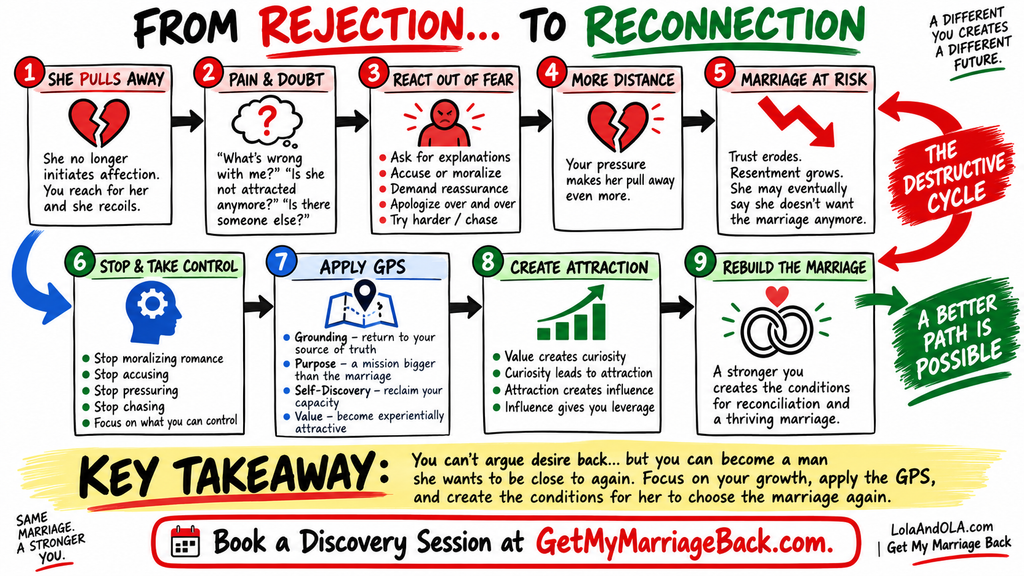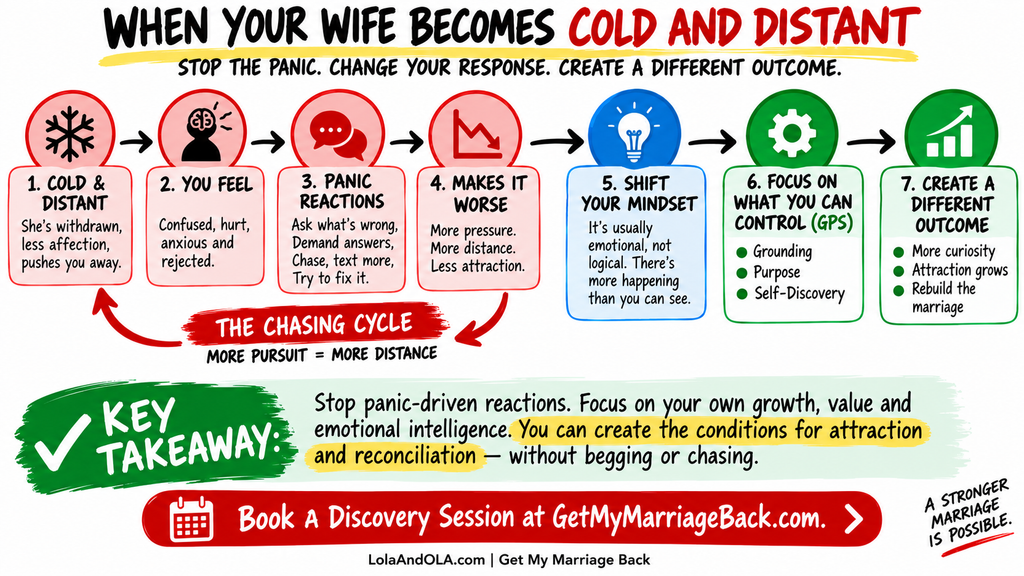


Your wife threatens divorce during arguments, and now every serious conversation feels like one wrong sentence could end your marriage.
Take This 2 Minutes Quiz
That changes you.
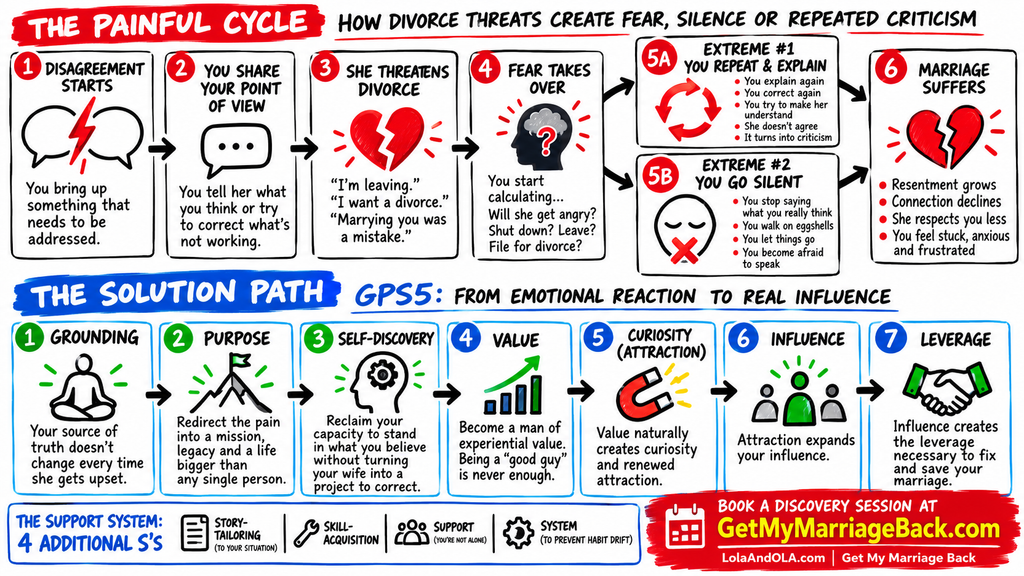
You notice something that needs to be addressed, but instead of simply expressing your perspective, you calculate the consequences first.
Will she get angry?
Will she shut down?
Will this become another two days of cold silence?
Will she say she wants a divorce again?
Is this finally the argument where she files?
Eventually, you can become so focused on preventing your wife from leaving that you stop showing up as yourself inside your own marriage.
And that is where a divorce threat becomes much more than something said during an argument.
It starts changing the entire emotional structure of the relationship.
When Your Wife Keeps Threatening Divorce, Silence Starts Feeling Safe
One of the first changes is subtle.
You start letting things go.
Then you let another thing go.
Soon, you are no longer choosing your battles from a place of emotional intelligence. You are avoiding battles because you are afraid of what disagreement will trigger.
There is a major difference.
You don’t suddenly agree with everything your wife says. You simply decide that silence feels safer than another explosive argument, another shutdown, or another threat to leave the marriage.
That may reduce conflict tonight.
It can also destroy attraction over time.
Attraction needs room for two adults to exist as two adults. Your wife does not need a frightened version of you whose opinions change according to her emotional temperature.
Neither does she need somebody constantly correcting her.
The skill is learning to stand in your perspective without making her agreement necessary for your emotional stability.

Why “Just Communicate More” Can Make the Problem Worse
Generic marriage advice often tells distressed couples to communicate more.
More is not automatically better.
Research on what psychologists call the demand-withdraw pattern helps explain why. One partner pushes for discussion, resolution, or change while the other withdraws, avoids, or attempts to end the interaction. Research involving everyday marital conflicts found these patterns were associated with more negative emotion and lower conflict resolution.
So imagine that your wife withdraws after an argument.
You explain harder.
She still doesn’t respond the way you expected.
Now you explain again.
She becomes increasingly defensive or distant, so you produce an even better argument.
You think clarity is the missing ingredient.
It may not be.
Your repeated explanation can become pressure.
Her withdrawal then increases your anxiety, which makes you explain even more.
Before long, you are not solving the original problem anymore. You are trapped inside a cycle.
The Fine Line Between Correction and Criticism
I learned this distinction during my own marriage crisis with Lola.
There was a period when I wanted things to operate a certain way. When something wasn’t working according to what I believed was right, I corrected it.
I explained what was wrong.
I explained what wasn’t working.
Then I showed her what I believed needed to change.
For a long time, there wasn’t enough obvious pushback for me to understand the cumulative impact.
Years later, during our crisis, I discovered that Lola had been carrying resentment connected to some of the things I had said.
Suddenly, I swung toward the opposite extreme.
Instead of being completely comfortable correcting, I became scared to say certain things.
I would see something differently and hesitate.
Would saying it make everything worse?
That is no way to live inside a marriage either.
The answer wasn’t becoming silent.
It was developing the emotional intelligence to understand where correction crossed the line.
The Line Is Repetition
You have a perspective?
State it.
You believe a behavior is hurting the marriage?
State it clearly.
You believe something needs to change?
Say what you believe.
Then watch what happens inside you when your wife doesn’t agree.
That’s the moment that exposes the difference.
When you say it again because she didn’t accept it, then again because she didn’t respond correctly, and again because you need her to acknowledge that your interpretation is the right interpretation, you are moving beyond expressing your perspective.
You are trying to force acceptance of it.
That’s where correction can become criticism.
The more available your correction becomes, the less weight your words can carry.
You don’t need fourteen speeches.
You don’t need another three-hour conversation.
And you certainly don’t need to keep explaining until your wife finally gives you the facial expression that makes you feel understood.
State your position.
Then give an adult room to be an adult.
Trap #1: Over-Explaining Because You Are Afraid She Will Leave
When your wife threatens divorce during arguments, fear can disguise itself as communication.
You tell yourself that you simply need to explain this one more time.
Maybe she misunderstood.
So you send the longer text.
You initiate another conversation.
Soon, your emotional objective is no longer expression. It is obtaining the response that will make you feel safe again.
That dependency drains attraction because your emotional center is now sitting in somebody else’s hands.
Your position is only allowed to feel valid when she validates it.
That’s not confidence.
Trap #2: Becoming Afraid to Tell the Truth
The opposite reaction isn’t better.
You decide you won’t say anything.
Your wife appears calmer, so silence seems to be working.
But what exactly have you created?
Peace—or fear with good manners?
You can save a marriage without turning yourself into a person who walks on eggshells.
In fact, developing the capacity to express yourself without needing to dominate, convince, correct, or retreat is part of becoming more experientially attractive.
That distinction matters.
Value in attraction is not the same thing as moral worth.
Being a good person does not automatically make somebody feel curiosity, attraction, or emotional engagement toward you.
Experiential value is about what interacting with you actually feels like.
Can you remain grounded during disagreement?
Can you hold a perspective without turning it into a courtroom argument?
Can you tolerate her disappointment without collapsing?
Can you remain emotionally present without trying to control her?
Those qualities change the experience of being around you.
Trap #3: Making Your Wife’s Reaction Your Emotional Compass
This is the deeper trap.
She is happy with you, so you’re okay.
She becomes cold, so you panic.
She mentions separation, and your entire identity collapses into saving the marriage before bedtime.
She threatens divorce, so every principle you held yesterday suddenly becomes negotiable.
Now her emotional state controls yours.
That makes genuine attraction difficult because attraction requires differentiation: the ability to remain emotionally connected without losing your own center.
Your goal isn’t to become cold.
It isn’t to punish her with silence.
And it isn’t to manufacture indifference so she’ll chase you.
The goal is self-leadership.
What To Do When Your Wife Threatens Divorce During Arguments
Start with Grounding.
Your absolute source of truth cannot change every time your wife gets upset.
Grounding means returning to something higher than the immediate symptom—the argument, the cold shoulder, the divorce threat—and reconnecting with your source of truth and gratitude.
Next comes Purpose.
Pain wants to shrink your entire world down to your marriage crisis.
Don’t allow it.
Redirect that energy toward a mission, contribution, impact, legacy, and reason to wake up that is bigger than any single human being—including you and your wife.
Then comes Self-Discovery.
Instead of obsessively discovering what is wrong with her, discover what you are capable of becoming under pressure.
That is GPS: Grounding, Purpose, Self-Discovery.
From there, you build experiential Value.
Value naturally creates Curiosity.
Curiosity opens the possibility for Attraction.
Attraction expands Influence.
Influence creates Leverage.
That leverage gives you a stronger position from which to create the conditions for marriage reconciliation instead of desperately protecting the broken version of the marriage you already have.
Attraction Is Not About Manipulating Her Back
This distinction is critical.
You are not improving yourself as a trick to produce a specific reaction from your wife.
That’s still control.
Building attraction skillfully means becoming somebody whose presence feels different because you are different.
Your words become less frantic.
Your emotional state becomes less dependent on immediate reassurance.
Your purpose becomes bigger than the crisis.
You stop treating your wife like a project requiring constant correction.
That creates space.
Space creates room for curiosity.
Curiosity matters because somebody who believes they completely understand your pattern has very little reason to look again.
When your pattern changes authentically, the experience changes.
Why You May Fall Back Into the Same Pattern Tonight
Understanding all of this intellectually is not enough.
Conflict creates pressure, and pressure has a way of resurrecting old behaviors.
In a controlled experiment, researchers found that stress shifted participants away from goal-directed behavior and toward habitual responding. You can read the NIH-indexed research on stress and habitual behavior.
That helps explain a frustrating experience many people have during a marriage crisis.
You know you shouldn’t deliver another lecture.
Then she gets upset.
You panic.
Suddenly you’re explaining again.
Or you retreat into silence because that is the habit your nervous system has learned feels safest.
This is Habit Drift.
Breaking it requires more than information. Your strategy has to fit your actual story, you need the skill to execute under emotional pressure, and you need enough structure to stop improvising according to whether your wife looks happy with you that day.
Your Marriage Cannot Be Built Around Fear of the Next Divorce Threat
You cannot control whether your wife gets upset.
You cannot force her to understand your perspective.
And you cannot guarantee that the perfect sentence will make a spouse who wants out suddenly want back in.
What you can control is far more powerful.
You can stop over-explaining.
You can stop disappearing.
You can tell the truth without demanding acceptance.
You can build the emotional capacity to withstand disagreement without turning your wife into either your enemy or your emotional life-support system.
That’s where personal power begins.
A marriage crisis naturally makes you want to grab harder at the marriage you are terrified of losing.
The more powerful move is to become capable of building something better.
Not through begging.
Not through fear.
Not through fourteen speeches.
Through Grounding, Purpose, Self-Discovery, Value, Curiosity, Attraction, Influence, and ultimately the Leverage necessary to create a different experience of you—and different conditions for saving your marriage.
Average Length of Separation Before Reconciliation: Data Reveals!
Frequently Asked Questions
Repeated divorce language can serve different functions in different marriages, including expressing genuine intent to leave, escalating conflict, or attempting to end an overwhelming argument. Treat the pattern seriously without assuming you already know exactly what each threat means.
Don’t panic into another marathon explanation or surrender your position simply to restore temporary peace. Regulate yourself, state what needs to be stated clearly, and avoid turning the moment into a contest over who can force the other person to concede.
Some marriages do reconcile after one spouse has expressed a desire to leave, but the immediate task is not forcing that spouse to reverse the decision. Focus first on changing the destructive patterns you control and creating healthier conditions for future interaction.
No—silence driven by fear is different from intentionally refusing to escalate an unproductive argument. Research on marital conflict has linked demand-withdraw patterns with negative emotions and poorer conflict resolution, so the objective is not permanent withdrawal but more emotionally intelligent engagement.