
Broken Marriage?
Fix it
Here FREE

Get My Marriage Back


Hardest Stage of Marriage: Why Years 7โ€“10 Test Couples Most

hardest stage of marriage

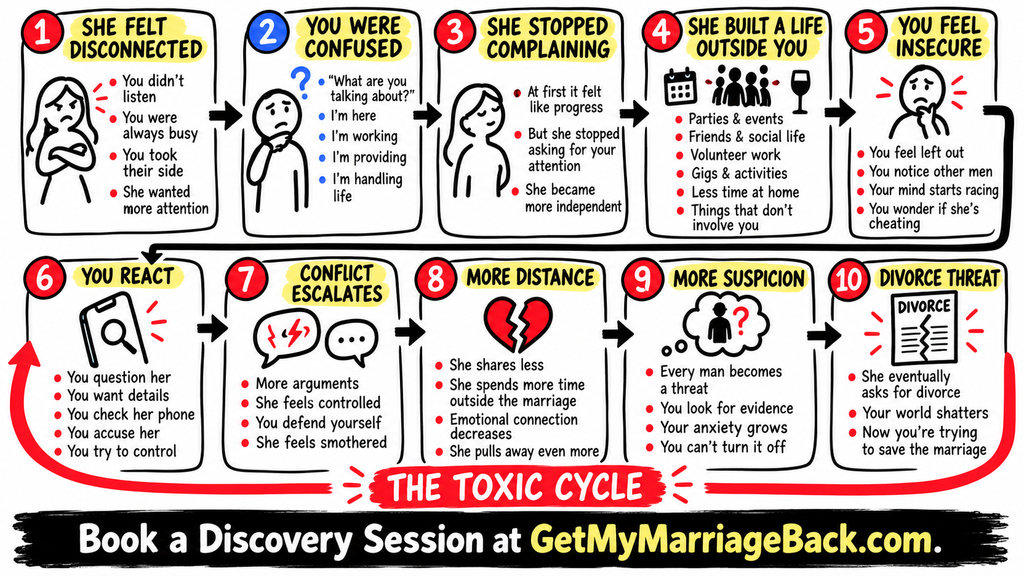
Marriage rarely falls apart in a single dramatic moment.

More often, it erodes slowly through neglect, routine, resentment, and emotional distance.

While many people assume the first year of marriage is the most challenging or that empty-nest years create the greatest strain, research and real-world experience suggest something different.

hardest stage of marriage

For many couples, the hardest stage of marriage arrives between years seven and ten.

This period often coincides with raising young children, demanding careers, financial pressure, chronic stress, and a gradual loss of romantic connection.

If your marriage feels more like a business partnership than a passionate relationship, you’re not necessarily failing.

You may simply be navigating one of the most difficult times in a marriageโ€”the stage where commitment is tested, attraction must be rebuilt intentionally, and emotional intelligence becomes more important than chemistry.

What Is the Hardest Stage of Marriage?

The hardest stage of marriage typically occurs during the mid-marriage years, often between years seven and ten.

This is the stage where the excitement of novelty fades and reality takes over.

The relationship no longer runs on automatic attraction.

The habits, communication patterns, expectations, and emotional wounds that were easy to overlook during the honeymoon phase become impossible to ignore.

Many couples find themselves asking:

  • Why do we argue so much now?
  • Why has our sex life disappeared?
  • Why do I feel lonely even though I’m married?
  • Why do I feel more appreciated by coworkers than my spouse?

These questions often emerge during the same period because the marriage is no longer fueled by chemistry alone.

It now requires skill, intention, leadership, and emotional maturity.

The Psychology of the Hardest Stage of Marriage: Why This Happens

The psychology behind the hardest stage of marriage is surprisingly simple.

Early attraction creates emotional momentum. During the beginning stages of marriage, couples naturally prioritize one another.

They pursue each other, admire each other, and forgive flaws more easily.

Eventually, life introduces competing priorities:

  • Children
  • Careers
  • Financial obligations
  • Extended family responsibilities
  • Health challenges
  • Household management

As these responsibilities grow, many couples stop investing in the very behaviors that created attraction in the first place.

The relationship shifts from active romance to passive maintenance.

The danger isn’t conflict.

The danger is indifference.

Conflict means two people still care enough to engage.

Indifference signals emotional withdrawal.

hardest stage of marriage - is it the 7th year?

Why Is the 7th Year of Marriage the Hardest?

The phrase “seven-year itch” exists for a reason.

Around year seven, many couples experience a collision of expectations and reality.

By this point:

  • The novelty has worn off.
  • Parenting responsibilities are often intense.
  • Career pressures are increasing.
  • Personal sacrifices begin to feel unequal.
  • Emotional needs are often neglected.

The problem isn’t that attraction naturally disappears.

The problem is that attraction is no longer being cultivated.

Many people mistakenly assume attraction should happen automatically forever.

In reality, long-term attraction is a skill that must be maintained through intentional behaviors.

What About The Hardest Stage of Marriage When Kids Are Involved?

Children are a blessing, but they can also expose weaknesses in a relationship.

Parents often become exhausted logistics managers.

Their conversations revolve around:

  • School schedules
  • Appointments
  • Bills
  • Chores
  • Household responsibilities

Meanwhile, romance slowly disappears.

Many couples unknowingly stop seeing each other as lovers and begin seeing each other only as co-parents.

This shift creates one of the biggest attraction killers in marriage: familiarity without mystery.

Healthy marriages balance two competing emotional needs:

1. Certainty

People need safety, trust, reliability, and consistency.

2. Variety

People also need novelty, excitement, adventure, and growth.

When marriage provides only certainty but no variety, attraction begins to fade.

hardest stage of marriage - The real reason

The Real Reasons Marriages Collapse

Most marriages don’t collapse because one person suddenly became evil.

More often, marriages deteriorate because of two recurring problems:

1. Mismanaged Expectations

Unspoken expectations create hidden resentment.

Many spouses secretly expect:

  • More affection
  • And More appreciation
  • More help
  • Then More intimacy
  • More validation

When these expectations remain unspoken, disappointment grows.

2. Mismanaged Pride

Pride prevents repair.

Pride says:

  • “Why should I apologize first?”
  • They started it.”
  • “I’m not going to chase someone who ignores me.”

Unfortunately, pride turns temporary conflict into long-term distance.

The strongest marriages are not conflict-free.

They are repair-focused.

The Silent Attraction Killers in Marriage

Many couples focus on communication while ignoring attraction.

Yet attraction often dies long before communication completely breaks down.

Some common attraction killers include:

Neediness

Constant validation-seeking creates pressure rather than desire.

Emotional Reactivity

Being easily triggered destroys emotional safety.

Criticism and Condemnation

People rarely feel attracted to someone who constantly judges them.

Loss of Self-Respect

When individuals abandon their goals, growth, health, or purpose, attraction often declines.

Chronic Neglect

Small moments of neglect accumulate into large emotional debts.

hardest stage of marriage - rebuilding attraction

From Roommates Back to Lovers: Rebuilding Attraction

The solution is not simply “communicate more.”

Many couples communicate frequently while becoming less attracted to each other.

Instead, focus on rebuilding the foundations of attraction.

Strengthen Friendship

Friendship remains one of the strongest predictors of long-term marital success.

Ask yourself:

  • Do we still enjoy each other’s company?
  • Do we laugh together?
  • Do we know what excites each other today?

Strong marriages maintain friendship long after the honeymoon ends.

Prioritize Intimacy

Sex is not the entire relationship.

However, intimacy often acts as a barometer for the emotional health of the marriage.

Couples who continually deprioritize intimacy often find themselves drifting into emotional distance.

Manage Expectations Explicitly

Stop assuming your spouse can read your mind.

Healthy couples discuss:

  • Emotional needs
  • Sexual needs
  • Financial expectations
  • Family responsibilities
  • Future goals

Clarity reduces resentment.

Choose Curiosity Over Ego

Many arguments continue because both partners are trying to win.

Winning an argument while losing connection is a poor trade.

Curiosity creates understanding.

Understanding creates empathy.

Empathy creates reconnection.

How Emotional Intelligence Saves Marriages

Emotional intelligence becomes more valuable than romance during the hardest stage of marriage.

Emotionally intelligent spouses learn to:

  • Regulate emotional reactions
  • Avoid blame and shame
  • Listen without defensiveness
  • Understand emotional needs beneath complaints
  • Repair conflicts quickly

The couples who survive the hardest years aren’t necessarily more compatible.

They’re often more emotionally skilled.

The Surprising Truth About the Best Years of Marriage

Many couples report that their best years of marriage arrive after they successfully navigate the difficult middle years.

Why?

Because trust becomes deeper.

Respect becomes earned.

Love becomes intentional.

The relationship evolves beyond chemistry into partnership, friendship, intimacy, and mutual growth.

The couples who endure the valley often discover a richer form of connection on the other side.

The Hardest Stage of Marriage Is an Invitation to Grow

Every marriage eventually reaches a point where attraction no longer runs on autopilot.

This isn’t evidence that the relationship is broken.

It’s evidence that the relationship is entering a new phase.

The hardest stage of marriage forces couples to make a choice:

Will you continue operating as roommates and logistics managers?

Or will you intentionally rebuild attraction, friendship, intimacy, and emotional connection?

The couples who thrive understand that marriage is not sustained by feelings alone.

It is sustained by daily choices, emotional intelligence, mutual respect, and the willingness to keep choosing each other long after the butterflies disappear.

Frequently Asked Questions

What is the most difficult stage of marriage?

The most difficult stage of marriage is often between years seven and ten when stress, routine, parenting, and emotional neglect converge.

At what stage do most marriages fail?

Many marriages struggle or fail during the mid-marriage years when unresolved resentment, communication breakdowns, and declining intimacy accumulate.

How do you know when it’s time to divorce?

It may be time to consider divorce when repeated efforts to repair the relationship fail and there is ongoing abuse, chronic betrayal, or complete unwillingness from one or both partners to work on the marriage.

What is the hardest age for divorce?

Divorce is often emotionally and financially hardest during middle age when couples have children, shared assets, and deeply intertwined lives.

Is the first year of marriage the hardest?

The first year can be challenging due to adjustment and expectation management, but many couples find the mid-marriage years significantly more difficult.

Is the 10th year of marriage the hardest?

For many couples, the years surrounding the tenth anniversary are among the hardest because accumulated stress and emotional distance often peak during this period.

When to Walk Away From a Sexless Marriage?

A sexless marriage may warrant serious evaluation when intimacy has been absent for an extended period, repeated repair efforts have failed, and one or both partners are unwilling to address the underlying causes.

What Is a Sexless Marriage? Definition, Signs, Psychology, and How to Rebuild Intimacy

Many couples quietly ask themselves the same question: what is a sexless marriage, and does a lack of intimacy mean the relationship is failing?

The truth is that every marriage experiences periods when sexual activity slows down. Stress, parenting, health concerns, emotional distance, and life transitions can temporarily reduce intimacy. A short-term dry spell does not automatically mean your marriage is in trouble.

what is a sexless marriage

However, when physical intimacy disappears for an extended period and neither partner addresses the underlying issues, emotional disconnection and resentment can begin to grow.

In this guide, you’ll learn:

  • What is considered a sexless marriage
  • The clinical definition
  • Common signs and stages
  • The Psychology
  • The effects on husbands and wives
  • When to walk away
  • Practical steps to rebuild attraction and connection

What Is a Sexless Marriage?

The most commonly cited definition of a sexless marriage is a relationship in which a married couple has sexual intimacy fewer than ten times per year.

Relationship researchers and therapists often use this benchmark when discussing intimacy patterns, although there is no universal legal or medical definition.

More importantly, frequency alone does not tell the whole story. Some couples are content with infrequent sex, while others experience significant emotional pain despite occasional intimacy.

A marriage becomes concerning when the lack of physical connection creates:

  • Emotional loneliness
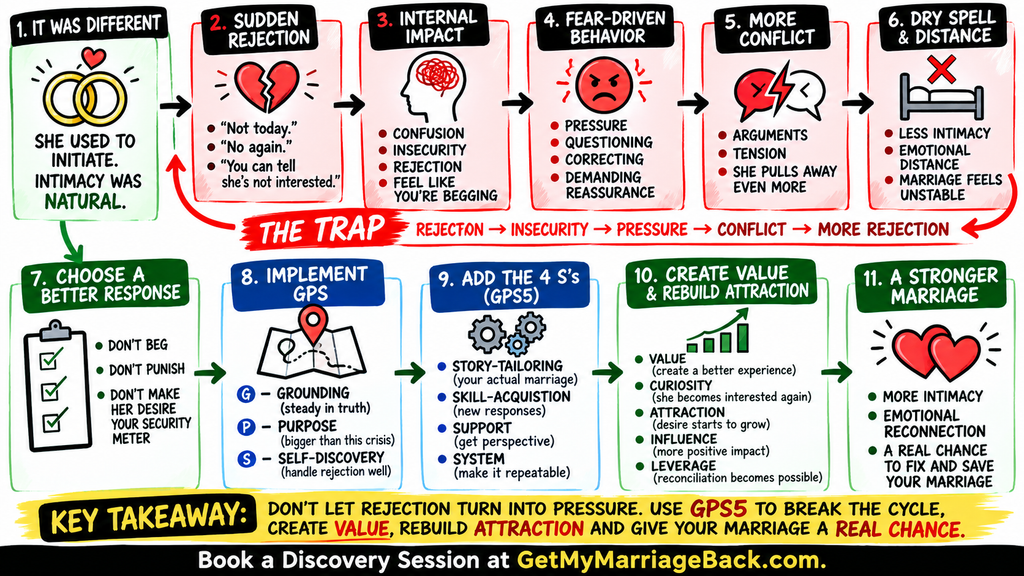
  • Rejection
  • Resentment
  • Loss of romantic connection
  • Persistent relationship dissatisfaction
What is a sexless marriage and what are the signs and stages?

What Is Considered a Sexless Marriage?

When people search for what is considered a sexless marriage, they are usually looking for a specific number.

While fewer than ten sexual encounters per year is the commonly accepted benchmark, context matters.

For example:

  • A couple recovering from childbirth may temporarily have little sexual activity.
  • A spouse managing a serious illness may experience a prolonged decline in libido.
  • Military deployments, work travel, or caregiving responsibilities can create temporary dry spells.

In these situations, the issue is often circumstance rather than relationship dysfunction.

The bigger concern is whether both partners feel emotionally connected and committed to addressing the problem together.


Definition of a Sexless Marriage: Clinical and Emotional Perspectives

The definition of a sexless marriage can be viewed from two different angles.

Clinical Definition of Sexless Marriage

Clinically, experts often define a sexless marriage as one in which sexual intimacy occurs fewer than ten times annually.

This benchmark provides a measurable framework for discussing intimacy levels.

Emotional Definition of a Sexless Marriage

From a relationship perspective, a marriage may feel sexless when one or both spouses experience:

  • Chronic rejection
  • Emotional isolation
  • Loss of affection
  • Absence of physical touch
  • Growing resentment

In other words, emotional impact often matters more than numerical frequency.


What Constitutes a Sexless Marriage Versus a Temporary Dry Spell?

Many couples experience temporary declines in intimacy.

A dry spell is usually linked to circumstances such as:

  • New parenthood
  • Financial stress
  • Medical issues
  • Mental health challenges
  • Work burnout
  • Grief or loss

A more serious problem exists when:

  • Physical intimacy has been absent for many months or years
  • Attempts to discuss the issue repeatedly fail
  • One partner completely withdraws from affection
  • Emotional connection continues to deteriorate

Understanding what constitutes a sexless marriage requires looking at both frequency and relationship quality.


What Defines a Sexless Marriage? Common Signs to Watch For

The following signs may indicate that intimacy issues are becoming a larger relationship problem.

Sign #1. Affection Begins to Disappear

Many sexless marriages begin with a decline in everyday affection:

  • Fewer hugs
  • Less hand-holding
  • Reduced kissing
  • Avoidance of cuddling

When non-sexual touch disappears, sexual intimacy often follows.

Sign #2. Conversations Become Defensive

Constant criticism, blame, and unresolved conflict can weaken emotional safety.

Most people struggle to feel desire when they feel attacked, misunderstood, or emotionally disconnected.

Sign #3. One Partner Feels Consistently Rejected

Repeated rejection can create:

  • Low self-esteem
  • Anxiety
  • Resentment
  • Emotional withdrawal

Over time, both partners may stop initiating intimacy altogether.

Sign #4. Emotional Distance Replaces Connection

When spouses stop sharing thoughts, feelings, goals, and daily experiences, physical intimacy often becomes more difficult.

Sign #5. Intimacy Feels Like an Obligation

A marriage may be moving toward a sexless pattern when intimacy feels transactional rather than mutually desired.


The Psychology of Sexless Marriage

Understanding a sexless marriage at a psychological level requires looking beyond the bedroom.

Sex is often a reflection of broader relationship dynamics.

Common psychological factors include:

  • Unresolved resentment
  • Emotional disconnection
  • Depression
  • Anxiety
  • Low self-esteem
  • Body image concerns
  • Trauma history
  • Attachment issues
  • Communication breakdowns

In many cases, the lack of sex is not the primary problem.

Instead, it is a symptom of deeper relational challenges.


The Effect of Sexless Marriage on A Husband

It can vary significantly between individuals.

Some common experiences include:

  • Feeling unwanted
  • Lower self-confidence
  • Emotional loneliness
  • Increased frustration
  • Reduced relationship satisfaction

However, not all men respond the same way.

Some prioritize emotional connection over sexual frequency, while others view sexual intimacy as a critical expression of love and partnership.


The Effect of Sexless Marriage on A Wife

The effect on wife can be equally significant.

Women in sexless marriages often report:

  • Feeling unattractive
  • Emotional abandonment
  • Loss of romantic connection
  • Increased resentment
  • Lower relationship satisfaction

Importantly, sexless marriages affect both genders and can occur regardless of which spouse has the lower desire level.


Why Would a Man Stay in a Sexless Marriage?

Reasons may include:

  • Love for his spouse
  • Commitment to family
  • Shared finances
  • Religious beliefs
  • Hope for improvement
  • Fear of divorce
  • Desire to preserve stability for children

The same reasons often apply to women who remain in sexless marriages.


Will a Man Leave a Sexless Marriage?

The answer depends on the individual relationship.

Some spouses eventually leave when intimacy issues remain unresolved for years.

Others remain committed and successfully rebuild connection through communication, therapy, and personal growth.

The deciding factor is often not the absence of sex itself, but whether both partners are willing to address the problem together.


Is Your Sexless Marriage Killing You? What to Do Next

Start by:

  1. Having an honest, non-accusatory conversation.
  2. Understanding your partner’s perspective.
  3. Identifying emotional and practical barriers.
  4. Rebuilding affection outside the bedroom.
  5. Seeking professional support if necessary.

Many couples wait years before discussing intimacy openly, which only deepens the problem.


How to Fix a Sexless Marriage

Rebuilding intimacy requires addressing both emotional and physical connection.

Improve Communication

Talk about intimacy without blame or criticism.

Rebuild Emotional Safety

Most people feel more desire when they feel emotionally understood and respected.

Prioritize Quality Time

Intentional connection often reignites attraction.

Address Health Concerns

Medical conditions, medications, hormonal changes, and mental health challenges can significantly affect libido.

Consider Couples Counseling, Coaching or Therapy

A qualified therapist can help identify patterns that are difficult to see from inside the relationship.


When to Walk Away From a Sexless Marriage

Check this out: When to Walk Away From A Sexless Marriage

Many people are actually asking whether recovery is still possible.

A marriage may require serious evaluation when:

  • One partner refuses all communication about intimacy.
  • Repeated efforts at repair are rejected.
  • Emotional abuse is present.
  • Trust has been permanently broken.
  • Years pass without meaningful progress.

Before making life-changing decisions, many couples benefit from professional counseling to determine whether the relationship can realistically be restored.


When Online Discussions Get it Wrong?

When reading online discussions, remember that online experiences are highly individual.

Online communities can provide useful perspectives and emotional support, but relationship outcomes vary widely.

What worked for one couple may not work for another.

Professional guidance, honest communication, and understanding your unique circumstances are often more valuable than comparing your marriage to anonymous online stories.


Take the 2 Minutes Sexless Marriage Quiz

โ€œI have a problem.

My wife wants to separate.

She said she doesnโ€™t love me anymore but she also said,

I love you because you are the father of my kids and also because of the struggles weโ€™ve been through.

We have been together for 11 years and I still love her.

What can I do? Iโ€™m just so confused.

We haven’t even talked about a divorce.

She has never brought it up and of course I donโ€™t want a divorce.

This is just so confusing.

We still live together with our kids in the same house.

We still have sex and sometimes we kind of flirt.

But she doesnโ€™t want to kiss me like she is afraid as if something.

Itโ€™s just so weird.

She said she doesnโ€™t love me but she still has an affection for me so itโ€™s very confusing.

Itโ€™s like do you love me or not.

And also, she has a big pride; she wants to be right all the time and never says she is wrong even when she is.โ€

Enjoy the video.

You may like this… “Is it too late to fix my marriage?”

and When to walk away from sexless marriage…

Frequently Asked Questions

How to fix a sexless marriage?

A sexless marriage is often improved by rebuilding emotional connection, improving communication, addressing health concerns, and seeking professional counseling when needed.

How do you know if you’re in a sexless marriage?

You may be in a sexless marriage when sexual intimacy occurs very infrequently and the lack of connection creates ongoing emotional distress or relationship dissatisfaction.

How unhealthy is a sexless marriage?

A sexless marriage is not automatically unhealthy, but it can become harmful when it leads to loneliness, resentment, emotional withdrawal, or chronic relationship conflict.

How long before a marriage is considered sexless?

Many relationship experts consider a marriage sexless when sexual intimacy occurs fewer than ten times per year, although context and relationship satisfaction matter as much as frequency.

What is the clinical definition of a sexless marriage according to relationship experts?

Clinically, a relationship is defined as a sexless marriage when a married couple engages in sexual intimacy fewer than ten times within a full calendar year.

What is considered a sexless marriage when evaluating a relationship’s health?

Beyond strict frequency metrics, a relationship is considered sexless when the total absence of physical affection causes deep emotional distress, resentment, or a feeling of isolation between the spouses.

What constitutes a sexless marriage dry spell versus a permanent marital crisis?

A temporary dry spell often constitutes a passing phase driven by external factors like work stress, illness, or childbirth, whereas a true marital crisis features a chronic, prolonged refusal to engage in physical intimacy.

Can a relationship recover once it fits what defines a sexless marriage?

Yes, many marriages recover from prolonged intimacy challenges when both spouses address underlying issues, improve communication, and actively work toward rebuilding emotional and physical connection.

Behaviors That Cause Divorces: 10 Marriage Killers Most Couples Ignore

Most divorces do not happen because of one dramatic event.

They usually happen because of repeated behaviors that slowly damage trust, respect, friendship, attraction, and emotional connection.

behaviors that cause divorces

A marriage may survive one bad argument.

It may survive a hard season.

It may even survive a serious mistake if both people are willing to repair the damage.

But when small harmful habits keep happening over and over, the relationship begins to weaken.

A little sarcasm becomes normal.

A little blame becomes a pattern.

A little emotional distance becomes a lifestyle.

A little pride keeps two people from saying:

“I was wrong.”

“I miss you.”

“Let’s fix this.”

That is how many marriages begin to break down.

The good news is that many of the same behaviors that cause divorces can be replaced with better habits.

Couples can learn how to communicate with more care, repair conflict faster, rebuild attraction, and meet each other’s emotional needs with more skill.

If you want a marriage that feels safe, passionate, respectful, and alive, you must understand the main causes of divorce before they become too big to ignore.

understanding behaviors that cause divorces

Why Understanding Behaviors That Cause Divorces Matters

Many people think divorce starts with infidelity, money problems, addiction, or constant fighting.

Those issues are serious, but they are often the final result of deeper problems that were ignored for too long.

Before many affairs, there was emotional distance.

Before many money fights, there were hidden expectations.

Before many explosive arguments, there were years of resentment.

Before one person finally leaves, they may have spent a long time feeling unseen, unheard, undesired, or unimportant.

This is why it is not enough to ask, “What ended the marriage?”

A better question is:

“What slowly weakened the marriage?”

Most strong marriages are not strong because the couple never has problems.

They are strong because both people learn how to deal with problems without destroying the bond.

They know how to repair after conflict.

They know how to stay friends.

They know how to protect trust.

They know how to keep attraction alive instead of assuming love will carry everything by itself.

Marriage needs love.

But love alone is not enough.

A healthy marriage also needs respect, patience, self-control, honesty, friendship, affection, shared purpose, and emotional intelligence.

When these things are missing for too long, even two people who once loved each other deeply can begin to feel like strangers.

Most Divorces Begin Long Before the Divorce

When people talk about the top causes of divorce, they often mention lack of commitment, infidelity, money problems, poor communication, and constant conflict.

These are real problems.

But they usually do not appear out of nowhere.

Most divorces begin with slow emotional erosion.

One spouse stops feeling appreciated.

The other stops feeling respected.

One stops feeling desired.

The other stops feeling understood.

One person wants peace.

The other wants passion.

One wants support.

The other wants space.

Over time, both people may begin to protect themselves instead of protecting the marriage.

This is where pride and expectations become dangerous.

Pride says:

“I should not have to change.”

Expectations say:

“You should already know what I need.”

Pride refuses to apologize.

Expectations create disappointment when they are never spoken clearly.

Together, they turn normal marriage stress into emotional distance.

In many struggling marriages, the real enemy is not the husband or the wife.

The real enemy is the pattern the couple keeps repeating.

A healthy marriage requires both people to ask a brave question:

“What am I doing that is making this harder?”

That question is not about blame.

It is about power.

When you focus only on what your spouse is doing wrong, you feel stuck.

When you focus on what you can change, you get your power back.

top 10 behaviors that cause divorces

The Top 10 Behaviors That Cause Divorces

1. Contempt: The Most Dangerous Behavior in Marriage

Contempt is one of the most harmful behaviors that cause divorces because it attacks the dignity of the other person.

It is more than being upset.

It is more than disagreeing.

Contempt carries a message of disgust, superiority, or disrespect.

It can show up through eye-rolling, mocking, sarcasm, name-calling, belittling, or talking to your spouse like they are beneath you.

Sometimes contempt is loud.

Other times, it is quiet but still painful.

A cold look, a cruel joke, or a dismissive tone can say:

“I do not respect you anymore.”

Respect is one of the roots of attraction.

It is hard to desire someone you secretly look down on.

It is also hard to feel emotionally safe with someone who makes you feel small.

Once contempt becomes normal, the marriage becomes emotionally unsafe.

Both people may start defending themselves instead of opening up.

The home becomes a courtroom instead of a safe place.

The better path is to practice admiration on purpose.

This does not mean pretending problems do not exist.

It means refusing to reduce your spouse to their worst habit or weakest moment.

Instead of saying:

“You are useless.”

Say:

“I feel unsupported, and I need us to work on this.”

Instead of attacking their character, speak to the issue.

Respect does not mean avoiding hard truth.

It means telling the truth without trying to destroy the person.

2. Constant Criticism Instead of Constructive Feedback

Every marriage needs honest feedback.

No one can grow if nothing can ever be discussed.

The problem begins when feedback becomes constant criticism.

Criticism attacks identity.

It says:

“You are selfish.”

“You are lazy.”

“You never do anything right.”

“You are impossible to live with.”

Over time, the criticized partner stops hearing the issue and only hears rejection.

People do not usually become better when they feel attacked.

They become defensive, quiet, angry, or distant.

Even if the criticism has some truth in it, the delivery can make repair almost impossible.

Healthy communication focuses on behavior, not identity.

There is a big difference between:

“You never care about me.”

and

“I felt hurt when you did not check on me yesterday.”

One attacks the whole person.

The other explains the pain and opens the door for repair.

In strong marriages, correction is mixed with warmth.

A spouse should not only hear what they are doing wrong.

They should also hear what they are doing right.

If every conversation feels like a performance review, attraction will suffer.

Nobody wants to feel like they are married to a judge.

3. Defensiveness and Refusing Accountability

Defensiveness is one of the most common reasons for divorce because it blocks growth.

When a person becomes defensive, they are no longer listening to understand.

They are listening to escape blame.

Defensiveness sounds like:

“Well, you do it too.”

“It is not my fault.”

“You are too sensitive.”

“I would not act this way if you did not make me.”

Sometimes it even sounds logical.

But the deeper message is:

“I do not want to take responsibility.”

A marriage cannot heal if both people are always defending themselves.

Someone has to become mature enough to pause, listen, and own their part.

This does not mean taking blame for everything.

It means having the strength to say:

“I can see how that hurt you.”

or

“I could have handled that better.”

Those words can soften conflict quickly because they show humility.

Many couples stay stuck because both people are waiting for the other person to go first.

But leadership in marriage often begins when one person decides to rise above pride and create a better pattern.

The person who takes ownership is not weak.

They are often the strongest person in the room.

4. Stonewalling and Emotional Withdrawal

Stonewalling happens when one spouse shuts down, avoids the conversation, gives the silent treatment, or refuses to engage emotionally.

Sometimes it happens because the person feels overwhelmed.

Other times, it becomes a way to punish or control.

Either way, emotional withdrawal can be deeply painful.

A marriage cannot stay close when important conversations are constantly avoided.

Over time, the other spouse may stop trying.

They may decide it is safer to be quiet than to keep reaching for someone who will not respond.

This is how loneliness can grow inside a marriage.

The couple may still live in the same home.

They may still handle bills, children, chores, and family events.

But emotionally, they begin living separate lives.

The healthier approach is not to force a conversation when emotions are too high.

Sometimes a break is wise.

But the key is to return.

Saying:

“I need 30 minutes to calm down, but I will come back so we can talk.”

is very different from disappearing emotionally.

Emotional availability builds trust.

When your spouse knows you will not abandon the conversation forever, it becomes easier to feel safe, even during conflict.

taken for granted - behaviors that cause divorces

5. Taking Your Spouse for Granted

One of the most overlooked behaviors that cause divorces is neglect.

Not dramatic betrayal.

Not explosive fighting.

Just the slow habit of assuming your spouse will always be there, no matter how little attention, affection, or appreciation they receive.

In the beginning of most relationships, people notice the little things.

They say thank you.

They compliment each other.

They make an effort.

They listen more closely.

They want to impress each other.

But over time, many couples stop doing the things that helped create the relationship.

A husband who once thanked his wife for her support may begin to treat it as expected.

A wife who once admired her husband’s effort may begin to focus only on what he is not doing.

Neither person may mean harm.

But both slowly stop feeding the bond.

People want to feel important.

They want to feel chosen.

They want to feel like their effort matters.

When appreciation disappears, resentment often grows.

The solution is simple.

But it requires consistency.

Notice what your spouse does right.

Say thank you.

Give sincere compliments.

Show affection without being asked.

Do not wait until your spouse feels invisible before reminding them they matter.

Check this out: When Can You Tell a Marriage Is Over? [5 Signs]

Frequently Asked Questions

What are the behaviors that cause divorce?

The most common behaviors that cause divorce are contempt, criticism, defensiveness, emotional withdrawal, dishonesty, neglect, blame, unresolved conflict, and loss of attraction.

What are the top causes of divorce?

The top causes of divorce are lack of commitment, infidelity, constant conflict, poor communication, emotional disconnection, unmet expectations, and financial stress.

What is the #1 thing that destroys marriages?

The #1 thing that destroys marriages is ongoing disrespect because it weakens trust, safety, attraction, friendship, and emotional connection.

What are the marriage killers?

Marriage killers include contempt, criticism, blame, sarcasm, defensiveness, pride, dishonesty, emotional neglect, lack of intimacy, and unresolved resentment.

What are the signs of a toxic relationship?

Signs of a toxic relationship include constant disrespect, manipulation, control, emotional abuse, gaslighting, fear, blame, dishonesty, and a lack of emotional safety.

At what point is a marriage not salvageable?

A marriage becomes difficult to salvage when one or both partners refuse accountability, repair, honesty, safety, change, or any real investment in rebuilding the relationship.

What is the misery stage of marriage?

The misery stage of marriage is a painful season where resentment, emotional distance, disappointment, and hopelessness feel stronger than love, friendship, affection, and connection.

When Can You Tell a Marriage Is Over? 5 Painful Signs You Should Never Ignore

when can you tell a marriage is over

There are few questions more heartbreaking than this:

When can you tell a marriage is over?

Ironically, most people don’t realize their marriage is over until it’s been emotionally dead for monthsโ€”or even years.

That’s what makes this question so difficult.

Marriage rarely ends the day divorce papers are filed.

when can you tell a marriage is over

It usually ends long before then, in the countless moments of emotional distance, unspoken resentment, silent suffering, and lost attraction.

Yet many couples continue living together, hoping tomorrow will somehow be different.

Maybe the criticism will stop.

Maybe the arguing will disappear.

And maybe they’ll wake up and find the person they once fell deeply in love with again.

Hope keeps many marriages alive long after the relationship itself has stopped breathing.

But hope alone isn’t enough.

The real question isn’t simply when can you tell a marriage is over?

It’s whether the relationship underneath the marriage still has life left in it.

Why It’s So Hard to Know When a Marriage Is Over

If you’re asking this question, chances are you’re emotionally exhausted.

You’re probably not asking because you’ve already decided to leave.

You’re asking because part of you still hopes there’s something worth saving.

That uncertainty is normal.

People inside a struggling marriage rarely see things as clearly as those watching from the outside.

When children are involved…

When finances are intertwined…

When family expectations weigh heavily…

When yearsโ€”or decadesโ€”have been invested…

Walking away isn’t just emotional.

It’s complicated.

Many people stay because leaving feels impossible.

Others stay because they’re desperately waiting for one sign that says things can still be fixed.

The truth is this:

Most marriages don’t collapse overnight. They slowly disconnect.

when can you tell a marriage is over - criticism

Sign #1. Constant Criticism Replaces Appreciation

One of the strongest predictors that a marriage is in serious trouble is constant criticism.

Every conversation feels like an attack.

Nothing you do seems good enough.

Instead of discussing behaviors, your partner attacks your character.

Healthy couples correct each other.

Unhealthy couples condemn each other.

If all you remember from the past several months is criticism, your relationship is waving a red flag.

Sign #2. Every Conversation Becomes Defensive

Another answer to when can you tell a marriage is over is when simple conversations immediately become battles.

One person raises a concern.

The other instantly defends themselves.

Nobody listens.

Nobody feels heard.

Nobody accepts responsibility.

Every discussion becomes about winning instead of understanding.

Defensiveness slowly destroys emotional safetyโ€”the very foundation of intimacy.

Without emotional safety, attraction begins to disappear.

when can you tell a marriage is over - stonewalling

Sign #3. Stonewalling Becomes the New Normal

Sometimes the loudest message is silence.

Stonewalling happens when one partner emotionally shuts down.

They stop responding.

They withdraw.

They give the silent treatment.

They refuse to engage.

When this becomes a consistent pattern over weeks or months, emotional intimacy begins to collapse.

Conflict may seem exhausting.

But emotional absence is even more dangerous.

You can’t repair a relationship with someone who refuses to participate.

Sign #4. Contempt Makes You Feel Like You’re Married to an Enemy

Perhaps the most destructive sign is contempt.

Contempt goes beyond frustration.

It’s disgust.

Sarcasm.

Eye rolling.

Mockery.

Belittling.

Feeling superior.

Instead of seeing your spouse as your teammate, you begin seeing them as your opponent.

When contempt takes root, couples often describe feeling like they’re living with an enemy instead of a life partner.

At this stage, attraction doesn’t simply fade.

It reverses.

The very person you once longed for becomes someone you emotionally avoid.

Sign #5. Physical Intimacy Has Completely Disappeared

Sex isn’t the only measure of a healthy marriage.

But prolonged absence of physical intimacy often reflects deeper emotional disconnection.

If months have passed without affection, desire, or intimate connectionโ€”and neither partner seems interested in changing itโ€”that isn’t merely a bedroom problem.

It’s usually a relationship problem.

Physical intimacy is often the symptom.

Emotional distance is usually the cause.

when can you tell a marriage is over - when divorce happens

The Marriage May Be Over Long Before Divorce Happens

Many people believe divorce ends a marriage.

In reality, divorce often confirms what happened emotionally years earlier.

Research consistently shows that many couples remain legally married long after they have emotionally checked out.

Some people live this way for years.

Others spend an entire decade sharing a home without sharing a relationship.

By the time someone finally files for divorce, the emotional separation often happened long before.

That’s why asking when can you tell a marriage is over isn’t really about legal paperwork.

It’s about emotional reality.

But Here’s the Good News: Not Every Marriage That Feels Over Actually Is

This is where many people lose hope too soon.

Every one of these warning signs can improve if both partners are genuinely willing to rebuild the relationship. But let’s be clear, one person needs to lead in creating that cycle.

The key isn’t pretending everything is okay.

The key is honestly acknowledging where you are.

You cannot repair what you refuse to recognize.

Once one spouse stop blaming and start becoming curious about the other’s pain, healing becomes possible because a new cycle is created when you interrupt the old cycle.

Attraction Dies Long Before Love Does

One of the biggest mistakes couples make is focusing only on saving the marriage.

Instead, focus on rebuilding the relationship.

Marriage is simply the legal structure.

The relationship is what keeps people choosing each other.

Ask yourself:

  • Do we still make each other feel emotionally safe?
  • Do we enjoy each other’s company?
  • Do we admire one another?
  • Do we still flirt?
  • Do we create moments of laughter and playfulness?
  • Do we make each other feel desired?

Attraction isn’t maintained by wedding vows.

It’s maintained through consistent emotional experiences.

The most emotionally intelligent couples understand this.

They don’t wait until love disappears.

They continually create reasons to fall in love again.

Building Attraction Instead of Waiting for It

If you’re hoping your marriage can recover, begin here:

Stop Trying to Win Every Argument

Winning arguments often means losing connection.

Seek understanding before being understood.

Become Emotionally Curious

Instead of asking,

“Why are they acting like this?”

Ask,

“What pain might they be carrying that I haven’t fully understood?”

Curiosity softens defensiveness.

Bring Back Playfulness

Attraction grows where there is novelty, laughter, and emotional safety.

Small moments matter.

A smile.

A lingering hug.

A playful compliment.

A meaningful date.

These aren’t trivial.

They’re relationship investments.

Become Someone Your Spouse Wants to Rediscover

Long-term attraction isn’t about perfection.

It’s about growth.

Keep evolving.

Keep learning.

Keep becoming more emotionally confident.

The most attractive people never stop becoming interesting.

Final Thoughts

So, when can you tell a marriage is over?

Sometimes it’s when criticism replaces kindness.

Sometimes it’s when silence replaces conversation.

Sometimes it’s when contempt replaces respect.

Sometimes it’s when intimacy disappears entirely.

But even then, those signs don’t automatically mean the relationship cannot recover.

What truly determines the future isn’t how damaged the marriage feels today.

It’s whether at least one person is still willing to rebuild trust, emotional safety, attraction, and connection.

Because marriages don’t survive simply because two people stay married.

They survive because two people continue choosing each other.

Check this out: 3 Signs Your Spouse Lost Respect for You | Save Your Marriage


Frequently Asked Questions

What are the 4 signs of marriage failure?

The four classic signs of marriage failure are persistent criticism, defensiveness, stonewalling, and contempt, all of which gradually erode trust, intimacy, and emotional connection.

What age is worst for divorce?

While divorce can happen at any age, research suggests couples in their late 20s to early 40s often experience the highest divorce rates due to life transitions, financial pressures, and parenting challenges.

What is the #1 thing that destroys marriages?

Contempt is widely considered the number one predictor of marriage failure because it replaces love and respect with resentment, ridicule, and emotional disconnection. We believe that’s closely associated with pride.

What is the biggest mistake during a divorce?

One of the biggest mistakes during a divorce is making decisions based on anger or revenge instead of focusing on long-term emotional, financial, and family well-being.

When can you tell a marriage is over?

A marriage may be over when criticism, defensiveness, stonewalling, contempt, and prolonged emotional or physical disconnection become the normal pattern. However, these signs don’t always mean the relationship cannot be repaired if both partners are willing to work together.

Can a marriage recover after emotional distance?

Yes. Emotional distance can often be reversed through honest communication, rebuilding trust, emotional intelligence, and a mutual commitment to reconnecting.

Is lack of intimacy a sign a marriage is over?

Not necessarily. While prolonged lack of intimacy can indicate deeper relationship problems, many couples restore intimacy by addressing the emotional issues causing the disconnect.

Should you stay in a marriage that feels over?

Every situation is unique. If you are willing to acknowledge the problems and actively work toward healing, many marriages can improve. If there is abuse or an unwillingness to change, professional guidance is strongly recommended.

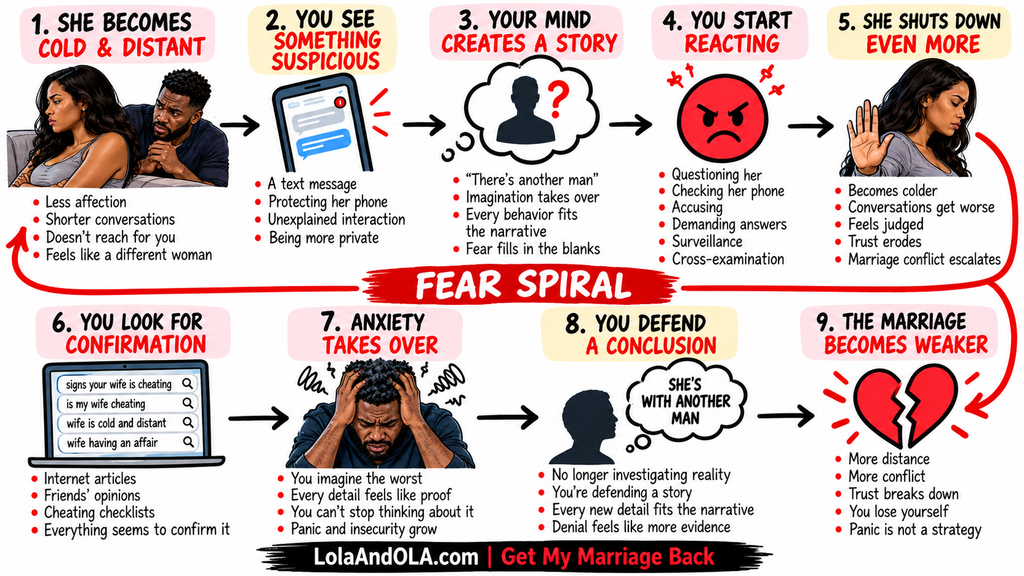
My Wife Loves Me But Doesn’t Desire Me 💔

Feeling like your wife loves you but doesnt desire you is one of the most painful, isolating experiences a husband can endure in a marriage.

When a relationship slips into a completely sexless routine, it’s easy to assume the romantic spark is dead permanently.

But there is a massive psychological difference between a woman losing her baseline love for you and her temporary lack of sexual desire.

my wife loves me but doesnt desire me

If you constantly feel like your wife loves you but is not sexually attracted to you, you must stop overreacting.

This comprehensive guide breaks down exactly why the physical intimacy has stopped, how to interpret her emotional distance, and the exact steps you can take today to revive her desire without losing yourself in the process.

Few relationship struggles cut as deeply as feeling loved but not desired.

For many men, especially husbands, this disconnect can be devastating. But before you assume the worst, it’s important to slow down, understand what’s really happening, and recognize that this situation may not be as permanentโ€”or as hopelessโ€”as it feels.

Where Did This Conclusion Come From?

Before anything else, ask yourself:

How did I arrive at the belief that my wife doesn’t desire me?

Was it something she said or did she tell you directly that she’s no longer attracted to you?

Has intimacy decreased or disappeared?

Does she seem emotionally distant?

Have there been repeated rejections that left you feeling unwanted?

Or have you simply noticed a pattern over time and drawn your own conclusions?

Understanding the source of your belief matters because sometimes our conclusions are based on clear evidence, while other times they’re based on assumptions, fears, or interpretations that may not tell the whole story.

The more specific you can be about what led you here, the better equipped you’ll be to address it.

Love and Desire Are Not the Same Thing

One of the hardest truths to accept is that love and desire, while connected, are not identical.

A person can genuinely love you and still struggle with desire.

That doesn’t necessarily mean they’re lying when they say they love you.

Love can exist in many forms:

  • Commitment
  • Loyalty
  • Affection
  • Respect
  • Care
  • Partnership

Desire, however, is often tied to attraction, emotional connection, excitement, energy, and physical intimacy.

While love tends to be stable, desire can fluctuate.

That’s why someone can sincerely say, “I love you,” while simultaneously feeling disconnected from the romantic or sexual aspects of the relationship.

Understanding this distinction doesn’t remove the pain, but it helps explain why these seemingly contradictory realities can exist at the same time.

Why This Hurts So Much

For many men, being desired by their wife isn’t simply about sex.

It’s about feeling chosen.

Also, it’s about feeling valued.

It’s about feeling attractive, important, and significant in the eyes of the woman they love.

When that desire seems absent, many men don’t just experience disappointmentโ€”they experience a blow to their identity.

Questions begin to surface:

  • What’s wrong with me?
  • Am I no longer attractive?
  • Did I fail somehow?
  • Is she interested in someone else?
  • Is our marriage over?

The emotional impact can be severe because it touches on self-worth, masculinity, and the need for connection.

That’s why hearing something like:

“I love you, but I’m not in love with you.”

or

“I care about you, but I don’t feel that way anymore.”

often feels worse than people realize.

The statement may be intended to soften the blow, but for the person receiving it, it can feel like a rejection of the deepest kind.

Desire Is Often Temporary

Here’s an important truth:

A lack of desire today does not automatically mean a lack of desire forever.

Desire is dynamic.

It rises and falls.

Also, it responds to circumstances.

It can be affected by:

  • Stress
  • Exhaustion
  • Resentment
  • Health issues
  • Hormonal changes
  • Parenting responsibilities
  • Emotional disconnection
  • Depression
  • Anxiety
  • Unresolved conflicts

Many couples go through seasons where attraction feels weaker.

That doesn’t necessarily mean the marriage is doomed.

In fact, some couples rebuild desire and intimacy after years of disconnection.

The key is understanding that low desire is often a symptom of something deeper rather than the problem itself.

Don’t Let Panic Make Things Worse

One of the biggest mistakes people make when they feel undesired is reacting out of fear.

When fear takes over, it often leads to:

  • Constant reassurance-seeking
  • Neediness
  • Anger
  • Defensiveness
  • Accusations
  • Emotional pressure
  • Desperation

Ironically, these reactions often push a spouse further away.

When you’re convinced that something is permanently broken, you tend to operate from panic.

When you recognize that the situation may be temporary, you create space for healthier responses.

Calmness doesn’t mean indifference.

It means approaching the issue with confidence instead of fear.

Seek Understanding Before Solutions

Instead of immediately trying to fix the problem, seek to understand it.

Ask questions.

Listen carefully.

Create a safe space for honest conversations.

You might discover that your wife’s lack of desire has little to do with your appearance or worth.

Perhaps she’s overwhelmed. Perhaps she’s emotionally exhausted.

And perhaps unresolved issues have built up over time.

Perhaps she’s struggling with something she hasn’t been able to communicate.

The goal isn’t to prove who’s right or wrong.

The goal is understanding.

Because once you understand the true cause, meaningful solutions become possible.

Remember Your Value

A temporary decline in your wife’s desire does not determine your worth as a man.

It’s easy to internalize rejection and begin believing that something is fundamentally wrong with you.

Don’t do that.

Your value isn’t measured solely by how desired you feel at any given moment.

Maintain your confidence.

Continue growing.

Check this article out: Saving A lonely Marriage

Take care of yourself physically, emotionally, and mentally.

The stronger and more grounded you remain, the better positioned you’ll be to navigate the challenges in your marriage.

Every Man Wants Both

Let’s be honest.

Most husbands don’t just want love.

They want love and desire.

Also, they want affection and attraction.

They want commitment and passion.

There’s nothing wrong with wanting that.

Desiring to be desired by your spouse is natural.

It’s healthy.

It’s human.

The goal isn’t to convince yourself that love alone is enough when your heart longs for more.

The goal is to approach the situation wisely, recognize that desire can be rebuilt, and avoid making permanent conclusions based on temporary circumstances.

If you’re currently thinking, “My wife loves me, but she doesn’t desire me,” remember this:

Don’t confuse today’s reality with tomorrow’s destiny.

Desire is not always permanent.

Attraction can be restored.

Connection can be rebuilt.

Marriages can recover.

The most important thing you can do right now is resist panic, seek understanding, communicate honestly, and approach the situation from a place of strength rather than fear.

Because sometimes what feels like the end of desire is actually the beginning of discovering what has been missing all alongโ€”and how to bring it back.


5 Subtle Signs Your Separated Wife Wants to Reconcile


It can be difficult if it seems like your wife loves you but doesn’t desire you, but there are a few things you can do. 

Weโ€™ve had a few people send these questions in and maybe you can relate in one shape, form or the other.  Here we go before I share 5 tips to help you through a difficult time in your marriage.

โ€œWife Has No Romantic Feelings For Meโ€

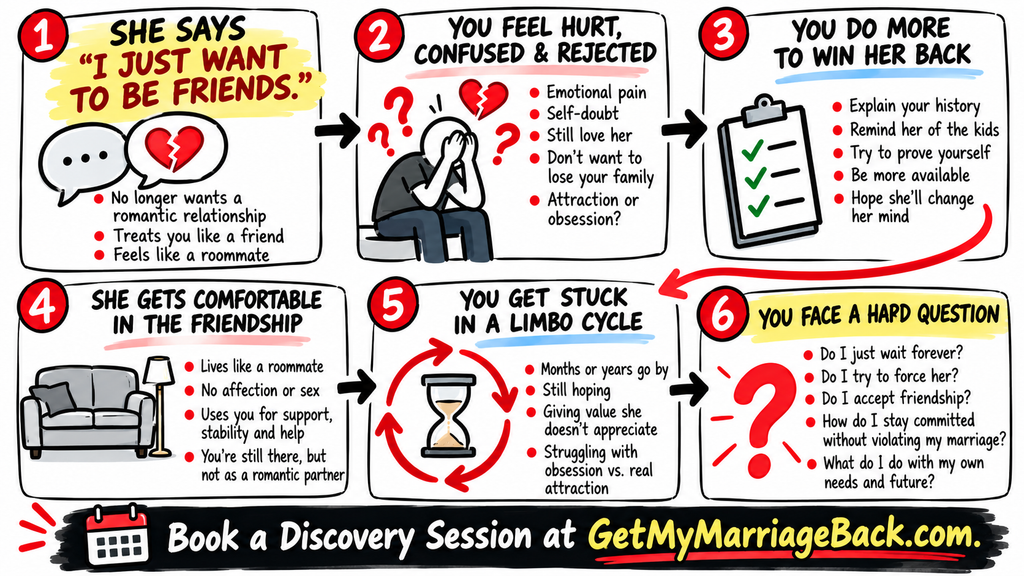
My wife and I have been married for several years, but I have come to realize that she has no romantic feelings for me. We still have a good relationship, but it is more of a friendship than a romantic partnership. I feel lonely and rejected, but I am trying to accept the situation and move forward.

Your Wife Hasn’t Slept With You In Monthsโ€

My marriage has been going through a difficult time lately. My wife and I have been growing apart and it has been months since we have shared a bed. This has been an incredibly hard time for both of us, and I am trying my best to make things better.

โ€œMy Wife Sees Me As A Friend Not A Loverโ€

My wife and I have a strong friendship, but it is not a romantic one. She sees me as a companion and confidant, but not as a lover. We have a mutual respect and admiration for one another, but it is not the same kind of connection that is usually associated with a romantic relationship. We are content with our relationship as it is, and we both appreciate the bond we share.

โ€œMy Wife Says She Loves Me But Doesn’t Show Itโ€

My wife often tells me that she loves me, but I can’t help but feel like she doesn’t show it. She is often busy with work and other commitments, so it’s hard for her to find the time to express her love. I try to understand, but it’s still difficult for me to feel truly appreciated.

You Don’t Feel Desired By You Wife

I feel like my wife doesn’t desire me anymore. Also, i feel like she has lost interest in me and our relationship. I feel neglected and unimportant to her. It’s heartbreaking to feel like I’m not wanted or desired by the person I love the most.

โ€œMy Wife Doesn’t Want Me Sexuallyโ€

My wife and I have been having a difficult time in our relationship lately. She has expressed that she no longer feels the same way about me sexually, and that she does not want to be intimate with me. This has been a difficult situation for both of us, but I am trying to be understanding and supportive of her feelings. We are working together to try to find a way to reconnect and build a stronger relationship.

Here are the 5 tipsโ€ฆ

Tip 1 – Honest & Open Conversation

Start by having an honest and open conversation with your wife and try to understand her perspective.

The best way to start having a meaningful conversation with your wife is to be honest and open within the confinement of emotional intelligence.

Listen to her perspective and try to understand where she is coming from. Ask her questions and be willing to compromise. 

Show her that you care about her feelings and that you are willing to work together to find a resolution. Be patient and understanding, and donโ€™t be afraid to express your own feelings.

Show her that you are willing to put in the effort to make things work. This will help to create an environment of trust and respect, which is essential for any healthy relationship.

Tip 2 – Active Listening

Make sure to actively listen to her and let her express her thoughts and feelings without judgment. 

It is important to make sure that you actively listen to her and let her express her thoughts and feelings without judgment. 

This means that you should be actively engaged in the conversation, focusing on what she is saying and not interrupting her. 

You should also be open to hearing her thoughts and feelings without passing any kind of judgment. 

This is important because it will allow her to feel comfortable expressing herself and will create a safe space for her to do so. 

It is also important to be patient and understanding, as this will help create a positive environment for her to share her thoughts and feelings.

Tip 3 – Self Care

You can also take time to focus on yourself. This has nothing to do with the selfless ingredient necessary for a marriageโ€™s sustainability.

Taking time to focus on yourself is a great way to make sure that you are taking care of your mental and physical health. 

Self-care can include activities such as reading a book, going for a walk, or taking a nap. 

It can also mean taking time to reflect on your thoughts and emotions, or doing something that brings you joy. 

Taking time to focus on yourself can help you to reduce stress, improve your mood, and increase your overall well being. 

It can also help you to gain clarity and perspective on your life and the decisions you make.

Taking time for yourself is an important part of self-care and should be an integral part of your life.

Make sure youโ€™re taking care of yourself and your own needs by engaging in activities that bring you joy and make you feel good. 

Self-care is an important part of maintaining a healthy and balanced lifestyle. 

Taking care of yourself and your own needs is essential for your mental, physical, and emotional wellbeing. 

Engaging in activities that bring you joy and make you feel good is a great way to practice self-care. 

This can include anything from exercising, reading a book, spending time with friends, or simply taking a few moments to relax. 

Taking the time to do something that you enjoy can help to reduce stress and improve your overall mood. 

Practicing self-care is a great way to ensure that you are taking care of yourself and your own needs.

Tip 4 – Affection

Lastly, donโ€™t forget to be affectionate with your wife. 

It is important to remember to be affectionate with your wife. 

Showing your wife affection is a great way to show her that you care and appreciate her. 

This can be done through small gestures such as holding hands, giving hugs, or even just saying โ€œI love youโ€. 

It is also important to make time for your wife, whether it is going on a date night or just spending quality time together. 

Showing your wife affection is a great way to strengthen your relationship and make her feel special.

Tip 5 – Love & Kindness

Show her love and kindness, and let her know that you appreciate her and are here for her.

Being in a relationship is hard work because it is highly rewarding, but it can also be immensely rewarding.

4 Signs Your Wife Is Not Sexually Attracted To You

There are a few signs that may indicate your wife is not sexually attracted to you. 

  1. She may avoid physical contact, such as cuddling or holding hands. 
  2. She may also not want to engage in any kind of sexual activity or intimacy. 
  3. She may be less interested in spending time with you or may be distant in conversations. 
  4. She may also not be as affectionate or show signs of physical attraction, such as compliments or flirting. 

If these signs are present, it may be a sign that your wife is not sexually attracted to you.

In this rest of the article, you will discover what to do if all signals indicate that the wife you married doesnโ€™t desire you anymore even though she claims she loves you.

It’s perfectly normal for a wife to love her husband, but sometimes not feel sexually attracted to him.

While desire cannot be negotiated, it can absolutely be influenced with some tips we will share in this article.

There could be any number of reasons for this, such as a lack of emotional connection, mismatched libido levels or unresolved anger or resentment.

If you’re in this situation, it’s important to talk to your spouse and figure out what’s causing the disconnect.

You may need to see a therapist to help address the underlying issues; you can start with a family therapist.

Here are some very important lessons that we will cover to give you a full understanding and tactful things you can do to rekindle things:

  1. The Meaning of “Desire” In A Marriage
  2. What is the Difference Between Love and Sexual Desire?
  3. “What Does it Mean When My Wife Loves Me But Doesn’t Desire Me?”
  4. How does this affect a marriage and relationship?
  5. Tips for creating sexual desire in your spouse again
  6. The Role of a Sex Therapist

… and more.

My Wife Never Touches Me Anymore

“She used to be so affectionate, but now she seems distant and removed. I don’t know what I did wrong, but I fear that she may be cheating on me or is no longer interested in me. I don’t know how much longer I can take this.”

This kind of problem always start with a wife losing interest.

Let’s dive right in…

3 Signs That Your Wife Is Losing Interest

It can be difficult to tell if your wife is losing interest in you.

However, there are 4 of many other signs you can look out for.

  • Sign #3 – One common sign is if your wife starts to avoid sexual intimacy.
  • Sign #2 – If she stops taking care of herself physically or stops dressing up for you, this can also be a sign that she’s losing interest.
  • Sign #1 – Another sign is if she becomes critical or negative towards you.

If your wife shows any of these signs, it might be time to talk to her about your concerns and see if there’s anything wrong.

The Meaning of “Desire” In A Marriage

When we think of the word “desire,” we often think of our sex life in a marriage and sexual desire.

However, desire is much more than that.

Desire is a yearning or craving for something, someone or the presence of someone.

It can be a strong feeling or emotion that motivates us to take further desired action of course.

In a marriage, it is important for both spouses to feel desired by the other.

This can be accomplished in many ways, such as through words of affirmation, acts of service, and physical touch.

When both spouses feel desired, it builds intimacy and strengthens the bond between them.

Sexual desire is an important part of a marriage, but it is not the only type of desire that matters.

Spouses should strive to meet each other’s non-sexual desires as well, in order to create a fulfilling and lasting relationship.

That alone can help in boosting and/or sustaining sexual desires in the marriage.

What is the Difference Between Love and Sexual Desire?

When we think of love, we often think of feelings of warmth, happiness and affection.

Love is a deep, emotional connection that spouses have with each other.

It is a feeling of being drawn to someone, of wanting to be close to them and wanting to make them happy.

In marriage, however, love is not just a feeling of lust or passion.

It is much more than that because a long term relationship between 2 different human beings is involved.

Love is Action, Patient, Kind and Fifty Million Others Things.

Sexual desire, on the other hand, is a physical attraction that spouses feel for each other.

It is the desire to be intimate with someone, to touch them and to be touched by them.

Sexual desire can often be confused with love, but they are two separate things.

Sexual desire was traditionally not necessary in a marriage, but love was as a function of duty and responsibility.

However, things have changed and it will hurt your marriage if you dare attempt to discount the importance of feelings in modern day marriage.

There Is A Strong Relationship Between A Couple’s Sex Life, Love And Sexual Desire. 

A couple’s sex life is often seen as the foundation of a healthy relationship, and is usually one of the first things to disappear when a relationship starts to deteriorate.

Love is often thought of as the emotional connection that couples share, and is what keeps them together over time.

Sexual desire, on the other hand, is what motivates people to have sex and is often seen as a physical manifestation of love.

“What Does it Mean When My Wife Loves Me But Doesn’t Desire Me?”

When a wife loves her husband but does not desire him, it can be a sign that there is something wrong in the underlying relationship.

It may be that the wife is no longer attracted to her husband, or that she is unhappy with the way things are going in the relationship.

If this is the case, then it is important for the husband to talk to his wife and find out what is wrong.

He should express his love for her and try to find a way to fix whatever is causing the problem.

By the way, she might not be able to explain this in words.

How Does Your Intimacy Affect a Marriage Relationship?

Your sex life is an important part of intimacy in your marriage and the underlying relationship.

It helps to keep the spark alive and allows couples to feel close to each other.

When there is not healthy level of intimacy (which is deeper than sex), everything else starts to feel wrong.

Your Sex Life Can Take Many Different Forms, Such As Talking And Touching.

If one partner feels that they are not being desired by the other, it can be a blow to their self-esteem.

It can make them feel like they are not good enough and that they are not wanted.

This can lead to a lot of emotional pain and conflict and even emotional and full blown infidelity.

There are many ways to improve your sex life in a marriage relationship.

Couples can talk about their needs and desires, spend time together, touch each other more often, and be open and honest with each other.

But that’s usually not enough because it would most likely take one person to lead the dance.

If you are struggling with this issue, please seek help from a therapist, coach or counselor.

They can assist you in working through these feelings and improving your relationship.

6 Tips for Creating A Fulfilling Sex Life With Your Spouse Again

There are many ways to rekindle your sex life in your relationship with your spouse.

Here are a few tips:

1. Talk openly and honestly about your feelings and desires but with respect to your partner’s feelings.

2. Make time for each other and carve out special moments just for the two of you.

3. Be affectionate and touch each other often.

4. Experiment and be playful in the bedroom.

5. Communicate during sex and let your partner know what you enjoy.

6. Connect emotionally as well as physically.

The Role of a Sex Therapist

A sex therapist’s role is to help couples or individuals overcome issues that are preventing them from enjoying a healthy and fulfilling sex life.

They can help with a range of issues, such as low libido, performance anxiety, erectile dysfunction, and more.

Sex therapists typically use a mix of therapies, such as cognitive behavioral therapy (CBT), couples therapy, and psycho-education.

How A Sex Therapist Uses CBT

A sex therapist uses cognitive behavioral therapy (CBT) which can be a great help for couples in this situation.

He or she can help the couple understand why the wife loves her husband but does not desire him.

They can also work to help the couple rebuild their intimacy and connection.

Every other advice would probably unintentionally position you to start feeling like your wife is weaponizing sex.

How can she weaponize sex if she doesn’t hate sex with you?

That’s The Easy Route Of Thought; Try Harder.

A sex therapist would help you do the hard work by digging deeper into the reasons behind the scenes and behind the obvious.

You can even take it further.

You will learn seduction skills from a sex therapist that will help you influence high level of desire, interest and attraction.

Check out American Association of Sexuality Educators, counselors and therapists to see if you can find an AASECT Certified Sex Therapist.

An AASECT Certified Sex Therapist is trained to provide in-depth psychotherapy and they are specialized in treating clients with sexual issues and concerns.

What To Do When Your Partner Doesn’t Want To Be Intimate

When your partner doesn’t want to be intimate, it can be a difficult and confusing experience.

You may feel like you’re not good enough or that you’re not attractive in your relationship anymore.

Here Are 5 Things You Can Do To Improve Intimacy:

1. Talk to your partner about why they don’t want to be intimate and try to understand their point of view.

2. Don’t take it personally (this is easier said than done) – remember that this has nothing to do with how much they love you.

3. Don’t pressure your partner into being intimate if they’re not comfortable doing so because desire cannot be negotiated; it can however be influenced if you have the skills.

4. Seek out support from friends or family members who can offer words of encouragement to you if need it; don’t count on them being able to correct your spouse into order.

5. Seek professional help if the situation is causing you significant distress.

Remember that you’re not alone and there are ways to deal with this situation.

Don’t hesitate to reach out for help if you need it.

“Can I Divorce My Wife For Not Sleeping With Me?”

Of course you can divorce your spouse these days for the dumbest reasons.

All you have to do is to claim “irreconcilable differences.”

But of course, I don’t just advice you to just run for the hills at the slightest sight of a slow down in intimacy.

While it may be frustrating if your wife doesn’t want to have sex with you, it’s important to remember that there are many reasons why someone may not be interested in sex.

It Could Be Due To Stress, Fatigue, or Health Issues.

If your wife is unwilling to discuss the issue, then you may want to consult with a therapist to help you understand why she is not interested in sex and work on ways to improve intimacy.

There are many bitter people on the internet that will advice you to just go ahead and kick her to the curb.

You and I know that if it was that easy, you would have done it already.

Don’t compare yourself to people who are so weak to the extent that they never had enough vested interest in a marriage they created in the first place.

Identify if you really want that marriage from a personal standpoint and then move intentionally and accordingly; with the help of good counsel and not random people on the internet.

How Health Issues Can Result in Lack of Physical Intimacy

Many couples struggle with physical intimacy at some point in their relationship.

This can be due to a variety of factors, such as fatigue, stress, or health issues.

When one partner is dealing with health issues leading to a lack of physical intimacy, it might not be as obvious.

Physical intimacy is an important part of a marriage, and when it’s lacking, it can be difficult for both partners.

There are issues that may be hormonal or psychological remnants of health crisis.

Start with a conversation as usual and a healthy does of empathy and that alone can instigate her wanting sex.

“I Just Want My Wife To Want Me But I’ve Heard Many Wives Like Her Hate Sex Eventually.”

Sexual pleasure is an important part of any relationship, and it’s no different for couples in which the wife loves her husband but doesn’t desire him.

This is a temporary issue normally and you next move can make it permanent or temporary; tread carefully.

Even though they’re not physically attracted to each other, these couples can still enjoy a healthy and fulfilling sexual relationship if they’re willing to put in the effort.

For men in this situation, it’s important to understand that sexual pleasure isn’t all about the physical act of sex.

Sexual pleasure actually starts long before the act of sex.

There is a lot more going on even though you may feel as though she hates sex; it’s highly unlikely.

One of the key things when you are going through this is to make sure you are prepared for the opportunity to be intimate when it presents itself again.

When that time comes…

Here Are Additional 5 Tips To Be More Sexually Intimate With Your Wife

Tip #5 – First, try to be more present when you’re together.

And Tip #4 – Pay attention to her body and her reactions when you’re touching her.

Tip #3 – Second, experiment with different types of touch. Try mixing up your routine to keep things fresh; don’t be predictable.

Tip #2 – Third, communicate with your wife about what she enjoys.

Let her know what turns you on, and ask her about her fantasies.

Tip #1 – Lastly, make time for sex.

Dedicate time specifically for intimacy, and make sure that both of you are available for it.

Here is a quick question for you to ponder.

How do you feel about entertaining sex toys in your sex life?

Your answer can make or break your sex life and intimacy; Hint: No answer is right and wrong.

Why Does My Wife Hate Initiating Sex?

There could be many reasons why your wife hates initiating sex.

It could be that she’s not attracted to you, she’s not in the mood, or she’s not feeling well.

If your wife doesn’t initiate sex very often, it might be because she’s not comfortable doing so.

Heck: It can be completely a traditional or cultural issue

Talk to her about how you feel and see if she has any concerns or suggestions.

This is one of those situations where you may want to identify the strengths and weaknesses of your relationship and both of you as individuals.

What I want you to do is to shed more energy and light on the strengths and avoid trying to force the weaknesses with respect to the result that you want.

I would hope that your desired result is simply more sex; more passionate sex.

“My Wife Makes Excuses To Refuse Sex.”

“My wife loves me and always tells me how much she cares for me, but she doesn’t desire me sexually. She makes excuses not to sleep with me, and it’s really starting to take a toll on our relationship. I’m not sure what to do, as I still want to be intimate with her.”

Most Women In Marriage React To Unhappiness In One Or More Ways: 

Outside of health issues, she might not feel satisfied with her marriage due to the amount of time spent away from her spouse.

The most recent findings suggest that up to 50 percent of couples who have been married 10 years are dissatisfied with their marriage because they report feeling frustrated and unfulfilled.

This is a rather strong reason why most women in marriage do not want sex – it’s as if they’re trying to protect themselves from being hurt again by refusing sex.

To a large extent, this can be subconscious.

Most women refuse sex because they are afraid of getting too close, only for them to continue to feel unhappy in the marriage down the road anyway.

It’s like “why bother?”

The First Step Is Always To Talk To Your Spouse About The Issue.

If that doesn’t work, you may want to engage your seduction power as a woman; that starts with self-assessment.

  • What turned him on to you in the first place?
  • What turns him on to you right now?
  • What turns you on?

Once you find out the answer to all 3 of these questions, then you will find everything else useful in rekindling things.

How To Deal With A Sexless Marriage As A Woman

Dealing with a sexless marriage as a woman can be difficult, but there are ways to cope.

First, it’s important to understand that there is no shame in having a sexless marriage.

It’s not your fault, and you’re not alone.

There are many couples who experience this problem and therefore there are many solutions and options.

In Conclusion

It’s normal for most women to lose interest in their husbands after some time and over time.

This doesn’t mean that the love is gone, just the desire may be absent.

There are many things you can do to help boost your wife’s desire and attraction towards you again.

By leveraging some of the simple tips we’ve covered, you can rekindle the flame and have a more fulfilling marriage.

Here is a last bonus tip for you.

If you are always engaged in arguments that you may have considered a harmless debate, that can sure create lower interest and desire from your spouse; It can get weird from time to time.

What a confusion right?

Are women crazy? 

How do you love a husband you donโ€™t desire?

I was on the receiving end of those resentments she mentioned earlier and it was not fun as you can probably imagine.

We got married and I flipped my legs on the table and just relaxed like most new husbands.

After all, we are now committed to each other for life. 

PREVIOUS POST: 💔 5 Reasons Your Wife is NOT Affectionate Anymore

What else is there to worry about? So I thought or acted at least.

Itโ€™s called complacency and we all do it in one shape, form or the other.  

The truth is that I truly loved my wife and my family even back then but that didnโ€™t stop me from being complacent.

Here is the first thing you should know.

On the other end of being complacent is a person you love who may be feeling undesired by you even if you donโ€™t mean to.

And you know what they say about hurt-people. They hurt people right?

Thatโ€™s right. But I didnโ€™t plan out how I was going to hurt you back.

It was more-so about two people who entered a whole marriage to wing things along.

I know what you are thinking.

Why didnโ€™t we vet properly and go through premarital counseling?

Not only did we engage in some premarital counseling,

we actually dated and were in a committed relationship for 3 years before we went to the altar.  

Here is what we know today after reviewing, consulting and coaching many people in modern marriages .

People that say โ€œI doโ€ donโ€™t know what they are doing because they couldnโ€™t possibly know.

When you havenโ€™t experienced marriage,

you are in a completely different context and it is what it is.

So when I complained about a few things a few times only to get undesirable responses from my husband,

I continued to feel more unsafe to express myself.

The resentments started to build up naturally.

It is in fact true that unexpressed expectations turn to resentments.

It is paramount that you give your partner freedom to express their expectations and the key is to not take those expectations personally.

TRENDING: 5 Stages that Leads to a Sexless Marriage 💔

After our relationship deteriorated so badly, I was still pretty much oblivious.  

To me it wasnโ€™t that difficult.  I just want my wife to want me and it was weird to me that she didnโ€™t get it.

Before I knew it, I started creating room in my life for the idea of entertaining attention that was being deprived on the sidelines.

We never stopped proclaiming our love for each other verbally but I didnโ€™t feel it. 

As a man, I simply normalized it because I grew up with Uncles who had and exercised options when it comes to women; married or not.

Like most men…

I thought about sexual attraction.

And I wondered why you avoided intimacy and I couldnโ€™t touch you anymore.

I resented the audacity of committing and not showing up to our marriage.

So of course over time, the disconnection reflected occasionally in my energy and at one point, my wife verbally gave up on us.

The Main Lesson

HAVE YOU SEEN THIS: More Video on our YouTube Channel

That rock bottom helped me discover the secret. 

A certain type of love required for all marriages is a choice.

However, desire, affection, and attraction are symptoms of a certain consistent way of showing up in your marriage as a man.

A typical wife has a lot on her plate and simply doesn’t get to decide if they want to desire you or not.

Think about it.

In the beginning of your love affair, your wife desired you without knowing enough about you.

Although, it wasnโ€™t controlled, it was an attraction.

So we can agree that desire in a marriage is not some logical decision.

At least, thatโ€™s not reality.

With proper support itโ€™s absolutely possible because we are a testimony.

But you will have to engage your power and itโ€™s impossible when you are playing the victim.

โ€œIs My Wife Attracted To Meโ€ Take The Quiz

Taking a quiz can be a great way to gauge the level of attraction between you and your wife.  Try this…

Question 1 of 15

It can help you to identify areas of your relationship that could use some work, or it can help you to recognize the positive aspects of your relationship. 

The quiz typically consists of questions about your relationship, such as how often you and your wife spend time together, how often you show affection, and how often you communicate.

Additionally, it may also include questions about how you and your wife interact with each other in public, how often you have disagreements, and how often you share intimate moments.

We will be creating a quiz soon.  Look out for it.

Frequently Asked Question

Why does my wife have no desire for me?

There are a variety of potential reasons why a wife may have no desire for her husband. It could be due to a lack of communication, a lack of emotional connection, or a lack of physical intimacy. And It could also be due to a change in circumstances, such as a job loss, a move, or a health issue. Also it could also be due to unresolved issues from the past, such as unresolved arguments, hurt feelings, or unresolved trauma. It is important to take the time to talk to your wife and try to understand the root cause of her lack of desire in order to find a solution that works for both of you.

What to do when my wife doesn’t want me sexually?

When your wife doesn’t want you sexually, it can be difficult to handle and can create a lot of tension in the relationship. It is important to talk to your wife about her feelings.

Why do I feel like my wife doesn’t want me sexually?

I feel like my wife doesn’t want me sexually for a variety of reasons. We may not be communicating our needs and desires effectively, or we may have drifted apart over time. It could also be that she is feeling overwhelmed with other aspects of life, such as work, family, or other commitments. It could be that she is dealing with her own issues that she hasn’t been able to share with me. Whatever the reason, it is important to talk to my wife and try to understand what is going on and how we can work together to improve our relationship.

Can a marriage survive without desire?

A marriage without desire can be a difficult situation to navigate. While it is possible for a marriage to survive without desire, it is often an uphill battle. Without the passion that comes with desire, couples may find that they are unable to connect on an emotional level, leading to a lack of communication and understanding. This can cause resentment and distance between the two partners, making it difficult to sustain the marriage. In order to make a marriage work without desire, couples must be willing to put in the effort to build a strong foundation of trust, respect, and communication. This can be difficult, but it is possible for a marriage to survive without desire if both partners are willing to put in the work.

How to deal with lack of intimacy as a man?

Dealing with a lack of intimacy as a man starts with resisting the urge to take it as a permanent judgment of your worth. Many men immediately internalize rejection and assume they’re no longer attractive, loved, or valued, but intimacy often reflects the overall health of the relationship rather than one person’s desirability. Focus on maintaining your confidence, mastering effective communication with your wife, and seeking to understand what may be contributing to the disconnect. Approach the issue with calmness instead of panic, because desperation, resentment, and pressure often make rebuilding intimacy more difficult.

What to do if my wife doesn’t desire me?

If your wife doesn’t seem to desire you, the first step is to avoid jumping to permanent conclusions. Desire naturally rises and falls throughout a marriage.

What causes lack of intimacy in a relationship?

A lack of intimacy in a relationship is often the result of factors that go far beyond physical attraction. Emotional disconnection, unresolved resentment, poor communication, stress, parenting responsibilities, financial pressures, depression, anxiety, and health concerns can all contribute to reduced intimacy. Over time, couples can become so focused on daily responsibilities that they neglect the emotional and romantic connection that fuels desire. If oreWhen intimacy declines, it’s important to view it as a signal that something needs attention rather than assuming that love has disappeared.


Broken Marriage?
Fix it
Here FREE

Get My Marriage Back