
Broken Marriage?
Fix it
Here FREE

Get My Marriage Back


7 Reasons – Your Husband Repulses You Sexually? Why It Happens & What to Do

If you’ve caught yourself thinking, “my husband repulses me sexually,” you’re probably carrying a mixture of guilt, confusion, frustration, and even fear.

You may love your husband as a person. And may respect him as a father. You may even want your marriage to work.

Yet when he reaches for your hand, initiates intimacy, or tries to kiss you, your body seems to pull away.

That reaction can be alarming.

Many women assume this means the marriage is over, their husband has become unattractive forever, or they have simply fallen out of love.

But in many cases, sexual repulsion is not the actual problem.

It is the symptom.

It is often your mind and body signaling that something deeper has been neglected for too long.

The good news is that attraction is far more dynamic than most people realize. Before making permanent decisions based on temporary emotions, it’s important to understand what is really happening beneath the surface.

my husband repulses me sexually - Sexual Repulsion Is Usually the Final Symptom, Not the Root Cause

Sexual Repulsion Is Usually the Final Symptom, Not the Root Cause

Most healthy marriages do not move from passion to repulsion overnight.

The journey is usually gradual.

Small disappointments become resentments.

Unspoken frustrations become emotional distance.

Emotional distance becomes indifference.

And eventually, physical intimacy starts to feel uncomfortable, forced, or even repulsive.

Many women mistakenly focus on fixing the sexual symptoms while ignoring the emotional infection underneath.

Trying to force intimacy when resentment is unresolved is like spraying perfume over a wound instead of treating it.

The real question isn’t:

“Why am I sexually repulsed by my husband?”

The better question is:

“What happened between us that made my body stop feeling emotionally safe, connected, or attracted?”

7 Hidden Reasons Your Husband Repulses You Sexually

1. Deep Emotional Resentment Has Been Building

Resentment is one of the biggest attraction killers in marriage.

Perhaps you feel unheard.

Maybe you feel unappreciated.

Perhaps you’ve carried the emotional load of the family while your husband remained unaware.

Over time, unresolved resentment creates emotional debt.

The problem is that resentment rarely stays emotional.

Eventually, it becomes physical.

Your body starts rejecting the person your mind feels hurt by.

Until resentment is addressed, sexual attraction often struggles to return naturally.

2. Your Marriage Has Become Predictable and Emotionally Flat

Human beings have six fundamental emotional needs:

  • Certainty
  • Variety
  • Significance
  • Connection
  • Growth
  • Contribution

Many marriages become overly focused on certainty while neglecting variety and growth.

The relationship becomes functional but no longer exciting.

You become roommates, co-parents, or business partners rather than romantic partners.

When novelty disappears entirely, attraction frequently follows.

This doesn’t mean you need drama.

It means healthy attraction requires ongoing curiosity, growth, and emotional engagement.

3. You No Longer Respect Him the Way You Once Did

This is uncomfortable to admit, but it matters.

Attraction often follows admiration.

When a woman repeatedly sees behaviors that erode trust, confidence, leadership, integrity, or emotional maturity, attraction can decline.

This doesn’t necessarily mean your husband is a bad man.

It simply means the version of him you’re experiencing today may not be inspiring the same feelings he once did.

Instead of focusing entirely on what he lacks, ask yourself:

  • Have these issues been discussed clearly?
  • Have realistic expectations been established?
  • Has pride prevented productive conversations?

Many marriages deteriorate because expectations remain unspoken while resentments continue growing.

4. Constant Criticism Has Poisoned the Emotional Climate

One of the fastest ways to destroy attraction is through a cycle of:

  • Blame
  • Judgment
  • Condemnation
  • Sarcasm
  • Guilt
  • Insults

Whether it comes from you, him, or both of you, these behaviors create emotional hostility.

Nobody feels naturally attracted to someone they constantly fight with.

When emotional safety disappears, sexual desire often follows.

The bedroom is usually reflecting what is happening everywhere else in the relationship.

5. He Has Stopped Pursuing the Relationship

Many women become emotionally disconnected when they feel invisible.

If your husband no longer:

  • Notices your efforts
  • Prioritizes quality time
  • Shows curiosity about your life
  • Initiates meaningful connection

You may gradually begin feeling taken for granted.

Feeling unseen creates emotional loneliness.

Emotional loneliness eventually creates physical disinterest.

However, before assuming neglect is intentional, it is important to explore what may be happening in his world as well.

Stress, depression, burnout, health challenges, and career pressure often impact connection more than many couples realize.

6. You’ve Lost Yourself in the Marriage

This reason surprises many women.

Sometimes your husband isn’t the entire problem.

Sometimes you’ve become disconnected from yourself.

You stopped pursuing your goals.

Stopped nurturing friendships.

You stopped growing outside the marriage.

Creating a life that energizes you.

When your entire identity revolves around the relationship, emotional dependency often develops.

Ironically, dependence frequently kills attraction.

One of the most attractive qualities in any person is vitality.

When you reconnect with your purpose, passions, and personal growth, attraction often begins shifting again.

7. There May Be Underlying Physical or Hormonal Factors

Not every attraction issue is psychological.

Hormonal changes, perimenopause, menopause, medication side effects, depression, anxiety, chronic stress, and health conditions can significantly impact desire and physical responses.

If your loss of attraction feels sudden or extreme, consulting a healthcare professional can provide valuable clarity.

Never assume every intimacy issue is purely relational.
What Not to Do If Your Husband Repulses You Sexually - my husband repulses me sexually

What Not to Do If Your Husband Repulses You Sexually

Don’t Force Yourself Into Intimacy

Many women try to “push through it.”

Unfortunately, forcing yourself into unwanted intimacy often strengthens the negative association.

Instead of rebuilding attraction, it can deepen aversion.

Pressure rarely creates desire.

Safety creates desire.

Don’t Turn Him Into the Villain

While your pain is valid, turning your husband into the sole problem often keeps you stuck.

Healthy relationships require curiosity before conclusions.

Most struggling marriages involve patterns, not villains.

Understanding the pattern gives you power to change it.

Don’t Make Permanent Decisions During Emotional Exhaustion

When emotions are running high, everything feels permanent.

Take time to evaluate what is actually happening before making life-altering decisions.

Many marriages recover after identifying and addressing the real issues beneath the surface.

13 Signs That Will Make You Say “My Husband Hates Me” to Yourself

How to Rebuild Attraction Skillfully

Start With Honest Self-Awareness

Ask yourself:

  • What specifically triggers the repulsion?
  • When did it begin?
  • What changed before it started?
  • Is the issue emotional, physical, relational, or all three?

Clarity creates options.

Confusion creates suffering.

Rebuild Friendship First

One of the most overlooked attraction principles is friendship.

Strong marriages are built on:

  • Shared experiences
  • Emotional safety
  • Playfulness
  • Respect
  • Positive interactions

Trying to fix sex before rebuilding friendship often creates more frustration.

Friendship lays the emotional foundation attraction grows from.

Focus on Your Own Growth

One of the most powerful shifts you can make is returning to your own life.

Reconnect with:

  • Your goals
  • Your purpose
  • Your health
  • Your confidence
  • Your spirituality
  • Your personal interests

Our GPS framework emphasizes:

G – Grounding: Stay connected to gratitude, faith, and emotional stability.

P – Purpose: Build a meaningful life beyond relationship problems.

S – Self-Awareness: Understand your patterns, triggers, and responsibilities.

The stronger you become emotionally, the more clearly you can evaluate your marriage.

Have Difficult Conversations Without Blame

Instead of:

“You never make me feel loved.”

Try:

“I’ve been feeling disconnected lately and I want us to understand what’s happening.”

Blame creates defensiveness.

Curiosity creates cooperation.

Consider Professional Guidance

Sometimes the emotional knots are too tangled to untangle alone.

A qualified therapist can help identify:

  • Hidden resentments
  • Communication breakdowns
  • Attachment patterns
  • Unmet emotional needs
  • Sexual aversions

Professional support often accelerates healing by providing clarity and structure.

Can Attraction Come Back?

Absolutely.

Many couples experience seasons where attraction fades.

The key is understanding that attraction is often a reflection of emotional dynamics, personal growth, unresolved pain, and relationship patterns.

When the underlying issues are addressed, attraction frequently returns in ways that feel more mature, intentional, and sustainable.

The goal isn’t to force chemistry.

The goal is to remove the barriers that are blocking it.

Wife or Husband Denying You Sex? DO THIS!!!

my husband repulses me sexually

So, if you think“your husband repulses you sexually,” try not to panic.

Sexual repulsion is often less about physical appearance and more about emotional reality.

Instead of focusing solely on the bedroom, look at the broader relationship.

Examine the friendship.

…The resentment.

Examine the expectations.

Examine your own personal growth.

Many marriages don’t collapse because love disappeared.

They collapse because emotional disconnection went unaddressed for too long.

When you address the deeper issues with honesty, courage, emotional intelligence, and self-respect, you give yourself the best chance of discovering whether attraction can be rebuilt—or whether a different path is ultimately needed.

Check This Out Now: My Husband Hates Me: 5 Steps to De-escalate Marital Hostility

Frequently Asked Questions (FAQ)

Are 20% of marriages sexless?

Research commonly suggests that approximately 15% to 20% of married couples experience what is often defined as a sexless marriage, meaning little to no sexual activity over an extended period. However, frequency alone does not determine relationship satisfaction because emotional connection and mutual agreement about intimacy matter just as much.

What is the root cause of a sexless marriage?

There is rarely a single cause behind a sexless marriage. The most common contributors include unresolved resentment, emotional disconnection, chronic stress, health issues, poor communication, mismatched desire levels, and unmet emotional needs.

What are the four behaviors that cause 90% of all divorces?

Relationship researcher John Gottman identified four highly destructive patterns often called the “Four Horsemen”: criticism, contempt, defensiveness, and stonewalling. When these behaviors become habitual and remain unresolved, they can gradually erode trust, respect, and emotional intimacy.

What does lack of intimacy do to a woman’s brain?

A prolonged lack of intimacy can increase feelings of loneliness, stress, emotional insecurity, and disconnection. For many women, healthy intimacy supports bonding hormones, emotional regulation, and a stronger sense of connection within the relationship.


Why Do I Get Irritated When My Husband Touches Me? Understanding the Real Reasons Behind the Feeling

So why do you get irritated when your husband touches you?

You’re not alone.

Many women experience periods in their marriage where physical affection that once felt comforting suddenly feels annoying, overwhelming, or even unwelcome.

The most important thing to understand is that irritation when your husband touches you is usually a symptom, not the root problem.

In many cases, the touch itself isn’t the issue.

Instead, the feeling is often connected to deeper emotional, relational, psychological, or even medical factors that have been building over time.

The good news is that if you’re asking questions and looking for answers, you’re already taking an important step toward understanding what’s happening and finding a path forward.

why do i get irritated when my husband touches me

Your Husband’s Touch Is Often a Reflection of Bigger Issues

When women say things like:

  • “I don’t feel anything when my husband touches me.”
  • “I don’t want my husband to touch me anymore.”
  • “My husband repulses me sexually.”
  • “I feel disgusted when my husband touches me.”

The physical reaction is often connected to something larger happening beneath the surface.

For some couples, there has been a gradual emotional drift over the years.

The relationship may not feel as close, exciting, or connected as it once did.

Life responsibilities, stress, parenting, financial pressures, disappointments, and unresolved conflicts can slowly create distance between spouses.

As that emotional distance grows, physical affection may begin to feel different as well.

Rather than seeing the irritation as the problem itself, it can be helpful to view it as a signal that something deeper deserves attention.

Start With a Root Cause Analysis

If you’re wondering, why you might even cringe when your husband touches you, one of the most productive things you can do is perform an honest root cause analysis.

Ask yourself:

  • When did these feelings begin?
  • Was there a specific event that triggered them?
  • Has the relationship changed significantly over time?
  • Are there unresolved hurts or resentments?
  • Do you still feel emotionally connected to your husband?
  • Have outside influences affected how you view my marriage?

Understanding how you got here is often the first step toward deciding where you want to go next.

Many women discover that the irritation didn’t appear overnight.

Instead, it developed gradually as emotional needs went unmet, communication declined, or disappointment accumulated over time.

why do i get irritated when my husband touches me - relationship drift

Comparison Can Quietly Create Relationship Drift

One often overlooked factor is comparison.

You may be comparing your husband to:

  • An ex-partner
  • Someone you know personally
  • A fictional character
  • Influencers on social media
  • Couples/Couple Goals portrayed online or on television

When comparison becomes a habit, real-life relationships can start to feel inadequate.

The reality is that social media and entertainment often show carefully curated versions of relationships.

Comparing your marriage to unrealistic standards can create dissatisfaction that affects attraction and emotional connection.

If you’ve found yourself thinking, why don’t you want you husband to touch or kiss you?, it may be worth examining whether unrealistic expectations or comparisons are contributing to your feelings.

Emotional Neglect Can Affect Physical Attraction

Sometimes the issue isn’t physical at all.

Your husband may not be meeting important emotional needs.

You may feel unheard, unappreciated, unsupported, or disconnected.

When emotional intimacy suffers, physical intimacy often follows.

For example, some women feel frustrated because:

  • Their husband doesn’t listen.
  • He rarely expresses appreciation.
  • He doesn’t understand their love language.
  • They feel emotionally alone in the marriage.

At the same time, it’s also important to examine your own role in the relationship.

Healthy marriages require, not necessarily starting as mutual effort, but eventually getting to “mutual”, understanding, and communication.

The goal isn’t assigning blame.

The goal is identifying patterns that may be contributing to the current situation.

why do i get irritated when my husband touches me - the obligation vs the desire

When Touch Starts Feeling Like an Obligation

Some women find themselves thinking:

“My husband thinks he can touch me whenever he wants.” Wait… wasn’t that the deal?

In these situations, irritation can stem from feeling that personal boundaries aren’t being respected.

Even in a healthy marriage, consent and consideration matter; of course.

Affection tends to feel better when it comes from a place of connection rather than expectation.

If you’ve repeatedly expressed discomfort and feel unheard, resentment can begin to build.

Over time, that resentment may become associated with physical touch itself.

This can also lead to your husband getting mad when you don’t want to be touched, creating additional pressure and tension around intimacy.

Unresolved Resentment May Be Playing a Role

Resentment is one of the most common reasons physical affection becomes difficult to receive.

When hurt feelings remain unresolved, every interaction can become filtered through emotional pain.

You may notice yourself becoming irritated over things that didn’t bother you before.

Some women even report experiences such as blowing up on their husband for touching them.

While the reaction may seem sudden, the emotions behind it often have a much longer history.

The outburst itself may simply be the moment when accumulated frustration finally reaches the surface.

Overstimulation and Constant Physical Contact

Sometimes the issue isn’t dislike or lack of love.

For example, you may feel overwhelmed because:

  • You’re caring for young children.
  • You’re emotionally exhausted.
  • You’re mentally overloaded.
  • You rarely get personal space.

In these situations, you might think your your husband is always touching you.

When someone already feels overstimulated, even affectionate touch can feel draining rather than comforting.

This doesn’t necessarily mean the relationship is unhealthy. It may simply indicate a need for better communication about personal space, rest, and emotional recovery.

Medical and Hormonal Factors Matter Too

Not every explanation is relational.

There are legitimate medical and hormonal conditions that can affect how you experience touch, attraction, and intimacy.

Examples include:

  • Postpartum changes
  • Perimenopause
  • Menopause
  • Hormonal imbalances
  • Anxiety
  • Depression
  • Chronic stress
  • Certain medications
  • Physical discomfort or pain

A woman experiencing hormonal changes may suddenly find herself feeling irritated by physical contact even when her feelings toward her husband haven’t fundamentally changed.

In these cases, speaking with a healthcare professional may provide valuable insights and solutions.

Can Attraction Be Rebuilt?

In many cases, yes.

If the issue stems from emotional disconnection, resentment, unmet needs, poor communication, or life stress, attraction can often be rebuilt through intentional effort.

The first step is understanding the true source of the problem.

Rather than focusing solely on why you feel repulsed by your husband’s touch, it can be more helpful to ask:

  • What changed?
  • What needs are not being met?
  • What emotions have gone unaddressed?
  • What patterns need to improve?

Once those answers become clear, solutions become much easier to identify.

You’re Not Alone

Many women feel guilty when they realize they no longer enjoy physical affection from their spouse.

They worry something is wrong with them or that they’re the only person experiencing these feelings.

They might yield to concepts indicating their lack of control such as compatibility or spirituality.

The truth is that relationship challenges, emotional disconnection, stress, and life transitions affect many marriages.

The fact that you’re searching for answers suggests that you care enough to understand what’s happening.

And understanding the problem is often the first step toward creating a healthier, more connected relationship.

why do i get irritated when my husband touches me - you are not alone

Conclusion

If you’ve been wondering, “why do I get irritated when my husband touches me?”, remember that the irritation is usually a symptom of something deeper rather than the actual problem itself.

Whether the cause is emotional distance, unresolved resentment, unrealistic comparisons, boundary issues, overstimulation, hormonal changes, or life stress, identifying the root cause is essential.

Once you understand your unique story and how you arrived at this point, you can begin creating a practical roadmap toward the relationship and level of connection you ultimately want.

Check This Out: I Feel Disgusted When My Husband Touches Me

FAQ

How can I stop being irritated by my husband?

Identify and address the underlying emotional, relational, or medical factors contributing to your irritation rather than focusing only on the physical touch itself.

Why do I feel repulsed by my husband’s touch?

Feelings of repulsion are often linked to unresolved resentment, emotional disconnection, unmet needs, stress, or hormonal changes rather than the touch alone.

Why do I get irritated when my husband touches me?

You may become irritated by your husband’s touch when deeper issues such as relationship drift, emotional distance, overstimulation, or personal stress are affecting your feelings.

Why do I cringe when my husband touches me?

Cringing at your husband’s touch can occur when physical affection has become associated with emotional discomfort, resentment, pressure, or unresolved relationship concerns.

I Feel Disgusted When My Husband Touches Me

Understanding the Shift: When Your Husband’s Touch Triggers Disgust

It is one of the most isolating, heavy, and deeply unsettling feelings a woman can experience in a marriage. You love him, or at least you remember loving him, but now, when he reaches out to touch your arm, leans in for a kiss, or initiates intimacy, your entire body tenses up.

First, let’s strip away the layers of judgment. What you are feeling is a real biological and emotional response. Your body is screaming a truth that your conscious mind might still be trying to minimize, rationalize, or hide from.

But we aren’t here to coddle you in a state of helpless victimhood. At our core, we believe in Self-Awareness, Power, and Leadership. We approach relationship navigation from a standpoint of deep empathy, but also fierce empowerment. That means looking at the brutal truth in the short term so you can reclaim your sovereignty, your desire, and your peace in the long term.

Let’s dissect exactly what this visceral repulsion means, how you got here, and the radical self-leadership required to fix it—or face it.

The Language of Repulsion: What Are You Really Saying?

If you were to sit across from your husband right now, look him in the eyes, and communicate what is happening inside you, what words exactly would you use?

Would you be honest enough to tell him, “You disgust me” or “My husband repulses me”?

For the vast majority of women, the answer is an absolute, terrifying no. But why? Why do women mask this feeling behind excuses like “I’m just tired,” “I have a headache,” or “I’m stressed about work”?

The Reasons We Hide the Truth

  • Fear of the Fallout: Saying “I feel disgusted when my husband touches me” or “I hate it when my husband touches me” feels like dropping a nuclear bomb on the relationship. You fear his anger, his tears, his neediness or immediate abandonment.
  • The Guilt Complex: You believe a “good wife” shouldn’t feel this way. You internalize the shame, assuming you are broken, cold, or experiencing a random medical loss of libido.
  • Avoiding Direct Conflict: It is easier to mismanage expectations and deploy tactical avoidance than to face the raw ego-shattering reality of sexual deadness.

The True Intent Behind the Statement

When a woman realizes, “Why do I hate my husband touching me?” she isn’t just making an observation about skin-on-skin contact. What she really wants with that statement is one of two things:

  1. A Wake-Up Call / An Emergency Brake: She wants the current dynamic of the marriage to stop immediately because it is draining her soul.
  2. Absolution and Escape: She wants validation that the romantic spark is entirely dead so she can emotionally checkout without feeling like the “bad guy.”

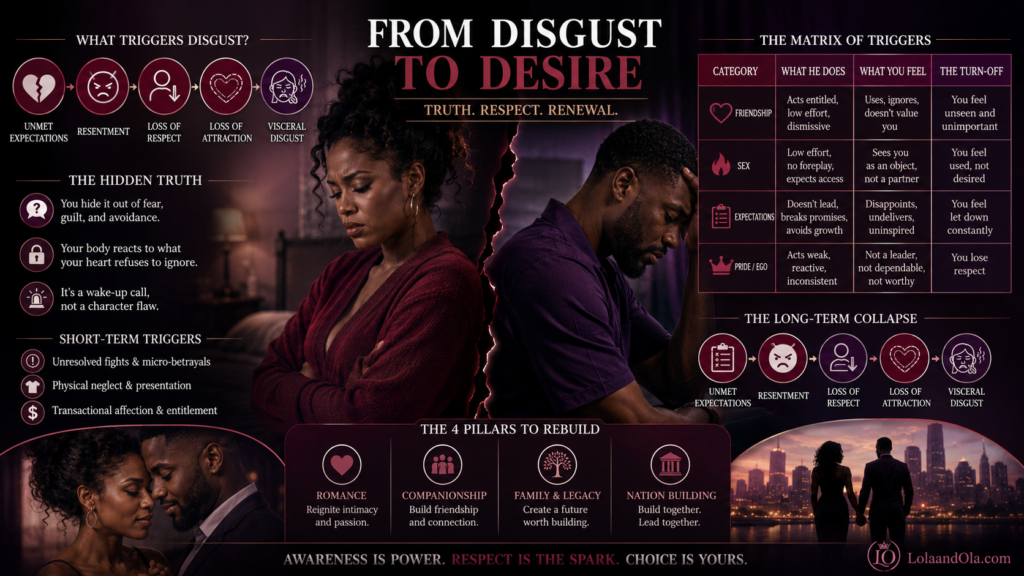
How the Poison Accumulates: Short-Term vs. Long-Term Collapse

A physical aversion to a partner rarely happens overnight. It is a slow, compounding toxic drip. While outright evil behavior is the rare exception in marriages, the slow rot of attraction is the norm.

Marriages collapse primarily due to two things: Mismanaged Pride and Unmet or Mismanaged Expectations. When these two elements clash, your nervous system begins to view your partner not as a safe haven, but as a psychological threat.

The Short-Term Timeline: Sudden Triggers

In the short term, disgust can be triggered by a specific, sharp fracture in the relationship’s foundation:

  • The Unresolved Micro-Betrayal: An argument where he weaponized your vulnerabilities, left you unprotected in front of family, or dismissed your tears.
  • The Physical Shift: A sudden, steep decline in his personal hygiene, grooming, or presentation that signals a total abandonment of self-pride.
  • The “Transactional” Attempt: He spends weeks ignoring you, helps with the dishes once, and immediately expects sexual access. Your body recoils because it feels like a transaction, not intimacy.

The Long-Term Timeline: The Erosion of Polarity

Over years, the erosion builds an architectural wall of repulsion. It follows a predictable trajectory of emotional decay:

[Unmet Expectations] ──> [Resentment] ──> [Loss of Respect] ──> [Loss of Attraction] ──> [Visceral Disgust]

When you look back, ask yourself: When was the first time you felt this way? What was the event that triggered it? And conversely, When was the last time?

Often, you will find that the physical aversion locked into place the moment you entirely lost respect for him as a partner, a leader, or an equal.

The Matrix of Triggers: What He Does vs. What You Feel He Does

To regain your power, you must possess the emotional intelligence to separate objective reality from subjective narrative. There is a profound difference between what a man actually does and how your accumulated resentment filters his actions.

Let’s break down this matrix across your core leverage focuses: Friendship, Sex, Expectations, and Pride/Ego.

The CategoryThe Objective Reality (What He Does/Fails to Do)The Filter of Resentment (What You Feel He Does)
The TriggerWhat he always does: He acts entitled to your body, using sloppy, low-effort physical advances without emotional buildup.

What he never does: He never courts you, dates you, or holds a deep conversation without angling for sex.
You feel he always views you as an object or a utility, entirely erasing your humanity.

You feel he never truly sees you, cherishes you, or values your inner world.
The Turn-OffWhat he always does: He exhibits the behaviors of an Anti-Seducer—acting like a Brute (zero patience), a Suffocator (clingy, fragile neediness), or a Reactor (highly volatile and easily triggered).

What he never does: He never takes charge, never exudes quiet confidence, and never protects your emotional peace.
You feel he always acts like an additional child you have to manage rather than a man you can rely on.

You feel he never provides a safe space where you can step out of your masculine management role and drop into your feminine energy.

When a man constantly displays these anti-seducer qualities, attraction dies. Respect, trust, and submission are earned over the mid-to-long term; they cannot be demanded. When he fails to earn them, your body protects itself via physical irritation and cringing.

The Illusion of the “Other Man” and the Myth of Vetting

When facing a sexless, repulsive marriage, many women naturally look out the window. You might ask yourself: “Have I already met a man who can fulfill these needs?”

If you have, and you haven’t left, why? Be brutally honest with yourself. Is it fear of financial instability? Fear of social judgment? Or is it because, deep down, you know something that psychological science and relationship leadership prove to be true?

The 5% Vetting Reality: Vetting a partner before marriage only accounts for about 5% of the long-term success of a relationship. The remaining 95% is entirely determined by how two people navigate the inevitable crisis patterns, manage their pride, and maintain emotional agility over decades.

If you believe a perfect man exists out there who will seamlessly fulfill your 6 Basic Human Emotional Needs (Certainty, Variety, Significance, Connection, Growth, and Contribution) without ever triggering you, you are chasing a ghost.

If you jump ship without changing your internal programming, the exact same problem of disgust, irritation, and coldness will follow you into your next relationship. Why? Because you haven’t addressed the operational system inside you that handles conflict, expectations, and the Art of Seduction.

The Hard Truth: The Educational Deficit in Modern Marriage

Let’s deploy some tough love. You are highly frustrated that your husband doesn’t know how to turn you on, how to behave, or how to make you feel safe.

But ask yourself these two baseline questions:

  1. How many hours of “communication in marriage” training have you taken?
  2. How many hours of “seduction in marriage” training have you taken?

Most couples spend tens of thousands of dollars on a single wedding day, but invest zero dollars and zero hours learning the actual mechanics of long-term human attraction, sexual polarity, and emotional intelligence.

You expect your marriage to perform at an elite level while operating on completely amateur training. When communication breaks down, both partners resort to the 10 Toxic Behaviors That Poison Relationships:

  1. Shaming (“What is wrong with you?”)
  2. Insulting (“You’re pathetic.”)
  3. Blaming & Fault-Finding (“This is entirely your fault.”)
  4. Judgment (“You only care about yourself.”)
  5. Condemnation (“You will never change.”)
  6. Guilt-Tripping (“If you loved me, you’d do this.”)
  7. Discrete Logic (Treating emotional wounds like cold, clinical math equations)
  8. Sarcasm (Cutting down the partner under the guise of humor)
  9. Condescension (Speaking to him from a pedestal of moral superiority)
  10. Right/Wrong Obsession (Prioritizing winning the argument over saving the connection)

If your daily interactions are marinated in these ten poisons, it is a biological certainty that your body will scream, “i don t feel anything when my husband touches me.”

Check This Out: Why Do I Get Irritated When My Husband Touches Me?

The Path Forward: Radical Leadership and the 3P Framework

So, where do you go from here? How do you move from “my husband repulses me” to a place of clarity, power, and resolution? You navigate this inevitable crisis using our core pillars: GPS (Grounding, Purpose, Self-Awareness) and the 3P Framework.

1. Execute the 3P Framework

When navigating a structural crisis in a marriage, you must rely on Prayer, Patience, and Process.

  • Prayer (Release the Uncontrollable): Give up the agonizing desire to forcefully change his personality, his intrinsic nature, or his past mistakes. You cannot control his choices.
  • Patience (Allow Space): Aversion built over years cannot be dismantled in a weekend. Give your nervous system time to settle without forcing yourself into premature physical intimacy that deepens your trauma.
  • Process (Focus on the Controllable): Shift your entire focus onto what you can control—your boundaries, your radical truth, your physical wellness, and your emotional leadership.

2. Establish Partnership vs. Temporary Leadership

Partnership is the default setting for the day-to-day operation of a healthy marriage. However, when a relationship falls into extreme crisis—such as total physical repulsion—it requires temporary leadership to rise above the chaos.

While social constructs and sexual polarity thrive long-term when the man steps into sustainable masculine leadership, you can be the one to initiate the cycle.

The strength of feminine energy is its capacity to multiply and reciprocate what is provided. If you lead by radically changing the environment—stepping out of the 10 Poisonous Behaviors, stating your objective boundaries with absolute clarity, and seeking professional intervention—you give him a clear runway to step up and claim sustainable leadership. If he refuses, you have your definitive answer.

3. Re-Anchor to the Purposes of Marriage

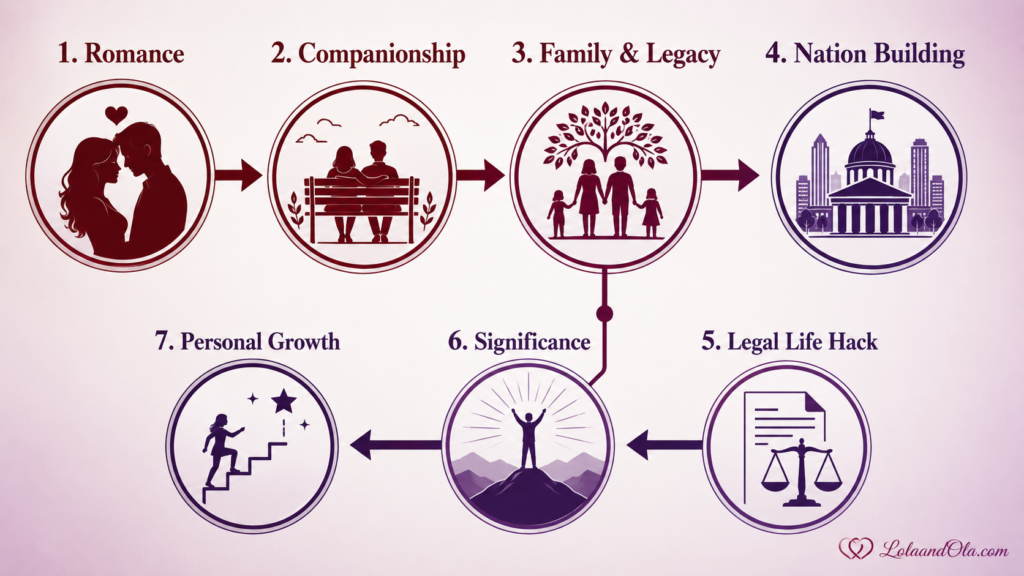
Look at why you are together. A marriage isn’t just an ongoing romance loop. It serves 7 Core Purposes:

1. Romance ── 2. Companionship ── 3. Family & Legacy ── 4. Nation Building
                                    │
7. Personal Growth ── 6. Significance ── 5. Legal Life Hack

If Pillar 1 (Romance) is currently broken and triggering disgust, look at the other pillars. Are you growing as an individual through this pain? Are you protecting your legacy?

Use this moment of crisis not to sink into passive-aggressive misery, but as a crucible for your own Personal Growth and Leadership. Speak the absolute truth, invest in real marital and seduction education, heal your nervous system’s triggers, and claim the power to choose your path forward with eyes wide open.

Check this out: 5 Signs Your Wife Never Really Loved You

Why do I feel repulsed by my husband’s touch?

A visceral feeling of repulsion is your body’s nervous system screaming an emotional truth that your conscious mind may still be trying to minimize or rationalize. This deep physical aversion rarely happens overnight; it is the biological culmination of a slow, compounding toxic drip of unresolved micro-betrayals, mismanaged expectations, and a foundational loss of respect. When daily marital interactions become marinated in poisonous dynamics like shaming, blame, or condescension, your brain stops viewing your husband as a safe haven and begins treating him as a psychological threat, causing your body to instinctively recoil to protect its own emotional sovereignty.

Why do I get so irritated when my husband touches me?

This intense irritation is often triggered by a sharp fracture in sexual polarity and a profound erosion of friendship within the marriage. When a partner consistently exhibits the qualities of an “anti-seducer”—such as the demanding impatience of a brute, the fragile neediness of a suffocator, or an entitlement to your body without any emotional courtship—his touch feels transactional rather than intimate. You get irritated because his physical advances force you to stay locked in a hyper-vigilant management role, denying you the safe emotional space required to drop your guard and freely receive affection.


Broken Marriage?
Fix it
Here FREE

Get My Marriage Back