
What Would Help You Most Right Now?

Choose the option that best matches where you are with your marriage.

I Need Personalized Help

My Marriage Is in Serious Trouble

If you're dealing with separation, divorce, loss of attraction, infidelity, intimacy problems, or a spouse who's pulling away, get help looking at what's happening in your specific situation.

Get Personalized Help →
Get My Marriage Back book cover
I'd Rather Learn What to Do First

Start With Get My Marriage Back

Get the book and start learning the principles for moving your marriage in a better direction.

Get the Free Book →

Wife Stopped Initiating Sex? What It Really Means & What to Do

Your wife used to initiate sex, reach for you, and make you feel wanted—but now you’re wondering how something that once happened naturally turned into something you feel like you’re begging for.

Take This 2 Minutes Quiz

Question 1 of 15

When your wife stopped initiating sex, you probably didn’t experience it as just a change in your sex life.

You experienced a change in her.

That’s why this can become so destabilizing.

Maybe she used to be the one who reached for you. Perhaps intimacy survived disagreements that would have wrecked other couples. You could argue, cool down, reconnect physically, and somehow everything still felt basically okay.

Then something changed.

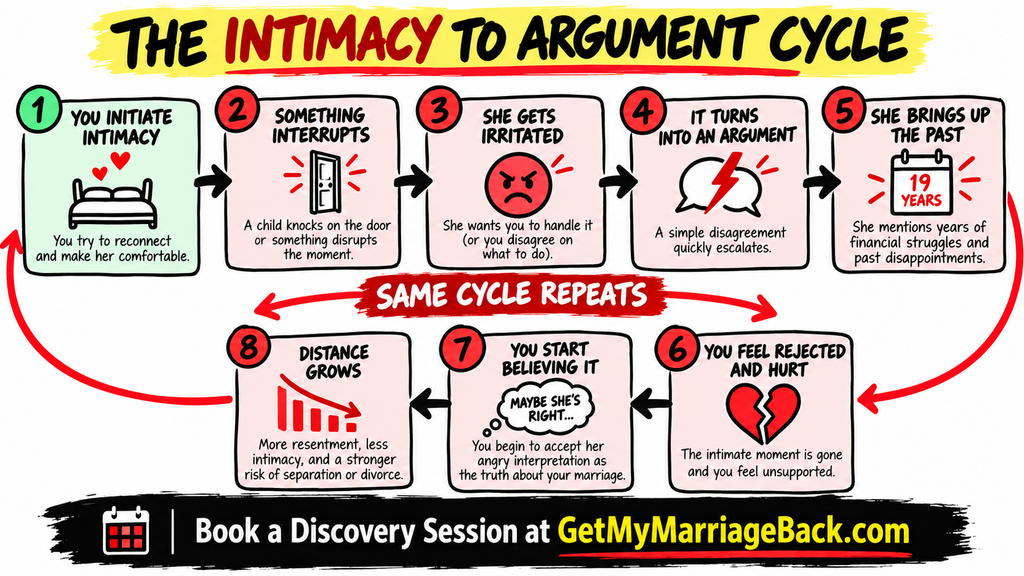
You initiate.

“Not tonight.”

Okay. No big deal.

You try again.

Another rejection.

By the third or fourth time, you’re no longer experiencing each rejection independently. You’re collecting evidence.

You notice her facial expression. …noticing how she responds when you touch her. You start counting how long it’s been since she initiated.

Eventually, an uncomfortable question starts forming:

Does my wife still want me?

That’s the point where a sexual problem can quietly become an attraction problem, a security problem, and ultimately a marriage problem.

When Your Wife Stops Initiating Sex, Don’t Rush to Diagnose Her

A sudden decline in sexual interest is information.

It is not automatically an explanation.

That distinction matters.

Your wife not initiating sex does not, by itself, prove she’s cheating. It doesn’t prove she has fallen out of love. Nor does it automatically mean she wants a divorce.

Sexual desire is affected by relationship dynamics, stress, parenthood, health, resentment, emotional connection, individual differences, and many other variables.

Research supports treating desire as a couple dynamic, rather than automatically locating the “problem” inside the lower-desire partner. Studies of married couples have associated greater discrepancies between desired and actual sexual frequency with lower relationship satisfaction and stability and greater conflict. PubMed

That’s important because the question isn’t merely:

“Why doesn’t she want sex?”

A more useful question is:

“What changed in the experience of this marriage?”

You May Be Living in the Old Marriage

This is one of the hardest realities to recognize during a marriage crisis.

You’re operating from the old marriage while your wife is experiencing the current marriage.

You remember the woman who reached for you.

You’re interacting with the woman who’s pulling away.

Those are two completely different realities.

Your memories tell you, We’ve always been able to get through things.

Her present behavior tells you, Something isn’t operating the way it used to.

When those realities collide, it’s tempting to keep invoking history.

“We’ve always had sex after arguments.”

“You never used to have a problem with this.”

“You used to initiate.”

“What happened to you?”

Those statements may be factually accurate, but they don’t necessarily create attraction.

In fact, repeatedly reminding someone that they used to desire you can make the present absence of desire feel even heavier.

The Dangerous Question Isn’t “Why Doesn’t She Want Sex?”

It’s what you make her rejection mean about you.

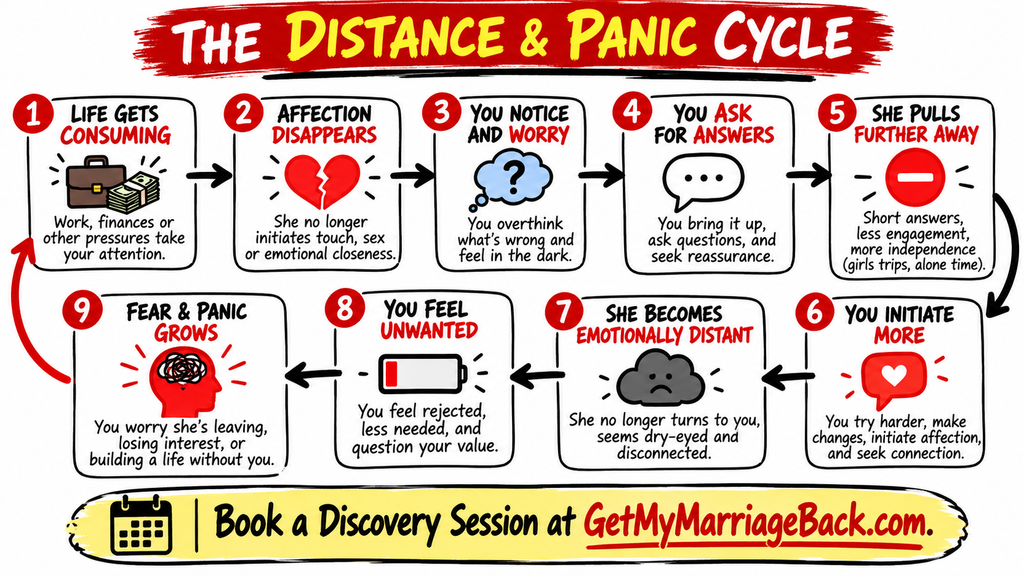
At first, you want an explanation.

Soon you may want reassurance.

There’s a significant difference.

You think you’re asking:

“What’s wrong?”

But emotionally, you may really be asking:

“Tell me you still want me.”

“Nobody else?”

“Tell me we’re going to be okay.”

“Prove that I’m still desirable to you.”

That’s when your wife’s sexual desire can become your security meter.

Every “not tonight” becomes a reading.

Sex happens? Marriage must be okay.

She initiates? …still wants me.

She rejects me? Something must be wrong.

She turns away? Maybe there’s somebody else.

Now your emotional stability is being controlled by whether another human being desires sex at a particular moment.

That’s a dangerous position from which to rebuild attraction.

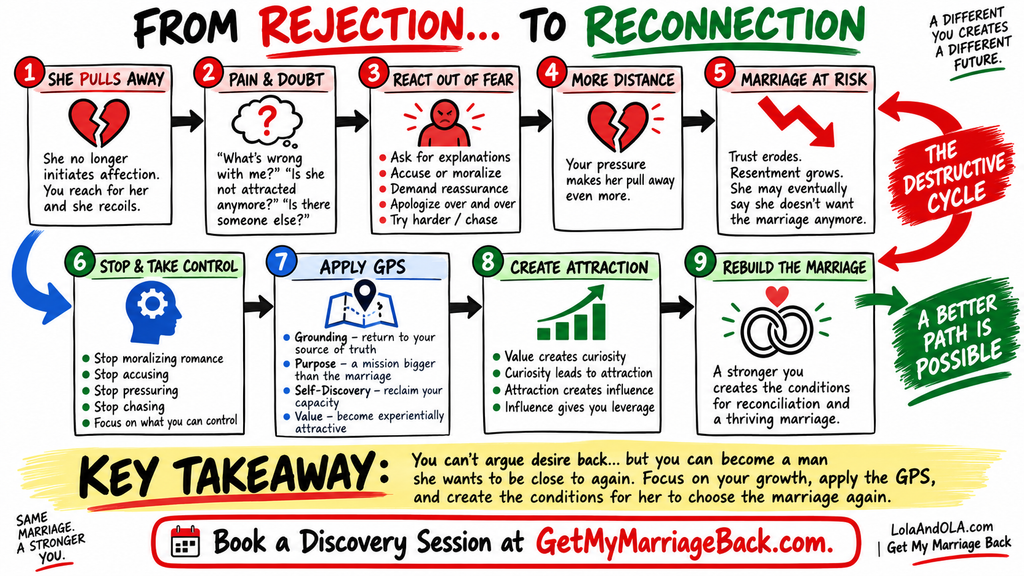
Pressure Can Turn Sexual Rejection Into a Cycle

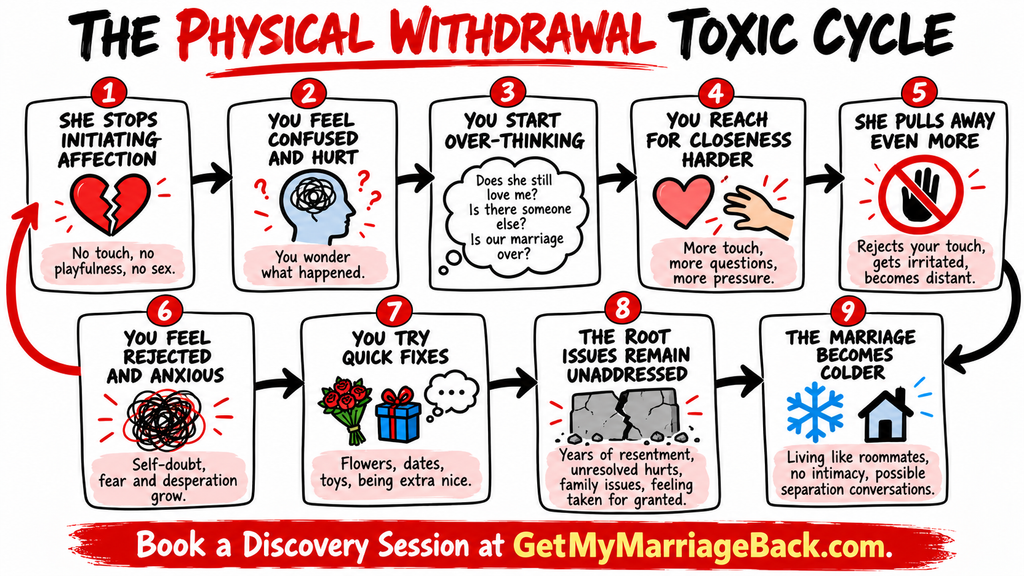
Here’s the trap.

You feel rejected.

Rejection creates fear.

Fear seeks reassurance.

When reassurance doesn’t arrive, you apply pressure.

Pressure creates conflict.

Conflict can make intimacy less appealing.

Then the resulting lack of intimacy creates even more fear.

You’re attempting to solve rejection with an emotional experience capable of producing more rejection.

Research on couples transitioning to parenthood is particularly relevant here. Researchers found that responsiveness included not only caring about a partner’s desire for sex but also being understanding when a partner didn’t want sex; that understanding was associated with sexual and relationship satisfaction. research on understanding a partner’s need not to have sex

That doesn’t mean pretending you’re happy about rejection.

Emotional intelligence means being able to experience disappointment without immediately converting it into pressure, punishment, interrogation, or panic.

Stop Making Sex Prove Your Marriage Is Okay

Imagine what happens from your wife’s perspective when sex acquires another job.

It isn’t simply intimacy anymore.

…has to reassure you.

It has to demonstrate attraction.

…has to prove fidelity.

It has to confirm the marriage isn’t ending.

That’s a lot of emotional weight to place on intimacy.

And attraction tends to struggle under compulsory emotional labor.

You cannot skillfully rebuild attraction by making your spouse responsible for constantly regulating your insecurity.

This doesn’t require becoming indifferent.

It requires becoming grounded.

Ground Yourself Before Trying to Rebuild Attraction

When your wife stopped initiating intimacy, your first assignment isn’t figuring out the perfect technique for making her desire you again.

Your first assignment is learning to handle what her rejection activates inside you.

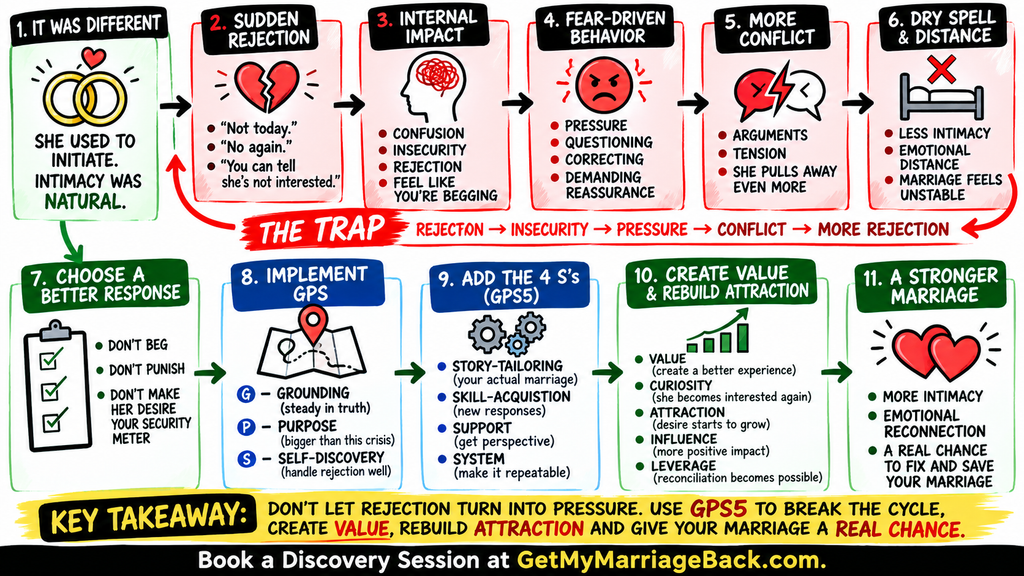
I call the beginning of this process GPS: Grounding, Purpose, and Self-Discovery.

Grounding

Ground yourself in a source of truth that doesn’t change every time your wife says “not tonight.”

Your identity cannot rise and fall with her libido.

Grounding allows you to remain emotionally present without pretending you don’t care.

That distinction is attractive because groundedness feels radically different from neediness disguised as authority.

Purpose

Redirect some of that emotional energy toward purpose: your mission, contribution, impact, and legacy beyond the immediate marriage crisis.

This isn’t about becoming busy to make your wife jealous.

It isn’t strategic withdrawal.

Purpose makes your world larger than tonight’s rejection.

A person consumed by obtaining reassurance creates one experience. A person capable of loving deeply while remaining connected to purpose creates another.

Self-Discovery

Now discover your actual capacity.

Can you hear “no” without retaliating?

…experience disappointment without becoming passive-aggressive?

Can you feel uncertainty without interrogating your spouse?

…notice fear without immediately obeying it?

That’s self-discovery.

You aren’t trying to become emotionless.

You’re developing the emotional capacity to experience rejection without allowing rejection to dictate your next move.

Attraction Is an Experience, Not a Reward for Good Behavior

One of the most frustrating beliefs in marriage sounds like this:

“But I’m a good husband.”

Maybe you are.

Being responsible, faithful, hardworking, and committed matters enormously.

But moral value and experiential value aren’t identical.

Someone can respect you without currently experiencing attraction toward you.

That’s why rebuilding attraction isn’t merely a matter of proving that you’re good enough.

You have to pay attention to the experience created in your presence.

Does your presence increasingly communicate pressure?

Anxiety?

Correction?

Monitoring?

Resentment?

Or does your presence communicate groundedness, emotional range, curiosity, purpose, playfulness, confidence, warmth, and genuine connection?

That shift matters.

Research involving more than 1,500 participants found that unmet sexual ideals were associated with poorer sexual satisfaction and relationship quality, while responsiveness to a partner’s sexual needs appeared to buffer some of those associations. PubMed

Attraction can’t be demanded.

But you can become more skillful at creating conditions in which attraction has room to breathe.

Don’t Confuse Seduction With Manipulation

Seduction in a marriage crisis isn’t about tricks.

It’s not withholding affection until your wife chases you.

It’s not manufacturing jealousy.

It isn’t pretending you suddenly don’t care.

Healthy seduction begins with becoming capable of creating an experience that feels better than the cycle you’ve been repeating.

Become curious instead of interrogative.

Be warm without demanding a reward.

Flirt without turning every affectionate interaction into an attempt to get sex.

Create moments that can simply be enjoyable.

Allow tension to breathe instead of demanding immediate resolution.

Most importantly, stop using every interaction to determine whether “it’s working.”

Constantly measuring attraction destroys some of the spontaneity you’re trying to recover.

Stop Testing Whether She’ll Initiate

This is subtle.

You decide you’re not going to initiate anymore.

But internally, you’re watching.

Let’s see how long it takes her.

Day three.

And day five.

Day nine.

Nothing.

Now you’re furious.

Technically, you stopped pursuing.

Emotionally, you never stopped testing.

That’s not detachment from the outcome. It’s a silent experiment your wife doesn’t know she’s participating in.

Real change begins when you stop making every interaction produce a verdict.

“My Wife Never Initiates Intimacy Anymore”—What Should I Watch For?

Look beyond the bedroom.

Did affection disappear too?

Has conflict become chronic?

Does she appear emotionally withdrawn?

Did the change coincide with childbirth, major stress, resentment, illness, medication, exhaustion, or another life transition?

Does she enjoy spending time with you but avoid sexual contact?

Has your communication become primarily logistical or conflict-oriented?

Those patterns don’t automatically tell you why your wife stopped initiating sex.

They help you understand the larger story.

A qualitative study of people in long-term relationships experiencing distressing desire discrepancy identified changes in sexual frequency and desire, barriers to sex, relationship satisfaction, and how couples coped with the discrepancy as important themes. PubMed

Your marriage has its own story.

Treat it accordingly.

The Goal Isn’t to Get Her to Have Sex Tonight

That objective is too small.

If the marriage is in crisis, one successful sexual encounter can temporarily reassure you while leaving the underlying dynamic untouched.

Your bigger objective is to change the experience surrounding the relationship.

Grounding creates stability.

Purpose expands you.

Self-discovery builds emotional capacity.

Those qualities can create greater experiential value.

Value creates room for curiosity.

Curiosity can create room for attraction.

Attraction increases influence.

Influence creates leverage for reconciliation.

None of that requires forcing, convincing, or begging another person into desire.

It requires becoming increasingly capable of responding to the marriage you’re actually in rather than desperately trying to recreate the marriage you remember.

When Something Changed, Get Curious Before You Panic

The disappearance of intimacy is useful information.

Something changed.

Take that seriously without turning it into a catastrophe before you understand it.

Your job isn’t to beg your wife for sex.

It’s also not to punish her for not wanting it.

Don’t immediately turn her rejection into evidence of cheating, divorce, or your inadequacy.

Instead, develop enough emotional stability to study what’s actually happening.

Because when your wife stopped initiating sex, the most important question isn’t simply how to get sex happening again.

It’s this:

What happened to the experience between us—and what kind of experience am I creating now?

That question gives you somewhere productive to begin.

Wife or Husband Denying You Sex? DO THIS!!!

Why has my wife stopped initiating sex?

There isn’t one universal explanation; relationship conflict, stress, parenthood, health factors, resentment, changing desire, and other circumstances can all matter. Look for what changed in the broader relationship rather than diagnosing the cause from rejection alone.

Does my wife not initiating sex mean she isn’t attracted to me?

Not necessarily; sexual initiation and attraction aren’t interchangeable measures. However, a sustained change in intimacy deserves attention as information about the sexual or relational dynamic.

Should I stop initiating if my wife keeps rejecting me?

Don’t turn withdrawal into a hidden test designed to see whether she’ll chase you. Instead, respect sexual boundaries while examining the pattern, your response to rejection, and the broader state of connection.

Can attraction come back in a sexless marriage?

Attraction and desire can change over time, and research shows that sexual desire discrepancies are meaningfully connected with sexual and relationship experiences. Focus on reducing pressure, understanding the actual relationship dynamic, and developing the emotional and relational skills that give desire room to emerge.

Wife Never Initiates Affection? 7 Shifts That Rebuild Attraction

Your wife used to initiate affection, welcome your touch, and make you feel wanted—but now you reach for her and feel her pulling away.

Take This 2 Minutes Quiz

Question 1 of 15

Few changes inside a marriage feel as personal as this one.

Maybe your wife never initiates affection anymore. Perhaps she rarely initiates sex, seems uncomfortable when you touch her, or gives you the feeling that physical closeness has become something she tolerates rather than desires.

That can mess with your head.

You start wondering:

“Is my wife still attracted to me?”

“Is there someone else?”

“Why does she never initiate intimacy?”

“What happened to the woman who used to want me?”

And underneath those questions is often an even more painful one:

“What does this say about me?”

I want you to be careful here, because the explanation you create for her withdrawal can become more destructive than the withdrawal itself.

Your goal is not to become indifferent to rejection.

Your goal is to become emotionally intelligent enough that rejection does not control your next move.

When Your Wife Never Initiates Affection, Don’t Turn Pain Into a Verdict

Physical rejection hurts.

I am not going to tell you to pretend otherwise.

When someone who once welcomed your touch begins pulling away, your nervous system naturally notices the contrast. The problem begins when you convert that contrast into certainty.

“She doesn’t love me.”

“She must be cheating.”

“She lied to me.”

“Our marriage is over.”

“I’m not attractive anymore.”

Those are interpretations.

They may feel like facts because rejection is emotionally intense, but intensity does not automatically make an interpretation accurate.

This distinction matters because your interpretation determines your behavior.

If you decide her withdrawal means betrayal, you may interrogate.

When you decide it means you are undesirable, you may start fishing for reassurance.

Once you decide she owes you affection because you are married, you may pressure her.

Each reaction can make an already fragile attraction dynamic heavier.

wife never initiates affection

The Dangerous Marriage Equation: “I’m Good, So You Should Desire Me”

One of the fastest ways to make romance feel less romantic is to moralize attraction.

You may have been faithful.

You may provide.

Perhaps you kept your vows, sacrificed for your family, remained committed during difficult seasons, and genuinely tried to be a good spouse.

Those things matter.

But they do not create an invoice for attraction.

You cannot say, in effect:

“I fulfilled my responsibilities, therefore you should desire me.”

Desire does not respond particularly well to prosecution.

Think about what happens when affection becomes evidence in a courtroom.

Every rejected touch becomes Exhibit A.

Every night without sex becomes Exhibit B.

Every moment when your wife does not initiate becomes another argument proving that something is wrong with her, you, or the marriage.

Now your wife is no longer experiencing your affection simply as affection.

She may experience it as a test.

Will she respond correctly?

Will she initiate enough?

Will she prove that she still desires you?

That pressure can make physical closeness increasingly difficult.

wife never initiates affection - A Crisis of Attraction Can Become a Moral Prosecution

A Crisis of Attraction Can Become a Moral Prosecution

I have seen this dynamic become especially destructive when someone believes they did everything “right” before marriage.

Imagine a husband who married his wife as a virgin after practicing celibacy himself.

They intentionally entered marriage believing their choices gave them a strong foundation.

Years later, she stops initiating sex and affection.

He cannot reconcile her lack of desire with what he believes about their beginning.

So he develops an explanation:

“She must have lied.”

Now the attraction problem has become an integrity problem.

He confronts her.

She denies lying.

Instead of resolving his fear, her denial makes him push harder because he still needs an explanation for why she no longer seems to want him.

Eventually, the marriage is no longer primarily dealing with lost attraction.

It is dealing with suspicion, defensiveness, pressure, resentment, and repeated prosecution.

That is how a painful symptom can become an even bigger marriage crisis.

What Does It Really Mean When Your Wife Doesn’t Want Affection?

There is no single explanation.

Attraction can be affected by unresolved conflict, chronic stress, resentment, relational dynamics, health issues, sexual difficulties, emotional disconnection, life transitions, exhaustion, familiarity, pressure, or changes in how two people experience each other.

That is why Story-Tailoring matters.

You cannot safely take one explanation from another marriage and automatically paste it onto yours.

Still, there is an important principle you can use immediately:

Stop treating every instance of rejection as a complete diagnosis of your marriage.

Your wife pulling away tonight tells you something about what she is experiencing tonight.

It does not automatically tell you everything about tomorrow.

Shift #1: Stop Chasing Reassurance

When affection disappears, reassurance becomes incredibly tempting.

“Do you still love me?”

“Are you attracted to me?”

“Why don’t you ever touch me?”

“Are we okay?”

One conversation may be reasonable. Repeatedly needing your wife to regulate your fear is something different.

The more desperately you need reassurance, the more every interaction becomes loaded with expectation.

You are no longer simply connecting.

You are checking.

That difference can be felt.

Seduction requires enough emotional space for curiosity, anticipation, individuality, and voluntary movement toward another person.

Constant reassurance-seeking tends to collapse that space.

Shift #2: Stop Confusing Begging With Pursuit

Pursuit and chasing are not the same thing.

Healthy pursuit can communicate interest, confidence, warmth, playfulness, intention, and desire.

Chasing says:

“Please respond so I can feel okay.”

Begging says:

“Please give me affection so I can stop feeling rejected.”

Pressure says:

“You should respond because I am your spouse.”

Those behaviors may look superficially similar because they all involve reaching toward someone.

Emotionally, however, they come from very different places.

The objective is not to become cold or perform indifference.

It is to express interest without making your emotional stability dependent on the response.

Shift #3: Build G.A.M.E.—Not Manipulation

When I talk about GAME, I mean:

Giving Authentically but Mindfully with Emotional intelligence.

GAME is skill.

You are authentic because you are not pretending that you have no desires.

You are mindful because you pay attention to timing, context, emotional climate, and the other person’s experience.

Emotional intelligence allows you to notice your own fear without immediately making your spouse responsible for soothing it.

That is dramatically different from using tactics to trick someone into wanting you.

Real seduction is not coercion.

It creates an experience in which attraction has room to emerge voluntarily.

Shift #4: Start With GPS Before Trying to Rebuild Attraction

Before you obsess over getting your wife to initiate affection again, strengthen your internal position.

I call this GPS:

Grounding. Purpose. Self-Discovery.

Grounding

Ground yourself in a source of truth bigger than whether your wife accepts your touch tonight.

Without grounding, her response becomes your emotional weather report.

She welcomes you, and you feel powerful.

She pulls away, and you collapse.

That volatility makes skillful behavior difficult.

Purpose

Redirect emotional energy toward a mission, contribution, impact, and legacy bigger than any single human being.

Purpose does not mean neglecting your marriage.

It means your marriage is important without becoming the sole source of your identity.

That distinction creates emotional stability.

Self-Discovery

Use the crisis to discover capacity rather than manufacture self-blame.

Ask better questions.

Where have you become predictable?

Where did confidence become approval-seeking?

Where have resentment or fear changed your energy?

Which relational skills have you never actually learned?

Self-Discovery turns the crisis into information you can use.

Shift #5: Build Experiential Value, Not Just Moral Value

Being a good person matters morally.

Attraction, however, is experiential.

That distinction is crucial.

Your spouse experiences your energy, emotional regulation, presence, confidence, playfulness, social intelligence, purpose, boundaries, conversation, sexuality, decisiveness, warmth, and the emotional atmosphere created around you.

Those experiences contribute to how the relationship feels.

Research provides an interesting parallel. In studies of long-term relationships, perceived partner responsiveness—feeling that a partner understands, values, and cares for you—has been associated with greater sexual desire, with particularly strong effects observed among women in that research. You can review the research on partner responsiveness and sexual desire.

That does not mean becoming endlessly agreeable.

Responsiveness and neediness are not synonyms.

The larger point is that attraction lives inside experience.

You cannot substitute a résumé of marital virtues for the experience of being with you.

Shift #6: Create the Conditions for Curiosity

Familiarity is inevitable in marriage.

Over-familiarity does not have to be.

When your entire emotional world becomes organized around whether your spouse is responding, you can become increasingly predictable.

She knows what happens if she pulls away.

You ask why.

Then you become upset.

Next comes the relationship conversation.

Afterward, you seek reassurance.

Eventually she can anticipate the whole sequence before it starts.

Curiosity disappears when every interaction has an obvious ending.

Your job is not to manufacture mystery through games.

Instead, continue becoming a person with depth, direction, emotional range, independent thought, interests, purpose, standards, and a life that continues developing.

Experiential Value can create Curiosity.

Curiosity gives Attraction room to emerge.

Attraction increases Influence.

Influence can eventually create Leverage for building a different marriage.

Value → Curiosity → Attraction → Influence → Leverage.

Notice what is missing from that sequence.

Begging.

Shift #7: Prepare for Habit Drift

Understanding all of this while calmly reading an article is one thing.

Remembering it when your wife physically recoils from your touch is another.

Stress can pull people toward previously learned habitual responses rather than deliberate goal-directed behavior. In marriage, that can look like knowing exactly how you intended to respond and then hearing yourself say:

“What’s wrong with you?”

“Are you cheating?”

“Why don’t you ever want me?”

“I’m your husband!”

Your old pattern fires before your better judgment catches up.

I call that Habit Drift.

This is why insight alone rarely creates lasting change.

GPS5: Why Information Isn’t Enough

GPS gives you Grounding, Purpose, and Self-Discovery.

But sustainable execution requires four additional S’s:

Story-Tailoring

Your marriage has its own history, personalities, injuries, dynamics, circumstances, and attraction patterns.

Generic advice can become dangerous when you apply the right principle to the wrong problem.

Skill-Acquisition

Emotional intelligence is trainable.

So are conversation, boundaries, self-regulation, attraction dynamics, calibrated pursuit, conflict management, and relational awareness.

Knowing what not to do is only the beginning.

You need replacement skills.

Support

Rejection can make fear sound remarkably convincing.

Support gives you somewhere to process the emotional charge without repeatedly dumping it into the marriage.

System

You cannot rebuild attraction by improvising every time your spouse pulls away.

A system keeps your actions aligned with the marriage you are trying to create rather than the panic you are feeling today.

Your Wife’s Rejection Is Not Your Permission to Lose Yourself

Your wife never initiating affection can become one of the most painful experiences in your marriage.

It can also expose exactly where your emotional power has become dependent on another person’s response.

Your job is not to force your wife to accept your touch.

Neither should you pretend rejection does not hurt.

The answer is not making her feel guilty enough to give you affection.

Regain control over what you can control.

Build experiential value.

Create room for curiosity.

Develop attraction skills without coercion.

Strengthen your emotional intelligence.

Learn to pursue without begging.

Become responsive without becoming needy.

And build enough Grounding, Purpose, and Self-Discovery that your wife’s reaction tonight does not determine who you become tomorrow.

Attraction is not an invoice.

It is an experience.

Change the experience.

5 Physical Signs She Just Slept With Someone Else: The Truth

Frequently Asked Questions

Why does my wife never initiate affection?

There is no universal cause; stress, resentment, relational patterns, health factors, sexual difficulties, pressure, or attraction changes can all contribute. Look for the pattern and context rather than assuming one rejected touch explains the entire marriage.

Does my wife not initiating intimacy mean she isn’t attracted to me?

Not necessarily; initiation and attraction overlap, but they are not identical, and desire can be affected by many individual and relationship factors. Research also connects perceived partner responsiveness with sexual desire, suggesting that the relational experience surrounding intimacy matters.

Should I stop initiating affection if my wife always turns me down?

Stop using initiation as a test of your worth or as pressure for reassurance, and respect physical boundaries when affection is unwelcome. The larger objective is understanding the dynamic and rebuilding the conditions in which voluntary closeness can become possible.

Can attraction come back in a marriage?

Attraction and sexual satisfaction are not necessarily static; longitudinal research has found reciprocal associations between marital and sexual satisfaction over time. Focus on changing controllable relational patterns rather than trying to argue or guilt your spouse into desire.

Your Wife Is Cold and Distant: What Her Withdrawal Really Means

Your wife is cold and distant, and every attempt you make to get closer seems to push her even further away.

Take This 2 Minutes Quiz

Question 1 of 15

You can feel the change before you can explain it.

Her warmth is different. Conversations are shorter. Affection has disappeared or feels forced. You reach for her and she pulls away. Maybe she gives you the cold shoulder, spends more time alone, or treats you more like a roommate than the man she once desired.

You want answers because uncertainty is brutal.

“What happened?”

“Why are you acting like this?”

“Do you even want this marriage anymore?”

Those are reasonable questions. But when your wife is emotionally withdrawing, your desperation for clarity can become the pressure that makes her retreat even further.

That is where many husbands accidentally turn an attraction problem into a much bigger marriage crisis.

Why Is My Wife Cold and Distant Towards Me?

Start with something that sounds simple but changes everything:

There is probably more happening internally than you can currently see.

That doesn’t excuse cruelty, betrayal, contempt, or disrespect. Nor does it require you to tolerate unacceptable behavior.

It means you should resist the temptation to interpret every cold response as a complete explanation of what is happening inside her.

A cold wife can be angry.

She can be disappointed.

She can be overwhelmed.

There may be accumulated resentment, lost attraction, unresolved conflict, stress, exhaustion, broken trust, or an emotional disconnection neither of you properly addressed when it was smaller.

Sometimes she doesn’t completely understand what she is experiencing herself.

That ambiguity matters because the wrong diagnosis produces the wrong response.

When you immediately decide, “She doesn’t care about me anymore,” you naturally start reacting to that conclusion. Fear takes over, and suddenly you are chasing reassurance, monitoring her mood, demanding answers, or desperately trying to make her feel differently.

Now the original problem has company.

my wife is cold and distant

Mistake #1: Turning Her Emotional Distance Into a Court Case

When your wife becomes cold, you want to appeal to logic.

“You’re my wife.”

“We made vows.”

“You need to communicate.”

“At least treat me with respect.”

“We can’t fix this if you won’t talk.”

On paper, some of those statements sound perfectly reasonable.

But your marriage isn’t a courtroom, and your wife isn’t a defendant.

You cannot cross-examine someone back into attraction.

You also cannot produce enough evidence to force another human being to feel warmth, curiosity, desire, or emotional connection.

This is especially important when a demand-withdraw cycle has developed. In research involving 116 married couples reporting conflicts at home, both husband-demand/wife-withdraw and wife-demand/husband-withdraw patterns were associated with more negative emotions and tactics and lower conflict resolution. The researchers also found these patterns were especially likely around marital issues. You can read the research on demand-withdraw patterns in marital conflict.

Think about what that can look like in your house.

You feel her withdrawing, so you pursue an explanation.

She experiences more pressure, so she withdraws further.

Her withdrawal scares you, so you pursue harder.

Soon you are no longer solving the original issue. You are feeding a cycle.

Mistake #2: Making Her Mood the Source of Your Emotional Stability

Your wife is warm this morning, and you feel hopeful.

She is distant tonight, and suddenly you believe the marriage is doomed.

She laughs at something you say, and you think attraction is returning.

Tomorrow she barely speaks, and your stomach drops again.

That’s exhausting.

More importantly, you have allowed your wife’s current emotional temperature to control yours.

This is where self-leadership becomes critical.

Your wife can matter tremendously to you without becoming the source of your identity.

Her attraction matters. Your marriage matters. Saving your marriage can matter enormously.

But when your emotional stability requires constant reassurance from the very person who is currently withdrawing, you create pressure precisely where you need room.

You begin watching every facial expression.

Every text becomes evidence.

Every quiet evening becomes a verdict.

That isn’t personal power. It’s emotional dependence disguised as vigilance.

Mistake #3: Believing You Must Fix Her Coldness

When you desperately want to save your marriage, your instinct is to fix the obvious symptom.

You want her to talk again.

You want affection back.

You want sex again.

You want her to stop pushing you away.

Naturally, your attention goes directly toward changing her.

That’s the trap.

You cannot sustainably build attraction by managing another adult’s emotional state.

Your power starts with changing what you can actually control: your emotional regulation, reactions, purpose, presence, habits, communication, social intelligence, and the experience of being around you.

This distinction is enormous.

You are not trying to manipulate your wife into becoming warm.

You are becoming capable of creating a different relational experience without requiring an immediate reward from her.

when your wife becomes cold and distant

Attraction Is an Experience, Not an Obligation

A lot of people approach marriage as though attraction should automatically survive because the marriage exists.

I used to see marriage heavily through the lens of duty myself.

You’re married. You’re building a life. You have responsibilities. You manage whatever comes with it.

But duty and desire aren’t identical.

A person can fulfill responsibilities while the relationship becomes emotionally flat.

You can pay every bill and still become roommates.

Both people can remain technically married while curiosity, playfulness, admiration, emotional engagement, and sexual attraction quietly disappear.

This is why keeping score is dangerous.

“I’ve been trying.”

“I’ve been affectionate.”

“I’ve provided.”

“I apologized.”

“Now she needs to do her part.”

That’s not attraction.

That’s an invoice.

Value inside an intimate relationship isn’t merely about moral worth or proving that you’re a good person. Experiential value is about what another person experiences around you.

Are interactions consistently tense?

Does every conversation become a marriage summit?

Are you interesting beyond this crisis?

Can you tolerate uncertainty without collapsing?

Do you bring purpose, emotional intelligence, curiosity, confidence, playfulness, and grounded energy into your life?

Attraction has room to grow when being around you becomes an experience rather than an obligation.

Mistake #4: Chasing Harder Because She Is Pulling Away

There is an important difference between pursuit and chasing.

Pursuit can come from dignity, genuine interest, confidence, and desire.

Chasing comes from fear.

Chasing says:

“Please tell me we’re okay.”

“Why haven’t you answered?”

“Do you still love me?”

“Are you attracted to me?”

“Are you leaving?”

“What can I do to make you happy?”

The words aren’t always the problem. The emotional dependency underneath them is.

Your wife can feel when every interaction carries an invisible demand: Make me feel safe about this marriage right now.

That is an enormous job to place on someone who is already emotionally withdrawing.

So don’t confuse “stop chasing” with pretending you don’t care.

Coldness isn’t attractive either.

Playing games isn’t self-leadership.

Manufacturing jealousy isn’t confidence.

The objective is not to punish her withdrawal with your own withdrawal. Your objective is to stop fear from dictating your behavior.

When Your Wife Pushes You Away, Stop Trying to Win the Moment

One of the hardest skills in a marriage crisis is learning not to treat every bad interaction as an emergency.

She walks past you without speaking.

Your nervous system wants resolution now.

She gives you a cold response.

You want to confront it now.

She sleeps facing the other direction.

Your mind wants to know what it means now.

That urgency makes you vulnerable to bad decisions.

Instead of asking, “How do I make her stop being cold tonight?” ask a better question:

“Who am I becoming while this marriage is under pressure?”

That shifts you from reaction to leadership.

Mistake #5: Becoming the Victim of Every Rejection

It is possible for your wife’s behavior to be unfair.

You can be genuinely hurt.

You can disagree strongly with how she is handling the marriage.

Self-leadership does not require pretending otherwise.

But victimhood becomes dangerous when it convinces you that your only path forward is waiting for her to change first.

If she must apologize before you grow, you’re stuck.

When she must communicate before you become emotionally disciplined, you’re stuck.

If she must become affectionate before you reclaim your confidence and purpose, you’re stuck.

Your ability to lead yourself cannot depend on another person’s cooperation.

That doesn’t mean one person can single-handedly maintain a healthy marriage forever. Ultimately, a marriage involves two people.

But you don’t need two people to stop contributing to a destructive cycle.

You need one.

Start with the person you control.

Ground Yourself Before You Try to Rebuild Attraction

When your marriage feels like it is collapsing, grounding means returning to a source of truth larger than the symptom in front of you.

The symptom is:

“My wife is cold.”

“My wife isn’t attracted to me.”

“She keeps pushing me away.”

“She wants separation.”

“She might want a divorce.”

Those circumstances matter, but they cannot become your entire identity.

Grounding gives you enough emotional distance from the immediate panic to choose your response instead of being dragged around by fear.

This is where gratitude also matters.

Not gratitude as denial.

You don’t pretend your marriage is fine.

Instead, you reconnect with what remains true and valuable in your life while confronting the crisis honestly.

A grounded person becomes harder to emotionally destabilize.

That quality matters tremendously when you are trying to rebuild attraction.

Reclaim a Purpose Bigger Than Your Marriage Crisis

Pain narrows your vision.

Suddenly everything becomes your marriage.

You wake up thinking about her.

You check your phone thinking about her.

At work, you’re analyzing last night’s conversation.

At home, you’re watching her face for clues.

Before sleeping, you’re replaying everything again.

That obsession doesn’t make you more committed. Eventually, it can make you less interesting, less stable, and less capable of handling the very crisis you desperately want to solve.

Purpose redirects pain into something larger.

What impact are you here to create?

What legacy are you building?

Who needs the strongest version of you?

What work would still matter if nobody applauded you?

Your purpose must be bigger than any single living human being—including your wife and including yourself.

This isn’t abandoning your marriage.

It is refusing to abandon yourself while saving it.

Use Self-Discovery Without Turning It Into Self-Blame

There is another extreme you need to avoid.

Once you realize that you can only control yourself, you can start blaming yourself for everything.

Don’t.

Self-discovery isn’t self-condemnation.

Ask useful questions instead.

What have you failed to notice?

Where have you become predictable?

Have you become chronically reactive?

Did marriage turn into duty instead of an engaging relationship?

Are you communicating because you have something meaningful to share—or because you need reassurance?

Has your entire identity narrowed into provider, parent, problem-solver, or rejected spouse?

What patterns do you bring into conflict?

These questions restore power because they reveal capacity.

You cannot change what you refuse to examine.

Build Value Before Demanding Attraction

This is where the work becomes practical.

Experiential value is the quality of the experience someone has around you.

It isn’t perfection.

It isn’t money.

Nor is it performing tricks to win your wife back.

Value can show up as emotional steadiness when you used to panic.

It can be listening without immediately defending yourself.

Sometimes it means bringing energy, purpose, humor, curiosity, social connection, competence, or playfulness back into a life that became consumed by marital problems.

You are creating contrast between the person fear was turning you into and the person you are capable of becoming.

That contrast can create something important:

Curiosity.

She starts noticing that something feels different.

Curiosity creates room for renewed attraction because she is no longer interacting with exactly the same predictable pattern.

Attraction can then create influence.

Influence creates leverage—not leverage for controlling her, but relational leverage for building a different experience between you.

That sequence cannot be bullied into existence.

It has to be experienced.

Stop Making Every Interaction About Saving the Marriage

Imagine living with someone who turns every dinner, car ride, text message, bedtime, or quiet moment into a referendum on the relationship.

That’s exhausting.

You desperately want to save your marriage, so everything starts becoming about saving the marriage.

Ironically, that can remove the very qualities that make marriage enjoyable.

There is no curiosity.

No play.

No discovery.

Every interaction carries emotional weight.

Give the relationship room to contain experiences that aren’t negotiations about its survival.

This doesn’t mean avoiding important issues indefinitely. It means understanding that connection needs oxygen.

What If She Says She Wants Separation or Divorce?

Now the stakes are higher, but the fundamental principle doesn’t change.

Don’t beg.

Don’t threaten.

Avoid writing an emotional dissertation trying to convince her that she’s wrong.

Don’t make promises you invented five minutes after hearing the word “divorce.”

Listen carefully to what is actually being communicated.

A spouse wants out for reasons that developed within a larger relationship history. Your panic response cannot erase that history overnight.

Separation can make your fear scream that you must do something dramatic immediately.

Choose deliberate action instead.

Saving your marriage while separated still begins with emotional intelligence, self-leadership, understanding your contribution to the dynamic, and rebuilding the qualities that make connection possible.

Can Marriage Be Saved When Your Wife Is Emotionally Checked Out?

Emotional withdrawal is serious.

Treat it seriously before paperwork makes the seriousness obvious.

At the same time, don’t automatically interpret distance as proof that every feeling she ever had for you has disappeared.

Research on demand-withdraw behavior is useful here because it shows that withdrawal exists inside relational patterns—not merely inside one “bad” spouse. Context matters, who wants change matters, and both husbands and wives can occupy either role.

That gives you somewhere productive to look.

Instead of obsessing over “How do I make her change?” examine the cycle.

What happens immediately before she withdraws?

How do you respond?

What happens next?

Where does the pattern repeat?

That is far more useful than simply labeling your wife cold and waiting for her to become warm again.

How to Save Your Marriage Without Begging for Love

Your marriage crisis presents you with two paths.

Fear tells you to chase certainty.

Self-leadership tells you to build capacity.

Fear wants reassurance tonight.

Purpose prepares you to behave differently tomorrow.

Fear watches her.

Grounding watches you.

Fear demands attraction.

Value creates conditions where attraction can breathe.

That is the shift.

You are not becoming indifferent to your wife. You are learning how to care deeply without allowing fear to turn care into pressure.

Nor are you surrendering the marriage.

You are becoming more skillful about how you fight for it.

When your wife is cold and distant, your strongest move isn’t forcing warmth out of her.

It’s becoming grounded enough to understand the dynamic, disciplined enough to stop feeding it, curious enough to discover your blind spots, and valuable enough to create a different experience.

That’s how you give curiosity room to return.

That’s how attraction gets oxygen.

And that’s how you begin creating the influence and leverage required for genuine marriage reconciliation.

5 Physical Signs She Just Slept With Someone Else: The Truth

Frequently Asked Questions

Why is my wife cold and distant towards me?

Coldness can reflect unresolved resentment, stress, attraction loss, disappointment, conflict, or a demand-withdraw cycle; the behavior alone cannot tell you which explanation applies. Look for the repeating interaction pattern rather than assuming one cold response explains her entire emotional state.

What should I do when my wife is emotionally distant?

Stop trying to force immediate reassurance and examine what you can control: your reactions, emotional regulation, communication, purpose, and contribution to the relationship dynamic. Pressure can intensify withdrawal, especially when a demand-withdraw pattern has already formed.

Does a distant wife mean she doesn’t love me anymore?

Not necessarily; emotional distance is a behavior, not a definitive measurement of love, attraction, or future intentions. Persistent withdrawal is still worth taking seriously because unresolved patterns can deepen marital distress.

Can I save my marriage if my wife is pushing me away?

One person can begin changing their contribution to a destructive pattern, although a sustainable marriage ultimately requires participation from both spouses. Focus first on stopping fear-driven chasing and rebuilding emotional stability, experiential value, curiosity, and healthier influence.

My Wife Is Not Attracted to Me: What Attraction Loss Really Means

When a man tells me that his wife is not attracted to him anymore, the pain usually goes deeper than sex.


Take This 2 Minutes Quiz

Question 1 of 15

You may still share a home. She may still care about you, laugh with you, raise children with you, or even tell you that she loves you.

Yet something feels unmistakably different.

The warmth is gone. Affection feels forced or nonexistent. Sex has slowed down or disappeared. Conversations sound more logistical than romantic.

Eventually, you start wondering whether your marriage has become a friendship with bills.

That realization can trigger fear quickly, and fear is where many otherwise intelligent husbands begin making their worst decisions.

You start proving.

Then you start pressuring.

Soon, you are analyzing every look, text, touch, mood, and conversation for evidence that attraction is returning—or disappearing completely.

That cycle rarely creates the emotional environment attraction needs.

The better question is not simply:

“How do I make my wife attracted to me again?”

Ask instead:

“What is she experiencing when she experiences me?”

That question changes everything.

Attraction Is Not the Same as Love

Your wife can love you deeply and still experience low romantic attraction.

That sounds contradictory until you separate attachment from attraction.

Love may include loyalty, history, family, friendship, concern, responsibility, shared memories, and emotional attachment.

Attraction involves something different.

There is energy.

Curiosity.

Emotional movement.

Presence.

Desire.

A sense that there is still something alive between two people rather than merely something established.

This is why “I love you, but I’m not in love with you” can feel so confusing.

She may not be saying that the entire relationship was fake.

She may be describing her current experience of the relationship.

That distinction matters because you cannot logically argue somebody into a romantic experience.

wife is not attracted to me

7 Signs Attraction Has Been Replaced by Roommate Energy

1. Your Conversations Have Become Almost Entirely Functional

Most conversations revolve around children, money, errands, appointments, work, meals, or household responsibilities.

Nothing is inherently wrong with those subjects.

The problem appears when administration becomes the entire relationship.

A marriage can run efficiently while feeling emotionally dead.

You become two competent people managing a small corporation called The Family.

Everything gets handled.

Very little feels alive.

2. She Still Loves You, But Romantic Energy Is Missing

Your wife may sincerely care about your well-being.

She might call you a great father or say that you are a good person.

Yet the romantic energy that once accompanied that affection may have faded.

That is why proving that you are a “good husband” can miss the point.

Being good matters.

Being good is not identical to being experientially attractive.

3. Affection Feels Obligatory Instead of Spontaneous

You notice that hugs are shorter.

Kissing becomes ceremonial.

Sex feels scheduled, avoided, negotiated, or nonexistent.

Even casual physical contact may become less common.

Rather than immediately turning every missing touch into evidence that the marriage is doomed, recognize what it tells you:

The experience between you needs attention.

4. You Feel Compelled to Keep Asking Whether She Still Loves You

Once attraction feels uncertain, reassurance becomes addictive.

You want to know:

“Are we okay?”

“Do you still love me?”

“Are you attracted to me?”

“Is there somebody else?”

“Do you think this can work?”

Some questions may genuinely need answers.

The important distinction is why you are asking them.

Are you gathering information so you can make a grounded decision?

Or are you asking your wife to regulate your fear?

Those are two completely different conversations.

5. You Keep Trying to Prove Your Value

This is one of the most common responses to rejection.

You remind her of your history.

You talk about the children.

Maybe you emphasize everything you provide.

You promise change.

Perhaps you explain how unreasonable divorce would be.

Underneath all those arguments can be an unspoken message:

“Please see my value again so I can feel safe.”

Your intentions may be loving.

Her experience can still be pressure.

6. Predictability Has Replaced Curiosity

Predictability has an important place in marriage.

Reliability matters.

Trust matters.

Consistency matters.

But romantic relationships also need vitality.

When every conversation, reaction, weekend, disagreement, and emotional response becomes completely predictable, there may be very little left to discover.

That does not mean you need to manufacture mystery or play childish games.

It means remaining a growing, evolving, engaged human being rather than becoming a fixed role called “husband.”

7. You Are Watching Her Like a Relationship Stock Market

She smiled at you.

Things are improving.

She did not text back quickly.

The marriage is over.

She initiated a conversation.

Attraction is coming back.

She slept facing the other direction.

Disaster.

You have turned your wife into a scoreboard.

I sometimes think of this as watching the Wife Index.

Up Monday.

Market crash Wednesday.

That is not emotional stability.

It is panic disguised as analysis.

The underlying destructive cycle is simple: fear produces proving, proving creates pressure, pressure fuels panic, and panic generates more fear.

wife is not attracted to me - Why More Effort Can Sometimes Create Less Attraction

Why More Effort Can Sometimes Create Less Attraction

One of the hardest truths to accept is that effort and effectiveness are not the same thing.

You can try extremely hard and still create the opposite result.

Suppose your wife feels emotionally crowded.

You respond by communicating more.

She retreats.

Now you explain more intensely.

She retreats further.

You interpret her withdrawal as proof that you need to try harder.

The cycle accelerates.

This dynamic resembles what relationship researchers call demand-withdraw patterns: one person increases pressure around a relational issue while the other retreats.

The lesson is not “never communicate.”

It is that pressure changes the experience of communication.

Even a reasonable question can feel unreasonable when the emotional subtext is:

“Give me the answer I need so I can calm down.”

Stop Trying to Win Her Feelings in Court - wife is not attracted to me

Stop Trying to Win Her Feelings in Court

A common reaction to attraction loss is becoming the attorney for your marriage.

You present exhibits.

Exhibit A: Your wedding.

B: The chilldren

C: Everything you have sacrificed.

Exhibit D: Your improved behavior over the last seventeen days.

Then you wait for the verdict.

Romantic attraction does not work like litigation.

You cannot win it by presenting sufficient evidence.

Attraction responds much more powerfully to experience.

That means your focus must shift from:

“How do I convince her of my value?”

to:

“What kind of experience am I creating?”

Ground Yourself Before You Try to Rebuild Attraction

A marriage crisis can make your entire identity feel threatened.

Your wife is not simply another woman.

She may represent your family, your home, your history, your future, your children, and a huge portion of how you imagined your life.

Of course fear shows up.

Grounding does not require pretending you are unaffected.

It means refusing to allow fear to run your behavior.

You can feel rejection without becoming rejection.

You can hear uncertainty without immediately trying to erase it.

Pain is real.

Panic is optional.

Return to a Purpose Bigger Than Her Response

When attraction disappears, many husbands accidentally make their wife the center of their entire psychological universe.

You monitor her.

Study her.

Analyze her.

Read articles about her.

Watch videos about her.

Think about what she said yesterday.

Then you imagine what she might say tomorrow.

Your own life slowly disappears.

That is not attractive, but more importantly, it is not healthy self-leadership.

Return energy to the parts of your life that create meaning.

Health.

Fatherhood.

Faith.

Work.

Mission.

Friendships.

Creativity.

Contribution.

Legacy.

Purpose should not be used as bait.

Do not suddenly become productive so your wife notices.

That is still performing for her.

Your purpose reminds you that your life has meaning even during relational uncertainty.

Use Rejection for Self-Discovery, Not Self-Blame

There is a major difference between responsibility and blame.

Blame asks:

“Whose fault is this?”

Self-discovery asks:

“What does this reveal about my capacity?”

Can you tolerate uncertainty?

Do you become defensive when criticized?

Have you become emotionally predictable?

Did you stop listening years ago?

Are you overly dependent on approval?

Have you become passive?

Did your life lose vitality?

Do you use logic to avoid emotional vulnerability?

Maybe you became complacent.

Perhaps the relationship became too functional.

There could also be issues on your wife’s side that have nothing to do with your behavior.

You do not need to accept responsibility for everything.

Your power comes from becoming extraordinarily responsible for what actually belongs to you.

Experiential Value: The Missing Piece in Attraction

People often misunderstand the word value.

I am not talking about your worth as a human being.

You do not become more worthy because somebody desires you.

Experiential value asks something else:

What does it feel like to interact with you?

Does your presence feel heavy?

Defensive?

Anxious?

Controlling?

Predictable?

Or does it feel grounded?

Interesting?

Emotionally intelligent?

Present?

Playful?

Purposeful?

Alive?

Romantic attraction is experiential.

That is why credentials do not guarantee desire.

Neither does money.

Providing matters, but provision alone cannot manufacture chemistry.

Being dependable matters, yet dependability without vitality can slowly become familiarity without romantic movement.

The goal is not to become a character.

Become more fully engaged with your own life.

Seduction Is Not Manipulation

Healthy seduction is often misunderstood.

Seduction does not mean tricks.

It is not withholding affection to punish somebody.

You are not trying to create jealousy, manipulate scarcity, or manufacture insecurity.

Skillful seduction is the ability to create an experience that contains warmth, confidence, individuality, curiosity, emotional intelligence, presence, playfulness, and tension without demanding an outcome.

That distinction is crucial.

Manipulation says:

“I am doing this so you will respond the way I want.”

Attractive self-leadership says:

“This is how I choose to show up.”

One depends on control.

The other creates space.

Curiosity Creates Room for Attraction

Curiosity matters because attraction struggles in an environment where everything feels emotionally predetermined.

Your wife already knows exactly how you will react.

She knows which argument you will make.

…knows when you will become defensive.

She can predict your complaints.

Maybe she even knows the speech you are about to give before you begin.

There is nowhere for curiosity to breathe.

This does not mean becoming intentionally inconsistent.

Instead, grow.

Learn.

Develop.

Become less reactive.

Introduce new dimensions into your life.

Be willing to surprise yourself before worrying about surprising her.

This principle has empirical support. A three-study research program on self-expansion and sexual desire in established relationships found that engaging in novel, broadening activities with a romantic partner was associated with higher sexual desire and greater relationship satisfaction; the researchers used daily-experience, longitudinal, and experimental methods.

The deeper insight is bigger than “go on exciting dates.”

Novelty without emotional capacity becomes entertainment.

Growth without connection can become distance.

The strongest attraction environment combines individual vitality with relational responsiveness.

Do Not Turn Curiosity Into Another Scoreboard

This is where people sabotage themselves.

You begin improving your life.

Then you check whether she noticed.

You dress better.

Did she notice?

You work out.

Did she notice?

You become calmer.

Did she notice?

You take your work more seriously.

Did she notice?

Stop.

You are back in the same cycle.

Curiosity is an outcome.

Attraction is an outcome.

Your assignment is not to inspect the seed every morning.

Build the conditions.

Let her experience them.

Attraction Needs Emotional Safety Too

Some people hear “attraction” and imagine excitement alone.

That is incomplete.

A sustainable marriage needs emotional safety.

Trust.

Consistency.

Freedom from constant interrogation.

The ability to speak without every conversation becoming a referendum on the future of the marriage.

You want emotional tension without emotional chaos.

That combination is powerful.

Novelty creates movement.

Grounding creates stability.

Curiosity creates openness.

Trust gives the relationship somewhere safe to land.

What to Do When Your Wife Is Not Attracted to You

Start with these seven shifts.

1. Stop proving.

Your marriage history does not need a courtroom defense every night.

2. Reduce reassurance-seeking.

Ask important questions when they are genuinely useful, not whenever anxiety spikes.

3. Stop tracking her emotional weather.

One cold evening does not define the marriage.

4. Rebuild your own vitality.

Become engaged with your body, work, purpose, friendships, interests, and growth.

5. Become easier to experience.

Practice presence instead of defensiveness and emotional pressure.

6. Create room for novelty.

Growth, new experiences, humor, playfulness, and exploration interrupt dead predictability.

7. Let attraction breathe.

Do not demand immediate evidence that your changes are “working.”

The Real Goal Is Not to Make Her Want You

That may sound strange in an article about attraction.

But it matters.

The moment your entire self-development project becomes a strategy for controlling your wife’s feelings, fear has taken over again.

A stronger goal is becoming a man capable of creating attraction without begging for it.

You become grounded enough to handle uncertainty.

Purposeful enough not to disappear into the marriage crisis.

Self-aware enough to recognize your destructive patterns.

Valuable enough that interaction with you feels different.

Emotionally intelligent enough to understand that your intentions and her experience are not always the same thing.

From there, curiosity has room to appear.

Attraction has room to breathe.

And marriage stops feeling like a desperate negotiation for affection.

My Wife Loves Me But Doesn’t Desire Me | 5 Signs | 5 Tips

Frequently Asked Questions

Why is my wife not attracted to me anymore?

Attraction can fade through emotional disconnection, unresolved resentment, excessive predictability, pressure, loss of vitality, conflict patterns, or changes in the relationship experience. The important question is not only what changed in her, but what changed in the dynamic between you.

Can my wife become attracted to me again?

Yes, attraction can change because it is an experience rather than a permanent identity label. Research on novelty and self-expansion suggests that growth, responsiveness, and fresh experiences can support desire in established relationships.

How do I make my wife attracted to me again?

Stop trying to force the feeling and focus on what you control: grounding, purpose, self-awareness, experiential value, emotional intelligence, and vitality. Attraction is more likely to grow when your presence creates curiosity rather than pressure.

Does my wife not being attracted to me mean my marriage is over?

No. Low attraction is serious information about the current condition of the marriage, but it does not automatically tell you what the future will be.

If Someone Wants a Divorce and the Other Doesn’t: 4 Mistakes

When one person wants a divorce and the other doesn’t, the marriage suddenly feels like an emergency.


Take This 2 Minutes Quiz

Question 1 of 15

You want to save your marriage. Your husband or wife sounds increasingly certain that leaving is the answer. Every conversation feels loaded, every period of silence feels dangerous, and every cold interaction can make you wonder whether you are running out of time.

That fear makes immediate action feel intelligent.

It usually isn’t.

One of the most important lessons I learned during my own marriage crisis is this: fear cannot become your strategist.

Your desire to save your marriage is not the problem. The problem begins when fear turns that desire into begging, debating, proving, performing, checking, and demanding reassurance.

Those behaviors feel like fighting for your marriage from your side.

From the other side, they can feel like pressure.

That distinction matters because when your husband or wife already feels emotionally checked out, pressure rarely creates the experience that restores attraction. It often strengthens the exact emotional environment they are trying to escape.

The better question is not:

“How do I make my husband or wife change their mind about divorce?”

The better question is:

“What can I change about the experience I am creating while I still have control over myself?”

That is where emotional intelligence, attraction, dignity, and reconciliation strategy meet.

Why Your Panic Makes Perfect Sense—and Why You Still Cannot Follow It

Divorce threatens several things at once.

It threatens your marriage, family structure, identity, routines, financial expectations, future plans, sense of belonging, and sometimes your relationship with your children.

Naturally, your nervous system wants certainty.

You want to know:

  • Are you still filing for divorce?
  • Do you still love me?
  • Is there somebody else?
  • Can this marriage be saved?
  • Do you notice that I’ve changed?
  • Are we getting better?
  • Do you still want to separate?

Those questions are understandable.

Repeatedly demanding answers to them is another matter.

Research on what psychologists call demand-withdraw communication helps explain why. In a longitudinal study, demanding behavior—and to a lesser extent withdrawal—was associated with relationship satisfaction both initially and 2.5 years later. Other research has also associated demand-withdraw communication with greater distress and lower relationship satisfaction.

The pattern is easy to recognize in a marriage crisis.

You feel the marriage slipping away, so you push for another conversation.

Your husband or wife feels pressured, so they withdraw.

Their withdrawal scares you.

Now you push harder.

The increased pressure produces greater withdrawal.

Eventually, you interpret that withdrawal as proof that the divorce is becoming inevitable.

You have just recreated the fear that started the cycle.

if someone wants a divorce and the other doesn't

The Divorce Panic Cycle

The destructive pattern usually looks something like this:

FEAR → Begging → Arguing → Proving → Pressure → FEAR

The problem is not that you care too much.

The problem is that fear turns love into an attempt to control an outcome that belongs partly to another adult.

During my own crisis, it took me time to understand that my intentions were not enough. What I intended as fighting for my marriage could still be experienced as neediness and pressure.

That difference between intention and experience is one of the most important emotional-intelligence lessons you can learn.

Mistake #1: Begging Your Husband or Wife to Stay

Begging often sounds loving from inside your own head.

“Please don’t do this.”

“Think about the kids.”

“We’ve been together too long to throw this away.”

“Just give me one more chance.”

“I promise everything will be different.”

The emotion underneath those statements is usually fear.

Begging places your emotional stability inside your husband or wife’s decision. Now the person who is already questioning the marriage also feels responsible for reducing your panic.

That creates emotional weight.

Love is not supposed to feel like captivity.

Healthy pursuit has dignity. Fear-driven chasing says, in effect, “I cannot be okay unless you choose me right now.”

Those experiences feel completely different.

Attraction requires enough emotional freedom for another person to experience you rather than manage you.

Mistake #2: Trying to Win the Divorce Debate

After begging fails, many people switch strategies without realizing it.

They start arguing.

You tell your husband or wife:

“Every marriage has problems.”

“You’re giving up too quickly.”

“You haven’t really tried.”

“Divorce will hurt the children.”

“You’re only focusing on the negative.”

Some of these statements can contain truth.

Truth is not the same thing as timing, emotional intelligence, or influence.

When your husband or wife says the marriage no longer feels right to them, arguing against that experience can sound like you are telling them that their feelings are invalid.

Now you’re trying to win a logical debate against an emotional conclusion.

That tends to be a losing game.

Research on intimacy provides an important clue here. Studies of married couples have found that perceived responsiveness—feeling understood, validated, and cared for—plays an important role in experiences of intimacy.

That does not mean agreeing with a divorce.

It means understanding this distinction:

Listening to someone’s experience is not surrendering your position.

You can want your marriage while refusing to litigate another adult’s feelings.

That is strength.

Mistake #3: Performing Change to Get a Reaction

Eventually you realize arguing is not working.

So you start improving.

At first glance, this sounds ideal.

You become more helpful. You improve your appearance. You start reading marriage books. You become more agreeable. You go to the gym. You work on communication. You become unusually attentive.

Nothing is inherently wrong with those changes.

The hidden problem is the scoreboard.

You keep wondering:

Did they notice?

Now your improvement is still organized around your husband or wife’s reaction.

You wear something better and watch their face.

You clean the house and wait for appreciation.

You become calmer and wonder why they still haven’t changed their mind.

You initiate affection and use the response as evidence about the marriage.

That’s performance.

Authentic self-development does not require immediate applause.

When I finally redirected my own energy away from begging and proving, personal development became valuable because it belonged to me. I had to confront what the crisis exposed about my character, habits, assumptions, purpose, and emotional capacity.

That is very different from becoming “better” for three days so your wife or husband will cancel a divorce.

Mistake #4: Demanding Certainty Before Certainty Exists

This is where the pressure reaches its peak.

You have begged.

You have talked.

You have changed.

Now you want the verdict.

“Are we staying married?”

“Are you still leaving?”

“Do you believe I’ve changed?”

“Are we reconciling?”

Those questions feel reasonable because certainty is psychologically comforting.

Unfortunately, attraction, trust, curiosity, warmth, and reconciliation are experiential.

You cannot demand an experience into existence.

You cannot demand desire any more effectively than you can command someone to become genuinely curious about you.

Pressure tends to make these experiences less natural.

That is why the most powerful move during a marriage crisis is not emotional disappearance and not manipulation.

It is building capacity.

if someone wants a divorce and the other doesn't - How to Save Your Marriage When You're the Only One Trying

How to Save Your Marriage When You’re the Only One Trying

Saving your marriage alone does not mean doing two people’s work.

You cannot manufacture another person’s decision.

What you can do is stop adding unnecessary pressure while becoming a stronger, more emotionally intelligent version of yourself.

The constructive roadmap looks like this:

FEAR → Grounding → Purpose → Self-Discovery → Value → Curiosity & Attraction → FEAR

Notice something important.

Fear eventually comes back.

That is intentional.

Marriage reconciliation is not a straight line where you finally become enlightened and never feel rejected again.

Life will test your capacity.

Your husband may still seem cold.

Your wife may still mention separation.

A good conversation can be followed by silence.

Warmth can appear and disappear.

The question becomes whether every uncomfortable moment sends you back into panic.

Step 1: Ground Yourself Before Trying to Save the Marriage

Grounding does not mean eliminating fear.

It means refusing to give fear control of your behavior.

Return your attention to what remains true and stable:

your health, responsibilities, work, faith, children, friendships, gratitude, sleep, emotional regulation, and personal standards.

Your marriage is important.

It cannot become your entire identity.

When one interaction controls your mood for three days, your emotional center has moved outside yourself.

Bring it back.

This is attractive in the deepest sense of the word because grounded people create less emotional chaos around themselves.

They are easier to experience.

Step 2: Turn Marriage Pain Into Purpose

One of the fastest ways to become emotionally suffocating during a divorce threat is to make the marriage your full-time occupation.

You wake up thinking about your husband.

You check your phone.

You analyze your wife’s tone.

You search divorce questions during lunch.

You replay last night’s conversation.

Then you lie awake trying to interpret everything again.

Your life becomes smaller while your obsession grows larger.

Purpose reverses that contraction.

Take the pain and redirect some of that energy toward mission.

Work.

Create.

Exercise.

Learn.

Parent.

Build.

Serve.

Reconnect with ambitions you neglected.

Purpose is not a trick to make your husband jealous or your wife curious.

The value is that you become alive again.

Ironically, aliveness is far more attractive than desperation.

Research on self-expansion supports part of this principle. Studies have found associations between self-expanding experiences and greater passion, positive emotion, relationship satisfaction, and sexual desire.

Novelty and personal growth matter because attraction does not thrive only on familiarity.

A marriage needs life inside it.

Step 3: Use the Crisis for Self-Discovery, Not Self-Blame

Self-discovery is not:

“Everything is my fault.”

That is still an emotionally immature extreme.

Instead ask:

What did this crisis reveal about me?

Do I become controlling when I feel rejected?

Do I argue when I feel powerless?

Have I allowed my identity to disappear into the marriage?

Did complacency replace curiosity?

Have I confused being right with being effective?

Was I emotionally absent before the crisis?

Did I stop creating interesting experiences in my own life?

Do I demand reassurance instead of building internal security?

This type of reflection gives pain a purpose.

A crisis has an uncomfortable way of introducing you to parts of yourself that comfort kept hidden.

Use that information.

Step 4: Build Value Instead of Proving Your Worth

Value is not moral worth.

You already possess human worth.

When I talk about value in attraction, I mean experiential value.

What does interacting with you feel like?

Do conversations constantly return to divorce?

Does your husband expect every warm moment to become a relationship meeting?

Does your wife feel that every friendly interaction will trigger another attempt to define the marriage?

Are you bringing curiosity, energy, humor, intelligence, purpose, emotional stability, and self-respect into your life?

Or does every interaction carry fear?

Attraction responds to experience.

Research consistently points toward the importance of responsiveness and positive relational experiences. One series of studies found that perceived partner responsiveness predicted affectionate touch, while other relationship research connects responsiveness with intimacy.

The lesson is not to perform responsiveness.

Become more responsive because emotional intelligence makes you a better human being.

That distinction keeps growth authentic.

Attraction Is an Outcome—Not an Assignment - if someone wants a divorce and the other doesn't

Attraction Is an Outcome—Not an Assignment

This is where people become tempted to turn attraction into another manipulation project.

Don’t.

You are not supposed to create a spreadsheet measuring:

  • how quickly your wife responds to texts,
  • whether your husband hugged you longer,
  • how often they initiate conversations,
  • whether they seem jealous,
  • whether sex increased,
  • whether they compliment your appearance.

That is still fear wearing a lab coat.

Curiosity and attraction are outcomes of value.

You work on your side.

Your husband or wife gets to experience it freely.

That freedom is part of what makes genuine attraction possible.

Seduction in Marriage Is About Experience, Not Tricks

Seduction has been cheapened into techniques.

Real seduction is much deeper.

It is the art of creating an experience that contains enough emotional freedom, confidence, curiosity, novelty, warmth, playfulness, and value for desire to breathe.

Pressure suffocates that experience.

Predictability can flatten it.

Neediness burdens it.

Resentment poisons it.

Self-abandonment makes it difficult to sustain.

That is why building attraction during a marriage crisis begins with you becoming more grounded and interesting rather than trying to become more convincing.

Research on long-term desire points in a similar direction. A systematic review of sexual desire in established relationships emphasizes that desire is influenced by relational and individual factors rather than functioning like a permanent on/off switch. Research also suggests that self-expanding experiences can support passion and desire over time.

Attraction lives inside an experience.

Create better experiences because they reflect who you are becoming—not because you need your husband or wife to reward you by staying.

What Happens When Fear Comes Back?

Fear will return.

Your husband may repeat, “I still want a divorce.”

Your wife might say, “I don’t know.”

Divorce papers may still exist.

Separation might continue.

The old version of you treats each event as an emergency.

The stronger version recognizes a capacity test.

Can you hear something painful without collapsing?

Can you remain emotionally intelligent while disappointed?

Can you accept reality without approving of it?

Can you continue building a meaningful life without pretending the marriage does not matter?

Can you pursue what you want with dignity instead of begging for validation?

That capacity makes you more powerful regardless of today’s outcome.

It also creates a healthier environment for marriage reconciliation than panic ever could.

Can a Marriage Be Saved When Only One Person Wants It?

A marriage ultimately contains two autonomous people, so you cannot guarantee another person’s choice.

However, one person’s behavior can dramatically change the emotional environment surrounding the relationship.

That matters.

The mistake is assuming that because you cannot control everything, you control nothing.

You control your emotional regulation.

Your reactions.

Your purpose.

Your growth.

Your communication.

Your boundaries.

Your value.

Your capacity to become more interesting, alive, socially intelligent, emotionally stable, and attractive.

That is a tremendous amount of influence.

It just isn’t control.

Understanding the difference between influence and control is one of the most liberating lessons available to you during divorce or separation.

Control asks:

“How do I make them stay?”

Influence asks:

“What experience am I responsible for creating from my side?”

One produces panic.

The other produces Personal Power.

The Truth About Saving Your Marriage From Divorce

When someone wants a divorce and the other doesn’t, your instinct is to fight the divorce directly.

That makes sense.

Yet the divorce statement is often the visible crisis rather than the entire problem.

Years of resentment, disappointment, poor communication, complacency, lost attraction, distrust, emotional disconnection, affairs, repeated conflict, or a roommate-style marriage can exist underneath that one sentence.

You cannot fix years of experience with one perfect conversation.

Neither can you rebuild attraction by repeatedly demanding proof that the marriage is improving.

Stop treating every moment as a verdict.

Ground yourself.

Reconnect with purpose.

Discover what the crisis is teaching you.

Build real experiential value.

Allow curiosity and attraction to become natural outcomes rather than demands.

Then, when fear returns, ground yourself again.

That is how you stop allowing divorce panic to run your marriage strategy.

More importantly, that is how you become capable of creating a relationship worth being curious about again.

“Wife Makes NO EFFORT In BED” (5 Tips For INSTANT Solution)

Frequently Asked Questions

What do you do when one person wants a divorce and the other doesn’t?

Stop making persuasion your primary strategy and focus first on reducing fear-driven begging, arguing, proving, and pressure. Build emotional stability and assess what actually led to the divorce decision before deciding what meaningful change looks like.

Can you save a marriage if your husband or wife wants a divorce?

A marriage can move from crisis toward reconciliation, but you cannot force another adult to choose it. Your strongest position is improving what you control: your emotional regulation, behavior, purpose, communication, personal growth, and the experience you create.

Should you give your husband or wife space when they want a divorce?

Space can reduce pressure when repeated pursuit has created a demand-withdraw pattern, but space should not be used as punishment or a manipulation tactic. Stay responsible, respectful, and emotionally grounded rather than using distance to provoke a reaction.

Does begging your husband or wife to stay make divorce worse?

Repeated begging can increase pressure by making your husband or wife responsible for calming your fear while they are already questioning the marriage. Research on demand-withdraw communication suggests that cycles of pressure and withdrawal are associated with poorer relationship outcomes.


What Would Help You Most Right Now?

Choose the option that best matches where you are with your marriage.

I Need Personalized Help

My Marriage Is in Serious Trouble

If you're dealing with separation, divorce, loss of attraction, infidelity, intimacy problems, or a spouse who's pulling away, get help looking at what's happening in your specific situation.

Get Personalized Help →
Get My Marriage Back book cover
I'd Rather Learn What to Do First

Start With Get My Marriage Back

Get the book and start learning the principles for moving your marriage in a better direction.

Get the Free Book →