
Broken Marriage?
Fix it
Here FREE

Get My Marriage Back


What to Say to a Distant or Cold Spouse: A Step-by-Step Guide to Rebuilding Connection in Your Marriage

Few things are more painful in marriage than feeling like the person you love has emotionally checked out.

Question 1 of 15

The conversations become shorter. The affection disappears. Your texts get one-word replies. They seem physically present but emotionally somewhere else.

When Can You Tell A Marriage is Over

When this happens, most people immediately search for the perfect words. They desperately want to know what to say to a distant or cold spouse that will somehow melt the emotional wall between them.

Unfortunately, that’s usually the wrong question.

The right words matterโ€”but they only work when they’re supported by the right emotional energy.

If your spouse feels pressured, cornered, judged, or emotionally suffocated, no script is powerful enough to overcome that dynamic. Attraction and emotional openness cannot be negotiated into existence.

The goal isn’t to convince your spouse to reconnect.

The goal is to create the conditions where reconnecting becomes emotionally safe and naturally appealing.

In this guide, you’ll learn what to say, what not to say, andโ€”most importantlyโ€”how to communicate in a way that rebuilds emotional safety, respect, and attraction instead of driving your spouse further away.

What to Say to a Distant or Cold Spouse

Why Your Spouse May Have Become Cold or Distant

A cold spouse isn’t always a spouse who has stopped loving you.

More often than people realize, emotional distance is a protective strategy.

Your husband or wife may be:

  • Feeling overwhelmed by stress
  • Carrying unresolved resentment
  • Emotionally exhausted from recurring conflicts
  • Feeling criticized more than appreciated
  • Trying to avoid another emotionally draining conversation
  • Struggling with depression or anxiety
  • Feeling like every interaction turns into relationship management

In many marriages, coldness is less about hatred and more about emotional self-preservation.

That doesn’t make it pleasant.

But it changes how you should respond.

When you stop seeing your spouse as an enemy and start seeing emotional distance as information, your response becomes much more effective.


The Biggest Mistake People Make When Their Spouse Pulls Away

Distance triggers fear.

Fear triggers chasing.

And chasing almost always creates more distance.

Many spouses begin:

  • Constantly asking what’s wrong
  • Sending multiple emotional texts
  • Demotionalizing every conversation
  • Begging for reassurance
  • Demanding honesty
  • Keeping score
  • Trying to force “relationship talks”

Ironically, these behaviors communicate one thing louder than any words:

Neediness.

Emotional pressure rarely inspires closeness.

It usually inspires escape.

When someone already feels emotionally overloaded, adding more pressure simply confirms their desire to withdraw.

This is why learning how to handle a cold spouse without chasing is often far more important than memorizing the perfect script.


What to Say to a Distant or Cold Spouse

Once you’ve stopped reacting emotionally, your words become much more powerful.

Here are conversations that invite connection instead of demanding it.

quiter lately - What to Say to a Distant or Cold Spouse

1. “I’ve noticed you’ve seemed quieter lately. How have you been doing?”

This communicates curiosity instead of accusation.

You’re not saying:

“Why are you acting like this?”

You’re simply noticing a change.

People become defensive when they feel judged.

They become open when they feel seen.


2. “I miss us.”

Simple.

Honest.

Without blame.

Notice the difference between:

“I miss us.”

versus

“You never spend time with me anymore.”

One expresses longing.

The other assigns fault.

That distinction matters.


3. “I’m here whenever you’re ready to talk.”

This sentence quietly removes pressure.

You’re communicating availability without demanding immediate vulnerability.

Ironically, people often become more willing to open up when they don’t feel forced.


4. “Help me understand your perspective.”

This is one of the most emotionally intelligent questions you can ask.

Most couples spend conversations trying to be understood.

Very few genuinely try to understand.

Curiosity lowers defenses.

Arguments raise them.


5. “I know things haven’t felt easy between us. I’d like us to get better together.”

Notice the language.

Not:

“You need to change.”

Not:

“You’ve become impossible.”

Instead:

Together.

Partnership creates safety.

Blame destroys it.

What to Say to a Distant or Cold Spouse - does it matter?

Sometimes What You Don’t Say Matters More

Silence isn’t always avoidance.

Sometimes silence is wisdom.

Not every uncomfortable moment requires immediate discussion.

Resist saying things like:

  • “Do you even love me anymore?”
  • “Why are you so cold?”
  • “You’re ruining this marriage.”
  • “Tell me what’s wrong right now.”
  • “You never care.”

These statements usually create defensiveness rather than intimacy.

Likewise, avoid the subtle habits that quietly poison attraction over time:

  • Shaming
  • Blame
  • Sarcasm
  • Condescension
  • Constant criticism
  • Emotional scorekeeping
  • Treating every disagreement like a courtroom trial

These behaviors don’t create emotional safetyโ€”they create emotional fatigue.


Rebuild Attraction Instead of Chasing Validation

One uncomfortable truth many couples eventually discover is this:

You cannot negotiate attraction.

You cultivate it.

One of the fastest ways to lose attraction in marriage is becoming consumed with getting your spouse to validate you.

The more someone becomes emotionally dependent on a partner’s approval, the more anxious, reactive, and exhausting they often become.

Instead of asking,

“How do I get my spouse to love me again?”

Ask:

  • Am I becoming emotionally stronger?
  • Am I managing my reactions better?
  • Am I bringing peace into our home or constant pressure?
  • Am I still growing as an individual?
  • Am I someone I would naturally enjoy spending time with?

Confidence without arrogance is attractive.

Purpose is attractive.

Calmness under pressure is attractive.

Self-respect is attractive.

Growth naturally creates curiosity.

Neediness rarely does.


Give Them Space Without Becoming Emotionally Distant Yourself

Many people misunderstand the advice to “give your spouse space.”

Space doesn’t mean emotional punishment.

It doesn’t mean playing games.

It doesn’t mean disappearing to make them jealous.

Healthy space simply means removing unnecessary pressure.

Continue being kind.

… being respectful.

Continue leading yourself well.

But stop making every interaction about fixing the relationship.

Use that energy to improve areas you actually control:

  • Your health
  • Your confidence
  • Your friendships
  • Your career or purpose
  • Your spiritual life
  • Your emotional regulation

Ironically, when you stop obsessing over changing your spouse, you often become more attractive to them.


When You Need to Set Boundaries

Giving grace doesn’t mean accepting disrespect.

If your spouse becomes verbally abusive, manipulative, or consistently contemptuous, calm boundaries become necessary.

You don’t need yelling.

…don’t need threats.

You simply need quiet confidence.

For example:

“I’m willing to have this conversation when we’re both respectful.”

Then follow through.

Healthy boundaries protect dignity without creating unnecessary drama.


Focus on What You Can Actually Control

Many struggling spouses unknowingly surrender their emotional stability to someone else’s behavior.

If your spouse is warm, you’re okay.

If they’re cold, your whole world falls apart.

That creates an exhausting emotional cycle.

Real strength comes from leading yourself first.

Focus on what you can influence:

  • Your reactions
  • Your communication
  • Your emotional intelligence
  • Your personal growth
  • Your patience
  • Your consistency

You cannot control another adult’s emotions.

You can become someone who consistently contributes peace instead of pressure.

That shift often changes the emotional climate of a marriage more than another thousand relationship conversations ever could.


When Professional Help May Be Needed

Sometimes emotional distance goes beyond ordinary marital struggles.

If your spouse has become emotionally withdrawn because of depression, unresolved trauma, addiction, chronic infidelity, or repeated emotional abuse, professional counseling may be an important next step.

Likewise, if communication repeatedly turns hostile or completely shuts down despite sincere efforts from both spouses, a qualified marriage therapist can help uncover patterns that are difficult to see from inside the relationship.

Seeking help isn’t admitting failure.

It’s choosing wisdom before resentment becomes permanent.


If you’re wondering what to say to a distant or cold spouse, remember this:

The right words matter.

But the emotional state behind those words matters even more.

Your spouse is far more likely to respond to calm confidence than emotional panic.

They’re more likely to soften when they feel emotionally safe rather than emotionally cornered.

Instead of chasing connection, become someone who naturally creates it.

Lead with empathy.

Communicate with emotional intelligence.

Give breathing room where it’s needed.

Keep growing yourself while extending grace where appropriate.

You cannot force warmth.

But you can consistently become the kind of partner who makes warmth easier to return to.


Want More Like This? Check This Out

What to Do When Your Marriage Feels Hopeless

19 Signs Your wife is NOT Attracted to You ❤️

Frequently Asked Questions [FAQ]

How to deal with an emotionless husband?

Start by resisting the urge to pressure him into opening up and instead create emotional safety through calm, patient communication. At the same time, continue investing in your own growth and encourage professional support if his emotional withdrawal appears linked to depression, trauma, or chronic stress.

How to leave someone you love but is not good for you?

If the relationship is consistently harmful, abusive, or destructive despite sincere efforts to improve it, prioritize your emotional and physical well-being by making a thoughtful, well-supported exit plan. Lean on trusted friends, family, or a counselor so you can process the grief while building a healthier future.

How to deal with a partner who is emotionally unavailable?

Avoid chasing, criticizing, or trying to force vulnerability because these responses often deepen emotional withdrawal. Communicate your needs clearly, maintain healthy boundaries, and pay attention to whether your partner is making a genuine effort to become more emotionally present over time.

How to deal with an emotionally immature partner?

Respond with calmness instead of matching impulsive reactions, and avoid getting pulled into blame, sarcasm, or emotional games. Encourage accountability through respectful boundaries while recognizing that lasting emotional maturity requires a willingness to growโ€”it cannot be forced by a spouse.
How to Keep the Spark Alive in Marriage: 5 Steps to Lasting Intimacy

Many long-term relationships do not end with dramatic, explosive betrayals.

Instead, they quiet down.

The shared charisma, the deep late-night conversations, and the magnetic physical presence that defined the early years slowly give way to a predictable routine.

Couples wake up years down the line realizing they have built a beautiful life together, but they have completely lost the romantic attraction.

They have drifted into the “roommate phase.”

Sustaining attraction over decades requires more than just date nights and physical chemistry.

True romantic vitality is protected by how couples handle emotional safety, privacy, and conflict.

To understand how to keep the spark alive in marriage, we have to look closely at the invisible psychological habits that either quietly erode or deeply protect intimacy.

how to keep the spark alive in marriage

The Roommate Phase: How Attraction Fades Outside the Spotlight

The foundation of lasting desire relies heavily on protecting a marriage from outside intrusion.

When a relationship faces friction, a modern trap is to seek external validationโ€”whether through family, friends, or social media.

However, public scrutiny and social exposure leave psychological scars that directly impact intimacy.

Research in behavioral psychology consistently shows that social rejection and public exposure activate the exact same neurological pathways associated with physical pain.

The human brain struggles to distinguish between being physically wounded and being relationally exposed.

When the intimate boundaries of a marriage are breached, the relationship loses its safety.

Without absolute safety, romantic vulnerability and physical desire cannot thrive.

This introduces a phenomenon known as reactive exposure.

Often, when a boundary is crossed, partners become so emotionally invested in fighting the outside narrative that their defensive reaction accidentally amplifies the very problem they wanted to minimize.

The emotional defense becomes a disclosure, pulling energy away from the core relationship and pouring it into managing outside perceptions.

how to keep the spark alive in marriage - attaction, tension and desire

The 5-Fold Destruction of Defensiveness

This protective mindset must also be applied internally during conflict.

Relationship researcher Dr. John Gottman, who studied couples for decades, identified defensiveness as one of the single most destructive behaviors to intimate attraction.

Defensiveness is uniquely dangerous because it always feels justified to the person doing it.

Yet, it systematically destroys desire in five specific ways.

Way #1 – Hyper-defensiveness acts as an accidental confirmation.

When a partner bravely raises an intimate concernโ€”such as feeling lonely or disconnectedโ€”and meets an immediate, intense, angry defense, it creates a subconscious impression that something deeper is being hidden.

The louder and more combative the defense becomes, the more emotional suspicion and anxiety grow in the relationship.

Way #2 – A defensive mindset prioritizes winning a battle over protecting the union.

During disagreements, the internal question flips from “What protects our bond?” to “How do I prove I am right?”

These two questions have completely opposite destinations.

One builds a shared future; the other wins a temporary argument while weakening the relational fabric.

A spouse can successfully win every single argument and still end up entirely alone.

Way #3 – Defensiveness invalidates emotional reality.

If a partner expresses that they feel neglected, the defensive mind immediately starts building a courtroom case, presenting factual evidence:

“I paid the bills, I bought gifts, and I checked in yesterday.”

But long-term intimacy is built on emotional experiences, not legal facts.

By focusing entirely on disproving the partnerโ€™s feeling, the defensive spouse completely misses the pain behind it.

When a partner stops feeling understood, physical and emotional attraction plummets.

Way #4 – Defensive loop creates deep emotional isolation.

When every vulnerability or complaint triggers a defensive counterattack, effective communication naturally slows down.

Partners start withholding their true thoughts to avoid conflict.

The marriage may look perfectly intact from the outside, but internally, the emotional connection is starving.

The spark dies because the bridge of communication has been dismantled.

Way #5 – Becoming purely defensive means inheriting external standards.

The moment a couple becomes entirely reactive to triggersโ€”whether from each other or outside stressesโ€”they surrender control of their behavior.

Instead of leading with wisdom, they spend their days managing accusations.

These 2 Kill Spark: Mismanaged Pride and Expectations

At the core of every fading marriage lies a fundamental shift in how partners manage their internal world.

Marriages rarely collapse because one partner is inherently evil; bad behavior is the exception, not the rule.

Instead, the breakdown is almost always driven by two core catalysts: mismanaged pride and toxic expectations.

When a relationship enters a crisis, couples often weaponize behaviors that poison their bond.

They fall into patterns of shaming, insult, blame, judgment, condemnation, and guilt.

They become obsessed with being “right or wrong,” using discrete logic, biting sarcasm, and condescension to score points.

These behaviors are the ultimate anti-seducers.

They transform an intimate partner into an adversary, instantly freezing sexual polarity and romantic desire.

To keep the spark alive in a relationship, you must pivot away from a victimhood mindset.

True empowerment means recognizing that you are the primary leader of your own emotional state.

When conflict hits, it requires temporary leadership from one side to rise above the chaos, restore emotional safety, and interrupt the defensive loop.

While day-to-day partnership is the default, sustainability requires lean-in leadershipโ€”often requiring the masculine energy to anchor the storm, allowing the feminine energy to safely drop its guard, multiply warmth, and reciprocate closeness.

Navigating Inevitable Low Levels of Spice & Spark

Every long-term relationship will face seasons of emotional winter.

How you navigate these periods determines whether your bond grows stronger or fractures permanently.

High-value couples utilize a three-part leverage focus to navigate crisis: Prayer, Patience, and Process.

  • Prayer: Release the things you cannot controlโ€”your partner’s immediate moods, external economic stressors, or past mistakes.
  • Patience: Understand that emotional safety and attraction take time to rebuild once they have been damaged by defensiveness or neglect.
  • Process: Relentlessly focus on what you can controlโ€”your own reactions, your tone, and your commitment to the relationship’s core pillars.

By anchoring your marriage in grounding, gratitude, and radical self-awareness, you shift the relationship from being reactive to being purpose-driven.

Pain and friction stop being the forces that tear you apart; instead, they become the exact fuel that drives personal growth, deeper emotional intelligence, and lasting sustainability.

6 Human Emotional Needs and Sexual Polarity

To effectively spice up your marriage, you must understand the psychological architecture of desire.

Human beings are driven by six basic emotional needs: certainty, variety, significance, connection, growth, and contribution.

The roommate phase occurs when a marriage provides massive amounts of certainty and connection, but completely starves the relationship of variety and significance.

Attraction requires tension, and tension requires polarity.

When a relationship becomes too comfortable, predictable, and devoid of playful mystery, the erotic spark vanishes.

To counter this, couples must consciously inject variety back into their dynamic.

This does not mean manufacturing fake scenarios; it means engaging the four leverage focuses of intimacy: deepening the foundational friendship, prioritizing unhurried sex, aligning unspoken expectations, and entirely removing the destructive ego from the bedroom.

Remember, respect, trust, and deep romantic submission are never guaranteed by a marriage certificate, nor are they fully secured during the initial vetting processโ€”which only accounts for about 5% of long-term success.

They are earned, optimized, and re-earned in the mid-to-long term through how you treat each other daily in the trenches of real life.

how to keep the spark alive in marriage

Cultivating Wisdom Over Protective Walls

Adversity and emotional pain do not merely test a marriage; they expose the emotional habits that were already running under the surface.

When the inevitable friction of life teaches us to build walls, long-term marital success depends entirely on wisdom.

We must know the difference between the walls that protect our love from the outside world, and the defensive walls we build against each other that quietly destroy it from within.

Attraction is not a static emotion that stays alive on its own. It is a daily practice of choosing connection over ego, and stewardship over defensiveness.

Check this out: Is Physical Attraction Overrated in Marriage? Hereโ€™s the Real Truth

Frequently Asked Questions

What does lack of intimacy do to a woman?

When a woman experiences a chronic lack of intimacy in her marriage, it directly threatens her core emotional needs for certainty and significance, often triggering deep emotional distress.

How do married couples keep the spark alive?

Married couples keep the spark alive by actively balancing connection with erotic polarity and aggressively eliminating defensiveness from their communication. They prioritize the four-point leverage focusโ€”friendship, unhurried sex, clear expectation management, and checking their pride at the door. By intentionally introducing variety to break the roommate routine and fiercely protecting their relational privacy from outside interference, they maintain a sacred, safe space where mutual attraction can continuously grow.

How do you keep the spark alive in a long-distance relationship?

To keep the spark alive in a long-distance relationship, couples must maximize emotional vulnerability and intentionally schedule shared experiences to fulfill the need for variety. Because physical presence is missing, communication cannot just be logistical; it must be deeply psychological, engaging in shared future-building, creative date nights, and clear expressions of desire. Establishing absolute certainty through clear timelines for when the distance will permanently end prevents the relationship from stagnating or succumbing to insecurity.

What are the main signs that a marriage is sliding into the roommate phase?

The primary sign of the roommate phase is a relationship rich in logistical coordination but entirely bankrupt of romantic tension and emotional depth. Couples find themselves talking endlessly about bills, schedules, and household chores, while completely avoiding late-night flirtation, deep eye contact, or spontaneous physical touch. When arguments stop being about passion and instead turn into cold, quiet resentment, or when partners become entirely indifferent to each other’s emotional worlds, the relationship has traded its romantic fire for mere cohabitation.

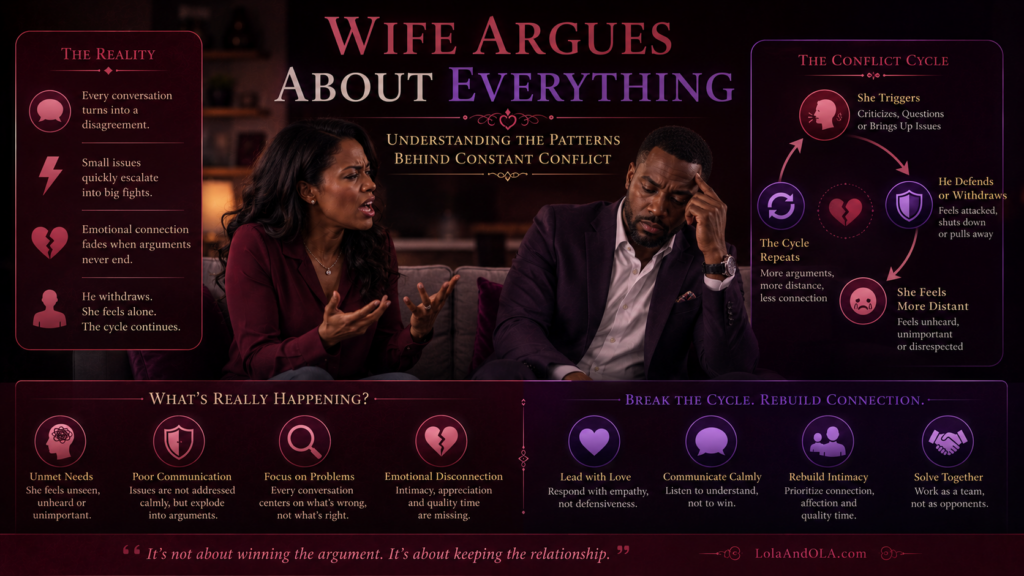
Wife Argues About Everything? Here’s the Hard Truth Most Husbands Need to Hear

If you’ve found yourself wondering why, “you wife argues about everything,” you’re not alone.

Take This 2 Minutes Marriage Assessment

Question 1 of 15

Many husbands reach a point where it feels like every conversation turns into a debate, every suggestion gets challenged, and every attempt at communication is met with pushback.

It can be exhausting.

You say something simple, and she immediately responds with a reason why it’s wrong.

You share an idea, and she has an argument against it before you’ve even finished explaining.

Over time, it can feel like you’re constantly walking into conflict, leaving you frustrated, disconnected, and wondering how your marriage got here.

But before we talk about how to stop the arguments, we need to address an uncomfortable reality:

If your wife argues about everything, there’s a good chance you’re arguing about everything too.

That may sound unfair at first.

You might be thinking,

“No, she’s the one starting it.”

Hear me out.

wife argues about everything

The Hidden Dynamic Behind Constant Arguments

It’s almost impossible for one person to sustain endless arguments without the other person participating in them.

Notice I said almost impossible.

When husbands describe their wives as argumentative, they often explain the same pattern:

  • Every suggestion gets challenged.
  • Every opinion gets questioned.
  • Every conversation feels like a debate.
  • Every disagreement turns into a battle.

The frustration is real.

However, when I observe these same husbands in coaching or counseling conversations, I often notice something surprising. They’re doing the exact same thing.

Every recommendation receives resistance.

Every new perspective gets debated.

Every alternative solution gets challenged.

In other words, they are responding to an argumentative spouse with more argument.

The result?

A relationship trapped in a cycle where both people feel unheard, misunderstood, and disrespected.

Why “Winning” the Argument Doesn’t Fix the Marriage

Many couples become so focused on proving their point that they forget the purpose of the conversation.

The goal isn’t to win.

The goal is understanding.

Unfortunately, when a marriage reaches the point where one spouse feels that the other argues about everything, both people are usually operating from a defensive position.

Instead of listening, they’re preparing rebuttals.

Instead of understanding, they’re building cases.

Instead of solving problems, they’re protecting themselves.

This creates an environment where every interaction feels like a courtroom rather than a partnership.

Take a Step Back Before You Take Another Stand

If the way you’ve been engaging your wife isn’t working, wouldn’t it make sense to stop using the same approach?

That’s the first step.

Take a step back.

Not because you’re surrendering.

Not because you’re admitting you’re wrong.

But because continuing the same pattern will only produce the same results.

Ask yourself:

  • How did I get here?
  • When did conversations become competitions?
  • What role am I playing in this dynamic?
  • How do I typically respond when she disagrees with me?
  • Do I genuinely listen, or do I immediately defend my position?

These questions require honesty.

And honesty is often where real change begins.

Conduct a Self-Audit Before Trying to Change Your Wife

One of the biggest mistakes people make is focusing entirely on their spouse’s behavior while ignoring their own.

It’s easy to identify what your wife is doing wrong.

It’s much harder to examine your own patterns.

Yet that’s where your power lies.

You cannot control whether your wife changes.

You can control how you respond.

You can control your communication style.

You can control your emotional reactions.

You can control whether you escalate conflict or de-escalate it.

A self-audit may reveal that you’ve developed habits that unintentionally fuel arguments:

  • Interrupting.
  • Becoming defensive.
  • Dismissing her concerns.
  • Correcting minor details.
  • Needing the last word.
  • Responding emotionally instead of thoughtfully.

The goal isn’t self-blame.

The goal is self-awareness.

What If My Wife Really Does Argue About Everything?

Let’s be honest.

There are people who are naturally more confrontational than others.

Some individuals challenge nearly everything.

Some people process thoughts through debate.

Some have communication habits that create friction in relationships.

Yes, those people exist.

But here’s the reality:

If that person is your wife, she’s still your wife.

Whether your marriage ultimately thrives, struggles, or even ends, you’ll still need the skills required to navigate difficult interactions.

Think about it.

If you separate and become co-parents, you’ll still need communication skills.

You’ll still need emotional intelligence.

You’ll still need active listening.

You’ll still need conflict-resolution skills.

The solution isn’t avoiding difficult conversations.

The solution is becoming better at handling them.

The Skills That Change Everything

Healthy relationships aren’t built by finding perfect partners.

They’re built by developing better skills.

Some of the most important include:

Active Listening

Most people listen to respond.

Successful couples listen to understand.

Before defending yourself, make sure you truly understand what your wife is saying.

Emotional Intelligence

Learn to recognize when emotions are driving the conversation.

When emotions rise, logic often disappears.

Pausing can be more productive than pushing forward.

Curiosity Instead of Defensiveness

Instead of immediately explaining why she’s wrong, ask questions.

Seek to understand her perspective before presenting your own.

Personal Accountability

Own your contribution to the problem.

Not because you’re responsible for everything, but because you’re responsible for your part.

Strategic Patience

Not every disagreement needs an immediate resolution.

Sometimes creating space allows both people to return with greater clarity and less emotion.

So How Do You Stop Your Wife From Arguing About Everything?

Here’s the answer most people don’t want to hear:

Stop arguing about everything yourself.

That doesn’t mean becoming passive.

It doesn’t mean agreeing with things you don’t believe.

It means refusing to participate in unnecessary conflict.

It means becoming intentional instead of reactive.

It means recognizing that the fastest way to change a relationship dynamic is often to change the role you’re playing within it.

When one person consistently changes their behavior, the entire interaction begins to shift.

Will it happen overnight?

No.

Will it guarantee that your wife changes?

No.

But it gives you the best chance of breaking the cycle that’s keeping both of you stuck.

And with that said, this is only the beginning.

Now that we’ve covered the foundational mindset shift, I’ve got something special before we move into five additional practical tips that can help you navigate a marriage where it feels like your wife argues about everything.

How to De-escalate an Argument in 30 Seconds

One of the most powerful concepts we teach is this:

The goal is not to win the moment. The goal is to lead the interaction.

When your wife argues about everything, it’s easy to get pulled into a battle over facts, details, and who is right.

The problem is that most arguments aren’t actually about the words being said. They’re about the emotions underneath them.

When a conversation starts escalating, try this simple de-escalation framework:

Step 1: Drop the Need to Be Right

This doesn’t mean admitting you’re wrong.

It means recognizing that proving your point is often less important than protecting the relationship.

Many men unknowingly escalate conflict because they feel compelled to correct every misunderstanding, challenge every accusation, or defend every criticism.

Unfortunately, the more you focus on being right, the more defensive your wife becomes.

Instead of thinking, “How do I prove my point?” ask yourself:

“How do I lower the emotional temperature of this conversation?”

Step 2: Listen for the Emotion, Not the Words

When emotions are running high, people rarely communicate their deepest concerns clearly.

For example, when your wife says:

  • “You never listen to me.”
  • “You don’t care about this family.”
  • “You always do whatever you want.”

The literal statement may not be accurate.

But the emotion underneath it is often real.

What she’s frequently communicating is:

  • “I don’t feel heard.”
  • “I feel overwhelmed.”
  • “I feel unsupported.”
  • “I feel disconnected from you.”

A relationship and emotional intelligence man learns to respond to and not be dismissive of the emotion before responding to the accusation.

Step 3: Validate the Feeling Without Agreeing to the Claim

Validation is one of the fastest ways to de-escalate conflict.

Validation does not mean agreement.

It simply means acknowledging her emotional experience.

Try statements like:

  • “I can see why that would be frustrating.”
  • “I understand why you’d feel that way.”
  • “I can tell this is really important to you.”

When people feel understood, they become less focused on fighting to be heard.

Step 4: Slow the Pace

Escalation thrives on speed.

De-escalation requires intentional pauses.

Lower your voice.

Slow your speech.

Take a breath before responding.

A calm nervous system is contagious.

When one person refuses to match the intensity of the argument, it often becomes much harder for the conflict to continue escalating.

Step 5: Redirect Toward Resolution

Once the emotional intensity begins to drop, shift the conversation toward problem-solving.

Ask:

  • “What would help you feel supported here?”
  • “What’s the biggest concern you’re trying to solve?”
  • “How can we approach this differently moving forward?”

These questions move the conversation away from blame and toward collaboration.

The truth is, many husbands who believe their wife argues about everything discover that what she’s really doing is repeatedly expressing an unmet need in an ineffective way.

When you learn to address the need beneath the argument, you’ll often find that the argument itself begins to lose its power.


Now, before I get into the tips, there’s a quick story behind why I came up with this topic.

I have a client who called me…

He called me, he is married to his wife and they’ve been going through it for a while.

A lot of arguments… a lot of resentments from the part of the wife, and they’re going through it.

So every now and then he will call me and I’ll give him some tips here and there.

Basically, I’m coaching him in a mild way.

When he called me, I could hear the wife in the background telling him that I’m a third party.

She said I’m an outsider, and he should not be sharing anything that’s going on in their family with me.

Now there’s a twist to the tips I’m going to share with you right now.

There are 5 tips…, If your โ€œWife argues about everythingโ€.

PREVIOUS POST: โ€œMy WIFE WANTS A DIVORCE How Can I CHANGE HER MIND?โ€ – 5 tips

The main issue here is the argument–Itโ€™s not about her opinion of where I belong. She is, in fact, very correct that I’m a third party.

I am an outsider when it comes to that marriage.

The more important thing in that scenario is the argument and the very heated argument that’s basically going on between the both of them at that point in time,

โ€ฆand how he was handling it.

That’s more of the tips that I want to share with you right now

Tip #1 – When you engage in an argument with your wife, Countdown 30 seconds.

You can’t cheat… you can’t afford to cheat on this one.

You need to countdown 30 seconds and try to take as much deep breath as possible while you’re counting down to 30 seconds.

I want you to trust me.

Trust God that heaven is not about to fall apart because your wife disagrees with you on whatever.

Unless it has to do with safety and security, there is absolutely no need for you to be right in that conversation.

And that’s why I’m asking you, take a countdown from 30 to 0.

Tip #2 – You wanna let go of your right to be right.

TRENDING: HOW TO CHANGE MYSELF TO SAVE MY MARRIAGE

I think I just hinted that real quick.

The reason why anyone engages in an argument is that they feel the need to be right.

We’re all like that as human beings.

When we engage in a little debate, it turns out to be an argument.

Then it’s: I’m right and you’re wrong.”

And essentially, even if you end up winning the battle of youโ€™re right and then she’s wrong,

โ€ฆyou’re still wrong because unfortunately or fortunately, this is a relationship.

And if she holds any resentment against you because you managed to convince her that you won the argument, itโ€™s just twice as bad.

Just keep that at the back of your mind.

Let go of all your right to be right–at least for now.

Because again, you’re engaged in a heated argument… no matter how right you are, the situation is wrong.

The dynamics of that relationship at that moment is wrong.

How Often Should Married Couples Spend Time Together?

Tip #3 – Turn it to an active listening session.

Now, this is very tricky.

This is can be very hard to do because again, remember,

โ€ฆtruthfully, you are caught up in your feelings and you do feel like you’re right.

You do feel like you know what you’re talking about.

But again if you did Tip #1, the 30 seconds countdown, this should be easier for you.

Turn into an active listening session.

Don’t just shut up.

Don’t be dismissive.

This is something that I myself am still working on.

Itโ€™s quite easy to go into the dismissive mode, but just try to actively listen to what your spouse or your wife is trying to say to you.

They’re coming from somewhere and it’s usually not easy to detect where they’re coming from just by listening to the words.

You have to listen not just to the words, but behind the scenes of why they’re saying what they’re saying from an emotional standpoint.

Tip #4 – Repeat what you’re hearing back to her.

HAVE YOU SEEN THIS: More Video on our YouTube Channel

So instead of you feeling the need to react to everything she’s saying,

Repeat what she said back to her.

For example,

She says, โ€œno, he’s an outsider. He is a third party!โ€

โ€œhmm interesting. So you’re saying he’s a third party. I agree with you. I actually agree with you. You’re saying … [WHATEVER SHE’S SAYING]โ€.

You see, it’s a little awkward because it’s not the easiest thing to do.

So why don’t just keep it simple? Repeat what she said back to her.

โ€œHe’s a third partyOkay, tell me more, babeโ€, just say tell me more.

Tip #5 – Ask her to tell you more.

Repeat what she said.

Ask her to tell you more.

Like, even if this creates awkwardness, she will calm down,

โ€ฆtry to hear what you’re trying to say and trying to probably put her words a little bit better.

Because again, when people are soaked up in their emotions, it’s also difficult for them.

It’s a good chance that they’re not expressing clearly whatever they’re trying to say.

But if you repeat what she said back to her, which is essentially tip #4,

โ€ฆyou now go to tip #5 and say, โ€œOkay, so you’re saying he’s wrong? Tell me moreโ€

Exactly.

You know, she will calm down and then probably tell you a little bit clearer.

By the way, here’s a bonus tip.

When I say conversation, let go of all your need to say your part. “Can I say something?”

Let her finish everything she has to say.

Trust me when you do that, you’re not losing.

Remember it’s not about losing, you’re actually winning because she gets to express everything she wants to say.

And this is going to require a lot of patience.

This is easier said than done but the alternative of this is that you’re gonna lose your relationship and your marriage slowly.

It’s gonna die a slow death and that’s not what we want, right?

So that’s what I have for you .

If you engage in negative and toxic energy arguments with your wife all the time,

โ€ฆjust follow these 5 tips and all should be well.

Practice it over and over and over, and it should get easier with time.

Check this Out: 5 Signs Your Wife Doesn’t Respect You

Frequently Asked Questions

How do you deal with an argumentative wife?

The most effective way to deal with an argumentative wife is to stop focusing on winning individual disagreements and start focusing on improving the overall communication dynamic. Listen for the emotion behind her words, avoid becoming defensive, validate her concerns where appropriate, and resist the urge to argue every point. When one spouse changes how they engage during conflict, it often changes the entire interaction.

Why does my wife argue about everything I say?

There can be many reasons your wife seems to argue about everything. She may feel unheard, disrespected, overwhelmed, disconnected, or frustrated about unresolved issues in the relationship. In some cases, arguing becomes a learned communication pattern. Rather than focusing solely on what she’s doing, it’s important to examine how both partners contribute to the cycle and whether deeper relationship concerns are fueling the constant disagreements.

Is constant arguing a sign of a failing marriage?

Not necessarily. Constant arguing is often a sign of poor communication, unresolved resentment, unmet emotional needs, or ineffective conflict-resolution skills. While frequent conflict can damage a marriage if left unaddressed, many couples learn healthier ways to communicate and go on to build stronger relationships. The key is addressing the underlying issues rather than simply trying to stop the arguments themselves.

What should I do when my wife disagrees with everything?

When your wife seems to disagree with everything, avoid immediately defending your position or trying to prove her wrong. Instead, ask questions, seek clarification, and try to understand what concern or emotion is driving her response. Taking a step back, practicing active listening, and responding calmly can help break the cycle of constant disagreement and create more productive conversations.

The Lonely Marriage: What to Do When Both of You Feel Completely Alone

If there is one marriage dynamic that catches peopleโ€™s attention, itโ€™s watching a husband say, โ€œI feel alone,โ€ while his wife sits across from him feeling exactly the same thing.

Itโ€™s a moment that feels painfully familiar to millions.

Beneath all the external success, the accomplishments, and the busy schedules, many couples eventually face a harsh reality: they see two people who love each other, who have built a life together, and who have sacrificed together, but who have reached a point where neither one feels truly heard.

If you’ve been married long enough, you know exactly how dangerous that place can become.

The Lonely Marriage

When Shared Ambition Creates Marital Friction

Many relationships don’t begin with conflict; they begin with ambition and alignment.

Couples often come together because they are both builders, thinkers, and highly driven individuals.

From the outside, their story looks like the blueprint many people dream about: children, growing businesses, financial success, and community recognition.

But there is something people rarely discuss about power couples.

The very traits that help you build external success can sometimes create friction inside a marriage.

Strong people marry strong people.

Ambitious people marry ambitious people.

We often see people blindly advise singles to “marry your type,” thinking theyโ€™ve offered profound wisdom.

The challenge is that when life becomes stressful, those same strengths can collide instead of cooperate.

What initially attracts you to your partner can easily end up being what you later resent.

Marital Friction

The Trap of “Relationship Gridlock”

When a husband admits he feels completely alone despite all the responsibilities surrounding him, outsiders are quick to take sides.

Some side with the husband; others side with the wife.

But taking sides misses the root issue.

What is actually happening beneath the surface is pure exhaustion.

  • The Husband is carrying responsibilities that he is proud to bear, but he is simultaneously overwhelmed by the weight of them.
  • The Wife genuinely believes she has been trying to support her husband, but she feels like every effort she makes gets discounted or overlooked.

Neither person feels understood.

This is where marriages enter dangerous territory, often sliding into divorce and bitter custody battles before either partner realizes what went wrong.

Relationship Gridlock

The Anatomy of a Gridlock:

  • Husband: “You gotta listen to me. I feel alone.”
  • Wife: “I don’t feel like you listen to me. I feel alone too.”

At first glance, it sounds like a disagreement.

But when you listen carefully, they are saying the exact same thing.

They are describing the exact same emotional experience from opposite sides of the table.

This is relationship gridlock.

Nobody is solving anything anymore.

Both people are presenting evidence.

Both people are defending themselves.

Both people are trying to explain their pain.

Yet, nobody feels relief because nobody feels emotionally received.

Why “More Communication” Isn’t Fixing the Problem

Many couples mistakenly believe communication problems happen because one person is talking and the other person is silent.

That is rarely the issue.

The real problem is that both people are talking while neither person feels emotionally received.

Psychologists have studied this for decades.

One of the strongest predictors of divorce is not conflict itself.

It is the pattern of:

  • Criticism
  • Defensiveness
  • Contempt
  • Stonewalling

When couples repeatedly get trapped in those cycles, they stop solving problems and start protecting themselves.

And when self-protection becomes the goal, intimacy dies.

This complexity doubles if you happen to be business partners or co-parents.

When things are not working, it becomes incredibly difficult to separate professional or logistical frustrations from relationship frustrations.

Are you arguing as spouses?

As business partners?

As parents?

The lines become blurry, and the emotional fatigue skyrockets.

The Reality of Permanent Differences

One thing we often tell couples is that differences are not the problem.

Differences are permanent.

In fact, they are actually an opportunity to build much-needed internal strength.

Every successful marriage is a marriage of differences.

Even if two people grew up in the same neighborhood, attended the same schools, or worshipped in the same church, they will still develop different personalities, different fears, different emotional triggers, and different communication styles.

The goal of marriage is not to eliminate differences; the goal is learning how to navigate them.

Unfortunately, many couples spend years weaponizing their differences against each other instead of leveraging them for the benefit of the relationship.

Emotional Leadership: Who Steps Up First?

When a marriage stalls, it’s often because both partners are asking for leadership while simultaneously waiting for the other person to provide it.

Some people call it “give and take.” Basically demanding result without work.

To break the cycle, somebody has to temporarily become the bigger person.

  • Somebody has to become more patient.
  • Somebody has to listen longer.
  • Somebody has to absorb more frustration without immediately reacting.
  • Somebody has to lead.

Leadership in marriage is not dominance; leadership is emotional capacity.

It is the ability to stay grounded when the other person is upset.

It is the ability to see beyond today’s temporary emotions and focus on tomorrow’s long-term outcome.

When tired people become competitors instead of teammates, resentment starts replacing goodwill.

Every interaction gets filtered through old disappointments, and every conversation becomes evidence for why you’re right and your spouse is wrong.

Once resentment takes root deeply enough, even good intentions begin to look suspicious.

How to Save a Lonely Marriage: Communication 2.0

If you want to turn the tide, you have to change how you communicate.

In Chapter 12 of our book, Get My Marriage Back, we dive deep into a concept called Communication 2.0.

One of the hardest lessons we had to learn in our own marriage was that solving a communication problem is not always about explaining yourself better.

The Golden Rule of Communication 2.0: Sometimes you must focus entirely on helping your spouse feel understood before trying to be understood yourself.

That single shift can completely change the direction of a struggling relationship.

The good news is that feeling lonely or unseen is not unusual.

Every successful marriage has seasons where two people question the future, and where frustration feels louder than love.

The difference between couples who make it and those who don’t isn’t whether those moments happenโ€”it’s whether at least one partner develops enough emotional intelligence, patience, and self-awareness to guide the relationship through them.

Marriage was never designed to remove uncertainty from your life.

Marriage simply gives you someone to navigate uncertainty with… or choose to blame them for the inevitable.

If you are ready to stop the cycle, let us know if youโ€™d like us to map your relationship through our GPS Marriage Fixing Framework.

It works 100% of the time when applied correctly.

When two exhausted people stop competing long enough to become teammates again, that is exactly where healing begins.

A Question for Reflection: When two people both feel unheard, lonely, and misunderstood at the same time, who should take the first step toward understandingโ€”and would you be willing to be that person in your own relationship?

Check this out: 17 Signs of When to Walk Away From A Sexless Marriage

Frequently Asked Questions

How to manage loneliness in a marriage?

Managing loneliness in a marriage requires shifting from self-protection back to emotional teamwork, starting with a commitment to listen before trying to be heard. When relationship gridlock sets in, both partners are often talking but neither feels emotionally received, allowing resentment to filter every interaction. To break this cycle, one partner must step up with emotional leadershipโ€”meaning they temporarily expand their emotional capacity to listen longer, absorb frustration without reacting, and actively validate their spouse’s experience. By prioritizing your spouseโ€™s need to feel understood before defending your own position, you can lower the relational defenses and begin rebuilding the shared intimacy that drives out loneliness.

How to deal with loneliness as a married woman?

Dealing with loneliness as a married woman, especially in an ambitious or highly driven partnership, means recognizing when shared strengths have accidentally turned into marital friction. It is easy to feel completely discounted or overlooked when you believe you are actively supporting your husband, yet every effort seems to go unnoticed while he retreats into his own exhaustion. To address this, initiate a “Communication 2.0” approach by addressing the shared dynamic rather than pointing fingers; acknowledge that you both appear to be suffering from the exact same emotional fatigue from opposite sides of the table. By shifting the conversation away from a competition over who is hurting more and toward a collaborative effort to become teammates again, you can create a safe emotional space for both of you to step out of isolation.

Is it normal to feel lonely in my marriage?

Yes, it is entirely normal to experience seasons of loneliness in a marriage, and it does not mean your relationship is fundamentally broken. Every successful, long-term marriage goes through periods where both partners feel unseen, where life’s heavy responsibilities cause exhaustion, and where frustration temporarily feels louder than love. The defining factor of a lasting relationship is not the total absence of these lonely seasons, but rather how you navigate them when they arrive. Recognizing that loneliness is a common, predictable hurdle allows you to stop weaponizing your differences and instead use them as an opportunity to build internal strength and deeper emotional intelligence together.

The #1 Communication Trick to Stop Arguments In a Marriage Fast

How to Stop Arguments in Marriage Using Proven Communication Strategies

You ever walk into a room, open your mouth to speak, and your spouse looks at you like you just interrupted their favorite showโ€”even though nothing is even playing?

Click Below to Watch the Video

how to stop arguments in marriage

Click Above to Watch the Video

That awkward tension?

That cold silence?

Thatโ€™s not in your imagination.

And youโ€™re not alone.

In fact, if youโ€™ve ever felt like every conversation with your spouse ends in a misunderstanding, raised voices, or complete shutdown, you might be wondering if there’s anything left to save.

Let us assure youโ€”there is.

Weโ€™re Ola and Lola, marriage coaches and authors of the book Get My Marriage Back.

Weโ€™ve been through the trenches ourselvesโ€”nearly gave upโ€”but fought to find our way back.

And weโ€™ve spent the last several years helping individuals and couples stop the toxic cycles and rekindle deep, lasting connection.

So if youโ€™re ready to finally learn how to stop arguments in marriage, youโ€™re in the right place.


Why Couples Argue (And Why It Keeps Happening)

According to a study by the National Library of Medicine, communication problems are the number one reason cited in over 65% of divorces.

And it’s not just what couples argue aboutโ€”but how they argue.

Most couples donโ€™t argue about the topic itself.

They argue about how they feel during the conversationโ€”disrespected, ignored, unheard.

Take our client Tunde, for example.

He told us, โ€œOla, I swear I was just asking her how her day went, and she looked at me like I asked for her bank password.โ€

It wasnโ€™t the words that were wrong.

It was the emotional atmosphere the words landed in.

So letโ€™s walk through three key lessons that helped Tunde and many others stop arguments in marriageโ€”fast.


Lesson #1 โ€“ Master the Art of Active Listening

This one communication skill can de-escalate 80% of arguments before they even start.

Letโ€™s get one thing straight: active listening is not just hearing.

Most people listen just enough to prepare a response. Like theyโ€™re shadowboxing in the ring, waiting for the right moment to land their verbal uppercut.

But active listening means youโ€™re hearing to understandโ€”not to defend, not to correct, and definitely not to win.

When you listen to understand, a few powerful things happen:

  • Your spouse feels safe to express themselves.
  • You begin to pick up on unspoken emotional cues.
  • You stop misinterpreting silence, sarcasm, or distance.

Real-Life Example:

Ada, one of our clients, thought her husband was emotionally unavailable.

But once she stopped interrupting and actually listened without fixing, he opened up more than he had in years.

Why?

Because for the first time in a long time, he felt heardโ€”not judged.

Tip: Next time youโ€™re in a tense moment, try this:
โ€œHelp me understand… How do you feel?โ€
Then? Zip it. Let them talk.

This principle echoes what the Christian scritptures James 1:19 teaches:

โ€œLet every person be quick to hear, slow to speak, slow to anger.โ€

Let your first move in conflict be listeningโ€”not launching into a defense.


Lesson #2 โ€“ Stop Trying to Win the Argument

Start trying to win unity instead.

Arguments in marriage often turn into courtroom scenes:

  • Whoโ€™s more hurt?
  • Whoโ€™s right?
  • Who has better evidence?

But hereโ€™s the truth:

In marriage, if one person loses the argument, you both lose.

The goal isnโ€™t to erase all conflict.

Thatโ€™s unrealistic.

The goal is to handle conflict in a way that creates connection, not casualties.

Client Example โ€“ Jideโ€™s Breakthrough

Jide used to say, โ€œBut I didnโ€™t mean it that way!โ€ every time his wife got upset.

He couldnโ€™t understand why she kept taking things the wrong way.

We told him:

โ€œItโ€™s not about what you meantโ€”itโ€™s about how it was received.โ€

Once he got that, things shifted dramatically.

Their arguments dropped, and their emotional intimacy rose.

As the Christian scriptures Proverbs 18:13 wisely states:

โ€œIf one gives an answer before he hears, it is his folly and shame.โ€


Lesson #3 โ€“ Remind Yourself: Your Partner Is Still Your Lover

Not your enemy.

Not your rival.

Not your roommate.

When you first fell in love, every word sparked laughter.

Every conversation was an adventure.

But now?

Maybe you talk only when thereโ€™s a problem.

Or worseโ€”only when you need something.

That shift often starts when familiarity replaces curiosity.

Reignite curiosity.

Ask questions again.

Laugh at each otherโ€™s jokesโ€”even if youโ€™ve heard them before.

We personally experienced this shift in our own marriage.

When we stopped assuming we knew each other and started dating againโ€”emotionally and conversationallyโ€”it felt like falling in love all over again.

So ask yourself:

  • When was the last time you flirted?
  • When was the last time you listened to your spouse like it was your first date?
  • When was the last time you complimented them for no reason?

The Science Behind Arguments in Marriage

Quick Stats:

  • According to Dr. John Gottman, couples who argue in a healthy way (i.e., with emotional safety and repair) are 5x more likely to stay together.
  • A 2022 Pew Research study found that 61% of divorced people cited communication as a โ€œmajor contributing factorโ€ to the end of their marriage.
  • Studies from the American Psychological Association (APA) show that active listening and emotional validation significantly lower cortisol levels (the stress hormone) during conflict.

So when we say this worksโ€”itโ€™s not just our opinion.

Itโ€™s evidence-based.


Finally, Here is How to Stop Arguments in Marriage Starting Today

If youโ€™re sick of:

  • Talking to a brick wall,
  • Feeling like everything turns into a fight,
  • Or emotionally walking on eggshells,

โ€ฆitโ€™s time to change the way you communicate.

Remember:

  1. Listen first. Understand before responding.
  2. Seek unity, not victory. Youโ€™re not debatingโ€”youโ€™re connecting.
  3. Rediscover your friendship. Let your marriage feel like love again, not war.

And if you want to go deeper and get step-by-step guidance for restoring communication and connectionโ€”even if your marriage feels cold or one-sidedโ€”join our FREE 72-minute masterclass:
👉 www.GetMyMarriageBack.com

Youโ€™ll learn exactly whatโ€™s blocking connection and what to do next.

FAQ: How to Stop Arguments in Marriage

How to stop an argument in marriage?

You can immediately reduce arguments by focusing on actively listening to your spouse with the intent to understand their perspective.

How to break the cycle of arguing?

To break the cycle of arguing, shift your focus from trying to “win” the argument to seeking unity and connection with your partner.

Why does my wife constantly pick fights with me?

Frequent arguments often stem from feeling unheard, disrespected, or emotionally unsafe during conversations.

How to control fights between husband and wife?

Husbands and wives can control fights by prioritizing active listening, understanding each other’s feelings, and remembering they are partners, not adversaries.


Broken Marriage?
Fix it
Here FREE

Get My Marriage Back