

If you’ve found yourself wondering why, “you wife argues about everything,” you’re not alone.
Take This 2 Minutes Marriage Assessment
Many husbands reach a point where it feels like every conversation turns into a debate, every suggestion gets challenged, and every attempt at communication is met with pushback.
It can be exhausting.
You say something simple, and she immediately responds with a reason why it’s wrong.
You share an idea, and she has an argument against it before you’ve even finished explaining.
Over time, it can feel like you’re constantly walking into conflict, leaving you frustrated, disconnected, and wondering how your marriage got here.
But before we talk about how to stop the arguments, we need to address an uncomfortable reality:
If your wife argues about everything, there’s a good chance you’re arguing about everything too.
That may sound unfair at first.
What Would Help You Most Right Now?
Choose the option that best matches where you are with your marriage.
My Marriage Is in Serious Trouble
If you're dealing with separation, divorce, loss of attraction, infidelity, intimacy problems, or a spouse who's pulling away, get help looking at what's happening in your specific situation.
Get Personalized Help →
Start With Get My Marriage Back
Get the book and start learning the principles for moving your marriage in a better direction.
Get the Free Book →You might be thinking,
“No, she’s the one starting it.”
Hear me out.
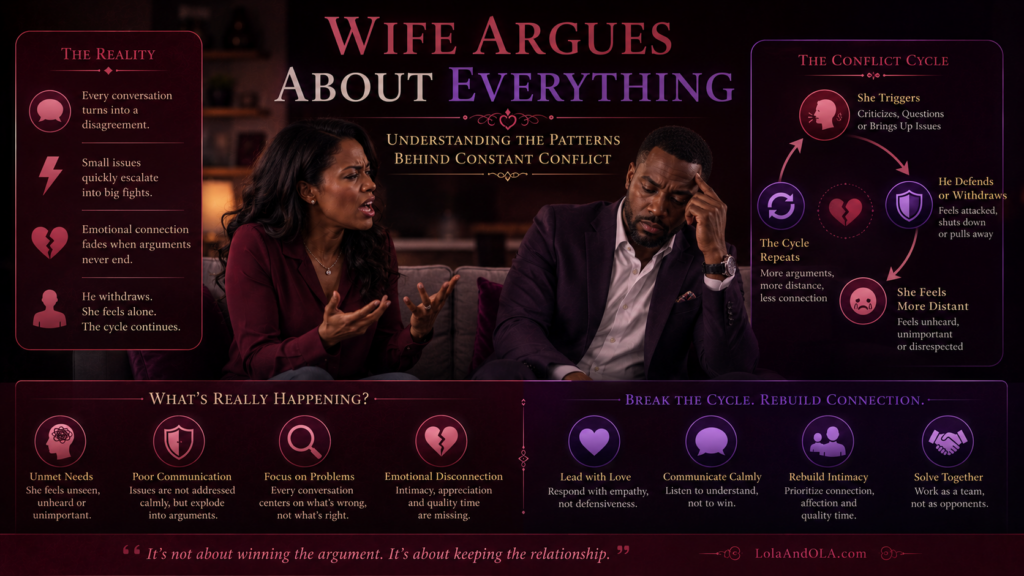
The Hidden Dynamic Behind Constant Arguments
It’s almost impossible for one person to sustain endless arguments without the other person participating in them.
Notice I said almost impossible.
When husbands describe their wives as argumentative, they often explain the same pattern:
- Every suggestion gets challenged.
- Every opinion gets questioned.
- Every conversation feels like a debate.
- Every disagreement turns into a battle.
The frustration is real.
However, when I observe these same husbands in coaching or counseling conversations, I often notice something surprising. They’re doing the exact same thing.
Every recommendation receives resistance.
Every new perspective gets debated.
Every alternative solution gets challenged.
In other words, they are responding to an argumentative spouse with more argument.
The result?
A relationship trapped in a cycle where both people feel unheard, misunderstood, and disrespected.
Why “Winning” the Argument Doesn’t Fix the Marriage
Many couples become so focused on proving their point that they forget the purpose of the conversation.
The goal isn’t to win.
The goal is understanding.
Unfortunately, when a marriage reaches the point where one spouse feels that the other argues about everything, both people are usually operating from a defensive position.
Instead of listening, they’re preparing rebuttals.
Instead of understanding, they’re building cases.
Instead of solving problems, they’re protecting themselves.
This creates an environment where every interaction feels like a courtroom rather than a partnership.
Take a Step Back Before You Take Another Stand
If the way you’ve been engaging your wife isn’t working, wouldn’t it make sense to stop using the same approach?
That’s the first step.
Take a step back.
Not because you’re surrendering.
Not because you’re admitting you’re wrong.
But because continuing the same pattern will only produce the same results.
Ask yourself:
- How did I get here?
- When did conversations become competitions?
- What role am I playing in this dynamic?
- How do I typically respond when she disagrees with me?
- Do I genuinely listen, or do I immediately defend my position?
These questions require honesty.
And honesty is often where real change begins.
Conduct a Self-Audit Before Trying to Change Your Wife
One of the biggest mistakes people make is focusing entirely on their spouse’s behavior while ignoring their own.
It’s easy to identify what your wife is doing wrong.
It’s much harder to examine your own patterns.
Yet that’s where your power lies.
You cannot control whether your wife changes.
You can control how you respond.
You can control your communication style.
You can control your emotional reactions.
You can control whether you escalate conflict or de-escalate it.
A self-audit may reveal that you’ve developed habits that unintentionally fuel arguments:
- Interrupting.
- Becoming defensive.
- Dismissing her concerns.
- Correcting minor details.
- Needing the last word.
- Responding emotionally instead of thoughtfully.
The goal isn’t self-blame.
The goal is self-awareness.
What If My Wife Really Does Argue About Everything?
Let’s be honest.
There are people who are naturally more confrontational than others.
Some individuals challenge nearly everything.
Some people process thoughts through debate.
Some have communication habits that create friction in relationships.
Yes, those people exist.
But here’s the reality:
If that person is your wife, she’s still your wife.
Whether your marriage ultimately thrives, struggles, or even ends, you’ll still need the skills required to navigate difficult interactions.
Think about it.
If you separate and become co-parents, you’ll still need communication skills.
You’ll still need emotional intelligence.
You’ll still need active listening.
You’ll still need conflict-resolution skills.
The solution isn’t avoiding difficult conversations.
The solution is becoming better at handling them.
The Skills That Change Everything
Healthy relationships aren’t built by finding perfect partners.
They’re built by developing better skills.
Some of the most important include:
Active Listening
Most people listen to respond.
Successful couples listen to understand.
Before defending yourself, make sure you truly understand what your wife is saying.
Emotional Intelligence
Learn to recognize when emotions are driving the conversation.
When emotions rise, logic often disappears.
Pausing can be more productive than pushing forward.
Curiosity Instead of Defensiveness
Instead of immediately explaining why she’s wrong, ask questions.
Seek to understand her perspective before presenting your own.
Personal Accountability
Own your contribution to the problem.
Not because you’re responsible for everything, but because you’re responsible for your part.
Strategic Patience
Not every disagreement needs an immediate resolution.
Sometimes creating space allows both people to return with greater clarity and less emotion.
So How Do You Stop Your Wife From Arguing About Everything?
Here’s the answer most people don’t want to hear:
Stop arguing about everything yourself.
That doesn’t mean becoming passive.
It doesn’t mean agreeing with things you don’t believe.
It means refusing to participate in unnecessary conflict.
It means becoming intentional instead of reactive.
It means recognizing that the fastest way to change a relationship dynamic is often to change the role you’re playing within it.
When one person consistently changes their behavior, the entire interaction begins to shift.
Will it happen overnight?
No.
Will it guarantee that your wife changes?
No.
But it gives you the best chance of breaking the cycle that’s keeping both of you stuck.
And with that said, this is only the beginning.
Now that we’ve covered the foundational mindset shift, I’ve got something special before we move into five additional practical tips that can help you navigate a marriage where it feels like your wife argues about everything.
How to De-escalate an Argument in 30 Seconds
One of the most powerful concepts we teach is this:
The goal is not to win the moment. The goal is to lead the interaction.
When your wife argues about everything, it’s easy to get pulled into a battle over facts, details, and who is right.
The problem is that most arguments aren’t actually about the words being said. They’re about the emotions underneath them.
When a conversation starts escalating, try this simple de-escalation framework:
Step 1: Drop the Need to Be Right
This doesn’t mean admitting you’re wrong.
It means recognizing that proving your point is often less important than protecting the relationship.
Many men unknowingly escalate conflict because they feel compelled to correct every misunderstanding, challenge every accusation, or defend every criticism.
Unfortunately, the more you focus on being right, the more defensive your wife becomes.
Instead of thinking, “How do I prove my point?” ask yourself:
“How do I lower the emotional temperature of this conversation?”
Step 2: Listen for the Emotion, Not the Words
When emotions are running high, people rarely communicate their deepest concerns clearly.
For example, when your wife says:
- “You never listen to me.”
- “You don’t care about this family.”
- “You always do whatever you want.”
The literal statement may not be accurate.
But the emotion underneath it is often real.
What she’s frequently communicating is:
- “I don’t feel heard.”
- “I feel overwhelmed.”
- “I feel unsupported.”
- “I feel disconnected from you.”
A relationship and emotional intelligence man learns to respond to and not be dismissive of the emotion before responding to the accusation.
Step 3: Validate the Feeling Without Agreeing to the Claim
Validation is one of the fastest ways to de-escalate conflict.
Validation does not mean agreement.
It simply means acknowledging her emotional experience.
Try statements like:
- “I can see why that would be frustrating.”
- “I understand why you’d feel that way.”
- “I can tell this is really important to you.”
When people feel understood, they become less focused on fighting to be heard.
Step 4: Slow the Pace
Escalation thrives on speed.
De-escalation requires intentional pauses.
Lower your voice.
Slow your speech.
Take a breath before responding.
A calm nervous system is contagious.
When one person refuses to match the intensity of the argument, it often becomes much harder for the conflict to continue escalating.
Step 5: Redirect Toward Resolution
Once the emotional intensity begins to drop, shift the conversation toward problem-solving.
Ask:
- “What would help you feel supported here?”
- “What’s the biggest concern you’re trying to solve?”
- “How can we approach this differently moving forward?”
These questions move the conversation away from blame and toward collaboration.
The truth is, many husbands who believe their wife argues about everything discover that what she’s really doing is repeatedly expressing an unmet need in an ineffective way.
When you learn to address the need beneath the argument, you’ll often find that the argument itself begins to lose its power.
Now, before I get into the tips, there’s a quick story behind why I came up with this topic.
I have a client who called me…
He called me, he is married to his wife and they’ve been going through it for a while.
A lot of arguments… a lot of resentments from the part of the wife, and they’re going through it.
So every now and then he will call me and I’ll give him some tips here and there.
Basically, I’m coaching him in a mild way.
When he called me, I could hear the wife in the background telling him that I’m a third party.
She said I’m an outsider, and he should not be sharing anything that’s going on in their family with me.
Now there’s a twist to the tips I’m going to share with you right now.
There are 5 tips…, If your “Wife argues about everything”.
PREVIOUS POST: “My WIFE WANTS A DIVORCE How Can I CHANGE HER MIND?” – 5 tips
The main issue here is the argument–It’s not about her opinion of where I belong. She is, in fact, very correct that I’m a third party.
I am an outsider when it comes to that marriage.
The more important thing in that scenario is the argument and the very heated argument that’s basically going on between the both of them at that point in time,
…and how he was handling it.
That’s more of the tips that I want to share with you right now…
Tip #1 – When you engage in an argument with your wife, Countdown 30 seconds.
You can’t cheat… you can’t afford to cheat on this one.
You need to countdown 30 seconds and try to take as much deep breath as possible while you’re counting down to 30 seconds.
I want you to trust me.
Trust God that heaven is not about to fall apart because your wife disagrees with you on whatever.
Unless it has to do with safety and security, there is absolutely no need for you to be right in that conversation.
And that’s why I’m asking you, take a countdown from 30 to 0.
Tip #2 – You wanna let go of your right to be right.
TRENDING: HOW TO CHANGE MYSELF TO SAVE MY MARRIAGE
I think I just hinted that real quick.
The reason why anyone engages in an argument is that they feel the need to be right.
We’re all like that as human beings.
When we engage in a little debate, it turns out to be an argument.
Then it’s: “I’m right and you’re wrong.”
And essentially, even if you end up winning the battle of you’re right and then she’s wrong,
…you’re still wrong because unfortunately or fortunately, this is a relationship.
And if she holds any resentment against you because you managed to convince her that you won the argument, it’s just twice as bad.
Just keep that at the back of your mind.
Let go of all your right to be right–at least for now.
Because again, you’re engaged in a heated argument… no matter how right you are, the situation is wrong.
The dynamics of that relationship at that moment is wrong.
How Often Should Married Couples Spend Time Together?
Tip #3 – Turn it to an active listening session.
Now, this is very tricky.
This is can be very hard to do because again, remember,
…truthfully, you are caught up in your feelings and you do feel like you’re right.
You do feel like you know what you’re talking about.
But again if you did Tip #1, the 30 seconds countdown, this should be easier for you.
Turn into an active listening session.
Don’t just shut up.
Don’t be dismissive.
This is something that I myself am still working on.
It’s quite easy to go into the dismissive mode, but just try to actively listen to what your spouse or your wife is trying to say to you.
They’re coming from somewhere and it’s usually not easy to detect where they’re coming from just by listening to the words.
You have to listen not just to the words, but behind the scenes of why they’re saying what they’re saying from an emotional standpoint.
Tip #4 – Repeat what you’re hearing back to her.
HAVE YOU SEEN THIS: More Video on our YouTube Channel
So instead of you feeling the need to react to everything she’s saying,
Repeat what she said back to her.
For example,
She says, “no, he’s an outsider. He is a third party!”
“hmm interesting. So you’re saying he’s a third party. I agree with you. I actually agree with you. You’re saying … [WHATEVER SHE’S SAYING]”.
You see, it’s a little awkward because it’s not the easiest thing to do.
So why don’t just keep it simple? Repeat what she said back to her.
“He’s a third party…Okay, tell me more, babe”, just say tell me more.
Tip #5 – Ask her to tell you more.
Repeat what she said.
Ask her to tell you more.
Like, even if this creates awkwardness, she will calm down,
…try to hear what you’re trying to say and trying to probably put her words a little bit better.
Because again, when people are soaked up in their emotions, it’s also difficult for them.
It’s a good chance that they’re not expressing clearly whatever they’re trying to say.
But if you repeat what she said back to her, which is essentially tip #4,
…you now go to tip #5 and say, “Okay, so you’re saying he’s wrong? Tell me more”
Exactly.
You know, she will calm down and then probably tell you a little bit clearer.
By the way, here’s a bonus tip.
When I say conversation, let go of all your need to say your part. “Can I say something?”
Let her finish everything she has to say.
Trust me when you do that, you’re not losing.
Remember it’s not about losing, you’re actually winning because she gets to express everything she wants to say.
And this is going to require a lot of patience.
This is easier said than done but the alternative of this is that you’re gonna lose your relationship and your marriage slowly.
It’s gonna die a slow death and that’s not what we want, right?
So that’s what I have for you .
If you engage in negative and toxic energy arguments with your wife all the time,
…just follow these 5 tips and all should be well.
Practice it over and over and over, and it should get easier with time.
Check this Out: 5 Signs Your Wife Doesn’t Respect You
Frequently Asked Questions
The most effective way to deal with an argumentative wife is to stop focusing on winning individual disagreements and start focusing on improving the overall communication dynamic. Listen for the emotion behind her words, avoid becoming defensive, validate her concerns where appropriate, and resist the urge to argue every point. When one spouse changes how they engage during conflict, it often changes the entire interaction.
There can be many reasons your wife seems to argue about everything. She may feel unheard, disrespected, overwhelmed, disconnected, or frustrated about unresolved issues in the relationship. In some cases, arguing becomes a learned communication pattern. Rather than focusing solely on what she’s doing, it’s important to examine how both partners contribute to the cycle and whether deeper relationship concerns are fueling the constant disagreements.
Not necessarily. Constant arguing is often a sign of poor communication, unresolved resentment, unmet emotional needs, or ineffective conflict-resolution skills. While frequent conflict can damage a marriage if left unaddressed, many couples learn healthier ways to communicate and go on to build stronger relationships. The key is addressing the underlying issues rather than simply trying to stop the arguments themselves.
When your wife seems to disagree with everything, avoid immediately defending your position or trying to prove her wrong. Instead, ask questions, seek clarification, and try to understand what concern or emotion is driving her response. Taking a step back, practicing active listening, and responding calmly can help break the cycle of constant disagreement and create more productive conversations.