
Broken Marriage?
Fix it
Here FREE

Get My Marriage Back


Wife Makes No Effort in Bed: Understanding the Real Reasons and Rebuilding Intimacy

📌 Author's Note from Lola & Ola:
If you are reading this right now, we know the heartbreak of watching the desire, intimacy, and warmth fade out of your relationship. We survived our own marriage completely dying at the 9-year mark and rebuilt a 20+ year roadmap from it. Before you dive into the details below, grab our complete book Get My Marriage Back for FREE right now so you have an immediate, step-by-step action plan to turn things around.

Wife Makes No Effort in Bed: Understanding the Real Reasons and Rebuilding Intimacy

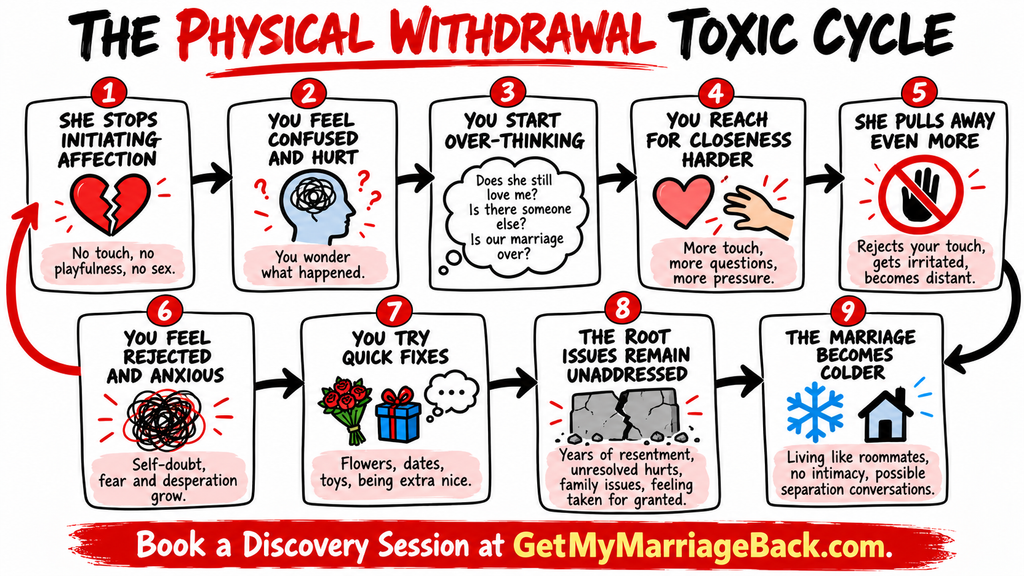
When it feels like your wife makes no effort in bed, the emotional impact can be significant.

You may feel rejected, unwanted, frustrated, or even question the future of your relationship.

Wife Makes NO EFFORT In BED

Perhaps your wife never initiates intimacy, seems disengaged during sex, or appears uninterested in exploring new experiences together.

If you’re asking yourself, “Why does my wife make no effort in bed?” it’s important to understand that the answer is rarely as simple as a lack of desire.

In many cases, there are deeper emotional, relational, physical, or psychological factors influencing intimacy.

The good news is that many couples can improve their connection when they approach the issue with patience, understanding, and effective communication.

What Does It Mean When a Wife Makes No Effort in Bed?

When people say their wife makes no effort in bed, they are often referring to one or more of the following situations:

  • She rarely or never initiates intimacy.
  • She appears emotionally disconnected during intimate moments.
  • She participates out of obligation (duty) rather than enthusiasm.
  • She avoids discussions about improving intimacy.
  • She shows little interest in physical affection outside the bedroom.

It’s important to remember that intimacy is experienced differently by different people.

What feels like a lack of effort to one partner may feel completely normal to another.

Expectations that are never communicated can create misunderstandings and resentment.

Before assuming the worst, it’s worth examining whether both partners have a shared understanding of what satisfying intimacy looks like.

“My Wife Doesn’t Initiate Intimacy: What Could Be Causing It?”

One of the most common complaints from husbands is, “My wife doesn’t initiate intimacy.”

While this can feel deeply personal, many factors may contribute:

Stress and Mental Overload

Many wives juggle responsibilities involving work, children, household management, and emotional labor. When someone is mentally exhausted, intimacy often becomes a lower priority.

Emotional Disconnection

For many women, emotional intimacy and physical intimacy are closely connected. If unresolved conflicts, resentment, or feelings of neglect exist, sexual desire may decline.

Hormonal or Health Issues

Hormonal changes, medications, depression, anxiety, and other health concerns can significantly affect libido and sexual interest.

Relationship Patterns

Over time, some couples fall into predictable routines where one partner becomes the primary initiator. What starts as a pattern can eventually feel like a permanent dynamic.

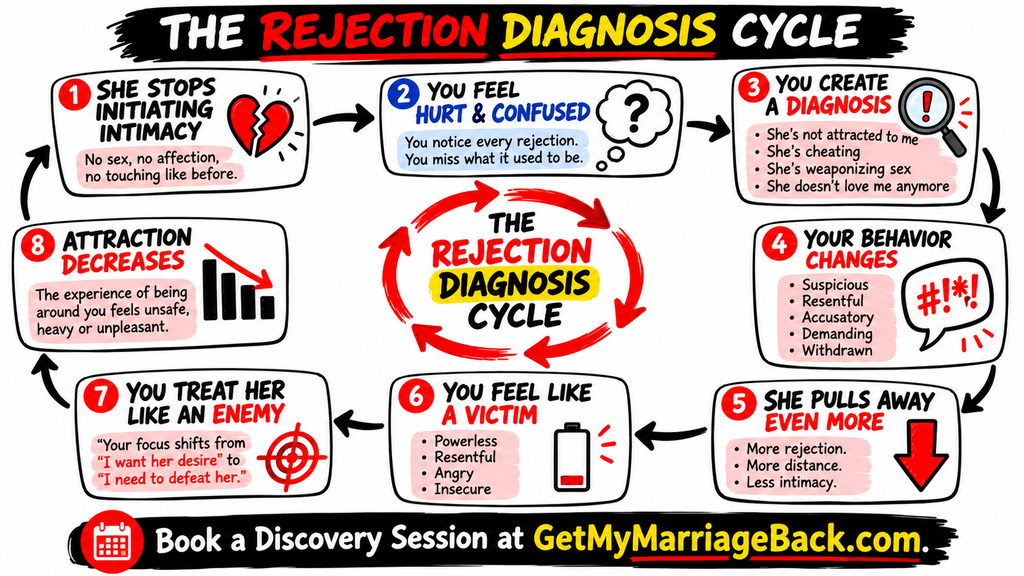
Here Are Some Signs Your Wife Is Not Sexually Attracted to Me

Many men worry that reduced intimacy automatically means attraction has disappeared.

However, attraction is only one piece of the puzzle.

Some possible signs your wife is not sexually attracted to you may include:

  • Consistently avoiding physical affection.
  • Showing little interest in romantic connection.
  • Frequently rejecting intimacy without explanation.
  • Expressing dissatisfaction with the relationship.
  • Avoiding conversations about intimacy altogether.

However, none of these signs alone prove a lack of attraction. Stress, emotional struggles, health concerns, and unresolved relationship issues can create similar behaviors.

Rather than jumping to conclusions, focus on understanding the underlying cause.

What if Your Wife Is Not Adventurous in Bed: Is That a Problem?

It’s important to distinguish between differing preferences and actual relationship problems.

Not everyone approaches intimacy with the same level of openness or curiosity.

Upbringing, cultural beliefs, religious values, personal comfort levels, and past experiences all influence how people express themselves sexually.

Instead of focusing on what your wife isn’t doing, try asking:

  • What makes her feel comfortable and safe?
  • What experiences does she genuinely enjoy?
  • What emotional conditions help her become more engaged?

Creating a positive environment often leads to greater openness than criticism or pressure ever could.

What If My Wife Makes No Effort to Be Attractive?

Some men feel hurt because their wife makes no effort to be attractive anymore.

While physical attraction matters in relationships, it’s important to approach this topic carefully.

Often, what appears to be a lack of effort is actually a symptom of something deeper.

Potential factors include:

  • Stress and burnout.
  • Low self-esteem.
  • Depression or anxiety.
  • Feeling unappreciated.
  • Physical health challenges.
  • Feeling disconnected from the relationship.

Before addressing appearance, consider whether emotional needs are being met on both sides.

Feeling valued, desired, and appreciated often influences how much effort someone invests in themselves and the relationship.

What to Do When Your Wife Doesn’t Want You Sexually

If you’re wondering what to do when your wife doesn’t want you sexually, the first step is to avoid making assumptions.

Many men immediately conclude:

  • She no longer loves me.
  • She’s not attracted to me.
  • She’s intentionally withholding affection.

In reality, the situation is often more complex.

1. Start With Curiosity Instead of Accusation

Approach the conversation with genuine interest rather than blame.

I wouldn’t start with common questions such as:

  • “How have you been feeling about our relationship lately?”
  • “Is there anything making intimacy difficult for you?”
  • “What can I do to help us reconnect?”

I would focus on expression what you love the most about intimate sessions with her and allow that conversation to lead where it may. Ask her, “what about you?” Open ended questions only.

2. Identify Underlying Issues

Conduct an honest assessment of your relationship.

Consider:

  • Communication quality
  • Emotional connection
  • Conflict patterns
  • Stress levels
  • Physical health concerns

Addressing root causes is often more effective than focusing solely on bedroom behavior.

3. Recreate Positive Experiences

Think back to periods when your relationship felt most connected and romantic.

What were you doing differently?

  • More quality time?
  • More flirting?
  • More affection?
  • Less pressure?

Reintroducing positive experiences can help rebuild emotional and physical connection.

4. Focus on Shared Enjoyment

Intimacy works best when both partners feel valued and understood.

Instead of focusing exclusively on your desired outcome, focus on creating experiences that both partners enjoy and anticipate.

I Want My Wife to Want Me Again

That reflects a desire that goes far beyond physical intimacy.

Most people don’t simply want sex—they want:

  • To feel desired.
  • To feel chosen.
  • To feel emotionally connected.
  • To feel important to their partner.

If this is your situation, recognize that rebuilding desire is often a gradual process.

Patience matters.

Trying to force change typically creates resistance.

Creating safety, appreciation, emotional connection, and positive experiences often produces much better results over time.

Is Lack of Intimacy Always a Relationship Crisis?

Not necessarily.

Every couple experiences fluctuations in intimacy.

Major life events such as:

  • Parenting young children
  • Career changes
  • Financial stress
  • Health challenges
  • Grief or loss

…can temporarily affect intimacy.

The key question isn’t whether intimacy has declined but whether you as a partner is willing to work together to understand why.

When Professional Help Can Make a Difference

Sometimes couples become stuck in patterns they cannot resolve alone.

Seeking support from a qualified marriage counselor or relationship therapist can help:

  • Improve communication.
  • Identify hidden resentments.
  • Rebuild emotional connection.
  • Address intimacy concerns.
  • Develop practical strategies for moving forward.

An experienced counselor can help tailor solutions to your specific relationship rather than relying on generic advice.

Moving from Where You Are to Where You Want to Be

Think of your relationship like a journey.

If your goal is greater intimacy, enthusiasm, and connection, you must first understand your current reality without judgment.

Many couples become frustrated because they focus entirely on where they want to be while ignoring where they are.

The most successful couples:

  1. Acknowledge the current situation honestly.
  2. Identify underlying obstacles.
  3. Create positive shared experiences.
  4. Move forward gradually and patiently.

Even modest improvements can dramatically increase relationship satisfaction and create momentum for further growth.

Further More…

If your wife makes no effort in bed, it’s understandable to feel discouraged.

However, viewing the situation solely as a bedroom problem may cause you to miss the bigger picture.

In many cases, intimacy challenges reflect deeper issues involving emotional connection, communication, stress, health, or unmet needs.

By approaching the situation with patience, empathy, and a willingness to understand your wife’s perspective, you greatly increase the chances of rebuilding the connection you both desire.

Remember: lasting intimacy is rarely created through pressure.

It is built through understanding, appreciation, and shared experiences that bring two people closer together.

Question: “Wife Makes NO EFFORT In BED”

This is a very common issue.

There’s a lot that we need to know, in order to know how to help you if you’re experiencing this problem.

But let me point out a few things that you probably should pay attention to.

A wife not making any efforts in bed is a sign of many things.

It could be a sign of many things.

The last thing that should be in your mind, by the way is,

…is she not interested in you sexually anymore?

That’s the last thing, Is it a possibility?

Yes, it’s a possibility, but it should be the last thing on your mind because keep in mind that,

…before a woman can get into the headspace where they’re making efforts in bed, there’s a lot that has to have happened.

Now, for a man, there are a lot of studies that show that man actively,

…like even if we’re going through the worst things in life, let’s say we lost our job.

Financially we’re not feeling good, we’re not feeling adequate, we’re not feeling fulfilled.

There are many studies that show that, one way we can get over that is to just have sex and we’ll be fine.

But a typical woman doesn’t operate that way.

If things are wrong or things that off in the other aspect of their life,

…they’re not gonna wanna be a part off some kind of sexual activity with you, even regular sex.

How much more asking them to make efforts.

So , wife makes no effort in bed,

that means you’re having sex but she’s not doing anything.

She’s just lying down there and you do your thing and you keep it moving.

I understand you.

If you like me, I like my wife to participate.

I like the idea when my wife is also initiating, participating and also being involved in doing some things but I also enjoyed giving.

Usually a lot of people would try to find a sweet balance or equal balance between two spouses, two partners like now you should be doing equal.

But in real life, it doesn’t work like that.

Life is not perfect, it’s not symmetrical.

It can feel symmetrical if you guys are having fun but it’s not symmetrical.

Meaning it’s not, like equal-equal like that.

The way it works is that, you bring what you have and I bring what I have,

…and then we’re having a good time.

That’s how you started dating, that’s how you fell in love and that’s how you are attracted to each other.

But things have changed, maybe you’re having kids, maybe life has happened, maybe you lost your job or maybe she lost a parent.

Maybe there are things going on personally with her mentally speaking.

The first step you wanna do is make sure you’re doing proper listening.

You need to understand what are the underlying reasons why your wife makes no effort in bed.

PREVIOUS POST: “5 Signs Your Wife DOESN’T RESPECT YOU”

Now, if she’s not having sex at all, then you will be worried about all that.

If she’s just not making any effort, there’s a good chance that the excitement is dissipating.

She lost the excitement, the butterflies that she used to have,

…the excitement, the fact that she used to look forward to that, she has lost all of that.

So, I’m gonna give you a couple of tips to see if you can revive things,

But just keep in mind that whatever you already do right now,

…I’m recommending, make sure it’s the opposite of it because the idea is you wanna bring in some excitement.

And anything that’s old will become boring.

Anything that’s readily available becomes boring.

It’s not just women and men, it’s not just husband and wife is anything in life.

It’s demand and supply.

See how you can do some inventory in your dynamics and your activities during the course of the day.

You may have been just very predictable.

If you’re very predictable, there is a good chance that you’re boring.

Maybe not particularly you, that’s why you don’t want to take it personally but the dynamic of your particular relationship is now boring to her.

You haven’t got that far yet because rejection breeds obsession, you are being rejected right now, so you can’t see that,

…but the relationship itself is probably boring right now.

She caught that signal first before you so now, before you could catch it, you’re feeling rejected and now you’re obsessed.

When I say all of that again, don’t over think that.

Just think of it as some kind of scientific experiment in front of you but you need to bring in some excitement into your relationship.

If you don’t have that, you know she’s not gonna make any extra effort in bed.

You’re lucky if she is still sleeping and just allowing you to do your thing right because that means you can switch things around.

TRENDING: 5 Stages that Leads to a Sexless Marriage 💔

You could literally say, “hey, let me avoid her tonight. Let me leave her alone”.

Not necessarily avoid but give her some space so she can miss you and invite you back into the situation.

How long should you wait?

Again, that time that you’re taking off is not just to be waiting, that’s not the idea.

The idea is to find other things you could do to spice things up.

You could buy some other things.

There are things you can learn that can excite her.

You could start with a conversation saying,

what excites you? I was just wondering. I’m curious what excites you. What is exciting to you right now in your life? I know I’m here. Just pretend I’m not here. What is exciting to you, that you would find exciting right now”.

Maybe you’ve never asked that question before, maybe it’s the first time you’re asking that question.

That kind of conversation can stimulate her and all you have to do is listen.

HAVE YOU SEEN THIS: More Video on our YouTube Channel

If you listen to a woman, if a woman feels heard,

…you’ll be able to penetrate every aspect and every part of her life, her body, her soul and her mind.

Does that make sense?

So let me give you the tip again one more time.

Excitement.

There are things that are not exciting right now,

…but you can bring in some excitement by simply asking a provoking question and say,

Hey, what is exciting right now for you?” or “What would you find exciting right now?”.

That’s like two questions and one already, “What is exciting for you right now?

And she will be like, “Why do you wanna know?”.

Then you’ll say, “I’m just curious”.

You’ll have a little spark of your face and you’re not asking for sex, you’re not asking for any of those things you’re just having the conversation.

If you do that long enough and she feels heard, you will be able to penetrate her and then she will participate more.

Also, if you wanna introduce anything else into your sexual relationship, then she will have even more opening and listening ears to hear what you have to say without being defensive.

But, you’ll be able to catch the game.

So it’s about having a game of being able to listen.

That’s what it comes down to.

Frequently Asked Questions

How do I deal with wife’s lack of intimacy?

Start by being open to a non-judgmental conversations about the relationship and her feelings. Look for underlying causes such as stress, emotional disconnection, health concerns, or unresolved conflict. Focus on rebuilding emotional closeness and creating positive experiences together rather than pressuring her for immediate change. And stop handling it from a standpoint of “duty”.

Is lack of intimacy a red flag?

Lack of intimacy can be a red flag if it reflects deeper unresolved issues, ongoing resentment, emotional distance, or unwillingness to address relationship concerns. However, temporary periods of reduced intimacy are common and often linked to life stressors, health issues, or changing circumstances.

Is it normal for married couples not to be intimate?

Permanently? No… But Yes, many married couples experience periods of reduced intimacy. Factors such as parenting, work stress, health challenges, aging, and life transitions can affect sexual frequency. What matters most is whether both partners are satisfied with the level of intimacy and willing to communicate openly about their needs.

Why Is My Husband Suddenly Cold and Distant? How to Break the Silence

📌 Author's Note from Lola & Ola:
If you are reading this right now, we know the heartbreak of watching the desire, intimacy, and warmth fade out of your relationship. We survived our own marriage completely dying at the 9-year mark and rebuilt a 20+ year roadmap from it. Before you dive into the details below, grab our complete book Get My Marriage Back for FREE right now so you have an immediate, step-by-step action plan to turn things around.

Few things cause more immediate panic than waking up to realize your husband has been cold and distant towards you.

It is an isolating, late-night experience that drives many women to search for answers, trying to decode a sudden shift in their partner’s behavior.

The confusion multiplies when the change happens without an obvious catalyst.

You find yourself wondering why your husband is suddenly cold and distant but everything on the surface—the household chores, the finances, the co-parenting—seems completely fine.

why is my husband suddenly cold and distant

When your husband is distant and moody, the instinctual response is often to treat the distance as a threat to be managed.

This is where fear-based relationship dynamics take root.

When a woman feels her husband is cold and unaffectionate, she may inadvertently step into a control-oriented posture, attempting to force reassurance out of a man who is currently emotionally offline.

To understand why your husband is so distant all of a sudden, we have to look past the surface-level silence and examine the underlying mechanics of how couples handle vulnerability.

The Panic Spiral: “Why Is My Husband Suddenly Cold and Distant?”

When a marriage enters a cold season, modern relationship discourse is quick to hand out viral labels.

Terms like “red flag,” “narcissist,” “simp,” or “pick-me” dominate social media feeds, reducing complex human connections to simple buzzwords.

When a husband becomes cold and emotionless, internet forums often offer scripts for walking away rather than frameworks for understanding.

The irony is that most people weaponizing these labels offer no framework for creating, maintaining, or protecting attraction.

True relationship mastery requires a framework of G.A.M.E.Giving Authentically and Mindfully with Emotional Intelligence.

It rejects manipulation, performative indifference, or withholding affection to gain leverage.

Instead, it focuses on understanding the dynamics of attraction and participating in them intentionally.

why is my husband suddenly cold and distant [ Emotional Withdrawal ] ──► [ Wife's Panic/Anxiety ]
              ▲                               │
              │                               ▼
   [ Further Retraction ] ◄── [ Hyper-Vigilant Control ]

When a wife faces a husband who is suddenly cold and distant after an argument, a stressful career shift, or an unexpected life change, she faces a choice between two opposing mindsets: fear management and confident connection.

Meeting his reactive withdrawal with your own reactive panic simply locks both partners into a defensive standoff.

7 Core Differences in Relationship Dynamics That You Can use To Break That Toxic “Cold & Distant” Cycles

By examining the behavioral differences below, we can see why certain relationship styles foster resilient, long-term attraction while others inadvertently lock emotional distance into place.

DynamicThe Control-Oriented Approach (Fear Management)The Connection-Oriented Approach (G.A.M.E.)
1. FocusCharacter Certification (Seeking future guarantees)Relationship Experience (Appreciating current data)
2. FoundationMorality & Rules (“He must fulfill his duties”)Attraction & Compatibility (“We are a team”)
3. AtmospherePressure & Public Contracts (Reputation management)Freedom & Autonomy (Letting the partner choose)
4. MindsetCertainty-Based (“I need to know you won’t change”)Confidence-Based (“I trust us to handle change”)
5. Core TopicTemptation & Prevention (Focus on bad outcomes)Connection & Shared Values (Focus on good outcomes)
6. EnergyReactive Control (Hyper-vigilance and tracking)Proactive Admiration (Gratitude and safety)
7. PostureVulnerability Avoidance (“Don’t let him see you hurt”)Emotional Openness (High emotional intelligence)

1. Character Certification vs. Relationship Experience

There is a massive psychological difference between issuing a “character certificate” for a partner and expressing appreciation for the shared experience.

Declaring that a partner “is incapable of hurting me” is a statement about future behavior that no one can truly guarantee.

When a wife feels her husband has become cold and emotionless, her immediate response may be to look for absolute proof of his character.

G.A.M.E., however, focuses on the present reality—such as compatibility, friendship, and your personal self-respect (and not necessarily mutual respect).

This centers the relationship on active appreciation.

Genuine appreciation is much harder to invalidate because it anchors itself in current data rather than future promises.

2. Morality vs. Attraction

Many relationship conversations revolve strictly around what a partner does not do (e.g., he doesn’t cheat, he doesn’t lie, he provides).

This fixes the conversation entirely on a baseline of morality.

However, basic fidelity and financial support are merely the floor of a relationship, not the ceiling.

Faithfulness is a minimum requirement; the advanced level of a partnership involves maintaining attraction level over time.

When your husband is cold and unaffectionate, the underlying issue is rarely a sudden collapse of his moral character; it is usually a stagnation of the attraction dynamics.

Obsessing over the moral baseline while neglecting the relational skills required to keep an emotional connection alive leaves a relationship vulnerable to a deep, silent freeze.

3. Pressure vs. Freedom

Attempting to force an emotionally withdrawn partner into engaging often feels like a contract or a public challenge.

When a woman panics because her husband is suddenly cold and distant, she may double down on expectations, demanding that he talk.

A more secure approach shifts the responsibility of character back to the individual.

Operating from a place of, “My partner’s emotional choices are ultimately up to him; I do not manage his character,” grants a partner autonomy.

Outside of influence, that responsibility belongs entirely to him.

This creates an atmosphere of freedom—and freedom is fundamentally attractive.

why is my husband suddenly cold and distant - Fear Management (Pressure)  ──► "You must talk to me right now and prove you care."
Confident Connection (Freedom) ──► "I am here when you are ready to connect."

4. Certainty-Based vs. Confidence-Based

  • Certainty says: “I know exactly what you will do in the future, and I need proof.”
  • Confidence says: “Based on everything I know today, I trust you and our connection.”

The first mindset attempts to eliminate uncertainty entirely, while the second accepts it as an inescapable reality of human nature.

When a husband shows no emotion when you cry, it can feel like a devastating confirmation that certainty has been lost.

The temptation is to demand an emotional performance to restore that certainty.

True confidence, however, accommodates the moments of emotional offline processing without letting fear dictate a reactive behavior.

5. Temptation vs. Connection

Control-oriented dynamics structure the relationship narrative around feared outcomes, centering the conversation on temptation, infidelity, and emotional abandonment.

Connection-oriented dynamics keep shared values, mutual enjoyment, and partnership at the center.

When a woman finds herself wondering why her husband suddenly cold and distant, her focus often drifts toward worst-case scenarios.

A relationship generally grows where its attention goes.

Focusing on what is missing or what could go wrong builds a vastly different emotional environment than intentionally focusing on creating low-pressure opportunities for connection.

6. Reactive vs. Proactive Energy

Many people mistakenly believe that loyalty testing, suspicion, and tracking emotional shifts protect a marriage.

In reality, these fear-based strategies are reactive attempts to control the uncontrollable.

If your husband is distant and moody, meeting his reactive withdrawal with your own reactive panic simply locks both partners into a defensive standoff.

I’m not judging you if you want to do that but it won’t work out well.

Proactive behaviors—such as active admiration, gratitude, and clear, calm emotional boundaries—do not eliminate the risk of distance, but they create an emotionally safe environment where attraction actually has room to thaw.

7. The Relationship to Vulnerability

The popular online advice concerning when to leave an emotionally unavailable husband often stems from the critics’ own fears.

Modern culture promotes a hyper-defensive internal narrative:

Never trust someone enough to be embarrassed later.

Never love or care more than the other person.

Never be the vulnerable one.

While these ideas masquerade as self-protective wisdom, they are actually forms of self-sabotage.

When a wife pulls back her warmth because she feels her husband has been cold and distant towards her, she isn’t protecting her relationship (and yes you can argue that he isn’t too)—she is managing her own fear of rejection.

The Illusion of Fear Management

The popular modern advice to “never love or invest more than your partner” is not wisdom; it is fear management.

Healthy relationships are not built by constantly calculating who holds the power, who carries the leverage, or who is more detached.

They are built by people who know how to give authentically and mindfully, without resorting to blind desperation or fear-driven withholding.

When a marriage enters a cold season, the temptation to look for opportunities to compete with your partner is real; avoid it.

Wives typically begin scanning for confirmation of their fears, asking fear-based questions, effectively preparing for a breakup while still living under the same roof.

Can a partner pull away permanently?

Yes. Can a marriage break down? Absolutely.

That possibility exists in every relationship on Earth.

Refusing to offer warmth or celebrate a partner out of fear of looking foolish does not reduce that risk; it simply reduces the amount of appreciation and positive reinforcement available inside the home.

The ultimate goal of a mature partnership is not a guarantee of absolute certainty.

The goal is to cultivate attraction, genuine connection, healthy influence, and emotional intelligence—creating conditions where positive outcomes are highly likely, without pretending they are guaranteed.

Check this out: How to Save My Marriage

Frequently Asked Questions

What are the first signs a marriage is ending?

The earliest signs that a marriage is structurally deteriorating go beyond simple arguments and instead manifest as chronic emotional detachment, contempt, and the total replacement of vulnerability with defensive stonewalling. When a relationship is ending, partners stop fighting for connection and instead choose quiet coexistence, where appreciation is entirely withheld and both individuals begin living parallel, independent lives under the same roof. This shift from a connection-oriented partnership to a risk-mitigation strategy indicates that the emotional foundation has eroded past the point of simple adjustment.

Why is my husband so distant all of a sudden?

A sudden emotional withdrawal from a husband typically occurs when he feels overwhelmed, misunderstood, or relationally unsafe, causing him to retreat into his internal processing space to handle stress, shame, or perceived failure. Because men frequently lack the relational vocabulary to articulate complex emotional pressures—whether stemming from career stress, financial anxiety, or marital tension—they manifest their overwhelm by shutting down entirely, becoming cold and unaffectionate as a primitive form of emotional self-defense rather than a deliberate rejection of their spouse.

What are the three signs a relationship won’t last?

The three definitive signs that a relationship lacks the structural integrity to survive long-term are a complete absence of emotional responsiveness (such as when a partner consistently shows no emotion when you cry), the normalization of chronic contempt over mutual respect, and a protective habit of withholding vulnerability to avoid future embarrassment. When a couple transitions permanently into a certainty-based, control-oriented dynamic where protecting oneself from pain matters more than giving authentically and mindfully, the relationship loses its capacity for attraction and inevitably collapses under the weight of its own emotional defenses.

5 Spiritual Signs You and Your Ex Are Meant to Be

📌 Author's Note from Lola & Ola:
If you are reading this right now, we know the heartbreak of watching the desire, intimacy, and warmth fade out of your relationship. We survived our own marriage completely dying at the 9-year mark and rebuilt a 20+ year roadmap from it. Before you dive into the details below, grab our complete book Get My Marriage Back for FREE right now so you have an immediate, step-by-step action plan to turn things around.

There comes a point after a breakup when logic starts running out of answers.

You’ve replayed the conversations.

You’ve analyzed what went wrong.

You’ve listened to friends, watched videos, and perhaps even convinced yourself that you’re finally moving on.

5 spiritual signs you and your ex are meant to be

Then something happens.

You see their name unexpectedly.

You dream about them.

You feel an overwhelming urge to reach out.

Maybe you even pick up your phone and discover they’re trying to contact you at the exact same moment.

Experiences like these cause many people to wonder whether there is something deeper at work.

If you’re searching for spiritual signs you and your ex are meant to be, you’re certainly not alone.

To me, spirituality doesn’t necessarily mean abandoning reason or embracing fairy tales.

Spiritual experiences are often deeply personal events that feel real and meaningful, even when they cannot be fully measured, explained, or proven.

Whether you describe that force as God, divine providence, intuition, destiny, or simply the mysterious nature of human connection, most people have experienced moments that seem to transcend ordinary explanation.

Love is one of those areas of life.

In fact, marriage itself is fundamentally a spiritual act.

No amount of compatibility tests, relationship advice, or data can guarantee a successful marriage.

At some point, two people make a leap of faith and commit themselves to a future they cannot see but only dream about.

Yet before we discuss these signs, there is an important warning.

A Quick Reality Check Before We Begin

This article has the unique ability to reinforce what you already want to believe.

If you desperately want your ex back, you may naturally interpret almost anything as a sign.

A random text becomes fate.

A dream becomes prophecy.

A coincidence becomes proof.

That’s why it’s important not to leave your love life entirely in the hands of destiny, the universe, or any romantic fantasy.

Human beings are spiritual creatures, but we are also responsible for our choices.

The universe may open a door, but you still have to walk through it.

And if you walk through it, you still have to do the work required to build a healthy relationship.

With that in mind, here are five spiritual signs that may suggest your connection with your ex isn’t completely finished.

Sign #1. You Picked Up the Phone to Call and There Was No Ringing—Only Breathing

Imagine deciding to call your ex after weeks or months of silence.

You press the call button.

Instead of hearing ringing, the call seems to connect almost immediately.

There is no conversation at first. Just breathing.

Perhaps they were calling you at the same moment.

Perhaps there is a technical explanation.

Perhaps there isn’t.

The point isn’t necessarily what happened.

The point is how experiences like these affect us.

Many people interpret moments of uncanny timing as synchronicities—meaningful coincidences that seem to point toward an ongoing connection between two people.

If you’ve ever wondered, “How do you know your ex is thinking about you spiritually?” these are often the kinds of experiences people point to.

Of course, one strange moment doesn’t prove you’re destined to be together.

But it may suggest that the emotional thread connecting you hasn’t fully disappeared.

The real question is whether that connection still has a healthy future—not merely whether it still exists.

the spiritual signs that you and your ex are meant to be

Sign #2. Friendship Feels Effortless

One of the strongest signs that a relationship may have unfinished potential is surprisingly ordinary.

You genuinely enjoy being around each other.

After many breakups, conversations become strained.

Every interaction feels forced.

The smallest disagreement reignites old wounds.

But some exes experience something very different.

The friendship feels natural.

The laughter returns easily.

The conversation flows effortlessly.

You don’t feel like you’re performing.

You don’t feel pressure to impress one another.

You simply enjoy each other’s company.

Spiritually speaking, this may indicate that your connection was built on something deeper than attraction alone.

Physical chemistry can fade.

Infatuation comes and goes.

But authentic friendship often reveals whether two people genuinely value one another beyond romance.

This is one reason many people view effortless reconnection as one of the strongest spiritual signs your soulmate is coming back into your life.

Not because friendship guarantees romance, but because healthy romance is difficult to sustain without friendship.

Sign #3. Your Ex Clearly Tells You They Want You Back

Sometimes the universe doesn’t speak through signs.

Sometimes it speaks through honesty.

People spend countless hours searching for signs the universe wants you to be with your ex while completely overlooking the most obvious evidence available.

Your ex directly tells you they want another chance.

They tell you they miss you.

They tell you they regret the breakup.

They tell you they still love you.

There is something profoundly spiritual about direct truth.

Many people expect divine guidance to arrive through mysterious symbols when it often arrives through ordinary human communication.

If your ex has openly expressed a desire to reconnect—and their actions consistently support their words—that deserves far more attention than dreams, angel numbers, or social media coincidences.

Of course, wanting each other isn’t enough.

You also need compatibility, maturity, trust, and growth.

But if you’re looking for one of the strongest signs your ex secretly wants you back, it usually stops being secret when they find the courage to tell you.

4. You Feel a Deep and Transformative Sense of Regret

Not all regret is created equal.

Sometimes people miss an ex because they’re lonely.

Sometimes they miss routine, comfort, familiarity, or validation.

That’s normal.

But spiritual regret feels different.

It isn’t simply about wanting someone back.

It’s about recognizing what was lost.

You begin seeing your mistakes with uncomfortable clarity.

You recognize opportunities you wasted.

You acknowledge ways you contributed to the relationship’s downfall.

This kind of regret often feels painful because it forces growth.

Spiritually speaking, regret can function like a refining fire.

It burns away excuses and reveals lessons that were hidden during the relationship itself.

Many people searching for signs the universe wants you to be with someone overlook this truth:

The breakup itself may have been part of the lesson.

If both you and your ex emerge from the experience wiser, humbler, and more emotionally mature, the separation may have served a purpose beyond simply ending the relationship.

Growth doesn’t guarantee reconciliation.

But meaningful reconciliation rarely happens without growth.

spiritual signs you and your ex are meant to be for ever

Sign #5. You’re Committed to Someone Else but Feel a Powerful Pull Toward Your Ex

This final sign is uncomfortable, controversial, and often misunderstood.

You may currently be involved with someone else.

On paper, the relationship makes sense.

They’re kind.

Stable.

Reliable.

Compatible.

Yet thoughts of your ex continue surfacing with surprising intensity.

You find yourself imagining what could have been.

You feel tempted to reconnect.

You feel drawn toward choices that would conflict with your current commitments and even integrity.

Let’s be very clear.

The spiritual sign is not the desire to behave dishonorably.

Being unfaithful is never evidence of spiritual maturity.

Rather, the sign is that these feelings force you to confront truths you may have been avoiding.

Perhaps you’ve never fully processed the breakup.

Perhaps you’ve rushed into a new relationship.

Perhaps part of you still believes your story with your ex isn’t finished.

Modern culture often encourages people to treat relationships as purely rational decisions.

But marriage and lifelong commitment involve far more than spreadsheets, checklists, and compatibility metrics.

They require faith.

They require vulnerability.

They require courage.

If your feelings for your ex remain powerful enough to challenge your current assumptions, don’t use that as permission to act recklessly.

Use it as an invitation to become radically honest with yourself.

The Difference Between Spiritual Signs and Wishful Thinking

One of the biggest mistakes people make after a breakup is confusing desire with destiny.

When we miss someone, we naturally notice reminders of them everywhere.

We assign meaning to coincidences.

We become hyper-aware of anything that appears to support what we already hope is true.

That doesn’t mean spiritual experiences are fake.

It simply means they should be interpreted carefully.

Healthy spirituality encourages self-awareness.

Unhealthy spirituality becomes a way of avoiding reality.

The strongest evidence that a relationship deserves another chance is usually practical:

  • Both people want reconciliation.
  • Both people have grown since the breakup.
  • The original problems are being addressed.
  • Communication is healthier than before.
  • Trust can realistically be rebuilt.
  • The relationship creates more peace than chaos.

Spiritual signs may point you toward a possibility.

But they cannot do the work required to make that possibility succeed.

Final Thoughts

Most people searching for spiritual signs want certainty.

Unfortunately, love rarely offers certainty.

What it offers instead is choice.

  • You can choose to learn from the relationship.
  • You can choose to grow from the heartbreak.
  • You can choose to become a better partner regardless of whether reconciliation happens.

And if you and your ex eventually find your way back to one another, the strongest sign you were meant to be together won’t be a dream, coincidence, or mystical experience.

It will be that two people, having grown through time apart, consciously choose each other again.

Not because fate forced them to.

Not because destiny demanded it.

But because they freely decided that the relationship was worth building.

Frequently Asked Questions

How do you know your ex is thinking about you spiritually?

Many people report vivid dreams, sudden emotional waves, meaningful coincidences, or an unexpected sense of connection during periods of no contact. While these experiences can feel spiritually significant, they are not definitive proof that your ex is thinking about you. The strongest evidence is usually found in real-world actions and communication rather than symbolism alone.

How do I know if the universe wants me to be with my ex?

Many people believe the universe points them toward reconciliation through recurring opportunities to reconnect, powerful intuition, or circumstances that repeatedly bring them back into each other’s lives. However, the healthiest sign is not merely repeated contact but whether both people are becoming more mature, self-aware, and capable of building a stronger relationship than before.

How do you know your ex is thinking about you spiritually?

Many people report vivid dreams, sudden emotional waves, meaningful coincidences, or an unexpected sense of connection during periods of no contact. While these experiences can feel spiritually significant, they are not definitive proof that your ex is thinking about you. The strongest evidence is usually found in real-world actions and communication rather than symbolism alone.

How do I know if the universe wants me to be with my ex?

Many people believe the universe points them toward reconciliation through recurring opportunities to reconnect, powerful intuition, or circumstances that repeatedly bring them back into each other’s lives. However, the healthiest sign is not merely repeated contact but whether both people are becoming more mature, self-aware, and capable of building a stronger relationship than before.

How to know if your ex is manifesting you?

People often interpret recurring dreams, persistent thoughts, unusual synchronicities, and sudden reminders of an ex as signs they are being manifested. While these experiences may feel meaningful, they should be viewed as invitations for reflection rather than certainty. Genuine interest, consistent effort, and direct communication remain far stronger indicators than symbolic experiences alone.

How do you know if you and your ex are meant to be?

You may be meant to be with your ex if time apart leads both of you toward growth, accountability, and a renewed willingness to address the issues that caused the breakup. Ultimately, people who are meant to be together don’t simply rely on fate. They choose each other repeatedly and do the work required to sustain a healthy relationship.

5 Physical Signs She Just Slept With Someone Else

physical signs she just slept with someone else
📌 Author's Note from Lola & Ola:
If you are reading this right now, we know the heartbreak of watching the desire, intimacy, and warmth fade out of your relationship. We survived our own marriage completely dying at the 9-year mark and rebuilt a 20+ year roadmap from it. Before you dive into the details below, grab our complete book Get My Marriage Back for FREE right now so you have an immediate, step-by-step action plan to turn things around.

Yes. Your wife is probably cheating on you. But let’s talk.

Sign #1: Sudden Showering

One of the most commonly cited physical signs she just slept with someone else is an immediate desire to shower the exact moment she returns home.

The suspicion usually goes something like this:

“Why is she rushing to the bathroom?

What is she trying to wash off?”

While it’s true that someone who has been unfaithful might shower afterward, so do millions of completely innocent people.

She could have worked a long shift, been at the gym, felt sweaty, or simply preferred showering before bed to relax.

A shower is evidence of a shower.

Nothing more.

The problem begins when anxiety turns ordinary hygiene into a detective case.

physical signs she just slept with someone else

Sign #2: An Unfamiliar Cologne or Scent

Another commonly mentioned indicator is noticing an unfamiliar fragrance on her clothing, hair, or skin.

Many men immediately assume another man must be responsible, and they begin connecting unrelated events to support the suspicion.

However, humans constantly absorb scents from their environment.

She could have been exposed to coworkers, crowded public transportation, restaurants, retail stores, or a simple hug from a friend or family member.

Finding an unfamiliar smell is not proof of a betrayal; it is simply a smell. But may be a sign… nonetheless.

Sign #3: Increased Phone Protectiveness

While not technically a physical sign, it is one of the most heavily searched indicators associated with cheating.

Examples include suddenly putting the phone face down, taking it into the bathroom, using new passwords, or becoming visibly startled by notifications.

Many people searching for these signs become especially obsessed with this behavior.

But once again, context matters far more than the action.

Phone privacy can increase due to work confidentiality, financial stress, deep family discussions, or simply wanting a bit of personal boundary space.

Suspicious behavior does not automatically equal guilt, but anxiety always fills informational gaps with worst-case assumptions.

Sign #4: She No Longer Wants To Sleep With You

When a sudden drop in intimacy occurs, men often conclude:

“If she’s not sleeping with me, she must be sleeping with someone else.”

That is an incredibly massive leap.

Relationship intimacy is influenced by dozens of complex variables, including chronic stress, depression, anxiety, hormonal changes, exhaustion, or underlying relationship conflict.

A lack of intimacy certainly indicates a problem in the relationship, but it does not automatically identify the source of that problem.

If you assume this is a sign your wife likes another man, you miss the chance to heal the actual bond. But anything is possible.

Sign #5: Sudden Hall Passes (Uncharacteristic Independence)

First of all, if she gives you a hall pass. She probably wants one for herself.

But some men become suspicious when their wife or girlfriend suddenly starts creating more opportunities for independence.

This might look like more nights out, new social circles, increased solo activities, or giving you unprompted “hall passes” to do your own thing without check-ins.

While a hyper-vigilant mind might view this as a way to balance a guilty conscience or create cover stories, it can also indicate something entirely healthy: personal growth, a new hobby, career development, or a natural desire to break out of a mundane routine.

⚠️ WARNING: Read This Entire Article Before You Draw Any Conclusions

physical signs your wife just slept with someone else

If you are currently searching for the physical signs she just slept with someone else, there is something critical you must understand before reading another word… especially about your own DNA.

This article can become a self-destructive weapon if you use it incorrectly.

The vast majority of people who look for these indicators are desperately searching for certainty whereas, in life, certainty simply does not exist. In fact, that’s a testament to your lack of “GAME”.

The fear that brought you here can easily cause you to misread ordinary behavior, jump to hasty conclusions, and push your further partner away than it already feels.

You must commit to reading this text to the very end before forming any judgments.

The uncomfortable truth is that no physical sign can reliably prove infidelity.

Not one.

When you search for these signs, your mind is looking for an absolute guarantee.

But in reality, every single behavior discussed above could easily mean 2,000 other things that have absolutely nothing to do with cheating or her sleeping with someone else.

The only true confirmation is witnessing it yourself or having undeniable evidence.

Everything else is pure interpretation—and interpretation is dangerous when fear is involved.

Fear doesn’t observe reality; it distorts it.

Let’s examine the commonly discussed signs in comparison to some other possibilities , and then we will address the much bigger issue hiding underneath them.

The Suspected SignThe Anxious InterpretationThe Common Reality
1. Sudden ShoweringWashing off physical evidence or an unfamiliar scent.A long shift, a hard workout, or wanting to wash off the day.
2. Unfamiliar ScentDirect physical contact with another man.Public transit, a coworker’s perfume, or retail environments.
3. Phone ProtectivenessHiding illicit texts or secret phone calls.Work confidentiality, personal boundaries, or planning a surprise.
4. Dropping IntimacyShe is getting her physical needs met elsewhere.Stress, exhaustion, hormonal changes, or relationship burnout.
5. Sudden Hall PassesGuilt-driven freedom or distracting you from her actions.A desire for individual hobbies, personal growth, or routine burnout.
signs your girlfriend just slept with someone else

The Real Elephant In The Room

The bigger question isn’t “What are the physical signs she just slept with someone else?”

The bigger question is “Why are you looking for them?”

The search itself reveals a profound truth.

People who spend their hours looking up these subtle signs are actually looking for emotional certainty.

They want a guarantee that they won’t get hurt, betrayed, or blindsided.

The problem?

No relationship comes with that guarantee.

Ever.

Fear Changes What You See

Fear is not a neutral observer—it actively edits your reality.

When you are terrified of betrayal, every single behavior starts looking like a smoking gun.

  • A shower becomes evidence.
  • A text becomes evidence.
  • A scent becomes evidence.
  • A tired mood becomes evidence.

Soon, you are no longer investigating reality; you are feeding an insatiable anxiety.

And anxiety always demands more evidence.

The Self-Sabotage Cycle & The “Anti-Seducer” Mindset

When fear takes over, it drives men to engage in behaviors that actively destroy the relationship they are trying to protect.

This ordinary, fear-driven mental perception naturally leads to:

  • Shaming and blaming
  • Constant accusing and interrogating
  • Toxic monitoring and tracking
  • Guilt-tripping over nothing

Ironically, these behaviors create the exact emotional distance you were trying to prevent.

The relationship becomes less safe, less trusting, and entirely unattractive.

Obsessing over these signs creates what can only be called an anti-seducer mindset.

It communicates deep-seated fear, neediness, distrust, and scarcity.

None of those qualities create attraction; all of them actively kill it.

There is a specific psychological “DNA” shared by people who constantly hunt for these signs.

They are chasing certainty in a place where it cannot exist.

If you do not address this underlying fear within yourself, you will repeat the exact same issues with your next relationship, and the one after that.

Even If It’s True That She Has Slept With Someone Else… Then What?

Let’s assume your absolute worst fear is correct.

Let’s assume she actually did step out on the relationship.

Now what?

Do you actually have a plan?

Most men never think this far.

They are so consumed by the chemical hit of anxiety that they never establish a clear, non-self-sabotaging objective.

  • What outcome are you actually trying to achieve?
  • Do you want reconciliation?
  • Do you want a clean separation?
  • Do you want couples counseling?

A mature response requires a clear objective.

An anxious response only keeps searching for more signs, dragging out the agony.

If you don’t have a plan, you have to ask yourself a painful question:

Are you just enjoying this anxiety in a weird, twisted way?

Stop chasing signs and start facing reality.

If something feels genuinely wrong in your partnership, focus on a skillful communication that leads with active listenings.

Leave the amateur detective work behind.

Sometimes, the greatest threat to a relationship isn’t infidelity—it is the exhausting, suffocating fear of it.

NEXT: 19 Signs Your wife is NOT Attracted to You

Frequently Asked Questions

How does a woman act when she has cheated?

There is no universal blueprint for how a woman acts when she has cheated. Depending on her personality and the context of the relationship, some women become emotionally distant and protective of their privacy, while others may exhibit an unusual spike in affection due to guilt. Many show no obvious behavioral changes at all. Because severe lifestyle stress, depression, anxiety, and relationship burnout produce identical behavioral shifts, it is impossible to accurately diagnose infidelity based purely on a change in attitude.

Can a man tell when a woman has slept with someone else?

No, can a man tell when a woman has slept with someone else? The short answer is absolutely not through physical observation alone. There are no universal physical markers, biological tells, or cosmetic clues left behind after consensual intimacy. While a man might notice a shift in his partner’s baseline behavior, daily routines, or physical warmth, these changes have thousands of entirely innocent explanations. Attempting to read physical “clues” usually results in false positives fueled entirely by personal insecurity.

The Lonely Marriage: What to Do When Both of You Feel Completely Alone

📌 Author's Note from Lola & Ola:
If you are reading this right now, we know the heartbreak of watching the desire, intimacy, and warmth fade out of your relationship. We survived our own marriage completely dying at the 9-year mark and rebuilt a 20+ year roadmap from it. Before you dive into the details below, grab our complete book Get My Marriage Back for FREE right now so you have an immediate, step-by-step action plan to turn things around.

If there is one marriage dynamic that catches people’s attention, it’s watching a husband say, “I feel alone,” while his wife sits across from him feeling exactly the same thing.

It’s a moment that feels painfully familiar to millions.

Beneath all the external success, the accomplishments, and the busy schedules, many couples eventually face a harsh reality: they see two people who love each other, who have built a life together, and who have sacrificed together, but who have reached a point where neither one feels truly heard.

If you’ve been married long enough, you know exactly how dangerous that place can become.

The Lonely Marriage

When Shared Ambition Creates Marital Friction

Many relationships don’t begin with conflict; they begin with ambition and alignment.

Couples often come together because they are both builders, thinkers, and highly driven individuals.

From the outside, their story looks like the blueprint many people dream about: children, growing businesses, financial success, and community recognition.

But there is something people rarely discuss about power couples.

The very traits that help you build external success can sometimes create friction inside a marriage.

Strong people marry strong people.

Ambitious people marry ambitious people.

We often see people blindly advise singles to “marry your type,” thinking they’ve offered profound wisdom.

The challenge is that when life becomes stressful, those same strengths can collide instead of cooperate.

What initially attracts you to your partner can easily end up being what you later resent.

Marital Friction

The Trap of “Relationship Gridlock”

When a husband admits he feels completely alone despite all the responsibilities surrounding him, outsiders are quick to take sides.

Some side with the husband; others side with the wife.

But taking sides misses the root issue.

What is actually happening beneath the surface is pure exhaustion.

  • The Husband is carrying responsibilities that he is proud to bear, but he is simultaneously overwhelmed by the weight of them.
  • The Wife genuinely believes she has been trying to support her husband, but she feels like every effort she makes gets discounted or overlooked.

Neither person feels understood.

This is where marriages enter dangerous territory, often sliding into divorce and bitter custody battles before either partner realizes what went wrong.

Relationship Gridlock

The Anatomy of a Gridlock:

  • Husband: “You gotta listen to me. I feel alone.”
  • Wife: “I don’t feel like you listen to me. I feel alone too.”

At first glance, it sounds like a disagreement.

But when you listen carefully, they are saying the exact same thing.

They are describing the exact same emotional experience from opposite sides of the table.

This is relationship gridlock.

Nobody is solving anything anymore.

Both people are presenting evidence.

Both people are defending themselves.

Both people are trying to explain their pain.

Yet, nobody feels relief because nobody feels emotionally received.

Why “More Communication” Isn’t Fixing the Problem

Many couples mistakenly believe communication problems happen because one person is talking and the other person is silent.

That is rarely the issue.

The real problem is that both people are talking while neither person feels emotionally received.

Psychologists have studied this for decades.

One of the strongest predictors of divorce is not conflict itself.

It is the pattern of:

  • Criticism
  • Defensiveness
  • Contempt
  • Stonewalling

When couples repeatedly get trapped in those cycles, they stop solving problems and start protecting themselves.

And when self-protection becomes the goal, intimacy dies.

This complexity doubles if you happen to be business partners or co-parents.

When things are not working, it becomes incredibly difficult to separate professional or logistical frustrations from relationship frustrations.

Are you arguing as spouses?

As business partners?

As parents?

The lines become blurry, and the emotional fatigue skyrockets.

The Reality of Permanent Differences

One thing we often tell couples is that differences are not the problem.

Differences are permanent.

In fact, they are actually an opportunity to build much-needed internal strength.

Every successful marriage is a marriage of differences.

Even if two people grew up in the same neighborhood, attended the same schools, or worshipped in the same church, they will still develop different personalities, different fears, different emotional triggers, and different communication styles.

The goal of marriage is not to eliminate differences; the goal is learning how to navigate them.

Unfortunately, many couples spend years weaponizing their differences against each other instead of leveraging them for the benefit of the relationship.

Emotional Leadership: Who Steps Up First?

When a marriage stalls, it’s often because both partners are asking for leadership while simultaneously waiting for the other person to provide it.

Some people call it “give and take.” Basically demanding result without work.

To break the cycle, somebody has to temporarily become the bigger person.

  • Somebody has to become more patient.
  • Somebody has to listen longer.
  • Somebody has to absorb more frustration without immediately reacting.
  • Somebody has to lead.

Leadership in marriage is not dominance; leadership is emotional capacity.

It is the ability to stay grounded when the other person is upset.

It is the ability to see beyond today’s temporary emotions and focus on tomorrow’s long-term outcome.

When tired people become competitors instead of teammates, resentment starts replacing goodwill.

Every interaction gets filtered through old disappointments, and every conversation becomes evidence for why you’re right and your spouse is wrong.

Once resentment takes root deeply enough, even good intentions begin to look suspicious.

How to Save a Lonely Marriage: Communication 2.0

If you want to turn the tide, you have to change how you communicate.

In Chapter 12 of our book, Get My Marriage Back, we dive deep into a concept called Communication 2.0.

One of the hardest lessons we had to learn in our own marriage was that solving a communication problem is not always about explaining yourself better.

The Golden Rule of Communication 2.0: Sometimes you must focus entirely on helping your spouse feel understood before trying to be understood yourself.

That single shift can completely change the direction of a struggling relationship.

The good news is that feeling lonely or unseen is not unusual.

Every successful marriage has seasons where two people question the future, and where frustration feels louder than love.

The difference between couples who make it and those who don’t isn’t whether those moments happen—it’s whether at least one partner develops enough emotional intelligence, patience, and self-awareness to guide the relationship through them.

Marriage was never designed to remove uncertainty from your life.

Marriage simply gives you someone to navigate uncertainty with… or choose to blame them for the inevitable.

If you are ready to stop the cycle, let us know if you’d like us to map your relationship through our GPS Marriage Fixing Framework.

It works 100% of the time when applied correctly.

When two exhausted people stop competing long enough to become teammates again, that is exactly where healing begins.

A Question for Reflection: When two people both feel unheard, lonely, and misunderstood at the same time, who should take the first step toward understanding—and would you be willing to be that person in your own relationship?

Check this out: 17 Signs of When to Walk Away From A Sexless Marriage

Frequently Asked Questions

How to manage loneliness in a marriage?

Managing loneliness in a marriage requires shifting from self-protection back to emotional teamwork, starting with a commitment to listen before trying to be heard. When relationship gridlock sets in, both partners are often talking but neither feels emotionally received, allowing resentment to filter every interaction. To break this cycle, one partner must step up with emotional leadership—meaning they temporarily expand their emotional capacity to listen longer, absorb frustration without reacting, and actively validate their spouse’s experience. By prioritizing your spouse’s need to feel understood before defending your own position, you can lower the relational defenses and begin rebuilding the shared intimacy that drives out loneliness.

How to deal with loneliness as a married woman?

Dealing with loneliness as a married woman, especially in an ambitious or highly driven partnership, means recognizing when shared strengths have accidentally turned into marital friction. It is easy to feel completely discounted or overlooked when you believe you are actively supporting your husband, yet every effort seems to go unnoticed while he retreats into his own exhaustion. To address this, initiate a “Communication 2.0” approach by addressing the shared dynamic rather than pointing fingers; acknowledge that you both appear to be suffering from the exact same emotional fatigue from opposite sides of the table. By shifting the conversation away from a competition over who is hurting more and toward a collaborative effort to become teammates again, you can create a safe emotional space for both of you to step out of isolation.

Is it normal to feel lonely in my marriage?

Yes, it is entirely normal to experience seasons of loneliness in a marriage, and it does not mean your relationship is fundamentally broken. Every successful, long-term marriage goes through periods where both partners feel unseen, where life’s heavy responsibilities cause exhaustion, and where frustration temporarily feels louder than love. The defining factor of a lasting relationship is not the total absence of these lonely seasons, but rather how you navigate them when they arrive. Recognizing that loneliness is a common, predictable hurdle allows you to stop weaponizing your differences and instead use them as an opportunity to build internal strength and deeper emotional intelligence together.


Broken Marriage?
Fix it
Here FREE

Get My Marriage Back