
What Would Help You Most Right Now?

Choose the option that best matches where you are with your marriage.

I Need Personalized Help

My Marriage Is in Serious Trouble

If you're dealing with separation, divorce, loss of attraction, infidelity, intimacy problems, or a spouse who's pulling away, get help looking at what's happening in your specific situation.

Get Personalized Help โ†’
Get My Marriage Back book cover
I'd Rather Learn What to Do First

Start With Get My Marriage Back

Get the book and start learning the principles for moving your marriage in a better direction.

Get the Free Book โ†’

Your Wife Is Living Single During Separation? Discover What To Do & 5 Ways To Rebuild Attraction

Your wife says she wants separation, and almost immediately it feels like she has given herself permission to start living like a single person while you are still carrying the responsibilities of a married spouse.

Take This 2 Minutes Quiz

Question 1 of 15

She is going out without you.

She is making plans that do not include you.

Her social life is changing.

Maybe men you have never heard about are suddenly appearing around her socially. Her phone rings at an hour that makes you uncomfortable. Perhaps she is getting dressed to go somewhere that does not look appropriate to you for somebody who is still married.

Meanwhile, you are looking around thinking:

โ€œWe are still married.โ€

โ€œWe have children.โ€

โ€œI am still paying bills.โ€

โ€œI am still taking care of responsibilities.โ€

โ€œYou cannot simply announce that you want separation and behave as though the marriage disappeared overnight.โ€

I understand why that feels unfair.

But if you want to save your marriage during separation, there is a distinction you need to understand before frustration pushes you into a strategy that makes attraction, respect and reconciliation even harder to rebuild.

Your marriage certificate does not give you control over another adult.

And trying to exercise control when your spouse is already moving away from you can accidentally create more of the experience she is trying to escape.

The goal is not passivity.

It is Personal Power.

Those are two radically different things.

When Your Wife Starts Living Single During Separation

The first mistake is assuming that her announcement created the crisis.

It probably did not.

Her announcement may simply be when you discovered how serious the crisis had already become.

This is why I describe the announcement as a lagging indicator.

When your wife finally says:

โ€œI don’t want this marriage anymore.โ€

โ€œI want a separation.โ€

โ€œI think I want a divorce.โ€

โ€œLeave me alone.โ€

You are hearing those words today.

She may have been emotionally experiencing the decision for months.

In some marriages, resentment has accumulated for years.

That does not automatically mean divorce is inevitable. It means you need to stop confusing the moment you received the information with the moment the emotional process began.

This distinction matters because otherwise you will look at whatever happened yesterday and decide that it caused everything.

The argument.

The night out.

The new friends.

The phone call.

The cold text.

The disrespectful comment.

The man whose name appeared on her screen.

Those events may matter tremendously, but they may be symptoms occurring inside a much older emotional process.

When you misunderstand the timeline, you can easily attack the symptom while strengthening the underlying problem.

wife living single during separation

The Painful Contradiction: She Wants Freedom While You Still Have Responsibilities

This is where separation becomes emotionally complicated.

One spouse can emotionally declare independence while practical marriage responsibilities continue.

Children still need stability.

A mortgage still exists.

Bills still arrive.

Schedules still have to be coordinated.

Property may still be shared.

Parenting responsibilities do not disappear.

That contradiction can produce enormous resentment.

You may think:

โ€œHow can you tell me to leave you alone while I am still responsible for all of this?โ€

That is a legitimate emotional reaction.

Yet legitimacy does not automatically make every response strategically useful.

You can be completely justified in feeling disturbed and still choose a response that works against the marriage you secretly want back.

That is the trap.
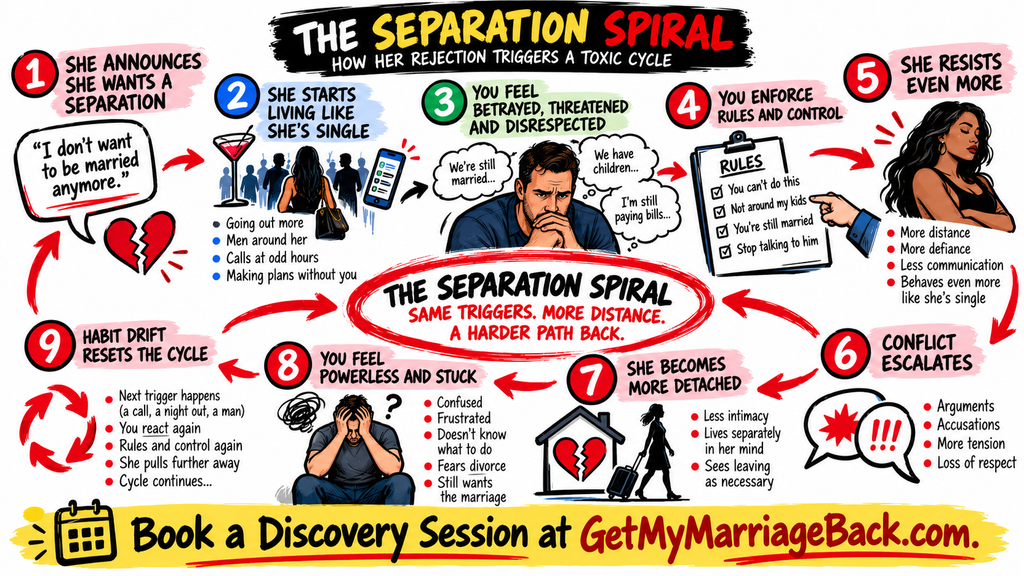
wife living single during separation - the separation spiral

Why Enforcing More Marriage Rules Can Backfire

Imagine your wife starts living single during separation.

Your instinct may be to tighten the rules.

โ€œYou cannot do that while my children are here.โ€

โ€œYou cannot have those people around our kids.โ€

โ€œYou are still my wife.โ€

โ€œYou cannot go out at that hour.โ€

โ€œWe are still married.โ€

Some distinctions are important here.

You absolutely can make responsible decisions concerning your own property, money, time, presence and conduct. You should protect your relationship with your children, fulfill appropriate parental responsibilities and address legitimate matters involving their safety and welfare.

But another adult ultimately controls another adult’s behavior.

That is where many distressed spouses get stuck.

They are trying to save a marriage by enforcing the authority of a position the other spouse has already rejected emotionally.

And every attempt to assert that authority can become, in the departing spouse’s mind, another reason why leaving feels necessary.

It does not mean she is right.

It does not mean you are wrong for being upset.

You do not have to approve of everything she does.

It simply means control and influence are not the same thing.

The Separation Control Trap

The cycle often looks like this:

She pulls away โ†’ You feel rejected โ†’ You demand change โ†’ She resists โ†’ You enforce harder โ†’ She pulls away further โ†’ You feel even more powerless.

Now you intensify.

She intensifies her resistance.

Eventually, both people become increasingly convinced that the other’s behavior proves their interpretation of the marriage.

You think:

โ€œShe obviously doesn’t respect me, so I need to become firmer.โ€

She may think:

โ€œHe still doesn’t understand why I needed to get away, so I need even more distance.โ€

Relationship research has examined a related interaction known as the demand-withdraw pattern, where one partner increasingly seeks discussion or change while the other increasingly avoids or withdraws. Research has associated this pattern with relationship distress, although circumstances and context matter; importantly, the person wanting more changeโ€”not simply genderโ€”can help determine who occupies which role in the cycle. You can review the underlying research on demand-withdraw patterns in couples for a deeper look at that dynamic.

The practical lesson is powerful.

The harder you chase control, the more resistance may become the response.

And resistance is not attraction.

Attraction During Separation Is an Experience

This is where I want you to stop thinking only about whether you are morally right.

You may be right.

Perhaps your spouse is behaving irresponsibly.

Maybe she is violating expectations you both previously shared.

You might have legitimate reasons to feel betrayed, rejected or disrespected.

But moral value and experiential value are different questions.

Experiential value asks:

What does it feel like to experience you right now?

Pressure?

Interrogation?

Correction?

Criticism?

Surveillance?

Neediness?

Anger?

Or does your presence increasingly communicate emotional stability, purpose, confidence, self-respect and groundedness?

That question matters because attraction is not an argument you win.

Attraction is experienced.

You cannot logically force your spouse to become curious about you.

You cannot lecture somebody into desire.

Nor can you enforce emotional closeness with a marriage certificate.

You can, however, become increasingly responsible for the experience you create.

That is where rebuilding attraction during separation gets interesting.

Shift #1: Stop Trying to Control What She Does Tonight

Suppose it is 11:30 tonight.

Her phone rings.

A man’s name appears.

Immediately, your nervous system lights up.

Or she is getting dressed to go somewhere and you are thinking:

โ€œWhere is she going?โ€

โ€œWho is she meeting?โ€

โ€œWhy is she dressed like that?โ€

โ€œWhat married woman behaves this way?โ€

Everything you intellectually understand about emotional intelligence can disappear within seconds.

You want to confront.

You want to demand.

Maybe you want to remind her that she is still married.

Stress pushes human beings toward familiar responses.

That is why insight alone is not enough.

Your power begins when you recognize that what she does tonight and what you become next are two separate things.

You cannot build attraction while requiring control to feel powerful.

Shift #2: Ground Yourself Before You Try to Influence Her

Your wife’s rejection cannot become the authority that determines who you are.

That is Grounding.

Her mood cannot decide whether you have value today.

A cold text cannot determine whether your life has meaning.

One pleasant interaction cannot make you emotionally euphoric while one distant interaction destroys your confidence again.

Otherwise, your spouse becomes the thermostat controlling your emotional temperature.

She warms up; you feel powerful.

She gets cold; you collapse.

She texts; you see hope.

She ignores you; you imagine divorce.

That emotional volatility creates pressure because every interaction secretly carries a job:

โ€œPlease make me feel safe about us.โ€

Grounding removes that burden.

You can still love your spouse deeply.

You can still want reconciliation.

The difference is that you stop requiring today’s interaction to determine your identity.

That is emotionally intelligent.

It is also more attractive.

Shift #3: Build a Purpose Bigger Than the Crisis

Pain produces energy.

So does rejection.

The question is where that energy goes.

When your wife wants separation, you can burn enormous amounts of emotional energy supervising her life.

Who called?

Where did she go?

Who liked the photo?

Why is she online?

Why didn’t she answer?

Who was that man?

What did she mean by that message?

What happens to attraction when your entire identity becomes private investigator, rejected spouse and marriage emergency manager?

Very little about that state creates curiosity.

Redirect the energy.

Your health matters.

Your children matter.

Your contribution matters.

Your work matters.

Your creativity matters.

Your faith may matter.

Your mission matters.

Your legacy matters.

Purpose does not mean pretending your marriage is unimportant.

It means refusing to make the marriage crisis bigger than your entire existence.

A person engaged with life creates a different experience from a person emotionally waiting outside somebody else’s door for permission to live.

That difference can be felt.

Shift #4: Use Self-Discovery to Recover Personal Power

Separation exposes things.

Let it.

Maybe what you previously called leadership occasionally became control.

Perhaps what you called communication sometimes became interrogation.

What felt like โ€œfighting for my marriageโ€ may occasionally have been panic wearing respectable clothing.

Maybe you abandoned important parts of yourself long before the separation began.

Self-Discovery is not self-condemnation.

It is capacity.

You ask:

โ€œWhat do I actually control?โ€

โ€œWhat patterns do I repeat when I feel rejected?โ€

โ€œWhat happens to me when I become afraid?โ€

โ€œWhat experience have I been creating?โ€

โ€œWhat have I neglected in myself?โ€

โ€œWhat kind of spouse am I capable of becoming?โ€

You are removing the fantasy that the perfect rule, argument, consequence or explanation can force another adult back into alignment.

That fantasy creates desperation.

Personal Power creates choice.

Shift #5: Replace Force With Influence

You never truly had control over your spouse.

You had influence.

There is an enormous difference.

Control says:

โ€œYou must behave this way because I am your spouse.โ€

Influence says:

โ€œMy presence, behavior, emotional intelligence and value affect the experience of being in relationship with me.โ€

Control requires compliance.

Influence leaves another adult with agency.

Control becomes obsessed with enforcement.

Influence becomes interested in experience.

And influence is much closer to attraction.

Think about the progression:

Grounding โ†’ Purpose โ†’ Self-Discovery โ†’ Value โ†’ Curiosity โ†’ Attraction โ†’ Influence โ†’ Leverage

Notice what is missing.

Force.

Attraction does not require you to become passive. It requires you to become sophisticated enough to distinguish personal power from controlling behavior.

What Experiential Value Looks Like During Separation

Experiential value does not mean becoming endlessly agreeable.

It does not mean accepting disrespect.

You are not required to pretend something doesn’t hurt when it does.

Experiential value means your spouse encounters somebody increasingly capable of handling emotional discomfort without automatically converting it into pressure.

You can disagree without prosecuting.

You can listen without immediately correcting.

A boundary can be expressed without turning it into an attempt to control another adult.

You can be warm without begging.

You can care without hovering.

You can remain interested without interrogating.

You can become more attractive without playing jealousy games.

This is seduction at a much more emotionally intelligent level.

You are not manufacturing anxiety so your spouse chases you.

You are rebuilding the conditions that make curiosity possible.

Curiosity Is the Bridge Back to Attraction

A spouse who believes she completely understands you has very little left to discover.

Especially when her current story about you is negative.

โ€œHe always reacts like this.โ€

โ€œI already know what he’s going to say.โ€

โ€œHe will interrogate me.โ€

โ€œHe will get angry.โ€

โ€œHe will beg.โ€

โ€œHe will lecture me about the marriage.โ€

Predictability becomes dangerous when the predicted experience is unpleasant.

Genuine change interrupts that prediction.

You respond differently.

You become less reactive.

Your life becomes fuller.

Your purpose becomes visible.

Your emotional stability improves.

The interaction she expected does not happen.

Now something becomes possible:

Curiosity.

โ€œWhat changed?โ€

โ€œWhy didn’t that trigger him?โ€

โ€œWhy does he seem different?โ€

โ€œWhat has he been doing?โ€

โ€œWhy does talking to him feel different now?โ€

You cannot demand those questions.

That is precisely why they matter.

Curiosity belongs to the person experiencing it.

And curiosity is almost attraction.

Don’t Turn Attraction Into Another Manipulation Strategy

This part is crucial.

Once people understand the value of curiosity, they sometimes immediately start performing.

They deliberately ignore texts.

Post photographs to create jealousy.

Pretend somebody else is interested.

Disappear because an internet rule told them to.

Become cold so their spouse will chase.

That is not Personal Power.

It is still obsession.

The spouse remains at the center of every move.

You are still asking:

โ€œDid she notice?โ€

โ€œDid she react?โ€

โ€œIs she jealous?โ€

โ€œDoes she miss me now?โ€

โ€œIs this working?โ€

The costume changed.

The dependency did not.

Real growth continues even when nobody applauds.

You ground yourself because emotional stability serves your life.

Purpose matters because your existence has meaning.

Self-Discovery matters because you need capacity.

Experiential value matters because you want your presence to become richer, healthier and more engaging.

When those changes become authentic, curiosity has room to emerge naturally.

What About Men Calling Your Wife During Separation?

This is where theory becomes difficult.

You may be able to calmly discuss Grounding at 2:00 in the afternoon.

At 11:30 at night, when a man’s name appears on her phone, the emotional test becomes real.

First, separate facts from interpretations.

A man’s name on a phone is a fact.

โ€œHe is replacing meโ€ is an interpretation unless you know that.

โ€œShe has been cheating for monthsโ€ is a conclusion that requires evidence.

Your feelings can still be intense.

Emotional intelligence does not require pretending otherwise.

But strong feelings should not automatically become instructions.

Before acting, ask:

What do I actually want?

If your answer is:

โ€œI want to save my marriage.โ€

Then ask the more difficult question:

Is what I am about to do creating movement toward what I actually want?

That question does not excuse infidelity.

It does not erase boundaries.

You are simply refusing to let emotional activation choose your strategy.

What If Your Wife Is Actually Dating During Separation?

Then you need clarity about the facts and your own standards.

Separation can mean very different things to different couples. Some spouses understand separation as remaining romantically exclusive while living apart; others treat it as the beginning of the end of the relationship.

Do not assume both people are operating under the same definition.

Have necessary conversations about children, finances, property, sexual health, living arrangements and whatever agreements legitimately affect both parties.

But recognize the boundary between an agreement and control.

You can decide what you participate in.

You can decide what you accept in a relationship.

You can decide what conditions would need to exist for reconciliation.

What you cannot do is convert those decisions into remote control over another adult.

Personal Power says:

โ€œI know what I stand for.โ€

Control says:

โ€œTherefore you must obey.โ€

The difference matters.

Saving Your Marriage Alone Does Not Mean Doing Nothing

People hear โ€œstop controllingโ€ and sometimes translate it into:

โ€œSo I’m supposed to let my spouse do whatever she wants?โ€

No.

You are supposed to stop measuring your power by whether another adult complies with you.

That is different.

Saving your marriage alone means you take responsibility for the side of the relational system you can actually influence directly:

Your emotional regulation.

Your communication.

Your purpose.

Your behavior.

Your reactions.

Your standards.

Your parenting.

Your integrity.

Your personal development.

Your experiential value.

You cannot perform both sides of reconciliation.

But you can dramatically change the experience coming from your side.

That is not weakness.

It requires substantially more strength than yelling a rule at somebody who has already decided she doesn’t recognize your authority.

The Announcement Is a Lagging Indicator

Remember where we started.

Your wife says:

โ€œI want separation.โ€

That announcement may be a lagging indicator.

The emotional decision may have been developing long before the announcement.

Now consider the other side.

Your behavior today is a leading indicator.

The way you handle rejection today matters.

How you respond to uncertainty matters.

What you build during separation matters.

Whether you become more grounded or more reactive matters.

The experiential value you create matters.

Your capacity to distinguish influence from control matters.

That is where your power lives.

Not in controlling what she does tonight.

In controlling what you become next.

How to Save Marriage During Separation Without Becoming Powerless

Start with the actual objective.

Do you want revenge?

Do you want to prove that you are right?

Do you want your spouse to feel guilty?

Do you want compliance?

Or do you want to create the strongest possible relational environment for marriage reconciliation?

Those objectives produce different behavior.

When your goal is reconciliation, attraction needs emotional breathing room.

Respect needs consistency.

Influence requires credibility.

Curiosity needs something new to discover.

Personal Power requires an identity that survives rejection.

That is why building and nurturing attraction during separation is not fundamentally about tricks.

It is about emotional capacity.

You become more skillful.

More grounded.

More purposeful.

More interesting to yourself.

Less easily controlled by temporary emotional weather.

More capable of warmth without pursuit.

More capable of strength without domination.

More capable of boundaries without attempting to parent your spouse.

More capable of desire without desperation.

That combination is powerful because your spouse is no longer interacting exclusively with the person desperately trying to save the marriage.

She gets the opportunity to experience you again.

The Real Attraction Shift When Your Wife Is Living Single During Separation

Your instinct says:

โ€œGet her under control.โ€

Your fear says:

โ€œStop this before I lose her.โ€

Your ego says:

โ€œShe cannot disrespect me like this.โ€

Your pain says:

โ€œMake her understand what she’s doing to me.โ€

But attraction asks a different question:

What is it like to experience you right now?

That is where the work becomes seductive rather than controlling.

Your goal is not to become somebody who tolerates everything.

It is to become somebody who does not require another adult’s obedience to possess Personal Power.

When that transformation becomes real, your presence changes.

Pressure can become composure.

Interrogation can become discernment.

Criticism can become clarity.

Desperation can become purpose.

Control can become influence.

Predictability can become curiosity.

And curiosity can create room for attraction that no argument, rule or marriage certificate could force into existence.

Your spouse’s announcement is a lagging indicator.

Who you become next is the leading indicator.

19 Signs Your Wife Is Not Sexually Attracted To You

Frequently Asked Questions

Can a marriage be saved during separation?

Yes, separation does not automatically mean divorce, and some separated couples do reconcile. What happens during the separationโ€”including communication, unresolved problems, boundaries and each spouse’s behaviorโ€”matters.

What should I do if my wife is living single during separation?

Clarify necessary agreements involving children, finances, property and exclusivity while focusing on what you actually control: your conduct, emotional regulation and standards. Trying to supervise another adult usually creates a different relational experience from expressing a clear boundary.

Should I give my wife space if I want to save my marriage?

Space can reduce unnecessary pressure when a spouse is already withdrawing, but it should not be confused with punishment, manipulation or ignoring legitimate responsibilities. The goal is emotional breathing room, not a tactic designed to force pursuit.

How do I rebuild attraction with my wife during separation?

Build attraction through Grounding, Purpose, Self-Discovery and stronger experiential value rather than chasing reassurance or trying to enforce desire. Become more emotionally responsive, purposeful and self-directed so that your spouse has an opportunity to experience something genuinely different.


Your Wife Asked You to Move Out? 5 Mistakes That Push Her Further Away

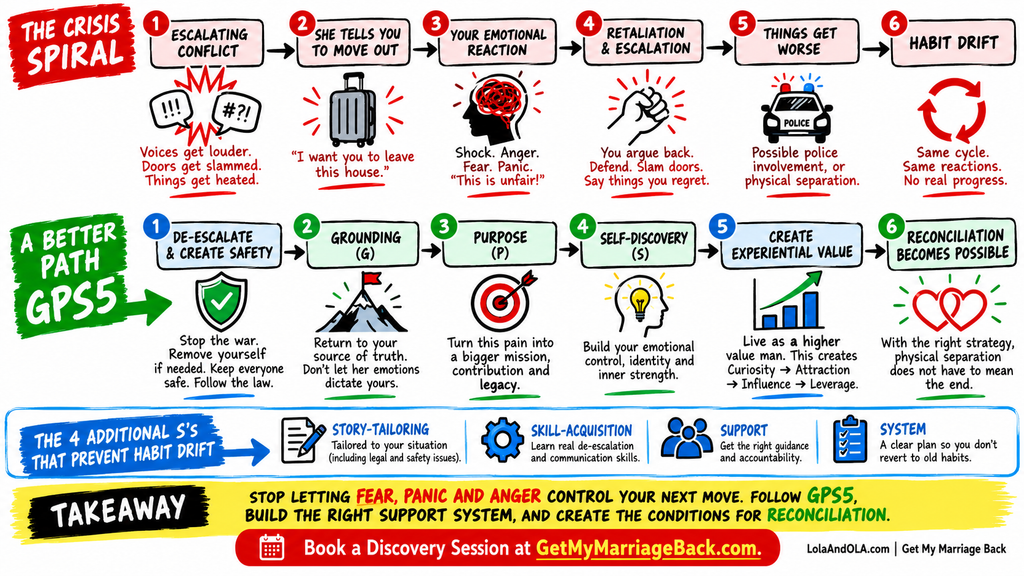
Your wife asked you to move out, and right now leaving your own home can feel exactly like agreeing that your marriage is over.

Take This 2 Minutes Quiz

Question 1 of 15

I understand why your first reaction can be, โ€œAbsolutely not.โ€

This is your house too. You may pay the mortgage or rent. Your children may live there. Your routines, memories, belongings and entire family life are wrapped up in that home.

Then the person you married tells you to leave.

It feels unfair.

And depending on the circumstances, it may genuinely be unfair.

But when your wife asks you to move out during a marriage crisis, the argument about who is right can quickly become less important than what happens next.

Your fear wants immediate action. Your anger wants justice. Your anxiety wants certainty.

None of those emotions should be driving the car.

I know this from more than coaching people through marriage crises. During the darkest period of my own marriage, I packed a small bag and left my house.

Our conflict eventually escalated further. During one argument, I became so frustrated that I picked up a bowl of water from the kitchen countertop and poured it onto the floor.

My logic at that moment was almost comical in hindsight: I was trying to demonstrate that anybody could fly off the handle.

Think about that.

I was demonstrating the problem of losing control by losing control.

Eventually, Lola called the police.

That is why I draw a hard line here. If anybody feels unsafe, safety comes first. If police or emergency assistance is necessary, call them. If there are legal questions about leaving the marital home, custody, property, a protective order or your rights, get qualified legal advice.

Marriage strategy does not override safety or the law.

Once those issues are separated from the reconciliation problem, however, you can ask a much more productive question:

What kind of man are you going to become while your marriage is under this pressure?

Wife Asked Me to Move Out: Does That Mean the Marriage Is Over?

No single request for physical distance can tell you the entire future of your marriage.

Your wife asking you to move out is serious information. Treat it seriously without turning it into a prophecy.

Separation and divorce are not identical.

Physical distance and emotional finality are not identical either.

The danger is that fear collapses all of those distinctions into one terrifying conclusion:

โ€œIf I leave, I lose her.โ€

Once you accept that conclusion as fact, almost anything can feel justified.

You argue.

You refuse.

You explain why she has no right to ask.

You remind her how much you pay.

You demand another conversation.

You send enormous text messages.

You insist that you’re โ€œfighting for your marriage.โ€

But there is an uncomfortable question underneath all of this:

Are you fighting for your marriageโ€”or is fear fighting through you?

That distinction changes everything.

wife asked me to move out

Mistake #1: Treating Retaliation Like Strength

One client I worked with had lived through years of increasingly heated marital conflict.

Arguments became normal. Doors were slammed. Emotions escalated.

His philosophy was straightforward:

If somebody brings war, retaliate with war. Otherwise, they’ll think you’re weak.

That philosophy felt powerful until his wife told him to move out.

Suddenly, everything he believed about strength was being tested.

This is one of the most seductive mistakes in a marriage crisis because retaliation feels like Personal Power.

It isn’t.

If your wife can raise her voice and automatically make you raise yours, she is influencing your emotional state.

If one sentence about separation makes you lose control, separation is controlling you.

When fear, panic, anger and anxiety determine your next move, those emotions have power over you.

Self-control is not submission. De-escalation is not weakness.

You can be physically strong enough to slam every door in your house and still be emotionally controlled by fear.

wife asked me to move out, not what

Mistake #2: Believing You Must Choose Between Fighting and โ€œGiving Her Spaceโ€

Generic marriage advice loves extremes.

โ€œNever leave your house.โ€

โ€œFight for your marriage.โ€

โ€œDon’t let her push you around.โ€

Then another corner of the internet tells you:

โ€œJust give her space.โ€

โ€œDo whatever she wants.โ€

โ€œDon’t contact her.โ€

โ€œIf she loves you, she’ll come back.โ€

Neither collection of slogans knows your marriage.

There is an enormous difference between fear-driven chasing and dignity-based pursuit.

You can want your wife.

You can want your marriage.

You can make your interest clear.

None of that requires you to beg for reassurance, force conversations, repeatedly ask whether she still loves you, or use every interaction to measure your chances of reconciliation.

Likewise, respecting legitimate distance does not require becoming cold, passive or manipulative.

You are not disappearing to โ€œmake her miss you.โ€

Your objective is much bigger.

Become someone whose emotional center is no longer dependent on what mood your wife is in today.

Mistake #3: Trying to Talk Your Way Back Into Attraction

When your wife wants separation, words become extremely tempting.

You want to explain your intentions.

You want her to understand how much you love her.

Maybe you have finally recognized mistakes that she complained about for years, and now you desperately need her to believe you have changed.

So you talk.

And talk.

And talk.

But attraction is experiential.

Your wife does not experience your transformation because you gave her a PowerPoint presentation about it.

She experiences you.

How do you respond under pressure?

What happens when she disagrees with you?

Can you hear something painful without immediately defending yourself?

Does every warm interaction become an opportunity to ask about reconciliation?

Can you experience rejection without collapsing, exploding or retaliating?

Those experiences communicate far more than another promise.

Why Chasing and Withdrawal Can Make the Crisis Worse

There is useful research behind this dynamic.

A study involving 116 married couples examined what researchers call demand-withdraw communicationโ€”a pattern where one spouse pushes for discussion, change or resolution while the other avoids or withdraws.

Both husband-demand/wife-withdraw and wife-demand/husband-withdraw patterns were associated with more negative emotions and tactics and lower conflict resolution. The pattern was not simply a โ€œhusband problemโ€ or a โ€œwife problemโ€; either spouse could occupy either side of the cycle. You can read the research on demand-withdraw patterns in marital conflict.

Look at how easily this can appear after your wife asks you to move out:

Fear โ†’ Pursuit โ†’ Pressure โ†’ Withdrawal โ†’ More Fear โ†’ More Pursuit

You want reassurance, so you push for a conversation.

She experiences pressure and retreats.

Her retreat frightens you, so you push harder.

Now she wants even more distance.

You interpret that distance as proof that you need to fight harder for the marriage.

The cycle feeds itself.

Breaking that cycle creates emotional breathing room. And emotional breathing room matters when you are trying to rebuild attraction.

Mistake #4: Making Your Wife Responsible for Your Emotional Stability

This is where separation exposes things ordinary married life can hide.

When your wife is warm, you feel powerful.

When she becomes cold, you fall apart.

When she texts you, you see hope.

When she doesn’t, you start imagining divorce.

When she laughs with you, you think reconciliation has started.

Then she mentions separation again and your entire emotional world crashes.

That’s not Personal Power.

Your wife has effectively become the thermostat controlling your emotional temperature.

Attraction struggles under that burden because every interaction acquires a hidden job:

โ€œPlease make me feel safe about us.โ€

Your wife can feel that pressure even when you never say those exact words.

This is why your first job is not making her change her mind.

Your first job is recovering your ability to lead yourself.

Grounding: Stop Letting the Symptom Become Your Identity

The symptom is:

โ€œMy wife asked me to move out.โ€

Grounding does not mean pretending that symptom doesn’t exist.

It means returning to a source of truth higher than the symptom.

Your marriage crisis cannot become your identity.

Your wife’s current emotional state cannot become your definition of your worth.

Her rejection cannot become the authority determining whether today has meaning.

Grounding brings you back to truth and gratitude while allowing you to confront the crisis exactly as it is.

Now you can respond instead of react.

That difference is enormous.

Purpose: Become Bigger Than the Crisis

Pain has a nasty habit of shrinking your entire world.

Suddenly everything becomes about your wife.

What did she mean by that text?

Why didn’t she call?

Is she talking to somebody else?

Does she miss you?

Is she filing?

When is she coming back?

Your marriage matters tremendously, but your purpose must be bigger than any single living human beingโ€”including your wife and including you.

Redirect pain into mission.

Reconnect with contribution, impact and legacy.

Build something meaningful enough that your marriage crisis cannot consume every available piece of your identity.

This isn’t a trick for making your wife jealous.

Purpose is attractive because purpose creates life.

A person with direction generates a different experience from a person whose entire existence has become monitoring whether someone else still wants them.

Self-Discovery: Find Out Who You Are Under Pressure

A marriage crisis reveals capacity.

It exposes your beliefs about masculinity, love, conflict, rejection, control, fairness and strength.

Don’t turn that discovery into self-blame.

Use it.

You may discover that what you called โ€œstanding up for yourselfโ€ was sometimes emotional reactivity.

Perhaps what you called โ€œfighting for the marriageโ€ was occasionally panic.

What looked like communication may have become repeated demands for reassurance.

Self-Discovery means developing enough emotional capacity to see those patterns without needing to declare yourself either the hero or villain.

Then you can change what you actually control.

How Attraction Starts Rebuilding During Separation

Attraction isn’t something you demand from your wife.

It emerges from experience.

I describe the progression this way:

Value โ†’ Curiosity โ†’ Attraction โ†’ Influence โ†’ Leverage

Value here does not mean moral worth.

You already have human worth.

I’m talking about experiential value: what does interacting with you feel like?

Are you emotionally exhausting or emotionally engaging?

Predictable or interesting?

Desperate or grounded?

Reactive or responsive?

Consumed by the marriage or connected to a meaningful life?

When your experience changes consistently, curiosity can emerge.

Your wife begins encountering something different instead of hearing another sales pitch about how different you are.

Curiosity gives attraction room to breathe.

Attraction can expand influence.

Influence creates leverageโ€”not leverage to control her, but a stronger relational position from which reconciliation becomes possible.

Mistake #5: Trying to Recreate the Old Marriage

You don’t need the broken marriage back.

Read that again.

The goal is a brand-new marriage with the same person.

Going back to exactly what existed before the separation simply restores the conditions that produced the crisis.

You need a different relational experience.

More emotional intelligence.

Better conflict skills.

Greater self-control.

More curiosity.

Stronger individuality.

More play.

More purpose.

Greater experiential value.

That is how reconciliation becomes something more meaningful than getting your wife physically back inside the same house.

What to Do After Your Wife Asks You to Move Out

Start with reality.

Determine whether there is an immediate safety issue.

Separate legal questions from emotional questions.

Do not make irreversible housing, financial, property or custody decisions based solely on marriage advice from the internet.

Then look directly at your emotional pattern.

What happens inside you when she says, โ€œI want you to leaveโ€?

Does fear become anger?

Do you retaliate?

Do you start proving?

Does panic make you send paragraphs of text?

Do you immediately demand certainty about divorce?

Identify the automatic reaction before trying to perfect your next speech.

From there, rebuild your foundation:

Grounding. Purpose. Self-Discovery.

Create experiential value through the way you live and interact.

Allow curiosity and attraction to emerge from experience rather than pressure.

Develop influence through consistency.

Build leverage through emotional intelligence, dignity and a life that does not collapse every time your wife has a difficult emotion.

This is not passivity.

This is strategic self-leadership.

Physical Separation Does Not Have to Mean Emotional Surrender

I packed a bag and left my house during my own marriage crisis.

I understand the fear attached to that moment.

Walking through a door with luggage can feel like you’re physically acting out the death of your marriage.

But distance itself does not write the ending.

What matters enormously is what happens inside that distance.

You can spend separation obsessing, retaliating, monitoring, begging and waiting.

Or you can use the crisis to become grounded, purposeful, emotionally intelligent and experientially attractive.

You cannot control whether your wife ultimately chooses reconciliation.

But you have tremendous influence over the experience of you that you bring into every interaction from this point forward.

That’s where your Personal Power lives.

Stop trying to win the argument about who has the right to be angry.

Stop allowing fear to masquerade as strength.

Don’t make your wife responsible for regulating your emotions.

Build the man who can experience this crisis without becoming the crisis.

That is where rebuilding your marriage begins.

Wife or Husband Denying You Sex? DO THIS!!!

Frequently Asked Questions

What should I do if my wife asks me to move out?

De-escalate first, address any immediate safety or legal issues appropriately, and avoid making panic-driven decisions. Then identify the fear-driven behaviors you control and begin changing the experience you create in the marriage.

Does moving out mean my marriage is over?

No; physical separation and divorce are different events, although a request to move out should be treated seriously. Focus less on predicting the ending and more on responding with emotional intelligence, dignity and deliberate action.

Should I give my wife space when she wants separation?

Respecting legitimate space can reduce pressure, but don’t use distance as a manipulation tactic to make her miss you. Research on demand-withdraw conflict suggests that cycles of pressure and withdrawal are associated with more negative interactions and poorer conflict resolution.

Can I save my marriage while separated?

You cannot single-handedly dictate reconciliation, but you can change your contribution to destructive patterns and rebuild grounding, purpose, experiential value and emotional intelligence. Those changes create healthier conditions in which curiosity, attraction and reconciliation can develop.

My Wife Wants to Move Out? Do This Without Pushing Her Away

Your wife wants to move out, and every instinct in your body is screaming at you to stop her before physical separation turns into divorce.

Take This 2 Minutes Quiz

Question 1 of 15

You want to explain why leaving is a mistake.

You want to remind her about everything you built together, the family, the memories, the promises, the sacrifices and the future you planned.

Maybe you want to tell her you finally understand what went wrong. Maybe you are ready to promise that everything will change. You may even feel willing to pay almost any price to keep her from walking through that door.

I understand that instinct because I lived it.

Months before my wife moved out, she told me she did not want to be in our marriage anymore. I flew off the handle.

There were arguments, defensiveness and begging. I was trying to fight the reality in front of me because I desperately did not want that reality.

Later, while I was away on business, my wife and I spoke on the phone and things seemed relatively normal.

I came home to crickets.

The closets were clean.

When I called her, it became obvious that this wasn’t a weekend away. My wife was making a move completely away from our marriage.

Something had changed in me by then.

I still wanted my marriage. Secretly, I hoped we would find our way back to each other.

But I finally started learning one of the hardest skills you will ever need when your wife wants separation:

Letting go without giving up.

Those are not the same thing.

When Your Wife Wants to Move Out, Don’t Fight the Suitcase

The suitcase is a symptom.

The apartment is a symptom.

The physical separation is the visible manifestation of something that probably started much earlier.

That matters because when you concentrate exclusively on stopping your wife from moving out, you can miss the actual marriage crisis.

You are trying to prevent the physical distance while ignoring the emotional distance that preceded it.

Imagine she has felt unheard, disconnected, chronically frustrated or emotionally exhausted for months. Perhaps conflict became constant. Maybe attraction deteriorated until you felt more like roommates than lovers.

Then she finally says:

โ€œI need to leave.โ€

From your perspective, everything suddenly changed.

From hers, leaving may feel like the culmination of a much longer process.

That does not make her decision fair.

It does not mean you agree with it.

And understanding why somebody reached a decision is not the same as endorsing that decision.

This distinction gives you Personal Power.

my wife wants to move out

Why Begging Your Wife to Stay Can Push Her Further Away

Your intention and her experience are two different things.

You intend to communicate love.

She can experience pressure.

You intend to demonstrate commitment.

She can experience desperation.

You intend to prove that you are finally serious about saving your marriage.

She can experience another demand to manage your fear.

That’s why the popular advice to โ€œfight for your marriageโ€ can become dangerous when nobody defines what fighting actually means.

Does fighting mean begging?

Does it mean sending a 1,500-word text at midnight?

Does it mean following her around the house while she packs?

Does it mean repeatedly explaining why she is wrong?

Does it mean using your children, vows or history as reasons she should reconsider?

That’s not the kind of pursuit that builds attraction.

That’s fear trying to regain control.

You can want your wife.

You can pursue reconciliation.

You can make it clear that you remain interested in saving the marriage.

But pursuit based on dignity is radically different from chasing based on fear.

My Wife Wants to Separate: What Should I Actually Say?

Keep it simple.

Tell her you understand.

Your emotions may immediately object:

โ€œHow can I tell her I understand when I don’t want her to leave?โ€

Because understanding is not agreement.

You understand that this did not start overnight.

You understand that something in the marriage brought the relationship to this point.

You understand that she currently believes distance is necessary.

None of those statements require you to declare the marriage dead.

Then let her know that if she changes her mind, she can let you know.

Stop there.

That statement does not mean:

โ€œI’ll wait forever.โ€

It does not mean:

โ€œYou can do anything you want and I’ll always be here.โ€

And it certainly does not mean putting your life on layaway until your wife decides what happens next.

Now the real work begins.

Saving Your Marriage Alone Does Not Mean Controlling Her

There is a popular statement that โ€œit takes two to save a marriage.โ€

Ultimately, two people choose whether they participate in a marriage.

But that does not mean two people must simultaneously become motivated before anything can change.

You control your contribution to the emotional system.

You control whether disagreement turns into combat.

You control whether rejection sends you into begging.

You control whether uncertainty turns you into an investigator.

You control whether your entire identity collapses because your wife wants separation.

Most importantly, you control what it feels like to experience you from this point forward.

That is where attraction starts becoming relevant again.

Attraction Is an Experience, Not an Argument

You cannot logically persuade your wife into attraction.

Think about how strange that proposition really is.

โ€œHere are twelve excellent reasons you should desire me again.โ€

Attraction doesn’t work like that.

You create an experience.

When your wife experiences you as chronically anxious, argumentative, controlling, needy or emotionally dependent on her responses, the experience matters regardless of your good intentions.

The opposite is also true.

When you become grounded, emotionally intelligent, purposeful, interesting, responsive and capable of tolerating discomfort without dumping it onto her, interacting with you begins to feel different.

That does not mean performing confidence.

Fake indifference is still fixation.

Posting pictures to make her jealous is still fixation.

Ignoring her because some internet advisers told you โ€œno contact makes women chaseโ€ is still allowing her behavior to control yours.

Real grounding is different.

You care without collapsing.

You remain interested without begging.

You can feel tremendous pain without making your wife responsible for regulating it.

That is attractive because it is sustainable.

Rebuild Value Before Demanding Reconciliation

Your wife has probably already heard promises.

โ€œI’ll change.โ€

โ€œI’ll do anything.โ€

โ€œI finally get it.โ€

โ€œJust give me another chance.โ€

Words have limited power when the existing experience contradicts them.

Experiential Value means she encounters something different rather than receiving another presentation about how different you are going to become.

If anger damaged the marriage, learn to experience frustration without turning the environment hostile.

If you became emotionally absent, develop your capacity to be present without demanding immediate credit for it.

When your life lost direction, rebuild purpose that exists beyond getting your wife back.

If every interaction became serious and heavy, stop turning every decent conversation into a marriage summit.

Changed behavior creates evidence.

Repeated promises create expectations.

The first can generate Curiosity.

Why Curiosity Matters When Your Wife Wants Separation

Attraction needs room.

Suppose your wife believes she already knows exactly how you will respond.

She pulls away.

You panic.

She becomes colder.

You explain.

She asks for space.

You chase.

She gives you a little warmth.

You immediately ask whether that means she wants to come home.

There is no mystery in that cycle.

Your emotional state is entirely predictable because she controls it without even trying.

Now imagine something genuinely changes.

She expects an argument, but you remain grounded.

She anticipates another desperate relationship conversation, but you don’t initiate one.

Your wife expects you to spend the entire separation monitoring her, yet she discovers you are becoming more engaged with your health, children, career, friendships, mission and emotional development.

You aren’t trying to make her curious.

You have become worth becoming curious about.

That’s different.

Curiosity can create room for attraction.

Attraction can create Influence.

Influence can create Leverage.

None of it requires manipulating your wife.

Ground Yourself Before You Try to Get Your Wife Back

The first part of our GPS framework is Grounding.

Grounding means returning to your higher self, source of truth and gratitude instead of allowing the symptomโ€”your wife moving outโ€”to become the source of your identity.

The pain remains real.

You simply stop allowing pain to issue commands.

Ask yourself:

What do I know to be true regardless of what she decides today?

What am I grateful for even in this painful season?

Which reactions have repeatedly made this marriage worse?

What would my highest self do with the next 24 hours?

These questions move you away from panic and toward intention.

Build a Purpose Bigger Than Your Marriage

This sounds counterintuitive when you desperately want to save your marriage.

It isn’t.

Your wife cannot sustainably function as your entire purpose.

Neither can reconciliation.

Purpose redirects pain toward the impact, legacy and mission your life is supposed to create beyond any single person.

That does not diminish marriage.

It makes you stronger inside it.

A person with meaningful direction carries a different emotional presence from somebody waiting beside the phone for one text to determine whether the day is worth living.

Purpose restores movement.

And movement creates aliveness.

Use Self-Discovery Without Turning It Into Self-Blame

Self-Discovery asks:

โ€œWhat capacity do I need to develop?โ€

It does not ask:

โ€œHow do I prove everything was my fault?โ€

Those are radically different questions.

You may have made serious mistakes.

Own them.

Your wife may have made serious mistakes too.

Her mistakes do not eliminate your opportunity to grow.

You are looking for capacity: emotional regulation, communication, boundaries, conflict skills, presence, playfulness, purpose, confidence and the ability to remain grounded when another person disappoints you.

That development has value regardless of what she does next.

Ironically, that is exactly why it can become attractive.

Don’t Let Acute Stress Put Your Old Marriage Back in Charge

Here is where execution gets difficult.

Tonight, your wife may send a cold text.

Tomorrow, she may pack another box.

Next week, she may tell you she still needs space.

Your intellectual understanding can disappear quickly when fear gets activated.

Research has found circumstances in which acute stress can shift behavior away from deliberate, goal-directed responding toward established habitual responses, although later replication research suggests that this effect has important boundary conditions rather than occurring universally. You can review the underlying research on stress and habitual behavior directly.

That is particularly useful to understand during a marriage crisis.

Your old reaction is waiting.

Beg.

Argue.

Explain.

Check her phone.

Demand certainty.

Send another text.

Promise more.

Call again.

Your work is to recognize that reaction before you obey it.

Letting Go Is Not Giving Up on Marriage Reconciliation

Letting go means releasing your attempt to control an outcome that another human being participates in creating.

Giving up means abandoning what matters to you.

You can release control without abandoning your desire to save your marriage.

In fact, your desperation to control the outcome can prevent you from developing the very qualities that make reconciliation more attractive.

Let her experience your interest without your panic.

Let her experience your growth without your sales pitch.

Allow a pleasant interaction to remain pleasant without immediately asking, โ€œSo what does this mean for us?โ€

Let change accumulate.

Your objective is not to restore the exact marriage she wanted to leave.

Why would either of you want that?

The objective is to become capable of participating in a marriage that feels fundamentally different.

That means more emotional intelligence.

More Personal Power.

More Value.

More Curiosity.

More Attraction.

More Influence.

And eventually, enough Leverage to create the conditions in which rebuilding the marriage becomes a compelling possibility rather than another obligation.

What If She Has Already Moved Out?

The front door closing does not change the principles.

Do not transform separation into surveillance.

Don’t count every day apart as evidence that divorce is inevitable.

Avoid treating every friendly interaction as proof that reconciliation is imminent.

And stop trying to manufacture missing you through manipulative silence.

Build a life worth returning toโ€”and more importantly, a self worth bringing into any future marriage.

Take responsibility for practical matters.

Remain dignified in necessary communication.

Respect legitimate boundaries.

Become more emotionally skilled.

Develop your purpose.

Create experiences that feel different when natural opportunities for interaction arise.

Your wife does not need another speech about the new you.

She needs the opportunity to encounter you.

The Real Goal When Your Wife Wants to Move Out

The goal is not to trick her into staying.

It is not to become emotionally cold enough that you stop caring.

And it is not to beg so convincingly that she postpones leaving.

Your goal is to stop making fear the leader of your marriage.

Understand what she is telling you.

Let go of your attempt to overpower her decision.

Then engage in the serious self-work required to rebuild Grounding, Purpose, Self-Discovery and experiential Value.

Value creates the possibility of Curiosity.

Curiosity gives Attraction room to breathe.

Attraction creates the conditions for Influence.

Influence creates Leverage.

That is a far more powerful position than sitting beside an unpacked suitcase begging your wife to choose you.

You still want your marriage.

Now you’re learning how to want it without losing yourself.

5 Physical Signs She Just Slept With Someone Else: The Truth

Frequently Asked Questions

What should I do when my wife wants to move out?

Stay grounded, understand that her decision probably developed before the physical move, and avoid turning fear into begging, arguing or repeated pressure. Make your interest in reconciliation clear without trying to overpower her freedom to decide.

Should I let my wife leave if she wants separation?

Understanding her desire to leave is not the same as agreeing that the marriage should end. Focus on what you control: your reactions, development, responsibilities, boundaries and the emotional experience you create.

Can I save my marriage after my wife moves out?

Physical separation does not by itself answer whether marriage reconciliation will occur. Use the separation to interrupt destructive patterns and build genuine, observable change instead of trying to force certainty.

How do I rebuild attraction while separated from my wife?

Reduce fear-driven chasing and strengthen Grounding, Purpose, emotional intelligence, self-respect and experiential Value. Give genuine change enough room to create Curiosity and Attraction instead of repeatedly asking your wife whether your efforts are working.

How to Get Your Husband Back After Separation Without Destroying Attraction

When your husband pulls away during separation, your mind naturally wants answers.


Take This 2 Minutes Quiz

Question 1 of 15

Does he still love you? Is he thinking about divorce? Is there someone else? Does he miss you? Is the separation temporary? Should you call him, text him, give him space, ask for counseling, or explain how much you have changed?

The deeper problem is not simply that your husband is distant.

The problem is what uncertainty starts making you do.

When you do not know where your marriage stands, fear can turn into checking, explaining, interrogating, over-contacting, apologizing, defending yourself, and trying to create another conversation. Those actions often feel like love because you are trying to save your marriage. In practice, they can produce more pressure at the exact moment your husband is already pulling away.

That is why learning how to get your husband back after separation is not primarily about finding the perfect message.

It is about becoming emotionally intelligent enough to navigate uncertainty without letting fear control your behavior.

Why Your Husband Pulling Away Feels So Urgent

Separation creates a painful loss of certainty.

You no longer have the same access to your husband, the same daily routines, or the same sense of where the marriage is going. Even a small change in tone can feel loaded with meaning.

A delayed text can feel like rejection.

A short conversation can feel like proof that divorce is coming.

A warm interaction can make you believe reconciliation is finally happening.

Then he becomes distant again, and the emotional cycle starts over.

Research helps explain why this pattern becomes so powerful. A 2020 study involving 328 participants found that intolerance of uncertainty was connected with worry and reassurance-seeking behavior. In other words, when uncertainty becomes emotionally difficult to tolerate, people become more likely to seek information or reassurance that temporarily reduces anxiety. (Wiley Online Library)

That temporary relief is the trap.

You get an answer, but then you need another answer.

You get reassurance, but then you need reassurance again.

The marriage slowly becomes less about attraction, friendship, emotional connection, and shared experienceโ€”and more about trying to determine whether you are safe.

how to get your husband back after separation

The First Attraction Shift: Stop Treating Certainty as the Goal

Your instinct may be to think:

โ€œI just need to know where we stand.โ€

That sounds reasonable, but during an active separation you may not be able to get a stable answer.

Your husband can sincerely feel one way today and differently several weeks from now. He can care about you while still feeling overwhelmed by the marriage. He can enjoy a conversation with you and still want space afterward.

Trying to force a final answer out of an unstable emotional situation creates pressure.

A better objective is learning to function well while uncertainty still exists.

That does not mean becoming passive.

It means becoming grounded.

Grounding is your ability to return to your higher self, your faith or source of truth, gratitude, perspective, and emotional stability before deciding what to do next.

When your husband pulls away, your nervous system wants to act first and think later.

Grounding reverses that order.

The Second Attraction Shift: Stop Turning Contact Into an Investigation

One of the most damaging changes during separation happens when normal communication becomes information gathering.

You start listening for clues.

You reread text messages.

You notice when he was online.

You look closely at unfamiliar phone numbers.

You wonder who he is talking to.

In more extreme cases, you start checking passwords, email accounts, WhatsApp messages, social media activity, or screenshots because you believe more evidence will finally make you feel secure.

The problem is not merely the act of looking.

The greater problem is interpretation.

When you are already afraid of rejection, neutral information can become evidence for your worst fear.

A simple message such as โ€œSee you laterโ€ can suddenly feel suspicious.

An unfamiliar number can turn into an imagined affair.

A few hours without communication can become proof that he no longer cares.

Once panic controls interpretation, the next conversation rarely feels light, warm, or attractive.

It feels like an interrogation.

Understand the Demand-Withdrawal Trap - how to get your husband back after separation

The Third Attraction Shift: Understand the Demand-Withdrawal Trap

There is a well-established relationship pattern called demand-withdraw.

One person seeks discussion, answers, change, connection, or resolution. The other person attempts to reduce the intensity by withdrawing, becoming quiet, ending the discussion, or limiting closeness.

A 2024 study of 63 heterosexual couples found that demand behavior from one person was associated with withdrawal from the other. When the conflict centered on an issue raised by the woman, men were more likely to withdraw. (DOI)

This matters when your husband wants separation.

You feel the marriage slipping away, so you demand more clarity.

He experiences more emotional pressure, so he withdraws.

His withdrawal creates more uncertainty.

Your uncertainty makes you demand more clarity.

Now you are both inside a self-reinforcing pattern.

This is why simply โ€œcommunicating moreโ€ is not automatically good marriage advice.

Communication quality matters more than communication quantity.

The Fourth Attraction Shift: Stop Over-Explaining Yourself

One of the most common mistakes during separation is trying to prove your intentions.

You explain why you called.

You explain why you were upset.

You explain why the marriage deserves another chance.

You explain why your husband has misunderstood you.

You explain the changes you are making.

You explain how much you love him.

Eventually, the explanation itself becomes pressure.

The hidden message is:

โ€œPlease understand this so that you will respond differently.โ€

That puts your husband in the position of needing to validate your interpretation before the conversation can feel successful.

Attraction does not thrive under that kind of emotional obligation.

You want your communication to become lighter, clearer, warmer, and less dependent on a specific response.

That does not mean pretending everything is fine.

It means speaking without demanding a particular emotional result.

Separate Moral Value From Experiential Value - how to get your husband back after separation

The Fifth Attraction Shift: Separate Moral Value From Experiential Value

Many people in marriage crisis become focused on proving that they are right.

Maybe you are right.

Your husband may have behaved badly.

He may have broken promises.

He may have withdrawn unfairly.

He may have become cold, defensive, secretive, or dismissive.

Being morally correct does not automatically create attraction.

That distinction matters.

Moral value answers the question:

โ€œAm I doing what I believe is right?โ€

Experiential value answers a different question:

โ€œWhat does it feel like to experience me?โ€

That second question is much more relevant when you are trying to rebuild attraction.

A person can be morally correct and emotionally exhausting.

Another person can have strong standards while still being calm, engaging, interesting, playful, emotionally intelligent, self-respecting, and grounded.

Experiential value is not about becoming fake.

It is about developing the skills that make your presence feel different.

The Sixth Attraction Shift: Build a Life That Is Bigger Than His Decision

One of the least seductive positions you can occupy is making another person’s decision the center of your life.

Your husband becomes the source of your mood.

His text determines whether you have a good day.

His warmth makes you hopeful.

His silence makes you panic.

His uncertainty becomes your uncertainty.

Purpose breaks that dependency.

Purpose means redirecting your pain into something meaningful that extends beyond the marriage.

Your children may be part of that.

Your work may be part of it.

Your faith, contribution, creativity, health, education, business, community, or legacy may also belong there.

Purpose is not a distraction technique.

It is the process of becoming a whole person again.

When your life develops direction beyond obtaining a particular response from your husband, your energy changes.

You become less emotionally demanding because every interaction no longer carries the weight of your entire future.

That is naturally more attractive.

The Seventh Attraction Shift: Let Curiosity and Attraction Become Outcomes

This is where many people sabotage progress.

They learn a better way to communicate, then immediately start measuring whether it is working.

โ€œDid he text more?โ€

โ€œDid he seem happier?โ€

โ€œDid he miss me?โ€

โ€œDid he ask about me?โ€

โ€œWas he jealous?โ€

โ€œDoes this mean he is coming back?โ€

Now the new strategy becomes another form of checking.

Curiosity and attraction should remain outcomes.

Your responsibility is to become increasingly grounded, purposeful, emotionally intelligent, self-aware, skillful, and experientially valuable.

His response belongs to him.

That distinction protects your dignity.

It also prevents every interaction from turning into a test.

Why Reassurance Does Not Always Make You Feel More Secure

Reassurance sounds like the obvious solution when you feel uncertain.

Research suggests it is more complicated.

A daily diary study of 110 heterosexual couples found that lower relationship trust was associated with greater excessive reassurance seeking. Among women higher in attachment anxiety, reassurance seeking was also associated with lower next-day trust.

That finding explains why reassurance can become addictive without actually solving the underlying problem.

Your husband can tell you:

โ€œIโ€™m not seeing anyone.โ€

You feel better for several hours.

Then another unanswered text creates doubt again.

You ask another question.

He reassures you again.

Eventually, the problem is no longer lack of information.

The problem is that your emotional stability depends on repeated external confirmation.

Attraction requires a different source of stability.

What Healthy Pursuit Looks Like During Separation

You do not need to become cold.

You do not need to pretend you have stopped caring.

You also do not need to disappear in order to manufacture scarcity.

Healthy interest has dignity.

For a woman trying to rebuild attraction with her husband, that means allowing your warmth and feminine seduction to exist without pursuing a man who is actively pulling away.

Seduction is not manipulation.

It is creating an experience that naturally invites curiosity.

Your tone can be lighter.

Your presence can become more peaceful.

Your life can become more interesting.

Your emotional responses can become more mature.

Your boundaries can become clearer.

Your need to force the relationship conversation can become smaller.

The objective is not to convince your husband that you have changed.

Let him experience the difference.

Do Not Use the Children to Reopen the Marriage Conversation

This deserves special attention.

During separation, children create legitimate reasons for communication.

That does not mean every parenting conversation should become a doorway into the marriage.

Statements such as:

โ€œDonโ€™t you want to be here for your children?โ€

or

โ€œThe kids need us together.โ€

may contain truth, but they can also become emotional leverage.

When you use a valid responsibility to force a reconciliation conversation, your husband experiences the hidden pressure underneath it.

Handle parenting directly.

Handle logistics clearly.

Keep marriage persuasion separate.

Your children deserve mature leadership, not a role inside the negotiation.

What About Accountability?

Accountability matters.

However, trying to force another adult to feel accountable often becomes blame, guilt, criticism, or repeated confrontation.

Those behaviors rarely create attraction.

You can decide what you accept.

You can set boundaries.

You can communicate standards.

You can make decisions based on his behavior.

What you cannot do is control whether your husband interprets his behavior the way you want him to.

Self-accountability is much more powerful.

Ask:

โ€œWhat am I contributing to the experience?โ€

โ€œWhat happens inside me when I feel rejected?โ€

โ€œDo I become critical?โ€

โ€œDo I interrogate?โ€

โ€œDo I over-explain?โ€

โ€œDo I collapse?โ€

โ€œDo I retaliate?โ€

That is self-discovery, not self-blame.

You are identifying your leverage.

How Attraction Begins to Rebuild

Attraction often begins to return when pressure begins to disappear.

Your husband starts experiencing you differently.

Instead of anxiety, he experiences more stability.

Instead of interrogation, he experiences conversation.

Instead of repeated persuasion, he experiences space.

Instead of emotional dependence, he experiences purpose.

Instead of moral superiority, he experiences emotional maturity.

Instead of predictably reactive behavior, he experiences curiosity.

That is why experiential value matters.

You are not trying to become โ€œgood enoughโ€ to be chosen.

You are becoming more skillful at creating a relationship experience worth participating in.

There is a major difference.

Your Husband Pulling Away Can Become a Capacity Test

One of the biggest mistakes is treating every setback as proof that nothing is working.

Your husband may become warm and then distant again.

He may have a great conversation with you and later ask for more space.

He may show curiosity without discussing reconciliation.

Uncertainty returning is not automatically failure.

It is a capacity test.

Can you experience uncertainty without immediately checking?

Can you hear something painful without defending yourself?

Can you feel rejection without trying to force reassurance?

Can you remain warm without pursuing?

Can you continue building value without turning his reactions into a scoreboard?

That is emotional intelligence in real time.

The Real Goal of Marriage Reconciliation

Marriage reconciliation is not simply getting your husband back into the house.

You can reunite physically and still recreate the exact same emotional environment that produced separation.

The more valuable objective is building the capacity to create trust, safety, attraction, friendship, respect, curiosity, and emotional stability consistently.

That requires skills.

It requires habits.

It requires self-discovery.

It requires purpose.

Most importantly, it requires learning how to stop making your husband’s behavior the orchestrator of your own behavior.

When that changes, your marriage has a fundamentally different foundation.

Average Length of Separation Before Reconciliation: Data Reveals!

Frequently Asked Questions

How do I get my husband back after separation?

Focus less on persuading him and more on reducing fear-driven pressure while strengthening grounding, purpose, self-discovery, communication, and experiential value. Attraction grows more naturally when contact stops feeling like a demand for certainty.

Should I give my husband space during separation?

Respecting requested space is different from using rigid no-contact rules to manipulate a reaction. Use the separation to stabilize yourself and improve how you show up rather than counting silent days.

How do I know if my husband misses me during separation?

Warmth, contact, or curiosity can occur during separation, but constantly measuring those behaviors recreates uncertainty and reassurance seeking. Focus on what you control instead of turning his behavior into a reconciliation scoreboard.

Can a marriage be saved after separation?

Yes, separation does not automatically mean divorce, and many marriages move through periods of distance before reconciliation. The stronger question is whether you are building the emotional capacity and relationship skills necessary to create a healthier marriage rather than simply restoring the old one.

Your Wife Wants Space? How to Rebuild Attraction in Your Marriage

When your wife wants space, the instinct to move closer can become almost irresistible.


Take This 2 Minutes Quiz

Question 1 of 15

You want clarity. You want reassurance. You want to know whether your marriage is going to survive. You may want to talk until both of you finally understand what went wrong, remind her of everything you have built together, demonstrate that you have changed, or get some indication that divorce is no longer on the table.

Yet this is precisely where a marriage crisis can become more destructive.

You are creating a pattern in which uncertainty leads to counting, counting creates interpretation, interpretation produces urgency, and urgency creates pressure. Eventually, pressure generates more withdrawal and rejectionโ€”which feeds the uncertainty that started the cycle.

If your wife wants separation or says she needs space, attraction is rarely rebuilt by winning an argument about why the marriage deserves another chance.

Attraction is an experience.

And the person you desperately want to experience you differently needs enough emotional room to actually experience something different.

That changes the question from:

โ€œHow do I get my wife to come back?โ€

to:

โ€œWhat does interacting with me feel like right now?โ€

That second question is where emotional intelligence, attraction, intimacy and reconciliation begin to intersect.

wife wants space

When Your Wife Wants Space, Stop Turning Time Into Evidence

One of the most psychologically expensive things you can do during marriage separation is turn the calendar into a scoreboard.

Three weeks becomes evidence.

Six weeks becomes stronger evidence.

Another quiet weekend becomes evidence.

A delayed text becomes evidence.

We call this turning time into proof. Every passing week can begin to feel like confirmation that she cares less, the separation is becoming permanent, or divorce is getting closer.

Once you interpret time that way, your behavior changes.

You may become more watchful, reactive and emotionally hungry. Suddenly, a simple interaction carries enormous weight because you are not merely talking to your wifeโ€”you are unconsciously trying to determine the future of your marriage.

She can feel that weight.

The Calendar Cannot Tell You How Your Wife Feels

A marriage separation is real. Divorce may also become real, and practical decisions still have to be made.

However, we need to make an important distinction: your power is not found in discovering the perfect number of weeks before reconciliation. It is found in what you become and how you show up while the outcome remains uncertain.

That distinction matters for attraction.

A man who needs every interaction to answer, โ€œDo you still want me?โ€ creates a very different emotional experience from a man capable of being warm, grounded and present without demanding an immediate verdict.

The second experience leaves room for curiosity.

And curiosity matters.

wife wants space - Why Chasing Your Wife Can Create More Withdrawal

Why Chasing Your Wife Can Create More Withdrawal

There is a well-established relationship pattern known as demand-withdraw.

One person pursues discussion, resolution or change while the other retreats or avoids engagement. Research examining married couples found greater demand-withdraw behavior was associated with lower marital satisfaction.

That does not mean every conversation is pressure.

It means your emotional agenda matters.

Consider the difference between:

โ€œCan we talk tonight? I really need to understand where we stand.โ€

and:

โ€œI understand you need some room. We can talk when there’s actually something useful for us to talk about.โ€

The first interaction may sound reasonable. But if your wife has repeatedly said she wants space, she may experience it as another request to manage your anxiety.

The second communicates something different:

I hear you. I can regulate myself. You don’t have to take care of my emotional stability.

That is not indifference.

It is emotional self-possession.


Attraction Cannot Thrive Under Constant Emotional Pressure

This is where many husbands misunderstand the objective.

If your wife wants space, the goal is not to manipulate her by withdrawing affection or pretending not to care.

Nor is the objective to manufacture scarcity through arbitrary โ€œ30-day no contactโ€ formulas. I want to warn you against using rigid no-contact deadlines as a substitute for genuine confidence and grounding.

The more sophisticated objective is to remove unnecessary emotional pressure.

Your wife should not have to continuously defend her desire for space.

She should not have to reassure you that there isn’t somebody else every few days.

Every conversation should not become an unofficial marriage counseling session.

Most importantly, she should not have to experience your presence as an obligation.

Attraction Needs Psychological Breathing Room

Attraction contains an element that distressed marriages often lose:

discovery.

When every thought, feeling, fear and intention is constantly explained, there is little left to discover.

This is not an argument for secrecy or emotional games.

It is an argument for having a life.

You need to move away from sitting around waiting for a wife to determine your emotional schedule and instead paying attention to purpose, health, children, career and self-development.

That shift is powerful because your wife is no longer interacting exclusively with the husband trying to save the marriage.

She gets an opportunity to encounter the fuller man again.

wife wants space - If Your Wife Is Distant, Become Responsive Without Becoming Needy

If Your Wife Is Distant, Become Responsive Without Becoming Needy

Emotional intelligence during marriage separation requires an unusual combination:

Warmth without pursuit.

Interest without interrogation.

Availability without hovering.

Confidence without coldness.

Research on romantic relationships gives us an important concept here: perceived partner responsiveness.

Responsiveness broadly involves feeling that another person understands, validates and cares about you. Research involving romantic couples found that perceiving one’s partner as responsive was positively associated with affectionate touch, and prospective studies found responsiveness predicted subsequent affectionate touching behavior.

Notice what that suggests.

You do not create intimacy merely by demanding more intimate behavior.

You improve the relational conditions under which intimacy can emerge.

That distinction is enormous.


Listen for the Experience Beneath Your Wife’s Words

Suppose your wife says:

โ€œEvery time I tell you I need space, you keep trying to fix everything.โ€

A defensive husband hears:

โ€œEverything you’ve done is worthless.โ€

An emotionally intelligent husband hears:

โ€œMy experience of you right now is pressure.โ€

That does not automatically make every accusation accurate.

It means you become interested in her experience before trying to correct her interpretation.

You might say:

โ€œI can see how my trying to solve this every time we talk has made it harder for you to breathe.โ€

Then stop.

No twenty-minute explanation.

No immediate request for credit.

No โ€œbut you alsoโ€ฆโ€

Understanding loses much of its seductive power when it immediately sends an invoice.


Stop Trying to Convince Your Wife That You’ve Changed

One of the weakest ways to communicate transformation is repeatedly announcing transformation.

โ€œI’ve changed.โ€

โ€œI finally understand.โ€

โ€œI’m working on myself.โ€

โ€œYou’ll see a different husband.โ€

Perhaps.

But let her discover it.

If you previously became defensive, let her encounter composure.

If you were chronically unavailable, let her experience attentiveness.

If every disagreement became a courtroom, let her discover that disagreement no longer automatically produces combat.

If you abandoned yourself trying to keep the marriage together, let her encounter a husband with a meaningful life.

Real change creates evidence without constantly narrating itself.

That is where attraction becomes more organic.


Your Wife Wants Separationโ€”But She Shouldn’t Become Your Entire Purpose

You need to make one of your strongest shifts around this point.

Instead of creating deadlines around somebody else’s timetable, uncertainty can become an opportunity to build yourself. Once purpose becomes active, separation stops functioning exclusively as waiting time and becomes processing time.

That is a dramatically healthier position from which to interact with your wife.

Purpose gives your emotional energy somewhere productive to go.

Without it, every spare ounce of attention can become surveillance:

Has she texted?

Where did she go?

Why didn’t she respond?

Why was that message shorter?

Is she happier without me?

Does she miss me?

Purpose interrupts obsession without requiring emotional numbness.

You can deeply desire reconciliation without making reconciliation your only source of vitality.


Become More Interesting to Yourself First

Attraction is not merely about looking more attractive.

It is partly about aliveness.

A person engaged with life carries different energy than somebody emotionally stationed outside another person’s door waiting for permission to live again.

Return to interests you neglected.

Develop competence.

Take your health seriously.

Deepen friendships that support responsible growth rather than resentment.

Become more present with your children.

Improve your environment.

Pursue meaningful professional or creative goals.

Not because completing a checklist magically makes your wife return.

Do it because self-abandonment is not seductive.


Novelty Can Matter in a Long-Term Marriage

There is also relationship science behind the importance of becoming more than predictable marital machinery.

A classic series of studies by Arthur Aron and colleagues found that couples participating together in novel and arousing activities experienced greater increases in relationship quality than couples completing mundane activities. The research connected shared excitement with relationship satisfaction and reduced boredom.

More recent experimental research continues to investigate this self-expansion principle, with findings linking aspects of novel shared experiences to reduced boredom and greater closeness.

This doesn’t mean booking skydiving tickets while your wife is asking you to leave her alone.

Timing matters.

Instead, understand the broader principle:

A marriage becomes vulnerable when every interaction is reduced to logistics, problems, responsibilities and relationship analysis.

Attraction needs some room for play, novelty, discovery, humor and emotional freshness.

When appropriate contact begins happening naturally again, resist turning every pleasant moment into an opportunity to discuss reconciliation.

Allow a good moment to simply be good.


Escape the Roommate Marriage Without Demanding Sex

For many people searching wife wants space, the deeper pain is not physical separation.

The separation began emotionally much earlier.

You became parents.

Administrators.

Bill payers.

Problem solvers.

Household coworkers.

Eventually, husband and wife started feeling more like roommates.

This is painful: โ€œno sex, just duty and responsibility.โ€

Sexual disconnection matters.

But demanding sex as proof that the marriage is recovering puts even more psychological weight on intimacy.

Instead, rebuild the environment from which attraction can emerge.


Emotional Safety and Sexual Attraction Are Not Enemies

Some people talk about emotional safety as though it inevitably produces friendship rather than desire.

That is an oversimplification.

Responsiveness research suggests that feeling understood, validated and cared for is deeply connected to intimacy, while perceived responsiveness has also been associated with affectionate physical contact.

Safety does not require becoming boring.

You can be emotionally safe and playful.

Grounded and flirtatious.

Reliable and mysterious enough to remain interesting.

Caring without becoming dependent.

Marriage attraction becomes especially compelling when security and vitality coexist.


Use Gratitude Without Turning It Into a Strategy

Gratitude is at the beginning of its constructive cycle, a return to grounding and gratitude rather than attempting to manufacture fake confidence.

Relationship research makes this especially interesting.

Studies of romantic couples have found links between perceived gratitude and relationship satisfaction. One dyadic investigation found people often underestimated their partner’s gratitude, while greater underestimation was associated with lower satisfaction.

Research involving 163 couples also found that gratitude played an important mediating role between supportive dyadic coping and relationship satisfaction. Both felt and expressed gratitude were relevant.

Yet gratitude becomes unattractive when weaponized.

โ€œAfter everything I’ve done for youโ€ฆโ€

is not gratitude.

It is an invoice.

Real appreciation recognizes something desirable without demanding repayment.

โ€œI appreciate how you handled that with the kids.โ€

โ€œThanks for telling me directly.โ€

โ€œYou looked great today.โ€

Then continue with your day.

Do not stare at her waiting for the emotional dividend.


Your Wife’s Curiosity Is More Valuable Than Forced Reassurance

An important transformation is necessary.

As a person develops genuine value through self-discovery rather than merely declaring โ€œI know my worth,โ€ other people can begin seeing that change. The person who was running away may eventually become curious about what is different.

Curiosity cannot be demanded.

That’s precisely why it is valuable.

You want your wife to occasionally wonder:

โ€œWhat changed?โ€

โ€œWhy didn’t that upset him like it normally would?โ€

โ€œHe seems different lately.โ€

โ€œWhat’s he been doing?โ€

Those questions are more useful than forcing her to answer:

โ€œDo you miss me?โ€

Because the first set of questions happens inside her.

Attraction is much more powerful when discovery belongs to the person experiencing it.


Don’t Confuse Mystery With Manipulation

Healthy mystery means your wife cannot predict every detail of your emotional state because your entire existence no longer revolves around monitoring hers.

Manipulative mystery looks different.

Deliberately making her jealous.

Posting photographs to provoke her.

Ignoring legitimate messages.

Pretending another woman is interested.

Withholding affection to punish her.

Creating artificial scarcity.

Those behaviors may generate emotional activation, but emotional activation is not necessarily attraction.

Your objective is not:

โ€œHow can I make my wife anxious enough to want me?โ€

It is:

โ€œHow can I become emotionally grounded enough that being around me feels different?โ€

That’s a far more sustainable form of seduction.


Stop Putting Your Life on Hold During Marriage Separation

This may be the most consequential lesson.

You cannot control exactly how long reconciliation takes.

You need to distinguish processing time from waiting time. ..waiting for another human being before allowing yourself to live.

Waiting says:

โ€œMy life resumes when my wife chooses me.โ€

Processing says:

โ€œThis marriage matters enormously to me, and my life is happening today.โ€

Those positions produce radically different behavior.

One breeds hypervigilance.

The other builds groundedness.

One constantly asks the wife for certainty.

The other becomes increasingly capable of tolerating uncertainty.

One tries to extract attraction.

The other develops the conditions under which attraction can breathe again.


What to Do When Your Wife Wants Space

When your wife wants space, think in terms of reducing destructive pressure while increasing genuine relational value.

First, respect clearly communicated boundaries. Space stops being space if you’re constantly testing whether she still needs it.

Next, stop using each interaction to measure reconciliation. A warm text is not proof you’re getting back together, and a quiet day isn’t proof you’re getting divorced.

Build emotional regulation so your wife isn’t responsible for stabilizing you.

Create a meaningful daily life involving health, purpose, family, work, friendship and development.

When communication occurs, practice responsiveness. Listen for the experience underneath the words instead of preparing your defense.

Allow positive interactions to remain positive without converting them into marriage negotiations.

Express sincere appreciation without requiring reciprocation.

When circumstances permit, gradually create experiences containing freshness, lightness, play and novelty rather than discussing problems every time you’re together.

Most importantly, allow change to become observable.

You don’t need to continuously explain who you’re becoming.

Let her experience him.


The Constructive Cycle of Marriage Attraction

The destructive cycle essentially feeds itself:

Uncertainty โ†’ Counting โ†’ Interpretation โ†’ Urgency โ†’ Pressure โ†’ Withdrawal/Rejection โ†’ More Uncertainty

The constructive direction starts differently.

It accepts that uncertainty exists.

Then it moves toward grounding, gratitude, purpose and self-discovery rather than deadlines and pressure.

From there, something significant becomes possible.

You become less obsessed with extracting certainty from your wife and more capable of creating a life and presence that have intrinsic value.

That affects how you communicate.

It affects how you handle rejection.

It affects your confidence.

It changes what your wife encounters when she interacts with you.

Eventually, it can even change what she becomes curious about.

This is the emotional intelligence of attraction in a marriage crisis:

You don’t try to control another person’s desire.

You become responsible for the experience you bring into the relationship.

When your wife wants space, that may be one of the most attractive changes she can possibly discover.

11 Signs Your Wife Doesn’t Respect You (And How to Rebuild It)


Frequently Asked Questions [FAQ]

What should I do when my wife says she wants space?

Respect the space while staying grounded, responsive and responsible for legitimate marital or family obligations. Avoid repeatedly asking for reassurance or turning every interaction into a conversation about whether the marriage will survive.

Does giving my wife space mean she wants a divorce?

Wanting space can occur for many reasons and does not, by itself, tell you the final outcome of your marriage. Treat what your wife actually communicates and does as more meaningful than assumptions created by counting days apart.

How long should I give my wife space?

There is no universal number of days or weeks that determines when marriage reconciliation should happen. Focus on respecting communicated boundaries and improving how you show up rather than turning the separation into a countdown.

How do I make my wife attracted to me again during separation?

Reduce pressure, strengthen emotional responsiveness, develop your own purpose and allow genuine changes to become observable rather than constantly announcing them. Attraction is more likely to breathe when interactions contain emotional safety, curiosity and vitality instead of repeated demands for reassurance.


What Would Help You Most Right Now?

Choose the option that best matches where you are with your marriage.

I Need Personalized Help

My Marriage Is in Serious Trouble

If you're dealing with separation, divorce, loss of attraction, infidelity, intimacy problems, or a spouse who's pulling away, get help looking at what's happening in your specific situation.

Get Personalized Help โ†’
Get My Marriage Back book cover
I'd Rather Learn What to Do First

Start With Get My Marriage Back

Get the book and start learning the principles for moving your marriage in a better direction.

Get the Free Book โ†’