Choose the option that best matches where you are with your marriage.
I Need Personalized Help
My Marriage Is in Serious Trouble
If you're dealing with separation, divorce, loss of attraction,
infidelity, intimacy problems, or a spouse who's pulling away,
get help looking at what's happening in your specific situation.
Feeling disrespected by your wife is one of the deepest, most isolating pains a husband can experience.
It cuts straight through your sense of self, your identity as a provider, and your daily emotional well-being.
But marital disrespect is not always loud, aggressive, or obvious—no shouting matches or slammed doors are required to cause profound damage to a relationship.
Instead, it is a slow, freezing erosion driven by subtle, daily patterns: the silent eye-rolls, the sharp sarcasm, the way she talks at you instead of to you, and a heavy undercurrent of criticism telling you that no matter what you do, it is never enough.
If you have found yourself trying to help around the house only to be told you’re doing it wrong, trying to lead your family only to be labeled controlling, or retreating into silence only to be accused of being cold and distant, you are stuck in a painful behavioral loop.
Understanding the root causes of these disrespectful wife signs, and learning how to respond rather than emotionally react, is the only way to break the pattern and reclaim your household’s peace.
Relational friction is normal, but systemic disrespect is a structural threat to your marriage.
To change the dynamic, you must first accurately identify the exact behaviors currently undermining your relationship.
1. Public and Private Emasculation
This occurs when your spouse systematically corrects, minimizes, or belittles your input in front of your children, friends, or extended family.
When private disagreements are weaponized into public performances, it signals a collapse of the marital team dynamic and destroys a husband’s authority in the home.
2. Chronic Dismissal of Your Personal Boundaries
A healthy marriage requires a mutual exchange of safety and consideration.
If your personal limits, your work schedule, or your explicit requests for calm, respectful communication are treated as non-existent, irrelevant, or laughable, your relational boundaries are actively being breached.
3. The Rejection of Household Leadership
If your financial plans, parenting boundaries, or long-term household decisions are instantly overridden or dismissed without a discussion, it forces you out of your natural frame.
You are left feeling less like an equal partner and more like an inconvenience.
4. Continuous Contempt, Sarcasm, and Passive-Aggressiveness
Contempt is the single greatest predictor of marital failure.
If your daily interactions are laced with mocking commentary, heavy sighing, sharp tones, or defensive stonewalling, the emotional bedrock of your connection is actively decaying.
5. Total Emotional and Physical Withdrawal
When respect exits a marriage, physical intimacy is almost always the next line of defense to fall.
This often triggers a devastating cascade where the relationship transitions into a completely platonic roommate arrangement, leading directly to the breakdown of the romantic covenant.
The Psychological Reality: Disrespect is a Dynamic
To change how your wife treats you, you must fundamentally change how you interpret and interact with her behavior.
Beneath the surface of a hostile marriage, three core relational truths are constantly at play:
Secret #1: Disrespect is a Feeling — Not a Fact
The first thing to understand is that disrespect is not always about an objective truth.
Instead, it is about how an action lands on your nervous system—it is a feeling based on perception.
For example, a husband sees an eye-roll or a sharp comment about budgeting as direct, malicious disrespect.
However, if you look beneath the surface, that tone is often an unmanaged expression of her own internal frustration, exhaustion, or fear.
She may see her tone not as disrespectful, but as desperate venting because she feels unsupported.
When you tie your entire sense of self-worth to your wife’s emotional state, you give away complete control over your peace of mind.
The moment you realize her attitude is a reflection of her internal world—not a factual verdict on your value as a man—you stop reacting defensively and start leading with clarity.
Secret #2: Her Hostility is a Test — Not the Final Grade
Many husbands dealing with a cold, critical spouse try everything to keep the peace.
They beg, they try to over-explain themselves, they try to buy gifts, or they retreat into total silence.
Nothing changes.
What they fail to realize is that her behavioral pushback is often an unconscious test of your emotional frame.
She is silently assessing your baseline stability.
She is asking:
Can I trust this man’s leadership, strength, and calm when a storm hits, or will he crumble into anger, match my hostility, or run away?
Reacting to disrespect with more disrespect simply fuels the cycle of dysfunction.
True leadership requires you to remain emotionally unshakeable, grounded in self-possession, while holding a firm, quiet line on your personal boundaries.
Secret #3: Her Behavioral Defenses are an Opportunity
A wife’s disrespectful behavior is almost always an erratic defense mechanism designed to prevent her from feeling dismissed, unseen, or rejected.
This creates a heartbreaking, vicious cycle: she pushes you away to protect herself from being hurt, and you respond by completely checking out or shutting down.
Breaking this cycle means leaning in with calm authority and deep empathy, not backing away in anger or trying to aggressively force her to change.
Listening for the underlying anxiety or pain driving the disrespect, while maintaining firm emotional boundaries, softens the conflict.
This approach transforms her defense mechanism back into mutual trust.
The Broader Marital Picture
A systemic breakdown of respect rarely happens in a vacuum.
If you are noticing these severe behavioral shifts, it is highly likely your relationship is showing other structural warning signs.
Do thisiIf you are trying to evaluate whether this toxic dynamic has pushed your relationship to the point of no return.
You can tell your wife is disrespecting you when minor disagreements consistently transition into contempt, sarcastic put-downs, or public emasculation.
What is the behavior of a toxic wife?
The behavior of a toxic wife is characterized by chronic manipulation, emotional stonewalling, continuous invalidation of her partner’s efforts, and the weaponization of affection or intimacy.
How to deal with a wife that doesn’t respect you?
To deal with a wife who doesn’t respect you, you must stop matching her emotional volume or retreating into silent compliance.
What does the Bible say about a husband that disrespects his wife?
The Bible explicitly commands husbands to love their wives selflessly, just as Christ loved the church (Ephesians 5:25). Scripture warns men that treating their wives with harshness, disrespect, or emotional neglect will fundamentally compromise their own spiritual well-being and directly hinder their prayers (1 Peter 3:7).
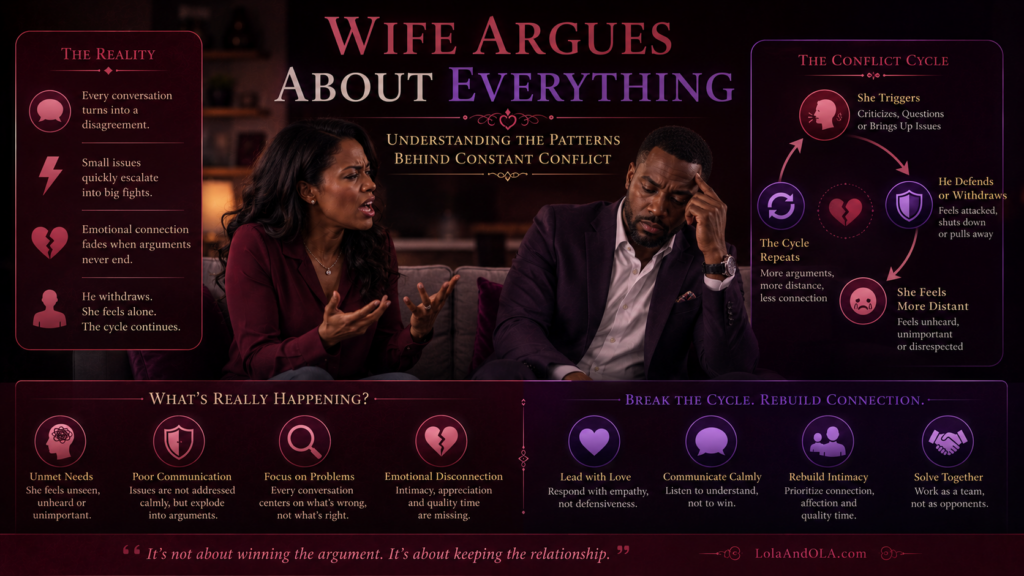
If you’ve found yourself wondering why, “you wife argues about everything,” you’re not alone.
Take This 2 Minutes Marriage Assessment
Question 1 of 15
Your Marital Assessment Status:
We have securely transmitted a comprehensive analytical breakdown matching this score directly to your email inbox shortly. We have just dispatched an analytical breakdown matching this assessment score along with your core strategic action plan.
YOUR ACCESS IS CONFIRMED
Your Copy of Get My Marriage Back Is Ready
Choose how you'd like to get started below.
Step 1: Get Your Book
Start With Get My Marriage Back
Use the book to begin understanding the principles that can help you stop making the situation worse, regain clarity, and start moving your marriage in a better direction.
If you're dealing with separation, divorce, loss of attraction, intimacy problems, infidelity, or a spouse who is pulling away, general information may not answer the most important question:
What should you do in your specific situation?
In a private 60-minute Discovery Session, we'll look at what's actually happening in your marriage, what may be making the situation worse, and what your next best steps may be.
Many husbands reach a point where it feels like every conversation turns into a debate, every suggestion gets challenged, and every attempt at communication is met with pushback.
It can be exhausting.
You say something simple, and she immediately responds with a reason why it’s wrong.
You share an idea, and she has an argument against it before you’ve even finished explaining.
Over time, it can feel like you’re constantly walking into conflict, leaving you frustrated, disconnected, and wondering how your marriage got here.
But before we talk about how to stop the arguments, we need to address an uncomfortable reality:
If your wife argues about everything, there’s a good chance you’re arguing about everything too.
That may sound unfair at first.
You might be thinking,
“No, she’s the one starting it.”
Hear me out.
The Hidden Dynamic Behind Constant Arguments
It’s almost impossible for one person to sustain endless arguments without the other person participating in them.
Notice I said almost impossible.
When husbands describe their wives as argumentative, they often explain the same pattern:
Every suggestion gets challenged.
Every opinion gets questioned.
Every conversation feels like a debate.
Every disagreement turns into a battle.
The frustration is real.
However, when I observe these same husbands in coaching or counseling conversations, I often notice something surprising. They’re doing the exact same thing.
Every recommendation receives resistance.
Every new perspective gets debated.
Every alternative solution gets challenged.
In other words, they are responding to an argumentative spouse with more argument.
The result?
A relationship trapped in a cycle where both people feel unheard, misunderstood, and disrespected.
Why “Winning” the Argument Doesn’t Fix the Marriage
Many couples become so focused on proving their point that they forget the purpose of the conversation.
The goal isn’t to win.
The goal is understanding.
Unfortunately, when a marriage reaches the point where one spouse feels that the other argues about everything, both people are usually operating from a defensive position.
Instead of listening, they’re preparing rebuttals.
Instead of understanding, they’re building cases.
Instead of solving problems, they’re protecting themselves.
This creates an environment where every interaction feels like a courtroom rather than a partnership.
Take a Step Back Before You Take Another Stand
If the way you’ve been engaging your wife isn’t working, wouldn’t it make sense to stop using the same approach?
That’s the first step.
Take a step back.
Not because you’re surrendering.
Not because you’re admitting you’re wrong.
But because continuing the same pattern will only produce the same results.
Ask yourself:
How did I get here?
When did conversations become competitions?
What role am I playing in this dynamic?
How do I typically respond when she disagrees with me?
Do I genuinely listen, or do I immediately defend my position?
These questions require honesty.
And honesty is often where real change begins.
Conduct a Self-Audit Before Trying to Change Your Wife
One of the biggest mistakes people make is focusing entirely on their spouse’s behavior while ignoring their own.
It’s easy to identify what your wife is doing wrong.
It’s much harder to examine your own patterns.
Yet that’s where your power lies.
You cannot control whether your wife changes.
You can control how you respond.
You can control your communication style.
You can control your emotional reactions.
You can control whether you escalate conflict or de-escalate it.
A self-audit may reveal that you’ve developed habits that unintentionally fuel arguments:
Interrupting.
Becoming defensive.
Dismissing her concerns.
Correcting minor details.
Needing the last word.
Responding emotionally instead of thoughtfully.
The goal isn’t self-blame.
The goal is self-awareness.
What If My Wife Really Does Argue About Everything?
Let’s be honest.
There are people who are naturally more confrontational than others.
Some individuals challenge nearly everything.
Some people process thoughts through debate.
Some have communication habits that create friction in relationships.
Yes, those people exist.
But here’s the reality:
If that person is your wife, she’s still your wife.
Whether your marriage ultimately thrives, struggles, or even ends, you’ll still need the skills required to navigate difficult interactions.
Think about it.
If you separate and become co-parents, you’ll still need communication skills.
You’ll still need emotional intelligence.
You’ll still need active listening.
You’ll still need conflict-resolution skills.
The solution isn’t avoiding difficult conversations.
The solution is becoming better at handling them.
The Skills That Change Everything
Healthy relationships aren’t built by finding perfect partners.
They’re built by developing better skills.
Some of the most important include:
Active Listening
Most people listen to respond.
Successful couples listen to understand.
Before defending yourself, make sure you truly understand what your wife is saying.
Emotional Intelligence
Learn to recognize when emotions are driving the conversation.
When emotions rise, logic often disappears.
Pausing can be more productive than pushing forward.
Curiosity Instead of Defensiveness
Instead of immediately explaining why she’s wrong, ask questions.
Seek to understand her perspective before presenting your own.
Personal Accountability
Own your contribution to the problem.
Not because you’re responsible for everything, but because you’re responsible for your part.
Strategic Patience
Not every disagreement needs an immediate resolution.
Sometimes creating space allows both people to return with greater clarity and less emotion.
So How Do You Stop Your Wife From Arguing About Everything?
Here’s the answer most people don’t want to hear:
Stop arguing about everything yourself.
That doesn’t mean becoming passive.
It doesn’t mean agreeing with things you don’t believe.
It means refusing to participate in unnecessary conflict.
It means becoming intentional instead of reactive.
It means recognizing that the fastest way to change a relationship dynamic is often to change the role you’re playing within it.
When one person consistently changes their behavior, the entire interaction begins to shift.
Will it happen overnight?
No.
Will it guarantee that your wife changes?
No.
But it gives you the best chance of breaking the cycle that’s keeping both of you stuck.
And with that said, this is only the beginning.
Now that we’ve covered the foundational mindset shift, I’ve got something special before we move into five additional practical tips that can help you navigate a marriage where it feels like your wife argues about everything.
How to De-escalate an Argument in 30 Seconds
One of the most powerful concepts we teach is this:
The goal is not to win the moment. The goal is to lead the interaction.
When your wife argues about everything, it’s easy to get pulled into a battle over facts, details, and who is right.
The problem is that most arguments aren’t actually about the words being said. They’re about the emotions underneath them.
When a conversation starts escalating, try this simple de-escalation framework:
Step 1: Drop the Need to Be Right
This doesn’t mean admitting you’re wrong.
It means recognizing that proving your point is often less important than protecting the relationship.
Many men unknowingly escalate conflict because they feel compelled to correct every misunderstanding, challenge every accusation, or defend every criticism.
Unfortunately, the more you focus on being right, the more defensive your wife becomes.
Instead of thinking, “How do I prove my point?” ask yourself:
“How do I lower the emotional temperature of this conversation?”
Step 2: Listen for the Emotion, Not the Words
When emotions are running high, people rarely communicate their deepest concerns clearly.
For example, when your wife says:
“You never listen to me.”
“You don’t care about this family.”
“You always do whatever you want.”
The literal statement may not be accurate.
But the emotion underneath it is often real.
What she’s frequently communicating is:
“I don’t feel heard.”
“I feel overwhelmed.”
“I feel unsupported.”
“I feel disconnected from you.”
A relationship and emotional intelligence man learns to respond to and not be dismissive of the emotion before responding to the accusation.
Step 3: Validate the Feeling Without Agreeing to the Claim
Validation is one of the fastest ways to de-escalate conflict.
Validation does not mean agreement.
It simply means acknowledging her emotional experience.
Try statements like:
“I can see why that would be frustrating.”
“I understand why you’d feel that way.”
“I can tell this is really important to you.”
When people feel understood, they become less focused on fighting to be heard.
Step 4: Slow the Pace
Escalation thrives on speed.
De-escalation requires intentional pauses.
Lower your voice.
Slow your speech.
Take a breath before responding.
A calm nervous system is contagious.
When one person refuses to match the intensity of the argument, it often becomes much harder for the conflict to continue escalating.
Step 5: Redirect Toward Resolution
Once the emotional intensity begins to drop, shift the conversation toward problem-solving.
Ask:
“What would help you feel supported here?”
“What’s the biggest concern you’re trying to solve?”
“How can we approach this differently moving forward?”
These questions move the conversation away from blame and toward collaboration.
The truth is, many husbands who believe their wife argues about everything discover that what she’s really doing is repeatedly expressing an unmet need in an ineffective way.
When you learn to address the need beneath the argument, you’ll often find that the argument itself begins to lose its power.
Now, before I get into the tips, there’s a quick story behind why I came up with this topic.
I have a client who called me…
He called me, he is married to his wife and they’ve been going through it for a while.
A lot of arguments… a lot of resentments from the part of the wife, and they’re going through it.
So every now and then he will call me and I’ll give him some tips here and there.
Basically, I’m coaching him in a mild way.
When he called me, I could hear the wife in the background telling him that I’m a third party.
She said I’m an outsider, and he should not be sharing anything that’s going on in their family with me.
Now there’s a twist to the tips I’m going to share with you right now.
There are 5 tips…, If your “Wife argues about everything”.
The main issue here is the argument–It’s not about her opinion of where I belong. She is, in fact, very correct that I’m a third party.
I am an outsider when it comes to that marriage.
The more important thing in that scenario is the argument and the very heated argument that’s basically going on between the both of them at that point in time,
…and how he was handling it.
That’s more of the tips that I want to share with you right now…
Tip #1 – When you engage in an argument with your wife, Countdown 30 seconds.
You can’t cheat… you can’t afford to cheat on this one.
You need to countdown 30 seconds and try to take as much deep breath as possible while you’re counting down to 30 seconds.
I want you to trust me.
Trust God that heaven is not about to fall apart because your wife disagrees with you on whatever.
Unless it has to do with safety and security, there is absolutely no need for you to be right in that conversation.
And that’s why I’m asking you, take a countdown from 30 to 0.
Tip #2 – You wanna let go of your right to be right.
The most effective way to deal with an argumentative wife is to stop focusing on winning individual disagreements and start focusing on improving the overall communication dynamic. Listen for the emotion behind her words, avoid becoming defensive, validate her concerns where appropriate, and resist the urge to argue every point. When one spouse changes how they engage during conflict, it often changes the entire interaction.
Why does my wife argue about everything I say?
There can be many reasons your wife seems to argue about everything. She may feel unheard, disrespected, overwhelmed, disconnected, or frustrated about unresolved issues in the relationship. In some cases, arguing becomes a learned communication pattern. Rather than focusing solely on what she’s doing, it’s important to examine how both partners contribute to the cycle and whether deeper relationship concerns are fueling the constant disagreements.
Is constant arguing a sign of a failing marriage?
Not necessarily. Constant arguing is often a sign of poor communication, unresolved resentment, unmet emotional needs, or ineffective conflict-resolution skills. While frequent conflict can damage a marriage if left unaddressed, many couples learn healthier ways to communicate and go on to build stronger relationships. The key is addressing the underlying issues rather than simply trying to stop the arguments themselves.
What should I do when my wife disagrees with everything?
When your wife seems to disagree with everything, avoid immediately defending your position or trying to prove her wrong. Instead, ask questions, seek clarification, and try to understand what concern or emotion is driving her response. Taking a step back, practicing active listening, and responding calmly can help break the cycle of constant disagreement and create more productive conversations.
It’s quiet. It’s awkward. It’s the moment you start to wonder…
“Wait a minute. Do they even respect me anymore?”
If that question has ever crossed your mind—even just once—you’re in the right place.
Because we’re going to explore 3 critical signs your wife or husband may have lost respect for you, and more importantly, how to start rebuilding that respect without begging, barking, or booking a silent couples’ retreat in the woods with no Wi-Fi.
Why Respect Is the Hidden Glue in Marriage
Last time, we dug into how to spot a fake apology after infidelity—ouch, right?
That one struck a nerve for a lot of couples, especially those stuck in cycles of emotional manipulation and empty apologies.
But this topic hits just as hard.
Because respect is the oxygen of marriage.
Without it, communication breaks down. Connection dries up. And the way your spouse looks at you—feels about you—starts to change.
You might still live together, but emotionally, you’re worlds apart.
Let’s fix that.
Sign #1: They’re Dismissive
Let’s talk about one of the sneakiest red flags in marriage.
Dismissiveness.
We once got an email from a man who said:
“I talk, and she scrolls. I share something I’m excited about, and she yawns. I ask her opinion, and she shrugs and says, ‘Whatever you want.’”
On paper, it sounds like nothing.
But emotionally? That’s devastating.
He was in a relationship—alone.
At first, he brushed it off. Maybe she’s tired. Distracted. Stressed.
But after months of being ignored, brushed aside, and minimized, he started to realize something was very wrong.
And here’s the uncomfortable truth:
When someone is consistently dismissive, it might be because they’ve stopped seeing you as someone to take seriously.
Not because you’re not lovable.
But because the version of you showing up every day might not be earning their respect.
This man had become overly accommodating.
He stopped expressing his needs. He avoided conflict. He over-apologized for things that weren’t even his fault.
He thought “being nice” would save the relationship.
But niceness without boundaries isn’t attractive—it’s exhausting.
Respect isn’t owed because you said “I do.” It’s earned—every day—through how you show up.
When he started showing up with calm confidence again? She noticed.
She began asking for his opinion again. She started listening.
The tension started to thaw.
Respect began to return.
Takeaway:
If you’re feeling dismissed, don’t shrink smaller. Grow stronger. Stop trying to be liked—start showing up as someone worth respecting.
Sign #2: They Are Argumentative, Disagreeable, and Just Plain Unreasonable
We had a woman write in and say:
“Ola, it’s like every word I say is wrong. If I say black, he says white. If I say the movie was good, he says it was boring. He even argued with me about the weather!”
She wasn’t exaggerating.
It had become a daily courtroom drama.
Now, it’s easy to chalk this up as a simple communication issue.
But frequent arguing—especially when it feels petty or unnecessary—can often mean something deeper:
A loss of respect.
When someone respects you, they care about your feelings. They want peace, not just to “win.”
They’ll still disagree—but it won’t feel like war.
Her husband wasn’t trying to communicate. He was trying to control.
All the arguments weren’t about facts. They were about power.
And that dynamic—constant contradiction without compassion—is a sign that emotional connection is slipping fast.
Think you’re just “strong-willed” people?
Think again.
Constant, unresolved conflict isn’t a sign of strength. It’s a sign that respect and safety are missing.
And here’s the truth bomb:
You don’t have to win every argument.
You just have to stop arguing for your worth.
Start responding, not reacting. Start showing up with calm authority, not emotional desperation.
One woman said when she finally stopped trying to prove her point, and instead started protecting her peace, things changed.
The arguments slowed down.
And the respect started to rebuild.
Takeaway:
Respect isn’t restored through shouting matches. It’s rebuilt through calm strength and emotional boundaries.
Sign #3: They’re Not Interested in Intimacy Anymore
Let’s talk about the bedroom—or the lack of it.
One man told us:
“It’s like we’re roommates. She doesn’t touch me. Doesn’t kiss me. Even sitting next to her feels like a negotiation.”
Sound familiar?
It’s not just about sex. It’s about emotional intimacy too.
Yes, life gets busy—kids, jobs, bills. But when a spouse completely checks out of intimacy, it’s not just exhaustion.
It’s emotional distance.
And that distance often stems from a loss of respect and emotional safety.
Here’s a myth that needs busting:
“If I just buy flowers or plan a romantic date night, it’ll fix the problem.”
Nope.
Intimacy isn’t bought. It’s built.
And it starts with emotional connection.
When your partner doesn’t feel emotionally seen, they’ll begin hiding… in plain sight.
They’ll give polite smiles. Offer side hugs. Avoid eye contact that lingers too long.
So what worked for the man above?
He stopped trying to perform romance.
And started being emotionally present.
He became more grounded. He stopped keeping score. He listened. Without trying to fix.
And little by little… the spark came back.
It wasn’t a rom-com montage. It was real life.
But it was real connection, too.
Takeaway:
Respect and intimacy go hand in hand. You can’t force either. But you can rebuild both—through presence, trust, and emotional availability.
Respect Can Be Rebuilt—Here’s How to Start
If you’ve seen even one of these signs in your marriage, you’re not alone.
We’ve been there.
And the good news is: it doesn’t have to stay this way.
You can absolutely get your spouse to respect you again.
Not through manipulation. Not through fear. But through growth, clarity, and emotional strength.
That’s exactly what our book Get My Marriage Back is all about.
We’ve helped thousands. We’d love to help you too.
FAQ: Respect in Marriage
What happens when respect is lost in a marriage?
When respect is lost, emotional connection, communication, intimacy, and even basic consideration begin to deteriorate, leading to a breakdown in the relationship.
How do you know if your spouse doesn’t respect you?
Signs include being consistently dismissed, constantly contradicted, emotionally shut out, or treated as if your thoughts and feelings don’t matter.
What does lack of respect look like in a marriage?
It often shows up as sarcasm, dismissiveness, chronic arguing, lack of emotional intimacy, or indifference toward your needs and boundaries.
How do you tell if your spouse has given up?
If they no longer engage emotionally, avoid meaningful conversation, show zero interest in intimacy, and stop making any effort to resolve conflict, they may have emotionally checked out.
Choose the option that best matches where you are with your marriage.
I Need Personalized Help
My Marriage Is in Serious Trouble
If you're dealing with separation, divorce, loss of attraction,
infidelity, intimacy problems, or a spouse who's pulling away,
get help looking at what's happening in your specific situation.