
What Would Help You Most Right Now?

Choose the option that best matches where you are with your marriage.

I Need Personalized Help

My Marriage Is in Serious Trouble

If you're dealing with separation, divorce, loss of attraction, infidelity, intimacy problems, or a spouse who's pulling away, get help looking at what's happening in your specific situation.

Get Personalized Help →
Get My Marriage Back book cover
I'd Rather Learn What to Do First

Start With Get My Marriage Back

Get the book and start learning the principles for moving your marriage in a better direction.

Get the Free Book →

Wife Wants to Separate? 5 Mistakes That Push Her Further Away

Your wife says she needs space, and suddenly the person you love most feels like the one person you cannot reach.

Take This 2 Minutes Quiz

Question 1 of 15

The temptation is immediate: call her, send another text, explain yourself, remind her of your history, and convince her that the marriage deserves another chance.

I understand that urgency. When the woman who once wanted your attention starts asking for distance, rejection can awaken an obsession you didn’t even know you had.

But here’s the contradiction you need to recognize: the harder you try to close the emotional distance, the more you may contribute to it.

A wife who wants to separate is not necessarily announcing that the marriage is over. She may be overwhelmed, emotionally exhausted, resentful, disconnected, or questioning whether she can experience love and attraction in the relationship again.

Those are different situations requiring different responses.

Your first responsibility is not to force an answer out of her. It is to understand what has changed, what your reactions are communicating, and whether your behavior is making you someone she wants to move toward—or further away from.

What Does It Mean When Your Wife Wants to Separate?

When your wife says she wants to separate, the words matter. The circumstances behind those words matter even more.

Perhaps she wants a few days without another argument. Maybe she has stopped initiating affection, avoids spending time together, or has begun discussing separate living arrangements.

In a more serious situation, she may have already moved out.

You cannot treat all these circumstances as the same marriage problem.

A request for space can indicate emotional overload after repeated conflict. It can also reveal resentment that has been building for years, a loss of romantic attraction, or uncertainty about remaining married.

Her request for distance is a symptom. It is not the complete diagnosis.

I want you to separate what you know from what you fear.

You know she has asked for space. You may not yet know whether she wants temporary relief, a trial separation, or a permanent ending.

Assuming divorce is inevitable can send you into a panic. Pretending nothing serious is happening can be equally destructive.

The intelligent response begins with observing the pattern behind her withdrawal.

wife wants to separate

Why Rejection Makes You Want to Chase Her

Before your wife started pulling away, you probably weren’t thinking about her every minute.

Now you monitor your phone.

A delayed response feels threatening. A short message becomes something to analyze, and silence makes you want to send another explanation.

This is how rejection can turn your attention into obsession.

Your mind begins treating reconnection as an emergency. Instead of asking whether a conversation would be useful, you ask how quickly you can get her to respond.

The difference is enormous.

A genuine desire to repair the marriage considers both people’s emotional experience. Fear-driven pursuit focuses on relieving your own discomfort.

That is why repeated attempts to reassure, explain, apologize, or argue can feel so intrusive to a spouse who has requested distance.

She asks for breathing room, but every interaction brings another demand for emotional engagement.

Over time, the pressure itself becomes part of what she wants to escape.
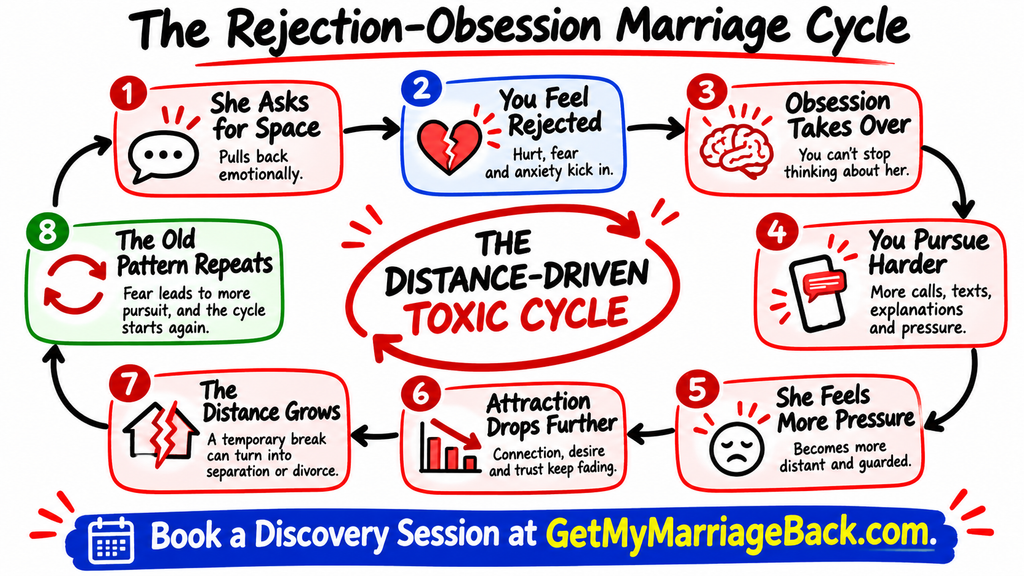
wife wants to separate - the rejection-obsession marriage cycle

Mistake 1: Making Your Anxiety Her Responsibility

There is nothing unusual about feeling frightened when your marriage becomes uncertain.

The mistake is expecting your wife to regulate that fear for you.

You may want her to promise she still loves you, explain exactly how long she needs, or reassure you that she isn’t considering divorce.

But reassurance extracted under pressure rarely creates the romantic connection you’re seeking.

You cannot skillfully rebuild attraction while making another person responsible for calming every uncomfortable feeling you experience.

Emotional intelligence begins when you can feel rejection without automatically acting on it.

That doesn’t mean pretending you aren’t hurt. It means choosing a response based on the marriage you want to build rather than the anxiety you want to escape.

Mistake 2: Treating Her Request for Space as the Entire Problem

Many people become obsessed with the question, “How much space should I give my wife?”

It’s understandable, but the question is incomplete.

The more important question is what created the distance in the first place.

Consider these possibilities:

  • Repeated arguments have made conversations emotionally exhausting.
  • Unresolved resentment has weakened trust and affection.
  • Your spouse no longer feels understood or valued.
  • Romantic attraction has deteriorated through predictable negative interactions.
  • Separation has become an option because earlier attempts to resolve problems went nowhere.

Each situation calls for a different level of repair.

If the problem is one emotionally charged disagreement, a brief pause may allow both people to settle down.

When the marriage has endured years of resentment, a day without arguing doesn’t erase the underlying damage.

Researchers studying relationship conflict have documented the importance of physiological calming during arguments. The Gottman approach, for example, emphasizes taking a break when partners become emotionally flooded, then returning to the conversation when they can engage more constructively.

That research supports a practical distinction: taking space can help interrupt escalation, but space alone does not repair a damaged relationship.

Mistake 3: Turning Separation Into a Countdown

Some people respond to a request for space by creating an imaginary deadline.

They decide that 24 hours should be enough. If their spouse doesn’t reconnect, they extend it to 48 hours or three days.

Then the ultimatum appears.

“I’ve given you enough space. We need to talk now.”

This approach treats separation like a negotiation in which the person who controls the calendar controls the outcome.

It doesn’t work that way.

A boundary isn’t automatically unreasonable because it makes you uncomfortable. Likewise, respecting a request for distance doesn’t require abandoning your own legitimate needs or accepting indefinite uncertainty.

You can discuss practical matters, household responsibilities, parenting arrangements, and reasonable opportunities to revisit the relationship.

What you cannot do is manufacture emotional readiness by declaring that the waiting period has expired.

The Client Whose Wife Moved to Her Mother’s House

One of my clients experienced an especially painful version of this situation.

His wife had moved to her mother’s house.

He was confused, frightened, and determined to repair the marriage. So he kept sending long text messages—paragraph after paragraph.

Sometimes he apologized. Other times he defended himself, criticized her, or tried to explain why her interpretation of the marriage was wrong.

At certain moments, he even declared that he didn’t care.

Yet his actions communicated something very different.

Those messages were not addressing the deeper problems behind the separation. They were expressing his panic.

We worked to understand his particular circumstances and change his approach.

It was difficult because familiar reactions don’t disappear simply because someone understands that they are unhelpful.

Over time, he began making meaningful changes without waiting for his wife to participate directly in every part of the process.

The important distinction was how he measured progress.

He stopped treating the number of messages he sent as evidence that he was fighting for the marriage.

Instead, he began paying attention to whether he was interrupting the behaviors contributing to the crisis.

That is a far more useful measure of personal growth.

Mistake 4: Losing Yourself While Trying to Save the Marriage

Here’s something I want you to examine carefully.

Have you become so consumed with saving your marriage that you’ve abandoned the person you were before the crisis?

Your confidence now depends on whether she responds.

A good day requires her affection. Your peace disappears whenever her mood changes.

You may still be going to work, paying bills, and handling responsibilities, but emotionally your entire identity has become attached to the marriage’s immediate condition.

That is emotional dependency, not personal power.

And dependency can quietly undermine attraction.

Romantic connection becomes difficult when every interaction carries the unspoken demand, “Please make me feel secure again.”

Rebuild the Person Your Spouse Can Experience Differently

I teach a progression that begins with grounding, purpose, and self-discovery.

Grounding means learning to experience difficult emotions without allowing them to dictate your next move.

When you feel the urge to send an angry or desperate message, notice the feeling before acting. Let the emotional intensity settle, then decide whether communication is necessary and appropriate.

Purpose means reconnecting with responsibilities and meaningful pursuits beyond your immediate marriage crisis.

Your health, work, relationships, personal growth, and contribution to the world still matter.

Self-discovery requires examining the patterns you would rather avoid.

Where have you been arguing instead of listening? When have you begged for reassurance, reacted defensively, or repeated behavior that clearly wasn’t working?

This isn’t about accepting blame for everything that has gone wrong.

It’s about taking ownership of what you can actually change.

You don’t need your spouse’s permission to become more grounded, confident, thoughtful, and emotionally disciplined.

Mistake 5: Trying to Explain Your Way Back Into Attraction

One of the biggest misunderstandings about marriage reconciliation is the belief that the right explanation will restore romantic attraction.

You imagine that if you could finally make your wife understand your intentions, she would see you differently.

But attraction isn’t simply an intellectual conclusion.

It is influenced by what someone repeatedly experiences in your presence.

Does interacting with you feel exhausting or enjoyable? Does a disagreement become a contest, or can you remain curious and composed?

Are your words consistent with your actions?

These experiences matter more than another carefully written promise.

Emotional Safety Creates Room for Romantic Curiosity

Research on intimate relationships helps explain why.

Studies of perceived partner responsiveness have found that feeling understood, validated, and cared for is closely associated with intimacy. Research published in the journal Psychological Science also examined how perceived partner responsiveness relates to affectionate touch, finding evidence that responsiveness and affectionate behavior are connected in romantic relationships.

The lesson is not that being agreeable automatically creates desire.

It is that closeness develops through experiences of connection, not through explanations alone.

Your spouse needs opportunities to experience meaningful differences in how you listen, communicate, handle conflict, and carry yourself.

That is where emotional intelligence becomes attractive.

Stop Using Text Messages to Force Emotional Resolution

When your wife wants space, texting can become one of your most destructive habits.

A simple logistical message may be necessary. Respectful communication about children, finances, or shared responsibilities can remain appropriate.

A seven-paragraph essay demanding that she understand your feelings is something else entirely.

Avoid using texts to litigate the marriage, extract reassurance, or force a conversation she has declined.

Also avoid the opposite manipulation: deliberately ignoring her to provoke jealousy or manufacture mystery.

Both behaviors are attempts to control her response.

The goal is not to become mysteriously unavailable.

The goal is to become genuinely different in the way that matters: you stop repeating destructive reactions.

How to Rebuild Attraction When Your Wife Wants Space

Attraction grows through a different experience of you.

That means your strategy should focus less on persuading your wife to feel something and more on becoming capable of creating healthier interactions.

1. Become Emotionally Steady

You can be concerned about your marriage without allowing every uncomfortable emotion to turn into an action.

Practice slowing your reactions, especially during disagreements or periods of silence.

Calmness is not indifference. It is the ability to remain responsible for yourself under pressure.

2. Respect Distance Without Becoming Cold

If your wife has requested space, take the request seriously.

You don’t have to punish her with silence, act detached, or pretend that the relationship means nothing.

When communication is appropriate, let it be warm, clear, and free from hidden demands.

Respect can be quietly attractive because it changes the emotional experience of interacting with you.

3. Replace Defensiveness With Curiosity

When your spouse expresses frustration, resist the urge to immediately prove that her interpretation is inaccurate.

Listen for the experience beneath the complaint.

You can acknowledge that she feels hurt without agreeing with every conclusion she draws.

That distinction allows you to remain confident while becoming easier to communicate with.

4. Create Experiential Value

I use the phrase experiential value to describe the positive experience someone has through interacting with you.

This is different from merely claiming to have good moral values.

You might consider yourself loyal, hardworking, and committed. Those qualities matter, but they don’t automatically tell you how your spouse experiences a conversation, an evening together, or a disagreement.

Experiential value comes from the way you live, communicate, listen, respond, and carry yourself.

Romantic curiosity has more room to develop when the familiar pattern of pressure and conflict begins to change.

5. Let Consistency Speak Louder Than Promises

A dramatic apology may capture attention.

Consistent behavior is what allows someone to notice that an old pattern is no longer dominating the relationship.

If you have promised to listen better, demonstrate it when a difficult conversation arises.

When you say you’re working on emotional control, practice it when you’re disappointed.

Attraction cannot be negotiated into existence. It develops in the context of lived experiences, including trust, emotional connection, individuality, and mutual desire.

What to Do When Your Wife Wants to Separate but You Don’t

Start by recognizing the seriousness of her request without assuming you already know the ending.

Ask for clarity when an appropriate conversation is possible. Respect the distance she has requested, and handle necessary responsibilities without turning every interaction into a discussion about reconciliation.

Meanwhile, examine the behaviors you control.

If you tend to pursue harder when you feel rejected, learn to interrupt that reaction. Should resentment and conflict have become normal, focus on communicating with greater awareness and less defensiveness.

Rebuild your personal stability instead of waiting for your spouse to supply it.

You also need to distinguish between doing your part and trying to do both people’s parts.

A marriage involves two individuals with independent choices. You can improve your own behavior and create conditions more supportive of connection, but you cannot decide for another person whether they will participate in rebuilding the relationship.

That is why personal power matters.

It allows you to act deliberately rather than desperately.

How Long Should You Give Your Wife Space?

There is no universal number of days that resolves every marriage crisis.

A short cooling-off period after an argument is fundamentally different from a separation involving a move out of the marital home.

Consider the severity and duration of the conflict, the specific boundary your wife has expressed, and the practical responsibilities you share.

A request for a quiet evening should not automatically become a month of silence.

Similarly, years of emotional disconnection will not necessarily disappear after 48 hours apart.

The better question is whether the space is helping interrupt destructive interactions while allowing both people to make thoughtful decisions.

Your role is to remain respectful, clear about practical needs, and focused on meaningful change.

The Real Shift: From Chasing Reassurance to Building Attraction

When your wife wants to separate, your instinct may be to fight harder for immediate closeness.

But a marriage crisis often exposes the limitations of that approach.

Repeated pursuit can become pressure. Explanations can become arguments, and attempts to save the relationship can turn into behaviors that make connection feel less appealing.

You need a different foundation.

Grounding helps you respond instead of react. Purpose restores a meaningful life beyond the crisis, while self-discovery reveals the habits you need to change.

From there, you can build experiential value through how you communicate, handle disagreements, and show up consistently.

This is the deeper distinction between trying to convince someone to love you and becoming someone who contributes to a more attractive relationship experience.

Your wife has asked for space.

The question is whether you will use that space to repeat the same cycle—or become capable of breaking it.

“I Feel Disgusted When My Husband Touches Me” – [5 Solutions]

Frequently Asked Questions

Does my wife wanting space mean she wants a divorce?

Not necessarily; a request for space can reflect emotional overwhelm, unresolved resentment, lost attraction, or uncertainty about the marriage. Pay attention to her specific words, actions, and circumstances rather than assuming divorce is inevitable.

How long should I give my wife space when she wants to separate?

There is no fixed timeline because a brief conflict break and a serious marital separation involve different levels of damage. Respect her stated boundaries while addressing necessary practical matters and discussing future communication when appropriate.

Should I text my wife when she asks for space?

Keep necessary communication respectful, brief, and consistent with the boundaries she has expressed. Avoid repeated emotional essays, demands for reassurance, or messages designed to force an immediate resolution.

Can I save my marriage if my wife wants to separate?

You can begin improving your communication, emotional stability, and relationship patterns without waiting for your wife to participate in every step. Reconciliation also requires her independent willingness to rebuild the relationship.


Wife Wants Separation? 5 Mistakes That Push Her Further Away

Your wife wants separation, and suddenly the woman you built your life with is asking for a future that might not include you.

Take This 2 Minutes Quiz

Question 1 of 15

Yesterday, you were her husband. Today, you feel like you’re auditioning for a position you already had.

She says she needs space. Maybe she isn’t sure about the marriage anymore. Perhaps she’s already mentioned divorce, moving out, or living separately while she figures out what she wants.

Now every unanswered text feels suspicious. Every conversation seems like a test. Your friends are telling you there’s probably another man, and you’re wondering whether giving her space means giving up on your marriage.

I want you to understand something important: Your wife asking for separation is a serious marriage crisis, but separation and divorce are not the same decision.

What you do during this period matters. And some of the most natural reactions to losing your wife can create exactly the kind of pressure that makes reconciliation harder.

https://www.youtube.com/watch?v=FCpuxML4uRo

Why Your Wife Wants Separation When You Still Love Her

When your wife wants separation, the announcement can seem to come out of nowhere.

You remember the last argument. Maybe you said something you regret. Perhaps she got upset over something you considered minor.

Now you’re wondering how one disagreement became a threat to everything you’ve built.

But the argument that triggers a separation conversation isn’t necessarily the problem that created the crisis.

Sometimes resentment has been accumulating for years.

Your wife may have experienced repeated disappointment, emotional disconnection, unresolved conflict, or declining attraction long before she mentioned leaving.

That doesn’t make every accusation against you accurate. It means the announcement and the emotional process behind it are two different things.

The marriage crisis that changed my perspective

Years into my own marriage, my wife told me she didn’t want to be married anymore.

I initially thought she was joking.

We had two boys together. We had built a family, and I couldn’t understand how an argument could suddenly put our marriage in jeopardy.

Then she repeated herself.

The reality became impossible to ignore.

For months, our marriage was in crisis. Eventually, I began accepting that divorce might become part of my story.

Yet my wife and I recently celebrated nineteen years of marriage.

That experience changed how I understand saving a marriage when one spouse wants out.

The biggest mistake is believing your wife must first change her mind before you can change the direction of your own life.

wife wants separation

The 5 Mistakes That Push Your Wife Further Away During Separation

1. Begging Her to Reconsider Before She Has Space to Think

Your wife says she needs time, and you immediately want another conversation.

You explain how much you love her. You remind her about your wedding vows, the children, the sacrifices, and everything you’ve survived together.

When that doesn’t work, you try again.

Here’s the problem.

You cannot negotiate somebody into wanting you.

Your explanations may be sincere, but when every interaction becomes an attempt to reverse her decision, your wife starts associating contact with emotional pressure.

Relationship researchers call one version of this the demand-withdraw pattern: one spouse increasingly presses for discussion or change while the other retreats.

A study of 116 couples examining marital conflict at home found that these patterns were associated with more negative interactions and less conflict resolution. The findings help explain why pursuing another conversation isn’t always the same as making progress.

The research on demand-withdraw patterns in marital conflict reinforces an important distinction: pressure and productive engagement are not interchangeable.

Giving your wife space doesn’t require pretending you don’t care.

It means refusing to make every interaction another campaign to change her mind.

2. Assuming She Wants Separation Because There’s Another Man

When your wife becomes emotionally distant, your imagination starts filling in the missing information.

She’s protecting her phone.

She doesn’t respond as quickly.

Her tone has changed.

Now your friends are telling you she must be interested in somebody else.

I worked with a man whose wife wanted divorce and was threatening to take much of what he had built financially.

But money wasn’t his deepest fear.

His parents had experienced multiple divorces. He had promised himself that his family would be different.

When his wife began questioning their future, he felt as though he was becoming the very story he’d spent his life trying to escape.

People around him became convinced another man was involved.

That possibility started dominating his thinking.

But suspicion isn’t evidence.

When you turn uncertainty into a conclusion, your behavior starts responding to a story you haven’t established as fact.

You become defensive, accusatory, controlling, or desperate for reassurance.

If there is evidence of infidelity, address the reality and protect your boundaries. But don’t manufacture certainty simply because uncertainty is painful.

Your fear of being replaced must not become the force controlling your behavior.

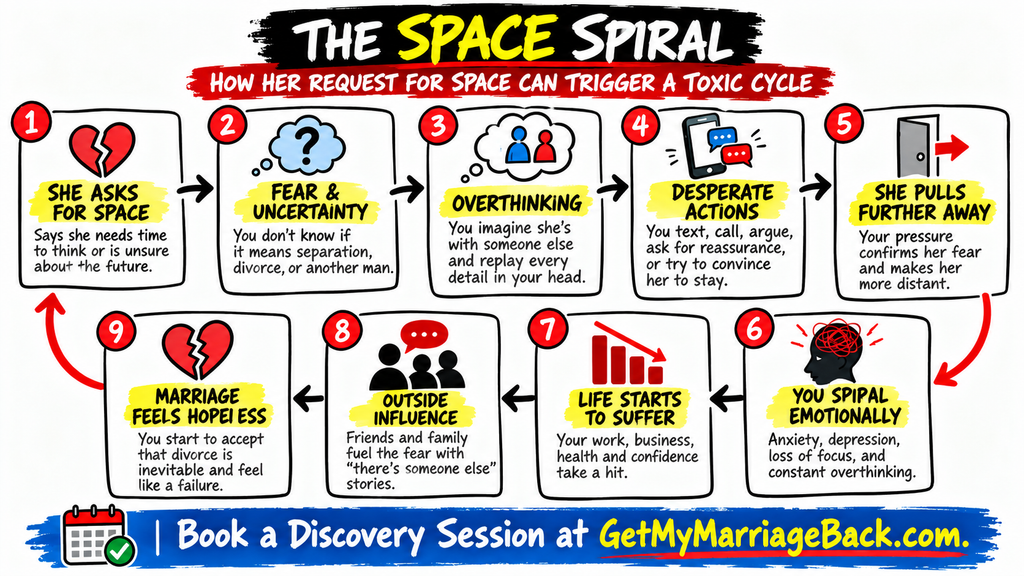
wife wants separation - the space spiral

3. Letting the Separation Destroy Your Identity

One of the most painful consequences of a marriage crisis is how quickly it can consume everything else.

Your business suffers.

You lose focus at work.

Sleep becomes difficult, and the activities that once gave your life meaning disappear.

I saw this happen with the client whose wife wanted divorce.

His emotional deterioration began affecting his business and everyday functioning.

Eventually, his wife pointed to those changes as additional reasons she no longer recognized the person she had married.

Think about that contradiction.

He was falling apart because he desperately wanted to save his family.

Yet the deterioration was making it harder for him to show up as the person he wanted to be.

This is where self-leadership becomes essential.

You don’t reclaim your identity by pretending the marriage doesn’t matter.

You reclaim it by refusing to make your wife’s immediate response the only measure of whether your life has value.

Your health, responsibilities, friendships, children, professional commitments, and personal mission still deserve your attention.

Those aren’t distractions from saving your marriage.

They’re part of rebuilding the stability that allows you to navigate the crisis intelligently.

4. Confusing Chasing With Genuine Pursuit

There’s a meaningful difference between pursuing your wife and chasing her.

Pursuit communicates interest with dignity.

Chasing demands reassurance because fear has taken control.

A thoughtful expression of love is different from sending six unanswered messages.

Respecting her request for space is different from disappearing to punish her.

Maintaining warmth when appropriate is different from manufacturing jealousy to make her react.

Attraction isn’t built by demonstrating how helpless you become when someone withdraws.

It’s influenced by the experience you create through your presence, emotional regulation, confidence, and behavior.

That is what I mean by experiential value.

I’m not talking about proving you’re morally superior or reminding your wife how good a husband you’ve been.

I’m talking about becoming someone whose presence creates a different emotional experience from the pressure and conflict she has come to expect.

You can be caring without being desperate.

You can remain interested without demanding access.

And you can respect distance without turning it into a manipulation tactic.

5. Treating Every Interaction as a Verdict on Your Marriage

Your wife responds warmly to a message.

You immediately think reconciliation is beginning.

The following day, she’s distant again.

Now you’re convinced divorce is inevitable.

That emotional roller coaster can turn every interaction into a test.

A short reply becomes rejection. A smile becomes proof of attraction. Silence becomes evidence of another man.

Eventually, your emotional stability depends on interpreting signals that may have several explanations.

One good conversation doesn’t mean your marriage is saved. One difficult conversation doesn’t mean it’s finished.

Instead of chasing individual signals, pay attention to patterns over time.

Is there less hostility?

Are your interactions becoming more respectful?

Are you responding differently when disappointment occurs?

Most importantly, are you becoming more capable of handling uncertainty without surrendering your judgment?

That is progress you can actually influence.

How to Save Your Marriage When Your Wife Wants Separation

Saving your marriage while separated begins with understanding the difference between control and influence.

You cannot control your wife’s feelings, attraction, or final decision.

But you can change the experience of interacting with you.

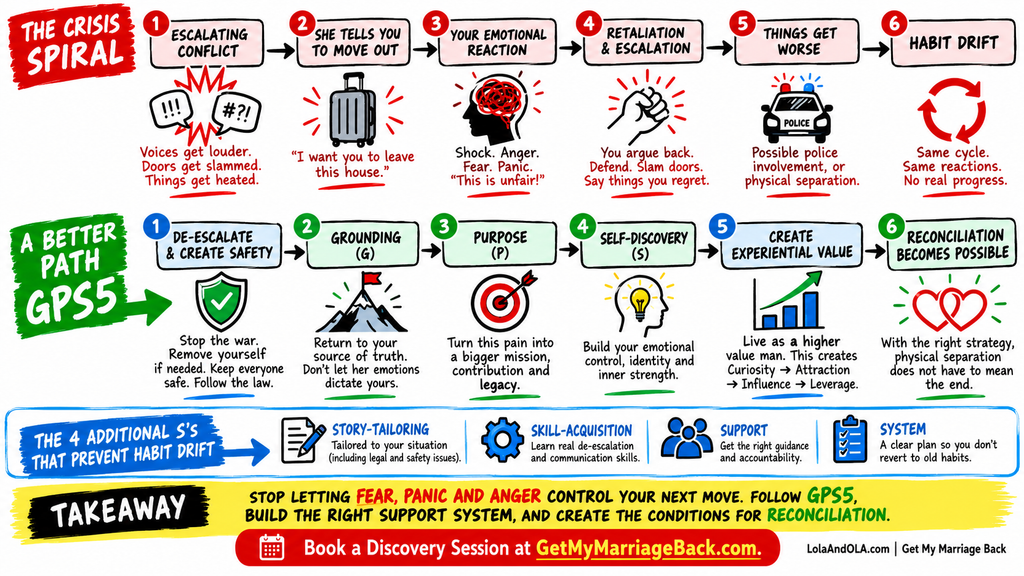
I teach a progression that begins with GPS: Grounding, Purpose, and Self-Discovery.

Grounding: Stop Letting Her Reactions Define Reality

Grounding means returning to a source of truth that remains stable even when your wife is uncertain about you.

Her emotional withdrawal is real.

Your marriage crisis is real.

But neither determines your entire identity or future.

When fear rises, acknowledge the situation without letting your imagination become your authority.

Purpose: Rebuild a Life Bigger Than This Crisis

Your marriage matters, but your purpose cannot depend entirely on another person’s decision.

Reconnect with your responsibilities, contribution, mission, and legacy.

This is particularly important when you’re trying to save your marriage alone.

You still have a life to lead while the future of your marriage remains unresolved.

Self-Discovery: Reclaim Your Capacity to Influence

Self-discovery isn’t an invitation to blame yourself for everything that went wrong.

It’s an opportunity to recognize the patterns you can change.

Perhaps you become defensive when criticized.

Maybe rejection triggers excessive reassurance-seeking.

You may have allowed years of disappointment to replace confidence with resentment.

Recognizing these behaviors gives you something practical to work on.

Rebuilding Attraction During Marriage Separation

The next progression is experiential value, curiosity, attraction, influence, and leverage.

Experiential value concerns what it is like to experience you.

When your behavior becomes more grounded, emotionally intelligent, and engaging, interactions can begin to feel different.

That difference creates room for curiosity.

Curiosity matters because attraction is difficult to nurture when every conversation feels predictable, pressured, or emotionally exhausting.

Your wife doesn’t need another performance designed to convince her you’ve changed.

She needs the freedom to observe whether your behavior actually changes.

That means demonstrating emotional intelligence in ordinary moments.

Respond without immediately defending yourself.

Respect reasonable boundaries without turning cold.

Maintain your responsibilities without demanding recognition.

Express interest without making every interaction a referendum on reconciliation.

This is how you begin changing your contribution to the relational dynamic.

Not by forcing attraction, but by becoming more capable of creating the conditions in which attraction can develop naturally.

Why Understanding Isn’t Enough: The Habit Drift Problem

You can understand everything I’ve explained and still repeat the same mistake tonight.

Your wife ignores your message.

Fear returns.

Suddenly, you’re writing another long paragraph explaining why she shouldn’t leave.

This is Habit Drift: returning to familiar reactions when emotional pressure rises.

Research into stress and decision-making has examined how stress can affect the balance between deliberate action and habitual responding, although findings are mixed and not every person responds the same way.

The practical lesson is straightforward.

Insight needs implementation.

In my GPS5 approach, the additional four S’s help turn understanding into sustained behavior:

  • Story-Tailoring: Understand the circumstances and history of your particular marriage.
  • Skill-Acquisition: Practice emotional intelligence until it becomes part of how you respond.
  • Support: Maintain perspective when fear and rejection distort your thinking.
  • System: Establish a consistent approach to difficult moments rather than improvising under emotional pressure.

The objective isn’t to become emotionally detached from your wife.

It’s to remain capable of making intelligent decisions even when your marriage is under threat.

Can Marriage Be Saved When Your Wife Wants Out?

A wife asking for separation is not automatically announcing an irreversible divorce.

Some marriages reconcile after significant emotional distance. Others move toward divorce despite sincere efforts to repair the relationship.

The distinction matters because you need to respond to the situation you’re actually facing, not the outcome you’re most afraid of.

When my own marriage reached a breaking point, I couldn’t see a path back.

Today, our history includes both that crisis and nineteen years of marriage.

What changed my perspective was recognizing that saving a marriage cannot require abandoning yourself.

Wanting your family is not weakness.

Loving your wife is not weakness.

Trying to save a broken marriage is not weakness.

But making your wife’s decision the sole source of your stability leaves you vulnerable to every change in her mood.

Your responsibility is to become grounded, emotionally intelligent, purposeful, and capable of creating a healthier relational experience.

Giving her space doesn’t have to mean giving up on your marriage. But saving your marriage cannot require losing yourself.

Wife or Husband Denying You Sex? DO THIS!!!

Frequently Asked Questions

What should I do if my wife wants separation?

Respect her request for reasonable space, avoid pressuring her for immediate reassurance, and focus on maintaining your emotional stability and responsibilities. Pay attention to the actual circumstances rather than assuming separation automatically means divorce.

Does separation mean my wife wants a divorce?

Not necessarily; separation can reflect uncertainty, emotional exhaustion, or a decision to move toward divorce. Her stated intentions and consistent actions provide more reliable information than speculation.

How can I save my marriage while separated?

Focus on the behaviors you control, including emotional regulation, respectful communication, personal stability, and addressing destructive relationship patterns. Sustainable reconciliation requires more than repeatedly convincing your wife to reconsider.

Should I contact my wife during separation?

Follow the boundaries and practical arrangements that apply to your separation, especially regarding children and shared responsibilities. Avoid using necessary contact as an excuse to pressure her into discussing reconciliation.

Your Wife Asked You to Move Out? 5 Mistakes That Push Her Further Away

Your wife asked you to move out, and right now leaving your own home can feel exactly like agreeing that your marriage is over.

Take This 2 Minutes Quiz

Question 1 of 15

I understand why your first reaction can be, “Absolutely not.”

This is your house too. You may pay the mortgage or rent. Your children may live there. Your routines, memories, belongings and entire family life are wrapped up in that home.

Then the person you married tells you to leave.

It feels unfair.

And depending on the circumstances, it may genuinely be unfair.

But when your wife asks you to move out during a marriage crisis, the argument about who is right can quickly become less important than what happens next.

Your fear wants immediate action. Your anger wants justice. Your anxiety wants certainty.

None of those emotions should be driving the car.

I know this from more than coaching people through marriage crises. During the darkest period of my own marriage, I packed a small bag and left my house.

Our conflict eventually escalated further. During one argument, I became so frustrated that I picked up a bowl of water from the kitchen countertop and poured it onto the floor.

My logic at that moment was almost comical in hindsight: I was trying to demonstrate that anybody could fly off the handle.

Think about that.

I was demonstrating the problem of losing control by losing control.

Eventually, Lola called the police.

That is why I draw a hard line here. If anybody feels unsafe, safety comes first. If police or emergency assistance is necessary, call them. If there are legal questions about leaving the marital home, custody, property, a protective order or your rights, get qualified legal advice.

Marriage strategy does not override safety or the law.

Once those issues are separated from the reconciliation problem, however, you can ask a much more productive question:

What kind of man are you going to become while your marriage is under this pressure?

Wife Asked Me to Move Out: Does That Mean the Marriage Is Over?

No single request for physical distance can tell you the entire future of your marriage.

Your wife asking you to move out is serious information. Treat it seriously without turning it into a prophecy.

Separation and divorce are not identical.

Physical distance and emotional finality are not identical either.

The danger is that fear collapses all of those distinctions into one terrifying conclusion:

“If I leave, I lose her.”

Once you accept that conclusion as fact, almost anything can feel justified.

You argue.

You refuse.

You explain why she has no right to ask.

You remind her how much you pay.

You demand another conversation.

You send enormous text messages.

You insist that you’re “fighting for your marriage.”

But there is an uncomfortable question underneath all of this:

Are you fighting for your marriage—or is fear fighting through you?

That distinction changes everything.

wife asked me to move out

Mistake #1: Treating Retaliation Like Strength

One client I worked with had lived through years of increasingly heated marital conflict.

Arguments became normal. Doors were slammed. Emotions escalated.

His philosophy was straightforward:

If somebody brings war, retaliate with war. Otherwise, they’ll think you’re weak.

That philosophy felt powerful until his wife told him to move out.

Suddenly, everything he believed about strength was being tested.

This is one of the most seductive mistakes in a marriage crisis because retaliation feels like Personal Power.

It isn’t.

If your wife can raise her voice and automatically make you raise yours, she is influencing your emotional state.

If one sentence about separation makes you lose control, separation is controlling you.

When fear, panic, anger and anxiety determine your next move, those emotions have power over you.

Self-control is not submission. De-escalation is not weakness.

You can be physically strong enough to slam every door in your house and still be emotionally controlled by fear.

wife asked me to move out, not what

Mistake #2: Believing You Must Choose Between Fighting and “Giving Her Space”

Generic marriage advice loves extremes.

“Never leave your house.”

“Fight for your marriage.”

“Don’t let her push you around.”

Then another corner of the internet tells you:

“Just give her space.”

“Do whatever she wants.”

“Don’t contact her.”

“If she loves you, she’ll come back.”

Neither collection of slogans knows your marriage.

There is an enormous difference between fear-driven chasing and dignity-based pursuit.

You can want your wife.

You can want your marriage.

You can make your interest clear.

None of that requires you to beg for reassurance, force conversations, repeatedly ask whether she still loves you, or use every interaction to measure your chances of reconciliation.

Likewise, respecting legitimate distance does not require becoming cold, passive or manipulative.

You are not disappearing to “make her miss you.”

Your objective is much bigger.

Become someone whose emotional center is no longer dependent on what mood your wife is in today.

Mistake #3: Trying to Talk Your Way Back Into Attraction

When your wife wants separation, words become extremely tempting.

You want to explain your intentions.

You want her to understand how much you love her.

Maybe you have finally recognized mistakes that she complained about for years, and now you desperately need her to believe you have changed.

So you talk.

And talk.

And talk.

But attraction is experiential.

Your wife does not experience your transformation because you gave her a PowerPoint presentation about it.

She experiences you.

How do you respond under pressure?

What happens when she disagrees with you?

Can you hear something painful without immediately defending yourself?

Does every warm interaction become an opportunity to ask about reconciliation?

Can you experience rejection without collapsing, exploding or retaliating?

Those experiences communicate far more than another promise.

Why Chasing and Withdrawal Can Make the Crisis Worse

There is useful research behind this dynamic.

A study involving 116 married couples examined what researchers call demand-withdraw communication—a pattern where one spouse pushes for discussion, change or resolution while the other avoids or withdraws.

Both husband-demand/wife-withdraw and wife-demand/husband-withdraw patterns were associated with more negative emotions and tactics and lower conflict resolution. The pattern was not simply a “husband problem” or a “wife problem”; either spouse could occupy either side of the cycle. You can read the research on demand-withdraw patterns in marital conflict.

Look at how easily this can appear after your wife asks you to move out:

Fear → Pursuit → Pressure → Withdrawal → More Fear → More Pursuit

You want reassurance, so you push for a conversation.

She experiences pressure and retreats.

Her retreat frightens you, so you push harder.

Now she wants even more distance.

You interpret that distance as proof that you need to fight harder for the marriage.

The cycle feeds itself.

Breaking that cycle creates emotional breathing room. And emotional breathing room matters when you are trying to rebuild attraction.

Mistake #4: Making Your Wife Responsible for Your Emotional Stability

This is where separation exposes things ordinary married life can hide.

When your wife is warm, you feel powerful.

When she becomes cold, you fall apart.

When she texts you, you see hope.

When she doesn’t, you start imagining divorce.

When she laughs with you, you think reconciliation has started.

Then she mentions separation again and your entire emotional world crashes.

That’s not Personal Power.

Your wife has effectively become the thermostat controlling your emotional temperature.

Attraction struggles under that burden because every interaction acquires a hidden job:

“Please make me feel safe about us.”

Your wife can feel that pressure even when you never say those exact words.

This is why your first job is not making her change her mind.

Your first job is recovering your ability to lead yourself.

Grounding: Stop Letting the Symptom Become Your Identity

The symptom is:

“My wife asked me to move out.”

Grounding does not mean pretending that symptom doesn’t exist.

It means returning to a source of truth higher than the symptom.

Your marriage crisis cannot become your identity.

Your wife’s current emotional state cannot become your definition of your worth.

Her rejection cannot become the authority determining whether today has meaning.

Grounding brings you back to truth and gratitude while allowing you to confront the crisis exactly as it is.

Now you can respond instead of react.

That difference is enormous.

Purpose: Become Bigger Than the Crisis

Pain has a nasty habit of shrinking your entire world.

Suddenly everything becomes about your wife.

What did she mean by that text?

Why didn’t she call?

Is she talking to somebody else?

Does she miss you?

Is she filing?

When is she coming back?

Your marriage matters tremendously, but your purpose must be bigger than any single living human being—including your wife and including you.

Redirect pain into mission.

Reconnect with contribution, impact and legacy.

Build something meaningful enough that your marriage crisis cannot consume every available piece of your identity.

This isn’t a trick for making your wife jealous.

Purpose is attractive because purpose creates life.

A person with direction generates a different experience from a person whose entire existence has become monitoring whether someone else still wants them.

Self-Discovery: Find Out Who You Are Under Pressure

A marriage crisis reveals capacity.

It exposes your beliefs about masculinity, love, conflict, rejection, control, fairness and strength.

Don’t turn that discovery into self-blame.

Use it.

You may discover that what you called “standing up for yourself” was sometimes emotional reactivity.

Perhaps what you called “fighting for the marriage” was occasionally panic.

What looked like communication may have become repeated demands for reassurance.

Self-Discovery means developing enough emotional capacity to see those patterns without needing to declare yourself either the hero or villain.

Then you can change what you actually control.

How Attraction Starts Rebuilding During Separation

Attraction isn’t something you demand from your wife.

It emerges from experience.

I describe the progression this way:

Value → Curiosity → Attraction → Influence → Leverage

Value here does not mean moral worth.

You already have human worth.

I’m talking about experiential value: what does interacting with you feel like?

Are you emotionally exhausting or emotionally engaging?

Predictable or interesting?

Desperate or grounded?

Reactive or responsive?

Consumed by the marriage or connected to a meaningful life?

When your experience changes consistently, curiosity can emerge.

Your wife begins encountering something different instead of hearing another sales pitch about how different you are.

Curiosity gives attraction room to breathe.

Attraction can expand influence.

Influence creates leverage—not leverage to control her, but a stronger relational position from which reconciliation becomes possible.

Mistake #5: Trying to Recreate the Old Marriage

You don’t need the broken marriage back.

Read that again.

The goal is a brand-new marriage with the same person.

Going back to exactly what existed before the separation simply restores the conditions that produced the crisis.

You need a different relational experience.

More emotional intelligence.

Better conflict skills.

Greater self-control.

More curiosity.

Stronger individuality.

More play.

More purpose.

Greater experiential value.

That is how reconciliation becomes something more meaningful than getting your wife physically back inside the same house.

What to Do After Your Wife Asks You to Move Out

Start with reality.

Determine whether there is an immediate safety issue.

Separate legal questions from emotional questions.

Do not make irreversible housing, financial, property or custody decisions based solely on marriage advice from the internet.

Then look directly at your emotional pattern.

What happens inside you when she says, “I want you to leave”?

Does fear become anger?

Do you retaliate?

Do you start proving?

Does panic make you send paragraphs of text?

Do you immediately demand certainty about divorce?

Identify the automatic reaction before trying to perfect your next speech.

From there, rebuild your foundation:

Grounding. Purpose. Self-Discovery.

Create experiential value through the way you live and interact.

Allow curiosity and attraction to emerge from experience rather than pressure.

Develop influence through consistency.

Build leverage through emotional intelligence, dignity and a life that does not collapse every time your wife has a difficult emotion.

This is not passivity.

This is strategic self-leadership.

Physical Separation Does Not Have to Mean Emotional Surrender

I packed a bag and left my house during my own marriage crisis.

I understand the fear attached to that moment.

Walking through a door with luggage can feel like you’re physically acting out the death of your marriage.

But distance itself does not write the ending.

What matters enormously is what happens inside that distance.

You can spend separation obsessing, retaliating, monitoring, begging and waiting.

Or you can use the crisis to become grounded, purposeful, emotionally intelligent and experientially attractive.

You cannot control whether your wife ultimately chooses reconciliation.

But you have tremendous influence over the experience of you that you bring into every interaction from this point forward.

That’s where your Personal Power lives.

Stop trying to win the argument about who has the right to be angry.

Stop allowing fear to masquerade as strength.

Don’t make your wife responsible for regulating your emotions.

Build the man who can experience this crisis without becoming the crisis.

That is where rebuilding your marriage begins.

Wife or Husband Denying You Sex? DO THIS!!!

Frequently Asked Questions

What should I do if my wife asks me to move out?

De-escalate first, address any immediate safety or legal issues appropriately, and avoid making panic-driven decisions. Then identify the fear-driven behaviors you control and begin changing the experience you create in the marriage.

Does moving out mean my marriage is over?

No; physical separation and divorce are different events, although a request to move out should be treated seriously. Focus less on predicting the ending and more on responding with emotional intelligence, dignity and deliberate action.

Should I give my wife space when she wants separation?

Respecting legitimate space can reduce pressure, but don’t use distance as a manipulation tactic to make her miss you. Research on demand-withdraw conflict suggests that cycles of pressure and withdrawal are associated with more negative interactions and poorer conflict resolution.

Can I save my marriage while separated?

You cannot single-handedly dictate reconciliation, but you can change your contribution to destructive patterns and rebuild grounding, purpose, experiential value and emotional intelligence. Those changes create healthier conditions in which curiosity, attraction and reconciliation can develop.

How to Save Marriage When Wife Wants Divorce: 3 Attraction Traps

Your wife says she wants a divorce. Maybe she still lives with you. She may still talk to you, laugh occasionally, coordinate the children, pay bills with you, or behave almost normally on certain days.


Take This 2 Minutes Quiz

Question 1 of 15

Then one disagreement happens and suddenly you hear it again:

“I’m done.”

“I don’t want this marriage anymore.”

“I want a divorce.”

That uncertainty can drive a man wild.

One minute you see evidence that there is still something between you. The next minute, you feel rejected by the woman you married. Naturally, your mind wants an answer.

Is my marriage over, or can I still save it?

I understand why that question becomes an obsession. But when your wife wants divorce, the most important question may not be what she is going to do next.

A more useful question is:

What is her uncertainty, rejection, or withdrawal turning you into?

Because you can love your wife deeply and still react to the fear of losing her in ways that make you less attractive to her.

That is where many husbands accidentally make an already fragile marriage worse.

When Your Wife Wants Divorce, Fear Can Disguise Itself as Love

Fear is seductive because it rarely announces itself as fear.

Instead, it sounds responsible:

  • Fight for your marriage.
  • Tell her how much you love her.
  • Remind her what you built together.
  • Get answers.
  • Show her how much you have changed.
  • Convince her to try marriage counseling.
  • Make her understand what divorce will do to the family.

Every one of those impulses can feel like love.

The problem is not necessarily your intention. The problem is the emotional experience you create on the other side.

Your intention may be connection while your wife experiences pressure. You may intend reassurance while she experiences neediness. What feels to you like “fighting for my marriage” can eventually feel to her like “he will not let me breathe.”

That distinction matters enormously when you are trying to figure out how to save marriage when wife wants divorce.

Attraction does not respond to your intentions alone.

It responds to experience.

how to save marriage when wife wants divorce

Attraction Cannot Be Negotiated Back Into Your Marriage

Suppose your wife tells you she is no longer happy.

You immediately start assembling evidence:

“But I’ve been a good husband.”

“I provide for this family.”

“I’m a good father.”

“We’ve been married for 15 years.”

“Look at everything we built.”

“I know I made mistakes, but I’ve changed.”

“Just give me another chance.”

Some of those statements may be completely true.

That is not the point.

Romantic attraction is not a courtroom, and your wife’s feelings are not a jury that can be persuaded by presenting enough evidence.

This is one of the hardest realities to accept when you desperately want to save your marriage. You can win the argument about why your marriage deserves another chance while simultaneously creating an emotional experience that makes your wife want more distance.

As a matter of fact, relationship research gives us a useful clue about what attraction responds to instead. Studies on perceived partner responsiveness have found associations between feeling understood, valued, and cared for by a romantic partner and greater sexual desire; the effect was particularly strong among women in one series of studies. research on partner responsiveness and sexual desire

Notice the distinction.

That research is not saying, “Be nicer until your wife stays.”

Responsiveness is not desperation, appeasement, or surrendering your standards. It is the ability to understand another person’s emotional experience without requiring that person to immediately change it so that you can feel safe.

That requires emotional intelligence.

And emotional intelligence is attractive precisely because it reduces the feeling that your wife must manage your emotional state for you.

how to save marriage when wife wants divorce - Blaming Your Wife for the Entire Marriage Crisis

Attraction Trap #1: Blaming Your Wife for the Entire Marriage Crisis

When your wife is the person talking about divorce, blaming her feels almost automatic.

“She’s destroying our family.”

“She changed.”

“Her friends are influencing her.”

“Her mother is in her ear.”

“She’s being selfish.”

“She’s confused.”

Maybe some of those observations contain truth.

Your wife is an adult. She can make bad decisions. She can behave selfishly, become confused, receive terrible advice, communicate poorly, or contribute substantially to the condition of your marriage.

Holding her accountable, however, is different from becoming psychologically consumed with proving whose fault everything is.

Blame becomes dangerous when you need your wife to accept your interpretation before you can regain your emotional stability.

Now your peace depends on her confession.

You need her to say:

“You were right.”

“I handled this badly.”

“My friends influenced me.”

“I caused this.”

But suppose she never says it?

Does that mean you remain angry, reactive, obsessive, and emotionally trapped?

That gives away far too much personal power.

You do not need to pretend your wife has done nothing wrong. You need enough emotional intelligence to separate her responsibility from your emotional regulation.

That distinction changes the energy you bring into every interaction.

Attraction Trap #2: Proving You Deserve Another Chance

Proving often follows blame.

Once you realize arguing about fault is getting you nowhere, you may switch strategies and begin demonstrating your value.

Suddenly you are more helpful.

You become extraordinarily attentive. You start doing everything around the house, sending thoughtful messages, announcing personal improvements, buying gifts, planning dates, and making sure your wife notices every positive change.

Growth is good.

Performance is different.

Ask yourself a difficult question:

Would I still make these changes if my wife gave me no immediate validation for them?

When the answer is no, your transformation may actually be an audition.

Your wife becomes the judge, and every interaction becomes your attempt to receive a passing grade.

“Did she notice?”

“Was she warmer today?”

“She smiled at me. Does that mean it’s working?”

“She didn’t text me back. Did I mess everything up?”

“She hugged me yesterday but seems cold today. What does that mean?”

Now your emotional state rises and falls according to her latest reaction.

That is exhausting for you, but it can also change how she experiences you.

Real self-development does not constantly look over its shoulder to see who noticed.

Attraction Trap #3: Pressing Your Wife for Certainty

Uncertainty hurts.

When you believe you might lose your marriage, your nervous system wants certainty immediately.

So you ask questions.

“Do you still love me?”

“Is there somebody else?”

“When did your feelings change?”

“Are you really going to file?”

“Do you want me to move out?”

“Can we try for another six months?”

“Do you see any hope for us?”

One honest conversation can be useful. Repeated questioning is different.

The diagnostic question is simple:

Am I asking because the answer will help me make a grounded decision—or because I need her answer to calm my fear?

Those motivations can produce completely different energy.

When reassurance becomes your emotional oxygen, your wife is effectively regulating your emotional state.

If she is warm, you breathe.

When she withdraws, you panic.

Then you press harder.

She feels more pressure and withdraws further.

You experience the withdrawal as greater rejection, which increases your need for reassurance.

That is how a destructive marriage cycle feeds itself.

how to save marriage when wife wants divorce - Why Pressure and Withdrawal Can Become a Self-Reinforcing Cycle

Why Pressure and Withdrawal Can Become a Self-Reinforcing Cycle

Marriage researchers have studied what is commonly called the demand-withdraw pattern: one person pushes for discussion, resolution, or change while the other avoids, shuts down, or withdraws.

The roles are not inherently male or female. In a divorce crisis, a husband who desperately wants certainty can easily become the person demanding discussion while his wife becomes the one trying to escape it.

The more she withdraws, the more urgent you feel.

Your urgency then gives her another reason to withdraw.

Now both people interpret the other person’s reaction as proof.

You think:

“See? She doesn’t care.”

She may think:

“See? He still doesn’t understand why I need space.”

Neither person necessarily intends to create the cycle.

Nevertheless, the cycle becomes the relationship experience.

And attraction cannot be skillfully rebuilt while every interaction feels like an emergency negotiation.

How to Save Your Marriage Alone Without Becoming Passive

This is where people often misunderstand the message.

Reducing pressure does not mean becoming passive.

It does not mean tolerating disrespect, abandoning standards, pretending divorce is not serious, or sitting around hoping your wife magically changes her mind.

There is an enormous difference between powerlessness and self-control.

Powerlessness says:

“There is nothing I can do.”

Control says:

“I cannot dictate her decision, but I can become extraordinarily intentional about what I bring into this situation.”

That is where attraction-building begins.

You stop trying to control her emotional experience and start taking responsibility for yours.

Instead of asking, “How do I get her to act right?” ask:

“Who am I becoming while my marriage is under pressure?”

That question puts your power back where it belongs.

Step 1: Ground Yourself Before You Try to Rebuild Attraction

Your wife saying she wants divorce is serious information.

Treat it seriously.

But serious does not mean you must turn every statement she makes today into an irreversible prophecy about tomorrow.

Grounding means learning to distinguish between what has actually happened and what fear predicts will happen.

“She said she wants divorce” is information.

“My life is over” is interpretation.

“She is emotionally withdrawn” is information.

“I will never be loved again” is interpretation.

“She did not respond to my text” is information.

“She must be talking to another man” is interpretation unless you actually have evidence.

This is emotional intelligence in practice.

Grounded people do not deny painful reality. They simply refuse to add unnecessary catastrophe to it.

That stability changes your presence.

Step 2: Stop Making Your Wife Your Source of Emotional Security

Your wife should matter to you.

Your marriage should matter.

The mistake is allowing her current emotional state to determine your identity.

You cannot build genuine attraction from:

“Please choose me so I can feel valuable.”

That emotional transaction is too expensive.

Instead, begin rebuilding a life that contains meaning independent of today’s marital temperature.

Reconnect with your purpose.

Invest emotionally in your children without using them as leverage in the marriage.

Take care of your body.

Deepen your faith if faith matters to you.

Strengthen meaningful friendships.

Return to interests that make you feel alive.

Advance your life’s work.

Develop yourself intellectually, socially, emotionally, financially, and physically.

None of this should be performed for your wife.

That is crucial.

The moment your growth becomes a campaign designed to make her jealous or force attraction, you have simply disguised the same dependency in more sophisticated clothing.

Become valuable because that is who you choose to be.

Step 3: Create Experiential Value Instead of Announcing Your Value

Do not repeatedly tell your wife that you have changed.

Let her experience something different.

Perhaps previous conversations became defensive. Now you can listen without instantly preparing your rebuttal.

Maybe every disagreement used to become a three-hour discussion. Today you can recognize when a conversation is deteriorating and stop escalating it.

Perhaps you previously needed reassurance every time she became quiet. Now you can tolerate uncertainty without interrogating her.

Maybe your energy around her used to communicate:

“Please tell me we’re okay.”

Over time, it can communicate:

“I care about this marriage deeply, and I am capable of standing emotionally whether today is warm or difficult.”

That difference is experiential.

Attraction is much more responsive to experience than advertising.

Step 4: Understand the Seductive Power of Curiosity

Long-term marriage creates familiarity.

Familiarity can create safety, which is valuable. Yet extreme predictability can also contribute to a roommate dynamic where two people know each other’s routines but stop discovering each other.

Research on self-expansion adds something fascinating here. Studies of established couples have found that engaging in novel, self-expanding activities together is associated with greater sexual desire and relationship satisfaction.

That does not mean dragging your wife on a surprise vacation while she is threatening divorce.

Timing matters.

During acute rejection, manufactured romance can feel like another attempt to influence her.

Instead, start by becoming a person who is still expanding.

Learn.

Grow.

Develop.

Create.

Have meaningful experiences.

Become curious about life again.

Then, when mutual openness exists, shared novelty can emerge organically rather than as an emergency marriage-saving technique.

Seduction in a long-term marriage is not merely candles, compliments, sex, or expensive dates.

At its most mature level, seduction contains curiosity.

There is still something about you to discover.

Step 5: Become Responsive Without Becoming Needy

A seductive, emotionally intelligent husband does not become cold.

Detachment is not the goal.

Neither is playing games, intentionally ignoring your wife, manufacturing jealousy, or pretending you do not care.

Those tactics merely replace anxious manipulation with avoidant manipulation.

Responsive strength sounds different.

You can hear that your wife is unhappy without immediately defending yourself.

You can acknowledge her experience without agreeing with every interpretation.

A difficult statement can be taken seriously without demanding immediate reassurance.

You can express that you value the marriage without making her responsible for calming your anxiety.

That balance—warmth without desperation, interest without pressure, strength without emotional coldness—is where mature attraction has room to breathe.

Stop Trying to “Make Your Wife Fall in Love With You Again”

I understand why people search for how to make your wife fall in love with you again after separation.

But notice the problem with the word make.

You cannot manufacture another adult’s feelings.

What you can influence is the relational environment she experiences when she encounters you.

Is it pressure?

Fear?

Interrogation?

Resentment?

A performance designed to win approval?

Or does she encounter emotional steadiness, growth, warmth, standards, self-respect, purpose, responsiveness, and a man who is increasingly interesting because he is actually living?

The second environment creates far more room for curiosity.

Curiosity creates the possibility of rediscovery.

Rediscovery can create conditions where attraction has somewhere to grow.

The Real Meaning of “Save Your Marriage Alone”

Saving your marriage alone does not mean one person can single-handedly create a healthy two-person marriage.

It means one person can stop waiting for the other person to change before taking ownership of their side of the dynamic.

That is powerful.

Perhaps your wife continues making mistakes.

You can still stop proving.

Maybe she remains uncertain.

You can stop pressing for constant reassurance.

She might be emotionally cold today.

You can refuse to let that determine whether you respect yourself tomorrow.

Your transformation does not require her permission.

Ironically, that is when change becomes more attractive—when it stops begging to be rewarded.

What Happens When Your Wife Still Wants Divorce?

This is where emotional maturity gets tested.

You may do substantial work on yourself and your wife may still say she wants divorce.

Do not convert personal development into a transaction:

“I changed, therefore you owe me reconciliation.”

That would put you right back into proving.

Growth is not a down payment on your wife’s decision.

The deeper objective is becoming emotionally capable of creating healthier love while remaining grounded enough to face reality.

That strength matters whether your marriage is beginning to reconnect or remains uncertain.

It also makes your interactions cleaner.

You can desire reconciliation without demanding it.

You can pursue your wife without chasing validation.

You can demonstrate warmth without begging.

You can respect her freedom without surrendering your own dignity.

And you can build attraction without attempting to manipulate attraction.

Your Wife Wants Divorce: What Should You Do First?

Do not begin by asking how to change her mind.

Start by identifying your cycle.

When she withdraws, what happens inside you?

Do you blame?

Prove?

Press?

Panic?

Over-text?

Over-explain?

Become excessively agreeable?

Monitor her mood?

Search her words for signs of reconciliation?

Treat every good day as evidence that the marriage is fixed and every bad day as evidence that divorce is inevitable?

Find the pattern first.

Then interrupt it.

Your immediate objective is not to create one magical conversation that saves your marriage.

It is to stop repeatedly creating the emotional conditions that deepen rejection.

From there, rebuild your grounding, purpose, self-respect, responsiveness, curiosity, emotional stability, and experiential value.

That is a much stronger foundation for attraction than convincing, begging, proving, or panic.

Your wife may be uncertain about the marriage right now.

You do not have to become uncertain about yourself.

My Wife Loves Me But Doesn’t Desire Me | 5 Signs | 5 Tips

Frequently Asked Questions

How do I save my marriage when my wife wants a divorce?

Start by reducing fear-driven behaviors such as arguing, proving, repeatedly seeking reassurance, and pressuring her for certainty. Focus on emotional stability, responsiveness, personal growth, and changing the relationship experience rather than trying to force her decision.

Can a marriage be saved if only one person wants it?

One person cannot control reconciliation, but one person can significantly change their own contribution to a destructive relationship pattern. That can create healthier conditions for communication, attraction, and possible reconnection.

How do I make my wife fall in love with me again?

You cannot force romantic feelings, but you can influence what it feels like to interact with you by replacing neediness and pressure with warmth, emotional intelligence, growth, curiosity, and self-respect. Research on romantic relationships has also associated responsiveness and shared self-expanding experiences with desire.

Should I give my wife space when she wants a divorce?

Respecting a genuine request for space can reduce unnecessary pressure, but space should not become a manipulative tactic designed to make her miss you. Use the space to regulate yourself, clarify boundaries, and develop rather than monitoring whether the strategy is “working.”

How to Save Your Marriage During Separation: 4 Signals You Misread

Separation creates one of the strangest emotional environments you can experience in a marriage.


Take This 2 Minutes Quiz

Question 1 of 15

Your husband or wife can sound completely finished with the relationship on Monday, call you comfortably on Wednesday, laugh with you on Friday, and become distant again by Sunday. A good conversation feels like reconciliation is starting. Then one cold text can make divorce feel inevitable all over again.

That emotional whiplash creates a dangerous question:

“What does this mean?”

Trying to answer that question from every individual interaction is where many people make saving their marriage during separation much harder than it needs to be.

The biggest challenge is often not the mixed signals themselves. It is what uncertainty starts making you do.

You begin assigning meaning to temporary moments. Then you look for evidence that your interpretation is correct. Fear turns ordinary uncertainty into worst-case scenarios, and before long, your search for reassurance becomes pressure.

That pressure can change the experience of interacting with you.

And when someone is already questioning whether they want to remain married, the experience of you matters enormously.

This is where rebuilding attraction during separation becomes less about convincing and more about emotional intelligence, Personal Power, self-discovery and experiential value.

Can a Marriage Be Saved After Separation?

Yes, separation does not automatically mean a marriage is permanently over.

A 2025 Journal of Marriage and Family study followed adults who separated after age 50 and found that some did eventually reconcile with their spouses. The study found reconciliation in roughly 7% of women and 11% of men during the observation period, although the authors noted that their method probably missed shorter separations that began and ended between interview waves.

Those statistics should not become a prediction about your marriage. Their importance is much simpler:

Separation is a relationship state, not a supernatural verdict about what happens next.

People search for the average length of separation before reconciliation because uncertainty is painful. They want a calendar that says, “At week six this means one thing; at month four it means another.”

Relationships do not work that neatly.

The history of the marriage, accumulated resentment, attraction, betrayal, emotional safety, individual personalities, children, outside influences, financial realities and the behaviors occurring during separation all matter.

That is why your real job is not predicting the outcome from a stopwatch.

It is understanding the relational environment that exists right now.

how to save your marriage during separation

Why Mixed Signals During Separation Feel So Powerful

Human beings crave certainty, especially when something valuable feels threatened.

When the future of your marriage becomes uncertain, your mind naturally starts scanning for information. A phone call becomes evidence. Silence becomes evidence too.

The problem becomes worse when your emotional stability depends on interpreting those clues correctly.

Recent longitudinal research involving 325 adults found that greater intolerance of uncertainty predicted increased mistake-rumination over time, with those processes negatively affecting family communication.

That matters because marriage separation creates an almost perfect environment for rumination.

You replay the conversation.

Was your husband warmer than yesterday?

Why did your wife send that photo?

Why did they stay on the phone for forty minutes if they really want divorce?

Was that hug meaningful?

Why did they suddenly become cold afterward?

Eventually you stop experiencing interactions and start testing them.

That distinction is critical.

A Warm Moment Is Not a Reconciliation Verdict - how to save your marriage during separation

Signal #1: A Warm Moment Is Not a Reconciliation Verdict

Warmth is good.

Friendship is good.

Comfort, laughter and positive interactions can all matter.

But none of them should carry the burden of proving that your marriage has already been saved.

Imagine that your wife has moved out but still enjoys talking to you. She calls, laughs, tells you about her day and sounds almost like the woman you remember.

It would be tempting to think:

“She clearly wants to come back.”

That conclusion may outrun the actual state of the marriage.

Warm behavior during separation can reflect affection, friendship, familiarity, shared history, attachment, comfort, uncertainty or genuine openness toward rebuilding. Several of those things can exist at the same time.

Your mistake is not appreciating a good experience.

The mistake is demanding that one experience tell you the entire future.

This matters for attraction because once you declare a warm moment “proof,” you become emotionally attached to getting more proof.

Now the interaction is no longer light.

It has a hidden job.

Signal #2: A Cold Moment Is Not Automatically a Divorce Verdict Either

The opposite mistake happens just as quickly.

Your husband is quiet.

Your wife takes longer to respond.

Yesterday felt close; today feels distant.

Fear immediately supplies the interpretation:

“It’s over.”

Then panic takes over strategy.

You may suddenly send a long message, demand clarification, ask what changed, revisit the marriage conversation or search for some hidden explanation.

None of this means you should ignore serious information. A divorce filing is real information. An affair is real information. Statements about wanting out deserve to be taken seriously.

But taking information seriously is different from emotionally turning every fluctuation into a final judgment.

Attraction becomes difficult when each interaction carries that much emotional weight.

The person on the other side starts experiencing not only the marriage crisis, but also your reaction to the marriage crisis.

That distinction brings us to one of the most important patterns in saving a marriage while separated.

The Uncertainty-Chasing Cycle

The destructive cycle often looks like this:

Uncertainty → Meaning → Testing → Pressure → More Uncertainty

You do not usually enter this cycle because you want to pressure your husband or wife.

Fear starts it.

The marriage feels unstable, so your mind creates a meaning for whatever just happened. Because that interpretation does not create lasting certainty, you begin looking for proof.

Testing follows naturally.

“Do you still love me?”

“Do you miss me?”

“Are you talking to someone else?”

“Are we getting back together?”

“Why were you so nice yesterday if you still want separation?”

“Are you really done?”

Each question can sound completely reasonable by itself.

Collectively, however, they can transform ordinary interactions into repeated relationship examinations.

Research on marital conflict has documented a related demand-withdraw dynamic. In a diary study involving 116 married couples, demand-withdraw patterns were associated with more negative emotions and tactics and with lower conflict resolution; the researchers found the pattern when either husbands or wives occupied the demanding role.

In other words, this is not simply “what men do” or “what women do.”

Research involving heterosexual and same-sex couples has also found that demand-withdraw behavior can be better explained by differences in who wants change during the conflict than by gender alone.

When you desperately need the marriage to move in a particular direction, it becomes very easy to become the person pushing for resolution.

The more the other person withdraws, the more frightened you become.

Then you push harder.

That is how the cycle recreates itself.

how to save your marriage during separation - Why Trying Harder Can Make Saving Your Marriage Harder

Why Trying Harder Can Make Saving Your Marriage Harder

Effort sounds virtuous.

More effort is rewarded almost everywhere else in life.

When your business struggles, you work harder. If your body is out of shape, you train more consistently. When a professional skill is weak, additional practice generally helps.

Marriage crisis is different because your effort is being experienced by another human being with their own emotions and autonomy.

Intensity is therefore not the same thing as effectiveness.

Trying harder from fear can mean explaining harder, apologizing harder, texting harder, proving harder, convincing harder and demanding clarity harder.

Your intention says:

“I’m fighting for my marriage.”

Their experience can become:

“Every interaction with you comes with pressure.”

Attraction lives in experience, not intention.

That is why I define Value here very carefully. I am not talking about your worth as a human being or whether you are morally superior to your husband or wife.

Value means the experience of interacting with you.

Does being around you repeatedly feel anxious, heavy and outcome-dependent?

Or are you gradually becoming a person capable of emotional stability, depth, curiosity, purpose, warmth, dignity and self-possession even while the marriage remains uncertain?

That difference matters.

How to Save Your Marriage During Separation Without Turning It Into a Performance

This is where people commonly misunderstand self-improvement.

They hear, “Work on yourself,” and secretly translate it into:

“Become impressive enough so my husband or wife comes back.”

Now self-development is another form of chasing.

You go to the gym but keep checking whether they noticed.

A new hobby becomes useful only if it makes them jealous.

Your confidence exists mainly to provoke a reaction.

Even giving space becomes a tactic designed to produce pursuit.

That is still outcome-dependence wearing better clothes.

The healthier direction begins somewhere else.

Grounding Comes Before Attraction

Before you can build attraction skillfully, you need enough emotional Grounding that panic is no longer controlling every interpretation.

Grounding does not mean suppressing pain.

Separation hurts.

Divorce threats hurt.

Rejection hurts.

Instead, Grounding means remembering that an emotion can be real without becoming the executive decision-maker of your life.

When fear stops running every interaction, you gain access to emotional intelligence again.

You notice instead of immediately reacting.

Curiosity becomes possible because you no longer need an instant verdict.

That creates the beginning of Personal Power.

Purpose Changes the Emotional Gravity of the Marriage

A marriage becomes dangerously heavy when it is carrying your entire sense of meaning.

During separation, everything can shrink until there is only one subject left:

the marriage.

Work becomes a distraction from the marriage.

Friends become people you talk to about the marriage.

Sleep becomes something interrupted by thoughts about the marriage.

Your phone becomes a marriage-monitoring device.

Purpose reverses that collapse.

Your career, faith, health, parenting, creativity, friendships, contribution, learning, business and larger mission begin occupying meaningful space again.

This is not detachment theater.

Purpose makes you more emotionally substantial because your life once again contains dimensions beyond whether another adult chooses you today.

That is naturally more attractive than desperation.

Self-Discovery Builds Capacity Without Self-Blame

Once you become grounded enough to look inward, the most powerful questions change.

Instead of asking only:

“Why is my husband doing this?”

or

“Why is my wife acting this way?”

you become interested in what the crisis is revealing about you.

What does rejection activate inside you?

Where does uncertainty become control?

What happens when you cannot get reassurance?

Which reactions belong to this marriage, and which patterns existed long before it?

Where have you become complacent?

What emotional skills are missing?

That investigation is not about taking responsibility for everything your husband or wife has done.

It is about discovering where your power actually lives.

You cannot control their choices.

Your capacity, however, belongs to you.

Attraction During Separation Is an Outcome, Not an Assignment

This distinction protects you from another common mistake.

Do not turn attraction into a scoreboard.

You do not need to count texts, monitor response speed, interpret hugs, measure flirtation or keep a spreadsheet of “positive signs during separation.”

Those behaviors put you right back into testing.

Curiosity and attraction work better as natural outcomes of value.

Research on long-term married couples offers an interesting parallel. One study found that “positivity resonance”—shared positive emotion combined with mutual care and behavioral synchrony—was associated with marital satisfaction even after accounting for other positive affect measures.

That does not mean you can manufacture attraction by acting cheerful.

It means relationships are experiential.

People respond to how interactions feel.

Building attraction in marriage therefore requires more than being logically correct or proving that divorce would be a mistake.

Safety, curiosity, emotional depth, respect, playfulness, individuality and genuine value shape the experience.

Seduction in a marriage crisis is not manipulation.

It is becoming less predictably fear-driven and more experientially engaging.

Positive Signs During Separation: Look at Direction, Not Isolated Events

People naturally want to know the positive signs during separation.

A healthier way to think about signs is direction rather than individual incidents.

An isolated affectionate interaction says little by itself. A broader reduction in hostility, greater ease around communication, renewed willingness to spend voluntary time together, increased openness and a progressively safer relational atmosphere can matter more.

Even then, do not convert progress into entitlement.

Warmth does not mean you are owed reconciliation.

Attraction does not mean the unresolved problems disappeared.

Friendship does not automatically equal restored marriage.

Direction gives you information.

It does not give you ownership over another person’s decision.

Bad Signs During Separation: Pressure Can Hide Behind “Fighting for the Marriage”

One of the clearest bad signs during separation is not simply that your husband or wife is distant.

Look at what the crisis is turning you into.

Are you constantly interrogating?

Do conversations keep becoming negotiations about reconciliation?

Has your identity collapsed around saving the marriage?

Are you trying to generate jealousy?

Do you repeatedly demand reassurance?

Is every positive interaction followed by a conversation about “us”?

Those patterns often reveal that uncertainty is still driving your behavior.

Ironically, they can happen precisely because you care deeply.

Care without emotional regulation can still feel like pressure.

Saving Your Marriage Alone Does Not Mean Controlling It Alone

The phrase save your marriage alone is easy to misunderstand.

You cannot single-handedly command another adult into a healthy marriage.

What you can do is radically improve the part of the relational system that belongs to you.

That is substantial power.

Research on people contemplating divorce shows that individuals use very different approaches to relationship repair, ranging from intensive professional help-seeking to private, self-directed efforts. In one national longitudinal sample of 745 married adults thinking about divorce, researchers found several distinct patterns of repair behavior rather than one universal pathway. (PubMed)

That supports a reality I see repeatedly:

There is no single script for marriage reconciliation.

More communication is not always the answer.

More distance is not always the answer either.

A separation created primarily by accumulated pressure is different from one following an affair. A husband who has lost attraction presents a different pattern from a wife who feels chronically unsafe during conflict.

The map can be universal.

The marriage is specific.

What to Do When Your Husband Wants to Separate

When your husband wants separation, your strongest position is not to become a female pursuer trying to drag him emotionally toward reconciliation.

Women do not need to chase.

Attraction grows more naturally when you retain dignity, emotional presence, femininity, value and openness while refusing to convert anxiety into pursuit.

That does not mean pretending you do not care.

It means your interest in the marriage does not require you to run after a man who is currently moving away.

Seduction creates room for curiosity.

Chasing destroys it.

What to Do When Your Wife Wants Separation

When your wife wants space or separation, pursuit itself is not automatically wrong.

Men pursue.

The distinction is between dignity-based pursuit and fear-driven chasing.

A grounded man can express interest without begging for reassurance. He can care deeply without turning every encounter into a referendum on whether she is returning.

Your wife needs enough emotional room to experience who you are becoming rather than repeatedly hearing arguments about why she should believe you have changed.

Attraction is experiential.

The PowerPoint presentation about your transformation is not the transformation.

Marriage Reconciliation Requires a New Experience, Not Just a Return to the Old One

Saving the marriage should not mean restoring the exact relationship that produced the crisis.

That marriage already generated separation.

Reconciliation becomes meaningful when the experience begins changing.

Grounding alters reactivity.

Purpose restores individuality.

Self-Discovery increases emotional capacity.

Value changes what it feels like to interact with you.

Curiosity and attraction then have space to develop naturally.

From there, trust and emotional safety have a better environment in which to grow.

The objective is not to become perfect.

It is to stop asking fear to lead your marriage.

Once you understand that, mixed signals become less powerful because they no longer dictate your identity, mood and next move.

You can care deeply about saving your marriage without surrendering your Personal Power to uncertainty.

That is where genuine attraction has room to breathe.

Average Length of Separation Before Reconciliation: Data Reveals

Frequently Asked Questions

Can you save your marriage during separation?

Yes, some separated couples do reconcile, and separation itself does not automatically determine the final outcome of the marriage. The more useful question is what patterns created the separation and whether the relationship experience is genuinely changing.

How long does marriage separation last before reconciliation?

There is no reliable universal timeline for reconciliation because separation circumstances and marriage histories vary significantly. Using an arbitrary number of weeks or months as a prediction can increase anxiety and encourage you to misread normal fluctuations.

What are positive signs during separation?

Reduced hostility, easier voluntary communication, renewed curiosity, warmth and a progressively safer relational atmosphere can indicate healthier movement. No single text, date, affectionate moment or conversation should be treated as proof of reconciliation.

What are bad signs during separation?

Escalating pressure, repeated relationship interrogations, hostility, manipulation, contempt and increasingly rigid demand-withdraw patterns point toward a worsening relational environment. The most actionable warning signs are often the patterns you can recognize and change on your own side.


What Would Help You Most Right Now?

Choose the option that best matches where you are with your marriage.

I Need Personalized Help

My Marriage Is in Serious Trouble

If you're dealing with separation, divorce, loss of attraction, infidelity, intimacy problems, or a spouse who's pulling away, get help looking at what's happening in your specific situation.

Get Personalized Help →
Get My Marriage Back book cover
I'd Rather Learn What to Do First

Start With Get My Marriage Back

Get the book and start learning the principles for moving your marriage in a better direction.

Get the Free Book →