
What Would Help You Most Right Now?

Choose the option that best matches where you are with your marriage.

I Need Personalized Help

My Marriage Is in Serious Trouble

If you're dealing with separation, divorce, loss of attraction, infidelity, intimacy problems, or a spouse who's pulling away, get help looking at what's happening in your specific situation.

Get Personalized Help →
Get My Marriage Back book cover
I'd Rather Learn What to Do First

Start With Get My Marriage Back

Get the book and start learning the principles for moving your marriage in a better direction.

Get the Free Book →

How to Rebuild Attraction During Separation: 9 Ways to Restore Desire

Your wife still calls you a good husband, a good father, and a dependable provider—but she no longer wants you romantically, and every attempt to close the distance seems to push her further away.

Take This 2 Minutes Quiz

Question 1 of 15

You have invested years in this marriage. You’ve remained loyal, paid the bills, made sacrifices, and tried to give your family a stable life.

Now your wife sleeps in another room, avoids your touch, and treats you more like a roommate than a romantic partner.

That hurts.

It feels unfair when someone you’ve sacrificed so much for no longer seems interested in the relationship you worked to build.

And the most frustrating part is that you don’t know what else you’re supposed to do.

Should you become more romantic? Give her more attention? Buy flowers? Explain how much you’ve sacrificed? Show her how good you’ve been?

I want you to understand something before you make another move:

Being morally good and being romantically attractive are not the same thing.

Your integrity matters. Loyalty matters. Being responsible matters.

But those qualities establish a foundation for marriage; they do not automatically create romantic desire.

When you’re trying to understand how to rebuild attraction during separation, your first responsibility is to recognize what has actually changed in the emotional experience of your marriage.

That is where the real work begins.

Why Your Wife Can Respect You but No Longer Feel Attracted to You

A wife can genuinely respect her husband’s character while no longer enjoying the emotional experience of being around him.

She can appreciate his financial contributions while feeling emotionally disconnected.

Your wife can acknowledge that you’re dependable and still experience little romantic excitement.

These realities are painful, but they are not contradictory.

Respect and attraction are related, but they are not identical experiences.

Consider the difference between being appreciated for what you provide and being desired for the experience of connecting with you.

One recognizes your contributions. The other involves emotional engagement, curiosity, warmth, and romantic interest.

When your wife says she’s no longer attracted to you, repeating your marriage résumé doesn’t address what she’s describing.

You cannot argue someone into feeling desire.

What you need to know is whether your marriage is dealing primarily with unresolved resentment, emotional exhaustion, lost attraction, or a more settled decision to leave.

Those circumstances require different responses.

And the first step is to stop treating every sign of distance as proof that the marriage is permanently over.

How to Rebuild Attraction During Separation

1. Focus on Attraction, Not Your Moral Résumé

You have never cheated.

You’ve provided for your family.

You have consistently shown up when your wife needed you.

Those contributions deserve recognition, but they are not romantic bargaining chips.

When your wife avoids intimacy, reminding her of your loyalty does not automatically make her want to kiss you.

The problem is not necessarily that you need to become a better person.

The problem is that the emotional experience of being around you has changed.

Ask yourself:

  • Does your wife describe you as dependable but avoid romantic contact?
  • Have your conversations become mostly about responsibilities, schedules, and problems?
  • Does she seem more relaxed when you’re not trying to secure affection?
  • Have you been presenting your sacrifices as reasons she should desire you?

These questions reveal whether you’re trying to solve an attraction problem with evidence of moral character.

I want you to preserve your integrity while developing the emotional qualities that make connection enjoyable.

Your marriage needs more than a list of everything you’ve done right.
How to Rebuild Attraction During Separation - the bad cycle

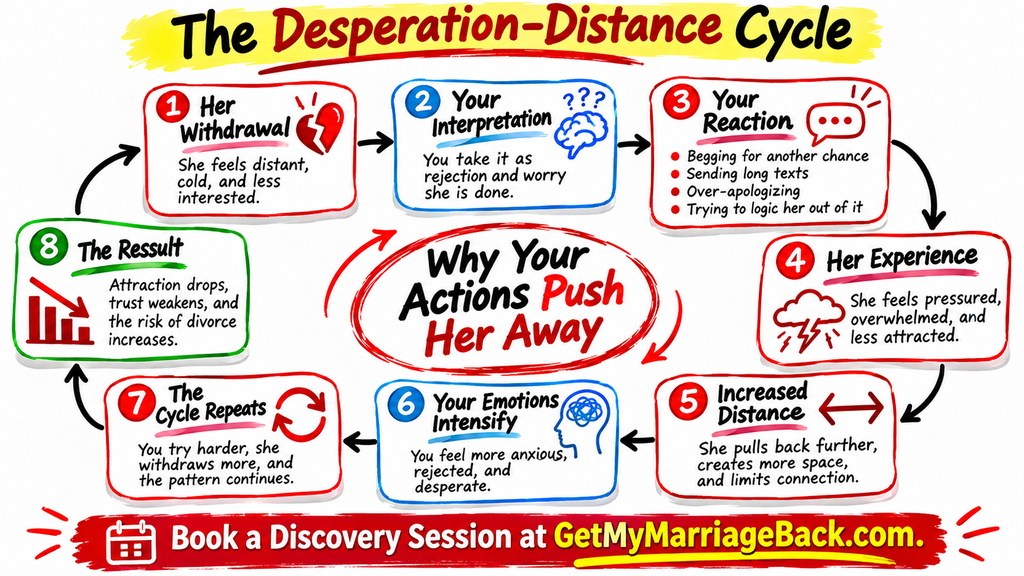
2. Get a Grip of Yourself Before Trying to Reconnect

Your wife walks past you in the kitchen without saying good morning.

Immediately, your stomach tightens.

You follow her, demand an explanation, and ask why she’s acting so cold.

She withdraws even further.

Now you’re convinced she doesn’t care about you anymore.

But what actually happened?

The observable behavior was silence. Your interpretation was rejection.

Her silence alone does not establish what she intended.

She may be angry, exhausted, distracted, resentful, or deliberately maintaining distance.

Your reaction can make the interaction more uncomfortable before you understand what you’re responding to.

This is why emotional self-control matters.

Before another conversation, regulate your breathing. Relax your shoulders. Stop following her around the house.

You cannot become emotionally compelling while treating every uncomfortable interaction as an emergency.

Confidence begins with your ability to handle discomfort without immediately transferring that discomfort to your wife.

And confidence is always sexy.

3. Start Giving to Yourself Again

You’ve spent years giving your time, energy, money, and attention to your marriage.

Somewhere along the way, you stopped investing in yourself.

Your sleep deteriorated. Physical activity disappeared. Personal interests became irrelevant.

Now you’re exhausted, resentful, and waiting for your wife to make those sacrifices feel worthwhile.

That is not sustainable generosity.

You cannot consistently offer an engaging emotional experience while running on exhaustion and resentment.

Start rebuilding the person who exists beyond the marriage crisis.

Take care of your health.

Return to meaningful activities.

Invest in your education, emotional well-being, and personal development.

Reconnect with the qualities that make your life fulfilling even when your marriage is experiencing uncertainty.

This is not about becoming selfish or pretending your wife doesn’t matter.

It’s about restoring the personal capacity that allows you to show up with genuine warmth rather than emotional depletion.

A fuller life gives you something meaningful to bring into your relationships.

4. Stop Turning Kindness Into an Invoice

You wash the dishes and expect affection.

You buy flowers and wait for a romantic response.

When nothing happens, you become bitter.

Suddenly, your kindness has become an invoice.

I want you to consider a familiar situation.

Your wife returns from work exhausted. You prepare dinner because you know she’s had a difficult day.

Then, almost immediately, you ask whether she appreciates you more now.

The dinner was helpful.

The demand afterward made the gesture transactional.

Instead of simply experiencing your care, she now feels responsible for providing the emotional payment you expected.

Genuine giving does not require an immediate emotional return.

Reciprocity absolutely matters in a healthy marriage. However, expecting every individual gesture to produce affection turns the relationship into a running calculation.

That calculation changes how your presence feels.

Before your next act of generosity, ask yourself whether you’re expressing care or trying to secure a particular response.

If the gesture only feels worthwhile when she rewards you, your expectations are driving the interaction.

Give because you choose to give.

Let appreciation remain appreciation rather than turning it into a demand for desire.

5. Develop the Kind of Confidence That Creates Attraction

Confidence is always sexy.

But confidence is not pretending you don’t care about your marriage.

It isn’t becoming emotionally unavailable, acting superior, or playing hard to get.

Real confidence is caring deeply without abandoning your dignity and self-respect.

Suppose you reach for your wife’s hand and she pulls away.

You have a choice.

You can sulk, demand an explanation, or turn her refusal into an argument.

Alternatively, you can respect her answer, remain composed, and continue your evening without making her responsible for regulating your emotions.

That response communicates emotional strength.

It also protects her freedom to choose whether and when she wants physical closeness.

Research supports the importance of emotional responsiveness in intimate relationships. A series of studies published in the Journal of Personality and Social Psychology found that perceived partner responsiveness was associated with greater sexual desire, particularly among women. The researchers examined how feeling understood, valued, and cared for contributes to romantic interest.

You can explore the findings in the research on partner responsiveness and sexual desire.

The practical lesson is not to perform sensitivity as another attraction tactic.

It is to become someone who can respond thoughtfully, respect boundaries, and create an emotionally engaging experience without demanding immediate affection.

6. Build Confidence Through Education and Practice

You cannot develop lasting confidence by repeating affirmations while continuing the same desperate behaviors.

Saying you don’t care means very little when your face, posture, and actions communicate panic.

Confidence is developed through education and repeated practice.

Learn communication skills.

Practice emotional regulation.

Develop social awareness and the ability to recognize what an interaction actually requires.

For example, before sending your wife another lengthy message, write it privately.

Then ask yourself:

  • Am I sharing necessary information?
  • Am I seeking reassurance?
  • Am I trying to prove my value?
  • Am I venting because I feel rejected?
  • Will this message respect the space she requested?

The answer tells you whether your communication is serving a meaningful purpose or simply relieving your anxiety.

Confidence grows when you repeatedly handle difficult moments competently.

You don’t have to eliminate uncomfortable emotions.

Instead, develop the ability to experience those emotions without letting them dictate every decision.

That skill changes how you carry yourself through separation.

7. Appreciate the Current State of Your Marriage

Your wife says she needs space.

You continue behaving as though the relationship still has the same level of romantic access it enjoyed five years ago.

Then you feel insulted when she declines affection.

I understand why that hurts.

You remember the closeness, laughter, physical intimacy, and ordinary affection that once made your marriage feel secure.

But you cannot navigate your relationship effectively while refusing to acknowledge its present condition.

Respect the current reality without automatically declaring it permanent.

When I say appreciate the current state, I don’t mean celebrate the separation or pretend you’re happy about it.

I mean recognize what is actually happening and identify what the situation reveals.

Is your wife asking for temporary space because she’s emotionally exhausted?

Has resentment accumulated through repeated unresolved experiences?

Does she still engage warmly in some situations but avoid romance?

Has she consistently communicated a concrete decision to end the marriage?

These are different relationship dynamics.

Pay attention to her stated boundaries, consistent behavior, and the history surrounding the change.

Don’t use one affectionate moment as proof that everything is repaired.

Likewise, don’t treat one cold interaction as a final verdict.

Your next move should reflect the marriage you have today, not the marriage you remember having.

8. Allow Your Wife to Become Curious About You Again

You start exercising again.

You take a course, improve your appearance, and become more intentional about your daily routine.

Then you report every improvement to your wife.

You tell her how much you’ve changed and repeatedly check whether she’s noticing.

That is not creating curiosity.

It’s another performance demanding attention.

Stop narrating your personal growth.

Let your actions speak.

When your wife encounters someone calmer, more engaged, and genuinely occupied with meaningful activities, she has room to notice the change herself.

There is an important difference between becoming interesting and trying to look interesting.

Manufacturing jealousy, disappearing to provoke anxiety, or using calculated silence to punish your wife does not create the kind of attraction I’m teaching.

Those tactics replace emotional connection with insecurity.

Real curiosity develops when someone encounters genuine qualities or experiences they find engaging.

Your responsibility is to build those qualities.

Her response remains her choice.

And that freedom is part of what makes authentic romantic interest meaningful.

9. Pursue a Meaningful Life Mission

You cannot fake busy.

A calendar filled with distractions is not the same thing as having a purpose.

When your entire emotional world revolves around whether your wife responds to your latest message, every interaction carries enormous pressure.

Her mood becomes your mood.

Her silence determines your day.

Your personal growth becomes another attempt to get her attention.

I want you to redirect that energy toward something meaningful.

Reconnect with your calling, meaningful work, service, personal development, and the legacy you want to create.

Your purpose must be greater than your wife’s current feelings about you.

This does not mean your marriage becomes unimportant.

It means the marriage stops being the sole source of your identity, emotional stability, and sense of direction.

A meaningful mission gives you something substantial to pursue even when your relationship is uncertain.

And a person who is genuinely engaged with life brings a different kind of energy into romantic interactions.

How GPS5 Connects Self-Leadership With Romantic Attraction

I use a framework called GPS5 to organize the personal work that supports sustainable attraction.

The process begins with three foundational areas: Grounding, Purpose, and Self.

Grounding: Stop Letting Every Reaction Control Your Day

Grounding redirects your attention away from the latest painful symptom and toward your higher self, a more accurate understanding of reality, and gratitude.

You acknowledge that your wife is distant without allowing that distance to define your entire identity.

Rather than building another catastrophic story around her silence, you return to what you know and what you can control.

Purpose: Turn Pain Into Meaningful Direction

Purpose redirects the emotional energy of the crisis toward your calling, contribution, impact, and legacy.

Your marriage matters, but your life has responsibilities and possibilities beyond the immediate relationship problem.

That broader direction reduces the pressure to extract all your emotional stability from your wife’s responses.

Self: Build Sustainable Emotional Capacity

Self involves accountability, responsibility, emotional maturity, and the capacity to love without abandoning yourself.

You take ownership of your conduct without turning every relationship problem into self-blame.

The goal is to become more capable of handling difficulty while remaining warm, engaged, and self-respecting.

Value Leads to Curiosity, Attraction, and Influence

As these qualities develop, you create greater experiential value.

In plain language, being around you becomes a calmer, more engaging, less pressured experience.

That experience creates room for curiosity.

Curiosity can support attraction when your wife begins noticing meaningful changes without being pressured to reward them.

Influence then becomes possible through the quality of your conduct rather than attempts to control her feelings.

The sequence is:

Grounding + Purpose + Self → Experiential Value → Curiosity and Attraction → Influence

This is not a strategy for forcing someone to desire you.

It is a roadmap for becoming more emotionally compelling while respecting another person’s freedom.

Why Attraction Doesn’t Return Just Because You Stop Chasing

Stopping desperate behavior is important, but removing pressure is only the beginning.

You can stop begging and still remain emotionally reactive.

Your wife can experience less pressure without suddenly feeling romantic desire.

Likewise, becoming quieter does not automatically repair months of resentment, loneliness, or emotional disconnection.

Research on romantic relationships consistently identifies perceived responsiveness as an important part of intimacy. In a 2012 daily-life study involving 102 couples, researchers found that concrete responsive behaviors were associated with feeling understood and with greater intimacy.

Other research has linked perceived responsiveness with affectionate touch, reinforcing the importance of the emotional experience surrounding physical connection.

The lesson is that attraction involves more than avoiding mistakes.

You need to develop a different way of engaging with yourself, your life, and the people around you.

That takes practice, not just a temporary change in tactics.

What to Do Tonight When Your Wife Gives You the Cold Shoulder

Tonight, your wife walks past you without acknowledging your presence.

You feel the familiar urge to follow her, ask what’s wrong, or send another message.

Here is what I want you to do.

Put your phone down. Relax your shoulders. Continue one meaningful activity without pursuing a reaction.

Don’t demand reassurance.

Avoid turning her silence into another argument.

Respect her space while maintaining your own composure.

You are not pretending the marriage crisis doesn’t exist.

You’re practicing the emotional self-control required to navigate it effectively.

That one decision reduces immediate pressure.

However, the deeper work involves developing the confidence, emotional intelligence, and personal direction that make your presence more engaging over time.

You cannot control whether your wife becomes attracted to you again.

You can control whether your conduct communicates desperation or dignity, emotional pressure or steadiness, resentment or genuine generosity.

And that is where rebuilding attraction begins.

Average Length of Separation Before Reconciliation: Data Reveals!

Frequently Asked Questions

Can attraction come back during marriage separation?

Yes, attraction can return when the emotional dynamics that contributed to disconnection change. Rebuilding confidence, reducing pressure, and creating more positive experiences can support renewed romantic interest.

How do I make my wife attracted to me again during separation?

Focus on emotional self-control, personal development, genuine generosity, and respecting her boundaries rather than begging for affection. Become more engaging through consistent actions instead of repeatedly asking whether she notices your progress.

Should I stop contacting my wife during separation?

Respect the boundaries she has communicated and keep necessary communication clear, calm, and purposeful. Avoid excessive messages intended primarily to obtain reassurance or provoke a romantic response.

How long does it take to rebuild attraction during separation?

There is no universal timeline because unresolved resentment, emotional exhaustion, attraction loss, and a settled decision to leave involve different circumstances. Consistent behavior and the actual state of your marriage matter more than counting days.


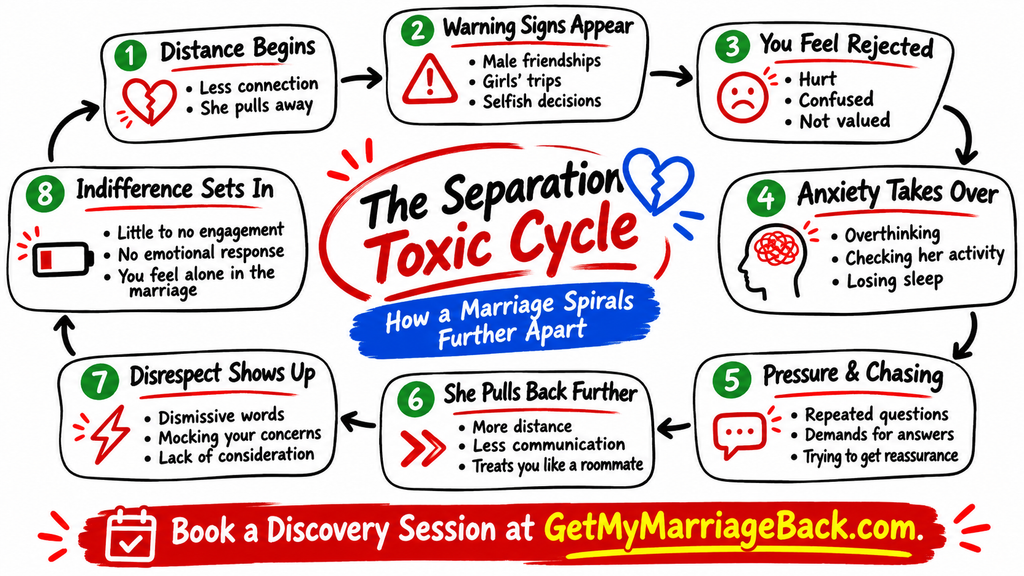
7 Bad Signs During Separation: Is Your Wife Pulling Away for Good?

Your wife is making plans without you, treating you like a roommate, and acting as though your marriage barely matters—but the most dangerous part may be how you’re responding to her distance.

Take This 2 Minutes Quiz

Question 1 of 15

You remember when your presence mattered to her. There was affection, curiosity, shared decision-making, and a sense that you were building something together.

Now, she barely acknowledges you when you enter the room. She makes decisions without consulting you, and when you express concern, you’re accused of being controlling, insecure, or overly emotional.

That’s painful, especially when you’ve invested years in building a life together.

But here’s what I want you to understand: Bad signs during separation are information, not a verdict.

A change in behavior tells you something about the present condition of your relationship. It doesn’t automatically tell you why the change happened, whether your wife has stopped loving you, or whether attraction can return.

Your responsibility is to recognize the patterns accurately, stop reacting from fear, and develop the emotional intelligence to make your next move more attractive rather than more desperate.

Let’s talk about seven warning signs that deserve your attention.

1. Sudden Male Friendships With Changing Boundaries

Your wife suddenly starts mentioning a male coworker you’ve never met.

His name comes up frequently. She’s texting him late at night, sharing personal experiences, and appearing emotionally engaged in conversations that don’t include you.

When you express discomfort, she says you’re insecure.

Naturally, that hurts.

You remember when you were the person receiving that attention, curiosity, and emotional openness.

However, having male friends doesn’t automatically establish infidelity.

What you need to know is whether the emotional boundaries have changed.

Ask yourself:

  • Has she become secretive about interactions that were previously transparent?
  • Is she sharing intimate concerns with someone else while withdrawing emotionally from you?
  • Have previously established relationship boundaries been abandoned?
  • Does she respond to reasonable concerns with honest conversation or repeated dismissal?

A friendship and an emotional affair are two different realities.

Don’t turn your imagination into evidence. At the same time, don’t pretend that repeated secrecy and broken agreements are meaningless.

The attractive response isn’t surveillance, interrogation, or competing with another man.

It’s emotional steadiness, clear boundaries, and enough self-respect to address observable behavior without losing control of yourself.

bad signs during separation

2. Sudden Girls’ Trips That Exclude You From Her Life

Your wife used to discuss vacations and weekend plans with you.

Now, she announces trips after everything has already been arranged.

You find yourself asking questions that once would have been part of a normal conversation.

Where is she going? When is she returning? What happens to the household responsibilities while she’s away?

Suddenly, you’re told she doesn’t need your permission.

But perhaps you weren’t demanding permission in the first place. You wanted consideration.

There’s an important difference between healthy independence and repeated exclusion from shared responsibilities.

A spouse can enjoy friendships, travel, and personal freedom without disregarding the practical commitments of marriage.

Consider the pattern rather than obsessing over the destination.

Does she coordinate responsibilities fairly? Is she becoming more independent while remaining respectful, or increasingly treating your shared life as an inconvenience?

Here’s another uncomfortable question: When you previously discussed her plans, did your conversations feel collaborative or interrogative?

That isn’t an invitation to blame yourself. It’s an opportunity to recognize whether your approach contributed to the tension.

Attraction becomes easier to nurture when your presence feels emotionally safe rather than controlling.

You can communicate expectations clearly without making your spouse feel that every independent decision requires a courtroom defense.

bad signs during separation - the separation toxic cycle

3. Selfish Decisions That Ignore Shared Responsibilities

Your wife changes financial arrangements, household expectations, or family schedules without discussing the consequences with you.

When you object, she explains that she’s finally doing what’s best for herself.

You experience that as abandonment.

And when her choices directly affect shared commitments, your concerns are legitimate.

Still, independence isn’t automatically selfishness.

A spouse establishing reasonable autonomy is different from someone repeatedly breaking agreements and expecting you to absorb the consequences.

The issue is not whether she makes decisions independently. It’s whether those decisions violate commitments, disregard practical responsibilities, or create an unfair burden.

Pay attention to repeatable behavior instead of treating every disagreement as proof that the marriage is finished.

Then respond with clarity.

You might say, “I respect your ability to make your own decisions. When those decisions affect our shared finances or responsibilities, we need a workable agreement.”

Notice what’s missing from that statement.

There’s no begging, character attack, or emotional threat.

You’re communicating a boundary without surrendering your composure.

That combination of self-respect and emotional maturity is far more compelling than trying to win every argument.

4. Indifference Replaces Emotional Engagement

This is one of the most painful bad signs during separation.

Your wife no longer argues with you.

When you tell her you’re struggling, she barely responds. You enter the room, and her expression doesn’t change.

Even conflict once felt like evidence that she cared enough to engage.

Now, you’re facing silence.

It’s tempting to conclude that she’s emotionally checked out of the marriage forever.

But indifference can have several explanations.

She may be emotionally exhausted from repeated conflict, protecting herself from another painful interaction, or actively disengaging from the relationship.

What you need to know is whether her withdrawal happens primarily during conflict or consistently across everyday interactions.

Someone overwhelmed by arguments may still demonstrate kindness, practical concern, or warmth in calmer moments.

Persistent emotional disengagement across different situations deserves closer attention.

Relationship research supports the importance of emotional responsiveness. A daily-diary study involving 99 couples found that perceived partner responsiveness was associated with relationship satisfaction.

That matters because emotional connection isn’t simply about how often you communicate. It’s also about whether interactions feel understanding, considerate, and responsive.

If your wife has become indifferent, demanding an emotional reaction can make your presence feel like another obligation.

Instead, focus on becoming someone who can remain grounded, listen without immediately defending himself, and participate in conversations without turning every interaction into a referendum on the marriage.

That doesn’t mean accepting endless indifference.

It means recognizing that emotional safety creates better conditions for connection than emotional pressure.

5. You’ve Become a Friend-Zoned Husband or Roommate

You still share a home, bills, schedules, and responsibilities.

She may even describe you as a good father, reliable provider, or wonderful friend.

Yet the romantic connection has disappeared.

There’s little affection, playful interaction, sexual curiosity, or excitement about spending time together.

You feel appreciated for what you provide but no longer desired for who you are.

This is where many husbands make a critical mistake.

They assume that if they become more helpful, more agreeable, or more persistent about intimacy, attraction will eventually return.

But attraction isn’t restored by demanding affection or accumulating favors.

What matters is the emotional experience of being around you.

I call this experiential value.

It involves how someone feels in your presence: relaxed or pressured, respected or judged, curious or exhausted, emotionally safe or constantly evaluated.

Your integrity, loyalty, and responsibilities matter. However, those qualities don’t automatically create romantic desire.

A marriage can have excellent logistical cooperation while suffering from a serious shortage of emotional and romantic energy.

Start paying attention to when the connection changed.

Did affection decline after unresolved resentment? Did your conversations become exclusively about bills, children, and schedules?

Have you stopped bringing playfulness, personal ambition, curiosity, and emotional presence into the relationship?

Research on sexual autonomy support and relationship satisfaction examined 786 participants across three studies and found positive associations between feeling supported in sexual autonomy, sexual need fulfillment, and relationship satisfaction.

The practical implication is important: Desire thrives more naturally when intimacy feels freely chosen rather than demanded.

You cannot force your wife to desire you.

What you can do is cultivate the personal confidence, emotional maturity, and enjoyable interactions that make genuine curiosity more possible.

Seduction in a marriage isn’t manipulation.

It’s the art of making connection feel inviting again, while respecting the other person’s freedom to respond.

6. Disrespectful Words Become Normal

Your wife dismisses your concerns, mocks your emotions, or repeatedly speaks to you with contempt.

Conversations that once felt respectful now leave you feeling small.

Perhaps she rolls her eyes, ridicules your intentions, or attacks your character whenever you disagree.

Disrespect matters.

However, not every disagreement is contempt, and not every frustrated statement means your spouse has lost all respect for you.

What you need to recognize is the difference between an isolated disagreement and a recurring pattern of humiliation.

Relationship researcher John Gottman’s work identifies criticism, contempt, defensiveness, and stonewalling as destructive patterns in distressed relationships.

Contempt is particularly concerning because it communicates superiority or disgust rather than a willingness to address the problem together.

Your response matters, too.

Are you retaliating with insults? Do you plead for approval, or abandon your boundaries to prevent another argument?

Neither aggression nor desperation creates genuine respect.

A grounded response might sound like this:

“I want to understand your concerns, but I’m not continuing a conversation where we’re insulting each other. We can discuss this respectfully.”

Then follow through calmly.

Your dignity doesn’t depend on winning the argument.

In fact, one of the most attractive qualities you can develop is the ability to maintain your standards without becoming emotionally volatile.

7. Your Anxiety Starts Controlling Your Behavior

This final warning sign isn’t necessarily about your wife’s behavior.

It’s about yours.

You’re checking her online status, rereading old messages, monitoring her mood, and struggling to sleep.

Every interaction feels like a test.

If she smiles, you feel hopeful. When she becomes distant, your entire day falls apart.

Her emotional availability has become the center of your existence.

I understand why that happens.

When your marriage feels threatened, your nervous system can start treating every unanswered message or cold response as an emergency.

But anxiety isn’t evidence that your marriage is beyond repair.

It tells you fear is beginning to direct your decisions.

And fear-driven behavior often creates additional pressure in an already strained relationship.

Repeated reassurance-seeking, emotional interrogation, and constant monitoring can make even ordinary conversations feel exhausting.

You need to stop treating every symptom as an emergency demanding an immediate reaction.

That shift begins with emotional self-leadership.

How to Rebuild Attraction During Separation Without Chasing

Recognizing the signs is only half the work.

The bigger question is what you do next.

If your wife has become distant, you may feel compelled to explain yourself repeatedly, convince her of your value, or make grand gestures to prove your commitment.

But attraction doesn’t respond well to pressure.

What you need is a more grounded way of showing up.

Ground Yourself Before Responding

In my GPS5 framework, the first principle is Grounding.

Instead of allowing every change in your wife’s mood to determine your emotional state, reconnect with your values, gratitude, and a perspective bigger than the immediate conflict.

When she gives you the cold shoulder, you don’t have to follow her around demanding an explanation.

Put your phone down. Relax your shoulders.

Give yourself enough space to respond thoughtfully rather than impulsively.

You’re not pretending the problem doesn’t exist. You’re refusing to let fear make your decisions.

Reconnect With Your Purpose

The second principle is Purpose.

Your marriage matters, but your entire identity cannot depend on your spouse’s current feelings.

Reconnect with your health, meaningful work, responsibilities, friendships, personal development, and long-term mission.

This isn’t about acting unavailable to provoke jealousy.

It’s about becoming a person whose life contains meaning beyond the relationship crisis.

Someone with a genuine sense of purpose often brings a different energy into conversations: less desperation, more steadiness, and greater capacity to be present.

Strengthen Your Sense of Self

The third principle is Self.

Develop accountability, emotional capacity, and personal responsibility without confusing those qualities with self-blame.

You can acknowledge your mistakes without accepting responsibility for every problem in the marriage.

Practice communicating your needs directly, maintaining boundaries respectfully, and listening without immediately defending yourself.

Research on self-determination and romantic conflict has found associations between autonomy and less defensive, more understanding responses during disagreements.

That makes emotional self-control more than a motivational slogan. It’s a practical relationship skill.

Develop the Skills, Support, and Systems to Sustain Change

A single calm response is valuable, but lasting change requires repetition.

That’s where the remaining elements of GPS5—Skills, Support, and Systems—become important.

Build the communication skills needed to de-escalate conflict. Surround yourself with constructive support, and establish routines that prevent anxious habits from controlling your day.

For example, stop checking your spouse’s online activity whenever you feel uncertain.

Replace that habit with a deliberate pause, physical movement, or a meaningful task.

When a conversation becomes heated, practice taking a respectful break rather than forcing immediate resolution.

Over time, these behaviors change the experience of interacting with you.

You become less reactive, more emotionally available, and more capable of genuine connection.

The Attraction Shift Most People Miss During Separation

Here’s the paradox.

The more desperately you try to secure your wife’s attraction, the more pressure she may experience.

Yet when you become emotionally grounded, maintain your dignity, and create more positive experiences, you stop making every interaction about what you need from her.

That changes the emotional atmosphere.

You can become playful without demanding affection, attentive without monitoring, and confident without becoming arrogant.

A warm smile, a thoughtful conversation, or a moment of genuine humor can feel more inviting than another intense discussion about whether the marriage will survive.

This isn’t about hiding your concerns or ignoring broken agreements.

It’s about understanding that repairing practical problems and rebuilding romantic attraction are related but different tasks.

You still need honesty, accountability, mutual respect, and workable agreements.

At the same time, emotional connection benefits from freedom, curiosity, and interactions that feel good rather than obligatory.

Confidence is always sexy.

Confidence isn’t the absence of fear. It’s the ability to act according to your values even when the outcome feels uncertain.

And that kind of confidence becomes especially powerful when it is combined with empathy.

What These Seven Warning Signs Really Mean for Your Marriage

The most important lesson isn’t that sudden male friendships, girls’ trips, selfish decisions, indifference, roommate dynamics, disrespect, or anxiety automatically predict divorce.

It’s that these patterns reveal where your marriage may be losing trust, cooperation, emotional safety, or attraction.

Some changes reflect healthy independence. Others reveal unresolved resentment, neglected boundaries, or serious emotional disengagement.

Your job is to differentiate those realities instead of allowing fear to decide what every behavior means.

When you recognize the pattern accurately, you can respond with more intelligence.

You stop chasing every emotional signal and start developing the qualities that support a healthier connection.

The goal isn’t to control your wife’s choices.

It’s to become a more grounded, self-respecting, emotionally compelling person while addressing the actual problems in your marriage.

That’s how you move from reacting to separation toward creating better conditions for trust, curiosity, and attraction to grow again.

5 Physical Signs She Just Slept With Someone Else: The Truth

Frequently Asked Questions

What are the biggest bad signs during separation?

Persistent emotional indifference, repeated boundary violations, contempt, exclusion from shared responsibilities, and disappearing romantic connection are important warning signs. Look for consistent patterns rather than treating one incident as a final verdict.

How do you know if your wife is emotionally checked out during separation?

She may show little interest in emotional connection, avoid meaningful conversations, and remain disengaged even when there is no conflict. Emotional exhaustion can look similar, so pay attention to whether warmth and consideration still appear in calmer situations.

Can attraction come back after separation?

Yes, attraction can return when emotional safety, mutual respect, curiosity, and positive experiences begin to develop again. Pressuring your spouse for affection is less constructive than addressing resentment and creating space for genuine connection.

What should you avoid doing during marriage separation?

Avoid constant monitoring, repeated reassurance demands, emotional interrogation, retaliation, and treating every interaction as an emergency. Focus instead on clear boundaries, emotional self-control, respectful communication, and personal growth.

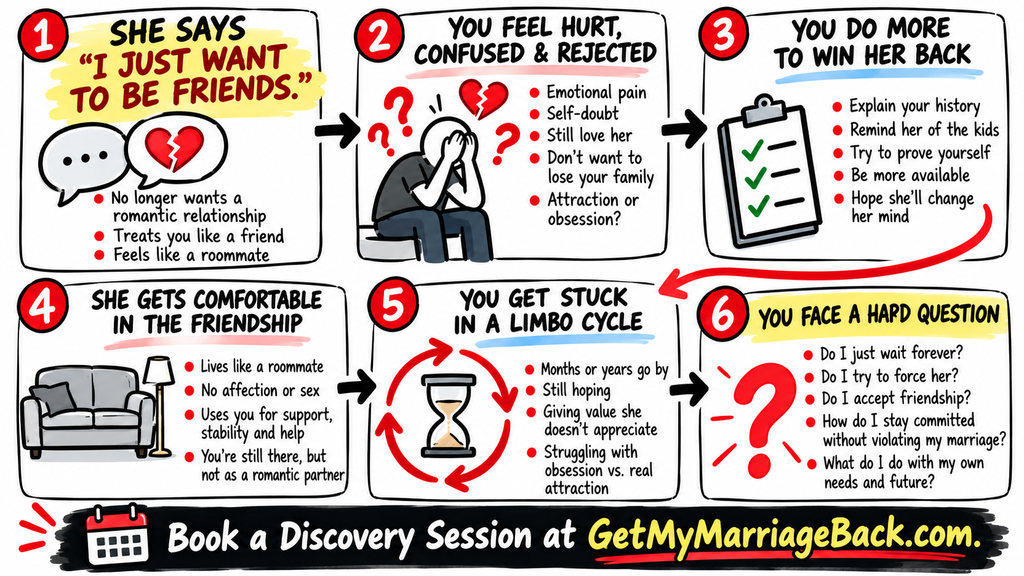
Your Wife Only Wants to Be Friends? 7 Ways to Rebuild Attraction

Your wife says she only wants to be friends, and suddenly you are married to someone who seems perfectly comfortable receiving friendship from you while you are starving for the romantic marriage you thought you were building.

Take This 2 Minutes Quiz

Question 1 of 15

That sentence—“I think we should just be friends”—can hit harder than an argument about divorce because it creates ambiguity.

You may still live together. You might still raise children, discuss bills, share meals, solve problems, and even laugh occasionally. From the outside, your marriage may look intact.

But you know something fundamental has changed.

She talks to you like a friend. She treats you like a roommate. Affection feels mechanical or disappears altogether. Sexual intimacy may be rare or nonexistent. You sense that she cares about you as a person but no longer experiences you as a romantic partner.

And because you still want your wife, your instinct may be to give her even more.

That is where you need emotional intelligence.

When your wife only wants to be friends, your objective is not to convince her that she should feel attracted to you. Attraction does not respond particularly well to arguments, invoices, pressure, guilt, or demonstrations of how much somebody should appreciate you.

Your first job is to understand what has actually changed.

What Does “My Wife Only Wants to Be Friends” Really Mean?

Take her words seriously without treating them as a prophecy about the rest of your life.

She is describing her present experience of the relationship.

That distinction matters.

“I only want friendship” can mean that romantic attraction has deteriorated. It can reflect accumulated resentment, emotional exhaustion, loss of sexual desire, disconnection, or uncertainty about whether she wants to remain married.

Sometimes a spouse genuinely does not know what she wants.

Don’t immediately translate uncertainty into an affair. Don’t assume “I need space” means another person exists. Equally, don’t dismiss what she is telling you because you believe your history, children, vows, or sacrifices should outweigh her current feelings.

Your history explains why the marriage matters.

It does not manufacture attraction.

my wife only wants to be friends

1. Stop Trying to Argue Her Back Into Attraction

One of the most predictable responses to romantic rejection is persuasion.

You explain how good the marriage used to be.

You remind her of everything you have survived together. Perhaps you talk about the children, your sacrifices, your future plans, or the promises you made.

None of those things is necessarily false.

The problem is the objective.

When the conversation becomes an attempt to prove that she should choose you, she experiences the emotional pressure behind your words even when your language sounds perfectly reasonable.

Seduction requires space for another human being to have an experience.

Pressure tries to dictate what that experience should be.

There is an enormous difference.

2. Don’t Confuse Rejection-Driven Obsession With Attraction

Here is an uncomfortable question:

Do you want your wife more because you are genuinely attracted to her—or because she no longer wants you?

It can be both.

Someone who was emotionally and physically available yesterday suddenly becoming unavailable today creates psychological tension. You start monitoring every interaction. A pleasant conversation gives you hope. A cold response ruins your day.

Before long, your emotional state revolves around whether she appears one percentage point closer to you.

That isn’t a powerful position from which to rebuild a marriage.

Stress matters here as well. Research has found evidence that stress can bias behavior toward previously learned habitual responses, although later replication work shows that the effect depends on conditions and is not universally reproduced.

That helps explain something many distressed spouses recognize immediately: knowing that chasing isn’t helping doesn’t automatically stop you from chasing.

When rejection hits again, old behavior can return.

3. Respect Her Autonomy Without Surrendering Your Own

Your wife is an adult.

She has autonomy.

So do you.

You cannot force another adult to want a romantic relationship with you, and respecting that reality is not weakness. In fact, trying to control what another person feels usually makes you less emotionally attractive, not more.

Recent relationship research is consistent with the importance of autonomy. Studies examining sexual autonomy support have found associations with greater sexual need fulfillment and sexual and relationship satisfaction.

That doesn’t mean “give your spouse unlimited space and attraction magically returns.”

It means desire and coercion are fundamentally poor partners.

You want your wife to experience you differently because her experience actually changes—not because you pressured her into saying the words you desperately wanted to hear.

4. Stop Feeding the Roommate Limbo

This is where many distressed spouses get stuck.

Your wife says she doesn’t want a romantic relationship, yet you continue supplying extraordinary amounts of romantic attention.

You chase.

You reassure.

You remain perpetually available.

You monitor her mood.

You solve every problem.

You perform increasingly elaborate demonstrations of love.

Underneath all of it may be an unspoken transaction:

If I keep showing you how valuable I am, eventually you will give me attraction in return.

But you cannot emotionally invoice somebody and demand attraction as payment.

That doesn’t mean becoming cold, cruel, vindictive, unavailable, or neglectful.

It means distinguishing responsibility from romantic over-functioning.

Be a responsible parent. Honor legitimate commitments. Treat your spouse with dignity. Participate appropriately in the family you created.

But stop turning endless giving into an indirect negotiation for desire.

If something you repeatedly offer is not being experienced as value, giving more of the same thing does not necessarily make it more valuable.

Sometimes it simply makes it more abundant.

5. Redirect Value Back Into Yourself

A marriage crisis can consume your identity.

You wake up thinking about your wife.

You analyze yesterday’s conversation in the shower. At work, you wonder whether she misses you. At night, you study her tone, body language, phone habits, and willingness to sit near you.

Your entire existence gradually becomes a referendum on whether she wants you.

Redirecting energy toward yourself interrupts that pattern.

This isn’t about pretending not to care.

Reconnect with purpose. Strengthen your physical and emotional health. Become more engaged with meaningful work, fatherhood or motherhood, friendships, contribution, learning, creativity, faith where applicable, and the larger mission of your life.

You are not doing those things as a performance designed to make your wife jealous.

If every improvement is secretly another strategy for obtaining her reaction, she remains the center of your identity.

The deeper shift is becoming grounded enough that rejection no longer dictates every move you make.

That creates something attraction desperately needs:

space.

6. Understand What Actually Creates Romantic Value

Being a good person and being romantically desirable are not identical concepts.

Moral value matters enormously.

Romantic attraction, however, involves experience.

How does someone experience themselves around you?

Do interactions repeatedly feel anxious, heavy, needy, resentful, transactional, interrogative, or emotionally exhausting?

Or does your presence increasingly communicate emotional stability, confidence, curiosity, playfulness, respect, competence, warmth, boundaries, and self-possession?

This is where emotional intelligence and seduction belong in the same conversation.

Seduction in marriage is not manipulation.

At its healthiest, seduction is your ability to participate skillfully in creating an experience where desire has room to emerge voluntarily.

There is research behind the importance of relational experience. A series of studies found that perceived partner responsiveness—feeling that a partner understands, values, and cares for you—was associated with greater sexual desire, with the association particularly strong among women in those studies. You can review the research on partner responsiveness and sexual desire.

Notice what this does not mean.

It doesn’t mean becoming a servant.

Responsiveness isn’t desperate compliance. Understanding someone doesn’t require abandoning yourself, and caring about your spouse doesn’t require removing every boundary.

Healthy responsiveness combines connection with self-respect.

7. Replace “Have You Changed Your Mind?” Energy With Curiosity

Imagine experiencing your spouse as someone who is constantly asking an invisible question:

Do you want me again yet?

Even when the words are never spoken, the energy can become obvious.

Every dinner becomes a test.

Every hug becomes evidence.

Every good weekend becomes proof that reconciliation is happening.

Every bad interaction becomes a catastrophe.

That’s exhausting for both people.

Your goal is to stop treating every interaction as a measurement of the marriage.

When you become less obsessed with extracting certainty, you create room for something different to happen.

Curiosity.

Your spouse notices changes she isn’t being instructed to notice. She encounters emotional responses she didn’t predict. Conversations can stop feeling like disguised marriage negotiations.

Curiosity is not the same thing as attraction.

But attraction rarely grows in an environment where everything about you has become predictable pursuit.

my wife only wants to be friends -friendship is not the enemy

Friendship Is Not the Enemy—Romantic Limbo Is

There is an important distinction here.

Friendship between spouses can be beautiful.

The problem isn’t that your wife enjoys talking with you or considers you a friend. A healthy marriage should contain friendship.

The crisis occurs when friendship replaces romance entirely while one spouse silently accepts an arrangement that is emotionally destroying them because they are terrified that asserting any internal boundary will cause permanent loss.

That creates limbo.

Months become years.

The distressed spouse keeps hoping.

Meanwhile, resentment quietly grows because the relationship continues providing certain comforts of partnership without resolving the central romantic rupture.

You don’t have to announce, “I refuse to be your friend.”

That can easily become another dramatic attempt to provoke a reaction.

Instead, recognize reality.

She has told you what she currently wants.

Respect that information, then take responsibility for what you control.

Don’t Use Distance as a Manipulation Tactic

This point is essential.

Some people hear “stop chasing” and immediately turn it into another technique:

I’ll withdraw so she misses me.

That’s still obsession.

Your behavior remains controlled by the response you hope to extract from her.

Genuine self-redirection is different.

You aren’t punishing her with silence. You’re not manufacturing jealousy, flirting with other people to provoke insecurity, withholding reasonable affection, or becoming deliberately cold.

Those tactics can create anxiety.

Anxiety is not the same thing as attraction.

Your objective is to become increasingly capable of bringing emotional stability, self-respect, boundaries, warmth, mystery, purpose, and genuine relational responsiveness into the marriage without trying to force an outcome from every interaction.

That is much harder than playing games.

It is also much more powerful.

What If Someone Else Eventually Shows Interest in You?

Prolonged roommate marriages create another complication people rarely discuss honestly.

You still have human needs.

You want connection. You want to feel desirable. You want affection and romantic companionship.

After months or years of rejection, attention from somebody new can feel intoxicating.

Suddenly someone laughs at your jokes, notices you, compliments you, or seems genuinely interested.

Be careful.

The existence of another opportunity doesn’t resolve the marriage you’re already in.

Don’t use an outside person as pain medication, leverage, revenge, or proof that you’re still desirable. That creates another crisis instead of solving the first one.

Clarity comes before complication.

Can You Save Your Marriage Alone?

You cannot single-handedly control the final outcome of a relationship involving two autonomous adults.

But you can profoundly change what you contribute to the relational system.

That’s why “save your marriage alone” should never mean doing twice as much relationship labor while your spouse does nothing.

It means beginning with what you actually control.

Your behavior.

Your emotional regulation.

Your purpose.

Your boundaries.

Your responsiveness.

Your attractiveness as an experience.

Your ability to stop turning fear into pressure.

A spouse who wants out may not immediately recognize those changes. That’s fine.

Real change is not a performance scheduled around somebody else’s applause.

Attraction Rebuilding Is a Skill

Most people were never taught how attraction works inside a long-term marriage.

They were taught commitment.

They were taught responsibility.

Some were taught communication.

Very few were taught how familiarity, resentment, autonomy, emotional responsiveness, confidence, novelty, sexuality, boundaries, and self-development interact with romantic desire over many years.

That’s why a marriage crisis can feel so bewildering.

You may be doing what you were taught a “good spouse” should do and still watching attraction disappear.

The answer isn’t becoming a bad spouse.

It is developing a more complete skill set.

You need enough self-awareness to notice when love has turned into chasing.

Enough emotional intelligence to distinguish responsiveness from appeasement.

Enough confidence to respect another person’s autonomy without collapsing.

Enough discipline to stop measuring your worth through your spouse’s immediate reaction.

And enough relational skill to become an increasingly desirable experience without trying to manipulate desire into existence.

Your wife saying she only wants to be friends describes where the relationship is today.

What you do next determines whether you spend your energy arguing with that reality—or developing the person and relational skills capable of creating a different experience tomorrow.

Wife or Husband Denying You Sex? DO THIS!!!

Frequently Asked Questions

What does it mean when my wife says she only wants to be friends?

It usually means she currently experiences the relationship as more platonic than romantic, although the reasons can include attraction loss, resentment, disconnection, uncertainty, or accumulated relationship problems. Treat the statement seriously without assuming you already know its cause.

Can my wife become attracted to me again after saying she only wants friendship?

Attraction can change because relationship experiences and desire are not necessarily static; research has associated perceived partner responsiveness with sexual desire and relationship quality. Rebuilding attraction, however, requires creating healthier relational conditions rather than demanding a particular emotional response.

Should I give my wife space if she says she just wants to be friends?

Respecting requested space can reduce pressure, but don’t turn distance into punishment or a manipulation designed to make her chase you. Use the space to regulate yourself, clarify boundaries, reconnect with purpose, and stop making every interaction a referendum on reconciliation.

How do I save my marriage when my wife isn’t attracted to me?

Start by stopping behaviors that convert fear into pressure, over-pursuit, or endless attempts to prove your value. Focus on emotional regulation, autonomy, responsiveness, purpose, boundaries, and the quality of experience you bring into the relationship rather than trying to argue your spouse back into attraction.

My Wife Is Not Attracted to Me: What Attraction Loss Really Means

When a man tells me that his wife is not attracted to him anymore, the pain usually goes deeper than sex.


Take This 2 Minutes Quiz

Question 1 of 15

You may still share a home. She may still care about you, laugh with you, raise children with you, or even tell you that she loves you.

Yet something feels unmistakably different.

The warmth is gone. Affection feels forced or nonexistent. Sex has slowed down or disappeared. Conversations sound more logistical than romantic.

Eventually, you start wondering whether your marriage has become a friendship with bills.

That realization can trigger fear quickly, and fear is where many otherwise intelligent husbands begin making their worst decisions.

You start proving.

Then you start pressuring.

Soon, you are analyzing every look, text, touch, mood, and conversation for evidence that attraction is returning—or disappearing completely.

That cycle rarely creates the emotional environment attraction needs.

The better question is not simply:

“How do I make my wife attracted to me again?”

Ask instead:

“What is she experiencing when she experiences me?”

That question changes everything.

Attraction Is Not the Same as Love

Your wife can love you deeply and still experience low romantic attraction.

That sounds contradictory until you separate attachment from attraction.

Love may include loyalty, history, family, friendship, concern, responsibility, shared memories, and emotional attachment.

Attraction involves something different.

There is energy.

Curiosity.

Emotional movement.

Presence.

Desire.

A sense that there is still something alive between two people rather than merely something established.

This is why “I love you, but I’m not in love with you” can feel so confusing.

She may not be saying that the entire relationship was fake.

She may be describing her current experience of the relationship.

That distinction matters because you cannot logically argue somebody into a romantic experience.

wife is not attracted to me

7 Signs Attraction Has Been Replaced by Roommate Energy

1. Your Conversations Have Become Almost Entirely Functional

Most conversations revolve around children, money, errands, appointments, work, meals, or household responsibilities.

Nothing is inherently wrong with those subjects.

The problem appears when administration becomes the entire relationship.

A marriage can run efficiently while feeling emotionally dead.

You become two competent people managing a small corporation called The Family.

Everything gets handled.

Very little feels alive.

2. She Still Loves You, But Romantic Energy Is Missing

Your wife may sincerely care about your well-being.

She might call you a great father or say that you are a good person.

Yet the romantic energy that once accompanied that affection may have faded.

That is why proving that you are a “good husband” can miss the point.

Being good matters.

Being good is not identical to being experientially attractive.

3. Affection Feels Obligatory Instead of Spontaneous

You notice that hugs are shorter.

Kissing becomes ceremonial.

Sex feels scheduled, avoided, negotiated, or nonexistent.

Even casual physical contact may become less common.

Rather than immediately turning every missing touch into evidence that the marriage is doomed, recognize what it tells you:

The experience between you needs attention.

4. You Feel Compelled to Keep Asking Whether She Still Loves You

Once attraction feels uncertain, reassurance becomes addictive.

You want to know:

“Are we okay?”

“Do you still love me?”

“Are you attracted to me?”

“Is there somebody else?”

“Do you think this can work?”

Some questions may genuinely need answers.

The important distinction is why you are asking them.

Are you gathering information so you can make a grounded decision?

Or are you asking your wife to regulate your fear?

Those are two completely different conversations.

5. You Keep Trying to Prove Your Value

This is one of the most common responses to rejection.

You remind her of your history.

You talk about the children.

Maybe you emphasize everything you provide.

You promise change.

Perhaps you explain how unreasonable divorce would be.

Underneath all those arguments can be an unspoken message:

“Please see my value again so I can feel safe.”

Your intentions may be loving.

Her experience can still be pressure.

6. Predictability Has Replaced Curiosity

Predictability has an important place in marriage.

Reliability matters.

Trust matters.

Consistency matters.

But romantic relationships also need vitality.

When every conversation, reaction, weekend, disagreement, and emotional response becomes completely predictable, there may be very little left to discover.

That does not mean you need to manufacture mystery or play childish games.

It means remaining a growing, evolving, engaged human being rather than becoming a fixed role called “husband.”

7. You Are Watching Her Like a Relationship Stock Market

She smiled at you.

Things are improving.

She did not text back quickly.

The marriage is over.

She initiated a conversation.

Attraction is coming back.

She slept facing the other direction.

Disaster.

You have turned your wife into a scoreboard.

I sometimes think of this as watching the Wife Index.

Up Monday.

Market crash Wednesday.

That is not emotional stability.

It is panic disguised as analysis.

The underlying destructive cycle is simple: fear produces proving, proving creates pressure, pressure fuels panic, and panic generates more fear.

wife is not attracted to me - Why More Effort Can Sometimes Create Less Attraction

Why More Effort Can Sometimes Create Less Attraction

One of the hardest truths to accept is that effort and effectiveness are not the same thing.

You can try extremely hard and still create the opposite result.

Suppose your wife feels emotionally crowded.

You respond by communicating more.

She retreats.

Now you explain more intensely.

She retreats further.

You interpret her withdrawal as proof that you need to try harder.

The cycle accelerates.

This dynamic resembles what relationship researchers call demand-withdraw patterns: one person increases pressure around a relational issue while the other retreats.

The lesson is not “never communicate.”

It is that pressure changes the experience of communication.

Even a reasonable question can feel unreasonable when the emotional subtext is:

“Give me the answer I need so I can calm down.”

Stop Trying to Win Her Feelings in Court - wife is not attracted to me

Stop Trying to Win Her Feelings in Court

A common reaction to attraction loss is becoming the attorney for your marriage.

You present exhibits.

Exhibit A: Your wedding.

B: The chilldren

C: Everything you have sacrificed.

Exhibit D: Your improved behavior over the last seventeen days.

Then you wait for the verdict.

Romantic attraction does not work like litigation.

You cannot win it by presenting sufficient evidence.

Attraction responds much more powerfully to experience.

That means your focus must shift from:

“How do I convince her of my value?”

to:

“What kind of experience am I creating?”

Ground Yourself Before You Try to Rebuild Attraction

A marriage crisis can make your entire identity feel threatened.

Your wife is not simply another woman.

She may represent your family, your home, your history, your future, your children, and a huge portion of how you imagined your life.

Of course fear shows up.

Grounding does not require pretending you are unaffected.

It means refusing to allow fear to run your behavior.

You can feel rejection without becoming rejection.

You can hear uncertainty without immediately trying to erase it.

Pain is real.

Panic is optional.

Return to a Purpose Bigger Than Her Response

When attraction disappears, many husbands accidentally make their wife the center of their entire psychological universe.

You monitor her.

Study her.

Analyze her.

Read articles about her.

Watch videos about her.

Think about what she said yesterday.

Then you imagine what she might say tomorrow.

Your own life slowly disappears.

That is not attractive, but more importantly, it is not healthy self-leadership.

Return energy to the parts of your life that create meaning.

Health.

Fatherhood.

Faith.

Work.

Mission.

Friendships.

Creativity.

Contribution.

Legacy.

Purpose should not be used as bait.

Do not suddenly become productive so your wife notices.

That is still performing for her.

Your purpose reminds you that your life has meaning even during relational uncertainty.

Use Rejection for Self-Discovery, Not Self-Blame

There is a major difference between responsibility and blame.

Blame asks:

“Whose fault is this?”

Self-discovery asks:

“What does this reveal about my capacity?”

Can you tolerate uncertainty?

Do you become defensive when criticized?

Have you become emotionally predictable?

Did you stop listening years ago?

Are you overly dependent on approval?

Have you become passive?

Did your life lose vitality?

Do you use logic to avoid emotional vulnerability?

Maybe you became complacent.

Perhaps the relationship became too functional.

There could also be issues on your wife’s side that have nothing to do with your behavior.

You do not need to accept responsibility for everything.

Your power comes from becoming extraordinarily responsible for what actually belongs to you.

Experiential Value: The Missing Piece in Attraction

People often misunderstand the word value.

I am not talking about your worth as a human being.

You do not become more worthy because somebody desires you.

Experiential value asks something else:

What does it feel like to interact with you?

Does your presence feel heavy?

Defensive?

Anxious?

Controlling?

Predictable?

Or does it feel grounded?

Interesting?

Emotionally intelligent?

Present?

Playful?

Purposeful?

Alive?

Romantic attraction is experiential.

That is why credentials do not guarantee desire.

Neither does money.

Providing matters, but provision alone cannot manufacture chemistry.

Being dependable matters, yet dependability without vitality can slowly become familiarity without romantic movement.

The goal is not to become a character.

Become more fully engaged with your own life.

Seduction Is Not Manipulation

Healthy seduction is often misunderstood.

Seduction does not mean tricks.

It is not withholding affection to punish somebody.

You are not trying to create jealousy, manipulate scarcity, or manufacture insecurity.

Skillful seduction is the ability to create an experience that contains warmth, confidence, individuality, curiosity, emotional intelligence, presence, playfulness, and tension without demanding an outcome.

That distinction is crucial.

Manipulation says:

“I am doing this so you will respond the way I want.”

Attractive self-leadership says:

“This is how I choose to show up.”

One depends on control.

The other creates space.

Curiosity Creates Room for Attraction

Curiosity matters because attraction struggles in an environment where everything feels emotionally predetermined.

Your wife already knows exactly how you will react.

She knows which argument you will make.

…knows when you will become defensive.

She can predict your complaints.

Maybe she even knows the speech you are about to give before you begin.

There is nowhere for curiosity to breathe.

This does not mean becoming intentionally inconsistent.

Instead, grow.

Learn.

Develop.

Become less reactive.

Introduce new dimensions into your life.

Be willing to surprise yourself before worrying about surprising her.

This principle has empirical support. A three-study research program on self-expansion and sexual desire in established relationships found that engaging in novel, broadening activities with a romantic partner was associated with higher sexual desire and greater relationship satisfaction; the researchers used daily-experience, longitudinal, and experimental methods.

The deeper insight is bigger than “go on exciting dates.”

Novelty without emotional capacity becomes entertainment.

Growth without connection can become distance.

The strongest attraction environment combines individual vitality with relational responsiveness.

Do Not Turn Curiosity Into Another Scoreboard

This is where people sabotage themselves.

You begin improving your life.

Then you check whether she noticed.

You dress better.

Did she notice?

You work out.

Did she notice?

You become calmer.

Did she notice?

You take your work more seriously.

Did she notice?

Stop.

You are back in the same cycle.

Curiosity is an outcome.

Attraction is an outcome.

Your assignment is not to inspect the seed every morning.

Build the conditions.

Let her experience them.

Attraction Needs Emotional Safety Too

Some people hear “attraction” and imagine excitement alone.

That is incomplete.

A sustainable marriage needs emotional safety.

Trust.

Consistency.

Freedom from constant interrogation.

The ability to speak without every conversation becoming a referendum on the future of the marriage.

You want emotional tension without emotional chaos.

That combination is powerful.

Novelty creates movement.

Grounding creates stability.

Curiosity creates openness.

Trust gives the relationship somewhere safe to land.

What to Do When Your Wife Is Not Attracted to You

Start with these seven shifts.

1. Stop proving.

Your marriage history does not need a courtroom defense every night.

2. Reduce reassurance-seeking.

Ask important questions when they are genuinely useful, not whenever anxiety spikes.

3. Stop tracking her emotional weather.

One cold evening does not define the marriage.

4. Rebuild your own vitality.

Become engaged with your body, work, purpose, friendships, interests, and growth.

5. Become easier to experience.

Practice presence instead of defensiveness and emotional pressure.

6. Create room for novelty.

Growth, new experiences, humor, playfulness, and exploration interrupt dead predictability.

7. Let attraction breathe.

Do not demand immediate evidence that your changes are “working.”

The Real Goal Is Not to Make Her Want You

That may sound strange in an article about attraction.

But it matters.

The moment your entire self-development project becomes a strategy for controlling your wife’s feelings, fear has taken over again.

A stronger goal is becoming a man capable of creating attraction without begging for it.

You become grounded enough to handle uncertainty.

Purposeful enough not to disappear into the marriage crisis.

Self-aware enough to recognize your destructive patterns.

Valuable enough that interaction with you feels different.

Emotionally intelligent enough to understand that your intentions and her experience are not always the same thing.

From there, curiosity has room to appear.

Attraction has room to breathe.

And marriage stops feeling like a desperate negotiation for affection.

My Wife Loves Me But Doesn’t Desire Me | 5 Signs | 5 Tips

Frequently Asked Questions

Why is my wife not attracted to me anymore?

Attraction can fade through emotional disconnection, unresolved resentment, excessive predictability, pressure, loss of vitality, conflict patterns, or changes in the relationship experience. The important question is not only what changed in her, but what changed in the dynamic between you.

Can my wife become attracted to me again?

Yes, attraction can change because it is an experience rather than a permanent identity label. Research on novelty and self-expansion suggests that growth, responsiveness, and fresh experiences can support desire in established relationships.

How do I make my wife attracted to me again?

Stop trying to force the feeling and focus on what you control: grounding, purpose, self-awareness, experiential value, emotional intelligence, and vitality. Attraction is more likely to grow when your presence creates curiosity rather than pressure.

Does my wife not being attracted to me mean my marriage is over?

No. Low attraction is serious information about the current condition of the marriage, but it does not automatically tell you what the future will be.

Your Wife Is Not Attracted to You? Here Are 5 Mistakes Making It Worse

Your wife still talks to you. You handle responsibilities, raise children, pay bills, solve problems, and keep life moving.


Take This 2 Minutes Quiz

Question 1 of 15

But something feels painfully different.

Affection is rare. Sex feels mechanical, awkward, dutiful, or completely absent. When you touch her, you sense hesitation instead of excitement. You may even sleep in the same bed while feeling like two people sharing a house rather than husband and wife.

Eventually, one thought becomes hard to escape:

“wife is not attracted to me anymore.”

That realization creates more than sexual frustration. It creates a specific kind of emotional starvation—the experience of loving someone, wanting romantic connection with her, yet no longer feeling wanted in return.

The danger begins when emotional starvation starts choosing your behavior.

You try harder. more helpful. Initiate more carefully. You ask questions about sex. You pull away to see whether she notices. Eventually, even your best intentions begin carrying pressure.

That is how a marriage can move deeper into roommate status even while you are desperately trying to save it.

The answer is not to become cold, manipulate your wife, perform tricks to make her jealous, or turn marriage into a negotiation over who owes whom affection.

The skill is learning how to build attraction from self-leadership, emotional intelligence, experiential value, healthy pursuit, curiosity, and personal power.

What Does It Really Mean When Your Wife Is Not Attracted to You?

Loss of attraction is serious, but it does not automatically mean your marriage is finished.

Attraction is an experience, not a moral judgment.

Your wife can believe you are a responsible father, good provider, decent person, and loyal friend while experiencing very little romantic or sexual energy toward you.

That distinction is difficult because most high-functioning husbands naturally think in terms of solutions.

You may reason:

  • “I provide for this family.”
  • “I help around the house.”
  • “I’m working on myself.”
  • “I’m more patient now.”
  • “I’ve apologized.”
  • “Why doesn’t she want me?”

All of those statements can be factually true while missing the central question:

What does being romantically connected to you currently feel like?

Research offers useful support for this distinction. In three studies, Gurit Birnbaum and colleagues found that perceived partner responsiveness—feeling understood, valued, and cared for—was associated with greater sexual desire, with the link especially pronounced among women. Attraction was connected to relational experience, not simply household functionality. (PubMed)

That does not mean “be nicer and she will desire you.”

It means attraction responds to an entire experience.

my wife is not attracted to me - The Roommate Marriage Usually Has a Cycle

The Roommate Marriage Usually Has a Cycle

When your marriage feels like roommates, the external symptom is obvious: romance has faded.

Underneath it, however, a destructive cycle can develop:

Roommate Status → Emotional Starvation → Connection Testing → Transaction Pressure → Romantic Shutdown → Deeper Roommate Status

Understanding this cycle matters because a man can unknowingly intensify the very rejection he is trying to escape.

1. Emotional Starvation

You want to feel desired.

That is normal.

Men do not stop needing affection, sexuality, admiration, playfulness, touch, warmth, and romantic connection simply because they got married.

Once those experiences disappear, however, hunger can become fear.

Now every interaction starts carrying extra meaning.

One rejected advance becomes:

“She’s not attracted to me.”

A week without sex becomes:

“Our marriage is dying.”

A cold response becomes:

“She doesn’t love me anymore.”

Soon, intimacy is no longer simply intimacy. It has become evidence.

That emotional weight sets up the next mistake.

my wife is not attracted to me

Mistake #1: You Start Testing Whether Your Wife Still Wants You

I call this connection testing.

Instead of expressing interest because you genuinely feel it, you begin expressing interest partly to measure her reaction.

You touch her to see if she leans in.

Sex becomes a test of whether attraction still exists.

You ask why she never initiates.

Sometimes you stop initiating completely because you want to see whether she comes looking for you.

Different behaviors can carry the same hidden question:

“Do I still matter to you romantically?”

That is a heavy question to attach to an ordinary hug.

Healthy pursuit has a different energy.

A man can desire his wife, initiate affection, flirt, express sexuality, and pursue without needing every interaction to reassure him that the marriage is safe.

Fear-driven chasing says, “I need your reaction to stabilize me.”

Dignity-based pursuit says, “I can express interest without losing myself inside your response.”

That difference is emotional intelligence.

Mistake #2: You Turn “Choreplay” Into Attraction Currency

Helping at home is not the problem.

Responsibility is attractive when it reflects your standards, leadership, maturity, generosity, and investment in the life you chose.

The problem appears when your behavior quietly becomes an exchange.

You clean.

…handle more errands.

You take care of the kids.

Then somewhere underneath the effort is an expectation:

“After everything I’ve done, why doesn’t she want sex?”

Now your contribution carries an invisible invoice.

Your wife does not have to hear you say the words to feel the transaction developing.

This does not mean domestic workload is irrelevant to desire. Stress, exhaustion, parenting demands, health changes, and unequal responsibilities can absolutely affect sexual interest.

The important distinction is motive.

Research on sexual motivation shows that responsiveness tends to work best when it comes from autonomous desire and genuine care rather than pressure or obligation. Across dyadic studies, people higher in what researchers call sexual communal strength—a willingness to care about a partner’s sexual needs without erasing their own—reported greater satisfaction and desire. By contrast, sex motivated more strongly by pressure and obligation was associated with poorer outcomes. (PubMed)

In plain English:

Care creates a different experience than payment.

Do your part because it represents your character.

Do not convert your character into a bill your wife must pay with attraction.

my wife is not attracted to me - You Keep Having “The Talk” About Why She Doesn't Want Sex

Mistake #3: You Keep Having “The Talk” About Why She Doesn’t Want Sex

Communication is valuable.

Interrogation disguised as communication is not.

Once attraction has already deteriorated, repeated conversations such as these can become emotionally exhausting:

“Why don’t you ever initiate?”

“Do you still find me attractive?”

“Why don’t we have sex anymore?”

“Are you still in love with me?”

“What do I need to change?”

Those questions make sense intellectually.

Emotionally, however, they can turn desire into a performance review.

Now your wife has to explain an experience she may not fully understand herself.

Worse, she starts associating affection with the possibility that another heavy conversation is coming.

A hug carries expectations.

A kiss becomes a signal.

Going to bed becomes tense.

Sex feels like proof that progress is happening.

Research on 1,054 married couples found that greater gaps between desired and actual sexual frequency were generally associated with poorer relationship outcomes, including lower satisfaction and stability and more conflict. The discrepancy itself matters, but turning that discrepancy into constant relational pressure does not solve it. (PubMed)

The better question is not:

“Why won’t she give me what I need?”

Ask:

“What has intimacy started to feel like inside this marriage?”

That question gives you something useful to work with.

Mistake #4: You Quietly Withdraw So She Will Miss You

After enough rejection, many husbands stop pursuing altogether.

You tell yourself:

“Fine. I’m done trying.”

You become polite but distant.

Warmth disappears.

You focus on work.

Sometimes you secretly hope your wife will finally notice the difference and begin chasing you.

That is still connection testing.

It simply wears a colder outfit.

Grounded detachment is different from quiet punishment.

You can stop over-pursuing without becoming emotionally dead.

And you can regain your independence without manufacturing scarcity.

You can respect her distance without turning silence into a manipulation strategy.

The purpose of reclaiming yourself is not to make your wife panic.

It is to stop allowing her current attraction level to control your identity, behavior, mood, and purpose.

Mistake #5: You Confuse Being a Good Husband With Being Experientially Attractive

This is one of the hardest ideas to accept.

Being a good person matters.

So does integrity.

Responsibility matters.

Faithfulness matters.

Providing matters.

None of those automatically creates romantic attraction.

Attraction has an experiential dimension.

Ask yourself:

What does my presence feel like?

Are you alive or chronically tense?

Curious or predictable?

Purposeful or emotionally dependent?

Playful or constantly serious?

Warm or defensive?

Present or mentally elsewhere?

Capable of hearing something painful without turning it into an argument?

Romantic attraction is not a reward for moral performance.

Your moral character establishes who you choose to be.

Experiential value affects what it feels like to interact with you.

That is why the goal is not merely “be a better husband.”

Become a fuller human being.

How to Rebuild Attraction Without Turning Your Wife Into a Project

Once you understand the destructive cycle, the constructive work becomes clearer.

The roadmap is:

Emotional Starvation → Grounding → Purpose → Self-Discovery → Value → Curiosity & Attraction

Notice where the work happens.

It starts with you.

Ground Yourself Before You Try to Fix the Marriage

Your wife’s attraction level is information about the present condition of the relationship.

It is not your source of truth.

Grounding means returning to your higher self before fear decides your next move.

You can acknowledge:

“My wife is not attracted to me sexually right now.”

without turning that sentence into:

“I am unattractive.”

Those are completely different statements.

Gratitude also matters here.

Not fake positivity.

Real gratitude widens your field of vision when fear has narrowed your entire life down to whether one person desires you today.

That is personal power.

Rebuild a Purpose Bigger Than Your Marriage

A marriage crisis can consume every available mental resource.

You wake up thinking about her.

You analyze her tone.

Work becomes harder.

Your phone becomes a source of anxiety.

Every quiet moment becomes another opportunity to think about the relationship.

Purpose interrupts that collapse.

Your life needs a mission greater than your wife and greater than your marriage.

Think about your children, health, faith, business, career, creativity, contribution, service, friendships, community, legacy, and the man you are becoming.

Purpose is not avoidance.

It is emotional structure.

When your entire identity depends on your wife’s current feelings, neediness naturally rises.

A purposeful life gives attraction room to breathe because you are no longer asking the marriage to carry the full weight of your identity.

Use the Crisis for Self-Discovery, Not Self-Blame

Now become curious about your own capacity.

Ask difficult questions without attacking yourself.

Where did you become complacent?

When did playfulness disappear?

Have resentment and defensiveness changed your energy?

Did work swallow your personality?

Have you become emotionally predictable?

Are you treating sex as reassurance rather than connection?

Do you listen to understand, or listen long enough to prepare your defense?

Self-discovery does not mean accepting blame for your wife’s feelings.

Her emotions remain hers.

Your behavior remains yours.

That boundary allows you to grow without surrendering your dignity.

Build Experiential Value

This is where attraction work becomes skillful and seductive in the healthiest sense of the word.

Seduction is not trickery.

It is the art of creating an experience that feels engaging enough to invite curiosity.

Experiential value includes presence, confidence, humor, emotional steadiness, competence, style, vitality, purpose, curiosity, warmth, sensuality, boundaries, social intelligence, and a genuine life of your own.

You are not assembling these qualities as bait.

Develop them because they expand you.

One useful body of research comes from Arthur Aron and colleagues. Their studies found that couples who participated in novel and arousing activities experienced increases in relationship quality compared with couples assigned more mundane activities. (DOI)

A 2026 review of self-expansion research likewise highlights evidence that novel, challenging, growth-oriented shared experiences can strengthen relationship quality and well-being.

The lesson is bigger than “plan a date.”

Routine can turn two interesting people into efficient coworkers.

Value requires aliveness.

Create Novelty Without Performing for Approval

Many husbands hear “bring excitement back” and immediately create another assignment.

Date night.

Vacation.

Flowers.

Fancy dinner.

Then comes the hidden scorecard:

“Did she appreciate it?”

“Was she affectionate afterward?”

“Did we have sex?”

Now novelty has become another transaction.

Instead, approach shared experiences with curiosity.

Try something different because life should be interesting.

Introduce more personality into your own life.

Become less predictable in healthy ways.

Explore.

Learn.

Create.

Invite rather than pressure.

Your wife can participate or decline.

The value of your growth does not disappear because her response was not what you hoped for.

That mindset is far more seductive than performing for approval.

Pursue Without Begging

A husband does not need to pretend he has stopped wanting his wife.

That performance usually feels fake anyway.

You can pursue.

Flirt.

Express attraction.

Initiate.

Compliment.

Create openings for connection.

The skill is removing emotional debt from the invitation.

A genuine invitation allows another person to say yes or no without having to manage your self-esteem afterward.

That is confidence.

When your wife says no, you do not have to sulk, interrogate, punish, or immediately diagnose the entire marriage.

You continue being a man whose emotional state belongs to him.

Over time, that difference changes the experience of you.

Stop Monitoring Whether Attraction Is “Working”

One of the fastest ways to turn personal growth back into pressure is to begin measuring your wife.

“She touched me twice this week.”

AND “She texted first.”

“She smiled at me.”

“We had sex, so this must be working.”

“She was cold tonight, so nothing is changing.”

Stop.

Curiosity, warmth, reciprocity, and attraction belong on her side of the equation.

Your job is value.

Her response is information—not your identity.

Attraction also fluctuates naturally. Stress, sleep, parenting, health, hormonal changes, medication, emotional history, and relational dynamics all influence sexual desire.

Research on desire discrepancy repeatedly shows that mismatched desire is common and connected with relationship and sexual satisfaction, but the meaning of the discrepancy varies across couples.

Do not convert every fluctuation into a marriage verdict.

What Attraction Recovery Actually Looks Like

Attraction recovery rarely begins with one dramatic romantic moment.

Often, the first changes are experiential.

Interactions become lighter.

Defensiveness decreases.

You stop forcing certainty.

Your identity expands beyond the marriage crisis.

Conversation stops feeling like crisis management every day.

Your energy becomes less predictable because your life is growing again.

Warmth can exist without demand.

Sexual interest can be expressed without making sex compulsory.

Curiosity has room to return.

That final word matters: room.

You cannot force curiosity.

You create an experience where curiosity has somewhere to live.

Your Wife’s Rejection Is Not a Command to Become Cold

Some men respond to rejection by deciding vulnerability itself is the problem.

It is not.

Emotional dependence and emotional openness are different things.

A strong man can say:

“I want my wife.”

“miss our connection.”

“I care about this marriage.”

“want romance in my life.”

None of those statements makes you weak.

The issue is what happens next.

Can you still stand when she does not immediately give you what you want?

Can you continue creating a meaningful life?

OR Can you learn from the crisis?

Can you pursue with dignity?

AND Can you remain warm without begging?

That is the kind of emotional capacity that makes reconciliation possible without turning it into an obsession.

The Goal Is Not to Restore the Old Marriage

When your marriage has reached deep roommate status, trying to recover exactly what you had before is often the wrong objective.

That version of the relationship produced the current result.

Build something more mature.

More emotionally intelligent.

alive.

More honest.

….purposeful.

More seductive.

…spacious.

Romantic attraction thrives when two people remain capable of experiencing each other as individuals—not merely roles performing household functions.

You are not only “husband.”

She is not only “wife.”

Marriage becomes far more compelling when the people inside it continue growing.

That is how you stop treating attraction like something you either have or lose forever.

It becomes a capacity you learn to nurture.

5 Physical Signs She Just Slept With Someone Else

Frequently Asked Questions

Why is my wife not attracted to me anymore?

Loss of attraction can grow from emotional disconnection, accumulated pressure, resentment, excessive routine, sexual obligation, stress, health changes, or a relational experience that has become more functional than romantic. The useful question is what attraction and intimacy currently feel like inside your marriage, not simply who is to blame.

Can a wife become attracted to her husband again?

Yes, attraction can change because it is responsive to relational experience, emotional connection, novelty, individual growth, sexual dynamics, and many other factors. Your strongest position is to improve what you control without trying to force her feelings.

How do I know if my wife is not sexually attracted to me?

Common signs include consistently avoiding sexual initiation, pulling away from affectionate touch, describing the marriage as friendship or roommate-like, and experiencing intimacy as obligation rather than desire. One isolated rejection does not establish the overall condition of your marriage.

What should I do when my wife rejects intimacy?

Do not interrogate, punish, sulk, or turn the rejection into proof that your marriage is over. Ground yourself, examine the larger relational pattern, express interest without pressure, and focus on building experiential value rather than demanding reassurance.


What Would Help You Most Right Now?

Choose the option that best matches where you are with your marriage.

I Need Personalized Help

My Marriage Is in Serious Trouble

If you're dealing with separation, divorce, loss of attraction, infidelity, intimacy problems, or a spouse who's pulling away, get help looking at what's happening in your specific situation.

Get Personalized Help →
Get My Marriage Back book cover
I'd Rather Learn What to Do First

Start With Get My Marriage Back

Get the book and start learning the principles for moving your marriage in a better direction.

Get the Free Book →