
What Would Help You Most Right Now?

Choose the option that best matches where you are with your marriage.

I Need Personalized Help

My Marriage Is in Serious Trouble

If you're dealing with separation, divorce, loss of attraction, infidelity, intimacy problems, or a spouse who's pulling away, get help looking at what's happening in your specific situation.

Get Personalized Help →
Get My Marriage Back book cover
I'd Rather Learn What to Do First

Start With Get My Marriage Back

Get the book and start learning the principles for moving your marriage in a better direction.

Get the Free Book →

7 Signs You Must Master To Get Your Wife To Start Initiating Affection Again

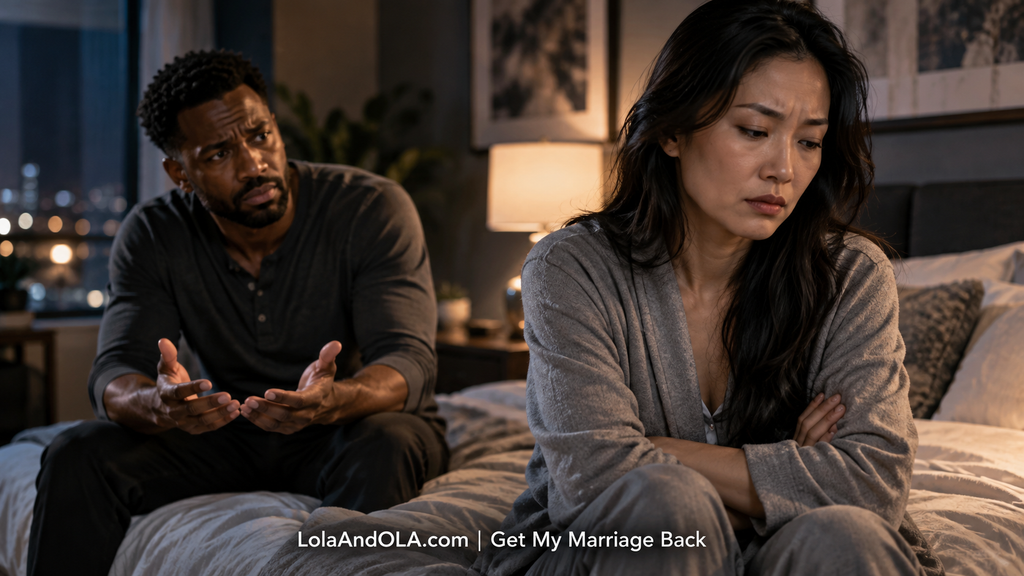
Your wife used to touch you, sit close, play with you, flirt with you, or initiate intimacy—and now even ordinary affection can feel like something she would rather avoid.

Take This 2 Minutes Quiz

Question 1 of 15

That change can mess with your head because it rarely feels like “just” a lack of physical touch. It can feel like rejection of you.

Maybe you reach for her shoulder and she stiffens. You move closer on the couch and she creates another few inches of distance. You initiate a kiss and receive the kind of response that makes you wonder whether you should have tried at all.

Then your mind starts filling in the blanks.

Does she still love me? Is she no longer attracted to me? Is there somebody else? Is this a sexless marriage now? Is she emotionally checked out? Does she want a separation? Can this marriage be saved?

Those questions are understandable. But when your wife never initiates affection, your first job is not to answer them from fear.

Your first job is to understand what changed.

Wife Never Initiates Affection: Don’t Confuse the Symptom With the Cause

A dry spell and deep emotional withdrawal are not automatically the same thing.

Real marriages have seasons. Stress rises. Children need attention. Careers become demanding. Health changes. Sexual desire fluctuates. Familiarity can temporarily replace novelty.

That does not mean every decline in affection is evidence that your marriage is dying.

But there is an important difference between having less sex for a season and experiencing a spouse who seems physically resistant to you.

When your wife isn’t sexually attracted to you—or when that is what you fear—your attention naturally locks onto the visible symptom. You notice how often she initiates sex. You count kisses. You notice whether she touches you in bed. You remember how she used to respond.

The danger is assuming the symptom explains itself.

It doesn’t.

Affectionate touch is closely connected with romantic bonding.

Research involving 7,880 people across 37 countries found a robust positive association between love and affectionate touch in romantic relationships.

Other relationship research has found that feeling understood, validated, and cared for by a partner predicts affectionate touch. In other words, touch is not merely something bodies do; it often reflects what is happening inside the relationship.

That is why trying to manufacture more touch without understanding the relational context can backfire.

wife never initiates affection

The Flowers-and-Date-Night Trap

Suppose your wife has stopped initiating intimacy.

Your instinct may be to create more intimacy.

So you buy flowers.

You organize a date.

You become extra nice.

You introduce something new sexually.

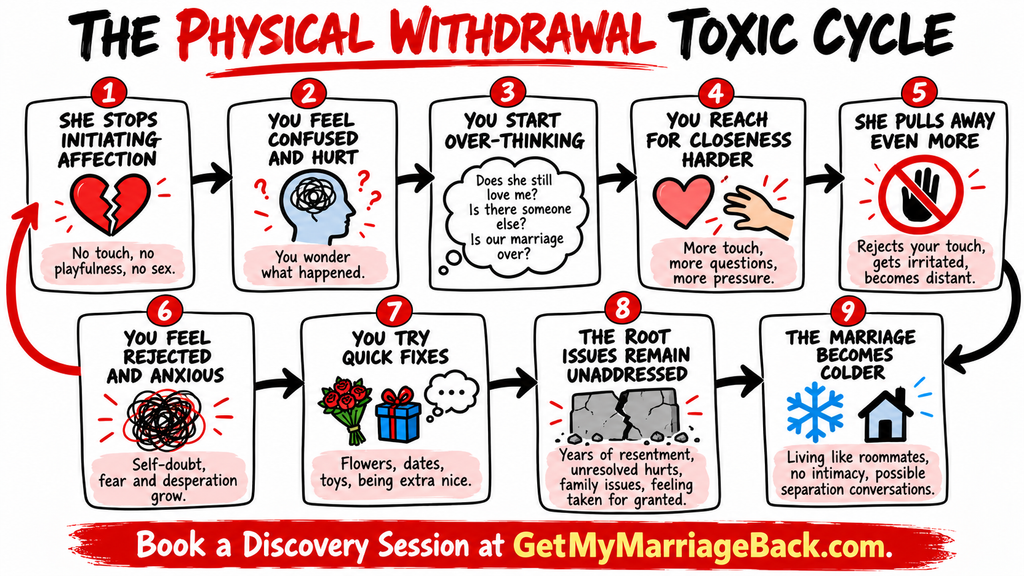
You repeatedly reach for her because you desperately want to recreate what disappeared.

None of those behaviors is inherently wrong. The mistake is using them as treatment before understanding the diagnosis.

Imagine smoke coming from a building. Painting the walls doesn’t extinguish the fire.

Likewise, if years of unresolved hurt are underneath your wife’s withdrawal, flowers may be received as flowers while the resentment remains exactly where it was.

This is one reason generic marriage advice can become dangerous during a serious marriage crisis. The same symptom can have very different causes.

What If Her Physical Withdrawal Has a History?

I once worked with a husband whose problem had progressed far beyond a disappointing sex life.

His wife didn’t want ordinary touch.

Playful banter had disappeared. Casual affection was unwelcome. Even touching her shoulder could provoke a reaction that made him feel as though she wanted his hand off her immediately.

He wanted his wife back badly.

What eventually surfaced was extraordinary: approximately 17 years of resentment.

She began describing experiences from when she was a new wife entering his family. In her account, she had felt taken for granted by members of the family and by her husband. Experiences she believed had never been properly addressed were still emotionally alive many years later.

He was shocked.

Her response was essentially: I’ve told you this many times. You don’t listen.

Now, don’t turn that sentence into an internet slogan.

Your spouse saying “you don’t listen” doesn’t automatically make every interpretation she has of the marriage objectively correct. Marriage reconciliation requires more emotional intelligence than blindly accepting one person’s narrative or defensively rejecting it.

The important discovery was different.

Her physical withdrawal had a story attached to it, and he didn’t understand that story.

That distinction changes everything.

Why Attraction Loss Can Be Bigger Than Sex

When people hear “attraction,” they often reduce it to physical appearance or sexual technique.

That is far too narrow.

Attraction in a long-term marriage is experiential.

Your spouse experiences your emotional presence, reactions, confidence, communication, predictability, boundaries, self-respect, attentiveness, resentment, anxiety, playfulness, purpose and behavior.

All of that becomes part of what it feels like to be married to you.

Research supports the importance of this broader relational context. Studies of romantic couples have found that perceived partner responsiveness—feeling that a partner understands, validates and cares for you—predicts affectionate touch. Research on perceived partner responsiveness and affectionate touch also found evidence of a reciprocal process: responsiveness can forecast affectionate touch, while affectionate touch can subsequently contribute to perceptions of responsiveness.

That’s important when you’re trying to build and nurture attraction in marriage.

You cannot intelligently reduce the problem to: “How do I get my wife to touch me again?”

A better question is:

“What has the experience of this marriage become, and what part of that experience can I influence?”
wife never initiates affection - stop asking your wife

Stop Asking Your Wife to Prove You’re Still Wanted

One of the easiest ways to make attraction loss worse is to turn affection into a test.

You reach for her.

She pulls away.

Your nervous system immediately interprets the moment.

Then you ask:

“Why don’t you ever touch me anymore?”

From your perspective, you may simply be expressing pain.

From hers, the question may feel like an accusation, obligation or indirect declaration that she is failing as a wife.

Now she becomes defensive.

You become emotional because her defensiveness feels like another rejection.

Suddenly you’re arguing about the absence of affection while creating an experience that makes spontaneous affection even less likely.

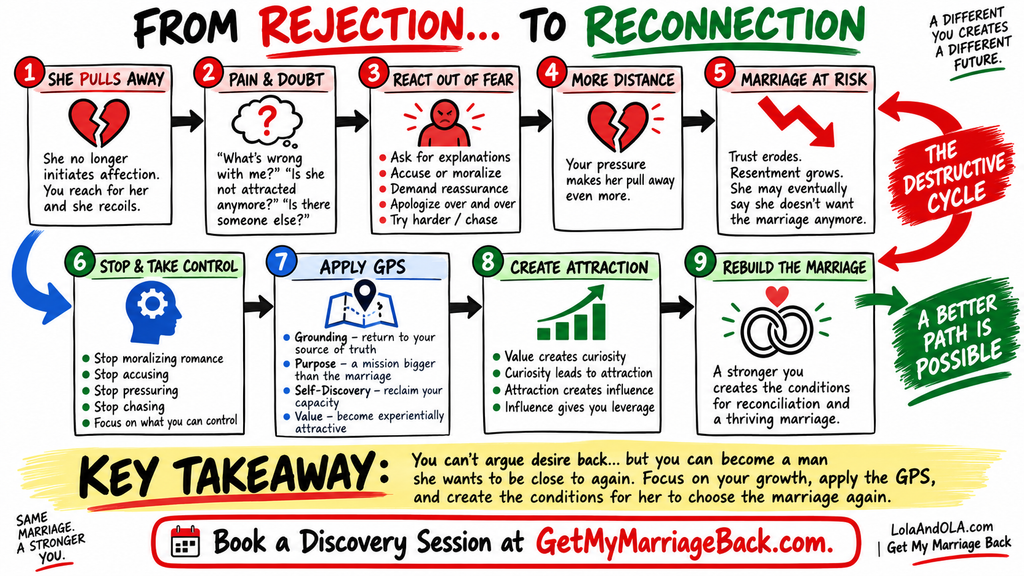
That is the cycle you must interrupt.

Seduction in a marriage crisis is not coercion, pressure, sexual tricks or endlessly proving how nice you are.

Skillful seduction starts by understanding experience.

Attraction Grows Differently From Reassurance

When you’re frightened about losing your marriage, reassurance becomes addictive.

You want confirmation that she still loves you.

You want a hug to prove everything isn’t falling apart.

You want sex because sex would temporarily quiet the voice telling you that your marriage is over.

You want her to say she isn’t leaving.

The problem is that chasing reassurance can make every interaction carry emotional weight.

Your spouse doesn’t simply receive a hug. She may sense that the hug contains a question:

Are we okay now?

A kiss contains another:

Are you attracted to me again?

Sex contains another:

Does this mean you’re staying?

That is an exhausting amount of meaning to place on ordinary affection.

Attraction needs more room than that.

Start With Root-Cause Analysis

Before trying to save marriage from divorce with more romantic gestures, study the marriage.

Ask yourself:

What changed?

When did affection noticeably decline?

What happened before that?

Was there a betrayal, repeated conflict, family problem, financial crisis, affair, childbirth, major disappointment, prolonged neglect, unresolved argument or period when one spouse felt abandoned?

Did attraction disappear suddenly, or did it erode gradually?

What complaints have been repeated so many times that you stopped hearing them?

This is not an invitation to obsess over every interaction or accept all blame.

It is an invitation to become curious instead of reactive.

Curiosity gives you information.

Fear gives you stories.

Don’t Let Fear Write the Story

When you don’t know why your wife stopped initiating intimacy, your brain will happily create explanations.

She doesn’t love me.

There must be another man.

She’s cheating.

Our marriage is over.

I’ll live like this forever.

Maybe one of your fears contains some truth. Maybe none does.

You don’t know yet.

The problem begins when you react to an unverified story as though it were established fact.

You start convincing.

Defending.

Interrogating.

Monitoring.

Pursuing.

Overexplaining.

Trying to force certainty out of someone who may already feel emotionally crowded.

That is how fear turns attraction loss into more attraction loss.

Ground Yourself Before You Try to Get Her Back

Your wife’s present response cannot become the measurement of your identity.

Her rejection can hurt without defining your worth.

This matters because emotional grounding changes your behavior.

When you are grounded, you can hear something painful without immediately defending yourself. You can observe distance without instantly chasing it. You can acknowledge a mistake without collapsing into guilt.

You can also disagree without becoming hostile.

That emotional steadiness is attractive because it changes the experience of interacting with you.

This is where saving your marriage alone begins—not with controlling your spouse, but with becoming responsible for the part of the relational dynamic you actually control.

Reconnect With Purpose

A marriage crisis can shrink your entire life until your spouse becomes the center of every thought.

Did she smile?

Why didn’t she text?

Why did she sit over there?

Why didn’t she kiss me?

What did that tone mean?

That isn’t purpose. That’s surveillance driven by anxiety.

Your life, impact and legacy must become bigger than chasing reassurance from one person.

Purpose doesn’t mean ignoring your marriage. It means refusing to abandon yourself while trying to save it.

A person with purpose can love deeply without begging for emotional oxygen.

That difference matters.

Practice Self-Discovery Without Self-Blame

Marriage help becomes useless when every lesson turns into:

“Everything is my fault.”

That’s not emotional intelligence.

Study your capacity, patterns and behaviors honestly.

How do you react to rejection?

Do you pressure when you’re afraid?

Do you withdraw to punish?

Do you become excessively agreeable?

Have you confused being a “good spouse” with becoming someone who never disagrees, never sets boundaries and constantly seeks approval?

Self-discovery allows you to see your patterns without turning insight into shame.

The objective isn’t to prove you’re good.

It is to become more effective.

Create Experiential Value

You cannot demand attraction.

You can influence the conditions in which attraction has room to re-emerge.

I call this experiential value.

Instead of asking, “How can I convince my spouse that I’m worth staying with?” ask:

“What is it like to experience me right now?”

Is your presence tense or grounded?

Predictable or intriguing?

Demanding or emotionally spacious?

Defensive or curious?

Dependent or purposeful?

Heavy or playful?

You are not performing a character to manipulate your spouse. You are developing the emotional and relational skills that make your presence different.

Value creates curiosity.

Curiosity creates conditions where attraction can breathe.

Attraction creates influence.

That is far more sustainable than trying to negotiate your spouse into wanting you.

Affection Is Valuable—But It Cannot Be Forced

None of this means touch is unimportant.

Quite the opposite.

Research has repeatedly linked affectionate touch with relationship well-being. A longitudinal study of older married couples found that shared affectionate touch predicted increases in one’s own relationship satisfaction, life satisfaction and mental health over five years, independent of sexual activity.

Research involving married individuals has also found that affectionate communication may help buffer some of the negative association between infrequent sexual activity and marital and sexual satisfaction.

So yes, touch matters.

But healthy affection is not extracted.

It is exchanged.

Your objective is not to engineer compliance from your spouse. It is to understand what has made affectionate exchange disappear and begin changing the relational conditions you can legitimately influence.

Don’t Treat Every Rejection Like an Emergency

Tonight you may understand all of this perfectly.

Then your spouse walks past.

You reach for her.

She pulls away.

Suddenly your intellectual understanding disappears.

Your old emotional pattern takes over.

This is why knowledge alone doesn’t transform a marriage.

Under emotional pressure, familiar responses are easy to repeat. You need enough self-awareness to notice the trigger before the trigger starts making decisions for you.

That moment is where emotional intelligence becomes behavior.

Can you experience rejection without retaliating?

Can you tolerate uncertainty without demanding reassurance?

Can you remain warm without becoming needy?

Can you create space without using silence as punishment?

Can you stay attractive to yourself while your spouse is temporarily unable or unwilling to validate you?

Those are marriage skills.

When Your Wife Wants Separation

The stakes become higher when affection loss progresses into emotional checkout or talk of living separately.

The husband I described earlier eventually faced exactly that escalation. His wife discussed living elsewhere, closer to the children, while they effectively visited one another.

That devastated him.

By then, however, the physical withdrawal was not the beginning of the crisis.

It was evidence of a much longer story.

This distinction matters when you’re trying to save marriage while separated or when your spouse wants out. You cannot assume the most recent symptom is the original wound.

Marriage reconciliation becomes much more intelligent when you stop asking only, “How do I stop the separation?” and also investigate, “What sequence of experiences made separation feel desirable to my spouse?”

Can Marriage Be Saved When Attraction Is Gone?

Attraction loss is serious.

It is not automatically a verdict.

A spouse saying “I don’t feel attracted to you” describes a present experience. It does not give you a complete causal analysis of how the relationship reached that point or tell you everything that can happen next.

The useful question is not whether you can force attraction back.

You can’t.

The useful question is whether you can understand the conditions surrounding attraction loss, change destructive patterns, develop better relational skills and create a substantially different experience of the marriage.

That gives you meaningful work to do without pretending you control another adult.

What To Remember When Your Wife Never Initiates Affection

Don’t panic.

Don’t generalize.

Don’t turn every rejected touch into evidence that divorce is inevitable.

Don’t outsource your marriage strategy to relatives or friends who already dislike your spouse.

Don’t decorate unresolved damage with flowers, gifts and sexual tricks.

Most importantly, don’t treat the withdrawal before you understand the wound.

A temporary dry spell is one thing.

A spouse who has psychologically connected your touch with years of unresolved pain is something completely different.

Your job is not to force affection back into your marriage.

Your job is to become grounded enough to understand the real problem, emotionally intelligent enough to stop making it worse, curious enough to discover the story underneath the symptom, and skillful enough to create a different relational experience.

That’s how you begin building attraction without begging for it.

That’s how you become seductive without becoming manipulative.

And that’s how you give marriage reconciliation something far more powerful than another desperate attempt to “get the spark back.”

19 Signs Your Wife Is Not Sexually Attracted To You

Frequently Asked Questions

Why does my wife never initiate affection?

A wife may stop initiating affection because of stress, resentment, emotional disconnection, attraction changes, relationship conflict, health factors or other personal circumstances. The pattern matters most when you investigate what changed before the withdrawal instead of assuming one universal cause.

Does my wife not initiating intimacy mean she isn’t attracted to me?

Not necessarily; sexual desire and affectionate behavior are influenced by both individual and relationship factors. Persistent withdrawal, however, deserves attention because affectionate touch is meaningfully associated with intimacy and relationship quality.

What should I do when my wife pulls away from my touch?

Don’t repeatedly test her by touching her again or demand immediate reassurance; respect the boundary and become curious about the larger relationship pattern. Study when the withdrawal began, what preceded it and what unresolved experiences may still be shaping how closeness feels.

Can a marriage be saved after affection and attraction disappear?

Marriage reconciliation can remain possible when spouses develop a clearer understanding of the underlying problems and change destructive interaction patterns. Focus first on what you can influence—your grounding, behavior, communication, purpose and relational skills—rather than trying to force your spouse to feel differently.


Wife Never Initiates Affection? 7 Shifts That Rebuild Attraction

Your wife used to initiate affection, welcome your touch, and make you feel wanted—but now you reach for her and feel her pulling away.

Take This 2 Minutes Quiz

Question 1 of 15

Few changes inside a marriage feel as personal as this one.

Maybe your wife never initiates affection anymore. Perhaps she rarely initiates sex, seems uncomfortable when you touch her, or gives you the feeling that physical closeness has become something she tolerates rather than desires.

That can mess with your head.

You start wondering:

“Is my wife still attracted to me?”

“Is there someone else?”

“Why does she never initiate intimacy?”

“What happened to the woman who used to want me?”

And underneath those questions is often an even more painful one:

“What does this say about me?”

I want you to be careful here, because the explanation you create for her withdrawal can become more destructive than the withdrawal itself.

Your goal is not to become indifferent to rejection.

Your goal is to become emotionally intelligent enough that rejection does not control your next move.

When Your Wife Never Initiates Affection, Don’t Turn Pain Into a Verdict

Physical rejection hurts.

I am not going to tell you to pretend otherwise.

When someone who once welcomed your touch begins pulling away, your nervous system naturally notices the contrast. The problem begins when you convert that contrast into certainty.

“She doesn’t love me.”

“She must be cheating.”

“She lied to me.”

“Our marriage is over.”

“I’m not attractive anymore.”

Those are interpretations.

They may feel like facts because rejection is emotionally intense, but intensity does not automatically make an interpretation accurate.

This distinction matters because your interpretation determines your behavior.

If you decide her withdrawal means betrayal, you may interrogate.

When you decide it means you are undesirable, you may start fishing for reassurance.

Once you decide she owes you affection because you are married, you may pressure her.

Each reaction can make an already fragile attraction dynamic heavier.

wife never initiates affection

The Dangerous Marriage Equation: “I’m Good, So You Should Desire Me”

One of the fastest ways to make romance feel less romantic is to moralize attraction.

You may have been faithful.

You may provide.

Perhaps you kept your vows, sacrificed for your family, remained committed during difficult seasons, and genuinely tried to be a good spouse.

Those things matter.

But they do not create an invoice for attraction.

You cannot say, in effect:

“I fulfilled my responsibilities, therefore you should desire me.”

Desire does not respond particularly well to prosecution.

Think about what happens when affection becomes evidence in a courtroom.

Every rejected touch becomes Exhibit A.

Every night without sex becomes Exhibit B.

Every moment when your wife does not initiate becomes another argument proving that something is wrong with her, you, or the marriage.

Now your wife is no longer experiencing your affection simply as affection.

She may experience it as a test.

Will she respond correctly?

Will she initiate enough?

Will she prove that she still desires you?

That pressure can make physical closeness increasingly difficult.

wife never initiates affection - A Crisis of Attraction Can Become a Moral Prosecution

A Crisis of Attraction Can Become a Moral Prosecution

I have seen this dynamic become especially destructive when someone believes they did everything “right” before marriage.

Imagine a husband who married his wife as a virgin after practicing celibacy himself.

They intentionally entered marriage believing their choices gave them a strong foundation.

Years later, she stops initiating sex and affection.

He cannot reconcile her lack of desire with what he believes about their beginning.

So he develops an explanation:

“She must have lied.”

Now the attraction problem has become an integrity problem.

He confronts her.

She denies lying.

Instead of resolving his fear, her denial makes him push harder because he still needs an explanation for why she no longer seems to want him.

Eventually, the marriage is no longer primarily dealing with lost attraction.

It is dealing with suspicion, defensiveness, pressure, resentment, and repeated prosecution.

That is how a painful symptom can become an even bigger marriage crisis.

What Does It Really Mean When Your Wife Doesn’t Want Affection?

There is no single explanation.

Attraction can be affected by unresolved conflict, chronic stress, resentment, relational dynamics, health issues, sexual difficulties, emotional disconnection, life transitions, exhaustion, familiarity, pressure, or changes in how two people experience each other.

That is why Story-Tailoring matters.

You cannot safely take one explanation from another marriage and automatically paste it onto yours.

Still, there is an important principle you can use immediately:

Stop treating every instance of rejection as a complete diagnosis of your marriage.

Your wife pulling away tonight tells you something about what she is experiencing tonight.

It does not automatically tell you everything about tomorrow.

Shift #1: Stop Chasing Reassurance

When affection disappears, reassurance becomes incredibly tempting.

“Do you still love me?”

“Are you attracted to me?”

“Why don’t you ever touch me?”

“Are we okay?”

One conversation may be reasonable. Repeatedly needing your wife to regulate your fear is something different.

The more desperately you need reassurance, the more every interaction becomes loaded with expectation.

You are no longer simply connecting.

You are checking.

That difference can be felt.

Seduction requires enough emotional space for curiosity, anticipation, individuality, and voluntary movement toward another person.

Constant reassurance-seeking tends to collapse that space.

Shift #2: Stop Confusing Begging With Pursuit

Pursuit and chasing are not the same thing.

Healthy pursuit can communicate interest, confidence, warmth, playfulness, intention, and desire.

Chasing says:

“Please respond so I can feel okay.”

Begging says:

“Please give me affection so I can stop feeling rejected.”

Pressure says:

“You should respond because I am your spouse.”

Those behaviors may look superficially similar because they all involve reaching toward someone.

Emotionally, however, they come from very different places.

The objective is not to become cold or perform indifference.

It is to express interest without making your emotional stability dependent on the response.

Shift #3: Build G.A.M.E.—Not Manipulation

When I talk about GAME, I mean:

Giving Authentically but Mindfully with Emotional intelligence.

GAME is skill.

You are authentic because you are not pretending that you have no desires.

You are mindful because you pay attention to timing, context, emotional climate, and the other person’s experience.

Emotional intelligence allows you to notice your own fear without immediately making your spouse responsible for soothing it.

That is dramatically different from using tactics to trick someone into wanting you.

Real seduction is not coercion.

It creates an experience in which attraction has room to emerge voluntarily.

Shift #4: Start With GPS Before Trying to Rebuild Attraction

Before you obsess over getting your wife to initiate affection again, strengthen your internal position.

I call this GPS:

Grounding. Purpose. Self-Discovery.

Grounding

Ground yourself in a source of truth bigger than whether your wife accepts your touch tonight.

Without grounding, her response becomes your emotional weather report.

She welcomes you, and you feel powerful.

She pulls away, and you collapse.

That volatility makes skillful behavior difficult.

Purpose

Redirect emotional energy toward a mission, contribution, impact, and legacy bigger than any single human being.

Purpose does not mean neglecting your marriage.

It means your marriage is important without becoming the sole source of your identity.

That distinction creates emotional stability.

Self-Discovery

Use the crisis to discover capacity rather than manufacture self-blame.

Ask better questions.

Where have you become predictable?

Where did confidence become approval-seeking?

Where have resentment or fear changed your energy?

Which relational skills have you never actually learned?

Self-Discovery turns the crisis into information you can use.

Shift #5: Build Experiential Value, Not Just Moral Value

Being a good person matters morally.

Attraction, however, is experiential.

That distinction is crucial.

Your spouse experiences your energy, emotional regulation, presence, confidence, playfulness, social intelligence, purpose, boundaries, conversation, sexuality, decisiveness, warmth, and the emotional atmosphere created around you.

Those experiences contribute to how the relationship feels.

Research provides an interesting parallel. In studies of long-term relationships, perceived partner responsiveness—feeling that a partner understands, values, and cares for you—has been associated with greater sexual desire, with particularly strong effects observed among women in that research. You can review the research on partner responsiveness and sexual desire.

That does not mean becoming endlessly agreeable.

Responsiveness and neediness are not synonyms.

The larger point is that attraction lives inside experience.

You cannot substitute a résumé of marital virtues for the experience of being with you.

Shift #6: Create the Conditions for Curiosity

Familiarity is inevitable in marriage.

Over-familiarity does not have to be.

When your entire emotional world becomes organized around whether your spouse is responding, you can become increasingly predictable.

She knows what happens if she pulls away.

You ask why.

Then you become upset.

Next comes the relationship conversation.

Afterward, you seek reassurance.

Eventually she can anticipate the whole sequence before it starts.

Curiosity disappears when every interaction has an obvious ending.

Your job is not to manufacture mystery through games.

Instead, continue becoming a person with depth, direction, emotional range, independent thought, interests, purpose, standards, and a life that continues developing.

Experiential Value can create Curiosity.

Curiosity gives Attraction room to emerge.

Attraction increases Influence.

Influence can eventually create Leverage for building a different marriage.

Value → Curiosity → Attraction → Influence → Leverage.

Notice what is missing from that sequence.

Begging.

Shift #7: Prepare for Habit Drift

Understanding all of this while calmly reading an article is one thing.

Remembering it when your wife physically recoils from your touch is another.

Stress can pull people toward previously learned habitual responses rather than deliberate goal-directed behavior. In marriage, that can look like knowing exactly how you intended to respond and then hearing yourself say:

“What’s wrong with you?”

“Are you cheating?”

“Why don’t you ever want me?”

“I’m your husband!”

Your old pattern fires before your better judgment catches up.

I call that Habit Drift.

This is why insight alone rarely creates lasting change.

GPS5: Why Information Isn’t Enough

GPS gives you Grounding, Purpose, and Self-Discovery.

But sustainable execution requires four additional S’s:

Story-Tailoring

Your marriage has its own history, personalities, injuries, dynamics, circumstances, and attraction patterns.

Generic advice can become dangerous when you apply the right principle to the wrong problem.

Skill-Acquisition

Emotional intelligence is trainable.

So are conversation, boundaries, self-regulation, attraction dynamics, calibrated pursuit, conflict management, and relational awareness.

Knowing what not to do is only the beginning.

You need replacement skills.

Support

Rejection can make fear sound remarkably convincing.

Support gives you somewhere to process the emotional charge without repeatedly dumping it into the marriage.

System

You cannot rebuild attraction by improvising every time your spouse pulls away.

A system keeps your actions aligned with the marriage you are trying to create rather than the panic you are feeling today.

Your Wife’s Rejection Is Not Your Permission to Lose Yourself

Your wife never initiating affection can become one of the most painful experiences in your marriage.

It can also expose exactly where your emotional power has become dependent on another person’s response.

Your job is not to force your wife to accept your touch.

Neither should you pretend rejection does not hurt.

The answer is not making her feel guilty enough to give you affection.

Regain control over what you can control.

Build experiential value.

Create room for curiosity.

Develop attraction skills without coercion.

Strengthen your emotional intelligence.

Learn to pursue without begging.

Become responsive without becoming needy.

And build enough Grounding, Purpose, and Self-Discovery that your wife’s reaction tonight does not determine who you become tomorrow.

Attraction is not an invoice.

It is an experience.

Change the experience.

5 Physical Signs She Just Slept With Someone Else: The Truth

Frequently Asked Questions

Why does my wife never initiate affection?

There is no universal cause; stress, resentment, relational patterns, health factors, sexual difficulties, pressure, or attraction changes can all contribute. Look for the pattern and context rather than assuming one rejected touch explains the entire marriage.

Does my wife not initiating intimacy mean she isn’t attracted to me?

Not necessarily; initiation and attraction overlap, but they are not identical, and desire can be affected by many individual and relationship factors. Research also connects perceived partner responsiveness with sexual desire, suggesting that the relational experience surrounding intimacy matters.

Should I stop initiating affection if my wife always turns me down?

Stop using initiation as a test of your worth or as pressure for reassurance, and respect physical boundaries when affection is unwelcome. The larger objective is understanding the dynamic and rebuilding the conditions in which voluntary closeness can become possible.

Can attraction come back in a marriage?

Attraction and sexual satisfaction are not necessarily static; longitudinal research has found reciprocal associations between marital and sexual satisfaction over time. Focus on changing controllable relational patterns rather than trying to argue or guilt your spouse into desire.

Your Wife Is Cold and Distant: What Her Withdrawal Really Means

Your wife is cold and distant, and every attempt you make to get closer seems to push her even further away.

Take This 2 Minutes Quiz

Question 1 of 15

You can feel the change before you can explain it.

Her warmth is different. Conversations are shorter. Affection has disappeared or feels forced. You reach for her and she pulls away. Maybe she gives you the cold shoulder, spends more time alone, or treats you more like a roommate than the man she once desired.

You want answers because uncertainty is brutal.

“What happened?”

“Why are you acting like this?”

“Do you even want this marriage anymore?”

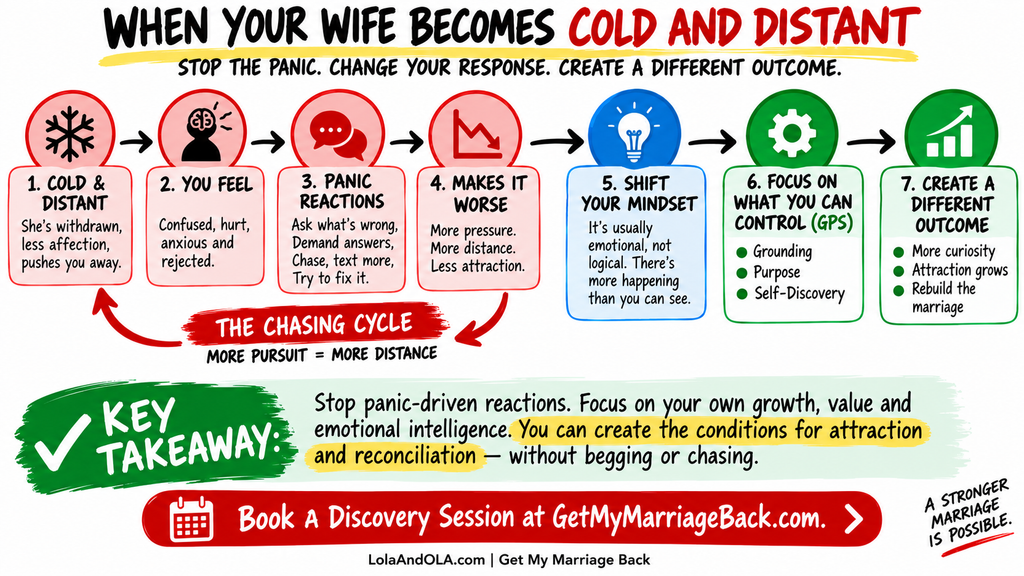
Those are reasonable questions. But when your wife is emotionally withdrawing, your desperation for clarity can become the pressure that makes her retreat even further.

That is where many husbands accidentally turn an attraction problem into a much bigger marriage crisis.

Why Is My Wife Cold and Distant Towards Me?

Start with something that sounds simple but changes everything:

There is probably more happening internally than you can currently see.

That doesn’t excuse cruelty, betrayal, contempt, or disrespect. Nor does it require you to tolerate unacceptable behavior.

It means you should resist the temptation to interpret every cold response as a complete explanation of what is happening inside her.

A cold wife can be angry.

She can be disappointed.

She can be overwhelmed.

There may be accumulated resentment, lost attraction, unresolved conflict, stress, exhaustion, broken trust, or an emotional disconnection neither of you properly addressed when it was smaller.

Sometimes she doesn’t completely understand what she is experiencing herself.

That ambiguity matters because the wrong diagnosis produces the wrong response.

When you immediately decide, “She doesn’t care about me anymore,” you naturally start reacting to that conclusion. Fear takes over, and suddenly you are chasing reassurance, monitoring her mood, demanding answers, or desperately trying to make her feel differently.

Now the original problem has company.

my wife is cold and distant

Mistake #1: Turning Her Emotional Distance Into a Court Case

When your wife becomes cold, you want to appeal to logic.

“You’re my wife.”

“We made vows.”

“You need to communicate.”

“At least treat me with respect.”

“We can’t fix this if you won’t talk.”

On paper, some of those statements sound perfectly reasonable.

But your marriage isn’t a courtroom, and your wife isn’t a defendant.

You cannot cross-examine someone back into attraction.

You also cannot produce enough evidence to force another human being to feel warmth, curiosity, desire, or emotional connection.

This is especially important when a demand-withdraw cycle has developed. In research involving 116 married couples reporting conflicts at home, both husband-demand/wife-withdraw and wife-demand/husband-withdraw patterns were associated with more negative emotions and tactics and lower conflict resolution. The researchers also found these patterns were especially likely around marital issues. You can read the research on demand-withdraw patterns in marital conflict.

Think about what that can look like in your house.

You feel her withdrawing, so you pursue an explanation.

She experiences more pressure, so she withdraws further.

Her withdrawal scares you, so you pursue harder.

Soon you are no longer solving the original issue. You are feeding a cycle.

Mistake #2: Making Her Mood the Source of Your Emotional Stability

Your wife is warm this morning, and you feel hopeful.

She is distant tonight, and suddenly you believe the marriage is doomed.

She laughs at something you say, and you think attraction is returning.

Tomorrow she barely speaks, and your stomach drops again.

That’s exhausting.

More importantly, you have allowed your wife’s current emotional temperature to control yours.

This is where self-leadership becomes critical.

Your wife can matter tremendously to you without becoming the source of your identity.

Her attraction matters. Your marriage matters. Saving your marriage can matter enormously.

But when your emotional stability requires constant reassurance from the very person who is currently withdrawing, you create pressure precisely where you need room.

You begin watching every facial expression.

Every text becomes evidence.

Every quiet evening becomes a verdict.

That isn’t personal power. It’s emotional dependence disguised as vigilance.

Mistake #3: Believing You Must Fix Her Coldness

When you desperately want to save your marriage, your instinct is to fix the obvious symptom.

You want her to talk again.

You want affection back.

You want sex again.

You want her to stop pushing you away.

Naturally, your attention goes directly toward changing her.

That’s the trap.

You cannot sustainably build attraction by managing another adult’s emotional state.

Your power starts with changing what you can actually control: your emotional regulation, reactions, purpose, presence, habits, communication, social intelligence, and the experience of being around you.

This distinction is enormous.

You are not trying to manipulate your wife into becoming warm.

You are becoming capable of creating a different relational experience without requiring an immediate reward from her.

when your wife becomes cold and distant

Attraction Is an Experience, Not an Obligation

A lot of people approach marriage as though attraction should automatically survive because the marriage exists.

I used to see marriage heavily through the lens of duty myself.

You’re married. You’re building a life. You have responsibilities. You manage whatever comes with it.

But duty and desire aren’t identical.

A person can fulfill responsibilities while the relationship becomes emotionally flat.

You can pay every bill and still become roommates.

Both people can remain technically married while curiosity, playfulness, admiration, emotional engagement, and sexual attraction quietly disappear.

This is why keeping score is dangerous.

“I’ve been trying.”

“I’ve been affectionate.”

“I’ve provided.”

“I apologized.”

“Now she needs to do her part.”

That’s not attraction.

That’s an invoice.

Value inside an intimate relationship isn’t merely about moral worth or proving that you’re a good person. Experiential value is about what another person experiences around you.

Are interactions consistently tense?

Does every conversation become a marriage summit?

Are you interesting beyond this crisis?

Can you tolerate uncertainty without collapsing?

Do you bring purpose, emotional intelligence, curiosity, confidence, playfulness, and grounded energy into your life?

Attraction has room to grow when being around you becomes an experience rather than an obligation.

Mistake #4: Chasing Harder Because She Is Pulling Away

There is an important difference between pursuit and chasing.

Pursuit can come from dignity, genuine interest, confidence, and desire.

Chasing comes from fear.

Chasing says:

“Please tell me we’re okay.”

“Why haven’t you answered?”

“Do you still love me?”

“Are you attracted to me?”

“Are you leaving?”

“What can I do to make you happy?”

The words aren’t always the problem. The emotional dependency underneath them is.

Your wife can feel when every interaction carries an invisible demand: Make me feel safe about this marriage right now.

That is an enormous job to place on someone who is already emotionally withdrawing.

So don’t confuse “stop chasing” with pretending you don’t care.

Coldness isn’t attractive either.

Playing games isn’t self-leadership.

Manufacturing jealousy isn’t confidence.

The objective is not to punish her withdrawal with your own withdrawal. Your objective is to stop fear from dictating your behavior.

When Your Wife Pushes You Away, Stop Trying to Win the Moment

One of the hardest skills in a marriage crisis is learning not to treat every bad interaction as an emergency.

She walks past you without speaking.

Your nervous system wants resolution now.

She gives you a cold response.

You want to confront it now.

She sleeps facing the other direction.

Your mind wants to know what it means now.

That urgency makes you vulnerable to bad decisions.

Instead of asking, “How do I make her stop being cold tonight?” ask a better question:

“Who am I becoming while this marriage is under pressure?”

That shifts you from reaction to leadership.

Mistake #5: Becoming the Victim of Every Rejection

It is possible for your wife’s behavior to be unfair.

You can be genuinely hurt.

You can disagree strongly with how she is handling the marriage.

Self-leadership does not require pretending otherwise.

But victimhood becomes dangerous when it convinces you that your only path forward is waiting for her to change first.

If she must apologize before you grow, you’re stuck.

When she must communicate before you become emotionally disciplined, you’re stuck.

If she must become affectionate before you reclaim your confidence and purpose, you’re stuck.

Your ability to lead yourself cannot depend on another person’s cooperation.

That doesn’t mean one person can single-handedly maintain a healthy marriage forever. Ultimately, a marriage involves two people.

But you don’t need two people to stop contributing to a destructive cycle.

You need one.

Start with the person you control.

Ground Yourself Before You Try to Rebuild Attraction

When your marriage feels like it is collapsing, grounding means returning to a source of truth larger than the symptom in front of you.

The symptom is:

“My wife is cold.”

“My wife isn’t attracted to me.”

“She keeps pushing me away.”

“She wants separation.”

“She might want a divorce.”

Those circumstances matter, but they cannot become your entire identity.

Grounding gives you enough emotional distance from the immediate panic to choose your response instead of being dragged around by fear.

This is where gratitude also matters.

Not gratitude as denial.

You don’t pretend your marriage is fine.

Instead, you reconnect with what remains true and valuable in your life while confronting the crisis honestly.

A grounded person becomes harder to emotionally destabilize.

That quality matters tremendously when you are trying to rebuild attraction.

Reclaim a Purpose Bigger Than Your Marriage Crisis

Pain narrows your vision.

Suddenly everything becomes your marriage.

You wake up thinking about her.

You check your phone thinking about her.

At work, you’re analyzing last night’s conversation.

At home, you’re watching her face for clues.

Before sleeping, you’re replaying everything again.

That obsession doesn’t make you more committed. Eventually, it can make you less interesting, less stable, and less capable of handling the very crisis you desperately want to solve.

Purpose redirects pain into something larger.

What impact are you here to create?

What legacy are you building?

Who needs the strongest version of you?

What work would still matter if nobody applauded you?

Your purpose must be bigger than any single living human being—including your wife and including yourself.

This isn’t abandoning your marriage.

It is refusing to abandon yourself while saving it.

Use Self-Discovery Without Turning It Into Self-Blame

There is another extreme you need to avoid.

Once you realize that you can only control yourself, you can start blaming yourself for everything.

Don’t.

Self-discovery isn’t self-condemnation.

Ask useful questions instead.

What have you failed to notice?

Where have you become predictable?

Have you become chronically reactive?

Did marriage turn into duty instead of an engaging relationship?

Are you communicating because you have something meaningful to share—or because you need reassurance?

Has your entire identity narrowed into provider, parent, problem-solver, or rejected spouse?

What patterns do you bring into conflict?

These questions restore power because they reveal capacity.

You cannot change what you refuse to examine.

Build Value Before Demanding Attraction

This is where the work becomes practical.

Experiential value is the quality of the experience someone has around you.

It isn’t perfection.

It isn’t money.

Nor is it performing tricks to win your wife back.

Value can show up as emotional steadiness when you used to panic.

It can be listening without immediately defending yourself.

Sometimes it means bringing energy, purpose, humor, curiosity, social connection, competence, or playfulness back into a life that became consumed by marital problems.

You are creating contrast between the person fear was turning you into and the person you are capable of becoming.

That contrast can create something important:

Curiosity.

She starts noticing that something feels different.

Curiosity creates room for renewed attraction because she is no longer interacting with exactly the same predictable pattern.

Attraction can then create influence.

Influence creates leverage—not leverage for controlling her, but relational leverage for building a different experience between you.

That sequence cannot be bullied into existence.

It has to be experienced.

Stop Making Every Interaction About Saving the Marriage

Imagine living with someone who turns every dinner, car ride, text message, bedtime, or quiet moment into a referendum on the relationship.

That’s exhausting.

You desperately want to save your marriage, so everything starts becoming about saving the marriage.

Ironically, that can remove the very qualities that make marriage enjoyable.

There is no curiosity.

No play.

No discovery.

Every interaction carries emotional weight.

Give the relationship room to contain experiences that aren’t negotiations about its survival.

This doesn’t mean avoiding important issues indefinitely. It means understanding that connection needs oxygen.

What If She Says She Wants Separation or Divorce?

Now the stakes are higher, but the fundamental principle doesn’t change.

Don’t beg.

Don’t threaten.

Avoid writing an emotional dissertation trying to convince her that she’s wrong.

Don’t make promises you invented five minutes after hearing the word “divorce.”

Listen carefully to what is actually being communicated.

A spouse wants out for reasons that developed within a larger relationship history. Your panic response cannot erase that history overnight.

Separation can make your fear scream that you must do something dramatic immediately.

Choose deliberate action instead.

Saving your marriage while separated still begins with emotional intelligence, self-leadership, understanding your contribution to the dynamic, and rebuilding the qualities that make connection possible.

Can Marriage Be Saved When Your Wife Is Emotionally Checked Out?

Emotional withdrawal is serious.

Treat it seriously before paperwork makes the seriousness obvious.

At the same time, don’t automatically interpret distance as proof that every feeling she ever had for you has disappeared.

Research on demand-withdraw behavior is useful here because it shows that withdrawal exists inside relational patterns—not merely inside one “bad” spouse. Context matters, who wants change matters, and both husbands and wives can occupy either role.

That gives you somewhere productive to look.

Instead of obsessing over “How do I make her change?” examine the cycle.

What happens immediately before she withdraws?

How do you respond?

What happens next?

Where does the pattern repeat?

That is far more useful than simply labeling your wife cold and waiting for her to become warm again.

How to Save Your Marriage Without Begging for Love

Your marriage crisis presents you with two paths.

Fear tells you to chase certainty.

Self-leadership tells you to build capacity.

Fear wants reassurance tonight.

Purpose prepares you to behave differently tomorrow.

Fear watches her.

Grounding watches you.

Fear demands attraction.

Value creates conditions where attraction can breathe.

That is the shift.

You are not becoming indifferent to your wife. You are learning how to care deeply without allowing fear to turn care into pressure.

Nor are you surrendering the marriage.

You are becoming more skillful about how you fight for it.

When your wife is cold and distant, your strongest move isn’t forcing warmth out of her.

It’s becoming grounded enough to understand the dynamic, disciplined enough to stop feeding it, curious enough to discover your blind spots, and valuable enough to create a different experience.

That’s how you give curiosity room to return.

That’s how attraction gets oxygen.

And that’s how you begin creating the influence and leverage required for genuine marriage reconciliation.

5 Physical Signs She Just Slept With Someone Else: The Truth

Frequently Asked Questions

Why is my wife cold and distant towards me?

Coldness can reflect unresolved resentment, stress, attraction loss, disappointment, conflict, or a demand-withdraw cycle; the behavior alone cannot tell you which explanation applies. Look for the repeating interaction pattern rather than assuming one cold response explains her entire emotional state.

What should I do when my wife is emotionally distant?

Stop trying to force immediate reassurance and examine what you can control: your reactions, emotional regulation, communication, purpose, and contribution to the relationship dynamic. Pressure can intensify withdrawal, especially when a demand-withdraw pattern has already formed.

Does a distant wife mean she doesn’t love me anymore?

Not necessarily; emotional distance is a behavior, not a definitive measurement of love, attraction, or future intentions. Persistent withdrawal is still worth taking seriously because unresolved patterns can deepen marital distress.

Can I save my marriage if my wife is pushing me away?

One person can begin changing their contribution to a destructive pattern, although a sustainable marriage ultimately requires participation from both spouses. Focus first on stopping fear-driven chasing and rebuilding emotional stability, experiential value, curiosity, and healthier influence.

Wife Never Initiates Sex? 7 Traps That Kill Desire—and What Works

When your wife never initiates sex anymore, the rejection can become so personal that every night in bed starts feeling like another verdict on your marriage.

Take This 2 Minutes Quiz

Question 1 of 15

You reach for her. You initiate the kiss. You initiate affection. You try to create sexual intimacy.

Then you stop initiating just to see what happens.

Nothing.

That silence can hurt more than an argument because now you are left trying to interpret it.

Does she still love you? Is your wife still sexually attracted to you? Is somebody else getting her attention? Has the marriage become sexless? Are you becoming roommates? Is separation or divorce coming next?

What you are experiencing is completely unfair.

You married this woman. You have invested years of your life, built memories, carried responsibilities, made sacrifices, and possibly raised children together.

You should not have to pretend that sexual rejection from your own wife does not hurt.

But there is an important distinction between validating the unfairness of the situation and allowing that unfairness to control what you do next.

That distinction can determine whether you become increasingly attractive to experience—or increasingly associated with pressure.

Why Does My Wife Never Initiate Sex?

Your wife’s lack of sexual initiation is a symptom.

It is not automatically the diagnosis.

She may love you and still experience low sexual desire. There may be resentment, chronic stress, exhaustion, unresolved conflict, hormonal or health factors, emotional disconnection, attraction loss, sexual dissatisfaction, routine, or a combination of issues underneath the visible behavior.

Research also suggests that desire naturally changes in long-term relationships. A systematic review of long-term sexual desire describes desire as something that can ebb and flow within individuals and relationships rather than remaining permanently fixed.

That matters because one of the most destructive conclusions you can make is:

“She doesn’t want sex right now, therefore she will never want me again.”

Those are not the same statement.

Your current reality matters.

It just does not have to become your permanent identity.

Trap #1: Turning Her Rejection Into Your Identity

At first, the problem is:

“My wife never initiates sex.”

Eventually, the problem becomes:

“My wife doesn’t desire me.”

Then:

“I am undesirable.”

Notice what happened.

A relationship condition became an identity.

Now her behavior determines how you feel about yourself.

When she kisses you passionately, you feel confident.

When she turns away, you collapse.

When sex happens, you think the marriage is recovering.

Three days without affection and panic returns.

This is where sexual intimacy stops being intimacy and becomes emotional evidence.

You are no longer simply enjoying your wife.

You are using her response to answer a much more frightening question:

“Am I still okay?”

That is too much emotional weight to place on sex.

wife never initiates sex

Trap #2: Begging for Reassurance Instead of Building Attraction

Once rejection starts controlling your emotional state, reassurance becomes addictive.

“Do you still love me?”

“Are you attracted to me?”

“What’s wrong?”

“Are we okay?”

“Why don’t you ever touch me anymore?”

“Is there somebody else?”

You are looking for certainty.

I understand why.

But reassurance and attraction perform completely different jobs.

Reassurance temporarily calms fear.

Attraction creates desire.

You can successfully convince your wife to tell you that she loves you and still have absolutely no improvement in your sex life.

That is because love and sexual attraction are related experiences, but they are not identical experiences.

Two people can care deeply about each other while their romantic marriage slowly becomes a roommate relationship.

Trap #3: Believing “Love Is Give and Take”

You have probably heard this your entire life:

“Marriage is give and take.”

There is truth in reciprocity, but attraction becomes dangerous when you turn that principle into a sexual transaction.

You touched her, therefore she should touch you.

You have been a good husband, therefore she should desire you.

You provided for the family, therefore she should appreciate you sexually.

You planned the date, therefore intimacy should follow.

You helped around the house, therefore she should recognize your effort.

But how is that working?

Desire does not operate like an invoice.

Once your generosity secretly requires sexual repayment, she can experience the expectation even when you never explicitly state it.

Now dinner has an agenda.

Affection has an agenda.

The romantic getaway has an agenda.

Even self-improvement can develop an agenda.

“Did she notice me yet?”

That is not seduction.

That is performance followed by evaluation.

Trap #4: Trying to Communicate Her Into Desire

“Just communicate” has become one of the most repeated pieces of relationship advice on the internet.

Communication matters.

But another emotionally loaded conversation does not automatically manufacture desire.

Your wife probably already knows that you are unhappy about the lack of sex.

She probably knows you want more affection.

Explaining your rejection for the seventh time may give you temporary emotional release while making intimacy feel increasingly connected to obligation, guilt, and pressure for her.

There is also an important difference between quality communication and constant communication.

An honest conversation can increase understanding.

Repeated interrogation can turn the marriage into a permanent relationship meeting.

So communicate when communication actually serves understanding.

Then stop trying to verbally negotiate attraction into existence.

Trap #5: Chasing Harder When She Withdraws

You notice her pulling away.

Fear says:

Close the distance immediately.

So you initiate more.

You become extra affectionate.

You send longer texts.

You apologize for things you have not even decided were wrong.

You explain your intentions.

You become unusually agreeable.

You ask for another conversation.

You pursue reassurance.

She withdraws more.

Now you chase harder.

This is the rejection cycle:

Rejection → Fear → Chasing → Pressure → Withdrawal → More Rejection

Your original desire to save your marriage is not the problem.

The fear-driven execution is.

There is a difference between pursuit and chasing.

Healthy pursuit expresses interest with dignity.

Chasing demands a response because your emotional stability depends on receiving one.

You can desire your wife without begging her to desire you back.

Trap #6: Assuming No Initiation Means No Love

Your wife can love you and not feel strong sexual desire right now.

That reality is painful, but understanding it gives you a much more useful starting point than arguing with it.

Research supports the idea that relationship context matters to desire. For example, research on partner responsiveness and sexual desire found that perceived partner responsiveness—experiencing a partner as understanding, validating, and caring—was associated with sexual desire. The research does not reduce attraction to one factor, but it reinforces an important point: desire exists inside an experience, not merely inside a marriage certificate.

That means being married does not automatically create attraction.

Being responsible does not automatically create attraction.

Having history together does not automatically create attraction.

Love itself does not automatically create attraction.

This is where your opportunity begins.

Instead of demanding:

“Why doesn’t she want me?”

Ask:

“What has it become like to experience this marriage—and what can I control about the experience of me?”

That question takes you somewhere useful.

Trap #7: Making Sex the Only Goal

Of course you want sex.

Let’s not pretend otherwise.

The objective is not to turn you into a man who becomes emotionally comfortable with a permanently sexless roommate marriage.

You want your wife to want you.

You want her reaching for you because she genuinely desires you.

You want her to kiss you because she wants to kiss you.

You want sexual intimacy that does not have to be negotiated, extracted through guilt, or requested repeatedly.

But obsessing over the outcome can sabotage the process.

When every interaction is evaluated according to whether it produced sex, your wife stops being someone you are experiencing and becomes the scoreboard for your recovery.

That creates pressure.

The smarter objective is to build the conditions from which genuine attraction has room to emerge.

How to Rebuild Attraction When Your Wife Never Initiates Sex

Here is what I want you to do.

Stop trying to destroy the symptom directly.

Build your capacity.

I teach this through Grounding, Purpose, and Self-Discovery—GPS.

From there, you develop experiential Value, which creates opportunities for Curiosity, Attraction, Influence, and Leverage.

Grounding: Stop Making Her Desire Your Source of Truth

Your wife can reject sex tonight.

That is real.

The rejection can hurt.

That is real too.

Neither fact gets to become your absolute source of truth about who you are.

Grounding means returning to something deeper than her current response.

Your emotions can give you information without becoming your commander.

Instead of immediately reacting, you regain your center.

That is emotional intelligence.

You are not pretending rejection does not matter.

You are refusing to let rejection decide what version of you shows up next.

Purpose: Become Bigger Than the Crisis

A marriage crisis can consume your identity.

Every morning starts with her.

Every thought revolves around the marriage.

Every interaction gets analyzed.

Every night becomes another intimacy test.

Purpose interrupts that obsession.

Your purpose needs to be bigger than any single living human being—including your wife and including you.

What are you building?

Who are you serving?

What legacy are you creating?

What pain have you survived that can become impact?

What kind of father, leader, creator, friend, businessman, professional, or human being are you becoming?

Purpose is not pretending your marriage does not matter.

Your marriage matters enormously.

It simply cannot become your entire reason for existing.

Self-Discovery: Find the Man Beneath the Panic

Rejection reveals things.

Use that information.

Where do you become approval-seeking?

Where does fear make you controlling?

When do you over-explain?

What makes you abandon your standards?

Where have you become passive?

What parts of your personality disappeared underneath work, parenting, routine, and marriage administration?

This is not self-blame.

Your wife’s choices belong to her.

Self-Discovery is about reclaiming the only capacity you can sustainably develop: your own.

Build Experiential Value Instead of Proving Your Worth

Your human worth is not the issue.

Experiential Value asks a different question:

What is it like to experience you?

Are you grounded under pressure?

Are you interesting?

Can you be playful?

Do you have opinions without needing agreement?

Can you express desire without making rejection catastrophic?

Do you take care of your body?

Do you have meaningful goals?

Can you create an enjoyable experience without demanding that it prove the marriage is recovering?

Are your conversations engaging—or does everything eventually become about the relationship?

Can your wife relax around you without sensing an invisible request for reassurance?

That is experiential Value.

It is not about becoming “good enough” for her.

It is about becoming increasingly compelling to experience.

Value Creates Curiosity

Curiosity disappears when everything becomes predictable.

She already knows the conversation.

She knows the questions.

She knows you are monitoring her affection.

She knows a good date will probably end with you checking whether things are improving.

She knows withdrawal will produce another emotional discussion.

Predictability is not always bad. Stability is essential in marriage.

But romantic attraction also benefits from aliveness.

You have interests again.

Your emotional reactions are no longer automatic.

You are developing.

Your life has movement.

There is something new to experience because you are actually growing—not pretending to grow so she notices.

Curiosity has room to return when your wife stops experiencing you as a completely predictable reaction to her behavior.

Curiosity Gives Attraction Room to Breathe

You cannot command attraction.

You can stop suffocating it.

That distinction changes everything.

Pressure says:

“Feel something for me.”

Seduction says:

“Experience me.”

Pressure needs an immediate answer.

Seduction allows discovery.

Pressure is obsessed with the destination.

Emotional intelligence manages the process.

When you understand this, your goal stops being to manufacture a sexual response tonight.

You start becoming better at creating experiences where genuine desire has room to emerge naturally.

Attraction Creates Influence and Leverage

Influence is not control.

Leverage is not manipulation.

When attraction exists, your marriage has more emotional and romantic energy available to work with.

A warm interaction has more potential.

A date means something different.

Physical closeness becomes less loaded.

Sexual tension can exist without immediately becoming a demand.

Your wife can become curious about you again rather than constantly defending herself from your need for certainty.

That is why attraction matters so much during marriage reconciliation.

You are not merely trying to become emotionally strong while your bedroom remains dead.

You are developing the conditions that give affection, intimacy, and sexual desire their strongest opportunity to return.

Stop Habit Drift Before It Restarts the Cycle

Knowing all of this intellectually is not enough.

Tonight your wife can turn away in bed and trigger the old reaction instantly.

Suddenly you want to ask:

“What’s wrong?”

You want to reach again.

You need reassurance.

You feel compelled to explain.

That is Habit Drift.

Your emotional trigger activates an established response before your better judgment catches up.

This is why information alone rarely fixes a broken marriage.

You need Story-Tailoring because your marriage has its own history.

You need Skill-Acquisition because knowing and executing are different abilities.

You need Support because fear thrives in isolation.

Finally, you need a System because emotional pressure will repeatedly tempt you back toward whatever behavior is most familiar.

What Does Success Actually Look Like?

Success is not learning to tolerate permanent rejection.

It is not convincing yourself that sex does not matter.

Nor is the goal becoming so detached that you no longer care whether your wife desires you.

You want genuine desire.

Not duty sex.

Not pity sex.

Not “fine, if it’ll make you happy” sex.

You want your wife to want to touch you.

You want her to initiate affection because the impulse came from her.

You want a kiss that is not payment for good behavior.

You want sexual intimacy that feels freely chosen rather than negotiated.

Attraction can return.

Desire can return.

Sex and intimacy can become part of a marriage again.

The path is not forcing your wife to change.

It is stopping your participation in patterns that suffocate desire while developing the Grounding, Purpose, Self-Discovery, Value, Curiosity, Attraction, Influence, and Leverage that create a dramatically different experience of you.

Your wife not initiating sex is today’s symptom.

It does not have to become tomorrow’s identity for your marriage.

5 Physical Signs She Just Slept With Someone Else

Frequently Asked Questions

Why does my wife never initiate sex?

Low initiation can reflect attraction loss, stress, resentment, health or hormonal factors, sexual dissatisfaction, emotional disconnection, routine, or differences in how desire develops. Look at the broader pattern rather than treating one behavior as the complete diagnosis.

Does my wife never initiating sex mean she isn’t attracted to me?

Not automatically, although persistent lack of desire can be one sign of attraction loss. Sexual desire can fluctuate, and the relationship context, emotional connection, stress, health, and sexual dynamics can all influence initiation.

Can a wife become sexually attracted to her husband again?

Yes, attraction and desire are dynamic rather than permanently fixed, and long-term relationship research connects desire with factors including responsiveness and relationship context. Rebuilding attraction begins with reducing destructive pressure while strengthening the experiences that give curiosity and desire room to emerge.

What should a husband do when his wife never initiates intimacy?

Stop using every sexual encounter or rejection as a verdict on the marriage, then examine the larger cycle of pressure, withdrawal, resentment, routine, and attraction. Build Grounding, Purpose, Self-Discovery, and experiential Value while expressing interest without begging, coercion, or reassurance-seeking.


What Would Help You Most Right Now?

Choose the option that best matches where you are with your marriage.

I Need Personalized Help

My Marriage Is in Serious Trouble

If you're dealing with separation, divorce, loss of attraction, infidelity, intimacy problems, or a spouse who's pulling away, get help looking at what's happening in your specific situation.

Get Personalized Help →
Get My Marriage Back book cover
I'd Rather Learn What to Do First

Start With Get My Marriage Back

Get the book and start learning the principles for moving your marriage in a better direction.

Get the Free Book →