

What Would Help You Most Right Now?

Choose the option that best matches where you are with your marriage.

I Need Personalized Help

My Marriage Is in Serious Trouble

If you're dealing with separation, divorce, loss of attraction, infidelity, intimacy problems, or a spouse who's pulling away, get help looking at what's happening in your specific situation.

Get Personalized Help โ†’
Get My Marriage Back book cover
I'd Rather Learn What to Do First

Start With Get My Marriage Back

Get the book and start learning the principles for moving your marriage in a better direction.

Get the Free Book โ†’

Your Wife Wants Space? 4 Signs She’s Pulling Away & What to Do

Your wife wants space, and now she’s sleeping in another bedroomโ€”leaving you wondering whether you’re watching your marriage fall apart or whether there’s still a way back.

Take This 2 Minutes Quiz

Question 1 of 15

The bed is still there. Your pillow hasn’t moved. But the woman you’ve shared your life with has decided she no longer wants to sleep beside you.

You’re still married. You might even be living under the same roof, sharing bills, raising children, and carrying on with everyday responsibilities.

Yet something fundamental has changed.

The bedroom that once represented intimacy, comfort, and belonging has become a painful reminder of the emotional distance between you.

And the temptation is to do something immediately.

You want another conversation. You want reassurance. Most importantly, you want her to come back.

But here’s what I need you to understand: your wife moving out of your bedroom is a serious sign of distance, not automatic proof that your marriage is over.

What happens next depends partly on whether you understand the distance or allow your fear to make it worse.

1. Your Wife Wants Space After Months of Complaints

One of the biggest mistakes you can make is treating the bedroom move as the beginning of your marriage crisis.

In many struggling marriages, it’s actually the latest development in a much longer story.

Think about what happened before she moved.

Did your wife repeatedly complain about feeling disconnected? Did arguments become more frequent? Was she telling you that she was tired, frustrated, or emotionally exhausted?

Perhaps you believed you were doing everything possible to resolve those disagreements.

You explained your intentions. You defended your decisions. Whenever she complained, you had an answer.

But there’s a difference between answering a complaint and understanding its emotional impact.

Your intentions don’t automatically cancel the experience your spouse is having.

That doesn’t mean every accusation she makes is objectively correct. It means her emotional experience deserves to be understood without automatically accepting every interpretation as fact.

my wife wants space

The Husband Who Never Expected His Wife to Leave the Bedroom

I worked with a husband whose wife had complained about their marriage for months.

Eventually, she started asking for space.

Then came the moment he never expected.

She moved out of their bedroom.

That single decision almost devastated him emotionally.

He hadn’t imagined reaching a point where his wife would deliberately choose to sleep somewhere else.

And she didn’t return the following night.

Or the next week.

His wife remained outside their bedroom for a little more than three months.

The physical separation made every unresolved problem feel more permanent.

But his greatest obstacle wasn’t simply the empty bed.

It was what his fear was pushing him to do about it.
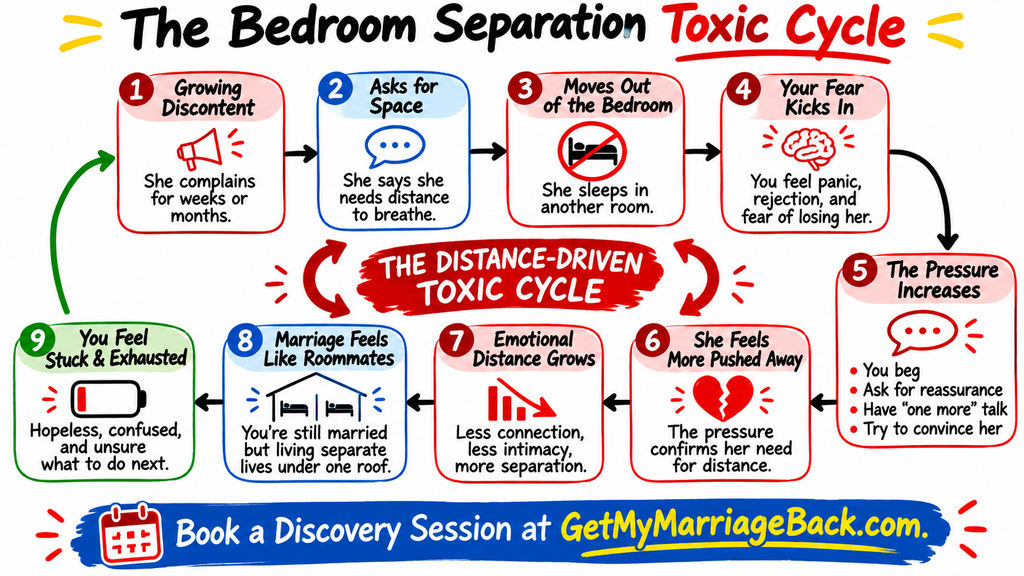
my wife wants space and the toxic cycle

2. Your Wife Needs Spaceโ€”But Does That Mean She Wants Divorce?

When your wife wants separation, you need to distinguish what she has actually done from what you fear her actions mean.

Several different relationship dynamics can produce similar behavior.

Emotional Exhaustion

Repeated arguments can make ordinary interactions feel overwhelming.

Your wife may associate the bedroom with another difficult conversation, another disagreement, or another attempt to convince her that things are improving.

Sleeping separately creates immediate distance from those interactions.

That doesn’t establish whether she wants divorce. It establishes that she wants something about her current experience to change.

Accumulated Resentment

Sometimes the problem is much older than the latest argument.

Unresolved disappointments, broken expectations, and repeated conflicts can gradually weaken emotional closeness.

Your wife may no longer experience the same warmth or desire for connection.

The bedroom move becomes an outward expression of a longer emotional withdrawal.

Loss of Attraction

Physical attraction in marriage is more than appearance or sexual performance.

It’s also influenced by the emotional experience of being around someone.

When your interactions become dominated by anxiety, defensiveness, resentment, and demands for reassurance, the relationship can lose the playfulness and ease that once supported intimacy.

You may still love your wife deeply while struggling to create an experience she finds emotionally attractive.

Preparation for Separation

There’s also a possibility you shouldn’t ignore.

Your wife may be considering a more permanent separation.

Look for additional evidence.

Has she explicitly said she wants divorce? Is she making arrangements to live elsewhere? Has she begun separating finances or discussing legal decisions?

Those actions provide different information from sleeping in another room.

Don’t turn a bedroom move into proof of divorce, but don’t dismiss concrete separation plans either.

Your responsibility is to respond to reality rather than predictions.

3. Why Trying Harder Can Push Your Wife Further Away

This is where a painful marriage crisis can become a destructive cycle.

Your wife asks for space.

You become frightened.

That fear creates an urgent desire to restore closeness.

So you pursue another conversation.

You send long text messages explaining everything you’ve sacrificed.

Perhaps you promise to change, then become frustrated when she doesn’t immediately acknowledge your efforts.

You call it fighting for your marriage.

But your wife experiences another demand when she has already asked for room to breathe.

The more she withdraws, the more anxious you become.

Your anxiety produces additional pressure, and that pressure gives her another reason to maintain her distance.

The Demand-Withdrawal Cycle

Relationship researchers have examined this pattern extensively.

A study involving 116 married couples found that demand-withdraw interactions were associated with more negative emotions, less constructive conflict behavior, and lower levels of conflict resolution.

The researchers observed this pattern in both husband-demand/wife-withdraw and wife-demand/husband-withdraw interactions.

You can examine the findings in the published research on demand-withdraw patterns in marital conflict.

This matters because the problem isn’t simply that one spouse wants communication while the other wants silence.

It’s the repetitive interaction that develops between pressure and withdrawal.

And the pattern can continue even when both individuals believe they’re protecting themselves.

Stop Confusing Begging With Pursuit

I want to make an important distinction.

There’s nothing inherently wrong with expressing romantic interest in your wife.

Healthy pursuit communicates interest, affection, confidence, and dignity.

Begging communicates something different.

It makes your emotional stability dependent on receiving a particular response.

When you repeatedly demand reassurance, you place responsibility for regulating your fear onto the person who has already requested distance.

That creates an unattractive emotional dynamic.

The objective isn’t to stop loving your wife. It’s to stop allowing fear to control how you express that love.

4. What Changes When You Stop Chasing and Start Leading Yourself

Inside our book Get My Marriage Back, we have a chapter called Stop the Bleeding.

That’s where I began working with the husband whose wife had moved out of their bedroom.

He initially feared that backing off would give her even more freedom to drift away.

From his perspective, doing less felt like surrendering.

But his attempts to control the distance were contributing to the pressure surrounding their interactions.

We began with self-development.

Not as a performance designed to make his wife jealous.

Not as a manipulation tactic to force her back into the bedroom.

We focused on developing the emotional capacity to respond differently.

Grounding: Stop Letting Panic Make Decisions

Your wife’s withdrawal can trigger powerful feelings of rejection.

Grounding begins when you recognize those feelings without allowing them to determine your next action.

You can acknowledge the pain of sleeping separately without demanding that she resolve it tonight.

Instead of standing outside her door requesting another conversation, return to your emotional center.

Notice the difference between an actual emergency and the discomfort of uncertainty.

Your fear deserves attention, but it doesn’t deserve control of your behavior.

Purpose: Become Bigger Than the Marriage Crisis

Your marriage matters.

But your entire identity cannot depend on whether your wife chooses to sleep beside you.

Redirect meaningful energy toward your health, responsibilities, work, personal mission, and contribution to others.

This isn’t about pretending you don’t care.

It’s about becoming someone whose emotional presence isn’t dominated by desperation.

A purposeful life creates stability and gives you something meaningful to bring into your relationships.

Self-Discovery: Recognize Your Own Patterns

Pay attention to your reactions when your wife withdraws.

Do you become argumentative?

Are you constantly explaining yourself?

Does every uncomfortable silence trigger another attempt to secure reassurance?

These questions aren’t invitations to blame yourself for everything wrong in the marriage.

They’re opportunities to discover what you can control.

You cannot force your wife to return to the bedroom.

You can change the way you respond to disappointment, rejection, and uncertainty.

And that capacity becomes especially important when your marriage is under pressure.

How Emotional Attraction Can Begin to Return

Building attraction in marriage isn’t about becoming cold, unavailable, or indifferent.

It’s about improving the experience of being around you.

Consider the difference between two interactions.

In the first, your wife walks into the kitchen and immediately senses that you’re waiting for an opportunity to discuss the marriage.

Your expression is tense. You’re monitoring her mood. Every response becomes evidence of whether reconciliation is approaching.

In the second, you’re grounded in your own activities.

You acknowledge her naturally. Your tone is relaxed, your presence is respectful, and you don’t turn an ordinary encounter into another relationship negotiation.

The second interaction removes a source of emotional pressure.

That matters because attraction needs room for positive experiences.

Value, Curiosity, Attraction, and Influence

Our framework builds from self-leadership toward experiential value.

Value isn’t merely your moral worth or your ability to provide financially.

It’s also the quality of the emotional experience you create through your presence, confidence, emotional intelligence, and personal development.

As your behavior changes consistently, your wife has the opportunity to experience you differently.

Curiosity can develop when familiar negative patterns no longer dominate your interactions.

Attraction becomes more possible when emotional safety, warmth, and positive engagement have room to emerge.

Influence grows through credibility and consistency rather than demands.

None of this requires treating your wife as a project to manage.

The focus remains on becoming responsible for your own behavior while respecting her freedom to make decisions.

What Happened After Three Months Outside the Bedroom?

The husband I worked with began changing how he responded to his marriage crisis.

He stopped begging.

Instead of repeatedly attempting to close the distance through emotional pressure, he concentrated on self-development and changing his own behavior.

Eventually, his wife revealed something significant.

She had become exhausted by the distance she herself had created.

After spending more than three months outside their shared bedroom, she independently raised the possibility of returning to the marriage.

That development mattered.

He had been terrified that respecting her space would make reconciliation less likely.

Yet reducing the pressure created a different environment from the one that had surrounded their earlier interactions.

The lesson isn’t that three months is a magical reconciliation timeline.

Nor should you interpret giving space as a technique for controlling someone’s feelings.

The meaningful change was that he stopped trying to govern his wife’s response and started governing his own.

Interestingly, his story eventually developed another complication.

By the end of our sessions, he faced a personal decision involving his wife and a younger woman who had been giving him attention.

His responsibility for making thoughtful, principled decisions hadn’t disappeared simply because his marriage was in crisis.

Personal power includes being accountable for the choices available to you.

What to Do Tonight When Your Wife Sleeps in Another Room

When you pass the closed bedroom door tonight, resist the urge to demand another conversation.

Don’t stand outside asking why she refuses to sleep beside you.

Avoid turning the evening into another debate about everything you’ve sacrificed.

Instead, carry yourself with dignity.

Relax your shoulders. Maintain your composure. If you cross paths, interact respectfully without making the encounter a test of her feelings.

Continue with your responsibilities.

This isn’t silent treatment, punishment, or pretending that everything is fine.

You’re removing unnecessary pressure while preserving your self-respect.

When an appropriate opportunity for communication arises, approach it without demanding an immediate emotional outcome.

Can You Save Your Marriage Alone?

You can begin changing your contribution to the relationship without waiting for your spouse to participate.

That means improving your emotional regulation, communication habits, self-awareness, and ability to create positive interactions.

You cannot make another person choose reconciliation.

But you can stop reinforcing behaviors that make constructive engagement more difficult.

If you’re trying to save your marriage while separated, remember that physical proximity isn’t the same as emotional intimacy.

Living under one roof doesn’t automatically mean you’re connected.

Likewise, sleeping in separate bedrooms doesn’t automatically establish that reconciliation is impossible.

The deeper question is whether the patterns that produced the distance are changing.

The Real Goal Is More Than Sharing a Bedroom Again

Getting your wife back into your bed isn’t the same as rebuilding your marriage.

You can restore physical proximity while leaving the original problems untouched.

That’s why your focus needs to extend beyond the immediate symptom.

Develop the emotional intelligence to recognize what is happening without reacting impulsively.

Build the self-leadership to maintain your dignity during uncertainty.

Create opportunities for attraction through authentic growth, positive experiences, and respectful engagement.

Your wife is responsible for her decisions.

You’re responsible for yours.

And the quality of those decisions matters whether you’re facing emotional withdrawal, a wife who wants separation, or the possibility of divorce.

Stop making the bedroom door the measure of your value. Start becoming someone who brings stability, confidence, and meaningful connection into the marriage.

โ€œWife Makes NO EFFORT In BEDโ€ (5 Tips For INSTANT Solution)

Frequently Asked Questions

What does it mean when my wife wants space?

It means she wants some form of distance, but the reason may involve emotional exhaustion, unresolved conflict, attraction loss, or consideration of separation. Examine what she has communicated and how her behavior has changed before drawing conclusions.

Should I give my wife space if I want to save my marriage?

Respect her clearly expressed boundaries while continuing to handle your responsibilities with dignity. Giving space doesn’t require abandoning your marriage or using silence to punish her.

Does sleeping in separate bedrooms mean divorce is coming?

Sleeping separately can signal serious relationship distress, but it doesn’t independently establish that divorce is inevitable. Explicit divorce statements, separation plans, and the broader history of your marriage provide more meaningful context.

Can my wife fall back in love with me after asking for space?

Emotional attraction can change as relationship experiences and behavior patterns change. Focus on becoming more grounded, emotionally intelligent, and genuinely engaging rather than attempting to force affection or reconciliation.


Your Wife Wants Space? How to Rebuild Attraction in Your Marriage

When your wife wants space, the instinct to move closer can become almost irresistible.


Take This 2 Minutes Quiz

Question 1 of 15

You want clarity. You want reassurance. You want to know whether your marriage is going to survive. You may want to talk until both of you finally understand what went wrong, remind her of everything you have built together, demonstrate that you have changed, or get some indication that divorce is no longer on the table.

Yet this is precisely where a marriage crisis can become more destructive.

You are creating a pattern in which uncertainty leads to counting, counting creates interpretation, interpretation produces urgency, and urgency creates pressure. Eventually, pressure generates more withdrawal and rejectionโ€”which feeds the uncertainty that started the cycle.

If your wife wants separation or says she needs space, attraction is rarely rebuilt by winning an argument about why the marriage deserves another chance.

Attraction is an experience.

And the person you desperately want to experience you differently needs enough emotional room to actually experience something different.

That changes the question from:

โ€œHow do I get my wife to come back?โ€

to:

โ€œWhat does interacting with me feel like right now?โ€

That second question is where emotional intelligence, attraction, intimacy and reconciliation begin to intersect.

wife wants space

When Your Wife Wants Space, Stop Turning Time Into Evidence

One of the most psychologically expensive things you can do during marriage separation is turn the calendar into a scoreboard.

Three weeks becomes evidence.

Six weeks becomes stronger evidence.

Another quiet weekend becomes evidence.

A delayed text becomes evidence.

We call this turning time into proof. Every passing week can begin to feel like confirmation that she cares less, the separation is becoming permanent, or divorce is getting closer.

Once you interpret time that way, your behavior changes.

You may become more watchful, reactive and emotionally hungry. Suddenly, a simple interaction carries enormous weight because you are not merely talking to your wifeโ€”you are unconsciously trying to determine the future of your marriage.

She can feel that weight.

The Calendar Cannot Tell You How Your Wife Feels

A marriage separation is real. Divorce may also become real, and practical decisions still have to be made.

However, we need to make an important distinction: your power is not found in discovering the perfect number of weeks before reconciliation. It is found in what you become and how you show up while the outcome remains uncertain.

That distinction matters for attraction.

A man who needs every interaction to answer, โ€œDo you still want me?โ€ creates a very different emotional experience from a man capable of being warm, grounded and present without demanding an immediate verdict.

The second experience leaves room for curiosity.

And curiosity matters.

wife wants space - Why Chasing Your Wife Can Create More Withdrawal

Why Chasing Your Wife Can Create More Withdrawal

There is a well-established relationship pattern known as demand-withdraw.

One person pursues discussion, resolution or change while the other retreats or avoids engagement. Research examining married couples found greater demand-withdraw behavior was associated with lower marital satisfaction.

That does not mean every conversation is pressure.

It means your emotional agenda matters.

Consider the difference between:

โ€œCan we talk tonight? I really need to understand where we stand.โ€

and:

โ€œI understand you need some room. We can talk when there’s actually something useful for us to talk about.โ€

The first interaction may sound reasonable. But if your wife has repeatedly said she wants space, she may experience it as another request to manage your anxiety.

The second communicates something different:

I hear you. I can regulate myself. You don’t have to take care of my emotional stability.

That is not indifference.

It is emotional self-possession.


Attraction Cannot Thrive Under Constant Emotional Pressure

This is where many husbands misunderstand the objective.

If your wife wants space, the goal is not to manipulate her by withdrawing affection or pretending not to care.

Nor is the objective to manufacture scarcity through arbitrary โ€œ30-day no contactโ€ formulas. I want to warn you against using rigid no-contact deadlines as a substitute for genuine confidence and grounding.

The more sophisticated objective is to remove unnecessary emotional pressure.

Your wife should not have to continuously defend her desire for space.

She should not have to reassure you that there isn’t somebody else every few days.

Every conversation should not become an unofficial marriage counseling session.

Most importantly, she should not have to experience your presence as an obligation.

Attraction Needs Psychological Breathing Room

Attraction contains an element that distressed marriages often lose:

discovery.

When every thought, feeling, fear and intention is constantly explained, there is little left to discover.

This is not an argument for secrecy or emotional games.

It is an argument for having a life.

You need to move away from sitting around waiting for a wife to determine your emotional schedule and instead paying attention to purpose, health, children, career and self-development.

That shift is powerful because your wife is no longer interacting exclusively with the husband trying to save the marriage.

She gets an opportunity to encounter the fuller man again.

wife wants space - If Your Wife Is Distant, Become Responsive Without Becoming Needy

If Your Wife Is Distant, Become Responsive Without Becoming Needy

Emotional intelligence during marriage separation requires an unusual combination:

Warmth without pursuit.

Interest without interrogation.

Availability without hovering.

Confidence without coldness.

Research on romantic relationships gives us an important concept here: perceived partner responsiveness.

Responsiveness broadly involves feeling that another person understands, validates and cares about you. Research involving romantic couples found that perceiving one’s partner as responsive was positively associated with affectionate touch, and prospective studies found responsiveness predicted subsequent affectionate touching behavior.

Notice what that suggests.

You do not create intimacy merely by demanding more intimate behavior.

You improve the relational conditions under which intimacy can emerge.

That distinction is enormous.


Listen for the Experience Beneath Your Wife’s Words

Suppose your wife says:

โ€œEvery time I tell you I need space, you keep trying to fix everything.โ€

A defensive husband hears:

โ€œEverything you’ve done is worthless.โ€

An emotionally intelligent husband hears:

โ€œMy experience of you right now is pressure.โ€

That does not automatically make every accusation accurate.

It means you become interested in her experience before trying to correct her interpretation.

You might say:

โ€œI can see how my trying to solve this every time we talk has made it harder for you to breathe.โ€

Then stop.

No twenty-minute explanation.

No immediate request for credit.

No โ€œbut you alsoโ€ฆโ€

Understanding loses much of its seductive power when it immediately sends an invoice.


Stop Trying to Convince Your Wife That You’ve Changed

One of the weakest ways to communicate transformation is repeatedly announcing transformation.

โ€œI’ve changed.โ€

โ€œI finally understand.โ€

โ€œI’m working on myself.โ€

โ€œYou’ll see a different husband.โ€

Perhaps.

But let her discover it.

If you previously became defensive, let her encounter composure.

If you were chronically unavailable, let her experience attentiveness.

If every disagreement became a courtroom, let her discover that disagreement no longer automatically produces combat.

If you abandoned yourself trying to keep the marriage together, let her encounter a husband with a meaningful life.

Real change creates evidence without constantly narrating itself.

That is where attraction becomes more organic.


Your Wife Wants Separationโ€”But She Shouldn’t Become Your Entire Purpose

You need to make one of your strongest shifts around this point.

Instead of creating deadlines around somebody else’s timetable, uncertainty can become an opportunity to build yourself. Once purpose becomes active, separation stops functioning exclusively as waiting time and becomes processing time.

That is a dramatically healthier position from which to interact with your wife.

Purpose gives your emotional energy somewhere productive to go.

Without it, every spare ounce of attention can become surveillance:

Has she texted?

Where did she go?

Why didn’t she respond?

Why was that message shorter?

Is she happier without me?

Does she miss me?

Purpose interrupts obsession without requiring emotional numbness.

You can deeply desire reconciliation without making reconciliation your only source of vitality.


Become More Interesting to Yourself First

Attraction is not merely about looking more attractive.

It is partly about aliveness.

A person engaged with life carries different energy than somebody emotionally stationed outside another person’s door waiting for permission to live again.

Return to interests you neglected.

Develop competence.

Take your health seriously.

Deepen friendships that support responsible growth rather than resentment.

Become more present with your children.

Improve your environment.

Pursue meaningful professional or creative goals.

Not because completing a checklist magically makes your wife return.

Do it because self-abandonment is not seductive.


Novelty Can Matter in a Long-Term Marriage

There is also relationship science behind the importance of becoming more than predictable marital machinery.

A classic series of studies by Arthur Aron and colleagues found that couples participating together in novel and arousing activities experienced greater increases in relationship quality than couples completing mundane activities. The research connected shared excitement with relationship satisfaction and reduced boredom.

More recent experimental research continues to investigate this self-expansion principle, with findings linking aspects of novel shared experiences to reduced boredom and greater closeness.

This doesn’t mean booking skydiving tickets while your wife is asking you to leave her alone.

Timing matters.

Instead, understand the broader principle:

A marriage becomes vulnerable when every interaction is reduced to logistics, problems, responsibilities and relationship analysis.

Attraction needs some room for play, novelty, discovery, humor and emotional freshness.

When appropriate contact begins happening naturally again, resist turning every pleasant moment into an opportunity to discuss reconciliation.

Allow a good moment to simply be good.


Escape the Roommate Marriage Without Demanding Sex

For many people searching wife wants space, the deeper pain is not physical separation.

The separation began emotionally much earlier.

You became parents.

Administrators.

Bill payers.

Problem solvers.

Household coworkers.

Eventually, husband and wife started feeling more like roommates.

This is painful: โ€œno sex, just duty and responsibility.โ€

Sexual disconnection matters.

But demanding sex as proof that the marriage is recovering puts even more psychological weight on intimacy.

Instead, rebuild the environment from which attraction can emerge.


Emotional Safety and Sexual Attraction Are Not Enemies

Some people talk about emotional safety as though it inevitably produces friendship rather than desire.

That is an oversimplification.

Responsiveness research suggests that feeling understood, validated and cared for is deeply connected to intimacy, while perceived responsiveness has also been associated with affectionate physical contact.

Safety does not require becoming boring.

You can be emotionally safe and playful.

Grounded and flirtatious.

Reliable and mysterious enough to remain interesting.

Caring without becoming dependent.

Marriage attraction becomes especially compelling when security and vitality coexist.


Use Gratitude Without Turning It Into a Strategy

Gratitude is at the beginning of its constructive cycle, a return to grounding and gratitude rather than attempting to manufacture fake confidence.

Relationship research makes this especially interesting.

Studies of romantic couples have found links between perceived gratitude and relationship satisfaction. One dyadic investigation found people often underestimated their partner’s gratitude, while greater underestimation was associated with lower satisfaction.

Research involving 163 couples also found that gratitude played an important mediating role between supportive dyadic coping and relationship satisfaction. Both felt and expressed gratitude were relevant.

Yet gratitude becomes unattractive when weaponized.

โ€œAfter everything I’ve done for youโ€ฆโ€

is not gratitude.

It is an invoice.

Real appreciation recognizes something desirable without demanding repayment.

โ€œI appreciate how you handled that with the kids.โ€

โ€œThanks for telling me directly.โ€

โ€œYou looked great today.โ€

Then continue with your day.

Do not stare at her waiting for the emotional dividend.


Your Wife’s Curiosity Is More Valuable Than Forced Reassurance

An important transformation is necessary.

As a person develops genuine value through self-discovery rather than merely declaring โ€œI know my worth,โ€ other people can begin seeing that change. The person who was running away may eventually become curious about what is different.

Curiosity cannot be demanded.

That’s precisely why it is valuable.

You want your wife to occasionally wonder:

โ€œWhat changed?โ€

โ€œWhy didn’t that upset him like it normally would?โ€

โ€œHe seems different lately.โ€

โ€œWhat’s he been doing?โ€

Those questions are more useful than forcing her to answer:

โ€œDo you miss me?โ€

Because the first set of questions happens inside her.

Attraction is much more powerful when discovery belongs to the person experiencing it.


Don’t Confuse Mystery With Manipulation

Healthy mystery means your wife cannot predict every detail of your emotional state because your entire existence no longer revolves around monitoring hers.

Manipulative mystery looks different.

Deliberately making her jealous.

Posting photographs to provoke her.

Ignoring legitimate messages.

Pretending another woman is interested.

Withholding affection to punish her.

Creating artificial scarcity.

Those behaviors may generate emotional activation, but emotional activation is not necessarily attraction.

Your objective is not:

โ€œHow can I make my wife anxious enough to want me?โ€

It is:

โ€œHow can I become emotionally grounded enough that being around me feels different?โ€

That’s a far more sustainable form of seduction.


Stop Putting Your Life on Hold During Marriage Separation

This may be the most consequential lesson.

You cannot control exactly how long reconciliation takes.

You need to distinguish processing time from waiting time. ..waiting for another human being before allowing yourself to live.

Waiting says:

โ€œMy life resumes when my wife chooses me.โ€

Processing says:

โ€œThis marriage matters enormously to me, and my life is happening today.โ€

Those positions produce radically different behavior.

One breeds hypervigilance.

The other builds groundedness.

One constantly asks the wife for certainty.

The other becomes increasingly capable of tolerating uncertainty.

One tries to extract attraction.

The other develops the conditions under which attraction can breathe again.


What to Do When Your Wife Wants Space

When your wife wants space, think in terms of reducing destructive pressure while increasing genuine relational value.

First, respect clearly communicated boundaries. Space stops being space if you’re constantly testing whether she still needs it.

Next, stop using each interaction to measure reconciliation. A warm text is not proof you’re getting back together, and a quiet day isn’t proof you’re getting divorced.

Build emotional regulation so your wife isn’t responsible for stabilizing you.

Create a meaningful daily life involving health, purpose, family, work, friendship and development.

When communication occurs, practice responsiveness. Listen for the experience underneath the words instead of preparing your defense.

Allow positive interactions to remain positive without converting them into marriage negotiations.

Express sincere appreciation without requiring reciprocation.

When circumstances permit, gradually create experiences containing freshness, lightness, play and novelty rather than discussing problems every time you’re together.

Most importantly, allow change to become observable.

You don’t need to continuously explain who you’re becoming.

Let her experience him.


The Constructive Cycle of Marriage Attraction

The destructive cycle essentially feeds itself:

Uncertainty โ†’ Counting โ†’ Interpretation โ†’ Urgency โ†’ Pressure โ†’ Withdrawal/Rejection โ†’ More Uncertainty

The constructive direction starts differently.

It accepts that uncertainty exists.

Then it moves toward grounding, gratitude, purpose and self-discovery rather than deadlines and pressure.

From there, something significant becomes possible.

You become less obsessed with extracting certainty from your wife and more capable of creating a life and presence that have intrinsic value.

That affects how you communicate.

It affects how you handle rejection.

It affects your confidence.

It changes what your wife encounters when she interacts with you.

Eventually, it can even change what she becomes curious about.

This is the emotional intelligence of attraction in a marriage crisis:

You don’t try to control another person’s desire.

You become responsible for the experience you bring into the relationship.

When your wife wants space, that may be one of the most attractive changes she can possibly discover.

11 Signs Your Wife Doesn’t Respect You (And How to Rebuild It)


Frequently Asked Questions [FAQ]

What should I do when my wife says she wants space?

Respect the space while staying grounded, responsive and responsible for legitimate marital or family obligations. Avoid repeatedly asking for reassurance or turning every interaction into a conversation about whether the marriage will survive.

Does giving my wife space mean she wants a divorce?

Wanting space can occur for many reasons and does not, by itself, tell you the final outcome of your marriage. Treat what your wife actually communicates and does as more meaningful than assumptions created by counting days apart.

How long should I give my wife space?

There is no universal number of days or weeks that determines when marriage reconciliation should happen. Focus on respecting communicated boundaries and improving how you show up rather than turning the separation into a countdown.

How do I make my wife attracted to me again during separation?

Reduce pressure, strengthen emotional responsiveness, develop your own purpose and allow genuine changes to become observable rather than constantly announcing them. Attraction is more likely to breathe when interactions contain emotional safety, curiosity and vitality instead of repeated demands for reassurance.


What Would Help You Most Right Now?

Choose the option that best matches where you are with your marriage.

I Need Personalized Help

My Marriage Is in Serious Trouble

If you're dealing with separation, divorce, loss of attraction, infidelity, intimacy problems, or a spouse who's pulling away, get help looking at what's happening in your specific situation.

Get Personalized Help โ†’
Get My Marriage Back book cover
I'd Rather Learn What to Do First

Start With Get My Marriage Back

Get the book and start learning the principles for moving your marriage in a better direction.

Get the Free Book โ†’