
What Would Help You Most Right Now?

Choose the option that best matches where you are with your marriage.

I Need Personalized Help

My Marriage Is in Serious Trouble

If you're dealing with separation, divorce, loss of attraction, infidelity, intimacy problems, or a spouse who's pulling away, get help looking at what's happening in your specific situation.

Get Personalized Help →
Get My Marriage Back book cover
I'd Rather Learn What to Do First

Start With Get My Marriage Back

Get the book and start learning the principles for moving your marriage in a better direction.

Get the Free Book →

Your Wife Loves You but Is Not Sexually Attracted to Me: 4 Signs of Hope

Your wife still kisses you, hugs you, and shows affection, but when you reach for sexual intimacy, she pulls away—and that contradiction can hide a marriage crisis far more serious than you realize.

Take This 2 Minutes Quiz

Question 1 of 15

You have invested years into your marriage. You share responsibilities, memories, perhaps children, and an entire life together. Yet something has changed in the bedroom.

Your wife still shows affection, so you hold on to the belief that everything will eventually return to normal.

But what if the affection you are using as reassurance is distracting you from the actual problem?

When you are wondering why, your wife loves you but is not sexually attracted to you, you are describing two different dimensions of your marriage that need to be examined separately.

Love is not automatically sexual desire. Affection does not necessarily mean forgiveness. And living together does not prove that your marriage has recovered from an earlier crisis.

I’m Ola, co-author of Get My Marriage Back and #1 Red Flag with my wife, Lola.

I want to show you how to distinguish ordinary changes in sexual desire from emotional detachment, unresolved betrayal, and patterns that are quietly damaging attraction.

More importantly, I want you to understand how to begin changing your experience of the marriage without begging, chasing, or attempting to control your wife.

Why Your Wife Still Kisses You but Doesn’t Want Sex

A kiss can communicate tenderness, familiarity, affection, or emotional connection.

Sexual desire involves another dimension of attraction.

Your wife can genuinely care about you while experiencing little interest in sexual intimacy. She can appreciate your role as a husband and father while questioning whether she wants to remain married.

These experiences are not necessarily contradictory.

The mistake is assuming that one affectionate behavior proves everything else is working.

Consider what happens when your wife kisses you before leaving for work.

You feel reassured.

Later, you initiate sexual intimacy. She turns away.

Now you are confused because the affectionate woman from this morning appears to be rejecting you tonight.

Your immediate instinct is to resolve the contradiction by demanding an explanation.

But the first skill of emotional intelligence is learning to separate what happened from what you believe it means.

Her kiss happened.

Her refusal happened.

Your conclusion that she no longer loves you is an interpretation, not an established fact.

That distinction changes how you respond.
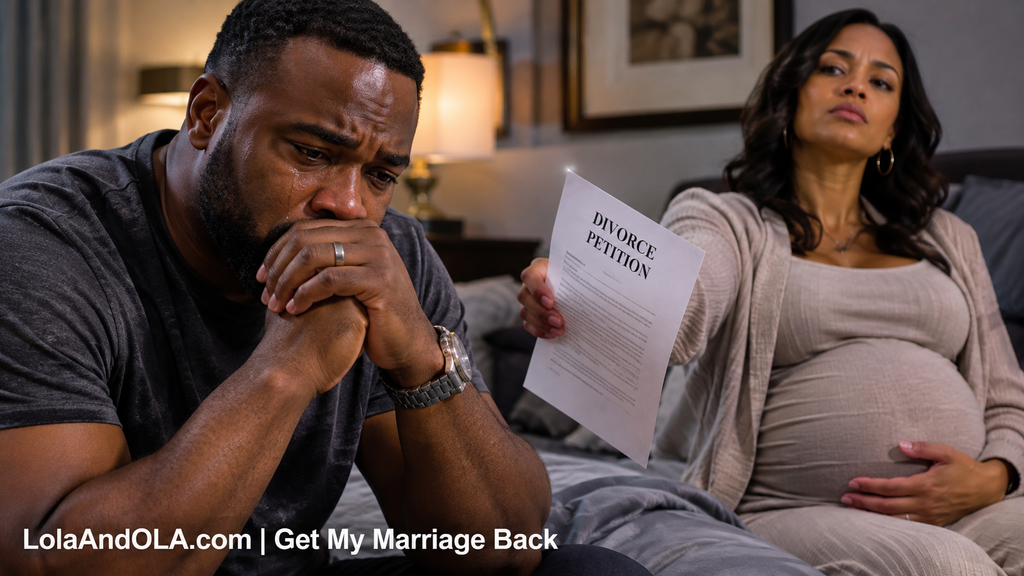
my wife loves me but is not sexually attracted to me

A Marriage Crisis That Looked Like Reconciliation

Consider a husband whose seven-year marriage appeared to have survived a devastating crisis.

Two years earlier, his wife had filed for divorce.

He admitted to an extramarital affair. During the divorce proceedings, he opposed her request for spousal support while agreeing to joint custody of their four children.

After conversations with their pastor, she withdrew the divorce petition and returned home.

He believed they had moved beyond the crisis.

Their household resumed its familiar routines. Everyday affection continued, including kissing and other expressions of closeness.

However, sexual intimacy remained a problem.

He recognized the distance but kept pushing his concerns aside because he believed her return home meant the marriage was safe.

Then she filed for divorce again—while pregnant with their fifth child.

The last thing he expected was another divorce petition during pregnancy.

He had confused the withdrawal of a legal petition with the restoration of emotional trust.

His wife had returned home, but the unresolved consequences of the earlier betrayal and conflict had not disappeared.

During our Discovery Session, he began identifying how his own reactions were contributing to the pressure surrounding their marriage.

Begging, chasing, defensiveness, and vindictive behavior had become part of the problem.

The important lesson is not that every wife who rejects intimacy is secretly preparing for divorce.

It is that a marriage can appear stable on the surface while unresolved problems continue underneath.
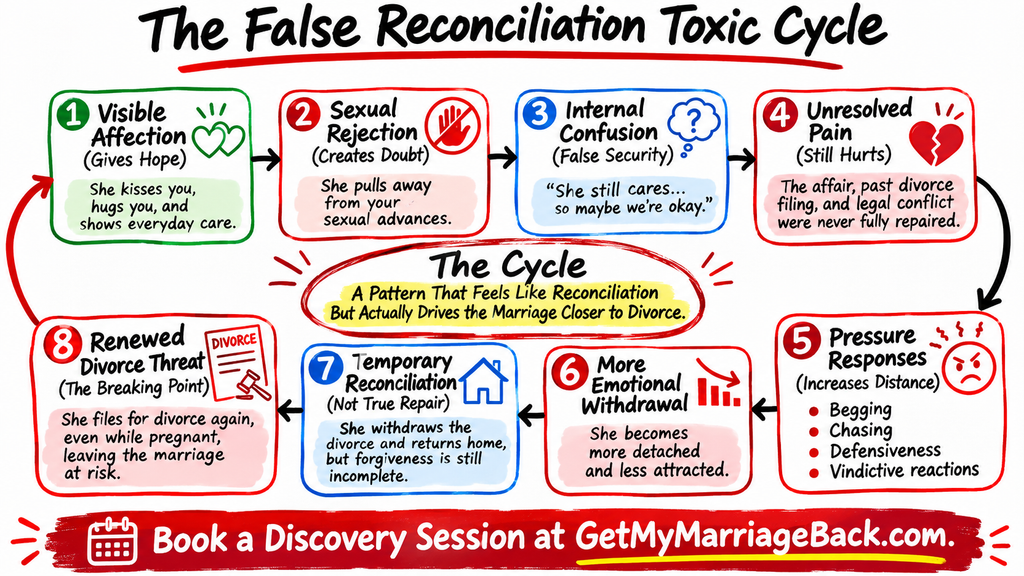
my wife loves me but is not sexually attracted to me -  the false reconciliation

4 Signs That Reveal What’s Really Happening to Attraction

1. She Shows Affection but Avoids Sexual Intimacy

The first sign is the difference between affectionate contact and sexual engagement.

Your wife may welcome hugs, casual kisses, and sitting beside you.

However, she consistently pulls away when affectionate contact becomes sexual.

Before interpreting this as lost attraction, examine the circumstances.

Does she initiate affectionate contact herself?

Has she expressed discomfort with particular sexual experiences?

Is the change recent, or has it developed over several years?

Does she avoid all forms of intimacy, or primarily sexual activity?

These distinctions matter.

Sexual desire can change because of stress, exhaustion, hormonal changes, physical discomfort, medication, relationship conflict, or emotional disconnection.

Pregnancy introduces additional physical and emotional considerations.

A pregnant wife experiencing fatigue, nausea, discomfort, or changing desire is not automatically losing attraction to her husband.

Sexual rejection alone does not establish the cause.

Your responsibility is to understand the pattern without turning every affectionate interaction into an expectation of sex.

When affection feels like the beginning of another demand, even innocent closeness can become uncomfortable.

2. Your Marriage Looks Repaired, but the Original Injury Remains

The second sign is unresolved relationship damage.

Perhaps your marriage previously survived infidelity, separation, or a serious divorce threat.

Your wife returned home.

The arguments became less frequent.

You resumed parenting, household responsibilities, and everyday activities.

Naturally, you interpreted these changes as progress.

But ask yourself a more important question:

What actually changed in the relationship after the crisis?

Did your conduct become consistently trustworthy?

Did you take responsibility for your actions without defending the original injury?

Have the behaviors that contributed to the breakdown genuinely changed?

Or did the marriage simply return to its previous routines?

There is a significant difference between restoring normal household activity and restoring emotional trust.

A spouse can withdraw a divorce petition without having resolved every concern that motivated it.

Similarly, a couple can remain legally married while emotional distance continues growing.

If your wife wants a divorce after an earlier reconciliation, examine what remained unresolved rather than assuming the previous reconciliation was meaningless.

The earlier effort may have been genuine. The underlying fracture may also have remained.

Both realities can exist.

3. Your Fear of Rejection Has Become Pressure

The third sign involves your reactions.

You notice your wife withdrawing, and you become increasingly anxious about losing the marriage.

You initiate intimacy more frequently because you want reassurance.

When she refuses, you ask whether she still loves you.

You remind her of your sacrifices.

Perhaps you apologize repeatedly, argue about fairness, or explain why her rejection hurts.

Eventually, resentment begins influencing your behavior.

What started as a desire for closeness becomes a cycle of pressure.

You feel rejected, so you pursue harder.

She experiences more pressure, so she withdraws.

Her withdrawal intensifies your fear, and your next reaction becomes even more desperate.

The problem is no longer simply the absence of sex. Your response to the absence of sex has become another relationship problem.

That does not mean your desire for intimacy is wrong.

Wanting your wife is natural.

Expressing romantic interest with dignity is different from insisting that she provide sexual reassurance.

A refusal is a boundary to respect, not a challenge to overcome.

Ask yourself what happens immediately after she says no.

Do you remain composed?

Or does the rest of the evening become dominated by disappointment, arguments, or silent punishment?

Your answer reveals an important part of the dynamic you can change.

4. You Have Made Her Reactions the Center of Your Life

The fourth sign is the gradual loss of your own emotional independence.

Your mood depends on whether she kisses you.

Your confidence rises when she seems affectionate and collapses when she becomes distant.

You constantly monitor her behavior for evidence that the marriage is improving.

Eventually, your attention becomes so concentrated on her responses that you neglect your health, responsibilities, friendships, personal mission, and emotional stability.

This is where attraction can become entangled with fear.

You are no longer expressing interest from a position of self-respect.

You are looking to your wife to regulate your emotional state.

The more urgently you seek reassurance, the more pressure you risk creating.

Your wife cannot become the sole source of your confidence, identity, or purpose.

Recovering those qualities is not about pretending you don’t care.

It is about becoming emotionally steady enough to care without losing control of yourself.

How to Rebuild Sexual Attraction Without Begging or Chasing

Attraction is not something you can demand from another person.

However, you can change the behaviors and relationship conditions that influence how your presence is experienced.

This is where self-leadership, emotional intelligence, and value-based influence become practical.

Start With Grounding Instead of Panic

When your wife rejects an advance, separate the event from your interpretation.

The event is straightforward: she does not want sexual intimacy at that moment.

Your mind may immediately turn that refusal into a much larger conclusion.

You assume she no longer loves you, that another man must be involved, or that divorce is inevitable.

Those conclusions require evidence.

Grounding means returning to what you know rather than reacting to what you fear.

Take responsibility for your response before attempting to interpret hers.

That alone can interrupt an escalating conflict.

Restore Your Purpose Beyond the Marriage

A marriage matters deeply, but it cannot become your entire identity.

You still have responsibilities, personal ambitions, health, friendships, and a greater purpose.

Your children need your presence and stability.

Your career or life mission deserves meaningful attention.

The goal is not to withdraw affection as punishment or manufacture jealousy.

It is to recover the qualities that make you a grounded, engaged, emotionally mature individual.

When your entire life revolves around obtaining reassurance, your behavior becomes increasingly reactive.

Purpose restores direction.

And direction helps you express romantic interest without making another person’s response determine your self-worth.

Practice Emotional Responsiveness, Not Performance

One of the most important distinctions in attraction is the difference between appearing impressive and being genuinely responsive.

A 2016 study published in the Journal of Personality and Social Psychology examined the connection between perceived partner responsiveness and sexual desire.

Across three studies, researchers found that responsiveness was associated with greater sexual desire, with a stronger association among women.

Feeling understood and valued helped explain the relationship.

The research supports an important principle: sexual attraction is connected to how people experience the relationship, not simply how often a partner initiates sex.

You can explore the research on partner responsiveness and sexual desire for the underlying findings.

In practical terms, responsiveness means paying attention to your wife’s actual experience.

If she is exhausted, notice it.

When she expresses discomfort, respect it.

If she identifies a legitimate concern, take it seriously without immediately defending yourself.

The purpose is not to perform helpful behaviors in exchange for sexual access.

It is to develop the emotional intelligence and reliability that make closeness more comfortable and meaningful.

Understand the Art of Seduction Without Pressure

Seduction in a marriage is not the same as persuasion.

You do not build genuine desire by repeatedly arguing that your wife should want you.

Nor does doing household chores create a sexual debt she must repay.

Skillful attraction begins with how you carry yourself.

Your emotional steadiness matters.

So does your confidence, personal engagement, ability to respect boundaries, and willingness to take responsibility for your behavior.

Express romantic interest naturally when it is welcome.

Maintain warmth without attaching expectations to every affectionate moment.

Allow your wife to experience your attention without fearing that every kiss must lead to sex.

When attraction begins returning, it should develop through mutual willingness rather than obligation.

That is the difference between value-based influence and control.

Can You Save Your Marriage Alone When Your Wife Wants Out?

You can begin changing your contribution to the marriage without waiting for your wife to participate.

That is what I mean by starting alone.

You can stop begging.

You can eliminate vindictive reactions.

You can develop stronger emotional regulation and become more accountable for your conduct.

You can also learn to distinguish actual relationship progress from temporary relief.

However, your wife’s decisions remain hers.

Your individual growth changes your behavior and the conditions you contribute to the relationship. Reconciliation itself requires her willingness to participate.

If your wife wants separation or has already filed for divorce, avoid confusing immediate de-escalation with complete restoration.

A peaceful evening does not repair years of broken trust.

Likewise, a withdrawn divorce petition does not establish that every underlying concern has been resolved.

The question is whether your conduct is becoming consistently different from the patterns that contributed to the crisis.

That is where meaningful individual change begins.

What to Do Tonight When Your Wife Rejects Intimacy

Imagine approaching your wife affectionately tonight.

She turns away.

Your instinct is to ask whether she still loves you.

Instead, stop.

Do not initiate again after a clear refusal.

Avoid interrogating her, arguing about your sacrifices, or responding with sarcasm.

Relax your shoulders and give her space.

Then continue with a meaningful responsibility rather than making the evening revolve around your disappointment.

This is not a technique for making her chase you.

It is an exercise in emotional self-leadership.

You are demonstrating that disappointment does not have to control your conduct.

Over time, consistent emotional steadiness, accountability, and respect can help create healthier conditions for connection.

The goal is not merely to get your wife to accept another sexual advance.

It is to understand the marriage you actually have, recognize what damaged attraction, and become capable of contributing to a different relationship experience.

The Truth About Love, Attraction, and Marriage Reconciliation

Your wife can love you and still experience little sexual desire.

She can show affection while carrying unresolved resentment.

She can return after separation without feeling that the marriage has been fully repaired.

And she can experience changing sexual interest for reasons unrelated to whether she values you.

These distinctions matter because the wrong diagnosis leads to the wrong response.

When you mistake affection for reconciliation, you overlook unresolved problems.

When you mistake sexual rejection for proof of betrayal, you create unnecessary conflict.

And when you respond to emotional distance with begging, defensiveness, or vindictive behavior, you add pressure to a relationship already struggling under it.

The path forward begins when you stop trying to control your wife’s feelings and start taking responsibility for the experience you create through your own behavior.

That is where self-leadership becomes attractive.

That is where emotional intelligence becomes practical.

And that is where rebuilding attraction becomes something more meaningful than simply trying to get sex back into your marriage.

“Wife Makes NO EFFORT In BED” (5 Tips For INSTANT Solution)

Frequently Asked Questions

Why does my wife love me but is not sexually attracted to me?

Your wife may feel genuine emotional attachment while experiencing reduced sexual desire because of unresolved conflict, stress, physical changes, or other relationship dynamics. Love and sexual attraction are connected but distinct experiences.

Can a marriage survive without sexual attraction?

A marriage can continue through periods of low sexual desire, but lasting dissatisfaction or unresolved conflict deserves attention. Understanding the underlying cause is more useful than assuming the absence of sex means the marriage is over.

How do I get my wife sexually attracted to me again?

Focus on emotional steadiness, personal growth, genuine responsiveness, accountability, and respecting her boundaries rather than pressuring her for intimacy. Attraction develops through mutual willingness, not through demands or transactional behavior.

Why does my wife kiss me but refuse sex?

Kissing can communicate affection, comfort, or familiarity without indicating a desire for sexual intimacy. Look at the broader relationship pattern, her expressed concerns, and any physical or emotional circumstances before drawing conclusions.


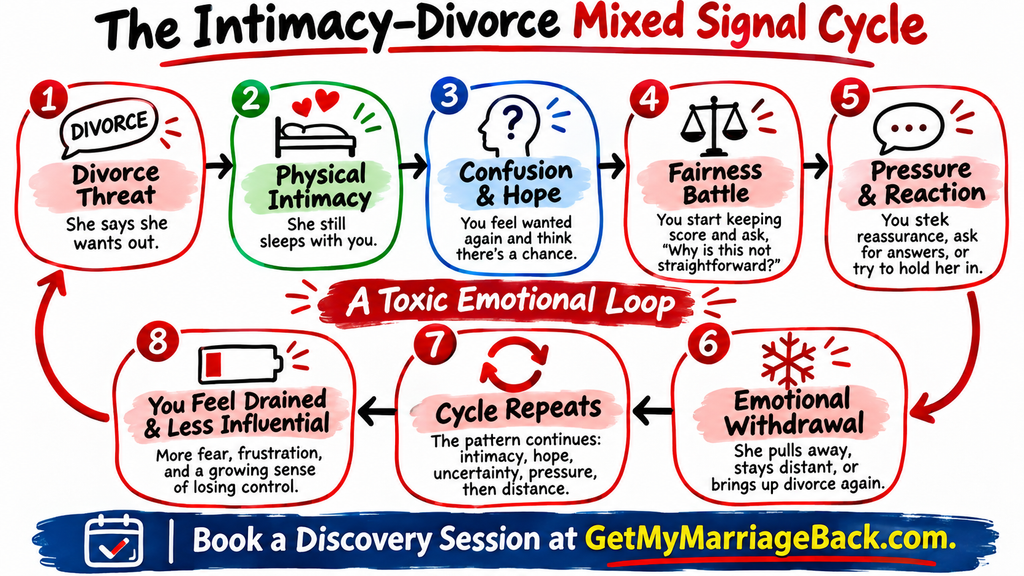
Wife Wants Divorce But Still Sleeps With You? 4 Signs to Examine

Your wife tells you she wants a divorce, yet she still reaches for you in bed—and the next morning, you’re left wondering how someone can desire you physically while questioning your entire future together.

Take This 2 Minutes Quiz

Question 1 of 15

One night, you feel wanted. The next morning, she is distant, uncertain, or talking about separation again.

You remember your wedding vows, the years you’ve invested, and the promises you made to each other. Marriage was supposed to mean loyalty, security, belonging, and a shared future.

Now you’re experiencing physical acceptance alongside emotional uncertainty.

Naturally, questions start racing through your mind.

Does she still love me? Is she manipulating me with sex? Does she secretly want to save our marriage? Or is she keeping me emotionally attached while preparing to leave?

I want you to understand something that can change how you navigate this crisis:

Your wife choosing intimacy with you is not the same thing as your wife choosing a future with you.

Confusing those two decisions can turn moments of closeness into painful cycles of hope, disappointment, resentment, and emotional pressure.

The opportunity is to understand what is happening without allowing fear to dictate how you respond.

Why Would Your Wife Want a Divorce but Still Sleep With You?

Physical desire and marital commitment are related, but they are not identical.

Your wife can still experience sexual attraction toward you while doubting whether your marriage can continue.

She may enjoy the familiarity of your body, the comfort of your presence, or the emotional connection that physical intimacy provides.

None of those experiences automatically resolves whatever caused her to consider divorce.

Consider this situation.

Your wife initiates intimacy on Saturday night. You enjoy the experience and begin imagining that perhaps the divorce conversation is finally behind you.

By Sunday afternoon, she mentions wanting space.

Suddenly, the intimacy that made you feel secure becomes the very thing making you feel rejected.

You start asking yourself what the previous night meant.

But the more important question is whether you’re using one intimate experience to interpret an entire relationship.

Sexual intimacy tells you something about that moment. Her behavior across the relationship tells you more about her willingness to remain married.

That distinction is essential when you’re trying to save your marriage from divorce.

wife wants divorce but still sleeps with me

1. She Still Desires You Physically but Questions the Marriage

One possibility is that your wife remains sexually attracted to you.

Perhaps the chemistry is still present. Your touch still feels familiar, and the physical connection remains enjoyable.

However, she may be struggling with unresolved disappointment, emotional disconnection, recurring arguments, or uncertainty about your future.

This is where many husbands make a costly interpretation.

They assume that because sexual attraction exists, reconciliation must already be happening.

Then they become frustrated when their wives continue expressing doubts about the marriage.

I want you to separate two questions:

Does she desire physical closeness with me?

Does she believe we can build a satisfying future together?

The answers can be different.

Rather than using intimacy as proof that the marriage has been repaired, observe whether she is becoming more open to spending time together, communicating, and discussing the future.

You are looking for patterns of voluntary connection beyond the bedroom.

Attraction Is More Than Sexual Availability

Sustainable attraction involves more than physical chemistry.

It also includes emotional responsiveness, curiosity, mutual respect, and the experience of feeling valued.

A 2016 study by Birnbaum and colleagues examined partner responsiveness across three studies and found that responsiveness was associated with increased sexual desire, particularly among women.

The researchers identified feeling special and perceiving a partner as desirable as important parts of that association.

This supports a valuable principle: how someone experiences you emotionally can influence how they experience you romantically.

Attraction is not simply something you demand because you’re married.

It is something that can be nurtured through the quality of your interactions.

wife wants divorce but still sleeps with me - intimacy-divorce cycle

2. She Wants the Comfort of Intimacy Without Having Resolved Her Decision

Years of marriage create familiarity.

You have shared routines, private experiences, responsibilities, memories, and perhaps children.

Physical intimacy can remain comforting even when the relationship is under significant stress.

Your wife may not be ready to abandon that closeness.

At the same time, she may not be ready to recommit.

This is ambivalence.

She experiences competing feelings about the marriage, and those feelings may appear contradictory from the outside.

One day, she seems affectionate. Another day, she pulls away.

You may interpret this as a calculated strategy to keep you emotionally available.

Sometimes, however, the inconsistency reflects genuine uncertainty.

How to Recognize Emotional Ambivalence

Look beyond individual moments.

Does your wife express affection but avoid discussing the future?

Is she comfortable spending time with you while remaining uncertain about reconciliation?

Does she occasionally initiate connection without following through on broader relationship conversations?

These behaviors can indicate that attachment remains even though commitment is unresolved.

The important distinction is between recognizing an emotional connection and assuming that connection has already become a decision.

Ambivalence is not reconciliation, but neither is it necessarily the absence of attraction.

This is why emotional intelligence matters.

You need enough self-control to observe the situation without turning every affectionate moment into a demand for reassurance.

3. Is Your Wife Using Physical Intimacy to Manipulate You?

Let’s address the uncomfortable possibility.

Manipulation can exist in marriage.

A spouse may use affection, rejection, or threats of divorce to influence the other’s decisions.

However, contradictory behavior alone does not establish manipulation.

You need to distinguish observable patterns from assumptions about intention.

For example, consider whether your wife repeatedly threatens divorce immediately before demanding that you surrender a boundary.

Does affection disappear as punishment whenever you disagree?

Is intimacy restored specifically after you provide money, abandon an important concern, or comply with a demand?

Those patterns deserve attention.

They are different from a spouse who feels attracted to you but remains uncertain about the relationship.

The Difference Between Manipulation and Mixed Signals

Suppose your wife is affectionate on Friday but distant on Saturday.

That inconsistency may hurt, but it does not tell you why her feelings changed.

Now suppose she repeatedly says she will divorce you unless you meet an unrelated demand, then withdraws affection until you comply.

The second situation provides more specific evidence of coercive behavior.

Your responsibility is to examine what actually happens rather than immediately assigning motives.

You can acknowledge the emotional impact of her behavior without pretending to know everything she is thinking.

And you can establish boundaries without retaliating, threatening, or using intimacy as leverage yourself.

Marriage Does Not Make Sexual Desire an Obligation

You may believe your wedding vows established a lifelong commitment to love, loyalty, and physical intimacy.

Those expectations matter.

However, marital commitment does not remove either partner’s ability to choose whether to engage in sex.

Desire that is freely expressed is fundamentally different from intimacy obtained through guilt, fear, or pressure.

Research published in Personality and Social Psychology Bulletin examined sexual autonomy support across three studies involving 786 participants.

The researchers found associations between feeling supported in one’s sexual choices and greater sexual need fulfillment and relationship satisfaction for both partners.

You can explore the research on sexual autonomy and relationship satisfaction to understand why freedom of choice matters within intimate relationships.

The practical lesson is straightforward.

You want your wife to desire you willingly, not simply comply with your expectations.

That difference matters when your goal is rebuilding genuine attraction.

4. Your Fear of Divorce Is Changing How You Respond to Intimacy

Here is where I want you to examine your own behavior.

When your wife welcomes physical intimacy, do you feel temporarily secure?

Afterward, when she becomes distant, do you immediately question her intentions?

Perhaps you ask whether she still wants a divorce.

Maybe you demand an explanation for why she slept with you if she doesn’t want the marriage.

Your fear is understandable.

But your reaction can create a second relationship problem.

Instead of experiencing intimacy as mutual connection, you begin treating it as evidence in an argument.

Your wife becomes the person who must explain herself.

You become the person demanding certainty.

Before long, your marriage starts resembling a courtroom.

The Fairness Trap That Makes Reconciliation Harder

You remember everything you’ve contributed.

The financial sacrifices, emotional investments, compromises, and years of commitment begin running through your mind.

You think about what she promised.

Then you compare those promises with her present behavior.

It feels unfair.

And perhaps some aspects of the situation genuinely are unfair.

But I want you to notice what happens when fairness becomes your primary strategy for restoring attraction.

You start keeping score.

Every disagreement becomes another opportunity to demonstrate why your spouse is wrong.

Each affectionate gesture becomes something you believe you are entitled to interpret as commitment.

Eventually, the relationship becomes a contest over who owes whom.

You cannot argue someone into freely desiring a future with you.

You can insist on honesty, express your needs, and maintain boundaries.

What you cannot do is use the strength of your argument to manufacture genuine romantic desire.

That is the difference between demanding fairness and exercising personal influence.

How to Rebuild Attraction When Your Wife Wants Out

If you’re trying to save your marriage while your spouse remains uncertain, your greatest opportunity is not to control her feelings.

It is to improve how you show up in the relationship.

That begins with emotional regulation.

Your wife should be able to experience your presence without every interaction becoming a referendum on whether she will stay.

This doesn’t mean suppressing your concerns.

It means choosing the appropriate time, setting, and emotional state for important conversations.

Stop Turning Intimacy Into an Interrogation

Imagine two different reactions.

In the first situation, your wife initiates sex.

Afterward, you immediately ask whether this means she has changed her mind about divorce.

When she cannot provide the reassurance you want, you become upset.

The intimate experience ends in emotional pressure.

In the second situation, both of you freely enjoy the closeness.

You remain present rather than using the moment to obtain promises.

Later, when you are both available for a meaningful conversation, you calmly explain that ongoing uncertainty matters to you.

You can ask what she believes needs to change without treating the previous night’s intimacy as evidence against her.

The second response creates more room for honest communication.

It also demonstrates that you can manage difficult emotions without making your spouse responsible for regulating every moment of your anxiety.

Build Emotional Safety Without Becoming Passive

Emotional safety does not mean agreeing with everything your wife says.

You can disagree respectfully.

You can express disappointment.

You can decline physical intimacy when the surrounding uncertainty makes it emotionally uncomfortable for you.

What matters is that your behavior remains intentional rather than retaliatory.

A responsive partner listens, recognizes the other’s experience, and respects boundaries.

Research involving 305 participants examining sexual need responsiveness identified listening, communicating, accommodating needs when possible, and respecting autonomy as central elements.

These qualities support an environment where attraction can be expressed without pressure.

Being emotionally intelligent is not the same as becoming agreeable at all costs.

It is the ability to remain grounded while addressing real problems.

Use Grounding, Purpose, and Self-Discovery to Strengthen Your Influence

I teach the importance of Grounding, Purpose, and Self-Discovery because relationship uncertainty can easily consume your identity.

When your entire emotional state depends on whether your wife is affectionate today, you become vulnerable to every change in her mood.

Your confidence rises when she welcomes you.

It collapses when she mentions divorce.

That cycle can make your behavior increasingly unpredictable.

Grounding: Stop Allowing Panic to Make Your Decisions

Grounding means returning to your values and choosing your conduct deliberately.

You may feel afraid of divorce.

That fear does not have to determine what you say next.

Before reacting, identify what you’re experiencing.

Are you angry, frightened, disappointed, or desperate for reassurance?

Once you recognize the emotion, you have more opportunity to choose a response that reflects your values.

Purpose: Maintain a Life Beyond the Marriage Crisis

Your marriage matters, but it cannot become the only source of meaning in your life.

Continue showing up for your responsibilities, personal development, friendships, work, and long-term goals.

Purpose helps prevent relationship uncertainty from consuming every hour of your day.

It also allows your spouse to experience you as a complete person rather than someone whose entire identity depends on her next decision.

A fulfilling personal life is not a performance designed to make your wife jealous.

It is part of maintaining your own emotional stability and relational capacity.

Self-Discovery: Identify the Reaction That Keeps Repeating

Notice what happens whenever your wife mentions divorce.

Do you argue?

Do you plead?

Do you become defensive or withdraw emotionally?

Perhaps you start explaining your worth or listing everything you’ve done for the marriage.

Those reactions may feel protective, but they can reinforce the very disconnection you’re trying to overcome.

Self-discovery means recognizing your patterns before they become automatic.

You can then develop better communication, patience, and emotional resilience.

This is how personal influence becomes more meaningful.

The Seductive Power of Emotional Confidence

Attraction is not simply about looking desirable or saying the right romantic words.

It is also about how someone feels in your presence.

Are conversations consistently tense?

Does affection create an expectation of immediate commitment?

Can your spouse disagree with you without every difference becoming an argument?

These questions matter because romantic curiosity struggles when every interaction carries emotional pressure.

Confidence creates a different experience.

You can be warm without begging for affection.

You can express attraction without demanding reciprocation.

You can remain playful without pretending the marriage crisis does not exist.

A gentle compliment, relaxed conversation, shared laughter, or affectionate touch can become meaningful when both partners welcome it.

The key is mutuality.

Seduction in a struggling marriage should be an invitation to connection, not a technique for overcoming someone’s resistance.

Allow your spouse the freedom to respond authentically.

When connection is mutual, enjoy it without immediately asking what it means for the divorce.

This is how you begin separating attraction from desperation.

What to Do When She Becomes Distant After Sex

Suppose your wife is affectionate tonight.

Tomorrow, she seems emotionally withdrawn.

Your instinct may be to confront the contradiction immediately.

Instead, examine whether the moment actually requires a conversation.

You do not have to chase her around the house seeking reassurance.

Neither do you have to pretend that repeated uncertainty is acceptable indefinitely.

Maintain your composure, continue your responsibilities, and choose an appropriate time to address the broader issue.

You might say:

“I value the closeness we share, but I’m also aware that we’re uncertain about our future. I’d like us to understand what each of us wants and what needs attention in our marriage.”

That statement communicates your concern without turning intimacy into an obligation.

If physical closeness repeatedly leaves you feeling emotionally distressed, you can also establish a boundary around your own participation.

Your willingness to have sex matters just as much as hers.

Watch What Happens Outside the Bedroom

When assessing whether reconciliation is developing, pay attention to everyday interactions.

Does your wife voluntarily initiate conversations?

Is she interested in spending time together?

Does she demonstrate curiosity about your experiences?

Are difficult conversations becoming more constructive?

Does she show increasing willingness to discuss what rebuilding the marriage would involve?

These patterns provide a broader picture of the relationship.

One night of intimacy may reflect attraction.

Consistent voluntary engagement offers more information about the possibility of renewed partnership.

Can You Save Your Marriage When Your Wife Still Wants a Divorce?

The desire to save your marriage is understandable.

You want the person you love to choose you again, not because she feels obligated, but because she genuinely wants to share a future with you.

That is a different objective from merely preventing divorce.

Preventing an immediate argument is not the same as restoring emotional connection.

Obtaining reassurance is not the same as rebuilding commitment.

And continuing to have sex is not necessarily the same as achieving marriage reconciliation.

If your wife remains uncertain, focus on understanding the relationship dynamic rather than trying to force a decision.

Look at your communication patterns, emotional reactions, mutual attraction, unresolved disagreements, and the quality of everyday connection.

You can improve your contribution to the marriage even while your spouse is uncertain.

At the same time, genuine reconciliation requires both people to participate willingly.

The most meaningful progress is not simply hearing your wife say she will stay.

It is developing a relationship in which both of you increasingly want to remain.

The Real Meaning of Physical Intimacy During a Divorce Crisis

When your wife wants a divorce but still sleeps with you, the most important question is not whether you can use that intimacy to convince her to stay.

The better question is what the relationship is communicating through its patterns.

Physical attraction may still exist.

Emotional attachment may remain strong.

Uncertainty may be preventing commitment.

In some marriages, manipulative patterns may also need to be addressed.

Your responsibility is to distinguish these possibilities without allowing fear to dominate your behavior.

You do not have to surrender your standards, ignore your needs, or accept ongoing coercion.

But you also do not have to turn every affectionate moment into a demand for certainty.

The kind of attraction worth rebuilding is attraction that can be expressed freely, confidently, and consistently within a relationship both people genuinely want.

That begins with the quality of connection you cultivate and the emotional intelligence you bring into the marriage.

11 Physical Attraction Signs That Reveal Real Desire

Frequently Asked Questions

Why does my wife still sleep with me if she wants a divorce?

She may still experience sexual attraction, emotional attachment, familiarity, or uncertainty about leaving. Physical intimacy alone does not establish whether she intends to reconcile.

Does my wife still love me if she wants a divorce but has sex with me?

Continued intimacy may reflect affection or attraction, but it cannot independently establish love or long-term commitment. Look at her voluntary emotional engagement and behavior outside the bedroom.

Is my wife manipulating me by having sex while threatening divorce?

Not necessarily, because conflicting feelings and intentional manipulation are different. Repeatedly using divorce threats or affection to demand compliance provides more meaningful evidence of coercive behavior.

Can I save my marriage if my wife wants a divorce but still sleeps with me?

You can work on emotional regulation, communication, attraction, and the relationship patterns within your influence. Lasting reconciliation also requires your wife’s willing participation in rebuilding the marriage.

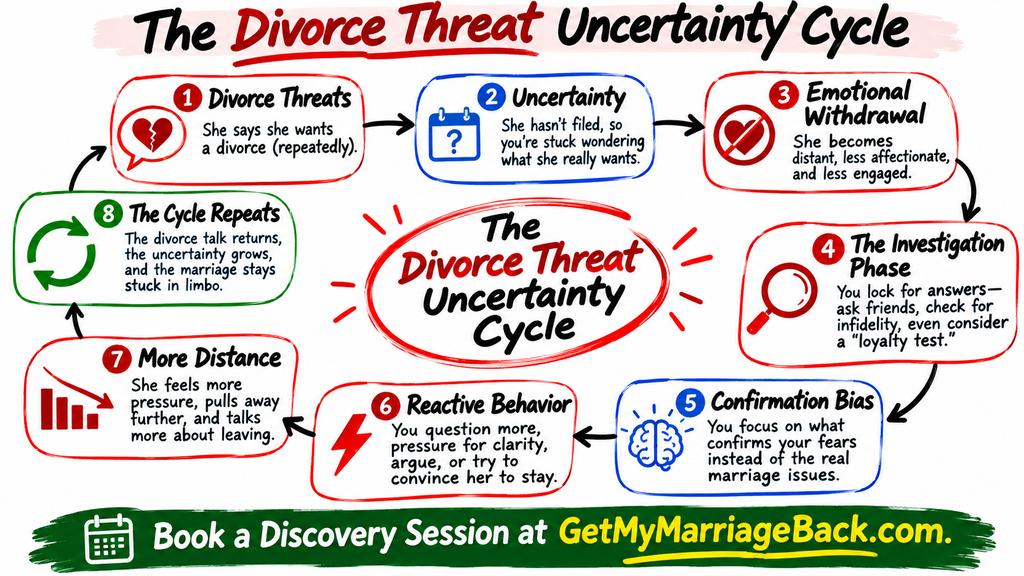
Your Wife Says She Wants a Divorce but Hasn’t Filed: 5 Signs That Matter

Your wife has been saying she wants a divorce for months—maybe even 18 months—but she still hasn’t filed, and you’re caught between hoping she wants to stay and fearing she’s already emotionally gone.

Take This 2 Minutes Quiz

Question 1 of 15

The uncertainty can become more exhausting than the arguments themselves.

One day, you’re wondering whether she’s serious about divorce. The next, you’re analyzing her tone, checking whether she still wears her wedding ring, or wondering why she hasn’t contacted an attorney.

Meanwhile, affection has disappeared. Conversations feel forced. Your attempts to reconnect seem to push her further away.

You want to save your marriage, but you’re not sure whether you’re fighting for a relationship that still has a future or holding on to someone who has already made up her mind.

Here’s what I want you to understand: Your wife not filing for divorce doesn’t automatically mean she wants to stay. But her emotional withdrawal doesn’t tell you everything about her intentions either.

The distinction matters because the way you interpret her behavior influences how you respond. And your response can either create opportunities for emotional reconnection or contribute to the distance already developing between you.

Let’s examine five signs that deserve your attention and what they mean for rebuilding attraction in your marriage.

1. Your Wife Keeps Threatening Divorce but Never Files

When your wife repeatedly says she wants a divorce but takes no legal action, it’s tempting to assume she doesn’t mean it.

You might tell yourself she’s bluffing, trying to get your attention, or using divorce to win arguments.

But those assumptions can become dangerous.

A person can genuinely want to leave a marriage while feeling uncertain about the consequences of ending it.

Children, financial responsibilities, housing, family expectations, emotional attachment, and fear of starting over can all influence the timing of a divorce.

Sometimes a spouse is still emotionally conflicted. Other times, the practical complications of leaving are greater than the emotional discomfort of staying.

The absence of divorce paperwork is not the same as the presence of commitment.

my wife says she wants a divorce but hasn't filed

What should you pay attention to?

Look beyond the words and examine the pattern.

Does your wife only mention divorce during heated arguments, or does she discuss it calmly when there is no immediate conflict?

Has she started making independent financial arrangements, researching housing, or discussing custody and separation?

Does she still participate in meaningful conversations about your future together?

These details provide more useful information than simply counting the months since she first mentioned divorce.

If she has been threatening divorce for 18 months, the important question is not merely why she hasn’t filed.

It’s what has been happening emotionally between you during those 18 months.

A marriage can remain legally intact while the emotional connection continues deteriorating.

That’s why waiting for paperwork is not a marriage-saving strategy.

my wife says she wants a divorce but hasn't filed - the divorce threat uncertainty cycle

2. Your Wife Has Emotionally Withdrawn From the Marriage

One of the most painful experiences in marriage is watching someone who once adored you become emotionally unavailable.

You remember when she wanted to talk to you, laugh with you, touch you, and share the smallest details of her day.

Now she barely responds.

You try to start a conversation, and she gives you short answers. When you reach for affection, she pulls away.

Even sitting together can feel lonely.

This is often when the distressed spouse begins asking, “Is my wife cheating?” or “Does she still love me?”

Those questions are understandable, but emotional withdrawal is not a complete diagnosis.

Emotional distance is a symptom, not an explanation

Withdrawal can reflect accumulated resentment, unresolved conflict, emotional exhaustion, declining attraction, or a growing desire for independence.

In some marriages, infidelity is involved. In others, the spouse has simply stopped expecting the relationship to feel emotionally rewarding.

The observable behavior is real, but the explanation still requires careful examination.

Research on relationship intimacy helps explain why this distinction matters.

Psychologists Harry Reis, Margaret Clark, and John Holmes identified perceived partner responsiveness as an important part of emotional intimacy. People experience greater closeness when they believe their partners understand, value, and respond meaningfully to their needs.

In practical terms, attraction is influenced by how people experience each other, not merely by what they promise.

When someone repeatedly feels misunderstood, dismissed, criticized, or emotionally disconnected, their willingness to engage can diminish.

This doesn’t mean every withdrawn spouse has experienced those conditions. It means you need to investigate the relationship pattern rather than automatically assume the presence of another person.

What does emotional withdrawal reveal about attraction?

Attraction is more than physical appearance or sexual chemistry.

It includes emotional safety, admiration, curiosity, respect, playfulness, and the experience of feeling valued.

When those qualities weaken, the marriage can begin to feel like an obligation instead of a relationship both people enjoy.

You cannot rebuild attraction simply by demanding affection.

Instead, examine what your wife has come to associate with interacting with you.

Does she anticipate another argument? Does she expect you to defend yourself before understanding her perspective? Has every conversation become a negotiation about whether she will stay?

These patterns matter because attraction struggles to grow when ordinary interactions consistently feel emotionally exhausting.

3. You’re Looking for Proof That She’s Cheating Instead of Understanding the Marriage

Imagine a husband whose wife has talked about divorce for more than a year without filing.

She’s emotionally distant, and he desperately wants to know whether there’s another man.

Friends begin offering explanations.

One person suggests she’s already cheating. Another insists she’s keeping him around until she finds someone better.

Eventually, he considers participating in a social-media loyalty test where a stranger would contact his wife and attempt to expose her intentions.

Think about what has happened.

He started with the desire to save his marriage, but his attention has shifted toward investigating his wife.

Even if a loyalty test produces something suspicious, it doesn’t automatically explain the history of the relationship or identify what reconciliation would require.

Why confirmation bias can keep you stuck

Confirmation bias is the tendency to notice, interpret, and prioritize information that supports beliefs you already hold.

When you’re afraid your wife is cheating, ordinary behavior can begin looking suspicious.

She spends more time on her phone, and you assume she’s communicating with someone else.

Her affection declines, and you interpret it as evidence that she’s attracted to another person.

She doesn’t file for divorce, and you conclude she’s keeping her options open.

Any of those interpretations could be correct in a particular situation. None is established by the behavior alone.

If credible evidence of infidelity exists, address it seriously and establish appropriate boundaries.

But don’t manufacture certainty from suspicion.

Confirmation is not reconciliation

You can spend months collecting opinions, studying her behavior, and looking for someone to validate your fears without making meaningful progress toward saving your marriage.

Meanwhile, your emotional energy becomes consumed by circumstances outside your control.

That creates another problem.

The more desperate you become for reassurance, the more likely you are to approach your wife from anxiety rather than emotional stability.

You may repeatedly question her, demand explanations, or turn every interaction into an investigation.

Even when your concerns are legitimate, this pattern can make emotional reconnection increasingly difficult.

A marriage cannot become attractive again when every conversation feels like an interrogation.

4. Your Wife Still Has Individual Choices You Cannot Control

Marriage creates a partnership, but it does not eliminate individuality.

The person you married remains a separate human being with personal desires, emotional experiences, fears, and decisions.

After 19 years of marriage with my wife, Lola, I understand that people continue revealing different aspects of themselves throughout their lives.

Our own marriage went through a major crisis roughly a decade ago, and that experience changed how I understood relationships.

One of the most important lessons was learning the difference between influencing a relationship and trying to control another person.

You cannot force your wife to choose you

You can explain how much you love her.

You can communicate your desire to preserve the marriage, acknowledge mistakes, and demonstrate meaningful changes.

But you cannot make her feel attracted to you on command.

Neither can you force her to reconsider divorce.

Trying to control another person’s emotional decisions usually creates more pressure, and pressure is not the same as attraction.

Genuine attraction involves freedom.

A spouse needs room to experience the relationship differently and make authentic choices about participation.

That doesn’t require you to tolerate mistreatment, ignore your needs, or abandon healthy boundaries.

It means recognizing that your responsibility is to manage your behavior, communicate honestly, and become someone who contributes positively to the relationship.

Her responsibility remains her own.

Emotional safety creates opportunities for reconnection

Emotional safety doesn’t mean agreeing with everything your spouse says.

It means being able to communicate difficult feelings without expecting intimidation, humiliation, manipulation, or unnecessary escalation.

Research from the Gottman Institute illustrates the importance of everyday emotional responsiveness.

In a longitudinal study of newlywed couples, those who remained married six years later responded positively to approximately 86% of their partners’ bids for connection during laboratory observations. Couples who later divorced responded positively about 33% of the time.

These bids are often small: a question, a smile, a request for attention, or an invitation to share an experience.

You can explore the underlying findings in the Gottman Institute’s research on emotional bids and trust.

The practical lesson is that emotional connection develops through repeated experiences, not occasional grand gestures.

When your wife has withdrawn, those everyday experiences deserve serious attention.

5. You’re So Focused on Saving Your Marriage That You’ve Lost Your Own Emotional Stability

This is where many distressed spouses become trapped.

You want to save your marriage so badly that your entire emotional world begins revolving around your wife’s reactions.

When she’s friendly, you feel hopeful.

When she’s distant, you feel rejected.

If she mentions divorce again, your confidence collapses.

You start measuring your personal worth against her willingness to stay.

Over time, the relationship crisis begins consuming your identity.

I understand this pattern because I had to confront aspects of it during my own marriage crisis.

Eventually, I recognized that constantly seeking validation from outside myself was weakening my ability to lead my own behavior.

I needed to develop greater personal capacity.

Why emotional stability matters when rebuilding attraction

Attraction is influenced by the emotional experience two people create together.

When your spouse experiences you as consistently anxious, demanding, reactive, or dependent on reassurance, ordinary interactions can become burdened with emotional pressure.

On the other hand, emotional steadiness can make difficult conversations more constructive.

A person who can listen without immediately becoming defensive, communicate without begging, and maintain self-respect during uncertainty brings a different quality of energy into the relationship.

This is not about pretending you don’t care.

It’s about caring deeply without allowing fear to control your behavior.

Emotional intelligence allows you to recognize your feelings, understand their influence, and respond intentionally.

That ability becomes especially important when your spouse is considering divorce.

How to Rebuild Attraction When Your Wife Wants a Divorce

When your wife wants divorce but you don’t, your instinct may be to persuade her to reconsider immediately.

You might promise dramatic changes, increase romantic gestures, or repeatedly remind her of your history together.

But rebuilding attraction requires more than convincing someone that your marriage deserves another chance.

It requires changing the emotional experiences associated with the relationship.

Begin with grounding

Before responding to another divorce threat, recognize what you’re feeling.

Fear, rejection, anger, grief, and uncertainty can all influence your reactions.

Grounding means learning to experience those emotions without automatically acting on them.

You don’t need to suppress your feelings. You need enough emotional stability to choose your response rather than surrendering that choice to panic.

Reconnect with your purpose

Your marriage is an important part of your life, but it cannot become the only source of your identity.

Reconnect with your health, responsibilities, meaningful work, friendships, personal values, and long-term goals.

This is not a strategy for making your wife jealous.

It’s an expression of self-respect and personal direction.

A person with purpose is better positioned to participate in a relationship from genuine desire rather than desperation.

Practice self-discovery

Examine the relationship patterns that may have contributed to disconnection.

Consider how you respond to criticism, disappointment, disagreement, and unmet expectations.

Do you become defensive? Do you withdraw emotionally? Are you constantly seeking reassurance?

Self-discovery is not an exercise in accepting responsibility for every marital problem.

It’s an opportunity to identify the behaviors you can meaningfully change.

Together, grounding, purpose, and self-discovery form the foundation of GPS5.

The Connection Between Value, Curiosity, and Attraction

One of the biggest misunderstandings about saving a marriage is believing that attraction returns when you explain your love convincingly enough.

Love declarations have their place, but attraction is experienced through interactions.

Your spouse notices how you handle pressure, whether you respect boundaries, how you communicate, and whether your actions align with your words.

These experiences influence how the relationship feels.

Value comes before persuasion

Value is not about money, status, or trying to prove you’re better than another potential partner.

It includes emotional maturity, integrity, self-respect, accountability, and the ability to contribute positively to shared experiences.

When you develop these qualities authentically, your behavior becomes less dependent on your spouse’s immediate approval.

That changes how you show up in the marriage.

Curiosity can reopen emotional possibilities

When two people have been arguing for months, they may begin assuming they already know everything about each other.

Every conversation becomes predictable.

Your wife expects you to react defensively, while you expect her to reject your attempts at connection.

Curiosity interrupts that pattern.

Instead of approaching every interaction with an agenda, you become more interested in understanding the person in front of you.

You listen for what she means rather than preparing your next argument.

You recognize changes in her emotional experience without automatically making them about yourself.

Curiosity also works in the other direction.

When your behavior becomes consistently different from the patterns she expects, she may begin noticing qualities that have been absent from the relationship.

That possibility cannot be forced, but it can be supported by genuine personal growth.

Attraction requires a different emotional experience

A seductive marriage is not built through manipulation, jealousy, or manufactured scarcity.

It’s built through genuine confidence, emotional presence, warmth, playfulness, mutual desire, and respect for personal choice.

Sometimes the most attractive response is not another romantic speech.

It’s demonstrating that you can remain composed during a difficult conversation.

Other times, attraction grows through humor, thoughtful attention, or the simple experience of enjoying each other’s company without discussing the marriage crisis.

Physical affection matters too, but it must remain welcome and mutually desired.

When your wife has withdrawn, the goal is not to pressure her into intimacy.

It’s to understand what has made connection difficult and whether a healthier emotional dynamic can develop.

Can You Save Your Marriage Alone When Your Wife Wants Out?

You can begin changing your contribution to the marriage even when your wife isn’t ready to participate.

That distinction is important.

Saving your marriage alone does not mean controlling the outcome by yourself.

It means refusing to postpone your personal growth until your spouse changes first.

You can improve emotional regulation, communicate more respectfully, recognize unhealthy patterns, and establish boundaries.

Those changes may create opportunities for reconciliation, especially when the relationship has been dominated by predictable conflict.

However, rebuilding a mutually satisfying marriage ultimately requires two people willing to participate.

Your growth is your responsibility. Her choices remain hers.

What to Do When Your Wife Says She Wants Divorce but Won’t Leave

Stop treating her continued presence as the answer to your marriage crisis.

Instead, evaluate the quality of the relationship that currently exists.

Consider whether communication is improving or deteriorating, whether emotional responsiveness is increasing, and whether both partners can discuss difficult subjects respectfully.

If separation is being discussed, address practical arrangements clearly rather than using uncertainty as a reason to avoid necessary decisions.

At the same time, avoid making every interaction a referendum on the marriage.

Not every conversation needs to determine whether your wife still loves you.

You can respect the seriousness of her statements while remaining intentional about your behavior.

The most important shift is moving from monitoring her every reaction to developing your own emotional capacity.

When you stop organizing your entire life around the next divorce threat, you become better equipped to see the relationship clearly.

And clarity is essential for making decisions about reconciliation.

The Truth About a Wife Who Wants Divorce but Hasn’t Filed

Your wife may be conflicted.

She may be emotionally exhausted, financially unprepared, uncertain about leaving, or still attached to aspects of your marriage.

It’s also possible that she’s made an emotional decision but hasn’t taken the legal steps to follow through.

You cannot determine her intentions from the missing paperwork alone.

What you can examine is the relationship dynamic developing between you.

The emotional withdrawal, repeated conflict, reduced affection, and loss of attraction deserve more attention than speculation about why an attorney hasn’t filed a petition.

Your greatest opportunity is not discovering how to make your wife stay. It’s becoming more emotionally capable while creating the conditions in which genuine connection can be considered again.

That begins with self-leadership, emotional intelligence, personal value, and a willingness to understand your marriage beyond the immediate fear of divorce.

Because the marriage crisis is already happening, whether or not the paperwork has been filed.

And the way you respond to that crisis matters.

“I Feel Disgusted When My Husband Touches Me” – [5 Solutions]

Frequently Asked Questions

Why does my wife say she wants a divorce but hasn’t filed?

She may be uncertain, emotionally conflicted, concerned about finances or children, or unprepared for the practical consequences of divorce. Her delay alone doesn’t establish whether she intends to stay or leave.

Does my wife not filing for divorce mean she still loves me?

Not necessarily, because remaining legally married doesn’t automatically indicate romantic attachment or a desire for reconciliation. Examine her communication, emotional engagement, and willingness to participate in repairing the relationship.

Can I save my marriage if my wife wants a divorce but I don’t?

You can begin improving your emotional stability, communication, and relationship behaviors without waiting for your wife to change. A lasting reconciliation, however, requires both partners to choose participation.

What should I do if my wife is emotionally withdrawn and keeps threatening divorce?

Take her statements seriously, avoid pressuring her for reassurance, and examine the relationship patterns contributing to emotional distance. Focus on constructive communication, healthy boundaries, and consistent personal growth rather than trying to control her decision.


What Would Help You Most Right Now?

Choose the option that best matches where you are with your marriage.

I Need Personalized Help

My Marriage Is in Serious Trouble

If you're dealing with separation, divorce, loss of attraction, infidelity, intimacy problems, or a spouse who's pulling away, get help looking at what's happening in your specific situation.

Get Personalized Help →
Get My Marriage Back book cover
I'd Rather Learn What to Do First

Start With Get My Marriage Back

Get the book and start learning the principles for moving your marriage in a better direction.

Get the Free Book →