
What Would Help You Most Right Now?

Choose the option that best matches where you are with your marriage.

I Need Personalized Help

My Marriage Is in Serious Trouble

If you're dealing with separation, divorce, loss of attraction, infidelity, intimacy problems, or a spouse who's pulling away, get help looking at what's happening in your specific situation.

Get Personalized Help →
Get My Marriage Back book cover
I'd Rather Learn What to Do First

Start With Get My Marriage Back

Get the book and start learning the principles for moving your marriage in a better direction.

Get the Free Book →

Wife Wants to Separate? 4 Signs Her Distance Could Become Divorce

Your wife wants to separate, and the most frightening part isn’t the word separation—it’s watching her gradually build a life that seems to have less and less room for you.

Take This 2 Minutes Quiz

Question 1 of 15

Maybe she stopped initiating sex months ago. Affection became inconsistent, conversations grew tense, and now she wants more personal space.

Her career, finances, friendships, and future plans increasingly seem to operate independently of your marriage.

You still love your wife. You want to understand what’s happening, but every attempt to get reassurance seems to push her further away.

Here’s the distinction I want you to understand:

Your wife’s independence doesn’t automatically mean she’s leaving your marriage. But temporary emotional distance can become permanent when the patterns surrounding it continue.

Understanding those patterns is the beginning of responding with emotional intelligence rather than fear.

Why Does My Wife Want to Separate When We’re Still Married?

When a wife wants to separate, her husband often assumes she’s already made a final decision.

That’s understandable, especially when the separation request follows months of sexual rejection, reduced affection, and emotional withdrawal.

However, wanting independence and deciding to divorce are not identical.

Your wife might be experiencing several competing emotions:

  • She feels overwhelmed by the demands of marriage, work, or family.
  • She wants more control over her personal decisions.
  • She has unresolved resentment toward you.
  • She misses the independence she experienced before marriage.
  • She is uncertain whether she still feels romantic attraction.
  • She has begun imagining what life would look like without the relationship.

These possibilities can overlap.

A woman can feel overwhelmed and emotionally detached at the same time. She can want space without knowing whether she wants divorce.

The mistake is assuming that one explanation automatically eliminates every other possibility.

I want you to recognize the difference between what your wife has actually communicated and what your anxiety is telling you her behavior means.

That distinction matters because your interpretation influences your next move.

wife wants to separate

When Your Wife Starts Acting Single While Still Married

Consider a marriage where physical intimacy has gradually disappeared.

The husband notices that his wife rarely initiates affection. Sometimes she compares him to other husbands, mentioning what her friends’ spouses are doing differently.

He begins questioning whether she’s still attracted to him.

Meanwhile, she’s experiencing perimenopause, financial pressure, and uncertainty about her career.

Her stress is real. His frustration is also real.

Then the relationship changes again.

She wants more independence, spends less time with him, and becomes increasingly focused on her own plans.

Eventually, she mentions separation.

What began as a concern about sex has become a much bigger question:

Is she trying to rediscover herself, or is she discovering that she prefers a life without her husband?

This is where many distressed spouses make a costly mistake.

They begin interpreting every independent decision as evidence of rejection.

A career opportunity becomes proof that she’s planning to leave. Spending time with friends becomes suspicious, and her desire for privacy starts looking like a secret divorce strategy.

You cannot understand the direction of your marriage by investigating isolated behaviors.

Instead, examine the relationship patterns surrounding those behaviors.
wife wants to separate emotional distance signs

4 Signs Your Wife’s Emotional Distance Could Be Becoming Permanent

1. Her Independence Is Replacing Your Shared Future

Healthy independence and marital commitment can coexist.

Your wife can pursue career opportunities, develop friendships, manage finances, and maintain personal interests while remaining emotionally invested in the marriage.

The concern begins when independence consistently replaces partnership.

Perhaps she no longer includes you in important discussions. Shared plans become increasingly rare, and conversations about the future focus almost entirely on her individual life.

Notice the distinction.

Having separate interests isn’t emotional abandonment.

However, consistently excluding the marriage from major future decisions can indicate a deeper change in how she understands the relationship.

Ask yourself whether she still demonstrates interest in building anything together.

Does she occasionally initiate meaningful conversations? Is she willing to discuss shared responsibilities or consider your perspective when decisions affect both of you?

A spouse who needs breathing room may still preserve a sense of partnership.

Growing detachment becomes more concerning when that shared identity repeatedly disappears.

2. Physical Withdrawal Is Becoming Emotional Withdrawal

A wife who stops initiating sex isn’t automatically preparing for divorce.

Sexual desire is influenced by physical health, emotional stress, relationship satisfaction, and hormonal changes.

Perimenopause, for example, can affect sleep, mood, comfort during intimacy, and sexual desire.

That context matters.

Nevertheless, a marriage can experience more than a temporary reduction in sexual activity.

Perhaps your wife no longer initiates affection, avoids meaningful conversations, and shows little curiosity about your emotional experience.

Now the issue extends beyond sex.

You’re experiencing a broader loss of connection.

Sexual rejection and emotional detachment are related concerns, but they are not interchangeable.

A wife can have reduced sexual desire while still feeling deeply connected to her husband.

Conversely, physical intimacy can occasionally continue even when emotional investment has weakened.

Rather than treating sex as the only measurement of attraction, pay attention to warmth, openness, curiosity, affection, and the overall quality of your interactions.

These provide a more complete picture of your marriage.

3. She Seems Increasingly Comfortable Imagining Life Without You

One of the most unsettling experiences in marriage separation is watching your spouse become comfortable with the idea of living independently.

She might talk about where she would live, how she would manage her finances, or what her daily routine might look like.

Sometimes these conversations are practical preparations.

Other times, they are expressions of frustration, uncertainty, or a desire to escape emotional pressure.

The important distinction is between imagining an alternative and making a definite decision.

A fantasy about independence isn’t the same as filing for divorce.

However, repeatedly imagining a future without the marriage can gradually make that future feel more familiar.

You should take explicit separation plans seriously without treating every hypothetical statement as a final decision.

Pay attention to what she communicates consistently, what practical steps she takes, and whether she remains willing to discuss the relationship.

Your objective isn’t to police her imagination.

It’s to understand the actual direction of the marriage.

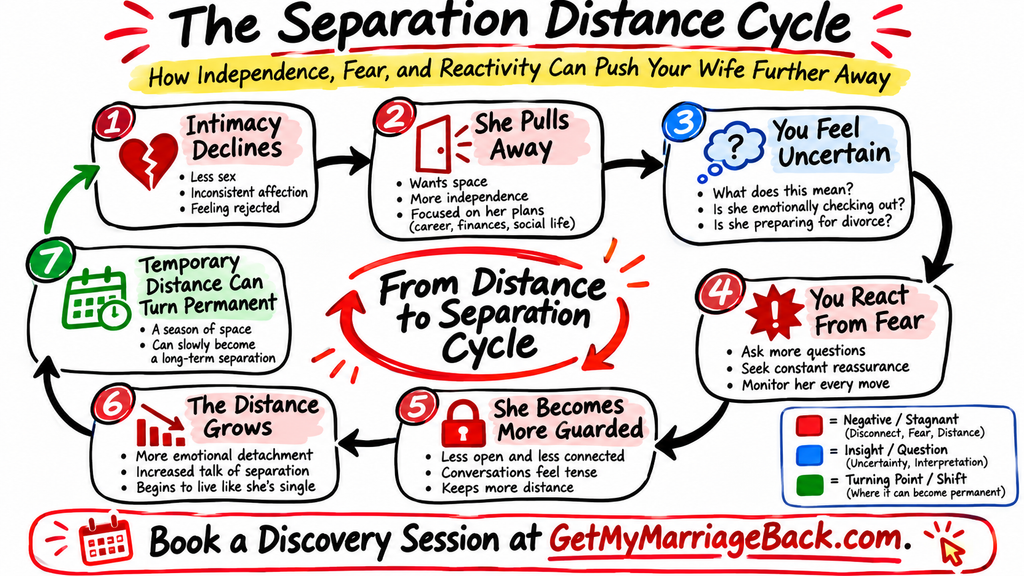
4. Your Conversations Are Becoming a Pursuit-and-Withdrawal Cycle

This is one of the most important signs because it involves something you can directly influence.

Your wife pulls away.

You feel anxious and begin asking questions.

Does she still love you? Is there another man? Does she want a divorce? Why doesn’t she want to spend time with you?

You’re looking for reassurance.

But she experiences the repeated questioning as pressure and becomes more guarded.

Her withdrawal increases your suspicion, so you ask even more questions.

Now both of you are contributing to an escalating cycle.

Relationship researchers call this a demand-withdraw pattern.

In a study involving 55 couples, researchers observed connections between one partner’s demanding behavior, the other’s withdrawal, and their emotional reactions during conflict.

The research on demand-withdraw behavior helps explain why repeated pursuit and emotional withdrawal can reinforce each other rather than resolve the underlying disagreement.

Here’s what I want you to recognize:

The more you pursue reassurance through pressure, the more threatening ordinary conversations can become.

This pattern isn’t limited to husbands pursuing wives. Either spouse can occupy either role.

When fear begins directing your communication, even reasonable questions can become part of an unhealthy interaction.

Breaking that pattern requires more than finding better words.

It requires developing a different emotional response.

Bad Signs During Separation: What Actually Deserves Your Attention?

When your wife wants to separate, it’s tempting to search for definitive signs that she’s never coming back.

But no single behavior can tell you everything about another person’s intentions.

Look for repeated patterns rather than isolated moments.

Some developments deserve particular attention:

  • She explicitly communicates that she no longer wants the marriage.
  • She consistently avoids discussions about shared responsibilities or the relationship’s future.
  • She begins making concrete plans for a separate household.
  • She shows sustained disinterest in repairing unresolved conflicts.
  • She establishes financial or legal arrangements for separation.
  • She repeatedly describes the relationship as something she no longer wants to participate in.

These are more consequential than whether she went out with friends or seemed emotionally distant after a difficult day.

At the same time, don’t confuse a calm separation with a successful reconciliation.

Reduced conflict can mean that emotional pressure has decreased.

It can also mean that one spouse has stopped engaging.

The meaning depends on the larger pattern.

Can You Save Your Marriage While Separated?

Marriage reconciliation begins with understanding the difference between influence and control.

You cannot force your wife to feel attraction.

Neither can you argue her into emotional intimacy or persuade her to experience desire through repeated explanations.

However, your behavior still influences the emotional environment of the relationship.

You can change how you communicate, manage anxiety, maintain boundaries, and show up in difficult conversations.

Those changes matter because attraction isn’t only about physical appearance.

Romantic attraction can also involve emotional safety, curiosity, confidence, warmth, respect, and the experience of being with someone who has a meaningful life.

When your entire identity becomes centered on whether your wife still wants you, your interactions can become dominated by insecurity.

You stop relating to her as a complete person and begin treating every conversation as a test of whether you’re still desirable.

That pressure rarely creates the emotional atmosphere you’re seeking.

Building attraction requires becoming someone who can offer connection without demanding constant validation in return.

This isn’t about pretending you don’t care.

It’s about caring without allowing desperation to determine your behavior.

How to Rebuild Attraction When Your Wife Wants Space

Stop Turning Every Interaction Into a Marriage Status Report

Your wife already knows you’re concerned about the relationship.

Repeating the same questions every evening doesn’t necessarily create more clarity.

Sometimes it creates emotional exhaustion.

There is a difference between having an intentional conversation about the marriage and repeatedly asking your spouse to regulate your anxiety.

You can express your desire to reconcile while respecting her need for space.

For example:

“I care about our marriage, and I’m interested in understanding what has changed between us. I also recognize that repeating the same conversation under pressure isn’t helping either of us.”

That statement communicates commitment without demanding an immediate declaration of love.

Then allow your behavior to support your words.

Replace Emotional Pursuit With Emotional Presence

Emotional presence is different from emotional pursuit.

Pursuit driven by fear seeks immediate relief.

Presence involves remaining grounded enough to listen, communicate, and tolerate uncertainty without escalating the situation.

You don’t need to disappear to demonstrate independence.

Instead, develop the ability to participate in interactions without constantly trying to control their outcome.

Listen without preparing a defensive argument.

Acknowledge what your wife says without automatically agreeing with every interpretation.

Express your own feelings without using guilt to secure affection.

These skills make difficult conversations less threatening.

They also allow your personality, warmth, and confidence to become visible again.

Rebuild Your Personal Identity

One of the most damaging consequences of marriage anxiety is losing your sense of self.

Your mood begins depending on your wife’s behavior.

When she’s affectionate, you feel hopeful. When she’s distant, you feel defeated.

Eventually, your entire day revolves around interpreting her reactions.

That’s not the emotional foundation from which healthy attraction develops.

Reconnect with meaningful responsibilities, friendships, physical well-being, interests, and personal ambitions.

Develop a life that remains purposeful even during uncertainty.

This doesn’t mean acting single to provoke jealousy.

It means becoming emotionally grounded enough to remain yourself while navigating a difficult marriage.

Confidence becomes more compelling when it’s supported by consistent behavior rather than performed for attention.

Create Room for Curiosity and Natural Attraction

Attraction grows through experiences, not interrogation.

When every interaction centers on separation, rejection, or divorce, the relationship can become emotionally predictable.

Your wife may begin anticipating another difficult conversation before you even speak.

Changing that atmosphere requires patience and discernment.

Not every moment needs to become an opportunity to discuss the marriage.

Appropriate humor, shared interests, respectful conversation, and genuine curiosity can create a different emotional experience.

Don’t use kindness as a transaction.

Affection offered with the expectation of immediate reciprocation can become another form of pressure.

Instead, practice warmth because it reflects the person you’re choosing to become.

Respect physical and emotional boundaries, particularly when your wife has clearly requested space.

Seduction within marriage is most meaningful when it involves mutual desire, emotional responsiveness, and the freedom to choose connection.

The goal is to become more engaging and emotionally available—not to manufacture attraction through manipulation.

The GPS5 Approach to Saving Your Marriage Alone

When your spouse wants out, your first responsibility is to regain emotional direction.

I begin with three elements of the GPS5 framework: Grounding, Purpose, and Self-Discovery.

Grounding: Separate Facts From Fear

Grounding means learning to recognize what you actually know.

Your wife asking for space is a fact.

Concluding that she’s secretly preparing to divorce you may be an interpretation.

Her reduced interest in sex is observable.

Assuming that another man must be responsible is speculation unless you have evidence.

This distinction protects you from reacting to imagined threats as though they’re established realities.

Purpose: Stop Making Your Marriage Crisis Your Entire Identity

Your marriage matters.

However, your value as a person cannot depend entirely on your spouse’s current feelings.

Reconnect with the responsibilities and aspirations that give your life direction.

A grounded sense of purpose allows you to remain emotionally available without becoming dependent on constant reassurance.

It also makes your presence more stable and engaging.

Self-Discovery: Identify the Patterns You’re Bringing Into the Marriage

Ask yourself difficult questions.

Do you become controlling when you feel rejected?

Are you repeatedly demanding affection because you’re afraid of abandonment?

Have you neglected your own development while focusing entirely on your spouse?

Perhaps you withdraw, criticize, or become defensive when conversations don’t go your way.

Self-discovery requires recognizing these behaviors without making your spouse responsible for changing them.

The purpose isn’t to blame yourself for the entire marriage crisis.

It’s to identify the patterns within your control.

What About the 3 S’s: Skills, Support, and System?

Understanding your marriage intellectually is different from behaving differently when emotions become intense.

You might recognize the pursuit-and-withdrawal cycle today, then repeat it tomorrow when your wife declines an invitation or avoids a conversation.

That’s why personal transformation requires more than motivation.

Skills help you communicate, regulate emotions, establish boundaries, and respond constructively.

Support helps you examine blind spots and maintain perspective when fear distorts your judgment.

System means developing consistent habits rather than relying on occasional moments of clarity.

Together, these elements help turn emotional intelligence into repeatable behavior.

The objective is not to become indifferent to your wife.

It’s to become someone capable of handling uncertainty, rejection, and difficult conversations without abandoning personal dignity.

When Temporary Separation Starts Feeling Permanent

The most dangerous assumption is that time alone will solve the problem.

Sometimes space allows both spouses to recover from emotional exhaustion.

In other situations, prolonged distance becomes the new normal because the underlying issues remain unresolved.

That’s why you need to pay attention to the direction of the relationship.

Are conversations becoming less defensive?

Is there more mutual understanding?

Does either spouse demonstrate interest in addressing the problems that contributed to separation?

Are shared responsibilities being handled respectfully?

These questions reveal more than simply counting how many days you’ve spent apart.

Reconciliation is not measured by whether your wife sends an affectionate text.

It’s reflected in the development of a healthier relationship pattern.

You can contribute to that pattern even before your spouse decides what she wants.

The Truth About Your Wife Wanting to Separate

Your wife may be overwhelmed.

She may be emotionally detached.

She may be imagining an independent future without you.

Several of these things can be true simultaneously.

The important question isn’t whether you can decode every thought in her mind.

It’s whether you can recognize the patterns unfolding in your marriage and respond with emotional intelligence.

Fear encourages interrogation, suspicion, and emotional pursuit.

Grounded confidence allows you to maintain boundaries, communicate clearly, and remain open to connection without surrendering your identity.

Your wife’s independence isn’t automatically the end of your marriage. But the emotional patterns you continue during this season can influence what happens next.

And that is where your personal development becomes essential.

“I Feel Disgusted When My Husband Touches Me” – [5 Solutions]

Frequently Asked Questions

Why does my wife want to separate but not divorce?

She may want relief from conflict, personal independence, or time to evaluate the relationship without making a final decision. Her willingness to discuss the marriage and her practical plans provide more context than the separation request alone.

What are the signs my wife is not coming back after separation?

Consistent rejection of reconciliation, concrete divorce preparations, and sustained unwillingness to discuss a shared future are more concerning than temporary emotional distance. Look at repeated behavior and explicit communication rather than isolated incidents.

How do I win my wife back during separation?

Focus on emotional regulation, respectful communication, personal development, and addressing the relationship patterns that contributed to separation. Attraction and reconciliation require voluntary participation rather than pressure or constant reassurance-seeking.

Can a marriage be saved when only one spouse is trying?

One spouse can improve personal behavior, reduce destructive interaction patterns, and create better conditions for communication. Rebuilding a mutually committed marriage ultimately requires both spouses to participate.


Wife Never Initiates Affection? The Hidden Cycle Keeping Her Distant

Your wife never initiates affection anymore, and every night you spend waiting for her to reach for you makes you feel like you’re the only one trying to keep your marriage alive.

Take This 2 Minutes Quiz

Question 1 of 15

You remember when your wife used to touch you without being asked. She would reach for your hand, kiss you spontaneously, lean against you on the couch, or initiate intimacy because she wanted to be close.

Now, you initiate almost everything.

When you stop making the first move, nothing happens. The silence becomes painful, and you start wondering whether your wife is still sexually attracted to you.

Perhaps you’ve already tried explaining how rejected you feel. You’ve reminded her that physical affection matters to you, worked harder to make her happy, or asked why she never initiates intimacy.

Yet the emotional distance keeps growing.

I want to show you something that changed my marriage.

Your wife’s withdrawal is a real problem. But the way you interpret that withdrawal can become a second problem that makes the first one worse.

Understanding this distinction is one of the most important steps toward rebuilding attraction when your marriage feels like it’s falling apart.

Why Your Wife Never Initiates Affection Anymore

When your wife stops initiating physical affection, your immediate instinct is to focus on what she’s no longer doing.

She doesn’t kiss you first. She doesn’t reach for your hand. She rarely initiates sex, and when you attempt physical intimacy, her response feels cold or mechanical.

Naturally, you begin connecting those experiences to a frightening conclusion: your wife doesn’t desire you anymore.

Sometimes, that conclusion reflects a genuine loss of attraction. In other situations, unresolved resentment, emotional disconnection, stress, or repeated negative interactions have changed how she experiences closeness.

The important distinction is that a lack of initiation is a symptom, not a complete explanation of what’s happening in your marriage.

And when you’re hurting, that symptom can become the lens through which you interpret everything else.

You stop noticing the ordinary moments when your wife is pleasant, thoughtful, cooperative, or emotionally available.

Instead, you become increasingly sensitive to every moment when she isn’t.

Before long, your entire marriage feels like one long experience of rejection.

That’s where the cycle begins.

wife never initiates affection

The Hidden Cycle That Makes Emotional Distance Worse

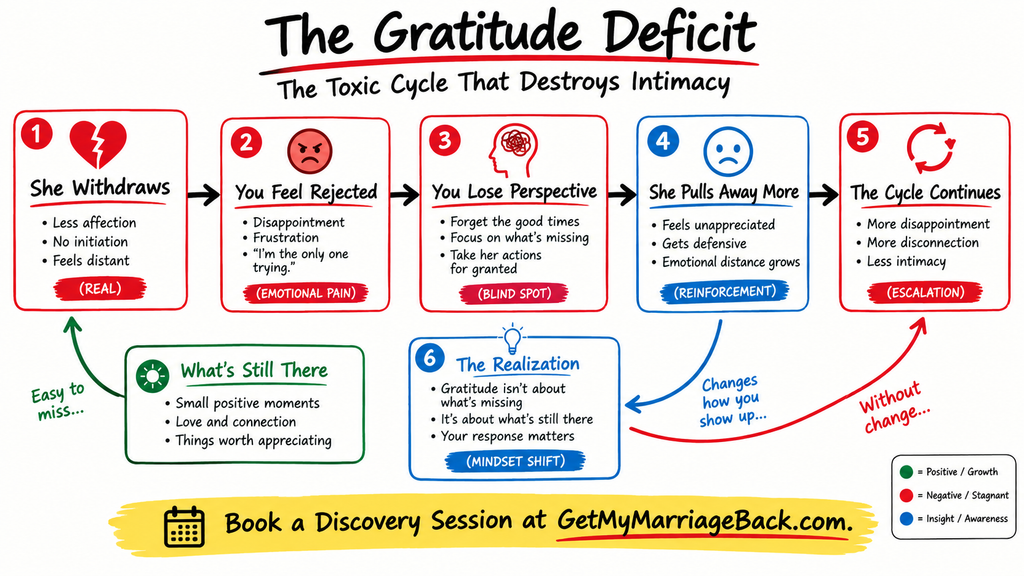
I call this the Disappointment Amplification Cycle.

It develops through a sequence of emotional reactions that can become almost automatic.

1. You Expect Affection and Feel Disappointed

You want your wife to initiate physical touch because you want to feel desired.

That’s a legitimate desire.

But when she doesn’t respond according to your expectations, disappointment enters the experience.

The problem begins when that disappointment becomes more important than everything else happening between you.

2. Your Attention Becomes Dominated by What’s Missing

One disappointing interaction begins overshadowing dozens of ordinary or positive experiences.

You remember the rejection but overlook the smile.

Her failure to initiate intimacy becomes more significant than the small gestures of care that still exist.

Your attention starts selecting evidence that supports the belief that your wife no longer cares.

3. Your Emotional Reaction Changes Your Behavior

Frustration begins affecting your tone, facial expressions, patience, and emotional availability.

You become more critical, defensive, or demanding.

Even when you’re trying to create intimacy, your wife experiences the emotional pressure surrounding your attempts.

Affection starts becoming associated with expectations and disappointment rather than enjoyment.

4. Your Wife Withdraws Further

As tension increases, she becomes less responsive.

Physical affection decreases, conversations feel strained, and spontaneous connection becomes increasingly rare.

You interpret this additional withdrawal as confirmation that you were right all along.

5. You Become Convinced You’re the Only One Trying

Now the marriage feels completely one-sided.

You begin measuring your effort against everything your wife isn’t doing.

The positive experiences become harder to remember, and the negative experiences grow more emotionally powerful.

Eventually, you return to the beginning of the cycle with even greater expectations, resentment, and fear.

The more you focus on the absence of affection, the more that absence can dominate the experience you’re creating.

wife never initiates affection - the gratitude deficit

What Almost Losing My Marriage Taught Me About Attraction

Lola and I recently celebrated 19 years of marriage.

About ten years ago, however, we experienced a marriage crisis that almost ended our relationship.

During our first eight or nine years together, there were several moments when things became serious enough to threaten everything we had built.

And one of the most important discoveries I made was about myself.

Whenever Lola did something that fell below my expectations, I had a tendency to allow that disappointment to overwhelm our entire experience.

Something would happen.

I wouldn’t like it.

Then I would carry the emotional weight of that experience into our next interaction.

Before long, Lola would withdraw.

And suddenly, I would become confused.

Why isn’t she initiating affection? Why is she responding that way? Why does she seem irritated? Why am I the only person trying?

Here’s the uncomfortable part.

Sometimes, she had already attempted to communicate what was happening.

But I wasn’t paying attention.

I had mentally disconnected from the earlier interaction while continuing to carry its emotional consequences.

I was surprised by her emotional disconnection without recognizing how my own reactions had contributed to the atmosphere between us.

Over the years, as Lola and I continued sharing our experiences, I discovered that there were moments when she had felt like the only person trying, too.

That realization changed how I understood marital dissatisfaction.

Two people can experience the same relationship and walk away with very different emotional accounts of what happened.

The Man Who Couldn’t Remember the Good Times

I once worked with a man who had spent years complaining about his wife.

According to him, she wasn’t doing enough.

She didn’t cook enough, clean enough, initiate affection, or understand his needs.

As I listened, I noticed that he could describe his disappointments with incredible detail.

But when I started asking about the good experiences in his marriage, something interesting happened.

It took considerable effort to get him to acknowledge them.

Those positive experiences existed.

He simply wasn’t giving them meaningful attention.

His disappointment had become so dominant that almost everything else disappeared from his emotional accounting.

Then we started talking about intimacy.

I asked him a question.

“What’s your love language?”

He struggled for a moment before answering.

“Sex.”

I stopped him.

“What do you mean by sex?”

Because sex fulfills something else.

What experience was he actually looking for?

Was it feeling desired? Was it reassurance that his wife still wanted him? Was it emotional closeness, acceptance, or the experience of being chosen?

He froze.

And I realized that there was much deeper work to do.

You can spend years telling your wife that she isn’t meeting your needs without understanding the experience you’re actually trying to create.

When that happens, you become dependent on her behavior for an emotional outcome you haven’t fully understood yourself.

Why Gratitude Matters When Your Wife Isn’t Affectionate

Gratitude is one of the most misunderstood principles in marriage.

People often interpret gratitude as pretending everything is wonderful or convincing themselves that their spouse is doing enough.

That’s not what I mean.

Gratitude is the ability to recognize the value of something real without requiring everything else to be perfect.

Imagine experiencing a thousand interactions in your marriage.

Some are wonderful. Others are ordinary. A few are deeply disappointing.

One painful experience can become so emotionally dominant that it changes how you remember everything else.

The purpose of gratitude isn’t to erase that pain.

It’s to stop the pain from erasing your awareness of everything valuable that still exists.

What Relationship Research Reveals About Appreciation

Relationship researchers have repeatedly examined the connection between gratitude, appreciation, and relationship quality.

A study by Sara Algoe, Shelly Gable, and Natalya Maisel found that gratitude following thoughtful interactions predicted increases in relationship connection and satisfaction the following day.

Other research by Amie Gordon and colleagues found that people who felt more appreciated tended to become more appreciative and responsive toward their partners.

Research involving 316 African American couples also found that feeling appreciated by a partner helped buffer some of the negative associations between relationship stress and relationship quality.

These findings support an important distinction: appreciation isn’t simply polite behavior. It is connected to the emotional experiences that help sustain intimate relationships.

You can explore the underlying findings in this peer-reviewed research on gratitude and relationship maintenance.

For your marriage, the practical lesson is straightforward.

When you consistently overlook positive experiences, you lose access to emotional resources that can help you respond more constructively to disappointment.

And when you become more intentional about recognizing genuine value, you begin changing the emotional experience you bring into your interactions.

Stop Confusing Being a Good Husband With Creating Attraction

One of the biggest mistakes I see when helping people save their marriages is confusing moral goodness with experiential attraction.

You can be responsible, loyal, hardworking, and deeply committed to your family.

Those qualities matter.

But they don’t automatically create romantic desire.

Attraction is also about the experience of being around you.

Does your presence create warmth or pressure?

When your wife interacts with you, does she encounter curiosity, emotional steadiness, playfulness, and genuine interest?

Or does every interaction carry the weight of another unmet expectation?

This is where emotional intelligence becomes essential.

You don’t build attraction by demanding proof that you’re attractive.

You build your capacity for attraction by developing the qualities and behaviors that make your presence engaging.

That includes emotional self-control, confidence, generosity without hidden expectations, personal direction, and the ability to create enjoyable experiences.

These qualities become especially important when you’re trying to save your marriage alone.

You cannot manufacture your wife’s desire.

But you can stop making your own fear and disappointment the dominant experience you bring into the relationship.

How to Rebuild Attraction Without Begging for Affection

Here’s what I want you to do.

Start by separating your wife’s behavior from your interpretation of your entire marriage.

If she doesn’t initiate affection tonight, acknowledge that reality.

Don’t automatically turn it into evidence that your marriage has no value or that you’re personally undesirable.

Then begin working through three essential areas.

Grounding: Stop Letting Her Response Define Your Worth

Your wife’s affection is something you desire.

It is not the ultimate source of your identity.

When rejection occurs, return to a source of truth beyond her immediate response.

Recognize the disappointment without allowing it to control your next interaction.

Practice gratitude by identifying something specific and genuine that deserves appreciation.

It can be a thoughtful gesture, a moment of cooperation, a shared laugh, or an ordinary act of consideration.

The objective isn’t to manufacture positivity.

It’s to develop a more accurate emotional perspective.

Purpose: Build a Life Bigger Than Her Approval

When your entire emotional world revolves around whether your wife desires you, every interaction becomes disproportionately important.

A missed kiss can ruin your evening.

One cold response can consume your attention for days.

Redirect that energy toward a meaningful mission.

Your work, contribution, health, personal development, and legacy deserve attention independent of your wife’s immediate behavior.

Purpose helps you become less reactive because your life no longer rises and falls with every romantic interaction.

That emotional independence is an important part of personal power.

Self-Discovery: Understand What Rejection Triggers Inside You

When your wife doesn’t initiate intimacy, examine your immediate reaction.

Do you become angry?

Do you withdraw affection to punish her?

Are you tempted to send a long message explaining everything you’ve sacrificed?

Or do you become desperate to prove that you’re still desirable?

Recognizing these patterns is not an exercise in blaming yourself for your wife’s withdrawal.

It’s an opportunity to understand your own emotional habits.

Once you recognize the pattern, you can choose a different response.

The Difference Between Pursuing Your Wife and Chasing Her

There’s nothing inherently wrong with wanting your wife.

Expressing romantic interest, initiating affection, and making your attraction known are normal parts of marriage.

The problem is the emotional position from which those behaviors emerge.

When you pursue from confidence, your interest is an authentic expression of desire.

When you chase from fear, your behavior becomes an attempt to escape rejection.

The distinction matters.

You can offer a warm touch without turning it into a demand for reassurance.

A compliment can be genuine appreciation rather than an attempt to secure affection in return.

You can create a thoughtful romantic moment while respecting your wife’s response.

Seduction loses its appeal when every gesture comes with an emotional invoice.

Attraction requires room for genuine choice.

Your responsibility is to become more skillful in how you express interest, manage disappointment, and create enjoyable experiences.

Her responsibility for her own choices remains hers.

Why Understanding This Once Isn’t Enough

You can read everything I’ve explained and understand it intellectually.

Then tonight, your wife walks past you without touching you.

Immediately, the old disappointment returns.

You remember the last time she rejected you, the conversation that went nowhere, and all the occasions when you initiated intimacy without receiving the response you wanted.

Your emotional habits take over.

This is why sustainable change requires more than a moment of inspiration.

Psychological research on habits and stress helps explain why familiar reactions can become more accessible when deliberate self-control is under pressure.

In your marriage, that means you need to practice responding differently before the next emotionally difficult moment arrives.

Build the skill of recognizing disappointment without escalating it.

Develop a reliable way to regain perspective.

Learn how to express desire without attaching your emotional stability to the outcome.

Over time, repeated practice makes these responses more familiar.

And that changes how you experience your marriage, even before you see significant changes in your wife’s behavior.

Can You Save Your Marriage When Your Wife Has Lost Attraction?

A marriage crisis involving attraction loss can become especially frightening because you cannot argue someone into desiring you.

You cannot present a list of sacrifices and expect romantic feelings to appear.

Nor can you demand that your wife initiate intimacy simply because you’ve been married for years.

What you can do is change the experience you bring into the relationship.

That starts with recognizing the difference between genuine rejection and the emotional story you build around it.

You can become more grounded, purposeful, appreciative, emotionally intelligent, and intentional.

These changes help you move away from a marriage experience dominated by complaints, fear, and unmet expectations.

And they create more room for curiosity and attraction than repeated pressure ever will.

Think Like Someone Planting a Seed

One principle helped me tremendously during my own marriage crisis.

You sow a seed.

Then comes a season of waiting.

During that season, you protect what you’ve planted.

You don’t dig it up every morning because you haven’t seen results yet.

The same principle applies when you’re rebuilding your own emotional habits.

You practice gratitude before receiving the affection you’re hoping for.

You become more intentional before your wife starts responding differently.

And you continue developing yourself without demanding immediate evidence that your effort is working.

That is not passivity.

It’s disciplined self-leadership.

Your wife’s withdrawal may have started the crisis you’re experiencing.

But it doesn’t have to dictate the person you become while navigating it.

The Real Shift When Your Wife Never Initiates Affection

When your wife never initiates affection, the pain can become so consuming that you lose sight of the marriage you’re actually experiencing.

You begin remembering only what’s missing.

Then your frustration changes your behavior, your interactions become more pressured, and the emotional distance grows.

Breaking that pattern begins with a different understanding of gratitude.

Gratitude doesn’t mean accepting an intimacy-free marriage as your ideal.

It means recognizing genuine value without allowing disappointment to destroy your perspective.

When I learned this during my marriage with Lola, it fundamentally changed how I approached difficult moments.

I stopped treating every unmet expectation as evidence that the entire relationship was failing.

Instead, I began paying more attention to the experience I was capable of creating.

And that’s where I want you to focus.

Your job isn’t to force your wife to initiate the next touch. Your job is to become someone who can express desire, create value, and maintain emotional power without being controlled by rejection.

That’s where rebuilding attraction begins.

19 Signs Your Wife Is Not Sexually Attracted To You

Frequently Asked Questions

Why does my wife never initiate affection?

Your wife may be experiencing reduced attraction, unresolved resentment, emotional disconnection, stress, or a pattern in which affection has become associated with pressure. Her lack of initiation is a symptom that needs context rather than proof of one particular explanation.

Does my wife not initiating intimacy mean she isn’t attracted to me?

Not necessarily, because sexual initiation and attraction are related but not identical. Pay attention to the broader pattern of emotional closeness, responsiveness, and physical connection rather than relying on initiation alone.

Should I stop initiating affection if my wife never does?

Stop initiating from fear, resentment, or a need to force reassurance, but don’t confuse dignified romantic interest with begging. Express genuine affection without pressure and respect her response.

Can a marriage be saved when your wife no longer shows affection?

A marriage experiencing emotional and physical withdrawal can recover when the patterns sustaining disconnection change and both partners remain free to make their own choices. Begin by developing emotional steadiness, personal purpose, genuine appreciation, and more attractive ways of interacting.

Your Wife Is Not Sexually Attracted to You? 5 Mistakes Making It Worse

You reach for your wife, and she brushes you off. You try to be affectionate, and she acts like you’re bothering her.

Take This 2 Minutes Quiz

Question 1 of 15

Your wife hasn’t asked for a divorce. She’s still living in the house, raising children with you, paying bills, and participating in family responsibilities.

Everything looks like a marriage.

Except you’re living like roommates.

The affection that once came naturally now feels forced. Your wife rarely initiates intimacy, and even simple gestures of affection seem to irritate her.

You remember when she couldn’t wait to spend time with you. Now, you’re wondering whether she even finds you attractive anymore.

And the more you try to reconnect, the further away she seems to move.

Here’s something I want you to understand immediately:

Your wife’s lack of sexual attraction is not necessarily the biggest obstacle to rebuilding your marriage. Your reaction to that rejection can become an even bigger obstacle.

Because rejection breeds obsession.

And when obsession takes over, you begin doing things that make emotional safety, curiosity, and attraction increasingly difficult to experience.

Let’s examine five mistakes that can keep you trapped in that cycle—and what it takes to change the experience you’re creating in your marriage.

https://www.youtube.com/watch?v=QhBbHoFG5aE

1. Mistaking a Marriage Dry Spell for Permanent Rejection

My wife, Lola, and I recently celebrated nineteen years of marriage.

And over those years, we’ve experienced our share of dry spells.

Sometimes life simply gets in the way.

Children, work, bills, family responsibilities, financial pressure, and the ordinary demands of building a life together can gradually push romance into the background.

There have been periods when Lola felt I was too consumed by work.

We’ve also experienced moments when I felt like we were living as roommates rather than romantic partners.

Those experiences taught me something important.

Not every season of reduced affection represents a marriage crisis.

But there’s a significant difference between a temporary dry spell and a deeper emotional disconnection.

A temporary dry spell often develops because life becomes demanding.

A deeper disconnection involves something more.

Resentment accumulates. Arguments remain unresolved. Emotional distance becomes habitual, and physical affection starts disappearing.

Sometimes extended family conflicts contribute to the tension.

Other times, years of disappointment gradually change the emotional experience of being around each other.

When your wife stops showing affection, you naturally notice the physical symptoms first.

She doesn’t initiate sex.

Her kisses become less enthusiastic.

She avoids your touch.

But those behaviors don’t automatically reveal the underlying cause.

Sexual attraction is often influenced by the emotional experience surrounding the relationship—not simply physical appearance or sexual performance.

Before concluding that your wife has permanently lost interest, examine the environment in which that attraction has been disappearing.

my wife is not sexually attracted to me

2. Allowing Rejection to Become Obsession

Here’s where the situation becomes dangerous.

Your wife rejects your affection.

Immediately, your emotions begin interpreting that rejection.

After everything you’ve sacrificed?

And After everything you’ve built together?

After nineteen years of marriage, how can someone suddenly act like they don’t want you?

And yes, sometimes the situation is genuinely unfair.

But being right about the unfairness doesn’t automatically make your next reaction intelligent.

Rejection creates uncertainty. And uncertainty creates an obsession with restoring certainty.

You want reassurance that your wife still loves you.

Naturally, you want confirmation that she still finds you attractive.

When she refuses to provide that reassurance, your anxiety increases.

You start paying closer attention to her behavior.

Every facial expression becomes significant.

Her tone of voice becomes evidence.

A rejected hug can ruin your entire evening.

Before long, your emotional stability becomes dependent on whether she responds positively to your next attempt at affection.

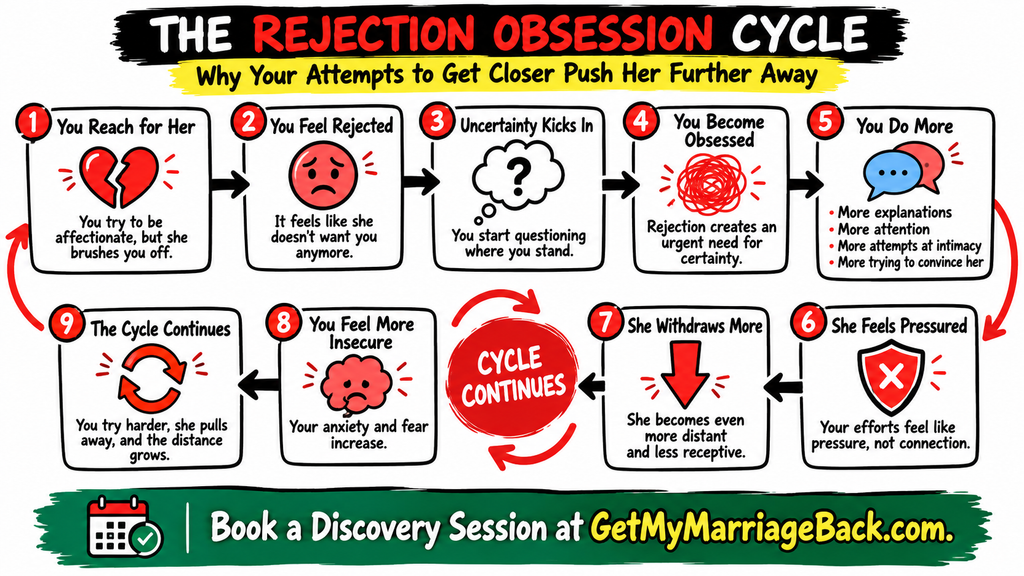
That’s the rejection-obsession cycle.

The more rejected you feel, the harder you pursue reassurance.

Unfortunately, the harder you pursue reassurance, the more pressure your wife experiences.

She withdraws further.

And her withdrawal produces even more obsession.

The problem is no longer just the absence of affection. It’s the emotional pressure surrounding every attempt to restore it.

my wife is not sexually attracted to me - recreate attraction

3. Trying to Recreate Attraction Through More Pursuit

Think about how your relationship began.

You probably demonstrated romantic interest.

And You pursued your wife.

You made an effort to spend time together, express affection, and create experiences she enjoyed.

Those behaviors helped establish your romantic connection.

So when that connection disappears, your instincts tell you to do more of what worked before.

More attention.

And More compliments.

More romantic gestures.

And More conversations about your feelings.

More attempts to initiate intimacy.

But there’s a fundamental difference between pursuing someone who welcomes your romantic interest and repeatedly approaching someone who is emotionally withdrawing.

What feels like romantic effort to you can feel like emotional pressure to her.

This doesn’t mean affection is wrong.

It means attraction depends partly on how affection is experienced.

A romantic gesture that once communicated love can begin communicating expectation.

A conversation intended to restore closeness can become another demand for reassurance.

Even an expensive gift can create discomfort when your wife senses that something is expected in return.

What Research Reveals About Attraction

A 2016 study published in the Journal of Personality and Social Psychology examined the relationship between perceived partner responsiveness and sexual desire.

Across three studies, researchers found that feeling understood, valued, and cared for was associated with greater sexual desire, particularly among women.

The researchers also identified feeling special and perceiving one’s partner as desirable as important mechanisms.

You can examine the research on partner responsiveness and sexual desire for the underlying findings.

This supports an important distinction.

Attraction is influenced by the experience you create, not simply the amount of effort you demonstrate.

Additional relationship research has found positive associations between perceived partner responsiveness, affectionate touch, and intimacy.

That doesn’t mean emotional responsiveness automatically produces sexual desire.

It means the quality of the relational experience deserves attention before you assume that more romantic pursuit is the answer.

4. Believing Personal Improvement Entitles You to Intimacy

I once worked with a man whose marriage had experienced an extraordinary level of betrayal.

He had committed serial infidelity.

His behavior had caused tremendous damage, including circumstances in which his wife required treatment for an infection.

Eventually, she emotionally withdrew from the marriage.

She wasn’t asking for divorce.

According to him, she was remaining in the household primarily because of the children.

But she had made one thing clear.

She never wanted him to touch her again.

Now, here’s where most people become distracted.

They immediately start looking for a way to change her mind.

But her determination to never touch him again was irrelevant to the work he needed to do on himself.

Not because her decision didn’t matter.

Her boundaries absolutely mattered.

The point is that his responsibility wasn’t to negotiate her decision or pressure her into reconsidering it.

His responsibility was to address the behavior that had destroyed emotional safety.

When Personal Transformation Becomes Entitlement

This man experienced what he described as a spiritual transformation.

He found God.

He believed he had become a different person.

And he genuinely wanted to repair his marriage.

But for approximately two years, he repeatedly tried to convince his wife that his transformation should change how she treated him.

He wanted recognition for becoming a better man.

He expected renewed affection.

His belief was that because they had committed to a lifetime together, she should give him another opportunity.

Unfortunately, his attempts to prove that he had changed became another source of pressure.

His declaration of change was not the same thing as her experience of safety.

That’s the distinction I want you to understand.

You can become more religious.

And You can work harder.

You can become more responsible.

And You can provide more financially.

But none of those improvements automatically changes the emotional experience your wife associates with you.

And when you demand affection as evidence that your personal improvement is working, you turn your growth into an invoice she is expected to pay.

This is particularly damaging when the marriage has experienced betrayal, cheating, or prolonged resentment.

Your wife needs the freedom to evaluate your behavior without being pressured to reward it.

Real transformation becomes influential when it can be experienced consistently—not when it is repeatedly announced.

5. Trying to Control Her Feelings Instead of Developing Your Influence

When your wife emotionally withdraws, your instincts naturally focus on the external situation.

You want to fix her mood.

And You want to change her response.

You want to convince her that you’re still desirable.

And you want her to understand why she should reconnect.

But this is where you begin surrendering your personal power.

Because you’re attempting to control something that belongs to another human being.

Influence begins where the need to control ends.

That distinction changes how you approach marriage reconciliation.

Control attempts to produce a particular response.

Influence develops through the quality, consistency, and emotional intelligence of your behavior.

When you become less defensive, more emotionally grounded, and more intentional about the experiences you create, your presence begins communicating something different.

Your wife no longer has to experience every interaction as an attempt to extract affection.

She can observe your behavior without being required to immediately validate your improvement.

And that creates room for a different kind of relational experience.

Emotional Safety Comes Before Romantic Reconnection

Consider what happens when your wife rejects a simple gesture of affection.

Your old response involves questioning her, becoming visibly frustrated, or withdrawing into resentment.

She learns that rejecting affection produces an uncomfortable emotional consequence.

Eventually, even innocent gestures can become associated with pressure.

Now consider a different response.

You recognize the rejection without making it the center of your identity.

Instead of interrogating her, you respect the boundary and continue conducting yourself with dignity.

Your emotional stability remains intact.

Over time, your consistent behavior communicates that she can interact with you without being responsible for regulating your emotions.

That’s emotional intelligence in action.

Emotional safety isn’t something you demand. It’s something your behavior helps establish.

And emotional safety creates better conditions for curiosity, warmth, and attraction to develop.

How to Rebuild Attraction Without Begging for Affection

Here’s what I want you to do.

Stop treating your wife’s immediate response as the ultimate measurement of your personal value.

Your responsibility is to develop the emotional capacity and behavioral consistency necessary to create a different experience.

I teach this through three foundational principles: Grounding, Purpose, and Self-Discovery.

Grounding: Stop Allowing Rejection to Define You

Grounding means returning to a source of truth greater than your wife’s immediate emotional response.

Her rejection is real.

The pain matters.

But that moment doesn’t determine your identity, dignity, or capacity for personal growth.

When you become grounded, you stop treating every interaction as an emergency requiring immediate resolution.

You can experience disappointment without becoming reactive.

And you can respect your wife’s boundaries without interpreting them as a personal catastrophe.

Purpose: Become Bigger Than the Marriage Crisis

Your marriage matters.

But your purpose must extend beyond the approval of any individual person.

Reconnect with your mission.

Examine the impact you want to create.

Consider your contribution to your family, community, career, and the legacy you intend to build.

Purpose redirects emotional energy away from obsessive monitoring of your wife’s behavior.

It also makes your life more engaging.

A person who is meaningfully engaged with life creates a different experience from someone whose entire emotional existence revolves around receiving reassurance.

Attraction is not built by abandoning your identity to obtain someone else’s approval.

Self-Discovery: Reclaim Your Capacity for Influence

Self-Discovery means examining your emotional patterns without collapsing into self-blame.

Notice what rejection triggers in you.

Do you become defensive?

And Do you overexplain?

Do you initiate arguments?

Do you attempt to purchase affection through gifts or favors?

Perhaps you withdraw emotionally to punish your wife for not responding.

These patterns deserve examination because they influence the experience you create.

The objective is not to become emotionally indifferent.

It’s to develop the capacity to express interest without desperation and experience rejection without losing self-control.

The Attraction Chain: Value, Curiosity, Influence, and Leverage

There’s another distinction that matters when you’re trying to save your marriage.

Being a morally good person and creating an attractive relational experience are not identical.

You can be hardworking, loyal, responsible, and generous while still creating interactions dominated by anxiety, resentment, or emotional pressure.

Experiential value concerns what another person experiences in your presence.

Do your interactions create unnecessary tension?

Can you remain warm without demanding affection?

Are you capable of humor, confidence, emotional regulation, and genuine interest without attaching hidden expectations?

Those qualities influence the relational environment.

And when your wife begins experiencing something different from the patterns she has come to expect, curiosity becomes possible.

Curiosity is closely connected to attraction because it creates renewed interest.

That interest can support influence.

Influence becomes leverage when your consistent behavior creates value without demanding an immediate return.

Leverage isn’t permission to manipulate your wife.

It is the personal capacity to contribute meaningfully to the relationship while remaining grounded in your own dignity.

That’s how you pursue reconciliation without turning your wife into a project you must control.

Why Knowing What to Do Isn’t Enough

Now imagine tonight.

You approach your wife affectionately.

She pulls away.

Immediately, your chest tightens.

The familiar thoughts return.

You want an explanation.

And You want reassurance.

You want to remind her of everything you’ve done.

And suddenly, the emotional understanding you’ve developed becomes difficult to apply.

That’s habit drift.

Research on habitual behavior shows that familiar environmental cues can activate automatic responses, particularly when established routines are strong.

Your reaction to rejection can become one of those routines.

The solution requires more than understanding the problem intellectually.

It requires repeated behavioral practice.

You need to recognize the emotional trigger, interrupt your established reaction, and consistently choose behavior aligned with the person you’re becoming.

That’s how emotional intelligence becomes a skill rather than an idea.

Can You Save Your Marriage When Your Wife Has Lost Attraction?

Yes, attraction can change throughout a long-term marriage.

But the path forward begins with understanding the difference between restoring affection and creating the conditions that make affection desirable.

Your wife isn’t a problem to solve.

Her emotional response isn’t something you can manufacture.

And her physical boundaries aren’t obstacles to overcome through persistence.

The meaningful work begins with your own behavior.

Stop attempting to extract intimacy through persuasion.

Develop emotional stability that doesn’t depend on constant reassurance.

Address the patterns that have contributed to resentment, insecurity, or disconnection.

Build a life characterized by purpose, confidence, and emotional intelligence.

Most importantly, understand that becoming more attractive is not simply about becoming a better person on paper.

It’s about becoming someone whose presence creates a better experience.

That’s where emotional safety develops.

That’s where curiosity becomes possible.

And that’s where attraction has room to grow.

Wife or Husband Denying You Sex? DO THIS!!!

Frequently Asked Questions

Why is my wife not sexually attracted to me anymore?

Sexual attraction can decline because of accumulated resentment, emotional disconnection, chronic stress, health changes, relationship dissatisfaction, or pressure surrounding intimacy. Understanding the underlying pattern is more useful than assuming her rejection has one simple explanation.

Can my wife love me but not be sexually attracted to me?

Yes, emotional attachment, commitment, and sexual attraction are related but distinct experiences. Your wife can care deeply about you while experiencing little romantic or sexual desire.

What should I do when my wife rejects my affection?

Respect her boundaries, avoid demanding reassurance, and examine whether your response to rejection creates additional emotional pressure. Focus on emotional regulation, personal purpose, and consistent behavior that supports trust and emotional safety.

Can sexual attraction return after years of marriage?

Yes, sexual desire can change over time, and research associates intimacy and perceived partner responsiveness with greater desire. Rebuilding attraction begins with improving the relational experience rather than pressuring your wife to demonstrate affection.

7 Signs Your Wife Is Not Sexually Attracted to You Any More

When your wife used to respond to your affection naturally and suddenly goes cold, the hardest part isn’t only the rejection—it’s not knowing what the rejection means.

Take This 2 Minutes Quiz

Question 1 of 15

Maybe she rarely initiates intimacy now. Perhaps affection feels forced, mechanical, or absent. You may lie beside the same woman you’ve loved for years wondering, “Is my wife still sexually attracted to me?”

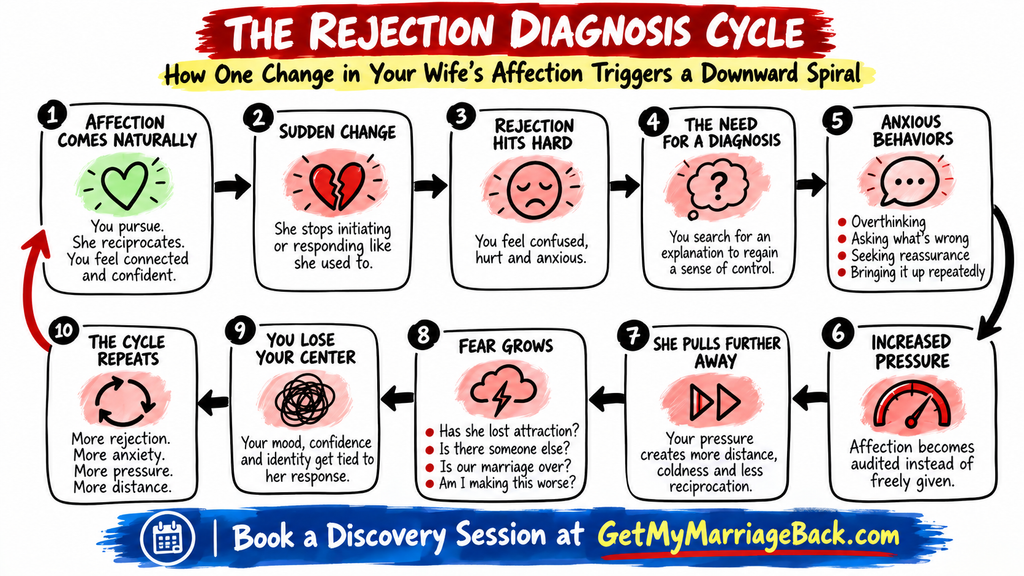
Your mind wants an immediate diagnosis.

“She doesn’t want me anymore.”

“Maybe there is someone else.”

“We’ve become roommates.”

“My marriage is over.”

Those conclusions can feel convincing precisely because uncertainty feels unbearable. But before you decide that your wife has lost attraction to you, understand something important:

A change in her behavior is information. It is not automatically a diagnosis.

There are signs worth paying attention to. There are also ways a frightened spouse can misread those signs—and then unintentionally make attraction harder to rebuild.

7 Signs Your Wife May Not Be Sexually Attracted to You

No single sign proves attraction is gone. What matters more is a sustained pattern, especially when several changes appear together.

1. She Rarely Initiates Affection or Intimacy Anymore

One of the clearest changes is contrast.

Your wife used to initiate. Now she doesn’t.

You remember a marriage where affection flowed naturally, but today almost every intimate interaction seems to depend on you starting it. Eventually, you begin wondering whether she participates because she genuinely wants to or because she feels obligated.

That distinction matters.

Research on long-term relationships shows that sexual desire naturally ebbs and flows. A systematic review examining 64 studies found that maintaining desire involves a combination of individual, interpersonal, and broader contextual factors—not one simple cause.

So reduced initiation deserves attention, but don’t turn one symptom into a verdict.

signs my wife is not sexually attracted to me

2. Your Pursuit No Longer Produces the Response It Once Did

This one can destabilize you emotionally.

You know how to pursue your wife—or at least you thought you did.

And You flirt. You create opportunities for connection. And You express desire. Yet the response that once came naturally isn’t there.

That’s when rejection stops feeling like an isolated event and starts feeling like evidence.

Be careful.

Sometimes what hurts most isn’t simply losing affection. It’s losing the predictability of affection.

You pursue; she responds.

That predictable response can quietly create a sense of control. Once it disappears, you may become obsessed with restoring the old response rather than understanding the new reality.

3. Affection Feels Like Obligation Instead of Desire

There’s a significant emotional difference between your wife willingly participating in intimacy and merely tolerating it.

You can usually feel that difference.

She may technically participate while enthusiasm has disappeared. Maybe affection seems transactional. Perhaps intimacy occurs primarily after arguments about its absence.

Research helps explain why this distinction matters. Studies have found benefits when partners are responsive to each other’s sexual needs, but those benefits can disappear when responsiveness becomes self-neglect, pressure, or obligation.

You don’t want compliance.

You want willing reciprocity.

That’s why skillfully rebuilding attraction cannot mean pressuring your wife into producing evidence that you’re still desirable.

4. Emotional Warmth Has Declined Alongside Physical Affection

Sexual attraction doesn’t exist inside a vacuum.

Look beyond the bedroom.

Has curiosity disappeared?

Does she seem emotionally disengaged?

Has playful energy vanished?

Does spending time together feel like managing a household rather than experiencing each other?

Research on partner responsiveness is particularly relevant here. In multiple studies, feeling that a partner understood, valued, and cared for one’s needs was associated with greater sexual desire, with a stronger association among women in that research.

In other words, what happens outside intimate moments can influence what happens inside them.

This doesn’t mean “be nicer and you’ll get sex.”

That’s transactional thinking disguised as relationship advice.

It means attraction lives inside an experience—and the quality of that experience matters.

Sexual attraction doesn’t exist inside a vacuum.

Look beyond the bedroom. Has curiosity disappeared?

Does she seem emotionally disengaged? Has playful energy vanished? Does spending time together feel more like managing a household than experiencing each other?

This matters because attraction isn’t only about appearance or sexual technique.

In three studies published in the Journal of Personality and Social Psychology, researchers found that perceived partner responsiveness was associated with greater sexual desire, with the association being stronger among women. Feeling special and perceiving the partner as more valuable helped explain that connection.

In practical terms, being experienced as understanding, attentive and responsive can matter to desire. That doesn’t mean “be nicer and you’ll get sex.” That’s transactional thinking disguised as relationship advice.

It means attraction lives inside an experience—and the quality of that experience matters.

5. She Seems More Comfortable With Distance Than Connection

Sometimes the warning isn’t dramatic rejection.

It’s indifference.

She doesn’t appear particularly bothered that affection has disappeared. Days become weeks. Weeks become months.

You become increasingly concerned while she appears increasingly comfortable with the distance.

That’s painful because it creates an asymmetry: you’re desperately trying to close the gap while she doesn’t appear motivated to close it.

This is where many spouses begin over-pursuing.

More questions.

And More reassurance seeking.

More relationship discussions.

And More attempts to create intimacy.

Unfortunately, desperation can transform your pursuit from seductive into emotionally expensive.

6. Conversations About Attraction Create Defensiveness or Pressure

Communication matters.

But “communicate more” is incomplete marriage advice.

When every rejection becomes a relationship meeting, communication itself can become associated with pressure.

You initiate affection.

She doesn’t reciprocate.

“What happened?”

“Are you still attracted to me?”

“Why don’t you ever initiate?”

“Do you even want this marriage?”

Now every missing expression of affection requires an explanation.

You aren’t simply experiencing your marriage anymore.

You’re auditing it.

Research on sexual desire discrepancy does find associations between better sexual communication and greater sexual satisfaction. But communication is not synonymous with interrogation, repeated reassurance seeking, or demanding that your spouse explain emotions she may not completely understand herself.

Healthy communication creates understanding.

Pressure demands certainty.

Know the difference.

7. You Feel More Like Roommates Than Romantic Partners

This is often where the previous signs converge.

You function well enough as parents, homeowners, financial partners, or household managers. Yet romantic energy seems missing.

There may be cooperation without curiosity.

Friendship without flirtation.

Familiarity without tension.

Marriage without much experience of being desired.

If you’re thinking, “My wife loves me but is not sexually attracted to me,” this distinction can be especially confusing because love and attraction aren’t identical experiences.

A spouse can care deeply about you while romantic attraction has declined.

That’s painful information.

But information gives you something to work with.

signs my wife is not sexually attracted to me anymore

The Biggest Mistake: Demanding an Instant Diagnosis

Suppose your wife has genuinely changed.

You should notice.

Pretending nothing happened isn’t emotional intelligence.

But the opposite extreme is equally dangerous: deciding you already know exactly what the change means.

Your brain hates uncertainty.

A diagnosis restores the illusion of control.

If you can declare, “My wife isn’t attracted to me anymore,” at least the chaos has a name.

But what if you’re wrong?

Low desire can be influenced by relationship dynamics, stress, resentment, familiarity, individual circumstances, sexual difficulties, health factors, emotional disconnection, or combinations of factors.

Desire discrepancy itself is common in long-term relationships. Researchers studying how couples navigate differences in desire have found that partnered approaches tend to be associated with greater sexual and relationship satisfaction than purely individual strategies.

Your first job isn’t to force an explanation.

It’s to become emotionally stable enough to observe accurately.

Her Rejection Is Information, Not Your Identity

This distinction can change everything.

When your wife’s response becomes the measurement of your value, every rejection becomes emotionally catastrophic.

One cold evening means you’re undesirable.

A week without intimacy means your marriage is doomed.

Her distracted mood means somebody else must have her attention.

That’s too much power to surrender to another person’s temporary emotional state.

I want you grounded enough to say:

“I see the change. I’m not going to ignore it. But I’m also not going to let fear write the explanation.”

That’s emotional control.

Not controlling your wife.

Controlling yourself.

Stop Trying to Make Her Response Predictable

Attraction becomes difficult to nurture when your primary goal is extracting reassurance.

Consider the hidden transaction:

“I’ll become more romantic so you’ll respond.”

“And I’ll do more around the house so you’ll desire me.”

“I’ll communicate perfectly so you’ll reassure me.”

“And I’ll become the perfect spouse so you’ll prove that you still want me.”

That’s not really value.

It’s bargaining.

You aren’t giving freely; you’re making emotional deposits and watching the account for your expected return.

Your wife can feel the weight of that expectation.

Attraction Needs Space for Curiosity

Long-term marriage naturally creates familiarity.

Familiarity has enormous benefits: safety, history, shared identity, trust, family, inside jokes, and the experience of being known.

But attraction also benefits from experiencing your spouse as a living, developing person rather than a completely predictable extension of yourself.

Research increasingly points toward the importance of responsiveness and self-expansion—experiences that allow partners to feel understood while continuing to grow.

A recent couples study involving people dealing with sexual interest/arousal difficulties found that days with greater self-expansion were associated with greater perceived partner responsiveness, which in turn was linked with higher sexual desire and satisfaction.

You don’t manufacture curiosity by playing games.

You cultivate it by continuing to develop.

Have a purpose.

Create experiences.

Become more emotionally skillful.

Maintain standards.

Develop interests.

Stay socially alive.

Bring energy into your marriage rather than waiting for your marriage to supply all your energy.

Attraction struggles when desperation becomes your dominant presence.

Value Is an Experience, Not a Performance

When I talk about bringing value into marriage, I’m not talking about proving that you’re a “good husband.”

Moral goodness and attraction are not interchangeable.

You can be responsible, loyal, hardworking, and dependable while the romantic dimension of your marriage slowly deteriorates.

Experiential value asks a different question:

What is it like to experience me?

Do you bring tension or emotional steadiness?

Neediness or curiosity?

Pressure or possibility?

Predictability or continued growth?

Resentment or playfulness?

Emotional intelligence means becoming aware of the experience you’re creating without turning yourself into a performer desperately trying to win approval.

That’s a subtle distinction.

It’s also where mature seduction begins.

Don’t Turn Affection Into an Audit

Imagine your wife hasn’t initiated intimacy recently.

You notice.

That’s legitimate.

But now you start counting.

“That’s four days.”

“That’s two weeks.”

“She didn’t respond yesterday.”

“She didn’t kiss me this morning.”

“Why didn’t she sit beside me tonight?”

Soon your marriage becomes a spreadsheet.

Every interaction is evidence.

And Every rejection confirms your fear.

Every positive response temporarily calms you until the next perceived rejection.

That’s not attraction.

That’s anxiety management.

Affection willingly given creates connection. Affection constantly audited creates pressure.

Your goal isn’t to stop caring.

Your goal is to stop requiring your wife’s affection to regulate your emotional state.

Build Attraction Without Manipulation

Seduction inside marriage isn’t manipulation.

Manipulation tries to manufacture somebody else’s behavior for your benefit.

Mature seduction creates conditions where desire has room to emerge willingly.

That means respecting boundaries while remaining desirable.

Listening without becoming submissive.

Leading without controlling.

Pursuing without chasing.

Expressing desire without demanding reciprocation.

Being responsive without abandoning yourself.

That last distinction matters. Research defining sexual need responsiveness emphasizes listening to and accommodating each other’s desires when possible while respecting both partners’ boundaries and safety.

You aren’t trying to force your wife to want you.

You’re becoming more capable of participating in a marriage where attraction can breathe.

When Your Wife Goes Cold, Watch Your Habit Drift

Here’s where intellectual understanding usually fails.

Right now, everything sounds reasonable.

Then tonight you initiate affection.

She rejects you.

Your nervous system fires.

Suddenly you’re not thinking about emotional intelligence.

You want answers.

“What’s wrong?”

“What did I do?”

“Are you attracted to me?”

“Is there somebody else?”

That return to your established reaction under stress is what I call Habit Drift.

You don’t overcome it merely by knowing better.

You need enough self-awareness to catch the pattern while it’s happening.

Notice the trigger.

And Notice the story your mind creates.

Notice your urge to demand certainty.

Then choose your response deliberately.

That is a skill.

Can You Save a Marriage When Attraction Is Gone?

Sometimes, yes.

But “save my marriage” cannot become another way of saying, “How do I control my spouse?”

Marriage reconciliation requires dealing with reality.

If your wife is not attracted to you right now, pretending otherwise doesn’t help.

Neither does begging.

And Neither does trying to prove your worth.

Neither does converting every evening into marriage counseling.

Instead, work on the dimensions you can actually influence: your emotional regulation, experiential value, communication skills, personal development, relationship patterns, ability to create curiosity, and willingness to confront reality without collapsing underneath it.

Your wife still has agency.

So do you.

The Shift: From Controlling Her Response to Leading Yourself

The strongest position in an attraction crisis isn’t indifference.

It’s emotional sovereignty.

You can love your wife deeply without making her response your source of identity.

And You can desire reconciliation without becoming desperate.

You can recognize attraction loss without assuming divorce is inevitable.

And You can pursue without chasing.

And you can become more attractive without turning self-development into a performance designed to manipulate her.

That’s the paradox.

The more desperately you need a particular response to prove you’re okay, the harder it becomes to create the emotional environment where willing affection can flourish.

So when you’re wondering whether your wife has lost attraction, start with the evidence.

Notice the pattern.

Respect the change.

But don’t allow fear to complete the diagnosis.

Your wife’s rejection is information.

What you become in response to that information is where your leverage begins.

Wife or Husband Denying You Sex? DO THIS!!!

Frequently Asked Questions

How do you know if your wife is not sexually attracted to you?

Look for sustained changes such as consistently reduced initiation, avoidance of intimacy, loss of romantic warmth, and affection that feels obligatory rather than willing. No single behavior proves attraction loss because sexual desire naturally fluctuates and is influenced by individual and relationship factors.

Can a wife love her husband but not be sexually attracted to him?

Yes, emotional attachment and sexual desire are related but distinct experiences, so someone can deeply value a marriage while experiencing reduced desire. Research suggests responsiveness, relationship dynamics, and other interpersonal factors can influence desire over time.

Can sexual attraction come back in a marriage?

Attraction can change rather than remaining permanently fixed, and research on long-term relationships identifies multiple interpersonal and individual factors associated with maintaining desire. Partner responsiveness and self-expanding experiences are among the factors researchers have linked with sexual desire and satisfaction.

What should I do if my wife is no longer attracted to me?

Don’t immediately beg, pressure, interrogate, or treat every rejection as proof your marriage is over; first distinguish the observable change from the story fear is creating around it. Focus on emotional steadiness, honest communication, continued personal growth, responsiveness, boundaries, and creating a relationship experience where willing attraction has room to develop.

Signs My Wife Is Not Sexually Attracted to Me: 7 Clues & What to Do

Few things inside a marriage create the kind of quiet panic that comes from realizing your wife may love you but no longer desire you.


Take This 2 Minutes Quiz

Question 1 of 15

She still talks to you. You may still raise children together, pay bills, laugh occasionally, sleep in the same bed and function as a family.

Yet something feels unmistakably different.

She rarely initiates intimacy. Your touch gets less enthusiasm. Kissing feels routine. Sex becomes infrequent, negotiated, mechanical or completely absent.

Eventually, the question becomes difficult to avoid:

What are the signs my wife is not sexually attracted to me—and what does that actually mean for my marriage?

I want you to take the problem seriously without turning it into a verdict on your worth.

Attraction is not a moral judgment.

Your wife can believe you are responsible, intelligent, loyal, hardworking and a good father while experiencing very little romantic or sexual energy toward you.

That distinction matters because the moment rejection becomes personal, fear starts making your decisions.

And fear is where otherwise intelligent people begin making attraction much harder to rebuild.

Love and Sexual Attraction Are Not the Same Experience

Love can contain loyalty, history, attachment, friendship, family, commitment and genuine concern.

Sexual attraction responds to a different layer of experience.

It is influenced by how emotionally alive the marriage feels, how much resentment or pressure has accumulated, whether your interactions still contain curiosity, how you carry yourself, what intimacy has come to represent and whether closeness feels freely chosen.

That is why your wife can sincerely tell you, “I love you,” while the sexual connection between you has deteriorated.

It hurts.

But it is not a contradiction.

Research supports the broader principle that sexual desire in long-term relationships is dynamic rather than fixed. A systematic review of sexual desire in long-term relationships examined research across multiple studies and found that desire is influenced by a combination of individual and relationship factors rather than behaving like a permanent on-or-off trait.

That means today’s level of attraction is information.

It is not automatically destiny.

7 Signs Your Wife Is Not Sexually Attracted to You

One sign by itself does not diagnose your marriage.

Patterns matter.

Pay attention to what has changed, how long it has been happening and whether several of these signs are appearing together.

1. She Rarely or Never Initiates Intimacy Anymore

This is often the first symptom you notice.

You remember a time when she reached for you, flirted, kissed you first or made it clear that she wanted physical closeness.

Now you feel like every sexual interaction starts with you.

Eventually, you stop experiencing initiation as a romantic act and start experiencing it as a test.

“Will she reject me tonight?”

That shift is dangerous because sex stops being intimacy and becomes emotional evidence.

When she responds, you feel temporarily secure.

When she turns away, your confidence collapses again.

You do not want your wife’s sexual response carrying that much responsibility for your emotional stability.

2. Affection Feels Tolerated Instead of Enjoyed

Your wife may still hug you, kiss you or sit beside you.

But the warmth has changed.

You can feel the difference between someone participating naturally and someone merely going along with the moment.

Perhaps she pulls away quickly. Her body feels stiff. A kiss has no energy behind it.

Do not turn every imperfect interaction into proof that the marriage is dead.

Instead, notice the broader experiential pattern.

Attraction usually disappears from the experience before someone finds perfect words to explain what has changed.

3. Sex Feels Mechanical, Obligatory or Negotiated

You can technically still be having sex while attraction is declining.

That distinction surprises people.

Sex becomes concerning when the experience resembles duty more than mutual desire.

Perhaps you have to repeatedly ask. Maybe she agrees primarily because she knows you are frustrated.

You might even receive what you wanted physically while walking away feeling more rejected emotionally.

That is why I do not define success as simply increasing sexual frequency.

Obligation is not the same thing as attraction.

The stronger goal is rebuilding an environment where intimacy has enough freedom, warmth and emotional energy to become desirable again.

4. Your Marriage Feels More Like Roommates Than Lovers

Roommate status does not always mean open hostility.

Sometimes it looks incredibly functional.

You coordinate schedules.

You discuss children.

You manage money.

You handle groceries, transportation, school, appointments and household responsibilities.

Then nighttime arrives and there is almost no romantic energy between you.

The marriage works administratively but feels emotionally flat.

That is one reason high-achieving people can miss attraction loss until it becomes severe. They are often excellent at running systems, fixing problems and meeting responsibilities.

Romance is not a spreadsheet.

Your competence can keep a household operating without creating desire.

5. She No Longer Seems Curious About You

Curiosity is one of the most overlooked ingredients in attraction.

In the early stages of a relationship, you did not know everything about each other.

There was discovery.

You had separate experiences, thoughts, stories, ambitions and worlds to explore.

Years later, excessive predictability can remove that psychological space.

Your wife knows exactly what you are going to say.

She knows how you will react.

She knows what you will do Friday night, Saturday morning and Sunday afternoon.

Predictability is valuable for trust and stability, but excessive predictability can drain romantic energy when nothing about your life seems to be expanding.

The answer is not acting mysterious as a manipulation tactic.

Become more interesting because you are actually growing.

6. Your Attempts to “Fix” Attraction Make Her Withdraw More

This is one of the clearest warnings.

You notice distance, so you increase effort.

More flowers.

More compliments.

More chores.

More date nights.

More relationship talks.

More attempts to initiate sex.

More explanations about everything you are doing differently.

Improvement itself is not the problem.

The motive underneath it changes the experience.

When your behavior silently says, “Look at everything I’m doing—now please desire me again,” self-development becomes performance.

Your wife can feel that invisible invoice.

Attraction does not respond well to an invoice.

7. Every Conversation About Intimacy Ends With More Pressure

You want answers.

Naturally, you ask questions.

“Why don’t you want me?”

“Are you still attracted to me?”

“Why do I always have to initiate?”

“Do you even want this marriage?”

You may call that communication, and sometimes a direct conversation is absolutely necessary.

But communication driven by panic can become interrogation.

The hidden request underneath the question becomes:

“Please say something that makes me feel safe again.”

Now your wife is not simply discussing intimacy.

She is being asked to regulate your fear.

That is a heavy burden to place inside a romantic interaction.

The Real Danger Is the Rejection Pressure Cycle

Your wife’s loss of attraction hurts.

What happens next is often more damaging.

I describe the destructive pattern like this:

Rejection → Asking → Performing → Pushing → Pressure → Withdrawal → Rejection

First, rejection scares you.

Then you start asking for reassurance.

When reassurance does not restore desire, you begin performing.

You become extra helpful, extra agreeable, extra romantic or suddenly transform yourself in ways designed to produce a reaction.

When that fails to create immediate attraction, fear escalates.

Now you push.

You push sex.

You push counseling.

You push date nights.

You push another conversation.

You push for explanations.

Eventually, your good intentions begin creating pressure.

Pressure produces withdrawal.

Her withdrawal feels like another rejection, so you become even more anxious and repeat the cycle with greater intensity.

Attraction cannot breathe when every interaction contains an invisible demand for proof.

Stop Treating Sex Like the Scoreboard for Your Marriage

Wanting your wife sexually is healthy.

Wanting her to desire you is also healthy.

The problem starts when intimacy becomes the instrument you use to regulate your confidence.

You have sex Saturday night and suddenly think:

“We’re getting better.”

She rejects you Tuesday and now you think:

“It’s over.”

She kisses you passionately on Thursday:

“She wants me again.”

Friday she seems distant:

“Something is wrong.”

This emotional roller coaster places you in a reactive position.

Your wife becomes your source of truth.

That is not personal power.

Sexual rejection is painful information, but it should not control your identity.

Attraction Is an Outcome of Experience

You cannot logically explain someone into desire.

A PowerPoint presentation about why your marriage deserves more sex will not create attraction.

Neither will moralizing.

“You’re my wife.”

“We took vows.”

“Marriage requires intimacy.”

Even when you can defend those statements philosophically, desire does not respond to courtroom arguments.

Attraction is experiential.

The useful question therefore changes.

Stop asking:

“How do I make my wife want me?”

Start asking:

“What does it currently feel like to experience me?”

That question brings your power back to the part of the marriage you can influence directly.

Ground Yourself Before Trying to Rebuild Attraction

Your first assignment is not seduction.

It is Grounding.

Rejection activates fear, anger, humiliation, sexual frustration and uncertainty.

Do not pretend those feelings are absent.

Return from them.

Grounding means reconnecting with your higher source of truth, gratitude, emotional stability and perspective before you react.

Your wife should not have to desire you today for you to know who you are.

When that becomes true internally rather than performatively, your energy changes.

You stop asking every interaction to rescue you.

Reconnect With Purpose Bigger Than Your Marriage

One of the fastest ways to become suffocating during a marriage crisis is making the marriage your entire life.

Every thought becomes about her.

Every podcast is about marriage.

Every search is about attraction.

Every conversation with friends becomes an analysis of what your wife said.

Your mission disappears while you obsess over whether she is coming back emotionally.

Purpose redirects that energy.

Your health matters.

Your children matter.

Your spiritual life matters.

Your work, creativity, friendships, contribution and legacy matter.

Purpose does not mean ignoring your marriage.

It means refusing to shrink your entire identity down to another person’s present feelings about you.

A person deeply engaged with meaningful life naturally brings more energy into a room than someone waiting to receive emotional permission to live.

Use Self-Discovery Without Turning It Into Self-Blame

Attraction loss is an opportunity to discover capacity you have not needed before.

Can you handle rejection without exploding?

Can you hear something painful without begging?

Are you able to express interest without demanding reciprocity?

Can you stay warm without becoming needy?

Will you pursue your wife with dignity instead of chasing her from fear?

Those are self-discovery questions.

They are not accusations.

You are not searching for evidence that everything is your fault.

You are identifying where greater emotional intelligence gives you leverage.

Build Experiential Value, Not a Résumé of Good Deeds

Being valuable inside attraction is different from proving moral worth.

You can be a good person and still be exhausting to experience.

Conversely, you can improve the experience of your presence dramatically without becoming fake or manipulative.

Experiential value includes emotional steadiness.

It includes listening without instantly defending yourself.

Confidence matters.

Playfulness matters.

Personal style, fitness, curiosity, humor, purpose, social intelligence and knowing when to stop talking matter.

Even restraint can become attractive when the alternative is relentless pressure.

Do not announce your improvement.

Let it become your normal way of living.

Seduction in Marriage Is Invitation, Not Manipulation

Seduction has been cheapened into tricks.

Healthy seduction is not tricking your wife into sex.

It is creating an experience that gives attraction room to emerge.

That means knowing how to pursue without begging.

Interest is attractive when it comes with dignity.

Neediness says:

“I need you to respond so I can feel okay.”

Pursuit says:

“I desire you, I can express that clearly, and I remain grounded regardless of this particular moment.”

Those are completely different energies.

You can flirt without demanding an outcome.

You can be affectionate without making every touch lead somewhere.

A compliment can simply be a compliment.

The absence of an invisible contract creates breathing room.

Curiosity Is Where Attraction Gets Room to Return

When your experience changes authentically, something interesting happens.

Your wife encounters a version of you that does not fit the old predictable pattern.

You react differently.

Your life has movement.

You seem grounded.

There is less pressure.

Your confidence does not rise and fall with every interaction.

She has room to wonder.

That curiosity should never become another metric you track.

Do not ask:

“Did she notice?”

“Is she warmer?”

“Did this work?”

The moment you turn curiosity into a test, you are back inside the Rejection Pressure Cycle.

Focus on becoming rather than monitoring.

Attraction is the outcome.

Trust, Safety and Security Are Built Through Repetition

One excellent evening does not erase months or years of tension.

Your wife may respond warmly and then seem cold again three days later.

That does not automatically mean you failed.

The symptom returning tests your capacity.

Old you sees another rejection and starts Asking → Performing → Pushing.

A stronger version of you returns to Grounding.

You continue developing Purpose.

Self-Discovery continues.

Your Value becomes consistent instead of strategic.

Over time, consistency produces a different experience.

That is how trust grows.

Safety does not mean becoming boring or passive.

It means your wife no longer has to wonder whether every imperfect interaction will produce another emotional emergency.

Security and attraction are not enemies.

Mature attraction requires enough security for vulnerability and enough individuality for curiosity.

What Should You Do When Your Wife Is Not Sexually Attracted to You?

Take the symptom seriously.

Then stop trying to force the result.

Do not beg.

Avoid performing goodness for sexual rewards.

Stop moralizing desire.

Do not turn affection into constant testing.

Ground yourself, reconnect with purpose, study your own patterns and increase the experiential value you bring into your marriage.

Pursue with dignity.

Allow your wife freedom to experience you rather than constantly telling her what she should feel.

The goal is not to manufacture desire.

Your goal is to become increasingly capable of creating the emotional, psychological and romantic conditions where attraction has room to live.

That is a skill.

And like every meaningful skill, it becomes more powerful through practice.

5 Physical Signs She Just Slept With Someone Else: The Truth

Frequently Asked Questions

What are the signs my wife is not sexually attracted to me?

Common signs include rarely initiating intimacy, avoiding or merely tolerating physical affection, mechanical sex, declining flirtation and a marriage that increasingly feels like roommates. Look for a sustained pattern rather than treating one rejection as a complete diagnosis.

Can my wife become sexually attracted to me again?

Yes, attraction is dynamic and can change as the emotional and romantic experience of a marriage changes. Focus on reducing pressure, strengthening yourself and creating genuine experiential value rather than trying to force her feelings.

Why does my wife love me but not want me sexually?

Love and sexual attraction overlap but are not identical; commitment and affection can remain while romantic desire declines. Stress, resentment, predictability, pressure, disconnection and changes in the broader marriage experience can all contribute.

What should I do if my wife keeps rejecting intimacy?

Stop using each rejection as a measurement of your worth or the entire marriage, and avoid responding with begging, guilt or pressure. Ground yourself, examine the larger pattern and build the qualities and experiences that support attraction without demanding an immediate result.


What Would Help You Most Right Now?

Choose the option that best matches where you are with your marriage.

I Need Personalized Help

My Marriage Is in Serious Trouble

If you're dealing with separation, divorce, loss of attraction, infidelity, intimacy problems, or a spouse who's pulling away, get help looking at what's happening in your specific situation.

Get Personalized Help →
Get My Marriage Back book cover
I'd Rather Learn What to Do First

Start With Get My Marriage Back

Get the book and start learning the principles for moving your marriage in a better direction.

Get the Free Book →