
What Would Help You Most Right Now?

Choose the option that best matches where you are with your marriage.

I Need Personalized Help

My Marriage Is in Serious Trouble

If you're dealing with separation, divorce, loss of attraction, infidelity, intimacy problems, or a spouse who's pulling away, get help looking at what's happening in your specific situation.

Get Personalized Help →
Get My Marriage Back book cover
I'd Rather Learn What to Do First

Start With Get My Marriage Back

Get the book and start learning the principles for moving your marriage in a better direction.

Get the Free Book →

Wife Never Initiates Affection? The Hidden Cycle Keeping Her Distant

Your wife never initiates affection anymore, and every night you spend waiting for her to reach for you makes you feel like you’re the only one trying to keep your marriage alive.

Take This 2 Minutes Quiz

Question 1 of 15

You remember when your wife used to touch you without being asked. She would reach for your hand, kiss you spontaneously, lean against you on the couch, or initiate intimacy because she wanted to be close.

Now, you initiate almost everything.

When you stop making the first move, nothing happens. The silence becomes painful, and you start wondering whether your wife is still sexually attracted to you.

Perhaps you’ve already tried explaining how rejected you feel. You’ve reminded her that physical affection matters to you, worked harder to make her happy, or asked why she never initiates intimacy.

Yet the emotional distance keeps growing.

I want to show you something that changed my marriage.

Your wife’s withdrawal is a real problem. But the way you interpret that withdrawal can become a second problem that makes the first one worse.

Understanding this distinction is one of the most important steps toward rebuilding attraction when your marriage feels like it’s falling apart.

Why Your Wife Never Initiates Affection Anymore

When your wife stops initiating physical affection, your immediate instinct is to focus on what she’s no longer doing.

She doesn’t kiss you first. She doesn’t reach for your hand. She rarely initiates sex, and when you attempt physical intimacy, her response feels cold or mechanical.

Naturally, you begin connecting those experiences to a frightening conclusion: your wife doesn’t desire you anymore.

Sometimes, that conclusion reflects a genuine loss of attraction. In other situations, unresolved resentment, emotional disconnection, stress, or repeated negative interactions have changed how she experiences closeness.

The important distinction is that a lack of initiation is a symptom, not a complete explanation of what’s happening in your marriage.

And when you’re hurting, that symptom can become the lens through which you interpret everything else.

You stop noticing the ordinary moments when your wife is pleasant, thoughtful, cooperative, or emotionally available.

Instead, you become increasingly sensitive to every moment when she isn’t.

Before long, your entire marriage feels like one long experience of rejection.

That’s where the cycle begins.

wife never initiates affection

The Hidden Cycle That Makes Emotional Distance Worse

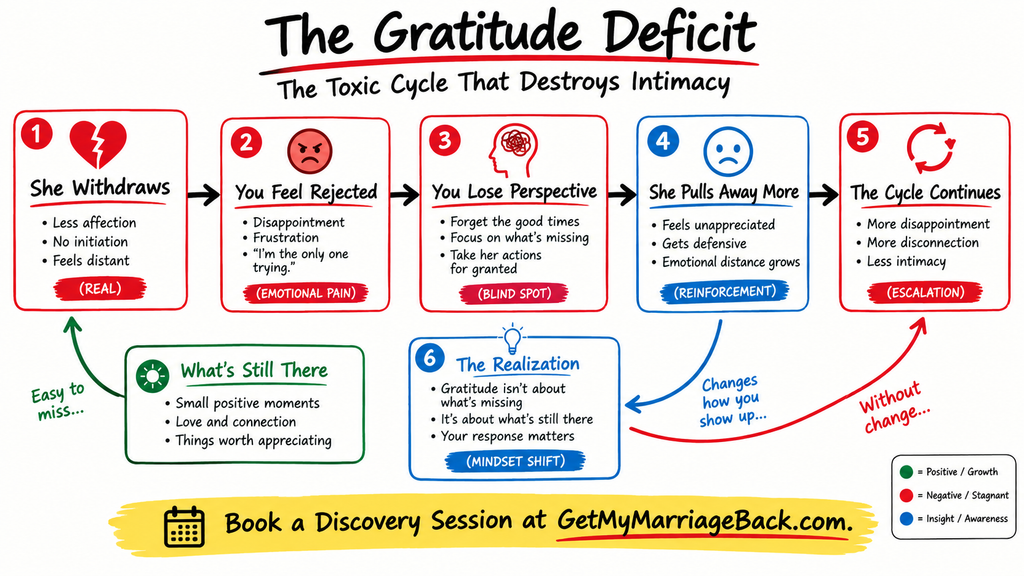
I call this the Disappointment Amplification Cycle.

It develops through a sequence of emotional reactions that can become almost automatic.

1. You Expect Affection and Feel Disappointed

You want your wife to initiate physical touch because you want to feel desired.

That’s a legitimate desire.

But when she doesn’t respond according to your expectations, disappointment enters the experience.

The problem begins when that disappointment becomes more important than everything else happening between you.

2. Your Attention Becomes Dominated by What’s Missing

One disappointing interaction begins overshadowing dozens of ordinary or positive experiences.

You remember the rejection but overlook the smile.

Her failure to initiate intimacy becomes more significant than the small gestures of care that still exist.

Your attention starts selecting evidence that supports the belief that your wife no longer cares.

3. Your Emotional Reaction Changes Your Behavior

Frustration begins affecting your tone, facial expressions, patience, and emotional availability.

You become more critical, defensive, or demanding.

Even when you’re trying to create intimacy, your wife experiences the emotional pressure surrounding your attempts.

Affection starts becoming associated with expectations and disappointment rather than enjoyment.

4. Your Wife Withdraws Further

As tension increases, she becomes less responsive.

Physical affection decreases, conversations feel strained, and spontaneous connection becomes increasingly rare.

You interpret this additional withdrawal as confirmation that you were right all along.

5. You Become Convinced You’re the Only One Trying

Now the marriage feels completely one-sided.

You begin measuring your effort against everything your wife isn’t doing.

The positive experiences become harder to remember, and the negative experiences grow more emotionally powerful.

Eventually, you return to the beginning of the cycle with even greater expectations, resentment, and fear.

The more you focus on the absence of affection, the more that absence can dominate the experience you’re creating.
wife never initiates affection - the gratitude deficit

What Almost Losing My Marriage Taught Me About Attraction

Lola and I recently celebrated 19 years of marriage.

About ten years ago, however, we experienced a marriage crisis that almost ended our relationship.

During our first eight or nine years together, there were several moments when things became serious enough to threaten everything we had built.

And one of the most important discoveries I made was about myself.

Whenever Lola did something that fell below my expectations, I had a tendency to allow that disappointment to overwhelm our entire experience.

Something would happen.

I wouldn’t like it.

Then I would carry the emotional weight of that experience into our next interaction.

Before long, Lola would withdraw.

And suddenly, I would become confused.

Why isn’t she initiating affection? Why is she responding that way? Why does she seem irritated? Why am I the only person trying?

Here’s the uncomfortable part.

Sometimes, she had already attempted to communicate what was happening.

But I wasn’t paying attention.

I had mentally disconnected from the earlier interaction while continuing to carry its emotional consequences.

I was surprised by her emotional disconnection without recognizing how my own reactions had contributed to the atmosphere between us.

Over the years, as Lola and I continued sharing our experiences, I discovered that there were moments when she had felt like the only person trying, too.

That realization changed how I understood marital dissatisfaction.

Two people can experience the same relationship and walk away with very different emotional accounts of what happened.

The Man Who Couldn’t Remember the Good Times

I once worked with a man who had spent years complaining about his wife.

According to him, she wasn’t doing enough.

She didn’t cook enough, clean enough, initiate affection, or understand his needs.

As I listened, I noticed that he could describe his disappointments with incredible detail.

But when I started asking about the good experiences in his marriage, something interesting happened.

It took considerable effort to get him to acknowledge them.

Those positive experiences existed.

He simply wasn’t giving them meaningful attention.

His disappointment had become so dominant that almost everything else disappeared from his emotional accounting.

Then we started talking about intimacy.

I asked him a question.

“What’s your love language?”

He struggled for a moment before answering.

“Sex.”

I stopped him.

“What do you mean by sex?”

Because sex fulfills something else.

What experience was he actually looking for?

Was it feeling desired? Was it reassurance that his wife still wanted him? Was it emotional closeness, acceptance, or the experience of being chosen?

He froze.

And I realized that there was much deeper work to do.

You can spend years telling your wife that she isn’t meeting your needs without understanding the experience you’re actually trying to create.

When that happens, you become dependent on her behavior for an emotional outcome you haven’t fully understood yourself.

Why Gratitude Matters When Your Wife Isn’t Affectionate

Gratitude is one of the most misunderstood principles in marriage.

People often interpret gratitude as pretending everything is wonderful or convincing themselves that their spouse is doing enough.

That’s not what I mean.

Gratitude is the ability to recognize the value of something real without requiring everything else to be perfect.

Imagine experiencing a thousand interactions in your marriage.

Some are wonderful. Others are ordinary. A few are deeply disappointing.

One painful experience can become so emotionally dominant that it changes how you remember everything else.

The purpose of gratitude isn’t to erase that pain.

It’s to stop the pain from erasing your awareness of everything valuable that still exists.

What Relationship Research Reveals About Appreciation

Relationship researchers have repeatedly examined the connection between gratitude, appreciation, and relationship quality.

A study by Sara Algoe, Shelly Gable, and Natalya Maisel found that gratitude following thoughtful interactions predicted increases in relationship connection and satisfaction the following day.

Other research by Amie Gordon and colleagues found that people who felt more appreciated tended to become more appreciative and responsive toward their partners.

Research involving 316 African American couples also found that feeling appreciated by a partner helped buffer some of the negative associations between relationship stress and relationship quality.

These findings support an important distinction: appreciation isn’t simply polite behavior. It is connected to the emotional experiences that help sustain intimate relationships.

You can explore the underlying findings in this peer-reviewed research on gratitude and relationship maintenance.

For your marriage, the practical lesson is straightforward.

When you consistently overlook positive experiences, you lose access to emotional resources that can help you respond more constructively to disappointment.

And when you become more intentional about recognizing genuine value, you begin changing the emotional experience you bring into your interactions.

Stop Confusing Being a Good Husband With Creating Attraction

One of the biggest mistakes I see when helping people save their marriages is confusing moral goodness with experiential attraction.

You can be responsible, loyal, hardworking, and deeply committed to your family.

Those qualities matter.

But they don’t automatically create romantic desire.

Attraction is also about the experience of being around you.

Does your presence create warmth or pressure?

When your wife interacts with you, does she encounter curiosity, emotional steadiness, playfulness, and genuine interest?

Or does every interaction carry the weight of another unmet expectation?

This is where emotional intelligence becomes essential.

You don’t build attraction by demanding proof that you’re attractive.

You build your capacity for attraction by developing the qualities and behaviors that make your presence engaging.

That includes emotional self-control, confidence, generosity without hidden expectations, personal direction, and the ability to create enjoyable experiences.

These qualities become especially important when you’re trying to save your marriage alone.

You cannot manufacture your wife’s desire.

But you can stop making your own fear and disappointment the dominant experience you bring into the relationship.

How to Rebuild Attraction Without Begging for Affection

Here’s what I want you to do.

Start by separating your wife’s behavior from your interpretation of your entire marriage.

If she doesn’t initiate affection tonight, acknowledge that reality.

Don’t automatically turn it into evidence that your marriage has no value or that you’re personally undesirable.

Then begin working through three essential areas.

Grounding: Stop Letting Her Response Define Your Worth

Your wife’s affection is something you desire.

It is not the ultimate source of your identity.

When rejection occurs, return to a source of truth beyond her immediate response.

Recognize the disappointment without allowing it to control your next interaction.

Practice gratitude by identifying something specific and genuine that deserves appreciation.

It can be a thoughtful gesture, a moment of cooperation, a shared laugh, or an ordinary act of consideration.

The objective isn’t to manufacture positivity.

It’s to develop a more accurate emotional perspective.

Purpose: Build a Life Bigger Than Her Approval

When your entire emotional world revolves around whether your wife desires you, every interaction becomes disproportionately important.

A missed kiss can ruin your evening.

One cold response can consume your attention for days.

Redirect that energy toward a meaningful mission.

Your work, contribution, health, personal development, and legacy deserve attention independent of your wife’s immediate behavior.

Purpose helps you become less reactive because your life no longer rises and falls with every romantic interaction.

That emotional independence is an important part of personal power.

Self-Discovery: Understand What Rejection Triggers Inside You

When your wife doesn’t initiate intimacy, examine your immediate reaction.

Do you become angry?

Do you withdraw affection to punish her?

Are you tempted to send a long message explaining everything you’ve sacrificed?

Or do you become desperate to prove that you’re still desirable?

Recognizing these patterns is not an exercise in blaming yourself for your wife’s withdrawal.

It’s an opportunity to understand your own emotional habits.

Once you recognize the pattern, you can choose a different response.

The Difference Between Pursuing Your Wife and Chasing Her

There’s nothing inherently wrong with wanting your wife.

Expressing romantic interest, initiating affection, and making your attraction known are normal parts of marriage.

The problem is the emotional position from which those behaviors emerge.

When you pursue from confidence, your interest is an authentic expression of desire.

When you chase from fear, your behavior becomes an attempt to escape rejection.

The distinction matters.

You can offer a warm touch without turning it into a demand for reassurance.

A compliment can be genuine appreciation rather than an attempt to secure affection in return.

You can create a thoughtful romantic moment while respecting your wife’s response.

Seduction loses its appeal when every gesture comes with an emotional invoice.

Attraction requires room for genuine choice.

Your responsibility is to become more skillful in how you express interest, manage disappointment, and create enjoyable experiences.

Her responsibility for her own choices remains hers.

Why Understanding This Once Isn’t Enough

You can read everything I’ve explained and understand it intellectually.

Then tonight, your wife walks past you without touching you.

Immediately, the old disappointment returns.

You remember the last time she rejected you, the conversation that went nowhere, and all the occasions when you initiated intimacy without receiving the response you wanted.

Your emotional habits take over.

This is why sustainable change requires more than a moment of inspiration.

Psychological research on habits and stress helps explain why familiar reactions can become more accessible when deliberate self-control is under pressure.

In your marriage, that means you need to practice responding differently before the next emotionally difficult moment arrives.

Build the skill of recognizing disappointment without escalating it.

Develop a reliable way to regain perspective.

Learn how to express desire without attaching your emotional stability to the outcome.

Over time, repeated practice makes these responses more familiar.

And that changes how you experience your marriage, even before you see significant changes in your wife’s behavior.

Can You Save Your Marriage When Your Wife Has Lost Attraction?

A marriage crisis involving attraction loss can become especially frightening because you cannot argue someone into desiring you.

You cannot present a list of sacrifices and expect romantic feelings to appear.

Nor can you demand that your wife initiate intimacy simply because you’ve been married for years.

What you can do is change the experience you bring into the relationship.

That starts with recognizing the difference between genuine rejection and the emotional story you build around it.

You can become more grounded, purposeful, appreciative, emotionally intelligent, and intentional.

These changes help you move away from a marriage experience dominated by complaints, fear, and unmet expectations.

And they create more room for curiosity and attraction than repeated pressure ever will.

Think Like Someone Planting a Seed

One principle helped me tremendously during my own marriage crisis.

You sow a seed.

Then comes a season of waiting.

During that season, you protect what you’ve planted.

You don’t dig it up every morning because you haven’t seen results yet.

The same principle applies when you’re rebuilding your own emotional habits.

You practice gratitude before receiving the affection you’re hoping for.

You become more intentional before your wife starts responding differently.

And you continue developing yourself without demanding immediate evidence that your effort is working.

That is not passivity.

It’s disciplined self-leadership.

Your wife’s withdrawal may have started the crisis you’re experiencing.

But it doesn’t have to dictate the person you become while navigating it.

The Real Shift When Your Wife Never Initiates Affection

When your wife never initiates affection, the pain can become so consuming that you lose sight of the marriage you’re actually experiencing.

You begin remembering only what’s missing.

Then your frustration changes your behavior, your interactions become more pressured, and the emotional distance grows.

Breaking that pattern begins with a different understanding of gratitude.

Gratitude doesn’t mean accepting an intimacy-free marriage as your ideal.

It means recognizing genuine value without allowing disappointment to destroy your perspective.

When I learned this during my marriage with Lola, it fundamentally changed how I approached difficult moments.

I stopped treating every unmet expectation as evidence that the entire relationship was failing.

Instead, I began paying more attention to the experience I was capable of creating.

And that’s where I want you to focus.

Your job isn’t to force your wife to initiate the next touch. Your job is to become someone who can express desire, create value, and maintain emotional power without being controlled by rejection.

That’s where rebuilding attraction begins.

19 Signs Your Wife Is Not Sexually Attracted To You

Frequently Asked Questions

Why does my wife never initiate affection?

Your wife may be experiencing reduced attraction, unresolved resentment, emotional disconnection, stress, or a pattern in which affection has become associated with pressure. Her lack of initiation is a symptom that needs context rather than proof of one particular explanation.

Does my wife not initiating intimacy mean she isn’t attracted to me?

Not necessarily, because sexual initiation and attraction are related but not identical. Pay attention to the broader pattern of emotional closeness, responsiveness, and physical connection rather than relying on initiation alone.

Should I stop initiating affection if my wife never does?

Stop initiating from fear, resentment, or a need to force reassurance, but don’t confuse dignified romantic interest with begging. Express genuine affection without pressure and respect her response.

Can a marriage be saved when your wife no longer shows affection?

A marriage experiencing emotional and physical withdrawal can recover when the patterns sustaining disconnection change and both partners remain free to make their own choices. Begin by developing emotional steadiness, personal purpose, genuine appreciation, and more attractive ways of interacting.


Wife Never Initiates Affection? 5 Mistakes That Push Her Away More

Your wife used to reach for your hand, kiss you without being asked, and make you feel wanted, but now you can sit right next to her and feel like you’re married to a stranger.

Take This 2 Minutes Quiz

Question 1 of 15

The hardest part isn’t necessarily the absence of sex. It’s realizing that the woman who once made you feel desired no longer seems interested in touching you, kissing you, or even turning to you emotionally.

And when your wife never initiates affection anymore, something changes inside you.

You start noticing every rejection.

You remember when she used to reach across the couch to touch your arm. Walking down the street, she would naturally hold your hand. Sometimes she initiated intimacy without you having to say anything.

Now you’re the one making every move.

Even worse, your efforts to restore that connection seem to make her withdraw further.

I’m Ola, coauthor of Get My Marriage Back, and I’ve experienced this personally.

My wife and I recently celebrated 19 years of marriage. But around eight or nine years into our relationship, we experienced a major crisis that changed how affection showed up between us.

Before that crisis, I never kept score of who initiated physical affection.

Why would I?

When your wife naturally makes you feel wanted, you simply enjoy it.

But when something you’ve enjoyed for years suddenly disappears, its absence becomes impossible to ignore.

And how you respond to that disappearance can determine whether you create more emotional distance or begin rebuilding the conditions for attraction.

Why Your Wife Stopped Initiating Affection

When your wife stops initiating physical affection, your first instinct is usually to find out why.

“What’s wrong?”

“Is everything okay?”

“Why don’t you kiss me anymore?”

Then come the answers that make everything worse.

“Nothing.”

“I’m fine.”

“Nothing’s wrong.”

You know something has changed, but you cannot get a meaningful explanation.

That’s when fear begins filling the gaps.

You start wondering whether your wife is no longer sexually attracted to you, whether someone else has her attention, or whether your marriage is quietly approaching divorce.

Those possibilities deserve careful attention, but none can be established from the absence of affection alone.

The more important question is what has changed in the emotional experience of your marriage.

Physical affection doesn’t exist in isolation. It is connected to emotional responsiveness, desire, trust, stress, and the experience two people create around each other.

In fact, research published in Personality and Social Psychology Bulletin found that feeling a partner was responsive predicted subsequent affectionate touch. The researchers also observed that affectionate touch could contribute to the partner’s perception of responsiveness.

You can examine the research on partner responsiveness and affectionate touch to understand why emotional connection and physical affection are closely linked.

The important distinction is that demanding more touching does not automatically create the emotional conditions that make someone want to initiate it.

Affection is an expression of connection, not proof you can demand whenever you feel insecure.

wife never initiates affection

When Your Wife No Longer Needs You Emotionally

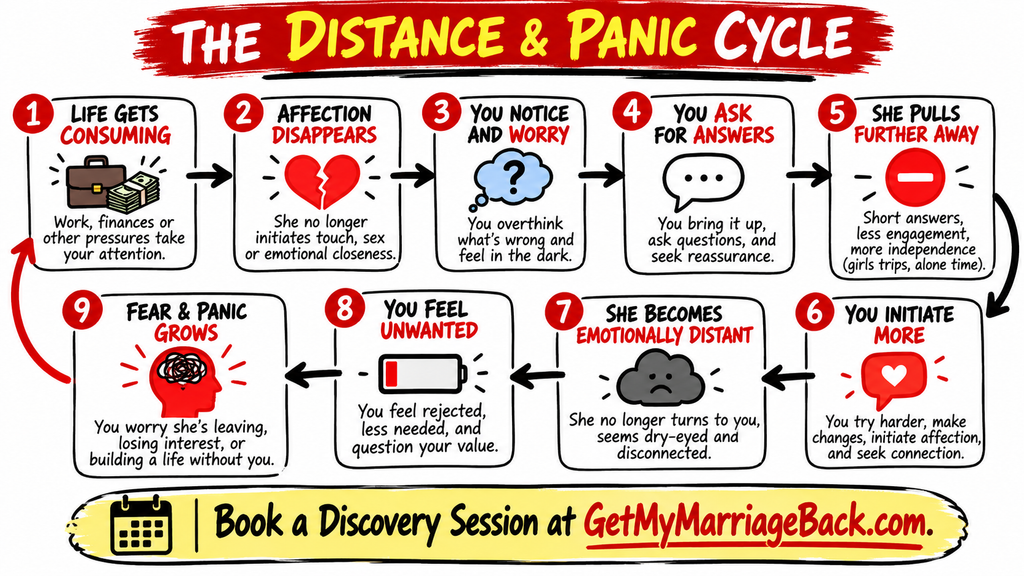
I worked with a man whose experience illustrates how quickly this crisis can escalate.

He and his wife had been together for eight years before getting married. After another thirteen years of marriage, they had shared more than two decades of their lives.

Then his business collapsed.

He found himself dealing with millions of dollars in debt, and for approximately eight months, trying to revive the business consumed his attention.

He was overwhelmed.

During that period, there were times his wife wanted affection, and he simply wasn’t in the mood.

Eventually, he began noticing something different.

His wife no longer initiated affection.

At first, that seemed like the central problem. But as we examined his situation, something more significant emerged.

She began taking multiple girls’ trips during the summer and insisted on going without him.

That behavior was unfamiliar in their marriage.

He started panicking.

His natural response was to initiate more affection, read marriage advice, attend therapy, and make changes he believed would win her back.

But she seemed to keep slipping away.

Then he told me something that revealed the deeper crisis.

His wife used to cry on his shoulder whenever something upsetting happened at work.

He was the person she turned to.

Now she seemed completely disconnected.

No tears.

No emotional vulnerability.

No desire to bring him into her inner world.

And after twenty-one years together, he began wondering whether she simply didn’t need him anymore.

The loss of physical affection hurts. The loss of emotional significance can make you panic.

That’s where many husbands begin making mistakes that unintentionally intensify the distance.

5 Mistakes When Your Wife Never Initiates Affection

1. Interrogating Her About Why She Doesn’t Want You

When affection disappears, you naturally want answers.

The problem begins when every conversation becomes another investigation into your wife’s feelings.

You ask why she doesn’t kiss you. When she gives a short answer, you press harder.

Soon, even an ordinary evening becomes another opportunity to question the relationship.

This creates a recognizable demand-withdraw pattern: one partner pushes for engagement while the other increasingly avoids the conversation.

Research on marital conflict has repeatedly associated this pattern with negative emotional exchanges and difficulties resolving conflict.

Your desire for clarity is understandable.

But repeatedly demanding reassurance can turn emotional connection into an obligation.

Stop treating every moment of distance as an emergency requiring an immediate explanation.

2. Initiating More Affection to Test Whether She Still Wants You

You reach for her hand, but you’re not simply enjoying the possibility of holding hands.

You’re watching how she responds.

When you kiss her, you’re measuring whether she kisses you back enthusiastically enough.

Even your attempts at intimacy become tests.

Does she still want me?

Is she rejecting me?

Am I losing my marriage?

The problem is no longer the affectionate gesture itself. It’s the emotional pressure attached to the gesture.

Genuine pursuit communicates interest without making the other person’s response responsible for your self-worth.

Fear-driven chasing demands evidence that you’re still desirable.

Those are two very different experiences.

If your wife doesn’t welcome a particular touch, respect that boundary without turning the moment into an argument.

Attraction needs room for genuine choice.

3. Trying to Earn Attraction Through Endless Changes

You begin reading books, watching marriage advice, improving your appearance, and doing more around the house.

Those changes can be valuable.

But there’s a dangerous assumption underneath them when you’re trying to save your marriage.

You believe that doing enough good things should produce the affection you’re missing.

So when your wife doesn’t respond, you become frustrated.

After everything you’ve changed, why isn’t she attracted to you again?

Because attraction isn’t a payment issued for completing a list of improvements.

Being responsible, dependable, and hardworking matters. But those qualities don’t automatically create romantic desire.

Experiential value is different.

It’s about what being around you actually feels like.

Are your interactions dominated by tension, disappointment, and emotional pressure?

Or are you becoming more grounded, engaging, emotionally intelligent, and comfortable in your own identity?

Being a good person and creating an attractive experience are related, but they are not identical.

4. Confusing Being Needed With Being Desired

This mistake is particularly painful when you’ve spent years providing for your family.

You work hard.

You handle responsibilities.

You sacrifice to create stability.

Then your wife becomes emotionally distant, and suddenly you wonder whether everything you’ve contributed means nothing.

It doesn’t mean nothing.

But providing stability and inspiring desire are different dimensions of marriage.

In the case I described earlier, the husband’s deepest fear wasn’t simply that his wife stopped initiating intimacy.

He feared becoming irrelevant to her.

She no longer came to him with her problems. She was making independent plans, and he felt left behind.

The temptation was to become more necessary.

But trying to make your wife depend on you is not the same as becoming someone she genuinely enjoys connecting with.

Being needed is not the same as being desired.

A healthier form of attraction allows your wife to maintain her independence while experiencing your presence as something valuable, enjoyable, and freely chosen.

5. Making Her Affection the Measurement of Your Worth

This is the mistake that holds the others together.

Your mood depends on whether she kisses you.

Your confidence rises when she touches you and collapses when she turns away.

One affectionate evening convinces you the marriage is recovering.

One distant morning sends you back into panic.

Now your emotional stability is being controlled by responses you cannot command.

That instability changes how you behave.

You become reactive, hypervigilant, and increasingly preoccupied with obtaining reassurance.

Your wife is no longer simply your partner. She has become the person you depend on to confirm that you’re still worthy of love.

That is an exhausting emotional arrangement.

And it undermines the very qualities that make someone engaging and attractive.

wife never initiates affection - the distance and panic cycle

How to Rebuild Attraction When Your Wife Doesn’t Initiate Intimacy

Here is what I want you to do.

Instead of concentrating exclusively on how to make your wife initiate affection again, focus on becoming someone who creates a different emotional experience.

That starts with GPS: Grounding, Purpose, and Self-Discovery.

Grounding: Stop Letting Her Reactions Define You

Grounding means returning to a source of truth bigger than your wife’s latest response.

Her emotional distance is real.

Your disappointment is real.

But neither determines your entire identity.

Reconnect with your principles, gratitude, spiritual foundation where applicable, and the values that guide how you carry yourself.

When your wife withdraws, you don’t have to respond with another interrogation.

You can acknowledge what is happening without surrendering control of your emotional behavior.

Purpose: Rebuild a Life Bigger Than the Marriage Crisis

When you’re desperately trying to save your marriage, the relationship can consume every waking thought.

You stop pursuing meaningful goals.

Your friendships weaken.

Everything becomes about getting your wife back.

Purpose redirects your energy toward a mission, contribution, and legacy greater than any single person, including yourself.

That doesn’t mean pretending you don’t care about your marriage.

It means refusing to abandon the rest of your identity while working toward reconciliation.

A man with meaningful direction brings a different presence into his relationships than someone whose entire emotional world depends on receiving affection.

Self-Discovery: Reclaim What You Can Control

Self-Discovery is not an invitation to blame yourself for your wife’s withdrawal.

It’s an opportunity to recognize your own capacity.

Examine how you respond to rejection, disappointment, uncertainty, and fear.

Can you express interest without demanding reassurance?

Can you remain warm without becoming intrusive?

Are you able to respect her independence without immediately interpreting it as proof that your marriage is over?

Those are emotional intelligence skills.

And they influence the experience you create around yourself.

The Real Connection Between Emotional Intelligence and Sexual Attraction

A more attractive marital experience is not created through manipulation, jealousy, or pretending to be unavailable.

It’s built through authentic behavior, emotional intelligence, confidence, playfulness, responsiveness, and self-respect.

Research on romantic desire has found an association between perceived partner responsiveness and sexual desire, particularly when responsiveness makes a partner feel special and valued.

That doesn’t mean becoming endlessly accommodating.

It means learning how to give authentically but mindfully.

I call this GAME:

Giving Authentically but Mindfully with Emotional intelligence.

You can express affection without chasing.

Show interest without interrogating.

Be playful without forcing sexual tension.

Give your wife room to approach you without punishing her when she doesn’t.

Seduction in a long-term marriage is not about tricks. It’s about creating an experience in which warmth, curiosity, attraction, and desire have room to emerge naturally.

And that begins with how you carry yourself when the affection you want isn’t immediately available.

Why Understanding Attraction Isn’t Enough

You can understand everything I’ve explained and still return to the same behavior tonight.

Your wife comes home.

She barely acknowledges you.

Then she walks into another room.

Suddenly, all your understanding disappears.

You want to ask another question, initiate another conversation, or explain how much you’ve changed.

That’s habitual behavior returning under emotional pressure.

Psychological research on habits shows that familiar contexts can activate established responses with relatively little conscious deliberation.

You need more than information to interrupt those patterns consistently.

That’s where GPS5 becomes important.

GPS establishes the foundation. Four additional elements support execution:

  • Story-Tailoring: Understand the circumstances, history, and emotional dynamics of your particular marriage.
  • Skill-Acquisition: Practice emotional intelligence and authentic, mindful giving rather than relying on good intentions.
  • Support: Maintain perspective when rejection and uncertainty distort your interpretation.
  • System: Establish reliable responses to familiar emotional triggers instead of improvising from fear.

These elements help transform insight into consistent behavior.

Can You Save Your Marriage When Your Wife Isn’t Attracted to You?

A marriage crisis involving lost affection is serious, particularly when emotional withdrawal has been developing for months.

But don’t confuse the current absence of desire with a complete explanation of your marriage’s future.

Attraction is influenced by emotional experiences, relationship patterns, stress, personal circumstances, and how people respond to one another over time.

You cannot manufacture your wife’s desire by demanding it.

What you can do is change the emotional experience you contribute to the relationship.

Stop making every interaction an investigation.

Replace fear-driven chasing with genuine, respectful interest.

Build confidence around a meaningful life rather than constant reassurance.

Become more intentional about your emotional presence, responsiveness, and personal direction.

Most importantly, understand that your job isn’t to make your wife initiate affection tonight.

Your job is to become someone who can offer connection without demanding it, express desire without losing dignity, and remain grounded even when the response you want doesn’t arrive.

That’s where the work of rebuilding attraction begins.

“I Feel Disgusted When My Husband Touches Me” – [5 Solutions]

Frequently Asked Questions

Why does my wife never initiate affection anymore?

Your wife may have stopped initiating affection because of unresolved relationship tension, emotional disconnection, stress, changes in desire, or other personal circumstances. The pattern deserves attention, but it doesn’t automatically mean she has stopped loving you.

What should I do when my wife never initiates intimacy?

Stop using intimacy as a test of whether she still wants you, and focus on emotional responsiveness, respectful pursuit, and rebuilding your own confidence. Make room for genuine affection without pressuring her to provide reassurance.

Can a marriage survive without physical affection?

A marriage can continue without frequent physical affection, but persistent differences in intimacy needs can create serious dissatisfaction. Addressing the emotional dynamics behind the distance is more productive than ignoring it or demanding physical contact.

How do I get my wife attracted to me again?

Focus on creating a more emotionally engaging experience through confidence, self-leadership, playfulness, responsiveness, and genuine interest. Attraction cannot be commanded, but you can improve how you show up and interrupt behaviors that intensify emotional distance.

My Wife Isn’t Attracted to Me: 5 Mistakes That Push Her Further Away

Your wife still lives under the same roof, but every time you reach for affection, you feel her pulling away—and now you’re afraid that trying to save your marriage is actually making her want you less.

Take This 2 Minutes Quiz

Question 1 of 15

You remember when your wife wanted to touch you, kiss you, spend time with you, and enjoy your company. Today, you can sit beside her on the same couch and feel like you’re living with a stranger.

The affection is disappearing. Intimacy feels awkward. Even a simple hug can leave you wondering whether she’s tolerating you rather than enjoying you.

And the most painful part?

You still want your wife, but you’re no longer sure she wants you.

When you’re thinking, “My wife isn’t attracted to me anymore,” the natural instinct is to do something immediately. You want to prove your love, fix whatever went wrong, and convince her that the marriage is worth saving.

But the actions you take from that desperate position can create the very pressure that makes attraction more difficult.

I want to show you how that happens, why some marriages become trapped in roommate status for years, and what you can begin changing without begging your wife to love you.

When Your Wife Becomes Comfortable Living Like a Roommate

About eight or nine years into my marriage, I experienced something I didn’t fully understand while it was happening.

My wife, Lola, and I had disagreements like many married couples. Sometimes we argued, but typically, within 24 hours, everything appeared to return to normal.

Or so I thought.

Looking back, one question stands out: Were we actually returning to normal, or was I simply assuming that because the argument had ended, the emotional damage had disappeared?

Over time, I realized that my wife had been carrying resentment that wasn’t being resolved.

Eventually, she told me she didn’t want to be in the marriage anymore.

You might imagine that somebody would immediately leave after making that declaration.

That wasn’t our reality.

We continued living under the same roof for several months, moving back and forth through a relationship that increasingly resembled a roommate arrangement.

The house was still there. Our responsibilities hadn’t disappeared. Yet the emotional and romantic connection that made the marriage meaningful was under serious threat.

This is what makes attraction loss so dangerous.

A marriage can remain physically intact while the romantic relationship inside it deteriorates.

You can continue paying bills, raising children, attending family gatherings, and maintaining appearances while privately wondering whether your wife has emotionally checked out.

And when that arrangement becomes familiar, the urgency to change it can become painfully unequal.

my wife isn't attracted to me

The Roommate Marriage Trap: When Affection Becomes Pressure

I once worked with a gentleman who was a minister in church.

People respected him and looked up to his marriage. From the outside, he appeared to have the kind of family life others admired.

Behind closed doors, however, he was suffering.

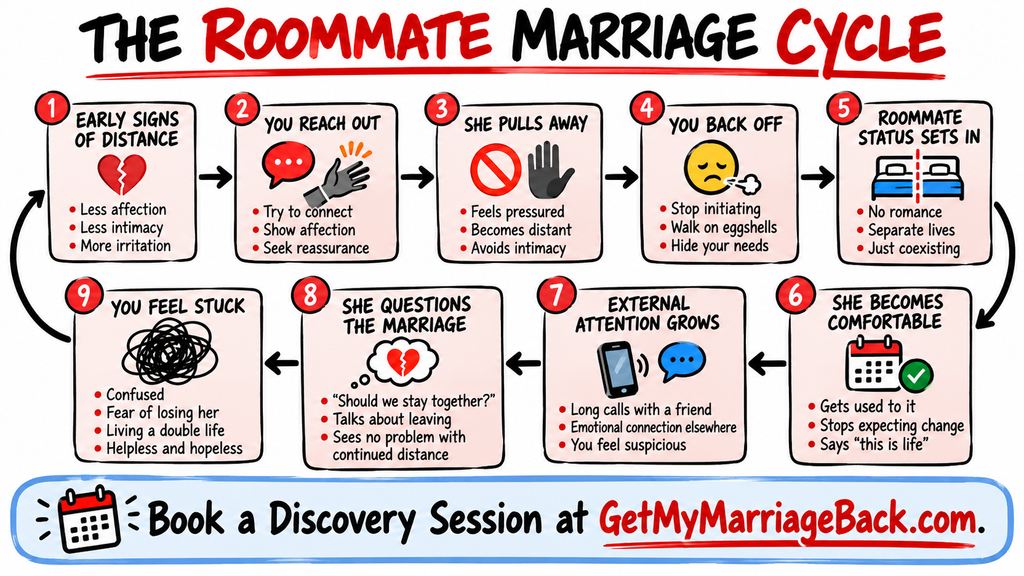
For approximately three to five years, he and his wife had been living like roommates.

He wanted affection, physical intimacy, public displays of affection, and the ordinary romantic connection he remembered from their earlier years.

But every time he reached toward his wife, he sensed that she was uncomfortable.

He didn’t want to pressure her.

So he stopped initiating.

At first, that seemed like the respectful thing to do. He believed that avoiding uncomfortable situations would preserve peace until they could figure things out.

Instead, the arrangement continued for years.

What bothered him most was something his wife had said while they were dating.

Back then, she was afraid that marriage would eventually destroy their romance. She worried that affection, excitement, and intimacy would disappear after the wedding.

Now, she appeared comfortable with the exact situation she once feared.

Sometimes she would essentially tell him that this was simply what married life had become.

Imagine how painful that contradiction was.

He was desperately trying to preserve the romantic relationship, while she seemed increasingly willing to accept a marriage without romance.

Eventually, she began questioning whether they should continue staying together.

That is the roommate marriage trap.

You become so afraid of making your wife uncomfortable that you stop expressing your own needs, while the distance between you becomes the accepted arrangement.

Respecting her boundaries is essential. But living indefinitely in fear of her reactions is not a sustainable marriage strategy.

my wife isn't attracted to me - the roommate marriage cycle

5 Mistakes That Push Your Wife Further Away When Attraction Is Gone

1. Trying to Convince Your Wife to Feel Attracted to You

When your wife says she isn’t attracted to you anymore, you naturally want an explanation.

You remind her of your history, your sacrifices, your responsibilities, and everything you’ve built together.

Perhaps you tell her how much you love her. You explain that marriage requires commitment and that she shouldn’t give up because her feelings have changed.

The problem is that these arguments address responsibility rather than attraction.

Your wife can recognize that you’re a good husband without experiencing romantic desire.

She can appreciate your sacrifices while feeling emotionally disconnected.

Being a responsible spouse and creating a desirable romantic experience are not the same thing.

Attraction is not something you can establish through a convincing argument.

When every conversation becomes another attempt to prove why she should love you, she starts associating your presence with emotional obligation.

That is the opposite of the experience you’re trying to create.

2. Treating Every Moment of Affection as a Test

Your wife sits beside you, and you reach for her hand.

She doesn’t respond the way you hoped.

Immediately, your mind starts interpreting what happened.

Does she still love you? Is she thinking about somebody else? Has she completely lost interest in physical intimacy?

Now every interaction carries emotional consequences.

A hug becomes a test. A kiss becomes evidence. Sex becomes a referendum on whether your marriage can survive.

Your wife begins sensing that ordinary affection comes with expectations.

Even when you don’t verbally demand anything, your disappointment can make the interaction feel emotionally expensive.

Here is the distinction I want you to understand:

Romantic pursuit expresses desire. Fear-driven chasing demands reassurance.

You can express genuine romantic interest without making your wife responsible for relieving your anxiety.

That requires emotional discipline.

When she declines affection, respect the boundary without punishing her through resentment, interrogation, or withdrawal.

Your ability to handle disappointment matters just as much as your willingness to initiate.

3. Assuming That Giving Her Space Will Automatically Rebuild Attraction

Generic marriage advice frequently tells you to give your wife space.

There are circumstances where space is necessary, especially when she feels overwhelmed or has explicitly requested distance.

But space alone doesn’t create attraction.

My client discovered this after years of avoiding situations that might make his wife uncomfortable.

He stopped initiating affection because he didn’t want to pressure her. Meanwhile, the roommate arrangement became increasingly established.

The mistake wasn’t respecting her boundaries.

The mistake was confusing the absence of pressure with the presence of romance.

A relationship can become peaceful without becoming passionate.

You can eliminate arguments while leaving the underlying disconnection untouched.

Rebuilding attraction requires more than simply staying out of her way. It requires changing the experience you bring into the relationship.

That begins with how you manage your emotions, express interest, maintain your identity, and engage with life.

4. Becoming Suspicious Instead of Emotionally Grounded

My client’s situation became even more complicated because of a family friend.

His wife regularly spent approximately 40 to 45 minutes talking with this person on the phone every other night.

Naturally, he became suspicious.

He was experiencing very little affection from his wife while watching her invest considerable time and attention in another relationship.

That combination was painful.

But suspicion is not proof of infidelity.

And allowing suspicion to control your behavior introduces another problem.

You start monitoring phone calls, questioning ordinary interactions, comparing yourself with another person, and interpreting every moment of distance as evidence of betrayal.

Before long, your behavior becomes organized around fear.

If there are legitimate concerns about an affair or inappropriate boundaries, address the facts directly and maintain your standards.

Don’t turn uncertainty into an excuse for accusations, surveillance, or emotional punishment.

You cannot rebuild attraction while allowing suspicion to become your personality.

Your wife needs to encounter somebody capable of exercising emotional intelligence, not somebody whose entire mood depends on her next phone call.

5. Making Your Wife the Center of Your Entire Identity

This is one of the most damaging mistakes because it often disguises itself as devotion.

You love your wife. You want to save your marriage. You believe your family is worth fighting for.

Those desires are understandable.

But somewhere along the way, your wife’s approval can become the measure of your entire existence.

When she smiles, you’re hopeful.

When she withdraws, you’re devastated.

If she mentions separation or divorce, everything else in your life suddenly loses meaning.

Your purpose, confidence, emotional stability, and daily decisions become dependent on her responses.

That creates a relationship in which you are constantly seeking something from her.

And when somebody experiences every interaction as another request for emotional reassurance, romantic connection can become burdensome.

Your wife can be deeply important to you without becoming the source of your identity.

That distinction is foundational to rebuilding attraction.

How to Rebuild Attraction in Marriage Without Begging or Pressure

The first thing I want you to understand is that attraction involves the experience somebody has in your presence.

I’m not talking about moral worth.

Being honest, faithful, hardworking, and responsible matters. But those qualities don’t automatically produce romantic excitement.

Experiential value is different.

It’s the emotional experience created by your confidence, attentiveness, energy, emotional intelligence, humor, boundaries, and genuine interest.

A person who is constantly afraid of rejection brings a different emotional atmosphere into the room than somebody who is grounded, engaged, and comfortable with himself.

This doesn’t mean pretending to be indifferent.

It means developing the ability to express love without demanding a particular response.

Start With Grounding, Purpose, and Self-Discovery

I teach a framework called GPS because rebuilding attraction begins with your own internal direction.

Grounding: Return to a source of truth greater than your wife’s immediate emotional response. Her attraction matters to the marriage, but it cannot determine your worth as a human being.

Purpose: Reconnect with your mission, contribution, growth, and legacy beyond the relationship. Your marriage deserves an engaged person with a meaningful life, not somebody who has abandoned everything else in pursuit of reassurance.

Self-Discovery: Examine how fear, insecurity, resentment, or emotional dependence have influenced your behavior. This is about discovering your capacity to respond differently, not blaming yourself for every problem in the marriage.

These three practices change the position from which you engage your wife.

Instead of approaching her as somebody desperately seeking emotional rescue, you begin approaching her as a person who has something meaningful to contribute.

That difference matters.

Make Your Presence Emotionally Attractive Again

Research provides an important insight into how attraction operates.

A 2016 study published in the Journal of Personality and Social Psychology examined how perceived partner responsiveness relates to sexual desire. Across three studies, researchers found that responsiveness was associated with greater desire, particularly among women, partly because feeling understood and valued made partners appear more desirable.

You can read the research on partner responsiveness and sexual desire.

The lesson isn’t that you should become endlessly accommodating.

Responsiveness means recognizing another person’s experience and responding thoughtfully without abandoning your own needs or boundaries.

For example, when your wife is upset, you don’t have to defend yourself against every statement.

When she disagrees with you, disagreement doesn’t have to become a battle for control.

If she declines intimacy, you can respect that decision without interpreting it as a verdict on your masculinity.

And when you express romantic interest, you can do so warmly and confidently without demanding reciprocation.

This is where emotional intelligence becomes attractive in practice.

You are no longer asking every interaction to prove that your marriage is safe.

You’re learning to create experiences that can be enjoyable on their own.

The Difference Between Seduction and Emotional Pressure

Seduction in marriage is not manipulation.

It is the art of creating an inviting romantic experience while preserving the other person’s freedom to participate.

That requires confidence, emotional awareness, and restraint.

Consider two different approaches.

In the first, you compliment your wife and immediately look for confirmation that she appreciates you.

When she doesn’t respond enthusiastically, you become disappointed.

In the second, you offer a sincere compliment because you genuinely appreciate something about her.

You remain comfortable whether she responds immediately or not.

The words may be identical, but the emotional experience is different.

One interaction carries a demand for reassurance. The other expresses authentic interest.

The same principle applies to flirting, humor, physical affection, and romantic pursuit.

Attraction grows in an atmosphere where interest is genuine and participation is freely chosen.

That doesn’t mean suppressing your desire or pretending you don’t care.

It means expressing desire with dignity.

A warm smile, playful conversation, attentive listening, and confident presence create opportunities for connection without turning every interaction into a negotiation.

Respect a lack of interest rather than escalating the pursuit.

Seduction loses its meaning when somebody feels obligated to respond.

Why Being Willing to Walk Away Changes Your Position

One principle I often teach is that the strongest position in a negotiation is being willing to walk away and genuinely meaning it.

This is frequently misunderstood.

I’m not suggesting that you threaten your wife with divorce to make her jealous or frightened.

I’m not suggesting that you pretend to stop caring.

And I’m certainly not suggesting that you abandon a marriage simply because attraction has declined.

I’m talking about the ability to recognize that your life has meaning beyond your wife’s decision to remain married.

When you’re terrified of losing her at any cost, you become vulnerable to accepting circumstances that violate your own needs and standards.

You stop expressing yourself honestly.

You tolerate indefinite uncertainty because you’re afraid that establishing boundaries will push her away.

Eventually, your fear begins shaping the entire relationship.

Being willing to walk away means you can sincerely pursue reconciliation while acknowledging that a romantic marriage requires willing participation.

You can love your wife without begging her to choose you.

The objective is not to make her afraid of losing you. It’s to stop being controlled by your fear of losing her.

That is personal power.

Can You Save Your Marriage When Your Wife Wants Out?

When attraction loss progresses into separation or divorce discussions, the stakes change.

Your wife may tell you she loves you but isn’t in love with you anymore.

She may stop initiating intimacy, move into another bedroom, or question whether remaining together makes sense.

Sometimes she continues sharing the house while emotionally preparing for a different future.

At this stage, trying harder in the same old ways often intensifies the problem.

Long emotional messages, repeated relationship discussions, desperate promises, and constant requests for reassurance can make every interaction revolve around your fear.

Instead, your behavior needs a different foundation.

Develop the ability to regulate your reactions. Maintain meaningful responsibilities and relationships outside the marriage. Express your intentions without attempting to control her decision.

Where affection is welcome, engage warmly. Where boundaries exist, respect them.

And where your own needs are consistently unmet, acknowledge that reality rather than pretending everything is fine.

Saving your marriage alone doesn’t mean you can manufacture your wife’s participation.

It means you can begin changing your contribution to the relationship without waiting for her to initiate every improvement.

From Experiential Value to Curiosity and Attraction

There is a progression worth understanding:

Grounding → Purpose → Self-Discovery → Experiential Value → Curiosity → Attraction → Influence → Leverage

This is not a technique for controlling your wife.

It’s a way of understanding how your own development changes the experiences available within the marriage.

When you’re grounded, you become less reactive.

With a meaningful purpose, your identity becomes broader than the relationship crisis.

Through self-discovery, you recognize behaviors that have been undermining your confidence and connection.

As your emotional presence improves, you become capable of creating more enjoyable interactions.

Those changes can introduce curiosity.

Your wife may begin encountering a version of you that is less defensive, less dependent, and more emotionally engaging.

Curiosity can open space for attraction.

But the important distinction is that you are not performing these changes to force a reaction.

You are becoming somebody whose presence has value regardless of whether your wife immediately recognizes it.

That is what makes the transformation sustainable.

Don’t Let the Roommate Marriage Become Your Permanent Reality

The most painful part of my client’s experience wasn’t simply the absence of sex.

It was the realization that years were passing while he continued living in a marriage that no longer reflected the relationship he wanted.

He had become afraid of making things worse.

So he stopped taking meaningful action.

His wife appeared increasingly comfortable with the arrangement, while he continued suffering privately.

That is why I want you to distinguish patience from paralysis.

Patience allows time for meaningful change.

Paralysis avoids necessary decisions because you’re afraid of the consequences.

You don’t have to threaten your wife, beg for affection, or pretend that living like roommates is acceptable to you.

Instead, reclaim your emotional stability, strengthen your personal direction, develop your relational skills, and become intentional about the experiences you create.

Attraction is not rebuilt through fear.

It is nurtured through authentic value, emotional intelligence, respectful romantic interest, and the freedom for genuine desire to emerge.

Your wife may have lost attraction to the relationship as she currently experiences it.

That doesn’t mean your next move should be to chase harder or disappear emotionally.

Your next move is to stop organizing your life around rejection and start becoming the person you can respect, whether your wife responds today or not.

That is where meaningful change begins.

19 Signs Your Wife Is Not Sexually Attracted To You

Frequently Asked Questions

Why is my wife not attracted to me anymore?

Your wife’s attraction may have declined because of accumulated resentment, emotional disconnection, unresolved conflict, changing desire, or negative experiences within the relationship. Understanding the specific pattern matters more than assuming one universal explanation.

Can my wife become attracted to me again?

Yes, attraction can change over time, particularly when the emotional experience of the relationship changes. Rebuilding it requires genuine desire and participation rather than pressure, persuasion, or forced intimacy.

What should I do when my wife never initiates intimacy?

Stop treating every intimate interaction as a test of your worth, and respect her boundaries while maintaining your own needs and standards. Focus on emotional connection, confident romantic interest, and understanding the circumstances surrounding her withdrawal.

How do I save my marriage when my wife wants a divorce?

Begin by controlling your reactions, respecting her autonomy, and addressing the behaviors and relationship dynamics within your influence. Avoid begging, threats, and repeated persuasion while developing a clear, dignified approach to reconciliation.

Your Wife Is Not Sexually Attracted to You? 5 Mistakes Making It Worse

You reach for your wife, and she brushes you off. You try to be affectionate, and she acts like you’re bothering her.

Take This 2 Minutes Quiz

Question 1 of 15

Your wife hasn’t asked for a divorce. She’s still living in the house, raising children with you, paying bills, and participating in family responsibilities.

Everything looks like a marriage.

Except you’re living like roommates.

The affection that once came naturally now feels forced. Your wife rarely initiates intimacy, and even simple gestures of affection seem to irritate her.

You remember when she couldn’t wait to spend time with you. Now, you’re wondering whether she even finds you attractive anymore.

And the more you try to reconnect, the further away she seems to move.

Here’s something I want you to understand immediately:

Your wife’s lack of sexual attraction is not necessarily the biggest obstacle to rebuilding your marriage. Your reaction to that rejection can become an even bigger obstacle.

Because rejection breeds obsession.

And when obsession takes over, you begin doing things that make emotional safety, curiosity, and attraction increasingly difficult to experience.

Let’s examine five mistakes that can keep you trapped in that cycle—and what it takes to change the experience you’re creating in your marriage.

https://www.youtube.com/watch?v=QhBbHoFG5aE

1. Mistaking a Marriage Dry Spell for Permanent Rejection

My wife, Lola, and I recently celebrated nineteen years of marriage.

And over those years, we’ve experienced our share of dry spells.

Sometimes life simply gets in the way.

Children, work, bills, family responsibilities, financial pressure, and the ordinary demands of building a life together can gradually push romance into the background.

There have been periods when Lola felt I was too consumed by work.

We’ve also experienced moments when I felt like we were living as roommates rather than romantic partners.

Those experiences taught me something important.

Not every season of reduced affection represents a marriage crisis.

But there’s a significant difference between a temporary dry spell and a deeper emotional disconnection.

A temporary dry spell often develops because life becomes demanding.

A deeper disconnection involves something more.

Resentment accumulates. Arguments remain unresolved. Emotional distance becomes habitual, and physical affection starts disappearing.

Sometimes extended family conflicts contribute to the tension.

Other times, years of disappointment gradually change the emotional experience of being around each other.

When your wife stops showing affection, you naturally notice the physical symptoms first.

She doesn’t initiate sex.

Her kisses become less enthusiastic.

She avoids your touch.

But those behaviors don’t automatically reveal the underlying cause.

Sexual attraction is often influenced by the emotional experience surrounding the relationship—not simply physical appearance or sexual performance.

Before concluding that your wife has permanently lost interest, examine the environment in which that attraction has been disappearing.

my wife is not sexually attracted to me

2. Allowing Rejection to Become Obsession

Here’s where the situation becomes dangerous.

Your wife rejects your affection.

Immediately, your emotions begin interpreting that rejection.

After everything you’ve sacrificed?

And After everything you’ve built together?

After nineteen years of marriage, how can someone suddenly act like they don’t want you?

And yes, sometimes the situation is genuinely unfair.

But being right about the unfairness doesn’t automatically make your next reaction intelligent.

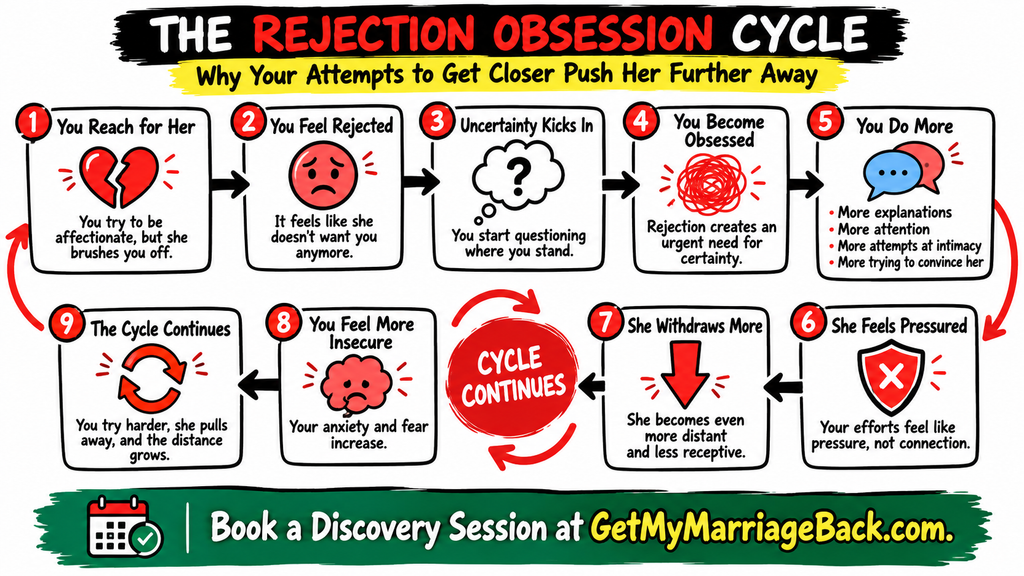
Rejection creates uncertainty. And uncertainty creates an obsession with restoring certainty.

You want reassurance that your wife still loves you.

Naturally, you want confirmation that she still finds you attractive.

When she refuses to provide that reassurance, your anxiety increases.

You start paying closer attention to her behavior.

Every facial expression becomes significant.

Her tone of voice becomes evidence.

A rejected hug can ruin your entire evening.

Before long, your emotional stability becomes dependent on whether she responds positively to your next attempt at affection.

That’s the rejection-obsession cycle.

The more rejected you feel, the harder you pursue reassurance.

Unfortunately, the harder you pursue reassurance, the more pressure your wife experiences.

She withdraws further.

And her withdrawal produces even more obsession.

The problem is no longer just the absence of affection. It’s the emotional pressure surrounding every attempt to restore it.

my wife is not sexually attracted to me - recreate attraction

3. Trying to Recreate Attraction Through More Pursuit

Think about how your relationship began.

You probably demonstrated romantic interest.

And You pursued your wife.

You made an effort to spend time together, express affection, and create experiences she enjoyed.

Those behaviors helped establish your romantic connection.

So when that connection disappears, your instincts tell you to do more of what worked before.

More attention.

And More compliments.

More romantic gestures.

And More conversations about your feelings.

More attempts to initiate intimacy.

But there’s a fundamental difference between pursuing someone who welcomes your romantic interest and repeatedly approaching someone who is emotionally withdrawing.

What feels like romantic effort to you can feel like emotional pressure to her.

This doesn’t mean affection is wrong.

It means attraction depends partly on how affection is experienced.

A romantic gesture that once communicated love can begin communicating expectation.

A conversation intended to restore closeness can become another demand for reassurance.

Even an expensive gift can create discomfort when your wife senses that something is expected in return.

What Research Reveals About Attraction

A 2016 study published in the Journal of Personality and Social Psychology examined the relationship between perceived partner responsiveness and sexual desire.

Across three studies, researchers found that feeling understood, valued, and cared for was associated with greater sexual desire, particularly among women.

The researchers also identified feeling special and perceiving one’s partner as desirable as important mechanisms.

You can examine the research on partner responsiveness and sexual desire for the underlying findings.

This supports an important distinction.

Attraction is influenced by the experience you create, not simply the amount of effort you demonstrate.

Additional relationship research has found positive associations between perceived partner responsiveness, affectionate touch, and intimacy.

That doesn’t mean emotional responsiveness automatically produces sexual desire.

It means the quality of the relational experience deserves attention before you assume that more romantic pursuit is the answer.

4. Believing Personal Improvement Entitles You to Intimacy

I once worked with a man whose marriage had experienced an extraordinary level of betrayal.

He had committed serial infidelity.

His behavior had caused tremendous damage, including circumstances in which his wife required treatment for an infection.

Eventually, she emotionally withdrew from the marriage.

She wasn’t asking for divorce.

According to him, she was remaining in the household primarily because of the children.

But she had made one thing clear.

She never wanted him to touch her again.

Now, here’s where most people become distracted.

They immediately start looking for a way to change her mind.

But her determination to never touch him again was irrelevant to the work he needed to do on himself.

Not because her decision didn’t matter.

Her boundaries absolutely mattered.

The point is that his responsibility wasn’t to negotiate her decision or pressure her into reconsidering it.

His responsibility was to address the behavior that had destroyed emotional safety.

When Personal Transformation Becomes Entitlement

This man experienced what he described as a spiritual transformation.

He found God.

He believed he had become a different person.

And he genuinely wanted to repair his marriage.

But for approximately two years, he repeatedly tried to convince his wife that his transformation should change how she treated him.

He wanted recognition for becoming a better man.

He expected renewed affection.

His belief was that because they had committed to a lifetime together, she should give him another opportunity.

Unfortunately, his attempts to prove that he had changed became another source of pressure.

His declaration of change was not the same thing as her experience of safety.

That’s the distinction I want you to understand.

You can become more religious.

And You can work harder.

You can become more responsible.

And You can provide more financially.

But none of those improvements automatically changes the emotional experience your wife associates with you.

And when you demand affection as evidence that your personal improvement is working, you turn your growth into an invoice she is expected to pay.

This is particularly damaging when the marriage has experienced betrayal, cheating, or prolonged resentment.

Your wife needs the freedom to evaluate your behavior without being pressured to reward it.

Real transformation becomes influential when it can be experienced consistently—not when it is repeatedly announced.

5. Trying to Control Her Feelings Instead of Developing Your Influence

When your wife emotionally withdraws, your instincts naturally focus on the external situation.

You want to fix her mood.

And You want to change her response.

You want to convince her that you’re still desirable.

And you want her to understand why she should reconnect.

But this is where you begin surrendering your personal power.

Because you’re attempting to control something that belongs to another human being.

Influence begins where the need to control ends.

That distinction changes how you approach marriage reconciliation.

Control attempts to produce a particular response.

Influence develops through the quality, consistency, and emotional intelligence of your behavior.

When you become less defensive, more emotionally grounded, and more intentional about the experiences you create, your presence begins communicating something different.

Your wife no longer has to experience every interaction as an attempt to extract affection.

She can observe your behavior without being required to immediately validate your improvement.

And that creates room for a different kind of relational experience.

Emotional Safety Comes Before Romantic Reconnection

Consider what happens when your wife rejects a simple gesture of affection.

Your old response involves questioning her, becoming visibly frustrated, or withdrawing into resentment.

She learns that rejecting affection produces an uncomfortable emotional consequence.

Eventually, even innocent gestures can become associated with pressure.

Now consider a different response.

You recognize the rejection without making it the center of your identity.

Instead of interrogating her, you respect the boundary and continue conducting yourself with dignity.

Your emotional stability remains intact.

Over time, your consistent behavior communicates that she can interact with you without being responsible for regulating your emotions.

That’s emotional intelligence in action.

Emotional safety isn’t something you demand. It’s something your behavior helps establish.

And emotional safety creates better conditions for curiosity, warmth, and attraction to develop.

How to Rebuild Attraction Without Begging for Affection

Here’s what I want you to do.

Stop treating your wife’s immediate response as the ultimate measurement of your personal value.

Your responsibility is to develop the emotional capacity and behavioral consistency necessary to create a different experience.

I teach this through three foundational principles: Grounding, Purpose, and Self-Discovery.

Grounding: Stop Allowing Rejection to Define You

Grounding means returning to a source of truth greater than your wife’s immediate emotional response.

Her rejection is real.

The pain matters.

But that moment doesn’t determine your identity, dignity, or capacity for personal growth.

When you become grounded, you stop treating every interaction as an emergency requiring immediate resolution.

You can experience disappointment without becoming reactive.

And you can respect your wife’s boundaries without interpreting them as a personal catastrophe.

Purpose: Become Bigger Than the Marriage Crisis

Your marriage matters.

But your purpose must extend beyond the approval of any individual person.

Reconnect with your mission.

Examine the impact you want to create.

Consider your contribution to your family, community, career, and the legacy you intend to build.

Purpose redirects emotional energy away from obsessive monitoring of your wife’s behavior.

It also makes your life more engaging.

A person who is meaningfully engaged with life creates a different experience from someone whose entire emotional existence revolves around receiving reassurance.

Attraction is not built by abandoning your identity to obtain someone else’s approval.

Self-Discovery: Reclaim Your Capacity for Influence

Self-Discovery means examining your emotional patterns without collapsing into self-blame.

Notice what rejection triggers in you.

Do you become defensive?

And Do you overexplain?

Do you initiate arguments?

Do you attempt to purchase affection through gifts or favors?

Perhaps you withdraw emotionally to punish your wife for not responding.

These patterns deserve examination because they influence the experience you create.

The objective is not to become emotionally indifferent.

It’s to develop the capacity to express interest without desperation and experience rejection without losing self-control.

The Attraction Chain: Value, Curiosity, Influence, and Leverage

There’s another distinction that matters when you’re trying to save your marriage.

Being a morally good person and creating an attractive relational experience are not identical.

You can be hardworking, loyal, responsible, and generous while still creating interactions dominated by anxiety, resentment, or emotional pressure.

Experiential value concerns what another person experiences in your presence.

Do your interactions create unnecessary tension?

Can you remain warm without demanding affection?

Are you capable of humor, confidence, emotional regulation, and genuine interest without attaching hidden expectations?

Those qualities influence the relational environment.

And when your wife begins experiencing something different from the patterns she has come to expect, curiosity becomes possible.

Curiosity is closely connected to attraction because it creates renewed interest.

That interest can support influence.

Influence becomes leverage when your consistent behavior creates value without demanding an immediate return.

Leverage isn’t permission to manipulate your wife.

It is the personal capacity to contribute meaningfully to the relationship while remaining grounded in your own dignity.

That’s how you pursue reconciliation without turning your wife into a project you must control.

Why Knowing What to Do Isn’t Enough

Now imagine tonight.

You approach your wife affectionately.

She pulls away.

Immediately, your chest tightens.

The familiar thoughts return.

You want an explanation.

And You want reassurance.

You want to remind her of everything you’ve done.

And suddenly, the emotional understanding you’ve developed becomes difficult to apply.

That’s habit drift.

Research on habitual behavior shows that familiar environmental cues can activate automatic responses, particularly when established routines are strong.

Your reaction to rejection can become one of those routines.

The solution requires more than understanding the problem intellectually.

It requires repeated behavioral practice.

You need to recognize the emotional trigger, interrupt your established reaction, and consistently choose behavior aligned with the person you’re becoming.

That’s how emotional intelligence becomes a skill rather than an idea.

Can You Save Your Marriage When Your Wife Has Lost Attraction?

Yes, attraction can change throughout a long-term marriage.

But the path forward begins with understanding the difference between restoring affection and creating the conditions that make affection desirable.

Your wife isn’t a problem to solve.

Her emotional response isn’t something you can manufacture.

And her physical boundaries aren’t obstacles to overcome through persistence.

The meaningful work begins with your own behavior.

Stop attempting to extract intimacy through persuasion.

Develop emotional stability that doesn’t depend on constant reassurance.

Address the patterns that have contributed to resentment, insecurity, or disconnection.

Build a life characterized by purpose, confidence, and emotional intelligence.

Most importantly, understand that becoming more attractive is not simply about becoming a better person on paper.

It’s about becoming someone whose presence creates a better experience.

That’s where emotional safety develops.

That’s where curiosity becomes possible.

And that’s where attraction has room to grow.

Wife or Husband Denying You Sex? DO THIS!!!

Frequently Asked Questions

Why is my wife not sexually attracted to me anymore?

Sexual attraction can decline because of accumulated resentment, emotional disconnection, chronic stress, health changes, relationship dissatisfaction, or pressure surrounding intimacy. Understanding the underlying pattern is more useful than assuming her rejection has one simple explanation.

Can my wife love me but not be sexually attracted to me?

Yes, emotional attachment, commitment, and sexual attraction are related but distinct experiences. Your wife can care deeply about you while experiencing little romantic or sexual desire.

What should I do when my wife rejects my affection?

Respect her boundaries, avoid demanding reassurance, and examine whether your response to rejection creates additional emotional pressure. Focus on emotional regulation, personal purpose, and consistent behavior that supports trust and emotional safety.

Can sexual attraction return after years of marriage?

Yes, sexual desire can change over time, and research associates intimacy and perceived partner responsiveness with greater desire. Rebuilding attraction begins with improving the relational experience rather than pressuring your wife to demonstrate affection.

Wife Wants Separation? 5 Mistakes That Push Her Further Away

Your wife wants separation, and suddenly the woman you built your life with is asking for a future that might not include you.

Take This 2 Minutes Quiz

Question 1 of 15

Yesterday, you were her husband. Today, you feel like you’re auditioning for a position you already had.

She says she needs space. Maybe she isn’t sure about the marriage anymore. Perhaps she’s already mentioned divorce, moving out, or living separately while she figures out what she wants.

Now every unanswered text feels suspicious. Every conversation seems like a test. Your friends are telling you there’s probably another man, and you’re wondering whether giving her space means giving up on your marriage.

I want you to understand something important: Your wife asking for separation is a serious marriage crisis, but separation and divorce are not the same decision.

What you do during this period matters. And some of the most natural reactions to losing your wife can create exactly the kind of pressure that makes reconciliation harder.

https://www.youtube.com/watch?v=FCpuxML4uRo

Why Your Wife Wants Separation When You Still Love Her

When your wife wants separation, the announcement can seem to come out of nowhere.

You remember the last argument. Maybe you said something you regret. Perhaps she got upset over something you considered minor.

Now you’re wondering how one disagreement became a threat to everything you’ve built.

But the argument that triggers a separation conversation isn’t necessarily the problem that created the crisis.

Sometimes resentment has been accumulating for years.

Your wife may have experienced repeated disappointment, emotional disconnection, unresolved conflict, or declining attraction long before she mentioned leaving.

That doesn’t make every accusation against you accurate. It means the announcement and the emotional process behind it are two different things.

The marriage crisis that changed my perspective

Years into my own marriage, my wife told me she didn’t want to be married anymore.

I initially thought she was joking.

We had two boys together. We had built a family, and I couldn’t understand how an argument could suddenly put our marriage in jeopardy.

Then she repeated herself.

The reality became impossible to ignore.

For months, our marriage was in crisis. Eventually, I began accepting that divorce might become part of my story.

Yet my wife and I recently celebrated nineteen years of marriage.

That experience changed how I understand saving a marriage when one spouse wants out.

The biggest mistake is believing your wife must first change her mind before you can change the direction of your own life.

wife wants separation

The 5 Mistakes That Push Your Wife Further Away During Separation

1. Begging Her to Reconsider Before She Has Space to Think

Your wife says she needs time, and you immediately want another conversation.

You explain how much you love her. You remind her about your wedding vows, the children, the sacrifices, and everything you’ve survived together.

When that doesn’t work, you try again.

Here’s the problem.

You cannot negotiate somebody into wanting you.

Your explanations may be sincere, but when every interaction becomes an attempt to reverse her decision, your wife starts associating contact with emotional pressure.

Relationship researchers call one version of this the demand-withdraw pattern: one spouse increasingly presses for discussion or change while the other retreats.

A study of 116 couples examining marital conflict at home found that these patterns were associated with more negative interactions and less conflict resolution. The findings help explain why pursuing another conversation isn’t always the same as making progress.

The research on demand-withdraw patterns in marital conflict reinforces an important distinction: pressure and productive engagement are not interchangeable.

Giving your wife space doesn’t require pretending you don’t care.

It means refusing to make every interaction another campaign to change her mind.

2. Assuming She Wants Separation Because There’s Another Man

When your wife becomes emotionally distant, your imagination starts filling in the missing information.

She’s protecting her phone.

She doesn’t respond as quickly.

Her tone has changed.

Now your friends are telling you she must be interested in somebody else.

I worked with a man whose wife wanted divorce and was threatening to take much of what he had built financially.

But money wasn’t his deepest fear.

His parents had experienced multiple divorces. He had promised himself that his family would be different.

When his wife began questioning their future, he felt as though he was becoming the very story he’d spent his life trying to escape.

People around him became convinced another man was involved.

That possibility started dominating his thinking.

But suspicion isn’t evidence.

When you turn uncertainty into a conclusion, your behavior starts responding to a story you haven’t established as fact.

You become defensive, accusatory, controlling, or desperate for reassurance.

If there is evidence of infidelity, address the reality and protect your boundaries. But don’t manufacture certainty simply because uncertainty is painful.

Your fear of being replaced must not become the force controlling your behavior.

wife wants separation - the space spiral

3. Letting the Separation Destroy Your Identity

One of the most painful consequences of a marriage crisis is how quickly it can consume everything else.

Your business suffers.

You lose focus at work.

Sleep becomes difficult, and the activities that once gave your life meaning disappear.

I saw this happen with the client whose wife wanted divorce.

His emotional deterioration began affecting his business and everyday functioning.

Eventually, his wife pointed to those changes as additional reasons she no longer recognized the person she had married.

Think about that contradiction.

He was falling apart because he desperately wanted to save his family.

Yet the deterioration was making it harder for him to show up as the person he wanted to be.

This is where self-leadership becomes essential.

You don’t reclaim your identity by pretending the marriage doesn’t matter.

You reclaim it by refusing to make your wife’s immediate response the only measure of whether your life has value.

Your health, responsibilities, friendships, children, professional commitments, and personal mission still deserve your attention.

Those aren’t distractions from saving your marriage.

They’re part of rebuilding the stability that allows you to navigate the crisis intelligently.

4. Confusing Chasing With Genuine Pursuit

There’s a meaningful difference between pursuing your wife and chasing her.

Pursuit communicates interest with dignity.

Chasing demands reassurance because fear has taken control.

A thoughtful expression of love is different from sending six unanswered messages.

Respecting her request for space is different from disappearing to punish her.

Maintaining warmth when appropriate is different from manufacturing jealousy to make her react.

Attraction isn’t built by demonstrating how helpless you become when someone withdraws.

It’s influenced by the experience you create through your presence, emotional regulation, confidence, and behavior.

That is what I mean by experiential value.

I’m not talking about proving you’re morally superior or reminding your wife how good a husband you’ve been.

I’m talking about becoming someone whose presence creates a different emotional experience from the pressure and conflict she has come to expect.

You can be caring without being desperate.

You can remain interested without demanding access.

And you can respect distance without turning it into a manipulation tactic.

5. Treating Every Interaction as a Verdict on Your Marriage

Your wife responds warmly to a message.

You immediately think reconciliation is beginning.

The following day, she’s distant again.

Now you’re convinced divorce is inevitable.

That emotional roller coaster can turn every interaction into a test.

A short reply becomes rejection. A smile becomes proof of attraction. Silence becomes evidence of another man.

Eventually, your emotional stability depends on interpreting signals that may have several explanations.

One good conversation doesn’t mean your marriage is saved. One difficult conversation doesn’t mean it’s finished.

Instead of chasing individual signals, pay attention to patterns over time.

Is there less hostility?

Are your interactions becoming more respectful?

Are you responding differently when disappointment occurs?

Most importantly, are you becoming more capable of handling uncertainty without surrendering your judgment?

That is progress you can actually influence.

How to Save Your Marriage When Your Wife Wants Separation

Saving your marriage while separated begins with understanding the difference between control and influence.

You cannot control your wife’s feelings, attraction, or final decision.

But you can change the experience of interacting with you.

I teach a progression that begins with GPS: Grounding, Purpose, and Self-Discovery.

Grounding: Stop Letting Her Reactions Define Reality

Grounding means returning to a source of truth that remains stable even when your wife is uncertain about you.

Her emotional withdrawal is real.

Your marriage crisis is real.

But neither determines your entire identity or future.

When fear rises, acknowledge the situation without letting your imagination become your authority.

Purpose: Rebuild a Life Bigger Than This Crisis

Your marriage matters, but your purpose cannot depend entirely on another person’s decision.

Reconnect with your responsibilities, contribution, mission, and legacy.

This is particularly important when you’re trying to save your marriage alone.

You still have a life to lead while the future of your marriage remains unresolved.

Self-Discovery: Reclaim Your Capacity to Influence

Self-discovery isn’t an invitation to blame yourself for everything that went wrong.

It’s an opportunity to recognize the patterns you can change.

Perhaps you become defensive when criticized.

Maybe rejection triggers excessive reassurance-seeking.

You may have allowed years of disappointment to replace confidence with resentment.

Recognizing these behaviors gives you something practical to work on.

Rebuilding Attraction During Marriage Separation

The next progression is experiential value, curiosity, attraction, influence, and leverage.

Experiential value concerns what it is like to experience you.

When your behavior becomes more grounded, emotionally intelligent, and engaging, interactions can begin to feel different.

That difference creates room for curiosity.

Curiosity matters because attraction is difficult to nurture when every conversation feels predictable, pressured, or emotionally exhausting.

Your wife doesn’t need another performance designed to convince her you’ve changed.

She needs the freedom to observe whether your behavior actually changes.

That means demonstrating emotional intelligence in ordinary moments.

Respond without immediately defending yourself.

Respect reasonable boundaries without turning cold.

Maintain your responsibilities without demanding recognition.

Express interest without making every interaction a referendum on reconciliation.

This is how you begin changing your contribution to the relational dynamic.

Not by forcing attraction, but by becoming more capable of creating the conditions in which attraction can develop naturally.

Why Understanding Isn’t Enough: The Habit Drift Problem

You can understand everything I’ve explained and still repeat the same mistake tonight.

Your wife ignores your message.

Fear returns.

Suddenly, you’re writing another long paragraph explaining why she shouldn’t leave.

This is Habit Drift: returning to familiar reactions when emotional pressure rises.

Research into stress and decision-making has examined how stress can affect the balance between deliberate action and habitual responding, although findings are mixed and not every person responds the same way.

The practical lesson is straightforward.

Insight needs implementation.

In my GPS5 approach, the additional four S’s help turn understanding into sustained behavior:

  • Story-Tailoring: Understand the circumstances and history of your particular marriage.
  • Skill-Acquisition: Practice emotional intelligence until it becomes part of how you respond.
  • Support: Maintain perspective when fear and rejection distort your thinking.
  • System: Establish a consistent approach to difficult moments rather than improvising under emotional pressure.

The objective isn’t to become emotionally detached from your wife.

It’s to remain capable of making intelligent decisions even when your marriage is under threat.

Can Marriage Be Saved When Your Wife Wants Out?

A wife asking for separation is not automatically announcing an irreversible divorce.

Some marriages reconcile after significant emotional distance. Others move toward divorce despite sincere efforts to repair the relationship.

The distinction matters because you need to respond to the situation you’re actually facing, not the outcome you’re most afraid of.

When my own marriage reached a breaking point, I couldn’t see a path back.

Today, our history includes both that crisis and nineteen years of marriage.

What changed my perspective was recognizing that saving a marriage cannot require abandoning yourself.

Wanting your family is not weakness.

Loving your wife is not weakness.

Trying to save a broken marriage is not weakness.

But making your wife’s decision the sole source of your stability leaves you vulnerable to every change in her mood.

Your responsibility is to become grounded, emotionally intelligent, purposeful, and capable of creating a healthier relational experience.

Giving her space doesn’t have to mean giving up on your marriage. But saving your marriage cannot require losing yourself.

Wife or Husband Denying You Sex? DO THIS!!!

Frequently Asked Questions

What should I do if my wife wants separation?

Respect her request for reasonable space, avoid pressuring her for immediate reassurance, and focus on maintaining your emotional stability and responsibilities. Pay attention to the actual circumstances rather than assuming separation automatically means divorce.

Does separation mean my wife wants a divorce?

Not necessarily; separation can reflect uncertainty, emotional exhaustion, or a decision to move toward divorce. Her stated intentions and consistent actions provide more reliable information than speculation.

How can I save my marriage while separated?

Focus on the behaviors you control, including emotional regulation, respectful communication, personal stability, and addressing destructive relationship patterns. Sustainable reconciliation requires more than repeatedly convincing your wife to reconsider.

Should I contact my wife during separation?

Follow the boundaries and practical arrangements that apply to your separation, especially regarding children and shared responsibilities. Avoid using necessary contact as an excuse to pressure her into discussing reconciliation.


What Would Help You Most Right Now?

Choose the option that best matches where you are with your marriage.

I Need Personalized Help

My Marriage Is in Serious Trouble

If you're dealing with separation, divorce, loss of attraction, infidelity, intimacy problems, or a spouse who's pulling away, get help looking at what's happening in your specific situation.

Get Personalized Help →
Get My Marriage Back book cover
I'd Rather Learn What to Do First

Start With Get My Marriage Back

Get the book and start learning the principles for moving your marriage in a better direction.

Get the Free Book →