

Your wife used to argue with you about everything, but now she barely reacts—even when you ask whether she still wants the marriage.
Take This 2 Minutes Quiz
You come home late. Nothing.
You forget something important. She doesn’t complain.
When you ask whether she still loves you, her response is painfully simple: “Do whatever you want.”
A few months ago, that conversation would have started an argument.
Today, she doesn’t even bother.
And strangely enough, you would almost prefer another fight.
At least when your wife argued, you knew something was happening emotionally.
Now you’re watching someone you’ve loved, supported, and sacrificed for behave as though your marriage is no longer worth discussing.
What Would Help You Most Right Now?
Choose the option that best matches where you are with your marriage.
My Marriage Is in Serious Trouble
If you're dealing with separation, divorce, loss of attraction, infidelity, intimacy problems, or a spouse who's pulling away, get help looking at what's happening in your specific situation.
Get Personalized Help →
Start With Get My Marriage Back
Get the book and start learning the principles for moving your marriage in a better direction.
Get the Free Book →Indifference is one of the strongest warning signs your wife is done with the marriage. But indifference is not an absolute verdict.
That’s the first thing I want you to understand.
A wife who is angry, a wife who is emotionally exhausted, and a wife who has genuinely disengaged can display similar behaviors.
All three can become distant.
Each can refuse intimacy, stop initiating conversations, or ask for separation.
Yet the underlying circumstances are different.
And confusing them can cause you to make a desperate decision when you need emotional intelligence, accurate interpretation, and self-leadership.
I want to show you how to recognize what is happening in your marriage before deciding your next move.
What Are the Signs Your Wife Is Done With the Marriage?
The strongest warning signs usually involve a sustained pattern of emotional disengagement rather than one bad conversation.
Pay attention when your wife:
- No longer argues about problems that previously upset her.
- Stops showing curiosity about your life, activities, or future.
- Responds to your efforts to reconnect with persistent indifference.
- Avoids emotional and physical intimacy over an extended period.
- Expresses little interest in repairing unresolved relationship problems.
- Begins making significant future plans without including the marriage.
- Repeatedly communicates a firm decision to separate or divorce.
- Appears emotionally unaffected by promises, apologies, or attempts to impress her.
These signs deserve attention, especially when several occur together.
However, a visible behavior is not the same thing as a verified explanation.
Your wife can stop arguing because she’s emotionally finished.
She can also stop because she’s exhausted, overwhelmed, or unwilling to participate in another painful conversation.
What you need to know is why her behavior changed, when it changed, and whether the pattern has become consistent.
Let’s differentiate the three levels.
Level 1: She’s Angry but Still Emotionally Engaged
Your wife complains that you never listen.
She brings up something you did three years ago.
Another argument begins over a problem you thought was already resolved.
You feel attacked.
After years of providing, sacrificing, and trying to be dependable, it’s unfair when your contributions seem to disappear from the conversation.
I understand why you become defensive.
You want your wife to acknowledge everything you’ve done right.
But I want you to pay attention to something else.
Her anger tells you that she’s reacting emotionally to the relationship. It does not, by itself, tell you that she’s done.
What Anger Can Reveal About Your Marriage
Suppose your wife says:
“You never care about me.”
You immediately remember the bills you’ve paid, the sacrifices you’ve made, and the countless times you’ve supported her.
Now you’re preparing your defense.
But look at the interaction more carefully.
The observable behavior is that your wife is confronting you.
Her expressed emotional interpretation is that she feels uncared for.
Those are different pieces of information.
You don’t need to agree that you’ve never cared about her.
What matters is recognizing that she’s describing a painful emotional experience.
If you spend the next twenty minutes proving that you’ve cared exactly 47 times, you’ve turned her complaint into another courtroom argument.
You can win that argument and still fail to understand what she’s communicating.
How to Recognize Emotional Engagement
Pay attention to the subject of her complaints.
Does she still talk about wanting more attention, affection, consideration, or emotional connection?
Is she upset because particular experiences keep repeating?
Does she describe what she wanted from you or what she feels has been missing?
Those complaints indicate that the relationship remains emotionally significant to her.
Anger is not proof of love, and it is not proof that reconciliation is coming.
It is evidence of emotional activation.
That matters because emotional activation and emotional indifference are not the same condition.
Your responsibility is to respond with composure instead of treating every complaint as an attack on your character.
Level 2: She’s Emotionally Exhausted and Protecting Herself
Now consider a different situation.
Your wife has spent months explaining that certain conversations leave her feeling dismissed.
Every disagreement follows the same pattern.
She raises a concern.
You present evidence.
Your wife gives an example.
You correct the wording, challenge the details, and explain why her interpretation is inaccurate.
Eventually, she stops participating.
Now she sleeps in another room, keeps her phone private, and says she needs space.
You interpret the distance as proof that she’s finished with the marriage.
But emotional exhaustion and a settled decision to leave are different circumstances.
Why Your Wife Stops Arguing After Repeated Conflict
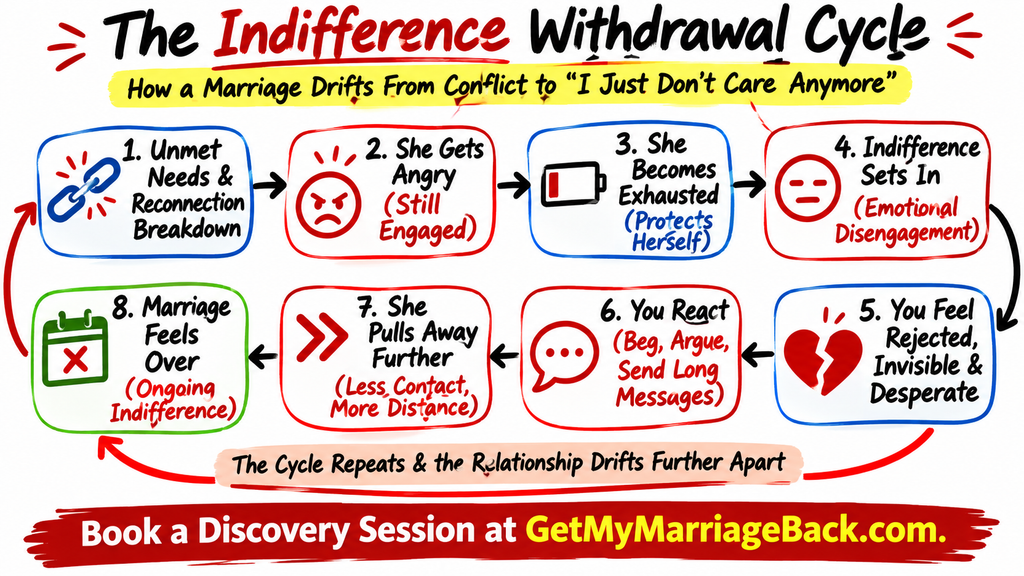
Sometimes a person stops arguing because the conversations have become emotionally expensive.
Every discussion requires energy.
When the same conflict repeatedly ends in defensiveness, frustration, or pressure, disengaging can become a way to protect emotional capacity.
Relationship researchers have studied this pattern extensively.
In a longitudinal study involving 3,405 couples, researchers found that conflict and withdrawing behaviors predicted later relationship perceptions, including lower satisfaction and greater perceived instability.
The findings appear in the research on couple conflict, withdrawal, and relationship satisfaction.
The practical lesson is important.
Repeated conflict doesn’t simply disappear because the arguments stop.
Sometimes the emotional consequences remain long after the conversations end.
Signs Your Wife Is Emotionally Exhausted
Look for a history of repeated frustration followed by reduced engagement.
Your wife previously explained what bothered her, but now she avoids discussing it.
She becomes quieter after arguments.
Requests for reassurance seem to increase her frustration.
Physical affection decreases, and she asks for more personal space.
You notice that attempts to explain your intentions often produce another withdrawal.
These behaviors are consistent with emotional exhaustion, although they don’t establish her private intentions.
What you need to know is what happened before the silence.
Did she repeatedly communicate the same concern?
Were her complaints dismissed or converted into arguments?
Has she explicitly requested less contact?
Did the withdrawal begin after a particular event or develop gradually over several months?
Silence following repeated conflict tells you something different from silence following a long period of calm separation.
That changes your next move.
When your wife asks for space, respect the boundary.
Don’t follow her around the house demanding another explanation.
Stop using long emotional messages to relieve your anxiety.
Reducing pressure creates breathing room, but it doesn’t automatically resolve the experiences that produced the exhaustion.
Those require a deeper change in how you conduct yourself.
Level 3: She’s Indifferent and No Longer Emotionally Invested
This is the level I want you to take most seriously.
Your wife no longer argues about the marriage.
She doesn’t ask where you’ve been.
Promises that once produced hope or frustration now seem irrelevant to her.
You attempt to impress her, but she shows little interest.
Even your anger fails to provoke much reaction.
Previously, you felt rejected by her criticism.
Now you feel invisible.
Indifference is often the closest thing to emotional disengagement in a marriage crisis.
People frequently say that hate is the opposite of love.
But in the context of a deteriorating marriage, persistent indifference can be more revealing than an emotional argument.
Anger still involves an emotional reaction.
Indifference involves reduced emotional investment in what happens between you.
That doesn’t mean every quiet spouse is indifferent.
It means a sustained absence of interest, concern, curiosity, or engagement deserves serious attention.
How to Recognize Genuine Indifference
Start with consistency.
Does your wife seem emotionally disengaged across different situations, not just after arguments?
Has she stopped expressing interest in your activities or future?
When you make meaningful changes, does she acknowledge them without showing renewed interest in the relationship?
Does she avoid conversations about rebuilding the marriage while consistently maintaining her decision to separate?
Most importantly, what has she explicitly communicated?
A wife who calmly states that she has decided to divorce deserves to be taken seriously.
Her lack of anger doesn’t make that decision less meaningful.
Likewise, a wife who avoids an argument because she’s overwhelmed isn’t automatically finished.
One cold evening is a moment. Months of indifference are a pattern. A clearly communicated decision to leave is a decision you must respect.
Don’t confuse those three realities.
Why Your Wife’s Indifference Hurts More Than Her Anger
Anger is uncomfortable, but it provides emotional feedback.
Your wife is upset about something.
You know she’s reacting.
There is an identifiable issue, even when the conversation becomes unpleasant.
Indifference creates a different emotional experience.
You don’t know whether she feels hurt, exhausted, disconnected, or completely finished.
Her silence leaves room for your imagination to construct the worst possible explanation.
That’s when you start monitoring every interaction.
You notice how long she takes to respond to a message.
Her facial expression becomes evidence.
A closed bedroom door feels like a verdict.
When she laughs at something on her phone but barely acknowledges you, the contrast feels unbearable.
I want you to recognize what happens next.
Your anxiety drives you to demand clarity.
That demand creates pressure.
She withdraws further.
Now her increased distance seems to confirm the very conclusion you feared.
Your interpretation of her withdrawal can produce reactions that intensify the withdrawal.
This is why self-leadership matters before reconciliation strategy.
The 5 Questions That Reveal What Her Withdrawal Means
Before deciding your wife is done with the marriage, evaluate your specific circumstances.
1. When Did Her Emotional Withdrawal Begin?
Identify the period when her behavior noticeably changed.
Was it after a major argument, a betrayal of trust, repeated disappointment, or a conversation about separation?
A sudden change after a particular event tells a different story from a gradual decline over several years.
Your timeline matters.
2. What Was Happening Before She Stopped Arguing?
Think about the months leading up to her silence.
Did she repeatedly express dissatisfaction?
Were the same problems resurfacing without meaningful changes?
Did she stop raising concerns after concluding that previous conversations were unproductive?
The history behind the behavior helps you differentiate exhaustion from disengagement.
3. Is Her Indifference Consistent?
Look beyond a single interaction.
Your wife can be distant during an argument but engaged in other areas of life.
She can also remain consistently detached across conversations, activities, and future planning.
Pay attention to repeated behavior over time.
Don’t build a permanent conclusion from one evening.
4. What Has She Actually Said About the Marriage?
Separate observable statements from emotional interpretations.
“She said she wants a divorce” is an observable statement.
“She didn’t smile when I walked into the kitchen, so she hates me” is your interpretation.
Both experiences matter, but they carry different kinds of information.
Give her explicit words appropriate weight.
5. What Happens When You Stop Demanding Reassurance?
Notice the interaction pattern when you stop pursuing an immediate emotional response.
Does the atmosphere become less tense?
Does she continue maintaining the same boundaries?
Are your conversations more practical and less reactive?
You’re not conducting an experiment to manipulate her.
You’re identifying whether your own fear-driven reactions have been contributing to the pressure.
Your specific marriage history matters more than a generic checklist of divorce warning signs.
Why Winning Every Argument Can Cost You Emotional Connection
Let me give you a familiar example.
Your wife tells you that she feels lonely in the marriage.
You explain that you’ve been working long hours to provide for the family.
She says you rarely spend meaningful time together.
You remind her of your responsibilities.
Soon you’re debating whether you spent three hours or five hours together last weekend.
The original issue was loneliness.
The conversation has become a dispute about evidence.
You establish that your sacrifices are real.
But the emotional concern remains unresolved.
Over time, repeated conversations like this can make engagement feel unproductive.
Eventually, your wife stops raising the issue.
You interpret the absence of complaints as improvement.
Then she announces that she wants separation.
And you’re shocked because you believed the arguments had finally stopped.
The absence of conflict is not automatically the presence of emotional connection.
You need to understand the experience that replaced the conflict.
Is there warmth?
Curiosity?
Affection?
Mutual interest?
Or has the relationship become a collection of logistical responsibilities with very little emotional engagement?
That question matters more than how many arguments you had this week.
How to Respond When Your Wife Seems Done With You
Here is what I want you to do.
Stop treating every sign of distance as an invitation to argue for your marriage.
You cannot logic your wife into feeling attracted to you.
Repeatedly explaining your sacrifices won’t manufacture desire.
Begging for reassurance doesn’t create emotional safety.
And pursuing an immediate reaction from someone who has asked for space communicates pressure rather than confidence.
Confidence is always sexy.
But confidence isn’t pretending you don’t care.
It means caring deeply without abandoning your dignity, composure, or self-respect.
You can remain interested in reconciliation without chasing someone who is withdrawing.
The difference is the emotional experience your conduct creates.
Fear-driven chasing demands relief.
Dignity-based pursuit expresses interest while respecting boundaries.
One transfers emotional pressure.
The other demonstrates self-control.
Your goal is to become someone who can handle the uncomfortable reality of separation without allowing that discomfort to dictate every action.
GPS5: Rebuild Your Personal Power Before Trying to Rebuild Attraction
I teach a self-leadership roadmap called GPS5.
It begins with Grounding, Purpose, and Self, then progresses toward experiential Value, Curiosity, and Influence.
Grounding: Stop Letting Her Silence Define Your Reality
Grounding redirects your attention away from the latest painful symptom and toward your higher self, truth, and gratitude.
You acknowledge that your wife is distant.
However, you stop treating every unanswered message as proof that your life is falling apart.
Your responsibility is to respond to observable reality instead of reacting to every frightening interpretation.
Purpose: Redirect Pain Into a Meaningful Mission
Your marriage matters enormously.
But your entire identity cannot depend on whether your wife feels affectionate toward you today.
Purpose redirects the pain of this experience toward your calling, meaningful contribution, and legacy.
You need a mission greater than the immediate marriage crisis.
That direction gives you something substantial to pursue while navigating uncertainty.
Self: Build Emotional Capacity Without Self-Blame
Self is about developing sustainable emotional strength.
You become accountable for your conduct.
Personal responsibility replaces defensiveness.
At the same time, you stop assuming that every problem in the marriage is your fault.
Accountability and self-blame are not the same thing.
Value: Become Experientially Attractive
Being a good person matters.
Integrity and responsibility are essential foundations.
But romantic attraction also involves the experience of interacting with you.
Does your presence communicate calmness, warmth, confidence, and emotional intelligence?
Or does every interaction feel like another demand for reassurance?
Experiential value means becoming more engaging to be around, not trying to prove your moral worth.
Curiosity and Attraction: Give Her Room to Notice
When your conduct changes consistently, the emotional experience surrounding you changes.
You become less reactive.
Your life develops meaningful direction.
Conversations stop revolving around your need for immediate validation.
These changes create room for natural curiosity.
Your wife has the freedom to notice your growth without being pressured to reward it.
Influence: Let Your Conduct Carry Weight
Influence is not control.
You cannot command your wife to love you.
What you can do is develop the emotional maturity and personal capacity that make your interactions more constructive.
The roadmap is:
Grounding + Purpose + Self → Value → Curiosity and Attraction → Influence
This approach begins with the person whose decisions you can actually control: yourself.
What to Do Tonight When Your Wife Gives You the Cold Shoulder
Tonight, your wife walks past you without acknowledging your presence.
Your chest tightens.
You want to follow her into the next room and demand to know whether she still loves you.
Don’t do that.
Put your phone down.
Relax your shoulders.
Continue one meaningful activity that has nothing to do with obtaining her reaction.
Avoid sending another lengthy emotional message.
Don’t turn her silence into a confrontation.
You are not pretending that the marriage crisis doesn’t exist.
You’re refusing to let panic determine your next move.
Removing pressure stops the bleeding. It doesn’t repair months of emotional disconnection.
The deeper work involves understanding what fractured the relationship and developing the emotional intelligence, confidence, and personal direction required to create a different experience.
Your wife may be angry.
She may be exhausted.
She may have become genuinely indifferent.
Those circumstances are not interchangeable.
What you need to know is which pattern most accurately reflects your marriage.
And once you understand that, you can stop reacting blindly and begin making decisions from a position of personal power.
Average Length of Separation Before Reconciliation: Data Reveals!
Frequently Asked Questions
Persistent emotional indifference, lack of interest in repairing the relationship, and a consistently communicated decision to separate or divorce are serious indicators. Consider her behavior over time and take her explicit statements seriously rather than relying on one isolated incident.
Common signs include reduced affection, little curiosity about your life, avoidance of relationship conversations, and sustained indifference toward reconciliation efforts. These behaviors also occur during emotional exhaustion, so the history and consistency of her withdrawal matter.
No, stopping arguments can reflect emotional exhaustion, conflict avoidance, or genuine disengagement. What happened before the silence and how she behaves consistently afterward help clarify its meaning.
Romantic interest can return when the emotional dynamics surrounding the relationship change and genuine connection becomes possible again. Your immediate focus should be on emotional self-control, respecting boundaries, and developing the qualities that make your presence more engaging.