


Your wife used to welcome your kisses, reach for your hand, and enjoy being close to you.
But now she pulls away from your touch, looks irritated when you approach, and acts like physical affection is something she has to endure.
Take This 2 Minutes Quiz
When your wife stops showing physical affection, especially after years of marriage, the rejection cuts deeper than sex.
You’re not simply missing intimacy. You’re watching a woman who once wanted you become increasingly uncomfortable around you.
Sometimes the situation gets even worse.
Your wife says she’s no longer in love with you. She wants separation. Perhaps she’s already asked for divorce.
And now you’re trying to figure out how to save your marriage when your wife isn’t attracted to you anymore.
I want you to understand something important.
Your wife’s lack of attraction is a serious symptom, but your reaction to that symptom can become another problem entirely.
You cannot argue your way back into her desire.
You cannot explain your sacrifices until she finds you attractive again.
And you certainly cannot make someone want to kiss you by proving how unfairly they’re treating you.
However, you can change the emotional experience you bring into the marriage.
That’s where rebuilding attraction begins.

5 Signs Your Wife May Be Losing Sexual Attraction
Before examining the mistakes, let’s identify what you’re experiencing.
1. She Pulls Away When You Try to Kiss Her
A kiss that used to happen naturally now creates discomfort.
She turns her face, stiffens, or avoids the moment altogether.
One rejected kiss doesn’t establish a loss of attraction. But repeated withdrawal alongside emotional disconnection deserves attention.
2. She Never Initiates Physical Affection
You initiate every hug, kiss, and attempt at closeness.
When you stop initiating, physical affection practically disappears.
The imbalance leaves you wondering whether she still desires you.
3. She Looks Irritated When You Approach
Sometimes the rejection isn’t verbal.
Her facial expression changes when you enter the room. She looks annoyed before you’ve even said anything.
Visible disgust or contempt is especially concerning when it becomes a recurring feature of your interactions.
4. She Avoids Emotional Intimacy
Conversations become strictly practical.
You discuss bills, children, schedules, and responsibilities, but meaningful emotional connection disappears.
The marriage begins resembling a household arrangement rather than a romantic relationship.
5. She Talks About Separation or Divorce
This is where the situation becomes urgent.
Your wife isn’t simply declining intimacy. She’s questioning whether she wants to remain married.
At this stage, treating the problem as a lack of sex misses the larger crisis.
You need to address the relationship experience surrounding the physical rejection, not merely the absence of physical affection.
Why Your Wife’s Rejection Feels So Devastating
When you’ve invested years in a marriage, physical rejection carries enormous emotional weight.
You’ve worked, sacrificed, supported your family, and tried to build a future together.
Now the woman you married appears uncomfortable with your presence.
That is painful.
It’s also frightening when you have children, shared responsibilities, and a life that could be dismantled by divorce.
Your immediate instinct is to seek an explanation.
You want her to understand your intentions, recognize your contributions, and acknowledge everything you’ve done.
Unfortunately, that instinct can lead directly into the first major mistake.
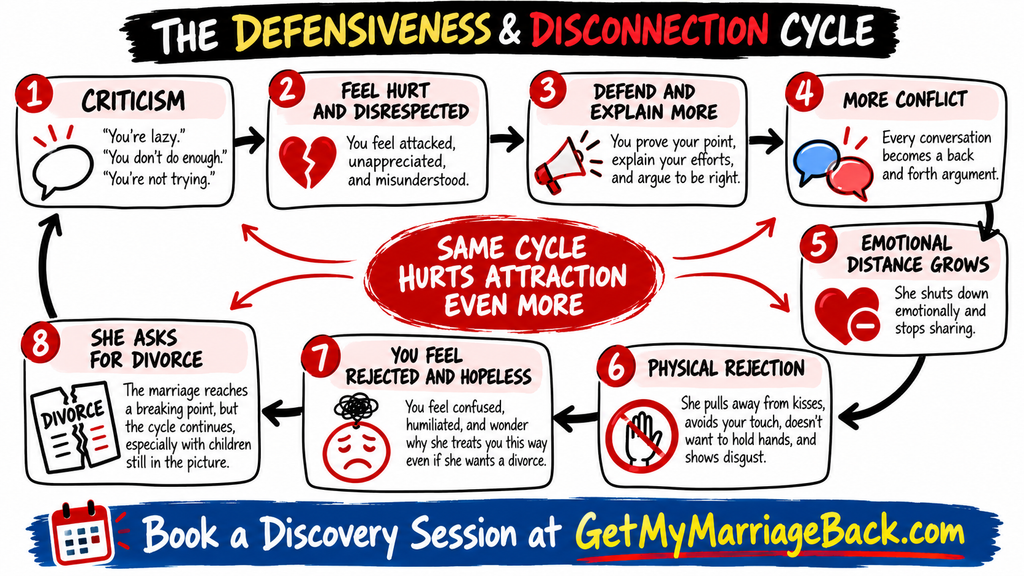
Mistake #1: Trying to Prove You’re Right
I worked with a gentleman whose wife had already asked for divorce.
They had three children, and their marriage had deteriorated to the point where she avoided kisses, refused to hold hands, and sometimes displayed visible disgust when he entered the room.
He couldn’t understand why she treated him so coldly.
Even if they eventually separated, he believed they should still be able to interact respectfully.
That concern was legitimate.
But another pattern became obvious as we worked through his situation.
He felt compelled to prove he was right about almost everything.
One recurring disagreement involved his employment.
He had worked as a consultant for years, but his income wasn’t consistently stable. His wife believed he wasn’t doing enough to secure dependable employment.
She accused him of being lazy.
He was actively looking for better opportunities, and her criticism felt deeply unfair.
So he defended himself.
He explained every application, every effort, every obstacle, and every reason she was misjudging him.
Yet the more he argued, the more emotionally exhausting their interactions became.
He was trying to demonstrate responsibility.
What she repeatedly experienced was another argument.
There’s a powerful distinction here.
Being right is not the same as being attractive.
Your wife doesn’t suddenly experience romantic desire because you’ve successfully defeated her argument.
You can be factually correct and still communicate in a way that intensifies conflict.
Mistake #2: Responding to Criticism With Defensiveness
When your wife criticizes your character, defending yourself feels natural.
She calls you lazy.
You explain why you’re hardworking.
She says you never do enough.
You produce evidence of everything you’ve done.
Before long, you’re both trapped in a repetitive argument.
Research from the Gottman Institute on destructive communication patterns identifies criticism, contempt, defensiveness, and stonewalling as particularly damaging patterns in distressed relationships.
Criticism attacks character rather than addressing a specific behavior.
Defensiveness attempts to protect the self from perceived accusations.
Contempt communicates disrespect or superiority.
Stonewalling involves withdrawing from an interaction.
These patterns can reinforce one another, creating an increasingly hostile emotional environment.
Importantly, refusing a kiss isn’t automatically stonewalling. Your wife has the right to decline physical affection.
The concern is the broader pattern of criticism, contempt, escalating arguments, and emotional disconnection.
What Defensiveness Does to Attraction
Defensiveness changes the emotional tone of an interaction.
Instead of communicating stability, you communicate that every criticism requires a counterargument.
Rather than demonstrating responsibility through consistent behavior, you demand immediate recognition.
Your intentions can be completely sincere while the experience becomes increasingly unpleasant.
Attraction involves more than appearance, income, or sexual technique.
The emotional experience of being around someone matters tremendously.
And constant conflict rarely creates an inviting romantic atmosphere.
Mistake #3: Confusing More Communication With Better Communication
Generic marriage advice frequently tells distressed spouses to communicate more.
Express your feelings.
Explain your intentions.
Make sure your wife understands.
But what happens when you’ve already explained yourself a hundred times?
Another explanation isn’t automatically progress.
When your wife has emotionally withdrawn, repeatedly demanding that she understand your perspective can feel like pressure.
Consider the gentleman whose wife criticized his employment situation.
He didn’t need to submit a verbal progress report every time she questioned his effort.
His stronger response was to continue taking meaningful action toward financial stability.
A calm reassurance could communicate his intentions without turning the conversation into a courtroom.
Then his consistent behavior would speak for itself.
The objective isn’t to become silent. It’s to stop making every disagreement a battle for validation.
You can communicate clearly without arguing endlessly.
You can disagree without becoming hostile.
And you can maintain your dignity without requiring your wife to declare you the winner.
Mistake #4: Trying to Restore Attraction Through Pressure
When your wife stops kissing you, the temptation is to pursue immediate reassurance.
You initiate more frequently.
You ask why she doesn’t touch you.
You remind her how long you’ve been married.
Sometimes you explain that withholding affection is unfair after everything you’ve sacrificed.
The pain behind those reactions is understandable.
But pressure is not seduction.
Romantic attraction requires space for voluntary interest.
Repeatedly seeking affection after clear rejection turns intimacy into another source of tension.
There’s also an important distinction between dignified pursuit and fear-driven chasing.
Pursuit expresses genuine interest while respecting the other person’s freedom.
Chasing attempts to eliminate your fear of rejection by obtaining an immediate response.
You don’t need to pretend you no longer desire your wife.
However, you must stop treating her physical response as a referendum on your worth.
A kiss freely given means something very different from a kiss obtained through pressure.
Mistake #5: Making Your Wife Responsible for Your Emotional Stability
This mistake is particularly dangerous during an active divorce threat.
Your wife withdraws, and your entire emotional state collapses.
She criticizes you, and you spend the evening proving yourself.
When she rejects affection, you immediately question your identity, attractiveness, and future.
Your emotional stability becomes dependent on her next reaction.
That dependence creates pressure even when you never intend to pressure her.
I understand this because my wife and I experienced a major marriage crisis ourselves.
We’ve celebrated 19 years of marriage, but almost ten years ago, our relationship nearly ended.
She asked for divorce during a period when physical attraction and emotional intimacy had seriously deteriorated.
The marriage we had before that crisis no longer exists in the same form.
We’re still married to each other, but rebuilding required a different approach.
One of the most important changes involved learning how to respond to rejection without allowing it to control my behavior.
That is the foundation of self-leadership.
How to Rebuild Attraction When Your Wife Isn’t Attracted to You
Here is what I want you to do.
Stop treating attraction as something you can demand, negotiate, or logically establish.
Begin changing what you can actually control.
Our framework starts with GPS: Grounding, Purpose, and Self-Discovery.
Grounding: Stop Letting Rejection Define You
When your wife pulls away, acknowledge what’s happening without allowing that moment to determine your identity.
Return to a source of truth beyond her immediate reaction.
Your values, responsibilities, gratitude, and personal integrity remain available regardless of whether she welcomes physical affection tonight.
Grounding doesn’t eliminate the pain.
It prevents the pain from controlling your next decision.
Purpose: Build a Life Bigger Than Her Approval
Your marriage matters.
Your family matters.
But your purpose must extend beyond obtaining your wife’s attention.
Redirect emotional energy toward meaningful responsibilities, personal growth, service, contribution, and the legacy you’re building.
When your wife criticizes your employment efforts, for example, keep pursuing meaningful professional progress.
Don’t turn every step into a campaign for recognition.
Become increasingly committed to the mission itself.
Self-Discovery: Examine Your Reactions Without Self-Blame
Pay attention to the moments when rejection triggers defensiveness.
Notice the urge to explain everything.
Recognize when you’re trying to force acknowledgment rather than demonstrate consistency.
This isn’t about blaming yourself for your wife’s choices.
It’s about discovering your capacity to respond with emotional intelligence instead of panic.
Attraction Is an Experience, Not an Argument
Here’s where the process becomes particularly important.
I teach a concept called experiential value.
Value in this context has very little to do with moral superiority, marrying the right person, or convincing your wife that you’re a good husband.
It’s about the experience you create through your presence, behavior, emotional intelligence, and interactions.
A person who constantly argues creates one kind of experience.
Someone who remains grounded, purposeful, warm, interesting, and emotionally steady creates another.
That distinction matters.
When your behavior changes consistently, your wife has the opportunity to experience you differently.
A different experience can create curiosity.
Curiosity can support attraction.
Attraction can open opportunities for influence and renewed connection.
None of that requires turning your wife into a project or manipulating her emotions.
Your responsibility is to become more intentional about the experience you contribute.
Use Emotional Intelligence Instead of Emotional Pressure
Another principle I teach is GAME:
Giving Authentically but Mindfully with Emotional intelligence.
Giving authentically means expressing genuine care without pretending.
Mindfulness means recognizing when your generosity is actually an attempt to obtain reassurance.
Emotional intelligence means understanding the circumstances before deciding how to respond.
For example, when your wife is visibly uncomfortable with physical affection, don’t intensify your attempts to kiss her.
Respect the boundary.
Remain composed.
Continue demonstrating warmth and responsibility through appropriate actions.
When criticism arises, address legitimate concerns without automatically turning the conversation into a defensive confrontation.
This is how you begin replacing destructive interactions with more constructive experiences.
Why Old Habits Return When Your Wife Rejects You
Understanding a strategy is different from executing it under pressure.
Research on habitual behavior by Wendy Wood and colleagues demonstrates how familiar environments and repeated cues can activate established behavioral patterns.
That helps explain why you can understand the dangers of defensiveness in the morning and still find yourself arguing with your wife that evening.
She makes another comment about your job.
Your body reacts.
You prepare your explanation.
Suddenly, you’re repeating the same argument.
This is why sustainable change requires more than collecting marriage advice.
You need practiced emotional-intelligence skills, a clear understanding of your particular circumstances, and a reliable way to interrupt destructive reactions.
Our broader implementation framework, GPS5, combines GPS with Story-Tailoring, Skill-Acquisition, Support, and System.
The objective is to turn understanding into consistent behavior.
Can Marriage Be Saved When Your Wife Has Lost Attraction?
A marriage crisis involving lost attraction, emotional withdrawal, and divorce threats requires serious attention.
But don’t confuse the current condition of your marriage with a complete description of everything that remains possible.
Your wife may be experiencing resentment, accumulated conflict, unresolved disappointment, or other reasons for withdrawing.
Those issues deserve to be taken seriously.
At the same time, you cannot personally manufacture her desire or decide whether she will remain married.
Your power lies in the experience you create, the choices you make, and the destructive patterns you stop repeating.
If you’ve been trying to save your marriage alone, begin by abandoning the belief that another argument will restore attraction.
Take responsibility for your behavior without accepting responsibility for every problem in the relationship.
Replace pressure with emotional steadiness.
Build meaningful value through consistent action.
And remember this distinction:
Winning an argument proves a point. Rebuilding attraction requires changing the experience.
That’s where your work begins.
19 Signs Your Wife Is Not Sexually Attracted To You
Frequently Asked Questions
Repeated avoidance of kissing, touching, sexual intimacy, and affectionate interaction can indicate declining attraction, especially when accompanied by emotional withdrawal. These behaviors can also reflect stress, resentment, health concerns, or unresolved conflict, so don’t assume a single explanation.
Yes, sexual attraction can change as emotional experiences, circumstances, and relationship dynamics change. Focus on rebuilding your own emotional stability, personal growth, and the quality of your interactions rather than pressuring her to desire you.
She may be experiencing emotional disconnection, resentment, discomfort, reduced attraction, or another concern affecting physical intimacy. Respect her withdrawal and examine the broader relationship dynamics instead of demanding an immediate explanation or affection.
Start by stopping fear-driven reactions such as begging, repeated arguments, defensiveness, and pressure for intimacy. Strengthen your self-leadership, address your responsibilities, and develop the emotional-intelligence skills necessary to respond constructively during the crisis.