

Your wife looks you straight in the face and says, “I don’t want to reconcile,” and suddenly everything you’ve sacrificed for your marriage feels like it’s slipping away.
Take This 2 Minutes Quiz
You ask her to reconsider.
She says no.
You remind her about the children, your history, the good times, and everything you’ve built together.
Her answer doesn’t change.
Now you’re watching the woman you married reject the very relationship you’re desperately trying to save.
Perhaps she’s moved into another bedroom. Her phone stays locked, physical affection has disappeared, and every attempt to discuss the marriage ends with another refusal.
You want your family. You want your wife. Most importantly, you want the romantic connection that made this relationship worth building in the first place.
And it’s unfair when you’ve invested years of loyalty, sacrifice, and commitment only to discover that she no longer wants what you want.
Here’s what I want you to understand: You don’t need your wife to want reconciliation before you begin becoming someone she can genuinely want to reconnect with.
That doesn’t cancel her freedom to say no.
Reconciliation requires her voluntary participation. Your personal development doesn’t.
This is where you regain your personal power.
What to Do When Your Wife Doesn’t Want to Reconcile
When your wife refuses reconciliation, the worst response is to make her agreement the starting point for everything you do.
You keep asking for another conversation.
Every refusal triggers another explanation.
Eventually, you’re trying to persuade someone who has already told you she doesn’t want to be persuaded.
Instead, I want you to make four moves:
- Stop asking her to want what you want. Recognize how reconciliation pressure affects your interactions.
- Identify the value you’re pursuing. Understand why you want your wife rather than simply fearing divorce.
- Differentiate rejection from the reasons behind it. Identify what her refusal actually reveals about your marriage.
- Become attractive without performing for approval. Develop genuine experiential value instead of demanding recognition for your improvements.
These four moves address the most important problem: how to pursue a marriage you value without turning your wife into someone you must convince, manage, or control.

Move 1: Stop Asking Her to Want What You Want
Your wife says she’s done discussing reconciliation.
You explain why divorce would be a terrible mistake.
She repeats that she doesn’t want to work on the marriage.
Now you remind her about your wedding vows, your children, and the sacrifices you’ve made.
The more she refuses, the more intensely you explain.
Eventually, your attempts to save the marriage become another source of emotional pressure.
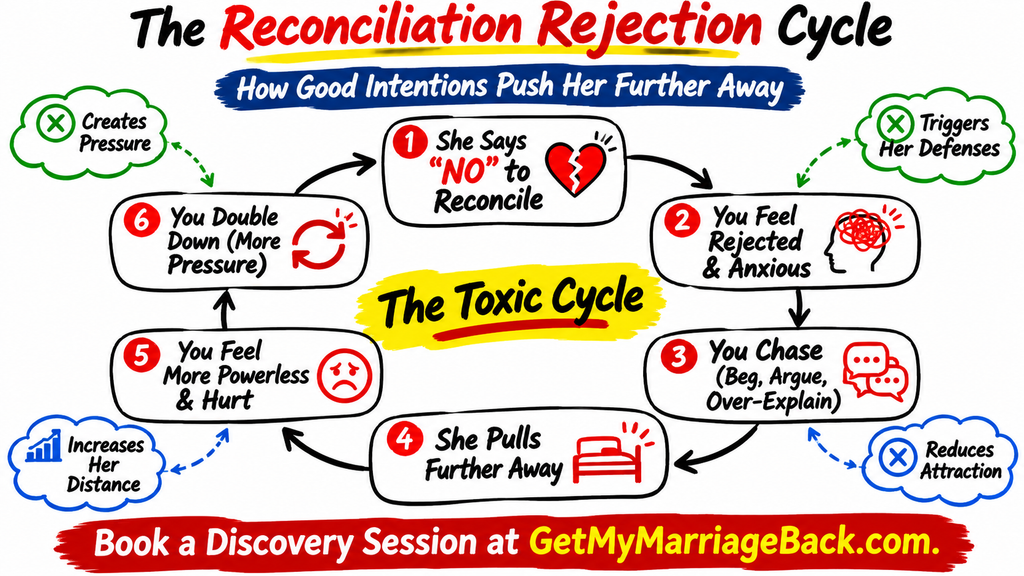
Why Begging for Reconciliation Pushes Her Further Away
Imagine your wife is already emotionally exhausted.
She’s experienced months of arguments, disappointments, or conversations that never seem to resolve anything.
Now she tells you she needs space.
Instead of respecting that request, you send another lengthy message about everything you’re willing to change.
Your intentions are sincere.
But the experience you’re creating is demanding.
She doesn’t experience your message as romantic pursuit. She experiences another request for emotional engagement when she’s explicitly asked for distance.
This pattern resembles what relationship researchers call demand-withdraw communication.
One spouse pressures for discussion or change while the other withdraws.
A study involving 116 couples found that these patterns were associated with more negative emotions and poorer conflict resolution during marital interactions.
Other longitudinal research has connected demand-withdraw communication with relationship dissatisfaction, although the meaning of withdrawal depends on the couple’s circumstances.
The lesson is straightforward.
Increasing pressure doesn’t automatically increase someone’s willingness to reconnect.
Sometimes it strengthens the very resistance you’re trying to overcome.
The Problem With “It Takes Two to Tango”
You’ve probably heard that saving a marriage takes two people.
That statement describes an important reality about mutual participation.
But it becomes useless advice when you interpret it as a reason to surrender your personal development.
Your wife doesn’t have to agree to reconciliation before you become emotionally stronger.
She doesn’t need to approve your decision to develop confidence.
You can improve your communication, emotional intelligence, personal direction, and capacity for romantic connection without waiting for her permission.
Her participation determines whether reconciliation becomes mutual. It doesn’t determine whether you become more attractive, engaging, and emotionally mature.
That’s where you begin.
What You Need to Know About Your Current Behavior
Pay attention to what happens after your wife refuses another conversation.
Do you immediately explain why she’s wrong?
Does your anxiety increase until you send another message?
Are you asking questions because you genuinely need information, or because you’re desperate for reassurance?
When she doesn’t respond, do you interpret the silence as a reason to pursue harder?
Your answers reveal whether you’re expressing dignified romantic interest or trying to escape the discomfort of rejection.
Pursuit is driven by genuine interest in someone you value.
Chasing is driven by fear and the urgent need for emotional relief.
Those experiences create very different interactions.
Move 2: Identify the Value You’re Pursuing
You want to reconcile with your wife.
Good.
Now I want you to answer a more important question.
Why do you want her?
Not why divorce would be embarrassing.
Forget the fear of losing your house or explaining the separation to your relatives for a moment.
What do you genuinely appreciate about the woman you married?
Is it her intelligence?
Her humor?
The way she challenges you?
The emotional and physical connection you once shared?
Perhaps you admire her ambition, creativity, warmth, or the life you wanted to continue building together.
Those are reasons grounded in value.
You’re interested in your wife because you recognize something desirable about her.
That matters.
You don’t need to moralize your desire for reconciliation or apologize for wanting the relationship.
But you do need to differentiate genuine romantic interest from the fear of losing something familiar.
Fear of Divorce Is Not the Same as Desire for Your Wife
A marriage crisis can create enormous emotional pressure.
You face uncertainty about your family, finances, home, children, and future.
Naturally, you want the crisis to end.
But ending your discomfort and rebuilding romantic attraction are not identical goals.
If your entire approach is designed to stop the pain of rejection, your wife becomes responsible for regulating your emotions.
Every interaction starts revolving around your need for relief.
You ask whether she misses you.
Another conversation becomes a request for reassurance.
Even your improvements become attempts to obtain her approval.
Romantic pursuit becomes more compelling when it grows from appreciation rather than desperation.
You recognize her value while retaining your own identity, dignity, and direction.
Why Being a Good Husband Doesn’t Automatically Create Attraction
Here’s a painful reality.
You can be loyal, financially responsible, dependable, and committed while your wife experiences declining romantic attraction.
Those qualities matter enormously.
They establish a foundation of integrity and responsibility.
But you cannot submit a marriage résumé and demand chemistry in return.
Romantic desire is also connected to the experience of interacting with someone.
Does your presence feel warm and engaging?
Are conversations interesting, or do they revolve around complaints and reassurance?
Does your attention feel inviting, or does it carry an expectation that she must respond?
Researchers Gurit Birnbaum and colleagues examined this connection across three studies of romantic responsiveness and desire.
Their research on partner responsiveness and sexual desire found that responsiveness was associated with greater desire, with a stronger association among women in the studies.
The findings also highlighted the importance of feeling valued and special within romantic interactions.
That’s a useful reminder.
Being responsible is important.
Being experientially attractive involves how someone feels while interacting with you.
You need both character and the interpersonal skills that sustain connection.
Move 3: Differentiate Rejection From the Reasons Behind It
Let me tell you a story.
Imagine your wife says, “I don’t want to work on this marriage anymore.”
You immediately send a six-paragraph message explaining everything you’re willing to change.
She replies with two words.
“Please stop.”
You conclude that she never loved you.
Now you’re replaying your entire marriage, questioning whether every affectionate moment was an act.
But what actually happened?
Your wife refused reconciliation and asked you to stop pressing the issue.
That’s observable.
The conclusion that she never loved you is your interpretation.
Those are different pieces of information.
Her refusal deserves respect.
Your interpretation deserves closer attention.
Four Reasons Your Wife Refuses Reconciliation
The same statement can emerge from different relationship circumstances.
Understanding those circumstances changes how you interpret her behavior.
Emotional Exhaustion
Your wife has spent months explaining what hurts.
Every conversation becomes another argument.
She stops participating because discussing the marriage has become emotionally draining.
What you need to know: Did she repeatedly communicate the same concerns before withdrawing?
If the answer is yes, her refusal has a history.
Unresolved Resentment
A particular betrayal, broken promise, or repeated disappointment continues affecting how she experiences you.
Your apologies no longer produce the reaction they once did.
She associates reconciliation conversations with promises that previously failed to become consistent behavior.
What you need to know: Is there a specific experience she repeatedly identifies as unresolved?
That history matters more than how convincingly you explain your intentions.
Attraction Loss
Your wife remains polite during ordinary conversations.
She discusses practical responsibilities without hostility.
But romantic affection has disappeared.
Physical closeness feels uncomfortable, and she shows little interest in rebuilding intimacy.
What you need to know: Has the emotional connection deteriorated primarily in romantic and intimate interactions, or has she withdrawn from every area of the relationship?
A loss of attraction calls for a different understanding from an unresolved logistical disagreement.
A Settled Decision to Leave
Your wife has consistently communicated that she wants divorce.
Her decisions, boundaries, and future planning reflect that position.
She no longer participates in conversations about rebuilding the marriage.
What you need to know: Has she clearly and repeatedly communicated a final decision, and are her actions consistent with that decision?
Take her words seriously.
Don’t reinterpret a firm refusal as a hidden invitation to pursue harder.
How to Identify What Her Rejection Means in Your Marriage
Start with the timeline.
When did your wife first refuse reconciliation?
What happened immediately before that decision?
Was there a major argument, an extended separation, a betrayal of trust, or a gradual decline in affection?
Next, identify the pattern.
Does she avoid every interaction?
Perhaps she remains friendly but rejects romantic conversations.
Alternatively, she may withdraw specifically when you pressure her to reconsider divorce.
These circumstances tell different stories.
Then consider what has changed.
Was she previously angry and emotionally engaged?
Did the complaints become less frequent before the silence began?
Has she moved from emotional exhaustion into consistent indifference?
Finally, identify what remains unclear.
You don’t need to invent an explanation simply because uncertainty hurts.
Your marriage history is more informative than one rejection, one unanswered message, or one cold evening.
Move 4: Become Attractive Without Performing for Approval
You start exercising again.
Your appearance improves.
You return to meaningful work and reconnect with activities you’ve neglected.
Those are positive changes.
Then you announce every improvement to your wife.
You explain how much you’ve grown.
Every conversation includes another reminder that you’re becoming a better person.
Finally, you ask whether she’s noticed.
Suddenly, your personal development has become another demand for validation.
That’s performance.
It isn’t confidence.
Confidence Is Always Sexy
Confidence doesn’t mean pretending you don’t care about your marriage.
You can love your wife deeply and still respect her boundaries.
Rejection hurts.
The uncertainty of separation creates real emotional pressure.
But confidence means your behavior isn’t controlled by the latest emotional reaction you receive.
You develop a life you genuinely value.
Your attention becomes more intentional.
Conversations stop revolving around your need to prove yourself.
You become capable of experiencing disappointment without immediately converting it into an argument.
Confidence is always sexy because emotional composure makes your presence less demanding and more engaging.
The goal isn’t to perform indifference.
It’s to develop genuine personal capacity.
Stop Advertising Every Improvement
Your wife doesn’t need a weekly report about your emotional growth.
She doesn’t need another speech about how much you’ve changed.
And she doesn’t owe you attraction because you’ve started exercising or reading relationship books.
Instead, let your conduct communicate what you’re developing.
Become more emotionally steady.
Take responsibility without collapsing into self-blame.
Build a meaningful life beyond the marriage crisis.
Respect the boundaries she communicates.
When interactions occur naturally, focus on creating a better emotional experience rather than obtaining an immediate romantic result.
Your wife remains free to notice, respond, or maintain her decision.
Attraction is something you nurture through genuine experiential value, not something you demand as payment for self-improvement.
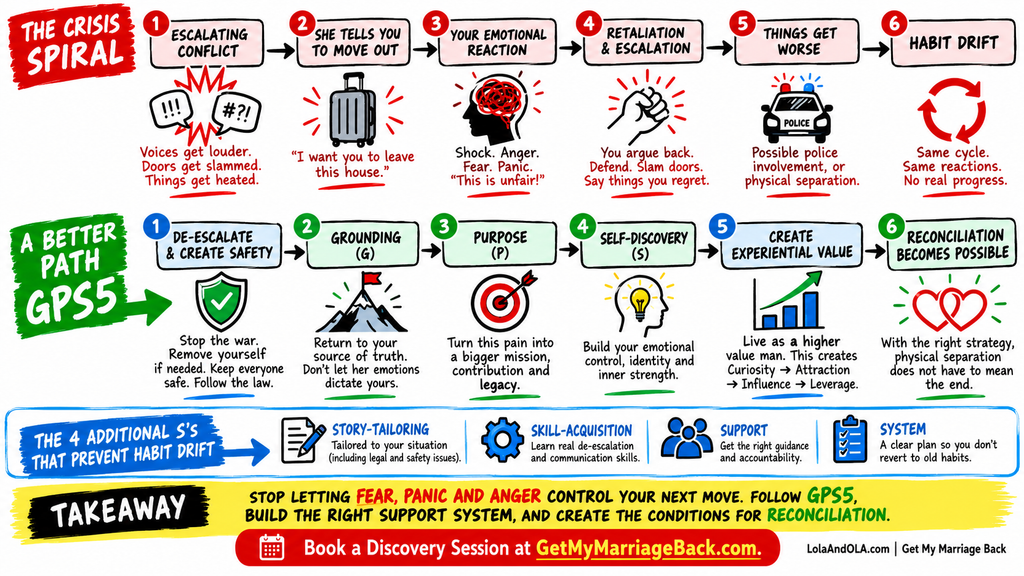
GPS5: How to Rebuild Personal Power When Your Wife Wants Out
I teach a self-leadership roadmap called GPS5.
The progression begins with Grounding, Purpose, and Self.
Those foundations support experiential Value, which creates room for Curiosity, Attraction, and eventually Influence.
This framework focuses on what you can develop rather than what you can force your wife to feel.
Grounding: Stop Letting Rejection Control Your Attention
Your wife says she doesn’t want reconciliation.
The rejection is real.
But your mind immediately adds frightening conclusions.
You decide she never loved you.
Every unanswered message becomes proof that the marriage is finished.
Grounding redirects your attention toward your higher self, your source of truth, and gratitude.
You’re not denying the crisis.
Instead, you’re learning to acknowledge the facts without surrendering control to every emotional interpretation.
Purpose: Build a Mission Greater Than the Marriage Crisis
Your marriage matters.
Your wife matters.
But your entire identity cannot depend on whether she wants reconciliation today.
Purpose redirects the pain you’re experiencing toward your calling, contribution, desired impact, and legacy.
You need something meaningful to build beyond the immediate relationship crisis.
That direction changes how you carry yourself.
Your days stop revolving entirely around waiting for her response.
Self: Develop Emotional Capacity Without Self-Blame
Self is the foundation of sustainable love and life.
You develop the capacity to handle rejection, uncertainty, disappointment, and emotional discomfort.
Personal responsibility becomes more important than proving who caused the marriage crisis.
Accountability doesn’t require accepting blame for everything.
You identify the behaviors you can change and take ownership of your development.
That’s how personal power becomes sustainable.
Value: Become More Engaging to Experience
Experiential value goes beyond moral character.
You can possess integrity while lacking the emotional skills that make romantic interactions enjoyable.
Value involves how you communicate, respond, carry yourself, and engage with the world.
Your presence becomes calmer.
Conversations become less demanding.
Confidence replaces constant reassurance-seeking.
You develop substance that exists independently of your wife’s approval.
Curiosity and Attraction: Give Her Room to Notice
When your conduct changes consistently, the emotional experience surrounding you changes.
Your wife no longer encounters the same anxious reactions during every interaction.
You stop narrating your progress.
Meaningful growth becomes something she can observe rather than something you’re demanding she acknowledge.
That creates room for natural curiosity.
Romantic attraction requires freedom.
You want your wife to become interested because she genuinely experiences something different, not because you’ve pressured her into offering reassurance.
Influence: Let Genuine Value Create Leverage
Influence isn’t control.
You cannot command your wife to reconcile.
But your emotional maturity, confidence, and interpersonal skills influence the quality of the interactions in which you participate.
When you develop genuine experiential value, you create a different basis for connection.
The roadmap is straightforward:
Symptom → GPS5 → Value → Curiosity and Attraction → Influence
Your wife’s decisions remain hers.
Your responsibility is to become more capable, attractive, and emotionally intelligent while respecting those decisions.
Why You Keep Begging Even After Deciding to Stop
You understand the problem intellectually.
Begging creates pressure.
Long emotional messages don’t manufacture desire.
Yet another cold interaction triggers the same behavior.
You pick up your phone.
Your mind starts composing another explanation.
Before long, you’re repeating the reaction you promised yourself you’d stop.
This is how habitual behavior operates.
Research on everyday habits has estimated that a substantial share of daily actions occurs in repeated contexts with limited conscious deliberation.
Your familiar emotional triggers can activate familiar reactions.
That’s why insight alone doesn’t always change behavior.
You need three practical foundations:
- Skills: The emotional and interpersonal abilities required to respond differently.
- Support: Guidance that helps you identify patterns you struggle to recognize alone.
- System: A consistent structure for practicing better responses until they become more natural.
Without these foundations, a moment of rejection can pull you back into the same reconciliation-pressure cycle.
What to Do Tonight When Your Wife Gives You the Cold Shoulder
Tonight, your wife walks past you without acknowledging your presence.
Your chest tightens.
You want to follow her and ask whether she’s reconsidered.
Don’t.
Put your phone down.
Relax your shoulders.
Continue one meaningful activity that doesn’t involve obtaining her attention.
Avoid another lengthy message.
Don’t turn her silence into an interrogation.
You’re not pretending the marriage crisis doesn’t exist.
You’re refusing to let your fear dictate the next interaction.
Removing pressure stops the bleeding. It doesn’t repair the deeper emotional fracture or automatically rebuild attraction.
That work requires consistency, emotional intelligence, and a clearer understanding of your specific marriage history.
You can want reconciliation without begging.
It’s possible to recognize your wife’s value without abandoning your own.
You can respect her refusal while continuing to develop the qualities that make romantic connection meaningful.
And you don’t need her permission to begin.
Average Length of Separation Before Reconciliation: Data Reveals!
Frequently Asked Questions
Stop pressuring her to reconsider, respect the boundaries she communicates, and identify the relationship patterns that preceded her refusal. Focus on emotional self-leadership, personal development, and becoming more engaging rather than repeatedly asking for reassurance.
One person can begin changing their behavior, emotional capacity, and contribution to the relationship without waiting for the other’s agreement. Reconciliation itself requires the other spouse to participate voluntarily.
Start by understanding whether her refusal reflects emotional exhaustion, unresolved resentment, attraction loss, or a settled decision to leave. Develop genuine experiential value, respect her boundaries, and allow any renewed interest to emerge without pressure.
A consistently communicated decision to divorce, sustained emotional disengagement, and future plans that exclude reconciliation are serious indicators of her present intentions. Take her stated decision seriously rather than trying to predict her future feelings from isolated interactions.